
Study Guides
Pearson Edexcel International A Level Business (YBS11): Managing Finance
Study guide to Edexcel IAL Business 2.3.3 Managing finance: profit and margins, profit versus cash, liquidity ratios, working capital and business failure.
- Subject
- Business
- Level
- AS LEVEL
- Topic
- Managing business activities
- Author
- Marlbridge Academic Team
- Updated
- Reviewed by
- Salman Ahmad (what this means)
Aligned to Pearson Edexcel A Level Business (WBS12/01), Issue 1, September 2017. Official specification .
Syllabus page (what it covers and how it is assessed): Pearson Edexcel A Level Business.
Found an error? Report a correction.
Need help with this topic? Request a free trial class for A Level Business (YBS11).
This guide covers section 2.3.3 Managing finance in Unit 2 (Managing business activities) of the Pearson Edexcel International Advanced Subsidiary/Advanced Level in Business, Issue 1. Where financial planning looks ahead, managing finance looks at results: how profitable the business is, whether it can pay its short-term debts, and why some businesses fail. All businesses and figures are invented.
For the unit as a whole, see the Managing Business Activities study guide. Condensed notes are in the Managing Finance revision notes and questions in the Managing Finance practice questions.
What the specification lists
- Profit: calculating gross profit, operating profit and profit for the year (net profit); ways to increase profits; the statement of comprehensive income, with gross, operating and net profit margins; ways to improve profitability.
- Liquidity: the distinction between profit and cash; the statement of financial position, with the current ratio and acid test ratio; ways to improve liquidity, including assets, supplier credit terms, factoring and inventory JIT; working capital and its management, and the importance of cash.
- Business failure: internal causes (poor management of cash flow, overestimation of sales, overtrading, poor inventory control, poor marketing, poor quality) and external causes (market conditions, competition, economic factors, exchange rates, interest rates, government regulations, supplier problems, natural phenomena).
Three levels of profit
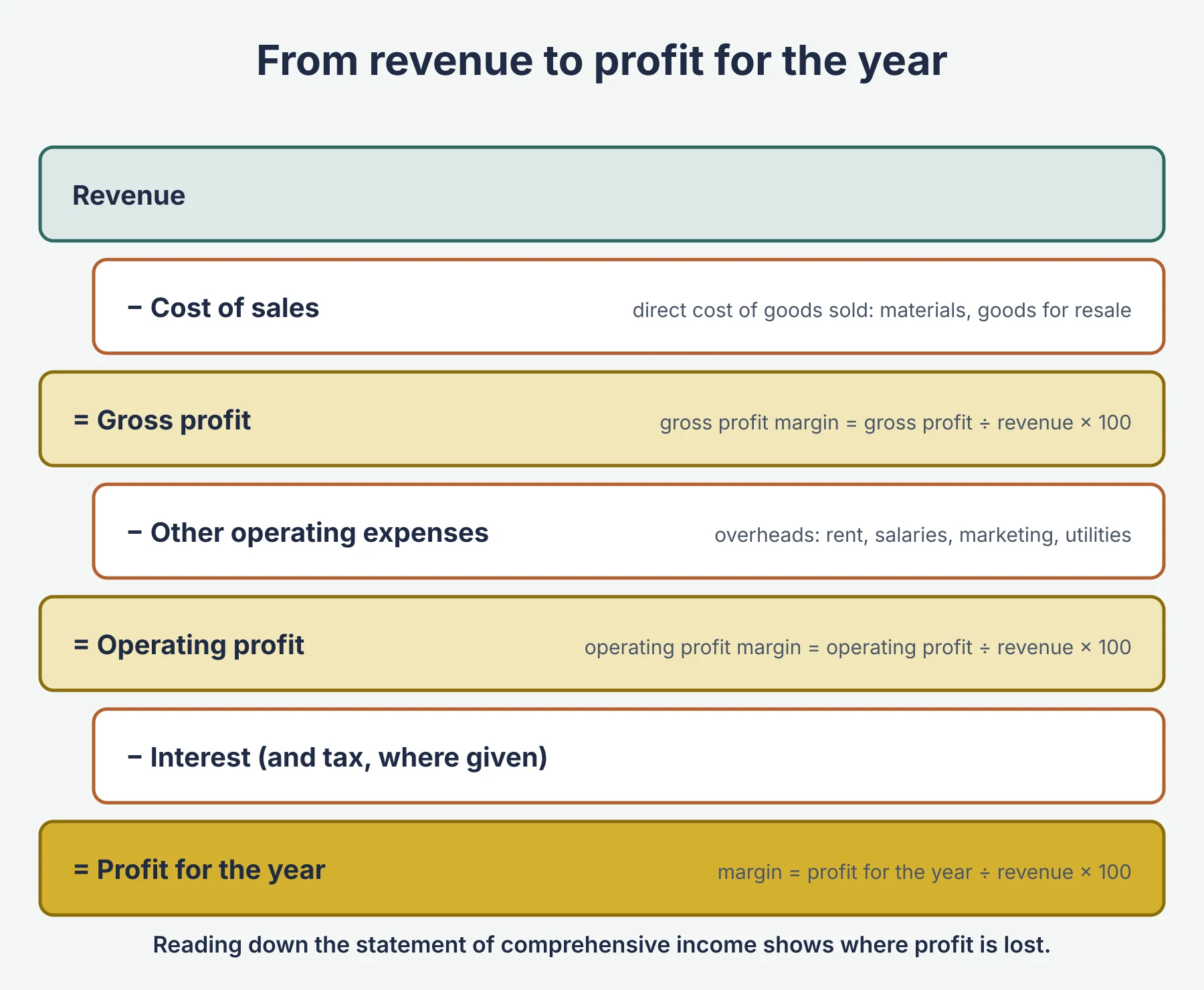
Gross profit         = revenue - cost of sales
Operating profit     = gross profit - other operating expenses
Profit for the year  = operating profit - interest (and tax, where given)

Gross profit margin      = gross profit / revenue x 100
Operating profit margin  = operating profit / revenue x 100
Profit for the year margin = profit for the year / revenue x 100
Cost of sales is the direct cost of the goods sold, such as materials or goods bought for resale. Other operating expenses are overheads: rent, salaries, marketing, utilities. The statement of comprehensive income sets these out in order, so reading down it shows where profit is lost.
Worked example 1: comparing two years
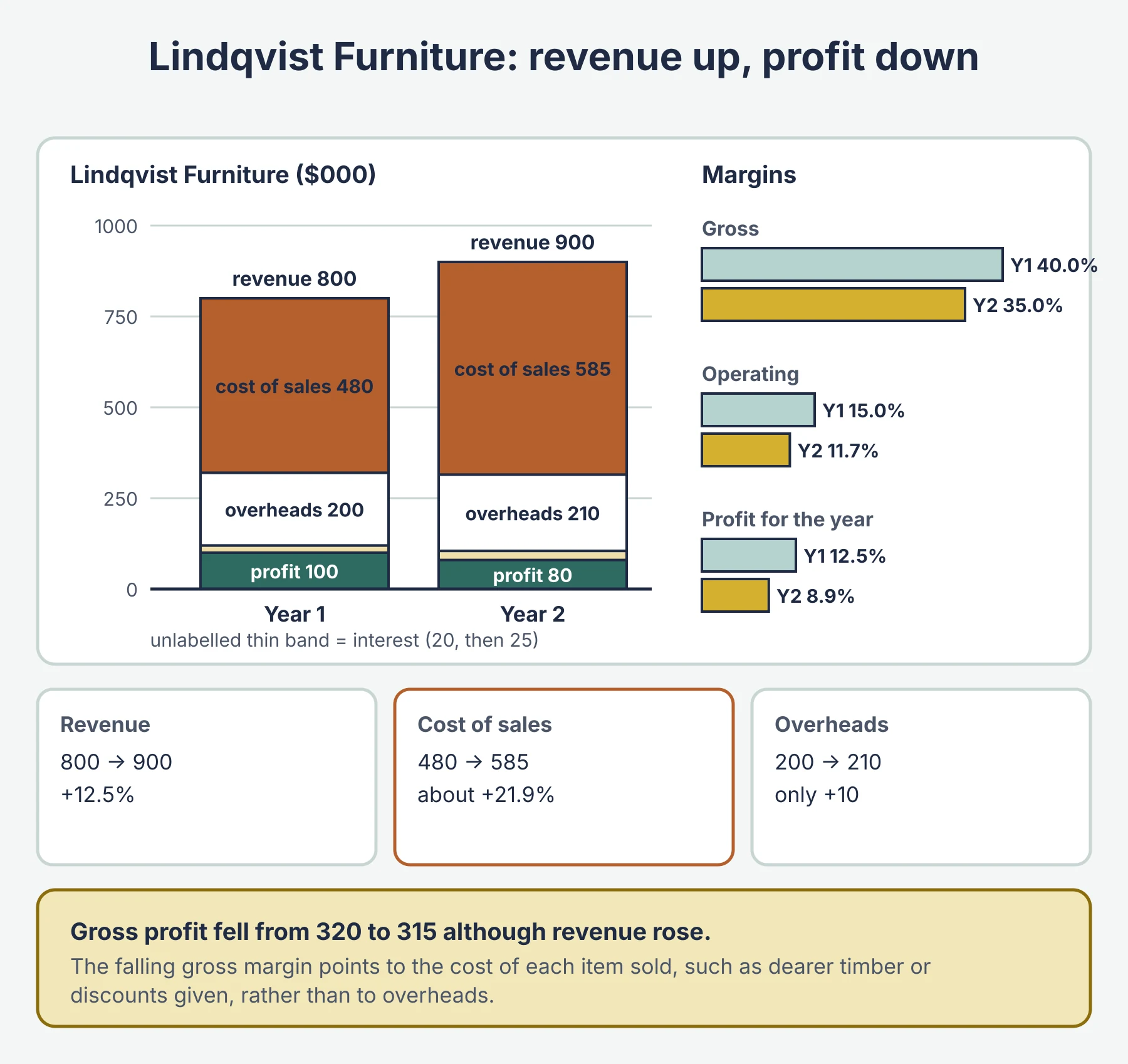
Lindqvist Furniture’s results (in $000):
| Year 1 | Year 2 | |
|---|---|---|
| Revenue | 800 | 900 |
| Cost of sales | 480 | 585 |
| Gross profit | 320 | 315 |
| Other operating expenses | 200 | 210 |
| Operating profit | 120 | 105 |
| Interest | 20 | 25 |
| Profit for the year | 100 | 80 |
| Gross profit margin | 40.0% | 35.0% |
| Operating profit margin | 15.0% | 11.7% |
| Profit for the year margin | 12.5% | 8.9% |
Revenue grew by 12.5%, but cost of sales grew by about 21.9%, so gross profit actually fell. The main problem is in the cost of each item sold, perhaps dearer timber or discounts given to win sales, rather than overheads, which rose only $10,000. The fall in the gross margin points the owner to the right place to look.
Increasing profit and profitability
Ways to increase profit: raise prices (if demand is price inelastic), raise sales volume, cut cost of sales (cheaper suppliers, less waste, bulk buying) or cut overheads (cheaper premises, more efficient staffing). Improving profitability means raising profit as a percentage of revenue, which needs either a higher price relative to direct cost or lower overheads relative to sales. Each method has a risk: cheaper materials may lower quality, price rises may lose customers, and staff cuts may hurt service.
Profit is not cash
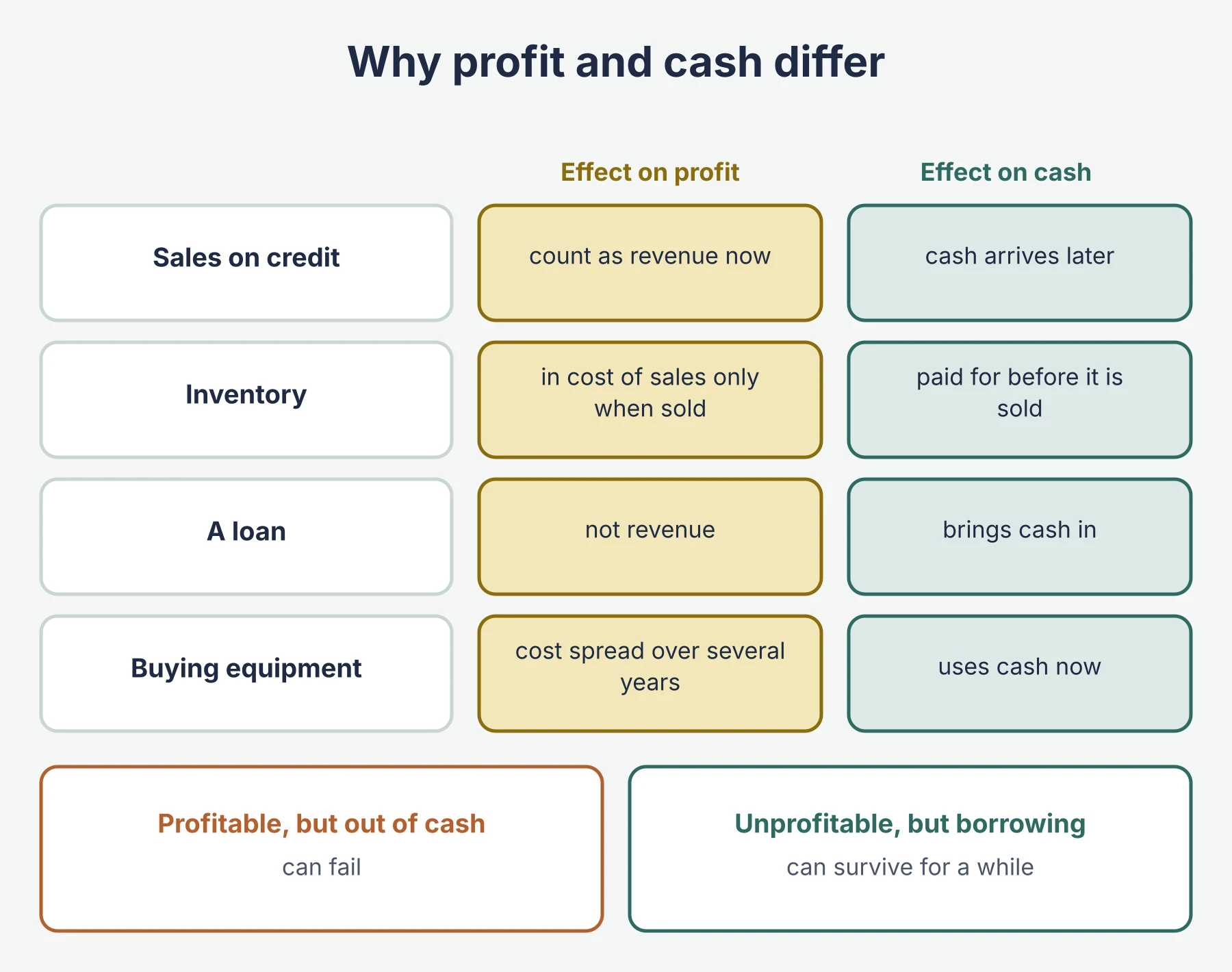
Profit compares revenue with costs over a period; cash is the money actually in the bank. They differ because sales on credit count as revenue before cash arrives; inventory is paid for before it is sold; loans bring in cash but are not revenue; and buying equipment uses cash but spreads its cost over several years. A profitable business can run out of cash and fail, while an unprofitable one can survive for a while on borrowed cash.
The statement of financial position and liquidity
The statement of financial position shows what a business owns and owes at one date. Current assets are inventory, trade receivables and cash; current liabilities are debts due within a year, such as trade payables and an overdraft.
Current ratio   = current assets / current liabilities
Acid test ratio = (current assets - inventory) / current liabilities
Working capital = current assets - current liabilities
The acid test is the stricter measure, because inventory may take time to sell. As a rough guide, a current ratio around 1.5 to 2 and an acid test around 1 are often seen as comfortable, but what is normal depends on the industry: a supermarket sells inventory for cash daily and can operate with lower ratios than a furniture maker.
Worked example 2: improving liquidity
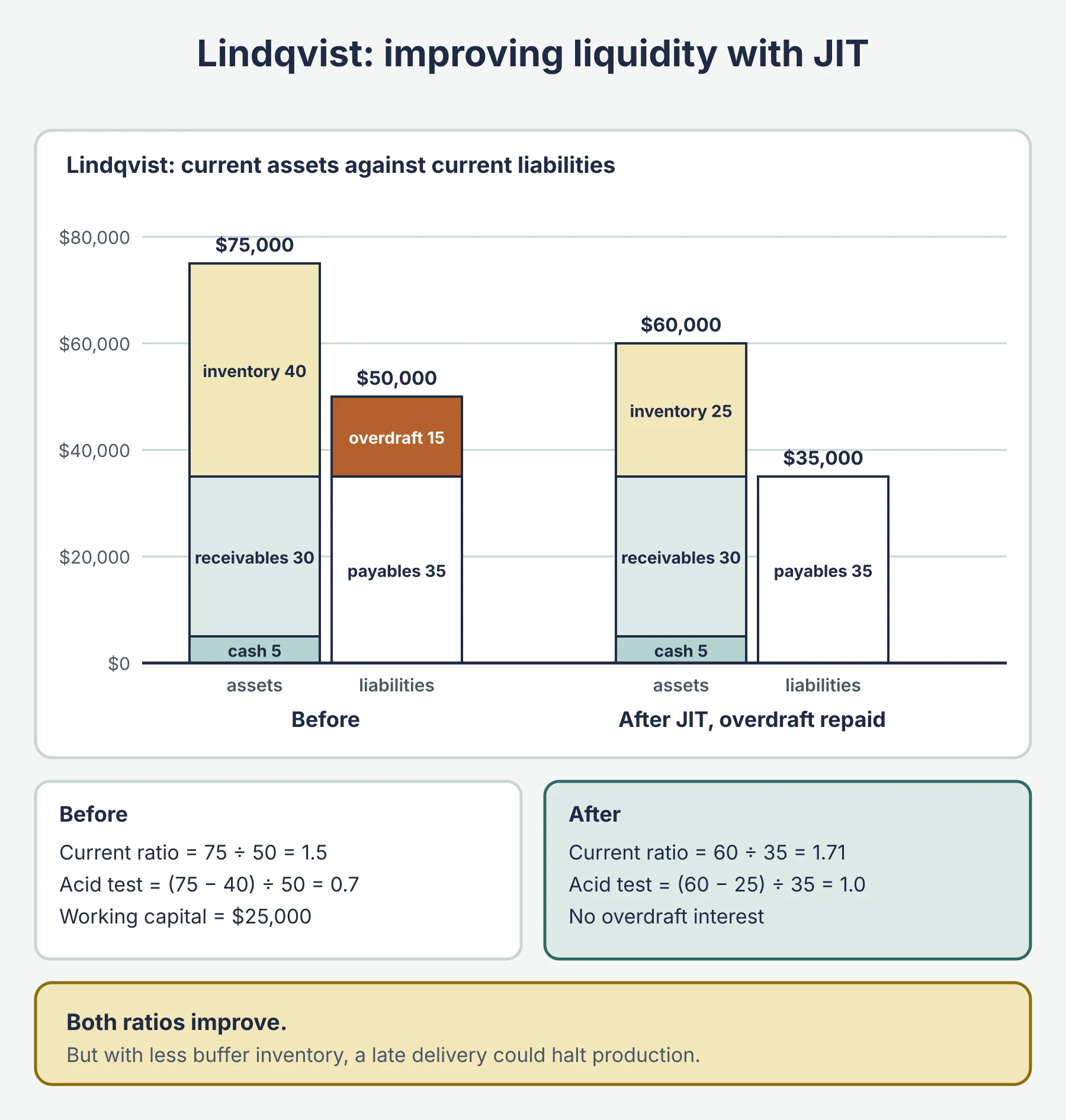
Lindqvist’s current position: inventory $40,000, trade receivables $30,000, cash $5,000; trade payables $35,000, overdraft $15,000.
Current assets = 40 + 30 + 5 = $75,000;  current liabilities = 35 + 15 = $50,000
Current ratio  = 75 / 50 = 1.5
Acid test      = (75 - 40) / 50 = 0.7
Lindqvist moves to just-in-time ordering, cutting inventory by $15,000, and uses the cash released to repay the overdraft.
Current assets = 25 + 30 + 5 = $60,000;  current liabilities = $35,000
Current ratio  = 60 / 35 = 1.71
Acid test      = (60 - 25) / 35 = 1.0
Both ratios improve, and the overdraft interest disappears. The risk is that with less buffer inventory a late delivery could halt production.
Other ways to improve liquidity named in the specification:
- Assets: selling unused non-current assets, such as an old van, raises cash.
- Supplier credit terms: negotiating 60 days rather than 30 to pay keeps cash in the business longer, though it may strain supplier relationships.
- Factoring: a factoring company pays most of an invoice’s value straight away and collects the debt, charging a fee.
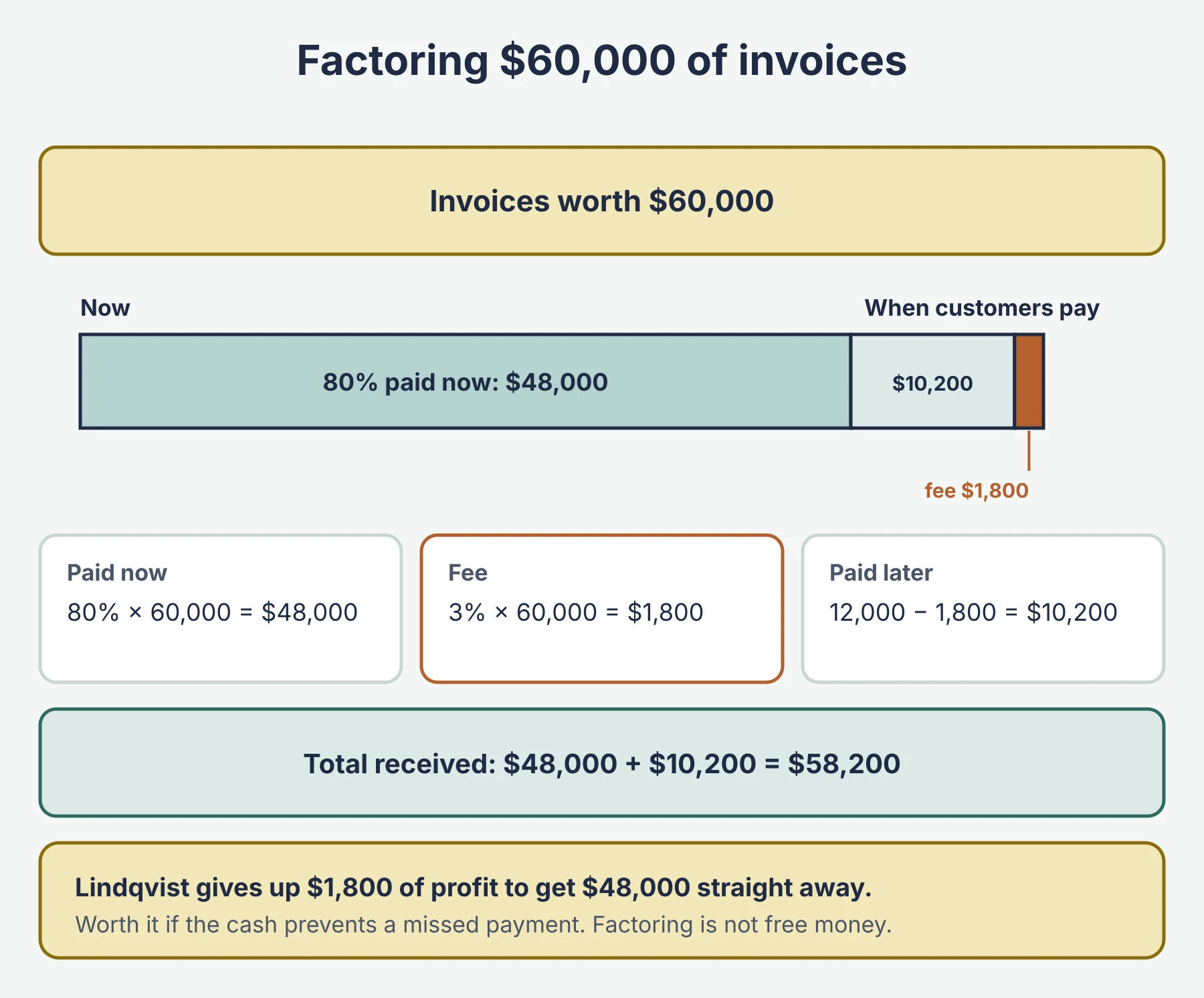
Worked example 3: factoring. Lindqvist has invoices worth $60,000. A factor pays 80% now and the balance when customers pay, less a fee of 3% of invoice value.
Paid now                    = 80% x 60,000 = $48,000
Fee                         = 3% x 60,000  = $1,800
Paid later                  = 12,000 - 1,800 = $10,200
Total received              = $58,200
Lindqvist gives up $1,800 of profit to receive $48,000 immediately. That trade is worth making if the cash prevents a missed payment.
Working capital: the importance of cash
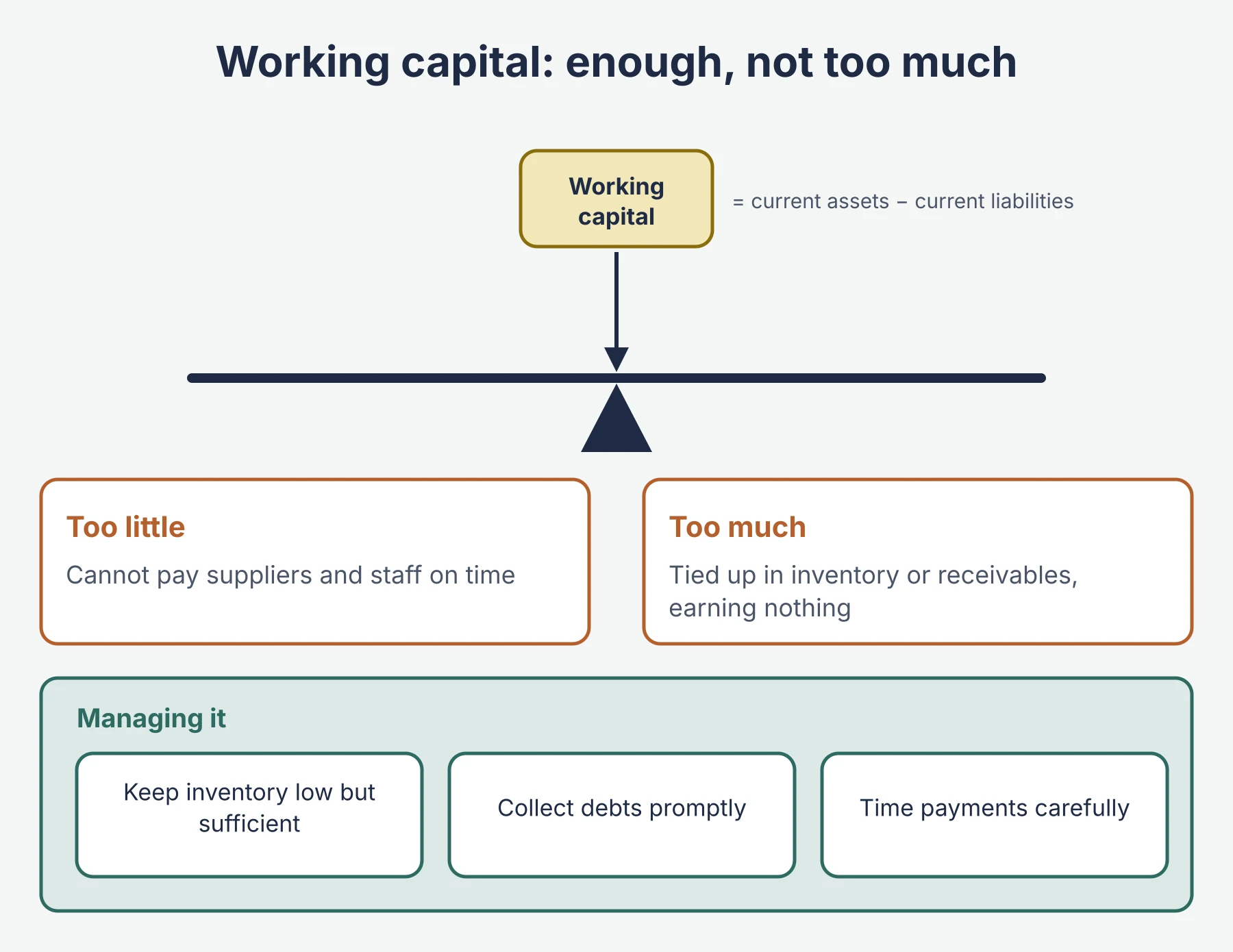
Working capital is the finance available for day-to-day operations. Too little, and the business cannot pay suppliers and staff on time; too much tied up in inventory or receivables earns nothing. Managing it means keeping inventory low but sufficient, collecting debts promptly and timing payments carefully.
Why businesses fail
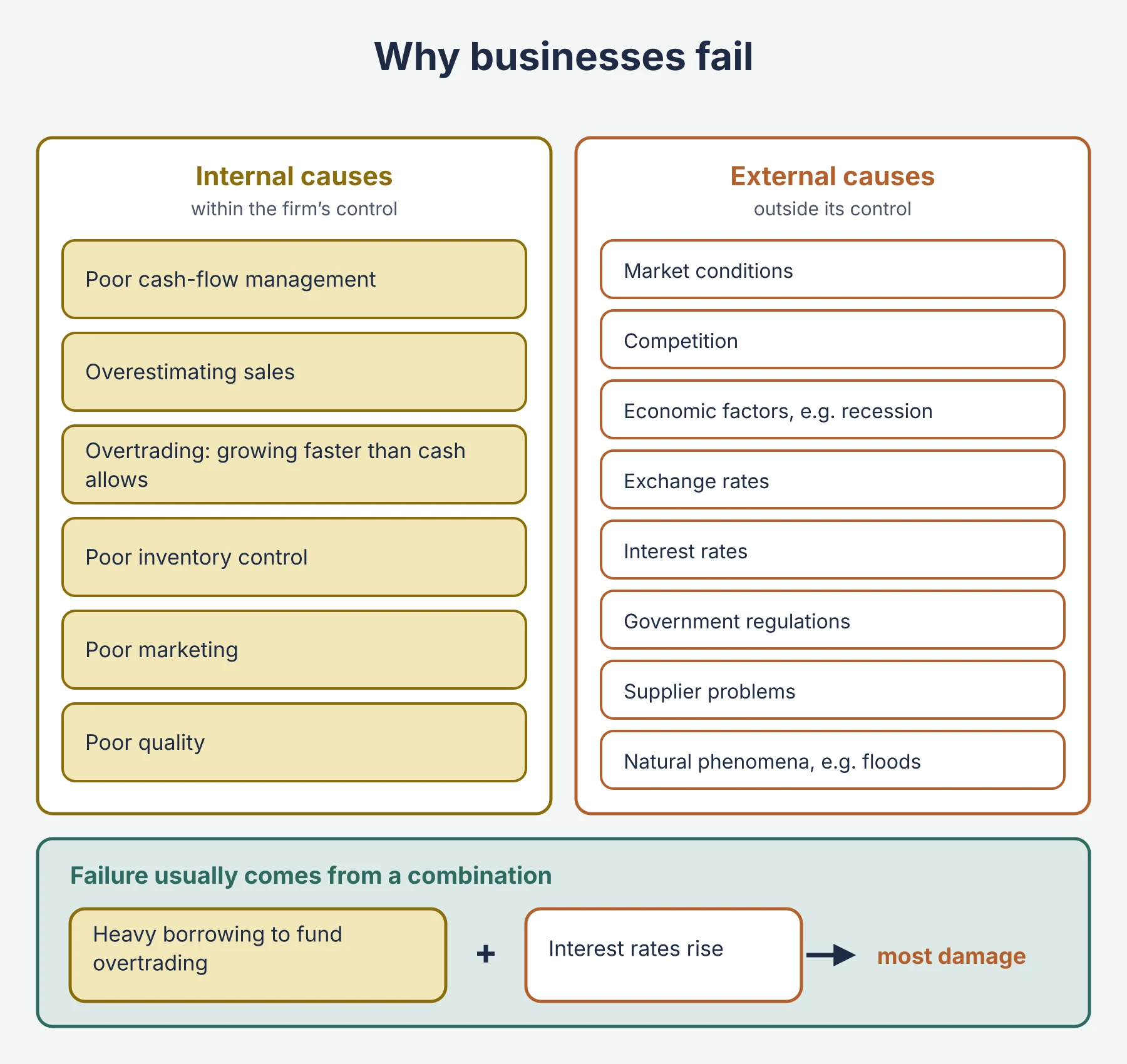
| Internal causes (within the firm’s control) | External causes (outside its control) |
|---|---|
| Poor management of cash flow | Market conditions |
| Overestimation of sales | Competition |
| Overtrading: growing faster than cash allows | Economic factors, such as a recession |
| Poor inventory control | Exchange rates |
| Poor marketing | Interest rates |
| Poor quality | Government regulations |
| Supplier problems | |
| Natural phenomena, such as floods |
Failure usually comes from a combination. An external shock, such as a rise in interest rates, does most damage to a business already weakened internally, for example by heavy borrowing to fund overtrading.
Common mistakes
- Subtracting overheads before cost of sales, or including interest in operating profit.
- Including inventory in the acid test.
- Calling a ratio “good” without comparing it with a previous year, a rival or the industry.
- Saying factoring is free money: it costs a fee and reduces profit.
- Mixing internal and external causes of failure in one list.
Exam technique
Calculate answers need the formula, the figures and the answer to a sensible number of decimal places, with % where relevant. In analyse answers, explain what a change in a ratio or margin means for the named business and why it happened. In discuss and assess answers about liquidity or failure, weigh internal against external causes, and judge which was more significant in the source.
More resources on this topic
Related resources
-
Practice questions
Pearson Edexcel International A Level Business (YBS11): Managing Finance – Practice Questions
Twelve original source-based questions with full answers on profit, margins, liquidity ratios, factoring and business failure for Edexcel IAL 2.3.3.
Business · Pearson Edexcel · AS Level
Try questions -
Revision notes
Pearson Edexcel International A Level Business (YBS11): Managing Finance – Revision Notes
Revision notes for Edexcel IAL Business 2.3.3: profit, margins, profit versus cash, liquidity ratios, working capital and business failure, with a self-test.
Business · Pearson Edexcel · AS Level
Revise topic -
Study guides
Pearson Edexcel International A Level Business (YBS11): Resource management
Study guide to Edexcel IAL Business 2.3.4 Resource management: production methods, productivity, efficiency, capacity utilisation, inventory control and quality.
Business · Pearson Edexcel · AS Level
Read guide
Get free revision emails (optional)
Occasional emails with practice questions, worked explanations and links to free resources for the qualification and subjects you choose. No spam, and you can unsubscribe from any email. The free tools on this site never need an email.