
Study Guides
Pearson Edexcel International A Level Business (YBS11): Meeting Customer Needs
Study guide to section 1.3.1 Meeting customer needs: mass and niche markets, dynamic markets, research and sampling, positioning and adding value.
- Subject
- Business
- Level
- AS LEVEL
- Topic
- Marketing and people
- Author
- Marlbridge Academic Team
- Updated
- Reviewed by
- Salman Ahmad (what this means)
Aligned to Pearson Edexcel A Level Business (WBS11/01), Issue 1, September 2017. Official specification .
Syllabus page (what it covers and how it is assessed): Pearson Edexcel A Level Business.
Found an error? Report a correction.
Need help with this topic? Request a free trial class for A Level Business (YBS11).
This guide covers section 1.3.1 Meeting customer needs in Unit 1 (Marketing and people) of the Pearson Edexcel International Advanced Subsidiary/Advanced Level in Business, Issue 1. The section has three parts: the market, market research and market positioning. Every business and figure below is invented for teaching.
For the whole of Unit 1, see the Marketing and People study guide. For this section in condensed form, use the Meeting Customer Needs revision notes, then test yourself with the Meeting Customer Needs practice questions.
What the specification lists
- The market: mass and niche markets (characteristics, market size and market share, brands); dynamic markets (online retailing, how markets change, innovation and market growth, adapting to change); how competition affects the market; the difference between risk and uncertainty.
- Market research: primary and secondary data, quantitative and qualitative, used to identify and anticipate customer needs and wants, quantify likely demand and gain insight into consumer behaviour; the named primary and secondary methods; random, quota and stratified sampling.
- Market positioning: product and market orientation, market mapping, market segmentation, competitive advantage, the purpose of product differentiation, and adding value.
Mass and niche markets compared
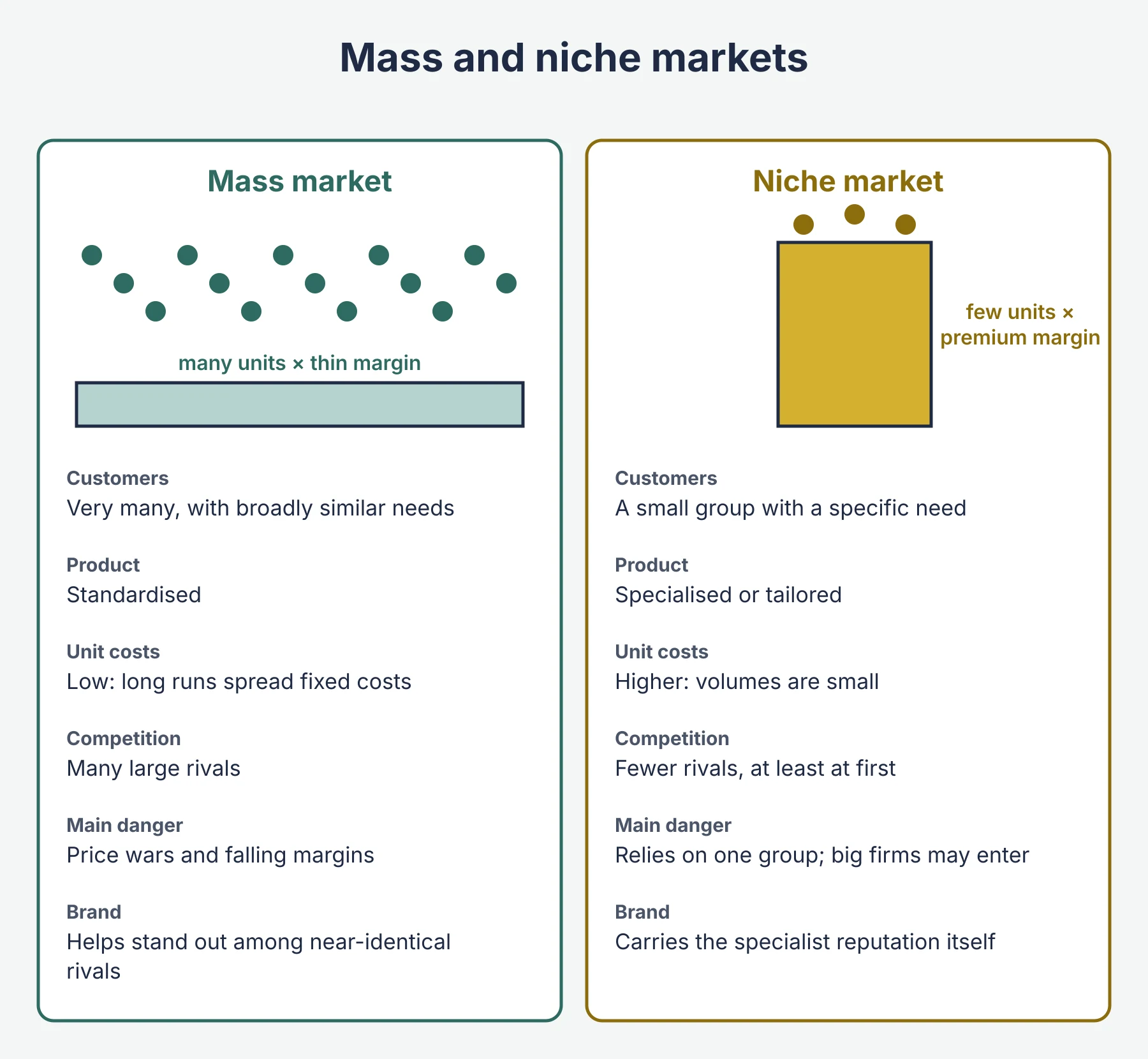
| Feature | Mass market | Niche market |
|---|---|---|
| Customers | Very large number with broadly similar needs | Small group with a specific need |
| Product | Standardised | Specialised or tailored |
| Unit costs | Low, because long production runs spread fixed costs | Higher, because volumes are small |
| Price and margin | Low price, thin margin per unit | Premium price, higher margin per unit |
| Competition | Many large rivals | Fewer rivals, at least at first |
| Main danger | Price wars and falling margins | Dependence on one small group; larger firms may enter once the niche grows |
Brands play a different role in each. In a mass market a brand helps a product stand out among near-identical rivals, so large firms spend heavily on advertising to keep it visible. In a niche market the brand often carries the specialist reputation itself, and customers pay a premium because the name signals expertise.
Watch the language of measurement. Market size is the total sales of all firms, measured by value (revenue) or volume (units). A question that gives volume figures for one year and value figures for another cannot be compared until both are on the same basis.
Dynamic markets and competition
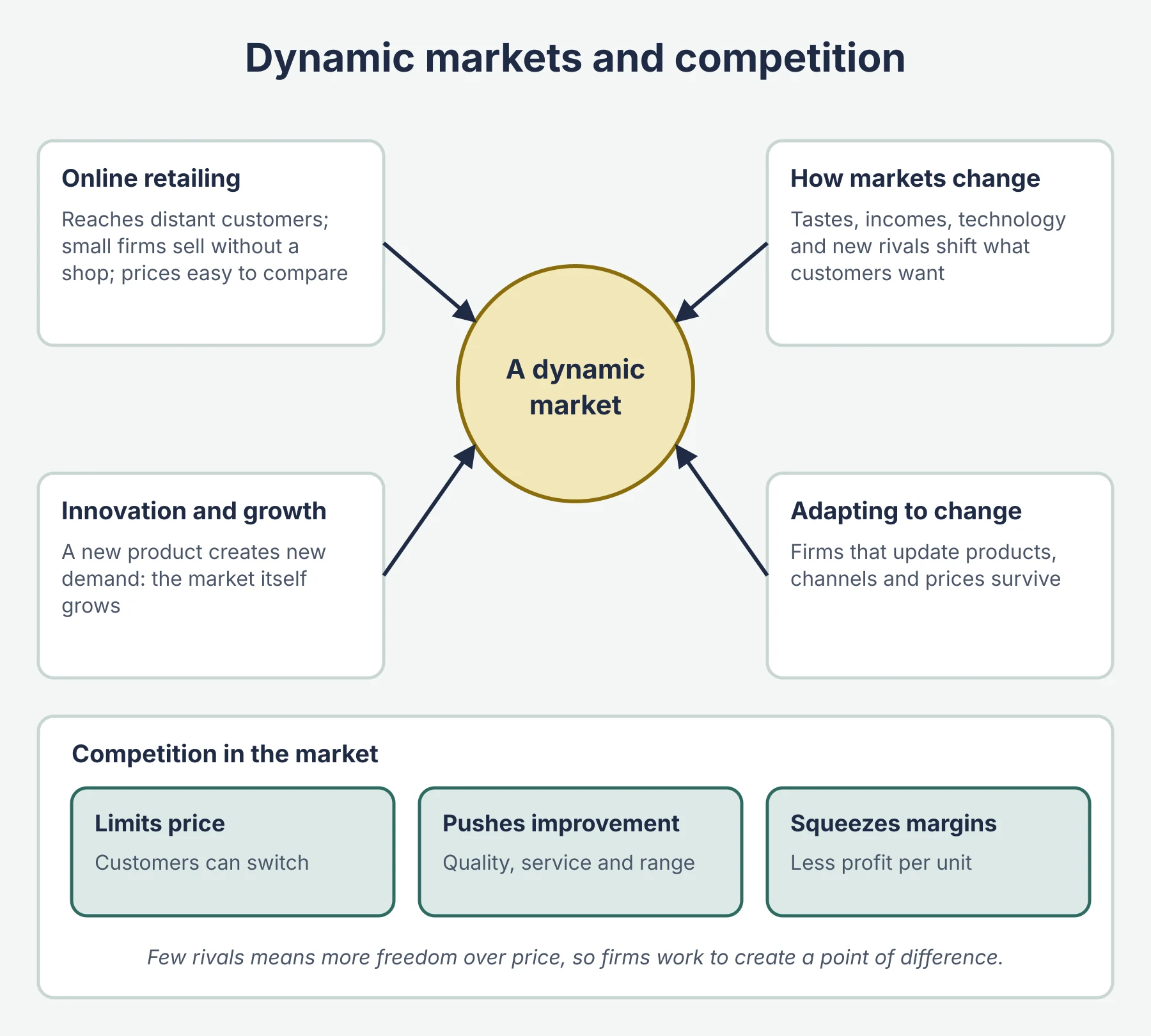
A dynamic market is one that keeps changing. The specification names four aspects:
- Online retailing lowers the cost of reaching customers far away, lets small firms sell without a shop and makes prices easy to compare, which pushes margins down.
- How markets change: tastes, incomes, technology and the arrival of new rivals all shift what customers want.
- Innovation and market growth: a new product or feature can create demand that did not exist before, so the market itself grows rather than firms simply taking share from each other.
- Adapting to change: firms that monitor the market and update products, channels and prices survive; firms that rely on last year’s offer lose customers.
Competition affects a market in three main ways. It limits the price any one firm can charge, because customers can switch; it pushes firms to improve quality, service and range; and it squeezes profit margins. A firm with few rivals has more freedom over price, which is why firms work so hard to create a point of difference.
Risk and uncertainty
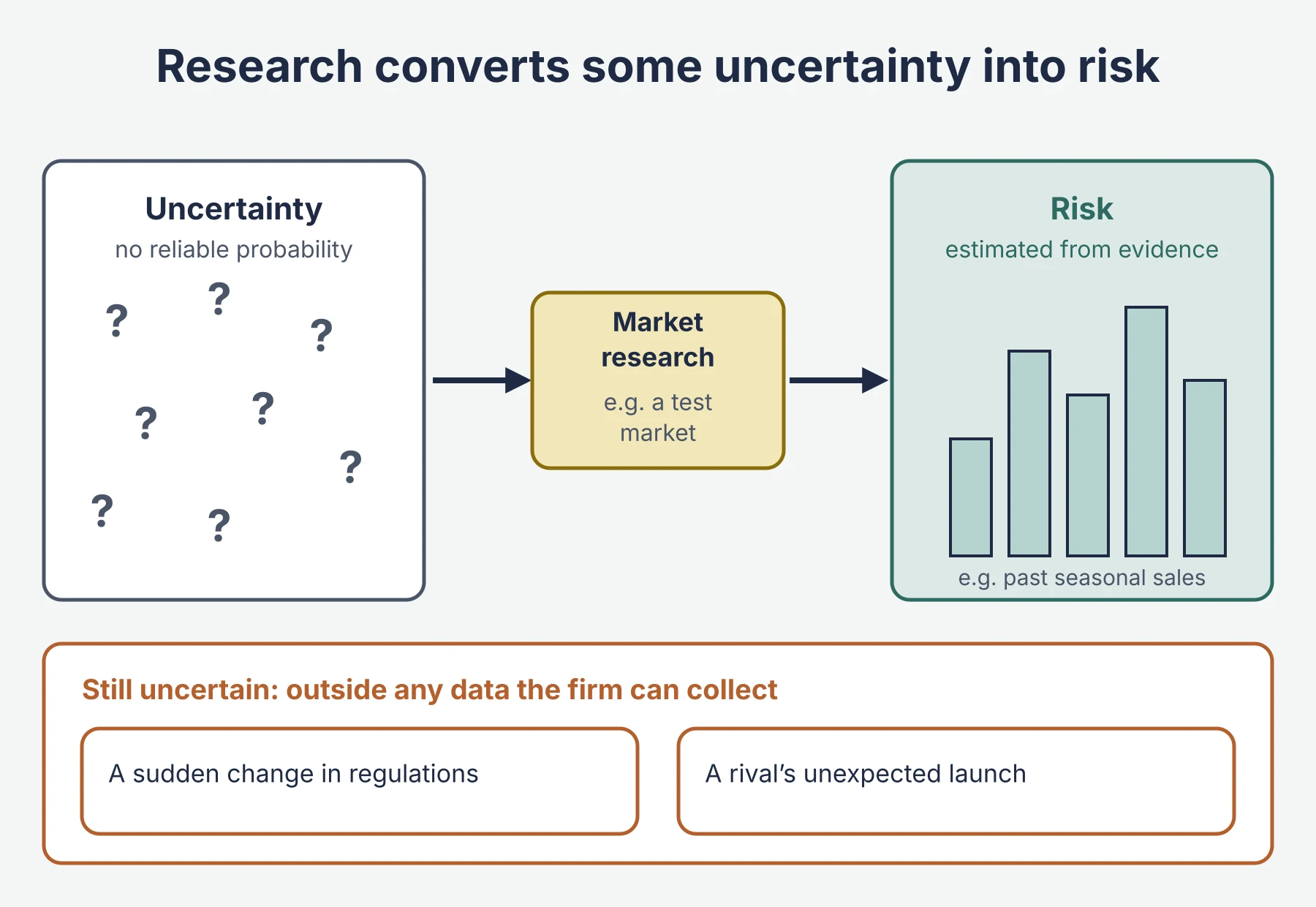
A risk can be estimated from evidence, such as past seasonal sales. Uncertainty cannot, because there is no reliable basis for a probability. The useful exam point is that market research converts some uncertainty into risk: a test market gives a firm data it did not have before. It cannot remove uncertainty altogether, because events such as a sudden change in regulations or a rival’s unexpected launch lie outside any data the firm can collect.
Market research: matching the method to the question
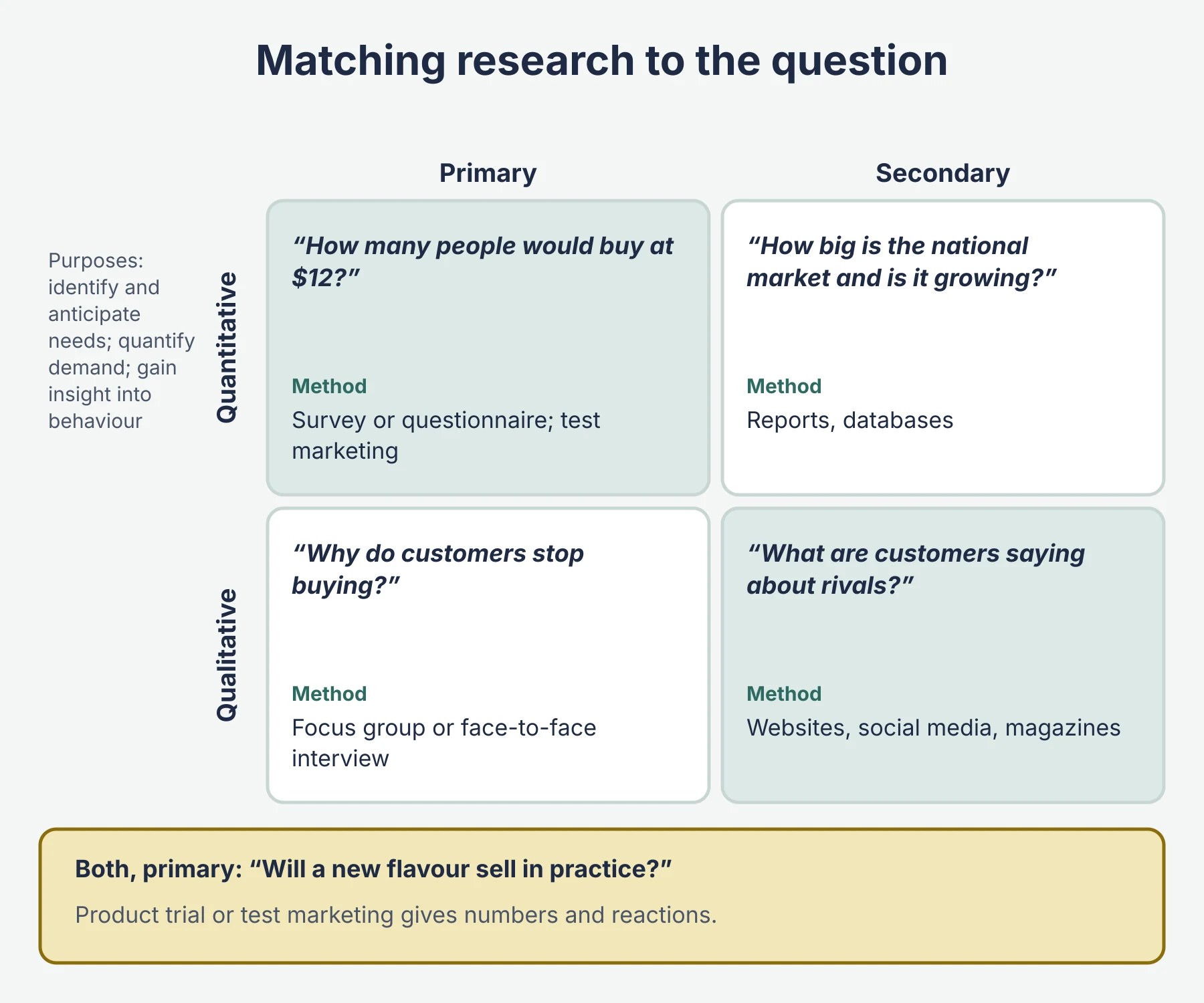
The specification gives three purposes for research: to identify and anticipate customer needs and wants, to quantify likely demand and to gain insight into consumer behaviour. Each purpose suits different data.
| Business question | Best type of data | Suitable method |
|---|---|---|
| How many people would buy at $12? | Quantitative, primary | Survey or questionnaire; test marketing |
| Why do customers stop buying? | Qualitative, primary | Focus group or face-to-face interview |
| How big is the national market and is it growing? | Quantitative, secondary | Reports, databases |
| What are customers saying about rivals? | Qualitative, secondary | Websites and social media, magazines |
| Will a new flavour sell in practice? | Quantitative and qualitative, primary | Product trial or test marketing |
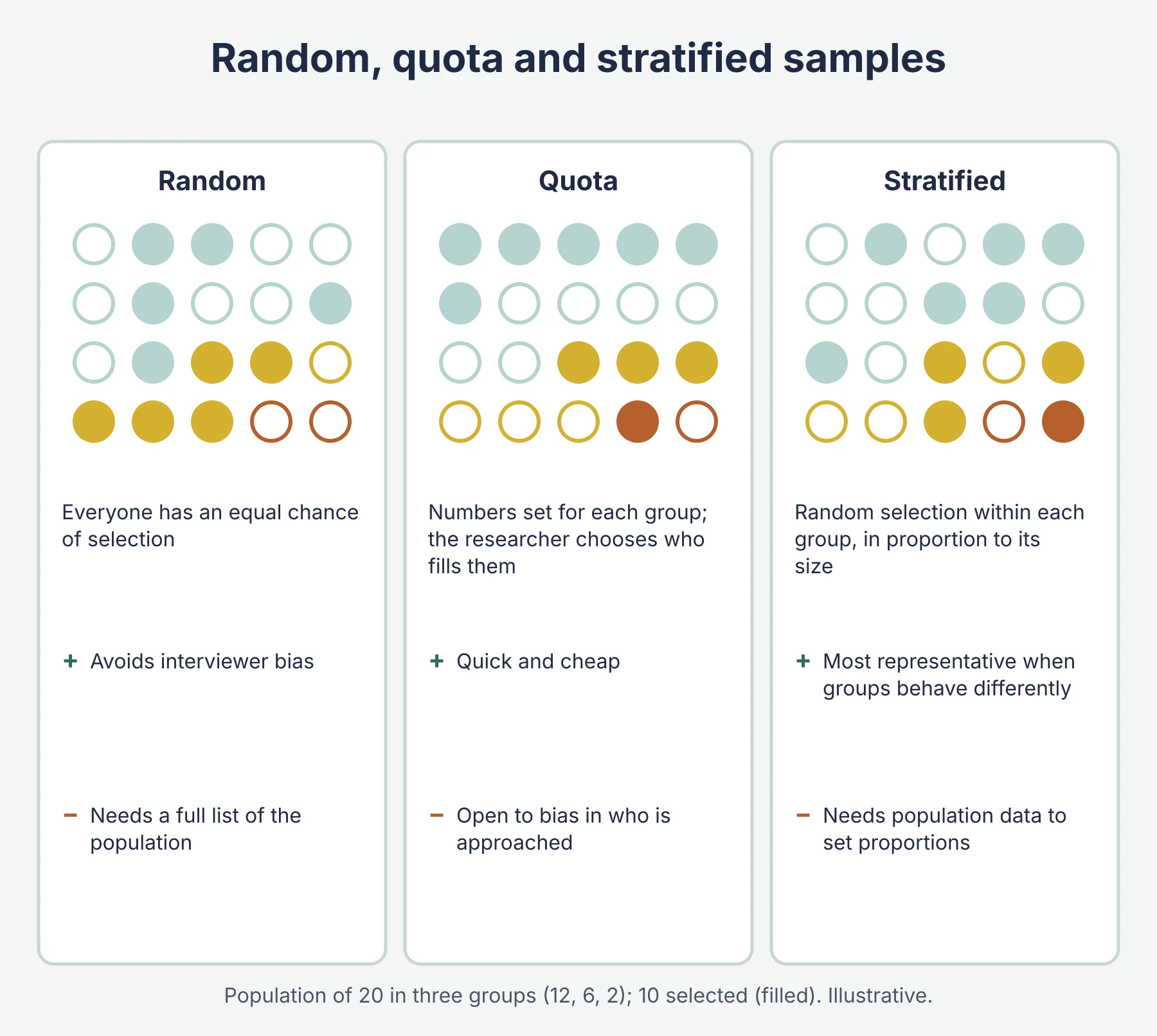
Sampling. A random sample gives everyone in the population an equal chance of selection, so it avoids interviewer bias, but it needs a full list of the population. A quota sample sets numbers for each group and lets the researcher choose who fills them, which is quick and cheap but open to bias in who is approached. A stratified sample divides the population into groups and selects randomly within each group in proportion to its size, which gives the most representative result when groups differ in behaviour, but it needs the population data to set the proportions. The best method depends on the budget, the time available and how different the groups are.
Market positioning
Product orientation starts with what the firm can make and then looks for buyers; it suits technical products where customers cannot describe what they want until they see it. Market orientation starts with research into customer needs and designs the product to match.
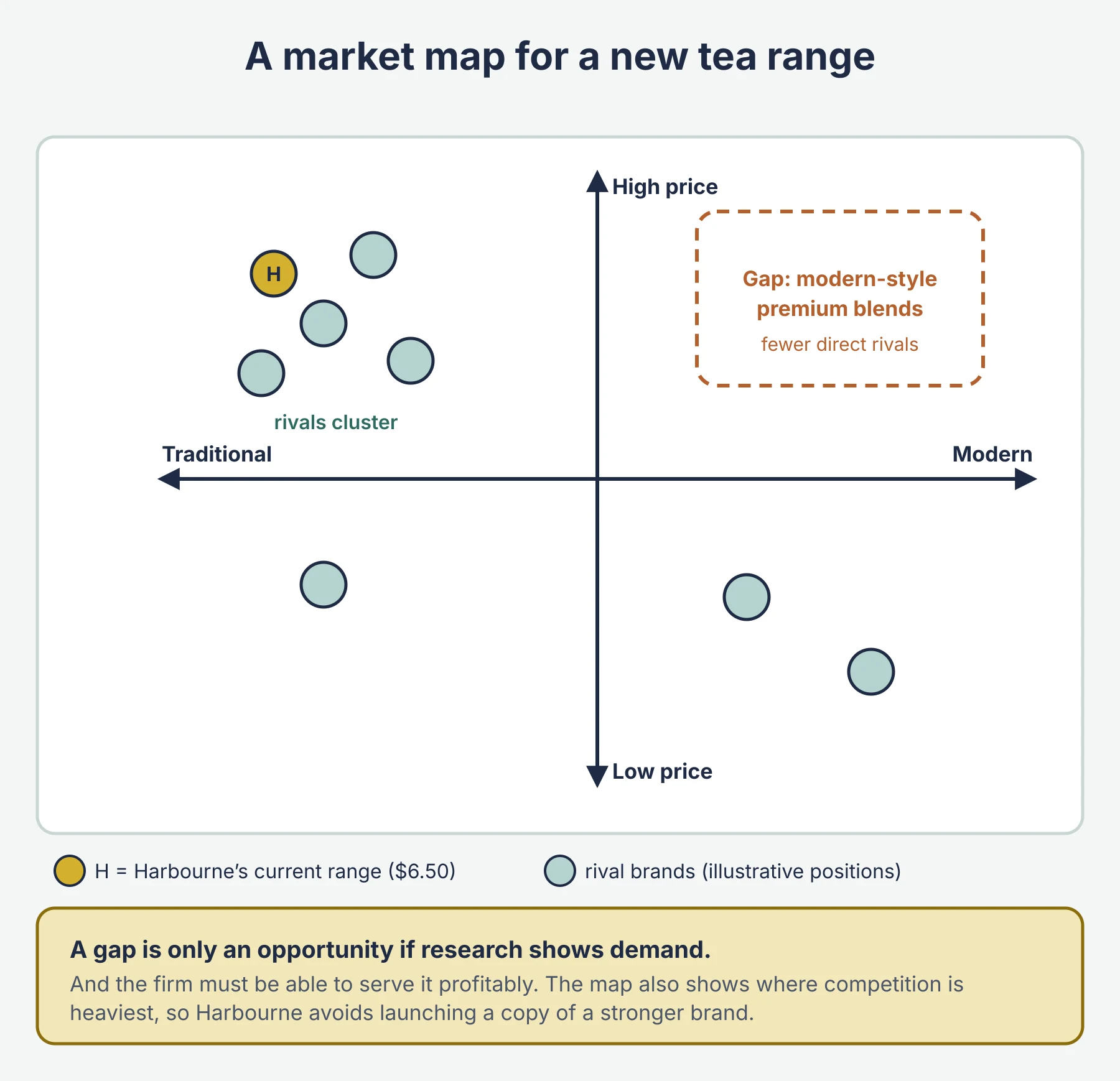
Market mapping plots brands on two axes that customers care about, for example price and perceived quality, or tradition and modernity. The map shows where rivals cluster and where gaps lie. A gap is only an opportunity if research shows demand exists there and the firm can serve it profitably.
Segmentation splits the market into groups with similar needs, by demographic, geographic, psychographic or behavioural characteristics, so the firm can choose which segment to target and how to position its offer for it.
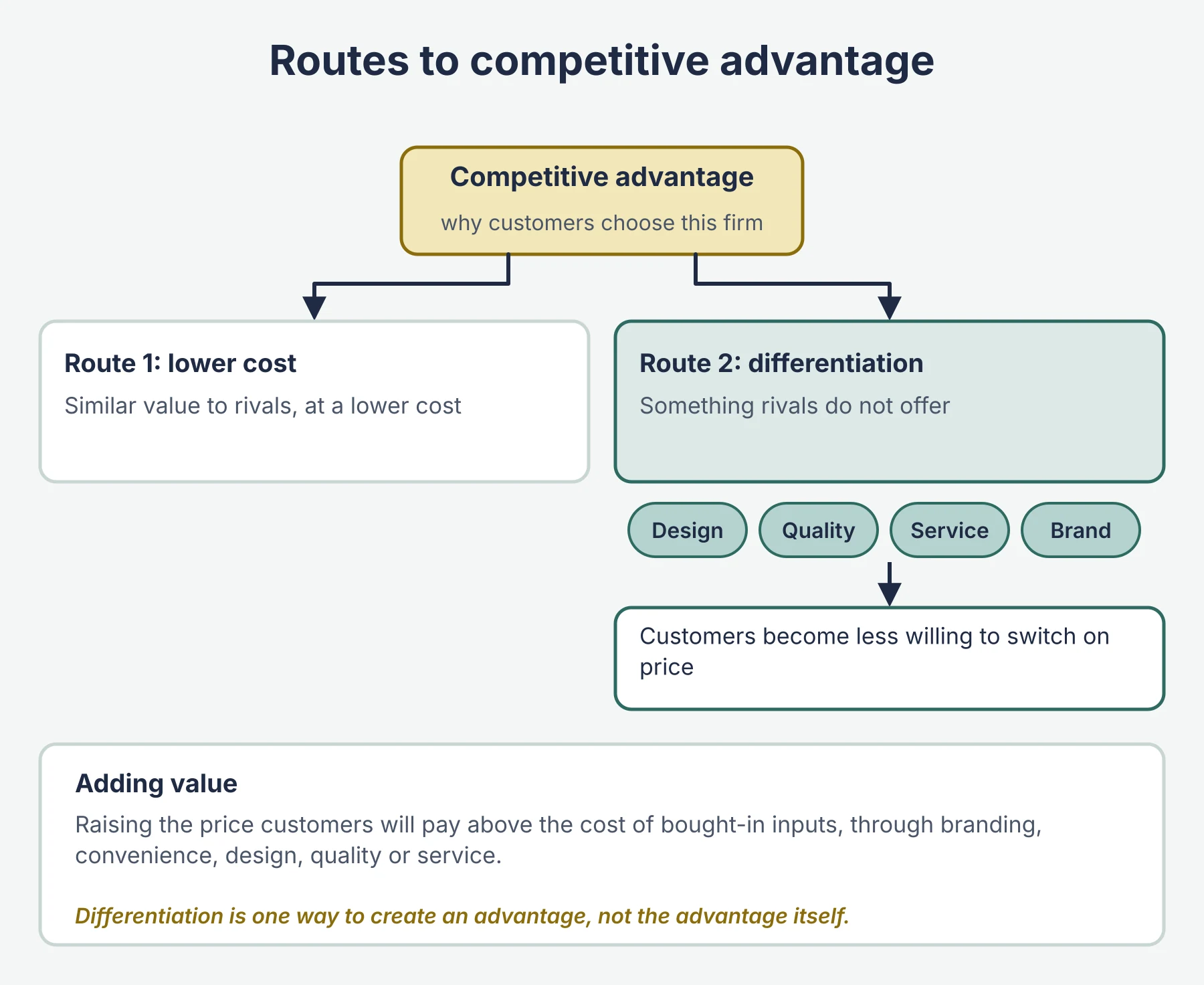
Competitive advantage is a feature that makes customers choose one firm’s product over rivals’ products. It comes either from offering similar value at a lower cost or from offering something rivals do not. Product differentiation is the purpose behind the second route: making the product distinct in design, quality, service or brand, so that customers become less willing to switch on price. Adding value means raising the price customers will pay above the cost of the bought-in inputs, through branding, convenience, design, quality or service.
Worked example 1: share, growth and value added
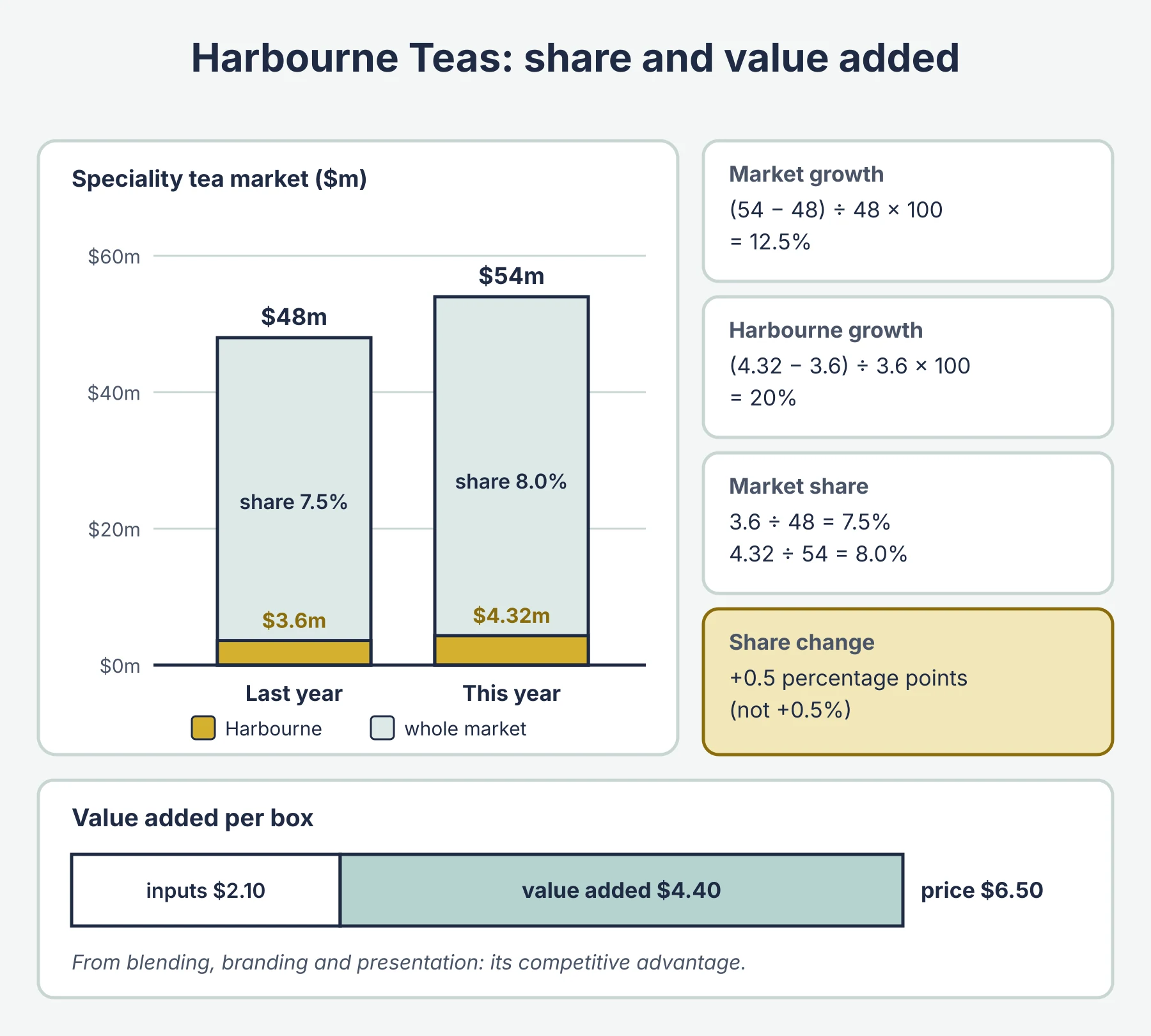
Harbourne Teas sells packaged speciality tea. The market was worth $48m last year and $54m this year. Harbourne’s sales rose from $3.6m to $4.32m.
Market growth  = (54 - 48) / 48 x 100        = 12.5%
Harbourne growth = (4.32 - 3.6) / 3.6 x 100  = 20%
Share last year = 3.6 / 48 x 100             = 7.5%
Share this year = 4.32 / 54 x 100            = 8.0%
Harbourne grew faster than its market, so its share rose by 0.5 percentage points, not by 0.5%. Each box costs $2.10 in loose tea and packaging and sells for $6.50, so Harbourne adds $4.40 of value per box. That value comes from blending, branding and presentation, which is where its competitive advantage lies.
Worked example 2: an annotated answer
Question: Analyse the benefits to Harbourne Teas of using a market map before launching a new range. (6 marks)
A market map plots existing tea brands by two features customers value, such as price and how traditional the brand appears [knowledge]. Harbourne could see whether rivals cluster at the high-price traditional end, where its current range sits [application]. If there is an empty area, for example modern-style premium blends, Harbourne could position the new range there and face fewer direct rivals, so it may be able to charge a price close to its existing $6.50 [analysis chain]. The map also shows where competition is heaviest, so Harbourne avoids launching a range that customers would see as a copy of a stronger brand, which reduces the risk of a costly failure [second chain].
The answer earns its marks through two linked chains tied to the business. It does not evaluate, because “analyse” does not ask for a judgement.
Common mistakes
- Treating market size and market share as the same thing, or reporting a change in share in per cent rather than percentage points.
- Describing a gap on a market map as an opportunity without asking whether customers want it.
- Recommending a random sample when the business has no list of its population.
- Using “differentiation” and “competitive advantage” as synonyms: differentiation is one way of creating an advantage, not the advantage itself.
- Choosing a research method without linking it to the purpose of the research.
Exam technique for this section
The paper uses fixed command words. Define (2 marks) needs a precise meaning, ideally with a short example. Explain (4 marks) needs a point developed with a cause or effect and a detail from the source. Analyse (6 marks) needs a chain of reasoning in context but no judgement. Discuss (8 marks) adds a brief weighing of competing factors. Assess (10 marks) needs balanced, contextualised argument and a supported judgement, and evaluate (20 marks) needs a full argument ending in a recommendation. For this section, the context almost always lies in the figures and customer details in the source: quote them, calculate from them and build your chain around them.
More resources on this topic
Related resources
-
Practice questions
Pearson Edexcel International A Level Business (YBS11): Meeting Customer Needs – Practice Questions
Eleven original source-based questions with mark-scheme answers on markets, research, sampling, positioning and adding value for Edexcel IAL Business 1.3.1.
Business · Pearson Edexcel · AS Level
Try questions -
Revision notes
Pearson Edexcel International A Level Business (YBS11): Meeting Customer Needs – Revision Notes
Revision notes for Edexcel IAL Business 1.3.1: markets, research methods, sampling, positioning, key terms, exam traps and a self-test with answers.
Business · Pearson Edexcel · AS Level
Revise topic -
Study guides
Pearson Edexcel International A Level Business (YBS11): The Market
Study guide to Edexcel IAL Business 1.3.2 The market: demand and supply shifts, taxes and subsidies, diagrams, PED and total revenue, and YED.
Business · Pearson Edexcel · AS Level
Read guide
Get free revision emails (optional)
Occasional emails with practice questions, worked explanations and links to free resources for the qualification and subjects you choose. No spam, and you can unsubscribe from any email. The free tools on this site never need an email.