
Revision Notes
Pearson Edexcel International A Level English Literature (YET01): Unit 1 Post-2000 Prose – Revision Notes
Quick-recall notes for YET01 Unit 1 Section B: the five post-2000 novels, narrative methods, AO1 to AO3, statement questions, context, traps and a self-test.
- Subject
- English Literature
- Level
- AS LEVEL
- Topic
- Unit 1 – Post-2000 Poetry and Prose
- Author
- Marlbridge Academic Team
- Updated
- Reviewed by
- Ammar Bilal (what this means)
Aligned to Pearson Edexcel A Level English Literature (YET01), For first teaching 2015 (units WET01–WET04). Official specification .
Syllabus page (what it covers and how it is assessed): Pearson Edexcel A Level English Literature.
Syllabus points this page covers
YET01 (AS Level)
- 1.4 Prose
Found an error? Report a correction.
Need help with this topic? Request a free trial class for A Level English Literature (YET01).
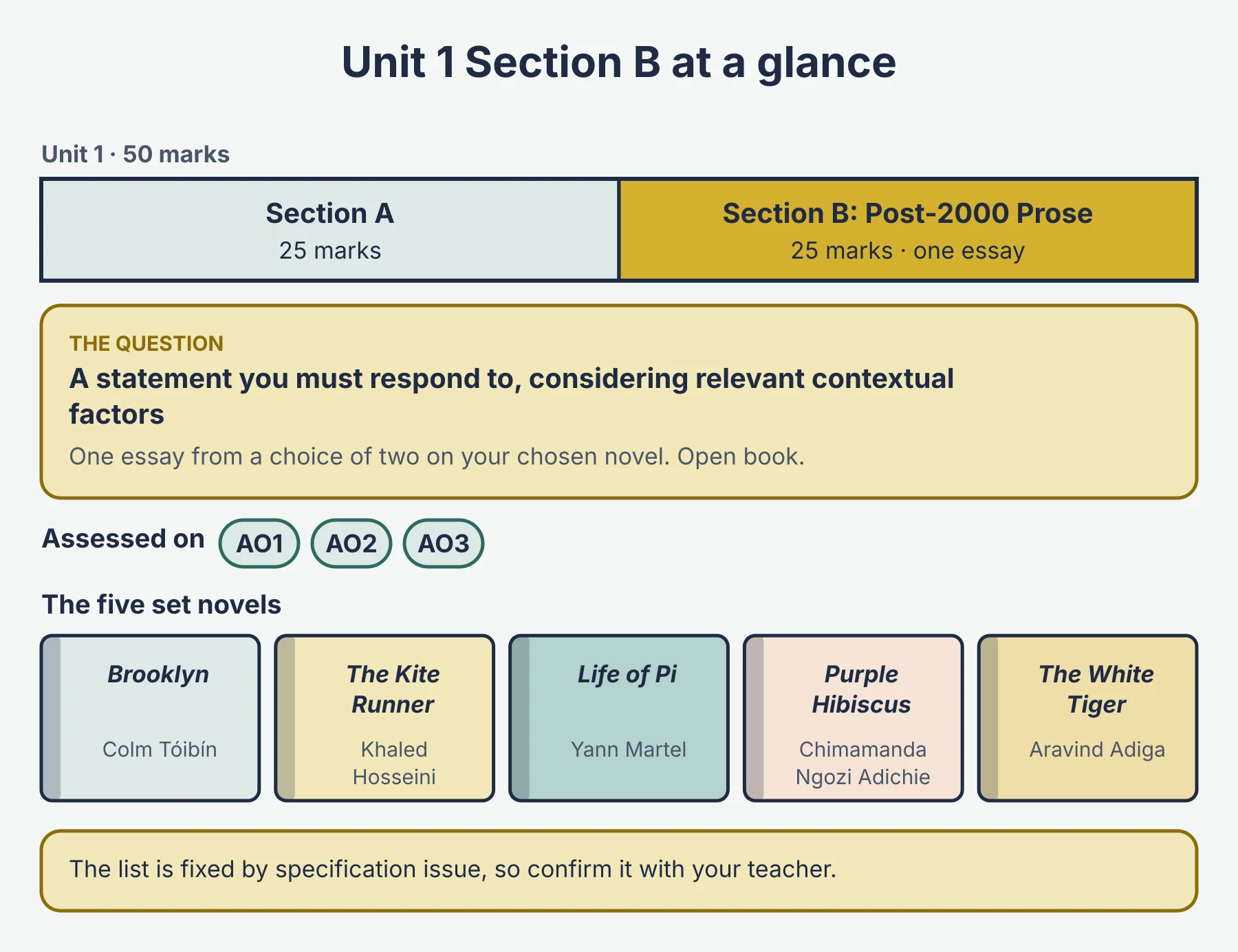
Condensed notes for the prose section of Unit 1 (WET01) in Pearson Edexcel International A Level English Literature (YET01). For the full method and a worked plan, use the Unit 1 Post-2000 Prose study guide.
The task in one box
| Detail | Section B |
|---|---|
| Question | One from a choice of two on your chosen novel |
| Question style | A statement to respond to, considering relevant contextual factors |
| Format | Open book |
| Marks | 25 of the paper’s 50 |
| AOs | AO1, AO2, AO3 (no AO4) |
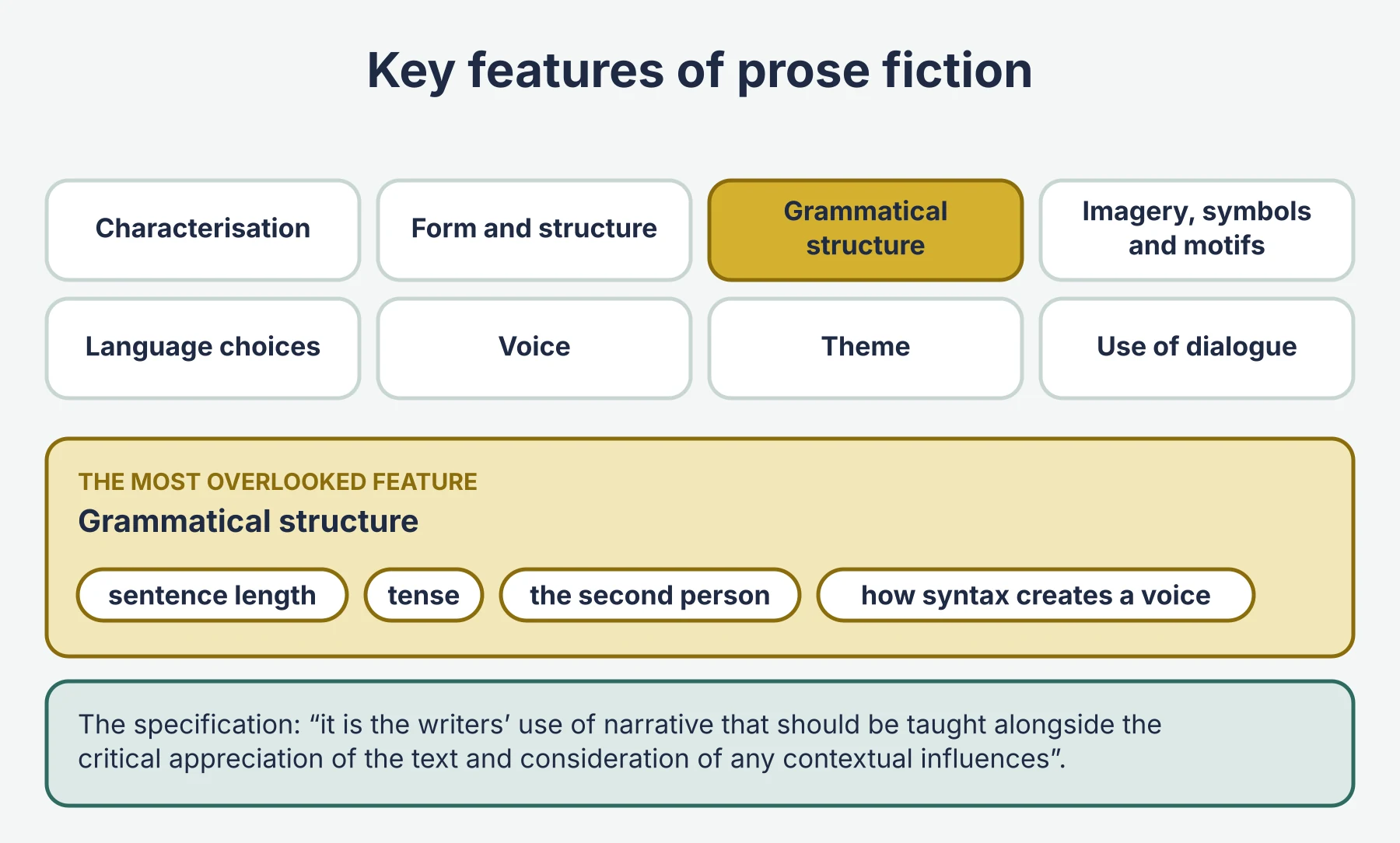
Key features of prose fiction (specification list)
Characterisation · form and structure · grammatical structure · imagery, symbols and motifs · language choices · voice · theme · use of dialogue.
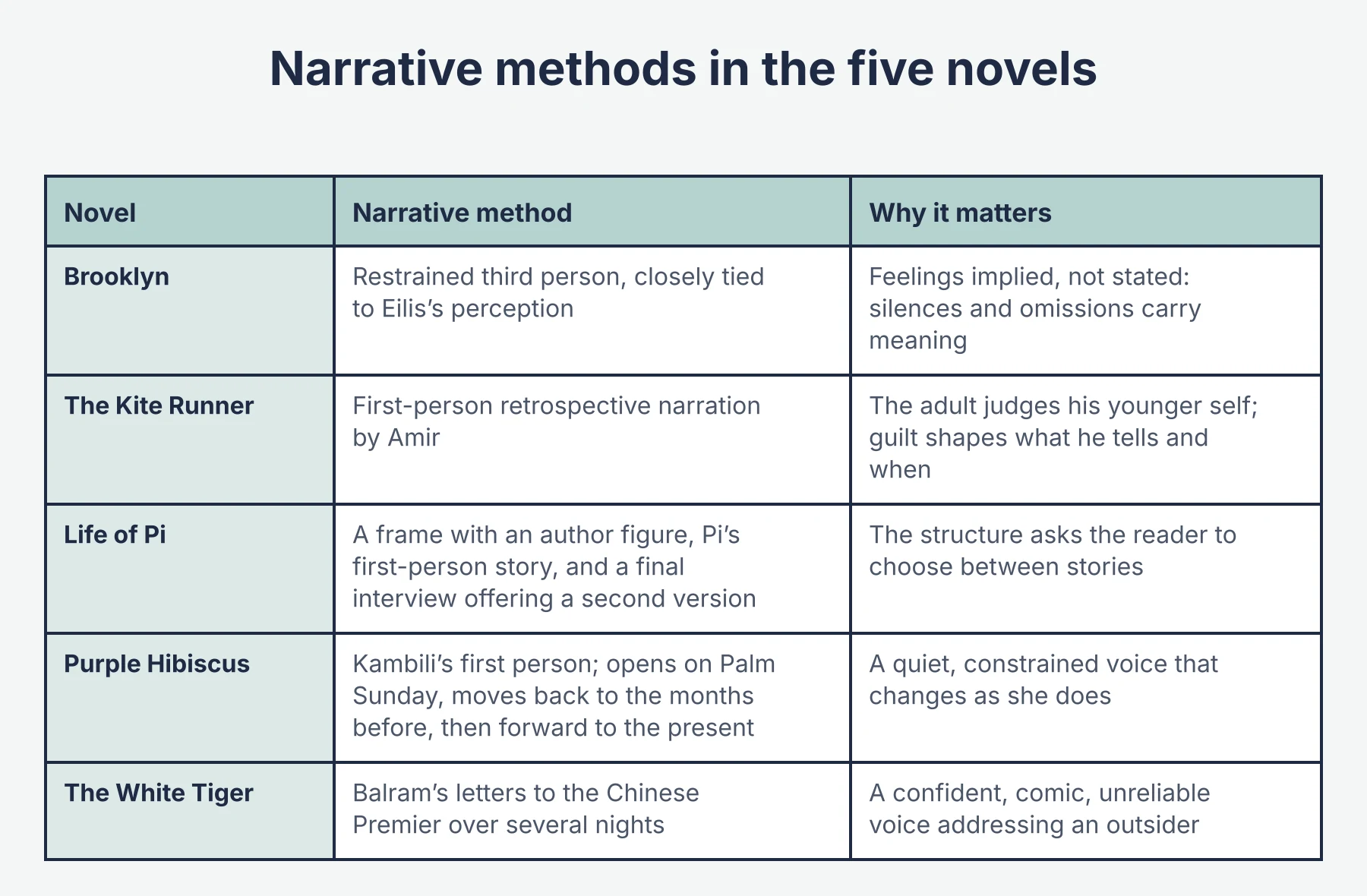
Novel recall grid
| Novel | Narrator and form | Key structural feature | Motifs and symbols to track |
|---|---|---|---|
| Brooklyn (Tóibín) | Close third person, restrained | Departure, new life, return to Ireland, final choice | Letters from home; the department store; the ship |
| The Kite Runner (Hosseini) | Amir, first person, retrospective | Childhood in Kabul, life in the United States, return to Afghanistan | Kites; the pomegranate tree; the act of atonement |
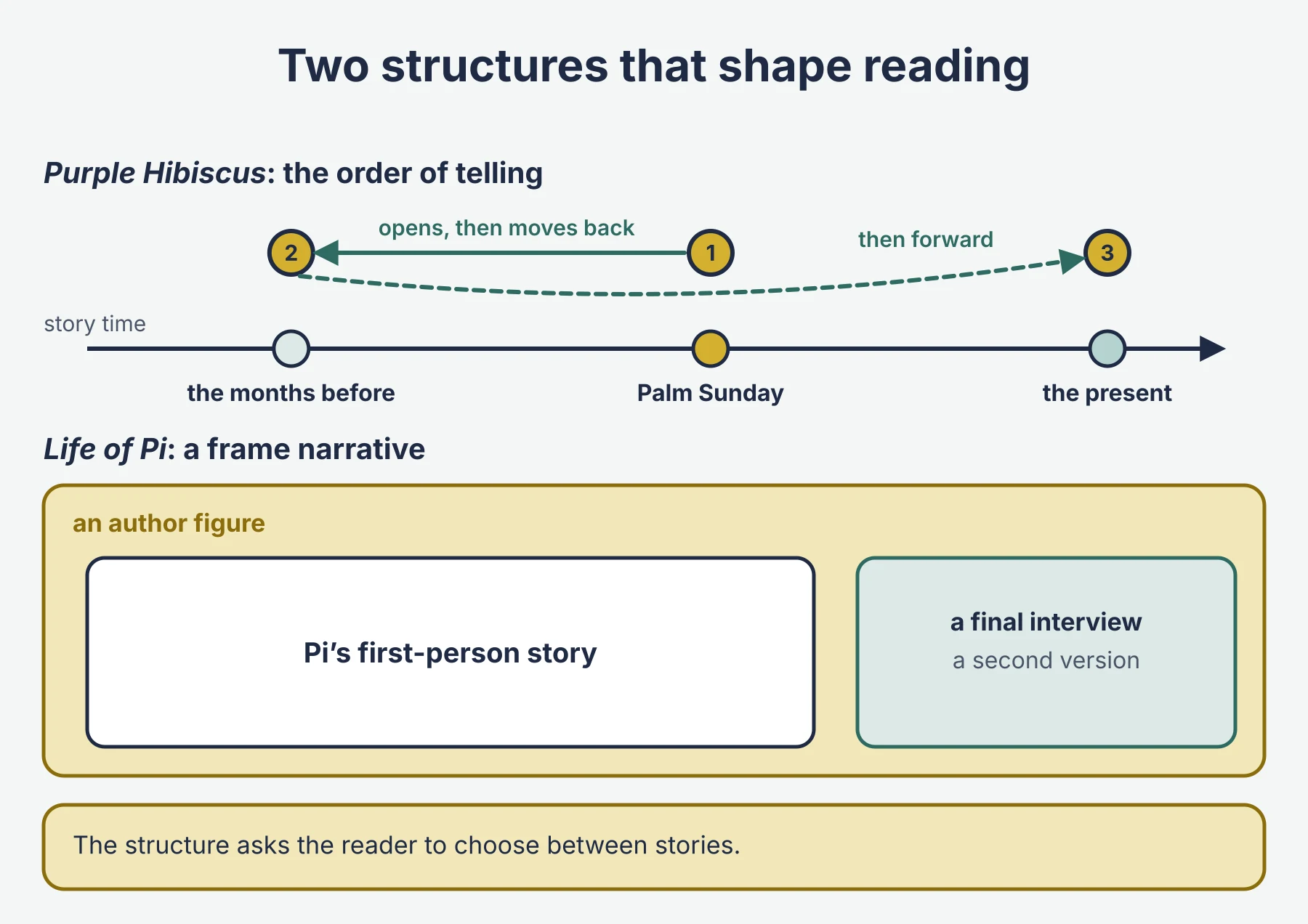
| Life of Pi (Martel) | Frame narrator plus Pi’s first person | Three parts; a second version of the story at the end | Richard Parker; the island; religion and zoos |
| Purple Hibiscus (Adichie) | Kambili, first person | Opens on Palm Sunday, moves back, then forward to the present | The purple hibiscus; silence and speech; figurines |
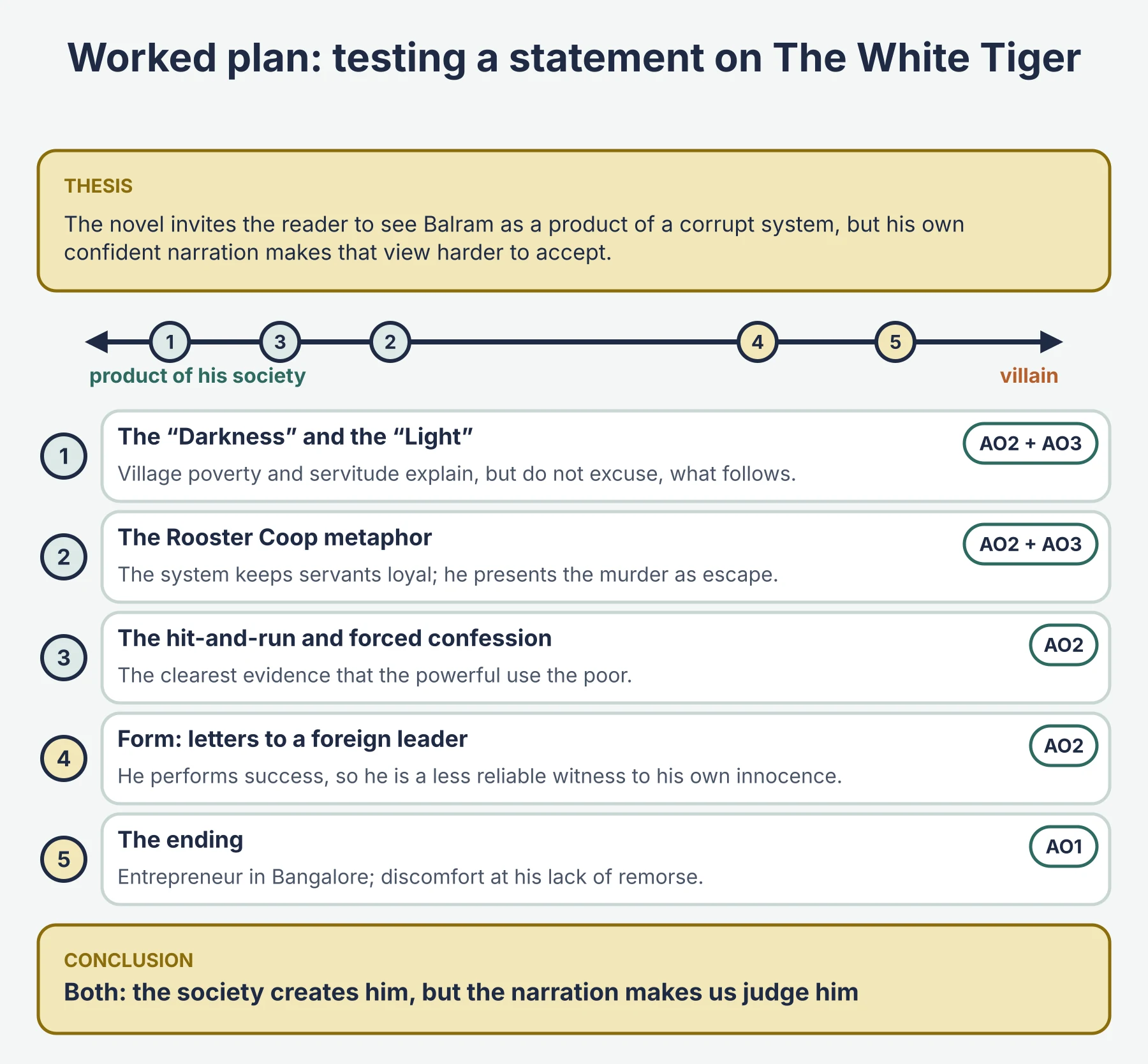
| The White Tiger (Adiga) | Balram, first person, letters to the Chinese Premier | Letters over several nights; a story told from its end | The Rooster Coop; Darkness and Light; the white tiger |
AO checklist
| AO | Ask yourself |
|---|---|
| AO1 | Have I tested the statement with a clear, personal argument and accurate terminology? |
| AO2 | Have I analysed narrative voice, structure and language, not just events? |
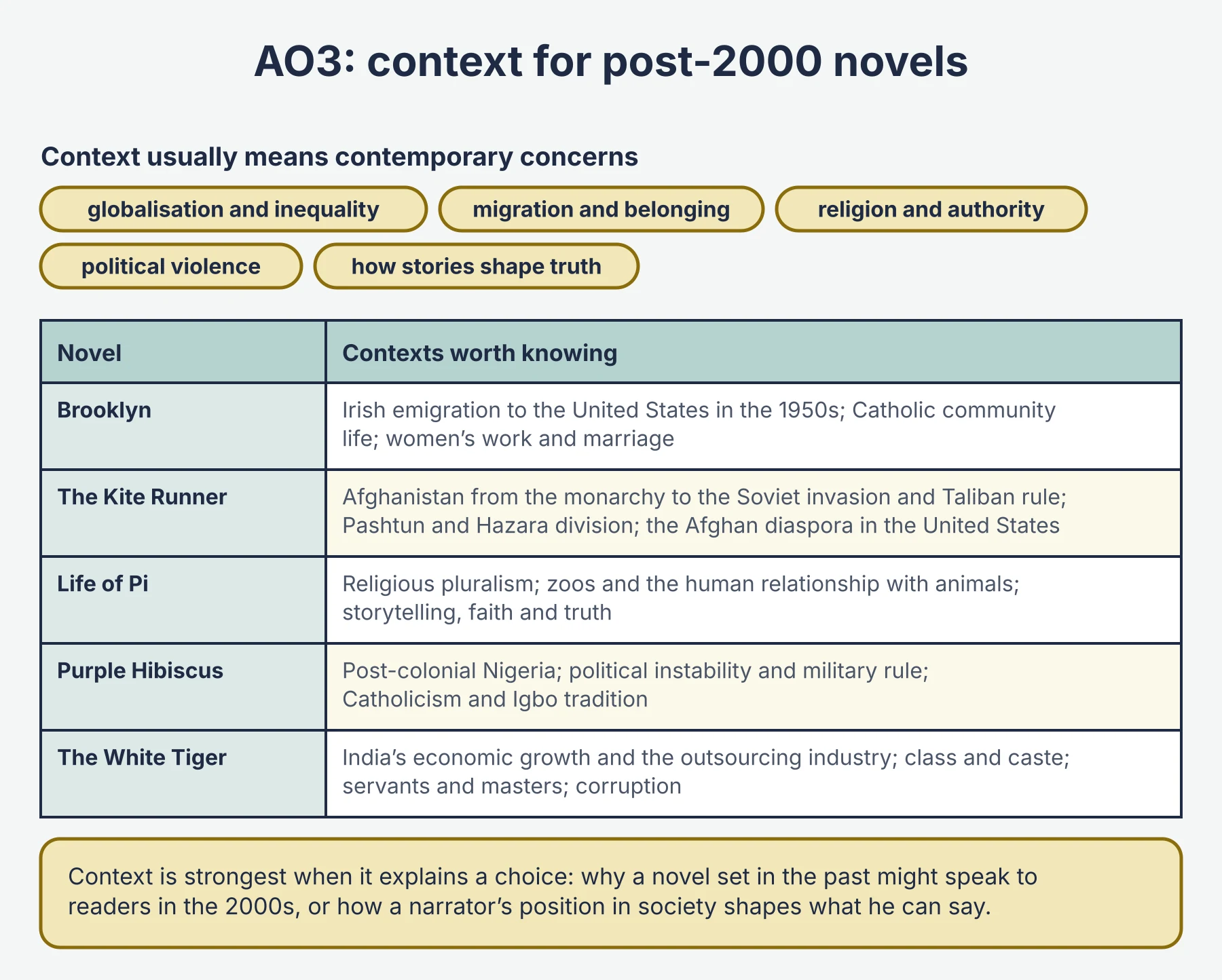
| AO3 | Have I used context to explain the writer’s choices and the reader’s response? |
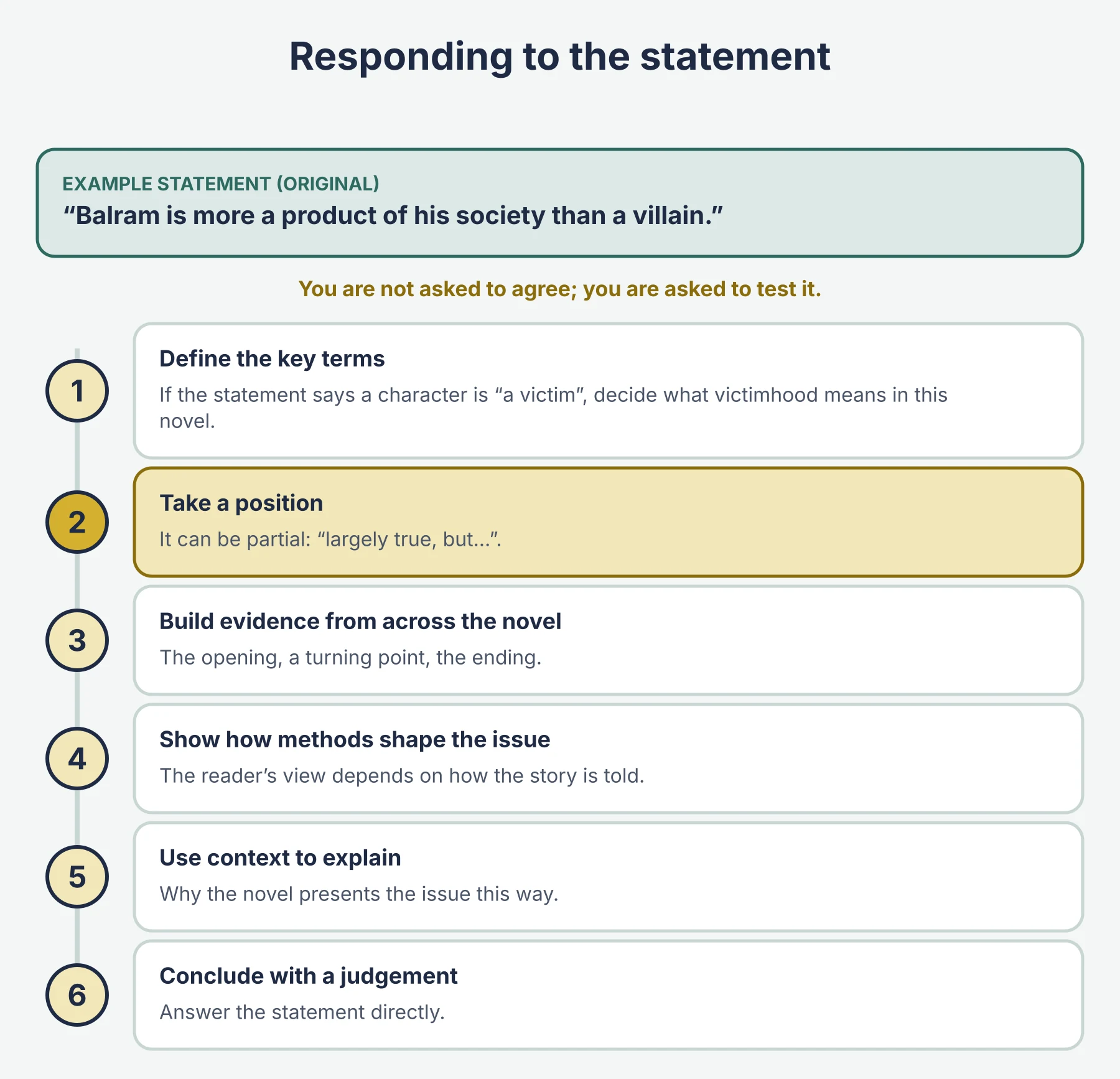
Statement method in six steps
- Define the key terms.
- Take a position (full, partial, or qualified).
- Gather evidence from the opening, a turning point and the ending.
- Analyse how narrative methods shape the issue.
- Explain with context.
- Judge the statement in the conclusion.
Context types (specification guidance)
- Writer’s life, only where it relates to the text.
- Historical setting, time and location.
- Social and cultural contexts.
- Literary context: genres, forms, traditions.
- Contexts of reception: reviews, prizes, adaptations, readers’ and critics’ interpretations.
Key terms
| Term | Meaning |
|---|---|
| First-person retrospective narration | An older narrator recounting earlier events |
| Unreliable narrator | A narrator whose account the reader has reason to doubt |
| Frame narrative | A story set inside another story |
| Epistolary form | A narrative told through letters |
| Free indirect discourse | Third-person narration that takes on a character’s thoughts and idiom |
| Bildungsroman | A novel of growth and education |
| Motif | A recurring image or idea |
| Foreshadowing | An early hint of later events |
| Non-linear structure | Events told out of chronological order |
| Diaspora | A community living away from its homeland |
| Post-colonial | Concerned with the aftermath of colonial rule |
Paragraph frame
- Topic sentence answering the statement.
- Precise reference (short quotation or specific moment).
- Analysis of method (voice, structure, imagery, dialogue).
- Effect on the reader.
- Context that explains the choice.
- Link back to the statement.
Testing a statement: key words to define
| Statement word | Questions to ask |
|---|---|
| “victim” / “villain” | Victim of whom or what? Does the narration invite sympathy or judgement? |
| “freedom” | Freedom from what, and at what cost to others? |
| “home” | A place, a family, a culture, or a feeling? |
| “truth” | Whose truth? Is the narrator reliable? |
| “change” | Does the character change, or only their circumstances? |
Defining a term early gives the essay an argument to test, not just a topic to describe.
Traps
- Retelling plot.
- Context paragraphs disconnected from the text.
- Confusing narrator and author.
- Forgetting the statement after the introduction.
- Analysing character as if real people, rather than as constructions.
- Ignoring grammatical structure and dialogue, both on the specification list.
- Long quotations from the open-book text.
Self-test
- How many marks is Section B worth, and which AOs are assessed?
- What does each Section B question give you to respond to?
- Name the five set novels and their authors.
- List four of the specification’s key features of prose fiction.
- What does the specification say should be taught alongside critical appreciation?
- What is a frame narrative? Which set novel uses one?
- Which set novel is narrated by a fifteen-year-old girl, and which by an adult looking back on his childhood in Kabul?
- What is epistolary form, and which set novel uses it?
- Name the five types of context in the specification’s guidance.
- Why is “the narrator is the author” a mistake?
- Is AO4 assessed in Section B?
- What should your conclusion do?
Answers: 1. 25 marks; AO1, AO2, AO3. 2. A statement, to be considered with relevant contextual factors. 3. Brooklyn (Colm Tóibín), The Kite Runner (Khaled Hosseini), Life of Pi (Yann Martel), Purple Hibiscus (Chimamanda Ngozi Adichie), The White Tiger (Aravind Adiga). 4. Any four of characterisation, form and structure, grammatical structure, imagery/symbols/motifs, language choices, voice, theme, use of dialogue. 5. The writers’ use of narrative, and contextual influences. 6. A story inside another story; Life of Pi. 7. Purple Hibiscus (Kambili); The Kite Runner (Amir). 8. A narrative told through letters; The White Tiger. 9. The writer’s life (where relevant), historical setting, social and cultural contexts, literary context, contexts of reception. 10. The narrator is a constructed voice whose views may differ from the author’s. 11. No. 12. Judge the statement directly.
Related pages
Related resources
-
Study guides
Edexcel International A-Level English Literature: Post-2000 Poetry and Prose (YET01)
Unit 1 Post-2000 Poetry and Prose of Pearson Edexcel International A Level English Literature YET01, the first of the two International AS units.
English Literature · Pearson Edexcel · AS Level
Read guide -
Practice questions
Post-2000 Poetry and Prose (YET01): Practice Questions
Original exam-style practice questions with worked answer plans on Unit 1 of Pearson Edexcel International Advanced Level English Literature (YET01).
English Literature · Pearson Edexcel · AS Level
Try questions -
Revision notes
Post-2000 Poetry and Prose (YET01): Revision Notes
Condensed recall notes on Unit 1's two-section structure and assessment objectives for Pearson Edexcel International Advanced Level English Literature (YET01).
English Literature · Pearson Edexcel · AS Level
Revise topic
Get free revision emails (optional)
Occasional emails with practice questions, worked explanations and links to free resources for the qualification and subjects you choose. No spam, and you can unsubscribe from any email. The free tools on this site never need an email.