
Study Guides
Pearson Edexcel International A Level English Literature (YET01): Unit 1 Post-2000 Prose
How to answer the statement-based post-2000 novel essay in YET01 Unit 1 Section B: narrative methods, AO3 context and a worked plan on The White Tiger.
- Subject
- English Literature
- Level
- AS LEVEL
- Topic
- Unit 1 – Post-2000 Poetry and Prose
- Author
- Marlbridge Academic Team
- Updated
- Reviewed by
- Ammar Bilal (what this means)
Aligned to Pearson Edexcel A Level English Literature (YET01), For first teaching 2015 (units WET01–WET04). Official specification .
Syllabus page (what it covers and how it is assessed): Pearson Edexcel A Level English Literature.
Syllabus points this page covers
YET01 (AS Level)
- 1.4 Prose
Found an error? Report a correction.
Need help with this topic? Request a free trial class for A Level English Literature (YET01).
Section B of Unit 1 (WET01) is an essay on one post-2000 novel. The specification is explicit that “it is the writers’ use of narrative that should be taught alongside the critical appreciation of the text and consideration of any contextual influences”. This guide shows what that means for each of the five set novels, how to handle the statement each question gives you, and how to bring in context without losing the text. The Unit 1 overview covers the paper as a whole.
What Section B covers
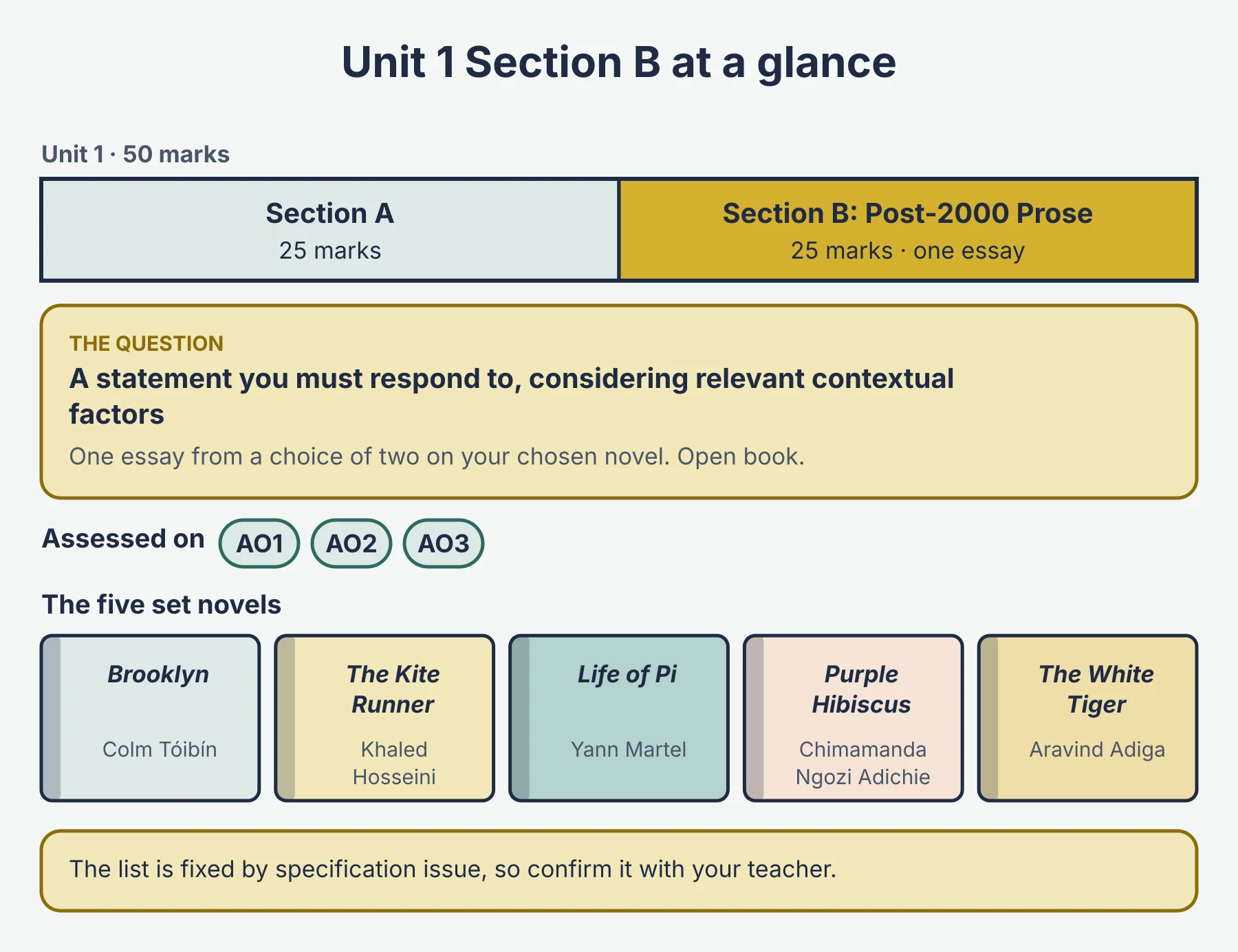
| Detail | Section B: Post-2000 Prose |
|---|---|
| Task | One essay from a choice of two on your chosen novel |
| Question type | A statement that you must respond to, considering relevant contextual factors |
| Format | Open book |
| Marks | 25 of the paper’s 50 |
| AOs | AO1, AO2, AO3 |
The set novels are Brooklyn (Colm Tóibín), The Kite Runner (Khaled Hosseini), Life of Pi (Yann Martel), Purple Hibiscus (Chimamanda Ngozi Adichie) and The White Tiger (Aravind Adiga). The list is fixed by specification issue, so confirm it with your teacher.
What the specification asks you to study
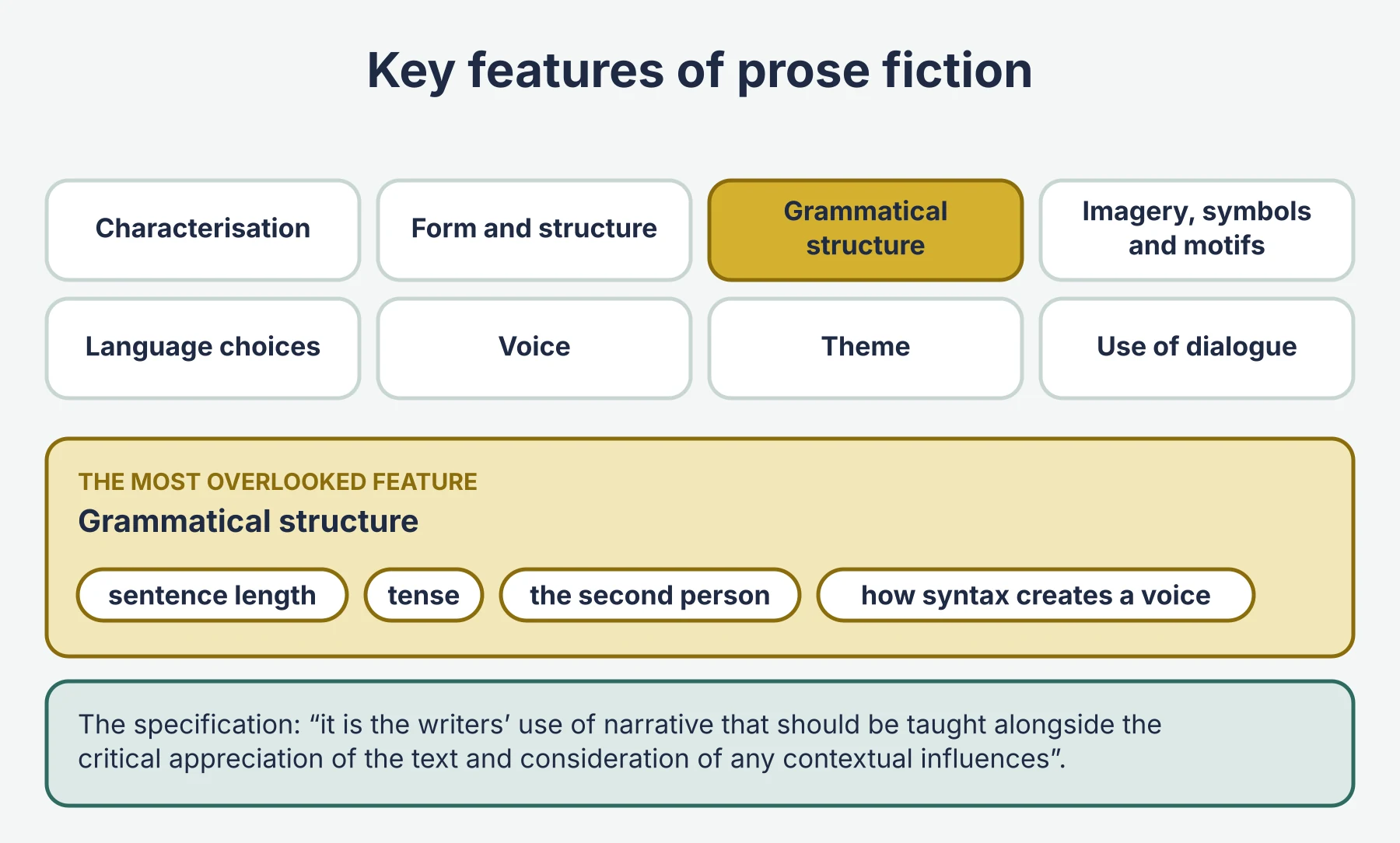
Key features of prose fiction: characterisation; form and structure; grammatical structure; imagery, symbols and motifs; language choices; voice; theme; and use of dialogue. The learning outcomes add reading for detail of how writers “use and adapt language, form and structure”, the contexts in which prose texts have been written and how they influence meaning, and how attitudes and values are expressed.
“Grammatical structure” is the feature students most often overlook: sentence length, tense, the use of the second person, and how syntax creates a voice.
Narrative methods in the five novels
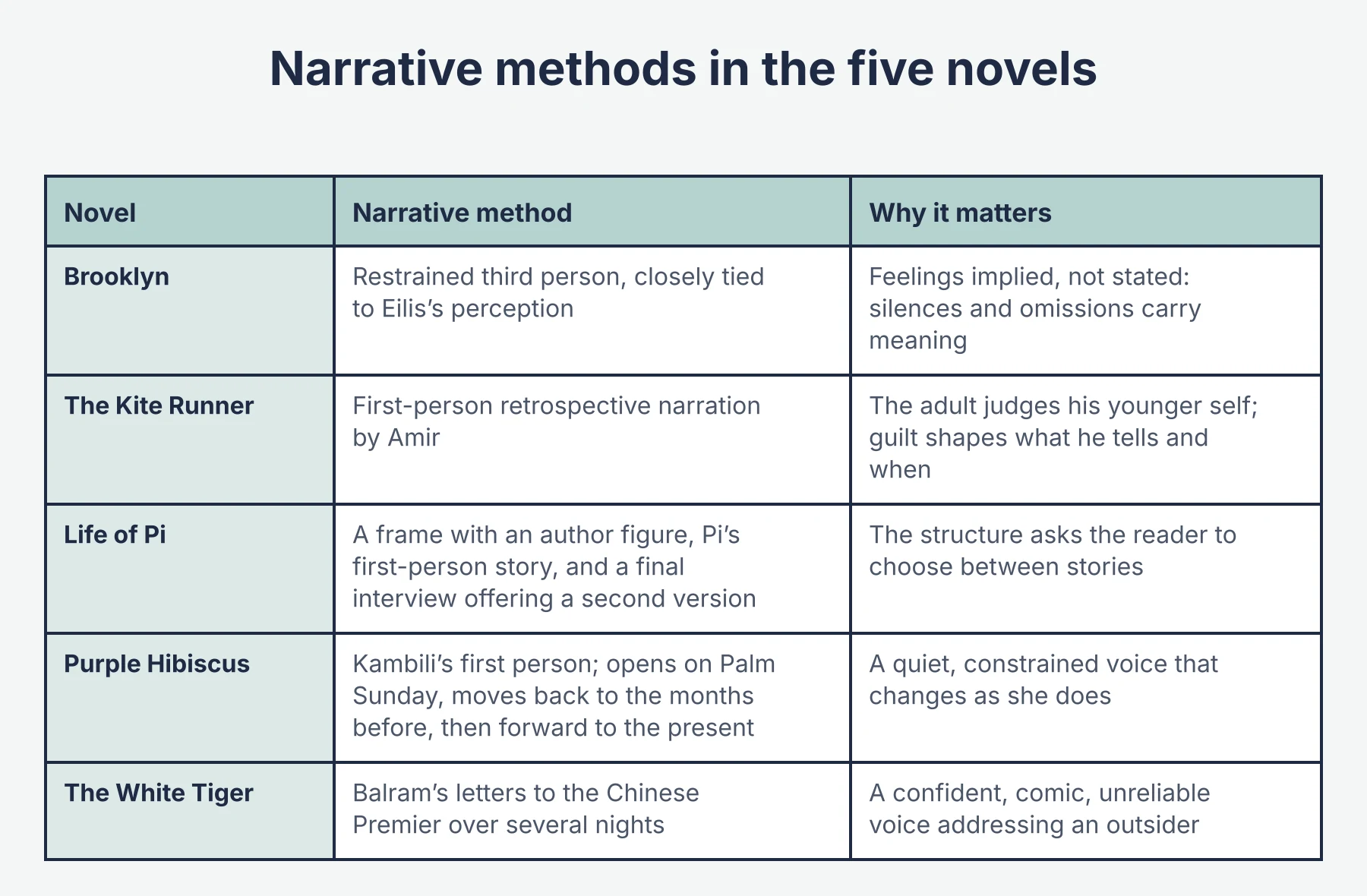
| Novel | Narrative method to analyse | Why it matters |
|---|---|---|
| Brooklyn | Restrained third-person narration closely tied to Eilis’s perception | Feelings are often implied rather than stated, so silences and omissions carry meaning |
| The Kite Runner | First-person retrospective narration by Amir | The adult narrator judges his younger self; guilt shapes what he tells and when |
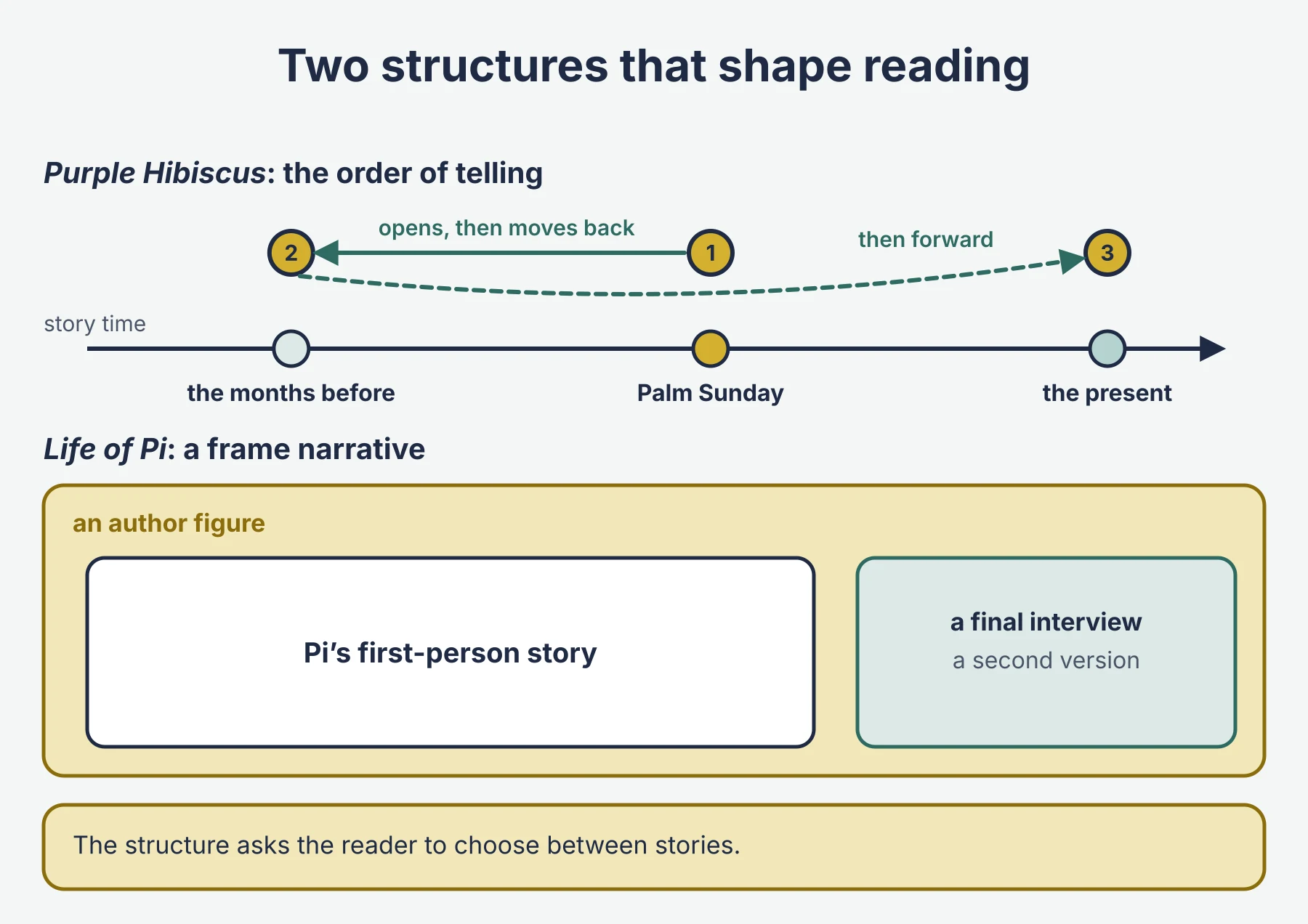
| Life of Pi | A frame narrative with an author figure, Pi’s first-person story, and a final interview offering a second version | The structure asks the reader to choose between stories |
| Purple Hibiscus | First-person narration by Kambili, with a non-chronological structure that opens on Palm Sunday, moves back to the months before it, then forward to the present | A quiet, constrained voice that changes as she does |
| The White Tiger | Balram’s letters to the Chinese Premier over several nights | A confident, comic, unreliable voice addressing an outsider |
Responding to the statement
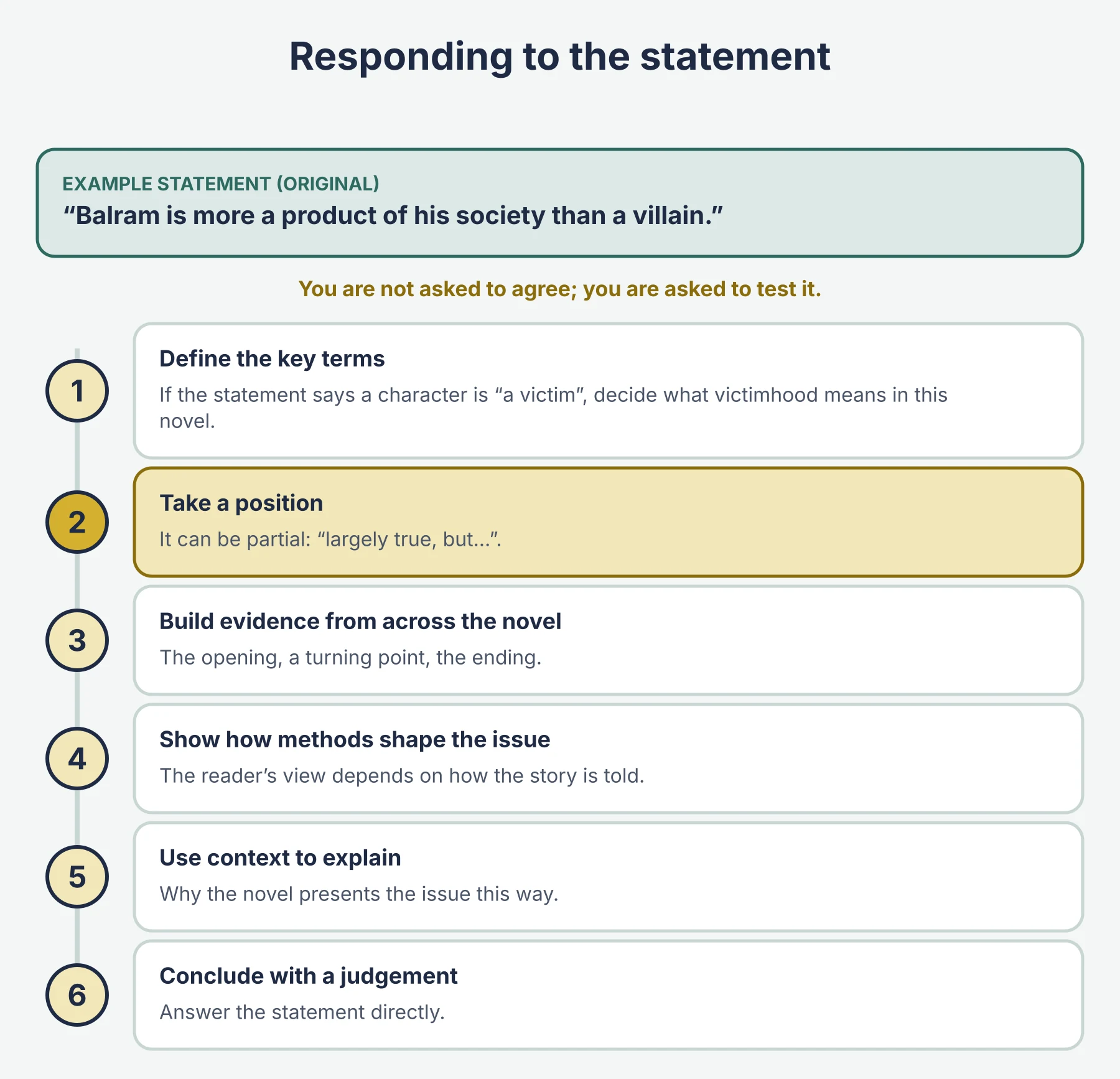
Each question gives a statement. You are not asked to agree; you are asked to test it.
- Define the key terms. If the statement says a character is “a victim”, decide what victimhood means in this novel.
- Take a position, which can be partial: “largely true, but…”.
- Build evidence from across the novel: the opening, a turning point, the ending.
- Show how methods shape the issue: the reader’s view of the claim depends on how the story is told.
- Use context to explain why the novel presents the issue this way.
- Conclude with a judgement that answers the statement directly.
AO3: context for post-2000 novels
The specification’s guidance on context lists the writer’s life and situation (only where relevant), the historical setting, social and cultural contexts, literary context, and contexts of reception.
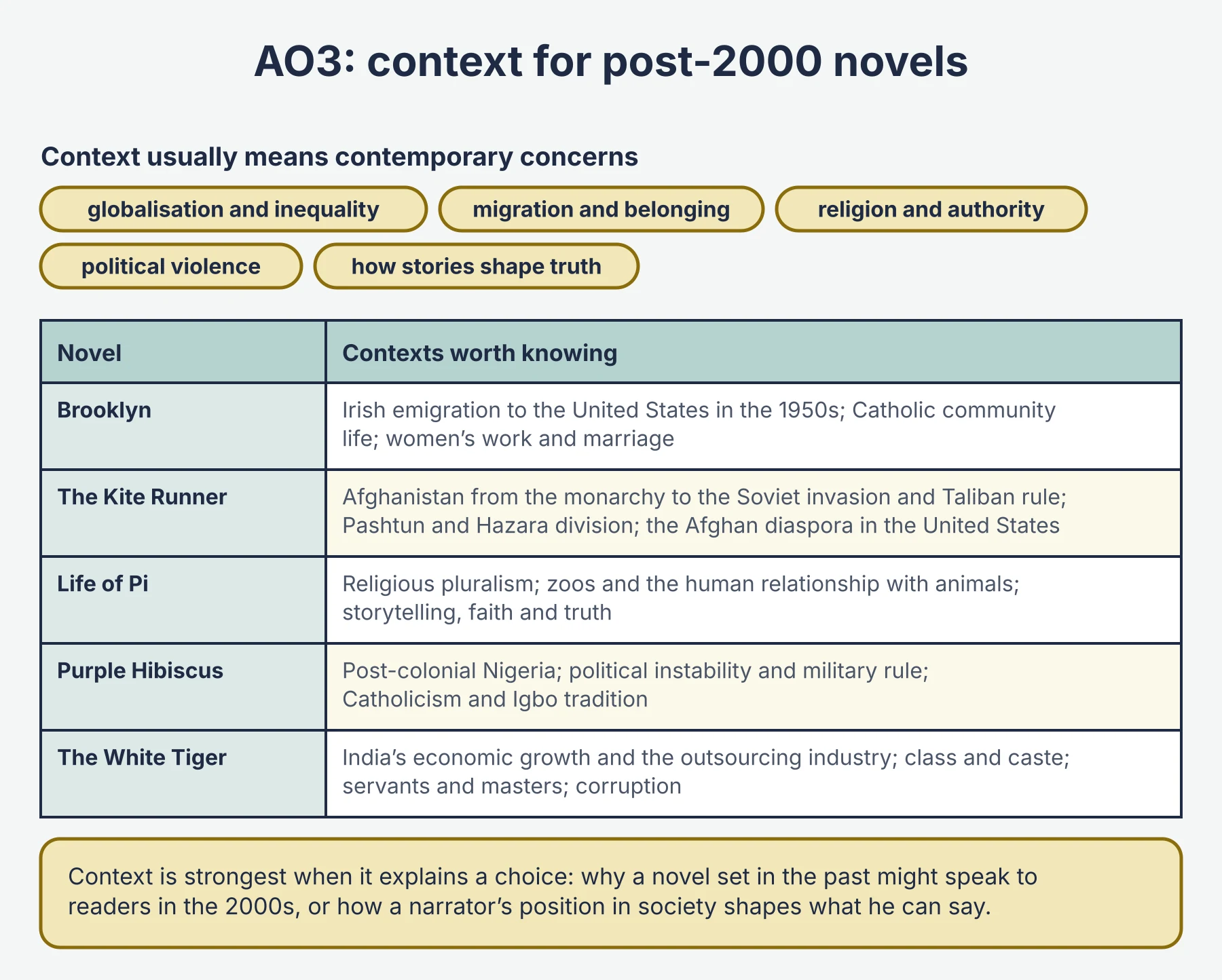
For these novels, context usually means contemporary concerns: globalisation and inequality, migration and belonging, religion and authority, political violence, and how stories shape truth. Context is strongest when it explains a choice: for example, why a novel set in the past might speak to readers in the 2000s, or how a narrator’s position in society shapes what he can say.
| Novel | Contexts worth knowing |
|---|---|
| Brooklyn | Irish emigration to the United States in the 1950s; Catholic community life; women’s work and marriage |
| The Kite Runner | Afghanistan from the monarchy to the Soviet invasion and Taliban rule; ethnic division between Pashtun and Hazara; the Afghan diaspora in the United States |
| Life of Pi | Religious pluralism; zoos and the human relationship with animals; storytelling, faith and truth |
| Purple Hibiscus | Post-colonial Nigeria; political instability and military rule; Catholicism and Igbo tradition |
| The White Tiger | India’s economic growth and the outsourcing industry; class and caste; servants and masters; corruption |
Worked example
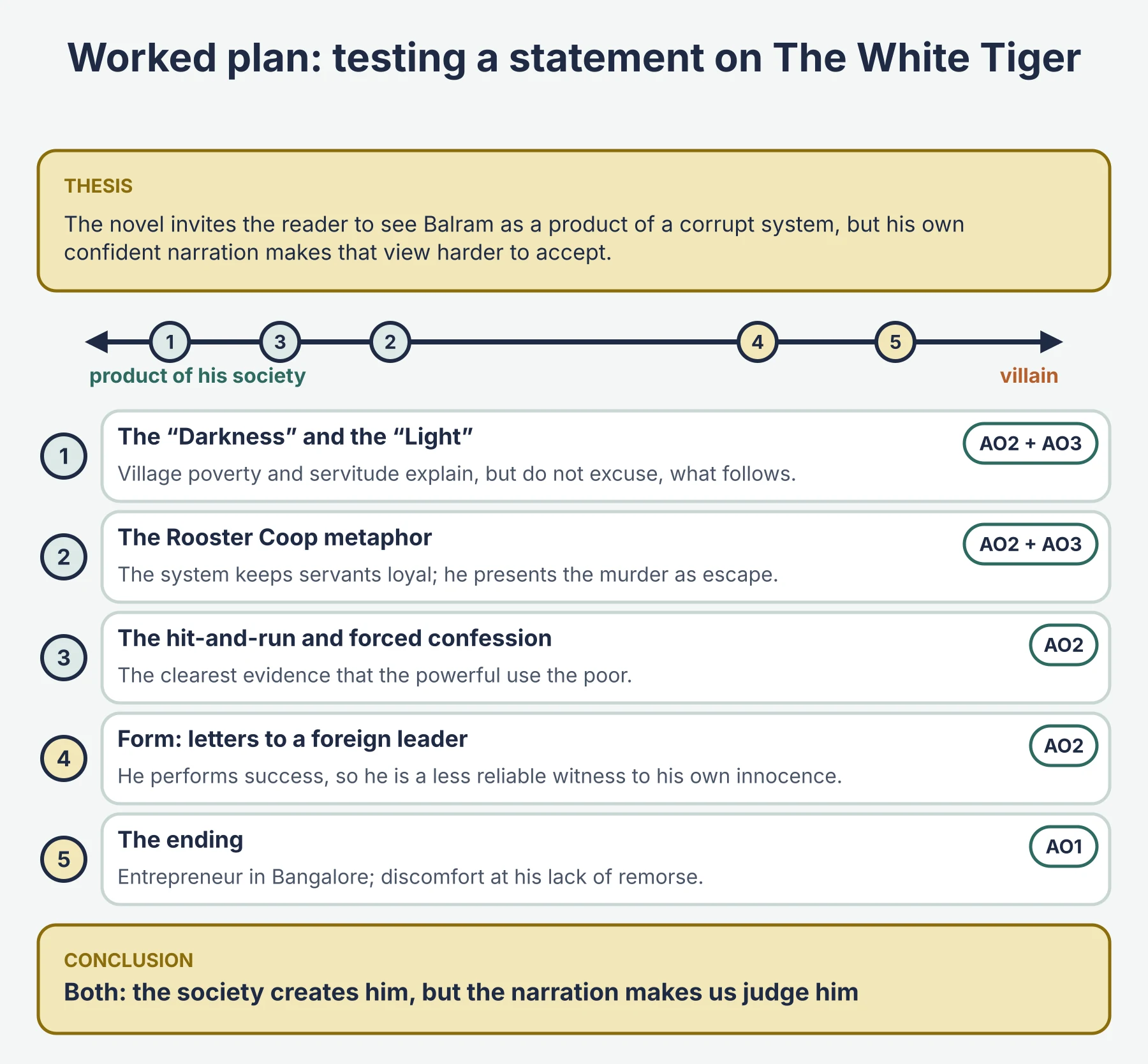
Statement (original): “Balram is more a product of his society than a villain.” Explore this view of The White Tiger.
Plan:
Thesis:   The novel invites the reader to see Balram as a product of a corrupt
          system, but his own confident narration makes that view harder to accept.
Para 1:   The "Darkness" and the "Light" - Balram's account of village poverty and
          servitude explains, but does not excuse, what follows (AO2 + AO3: rural
          poverty, class)
Para 2:   The Rooster Coop metaphor - the system keeps servants loyal; Balram presents
          the murder as escape from it (AO2: extended metaphor; AO3: servant culture)
Para 3:   The hit-and-run and the forced confession - the novel's clearest evidence
          that the powerful use the poor (AO2: structure, turning point)
Para 4:   Form - letters to a foreign leader: Balram performs success and markets
          himself, which makes him a less reliable witness to his own innocence (AO2: voice)
Para 5:   The ending - entrepreneur in Bangalore; the reader's discomfort at his
          lack of remorse and the likely cost to his family (AO1: judgement)
Conclusion: both - the society creates him, but the narration makes us judge him
Model paragraph (paragraph 4):
Adiga’s choice of form complicates any simple claim that Balram is only a product of his society. Because the novel is written as letters to the Chinese Premier, Balram is always performing: he presents himself as a self-made entrepreneur explaining the “real” India to a powerful outsider, and his comic confidence draws the reader in. Yet the same voice that exposes the corruption of masters and politicians also justifies a murder with unsettling ease. The epistolary form therefore makes the reader both an ally and a judge: we accept his diagnosis of an unequal society, written at a time of celebrated economic growth, while recognising that his account is designed to persuade.
What earns credit: AO1 argument tied to the statement; AO2 analysis of form and voice; AO3 context (economic growth and inequality) used to explain a narrative choice, not added as background.
Common mistakes
- Plot summary in place of analysis of narrative methods.
- Historical background paragraphs that never return to the novel.
- Ignoring the statement, or agreeing with it in the introduction and then forgetting it.
- Treating the narrator as the author, especially with first-person narrators such as Amir, Kambili and Balram.
- Quoting long passages from the open-book text with little comment.
- Writing only about character: structure, voice and symbols are what AO2 rewards.
Exam technique
- Read both questions; choose the statement you can test across the whole novel.
- Plan for five minutes: thesis, four or five points, ending.
- Use the open book for short, precise quotations you have already located during revision.
- Make each paragraph’s topic sentence answer the statement.
- Finish with a judgement that weighs the statement, not a summary.
Where to go next
- Unit 1 Post-2000 Prose revision notes
- Unit 1 Post-2000 Prose practice questions
- Unit 1 Post-2000 Poetry study guide
- Unit 3 Prose study guide, where these skills extend to comparing two novels
Official specification
Pearson Edexcel International Advanced Subsidiary/Advanced Level in English Literature, Issue 7, Unit 1 — qualifications.pearson.com.
Related resources
-
Practice questions
Pearson Edexcel International A Level English Literature (YET01): Unit 1 Post-2000 Prose – Practice Questions
Narrative-method drills on an original extract and 25-mark statement essays on each post-2000 novel for YET01 Unit 1 Section B, with indicative content by AO.
English Literature · Pearson Edexcel · AS Level
Try questions -
Revision notes
Pearson Edexcel International A Level English Literature (YET01): Unit 1 Post-2000 Prose – Revision Notes
Quick-recall notes for YET01 Unit 1 Section B: the five post-2000 novels, narrative methods, AO1 to AO3, statement questions, context, traps and a self-test.
English Literature · Pearson Edexcel · AS Level
Revise topic -
Study guides
Edexcel International A-Level English Literature: Post-2000 Poetry and Prose (YET01)
Unit 1 Post-2000 Poetry and Prose of Pearson Edexcel International A Level English Literature YET01, the first of the two International AS units.
English Literature · Pearson Edexcel · AS Level
Read guide
Get free revision emails (optional)
Occasional emails with practice questions, worked explanations and links to free resources for the qualification and subjects you choose. No spam, and you can unsubscribe from any email. The free tools on this site never need an email.