
Revision Notes
Pearson Edexcel International A Level English Literature (YET01): Unit 1 Post-2000 Poetry – Revision Notes
Quick-recall notes for YET01 Unit 1 Section A: the 21 prescribed poems by theme, key poetic features, AO1, AO2 and AO4, comparison structure and a self-test.
- Subject
- English Literature
- Level
- AS LEVEL
- Topic
- Unit 1 – Post-2000 Poetry and Prose
- Author
- Marlbridge Academic Team
- Updated
- Reviewed by
- Ammar Bilal (what this means)
Aligned to Pearson Edexcel A Level English Literature (YET01), For first teaching 2015 (units WET01–WET04). Official specification .
Syllabus page (what it covers and how it is assessed): Pearson Edexcel A Level English Literature.
Syllabus points this page covers
YET01 (AS Level)
- 1.3 Poetry
Found an error? Report a correction.
Need help with this topic? Request a free trial class for A Level English Literature (YET01).
Condensed notes for the poetry section of Unit 1 (WET01) in Pearson Edexcel International A Level English Literature (YET01). For the full method and a worked comparison, use the Unit 1 Post-2000 Poetry study guide.
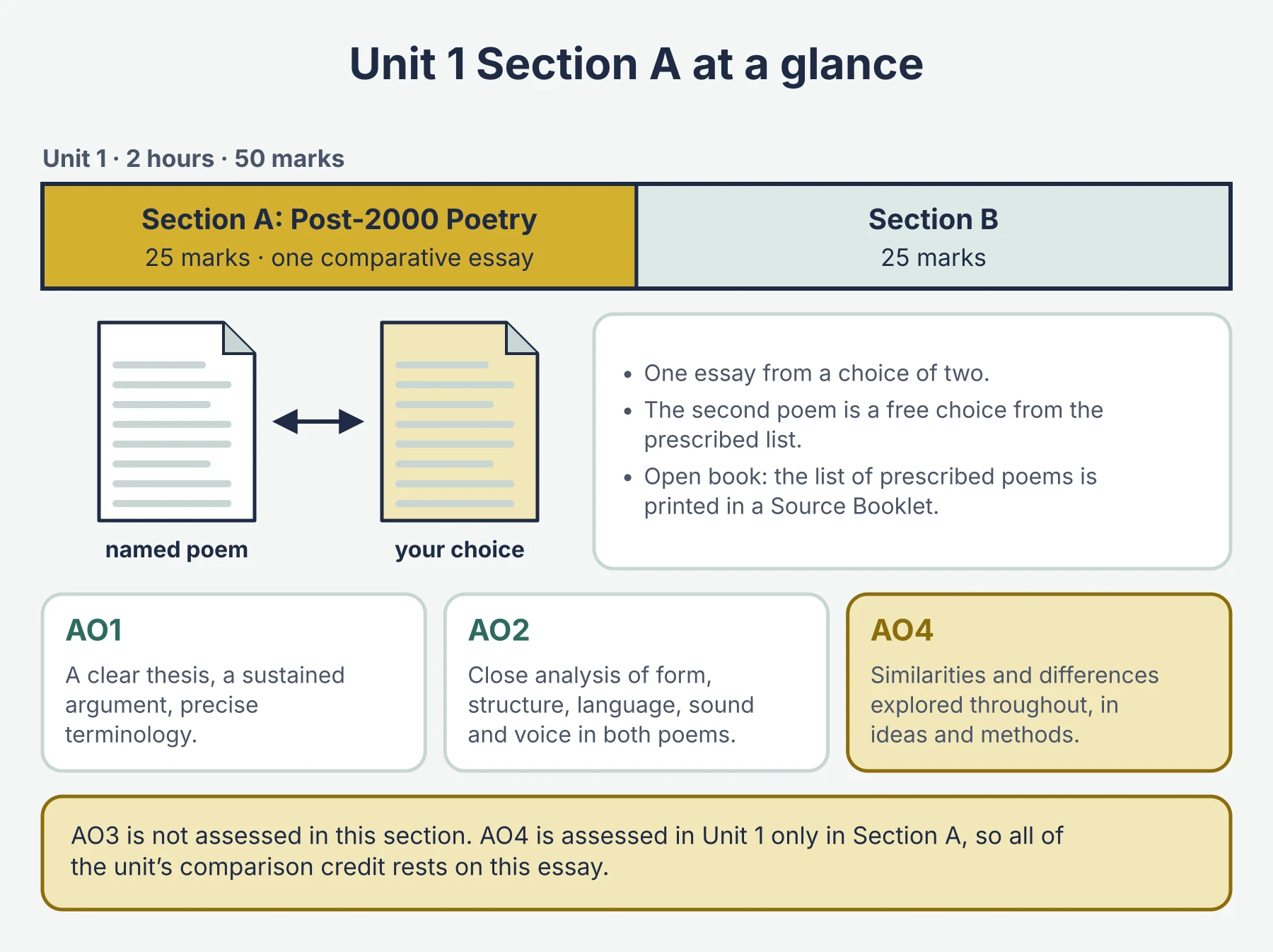
The task in one box
| Detail | Section A |
|---|---|
| Question | One from a choice of two; comparative |
| Poems | One named poem plus your own choice of a second from the prescribed list |
| Format | Open book; list of prescribed poems printed in a Source Booklet |
| Marks | 25 of the paper’s 50 |
| AOs | AO1, AO2, AO4 (no AO3) |
| Weighting | Unit 1 is 50% of the International AS and 25% of the International A Level |
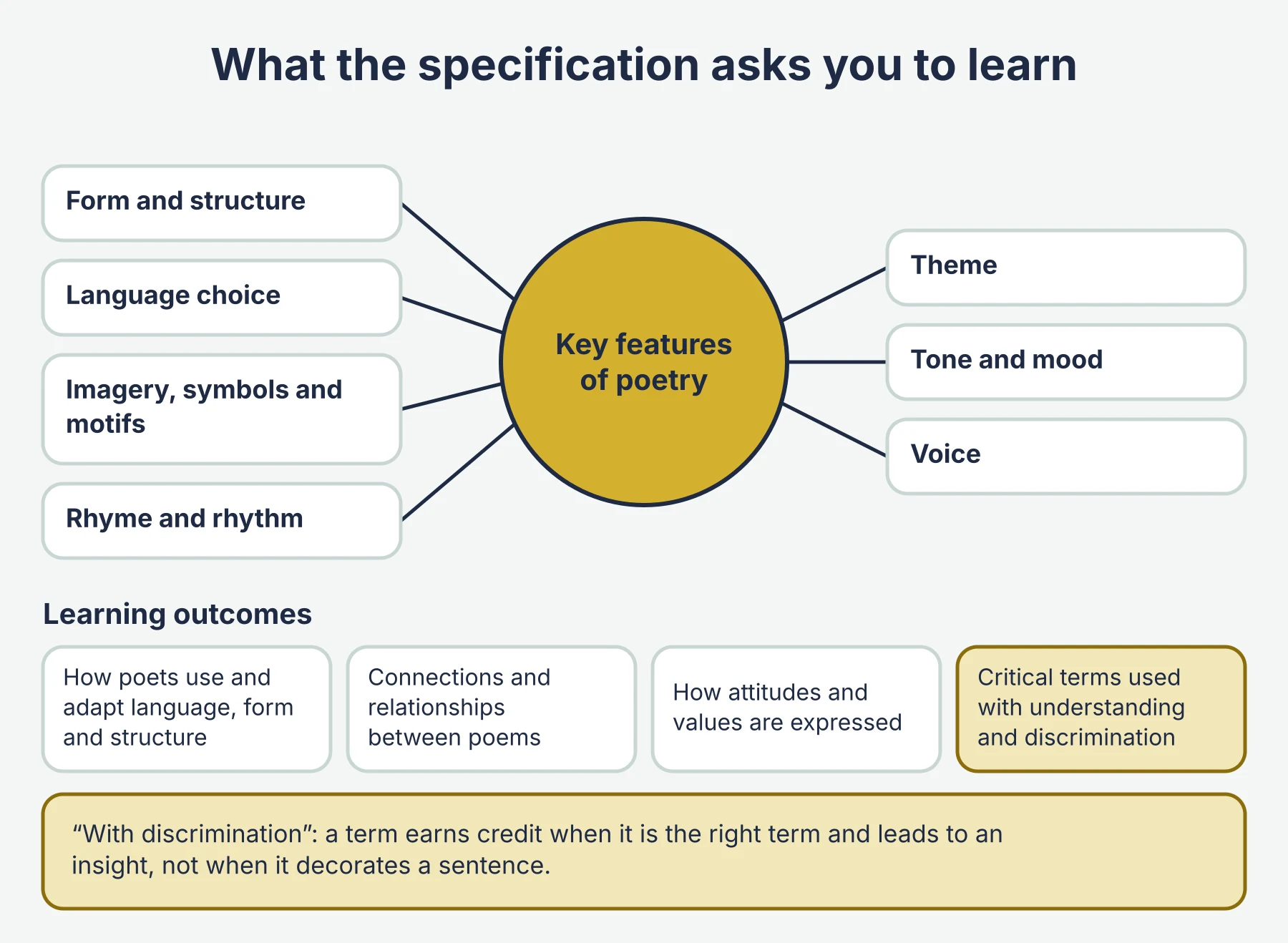
Key features of poetry (specification list)
Form and structure · language choice · imagery, symbols and motifs · rhyme and rhythm · theme · tone and mood · voice.
Recall table: the 21 prescribed poems
| Poem | Poet | One-line reminder |
|---|---|---|
| Eat Me | Patience Agbabi | A woman’s voice on a relationship of control through feeding |
| Chainsaw Versus the Pampas Grass | Simon Armitage | A man’s violent attack on a garden plant; power over nature |
| Material | Ros Barber | A mother’s handkerchiefs and a changing world; memory and loss |
| History | John Burnside | A parent and child on a beach in the shadow of world events |
| An Easy Passage | Julia Copus | A girl climbing into a house; adolescence observed |
| The Deliverer | Tishani Doshi | Adoption of an abandoned girl; rescue and its costs |
| The Map Woman | Carol Ann Duffy | A woman whose skin carries the map of her home town |
| The Lammas Hireling | Ian Duhig | A farmer’s confession about a mysterious hired man |
| To My Nine-Year-Old Self | Helen Dunmore | An adult addressing her childhood self |
| A Minor Role | U A Fanthorpe | Illness and hospital life seen through the language of theatre |
| The Gun | Vicki Feaver | A gun brought into a home and its effect on a relationship |
| The Furthest Distances I’ve Travelled | Leontia Flynn | Youthful travel and what it reveals |
| Giuseppe | Roderick Ford | A disturbing wartime story from Sicily, told second-hand |
| Out of the Bag | Seamus Heaney | Childhood beliefs about a doctor’s bag and birth |
| Effects | Alan Jenkins | A son’s memories of his mother and her last years |
| Genetics | Sinéad Morrissey | Inherited features as evidence of parents’ union |
| From the Journal of a Disappointed Man | Andrew Motion | An observer watching workmen on a pier |
| Look We Have Coming to Dover | Daljit Nagra | Migrants’ arrival in Britain, in a voice that resists Standard English |
| Please Hold | Ciaran O’Driscoll | Frustration with an automated telephone system |
| On Her Blindness | Adam Thorpe | A son on his mother’s loss of sight |
| Ode on a Grayson Perry Urn | Tim Turnbull | Modern youth culture on a contemporary pot, in a traditional form |
AO checklist
| AO | Ask yourself |
|---|---|
| AO1 | Is my thesis comparative, personal and sustained? Is my terminology accurate and useful? |
| AO2 | Have I analysed form, structure and language, and explained effects? |
| AO4 | Is there a connection in every paragraph, in methods as well as ideas? |
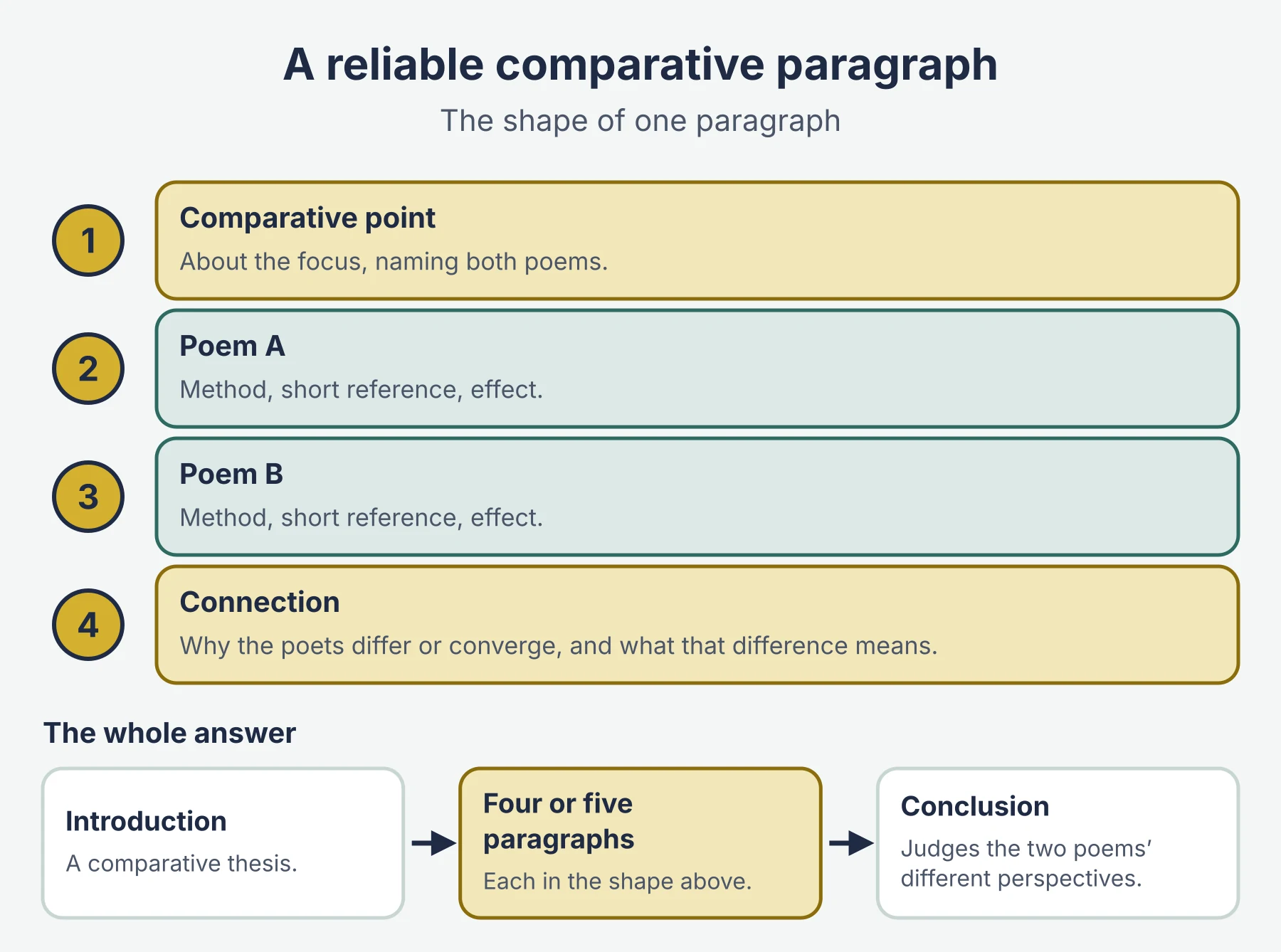
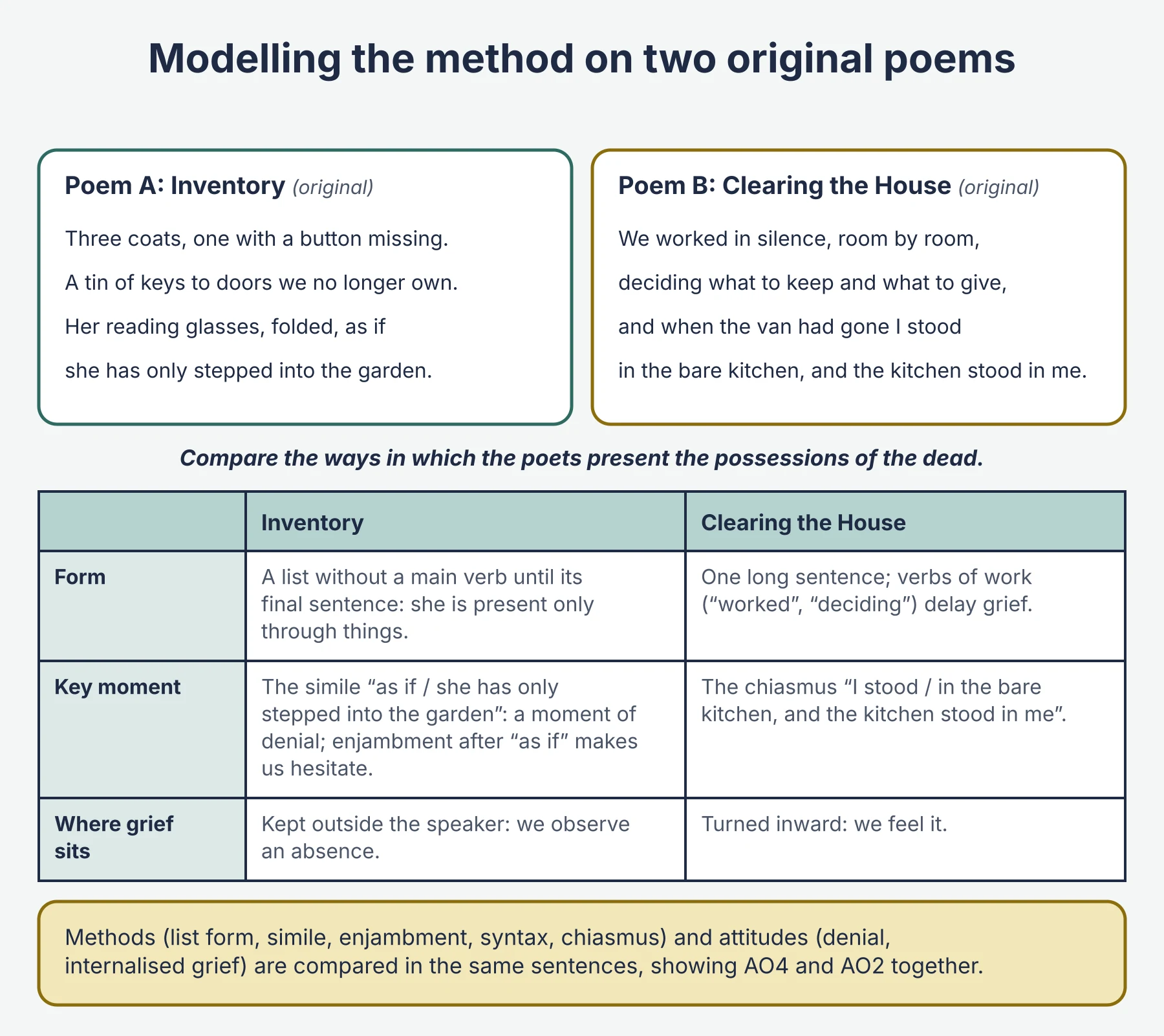
Comparison paragraph frame
- Comparative point (both poems named).
- Poem A: method → reference → effect.
- Poem B: method → reference → effect.
- Connection: what the difference reveals.
Useful connectives: whereas, by contrast, similarly, both poets, while A… B instead…, this difference suggests…
Key terms to use with discrimination
| Term | Meaning |
|---|---|
| Dramatic monologue | A poem spoken by a character, often revealing more than they intend |
| Volta | A turn in argument or mood |
| Enjambment | A sentence running over a line break |
| Caesura | A pause within a line |
| Chiasmus | A reversed repetition (A B / B A) |
| Free verse | Verse without regular metre or rhyme |
| Apostrophe | Direct address to an absent person, thing or idea |
| Intertextuality | Deliberate echo of another text |
| Persona | The speaker as distinct from the poet |
| Semantic field | A group of words from one area of meaning |
| Tone | The attitude a poem conveys |
| Motif | A recurring image or idea |
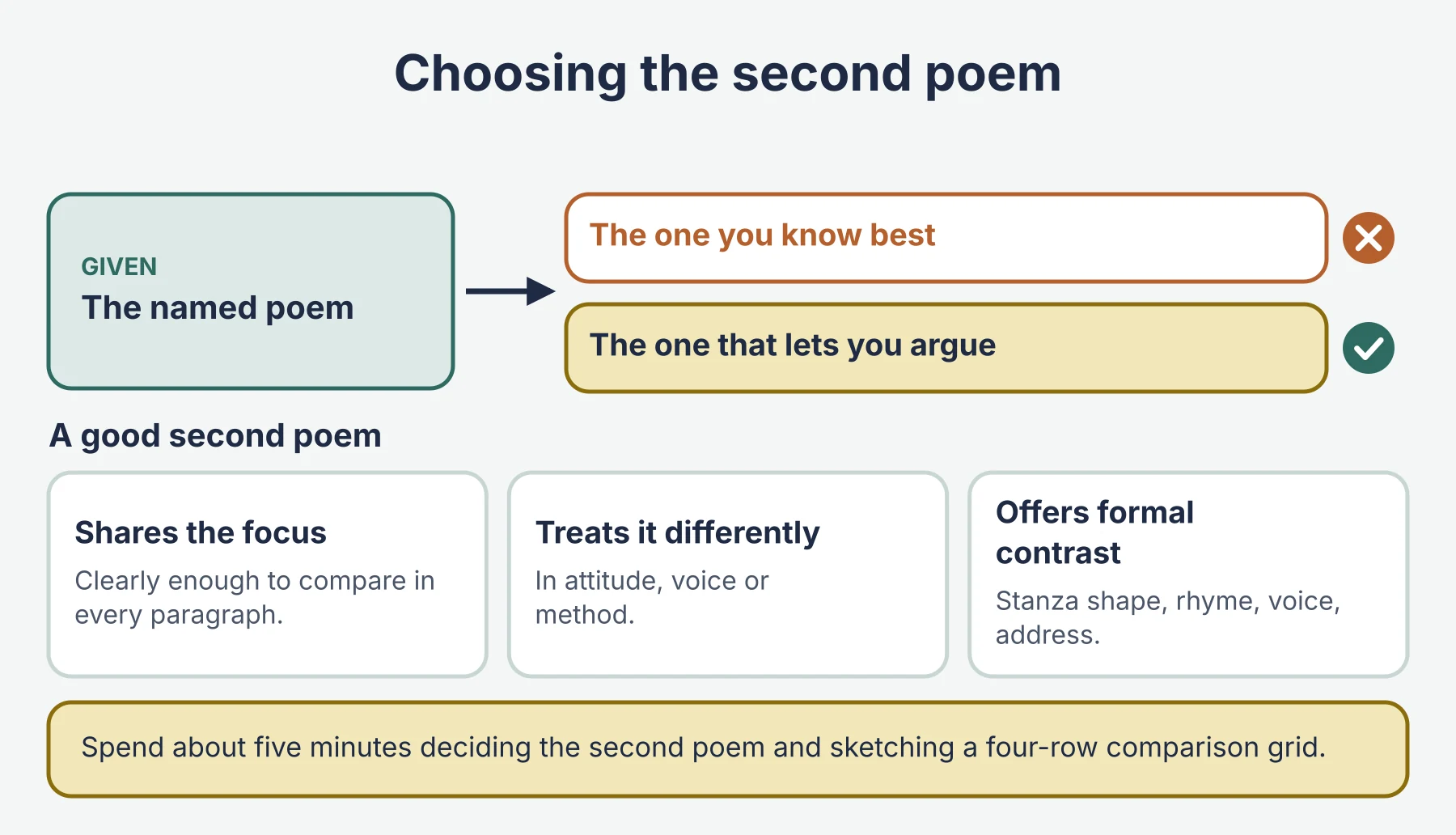
Choosing the second poem in two minutes
- Does it share the focus?
- Does it treat it differently?
- Does it offer formal contrast?
- Do you know where its key lines are?
Traps
- Two separate essays and a closing comparison.
- Context paragraphs (AO3 is not assessed here).
- Picking a second poem you know well but which barely fits.
- Paraphrasing instead of analysing.
- Ignoring how each poem ends.
- Using a term incorrectly to sound sophisticated.
Self-test
- How many marks is Section A worth, and which AOs are assessed?
- Which AO is not assessed in Section A?
- What is the structure of the question?
- Where is the list of prescribed poems printed in the exam?
- Name the seven key features of poetry in the specification.
- What does AO4 require?
- Give three tests for choosing a second poem.
- Why organise by point of comparison?
- What is a dramatic monologue?
- What does “terminology with discrimination” mean?
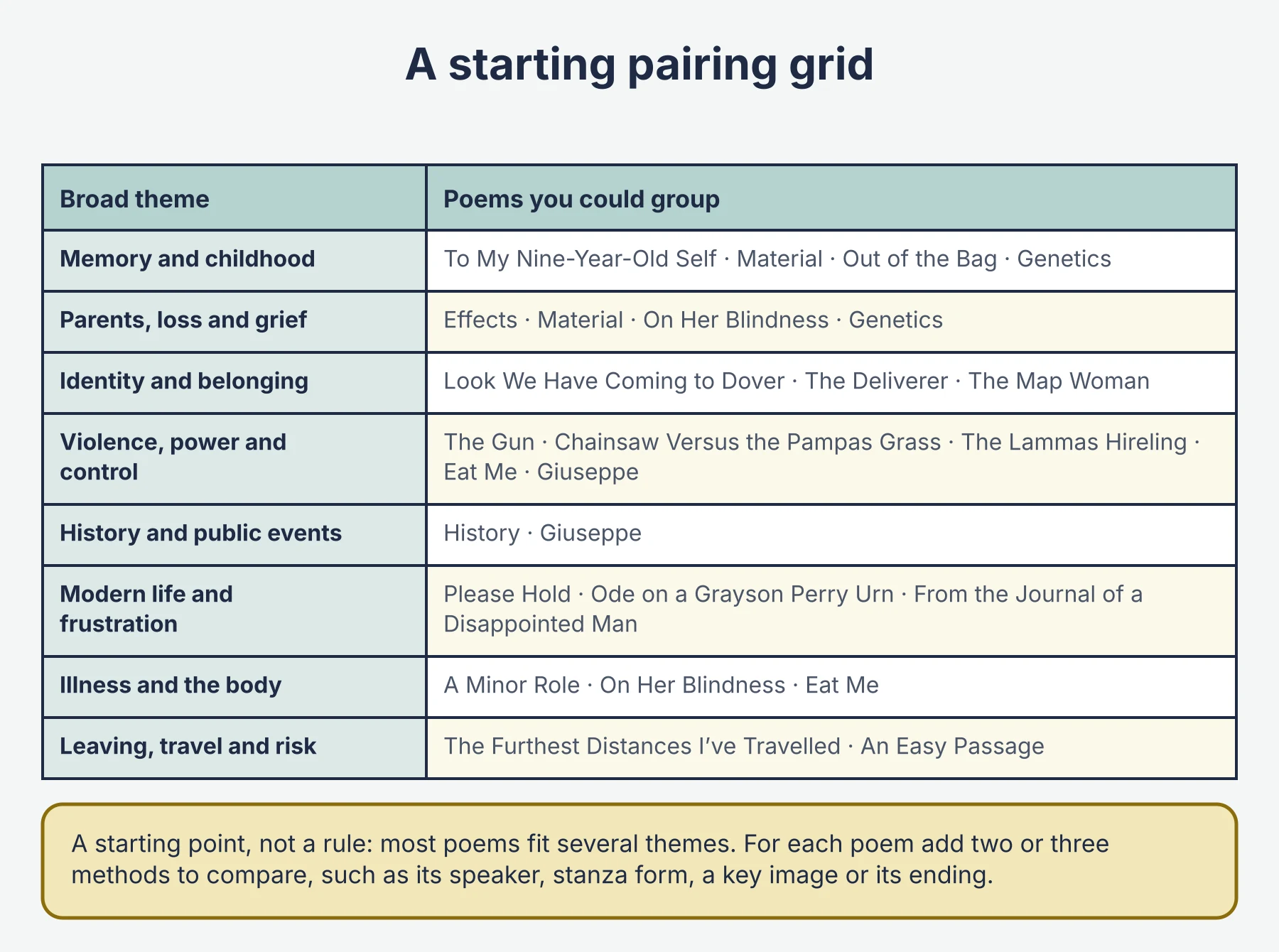
- Name two prescribed poems that could be compared on memory or childhood.
- What proportion of the International AS is Unit 1 worth?
Answers: 1. 25 marks; AO1, AO2, AO4. 2. AO3. 3. One named poem compared with a second poem of your choice from the prescribed list. 4. In a Source Booklet. 5. Form and structure; language choice; imagery, symbols and motifs; rhyme and rhythm; theme; tone and mood; voice. 6. Exploring connections across literary texts. 7. Shares the focus; treats it differently; offers formal contrast (also: you can find its key lines). 8. It keeps both poems in every paragraph, making AO4 visible throughout. 9. A poem spoken by a character, often revealing more than they intend. 10. Choosing the right term and using it to reach an insight, not as decoration. 11. Any two of To My Nine-Year-Old Self, Material, Out of the Bag, Genetics (or other defensible pairs). 12. 50%.
Related pages
Related resources
-
Study guides
Pearson Edexcel International A Level English Literature (YET01): Unit 1 Post-2000 Prose
How to answer the statement-based post-2000 novel essay in YET01 Unit 1 Section B: narrative methods, AO3 context and a worked plan on The White Tiger.
English Literature · Pearson Edexcel · AS Level
Read guide -
Practice questions
Pearson Edexcel International A Level English Literature (YET01): Unit 1 Post-2000 Prose – Practice Questions
Narrative-method drills on an original extract and 25-mark statement essays on each post-2000 novel for YET01 Unit 1 Section B, with indicative content by AO.
English Literature · Pearson Edexcel · AS Level
Try questions -
Revision notes
Pearson Edexcel International A Level English Literature (YET01): Unit 1 Post-2000 Prose – Revision Notes
Quick-recall notes for YET01 Unit 1 Section B: the five post-2000 novels, narrative methods, AO1 to AO3, statement questions, context, traps and a self-test.
English Literature · Pearson Edexcel · AS Level
Revise topic
Get free revision emails (optional)
Occasional emails with practice questions, worked explanations and links to free resources for the qualification and subjects you choose. No spam, and you can unsubscribe from any email. The free tools on this site never need an email.