
Study Guides
Pearson Edexcel International A Level English Literature (YET01): Unit 1 Post-2000 Poetry
How to write the comparative Poems of the Decade essay in YET01 Unit 1 Section A: AO1, AO2 and AO4, choosing a second poem, and a worked comparison.
- Subject
- English Literature
- Level
- AS LEVEL
- Topic
- Unit 1 – Post-2000 Poetry and Prose
- Author
- Marlbridge Academic Team
- Updated
- Reviewed by
- Ammar Bilal (what this means)
Aligned to Pearson Edexcel A Level English Literature (YET01), For first teaching 2015 (units WET01–WET04). Official specification .
Syllabus page (what it covers and how it is assessed): Pearson Edexcel A Level English Literature.
Syllabus points this page covers
YET01 (AS Level)
- 1.3 Poetry
Found an error? Report a correction.
Need help with this topic? Request a free trial class for A Level English Literature (YET01).
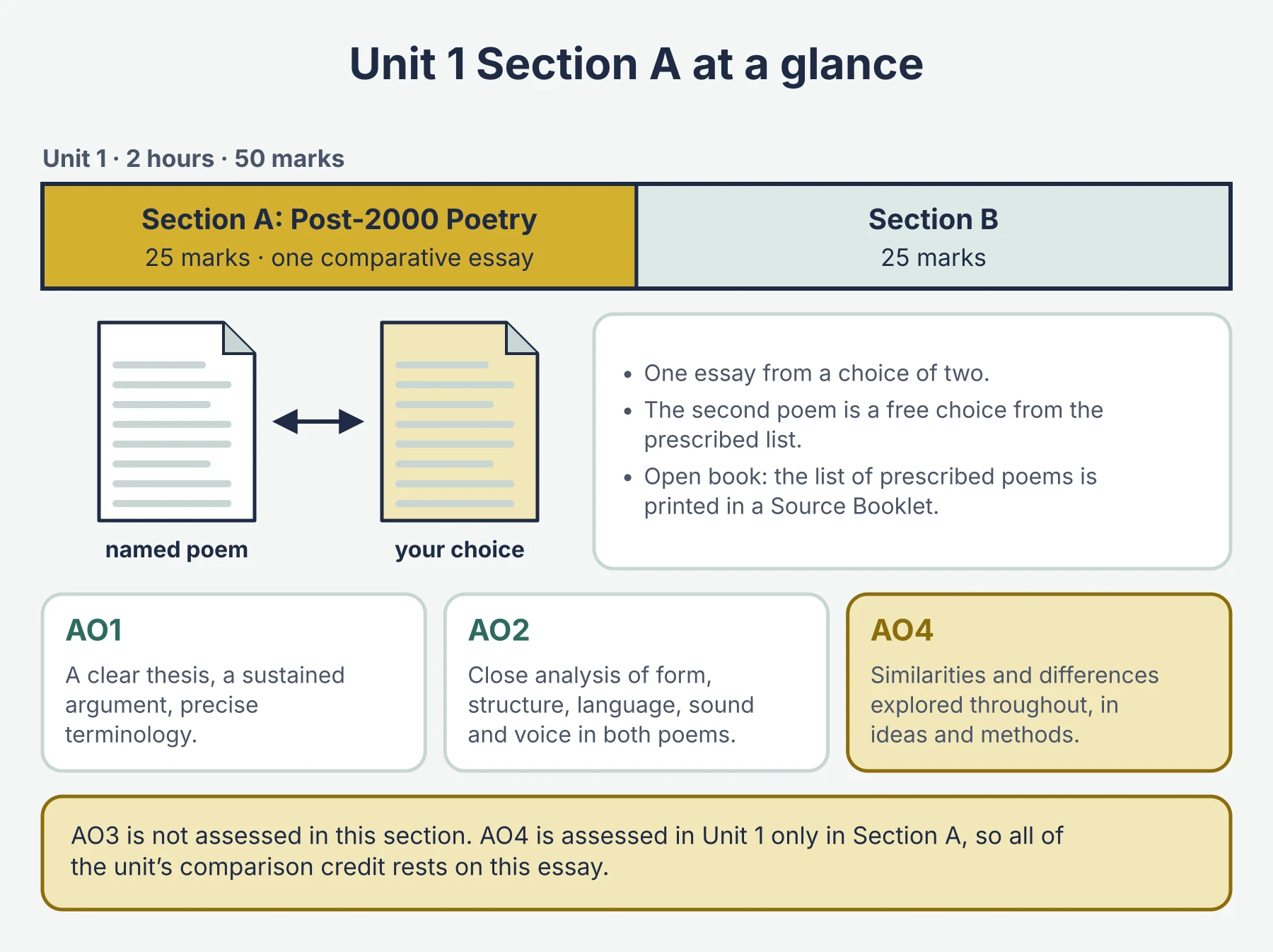
Section A of Unit 1 (WET01) is a comparative essay on poems from the prescribed selection of Poems of the Decade: An Anthology of the Forward Books of Poetry 2002–2011. This guide goes deeper than the Unit 1 overview: it explains what the specification asks you to learn about poetry, how comparison is assessed, how to choose your second poem quickly, and how to structure an argument that makes connections in every paragraph.
What Section A covers
| Detail | Section A: Post-2000 Poetry |
|---|---|
| Task | One essay from a choice of two |
| Question type | Comparative: one named poem plus a free choice of second poem from the prescribed list |
| Texts in the exam | Open book; the list of prescribed poems is printed in a Source Booklet |
| Marks | 25 |
| AOs | AO1, AO2, AO4 (AO3 is not assessed in this section) |
Unit 1 lasts 2 hours for 50 marks in total, so Section A is worth half the paper. Because AO4 is assessed in Unit 1 only in Section A, the whole of the unit’s comparison credit rests on this essay.
What the specification asks you to learn
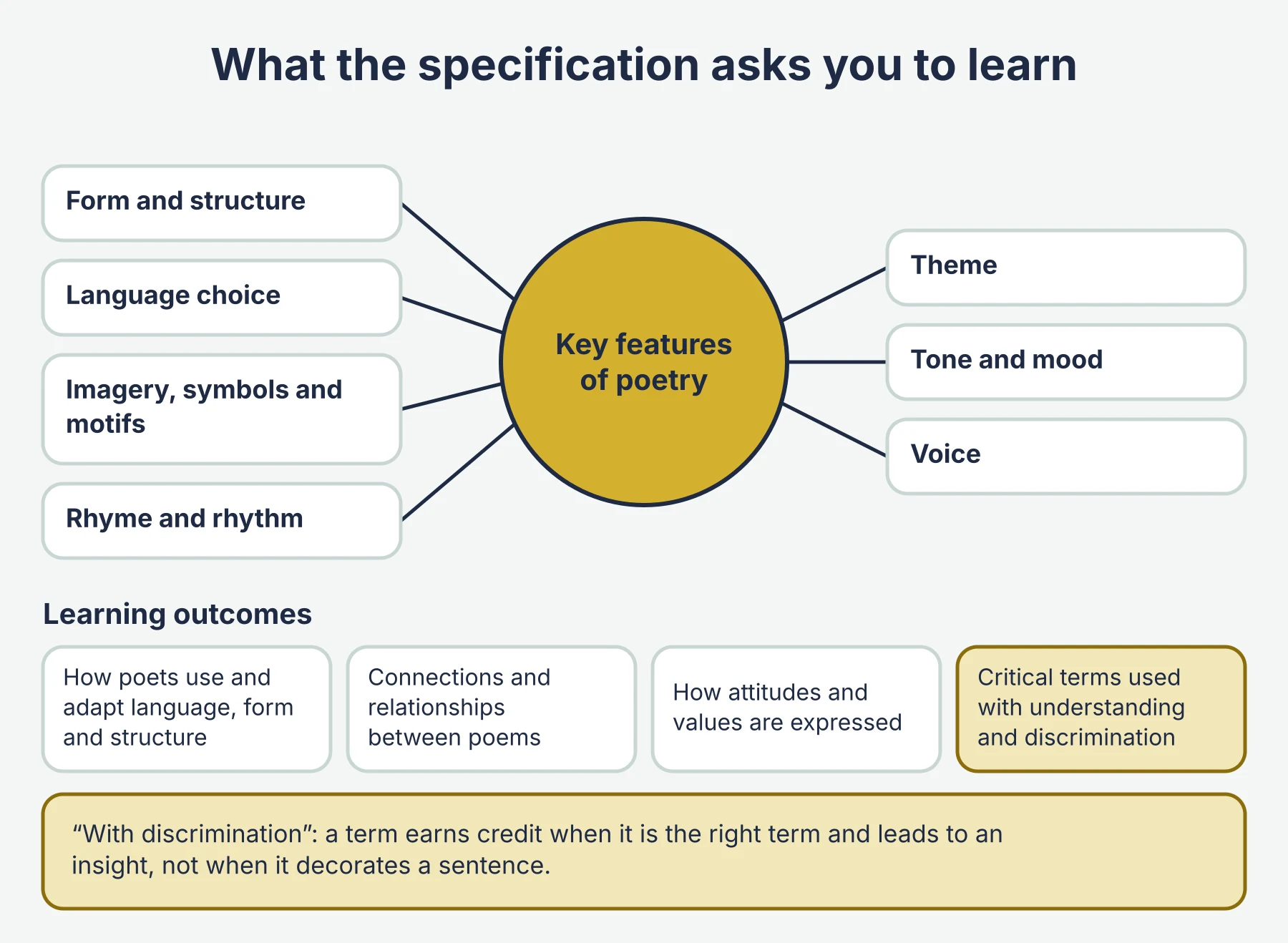
The specification lists key features of poetry to be studied: form and structure; language choice; imagery, symbols and motifs; rhyme and rhythm; theme; tone and mood; and voice. Its learning outcomes add that you should:
- read for detail of how poets use and adapt language, form and structure, responding critically and creatively
- make connections and explore the relationships between poems
- identify and explore how attitudes and values are expressed
- use literary critical concepts and terminology with understanding and discrimination.
“With discrimination” matters: a term earns credit when it is the right term and leads to an insight, not when it decorates a sentence.
The three assessment objectives in Section A
| AO | Wording | What it looks like in a comparison essay |
|---|---|---|
| AO1 | Articulate informed, personal and creative responses to literary texts, using associated concepts and terminology, and coherent, accurate written expression | A clear thesis, a sustained argument, precise terminology |
| AO2 | Analyse ways in which meanings are shaped in literary texts | Close analysis of form, structure, language, sound and voice in both poems |
| AO4 | Explore connections across literary texts | Similarities and differences explored throughout, in ideas and methods |
Choosing the second poem
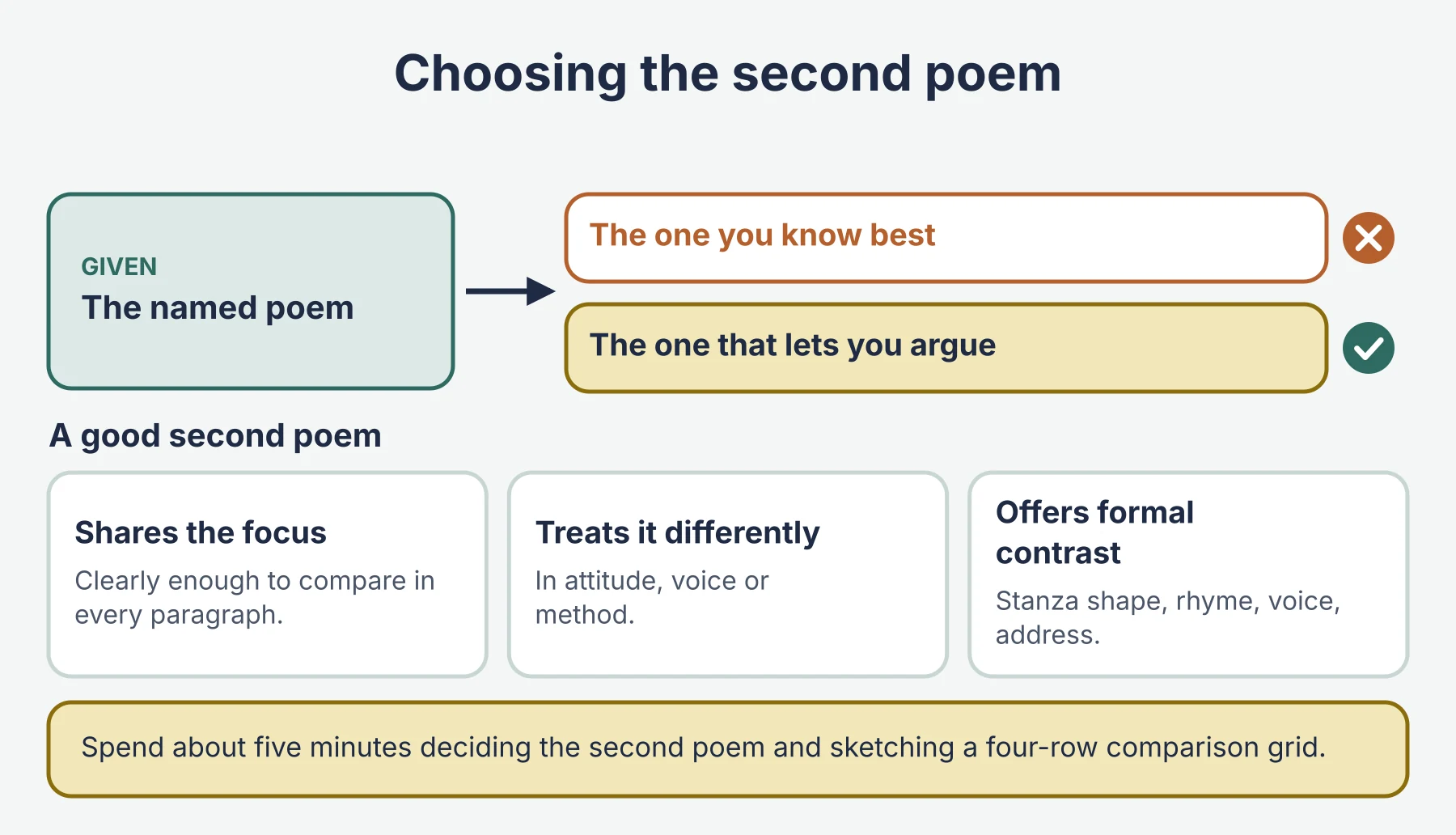
The named poem is given; the second is yours. The right choice is the poem that lets you argue, not the one you know best. A good second poem:
- shares the question’s focus clearly enough for you to compare in every paragraph
- treats that focus differently in attitude, voice or method
- offers enough formal contrast (stanza shape, rhyme, voice, address) to analyse.
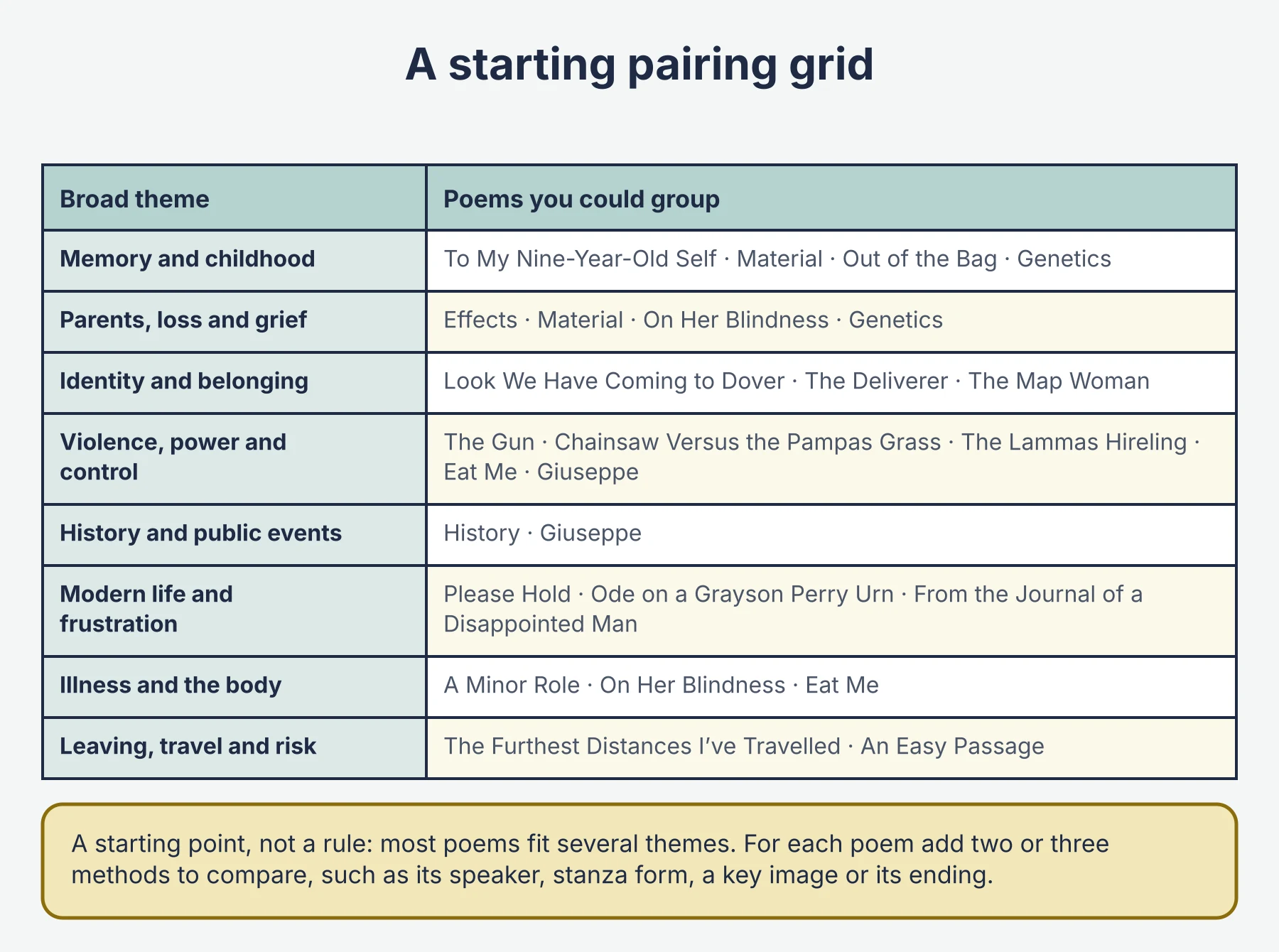
Prepare by building a pairing grid before the exam. A starting grid by broad theme:
| Broad theme | Poems you could group |
|---|---|
| Memory and childhood | To My Nine-Year-Old Self, Material, Out of the Bag, Genetics |
| Parents, loss and grief | Effects, Material, On Her Blindness, Genetics |
| Identity and belonging | Look We Have Coming to Dover, The Deliverer, The Map Woman |
| Violence, power and control | The Gun, Chainsaw Versus the Pampas Grass, The Lammas Hireling, Eat Me, Giuseppe |
| History and public events | History, Giuseppe |
| Modern life and frustration | Please Hold, Ode on a Grayson Perry Urn, From the Journal of a Disappointed Man |
| Illness and the body | A Minor Role, On Her Blindness, Eat Me |
| Leaving, travel and risk | The Furthest Distances I’ve Travelled, An Easy Passage |
Groupings are a starting point, not a rule; most poems fit several themes. For each poem, add two or three methods you could compare (for example its use of a speaker, its stanza form, a key image, its ending) so that the comparison is ready on both levels.
Structuring the comparison
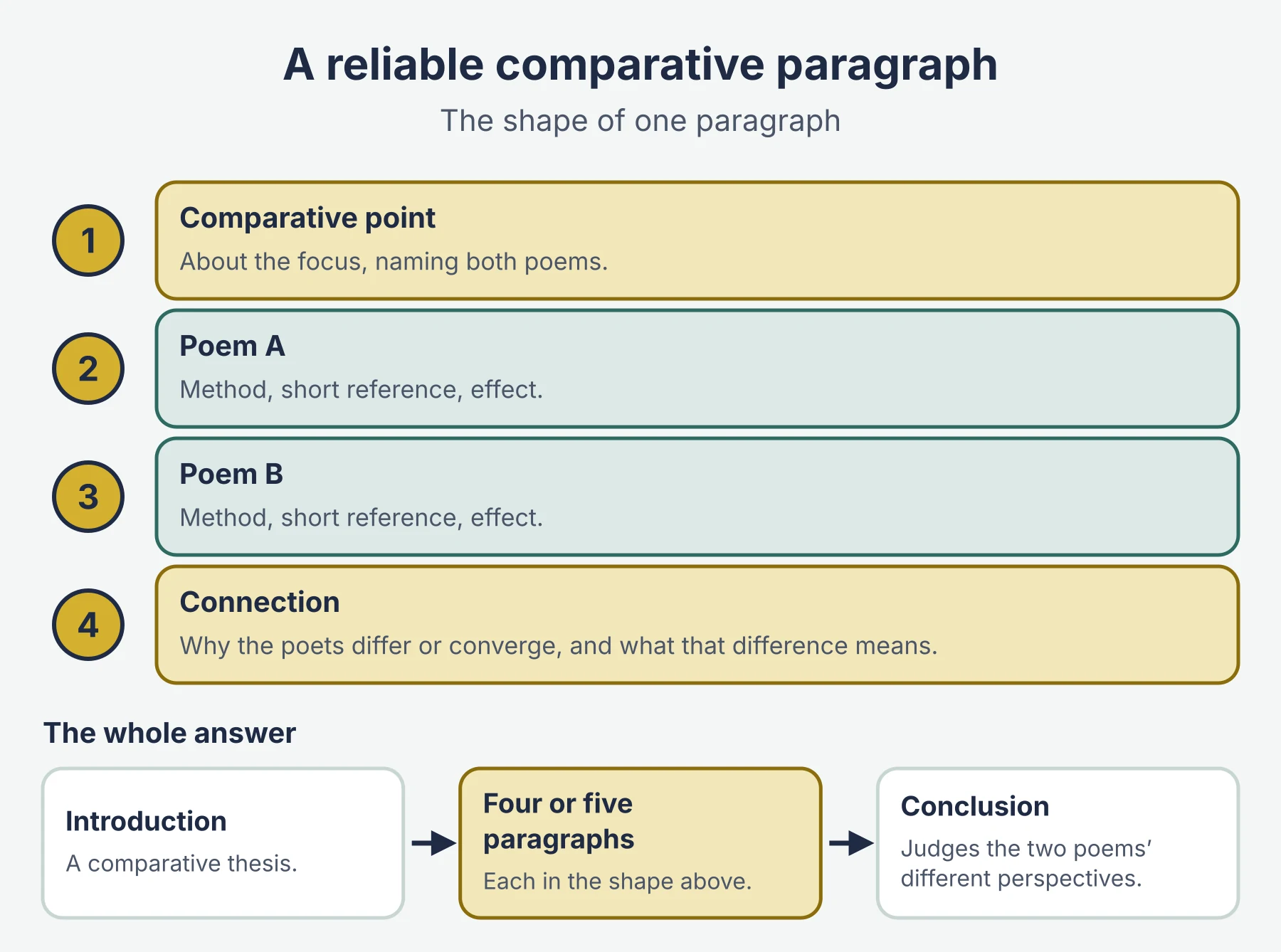
Organise by point of comparison, not poem by poem. A reliable paragraph shape:
- Comparative point about the focus, naming both poems.
- Poem A: method, short reference, effect.
- Poem B: method, short reference, effect.
- Connection: why the poets differ (or converge), and what that difference means.
Four or five such paragraphs, an introduction with a comparative thesis, and a short conclusion that judges the two poems’ different perspectives make a complete answer.
Worked example: modelling the method
Because the prescribed poems are in copyright, the method is shown here on two short original poems written for this page. Apply the same steps to your anthology.
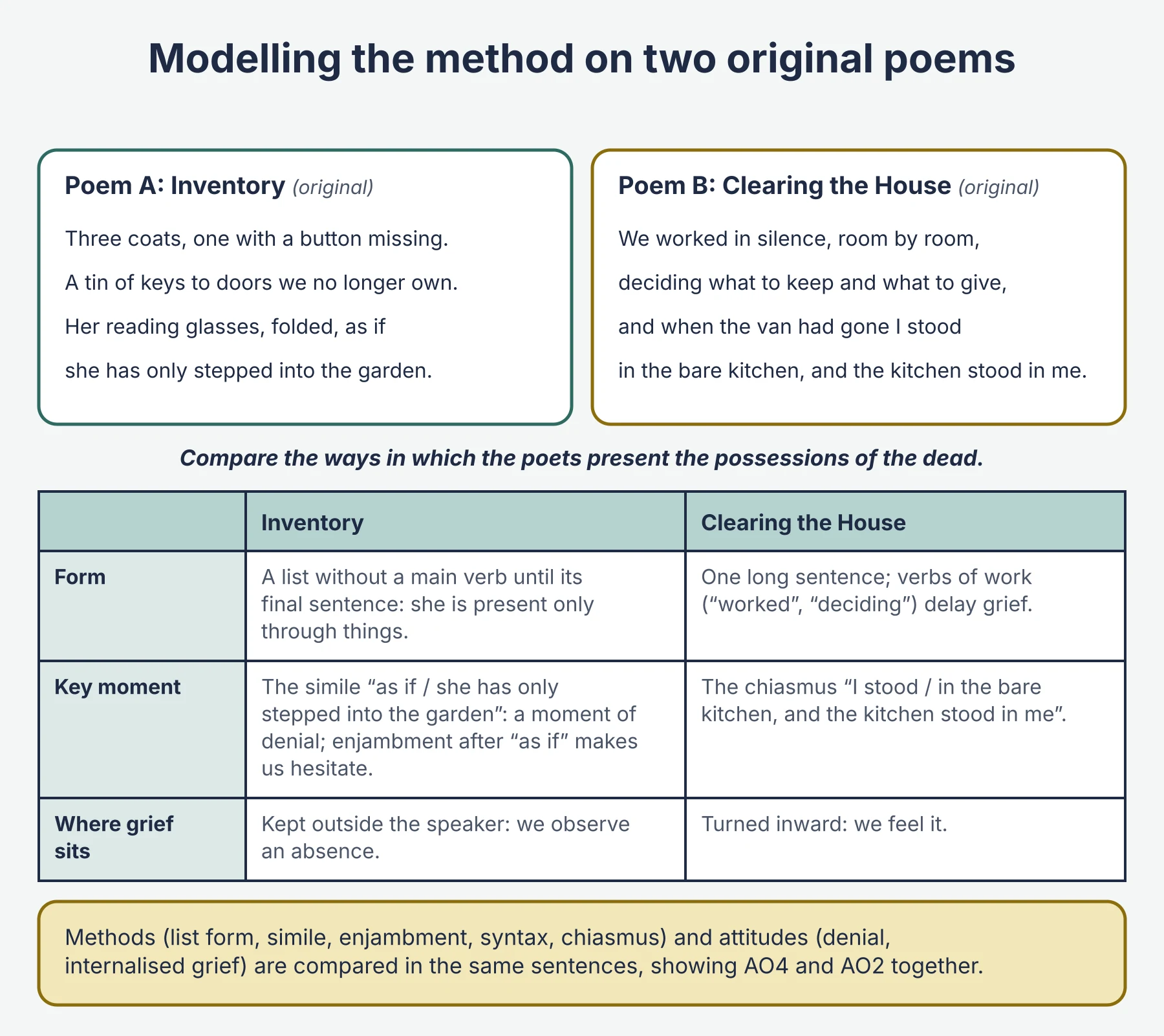
Poem A: Inventory (original)
Three coats, one with a button missing.
A tin of keys to doors we no longer own.
Her reading glasses, folded, as if
she has only stepped into the garden.
Poem B: Clearing the House (original)
We worked in silence, room by room,
deciding what to keep and what to give,
and when the van had gone I stood
in the bare kitchen, and the kitchen stood in me.
Question: Compare the ways in which the poets present the possessions of the dead.
Comparative introduction:
Both poems treat a dead person’s belongings as the place where grief becomes visible, but they differ in where they locate that grief. Inventory stays with the objects, letting a flat list carry feeling the speaker never names, whereas Clearing the House moves from objects to absence, ending with the speaker’s sense that the emptied room now lives inside her.
Comparative paragraph:
The poems use form to control emotion in opposite ways. Inventory is a list without a main verb until its final sentence, so the dead woman is present only through things; the final simile, “as if / she has only stepped into the garden”, allows a moment of denial, and the enjambment after “as if” makes the reader hesitate with the speaker. Clearing the House is built from one long sentence, its verbs of work (“worked”, “deciding”) delaying grief until the chiasmus of the last line, “I stood / in the bare kitchen, and the kitchen stood in me”. Where the first poem keeps the loss outside the speaker, the second turns it inward, so the reader moves from observing an absence to feeling it.
The paragraph compares methods (list form, simile, enjambment, syntax, chiasmus) and attitudes (denial and internalised grief) in the same sentences, which is how AO4 and AO2 are shown together.
Using the open book well
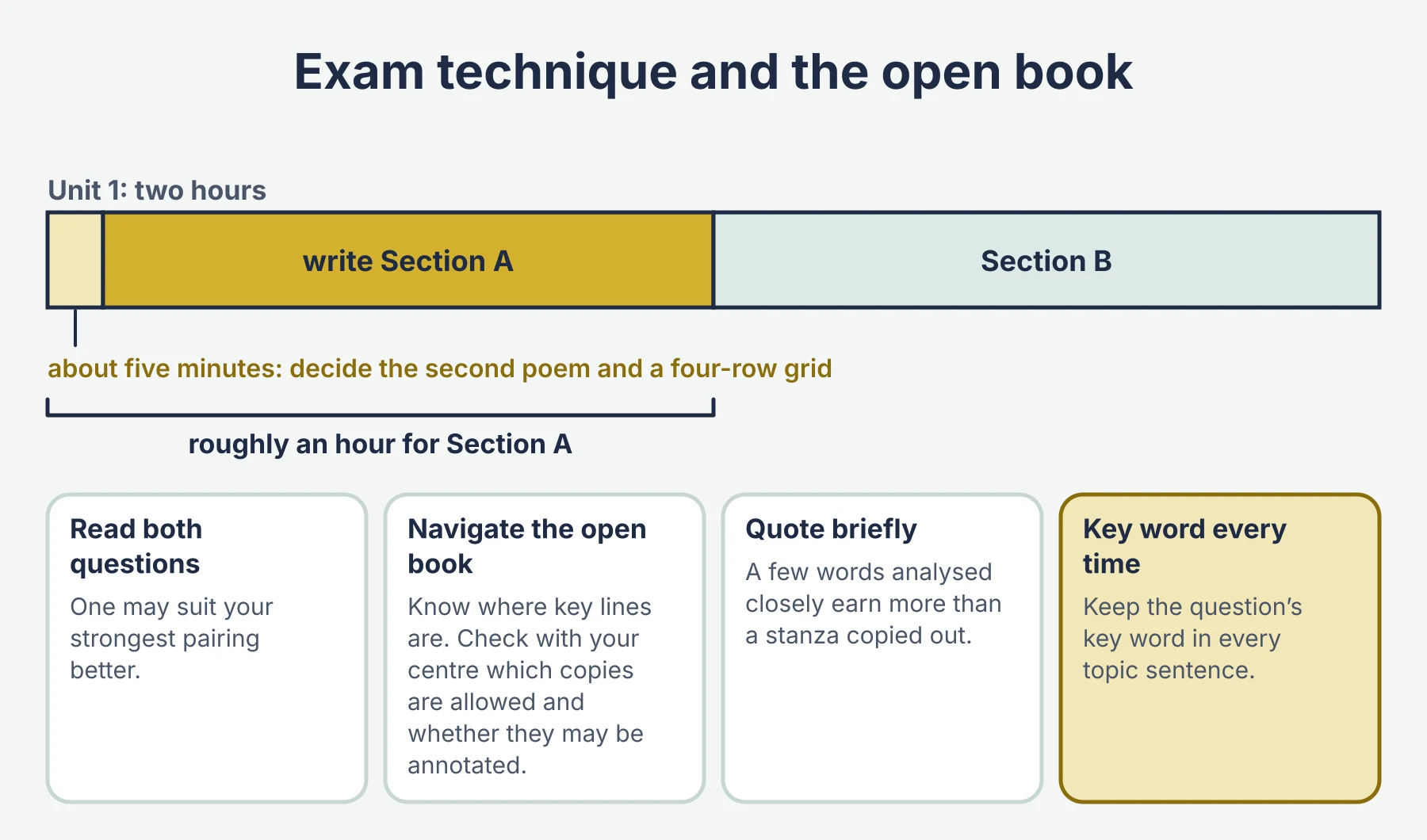
The anthology is with you, so the skill is navigation. Know where each poem’s key lines are, and check with your centre which copies are allowed into the exam and whether they may contain any annotation. Quote briefly and precisely: a few words analysed closely earn more than a stanza copied out.
Common mistakes
- Choosing the second poem by familiarity rather than by how well it fits the question.
- Two separate commentaries with a comparison paragraph at the end.
- Context paragraphs: AO3 is not assessed in Section A, so biography earns nothing here.
- Feature-spotting: naming enjambment or caesura without explaining its effect.
- Comparing content only: two poems about mothers is a starting point; how each poet shapes the subject is the comparison.
- Ignoring endings and turns, where poems often change their attitude.
Exam technique
- Read both questions before choosing; one may suit your strongest pairing better.
- Spend about five minutes deciding the second poem and a four-row comparison grid.
- Allow roughly an hour for Section A, leaving the rest of the two hours for Section B.
- Keep the question’s key word in every topic sentence.
Where to go next
- Unit 1 Post-2000 Poetry revision notes
- Unit 1 Post-2000 Poetry practice questions
- Unit 1 Post-2000 Prose study guide
- Unit 3 Poetry study guide, where these skills are applied to an unseen poem
Official specification
Pearson Edexcel International Advanced Subsidiary/Advanced Level in English Literature, Issue 7, Unit 1 — qualifications.pearson.com.
Related resources
-
Practice questions
Pearson Edexcel International A Level English Literature (YET01): Unit 1 Post-2000 Poetry – Practice Questions
Short comparison drills on two original poems and 25-mark comparative essays in the Unit 1 Section A format for YET01, with indicative content and guidance.
English Literature · Pearson Edexcel · AS Level
Try questions -
Revision notes
Pearson Edexcel International A Level English Literature (YET01): Unit 1 Post-2000 Poetry – Revision Notes
Quick-recall notes for YET01 Unit 1 Section A: the 21 prescribed poems by theme, key poetic features, AO1, AO2 and AO4, comparison structure and a self-test.
English Literature · Pearson Edexcel · AS Level
Revise topic -
Study guides
Pearson Edexcel International A Level English Literature (YET01): Unit 1 Post-2000 Prose
How to answer the statement-based post-2000 novel essay in YET01 Unit 1 Section B: narrative methods, AO3 context and a worked plan on The White Tiger.
English Literature · Pearson Edexcel · AS Level
Read guide
Get free revision emails (optional)
Occasional emails with practice questions, worked explanations and links to free resources for the qualification and subjects you choose. No spam, and you can unsubscribe from any email. The free tools on this site never need an email.