
Study Guides
Pearson Edexcel International A Level English Literature (YET01): Unit 3 Unseen Poetry
How to read and write about the unseen post-1900 poem in YET01 Unit 3 Section A: AO1 and AO2, a reading sequence, ambiguity, and an annotated original poem.
- Subject
- English Literature
- Level
- A LEVEL
- Topic
- Unit 3: Poetry and Prose
- Author
- Marlbridge Academic Team
- Updated
- Reviewed by
- Ammar Bilal (what this means)
Aligned to Pearson Edexcel A Level English Literature (YET01), For first teaching 2015 (units WET01–WET04). Official specification .
Syllabus page (what it covers and how it is assessed): Pearson Edexcel A Level English Literature.
Syllabus points this page covers
YET01 (A Level)
- 3.3 Poetry
Found an error? Report a correction.
Need help with this topic? Request a free trial class for A Level English Literature (YET01).
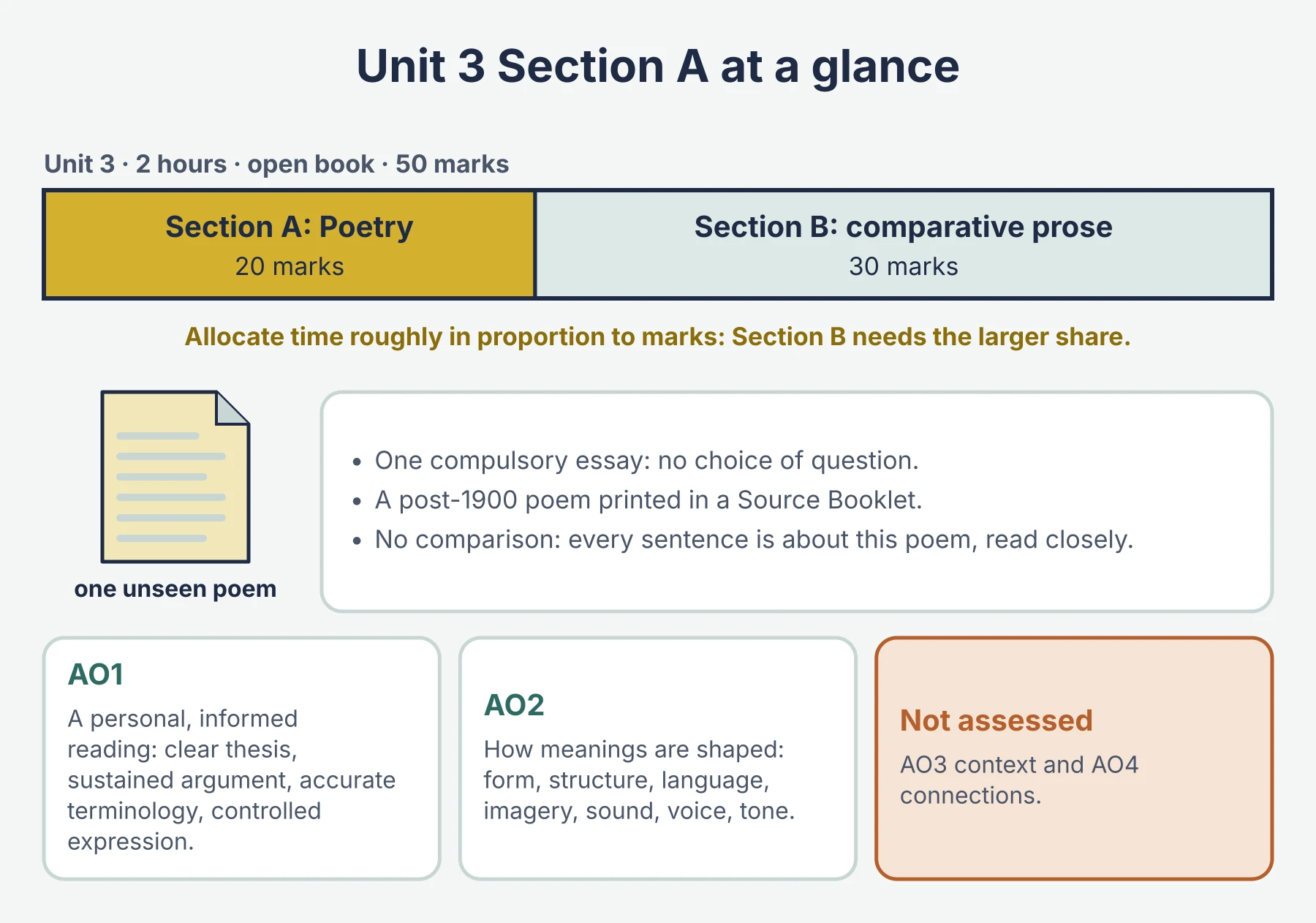
Section A of Unit 3 (WET03) is the only part of the International A Level where you meet a poem for the first time in the exam. The specification frames it simply: you study “how to apply the poetry learning from Unit 1 to unseen post-1900 poetry”. This guide explains what that means in practice, offers a reading sequence for the planning time, and models an answer on an original poem. The Unit 3 study guide covers the paper as a whole.
What Section A covers
| Detail | Section A: Poetry |
|---|---|
| Task | One compulsory essay on one unseen post-1900 poem |
| Text | Printed in a Source Booklet |
| Marks | 20 of the paper’s 50 |
| AOs | AO1 and AO2 only |
| Paper | 2 hours, open book; Section B is a 30-mark comparative prose essay |
There is no choice of question and no comparison. Context (AO3) and connections (AO4) are not assessed here, so every sentence should be about this poem, read closely.
What the learning outcomes ask
The specification’s 3.3 outcomes ask you to:
- show knowledge and understanding of the function of key features in poetry
- read for detail of how poets use and adapt language, form and structure in poems, responding critically and creatively
- communicate fluently, accurately and effectively your critical evaluation
- identify and explore how attitudes and values are expressed
- use literary critical concepts and terminology with understanding and discrimination
- refer accurately and appropriately to texts.
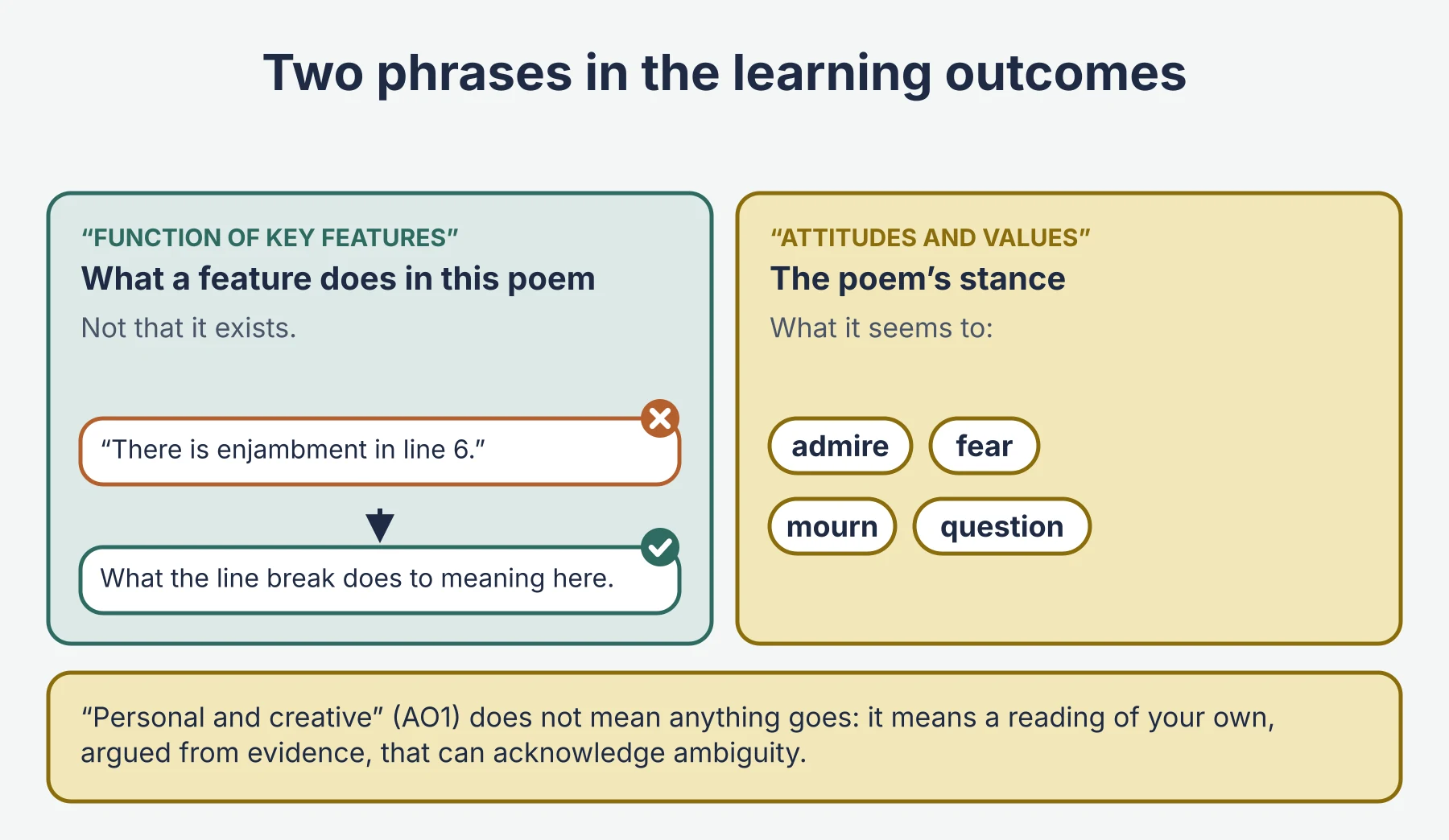
Two phrases deserve attention. “Function of key features” means explaining what a feature does in this poem, not that it exists. “Attitudes and values” means the poem’s stance: what it seems to admire, fear, mourn or question.
AO1 and AO2 in an unseen essay
| AO | In this section it means |
|---|---|
| AO1 | A personal, informed reading with a clear thesis, sustained argument, accurate terminology and controlled expression |
| AO2 | Analysis of how meanings are shaped: form, structure, language, imagery, sound, voice, tone |
“Personal and creative” (AO1) does not mean anything goes. It means a reading of your own, argued from evidence, that can acknowledge ambiguity.
A reading sequence for the planning time
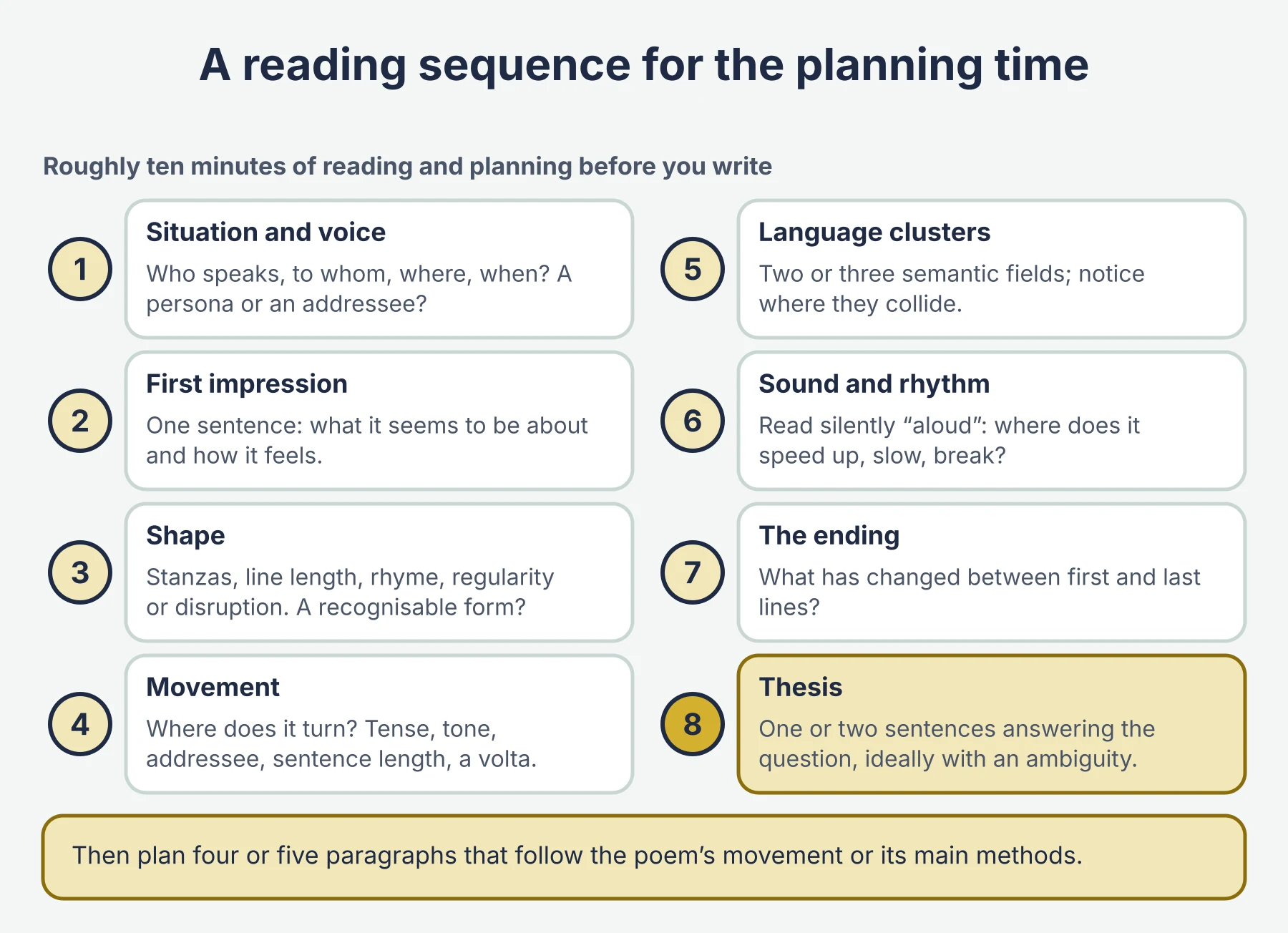
Spend roughly ten minutes reading and planning before you write.
- Situation and voice. Who speaks, to whom, where, when? Is there a persona, or an addressee?
- First impression. Write one sentence: what the poem seems to be about and how it feels.
- Shape. Stanza pattern, line length, rhyme or its absence, regularity or disruption. Is it a recognisable form (sonnet, villanelle, dramatic monologue, free verse, prose poem)?
- Movement. Where does the poem turn? Look for changes of tense, tone, addressee or sentence length, and for a volta.
- Language clusters. Group images and words into two or three semantic fields; notice where they collide.
- Sound and rhythm. Read silently “aloud”: where does it speed up, slow down, break?
- The ending. What has changed between first and last lines?
- Thesis. One or two sentences answering the question, ideally including an ambiguity.
Then plan four or five paragraphs that follow the poem’s movement or its main methods.
Handling unfamiliar forms and difficulty
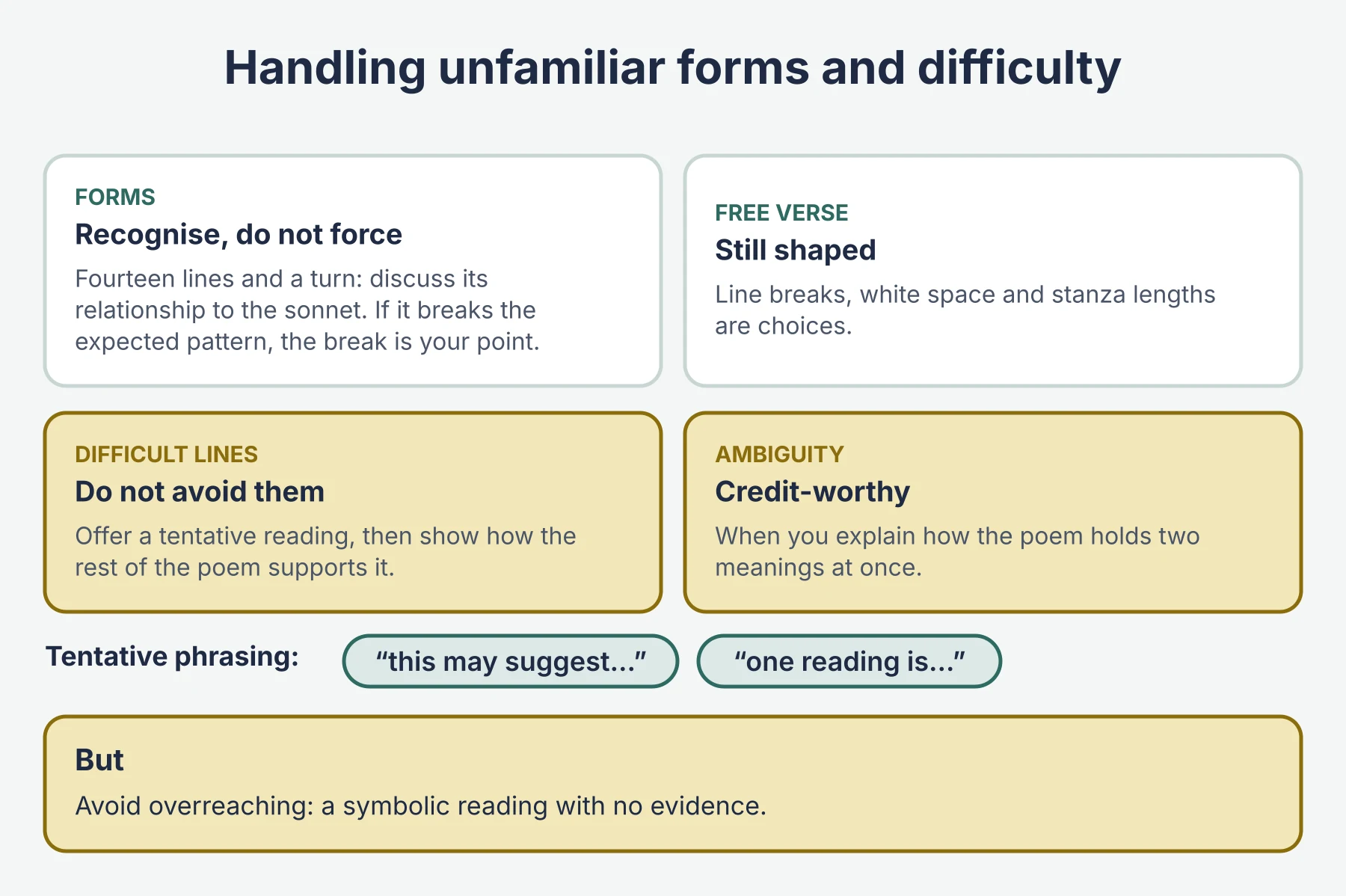
- Recognise forms but do not force them. If a poem has fourteen lines and a turn, discuss its relationship to the sonnet; if it breaks the expected pattern, the break is your point.
- Free verse is still shaped. Line breaks, white space and stanza lengths are choices.
- Difficult lines are not to be avoided. Offer a tentative reading (“this may suggest…”, “one reading is…”) and show how the rest of the poem supports it.
- Ambiguity is credit-worthy when you explain how the poem holds two meanings at once.
Worked example on an original poem
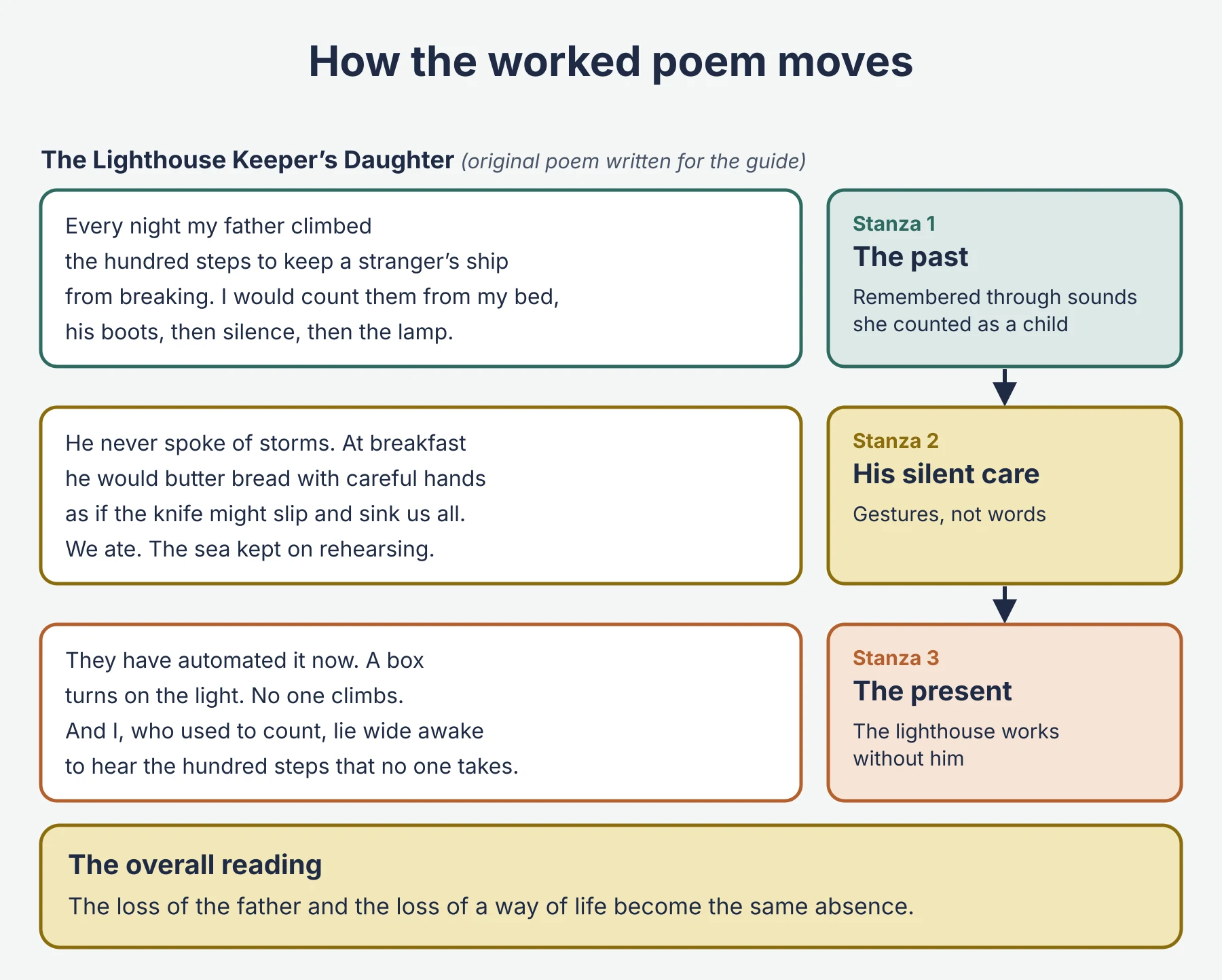
The Lighthouse Keeper’s Daughter (an original poem written for this page)
Every night my father climbed
the hundred steps to keep a stranger’s ship
from breaking. I would count them from my bed,
his boots, then silence, then the lamp.He never spoke of storms. At breakfast
he would butter bread with careful hands
as if the knife might slip and sink us all.
We ate. The sea kept on rehearsing.They have automated it now. A box
turns on the light. No one climbs.
And I, who used to count, lie wide awake
to hear the hundred steps that no one takes.
Question (original): Explore the poet’s presentation of memory and loss in this poem. In your answer you should consider the poet’s use of language, form and structure.
Introduction:
The poem presents memory as something carried in the body and the ear: the speaker remembers her father less through what he said than through sounds and gestures she counted as a child. Its three-stanza structure moves from the past, through a portrait of his silent care, to a present in which the lighthouse works without him, so that the loss of the father and the loss of a way of life become the same absence.
Body paragraph:
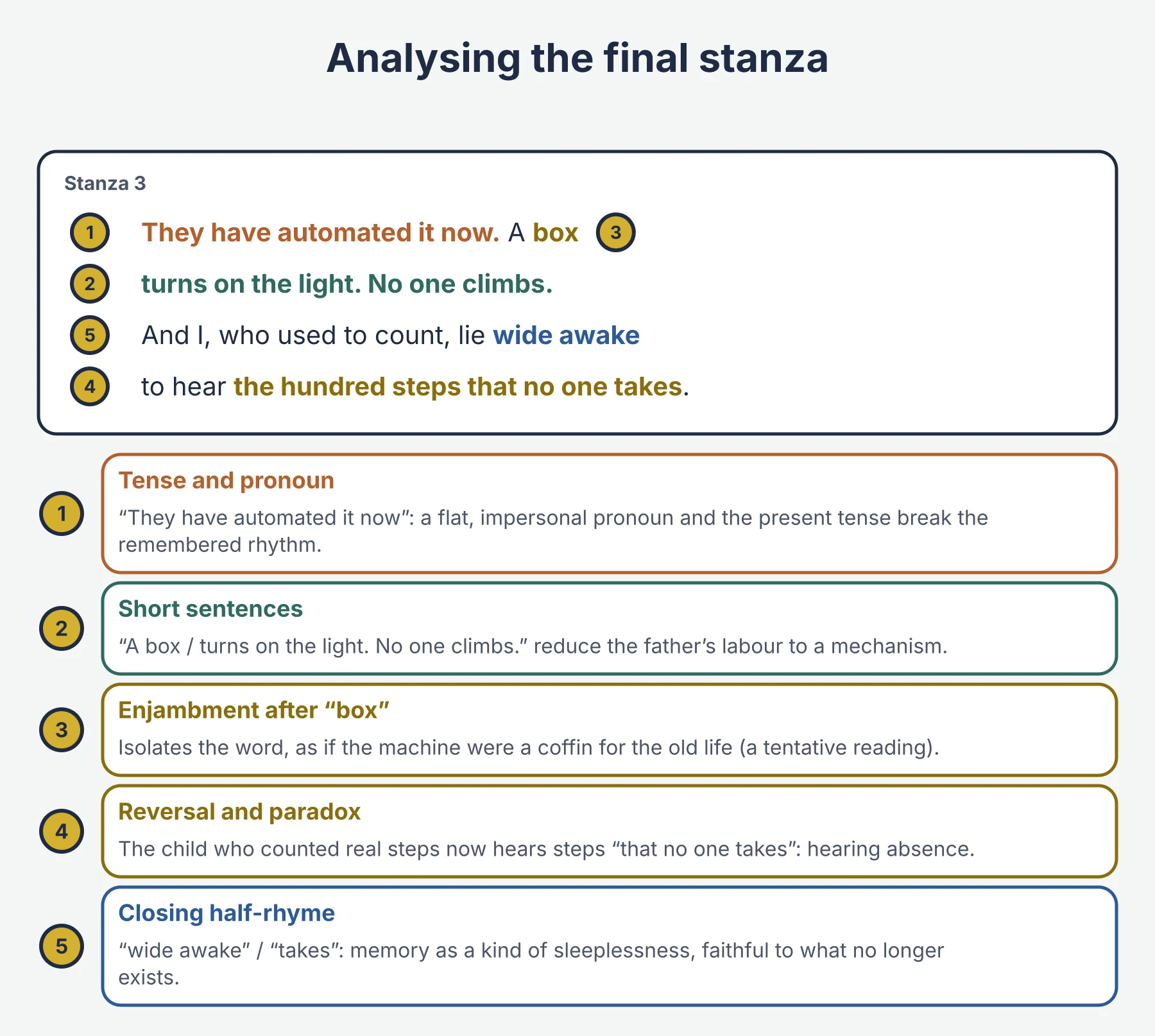
The final stanza turns on the plain statement “They have automated it now”, whose flat, impersonal pronoun and present tense break the remembered rhythm of the first two stanzas. The short sentences “A box / turns on the light. No one climbs.” reduce the father’s nightly labour to a mechanism, and the enjambment after “box” isolates the word, as if the machine were a coffin for the old life. The last two lines then reverse the poem’s opening: the child who once counted real steps now hears “the hundred steps that no one takes”. The paradox of hearing absence, sharpened by the closing half-rhyme of “wide awake” with “takes”, suggests that memory has become a kind of sleeplessness, faithful to something that no longer exists.
What earns credit: a clear, personal thesis (AO1); analysis of structure (tense shift, stanza movement), syntax, enjambment, paradox and rhyme, each tied to meaning (AO2); an interpretation that is tentative where the poem is ambiguous (“as if… a coffin”).
Building the essay
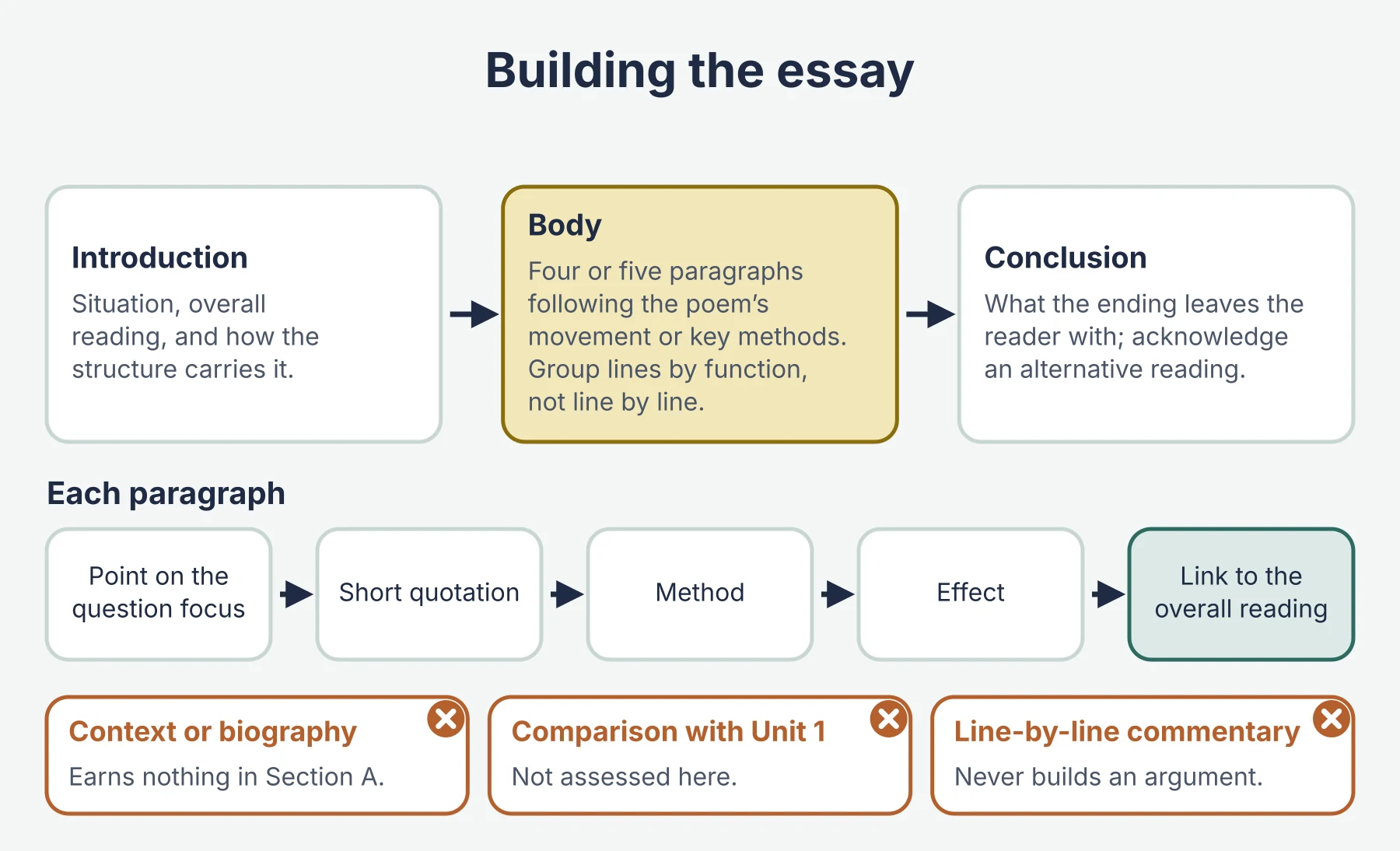
- Introduction: situation, overall reading, and how the poem’s structure carries it.
- Body: four or five paragraphs following the poem’s movement or its key methods. Do not analyse line by line; group lines by function.
- Each paragraph: point on the question focus, short quotation, method, effect, link to the overall reading.
- Conclusion: what the poem’s ending leaves the reader with; acknowledge an alternative reading.
Common mistakes
- Context or biography: guessing the poet’s life or period earns nothing in Section A.
- Comparison with poems from Unit 1: not assessed here.
- Line-by-line commentary that never builds an argument.
- Feature-spotting: “there is enjambment in line 6”.
- Ignoring form in a free-verse poem.
- Overreaching: a symbolic reading with no evidence.
- Overrunning: Section B carries 30 marks and needs the larger share of the two hours.
Exam technique
- Allocate time roughly in proportion to marks: Section A is 20 of 50.
- Annotate the Source Booklet: circle the turn, bracket image clusters, mark the ending.
- Use the question’s key words in your thesis and topic sentences.
- Quote a few words at a time and analyse them.
- Practise regularly with unfamiliar post-1900 poems of different forms and periods.
Where to go next
- Unit 3 Unseen Poetry revision notes
- Unit 3 Unseen Poetry practice questions
- Unit 3 Prose study guide
- Unit 1 Post-2000 Poetry study guide, where the poetry skills are first built
Official specification
Pearson Edexcel International Advanced Subsidiary/Advanced Level in English Literature, Issue 7, Unit 3 — qualifications.pearson.com.
Related resources
-
Practice questions
Pearson Edexcel International A Level English Literature (YET01): Unit 3 Unseen Poetry – Practice Questions
Three original unseen poems with short AO2 questions and 20-mark essay tasks in the YET01 Unit 3 Section A format, with mark-scheme-style answers and guidance.
English Literature · Pearson Edexcel · A Level
Try questions -
Revision notes
Pearson Edexcel International A Level English Literature (YET01): Unit 3 Unseen Poetry – Revision Notes
Quick-recall notes for the YET01 Unit 3 unseen post-1900 poem: AO1 and AO2, an eight-step reading sequence, forms, key terms, traps and a self-test.
English Literature · Pearson Edexcel · A Level
Revise topic -
Study guides
Pearson Edexcel International A Level English Literature (YET01): Unit 3 Thematic Prose
How to write the 30-mark comparative prose essay in YET01 Unit 3 Section B: AO1 to AO4, comparison frameworks by theme, context, and a worked Theme 4 plan.
English Literature · Pearson Edexcel · A Level
Read guide
Get free revision emails (optional)
Occasional emails with practice questions, worked explanations and links to free resources for the qualification and subjects you choose. No spam, and you can unsubscribe from any email. The free tools on this site never need an email.