
Revision Notes
Pearson Edexcel International A Level English Literature (YET01): Unit 3 Unseen Poetry – Revision Notes
Quick-recall notes for the YET01 Unit 3 unseen post-1900 poem: AO1 and AO2, an eight-step reading sequence, forms, key terms, traps and a self-test.
- Subject
- English Literature
- Level
- A LEVEL
- Topic
- Unit 3: Poetry and Prose
- Author
- Marlbridge Academic Team
- Updated
- Reviewed by
- Ammar Bilal (what this means)
Aligned to Pearson Edexcel A Level English Literature (YET01), For first teaching 2015 (units WET01–WET04). Official specification .
Syllabus page (what it covers and how it is assessed): Pearson Edexcel A Level English Literature.
Syllabus points this page covers
YET01 (A Level)
- 3.3 Poetry
Found an error? Report a correction.
Need help with this topic? Request a free trial class for A Level English Literature (YET01).
Condensed notes for Section A of Unit 3 (WET03) in Pearson Edexcel International A Level English Literature (YET01). For the full method and an annotated example, use the Unit 3 Unseen Poetry study guide.
The task in one box
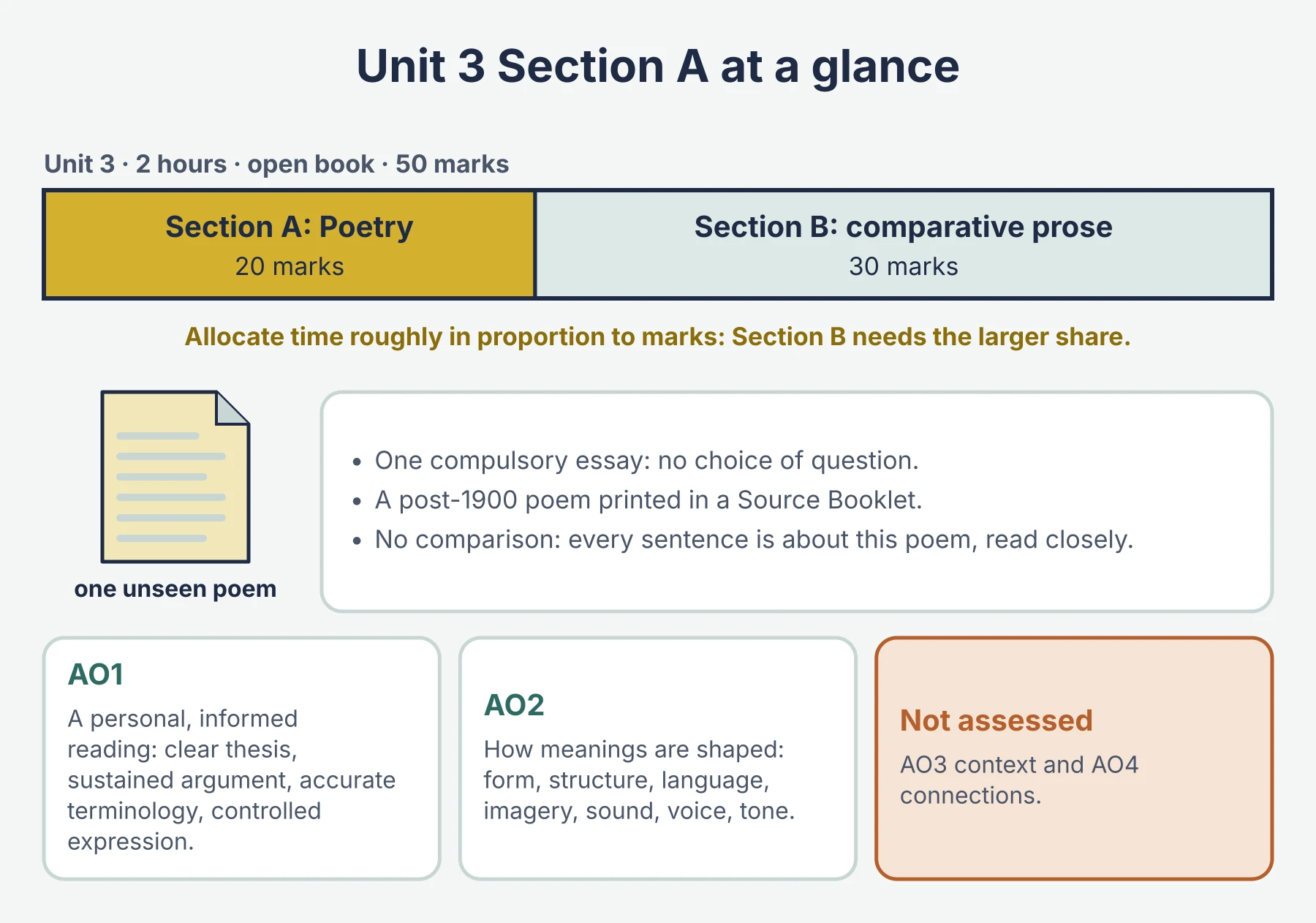
| Detail | Section A |
|---|---|
| Question | One compulsory essay; no choice |
| Poem | One unseen post-1900 poem, printed in a Source Booklet |
| Marks | 20 of 50 |
| AOs | AO1, AO2 (no AO3, no AO4) |
| Skills | Unit 1 poetry learning applied to an unseen poem |
Eight-step reading sequence
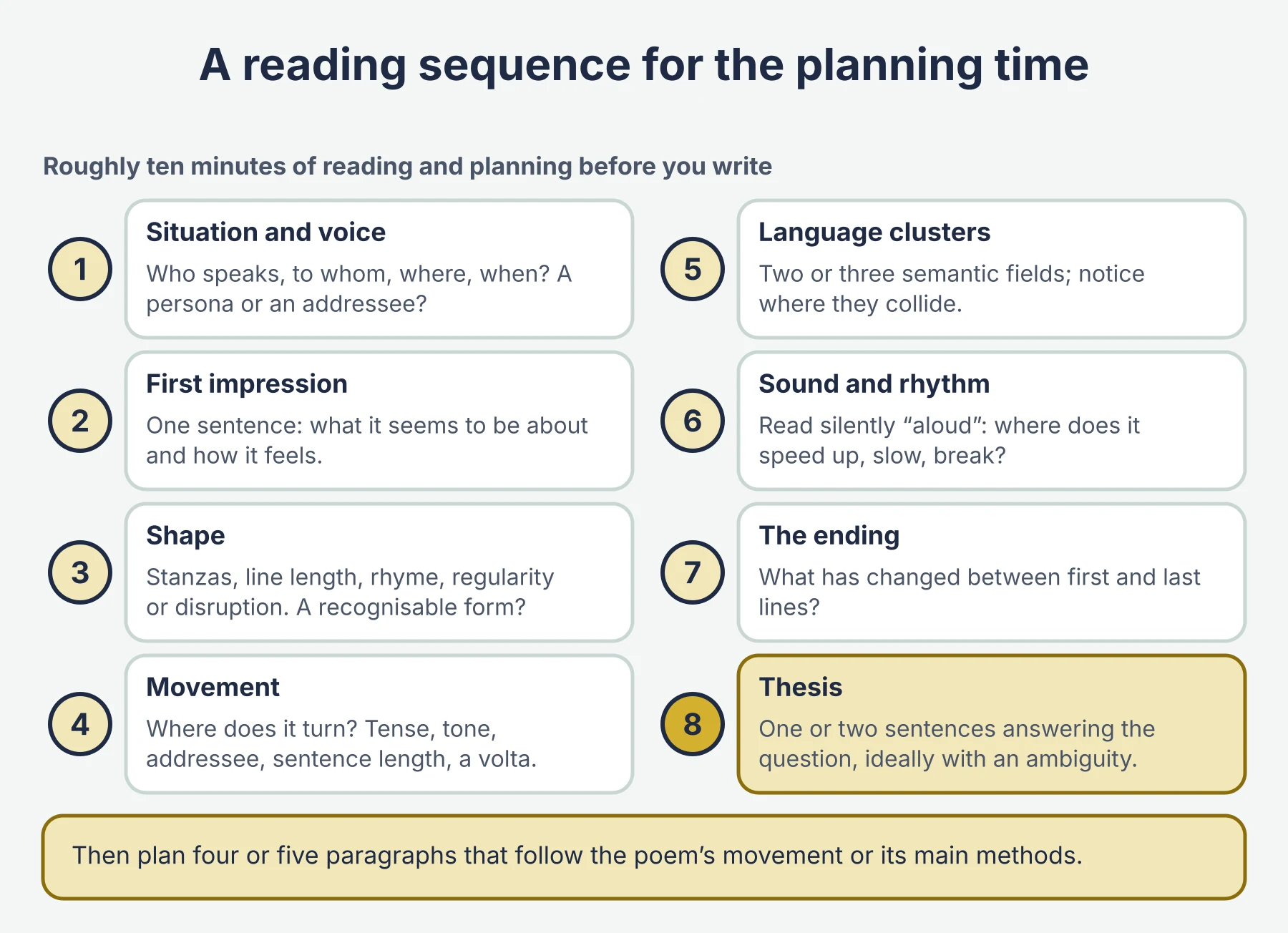
- Situation and voice.
- First impression in one sentence.
- Shape: stanzas, lines, rhyme, form.
- Movement: the turn or shift.
- Language clusters: two or three semantic fields.
- Sound and rhythm.
- The ending: what has changed?
- Thesis, including an ambiguity if there is one.
Forms you might meet
| Form | Recognise it by | What to say about it |
|---|---|---|
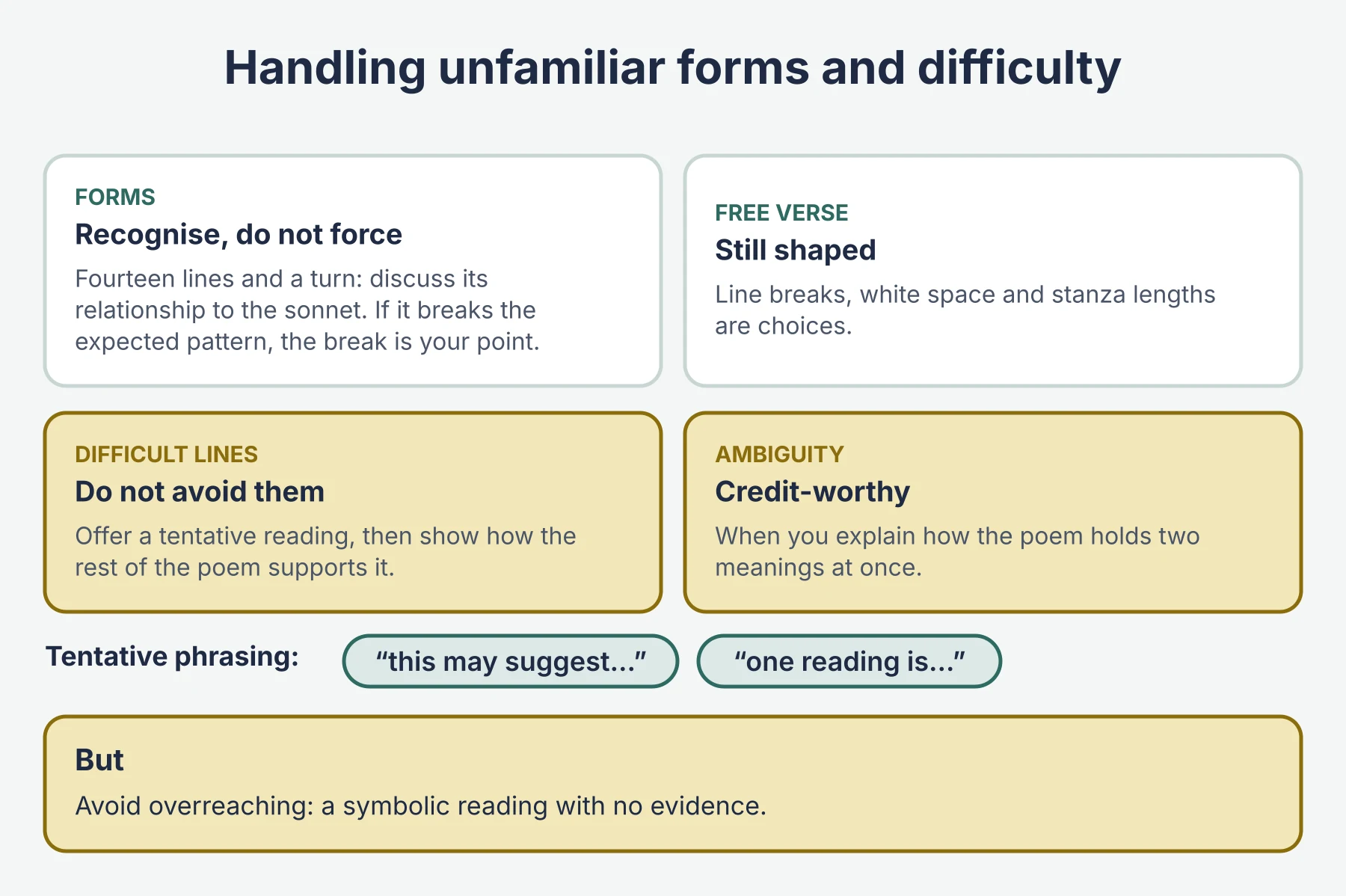
| Sonnet | Fourteen lines, often a turn | How the turn changes the argument; any break from convention |
| Villanelle | Nineteen lines, two refrains, two rhymes | Obsession, return, inescapability |
| Dramatic monologue | A speaker addressing a listener | What the speaker reveals unintentionally |
| Free verse | No regular metre or rhyme | Line breaks, white space and stanza lengths as choices |
| Prose poem | Paragraph, no line breaks | Compression and momentum; poetic devices within prose |
| Elegy | Lament for the dead | Movement from grief towards (or away from) consolation |
| Lyric | Short, personal, often first person | Voice and feeling; the moment captured |
Spotting the turn
| Signal | Example of what to look for |
|---|---|
| Tense | Past memory becoming present reality |
| Pronoun | “I” becoming “we”, or “you” appearing |
| Sentence length | Long flowing sentences giving way to short ones |
| Conjunction | “But”, “Yet”, “Now” at a line or stanza opening |
| Stanza break | A white-space pause before a new attitude |
| Tone | Description becoming reflection or protest |
Key terms
| Term | Meaning |
|---|---|
| Persona | The speaker as distinct from the poet |
| Addressee | The person or thing the poem speaks to |
| Volta | Turn in argument or mood |
| Enjambment | A sentence running across a line break |
| End-stopping | A line ending with punctuation and a pause |
| Caesura | A pause within a line |
| Paradox | An apparently contradictory statement that reveals a truth |
| Juxtaposition | Placing contrasting images side by side |
| Semantic field | Words linked by area of meaning |
| Assonance | Repeated vowel sounds |
| Sibilance | Repeated “s” sounds |
| Ambiguity | A word or line holding more than one meaning |
Five questions to ask of any image
- What is compared to what? Name both halves of the metaphor or simile.
- What does the comparison carry over? Weight, colour, danger, tenderness.
- Does it belong to a cluster? Link it to other images in the same semantic field.
- Where is it placed? An image at a line end, stanza end or the close carries extra weight.
- Does it change? A recurring image that shifts meaning often marks the poem’s movement.
Answering these turns “the poet uses a metaphor” into analysis of how meaning is shaped.
Paragraph frame
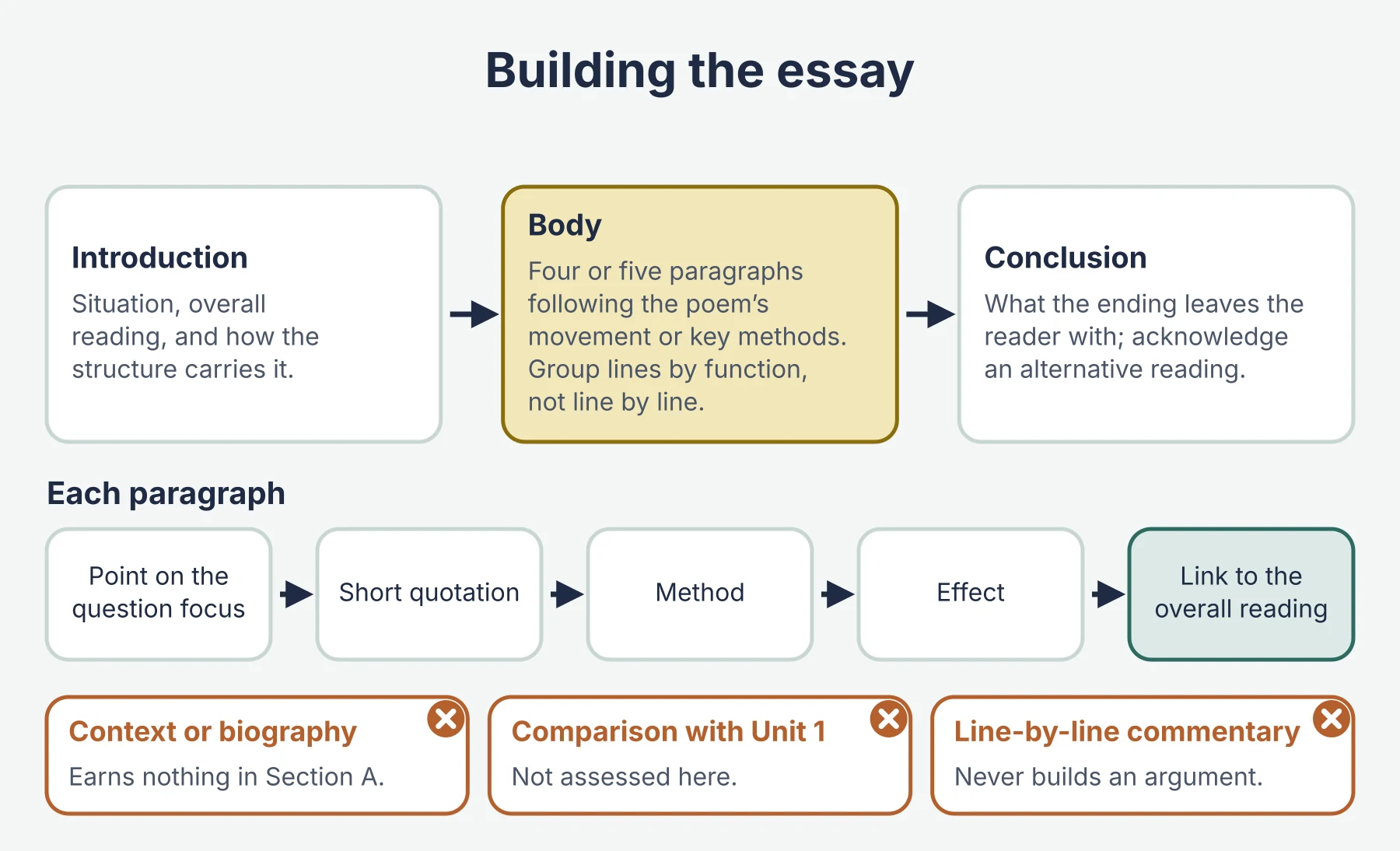
Point on the question focus → short quotation → method → effect → link to your thesis.
Writing with discrimination: weak to strong
Weak: “The poet uses enjambment to make the poem flow.”
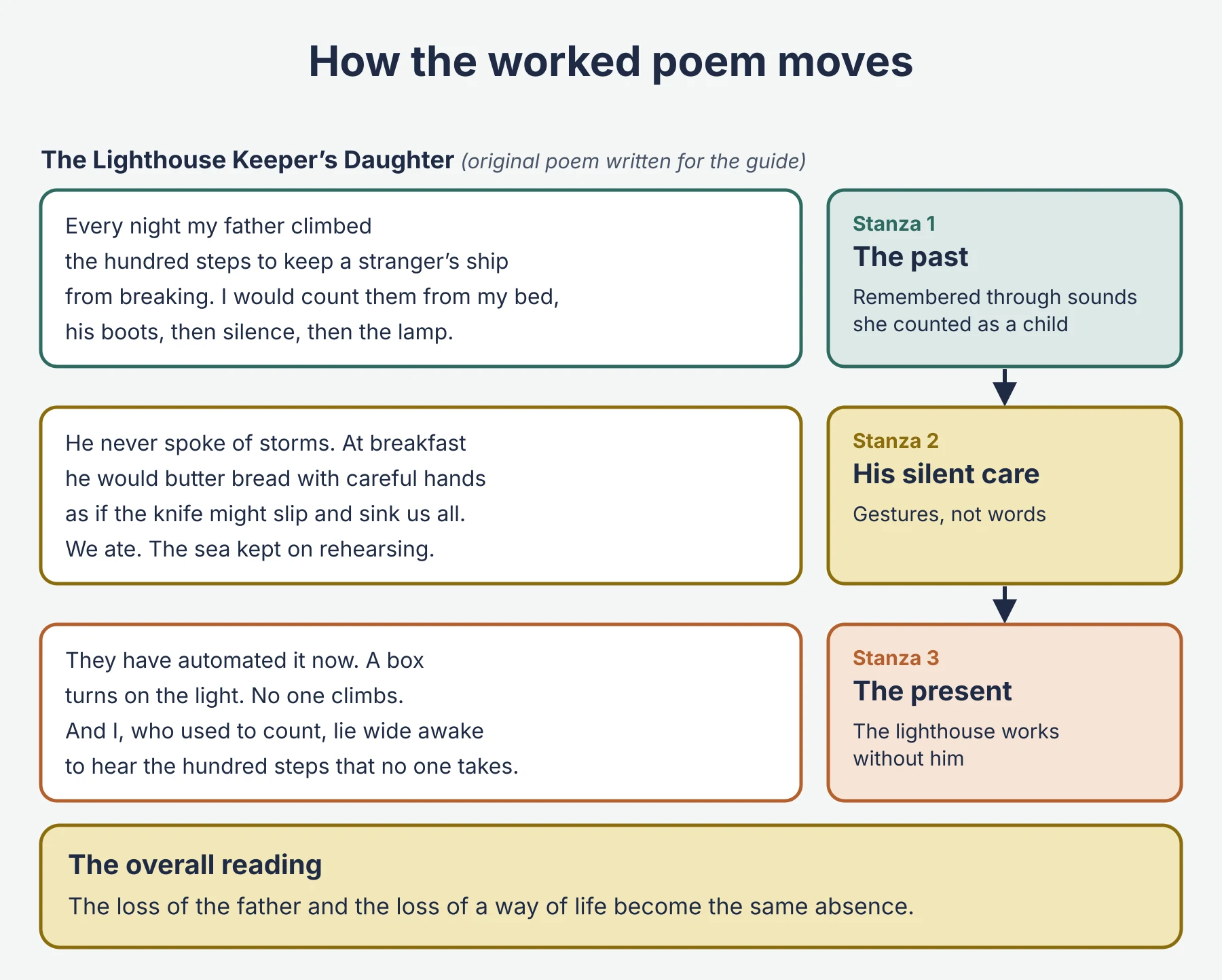
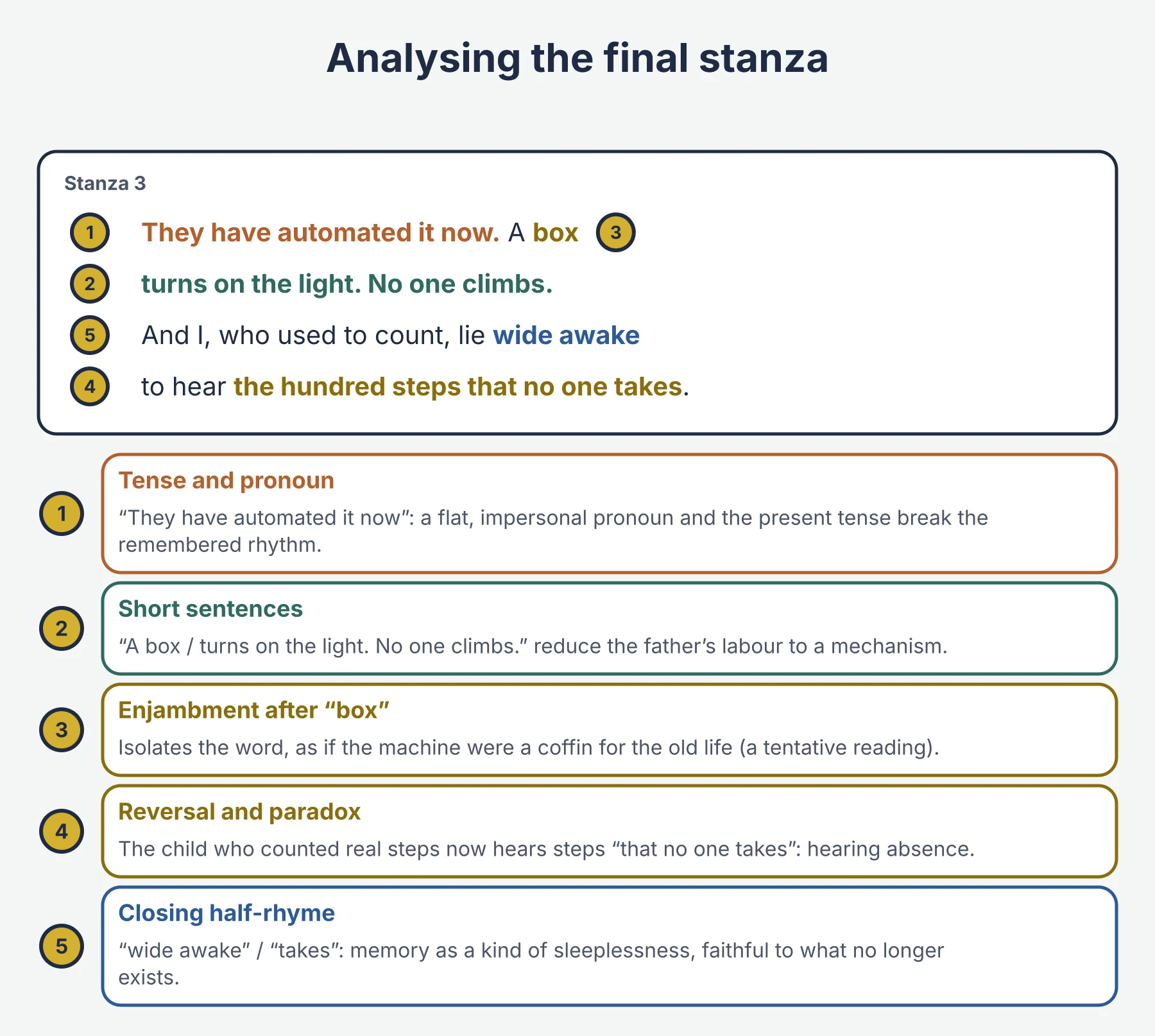
Stronger: “The enjambment after ‘box’ isolates the word at the end of the line, so the machine seems to stand alone in the place where the father used to be.”
The stronger sentence names a specific instance, explains the effect and links it to meaning.
Time
- About ten minutes reading and planning.
- Time in proportion to marks: Section A is 20 of 50.
- Leave the larger share of the two hours for Section B (30 marks).
Traps
- Writing about context or the poet’s life.
- Comparing with Unit 1 poems.
- Line-by-line paraphrase.
- Naming features without effects.
- Ignoring form in free verse.
- Forcing a symbolic reading the poem does not support.
- No thesis: the essay becomes a list.
Self-test
- How many marks is Section A worth, and which AOs?
- Is there a choice of question?
- What date range does the unseen poem come from?
- Which unit’s poetry learning does the specification say you apply?
- What does “function of key features” ask you to explain?
- Give three signals of a turn in a poem.
- What is a villanelle, and what effect does its form often create?
- Why is context not worth including?
- What is the difference between enjambment and end-stopping?
- How should you treat an ambiguous line?
- Roughly how long should you spend reading and planning?
- What should a conclusion do?
Answers: 1. 20 marks; AO1 and AO2. 2. No; it is compulsory. 3. Post-1900. 4. Unit 1. 5. What each feature does in the poem, not just that it is present. 6. Any three: change of tense, pronoun or addressee; sentence length; a conjunction such as “But”; a stanza break; a change of tone. 7. Nineteen lines with two refrains and two rhymes; it often creates obsession or inescapability. 8. AO3 is not assessed in Section A. 9. Enjambment runs a sentence over the line break; end-stopping closes the line with punctuation. 10. Offer a tentative reading and show how the poem supports more than one meaning. 11. About ten minutes. 12. Say what the ending leaves the reader with and acknowledge an alternative reading.
Related pages
Related resources
-
Study guides
Pearson Edexcel International A Level English Literature (YET01): Unit 3 Thematic Prose
How to write the 30-mark comparative prose essay in YET01 Unit 3 Section B: AO1 to AO4, comparison frameworks by theme, context, and a worked Theme 4 plan.
English Literature · Pearson Edexcel · A Level
Read guide -
Practice questions
Pearson Edexcel International A Level English Literature (YET01): Unit 3 Thematic Prose – Practice Questions
Comparison drills on two original openings and 30-mark comparative essays for every YET01 Unit 3 prose theme, with indicative content mapped to AO1 to AO4.
English Literature · Pearson Edexcel · A Level
Try questions -
Revision notes
Pearson Edexcel International A Level English Literature (YET01): Unit 3 Thematic Prose – Revision Notes
Quick-recall notes for the YET01 Unit 3 comparative prose essay: themes and texts, narrative methods by novel, AO1 to AO4, context types, traps and a self-test.
English Literature · Pearson Edexcel · A Level
Revise topic
Get free revision emails (optional)
Occasional emails with practice questions, worked explanations and links to free resources for the qualification and subjects you choose. No spam, and you can unsubscribe from any email. The free tools on this site never need an email.