
Revision Notes
Pearson Edexcel International A Level English Literature (YET01): Unit 3 Thematic Prose – Revision Notes
Quick-recall notes for the YET01 Unit 3 comparative prose essay: themes and texts, narrative methods by novel, AO1 to AO4, context types, traps and a self-test.
- Subject
- English Literature
- Level
- A LEVEL
- Topic
- Unit 3: Poetry and Prose
- Author
- Marlbridge Academic Team
- Updated
- Reviewed by
- Ammar Bilal (what this means)
Aligned to Pearson Edexcel A Level English Literature (YET01), For first teaching 2015 (units WET01–WET04). Official specification .
Syllabus page (what it covers and how it is assessed): Pearson Edexcel A Level English Literature.
Syllabus points this page covers
YET01 (A Level)
- 3.4 Prose
Found an error? Report a correction.
Need help with this topic? Request a free trial class for A Level English Literature (YET01).
Condensed notes for Section B of Unit 3 (WET03) in Pearson Edexcel International A Level English Literature (YET01). For the full method and a worked plan, use the Unit 3 Thematic Prose study guide.
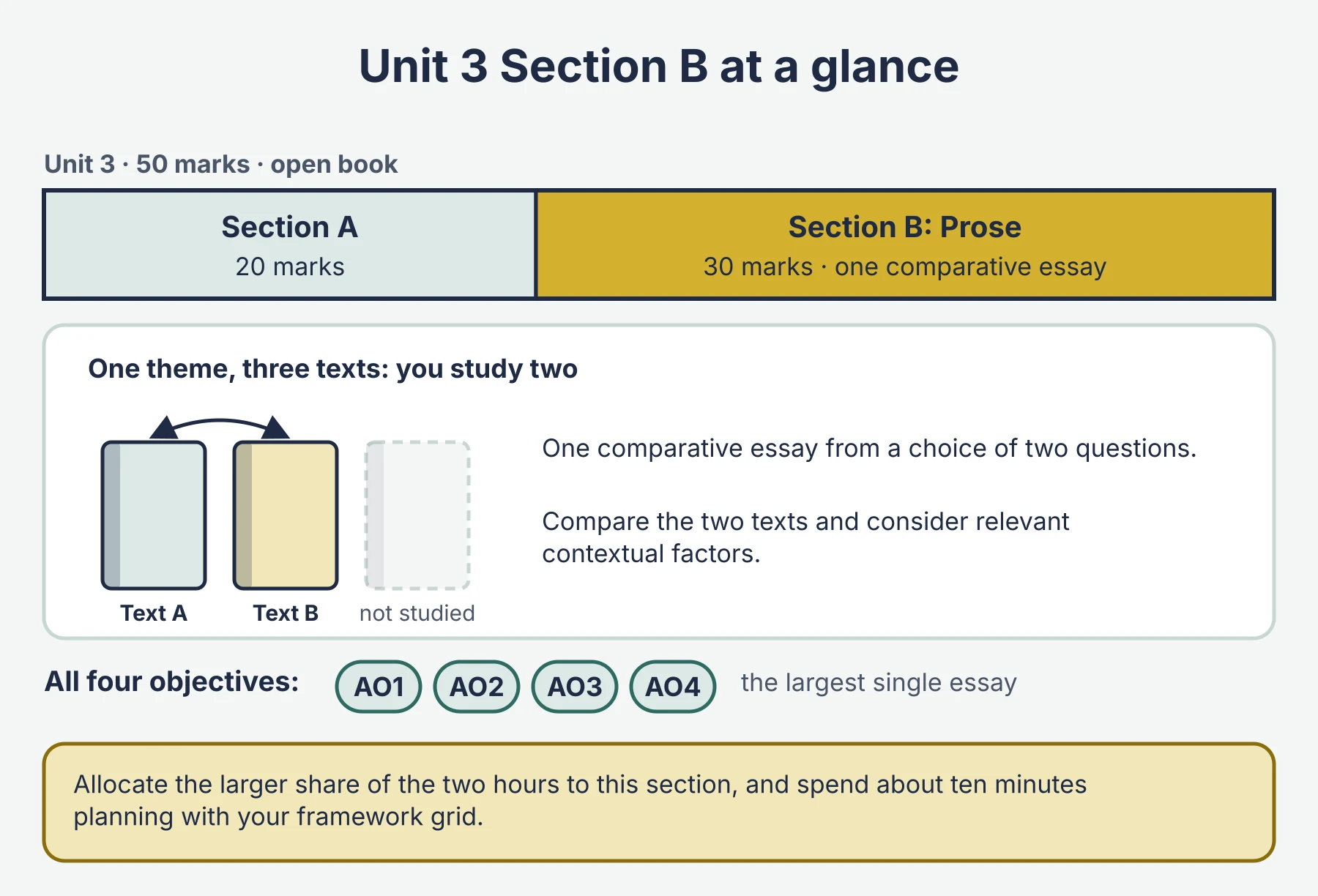
The task in one box
| Detail | Section B |
|---|---|
| Texts | Two prose texts from one theme |
| Question | One comparative essay from a choice of two |
| Must do | Compare the two texts and consider relevant contextual factors |
| Marks | 30 of 50 |
| AOs | AO1, AO2, AO3, AO4 (no AO5) |
Narrative methods at a glance
| Novel | Narrative method | Structure to remember |
|---|---|---|
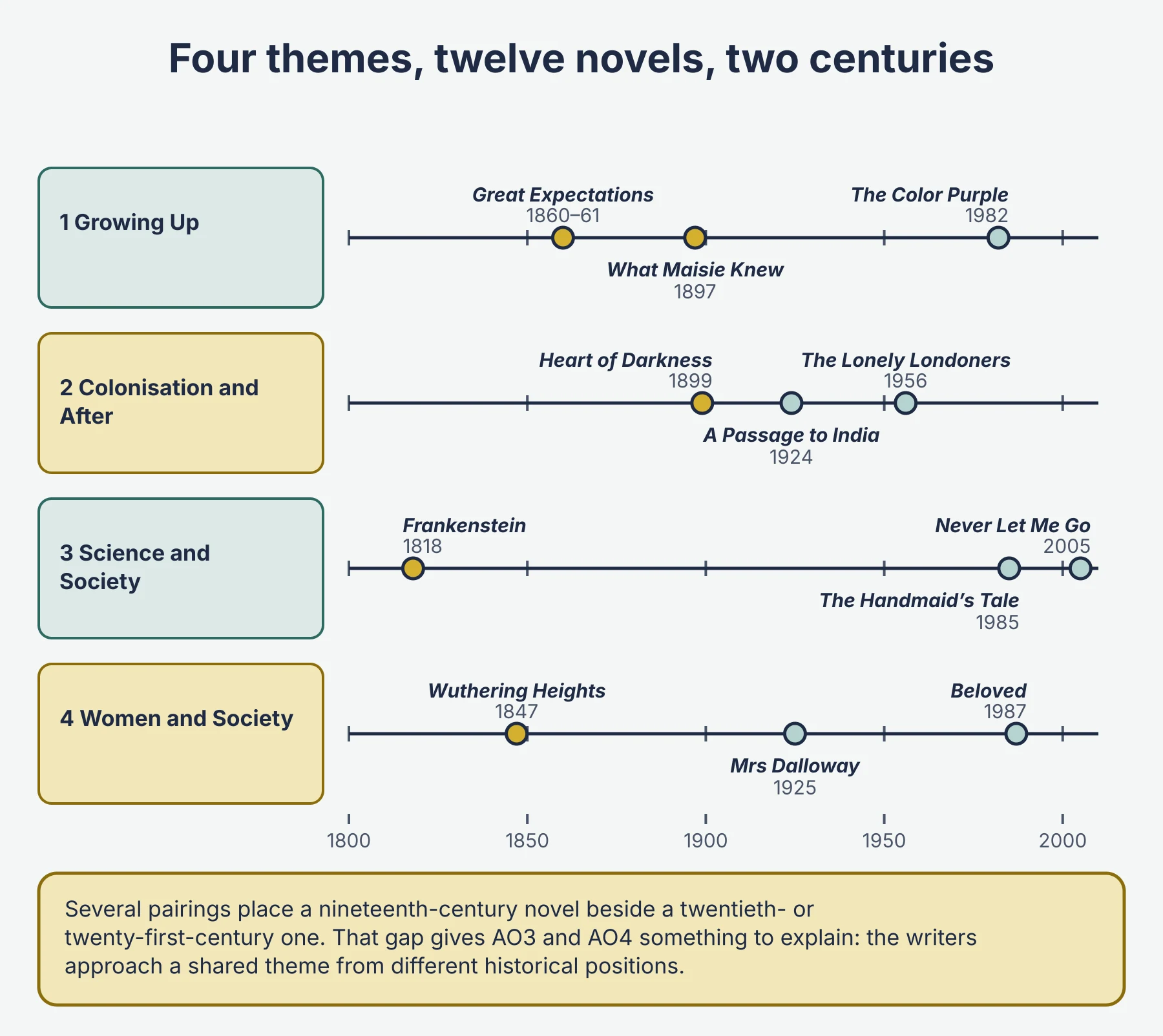
| Great Expectations | First-person retrospective (older Pip) | Three stages of Pip’s expectations |
| The Color Purple | Epistolary: Celie’s letters, later Nettie’s | Celie’s voice develops across the letters |
| What Maisie Knew | Third person restricted to a child’s perception | The reader understands more than Maisie |
| Heart of Darkness | Frame narrative: an unnamed narrator reports Marlow’s story | Journey upriver towards Kurtz |
| The Lonely Londoners | Third person in a creolised narrative voice | Episodic sketches of migrant life |
| A Passage to India | Omniscient narrator | Three parts: Mosque, Caves, Temple |
| Frankenstein | Nested narrators: Walton, Victor, the creature | Frame letters around Victor’s story, with the creature’s at the centre |
| The Handmaid’s Tale | Offred’s fragmented first person | “Historical Notes” epilogue reframes the account |
| Never Let Me Go | Kathy H.’s calm first-person retrospection | Three parts: Hailsham, the Cottages, the period of donations |
| Beloved | Shifting viewpoints; fragmented chronology | Past revealed gradually through “rememory” |
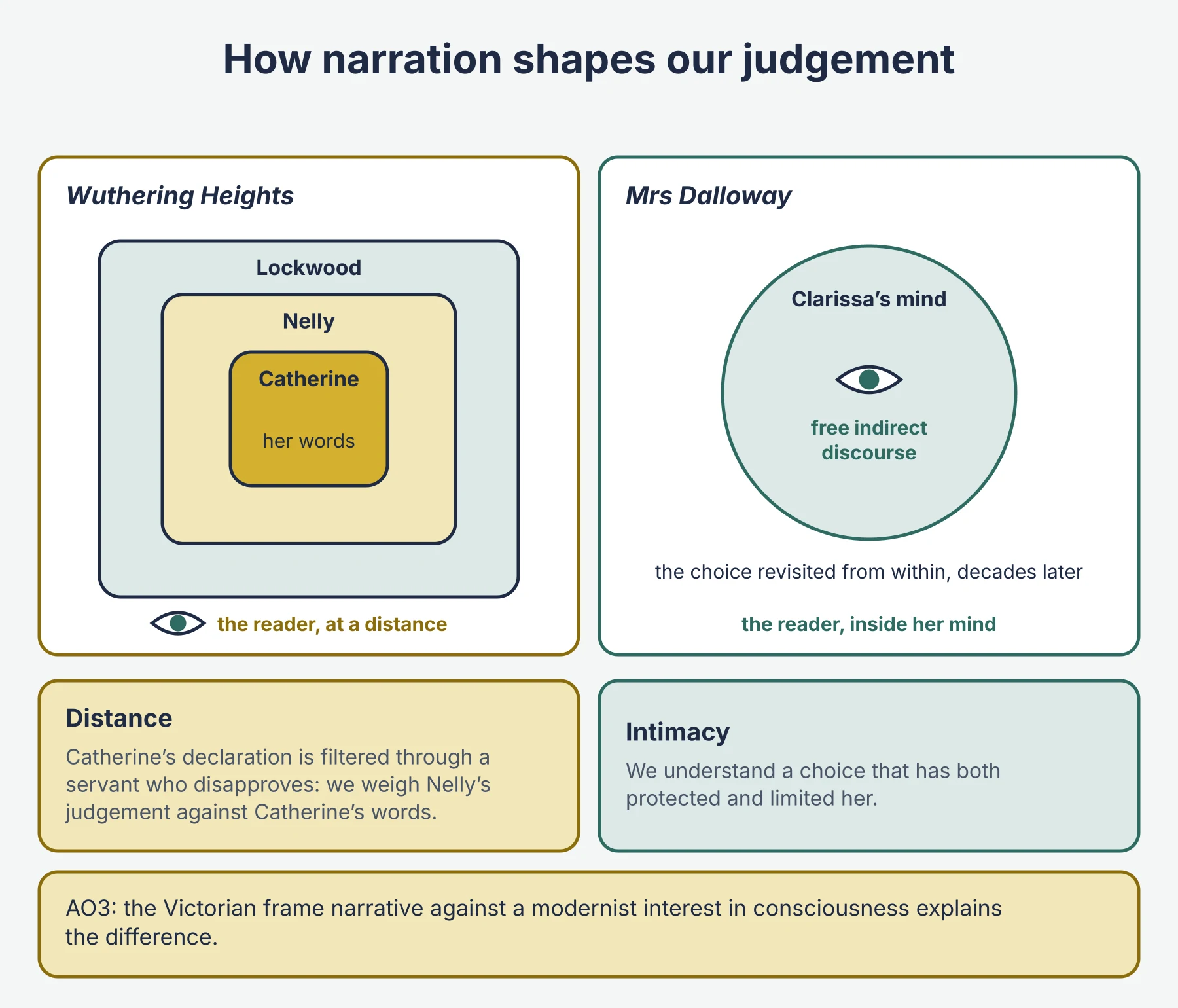
| Mrs Dalloway | Free indirect discourse, moving between minds | A single day in June 1923 |
| Wuthering Heights | Frame: Lockwood, then Nelly Dean | Two generations |
AO checklist for every paragraph
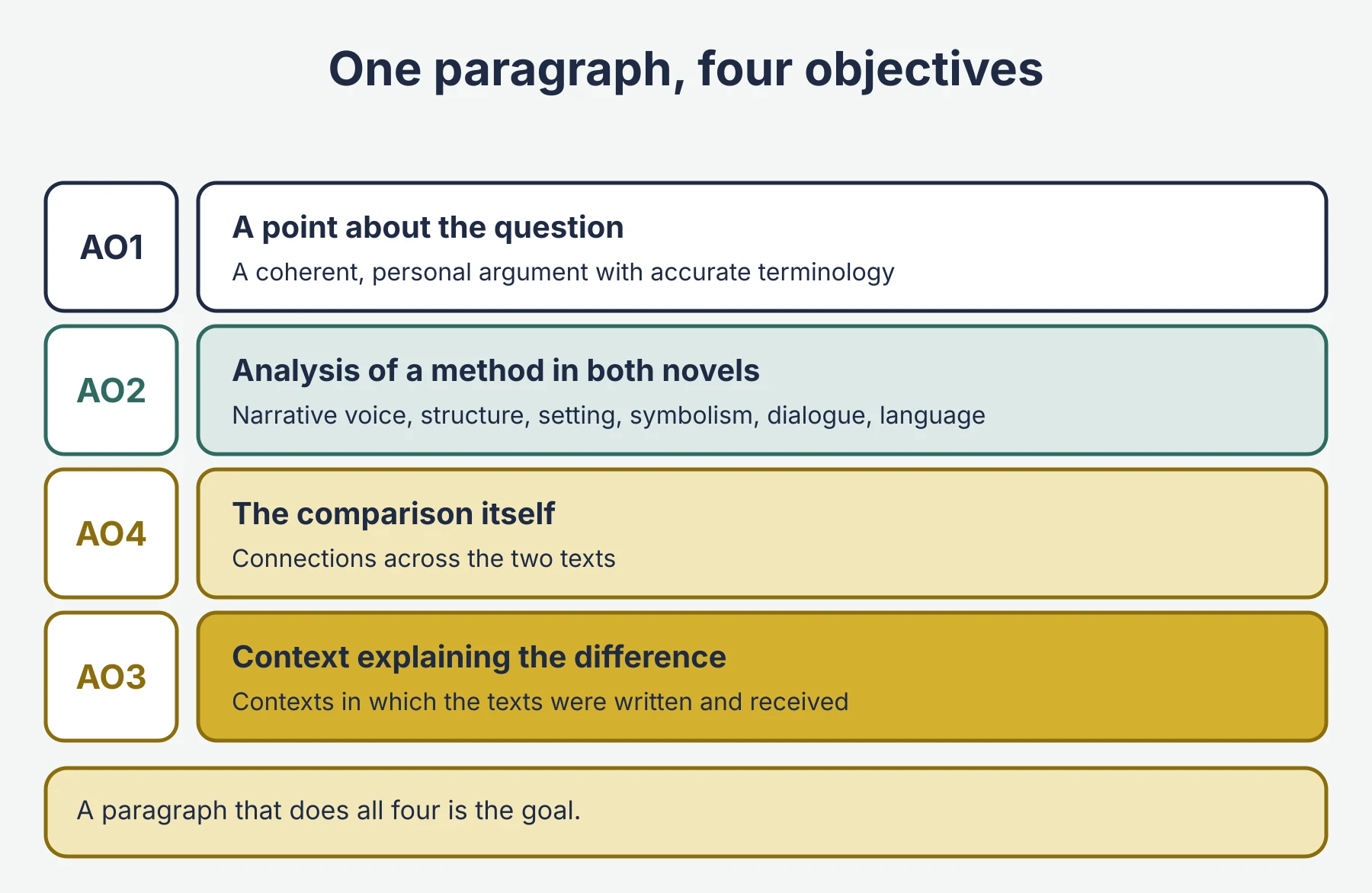
| AO | Check |
|---|---|
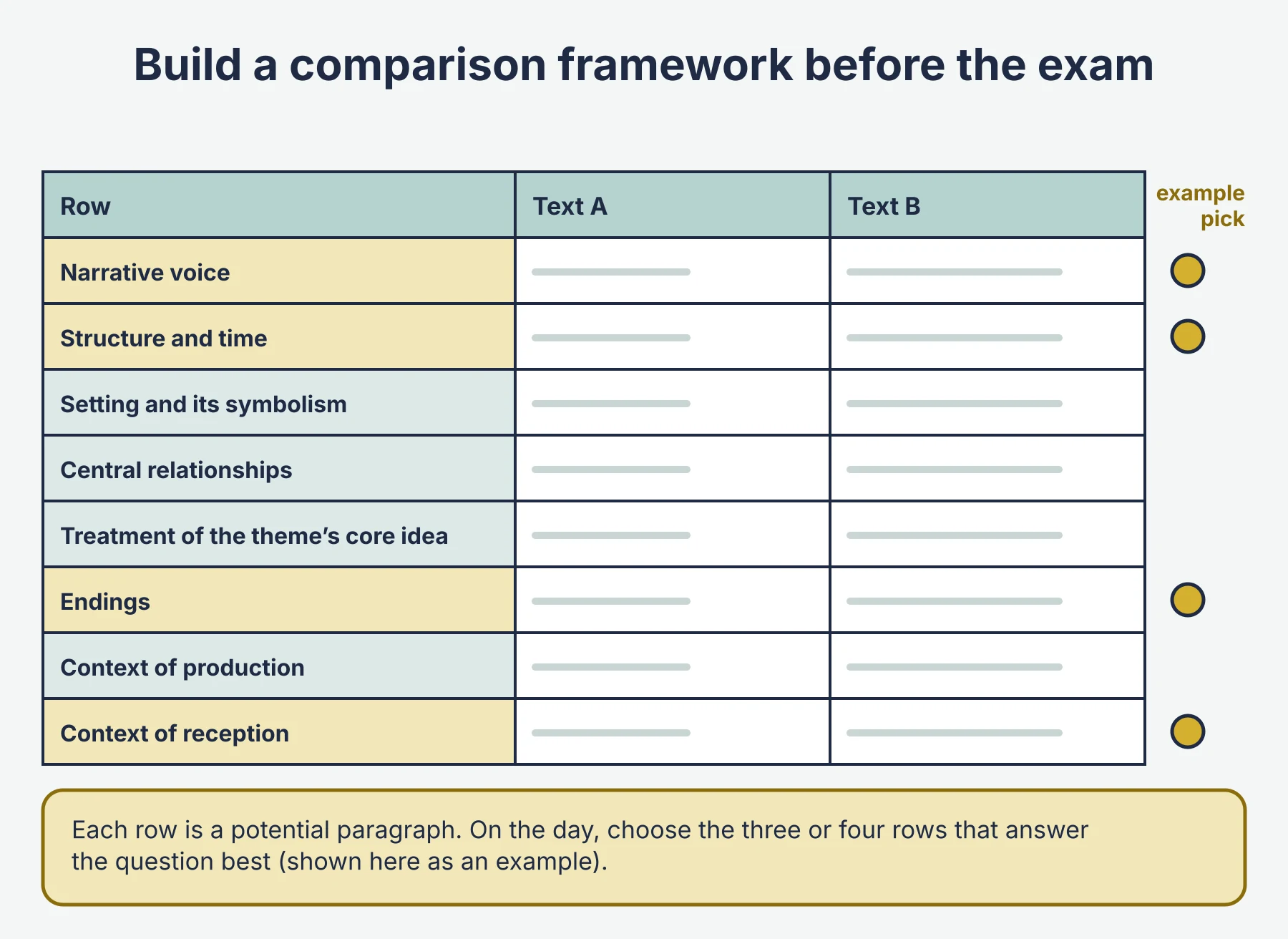
| AO1 | Does the topic sentence answer the question? |
| AO2 | Have I analysed a method, not just an event? |
| AO4 | Are both novels in the paragraph? |
| AO3 | Does context explain a difference or similarity? |
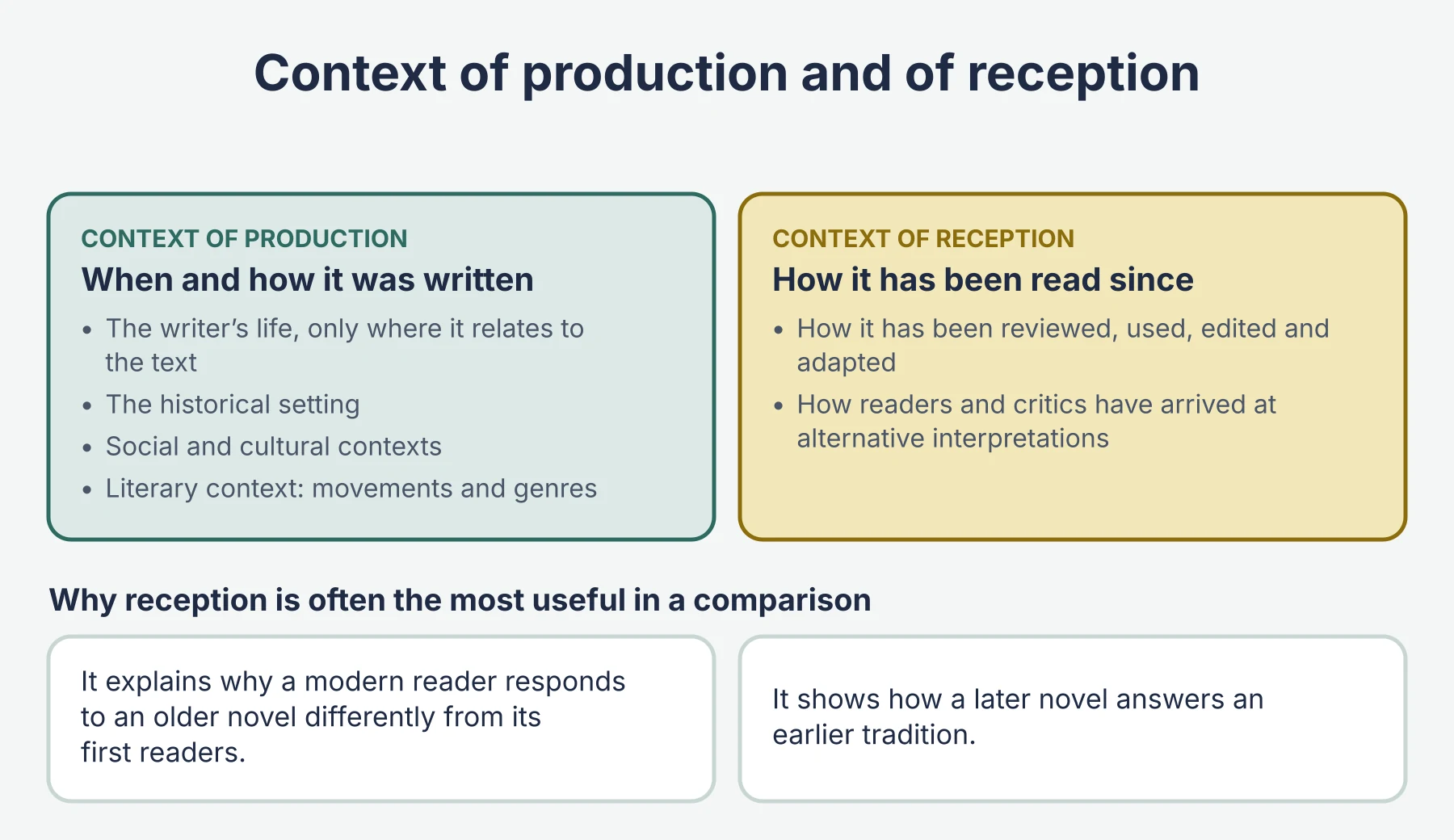
Context types (specification guidance)
- Writer’s life and situation, only where relevant to the text.
- Historical setting, time and location.
- Social and cultural contexts.
- Literary context: movements and genres.
- Contexts of reception: reviews, editions, adaptations, critical readings.
Context pairs worth knowing
| Theme | Example contrast in context |
|---|---|
| Growing Up | Victorian class and the idea of the gentleman; the American South and its racial and gender oppression; late-Victorian divorce and custody |
| Colonisation and After | Late-nineteenth-century imperialism; British rule in India; post-war Caribbean migration to Britain |
| Science and Society | Early-nineteenth-century science and Romanticism; 1980s politics and dystopia; late-twentieth-century debates on cloning |
| Women and Society | Slavery and its aftermath in America; post-First World War London; early-nineteenth-century inheritance and marriage |
Comparative connectives
Whereas · by contrast · both writers · similarly · where X…, Y instead… · this difference reflects… · although both… only one…
From alternating to integrated: one sentence
Alternating: “In Frankenstein the creature is lonely. In Never Let Me Go the clones are also lonely.”
Integrated: “Both novels make their created beings articulate about isolation, but Shelley gives the creature an impassioned narrative at the heart of the book, whereas Ishiguro’s Kathy narrates with a restraint that makes acceptance, not protest, the source of the reader’s distress.”
The integrated version compares methods (AO2, AO4) and sets up a contextual explanation (AO3).
Key terms
| Term | Meaning |
|---|---|
| Frame narrative | A story contained within another |
| Epistolary | Told through letters or documents |
| Free indirect discourse | Third-person narration in a character’s idiom |
| Restricted viewpoint | Narration limited to one character’s knowledge |
| Retrospective narration | Telling events from a later vantage point |
| Dystopia | A society imagined as oppressive |
| Gothic | Fiction of terror, mystery and the uncanny |
| Modernism | Early-twentieth-century experiment with form and consciousness |
| Postcolonial | Concerned with colonialism and its aftermath |
| Context of reception | How a text has been read, reviewed or adapted over time |
Traps
- Two mini-essays with a final comparison.
- Biography or history with no link to the text.
- Comparing plots instead of methods.
- One novel dominating.
- Ignoring the context of reception.
- Using critics for their own sake: AO5 is not assessed in Unit 3.
- Not reading both questions; they differ.
Self-test
- How many marks is Section B worth, and which AOs?
- How many texts do you study, and from how many themes?
- Name the four themes.
- Which novels form Theme 3?
- Which novel is told in letters, and in which theme?
- Which two novels in the themes use a frame narrative?
- Which AO is not assessed in Unit 3?
- What does the specification say the Section B questions require?
- What is meant by context of reception? Give one example.
- What is free indirect discourse, and which Theme 4 novel uses it?
- What should each topic sentence do?
- Why can a pre-1900 and post-1900 pairing help AO3 and AO4?
Answers: 1. 30 marks; AO1, AO2, AO3, AO4. 2. Two texts from one theme. 3. Growing Up; Colonisation and After; Science and Society; Women and Society. 4. Frankenstein, The Handmaid’s Tale, Never Let Me Go. 5. The Color Purple, in Growing Up. 6. Any two of Heart of Darkness, Frankenstein, Wuthering Heights. 7. AO5. 8. Comparison of the two prose texts and consideration of relevant contextual factors. 9. How a text has been read, reviewed, edited or adapted; for example, later postcolonial criticism of Heart of Darkness. 10. Third-person narration that takes on a character’s thoughts and idiom; Mrs Dalloway. 11. Answer the question and name both texts. 12. The writers’ different historical positions give a reason for differences in method and attitude.
Related pages
Related resources
-
Practice questions
Unit 3 Poetry and Prose (YET01): Practice Questions
Original Edexcel IAL English Literature (YET01) Unit 3-style questions: an unseen post-1900 poem and comparative prose essays by theme, with indicative content.
English Literature · Pearson Edexcel · A Level
Try questions -
Revision notes
Unit 3 Poetry and Prose (YET01): Revision Notes
Quick-recall notes for Edexcel IAL English Literature (YET01) Unit 3: the unseen post-1900 poem, the comparative prose essay, themes, set texts and AOs.
English Literature · Pearson Edexcel · A Level
Revise topic -
Study guides
Pearson Edexcel A Level English Literature (YET01): Unit 3 Poetry and Prose – Study Guide
Reading and writing about poetry and prose for Unit 3 of Edexcel International A Level English Literature, with a method for comparison and a worked paragraph.
English Literature · Pearson Edexcel · A Level
Read guide
Get free revision emails (optional)
Occasional emails with practice questions, worked explanations and links to free resources for the qualification and subjects you choose. No spam, and you can unsubscribe from any email. The free tools on this site never need an email.