
Study Guides
Pearson Edexcel International A Level English Literature (YET01): Unit 3 Thematic Prose
How to write the 30-mark comparative prose essay in YET01 Unit 3 Section B: AO1 to AO4, comparison frameworks by theme, context, and a worked Theme 4 plan.
- Subject
- English Literature
- Level
- A LEVEL
- Topic
- Unit 3: Poetry and Prose
- Author
- Marlbridge Academic Team
- Updated
- Reviewed by
- Ammar Bilal (what this means)
Aligned to Pearson Edexcel A Level English Literature (YET01), For first teaching 2015 (units WET01–WET04). Official specification .
Syllabus page (what it covers and how it is assessed): Pearson Edexcel A Level English Literature.
Syllabus points this page covers
YET01 (A Level)
- 3.4 Prose
Found an error? Report a correction.
Need help with this topic? Request a free trial class for A Level English Literature (YET01).
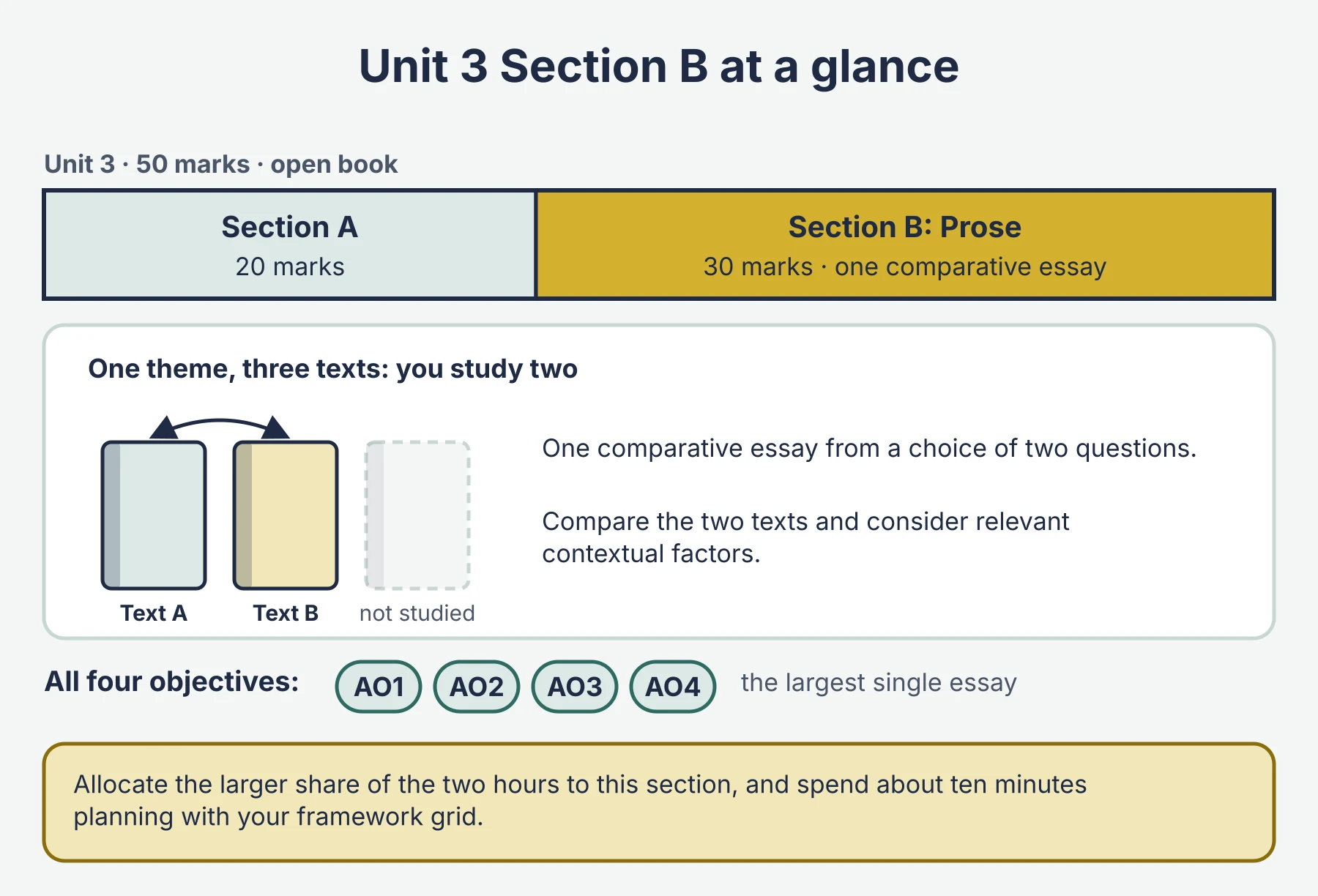
Section B of Unit 3 (WET03) is the largest single essay in the International A Level: 30 marks, four assessment objectives, two novels. The specification asks you to apply “the prose fiction learning from Unit 1 in relation to two thematic prose fiction texts” and to make “connections between prose fiction texts thematically”. This guide shows how to build a comparison that works on every level, how to use context of both writing and reception, and how to plan. The Unit 3 study guide covers the paper as a whole.
What Section B covers
| Detail | Section B: Prose |
|---|---|
| Texts | Two prose fiction texts from one theme (you study two of the theme’s three) |
| Task | One comparative essay from a choice of two questions |
| Requirement | Compare the two texts and consider relevant contextual factors |
| Marks | 30 of the paper’s 50 |
| AOs | AO1, AO2, AO3, AO4 |
| Format | Open book |
The themes and texts
| Theme | Texts |
|---|---|
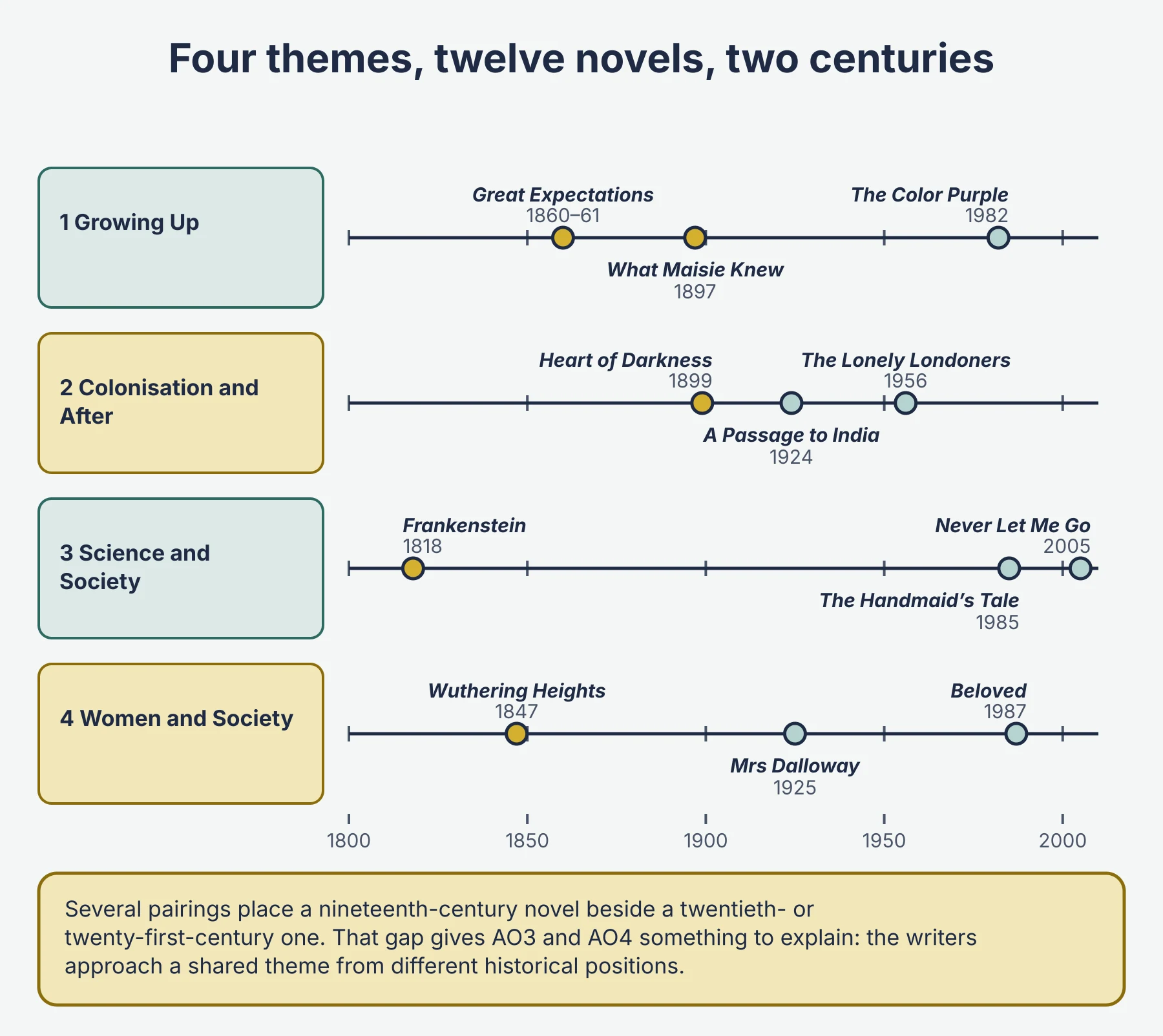
| 1 Growing Up | The Color Purple (Alice Walker, 1982); Great Expectations (Charles Dickens, 1860–61); What Maisie Knew (Henry James, 1897) |
| 2 Colonisation and After | Heart of Darkness (Joseph Conrad, 1899); The Lonely Londoners (Samuel Selvon, 1956); A Passage to India (E. M. Forster, 1924) |
| 3 Science and Society | Frankenstein (Mary Shelley, 1818); The Handmaid’s Tale (Margaret Atwood, 1985); Never Let Me Go (Kazuo Ishiguro, 2005) |
| 4 Women and Society | Beloved (Toni Morrison, 1987); Mrs Dalloway (Virginia Woolf, 1925); Wuthering Heights (Emily Brontë, 1847) |
Several pairings place a nineteenth-century novel beside a twentieth- or twenty-first-century one. That gap is useful: it gives AO3 and AO4 something to explain, because the writers approach a shared theme from different historical positions.
The four AOs together
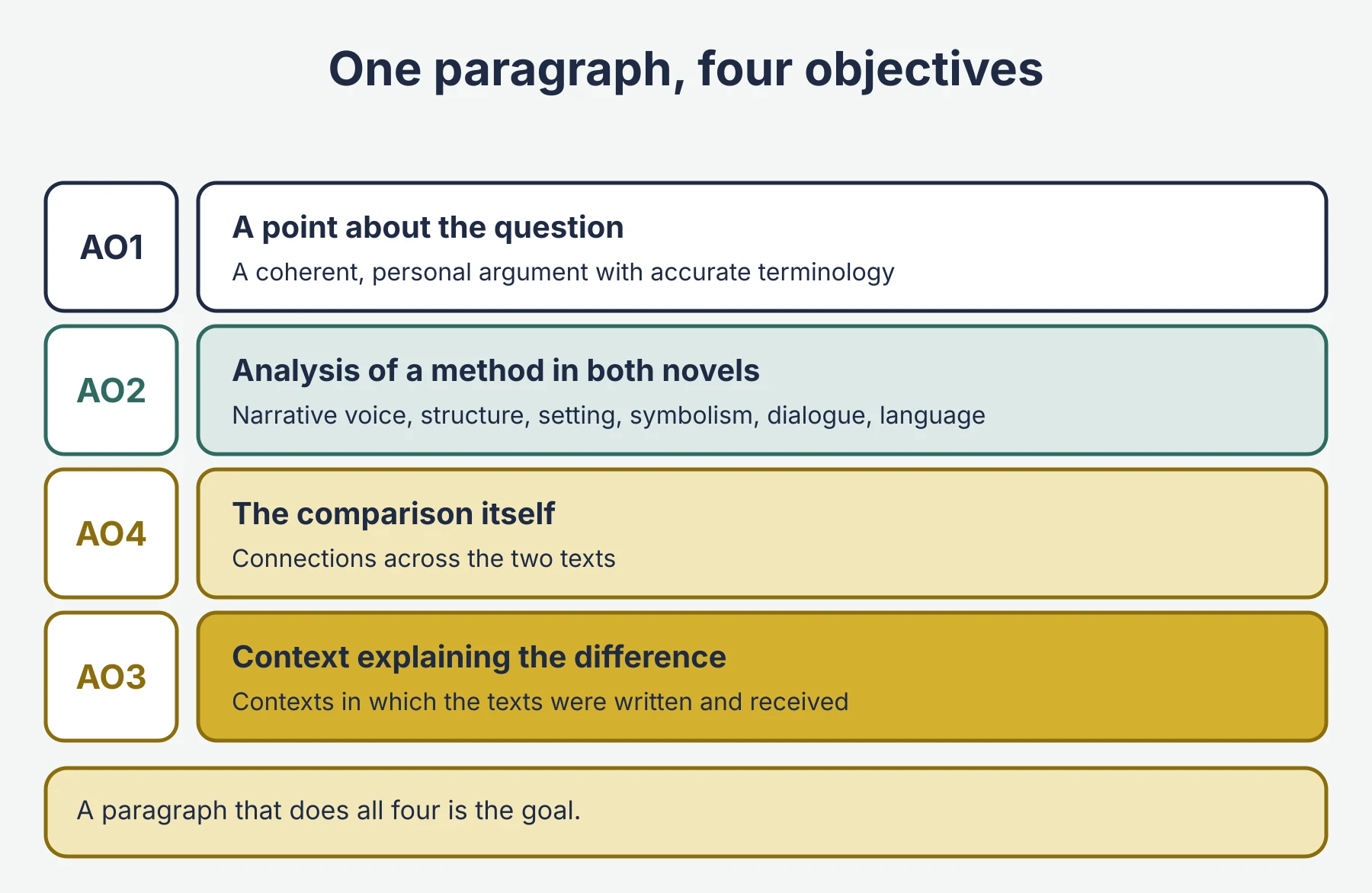
| AO | What it asks in Section B |
|---|---|
| AO1 | A coherent, personal argument answering the question, with accurate terminology |
| AO2 | Analysis of how meanings are shaped: narrative voice, structure, setting, symbolism, dialogue, language |
| AO3 | The significance and influence of the contexts in which the texts were written and received |
| AO4 | Connections across the two texts |
A paragraph that does all four is the goal: a point about the question (AO1), analysis of a method in both novels (AO2), the comparison itself (AO4), and context explaining the difference (AO3).
Building a comparison framework
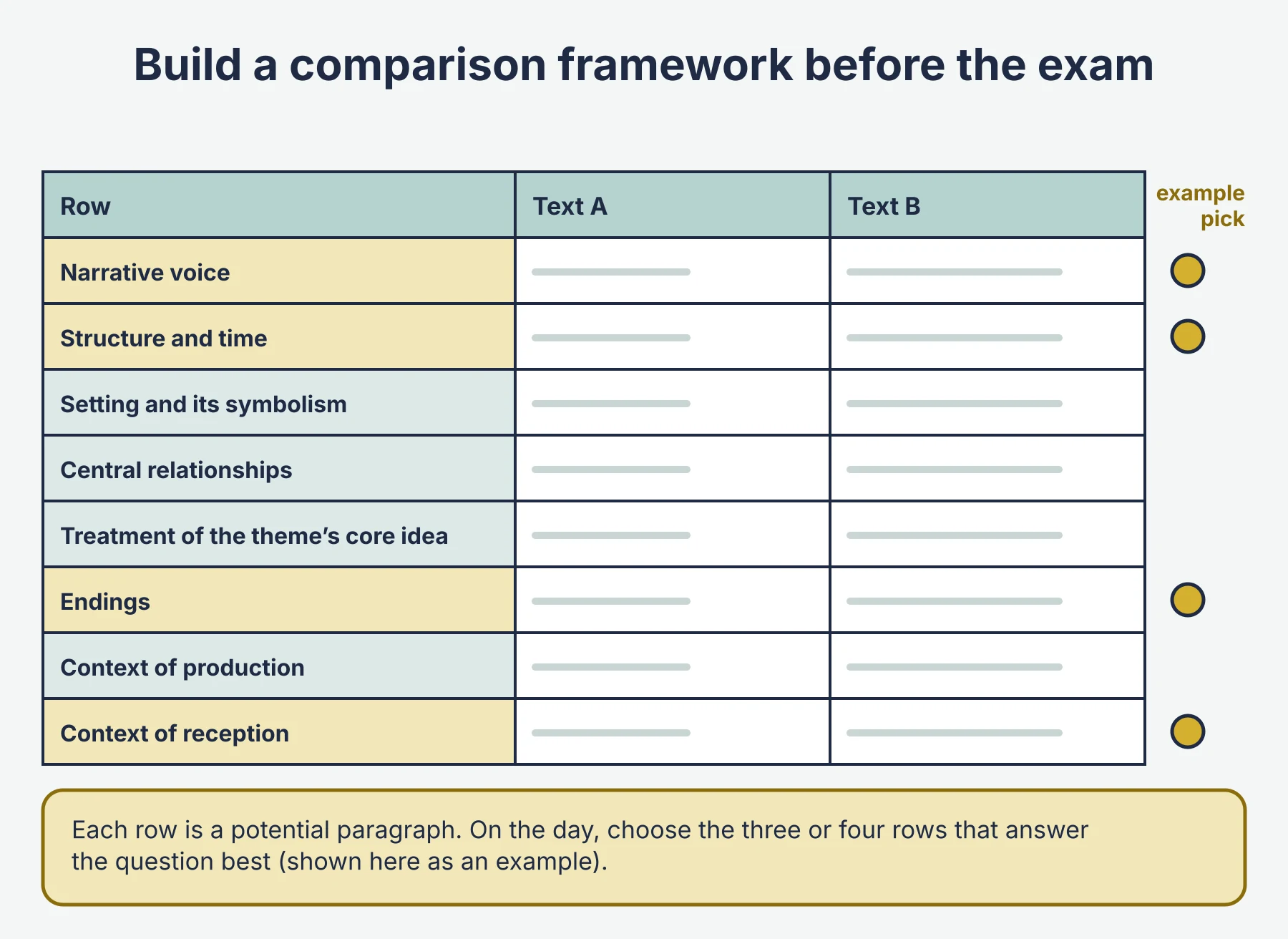
Before the exam, build a grid for your pair with rows like these:
| Row | Text A | Text B |
|---|---|---|
| Narrative voice | ||
| Structure and time | ||
| Setting and its symbolism | ||
| Central relationships | ||
| Treatment of the theme’s core idea | ||
| Endings | ||
| Context of production | ||
| Context of reception |
Each row is a potential paragraph. On the day, choose the three or four rows that answer the question best.
Context: production and reception
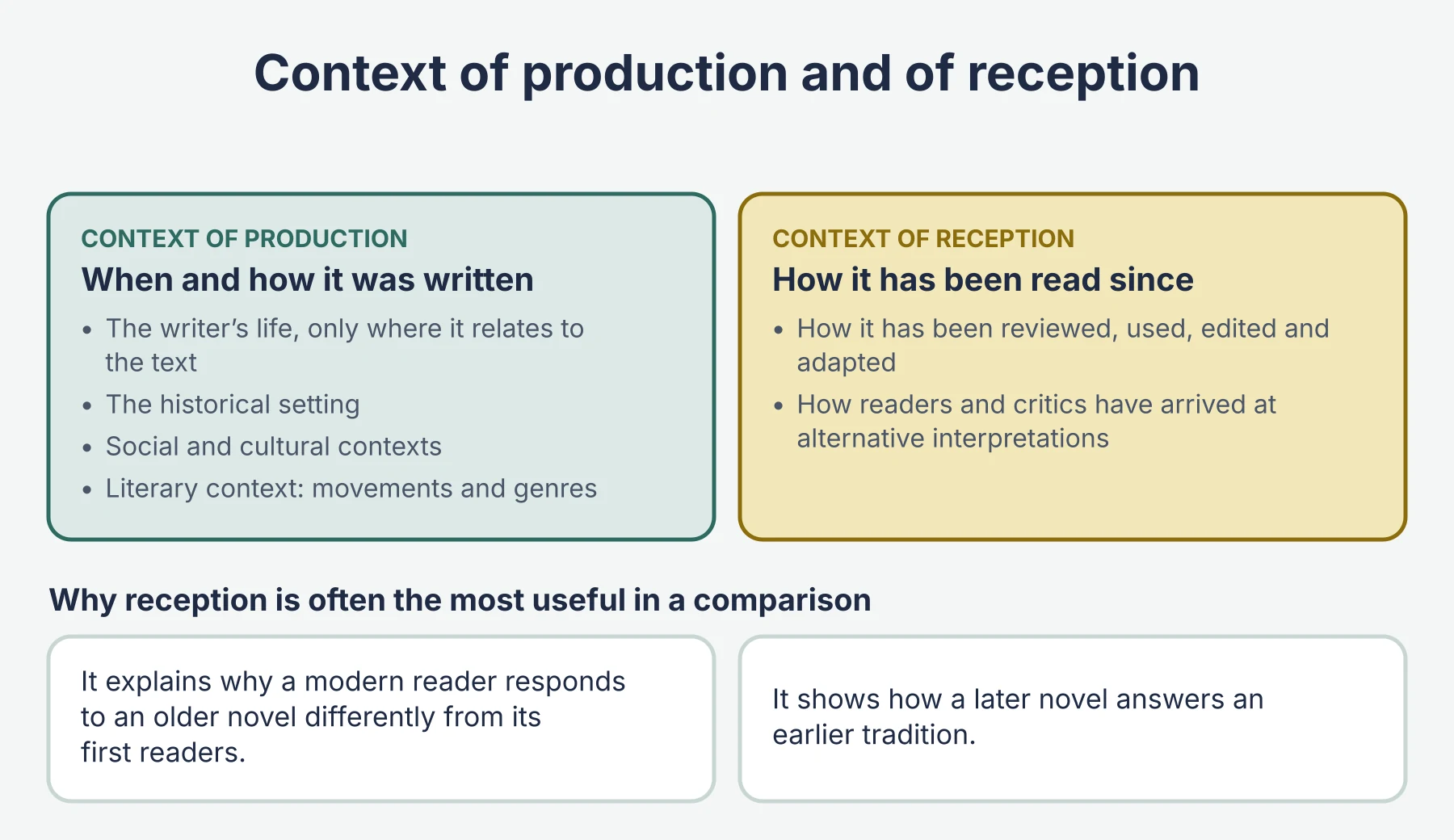
The specification’s guidance lists the writer’s life (only where it relates to the text), the historical setting, social and cultural contexts, literary context such as movements and genres, and contexts of reception: how a text has been reviewed, used, edited, adapted, and how readers and critics have arrived at alternative interpretations.
Reception context is often the most useful in a comparison, because it lets you explain why a modern reader responds to an older novel differently from its first readers, or how a later novel answers an earlier tradition.
Worked example: Theme 4
Question (original): Compare the ways in which the writers of your two chosen texts present the choices women make about marriage. Pair: Wuthering Heights and Mrs Dalloway.
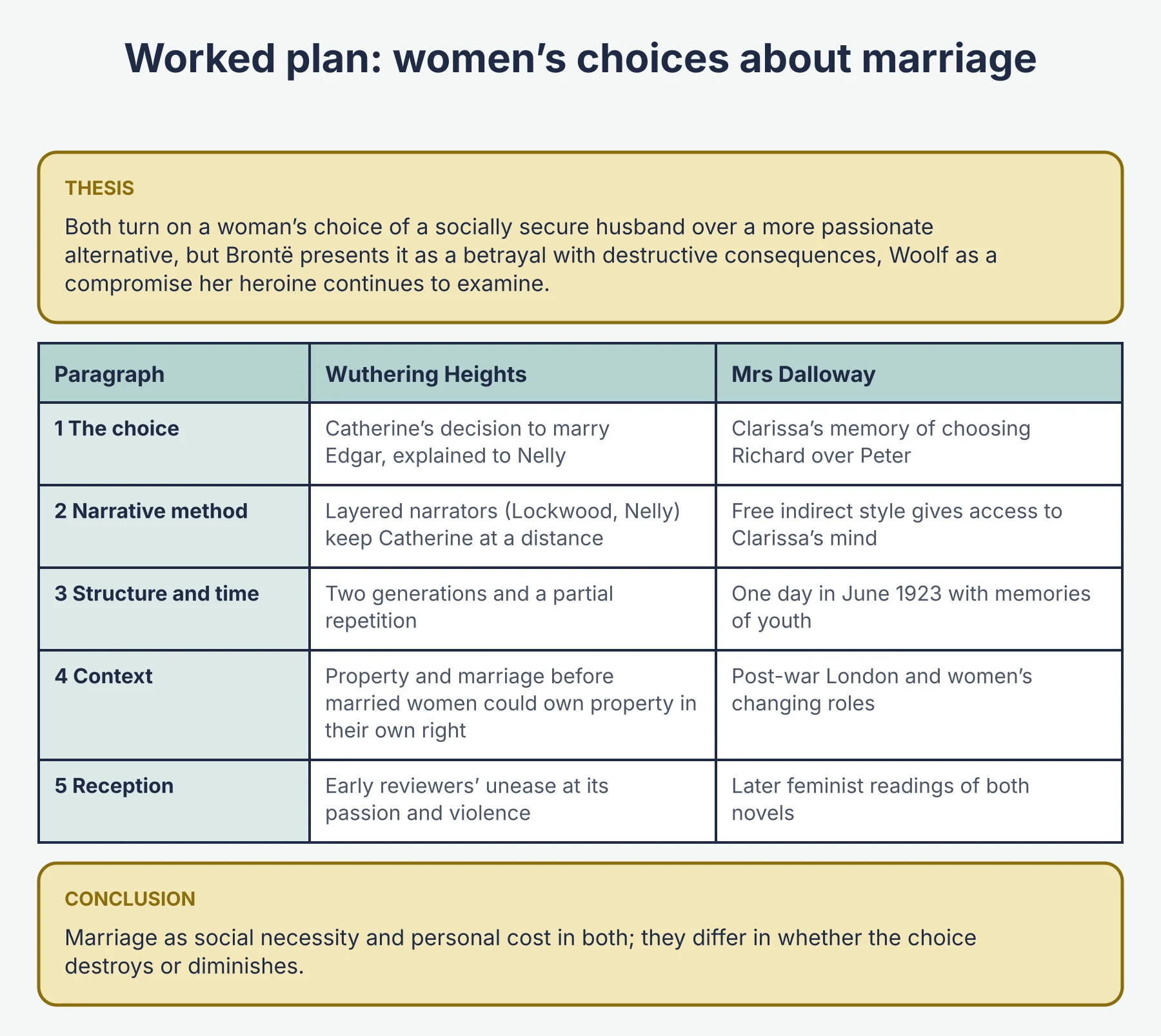
Plan:
Thesis:   Both novels turn on a woman's choice of a socially secure husband over a
          more passionate alternative, but Brontë presents the choice as a betrayal
          with destructive consequences, while Woolf presents it as a compromise that
          her heroine continues to examine.
Para 1:   The choice itself - Catherine's decision to marry Edgar, explained to Nelly;
          Clarissa's memory of choosing Richard over Peter (AO2: dialogue vs memory)
Para 2:   Narrative method - Brontë's layered narrators (Lockwood, Nelly) keep
          Catherine at a distance; Woolf's free indirect style gives access to
          Clarissa's mind (AO2/AO4)
Para 3:   Structure and time - two generations and a partial repetition in Brontë;
          one day in June 1923 with memories of youth in Woolf (AO2)
Para 4:   Context - property and marriage before married women could own property
          in their own right; post-war London and women's changing roles (AO3)
Para 5:   Reception - early reviewers' unease at Wuthering Heights' passion and
          violence; later feminist readings of both novels (AO3: context of
          reception)
Conclusion: marriage as social necessity and personal cost in both; differing in
          whether the choice destroys or diminishes
Model paragraph (paragraph 2):
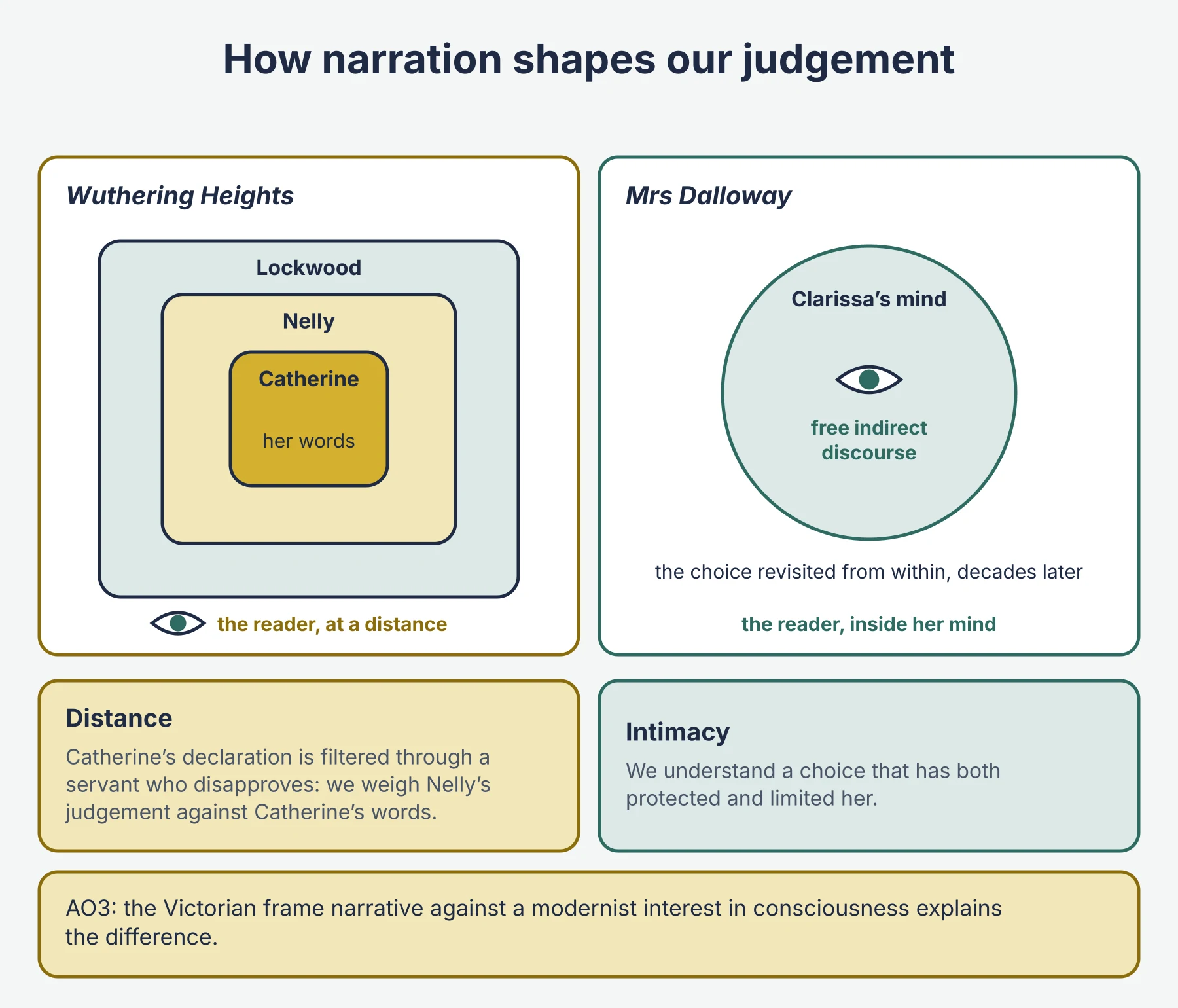
The novels’ narrative methods shape how far the reader can judge each woman’s choice. Brontë never lets Catherine narrate; her decision to marry Edgar reaches us through Nelly’s account, itself retold to Lockwood, so Catherine’s passionate declaration of her bond with Heathcliff is filtered through a servant who disapproves. The reader is left to weigh Nelly’s judgement against Catherine’s own words. Woolf, by contrast, takes us inside Clarissa’s mind through free indirect discourse, so her choice of Richard over Peter is revisited from within, decades later, as she prepares for her party. Where Brontë’s frame distances us from a choice that destroys, Woolf’s intimacy invites us to understand a choice that has both protected and limited her, which reflects a modernist interest in consciousness that the Victorian frame narrative does not share.
What earns credit: comparison within the paragraph (AO4); analysis of narrative structure and voice in both novels (AO2); an argued judgement (AO1); literary context (Victorian frame narrative and modernist interiority) used to explain the difference (AO3).
Integrating rather than alternating
- Topic sentences name both texts.
- Use comparative syntax: “Where Brontë…, Woolf…”, “Both writers…, but…”.
- Keep balance: roughly equal attention to each novel across the essay.
- Place context inside the comparison, explaining why the methods differ.
Common mistakes
- Two mini-essays joined by a comparative conclusion.
- Context as a history lesson, or biography unrelated to the text.
- Plot comparison without analysis of narrative method.
- Lopsided coverage of one novel.
- Ignoring reception, which the specification names explicitly.
- Answering a prepared question instead of the one set: the two Section B questions differ.
Exam technique
- Choose the question that lets you compare in every paragraph.
- Spend about ten minutes planning with your framework grid.
- Allocate the larger share of the two hours to this section: it carries 30 of 50 marks.
- Use the open book for short, precise references you have located during revision.
- End with a comparative judgement that answers the question.
Where to go next
- Unit 3 Thematic Prose revision notes
- Unit 3 Thematic Prose practice questions
- Unit 3 Unseen Poetry study guide
- Unit 1 Post-2000 Prose study guide, where the prose skills are first built
Official specification
Pearson Edexcel International Advanced Subsidiary/Advanced Level in English Literature, Issue 7, Unit 3 — qualifications.pearson.com.
Related resources
-
Practice questions
Pearson Edexcel International A Level English Literature (YET01): Unit 3 Thematic Prose – Practice Questions
Comparison drills on two original openings and 30-mark comparative essays for every YET01 Unit 3 prose theme, with indicative content mapped to AO1 to AO4.
English Literature · Pearson Edexcel · A Level
Try questions -
Revision notes
Pearson Edexcel International A Level English Literature (YET01): Unit 3 Thematic Prose – Revision Notes
Quick-recall notes for the YET01 Unit 3 comparative prose essay: themes and texts, narrative methods by novel, AO1 to AO4, context types, traps and a self-test.
English Literature · Pearson Edexcel · A Level
Revise topic -
Practice questions
Unit 3 Poetry and Prose (YET01): Practice Questions
Original Edexcel IAL English Literature (YET01) Unit 3-style questions: an unseen post-1900 poem and comparative prose essays by theme, with indicative content.
English Literature · Pearson Edexcel · A Level
Try questions
Get free revision emails (optional)
Occasional emails with practice questions, worked explanations and links to free resources for the qualification and subjects you choose. No spam, and you can unsubscribe from any email. The free tools on this site never need an email.