
Revision Notes
Edexcel International A Level Law (YLA1): Trespass to Land – Revision Notes
Condensed notes on trespass to land: unlawful entry, intentional and direct interference, continuing trespass, defences, remedies and a self-test (YLA1).
- Subject
- Law
- Level
- A LEVELS
- Topic
- Paper 2 – The Law in Action
- Author
- Marlbridge Academic Team
- Updated
- Reviewed by
- Aizaz Raoof Ali (what this means)
Aligned to Pearson Edexcel A Level Law (YLA1), Issue 4, November 2021. Official specification .
Syllabus page (what it covers and how it is assessed): Pearson Edexcel A Level Law.
Syllabus points this page covers
YLA1
- 2.3 The individual
Found an error? Report a correction.
Need help with this topic? Request a free trial class for A Level Law (YLA1).
Condensed for the final weeks. These notes cover content area 2.3.9, “Trespass to land”: “unlawful entry”, “intentional and direct interference” and “continuing trespass and remedies”. For the full explanation, use the trespass to land study guide; the whole section is in the individual revision notes.
Definition
An unjustifiable, direct and intentional interference with land in the possession of another.
- Actionable per se: no damage needed.
- Protects possession: tenants can sue, even against the landlord.
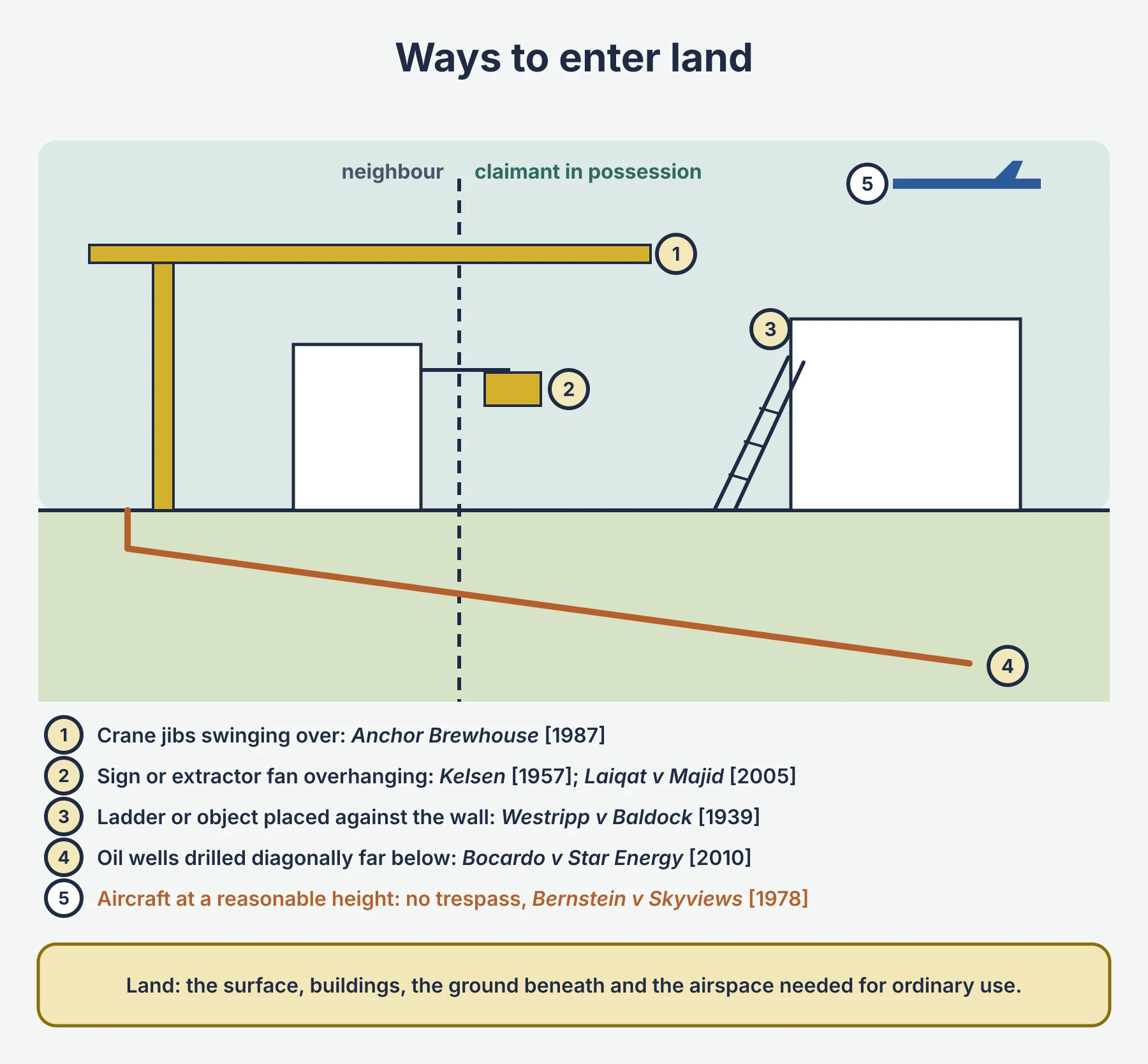
- “Land” = surface, buildings, subsoil and airspace needed for ordinary use.
Forms of unlawful entry
| Form | Case |
|---|---|
| Walking or driving onto land | The basic case |
| Placing objects against or on land | Westripp v Baldock [1939] (ladder) |
| Overhanging airspace | Kelsen v Imperial Tobacco [1957] (sign); Anchor Brewhouse v Berkley House [1987] (crane jibs); Laiqat v Majid [2005] (extractor fan) |
| Below the surface | Bocardo v Star Energy [2010] (oil wells deep below) |
| Not trespass: aircraft at a reasonable height | Bernstein v Skyviews [1978]; Civil Aviation Act 1982 |
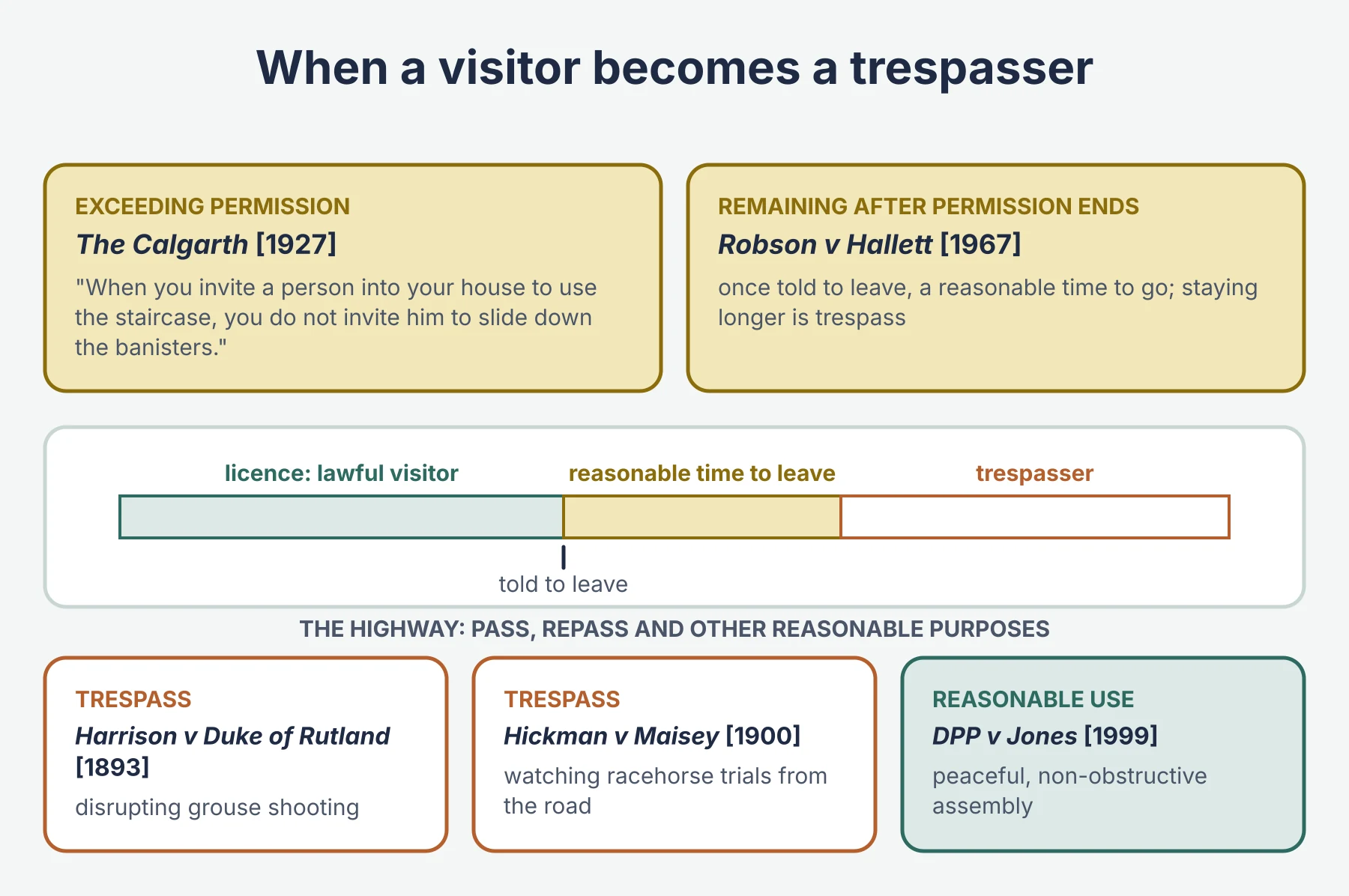
| Exceeding permission | The Calgarth [1927] (staircase and banisters) |
| Staying after permission revoked | Robson v Hallett [1967] (reasonable time to leave) |
| Misusing the highway | Harrison v Duke of Rutland [1893]; Hickman v Maisey [1900]; contrast DPP v Jones [1999] |
Intentional and direct
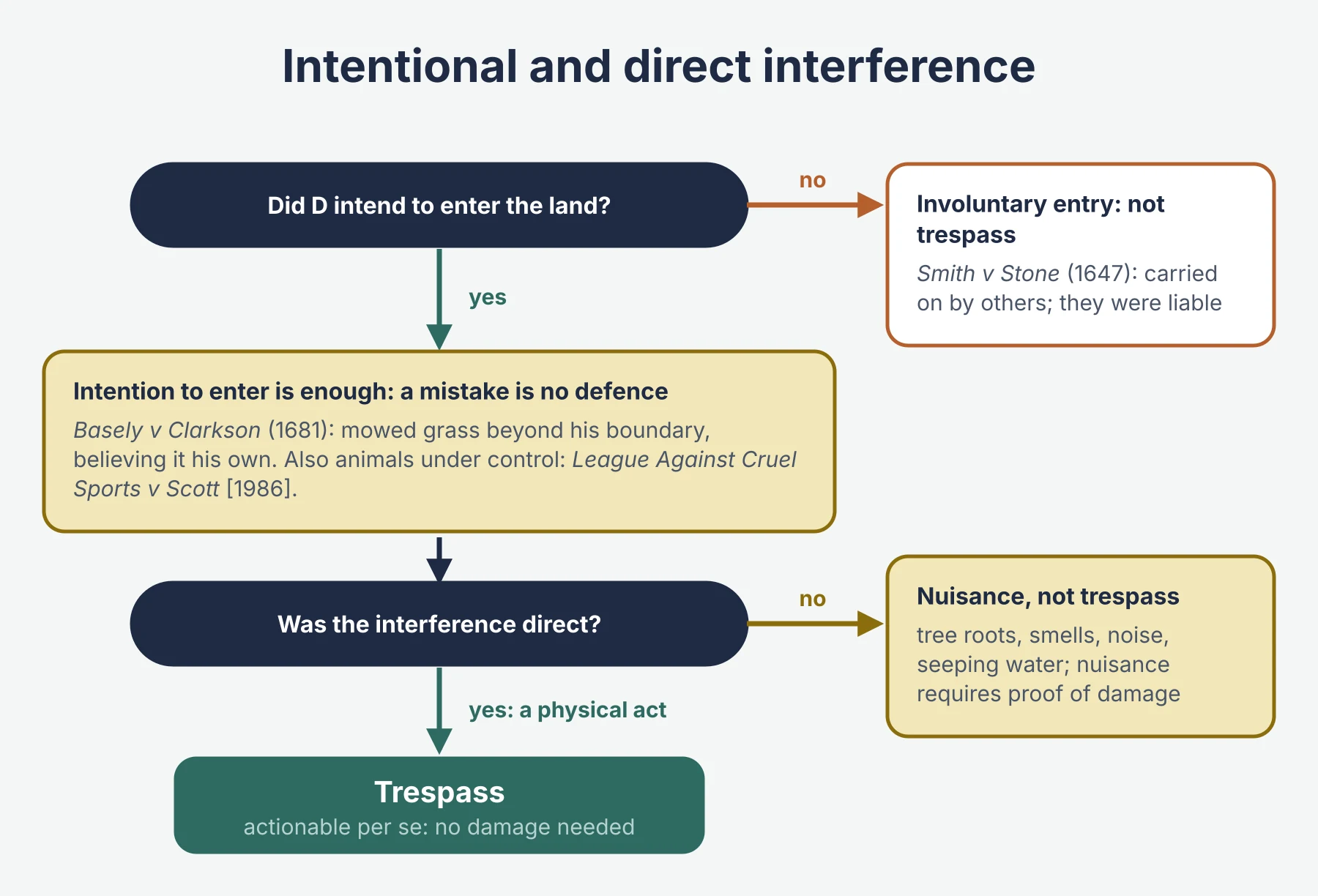
- Intention to enter, not to trespass: mistake is no defence (Basely v Clarkson (1681)).
- Involuntary entry is not trespass (Smith v Stone (1647)).
- Liability for animals under control if intended or negligently allowed (League Against Cruel Sports v Scott [1986]).
- Direct physical interference only; indirect harm (roots, smells, seepage) is nuisance, which needs damage.
Continuing trespass
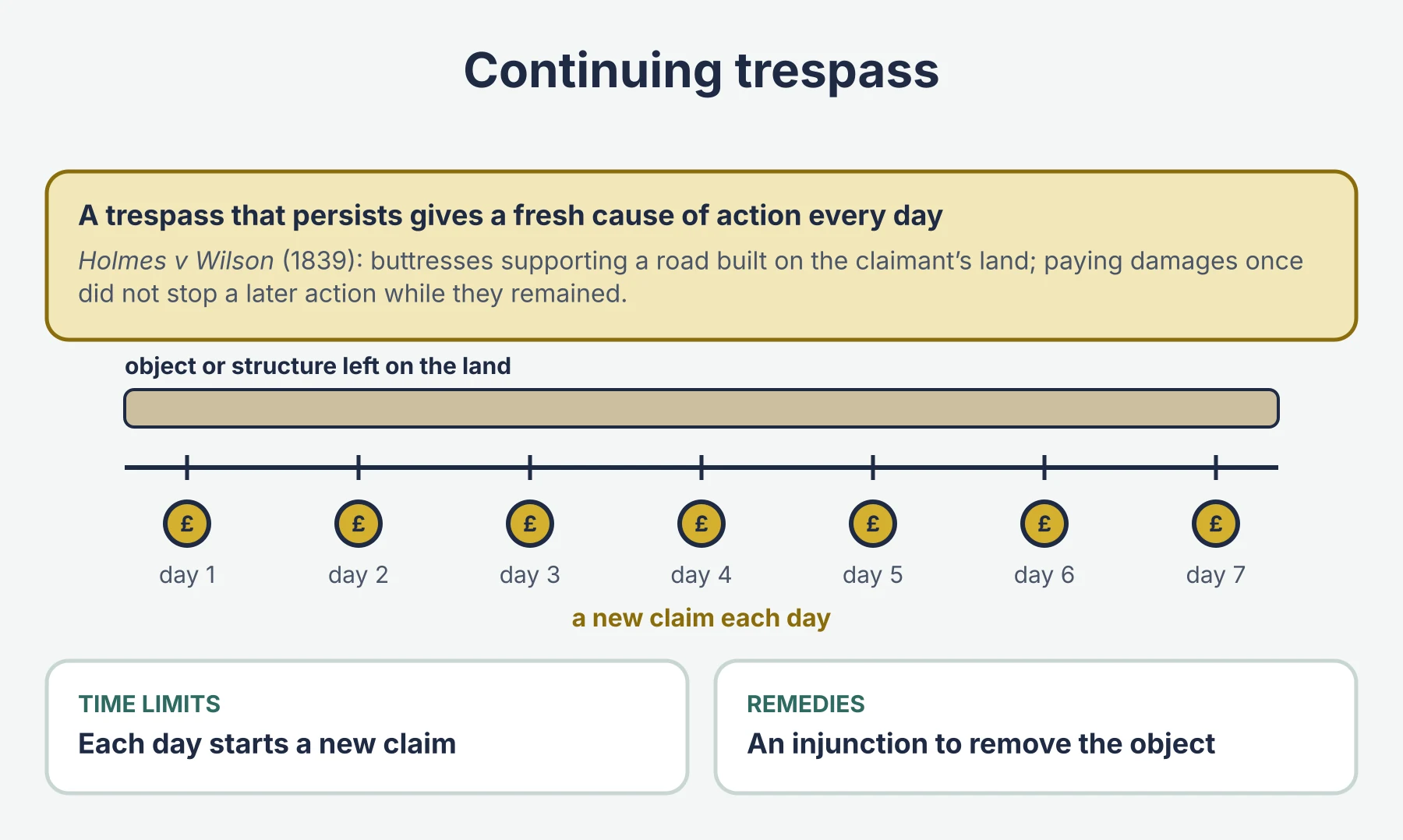
- Object or structure left on the land.
- Fresh cause of action each day (Holmes v Wilson (1839)).
- Supports a mandatory injunction to remove it.
Defences
| Defence | Key point |
|---|---|
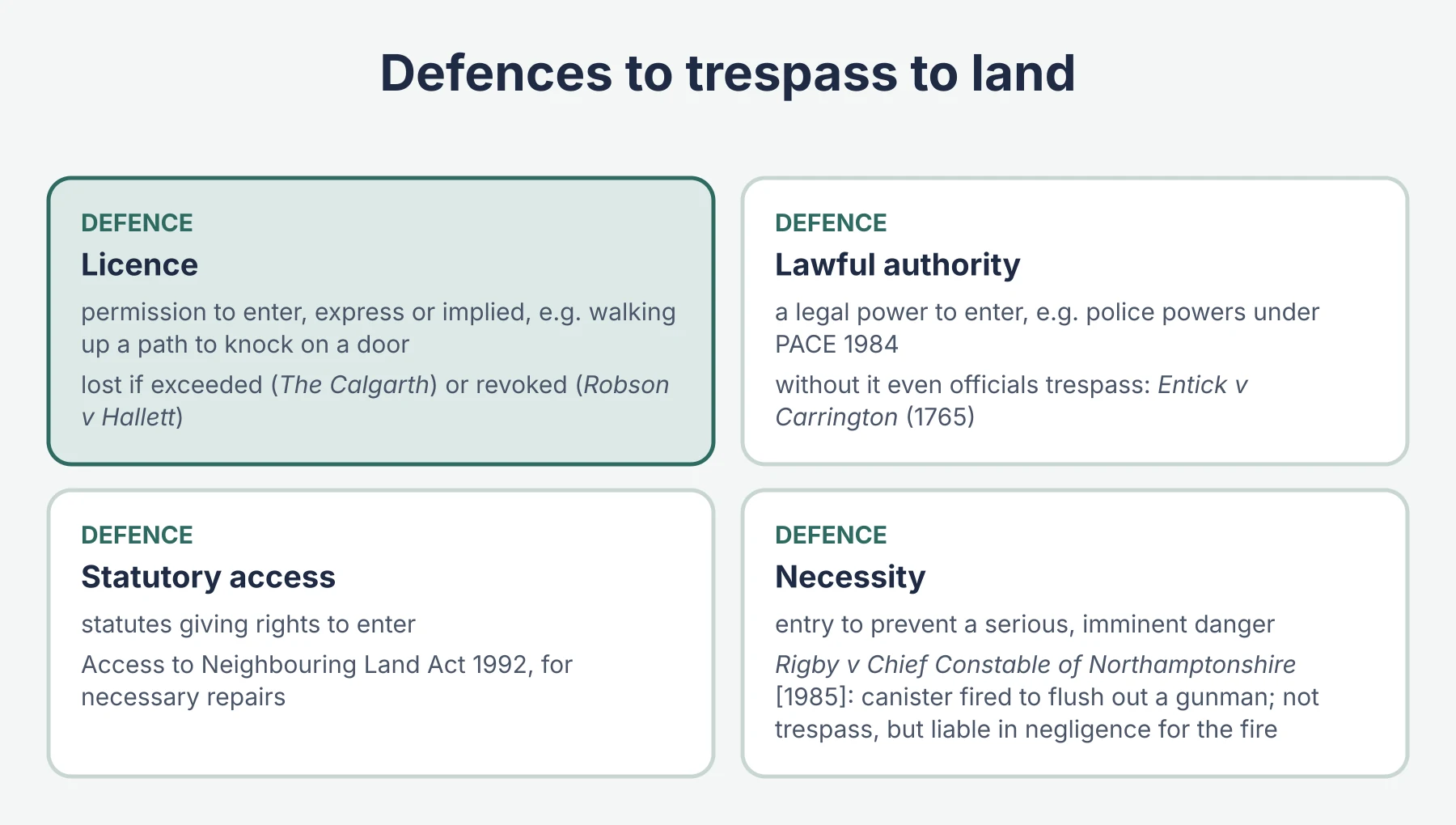
| Licence | Express or implied; lost if exceeded or revoked |
| Lawful authority | PACE 1984 powers; no authority, no right to enter (Entick v Carrington (1765)) |
| Statute | Access to Neighbouring Land Act 1992 |
| Necessity | Serious, imminent danger (Rigby v Chief Constable of Northamptonshire [1985]) |
Remedies
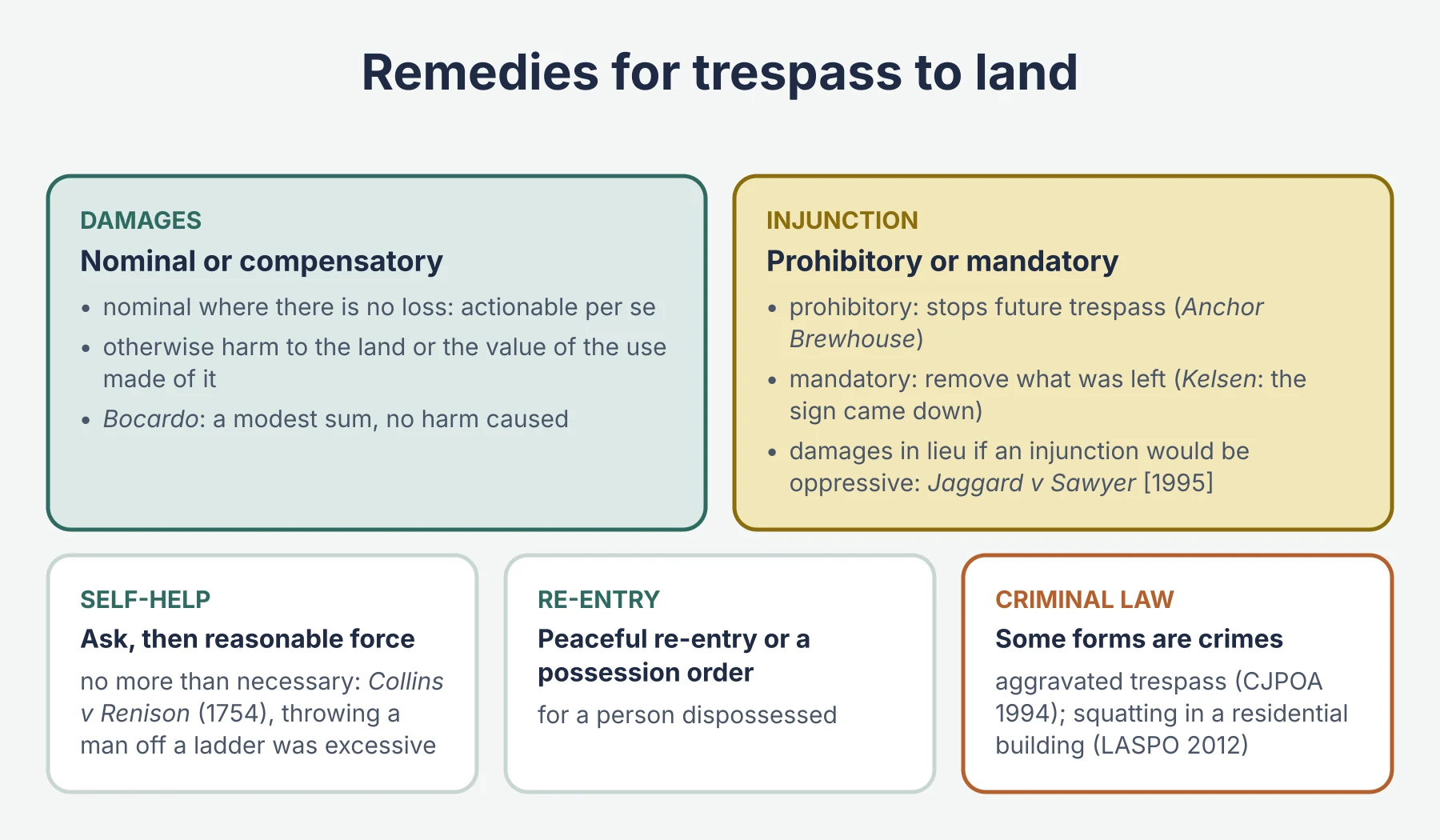
- Damages: nominal if no loss; compensatory for harm or use (Bocardo: modest sum).
- Injunction: prohibitory or mandatory (Kelsen; Anchor Brewhouse); damages in lieu if oppressive (Jaggard v Sawyer [1995]).
- Self-help: request to leave, then reasonable force (Collins v Renison (1754): excessive force not allowed).
- Possession order or peaceful re-entry.
- Criminal: aggravated trespass (CJPOA 1994); squatting in a residential building (LASPO 2012).
Trespass or nuisance?
| Trespass | Nuisance | |
|---|---|---|
| Interference | Direct | Indirect |
| Damage needed? | No | Yes |
| Typical examples | Entry, objects, overhanging structures | Noise, smells, roots, seepage |
Model evaluation paragraph
Because trespass is actionable per se, the law gives strong protection to those in possession: a claimant like the one in Bocardo can win without proving any harm. This supports privacy and property rights and deters interference, and the remedies are flexible, since damages in lieu (Jaggard v Sawyer) avoid oppressive injunctions. But strong protection can restrict others’ legitimate activity, which is why the law makes exceptions for aircraft (Bernstein), reasonable use of the highway (DPP v Jones) and statutory access for repairs.
Key terms
| Term | Meaning |
|---|---|
| Actionable per se | Actionable without proof of damage |
| Possession | Occupation and control of land, which gives the right to sue |
| Licence | Permission to be on land |
| Continuing trespass | A trespass that persists, giving a fresh claim each day |
| Nominal damages | A small sum recognising a legal wrong without loss |
| Mandatory injunction | An order to do something, such as remove an object |
| Prohibitory injunction | An order to stop doing something |
| Damages in lieu | Damages awarded instead of an injunction |
| Self-help | Lawful action by the occupier, such as removing a trespasser with reasonable force |
Exam traps
- No damage is needed.
- Mistake about ownership or the boundary is no defence.
- Indirect interference is nuisance, not trespass.
- A visitor becomes a trespasser by exceeding or outstaying permission.
- Overflight at a reasonable height is not trespass.
Self-test
- Define trespass to land.
- Who can sue for trespass?
- What does “actionable per se” mean?
- Why was there a trespass in Anchor Brewhouse?
- What did Bocardo v Star Energy decide?
- Why was there no trespass in Bernstein v Skyviews?
- What did Scrutton LJ say in The Calgarth?
- What did Robson v Hallett decide?
- Is a mistake about a boundary a defence?
- What is a continuing trespass, and why does it matter?
- Give two defences to trespass to land.
- When will a court award damages instead of an injunction?
Answers: 1. An unjustifiable, direct and intentional interference with land in the possession of another. 2. The person in possession, such as a tenant, not only the owner. 3. It can be sued on without proof of damage. 4. Crane jibs swung through the claimant’s airspace at a height that affected ordinary use. 5. Drilling wells far beneath the claimant’s land was a trespass. 6. The aircraft flew at a reasonable height, above the airspace needed for ordinary use. 7. “When you invite a person into your house to use the staircase, you do not invite him to slide down the banisters.” 8. A person whose licence is revoked has a reasonable time to leave before becoming a trespasser. 9. No (Basely v Clarkson). 10. A trespass that persists, such as an object left on land; it gives a fresh cause of action every day. 11. Any two: licence; lawful authority; statutory access; necessity. 12. Where an injunction would be oppressive and damages are an adequate remedy (Jaggard v Sawyer).
Test yourself further with the trespass to land practice questions.
Related resources
-
Practice questions
Edexcel International A Level Law: The Law in Action — Practice Questions
Edexcel International A Level Law Paper 2 practice with worked answers on contract, consumer rights, negligence, crime, defamation and occupiers' liability.
Law · Pearson Edexcel · A Level
Try questions -
Revision notes
Edexcel International A Level Law: The Law in Action — Revision Notes
Revision notes for Edexcel International A Level Law Paper 2: contract, negligence, criminal liability, property offences, defamation and occupiers' liability.
Law · Pearson Edexcel · A Level
Revise topic -
Study guides
Edexcel International A Level Law: The Law in Action (YLA1)
Contract or negligence, criminal liability and property offences, and reputation, privacy and land: Paper 2 of Pearson Edexcel International A Level Law.
Law · Pearson Edexcel · A Level
Read guide
Get free revision emails (optional)
Occasional emails with practice questions, worked explanations and links to free resources for the qualification and subjects you choose. No spam, and you can unsubscribe from any email. The free tools on this site never need an email.