
Study Guides
Edexcel International A Level Law (YLA1): Trespass to Land
Trespass to land for YLA1 2.3.9: unlawful entry, intentional and direct interference, continuing trespass, defences and remedies, with cases and a scenario.
- Subject
- Law
- Level
- A LEVELS
- Topic
- Paper 2 – The Law in Action
- Author
- Marlbridge Academic Team
- Updated
- Reviewed by
- Aizaz Raoof Ali (what this means)
Aligned to Pearson Edexcel A Level Law (YLA1), Issue 4, November 2021. Official specification .
Syllabus page (what it covers and how it is assessed): Pearson Edexcel A Level Law.
Syllabus points this page covers
YLA1
- 2.3 The individual
Found an error? Report a correction.
Need help with this topic? Request a free trial class for A Level Law (YLA1).
This guide covers content area 2.3.9 of Pearson Edexcel International Advanced Level Law, Issue 4, “Trespass to land”, whose bullets are “unlawful entry”, “intentional and direct interference” and “continuing trespass and remedies”, together with the remedies that link to 2.3.10, “Remedies for the individual”. The individual study guide covers trespass in one paragraph with two airspace cases. This page takes each bullet in turn, adds the defences, and shows how to work through a trespass scenario.
What trespass to land is
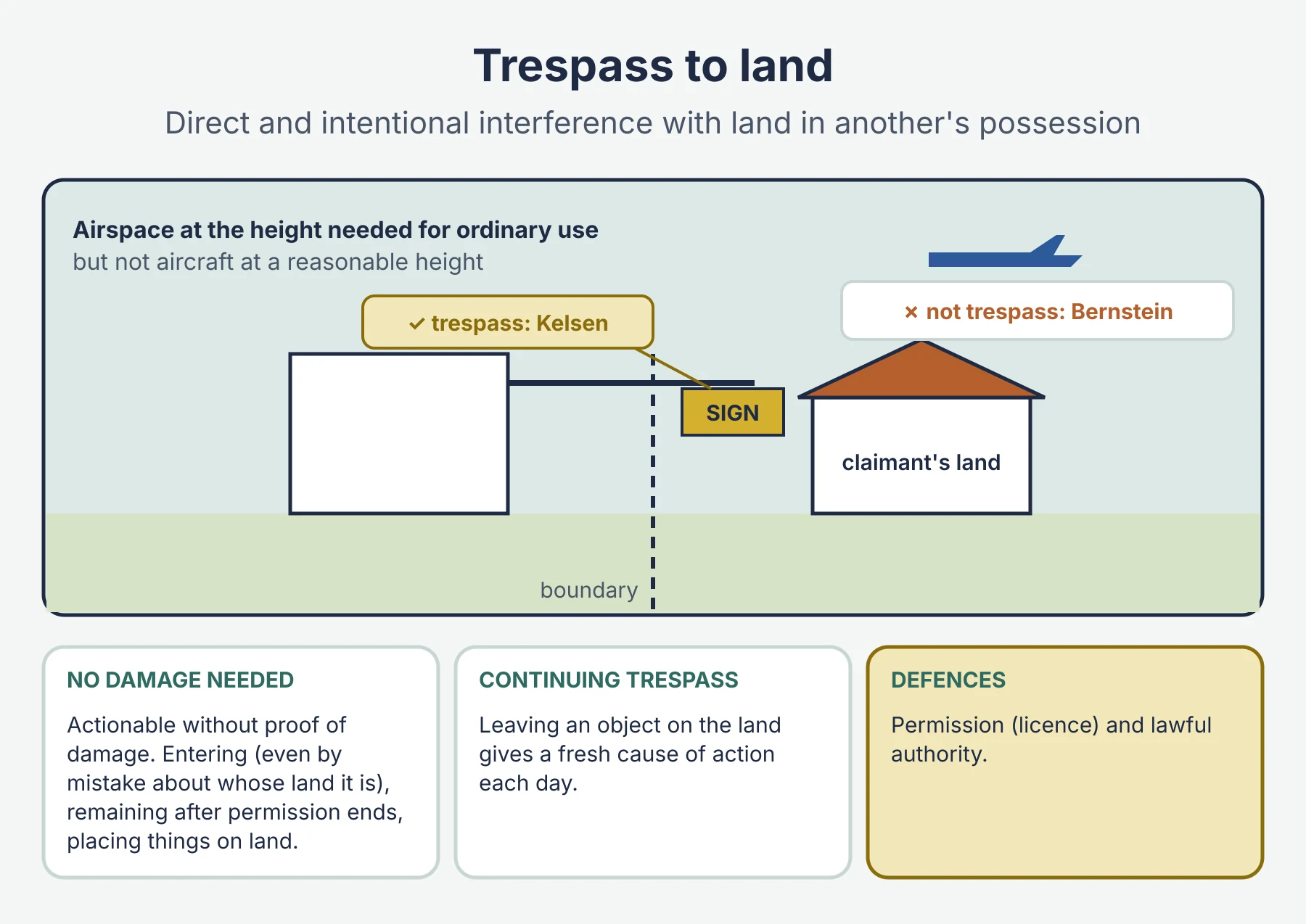
Trespass to land is an unjustifiable, direct and intentional interference with land in the possession of another. Two features make it different from most torts:
- It is actionable per se: the claimant need not prove any damage.
- It protects possession, not ownership. The person entitled to sue is whoever is in possession: a tenant can sue a trespasser, and can even sue the landlord who enters without a right to do so.
“Land” includes the surface, buildings on it, the ground beneath and the airspace above, to the extent needed for ordinary use.
Unlawful entry
The commonest trespass is going onto the land without permission. But “entry” covers more than walking on:
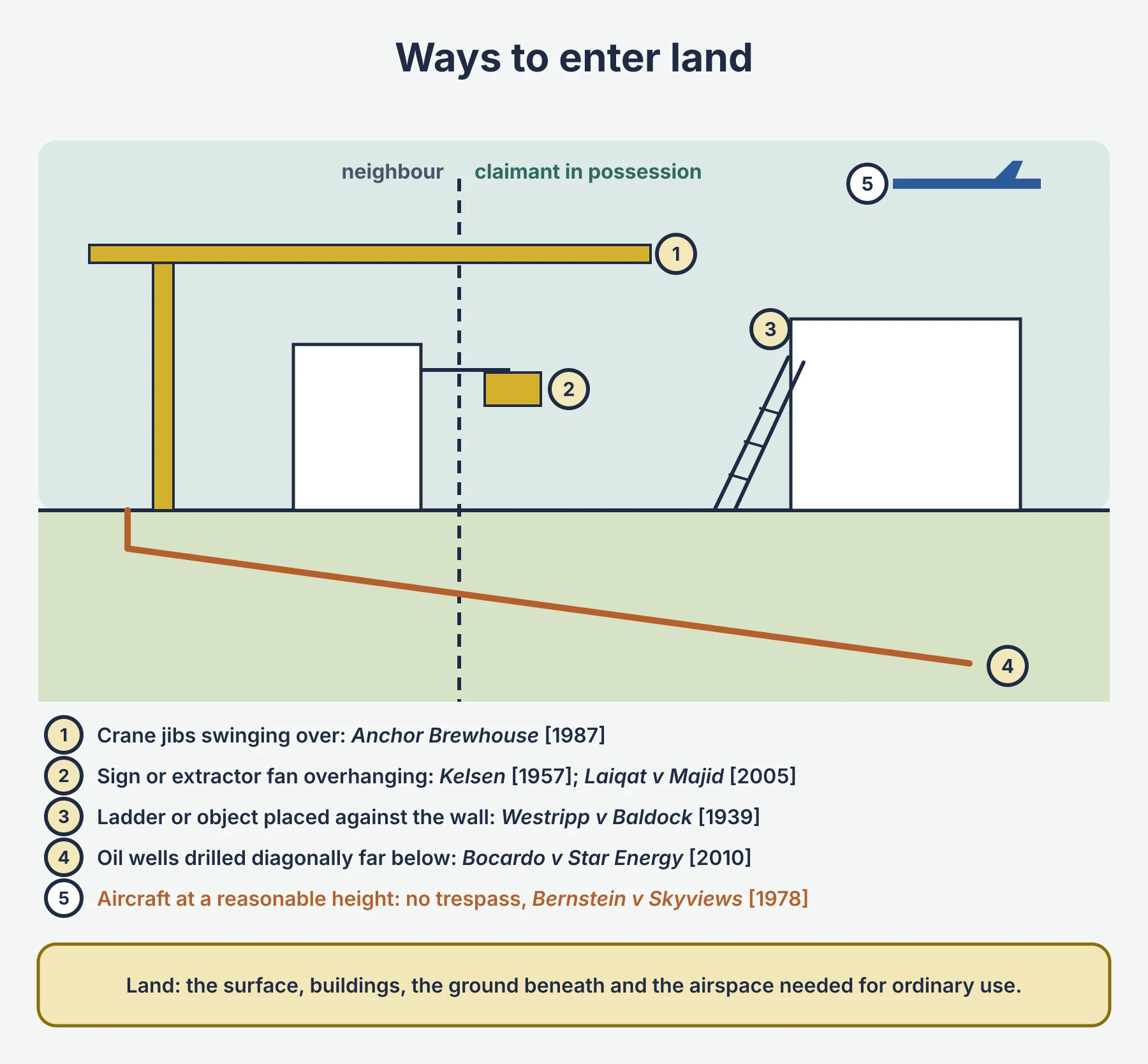
- Placing or throwing objects onto land, or leaning a ladder against a wall: Westripp v Baldock [1939].
- Projecting into airspace: a sign overhanging a shop (Kelsen v Imperial Tobacco [1957]); the jibs of tower cranes swinging over neighbouring land (Anchor Brewhouse Developments v Berkley House [1987]); an extractor fan overhanging a neighbour’s yard (Laiqat v Majid [2005]).
- Beneath the surface: in Bocardo SA v Star Energy [2010] the Supreme Court held that oil wells drilled diagonally under the claimant’s land, hundreds of metres down, were a trespass.
- Aircraft: flying over land at a reasonable height is not a trespass (Bernstein v Skyviews [1978], an aerial photograph), and the Civil Aviation Act 1982 protects aircraft flying reasonably.
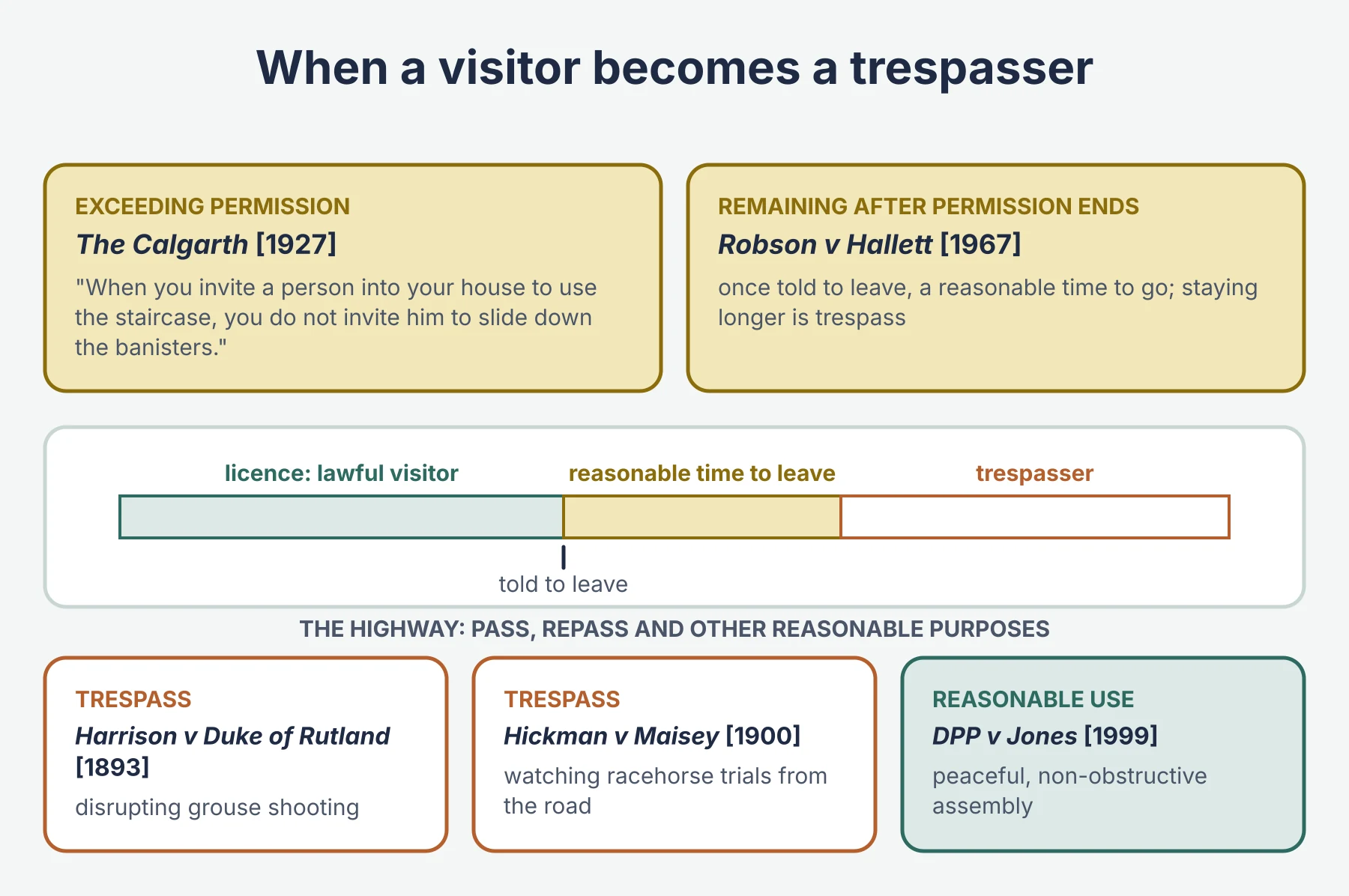
Exceeding permission. A visitor who goes beyond what they were permitted to do becomes a trespasser. In The Calgarth [1927] Scrutton LJ said: “When you invite a person into your house to use the staircase, you do not invite him to slide down the banisters.”
Remaining after permission ends. If a licence is revoked, the visitor must be given a reasonable time to leave; after that, staying is trespass. In Robson v Hallett [1967] police officers who were told to leave were not trespassers during the short time needed to go.
The highway. The public may use a highway to pass and repass and for other reasonable purposes. Using it for something else can be trespass against the owner of the land beneath: in Harrison v Duke of Rutland [1893] a man who used a highway to disrupt grouse shooting was a trespasser, as was a man who watched racehorse trials from the road in Hickman v Maisey [1900]. In DPP v Jones [1999] the House of Lords accepted that peaceful, non-obstructive assembly can be a reasonable use of the highway.
Intentional and direct interference
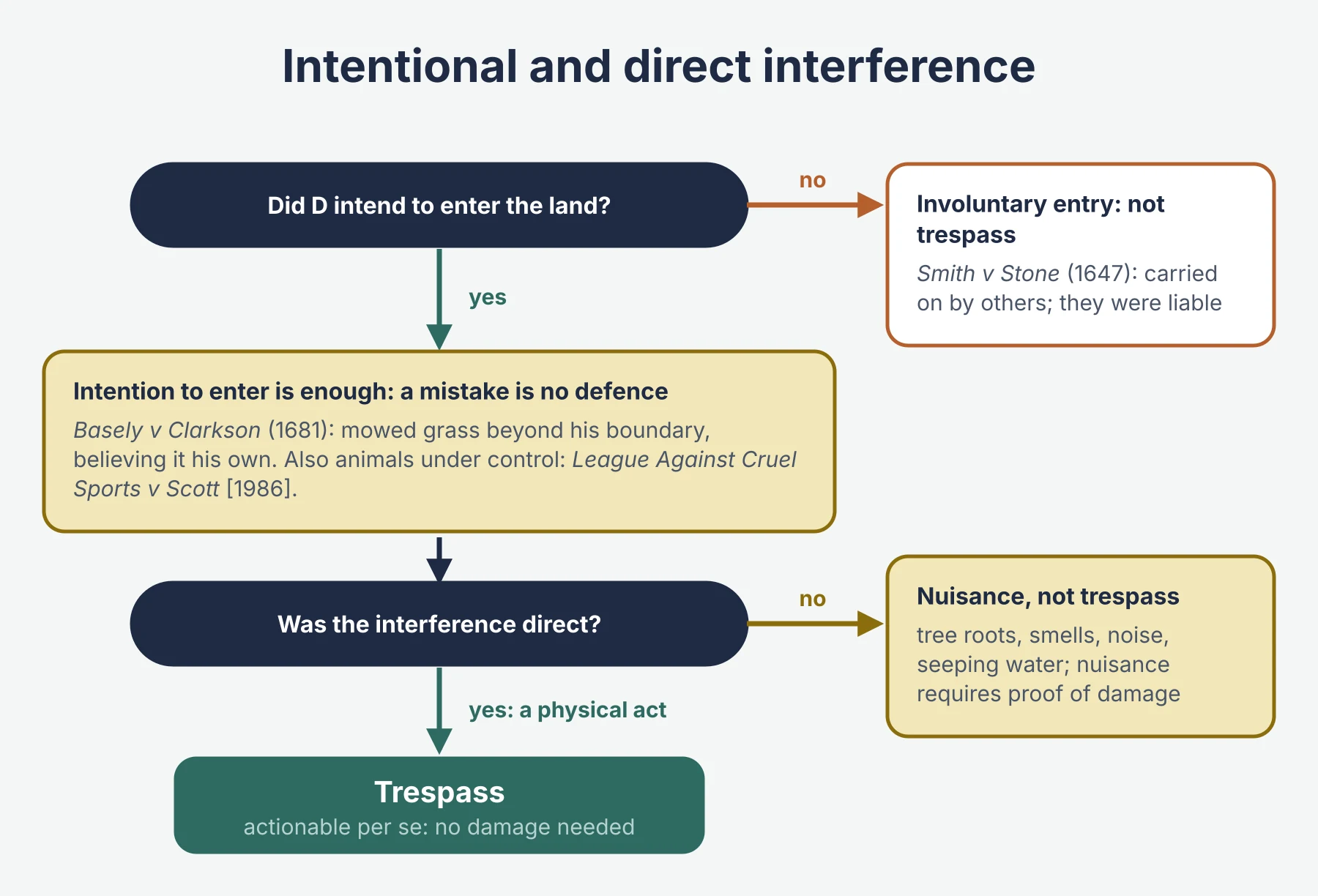
Intentional. The defendant must intend to enter the land, not to trespass. A mistake about the boundary or about who owns the land is no defence: in Basely v Clarkson (1681) a man who mowed grass beyond his boundary, believing it to be his own, was liable. But an entry that is involuntary is not a trespass: in Smith v Stone (1647) a man carried onto land by others was not liable; the people who carried him were.
Animals and people under one’s control. In League Against Cruel Sports v Scott [1986] the master of a hunt was liable for hounds entering land where he intended them to enter, or by negligence failed to stop them.
Direct. The interference must be a direct physical act. Indirect interference, such as tree roots spreading, smells, noise or water seeping across, is dealt with by the tort of nuisance, which requires proof of damage. This line between direct (trespass) and indirect (nuisance) is often the first issue in a scenario.
Continuing trespass
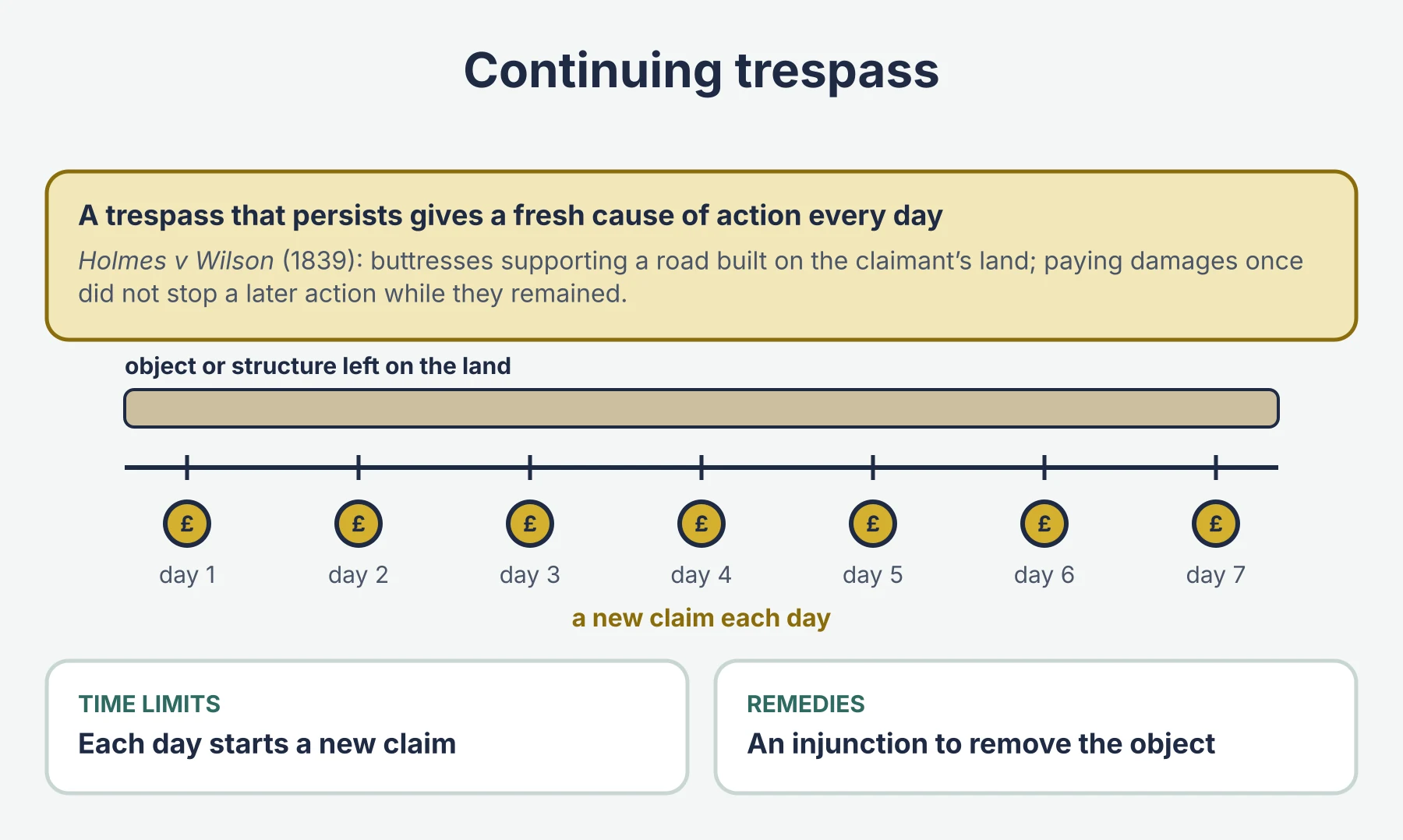
A trespass that persists, such as an object left on the land or a structure built on it, is a continuing trespass. It gives rise to a fresh cause of action every day it continues. In Holmes v Wilson (1839) buttresses built on the claimant’s land to support a road were a continuing trespass; paying damages once did not stop a later action while they remained. Continuing trespass matters for time limits (each day starts a new claim) and for remedies (an injunction to remove the object).
Defences
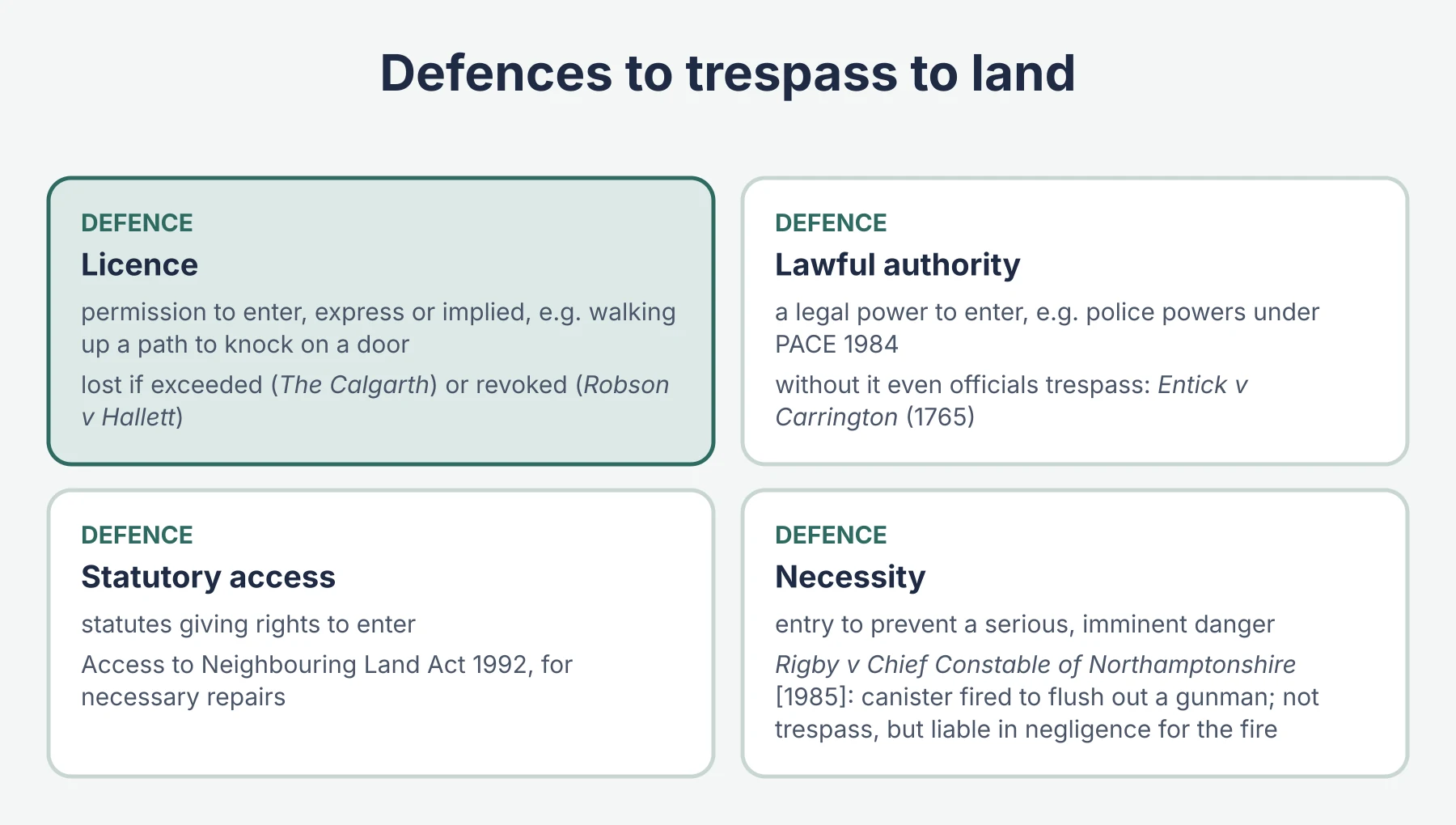
| Defence | Explanation | Example |
|---|---|---|
| Licence | Permission to enter, express or implied (such as walking up a path to knock on a door) | Lost if exceeded (The Calgarth) or revoked (Robson v Hallett) |
| Lawful authority | A legal power to enter | Police powers under the Police and Criminal Evidence Act 1984; without such authority even officials trespass (Entick v Carrington (1765)) |
| Statutory access | Statutes giving rights to enter | Access to Neighbouring Land Act 1992 for necessary repairs |
| Necessity | Entry to prevent a serious, imminent danger | Police firing a canister into a shop to flush out a gunman were not trespassers, though liable in negligence for the fire (Rigby v Chief Constable of Northamptonshire [1985]) |
Remedies
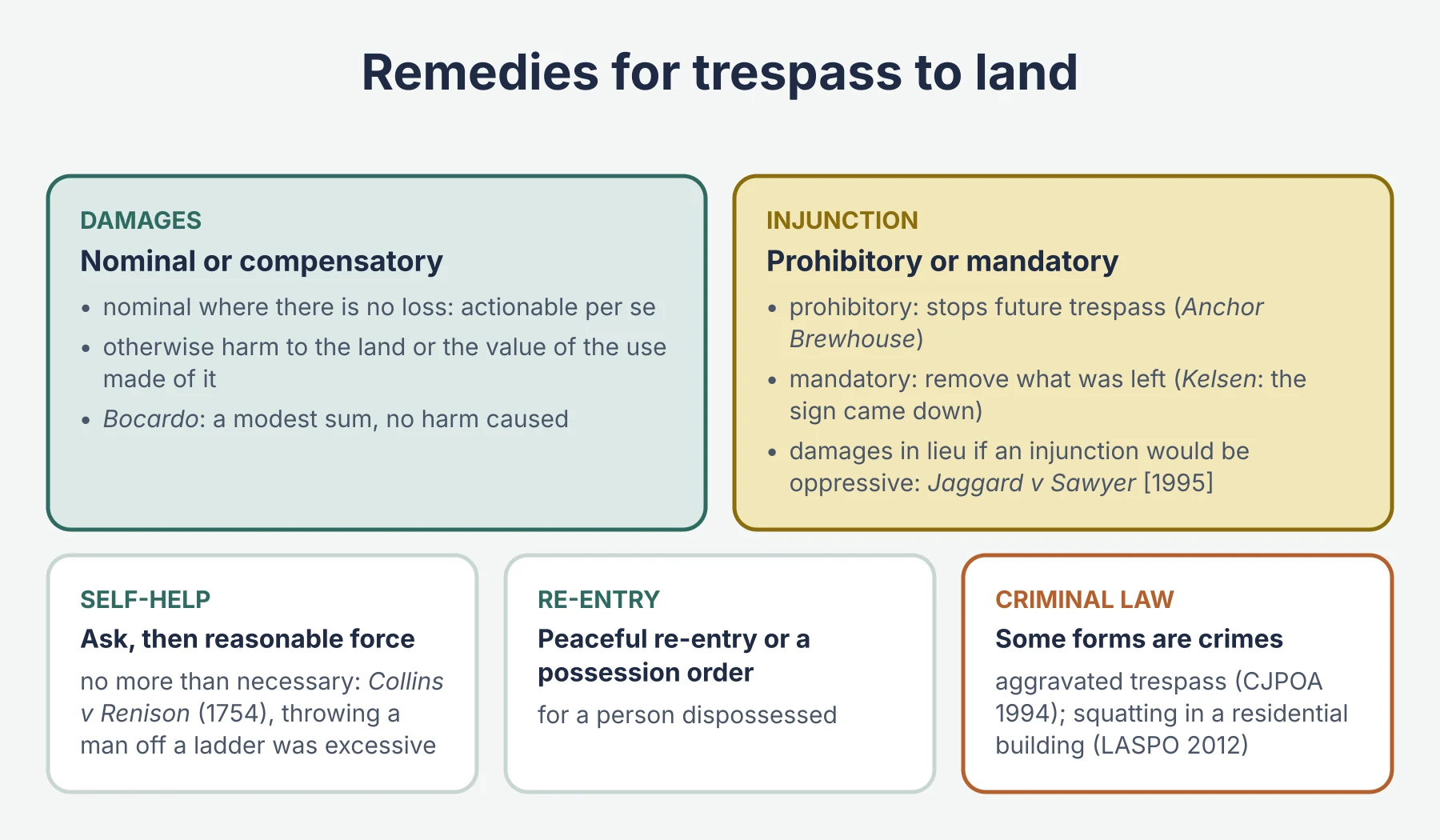
- Damages. Because trespass is actionable per se, nominal damages are available where there is no loss. Where there is loss, damages compensate for harm to the land or for the value of the use made of it. In Bocardo the claimant recovered only a modest sum, because the drilling had caused no harm.
- Injunction. A prohibitory injunction stops future trespass; a mandatory injunction orders removal of something left on the land, as in Kelsen, where the sign had to come down. In Anchor Brewhouse an injunction was granted against the crane jibs. The court has a discretion to award damages in lieu of an injunction where an injunction would be oppressive (Jaggard v Sawyer [1995]).
- Self-help. An occupier may ask a trespasser to leave and, if they refuse, use reasonable force to remove them. Force must be no more than necessary: in Collins v Renison (1754) throwing a man off a ladder was excessive.
- Re-entry and possession orders. A person dispossessed may re-enter peacefully or seek a court order for possession.
- Criminal law. Trespass is usually a civil wrong, but some forms are crimes, such as aggravated trespass under the Criminal Justice and Public Order Act 1994 and squatting in a residential building under the Legal Aid, Sentencing and Punishment of Offenders Act 2012.
Worked example
Femi is building an extension. He leaves scaffolding that rests against his neighbour Gita’s wall, and his crane swings over her garden each day. When she complains, his builder walks into her garden to inspect the wall, and refuses to leave when told to. Advise Gita.
Scaffolding  object placed against her wall: entry (Westripp v Baldock);
             left there: continuing trespass, fresh claim daily
             (Holmes v Wilson)
Crane        airspace at a height needed for ordinary use: trespass
             (Anchor Brewhouse)
Builder      no licence; even if implied permission existed, it ended
             when she told him to leave; after a reasonable time to go,
             trespass (Robson v Hallett)
Damage?      none needed: actionable per se
Remedies     injunction to remove scaffolding and stop crane oversailing;
             damages (at least nominal); reasonable force to remove the
             builder after a request to leave
Defence?     Femi could apply under the Access to Neighbouring Land
             Act 1992 if access is genuinely needed for works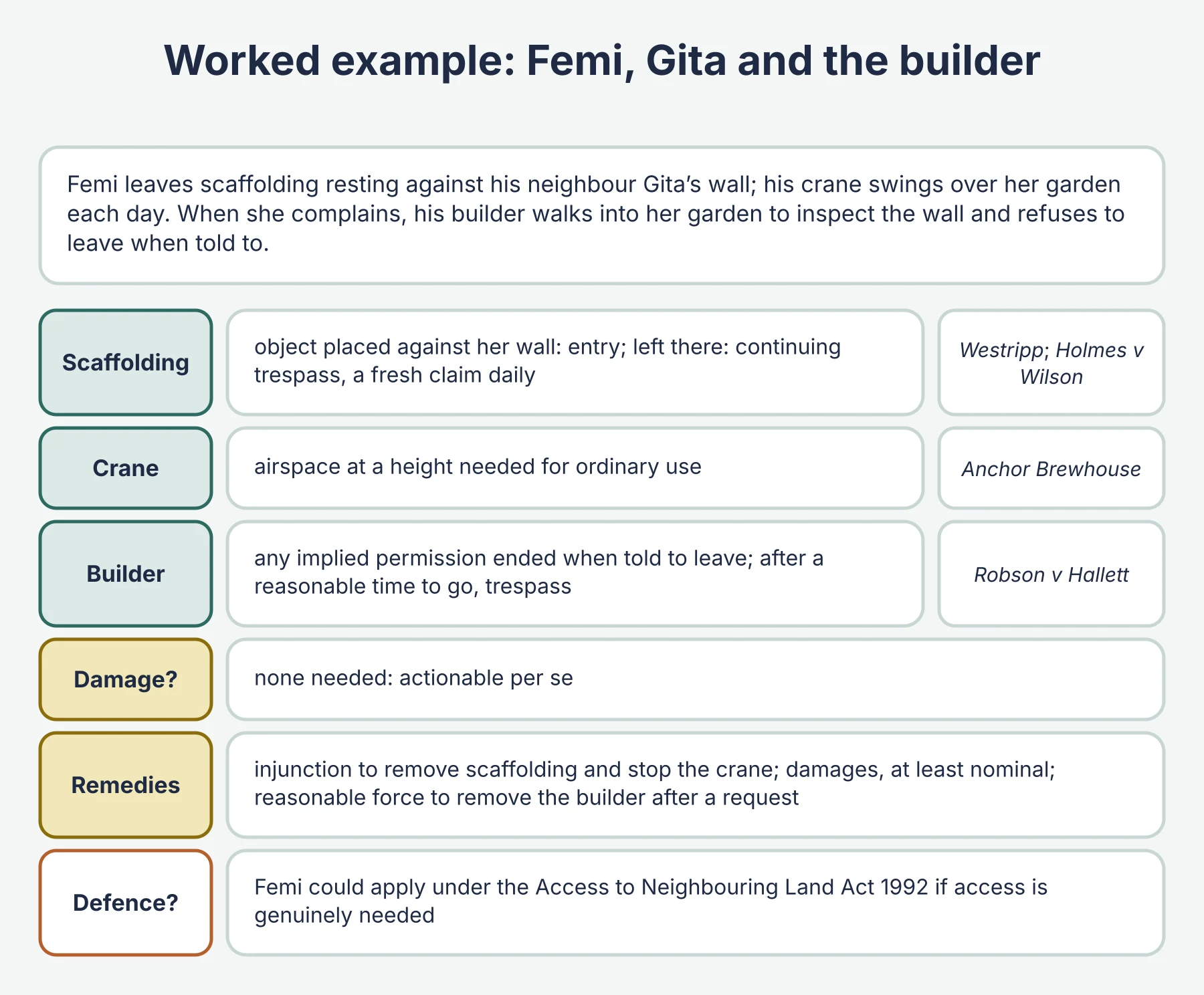
Common mistakes
- Saying trespass requires damage.
- Saying a mistake about the boundary is a defence.
- Treating indirect interference, such as roots or smells, as trespass rather than nuisance.
- Forgetting that a lawful visitor becomes a trespasser by exceeding or outstaying permission.
- Saying any overflight is trespass, ignoring Bernstein and the Civil Aviation Act 1982.
Exam technique
Work through: possession (who can sue), entry (what kind), intention and directness, continuing or not, defences, then remedies. For evaluate questions, weigh the strong protection trespass gives to possession (no damage needed) against the interests of neighbours, the public using highways, and protesters.
Condense with the trespass to land revision notes and practise with the trespass to land practice questions.
Related resources
-
Practice questions
Edexcel International A Level Law (YLA1): Trespass to Land – Practice Questions
Original practice questions with full answers on trespass to land: unlawful entry, direct and intentional interference, continuing trespass and remedies.
Law · Pearson Edexcel · A Level
Try questions -
Revision notes
Edexcel International A Level Law (YLA1): Trespass to Land – Revision Notes
Condensed notes on trespass to land: unlawful entry, intentional and direct interference, continuing trespass, defences, remedies and a self-test (YLA1).
Law · Pearson Edexcel · A Level
Revise topic -
Practice questions
Edexcel International A Level Law: The Law in Action — Practice Questions
Edexcel International A Level Law Paper 2 practice with worked answers on contract, consumer rights, negligence, crime, defamation and occupiers' liability.
Law · Pearson Edexcel · A Level
Try questions
Get free revision emails (optional)
Occasional emails with practice questions, worked explanations and links to free resources for the qualification and subjects you choose. No spam, and you can unsubscribe from any email. The free tools on this site never need an email.