
Revision Notes
Edexcel A Level Urdu (9UR0): Patras Ke Mazameen (پطرس کے مضامین) – Revision Notes
9UR0 notes on Patras Ke Mazameen (پطرس کے مضامین): the five set essays, humour techniques, a model paragraph and a self-test.
- Subject
- Urdu Language
- Level
- A LEVELS
- Topic
- Prescribed literary texts and films
- Author
- Marlbridge Academic Team
- Updated
- Reviewed by
- Farheen Zehra (what this means)
Aligned to Pearson Edexcel A Level Urdu Language (9UR0), 2018. Official specification .
Syllabus page (what it covers and how it is assessed): Pearson Edexcel A Level Urdu Language.
Syllabus points this page covers
9UR0
- 5.2 پطرس کے مضامین — احمد شاہ پطرس بخاری (2011) essays: سویرے جو کل آنکھ میری کھُلی؛ اُردو کی آخری کتاب؛ مُرید پُور کا پیر؛ مرحُوم کی یاد میں؛ لاہور کا جغرافیہ
Found an error? Report a correction.
Need help with this topic? Request a free trial class for A Level Urdu Language (9UR0).
Revision notes for 5.2 in the prescribed literary texts and films of Pearson Edexcel A Level Urdu (9UR0), Paper 2. For the full explanation of the paper, read the Translation into Urdu and Written Response to Works study guide and the Paper 2 revision notes.
The work
- Title: پطرس کے مضامین (Patras Ke Mazameen)
- Author: احمد شاہ پطرس بخاری (Ahmad Shah Patras Bukhari)
- Year: 2011
- Form: essays; a prescribed literary text in Appendix 1.
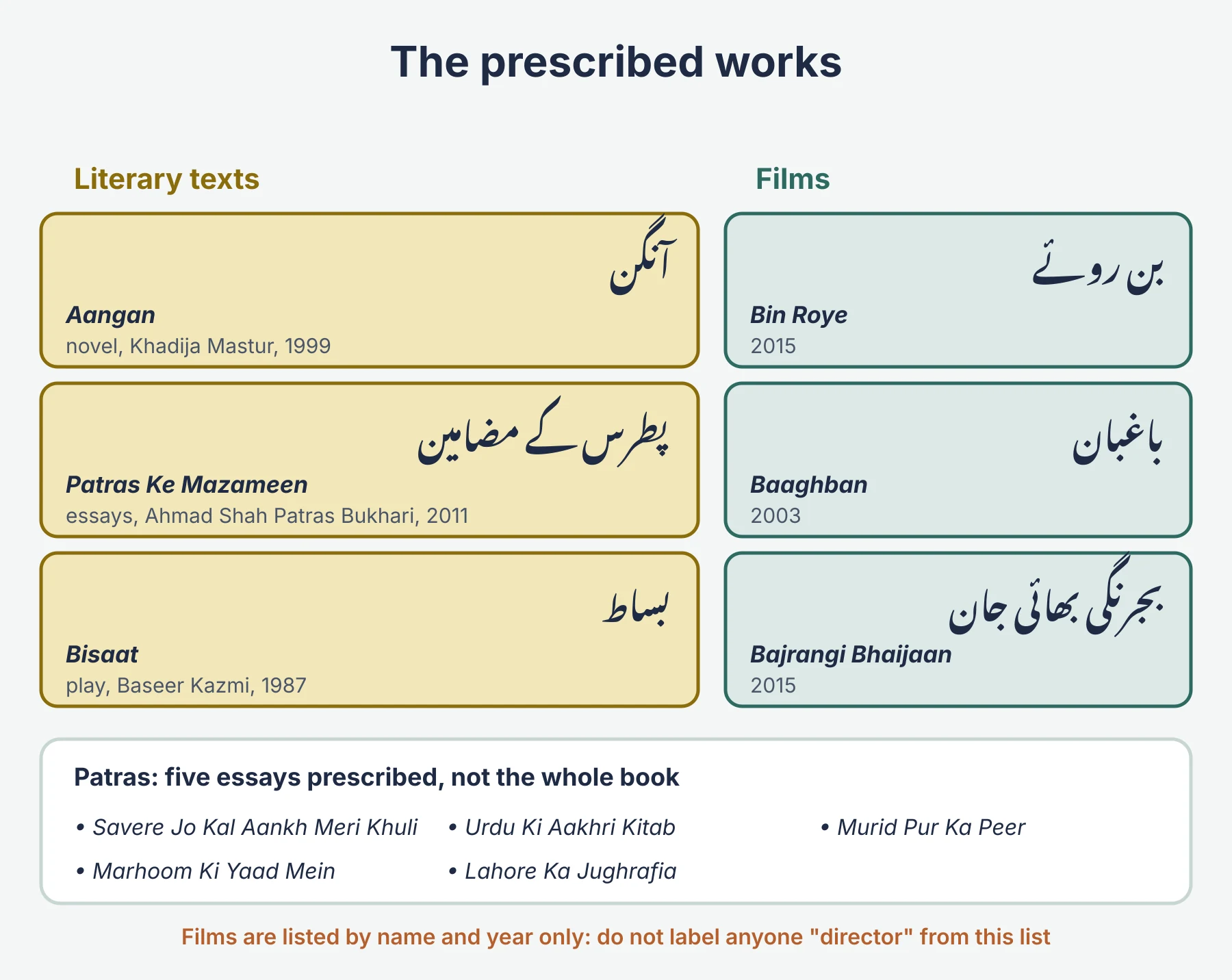
Only five essays are prescribed, not the whole book:
- سویرے جو کل آنکھ میری کھُلی
- اُردو کی آخری کتاب
- مُرید پُور کا پیر
- مرحُوم کی یاد میں
- لاہور کا جغرافیہ
2011 is the year printed in the specification’s list; the essays themselves were written in the first half of the twentieth century. پطرس was the pen name of Ahmad Shah Bukhari (1898 to 1958), who taught at Government College Lahore and later represented Pakistan at the United Nations. He wrote relatively little, but this small collection made him one of the best-loved humorists in Urdu.
The five essays in brief
Use these as orientation only; your evidence must come from your own reading.
- سویرے جو کل آنکھ میری کھُلی: the narrator resolves to get up early to study and arranges to be woken, and the essay follows the comic collapse of his good intentions. Humour of laziness, excuses and self-deception.
- اُردو کی آخری کتاب: a parody of a children’s Urdu school primer, with mock lessons that make fun of rote teaching and of textbook moralising.
- مُرید پُور کا پیر: the narrator returns to his home town, where people treat him as an important leader and expect a speech. Satire of political speech-making and of the public’s readiness to revere anyone who seems important.
- مرحُوم کی یاد میں: a mock elegy for a worn-out bicycle, described in the solemn tone usually kept for mourning a person.
- لاہور کا جغرافیہ: a parody of a geography textbook, describing Lahore in mock-scholarly headings and poking fun at the city’s dust, construction and habits.
Key themes and techniques
- مزاح (humour) and طنز (satire): Patras’s laughter is usually gentle, but it points at real weaknesses, in individuals, in education and in public life.
- مبالغہ (exaggeration): small events are blown up to absurd proportions.
- تحریف (parody): two essays imitate the form of school books; the joke lies in applying a serious format to an unworthy subject.
- Mock-solemn tone: in the bicycle essay, the gap between a grave style and a trivial subject creates the comedy.
- Self-mockery: the first-person narrator is often the main target of the joke, which makes the reader laugh with him rather than at others.
- Social setting: the essays give a picture of educated, middle-class life in colonial Lahore and north India: students, teachers, neighbours, public meetings.
When you analyse humour, do not only say an essay is ‘funny’. Name the technique, give a short example from the essay and explain the effect on the reader.
How it is examined
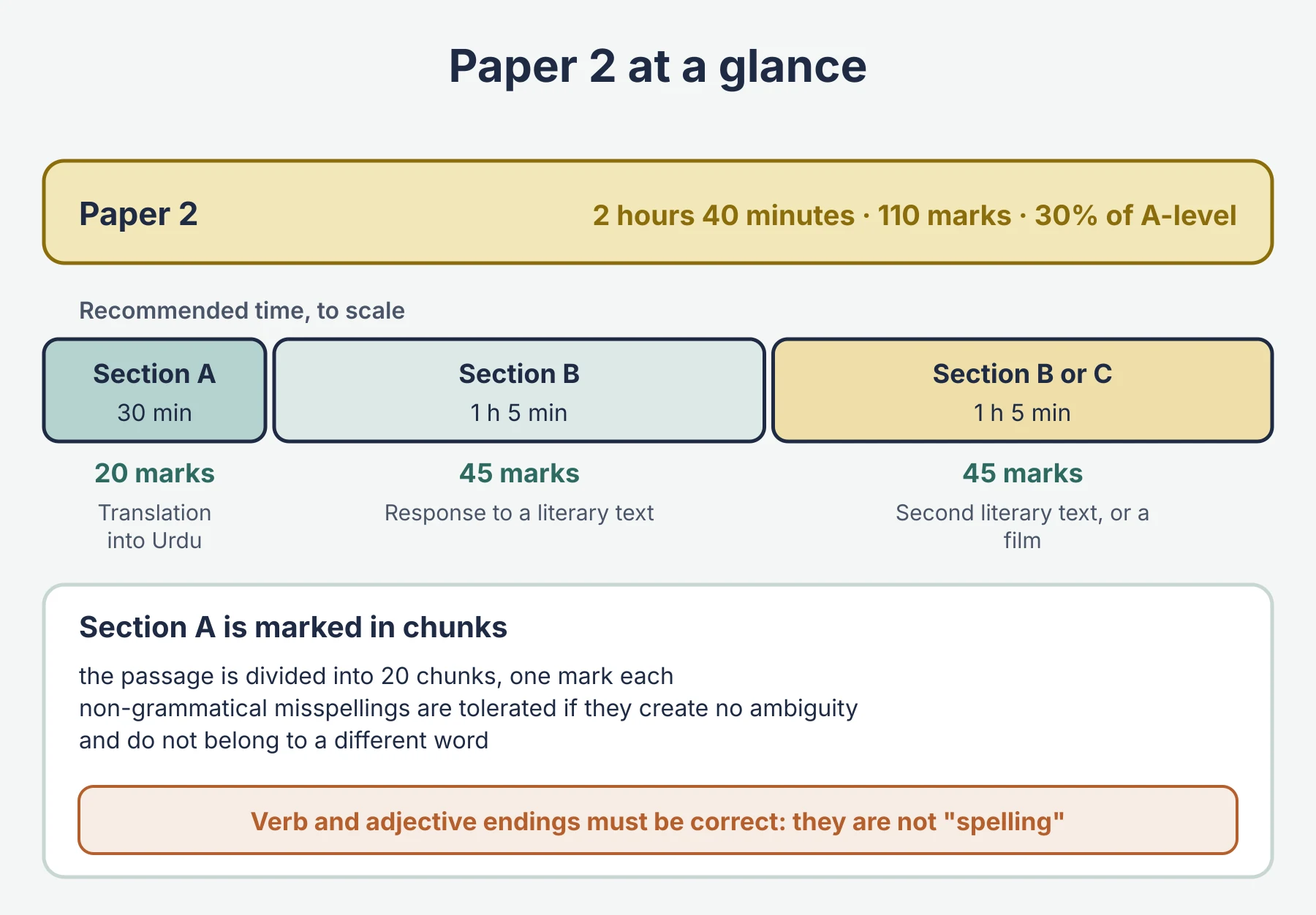
- Paper 2 is 2 hours 40 minutes, 110 marks, 30% of the A Level.
- Section B (literary text) is worth 45 marks and about 1 hour 5 minutes; you choose from two questions.
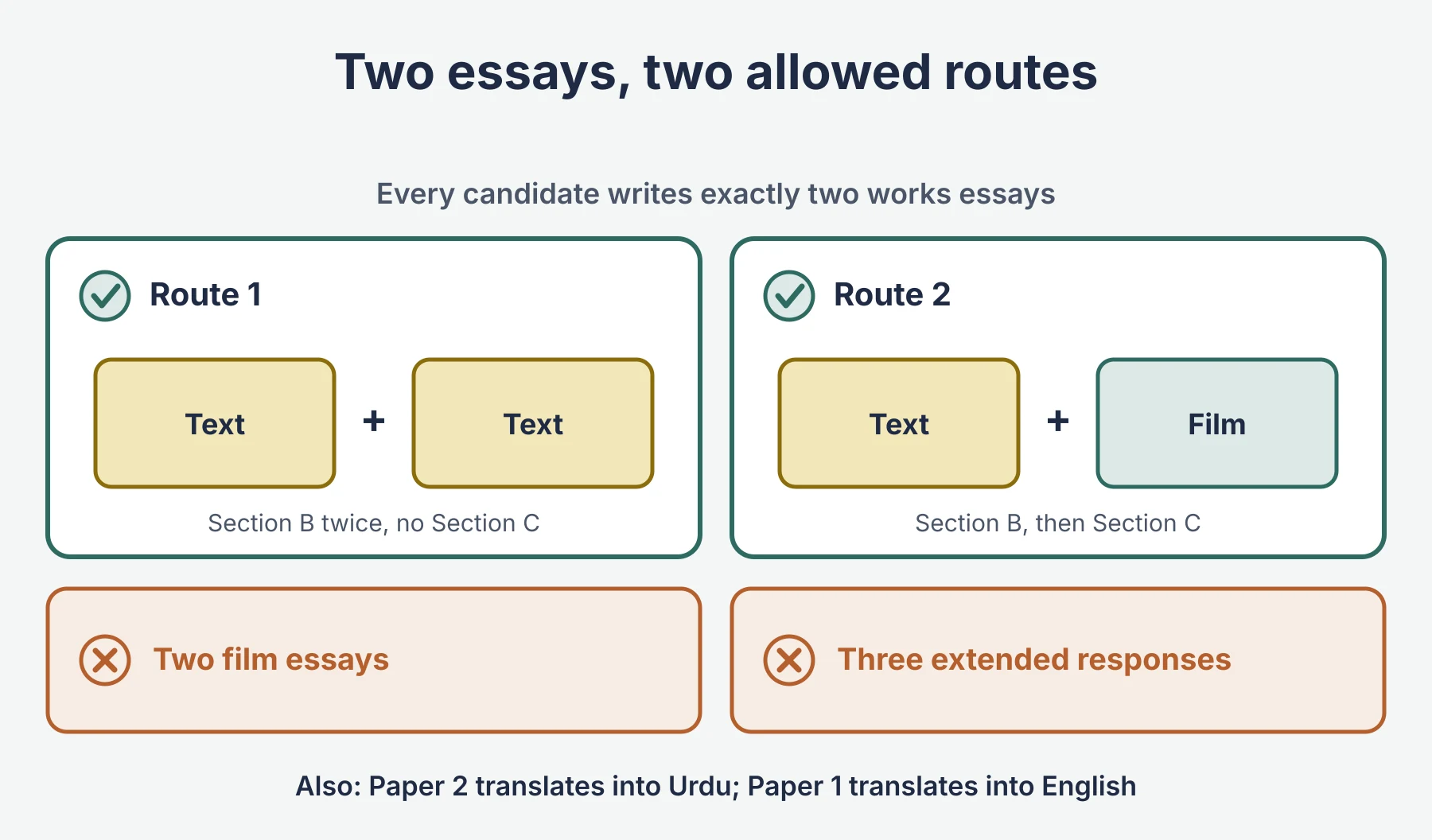
- You write exactly two extended responses: two literary texts, or one literary text and one film. Two films is never allowed.
- Marking criteria: critical and analytical response with cultural or social insight (AO4), range of grammatical structures and vocabulary (AO3), and accuracy of language (AO3). There are no AO1 or AO2 marks on Paper 2.
Approach and skills
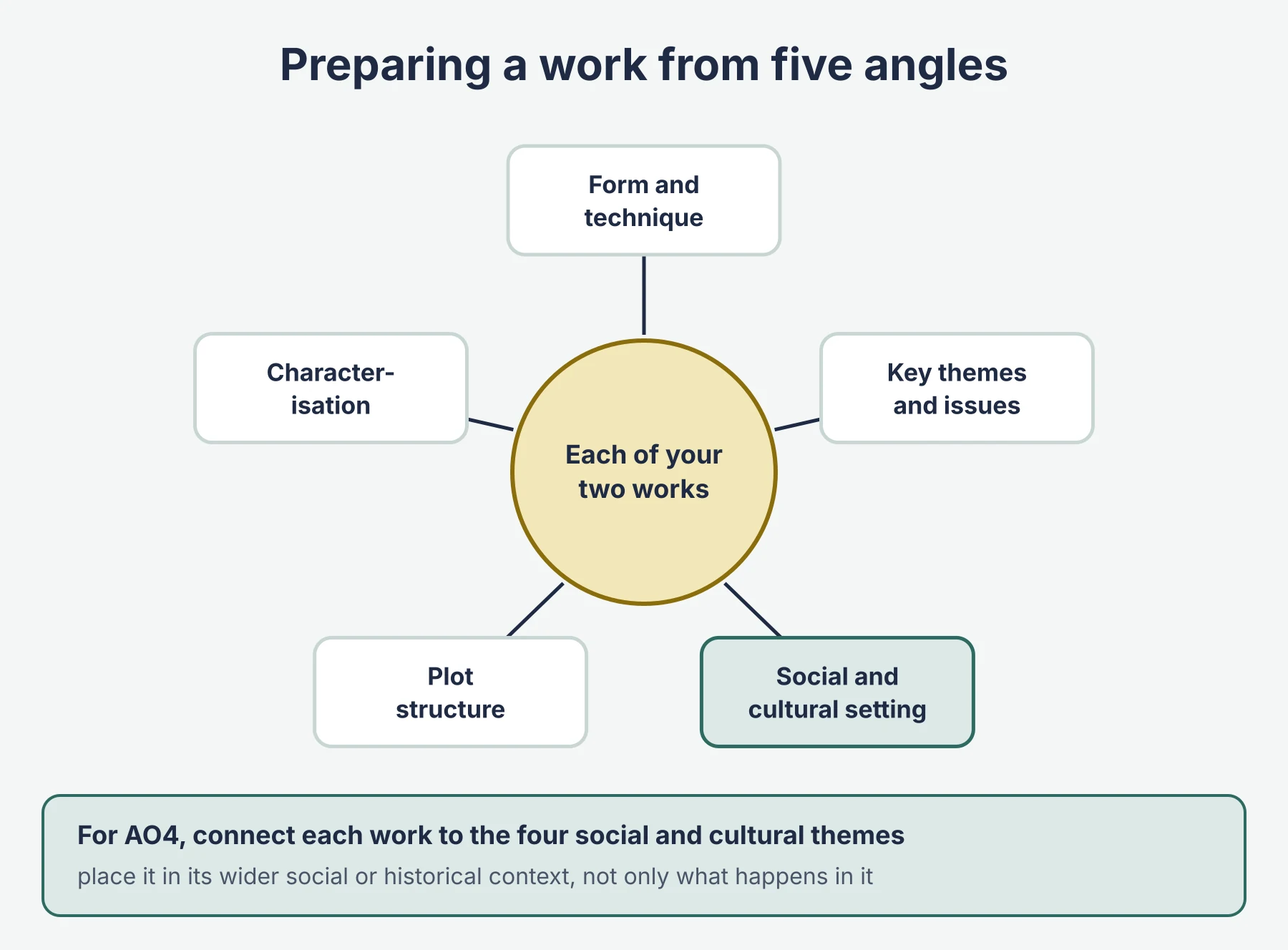
- Prepare against five angles: form and technique, key themes and issues, characterisation, plot structure, social and cultural setting.
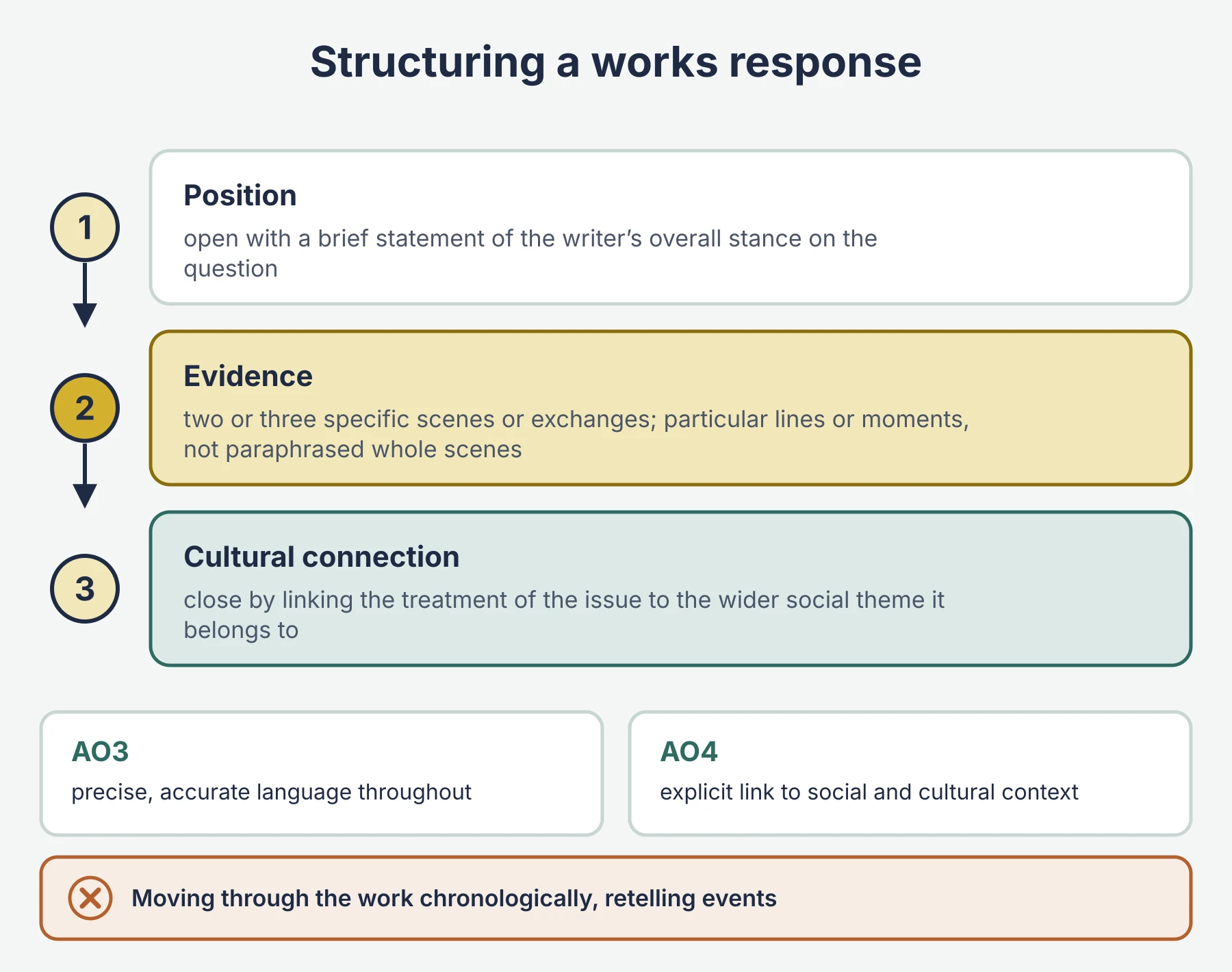
- Structure each answer as position, evidence, cultural connection: state your stance, support it with two or three specific points (not a retelling), then link the writer’s or film’s treatment of an issue to a broader social or cultural theme.
- Write in controlled Urdu with correct agreement, tense and spelling, and plan before you write.
- Use your own prepared references from the work; this page does not replace studying it.
For essays rather than a single story, ‘plot structure’ means how each essay is built: its opening, how the comedy escalates and how it ends. Prepare at least three of the five essays in detail so you can compare them.
Vocabulary for writing about the essays
| Urdu | Meaning |
|---|---|
| مضمون / مضامین | essay / essays |
| مزاح نگار | humorist |
| مزاحیہ | humorous |
| طنز | satire |
| طنز و مزاح | satire and humour |
| مبالغہ | exaggeration |
| تحریف | parody |
| ظرافت | wit |
| شگفتگی | lightness of style |
| اسلوب | style |
| راوی | narrator |
| واحد متکلم | first person |
| لہجہ | tone |
| تضاد | contrast |
| درسی کتاب | textbook |
| مرحوم | the late, deceased |
| مرید | disciple |
| پیر | spiritual guide |
Useful sentences with grammar notes
- پطرس اپنی کمزوریوں پر خود ہنستے ہیں۔ (Patras laughs at his own weaknesses.) Respectful plural ہنستے ہیں for the author; اپنی refers back to the subject.
- مضمون “مرحوم کی یاد میں” میں ایک پرانی سائیکل کا ذکر اس طرح کیا گیا ہے جیسے کسی عزیز کا ماتم ہو۔ (In the essay Marhoom Ki Yaad Mein, an old bicycle is described as if a loved one were being mourned.) Passive agreeing with ذکر (masculine); جیسے … ہو (as if) takes a subjunctive.
- “اردو کی آخری کتاب” میں درسی کتابوں کے انداز کی نقل کی گئی ہے۔ (Urdu Ki Aakhri Kitab imitates the style of school textbooks.) Passive agreeing with نقل (feminine): کی گئی ہے.
- مصنف کا مقصد صرف ہنسانا نہیں بلکہ سوچنے پر مجبور کرنا بھی ہے۔ (The author’s aim is not only to make us laugh but also to make us think.) The frame صرف … نہیں بلکہ … بھی is ideal for evaluation.
Model paragraph
Task: how does Patras create humour?
پطرس بخاری کے مضامین میں مزاح کا سب سے بڑا ذریعہ مبالغہ اور خود پر ہنسنا ہے۔ “مرحوم کی یاد میں” میں راوی ایک پرانی سائیکل کا ذکر اس طرح کرتا ہے جیسے کسی عزیز کی موت کا غم منا رہا ہو، اور یہی سنجیدہ لہجے اور معمولی موضوع کا تضاد قاری کو ہنساتا ہے۔ اسی طرح “لاہور کا جغرافیہ” میں درسی کتابوں کے انداز کی نقل کر کے شہر کے مسائل پر ہلکا سا طنز کیا گیا ہے۔ میرے خیال میں پطرس کا مزاح محض تفریح نہیں، کیونکہ وہ ہنسی ہنسی میں انسانی کمزوریوں اور معاشرتی رویوں کی طرف بھی اشارہ کرتے ہیں۔
Translation: In Patras Bukhari’s essays, the greatest source of humour is exaggeration and laughing at oneself. In Marhoom Ki Yaad Mein, the narrator speaks of an old bicycle as if he were grieving the death of a loved one, and it is this contrast between a serious tone and a trivial subject that makes the reader laugh. Similarly, Lahore Ka Jughrafia imitates the style of textbooks to make gentle fun of the city’s problems. In my view Patras’s humour is not mere entertainment, because while making us laugh he also points to human weaknesses and social attitudes.
Why it works: a clear position, two essays compared, named techniques (مبالغہ، تضاد، نقل، طنز) and a cultural point. In a real answer, add a short example of your own from each essay.
Essay prompts to prepare
- «پطرس کے مضامین میں مزاح کے مختلف حربوں کا تجزیہ کیجیے۔» (Analyse the different techniques of humour in Patras’s essays.)
- «پطرس کا مزاح محض ہنسانے کے لیے نہیں۔» (Patras’s humour is not merely meant to amuse.) To what extent do you agree?
- What picture of education and public life emerges from the essays?
- Compare the role of the narrator in two of the prescribed essays.
Exam traps
- Retelling the story without connecting it to a theme weakens the AO4 mark.
- Attempting three responses, or choosing two films.
- Running over time on the first response and squeezing the second.
- Writing about essays that are not among the five prescribed.
- Saying ‘it is funny’ without naming the technique and its effect.
- Treating the narrator’s views as the author’s sincere opinions; the narrator is often a comic mask.
Self-test
- Who wrote پطرس کے مضامین, in what year, and what is its form?
- Do you study the whole book?
- Name two of the five prescribed essays.
- What counts as strong evidence in an answer?
- What section and marks apply?
- What was the author’s real name, and where did he teach?
- Which two essays parody school books?
- What is the subject of مرحوم کی یاد میں, and how does the essay create humour?
- What does مرید پور کا پیر satirise?
- Give the Urdu for ‘exaggeration’, ‘parody’ and ‘satire’.
- In “اردو کی آخری کتاب” میں … نقل کی گئی ہے, why is the verb کی گئی?
- What does ‘plot structure’ mean for an essay collection?
Answers: 1. احمد شاہ پطرس بخاری, 2011, a collection of essays. 2. No; five essays are prescribed. 3. For example, اُردو کی آخری کتاب and لاہور کا جغرافیہ. 4. Specific, well-chosen references to the essays, explained in your own accurate Urdu. 5. Section B, 45 marks. 6. Ahmad Shah Bukhari; Government College Lahore. 7. اُردو کی آخری کتاب (a school primer) and لاہور کا جغرافیہ (a geography textbook). 8. A worn-out bicycle; it uses a solemn, mourning tone for a trivial subject. 9. Political speech-making and the public’s readiness to revere anyone who seems important. 10. مبالغہ, تحریف and طنز. 11. It is a passive agreeing with نقل, which is feminine. 12. How each essay is built: its opening, how the comedy escalates and how it ends.
Related resources
-
Study guides
Edexcel A Level Urdu (9UR0): Aangan (آنگن) by Khadija Mastur
9UR0 study guide to Aangan (آنگن): the five features examiners reward, the essay grids, an annotated model introduction and a 45-mark Section B plan.
Urdu Language · Pearson Edexcel · A Level
Read guide -
Practice questions
Edexcel A Level Urdu (9UR0): Aangan (آنگن) by Khadija Mastur – Practice Questions
Eleven original 9UR0 practice questions on Aangan: facts, literary terms, analytical Urdu, paragraph repair and a full 45-mark essay with indicative content.
Urdu Language · Pearson Edexcel · A Level
Try questions -
Study guides
Edexcel A Level Urdu (9UR0): Baaghban (باغبان)
9UR0 study guide to the film Baaghban (باغبان): evaluating melodrama, songs and structure, comparing characters, and planning a 45-mark Section C essay.
Urdu Language · Pearson Edexcel · A Level
Read guide
Get free revision emails (optional)
Occasional emails with practice questions, worked explanations and links to free resources for the qualification and subjects you choose. No spam, and you can unsubscribe from any email. The free tools on this site never need an email.