
Revision Notes
Edexcel A Level Urdu (9UR0): Positive Features of a Diverse Society – Revision Notes
9UR0 Theme 3.1 notes on the positive features of a diverse society: perspectives, key terms, grammar notes, a model paragraph and a self-test.
- Subject
- Urdu Language
- Level
- A LEVELS
- Topic
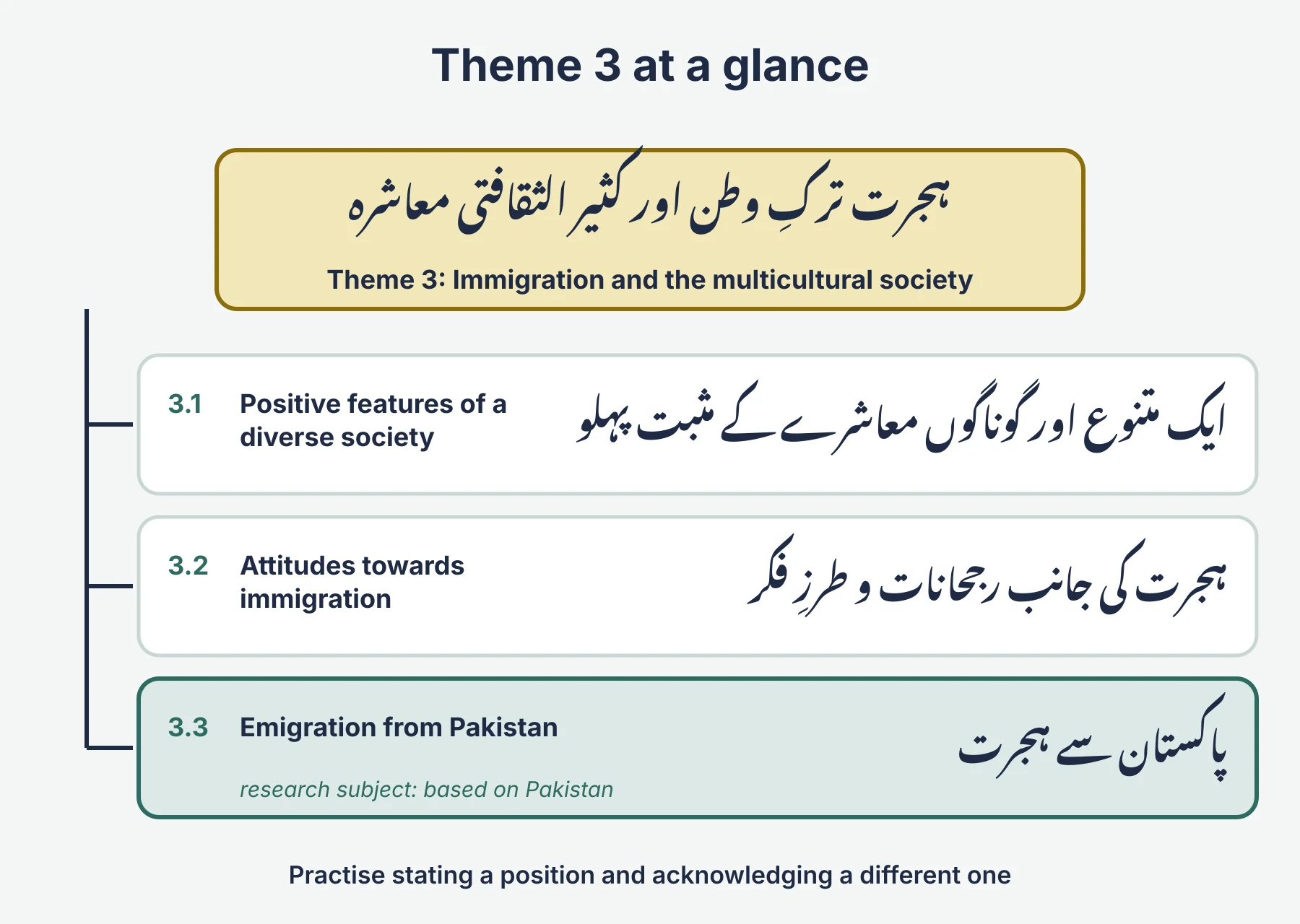
- Theme 3: Immigration and the multicultural society (ہجرت ترکِ وطن اور کثیر الثقافتی معاشرہ)
- Author
- Marlbridge Academic Team
- Updated
- Reviewed by
- Farheen Zehra (what this means)
Aligned to Pearson Edexcel A Level Urdu Language (9UR0), 2018. Official specification .
Syllabus page (what it covers and how it is assessed): Pearson Edexcel A Level Urdu Language.
Syllabus points this page covers
9UR0
- 3.1 ایک متنوع اور گوناگوں معاشرے کے مثبت پہلو
Found an error? Report a correction.
Need help with this topic? Request a free trial class for A Level Urdu Language (9UR0).
Revision notes for sub-theme 3.1 of Theme 3 in Pearson Edexcel A Level Urdu (9UR0): the positive features of a diverse society (ایک متنوع اور گوناگوں معاشرے کے مثبت پہلو). For the wider theme, read the Theme 3 study guide.
Key ideas
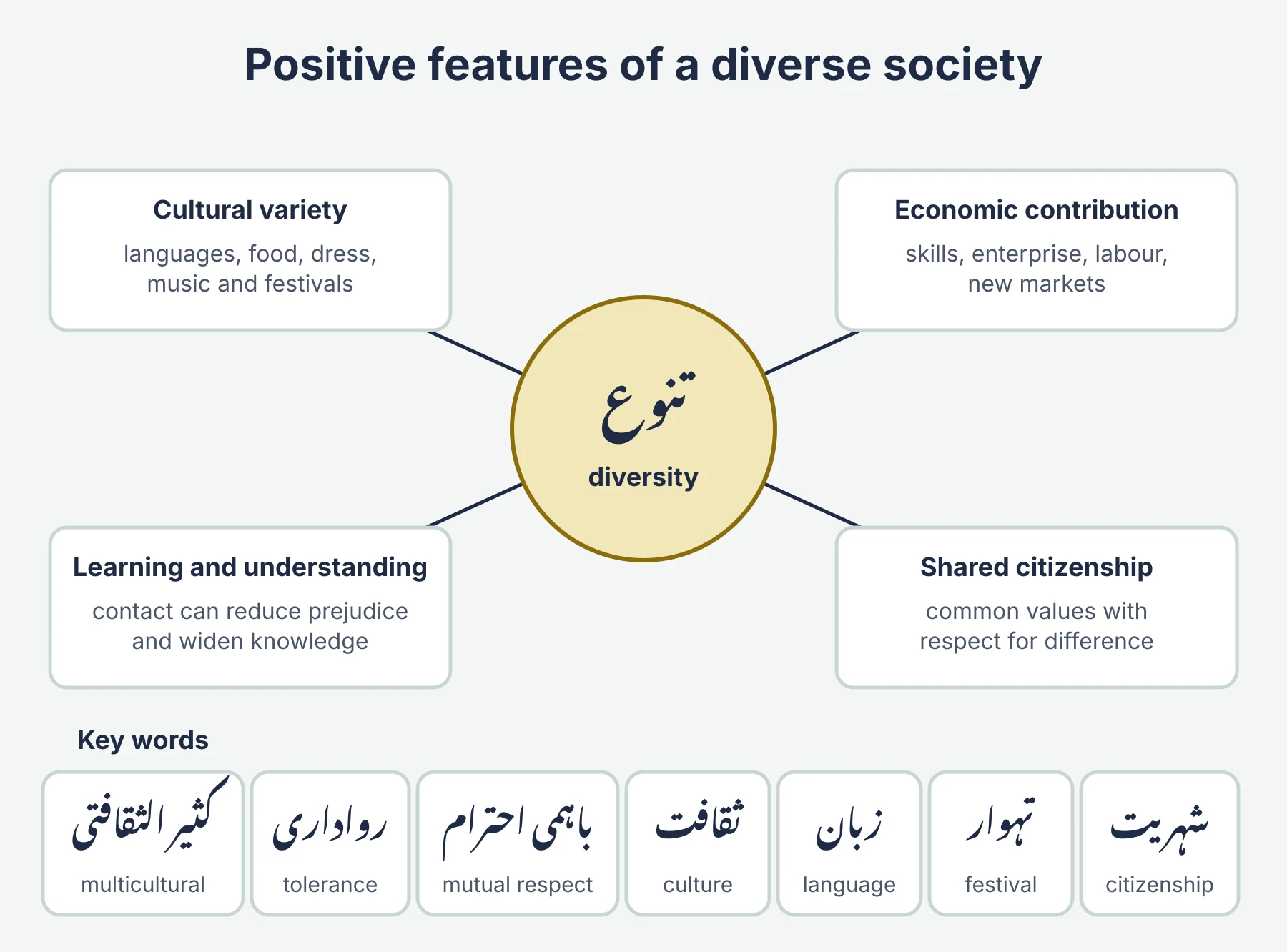
- Cultural variety: languages, food, dress, music and festivals shared across communities.
- Economic contribution: skills, enterprise, labour and new markets brought by migrants.
- Learning and understanding: contact between communities can reduce prejudice and widen knowledge.
- Shared citizenship: balancing common values with respect for difference.
Issues and perspectives
Diversity is not only about other countries. Pakistan is itself a diverse society. Alongside Urdu, the national language, people speak Punjabi, Sindhi, Pashto, Balochi, Saraiki and many other languages, and the country has religious minorities and regional cultures with their own dress, music and food. Urdu often works as the shared language (رابطے کی زبان, link language) between them. A strong answer can draw on Pakistan’s own diversity as well as on Pakistani communities abroad.
Urdu as an example of mixing. The word اردو comes from a Turkic word for a camp or army, and the language grew through contact: its vocabulary draws on Persian, Arabic and Turkish as well as on the languages of the subcontinent. This makes a memorable example of how contact between peoples can create something new rather than destroy what was there before.
Cultural enrichment. Food, music, fashion and festivals cross community lines: a dish, a song or a celebration that began in one community becomes part of everyone’s life. Think of how South Asian food and music have become part of everyday life in British cities.
Economic contribution. Newcomers fill gaps in the labour market, start businesses, bring skills and languages, and open trading links with their countries of origin. Be careful to describe this as a pattern and to support any figure with a named source.
Social and educational benefits. Children who grow up with classmates of different backgrounds learn to see a question from more than one point of view, and regular contact (میل جول) can reduce prejudice (تعصب). Shared projects such as charities, sport and local events build بھائی چارہ (fellowship) and یکجہتی (solidarity).
The conditions for success. The positive features do not appear automatically. Most writers agree they depend on رواداری (tolerance), باہمی احترام (mutual respect), a common language for public life, fair treatment under the law and opportunities to meet. Where communities live separate lives, the benefits are smaller. Mentioning these conditions shows the examiner that your argument is balanced, even when the task asks you to focus on the positives.
Vocabulary
| Urdu | Meaning |
|---|---|
| کثیر الثقافتی | multicultural |
| تنوع | diversity |
| رواداری | tolerance |
| باہمی احترام | mutual respect |
| ثقافت | culture |
| زبان | language |
| تہوار | festival |
| شہریت | citizenship |
| متنوع | diverse |
| گوناگوں | varied, manifold |
| مثبت پہلو | positive aspect |
| ہم آہنگی | harmony |
| بھائی چارہ | brotherhood, fellowship |
| یکجہتی | solidarity, unity |
| میل جول | social mixing, contact |
| رابطے کی زبان | link language, lingua franca |
| معاشرہ | society (masculine) |
| مذہب | religion |
| لباس | dress, clothing |
| پکوان | dishes, cuisine |
| معیشت | economy |
| ہنر | skill |
| ثقافتی ورثہ | cultural heritage |
| مکالمہ | dialogue |
Writing frame
Point about contribution, then its result, then a counter-view introduced with تاہم, then a reasoned conclusion. Use کیونکہ for reasons and میرے خیال میں for your opinion.
Grammar to control
- Masculine plural subject, masculine plural verb: ہجرت کرنے والے لوگ … لے جاتے ہیں.
- Masculine singular: معاشرہ … بن جاتا ہے.
- Dative construction: انھیں … فکر ہوتی ہے, which differs from English.
Useful sentences with grammar notes
- مختلف ثقافتوں کے میل جول سے معاشرے میں رواداری بڑھتی ہے۔ (Contact between different cultures increases tolerance in society.) معاشرہ changes to the oblique معاشرے after میں; the verb agrees with رواداری (feminine), so بڑھتی.
- ہجرت کر کے آنے والوں نے برطانیہ کی معیشت میں اہم کردار ادا کیا ہے۔ (Those who came as migrants have played an important role in Britain’s economy.) With نے, the verb agrees with the object کردار (masculine singular): ادا کیا ہے.
- ایک ہی محلے میں مختلف زبانیں بولی جاتی ہیں۔ (Different languages are spoken in a single neighbourhood.) Passive with جانا: بولی جاتی ہیں agrees with زبانیں (feminine plural).
- جب بچے مختلف پس منظر کے دوستوں کے ساتھ پڑھتے ہیں تو ان کے دل سے تعصب کم ہو جاتا ہے۔ (When children study with friends from different backgrounds, prejudice fades from their hearts.) The جب … تو frame links a condition to a result; تعصب is masculine, so ہو جاتا ہے.
- اگرچہ تنوع کے کچھ چیلنج بھی ہیں، پھر بھی اس کے فوائد زیادہ ہیں۔ (Although diversity brings some challenges, its benefits are greater.) The concessive frame اگرچہ … پھر بھی lets you admit a counter-point and still keep your position.
Model paragraph
ایک متنوع معاشرہ اپنے شہریوں کو بہت کچھ سکھاتا ہے۔ جب مختلف زبانوں، مذاہب اور روایات کے لوگ ایک ساتھ رہتے ہیں تو ان کے کھانے، لباس اور تہوار پورے معاشرے کا حصہ بن جاتے ہیں۔ اس کے علاوہ نئے آنے والے اپنے ہنر اور محنت سے معیشت کو مضبوط کرتے ہیں۔ خود اردو زبان اس میل جول کی ایک اچھی مثال ہے، کیونکہ اس میں فارسی، عربی، ترکی اور مقامی زبانوں کے الفاظ شامل ہیں۔ تاہم یہ فوائد اسی وقت حاصل ہوتے ہیں جب لوگ ایک دوسرے کا احترام کریں اور مکالمے کا راستہ کھلا رکھیں۔ میرے خیال میں تنوع کمزوری نہیں بلکہ طاقت ہے۔
Translation: A diverse society teaches its citizens a great deal. When people of different languages, religions and traditions live together, their food, dress and festivals become part of the whole society. In addition, newcomers strengthen the economy with their skills and hard work. The Urdu language itself is a good example of this mixing, because it contains words from Persian, Arabic, Turkish and local languages. However, these benefits are only gained when people respect one another and keep the path of dialogue open. In my view, diversity is not a weakness but a strength.
Why it works: a general claim, two developed benefits, a concrete example linked to the language itself, a condition introduced with تاہم, and a short, memorable conclusion using نہیں بلکہ (not … but rather).
Discussion and essay prompts
- «تنوع کسی بھی معاشرے کی طاقت ہے۔» (Diversity is the strength of any society.) To what extent do you agree?
- «ایک کثیر الثقافتی معاشرے میں سب سے اہم چیز ایک مشترکہ زبان ہے۔» (In a multicultural society the most important thing is a shared language.) Discuss.
- How can schools help a diverse society to work well?
- Does diversity bring benefits automatically, or only under certain conditions?
Exam traps
- Presenting only one view, or opinions with no reasons.
- Generalising about whole communities instead of using specific, accurate evidence.
- Careless gender agreement and tense in longer answers.
- Forgetting that تنوع and معاشرہ are masculine but رواداری, ثقافت and ہم آہنگی are feminine.
- Using economic figures without a source; describe the pattern instead.
- Listing foods and festivals without explaining why they matter to the argument.
Self-test
- What does کثیر الثقافتی معاشرہ mean?
- Give the Urdu for ‘tolerance’ and ‘mutual respect’.
- Name two positive features of a diverse society.
- Which connective introduces a counter-view in the model paragraph?
- Translate: ‘a diverse society respects everyone’.
- Why is the Urdu language itself a useful example in this sub-theme?
- Give the Urdu for ‘solidarity’ and ‘social mixing’.
- In ایک ہی محلے میں مختلف زبانیں بولی جاتی ہیں, why is the verb بولی جاتی ہیں?
- Name two conditions on which the benefits of diversity depend.
- What does the frame اگرچہ … پھر بھی allow you to do?
- Translate: ‘contact between different cultures increases tolerance in society’.
Answers: 1. A multicultural society. 2. رواداری and باہمی احترام. 3. For example, cultural variety and economic contribution. 4. تاہم. 5. ایک متنوع معاشرہ سب کا احترام کرتا ہے۔ 6. It grew through contact between peoples, with vocabulary from Persian, Arabic, Turkish and local languages, and its name comes from a Turkic word for a camp or army. 7. یکجہتی and میل جول. 8. It is a passive that agrees with زبانیں, which is feminine plural. 9. For example, tolerance and mutual respect, a common language for public life, fair treatment under the law, or opportunities to meet. 10. Admit a counter-point while keeping your own position. 11. مختلف ثقافتوں کے میل جول سے معاشرے میں رواداری بڑھتی ہے۔
Related resources
-
Study guides
Edexcel A-Level Urdu: Theme 3, Immigration and the Multicultural Society (9UR0)
Diverse societies, attitudes towards immigration and emigration from Pakistan: ideas, vocabulary and model Urdu writing for Theme 3 of Pearson Edexcel GCE A-Level Urdu (9UR0).
Urdu Language · Pearson Edexcel · A Level
Read guide -
Study guides
Edexcel A Level Urdu (9UR0): Attitudes Towards Immigration
9UR0 sub-theme 3.2 study guide: community activities, public attitudes and migrants' own viewpoint in Pakistan, with reported speech and Paper 3 technique.
Urdu Language · Pearson Edexcel · A Level
Read guide -
Practice questions
Edexcel A Level Urdu (9UR0): Attitudes Towards Immigration – Practice Questions
Twelve original 9UR0 practice questions on community activities, public attitudes and migrants' views in Pakistan, with reported speech and full answers.
Urdu Language · Pearson Edexcel · A Level
Try questions
Get free revision emails (optional)
Occasional emails with practice questions, worked explanations and links to free resources for the qualification and subjects you choose. No spam, and you can unsubscribe from any email. The free tools on this site never need an email.