
Study Guides
Edexcel GCSE Business: Aims, objectives, revenue, costs and profit (1BS0)
Study guide to business aims and objectives, revenue, costs, profit, interest, break-even and margin of safety for Pearson Edexcel GCSE Business 1BS0.
- Subject
- Business
- Level
- GCSE
- Topic
- Putting a business idea into practice
- Author
- Marlbridge Academic Team
- Updated
- Reviewed by
- Asif Iqbal (what this means)
Aligned to Pearson Edexcel GCSE Business (1BS0), Issue 2, July 2022. Official specification .
Syllabus page (what it covers and how it is assessed): Pearson Edexcel GCSE Business.
Syllabus points this page covers
1BS0
- 1.3 Putting a business idea into practice (whole topic)
- 1.3.1 Business aims and objectives
- 1.3.2 Business revenues, costs and profits
Found an error? Report a correction.
Want a teacher for this? Marlbridge teaches Business online. Request a free trial class.
This guide teaches content items 1.3.1 (Business aims and objectives) and 1.3.2 (Business revenues, costs and profits) from Topic 1.3, Putting a business idea into practice, in the Pearson Edexcel Level 1/Level 2 GCSE (9-1) in Business (1BS0) specification, Issue 2, July 2022. The specification describes this topic as making a business idea happen through identifying aims and objectives and concentrating on the financial aspects. The qualification has two written papers: Theme 1, Investigating small business (1BS0/01), and Theme 2, Building a business (1BS0/02). Both are 1 hour 45 minutes long and worth 90 marks, which is 50% of the qualification each. Their three sections (A is 35 marks, B is 30, C is 25) mix calculations, multiple-choice, short-answer and extended-writing questions, with Sections B and C built on business contexts printed in the paper. Calculators may be used. Appendix 3 of the specification lists the formulae, and the examinations do not supply them. Every business below is invented.
Course links: Edexcel GCSE Business hub, the printable checklist and the free 10-minute diagnostics. Companion pages: the revision notes and the practice questions.
What 1.3.1 and 1.3.2 ask you to know
| Ref | Content point | Where in this guide |
|---|---|---|
| 1.3.1 | What business aims and business objectives are | Part 1 |
| 1.3.1 | Financial aims and objectives when starting up: survival, profit, sales, market share, financial security | Part 2 |
| 1.3.1 | Non-financial aims and objectives: social objectives, personal satisfaction, challenge, independence and control | Part 3 |
| 1.3.1 | Why aims and objectives differ between businesses | Part 4 |
| 1.3.2 | Revenue, fixed and variable costs, total costs, profit and loss, and interest: concept and calculation | Part 5 |
| 1.3.2 | The concept and calculation of break even level of output and margin of safety | Part 6 |
| 1.3.2 | Interpretation of break even diagrams: changes in revenue and costs, break even, margin of safety, profit and loss | Part 7 |
Appendix 2 of the specification lists revenue, costs and profit among the calculations, and information from graphs and charts among the interpretation skills. Questions that use these skills are always set in a business context.
Part 1: aim or objective?
The specification names both terms but does not give a wording for them, so the definitions here are the standard ones.
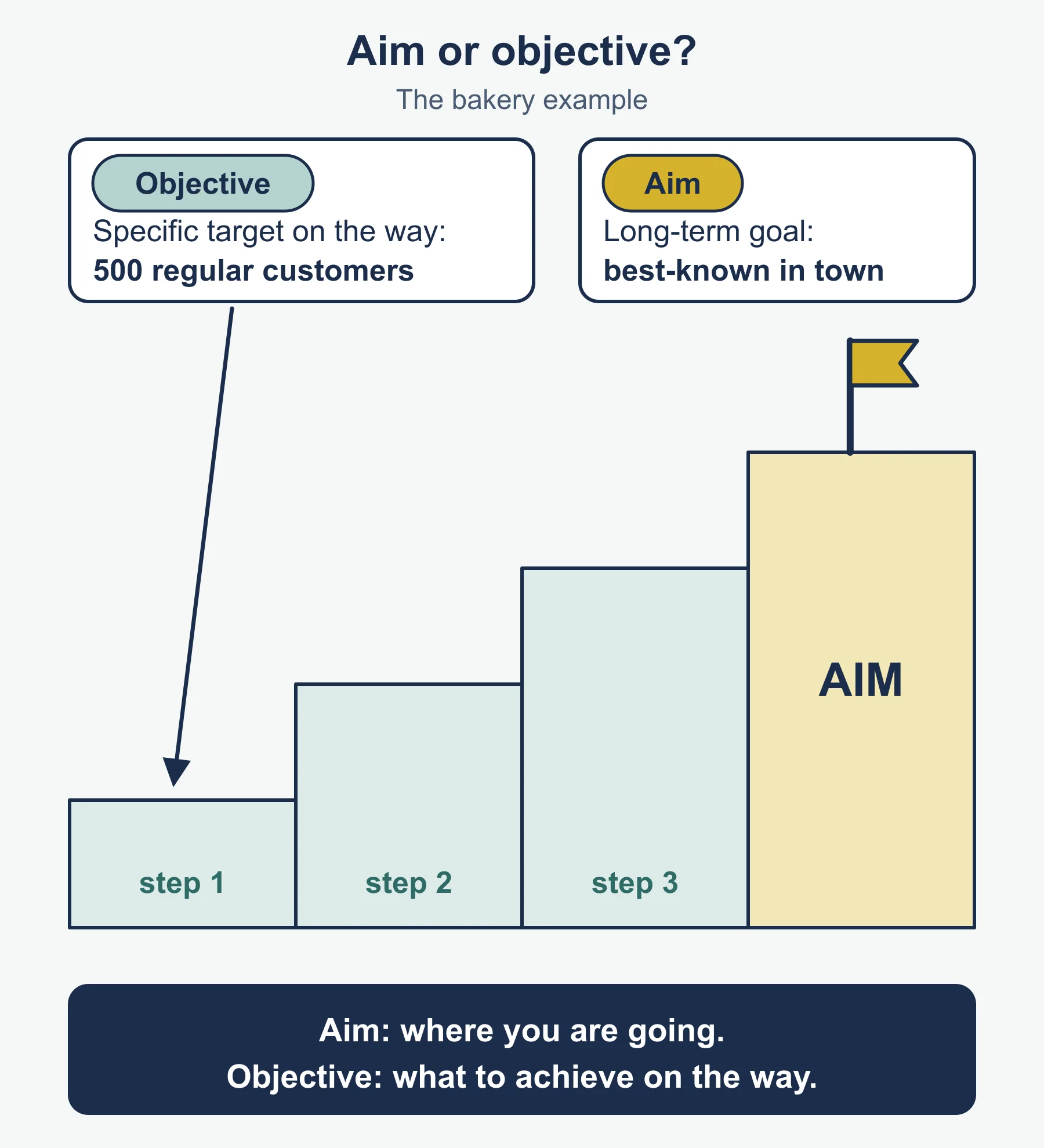
- A business aim is a long-term, general goal: where the owner wants the business to end up.
- A business objective is a more specific target, usually with a number and a date, that moves the business towards its aim.
For example, a start-up cleaning firm might have the aim of becoming the best-known cleaner in its town. An objective that supports it could be signing 40 regular customers within the first twelve months. When a question asks you to identify an objective, look for a measurable target. When it asks for an aim, look for the broad direction.
Part 2: financial aims and objectives (1.3.1)
The specification lists five that apply when starting up.
- Survival. The business stays open. For a new firm the first year is often about covering costs and staying out of debt it cannot repay.
- Profit. Revenue is greater than total costs. A profit objective might be a stated profit for the year.
- Sales. The business sells more units or earns more sales revenue. Selling more is not the same as making more profit, because extra sales can come from lower prices or from higher advertising costs.
- Market share. The business takes a bigger proportion of all the sales in its market. This needs information about competitors as well as itself.
- Financial security. The owner wants steady income and enough reserves to cope with a bad month. It matters most when the owner depends on the business to pay household bills.
These can pull against one another. A bike-repair stall that cuts its prices to win market share may sell more but earn less profit per repair.
Part 3: non-financial aims and objectives (1.3.1)
Not every owner starts a business mainly for money. The specification lists four.
- Social objectives. The business aims to help people or the community, for example by employing local young people or giving a share of earnings to a local project.
- Personal satisfaction. The owner wants to enjoy the work, such as turning a hobby into a living.
- Challenge. The owner wants to test themselves by building something difficult.
- Independence and control. The owner wants to be their own boss and make the decisions.
A non-financial objective can still affect the money. An owner who values independence and control may refuse an investor, which keeps decisions in their hands but limits the cash available for growth.
Part 4: why aims and objectives differ between businesses (1.3.1)
Two businesses in the same street can want different things. The specification asks you to be able to explain why, so use the situation in the question. Common reasons are below.
| Reason | Effect on aims and objectives |
|---|---|
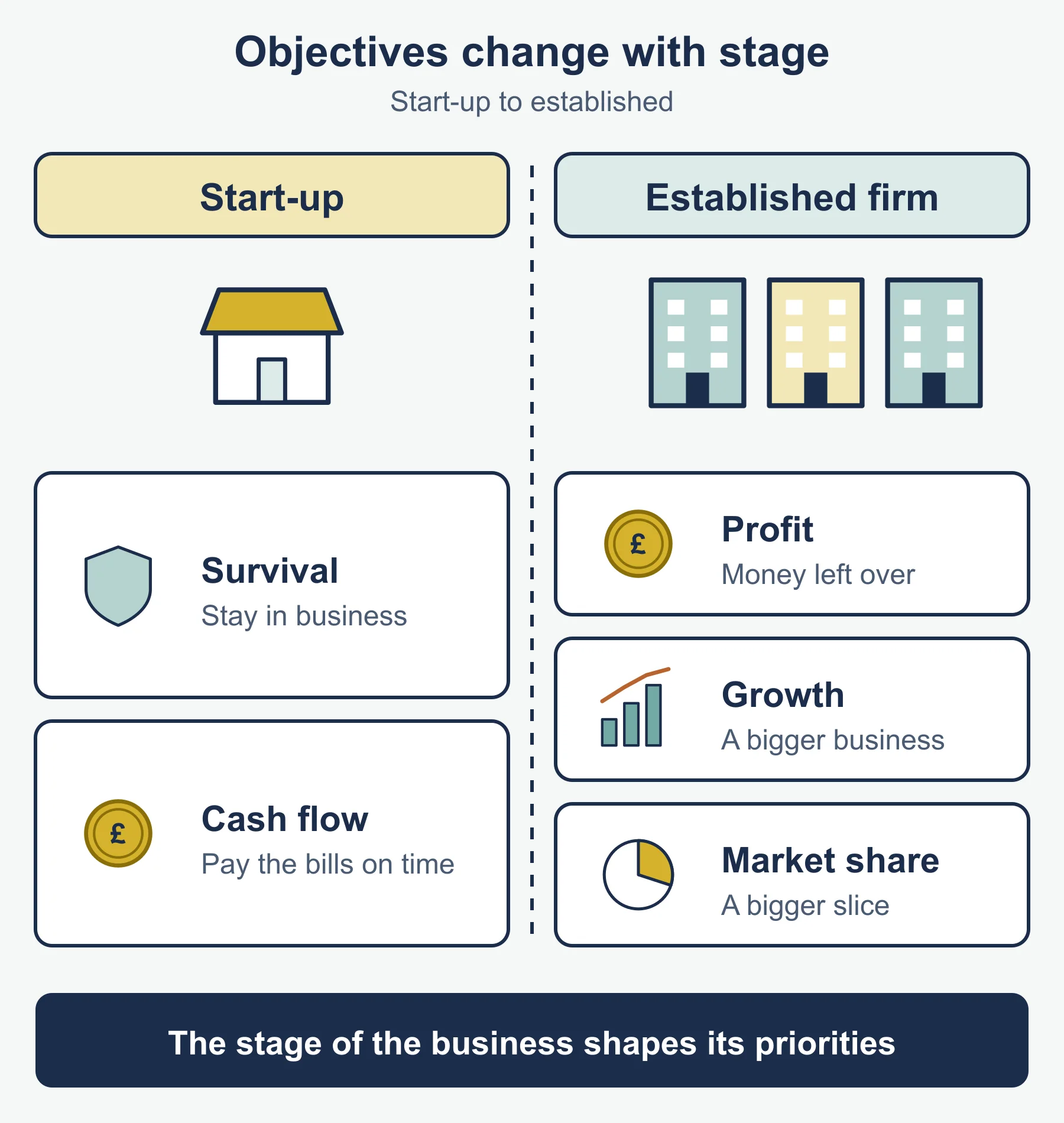
| Stage of the business | A new firm often sets survival first. A settled firm may set market share or profit. |
| The owner’s motives | An owner who left a job for independence may accept lower profit to stay in control. |
| Size and ownership | A one-person business can pursue personal satisfaction. A business with several investors is more likely to be pushed towards profit. |
| Type of business | A community project may have social objectives alongside financial ones. |
| Conditions in the market | Strong competitors or a falling market can move the focus to survival. |
Aims also change over time. A business that has survived two years may then set a sales or market share objective.
Part 5: revenue, costs, profit and interest (1.3.2)
These formulae are in Appendix 3 of the specification.
- Revenue = price × quantity
- Total cost (TC) = total fixed costs (TFC) + total variable costs (TVC)
- Interest on loans (%) = (total repayment − borrowed amount) ÷ borrowed amount × 100
Profit is revenue minus total costs. If the answer is negative, it is a loss. The profit formula here is the standard form. A fixed cost does not move when output changes within the period, such as rent, insurance and a website fee. Variable costs change with output, such as ingredients, packaging and materials.
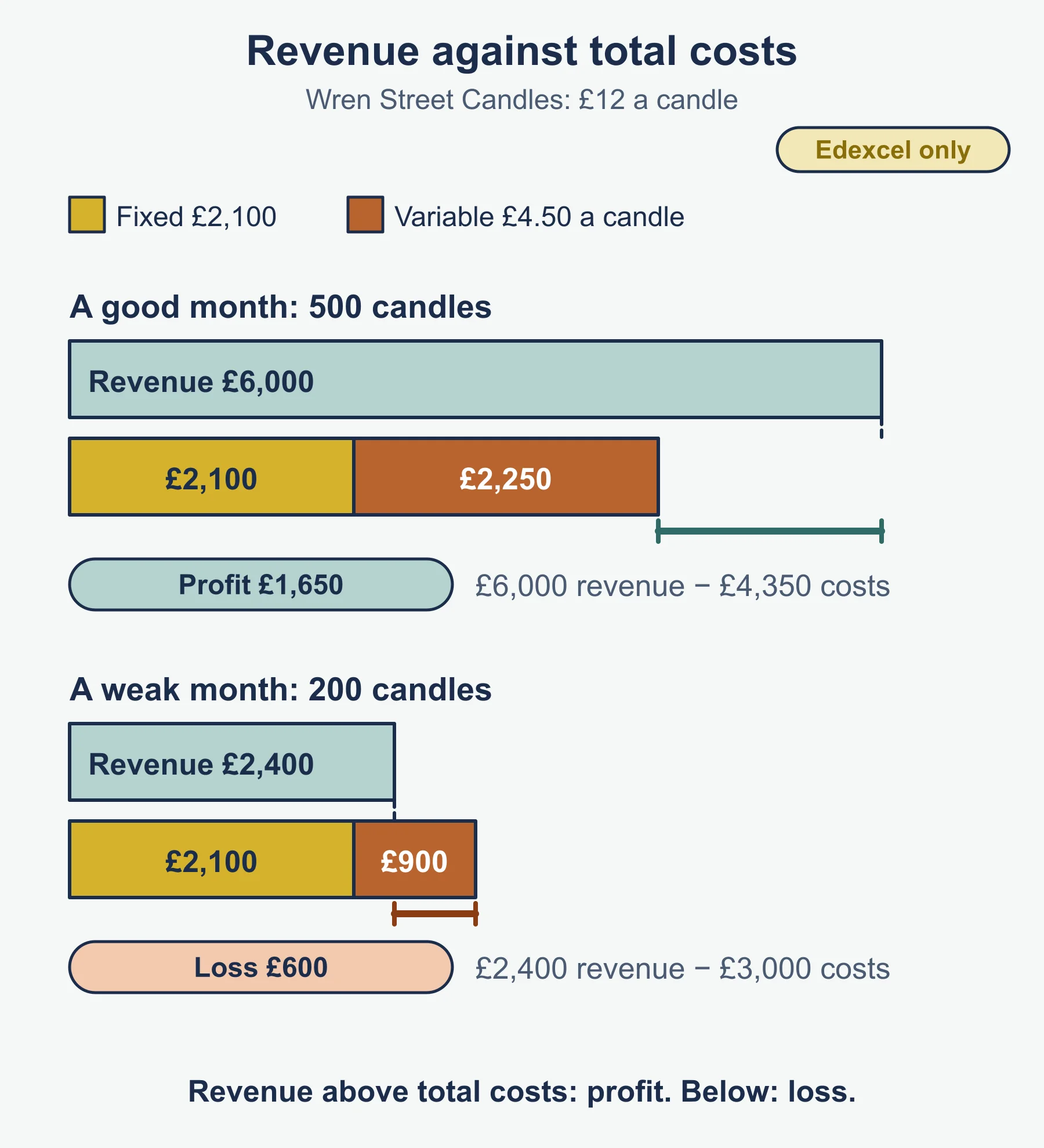
Worked example: Wren Street Candles. Wren Street Candles sells each candle for £12. Variable cost is £4.50 a candle. Fixed costs are £2,100 a month. In one month it makes and sells 500 candles.
- Revenue = £12 × 500 = £6,000
- TVC = £4.50 × 500 = £2,250
- TC = £2,100 + £2,250 = £4,350
- Profit = £6,000 − £4,350 = £1,650
In a weak month with 200 sales: revenue is £2,400 and TVC is £900, so TC is £3,000. The business makes a loss of £600.
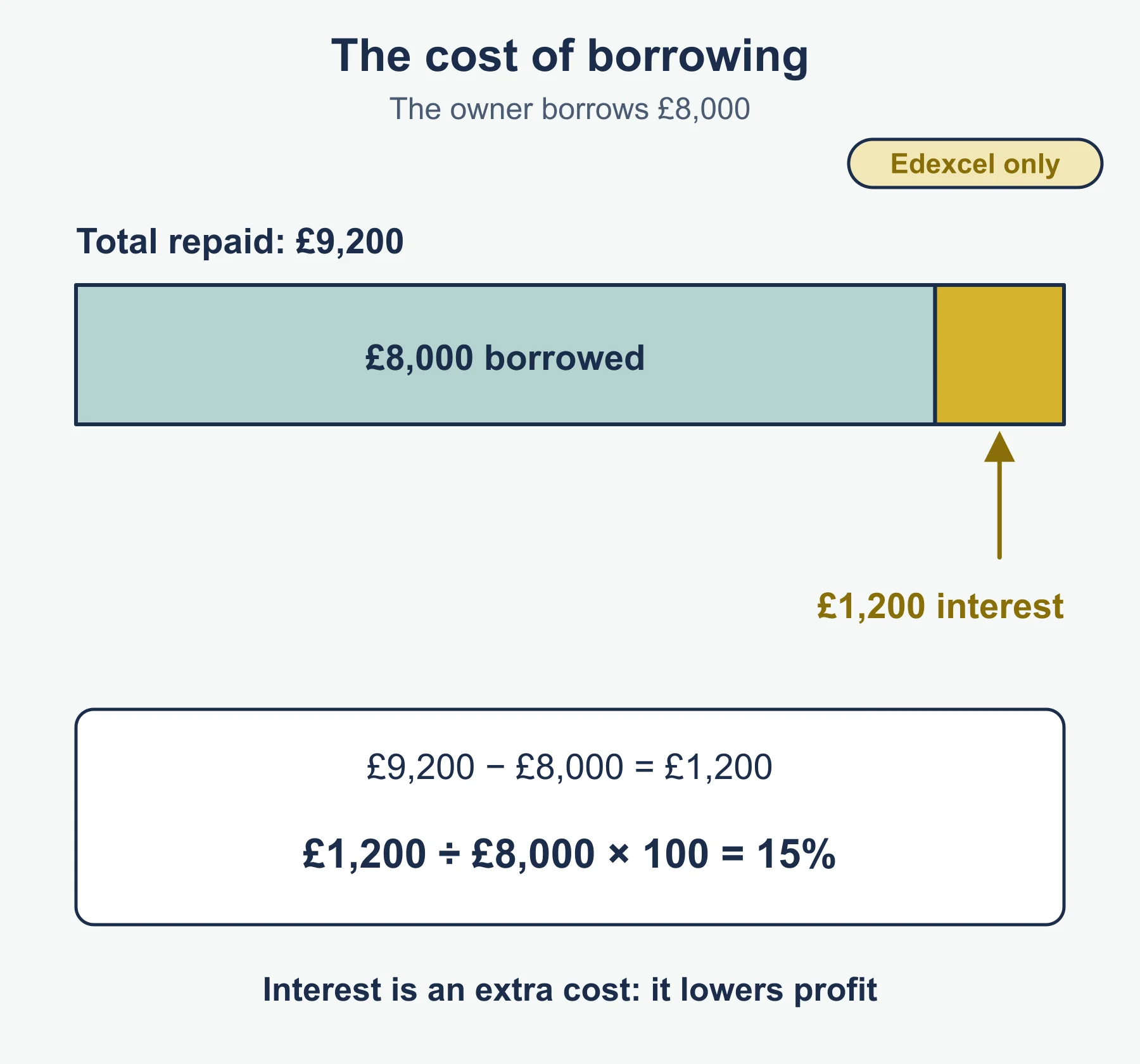
Worked example: interest. The owner borrows £8,000 and repays £9,200 in total.
- Interest paid = £9,200 − £8,000 = £1,200
- Interest (%) = £1,200 ÷ £8,000 × 100 = 15%
Interest is the cost of borrowing. It is an extra cost the business must plan for, and it lowers profit.
Part 6: break even and margin of safety (1.3.2)
Break even happens at the output where money coming in matches total costs, so the business makes no profit and no loss. Appendix 3 gives:
- Break even point in units = fixed cost ÷ (sales price − variable cost)
- Break even point in costs or revenue = break even point in units × sales price
- Margin of safety = actual or budgeted sales − break even sales
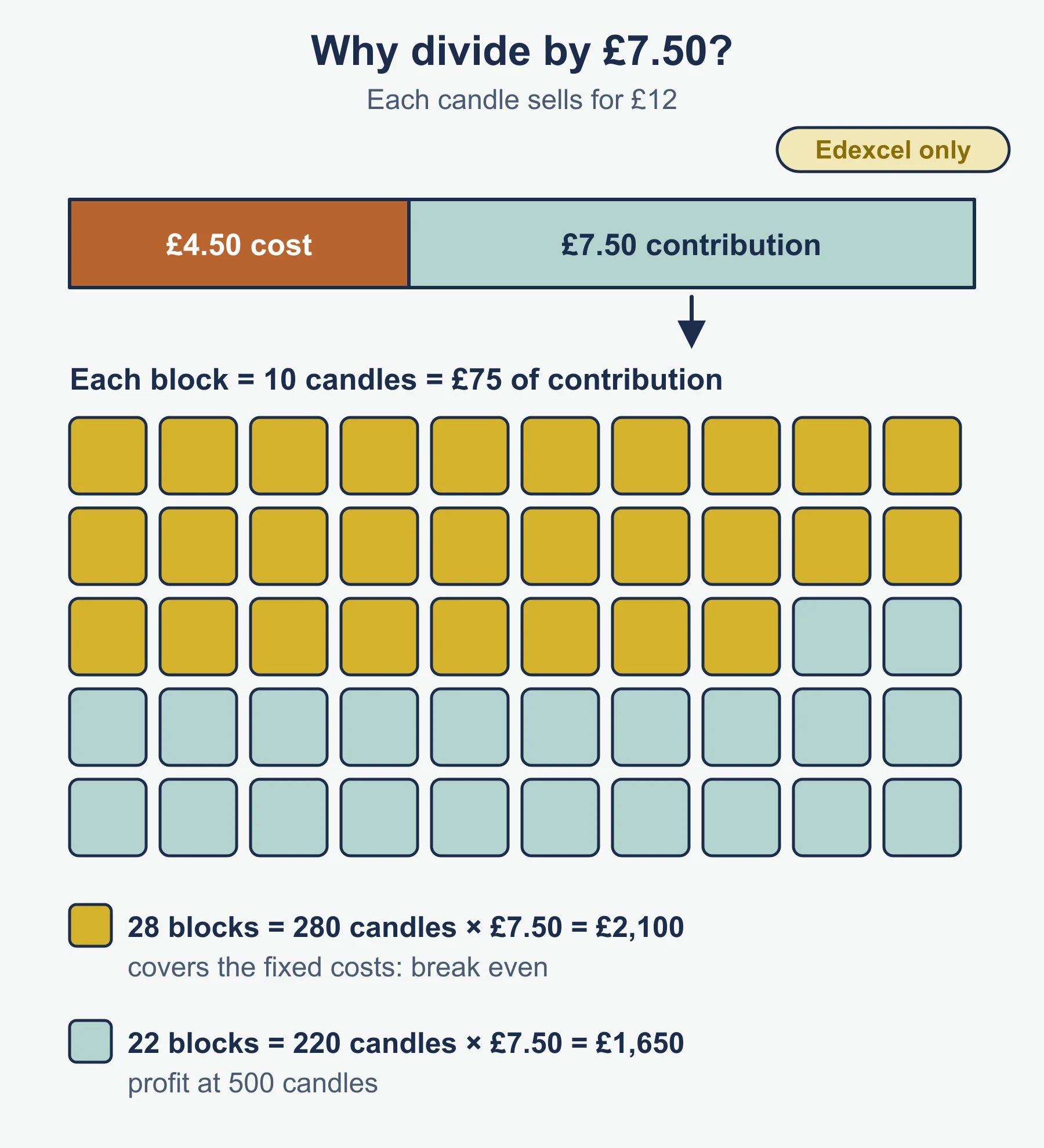
The bottom line (sales price − variable cost) is the amount each unit contributes towards fixed costs.
Wren Street Candles, continued.
- Break even = £2,100 ÷ (£12 − £4.50) = £2,100 ÷ £7.50 = 280 candles
- Break even revenue = 280 × £12 = £3,360
- Margin of safety at 500 candles = 500 − 280 = 220 candles
The margin of safety shows how far sales could fall before the business starts to make a loss. A large margin means a cushion. As a standard extra, some questions show it as a percentage of sales: 220 ÷ 500 × 100 = 44%.
If the break-even figure is not a whole number, remember that candles cannot be part-sold. It is sensible to round up and say so, because rounding down would leave the business at a small loss. This is advice on method, not wording from the specification.
Part 7: break even diagrams (1.3.2)
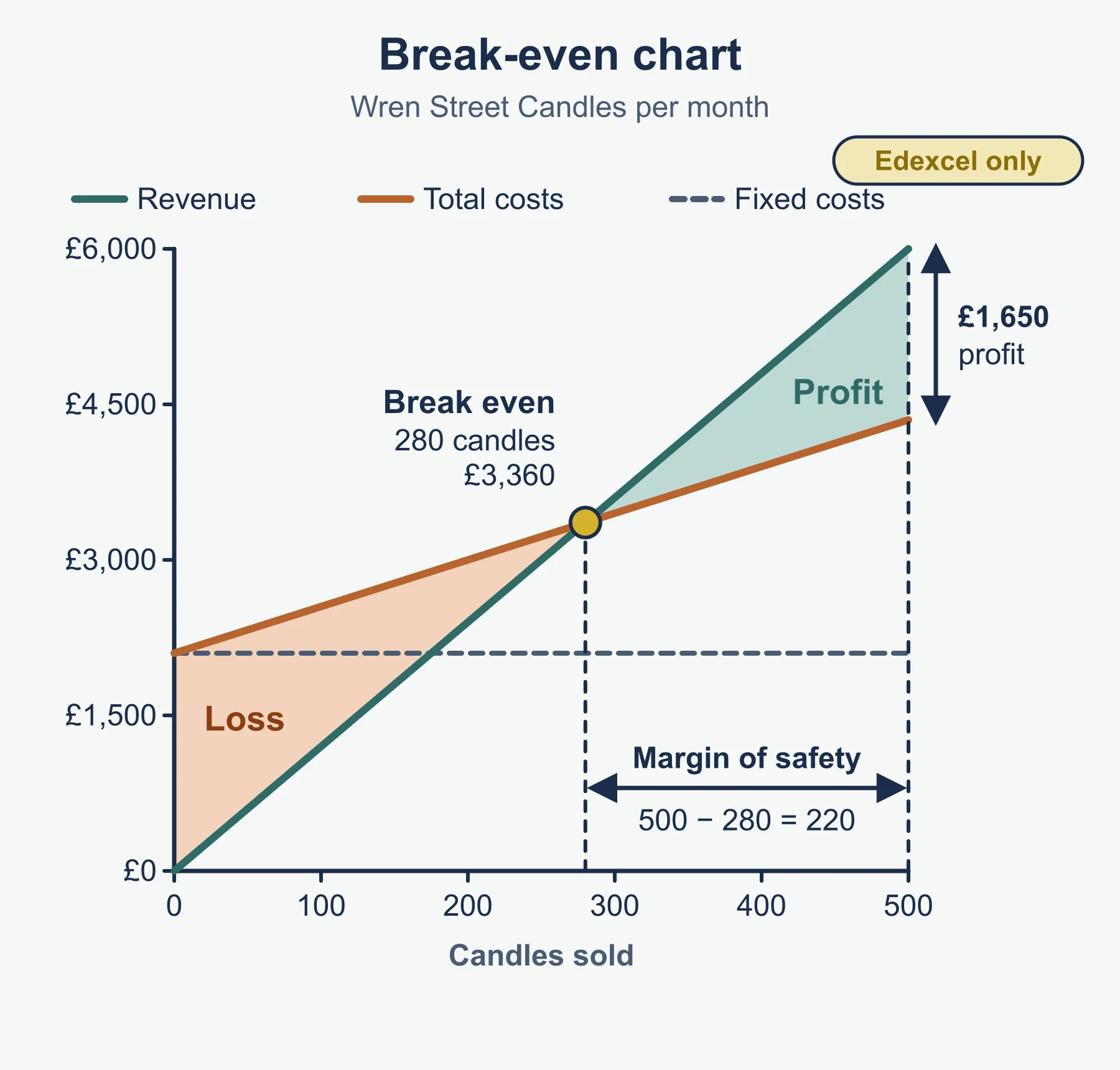
On a break even diagram, the number of units made and sold runs along the bottom, and pounds run up the side. Three lines matter.
- Total revenue starts at the origin and rises steadily.
- Fixed costs are a flat horizontal line.
- The total costs line begins at the height of fixed costs, not at zero, and climbs at the rate of the variable cost per unit.
Here are the Wren Street figures that such a diagram plots:
| Candles | Revenue (£) | Total costs (£) | Profit or loss (£) |
|---|---|---|---|
| 0 | 0 | 2,100 | −2,100 |
| 100 | 1,200 | 2,550 | −1,350 |
| 200 | 2,400 | 3,000 | −600 |
| 300 | 3,600 | 3,450 | 150 |
| 400 | 4,800 | 3,900 | 900 |
| 500 | 6,000 | 4,350 | 1,650 |
Read the diagram like this.
- Break even level of output: where the revenue and total costs lines cross. Read straight down to the output axis. Here it is between 200 and 300 candles, at 280.
- Loss: below the break even output, the total costs line is above revenue. The gap is the loss.
- Profit: above break even output, revenue is above total costs. The gap is the profit.
- Margin of safety: the gap, measured along the output axis, between break even output and the planned or actual output.
The impact of changes in revenue and costs
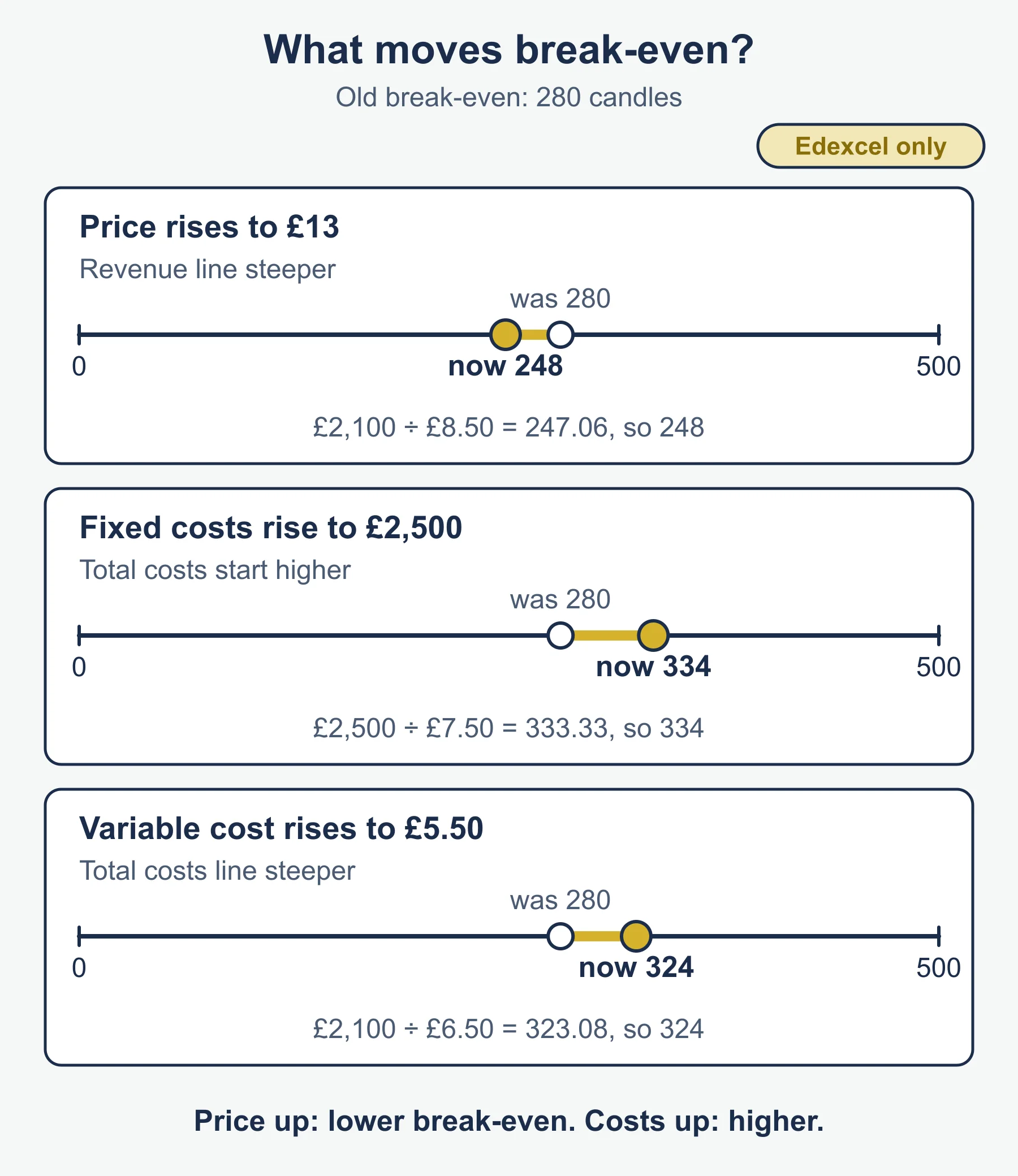
Each change moves a line. Test the effect with the formula.
| Change | Effect on lines | New break even output |
|---|---|---|
| Price rises from £12 to £13 | Revenue line is steeper | £2,100 ÷ £8.50 = 247.06, so 248 candles |
| Fixed costs rise to £2,500 | Total costs line starts higher | £2,500 ÷ £7.50 = 333.33, so 334 candles |
| Variable cost rises to £5.50 | Total costs line is steeper | £2,100 ÷ £6.50 = 323.08, so 324 candles |
A price rise lowers break even output and widens the margin of safety, if customers keep buying. Higher costs of either type raise break even output and shrink the margin of safety. In an analysis answer, say what happens to the lines, then what this means for the owner. A price rise helps only if customers still buy enough, so mention that risk.
Common errors
- Writing aims and objectives as the same thing. Keep aims as the long-term direction and objectives as the measurable steps.
- Treating “sales” as the same as “profit”.
- Naming a non-financial objective without relating it to the named business.
- Mixing up a per-unit figure with a total: unit variable cost used as TVC, or a fixed cost per unit used as TFC.
- Dividing fixed costs by the price, not by price minus variable cost.
- Starting the total costs line at zero on a diagram.
- Calling the gap between price and variable cost the profit, when fixed costs have not yet been covered.
- Giving a break even or margin of safety figure with no units.
Frequently asked questions
What is the difference between a business aim and a business objective? A business aim is a long-term, general goal: where the owner wants the business to be. A business objective is a more specific target, usually with a number and a date, that moves the business towards its aim.
Why do aims and objectives differ between businesses? Reasons include the stage of the business, the owner’s motives, its size and ownership, the type of business and conditions in the market. Aims also change over time.
How does a price rise affect break even? A price rise makes the revenue line steeper, lowering the break even level of output and widening the margin of safety, as long as customers keep buying at the new price.
What should I do if break even output is not a whole number? Round up to the next whole unit, because a business cannot sell part of a product and rounding down would leave it just short of covering its costs.
Official syllabus
Pearson Edexcel Level 1/Level 2 GCSE (9-1) in Business (1BS0), Specification, Issue 2, July 2022, published by Pearson Education Limited. The subject content covered is in Theme 1 (Investigating small business), under Topic 1.3 (Putting a business idea into practice): items 1.3.1 and 1.3.2.
Get free revision emails (optional)
Occasional emails with practice questions, worked explanations and links to free resources for the qualification and subjects you choose. No spam, and you can unsubscribe from any email. The free tools on this site never need an email.
Related resources
-
Practice questions
Edexcel GCSE Business: Aims, objectives, revenue, costs and profit (1BS0) – Practice Questions
Original practice questions with worked answers on aims, objectives, costs, profit, interest and break-even for Edexcel GCSE Business 1BS0, topic 1.3.
Business · Pearson Edexcel · GCSE
Try questions -
Revision notes
Edexcel GCSE Business: Aims, objectives, revenue, costs and profit (1BS0) – Revision Notes
Condensed revision notes on aims, objectives, revenue, costs, profit, interest, break-even and margin of safety for Pearson Edexcel GCSE Business 1BS0.
Business · Pearson Edexcel · GCSE
Revise topic -
Study guides
Edexcel GCSE Business: Cash flow and sources of finance for a small business (1BS0)
Study guide to why cash matters, cash-flow forecasts and short- and long-term sources of finance, for Edexcel GCSE Business Theme 1.
Business · Pearson Edexcel · GCSE
Read guide
Related articles
-
teaching
A Level tuition in Dubai: Cambridge or Pearson Edexcel International A Level?
Schools in Dubai and Abu Dhabi teach either Cambridge International AS & A Level or Pearson Edexcel International A Level. How the two are structured, why it matters for tuition, and how online classes from Lahore work.
9 October 2026
-
curriculum guides
Choosing subjects at IGCSE and A Level
How subject choices at 14 and 16 affect university options later, and how to keep pathways open without overloading a timetable.
28 July 2026
Studying this with a teacher
Working through Business GCSE?
This page is free and stays free. If you would rather be taught it, Marlbridge runs Business classes one-to-one and in small groups of up to 15, online in your own time zone. The first trial class is free. WhatsApp replies within an hour (8am–11pm Pakistan time, every day); email the same day.
Pearson Edexcel Business teachers at Marlbridge

