
Study Guides
Edexcel GCSE Business: Cash flow and sources of finance for a small business (1BS0)
Study guide to why cash matters, cash-flow forecasts and short- and long-term sources of finance, for Edexcel GCSE Business Theme 1.
- Subject
- Business
- Level
- GCSE
- Topic
- Putting a business idea into practice
- Author
- Marlbridge Academic Team
- Updated
- Reviewed by
- Asif Iqbal (what this means)
Aligned to Pearson Edexcel GCSE Business (1BS0), Issue 2, July 2022. Official specification .
Syllabus page (what it covers and how it is assessed): Pearson Edexcel GCSE Business.
Syllabus points this page covers
1BS0
- 1.3 Putting a business idea into practice (whole topic)
- 1.3.3 Cash and cash-flow
- 1.3.4 Sources of business finance
Found an error? Report a correction.
Want a teacher for this? Marlbridge teaches Business online. Request a free trial class.
This guide follows the Pearson Edexcel Level 1/Level 2 GCSE (9-1) in Business (1BS0) specification, Issue 2, July 2022. It covers Theme 1, Topic 1.3 Putting a business idea into practice, content items 1.3.3 (cash and cash-flow) and 1.3.4 (sources of business finance). The specification lists the formulae in Appendix 3 and says they are not provided in the examinations, so learn them. It also says calculators may be used.
Links: the Business hub, the printable checklist and the free diagnostics. Companion pages: the revision notes and the practice questions.
What the specification asks for
| Item | You must be able to | Section |
|---|---|---|
| 1.3.3 | Explain why cash is needed to pay suppliers, overheads and employees | 1 |
| 1.3.3 | Explain how cash helps prevent business failure (insolvency) | 1 |
| 1.3.3 | Explain the difference between cash and profit | 2 |
| 1.3.3 | Calculate and interpret a cash-flow forecast: cash inflows, cash outflows, net cash flow, opening and closing balances | 3 and 4 |
| 1.3.4 | Explain short-term sources: overdraft and trade credit | 5 |
| 1.3.4 | Explain long-term sources: personal savings, venture capital, share capital, loans, retained profit and crowd funding | 6 |
| 1.3.4 | Choose sources for a start-up or an established small business | 7 |
The command-word table says what a question wants. “Explain” is a statement of fact with two expansion points and no context. “Analyse” is an extended answer placed in the context the question gives. “Justify” means using the information provided to recommend one of two options. “Evaluate” means using your knowledge to reach a supported conclusion about a business situation.
1. Why cash matters
Cash is the money a business can spend now: the balance in the bank account and the notes and coins in the till. A business needs it for three everyday jobs.
- Paying suppliers. Suppliers of materials, stock or services expect payment. If a business pays late, suppliers may refuse to deliver, ask for cash up front, or stop dealing with it.
- Paying overheads. Rent, electricity, insurance and similar bills fall due on set dates whether or not sales have been good that week.
- Paying employees. Wages must be paid on the agreed day.
Insolvency means a business cannot pay its debts when they fall due. A business that keeps enough cash coming in, and plans for the gaps, avoids this. Many profitable small businesses still fail because the cash runs out before the money from customers arrives.
2. Cash and profit are different
- Cash is money actually received or paid out. It moves when money changes hands.
- Profit is sales revenue minus costs over a period. It is recorded when the sale is made or the cost is incurred, even if the money moves later.
Because customers often pay after the sale (and a business often pays for materials first), the two figures can point in different directions in the same month.
Worked example: Pellam Joinery
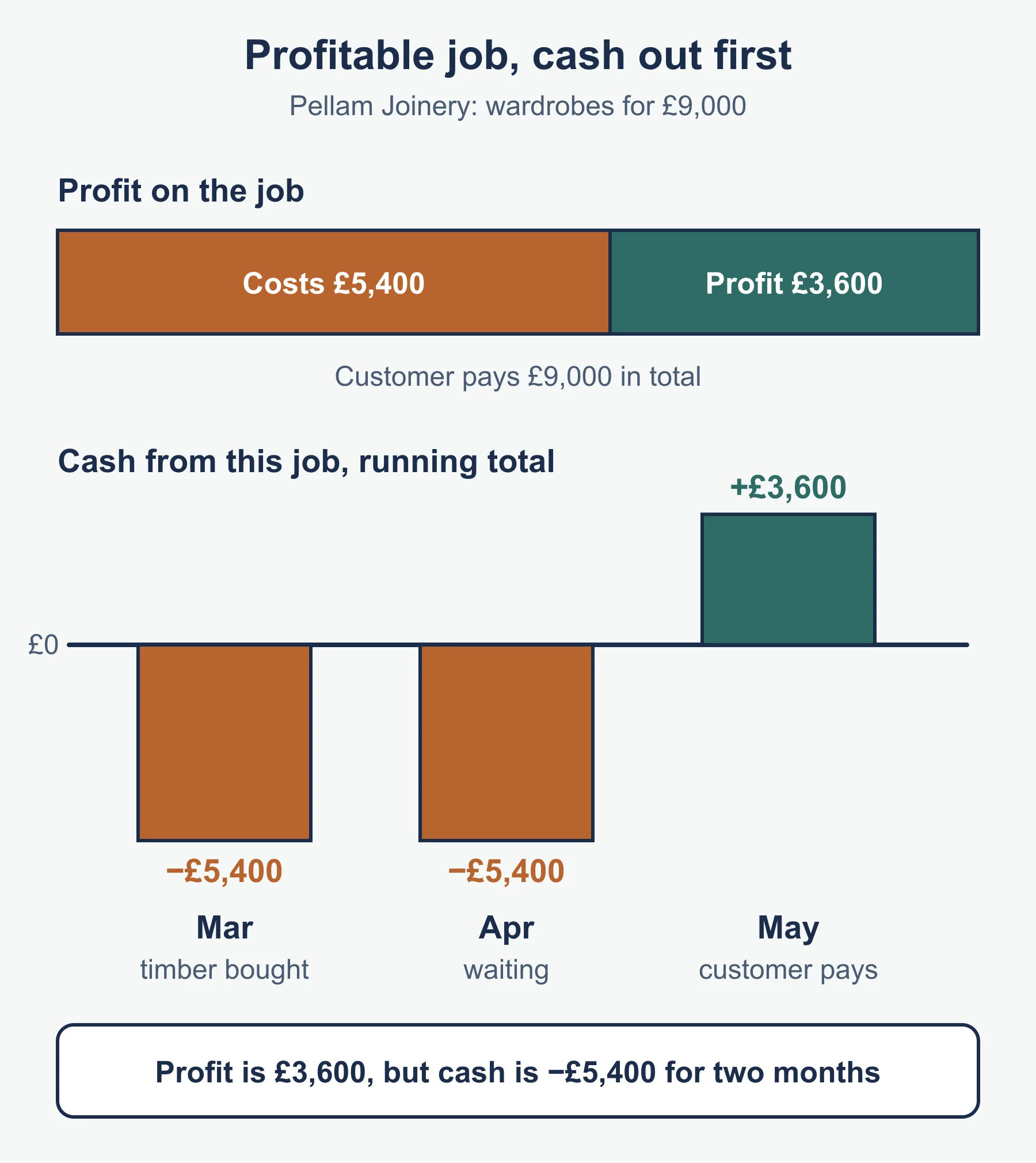
Pellam Joinery agrees to fit a set of wardrobes for £9,000. In March it pays £5,400 for timber and fittings. The customer receives a bill and pays in May.
- Profit on the job = 9,000 - 5,400 = £3,600. The job is profitable.
- Cash in March: £5,400 goes out and nothing comes in, so the cash effect is -£5,400.
- Cash in May: £9,000 arrives.
For two months the firm is out of pocket by £5,400 on a job that makes £3,600 profit. If its bank balance is below £5,400 in March, it cannot buy the timber without borrowing. A customer who pays a deposit in advance does the reverse: cash improves before profit is made.
A loan received is also an inflow of cash, but it is not sales revenue and it is not profit.
3. Building a cash-flow forecast
A cash-flow forecast is a prediction, month by month, of the cash expected to come in and go out, with the bank balance it leaves. Owners use one to spot gaps early. The specification names these parts.
- Cash inflows: money coming in, such as sales receipts (cash sales and customers paying their bills), a loan, or the owner’s capital.
- Cash outflows: money going out, such as materials, wages, rent, utilities and equipment.
- Net cash flow = cash inflows - cash outflows in a given period.
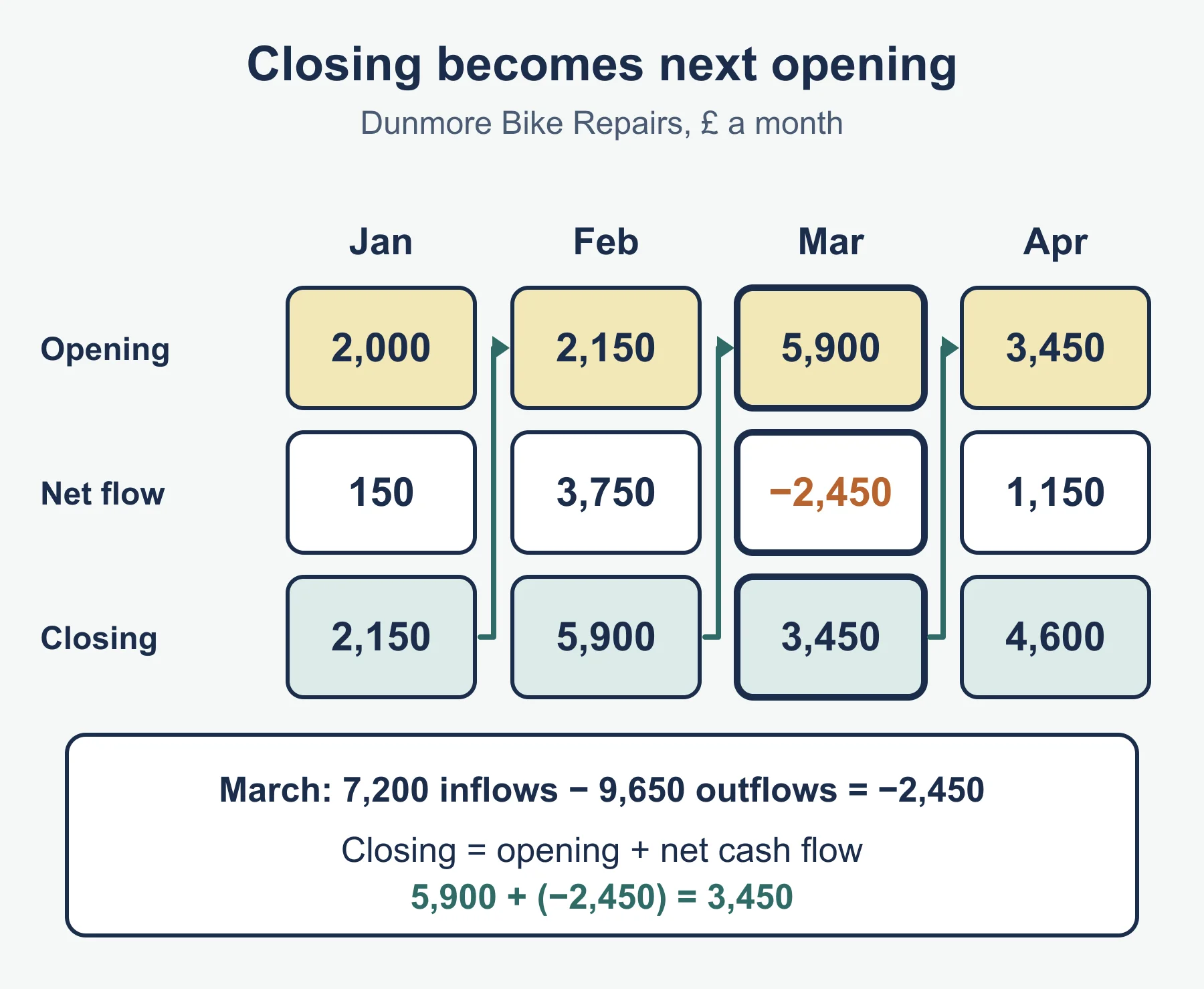
- Opening balance = the closing balance of the previous period.
- Closing balance = opening balance + net cash flow.
The first opening balance is the cash the business starts with. Every later opening balance is copied from the previous closing balance. If a closing balance is negative, the business is forecasting that it will have spent more cash than it has.
Worked example: Dunmore Bike Repairs
Dunmore Bike Repairs starts January with £2,000 in the bank. Monthly wages are £2,400 and rent and overheads are £1,350. In March it buys a lifting stand for £3,000. It plans to take a £4,000 loan in February.
| Jan | Feb | Mar | Apr | |
|---|---|---|---|---|
| Sales receipts | 6,500 | 5,800 | 7,200 | 8,100 |
| Loan received | 0 | 4,000 | 0 | 0 |
| Total inflows | 6,500 | 9,800 | 7,200 | 8,100 |
| Parts | 2,600 | 2,300 | 2,900 | 3,200 |
| Wages | 2,400 | 2,400 | 2,400 | 2,400 |
| Rent and overheads | 1,350 | 1,350 | 1,350 | 1,350 |
| Equipment | 0 | 0 | 3,000 | 0 |
| Total outflows | 6,350 | 6,050 | 9,650 | 6,950 |
| Net cash flow | 150 | 3,750 | -2,450 | 1,150 |
| Opening balance | 2,000 | 2,150 | 5,900 | 3,450 |
| Closing balance | 2,150 | 5,900 | 3,450 | 4,600 |
Check one column. March inflows are 7,200 and outflows are 2,900 + 2,400 + 1,350 + 3,000 = 9,650. Net cash flow = 7,200 - 9,650 = -2,450. Closing balance = 5,900 + (-2,450) = 3,450, and that becomes the April opening balance.
4. Interpreting a forecast
Calculation is only half of the topic. A good answer also says what the figures mean for the business.
- Look at the closing balances. Dunmore never forecasts a negative balance, so it can pay its bills each month.
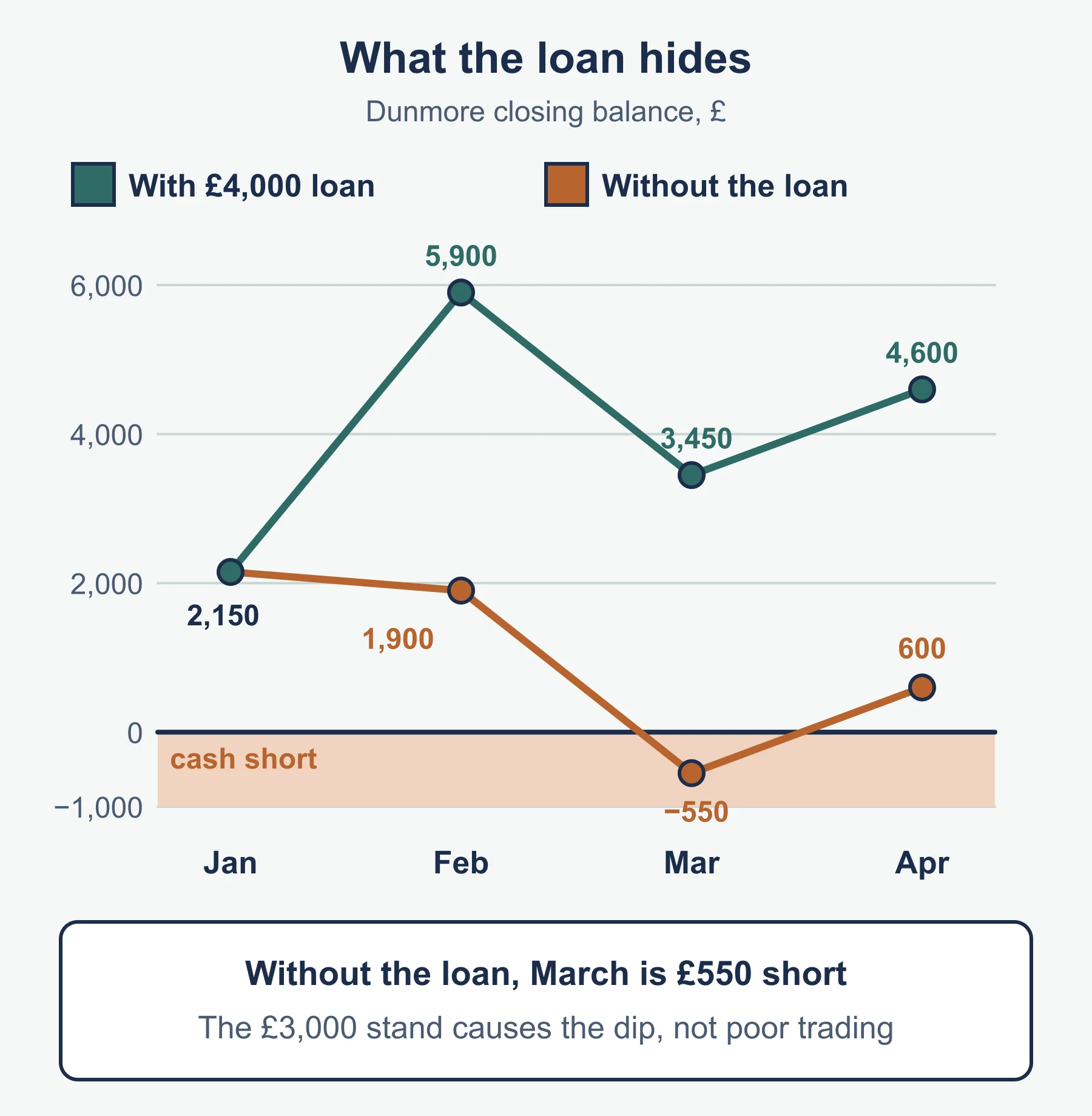
- Ask what the balance depends on. The £4,000 loan makes the difference. Without it, the closing balances would be £2,150, £1,900, -£550 and £600. March would be a gap of £550. That is useful to know in January, because the owner could arrange an overdraft, delay the stand purchase or collect payments faster.
- Find the cause of a dip. March falls because of the one-off equipment purchase, not because trading is poor. Without the £3,000 stand, March net cash flow would be +£550.
- Remember the limits. A forecast is built from estimates. Sales may be lower, customers may pay later and costs may rise, so owners compare it with actual figures and update it.
- Act on what you find. Responses to a gap include short-term finance, asking customers to pay sooner, negotiating longer supplier credit, or timing large purchases for a stronger month.
5. Short-term sources of finance
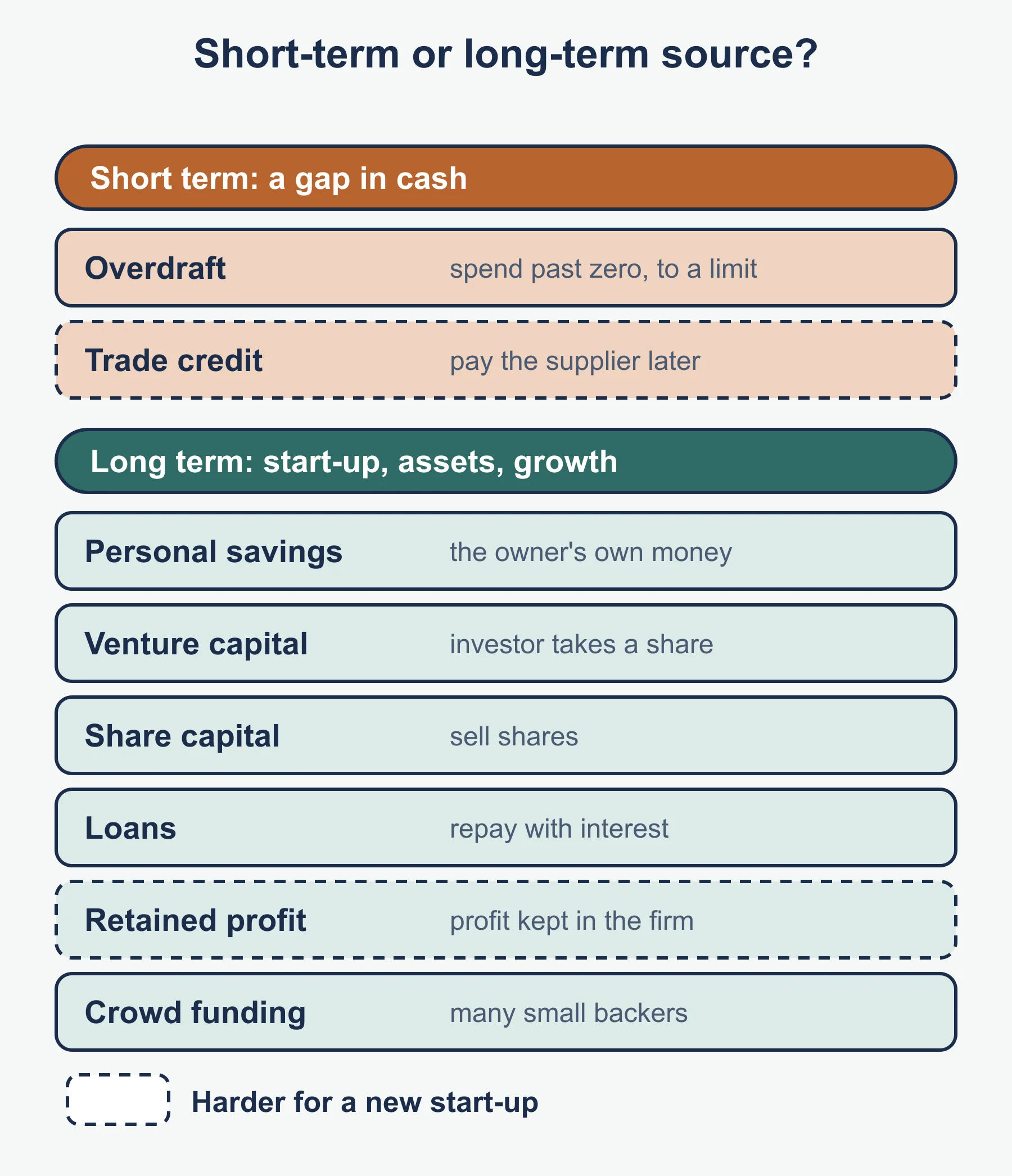
Short-term sources cover temporary cash gaps and day-to-day running costs. The specification names two.
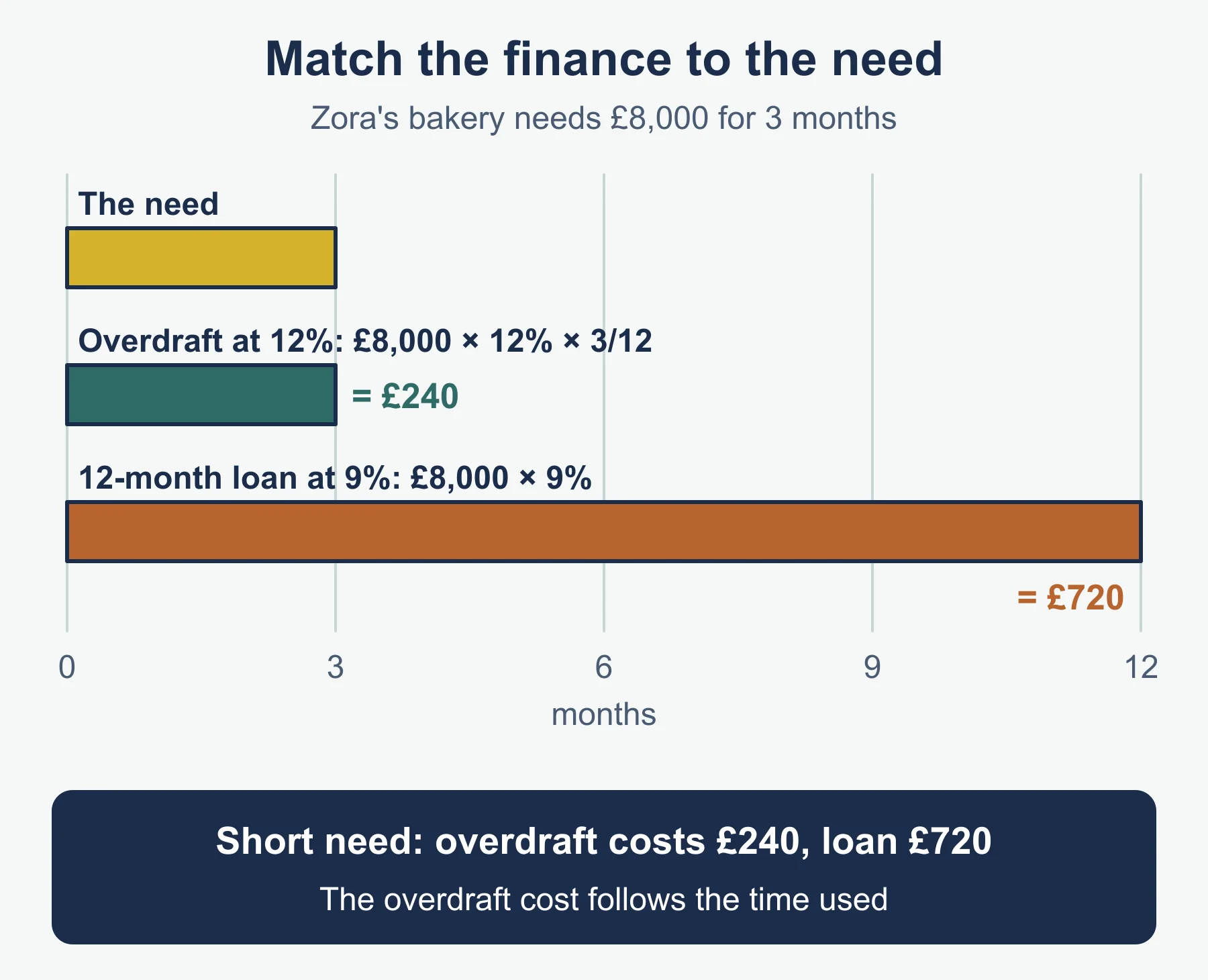
Overdraft. The bank lets the business spend more than it has in its current account, up to an agreed limit. It is flexible: the business only borrows what it needs, when it needs it, and interest is charged on the amount overdrawn. Interest rates can be high and the bank may reduce the limit. It suits a gap such as Dunmore’s March dip, not something that takes years to pay back.
Trade credit. A supplier delivers goods now and lets the business pay later, for example after 30 days. There is no interest in the usual arrangement, so the supplier is in effect lending the money. It helps cash flow because stock can be sold before it is paid for. The drawbacks: a new business without a track record may not be offered credit, the supplier may offer a discount for early payment that is lost, and late payment can damage the relationship.
6. Long-term sources of finance
Long-term sources fund start-up costs, equipment, premises and growth. The specification names six.
- Personal savings. The owner puts in their own money. There is no interest and no outsiders to answer to, but the amount is limited and the owner can lose it if the business fails.
- Venture capital. An investor provides a sizeable sum in return for a share in the business and often a say in decisions. It can give a growing firm large funds without monthly repayments, but the owner gives up part of the ownership and some control, and a share of future profit.
- Share capital. A company raises money by selling shares. Shareholders become part-owners. The money does not have to be repaid, but profits are shared through dividends and ownership is spread out.
- Loans. A lender provides a fixed sum, repaid with interest over an agreed time. Loans give certainty and keep ownership intact. The business must make the repayments even in a poor month, and lenders may ask for some form of security.
- Retained profit. Profit kept in the business rather than paid out to the owners. It has no interest and no outsiders, but it exists only if the business has been profitable and keeping it means less for the owners.
- Crowd funding. Many people each give a small amount, usually through an online platform, in return for a reward, a product or a stake. It can test demand and raise money without a bank, but a business must attract enough backers, and the project may need a strong pitch and public exposure of the idea. Terms vary between platforms.
Worked example: loan interest
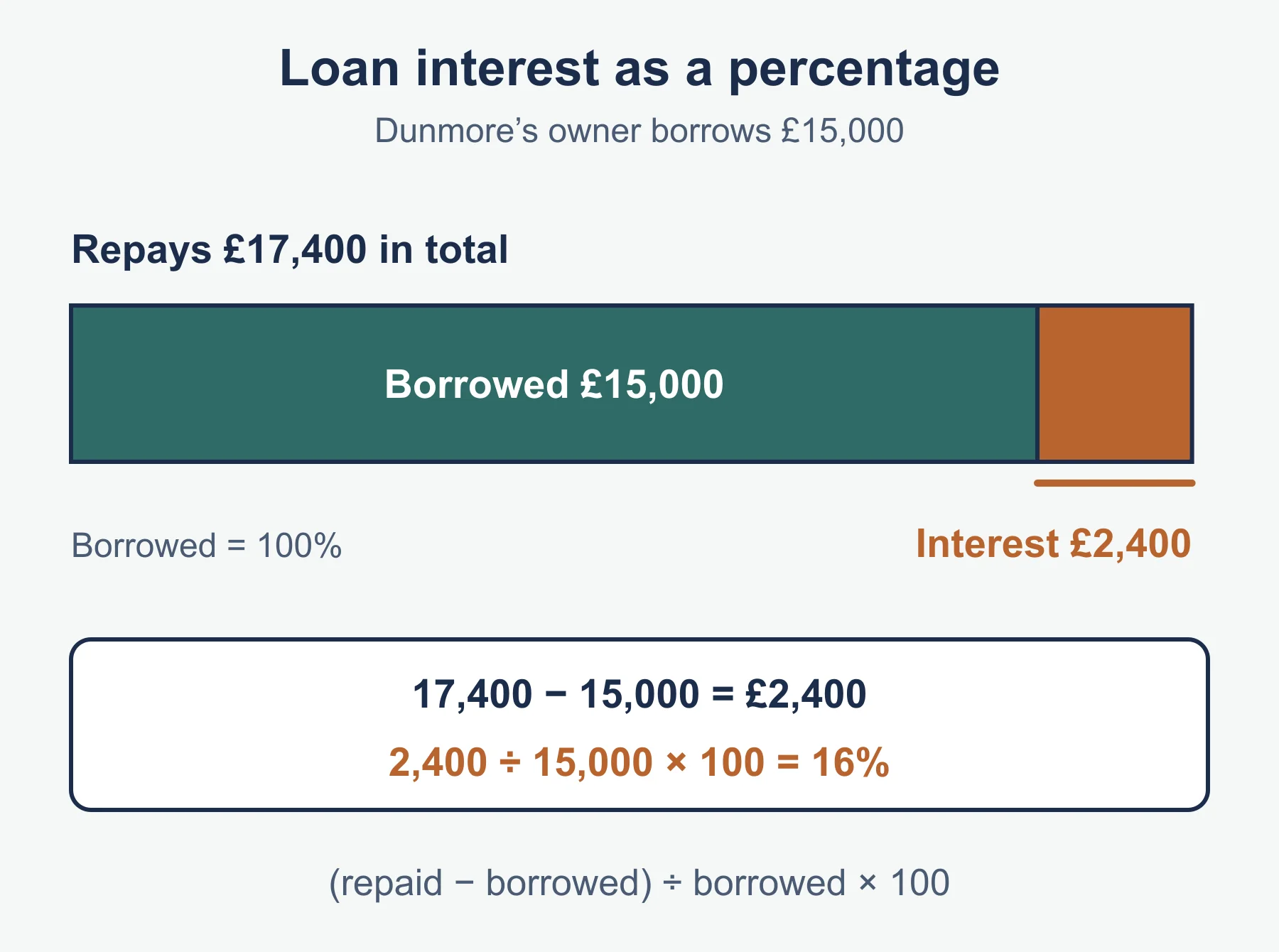
The specification gives interest on loans in % as (total repayment - borrowed amount) / borrowed amount × 100.
Dunmore’s owner considers borrowing £15,000 and repaying £17,400 in total. Interest = 17,400 - 15,000 = £2,400. As a percentage: 2,400 / 15,000 × 100 = 16%.
7. Choosing between sources
A start-up has no trading history and no retained profit. It usually relies on personal savings, a loan, share capital, venture capital or crowd funding, and may find trade credit harder to obtain. An established small business can also use retained profit, and its record often makes lenders and suppliers more willing.
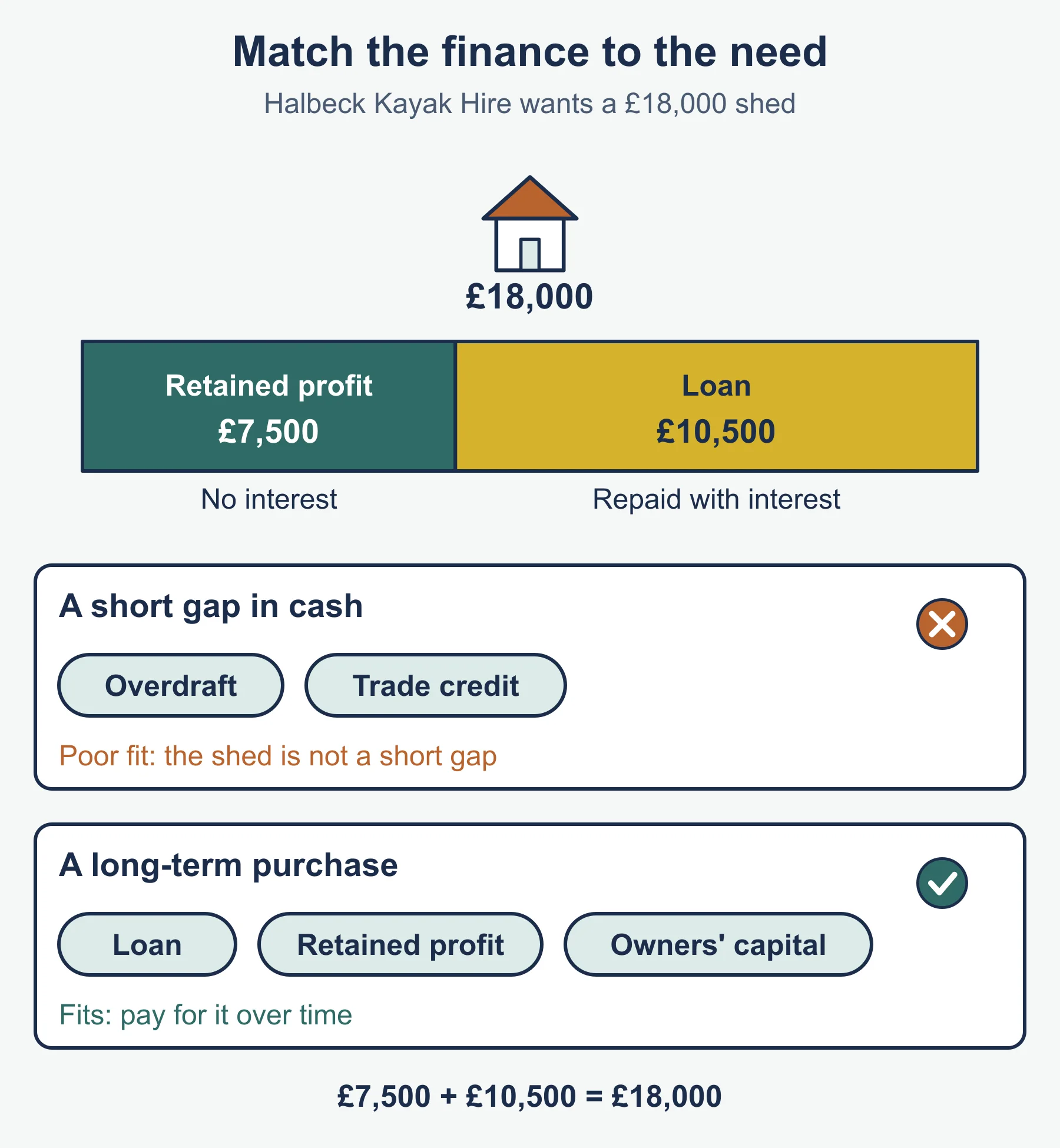
Match the source to the need. A short gap in cash suits an overdraft or trade credit. A van or machine suits a loan or retained profit. Large growth, where the owner will share ownership, suits venture capital or share capital. A small sum to test an idea with a ready audience suits crowd funding.
Worked example: Hollin Garden Design
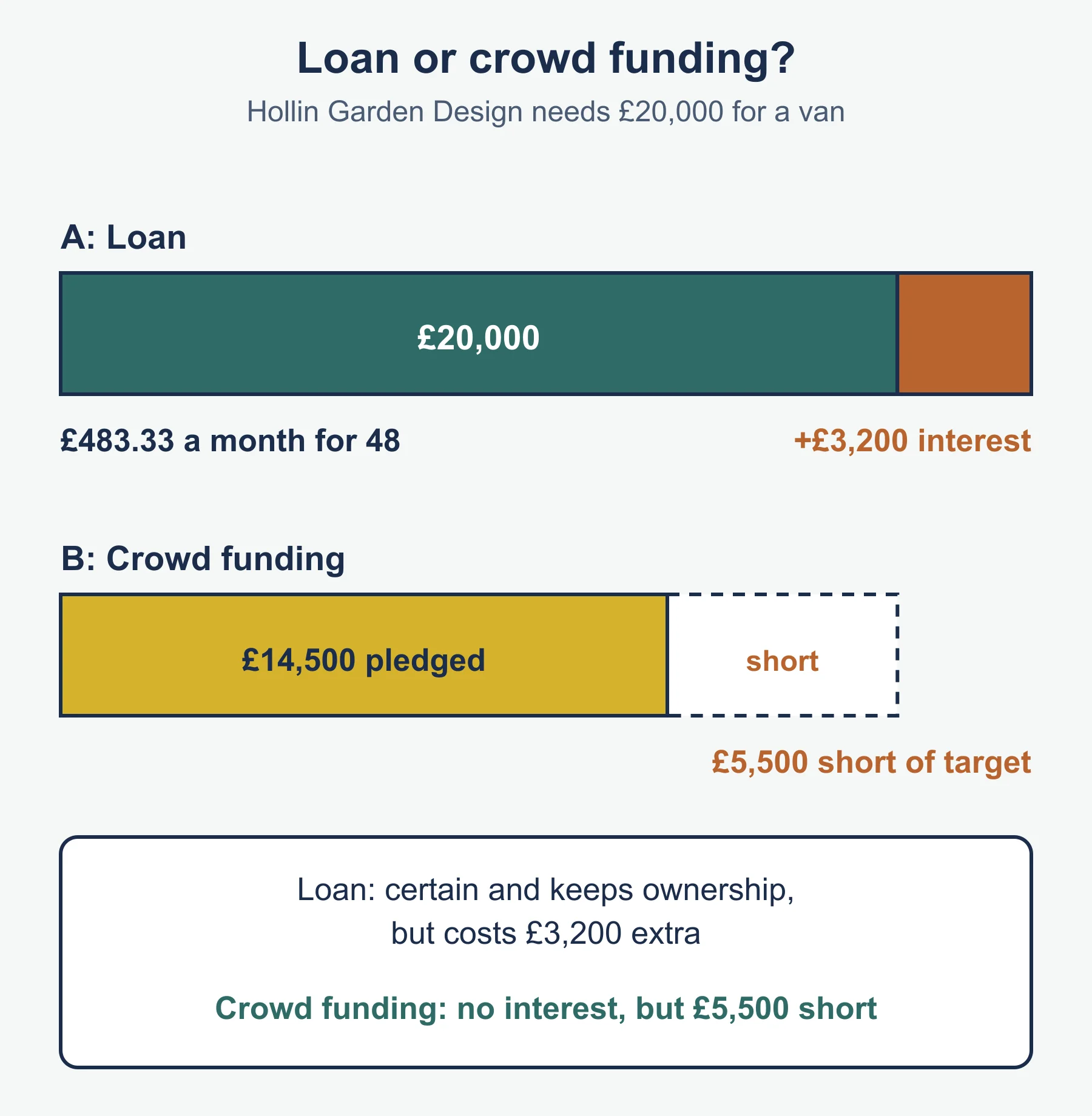
Hollin Garden Design needs £20,000 for a van. Option A is a loan: repay £23,200 over 48 months, which is £483.33 a month and 16% interest in total ((23,200 - 20,000) / 20,000 × 100). Option B is crowd funding, with pledges of £14,500 so far against a £20,000 target.
A justified recommendation weighs both sides. The loan is certain and keeps ownership, but costs £3,200 extra and the payment must come from cash flow. Crowd funding has no interest, but pledges are £5,500 short of the target. Unless Hollin can close that gap, the loan is the safer route. The conclusion would change if cash flow could not support the monthly payment.
Common errors
- Treating profit as if it were cash in the bank.
- Counting a loan as sales revenue or profit.
- Forgetting that the closing balance becomes the next opening balance.
- Adding outflows to inflows when finding net cash flow.
- Naming a source without saying why it suits this business.
- Calling an overdraft a long-term source, or retained profit a short-term one.
- Saying a negative closing balance means a loss. It means cash is short.
Frequently asked questions
Why can a profitable business run out of cash? Profit is recorded when a sale is made, but customers often pay later while the business pays for materials first. A job can make a profit yet leave the business short of cash for weeks, so it may struggle to pay suppliers, overheads and wages.
What does a negative closing balance on a cash-flow forecast mean? It means the business forecasts that it will have spent more cash than it has, so cash is short in that month. It does not mean the business has made a loss.
What is the difference between an overdraft and trade credit? An overdraft lets a business spend more than it has in its bank account up to an agreed limit, with interest charged on the amount overdrawn. Trade credit lets a business receive goods from a supplier now and pay later, usually with no interest.
What can a business do if its cash-flow forecast shows a gap? It can arrange short-term finance such as an overdraft, ask customers to pay sooner, negotiate longer credit from suppliers, or time large purchases for a stronger month. In Edexcel GCSE Business (1BS0), interpreting the forecast earns marks as well as calculating it.
Official syllabus
Pearson Edexcel Level 1/Level 2 GCSE (9-1) in Business (1BS0), Specification, Issue 2, July 2022, published by Pearson Education Limited. Theme 1: Investigating small business, Topic 1.3 Putting a business idea into practice, items 1.3.3 and 1.3.4.
Get free revision emails (optional)
Occasional emails with practice questions, worked explanations and links to free resources for the qualification and subjects you choose. No spam, and you can unsubscribe from any email. The free tools on this site never need an email.
Related resources
-
Practice questions
Edexcel GCSE Business: Cash flow and sources of finance for a small business (1BS0) – Practice Questions
Original practice questions with worked answers on cash, cash-flow forecasts and sources of finance for Edexcel GCSE Business Theme 1.
Business · Pearson Edexcel · GCSE
Try questions -
Revision notes
Edexcel GCSE Business: Cash flow and sources of finance for a small business (1BS0) – Revision Notes
Condensed revision notes on cash, cash-flow forecasts and short- and long-term sources of finance for Edexcel GCSE Business Theme 1.
Business · Pearson Edexcel · GCSE
Revise topic -
Study guides
Edexcel GCSE Business: Aims, objectives, revenue, costs and profit (1BS0)
Study guide to business aims and objectives, revenue, costs, profit, interest, break-even and margin of safety for Pearson Edexcel GCSE Business 1BS0.
Business · Pearson Edexcel · GCSE
Read guide
Related articles
-
teaching
A Level tuition in Dubai: Cambridge or Pearson Edexcel International A Level?
Schools in Dubai and Abu Dhabi teach either Cambridge International AS & A Level or Pearson Edexcel International A Level. How the two are structured, why it matters for tuition, and how online classes from Lahore work.
9 October 2026
-
curriculum guides
Choosing subjects at IGCSE and A Level
How subject choices at 14 and 16 affect university options later, and how to keep pathways open without overloading a timetable.
28 July 2026
Studying this with a teacher
Working through Business GCSE?
This page is free and stays free. If you would rather be taught it, Marlbridge runs Business classes one-to-one and in small groups of up to 15, online in your own time zone. The first trial class is free. WhatsApp replies within an hour (8am–11pm Pakistan time, every day); email the same day.
Pearson Edexcel Business teachers at Marlbridge

