
Revision Notes
Edexcel GCSE Business: Cash flow and sources of finance for a small business (1BS0) – Revision Notes
Condensed revision notes on cash, cash-flow forecasts and short- and long-term sources of finance for Edexcel GCSE Business Theme 1.
- Subject
- Business
- Level
- GCSE
- Topic
- Putting a business idea into practice
- Author
- Marlbridge Academic Team
- Updated
- Reviewed by
- Asif Iqbal (what this means)
Aligned to Pearson Edexcel GCSE Business (1BS0), Issue 2, July 2022. Official specification .
Syllabus page (what it covers and how it is assessed): Pearson Edexcel GCSE Business.
Syllabus points this page covers
1BS0
- 1.3 Putting a business idea into practice (whole topic)
- 1.3.3 Cash and cash-flow
- 1.3.4 Sources of business finance
Found an error? Report a correction.
Want a teacher for this? Marlbridge teaches Business online. Request a free trial class.
These notes condense Topic 1.3 Putting a business idea into practice, items 1.3.3 (cash and cash-flow) and 1.3.4 (sources of business finance), from the Pearson Edexcel Level 1/Level 2 GCSE (9-1) in Business (1BS0) specification, Issue 2, July 2022. For full explanations and worked examples read the study guide. Test yourself with the practice questions.
Links: the Business hub, the printable checklist and the free diagnostics.
1. Why cash matters (1.3.3)
| Idea | What to remember |
|---|---|
| Pay suppliers | Suppliers can refuse further deliveries or demand payment up front if bills are late |
| Pay overheads | Rent, utilities and insurance fall due on fixed dates |
| Pay employees | Wages are due on the agreed day, whatever the sales that week |
| Prevent business failure | Running out of cash can lead to insolvency: unable to pay debts when due |
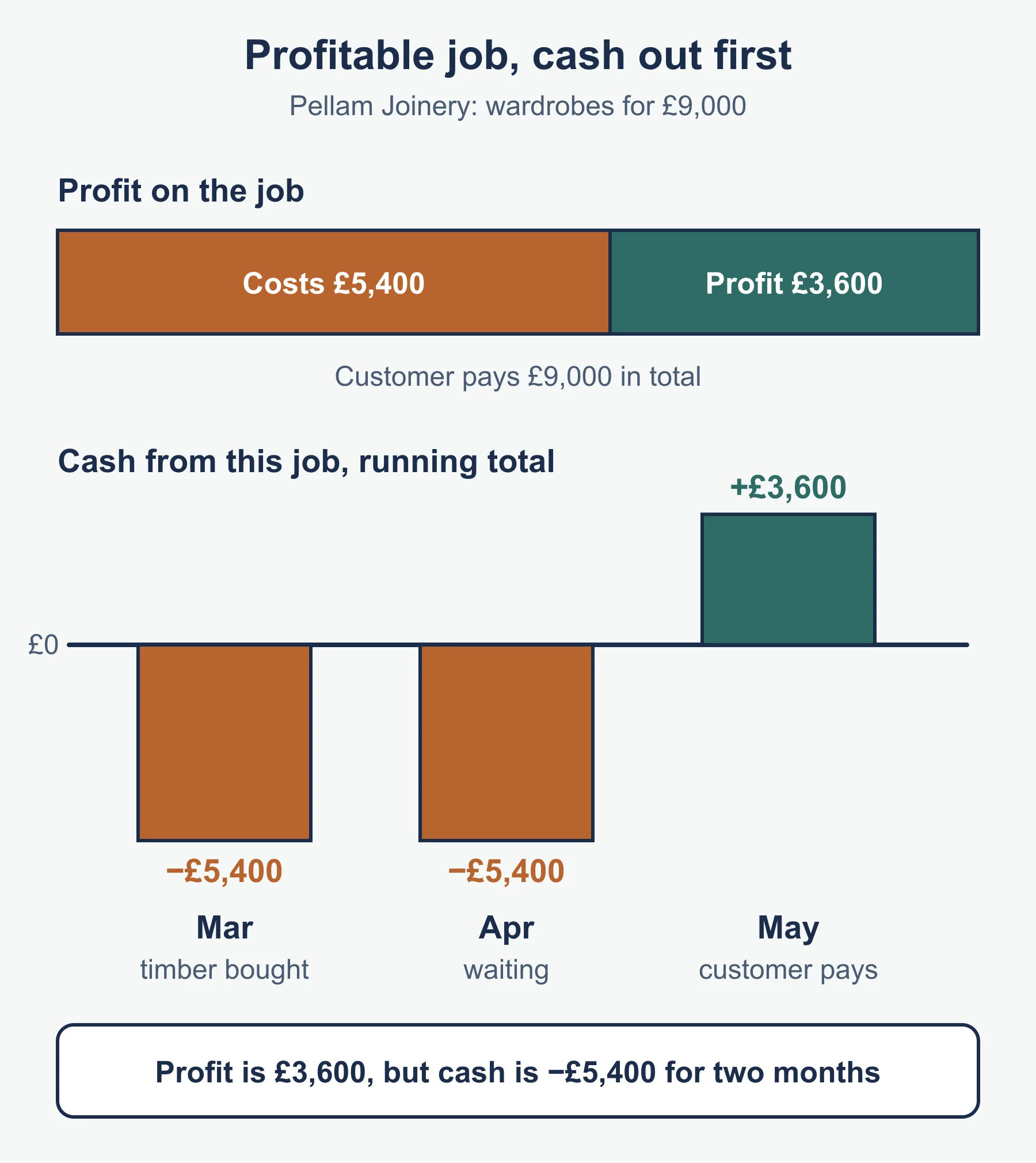
Insolvency = a business cannot pay its debts when they are due. A profitable business can still become insolvent if cash arrives too late.
Cash versus profit
| Cash | Profit | |
|---|---|---|
| Meaning | Money actually received or paid | Sales revenue minus costs |
| Timing | When money changes hands | When the sale is made or cost incurred |
| Can a business have one without the other? | Yes: cash-rich but loss-making, or profitable but cash-poor | Yes |
Typical causes of profit without cash: customers given time to pay, large stock bought up front, big equipment purchases, loan repayments. Typical causes of cash without profit: a loan received, a customer deposit, the owner adding money.
2. Cash-flow forecast: terms and formulae
The specification gives these in Appendix 3. Formulae are not provided in the examinations.
| Term | Rule |
|---|---|
| Cash inflows | Money coming in: sales receipts, loan received, owner’s money |
| Cash outflows | Money going out: materials, wages, rent, utilities, equipment, loan repayments |
| Net cash flow | Cash inflows - cash outflows, for the period being forecast |
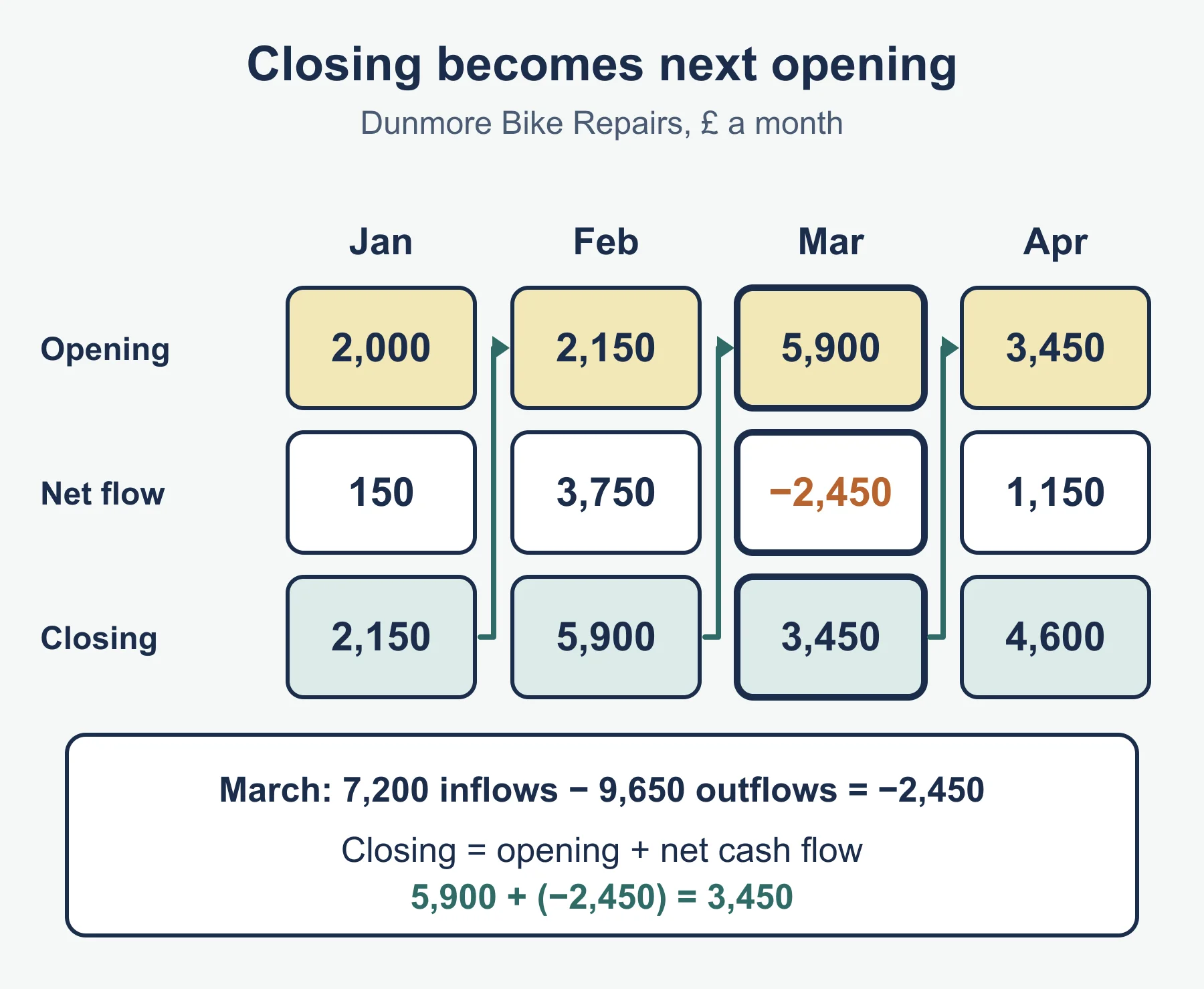
| Opening balance | Closing balance of the previous period |
| Closing balance | Opening balance + net cash flow |
Appendix 2 also lists cash-flow forecasts including total costs, total revenue and net cash flow among the quantitative skills.
Method: completing a forecast
- Add the inflows in each month to get total inflows.
- Add the outflows in each month to get total outflows.
- Net cash flow = total inflows - total outflows.
- The first opening balance is given. Every later opening balance = the previous closing balance.
- Closing balance = opening balance + net cash flow.
- Test your final answer: start from the first opening balance and add every net cash flow in turn.
Worked reminder: a three-month forecast
Opening balance in the first month is £1,200.
| Month 1 | Month 2 | Month 3 | |
|---|---|---|---|
| Total inflows | 4,300 | 3,900 | 5,100 |
| Total outflows | 4,800 | 4,600 | 4,200 |
| Net cash flow | -500 | -700 | 900 |
| Opening balance | 1,200 | 700 | 0 |
| Closing balance | 700 | 0 | 900 |
Check: 1,200 + (-500) + (-700) + 900 = 900. The balance touches £0 at the end of month 2, so any small shortfall would mean the business cannot pay a bill. A real owner would act before then.
Reading a forecast
- A falling closing balance is a warning even if it is still positive.
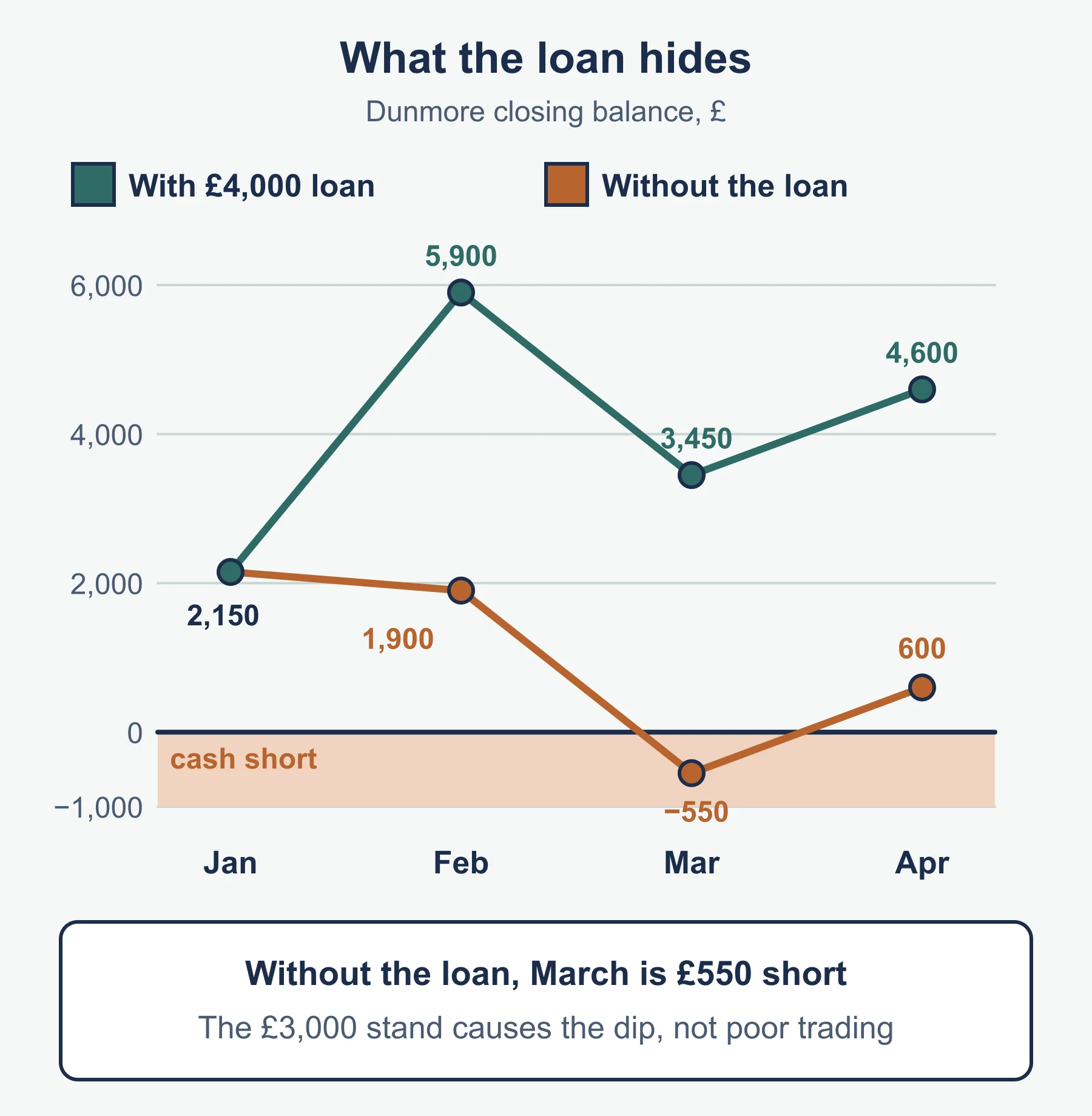
- A negative closing balance forecasts a cash shortage that needs financing or a change of plan.
- Find the cause: a one-off purchase, a seasonal dip, or weak trading.
- A forecast uses estimates, so it can be wrong. Sales may fall short and customers may pay late.
- Possible actions: arrange an overdraft, ask customers to pay sooner, seek longer supplier credit, delay a purchase, or cut costs.
3. Sources of finance (1.3.4)
The specification sorts the sources as follows.
| Term | Source |
|---|---|
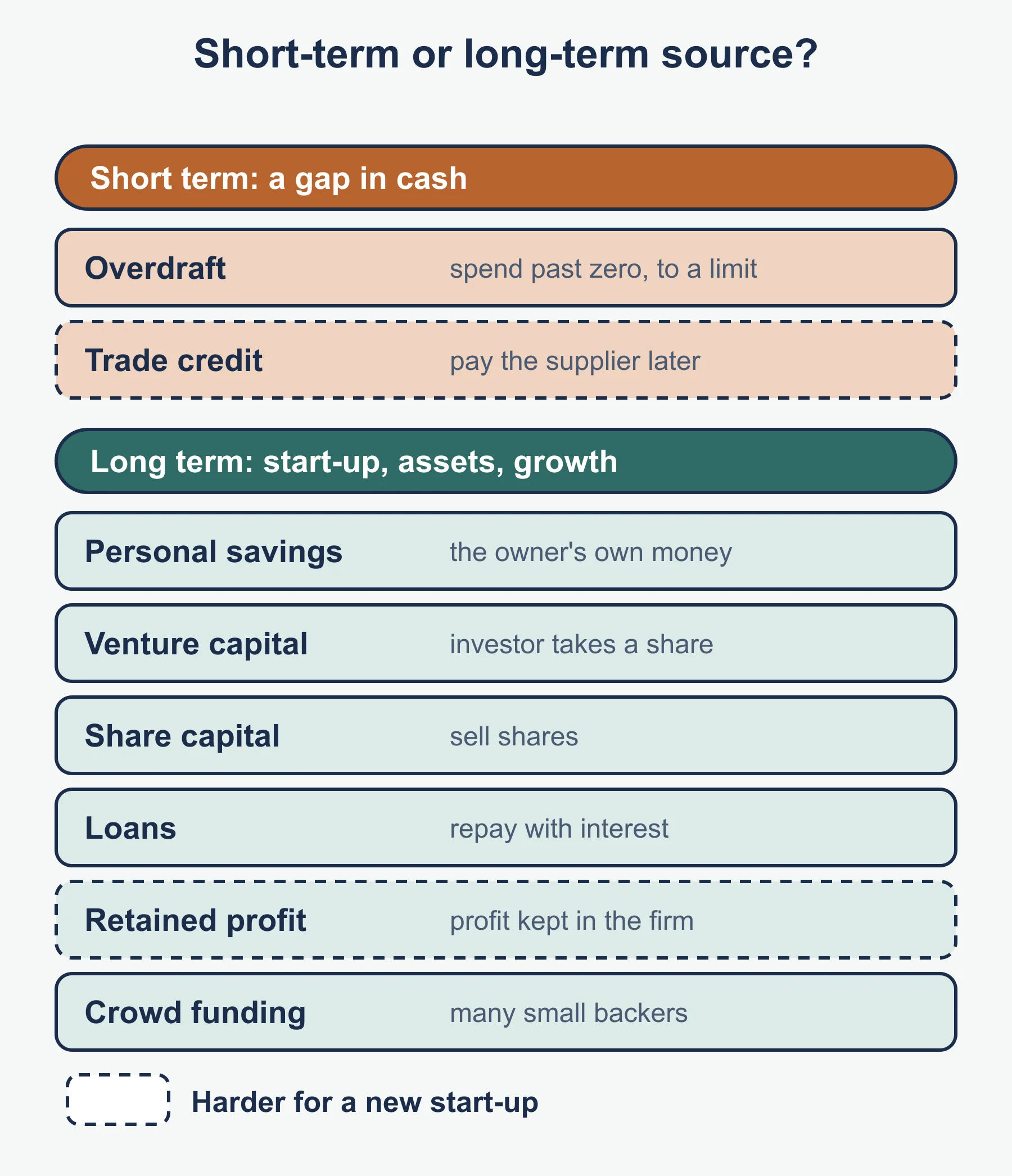
| Short-term | Overdraft, trade credit |
| Long-term | Personal savings, venture capital, share capital, loans, retained profit, crowd funding |
Short-term sources
| Source | What it is | Advantage | Disadvantage |
|---|---|---|---|
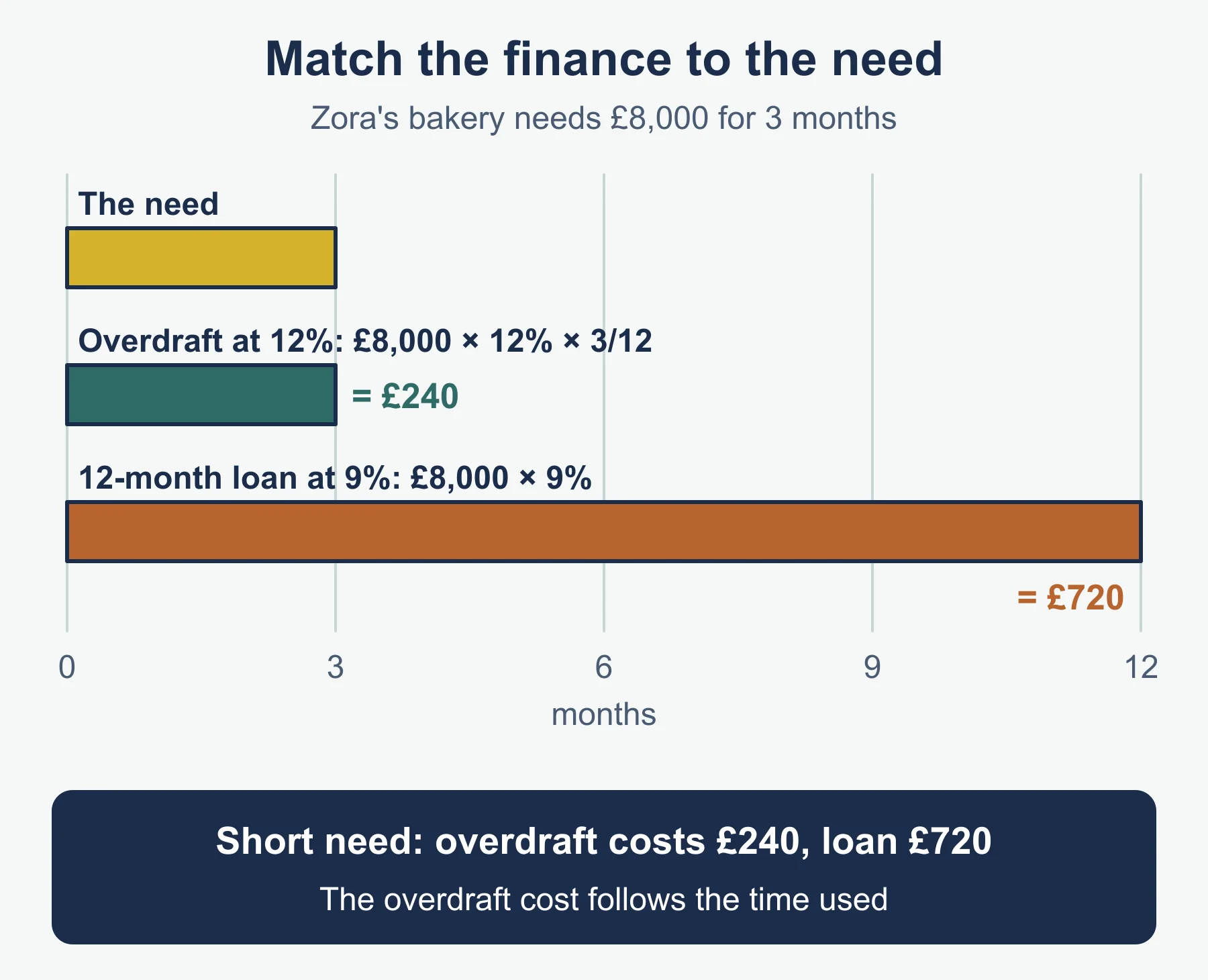
| Overdraft | Bank lets the account go below zero up to an agreed limit | Flexible: borrow only what is needed | Interest can be high and the limit may be cut |
| Trade credit | Supplier delivers now, business pays later | No interest in the usual arrangement; stock sold before it is paid for | May not be offered to new businesses; discounts for early payment are lost |
Long-term sources
| Source | What it is | Advantage | Disadvantage |
|---|---|---|---|
| Personal savings | Owner’s own money | No interest and no outsiders | Limited sum; owner can lose it |
| Venture capital | Investor funds the business for a share and often a say | Large sums, no monthly repayments | Owner gives up ownership, control and a share of profit |
| Share capital | Company sells shares | No repayment; no interest | Ownership shared; dividends paid; companies only |
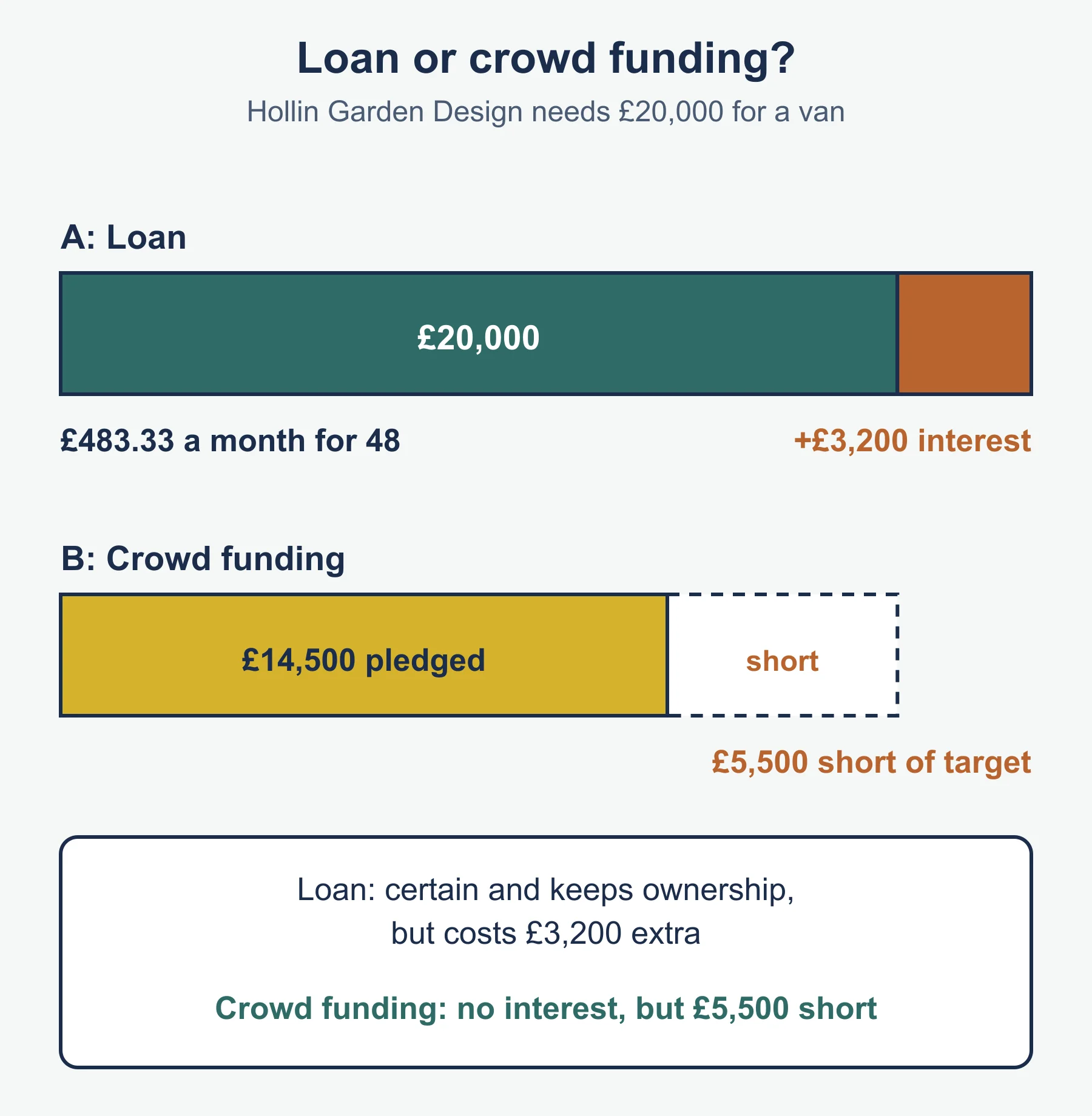
| Loans | Fixed sum repaid with interest | Certain amount; ownership kept | Repayments must be met in poor months; security may be asked for |
| Retained profit | Profit kept in the business | No interest; no outsiders | Only exists if profitable; less for owners |
| Crowd funding | Many small contributions, usually online | Tests demand; no bank needed | Needs enough backers; terms vary |
Loan interest formula
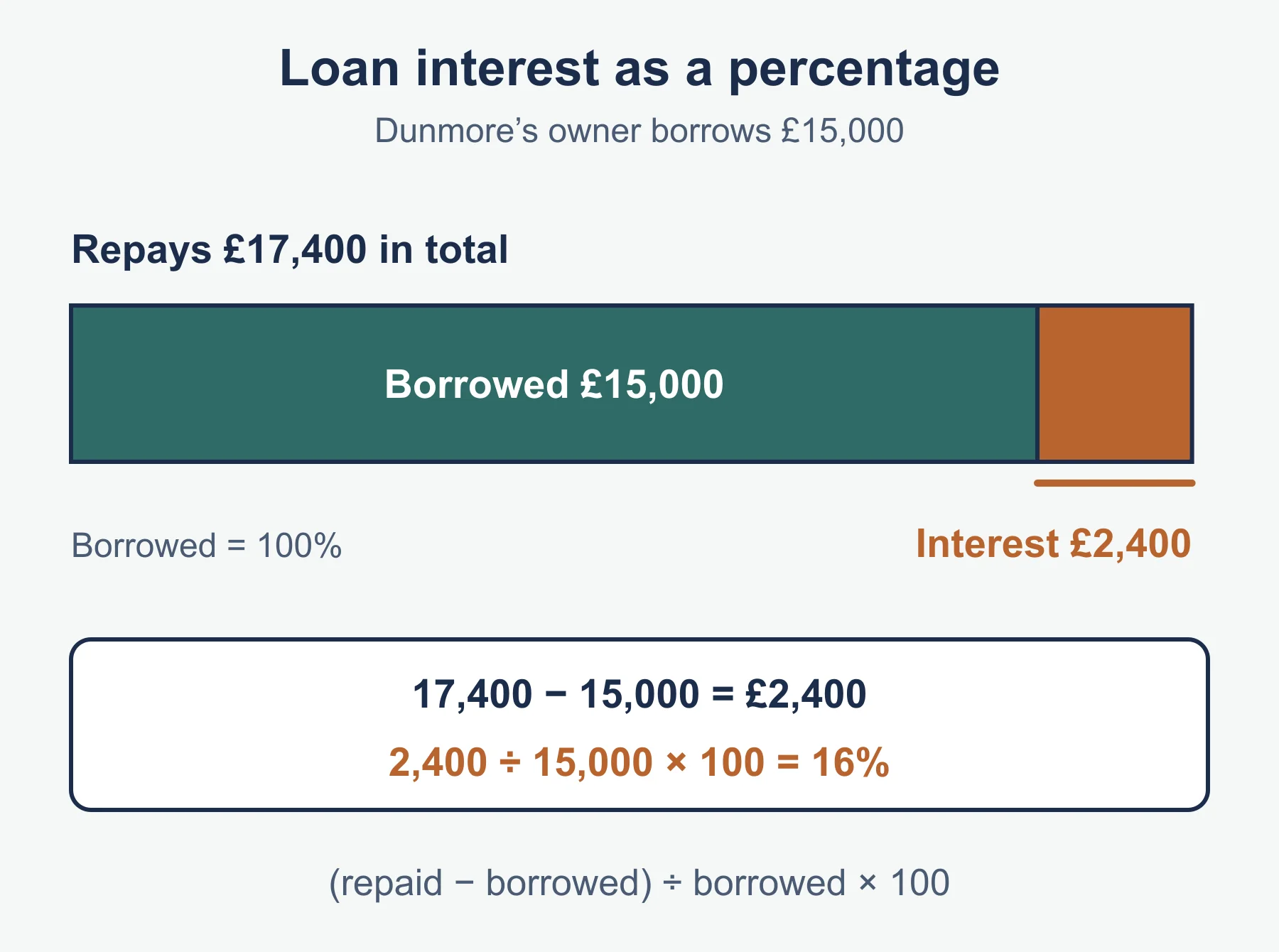
Interest (on loans) in % = (total repayment - borrowed amount) / borrowed amount × 100.
Worked reminder: borrow £7,500, repay £9,000 in total. Interest = 1,500. Percentage = 1,500 / 7,500 × 100 = 20%.
Start-up versus established
- A start-up has no trading history and no retained profit. It leans on savings, loans, share capital, venture capital or crowd funding. Trade credit may be hard to get.
- An established small business can add retained profit, and its record helps with lenders and suppliers.
4. Matching finance to need
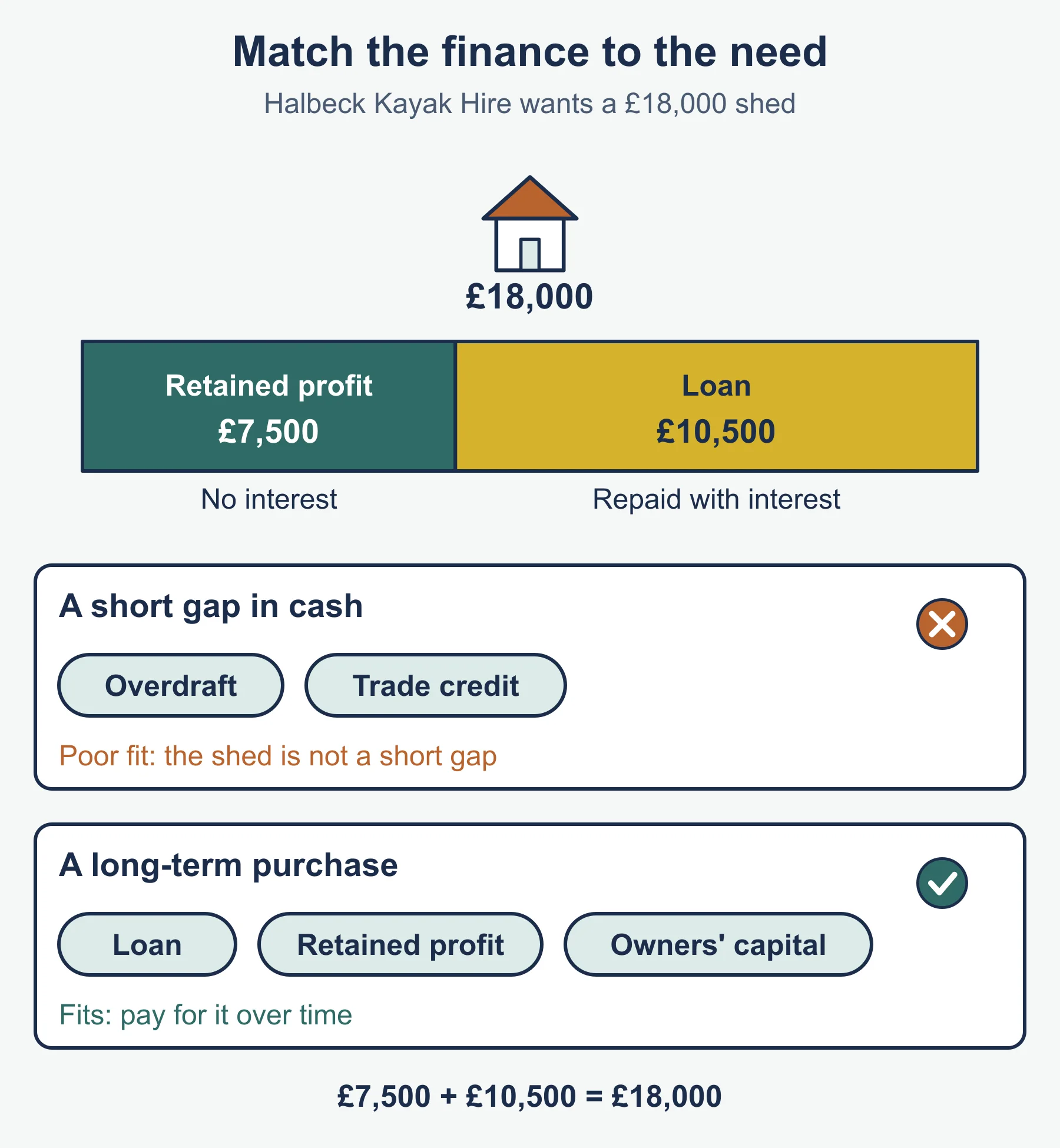
| Need | Better fit | Why |
|---|---|---|
| Short gap in cash | Overdraft, trade credit | Flexible, short term |
| Equipment lasting years | Loan, retained profit | Repaid over its useful life |
| Large growth, owner willing to share control | Venture capital, share capital | Big sums, no repayment |
| Small project with a ready audience | Crowd funding | Tests demand |
For “justify” or “evaluate”, always weigh cost, certainty, control, speed and the firm’s ability to repay, then reach a reasoned conclusion that uses the data given.
Must-know distinctions
- Cash is not profit. Cash is money moved. Profit is revenue minus costs.
- Inflow is not revenue. A loan is an inflow but not revenue.
- Overdraft is not a loan. An overdraft is flexible and short term. A loan is a set amount repaid on agreed dates.
- Share capital is not venture capital. Share capital is raised by a company selling shares. Venture capital is an investor funding a business for a stake.
- Retained profit is not cash in the bank. It is profit kept in the business, which may already have been spent on stock or equipment.
Quick self-test
- Name two things a business needs cash to pay.
- Define insolvency.
- A month has inflows of £8,200 and outflows of £9,050. Calculate net cash flow.
- The opening balance was £1,000 in question 3. State the closing balance.
- A month closes at £600 and the next has net cash flow of +£350. What is its closing balance?
- A business borrows £6,000 and repays £6,900. Calculate the interest as a percentage.
- A job brings sales revenue of £7,500 and costs £4,800. How much profit does it make, and why might cash still be short?
- Give two short-term sources of finance.
- Name two long-term sources a start-up could use but an established business could also use, and one only an established business has.
- State one disadvantage of venture capital for the owner.
Answers
- Any two of suppliers, overheads (such as rent) and employees.
- A business cannot pay its debts when they are due.
- 8,200 - 9,050 = -£850.
- 1,000 + (-850) = £150.
- 600 + 350 = £950 (the opening balance is the previous closing balance).
- (6,900 - 6,000) / 6,000 × 100 = 15%.
- Profit = 7,500 - 4,800 = £2,700. Cash can be short if the customer has not yet paid or if the costs were paid up front.
- Overdraft and trade credit.
- Any two of personal savings, loans, share capital, venture capital, crowd funding; retained profit is the one only an established business has.
- The owner gives up part of the ownership and some control, and shares future profit.
Where marks are usually lost
- Writing “profit” when the question asks about cash, or the reverse.
- Misreading a negative net cash flow as a loss.
- Forgetting to carry the closing balance forward as the next opening balance.
- Subtracting inflows from outflows in the wrong order.
- Using a long-term source for a short gap, or the reverse, without justification.
- Listing advantages of a source without linking them to the business in the case.
- Giving a recommendation with no counter-argument on “justify” or “evaluate” questions.
- Giving an interest percentage without dividing by the amount borrowed.
Frequently asked questions
What is insolvency in GCSE Business? Insolvency means a business cannot pay its debts when they fall due. Many profitable small businesses still fail because cash runs out before the money from customers arrives.
What is the difference between short-term and long-term sources of finance? Short-term sources, such as an overdraft and trade credit, cover temporary cash gaps and day-to-day running costs. Long-term sources, such as personal savings, venture capital, share capital, loans, retained profit and crowd funding, fund start-up costs, equipment, premises and growth.
Which sources of finance can a start-up use? A start-up has no trading history and no retained profit, so it usually relies on personal savings, a loan, share capital, venture capital or crowd funding. It may find trade credit harder to obtain than an established business does.
Is a loan counted as profit on a cash-flow forecast? No. A loan received is a cash inflow, but it is not sales revenue and it is not profit. Counting a loan as revenue is a common error in Edexcel GCSE Business (1BS0) answers.
Official syllabus
Pearson Edexcel Level 1/Level 2 GCSE (9-1) in Business (1BS0), Specification, Issue 2, July 2022, published by Pearson Education Limited. Theme 1: Investigating small business, Topic 1.3 Putting a business idea into practice, items 1.3.3 and 1.3.4.
Get free revision emails (optional)
Occasional emails with practice questions, worked explanations and links to free resources for the qualification and subjects you choose. No spam, and you can unsubscribe from any email. The free tools on this site never need an email.
Related resources
-
Study guides
Edexcel GCSE Business: Aims, objectives, revenue, costs and profit (1BS0)
Study guide to business aims and objectives, revenue, costs, profit, interest, break-even and margin of safety for Pearson Edexcel GCSE Business 1BS0.
Business · Pearson Edexcel · GCSE
Read guide -
Practice questions
Edexcel GCSE Business: Aims, objectives, revenue, costs and profit (1BS0) – Practice Questions
Original practice questions with worked answers on aims, objectives, costs, profit, interest and break-even for Edexcel GCSE Business 1BS0, topic 1.3.
Business · Pearson Edexcel · GCSE
Try questions -
Revision notes
Edexcel GCSE Business: Aims, objectives, revenue, costs and profit (1BS0) – Revision Notes
Condensed revision notes on aims, objectives, revenue, costs, profit, interest, break-even and margin of safety for Pearson Edexcel GCSE Business 1BS0.
Business · Pearson Edexcel · GCSE
Revise topic
Related articles
-
teaching
A Level tuition in Dubai: Cambridge or Pearson Edexcel International A Level?
Schools in Dubai and Abu Dhabi teach either Cambridge International AS & A Level or Pearson Edexcel International A Level. How the two are structured, why it matters for tuition, and how online classes from Lahore work.
9 October 2026
-
curriculum guides
Choosing subjects at IGCSE and A Level
How subject choices at 14 and 16 affect university options later, and how to keep pathways open without overloading a timetable.
28 July 2026
Studying this with a teacher
Working through Business GCSE?
This page is free and stays free. If you would rather be taught it, Marlbridge runs Business classes one-to-one and in small groups of up to 15, online in your own time zone. The first trial class is free. WhatsApp replies within an hour (8am–11pm Pakistan time, every day); email the same day.
Pearson Edexcel Business teachers at Marlbridge

