
Revision Notes
Edexcel GCSE Business: Aims, objectives, revenue, costs and profit (1BS0) – Revision Notes
Condensed revision notes on aims, objectives, revenue, costs, profit, interest, break-even and margin of safety for Pearson Edexcel GCSE Business 1BS0.
- Subject
- Business
- Level
- GCSE
- Topic
- Putting a business idea into practice
- Author
- Marlbridge Academic Team
- Updated
- Reviewed by
- Asif Iqbal (what this means)
Aligned to Pearson Edexcel GCSE Business (1BS0), Issue 2, July 2022. Official specification .
Syllabus page (what it covers and how it is assessed): Pearson Edexcel GCSE Business.
Syllabus points this page covers
1BS0
- 1.3 Putting a business idea into practice (whole topic)
- 1.3.1 Business aims and objectives
- 1.3.2 Business revenues, costs and profits
Found an error? Report a correction.
Want a teacher for this? Marlbridge teaches Business online. Request a free trial class.
These notes condense content items 1.3.1 (Business aims and objectives) and 1.3.2 (Business revenues, costs and profits) of Topic 1.3, Putting a business idea into practice, in the Pearson Edexcel Level 1/Level 2 GCSE (9-1) in Business (1BS0) specification, Issue 2, July 2022. This topic sits in Theme 1, Investigating small business. Read the study guide first. Then test yourself with the practice questions.
Course links: Edexcel GCSE Business hub, the printable checklist and the free 10-minute diagnostics. Appendix 3 holds the formulae and the examinations do not hand them out, so memorise them. Calculators are allowed, and the Calculate command word expects workings.
1.3.1 Aims and objectives at a glance
| Term | Meaning (standard definitions) |
|---|---|
| Business aim | A long-term, general goal for the business |
| Business objective | A specific, usually measurable target that moves the business towards its aim |
Financial and non-financial
| Type | Listed in the specification | One-line reminder |
|---|---|---|
| Financial | Survival | Stay open and cover costs |
| Financial | Profit | Revenue above total costs |
| Financial | Sales | Sell more units or earn more sales revenue |
| Financial | Market share | A bigger proportion of the whole market |
| Financial | Financial security | A dependable income and a cash cushion |
| Non-financial | Social objectives | Help people or the community |
| Non-financial | Personal satisfaction | Enjoy the work |
| Non-financial | Challenge | Test yourself with something hard |
| Non-financial | Independence and control | Be your own boss and decide |
Why aims and objectives differ between businesses
Learn five reasons and apply one to the case in front of you.
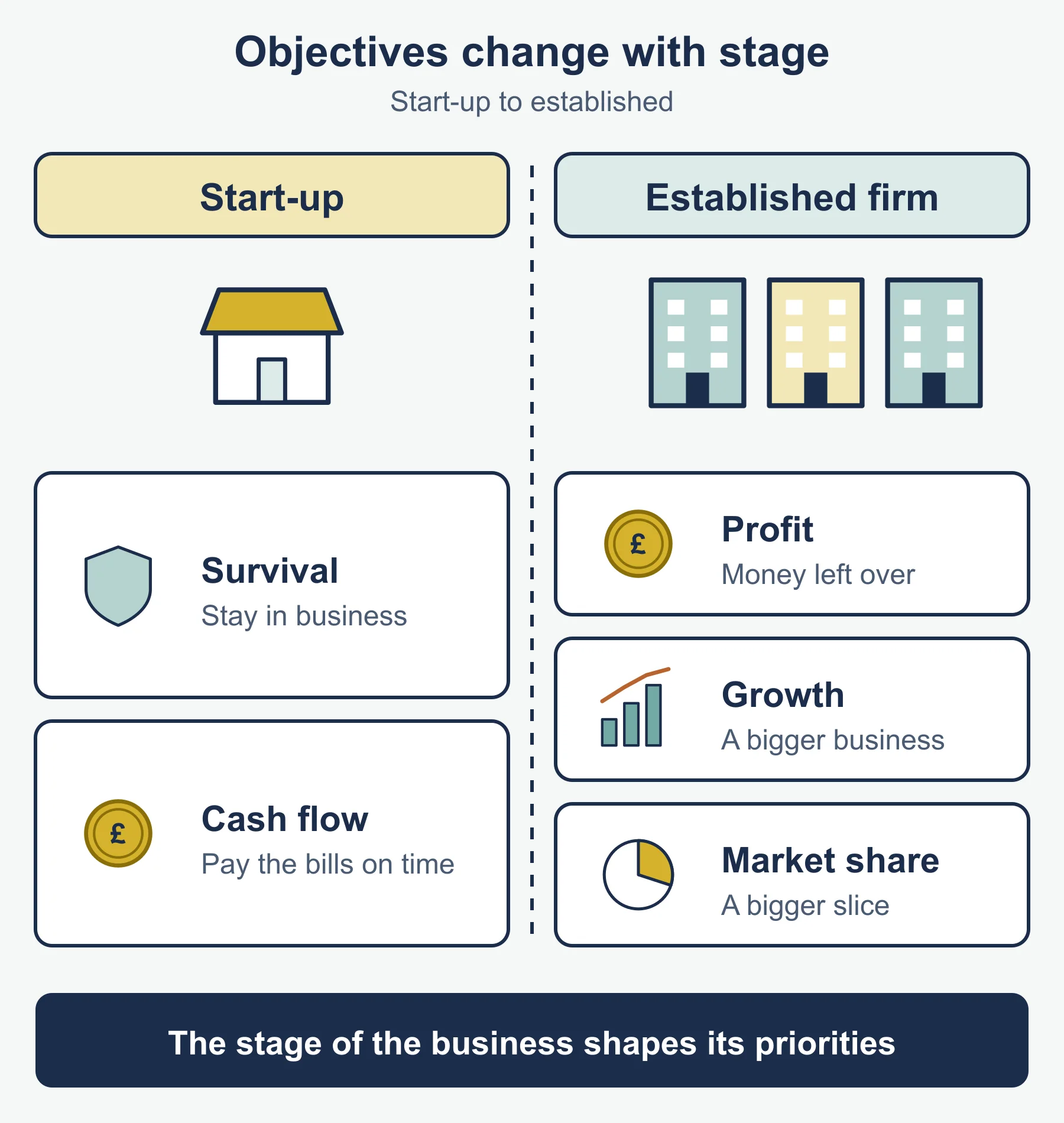
- Stage: new businesses often start with survival.
- Owner’s motives: independence or personal satisfaction can outweigh profit.
- Size and ownership: investors tend to press for profit.
- Type of business: community projects may add social objectives.
- Market conditions: tough competition can move the focus to survival.
Must-know distinctions
- Sales vs profit. Sales can rise while profit falls, for example after a price cut.
- Market share vs sales. Market share compares the business with the whole market. Sales only count the business.
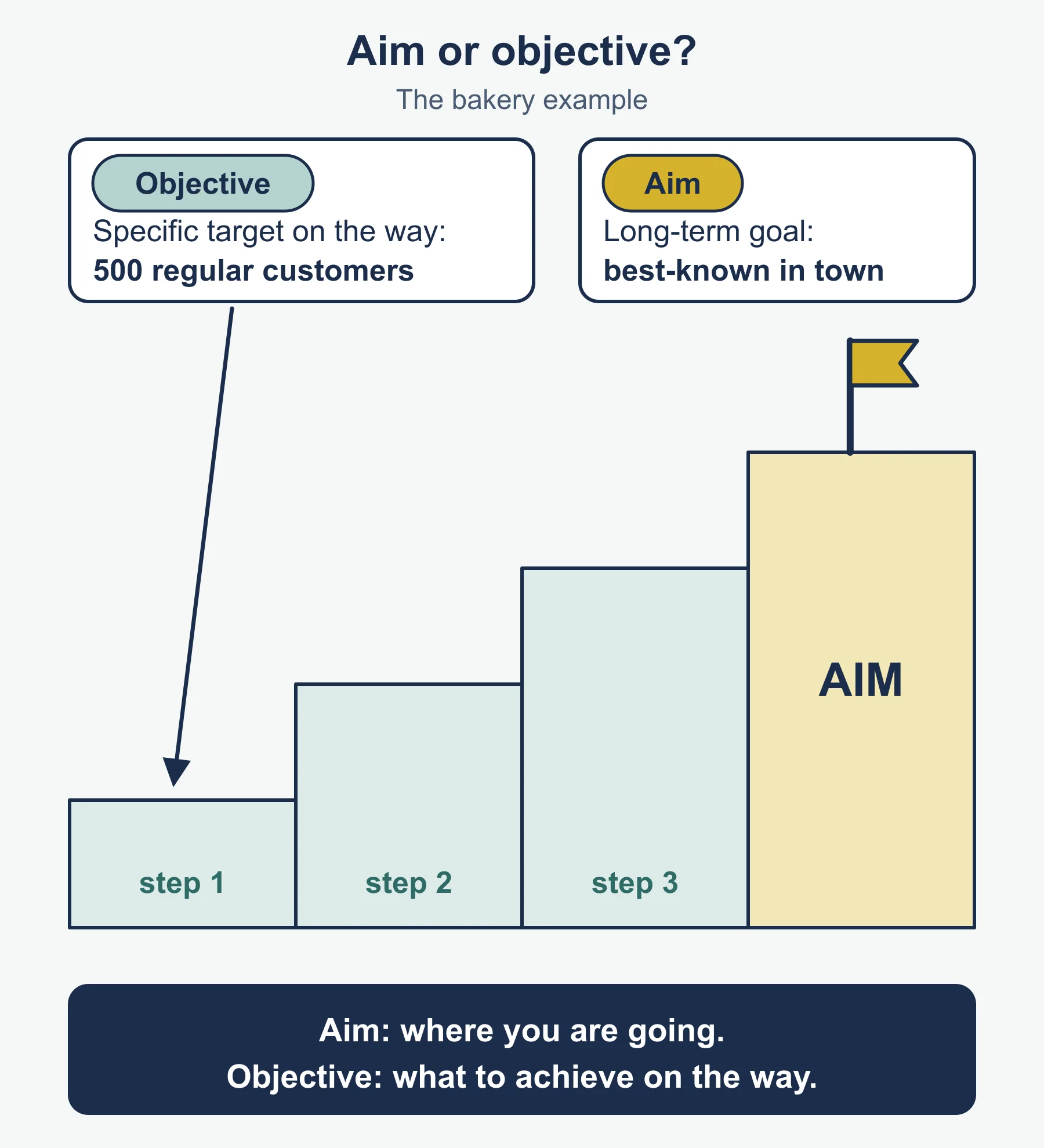
- Aim vs objective. An aim gives direction. An objective is the measurable step.
- Survival vs financial security. Survival is staying open. Financial security is a stable income and a cushion.
1.3.2 Formulae (Appendix 3 forms)
| Item | Formula |
|---|---|
| Revenue | price × quantity |
| Total cost | TC = TFC + TVC |
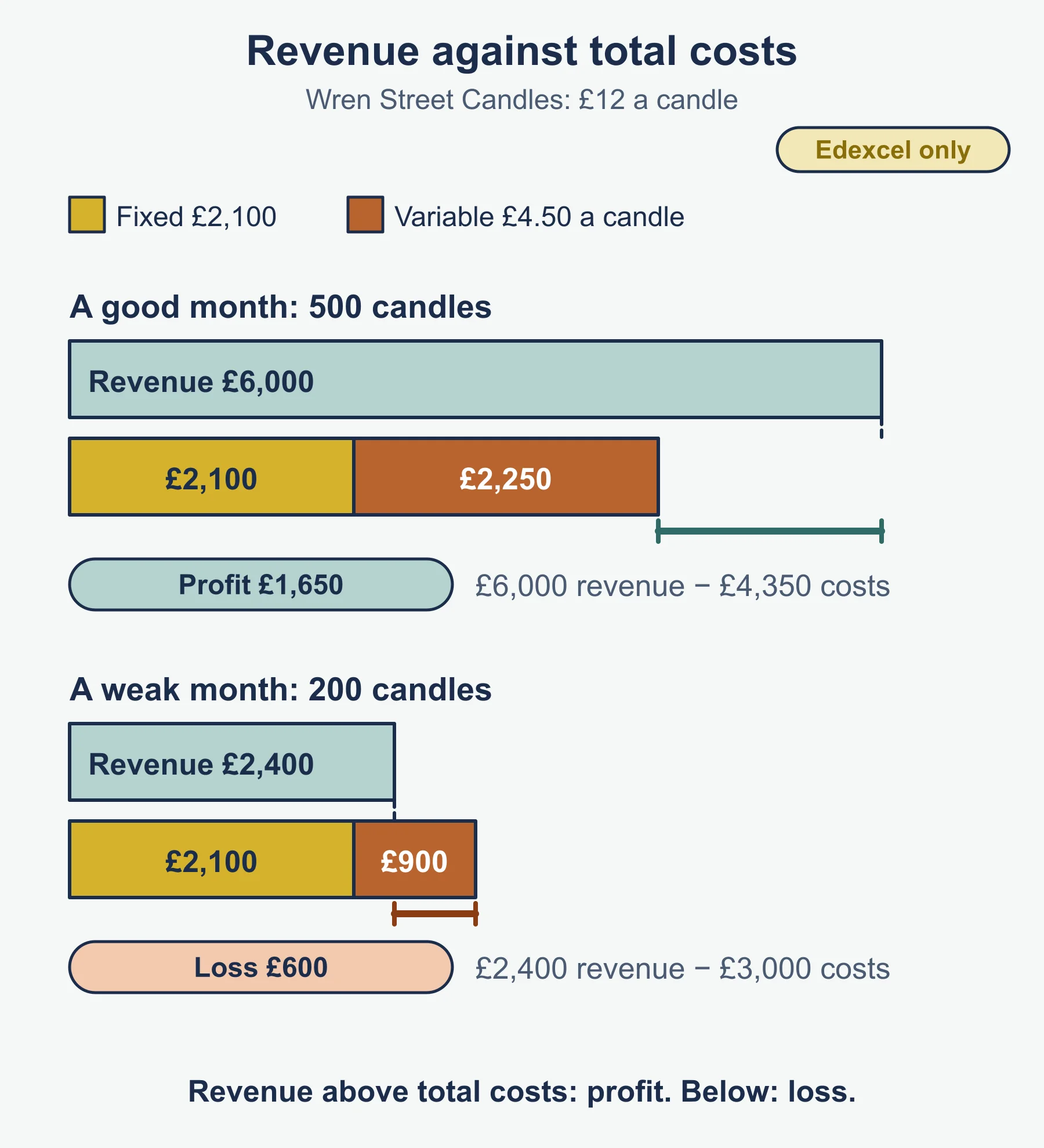
| Profit or loss | revenue − total costs (standard form); a negative answer is a loss |
| Interest on loans (%) | (total repayment − borrowed amount) ÷ borrowed amount × 100 |
| Break even point in units | fixed cost ÷ (sales price − variable cost) |
| Break even point in costs or revenue | break even point in units × sales price |
| Margin of safety | actual or budgeted sales − break even sales |
Fixed or variable?
- Fixed: does not change with output in the period. Examples: rent, insurance, a loan interest bill, a software subscription.
- Variable: changes as output changes. Examples: raw materials, packaging, parts.
Method in steps
Break even and margin of safety
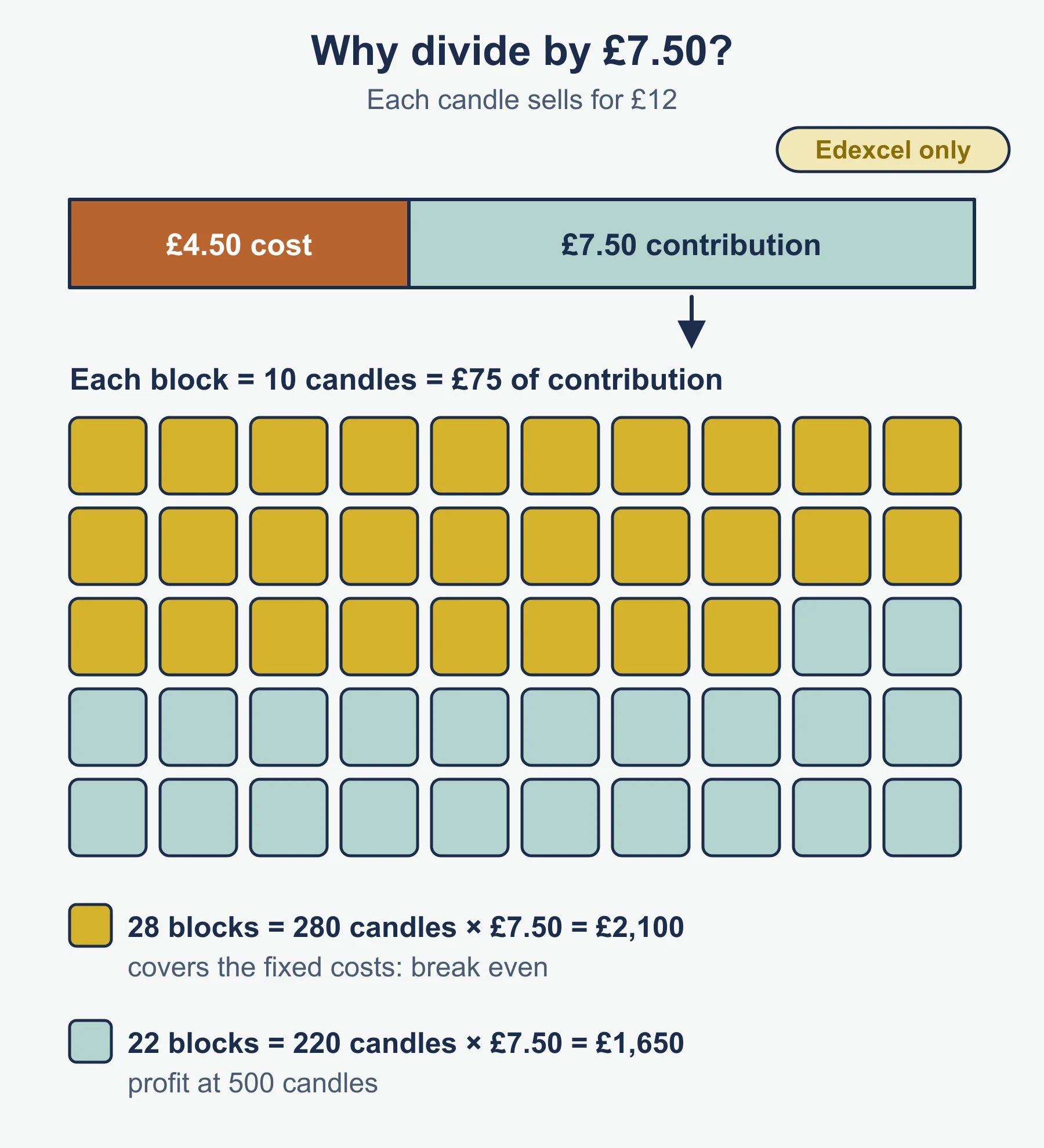
- Work out the contribution per unit: price − variable cost per unit.
- Divide fixed costs by the contribution. That is the break even output in units.
- Multiply by price if the question asks for break even revenue.
- Subtract break even output from actual or budgeted sales for the margin of safety.
- Write the units, and round up if the answer is not a whole number.
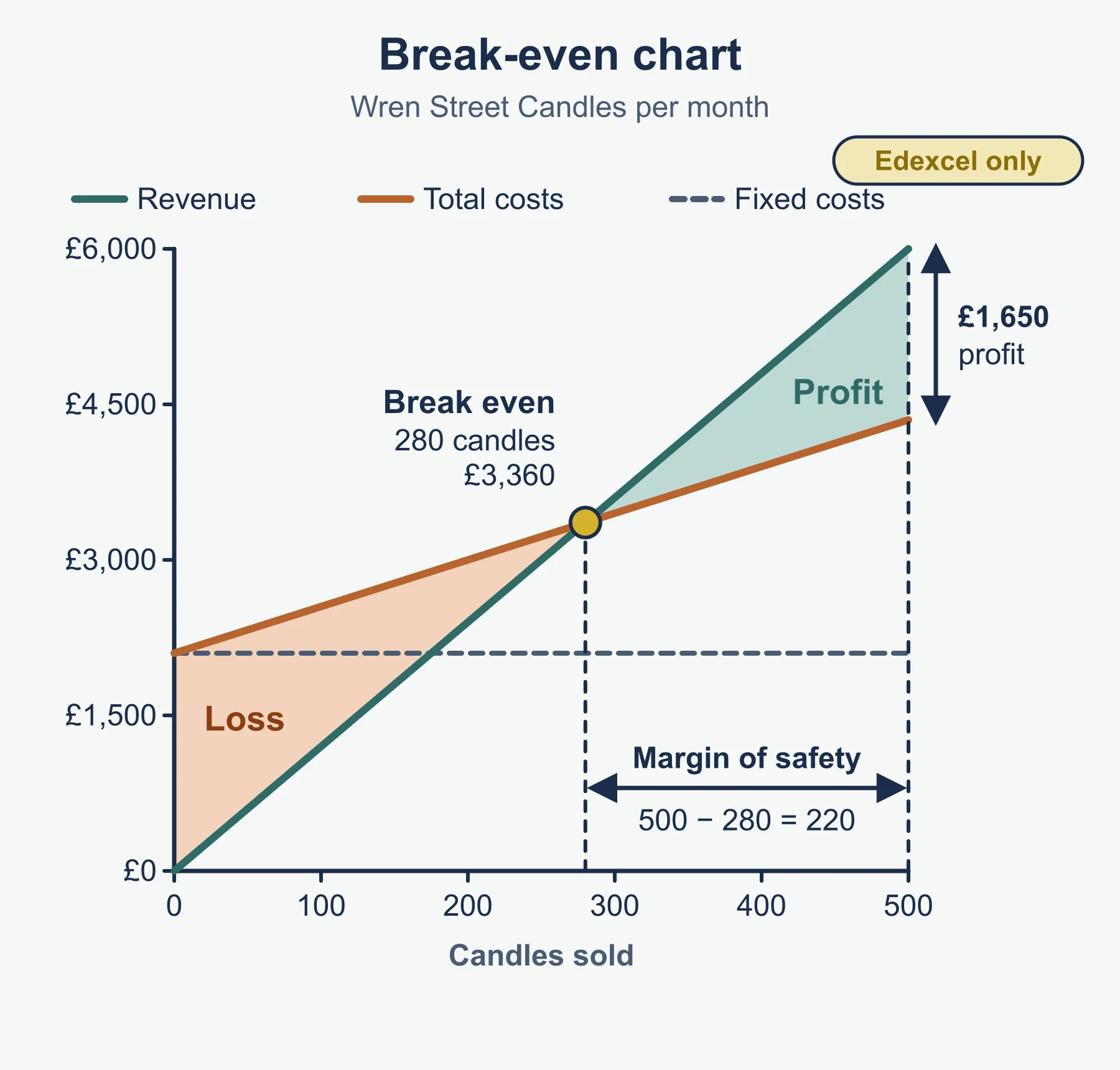
Reading a break even diagram
- Find where total revenue crosses total costs. Read down to the output axis.
- At any output, the vertical gap between the two lines is the profit (revenue above) or loss (revenue below).
- Margin of safety runs along the output axis, from break even output across to planned output.
- A new price moves the revenue line. New fixed costs lift the start of the total costs line. New variable costs change its slope.
Worked reminder: Kestrel Phone Repairs
Kestrel charges £40 a repair. Variable cost is £15 a repair. Fixed costs are £5,000 a month. It plans to carry out 260 repairs.
| Step | Working | Result |
|---|---|---|
| Revenue | £40 × 260 | £10,400 |
| TVC | £15 × 260 | £3,900 |
| TC | £5,000 + £3,900 | £8,900 |
| Profit | £10,400 − £8,900 | £1,500 |
| Break even | £5,000 ÷ (£40 − £15) | 200 repairs |
| Break even revenue | 200 × £40 | £8,000 |
| Margin of safety | 260 − 200 | 60 repairs |
Effects of changes
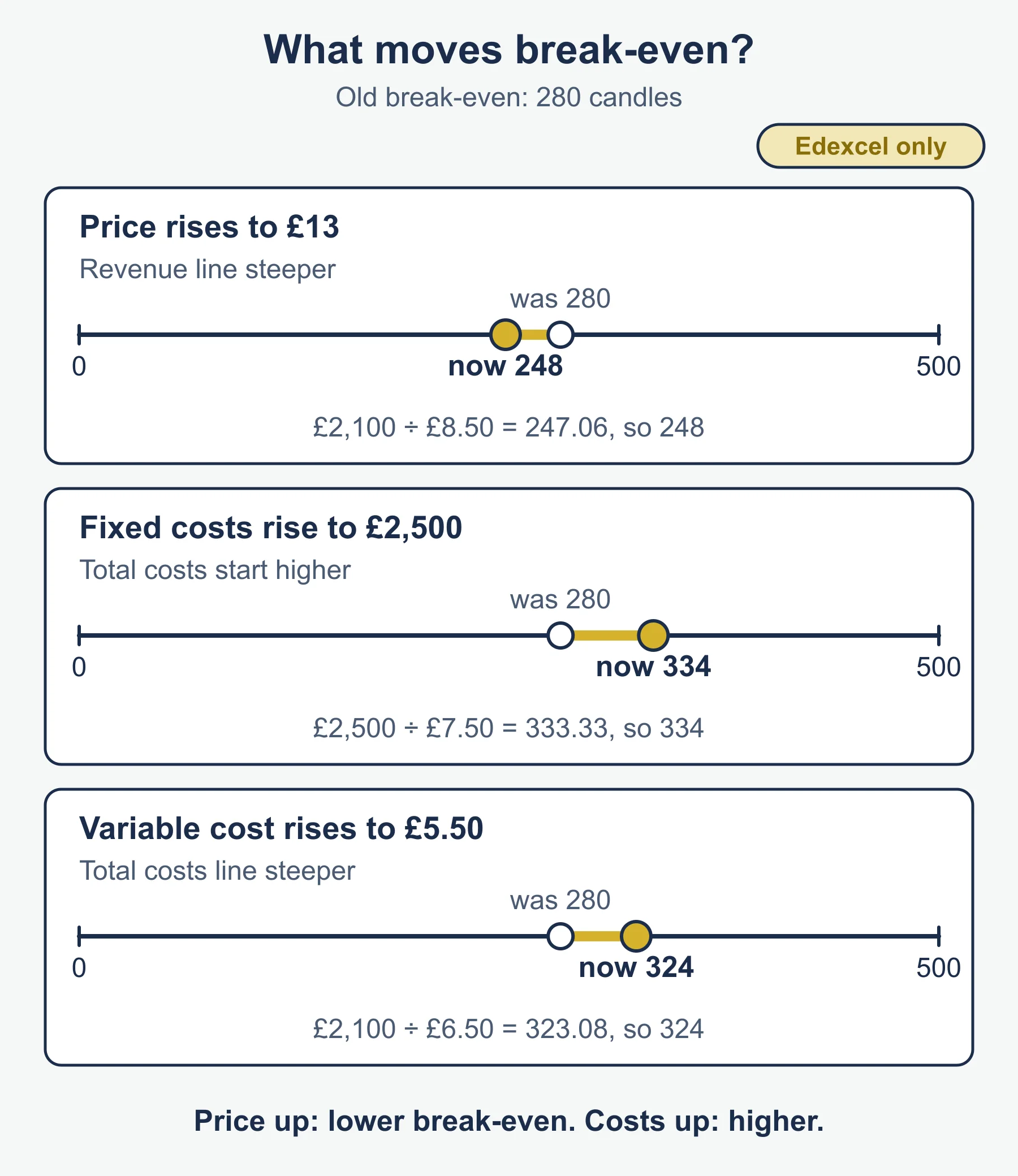
| Change | What moves | Break even output |
|---|---|---|
| Price rises to £45 | Revenue line steeper | £5,000 ÷ £30 = 166.67, so 167 |
| Fixed costs rise to £6,000 | Total costs line starts higher | £6,000 ÷ £25 = 240 |
| Variable cost falls to £12 | Total costs line flatter | £5,000 ÷ £28 = 178.57, so 179 |
Costs rising means break even output rises and the margin of safety falls. Prices rising does the opposite, as long as customers keep buying.
Using the command words
Appendix 1 of the specification defines the command words. These are the ones this topic tends to use:
- Define: give the meaning of a term from the content, such as variable costs.
- State and Identify: a short answer taken from the information or a graph or table.
- Calculate: use the given data. Workings should be shown.
- Complete the table: work out the missing values in a table of data.
- Outline: two connected points set in the business context given.
- Explain: one statement of fact plus two further points that expand on it.
- Analyse: an extended answer placed in context.
- Justify: draw on the data supplied to back one of two options for the owner.
- Evaluate: a longer answer using subject knowledge to arrive at a conclusion that is backed up.
Sentence starters for diagram and change questions
These are the writer’s suggestions, not specification wording.
- “Break even output is where the revenue line meets the total costs line, which is at … units.”
- “At … units the business makes a loss, because total costs are above revenue.”
- “The margin of safety is … units, so sales could fall by this much before a loss.”
- “A rise in fixed costs lifts the total costs line, so break even output rises and the cushion shrinks.”
- “This only helps if customers keep buying at the new price.”
Quick self-test
Use the Kestrel data (price £40, variable cost £15, fixed costs £5,000) unless a question says otherwise.
- State the difference between a business aim and a business objective.
- Give one financial and one non-financial objective from the specification.
- Calculate the revenue from 260 repairs.
- Calculate total costs for 260 repairs.
- Calculate the profit for 260 repairs.
- Calculate the break even level of output.
- Calculate break even revenue.
- Calculate the margin of safety when 260 repairs are planned.
- Calculate the profit or loss if only 150 repairs are carried out.
- Calculate the new break even output if fixed costs rise to £6,000.
- A different owner borrows £4,000 and repays £4,360. Calculate the interest as a percentage.
- Explain one reason why a new business might set survival as its first objective.
Answers
- An aim is a long-term, general goal. An objective is a specific, measurable target that helps reach it.
- Any financial one from survival, profit, sales, market share, financial security. Any non-financial one from social objectives, personal satisfaction, challenge, independence and control.
- £40 × 260 = £10,400.
- £5,000 + (£15 × 260) = £5,000 + £3,900 = £8,900.
- £10,400 − £8,900 = £1,500.
- £5,000 ÷ (£40 − £15) = £5,000 ÷ £25 = 200 repairs.
- 200 × £40 = £8,000.
- 260 − 200 = 60 repairs.
- Revenue £6,000 (150 × £40). Total costs £5,000 + £2,250 = £7,250. Loss of £1,250.
- £6,000 ÷ £25 = 240 repairs.
- Interest = £4,360 − £4,000 = £360. £360 ÷ £4,000 × 100 = 9%.
- A new firm has little cash and few regular customers, so one bad month could force it to close. Setting survival first means it prioritises covering its costs before chasing profit or growth.
Where marks are usually lost
- Mixing up aim and objective, or giving an objective with no target in it.
- Naming an objective from the list without connecting it to the firm in the stem.
- Treating more sales as automatically more profit.
- Saying aims are the same for every business, when the question asks why they differ.
- Using the selling price, and not the contribution per unit, as the divisor in the break even formula.
- Swapping unit variable cost and total variable cost.
- Drawing the total costs line from the origin.
- Reading the margin of safety from the wrong axis, or giving a revenue figure when units were asked for.
- Leaving out units or the £ sign after a calculation.
- Saying how a change shifts the lines without stating the consequence for the owner.
Frequently asked questions
What are the financial objectives in Edexcel GCSE Business (1BS0)? The specification lists survival, profit, sales, market share and financial security as financial aims and objectives when starting up.
What are the non-financial objectives in Edexcel GCSE Business? Social objectives, personal satisfaction, challenge, and independence and control.
How do you calculate interest on a loan as a percentage? Subtract the amount borrowed from the total repayment, divide by the amount borrowed and multiply by 100. Dividing by the total repayment is a common error.
Does the total costs line start at zero on a break even diagram? No. The total costs line starts at the level of fixed costs and rises from there, while the total revenue line starts at the origin.
Official syllabus
Pearson Edexcel Level 1/Level 2 GCSE (9-1) in Business (1BS0), Specification, Issue 2, July 2022, published by Pearson Education Limited. The subject content covered is in Theme 1 (Investigating small business), under Topic 1.3 (Putting a business idea into practice): items 1.3.1 and 1.3.2.
Get free revision emails (optional)
Occasional emails with practice questions, worked explanations and links to free resources for the qualification and subjects you choose. No spam, and you can unsubscribe from any email. The free tools on this site never need an email.
Related resources
-
Study guides
Edexcel GCSE Business: Cash flow and sources of finance for a small business (1BS0)
Study guide to why cash matters, cash-flow forecasts and short- and long-term sources of finance, for Edexcel GCSE Business Theme 1.
Business · Pearson Edexcel · GCSE
Read guide -
Practice questions
Edexcel GCSE Business: Cash flow and sources of finance for a small business (1BS0) – Practice Questions
Original practice questions with worked answers on cash, cash-flow forecasts and sources of finance for Edexcel GCSE Business Theme 1.
Business · Pearson Edexcel · GCSE
Try questions -
Revision notes
Edexcel GCSE Business: Cash flow and sources of finance for a small business (1BS0) – Revision Notes
Condensed revision notes on cash, cash-flow forecasts and short- and long-term sources of finance for Edexcel GCSE Business Theme 1.
Business · Pearson Edexcel · GCSE
Revise topic
Related articles
-
teaching
A Level tuition in Dubai: Cambridge or Pearson Edexcel International A Level?
Schools in Dubai and Abu Dhabi teach either Cambridge International AS & A Level or Pearson Edexcel International A Level. How the two are structured, why it matters for tuition, and how online classes from Lahore work.
9 October 2026
-
curriculum guides
Choosing subjects at IGCSE and A Level
How subject choices at 14 and 16 affect university options later, and how to keep pathways open without overloading a timetable.
28 July 2026
Studying this with a teacher
Working through Business GCSE?
This page is free and stays free. If you would rather be taught it, Marlbridge runs Business classes one-to-one and in small groups of up to 15, online in your own time zone. The first trial class is free. WhatsApp replies within an hour (8am–11pm Pakistan time, every day); email the same day.
Pearson Edexcel Business teachers at Marlbridge

