
Revision Notes
Edexcel GCSE Business: Enterprise and entrepreneurship (1BS0) – Revision Notes
Condensed revision notes with definitions, tables and a self-test on enterprise and entrepreneurship for Edexcel GCSE Business Theme 1, Topic 1.1.
- Subject
- Business
- Level
- GCSE
- Topic
- Enterprise and entrepreneurship
- Author
- Marlbridge Academic Team
- Updated
- Reviewed by
- Asif Iqbal (what this means)
Aligned to Pearson Edexcel GCSE Business (1BS0), Issue 2, July 2022. Official specification .
Syllabus page (what it covers and how it is assessed): Pearson Edexcel GCSE Business.
Syllabus points this page covers
1BS0
- 1.1 Enterprise and entrepreneurship (whole topic)
- 1.1.1 The dynamic nature of business
- 1.1.2 Risk and reward
- 1.1.3 The role of business enterprise
Found an error? Report a correction.
Want a teacher for this? Marlbridge teaches Business online. Request a free trial class.
These notes condense Theme 1, Topic 1.1 Enterprise and entrepreneurship from the Pearson Edexcel Level 1/Level 2 GCSE (9-1) in Business (1BS0) specification, Issue 2, July 2022. They cover items 1.1.1 (the dynamic nature of business), 1.1.2 (risk and reward) and 1.1.3 (the role of business enterprise). For full explanations and worked examples, read the study guide.
Course links: the Business hub, the printable checklist, the practice questions and the free diagnostics.
Key terms
| Term | Short definition |
|---|---|
| Dynamic | Always changing, so ideas and markets keep shifting |
| Obsolete | Out of date because something better has replaced it |
| Original idea | A new product, service or approach not offered before |
| Adapting | Changing an existing product, service or idea |
| Risk | The chance of a bad outcome from a business decision |
| Reward | The gain from taking the risk |
| Profit | Revenue minus total costs |
| Independence | Being your own boss and choosing how to work |
| Goods | Physical items sold to customers |
| Services | Actions done for customers |
| Add value | Make the output worth more to the customer than the inputs bought |
| Unique selling point (USP) | A feature that rivals do not offer |
| Entrepreneur | Someone who sets up a business, organising resources, making decisions and taking risks |
1.1.1 The dynamic nature of business
Why ideas come about
| Reason | Think | Typical link to an idea |
|---|---|---|
| Changes in technology | New or cheaper methods | Sell through an app; use a machine that cuts costs |
| Changes in what consumers want | New tastes, incomes, habits | Plant-based food; ethical packaging |
| Products and services becoming obsolete | Old item replaced | Offer the modern replacement |
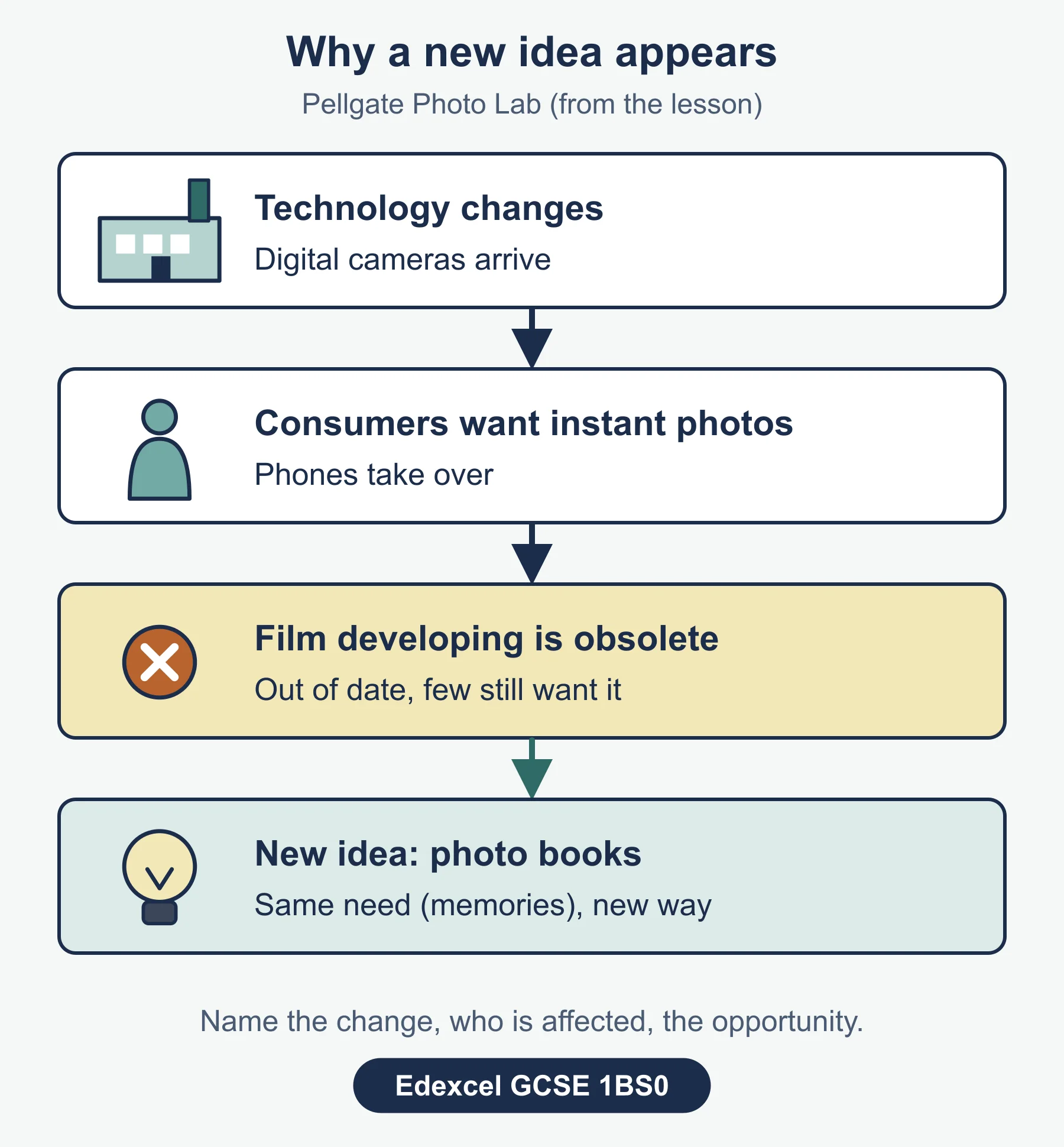
How ideas come about
- Original ideas: new to the market. No direct rivals at first, but demand is untested.
- Adapting existing products, services or ideas: change what is already sold. Demand is proven, but rivals exist.
Method in steps: a “why this idea” answer
- Name the change (technology, consumer wants or obsolescence).
- Say who is affected in the case.
- State the gap or opportunity that follows.
- Say whether the idea is original or adapted, and why that suits the business.
1.1.2 Risk and reward
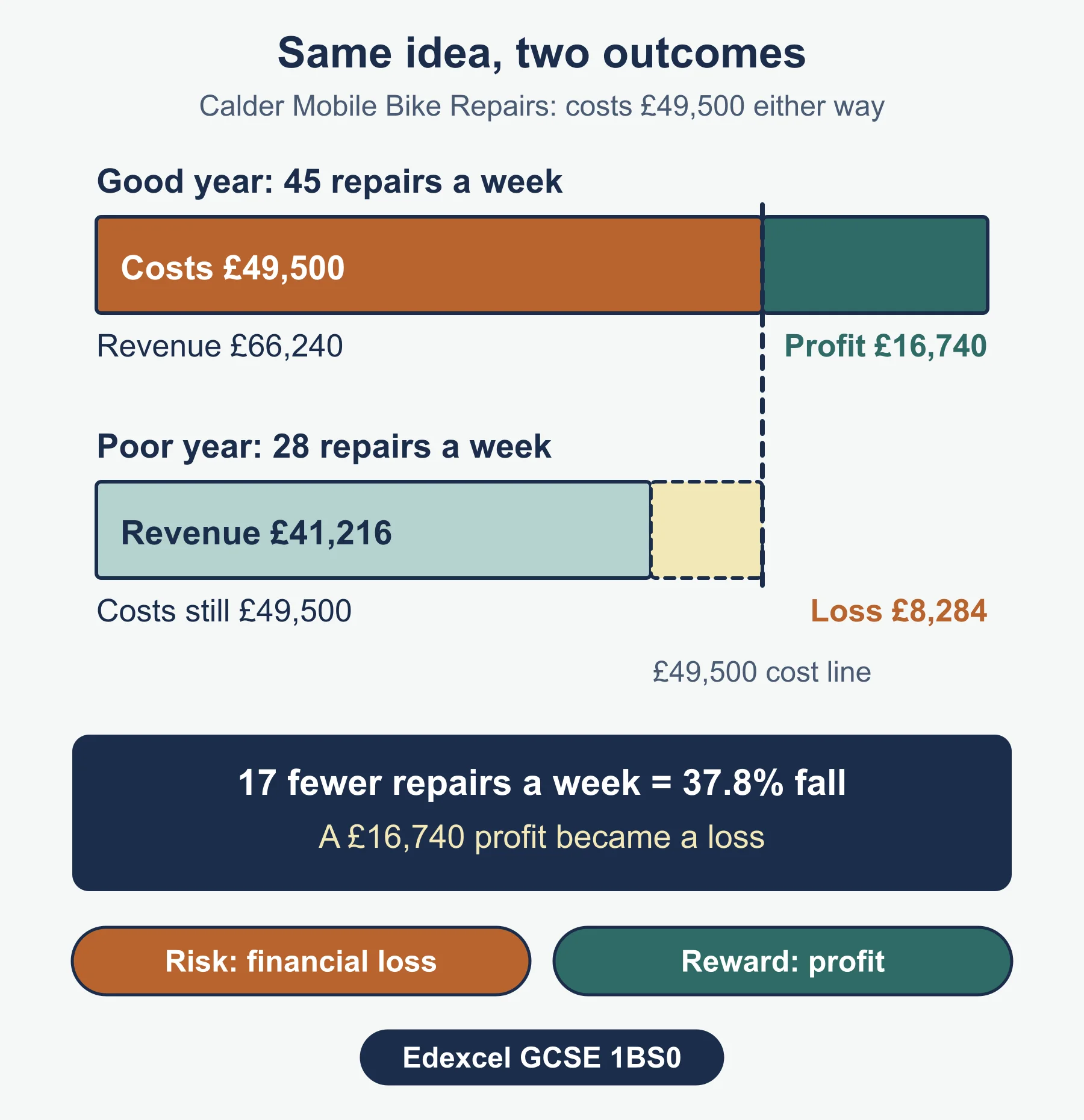
| Risks | Rewards |
|---|---|
| Business failure | Business success |
| Financial loss | Profit |
| Lack of security | Independence |
Formulae to know:
| Item | Standard form |
|---|---|
| Revenue | price × quantity (Appendix 3) |
| Profit | revenue − total costs (standard form) |
| Total cost | total fixed costs + total variable costs (Appendix 3) |
| Percentage change | change ÷ original × 100 |
The specification says formulae are not provided in the examinations, so memorise these.
Small worked reminder
A shop sells 140 items at £9 each. Total costs are £1,000.
- Revenue = 9 × 140 = £1,260
- Profit = 1,260 − 1,000 = £260
If sales fall to 100 items and costs stay at £1,000, revenue is £900 and there is a loss of £100.
Must-know distinction
Failure is the business closing. Financial loss is costs exceeding revenue, or money being lost. A business can make a loss for a while without failing, and a loss over time may cause failure.
1.1.3 The role of business enterprise
Purpose of business activity
- Produce goods or services.
- Meet customer needs.
- Add value.
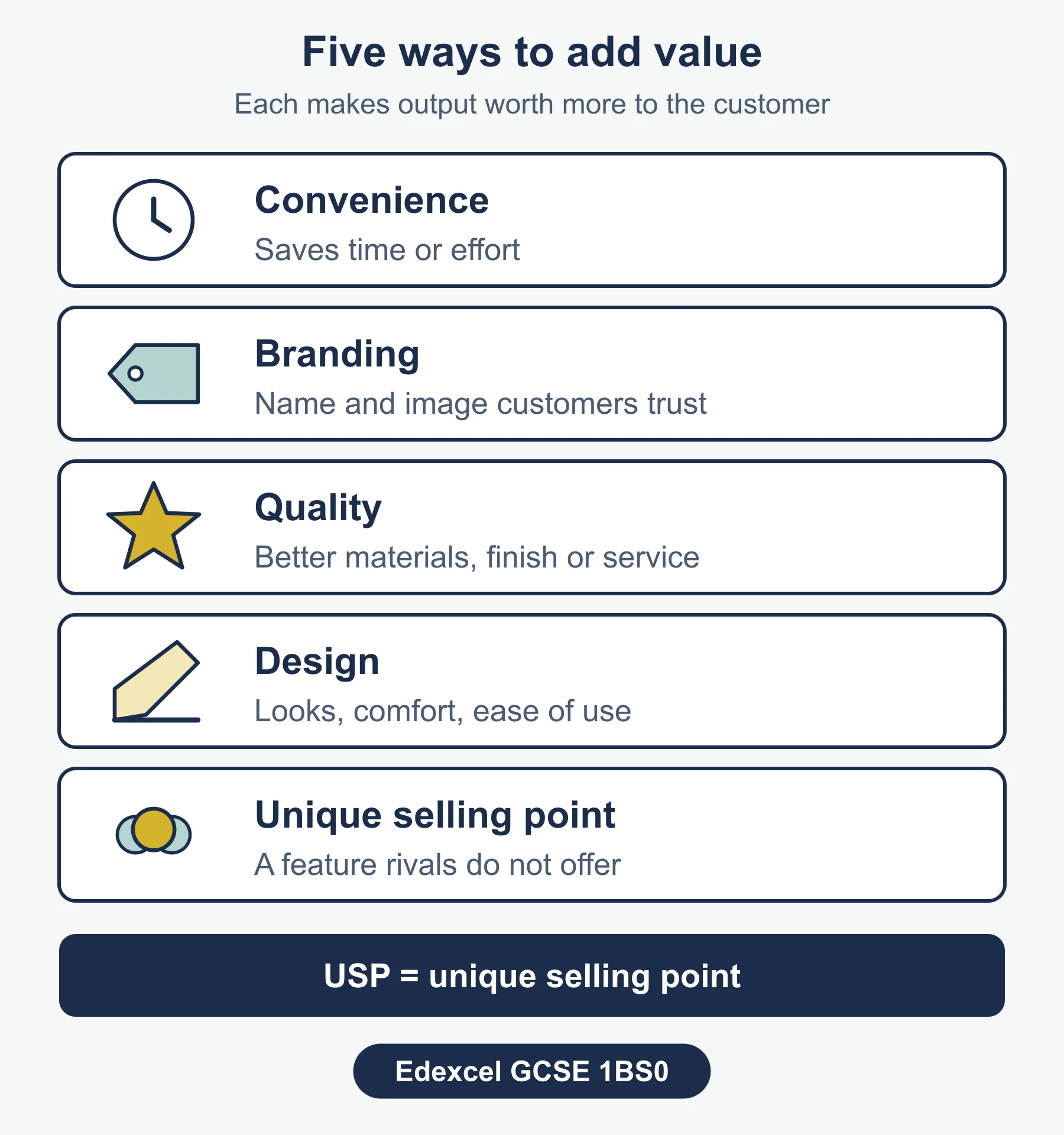
Five ways to add value
| Way | Quick test | Mini example |
|---|---|---|
| Convenience | Does it save time or effort? | A shop open until late |
| Branding | Do customers trust the name? | Higher price for a known label |
| Quality | Is it better made or delivered? | Fabric that lasts longer |
| Design | Does it look or work better? | A comfortable handle |
| USP | Do rivals lack this? | The only local firm offering weekend repairs |
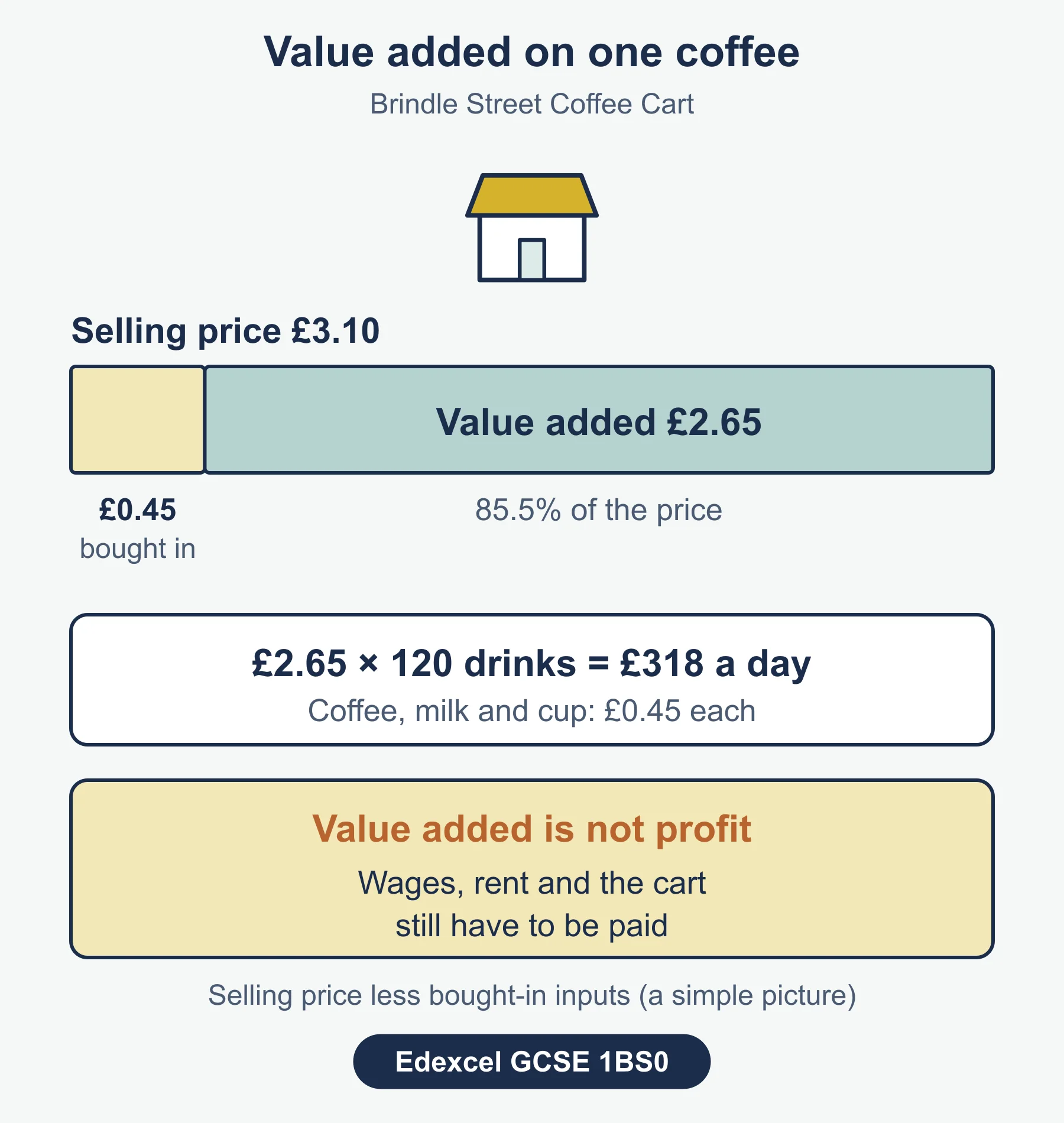
Simple picture of value added: selling price minus the cost of bought-in inputs. The specification does not list this as a formula, and the result is not all profit because wages and rent still have to be paid.
The role of an entrepreneur
| Role | Meaning | Clue in a case study |
|---|---|---|
| Organises resources | Brings premises, labour, equipment and money together | Rents a unit, hires staff, buys machinery |
| Makes business decisions | Chooses what, where, how and for whom | Picks a product range or a price |
| Takes risks | Puts time and money in without a guarantee | Uses savings, takes out a loan |
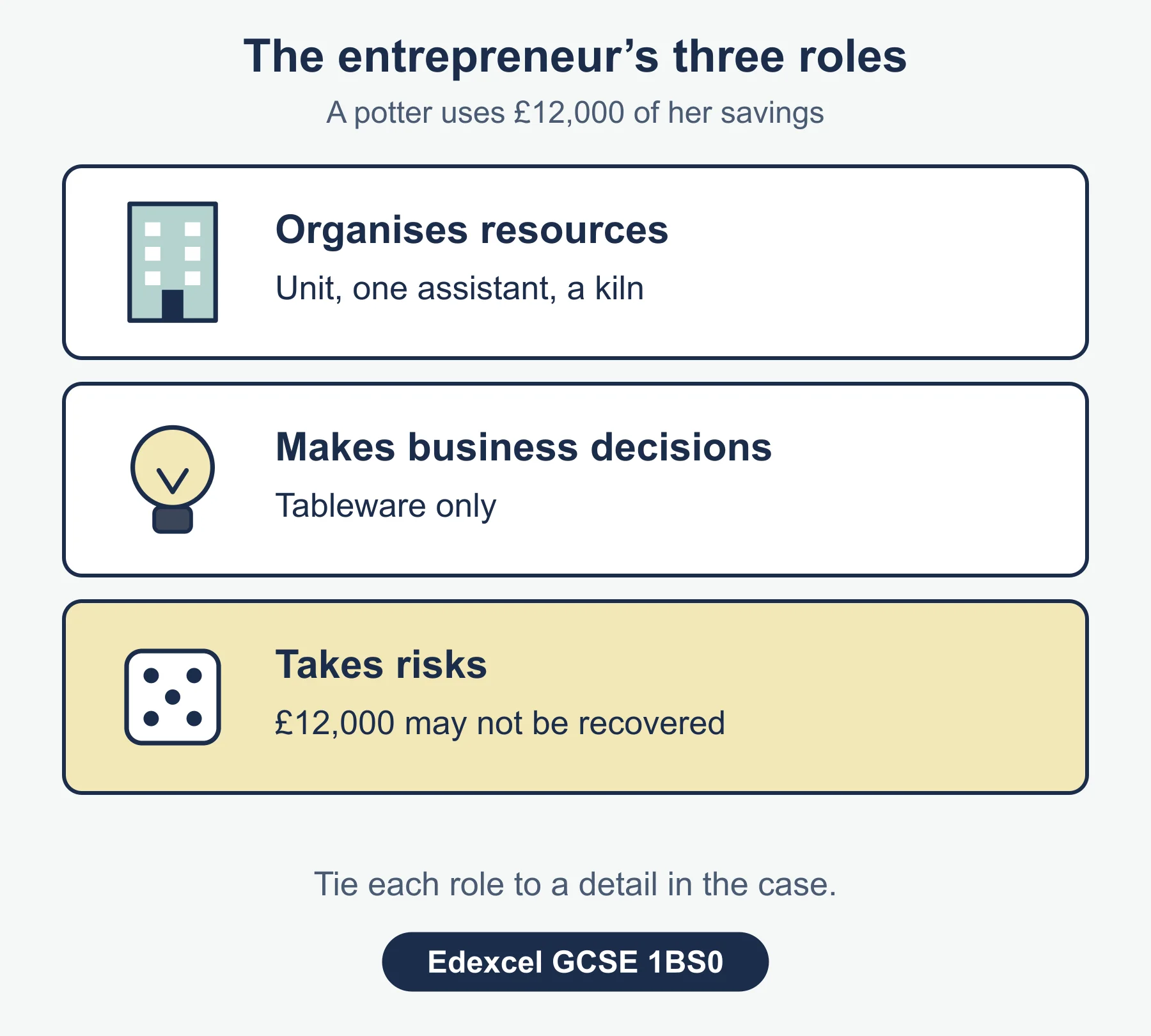
Quick case recognition
Practise labelling short situations. Each one points to a different part of the topic.
| Situation | Label |
|---|---|
| A tailor starts offering online fitting through video calls | Change in technology; adapting an existing service |
| Shoppers begin asking for refill stations instead of plastic bottles | Change in what consumers want |
| Few people still buy pagers, so a repairer retrains | Product becoming obsolete |
| A student invents a folding desk no one has sold before | Original idea |
| A gardener leaves a salaried job and has no sick pay | Lack of security |
| A baker keeps all the money left after paying costs | Profit |
| A joiner decides which jobs to take and when to work | Independence |
| A kiosk owner hires two staff and rents a pitch | Entrepreneur organising resources |
Building an evaluation on risk and reward
A strong “evaluate” or “justify” answer on this topic often follows five moves.
- Show the reward with a figure from the case, such as forecast profit.
- Show the risk with a figure, such as a loss in the weak scenario.
- Say how likely each outcome looks, using the evidence given.
- Say what the owner would give up or gain, for example a steady wage or independence.
- Reach a decision and give the main reason for it.
Do not stop at step 2. A list of pros and cons with no decision is incomplete.
Linking the three parts of the topic
The three items connect, and a good answer shows the links.
- A change (1.1.1) creates a gap in the market.
- An entrepreneur (1.1.3) organises resources and decides how to fill it, accepting risk (1.1.2).
- If customers value the result, the business meets their needs and adds value, and the reward follows.
When a question gives a case, ask three things in turn. What changed? What is the owner risking? How does the business make itself worth more to customers than a rival? Those three questions cover most of what this topic can ask.
Command words for this topic
| Command word | What the answer needs (from Appendix 1) |
|---|---|
| Define | A definition of a term from the content |
| Give | A recalled answer |
| Calculate | Maths on the data given, with workings shown |
| Outline | Two linked points placed in the context given |
| Explain | One fact plus two developing points; the question gives no context |
| Analyse | An extended answer placed in context by the question |
| Justify | Use the data supplied to back one of the two choices |
| Evaluate | Use your knowledge to reach a supported conclusion about the situation |
Quick self-test
- State the three reasons the specification gives for new business ideas.
- Give the two ways ideas come about.
- Define “obsolete”.
- A florist sells 250 bouquets a month at £12 each. Calculate monthly revenue.
- The florist’s total costs are £2,400 a month. Calculate monthly profit.
- Weekly orders fall from 30 to 24. Calculate the percentage fall.
- Name the three risks and the three rewards.
- Name the five ways of adding value.
- State the three purposes of business activity.
- State the three roles of an entrepreneur.
- A café stays open until midnight when rivals close at six. Which way of adding value is this?
- Why does “profit” alone make a weak answer to “explain one reward of starting a business”?
Answers
- Changes in technology; changes in what consumers want; products and services becoming obsolete.
- Original ideas; adapting existing products, services or ideas.
- Out of date, with few people wanting it because something better has replaced it.
- 12 × 250 = £3,000.
- 3,000 − 2,400 = £600.
- (30 − 24) ÷ 30 × 100 = 20% fall.
- Risks: business failure, financial loss, lack of security. Rewards: business success, profit, independence.
- Convenience, branding, quality, design, unique selling points.
- To produce goods or services; to meet customer needs; to add value.
- Organises resources; makes business decisions; takes risks.
- Convenience (and possibly a USP, if no rival offers late opening).
- “Explain” needs a statement plus two expansion points, so say what profit is, then why it matters to the owner, for example funds for growth or personal income.
Where marks are usually lost
- Giving one-word answers such as “technology” without saying what changed and what opportunity it created.
- Confusing obsolete (replaced and out of date) with faulty or unpopular.
- Writing “risk” without naming one of failure, financial loss or lack of security.
- Treating profit as the only reward and ignoring independence and success.
- Mixing up revenue and profit in a calculation, or forgetting to subtract total costs.
- Quoting a percentage change from the wrong base figure. Divide by the starting value.
- Claiming value added equals profit.
- Listing the entrepreneur’s roles without tying any of them to the case.
- Giving a one-sided answer to “evaluate” or “justify” and never stating a decision.
Frequently asked questions
What does obsolete mean in GCSE Business? A product or service is obsolete when it is out of date and few people still want it, usually because something better has replaced it. It does not mean broken; the need it met often remains, which creates room for a new idea.
What are the five ways a business can add value? The Edexcel GCSE Business (1BS0) specification lists convenience, branding, quality, design and a unique selling point (USP). Each makes the output worth more to the customer than the inputs the business bought.
Is value added the same as profit? No. Value added can be pictured as the selling price less the cost of bought-in inputs, but wages, rent and other costs still have to be paid out of it. Profit is revenue minus total costs.
What are the three roles of an entrepreneur? An entrepreneur organises resources, makes business decisions and takes risks. In a context question, tie each role to a detail from the case rather than just listing them.
Official syllabus
Pearson Edexcel Level 1/Level 2 GCSE (9-1) in Business (1BS0), Specification, Issue 2, July 2022, published by Pearson Education Limited. Theme 1: Investigating small business, Topic 1.1 Enterprise and entrepreneurship, items 1.1.1 to 1.1.3.
Get free revision emails (optional)
Occasional emails with practice questions, worked explanations and links to free resources for the qualification and subjects you choose. No spam, and you can unsubscribe from any email. The free tools on this site never need an email.
Related resources
-
Study guides
Edexcel GCSE Business: Enterprise and entrepreneurship (1BS0)
Study guide to why business ideas arise, risk and reward, adding value and the entrepreneur's role, for Edexcel GCSE Business Theme 1, Topic 1.1.
Business · Pearson Edexcel · GCSE
Read guide -
Practice questions
Edexcel GCSE Business: Enterprise and entrepreneurship (1BS0) – Practice Questions
Original practice questions with worked answers on business ideas, risk and reward, adding value and entrepreneurs for Edexcel GCSE Business Topic 1.1.
Business · Pearson Edexcel · GCSE
Try questions -
Study guides
Edexcel GCSE Business: Globalisation, ethics and the environment (1BS0)
Study guide to globalisation, ethical and environmental considerations and pressure groups for Pearson Edexcel GCSE Business, Theme 2 topic 2.1.
Business · Pearson Edexcel · GCSE
Read guide
Related articles
-
teaching
A Level tuition in Dubai: Cambridge or Pearson Edexcel International A Level?
Schools in Dubai and Abu Dhabi teach either Cambridge International AS & A Level or Pearson Edexcel International A Level. How the two are structured, why it matters for tuition, and how online classes from Lahore work.
9 October 2026
-
curriculum guides
Choosing subjects at IGCSE and A Level
How subject choices at 14 and 16 affect university options later, and how to keep pathways open without overloading a timetable.
28 July 2026
Studying this with a teacher
Working through Business GCSE?
This page is free and stays free. If you would rather be taught it, Marlbridge runs Business classes one-to-one and in small groups of up to 15, online in your own time zone. The first trial class is free. WhatsApp replies within an hour (8am–11pm Pakistan time, every day); email the same day.
Pearson Edexcel Business teachers at Marlbridge

