
Study Guides
Edexcel GCSE Business: Globalisation, ethics and the environment (1BS0)
Study guide to globalisation, ethical and environmental considerations and pressure groups for Pearson Edexcel GCSE Business, Theme 2 topic 2.1.
- Subject
- Business
- Level
- GCSE
- Topic
- Growing the business
- Author
- Marlbridge Academic Team
- Updated
- Reviewed by
- Asif Iqbal (what this means)
Aligned to Pearson Edexcel GCSE Business (1BS0), Issue 2, July 2022. Official specification .
Syllabus page (what it covers and how it is assessed): Pearson Edexcel GCSE Business.
Syllabus points this page covers
1BS0
- 2.1 Growing the business (whole topic)
- 2.1.3 Business and globalisation
- 2.1.4 Ethics, the environment and business
Found an error? Report a correction.
Want a teacher for this? Marlbridge teaches Business online. Request a free trial class.
This guide follows the Pearson Edexcel Level 1/Level 2 GCSE (9-1) in Business (1BS0) specification, Issue 2, July 2022. It covers Theme 2: Building a business, topic 2.1 Growing the business, content items 2.1.3 Business and globalisation and 2.1.4 Ethics, the environment and business. The specification has two written papers: Theme 1 Investigating small business (1BS0/01) and Theme 2 Building a business (1BS0/02). Each lasts 1 hour 45 minutes, carries 90 marks and is 50% of the qualification. Each has three sections (A 35 marks, B 30 marks, C 25 marks) of calculations, multiple-choice, short-answer and extended-writing questions, and Sections B and C use business contexts given in the paper. Calculators may be used, and formulae are listed in the specification (Appendix 3) but are not provided in the examinations.
Course links: the Edexcel GCSE Business hub, the printable checklist and the free diagnostics. Companion pages: the revision notes and the practice questions. Every business and figure below is invented.
What the specification asks for
| Item | What you need to learn | Section |
|---|---|---|
| 2.1.3 | The impact of globalisation: imports (competition from overseas, buying from overseas) | 1 |
| 2.1.3 | Exports: selling to overseas markets | 2 |
| 2.1.3 | Changing business locations | 3 |
| 2.1.3 | Multinationals | 4 |
| 2.1.3 | Barriers to international trade: tariffs, trade blocs | 5 |
| 2.1.3 | How businesses compete internationally: the internet and e-commerce; changing the marketing mix | 6 |
| 2.1.4 | Ethical considerations and the possible trade-offs between ethics and profit | 7 |
| 2.1.4 | Environmental considerations and the possible trade-offs between the environment, sustainability and profit | 8 |
| 2.1.4 | The potential impact of pressure group activity on the marketing mix | 9 |
Sections 8 and 9 are the briefest. The specification does not define sustainability, tariffs, trade blocs, multinationals, e-commerce or pressure groups; the definitions here and the European Union example are standard usage, not specification text. Globalisation means that businesses and markets in different countries become more closely linked, so a business can buy, sell, make and compete across borders.
1. Imports (2.1.3)
Imports are goods or services bought from overseas. Imports affect a business in two ways.
Competition from overseas. Overseas rivals can sell in the home market, often with lower costs. A small business then faces more choice for customers, pressure to cut prices and a risk of losing sales. Competition can also push a business to improve.
Buying from overseas. A business can buy materials, components or finished goods abroad. The reasons are lower prices, a wider choice or goods that are not available at home. The costs to include are freight, delays, quality control and any tariff.
Worked example: the true cost of buying abroad
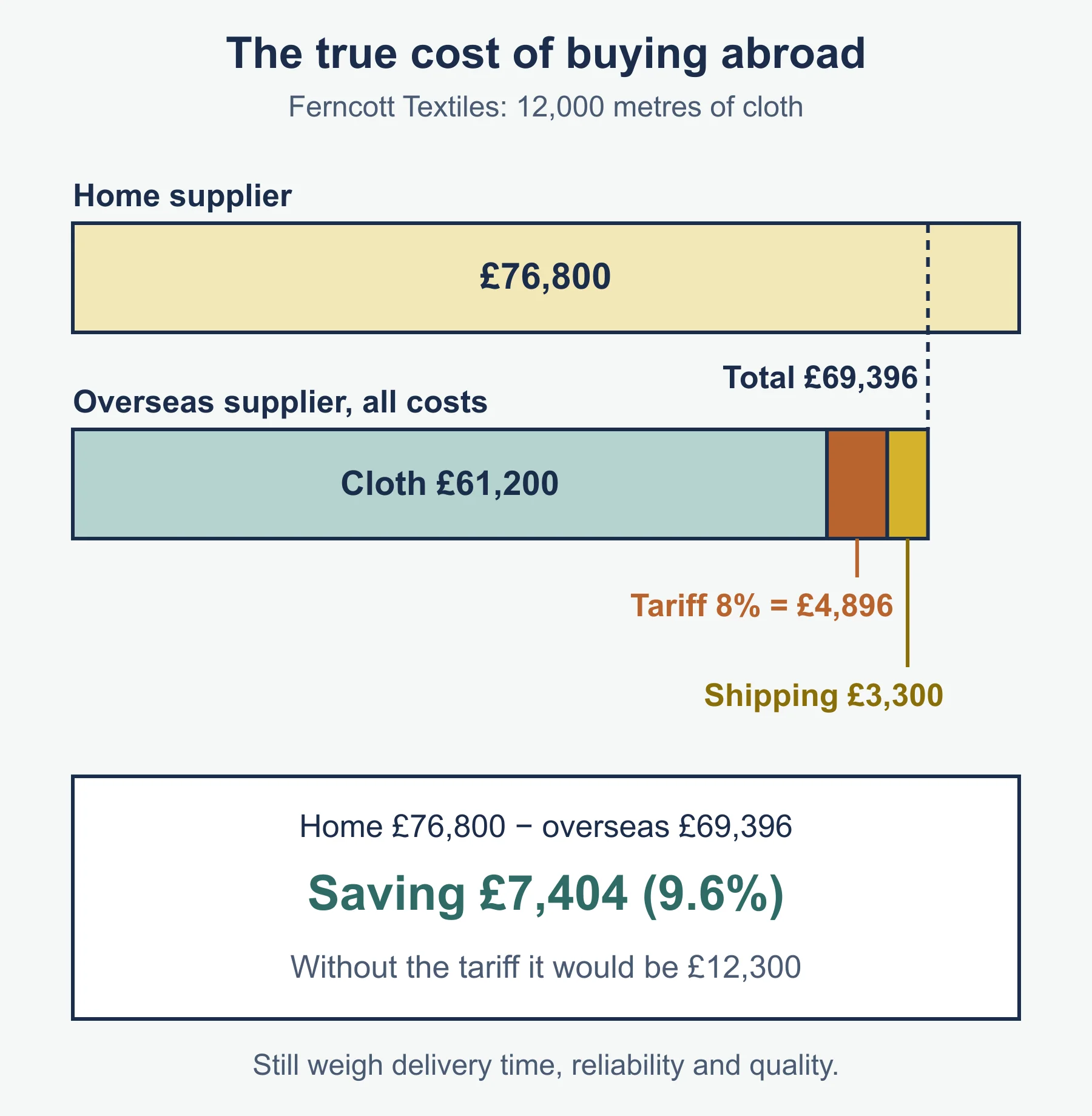
Ferncott Textiles needs 12,000 metres of cloth. A home supplier charges £6.40 a metre. An overseas supplier charges £5.10 a metre, a tariff of 8% of the cloth value applies, and shipping costs £3,300.
Home supplier:   12,000 x 6.40               = £76,800
Overseas cloth:  12,000 x 5.10               = £61,200
Tariff:          8% of 61,200                = £4,896
Shipping                                     = £3,300
Overseas total:  61,200 + 4,896 + 3,300      = £69,396
Saving:          76,800 - 69,396             = £7,404
The saving is 9.6% of the home price (7,404 / 76,800 x 100). Without the tariff it would be £12,300. The overseas route is cheaper, but a good answer still weighs delivery times, reliability and quality before recommending it.
2. Exports (2.1.3)
Exports are goods or services sold to overseas markets. Exporting gives a business more potential customers, a way to grow when the home market is crowded and less dependence on one market. The drawbacks are higher transport and administration costs, the need to understand different tastes and languages, and barriers such as tariffs.
Worked example: export share and a tariff
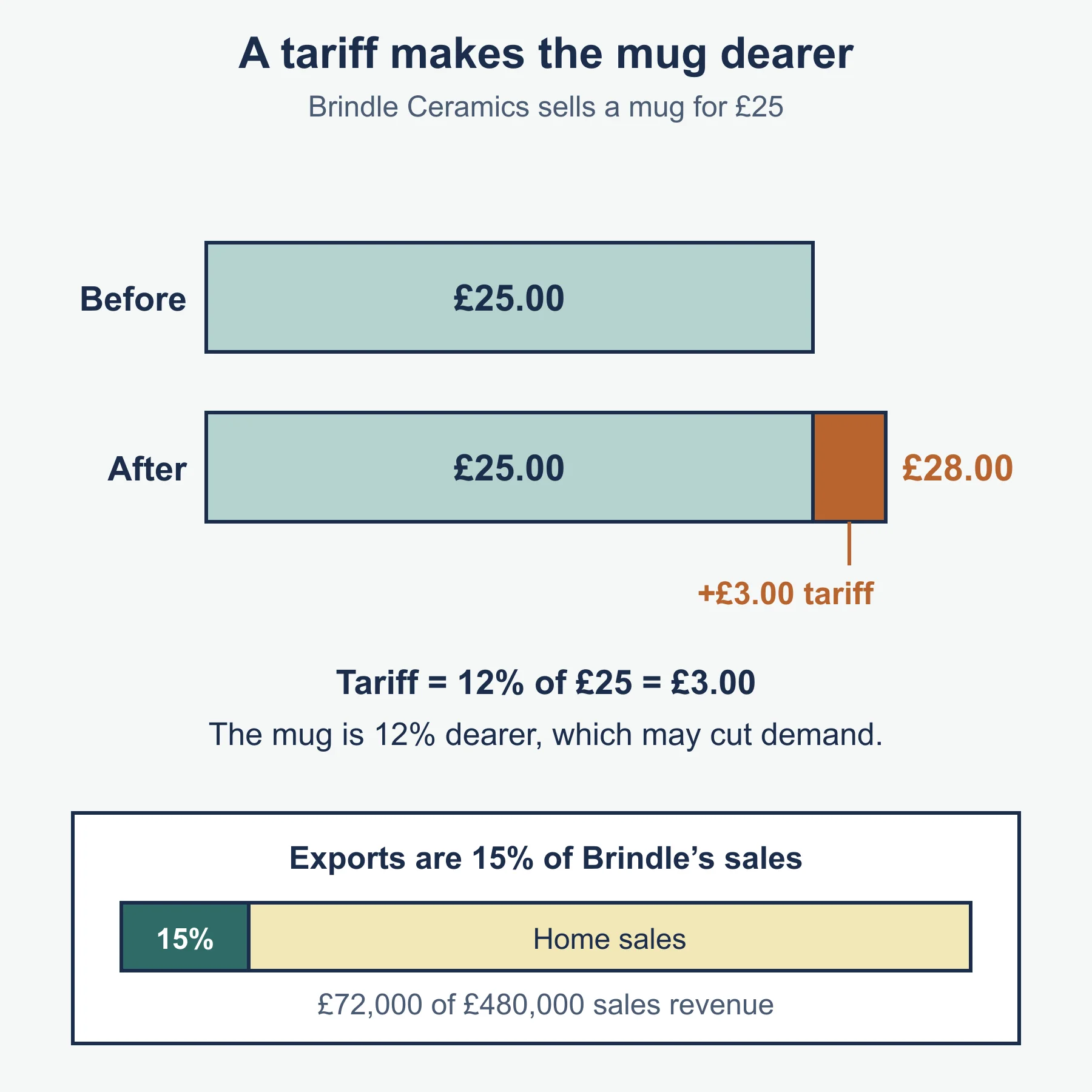
Brindle Ceramics has sales revenue of £480,000, of which £72,000 comes from exports.
Export share = 72,000 / 480,000 x 100 = 15%Next year exports rise to £99,000. The change is (99,000 - 72,000) / 72,000 x 100 = 37.5%.
A customer country charges a 12% tariff on a mug that Brindle sells for £25. The tariff is 12% of £25 = £3.00, so the mug costs £28.00 if the importer passes the whole tariff on. The mug is now 12% dearer than before, which may cut demand.
3. Changing business locations (2.1.3)
Globalisation lets a business change where it operates. It may move production abroad, open an overseas office or shop, or use overseas call centres or suppliers. The usual reasons are lower labour costs, cheaper land or materials, being closer to a growing market and avoiding tariffs by making goods inside the target country. The costs are redundancy payments at home, harm to reputation if local jobs are lost, longer supply chains and the need to manage staff from a distance.
Worked example: moving production
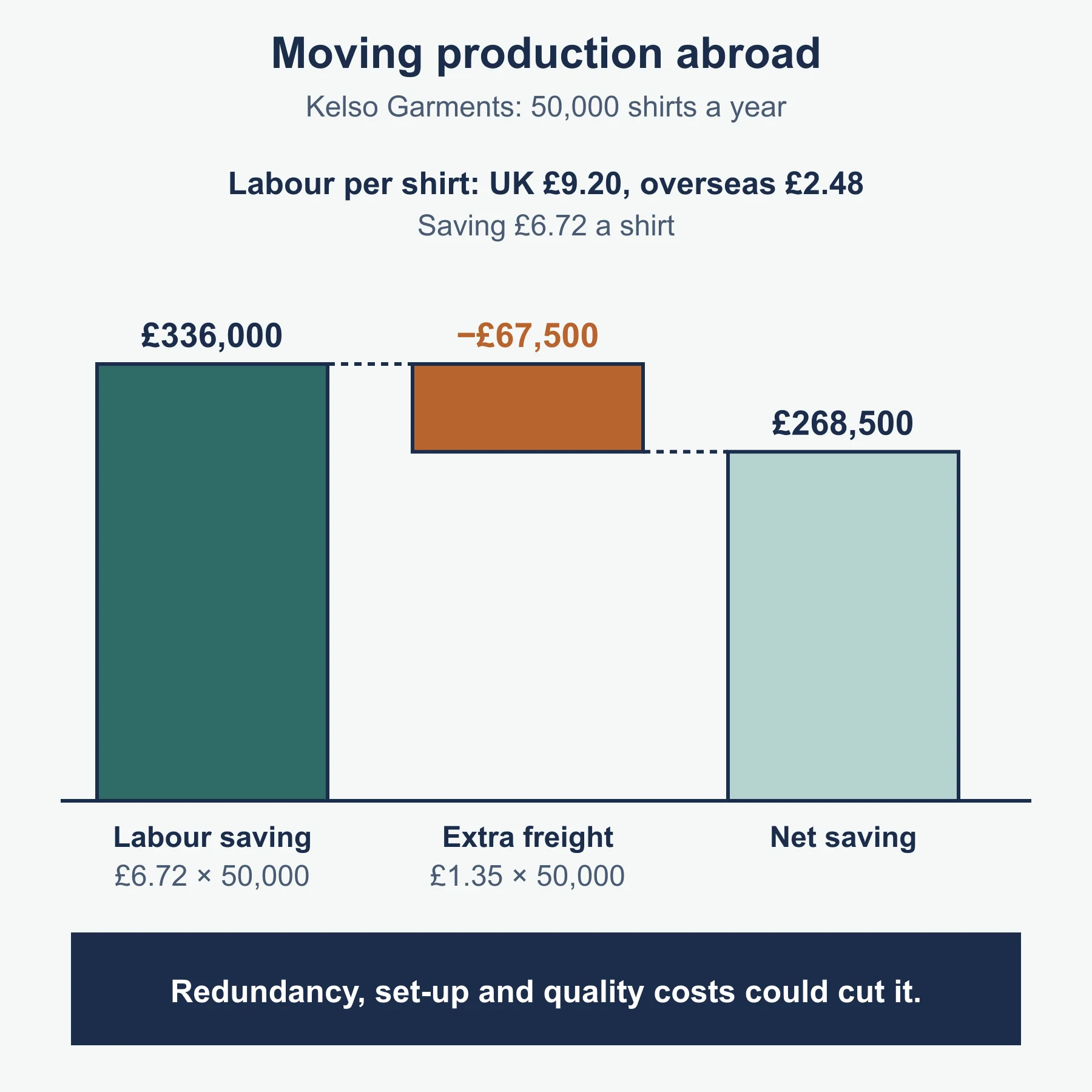
Kelso Garments makes 50,000 shirts a year. Each shirt needs 0.8 hours of labour. UK labour costs £11.50 an hour; the overseas site would cost £3.10 an hour, and extra freight is £1.35 a shirt.
UK labour per shirt:        0.8 x 11.50 = £9.20
Overseas labour per shirt:  0.8 x 3.10  = £2.48
Labour saving per shirt:    9.20 - 2.48 = £6.72   (x 50,000 = £336,000)
Extra freight:              1.35 x 50,000 = £67,500
Net saving:                 336,000 - 67,500 = £268,500
Redundancy costs, set-up costs and quality problems could reduce the saving.
4. Multinationals (2.1.3)
A multinational is a business that has operations (such as factories, shops or offices) in more than one country. It usually has a head office in one country.
For the business: access to new customers, lower costs, spreading risk across countries and the ability to produce near each market. Possible problems are the cost and difficulty of managing operations in several countries, different cultures and rules, and being blamed in the news for conditions anywhere in its supply chain.
For host countries: jobs, spending, new skills and tax receipts. Possible problems include competition that squeezes local firms, profits that leave the country and pressure on the environment.
5. Barriers to international trade (2.1.3)
A tariff is a tax on imported goods. It raises the price of the import compared with home products, which protects home producers and raises money for a government. For an importer it raises costs; for an exporter it makes the product dearer in the customer country. The Ferncott and Brindle examples above show each effect.
A trade bloc is a group of countries that agree to trade with each other on easier terms, for example with low or no tariffs between members. Members commonly keep tariffs on goods from outside the group. The European Union is an example. Two effects follow:
- Inside the bloc: exporting to other members is easier and cheaper, which helps growth.
- Outside the bloc: a business faces the bloc’s tariffs, so a trade bloc acts as a barrier. One response is to produce inside the bloc (see section 3).
6. How businesses compete internationally (2.1.3)
The internet and e-commerce
E-commerce means selling over the internet. A website can reach overseas customers without a shop in each country. It is open all day and can link to online marketplaces and social media. Limits include delivery cost and time, returns, language and payment preferences, and the need to build trust with unfamiliar buyers.
Worked example: overseas web sales
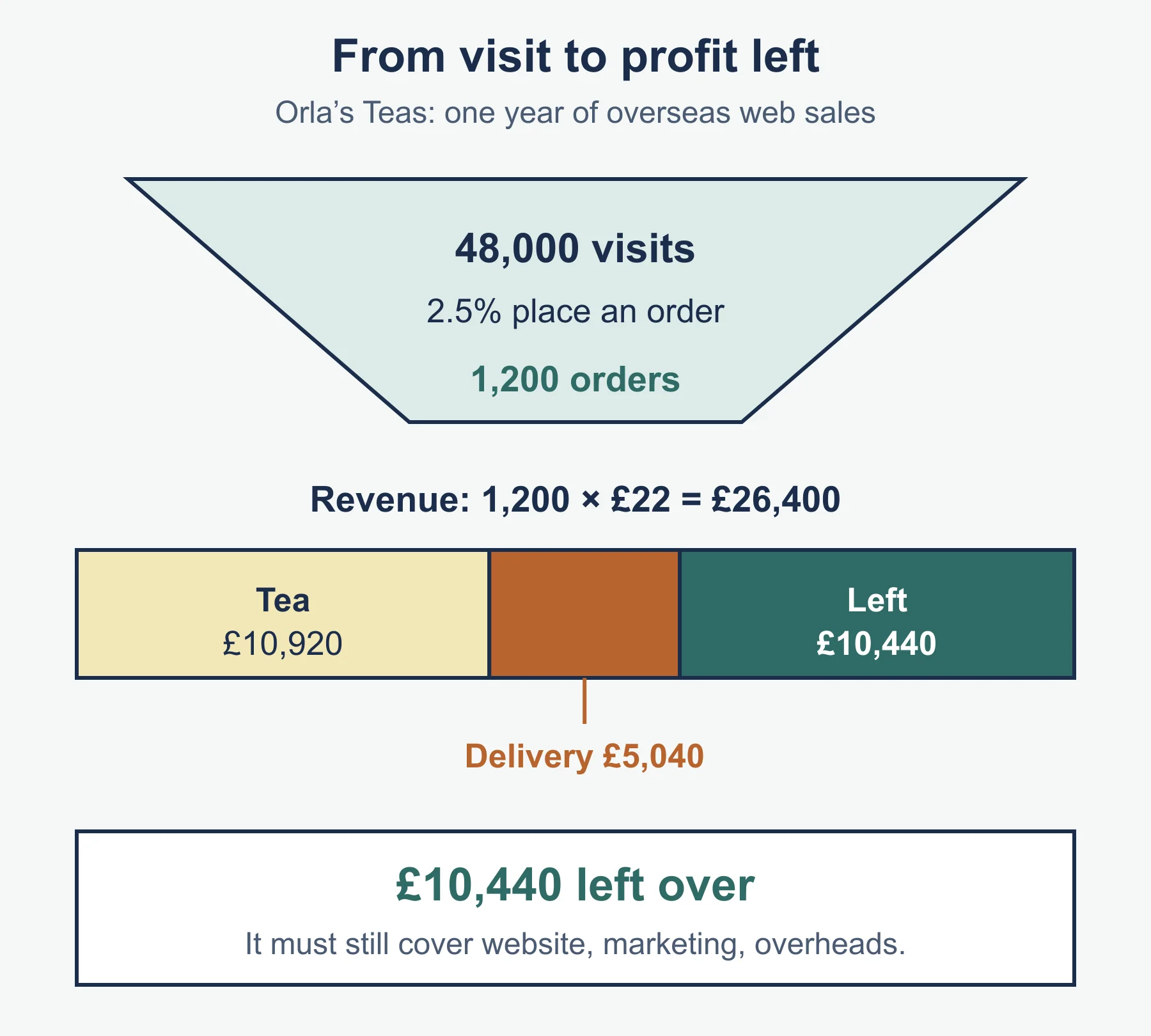
Orla’s Teas gets 48,000 overseas visits to its site in a year. Of these, 2.5% place an order. The average order is £22, the tea in each order costs £9.10 and delivery costs £4.20 an order.
Orders:   48,000 x 2.5% = 1,200
Revenue:  1,200 x 22    = £26,400
Tea cost: 1,200 x 9.10  = £10,920
Delivery: 1,200 x 4.20  = £5,040
Left over: 26,400 - 10,920 - 5,040 = £10,440
The £10,440 must still cover website costs, marketing and other overheads.
Changing the marketing mix
Competing abroad often means adjusting each element of the mix:
- Product: change size, flavour, labelling or language to suit local tastes and needs.
- Price: set it for local incomes and competitors, allowing for freight and tariffs.
- Promotion: use the local language, local media and cultural references that fit.
- Place: use a local distributor, an overseas warehouse or a local online marketplace.
7. Ethical considerations (2.1.4)
Ethical considerations are questions of right and wrong in how a business behaves, such as how it treats employees and suppliers, how honest its advertising is and where it buys its goods. Ethical behaviour can cost money in the short run. There is a possible trade-off between ethics and profit.
Possible gains: better reputation, loyal customers, motivated staff and an easier time recruiting. Possible costs: higher costs, lower profit in the short run and possibly higher prices.
Worked example: paying suppliers a fairer price
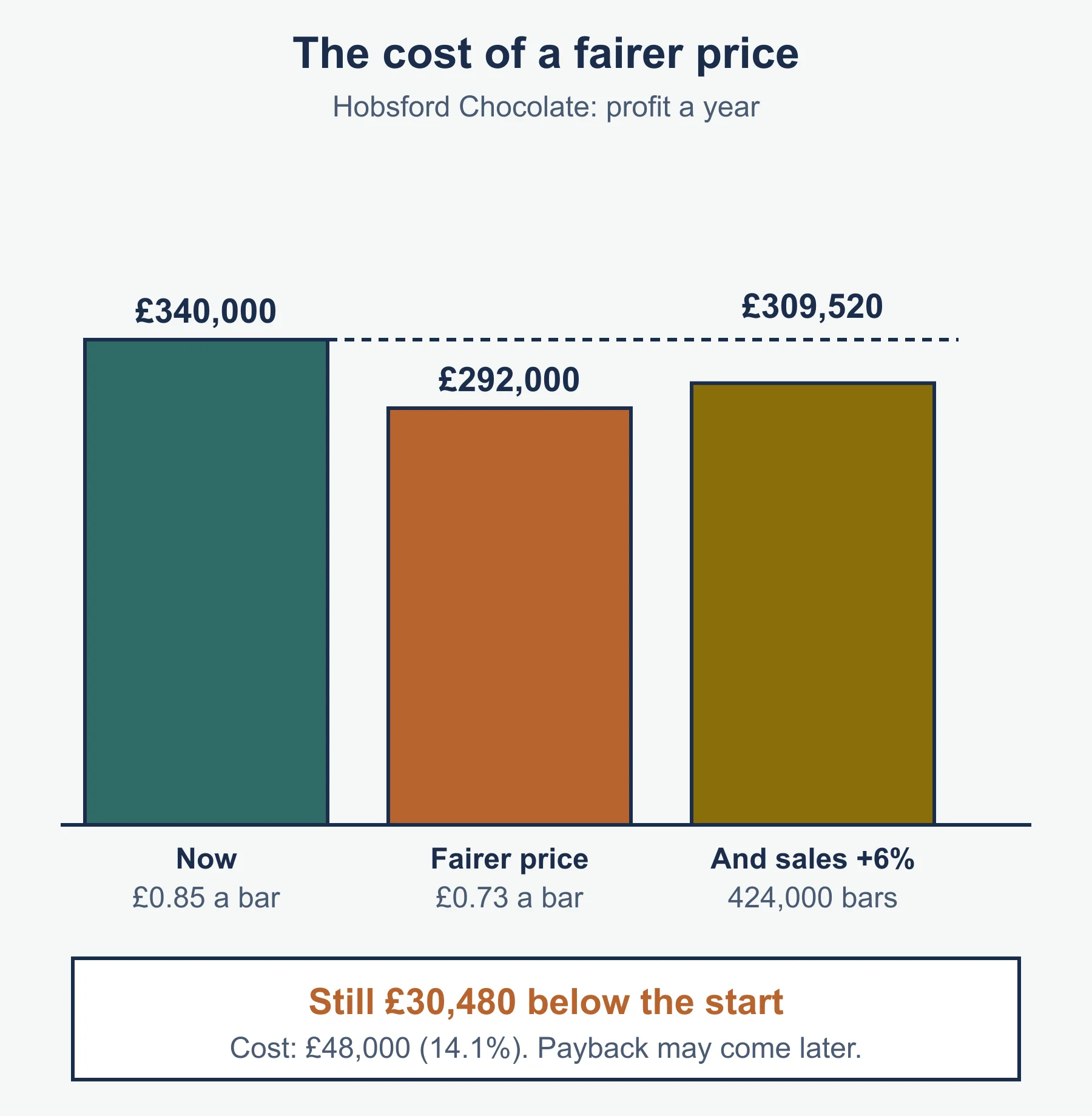
Hobsford Chocolate sells 400,000 bars at £1.80. Each bar costs £0.95 to make.
Profit before: (1.80 - 0.95) x 400,000 = 0.85 x 400,000 = £340,000
Fairer price adds £0.12 a bar: 0.73 x 400,000 = £292,000
Fall in profit: 340,000 - 292,000 = £48,000  (14.1%)
If sales rise 6%: 424,000 x 0.73 = £309,520
Profit is still £30,480 below the starting point even after the sales rise. The ethical choice costs profit in the short run. A business might accept that if it expects loyal customers and a stronger reputation to pay back over time, and it should say so in the answer.
8. Environmental considerations and sustainability (2.1.4)
Environmental considerations are the effects of a business on the natural environment: waste, pollution, energy and resource use. Sustainability means operating so that resources are not used up and the environment is not damaged beyond repair, so that future generations can still meet their needs.
Actions include using recycled packaging, cutting energy use or reducing waste. The trade-off is between the environment, sustainability and profit. The environmental choice can raise costs, but it can also attract customers and cut running costs.
Worked example: refillable packaging
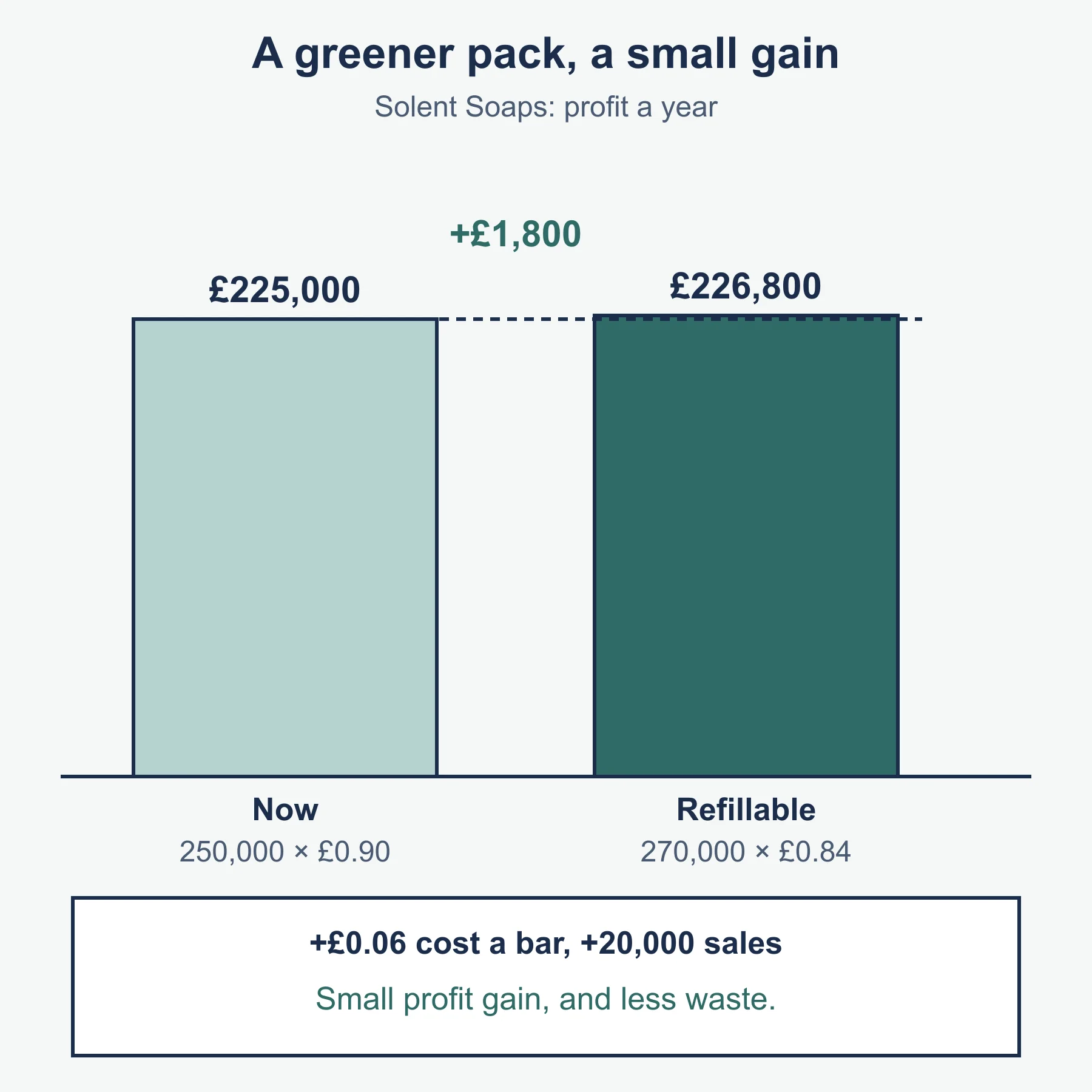
Solent Soaps sells 250,000 bars a year with a profit of £0.90 a bar. Switching to refillable packaging adds £0.06 to the cost of every bar and brings 20,000 extra sales.
Profit before:  250,000 x 0.90 = £225,000
After:          270,000 x 0.84 = £226,800
Change:         +£1,800
The profit gain is small. The business also cuts waste, which would support a sustainability claim.
9. Pressure groups and the marketing mix (2.1.4)
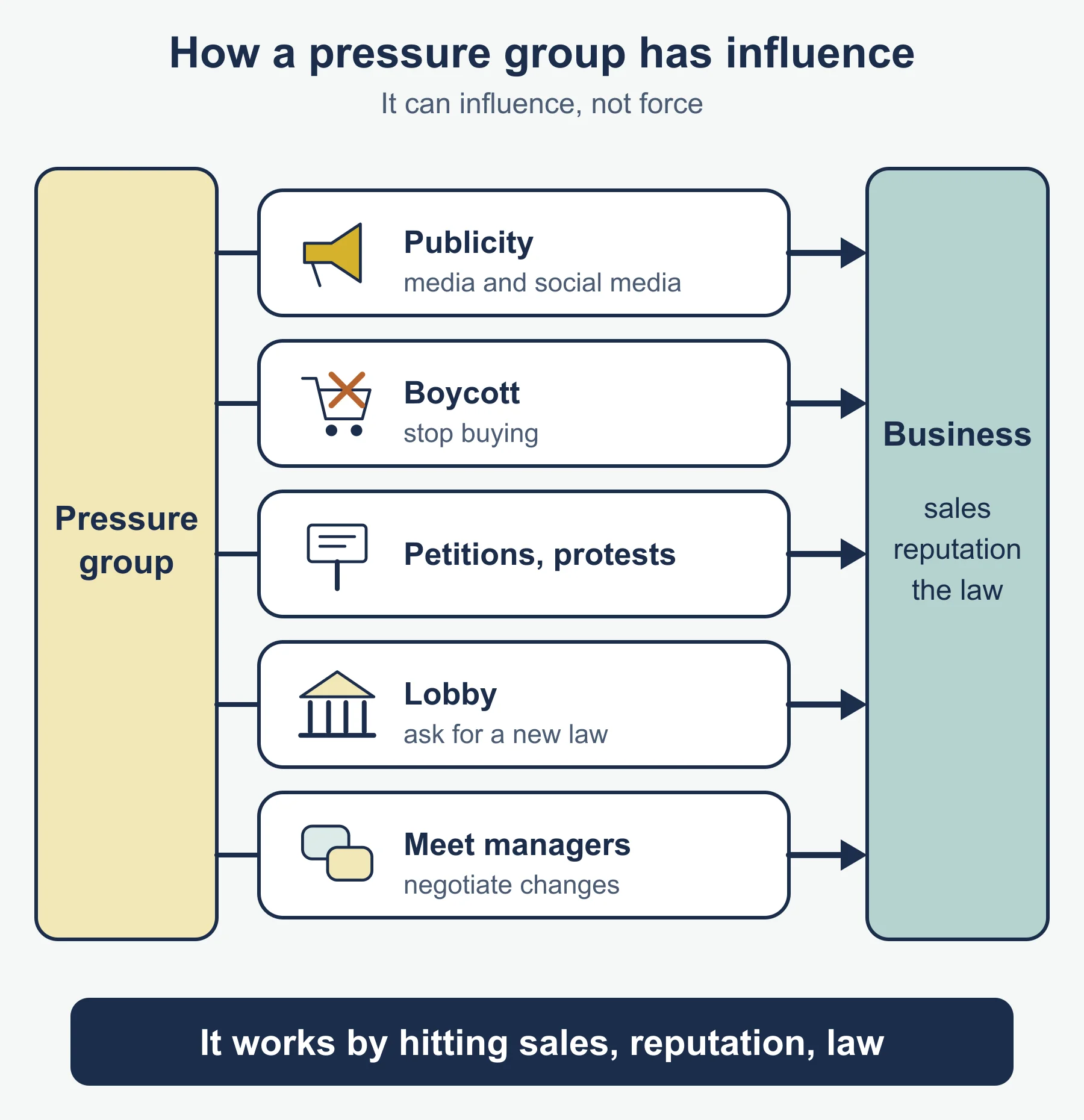
A pressure group is an organised group that tries to change how businesses or governments behave. It uses campaigns, petitions, social media, protests and media coverage. If the group’s message spreads, customers may stop buying, which gives the business a reason to respond.
| Element | Possible impact |
|---|---|
| Product | Change an ingredient, material or design |
| Price | A fairer price to suppliers raises costs and may raise prices |
| Promotion | Bad publicity must be answered; advertising may feature the changes |
| Place | Retailers may stop stocking the product, or stock it more widely if it is approved |
Suppose a campaign leads a retailer to stop selling Bramley Foods’ range. If this cut 8% of sales revenue of £2.5 million, the business would lose £200,000 a year.
Common errors
- Writing that a tariff is paid by the exporter. A tariff is a tax on imports; the importer pays it, though prices may be passed on.
- Using the word “export” for something bought from abroad.
- Saying that moving production abroad always saves money without counting redundancy, freight and quality control.
- Assuming that ethical or environmental choices always cost profit. They can bring sales.
- Listing four marketing mix points without tying them to the business in the question.
Frequently asked questions
What is globalisation in GCSE Business? Globalisation means that businesses and markets in different countries become more closely linked, so a business can buy, sell, make and compete across borders. The Edexcel GCSE Business (1BS0) specification covers it in Theme 2 item 2.1.3.
What is the difference between imports and exports? Imports are goods or services bought from overseas, which bring both overseas competition and cheaper or wider sources of supply. Exports are goods or services sold to overseas markets, giving more potential customers but higher transport and administration costs.
Why might a business move production abroad? Common reasons are lower labour costs, cheaper land or materials, being closer to a growing market and avoiding tariffs by making goods inside a trade bloc. Redundancy, set-up, freight and quality-control costs can reduce the saving.
What does sustainability mean for a business? Sustainability means operating so that resources are not used up and the environment is not damaged beyond repair, so that future generations can still meet their needs. Actions such as recycled packaging can raise costs but may attract customers and cut waste.
Official syllabus
Pearson Edexcel Level 1/Level 2 GCSE (9-1) in Business (1BS0), Specification, Issue 2, July 2022, published by Pearson Education Limited. Theme 2: Building a business, Topic 2.1 Growing the business, items 2.1.3 and 2.1.4.
Get free revision emails (optional)
Occasional emails with practice questions, worked explanations and links to free resources for the qualification and subjects you choose. No spam, and you can unsubscribe from any email. The free tools on this site never need an email.
Related resources
-
Practice questions
Edexcel GCSE Business: Globalisation, ethics and the environment (1BS0) – Practice Questions
Original practice questions with worked answers on imports, exports, tariffs, ethics, the environment and pressure groups for Edexcel GCSE Business.
Business · Pearson Edexcel · GCSE
Try questions -
Revision notes
Edexcel GCSE Business: Globalisation, ethics and the environment (1BS0) – Revision Notes
Condensed revision notes on globalisation, tariffs, trade blocs, ethics, the environment and pressure groups for Edexcel GCSE Business Theme 2, topic 2.1.
Business · Pearson Edexcel · GCSE
Revise topic -
Study guides
Edexcel GCSE Business: Business growth and changing aims (1BS0)
Study guide to organic and external growth, plc ownership, sources of finance and why aims change, for Pearson Edexcel GCSE Business Theme 2.
Business · Pearson Edexcel · GCSE
Read guide
Related articles
-
teaching
A Level tuition in Dubai: Cambridge or Pearson Edexcel International A Level?
Schools in Dubai and Abu Dhabi teach either Cambridge International AS & A Level or Pearson Edexcel International A Level. How the two are structured, why it matters for tuition, and how online classes from Lahore work.
9 October 2026
-
curriculum guides
Choosing subjects at IGCSE and A Level
How subject choices at 14 and 16 affect university options later, and how to keep pathways open without overloading a timetable.
28 July 2026
Studying this with a teacher
Working through Business GCSE?
This page is free and stays free. If you would rather be taught it, Marlbridge runs Business classes one-to-one and in small groups of up to 15, online in your own time zone. The first trial class is free. WhatsApp replies within an hour (8am–11pm Pakistan time, every day); email the same day.
Pearson Edexcel Business teachers at Marlbridge

