
Study Guides
Edexcel GCSE Business: Business growth and changing aims (1BS0)
Study guide to organic and external growth, plc ownership, sources of finance and why aims change, for Pearson Edexcel GCSE Business Theme 2.
- Subject
- Business
- Level
- GCSE
- Topic
- Growing the business
- Author
- Marlbridge Academic Team
- Updated
- Reviewed by
- Asif Iqbal (what this means)
Aligned to Pearson Edexcel GCSE Business (1BS0), Issue 2, July 2022. Official specification .
Syllabus page (what it covers and how it is assessed): Pearson Edexcel GCSE Business.
Syllabus points this page covers
1BS0
- 2.1 Growing the business (whole topic)
- 2.1.1 Business growth
- 2.1.2 Changes in business aims
Found an error? Report a correction.
Want a teacher for this? Marlbridge teaches Business online. Request a free trial class.
This guide follows the Pearson Edexcel Level 1/Level 2 GCSE (9-1) in Business (1BS0) specification, Issue 2, July 2022. It covers Theme 2, Topic 2.1 Growing the business, content items 2.1.1 (business growth) and 2.1.2 (changes in business aims and objectives). The specification lists formulae in Appendix 3 and says they are not provided in the examinations, so learn the ones used here. Every business below is invented.
Course links: the Business hub, the printable checklist and the free diagnostics. Companion pages: the revision notes and the practice questions. For the types of ownership met earlier, see limited liability and business location.
What the topic asks for
| Item | You must be able to | Part |
|---|---|---|
| 2.1.1 | Explain internal (organic) growth through new products (innovation, research and development) | 1 |
| 2.1.1 | Explain internal growth through new markets: changing the marketing mix, using technology, expanding overseas | 2 |
| 2.1.1 | Explain external (inorganic) growth: merger and takeover | 3 |
| 2.1.1 | Explain the public limited company (plc) as ownership for a growing business | 4 |
| 2.1.1 | Explain internal sources of finance (retained profit, selling assets) and external sources (loan capital, share capital, stock market flotation) | 5 |
| 2.1.2 | Explain why aims and objectives change: market conditions, technology, performance, legislation, internal reasons | 6 |
| 2.1.2 | Explain how they change: survival or growth, entering or exiting markets, workforce, product range | 7 |
The command words matter. “Explain” is a statement of fact with two expansion points and no context. “Analyse” is an extended answer set in the business the question describes. “Justify” recommends one of two options for a business owner, using the information given. “Evaluate” reaches a supported conclusion. The specification says calculators may be used and workings should be given.
1. Organic growth through new products
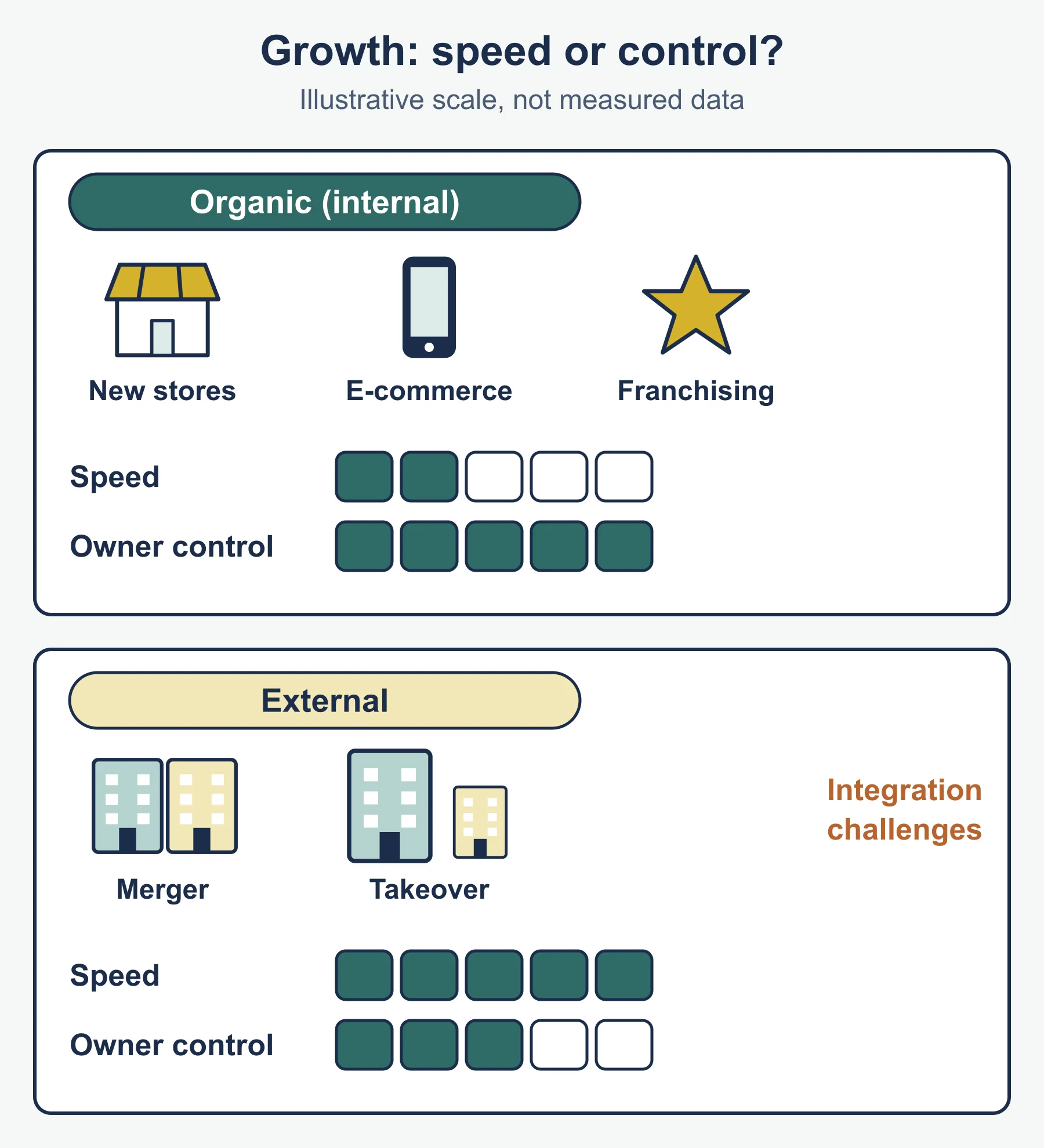
Internal (organic) growth means a business gets bigger using its own resources and its own sales, without buying or joining another firm. It is usually slower than external growth, but the business stays in control and keeps its own culture.
One route is new products. Innovation is bringing in a new or improved product or way of working. Research and development (R&D) means the work a firm carries out to design or improve products ahead of launch. R&D costs money and may produce nothing, so the owner is gambling on future sales.
Worked example: Norrish Joinery
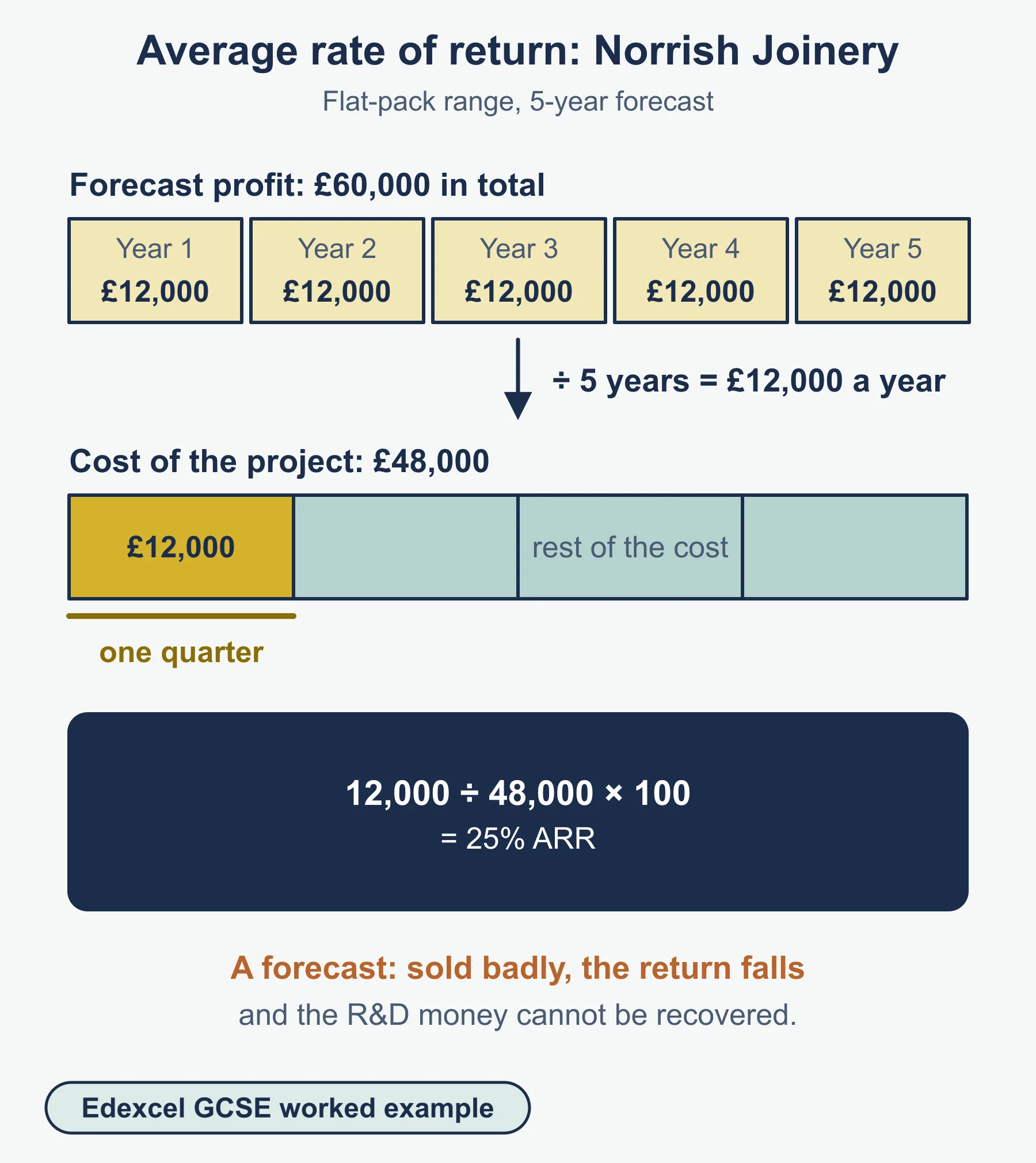
Norrish Joinery makes oak tables. It spends £22,000 on R&D to design a flat-pack range, and the total cost of the project (including tooling) is £48,000. The owner expects a total profit of £60,000 over 5 years.
The average rate of return (ARR) is in the specification’s Appendix 3: average annual profit divided by cost of investment, times 100.
- Average annual profit = 60,000 / 5 = £12,000
- ARR = 12,000 / 48,000 × 100 = 25%
A 25% return looks attractive, but it rests on a forecast. If the range sells badly the return falls, and the R&D money cannot be recovered.
2. Organic growth through new markets
A new market means selling to customers the business does not yet reach. The specification names three ways.
- Changing the marketing mix. Alter product, price, promotion or place to attract a new group. Norrish Joinery might add a cheaper range and advertise it on social media, aiming at first-time buyers.
- Using technology. An online shop or delivery app lets a small firm sell outside its local area without opening a new site.
- Expanding overseas. Selling abroad (exporting) opens a large customer base but brings extra costs, such as transport and learning the preferences of new customers.
Worked example: percentage growth
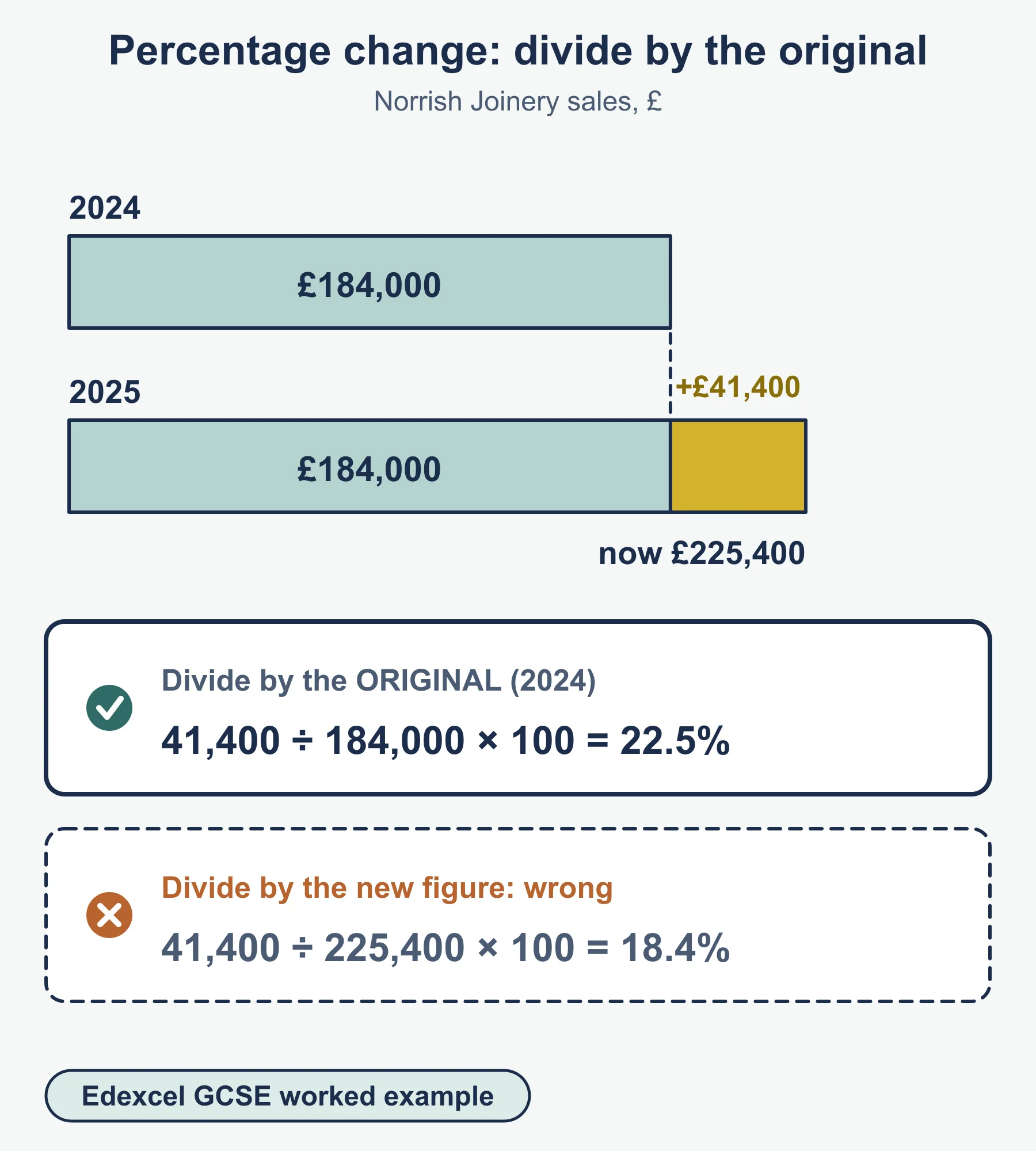
Norrish Joinery sells £184,000 of furniture in 2024. After launching its website, sales are £225,400 in 2025.
- Change = 225,400 - 184,000 = £41,400
- Percentage change = 41,400 / 184,000 × 100 = 22.5%
Percentage change is change divided by the original figure, not the new one. A common slip is dividing by 225,400 and getting 18.4%.
3. External growth: merger and takeover
External (inorganic) growth means growing by joining with, or buying, another business. It is fast, but it costs more and can go wrong.
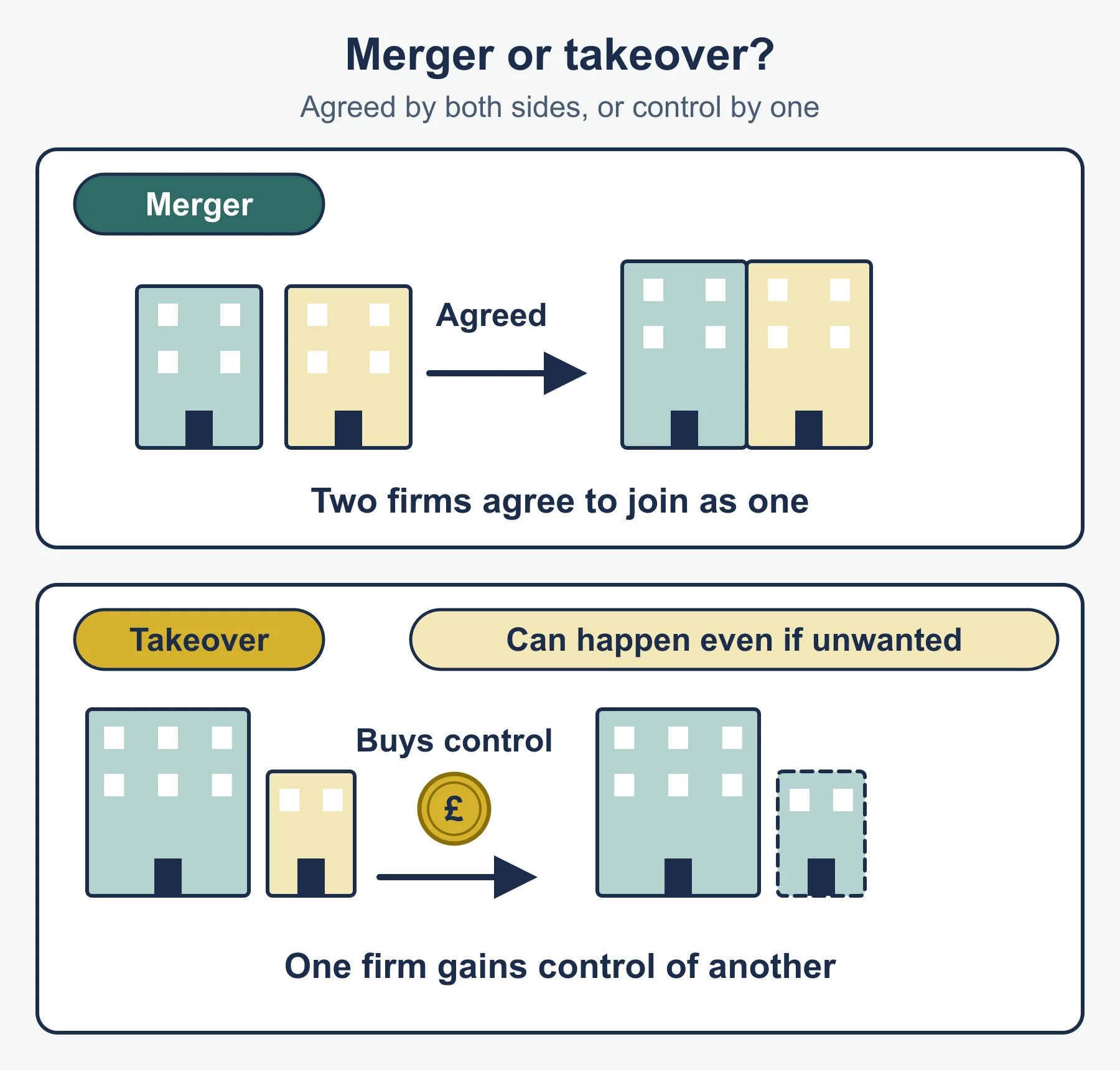
- A merger is when the owners of two businesses agree to combine them into one. The usual case is a joining of roughly equal partners. This is the standard form of the definition; the specification names the term but does not define it.
- A takeover is when one business buys enough shares in another to gain control of it. A takeover can be friendly or opposed by the target’s board.
Benefits include a bigger market share at once, new products or customers, and fewer competitors. Drawbacks include the price paid, clashing ways of working, job cuts and the risk that the combined business is harder to manage.
Worked example: Zandrick Foods
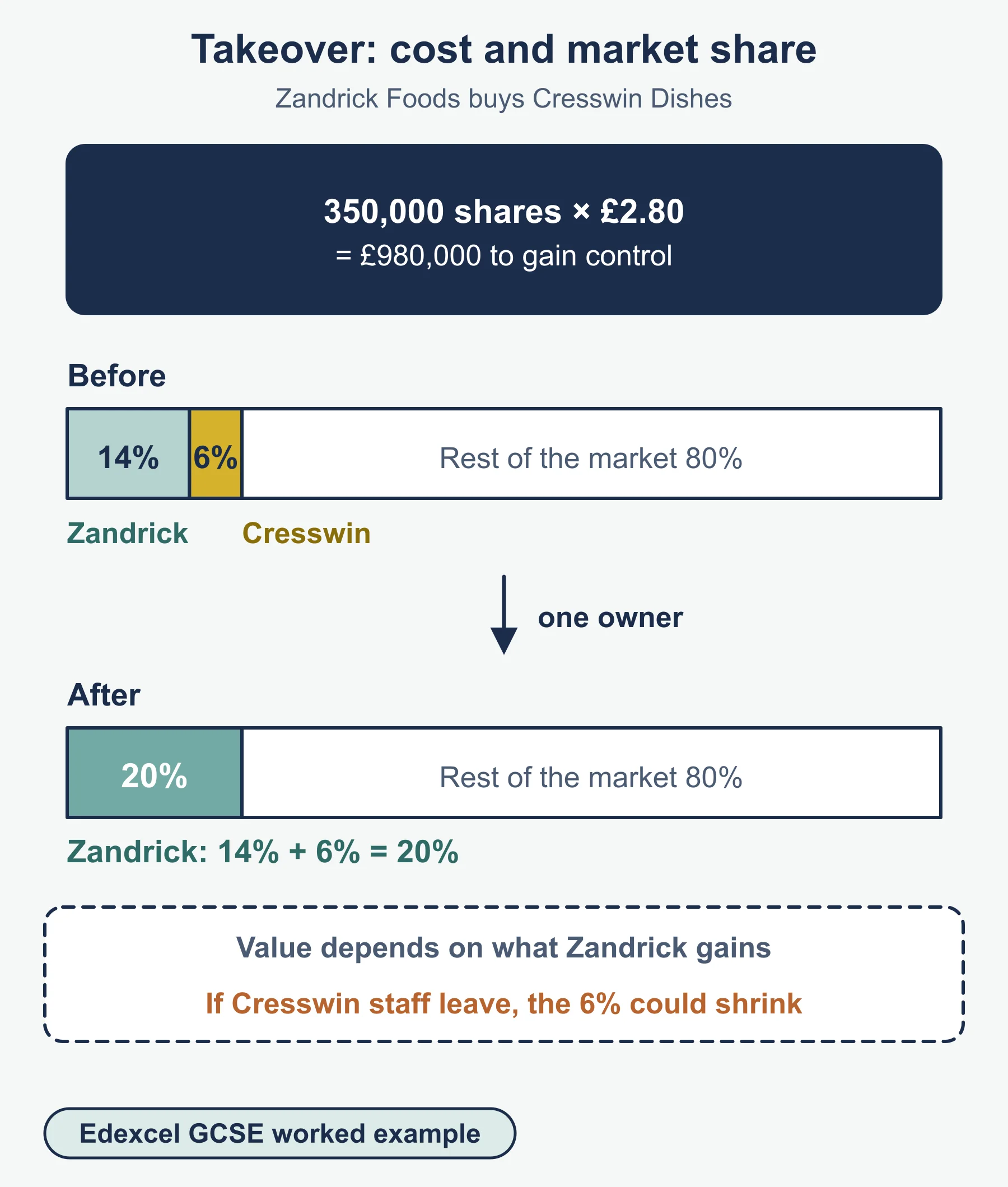
Zandrick Foods, a frozen-meal maker with 14% of its market, offers £2.80 a share for all 350,000 shares of Cresswin Dishes, which has 6%.
- Cost = 350,000 × 2.80 = £980,000
- Combined market share = 14% + 6% = 20%
Whether this is good value depends on what Zandrick expects to gain. It might save money by closing a duplicate head office, but if Cresswin’s staff leave, the 6% share could shrink.
4. The public limited company (plc)
The specification names the public limited company (plc) as the ownership type for a growing business. In general terms, a plc has limited liability and can offer its shares to the public, with its shares traded on the stock market. Compare this with a private limited company, whose shares are not offered to the public.
- Advantages. It can raise large sums by selling shares, and a bigger, better-known business may find it easier to win customers and borrow.
- Disadvantages. Ownership spreads across many shareholders, so the founders may lose control, and the business faces more public attention. A plc can also be a takeover target, because anyone can buy its shares.
5. Sources of finance for growth
Finance can come from inside the business (internal) or from outside it (external).
| Source | Type | Key point |
|---|---|---|
| Retained profit | Internal | Profit kept in the business rather than paid out as dividends. No interest, but only available if profit has been made. |
| Selling assets | Internal | Raising cash by selling something the business owns, such as a spare vehicle. Quick, but the asset is lost. |
| Loan capital | External | Money borrowed and repaid with interest. Fixed repayments are a burden if sales fall. |
| Share capital | External | Money from selling shares. No repayment, but owners share profit and some control. |
| Stock market flotation | External (plc) | Offering shares to the public for the first time through the stock market. |
Worked example: funding the Zandrick takeover
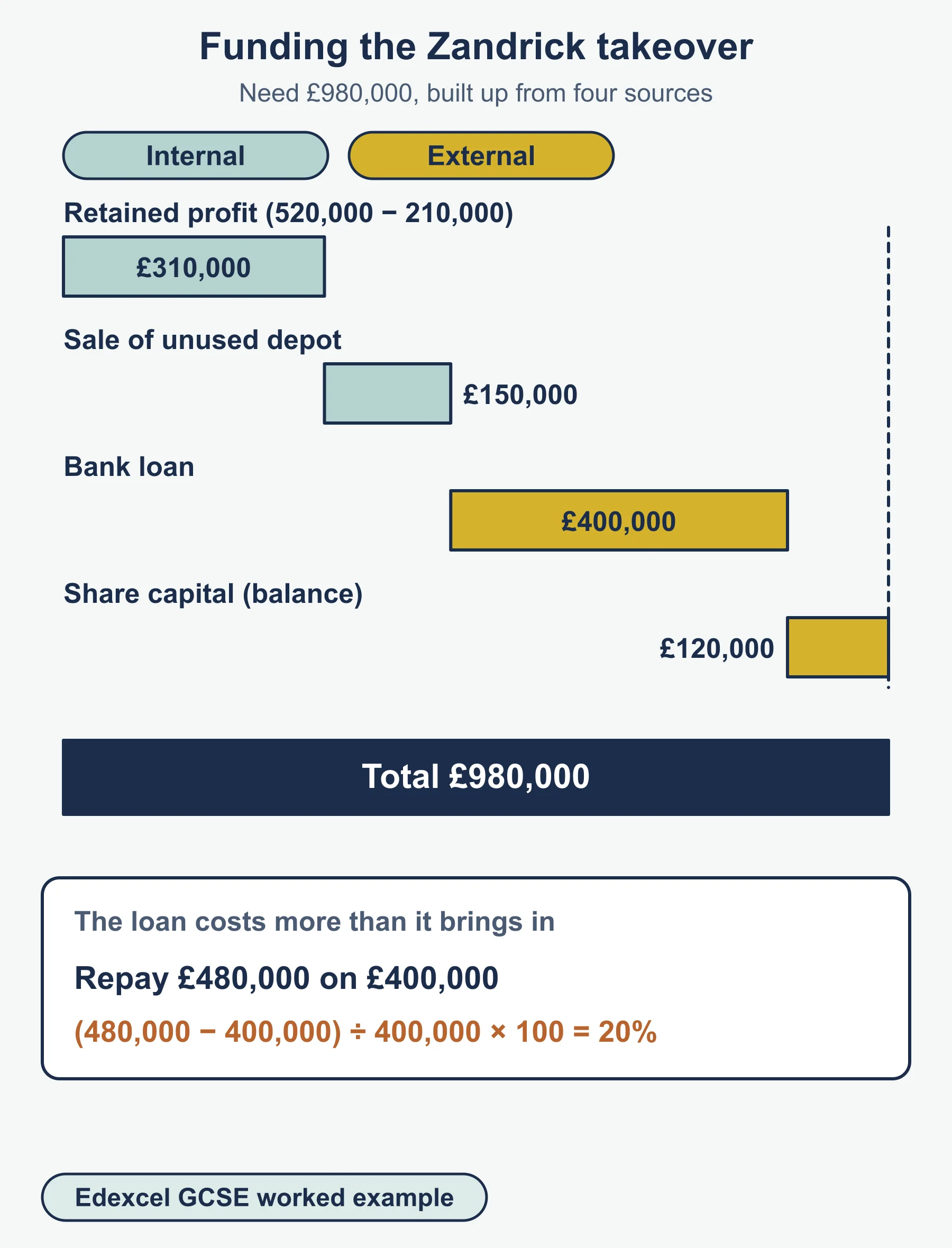
Zandrick needs £980,000. Its profit after tax is £520,000 and it pays £210,000 in dividends. The standard form is retained profit = profit after tax - dividends.
- Retained profit = 520,000 - 210,000 = £310,000
- Sale of an unused depot = £150,000
- A bank loan of £400,000, with a total repayment of £480,000
- Share capital for the rest = 980,000 - 310,000 - 150,000 - 400,000 = £120,000
The specification’s formula for interest on loans is (total repayment - borrowed amount) / borrowed amount × 100. Here that is (480,000 - 400,000) / 400,000 × 100 = 20% of the amount borrowed over the whole loan.
Worked example: flotation
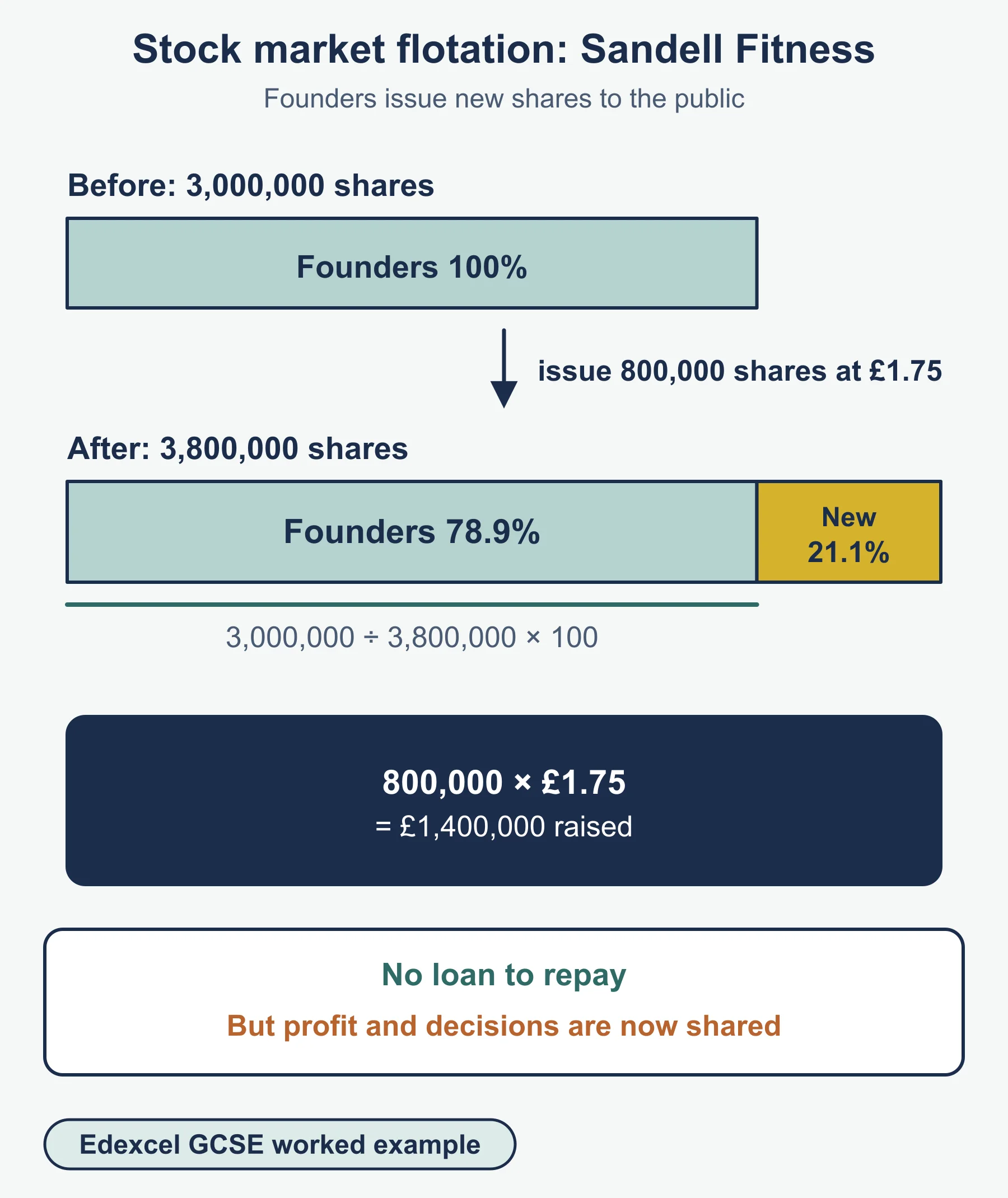
Sandell Fitness has 3,000,000 shares, all held by its founders. It floats by issuing 800,000 new shares at £1.75.
- Money raised = 800,000 × 1.75 = £1,400,000
- Founders’ share of the shares = 3,000,000 / 3,800,000 × 100 = 78.9%
The business gains cash with no loan to repay, but the founders now share profits and decisions with new shareholders.
6. Why aims and objectives change
An aim is what the business wants to achieve over the long run; an objective is a narrower target that moves it towards that aim. As a business evolves, these are rarely fixed. The specification gives five reasons.
- Market conditions. Rising competition, falling demand or new customer tastes can push a business to cut costs rather than expand.
- Technology. New equipment or online selling can make a bigger market reachable.
- Performance. Strong results can encourage ambitious targets. Weak results can force a focus on survival.
- Legislation. A change in the law can add costs or force a change of practice, so objectives shift.
- Internal reasons. A new owner, a change in staff, or a decision that the business is ready to grow.
7. How aims and objectives change
The specification gives four examples of the change itself.
- Survival or growth. A new business usually aims to survive first. An established, profitable one can aim to grow. Poor results can push it back to survival.
- Entering or exiting markets. Growth may mean entering a new market; losses may mean leaving one.
- Growing or reducing the workforce. Expansion may mean hiring; cost cutting may mean redundancies.
- Increasing or decreasing the product range. Adding lines serves new customers, while dropping weak lines saves cost.
Worked example: Sandell Fitness over time
| Year | Revenue | Net profit | Net profit margin | Aim |
|---|---|---|---|---|
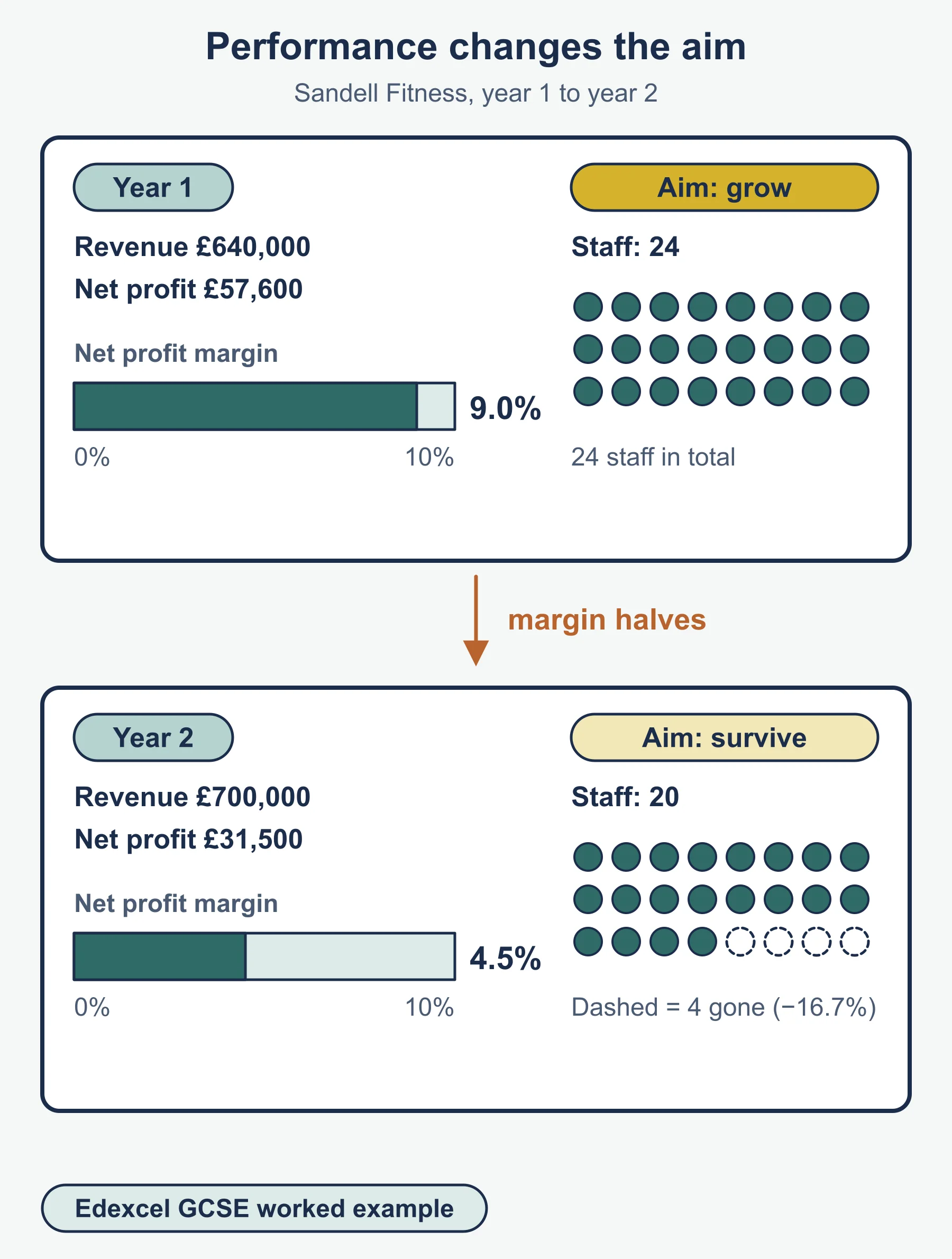
| 1 | £640,000 | £57,600 | 9.0% | Open a second gym (growth) |
| 2 | £700,000 | £31,500 | 4.5% | Protect cash and cut costs (survival) |
Net profit margin = net profit / sales revenue × 100, so 57,600 / 640,000 × 100 = 9.0% and 31,500 / 700,000 × 100 = 4.5%. Revenue rose by 9.4% but the margin halved, because costs grew faster. Sandell responds by reducing staff from 24 to 20, a fall of 4 / 24 × 100 = 16.7%, and by dropping a loss-making class timetable. Performance has changed both the aim and the actions.
Common errors
- Calling any growth in sales “organic”. Organic growth must come from the business’s own resources.
- Mixing up merger and takeover. A merger is by agreement; a takeover is one business buying control.
- Using the later figure as the divisor in a percentage change.
- Treating retained profit as cash stored in a bank. It is profit kept in the business and may already be spent on equipment.
- Saying share capital must be repaid. It is not repaid, but it dilutes ownership.
- Writing a general list of reasons for changed aims without linking to the situation described.
Frequently asked questions
What is the difference between a merger and a takeover? In a merger, two businesses agree to combine into one. In a takeover, one business buys enough shares in another to control it, even if the target business does not want this.
Why is a public limited company more at risk of a takeover? A plc’s shares are offered to the public and traded on the stock market, so another business can buy enough of them to gain control. Selling shares to many shareholders also means the founders may lose control of decisions.
How do you calculate the interest on a loan as a percentage in Edexcel GCSE Business? Subtract the amount borrowed from the total repayment, divide by the amount borrowed and multiply by 100. Borrowing £20,000 and repaying £22,400 gives 2,400 / 20,000 × 100 = 12%, a formula from Appendix 3 of the 1BS0 specification.
How can changing aims affect a business’s workforce and product range? A business aiming for growth may hire more staff and add product lines for new customers. A business switching to survival may reduce staff to save cost, close loss-making branches or drop weak products.
Official syllabus
Pearson Edexcel Level 1/Level 2 GCSE (9-1) in Business (1BS0), Specification, Issue 2, July 2022, published by Pearson Education Limited. Theme 2: Building a business, Topic 2.1 Growing the business, items 2.1.1 and 2.1.2.
Get free revision emails (optional)
Occasional emails with practice questions, worked explanations and links to free resources for the qualification and subjects you choose. No spam, and you can unsubscribe from any email. The free tools on this site never need an email.
Related resources
-
Practice questions
Edexcel GCSE Business: Business growth and changing aims (1BS0) – Practice Questions
Twelve original practice questions with worked answers on growth methods, plc, finance and changing aims for Edexcel GCSE Business Theme 2.
Business · Pearson Edexcel · GCSE
Try questions -
Revision notes
Edexcel GCSE Business: Business growth and changing aims (1BS0) – Revision Notes
Condensed revision notes on growth methods, plc, sources of finance and changing aims for Pearson Edexcel GCSE Business Theme 2, with a self-test.
Business · Pearson Edexcel · GCSE
Revise topic -
Study guides
Edexcel GCSE Business: Globalisation, ethics and the environment (1BS0)
Study guide to globalisation, ethical and environmental considerations and pressure groups for Pearson Edexcel GCSE Business, Theme 2 topic 2.1.
Business · Pearson Edexcel · GCSE
Read guide
Related articles
-
teaching
A Level tuition in Dubai: Cambridge or Pearson Edexcel International A Level?
Schools in Dubai and Abu Dhabi teach either Cambridge International AS & A Level or Pearson Edexcel International A Level. How the two are structured, why it matters for tuition, and how online classes from Lahore work.
9 October 2026
-
curriculum guides
Choosing subjects at IGCSE and A Level
How subject choices at 14 and 16 affect university options later, and how to keep pathways open without overloading a timetable.
28 July 2026
Studying this with a teacher
Working through Business GCSE?
This page is free and stays free. If you would rather be taught it, Marlbridge runs Business classes one-to-one and in small groups of up to 15, online in your own time zone. The first trial class is free. WhatsApp replies within an hour (8am–11pm Pakistan time, every day); email the same day.
Pearson Edexcel Business teachers at Marlbridge

