
Study Guides
Edexcel GCSE Business: Limited liability and business location (1BS0)
Study guide to limited and unlimited liability, sole traders, partnerships, private limited companies, franchising and location, for Edexcel GCSE Business.
- Subject
- Business
- Level
- GCSE
- Topic
- Making the business effective
- Author
- Marlbridge Academic Team
- Updated
- Reviewed by
- Asif Iqbal (what this means)
Aligned to Pearson Edexcel GCSE Business (1BS0), Issue 2, July 2022. Official specification .
Syllabus page (what it covers and how it is assessed): Pearson Edexcel GCSE Business.
Syllabus points this page covers
1BS0
- 1.4 Making the business effective (whole topic)
- 1.4.1 Options for start-up and small businesses
- 1.4.2 Business location
Found an error? Report a correction.
Want a teacher for this? Marlbridge teaches Business online. Request a free trial class.
This guide follows the Pearson Edexcel Level 1/Level 2 GCSE (9-1) in Business (1BS0) specification, Issue 2, July 2022. It covers Theme 1, Topic 1.4 Making the business effective, content items 1.4.1 (the options for start-up and small businesses) and 1.4.2 (business location). The specification lists formulae in Appendix 3 and says they are not provided in the examinations, so any calculation on this page is something to practise from memory. Points on partner liability, the Ltd name, personal guarantees, share rules and franchise fee structure are general knowledge, not specification wording, and are worded as general.
Course links: the Business hub, the printable checklist and the free diagnostics. Companion pages: the revision notes and the practice questions.
What the specification asks for
| Item | You must be able to | Section |
|---|---|---|
| 1.4.1 | Explain limited and unlimited liability | 1 |
| 1.4.1 | Explain what each means for the owner or owners | 1 |
| 1.4.1 | Compare sole trader, partnership and private limited company, with advantages and disadvantages of each | 2 |
| 1.4.1 | Weigh the advantages and disadvantages of franchising | 3 |
| 1.4.2 | Explain proximity to market, labour, materials and competitors | 4 |
| 1.4.2 | Explain how the nature of the business activity affects location | 5 |
| 1.4.2 | Explain the impact of the internet: e-commerce and/or fixed premises | 6 |
The specification’s command-word table tells you what the question wants. “Explain” is a statement of fact with two expansion points and no context. “Analyse” is an extended answer placed in the context the question gives. “Justify” means using the information provided to recommend one of two options. “Evaluate” means reaching a supported conclusion about a business situation.
1. Limited and unlimited liability
Liability is who has to pay when a business cannot pay its debts.
- Unlimited liability. The owner is personally responsible for all of the business debts. If the business assets do not cover what is owed, creditors can look to the owner’s own wealth, such as savings.
- Limited liability. The owner’s risk is limited to the money they put in, which is usually the value of their shares. Creditors cannot ask the owner to cover the rest from personal wealth.
Worked example: Elmstead Ceramics
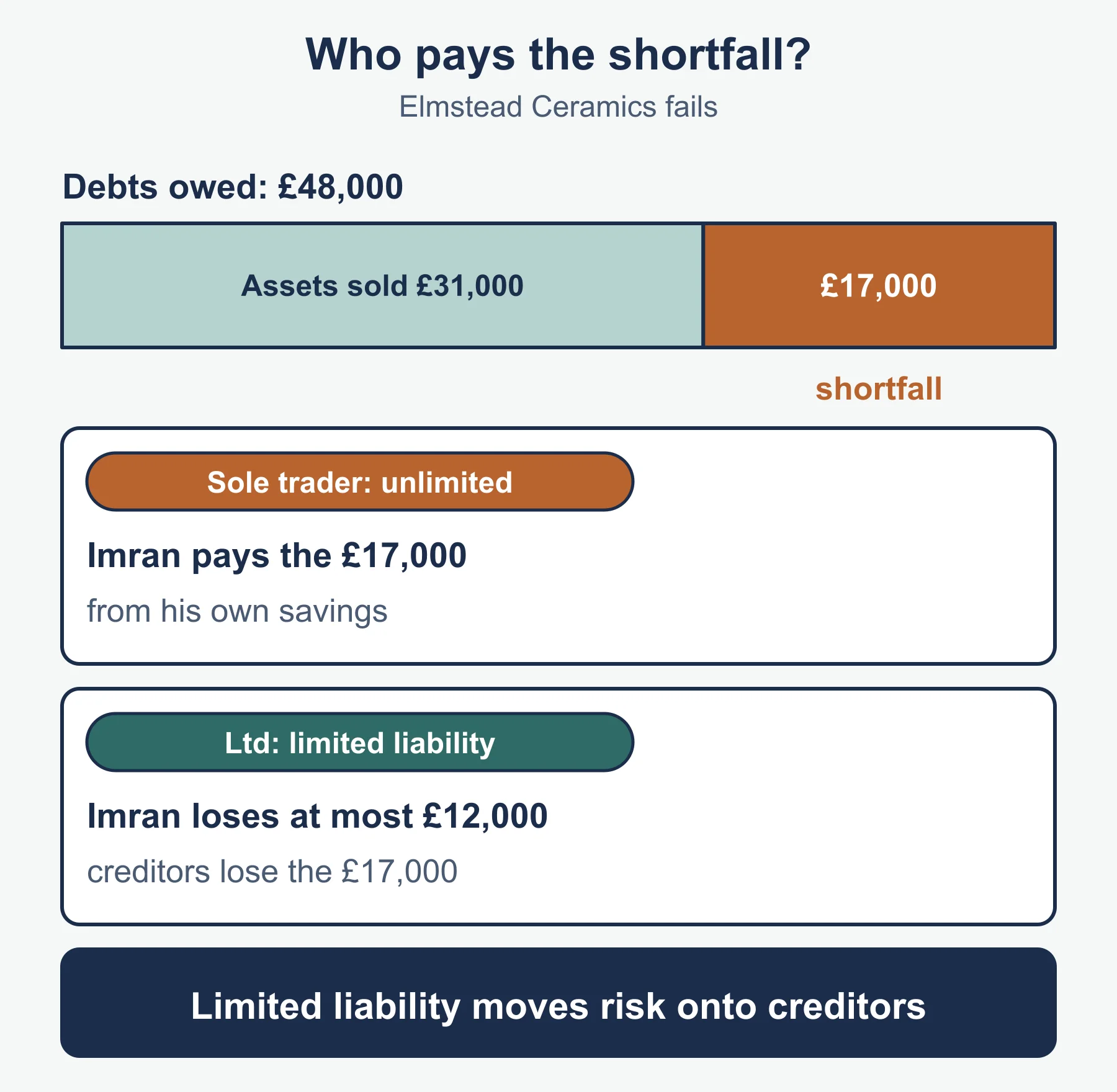
Imran runs Elmstead Ceramics as a sole trader. The business fails owing £48,000. Selling every business asset raises £31,000.
Shortfall = 48,000 - 31,000 = £17,000.
With unlimited liability, Imran must find the £17,000 from personal resources.
Now suppose the same business had been a private limited company in which Imran paid £12,000 for shares. His loss is limited to that £12,000. The £17,000 shortfall is not his to pay. The creditors lose it. That is the trade-off: limited liability protects the owner and moves risk onto the people the business owes.
Implications for the owner. Unlimited liability means a business failure can become a personal financial crisis. It can make an owner cautious about borrowing and about expansion. Limited liability makes it easier to take a risk, and can make it easier to persuade other people to invest. Lenders may still ask a small company owner for a personal guarantee, which means the protection is not always complete in practice. This is a general possibility, not a rule.
2. Types of business ownership for start-ups
Sole trader
One person owns and runs the business.
- Advantages: the owner keeps all the profit, makes decisions quickly, has few formalities to set up and keeps close contact with customers.
- Disadvantages: unlimited liability, a small pool of capital (the owner’s own money and loans), the whole workload falls on one person, and the business can struggle to cover illness or holidays.
Partnership
Two or more people share ownership. In general, partners in an ordinary partnership have unlimited liability (general knowledge, not specification text).
- Advantages: more capital than one person can raise, a wider mix of skills, a shared workload and shared decisions.
- Disadvantages: unlimited liability, profits must be shared, partners may disagree, and a partner’s poor decision can leave the others paying.
Partners often agree in writing how to share profit. A common method is to share in proportion to the capital each put in.
Worked example: Calder and Moss Design
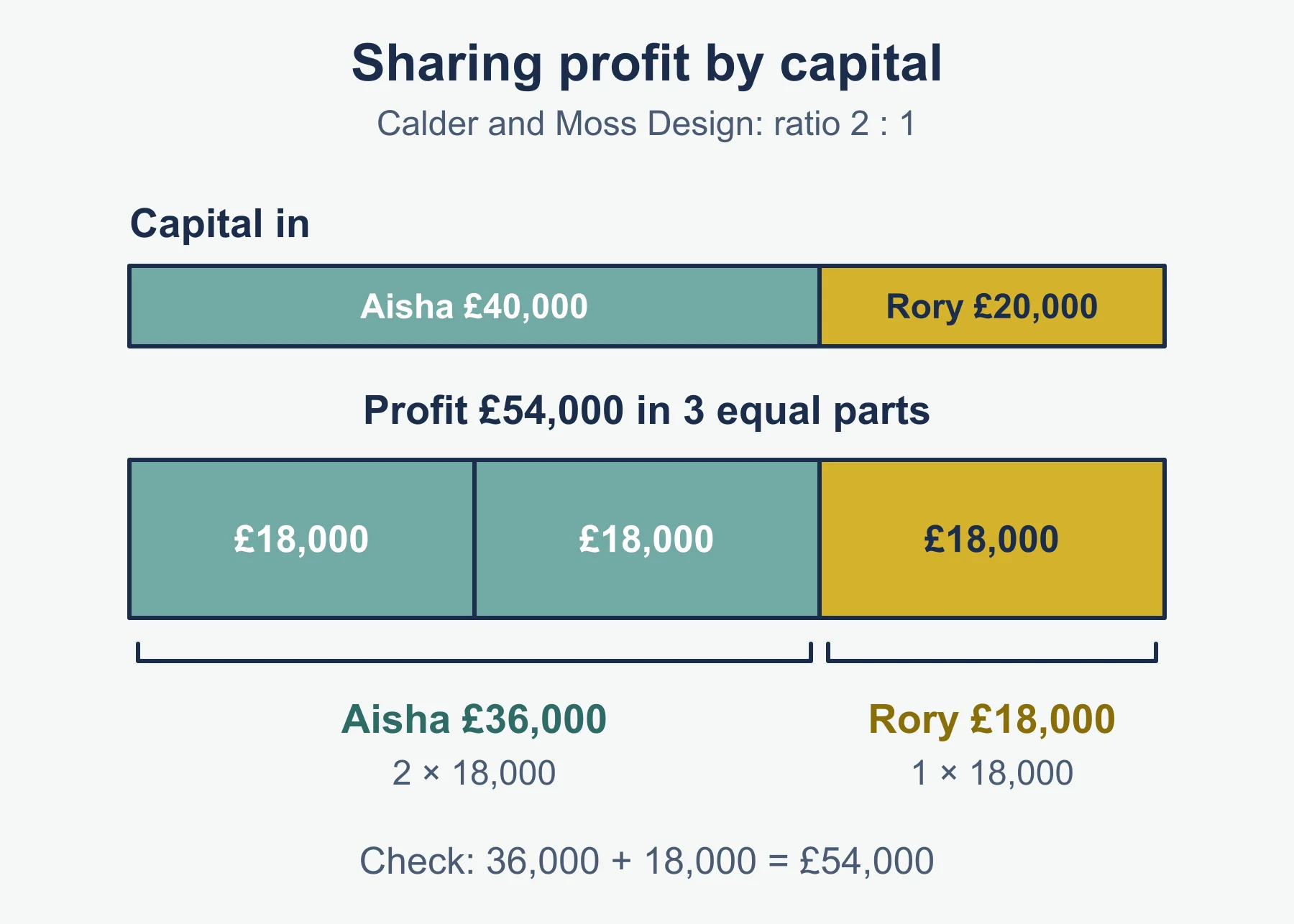
Aisha puts in £40,000 and Rory puts in £20,000. They agree to share profit in the ratio of their capital, which is 2 : 1. Profit for the year is £54,000.
Total parts = 2 + 1 = 3. One part = 54,000 / 3 = £18,000. Aisha = 2 x 18,000 = £36,000. Rory = £18,000. Check: 36,000 + 18,000 = £54,000.
Private limited company
A private limited company is owned by shareholders, and, as a general rule, its name ends in Ltd. It has limited liability, so shareholders risk only what they invested.
- Advantages: limited liability, shares can be sold to family or investors to raise capital, and the business can continue even if one owner leaves.
- Disadvantages: more rules and paperwork than a sole trader faces, the founder may share control and profit with other shareholders, and, in general, the shares cannot be offered freely to the public.
Keep legal detail general. The specification asks for advantages and disadvantages, not for statutes or filing deadlines.
| Feature | Sole trader | Partnership | Private limited company |
|---|---|---|---|
| Owners | One | Two or more | Shareholders |
| Liability | Unlimited | Unlimited (ordinary partnership) | Limited |
| Capital | Narrowest | Wider | Widest of the three |
| Control | Complete | Shared | Shared with shareholders |
| Set-up | Simplest | Simple | More formal |
3. Franchising
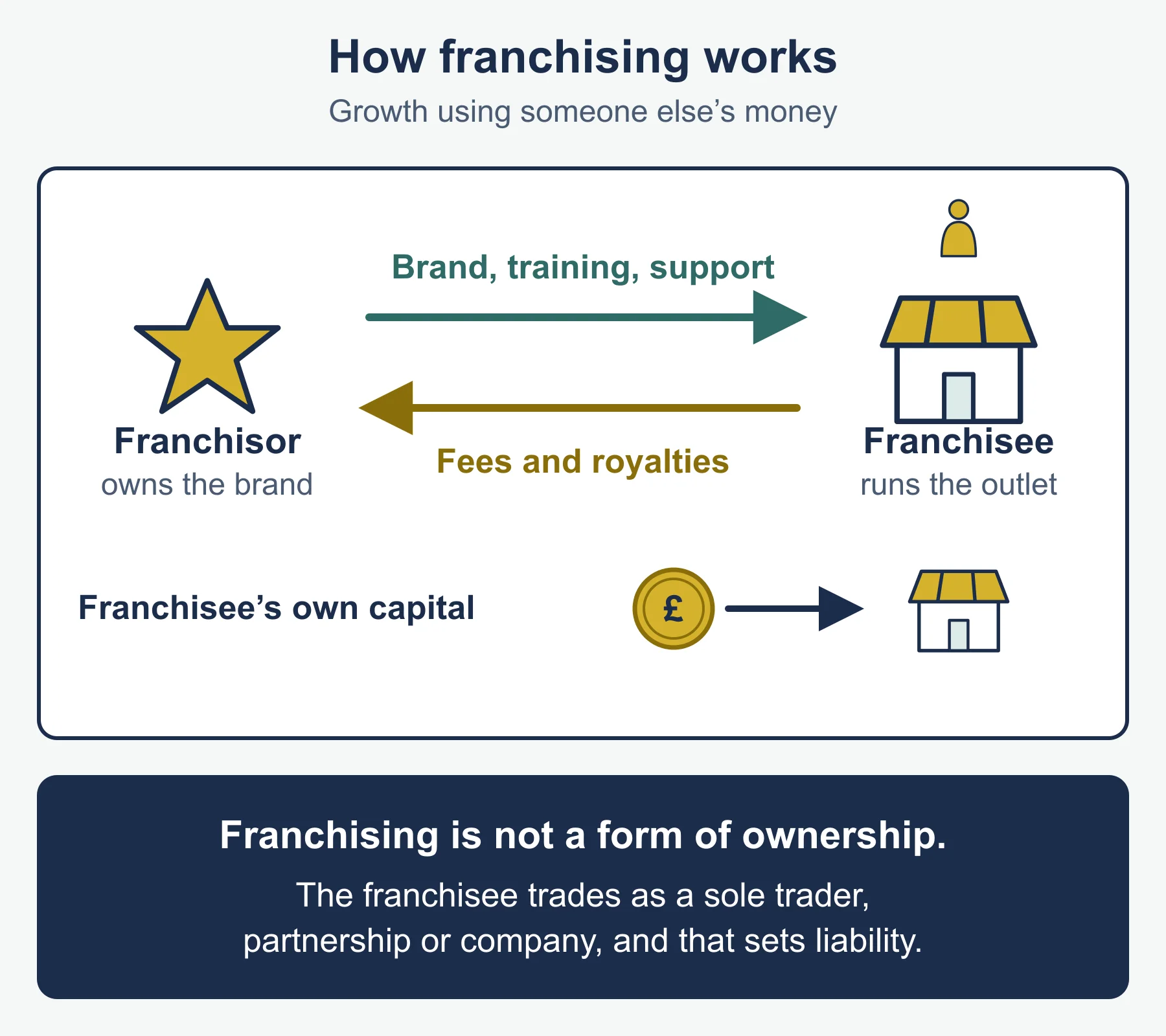
A franchise is an arrangement where a franchisor (the owner of a brand and business method) lets a franchisee run an outlet under that name. In general, a franchisee pays an initial fee and then a royalty, often a percentage of sales revenue (a common structure, not specification text).
Advantages of franchising (mainly for the franchisee): a known brand brings customers from the start, a proven business format lowers the risk of failure, and the franchisor may give training and support. For the franchisor: the brand can grow without the franchisor putting up all the capital, and the franchisee is motivated because it is their own money at stake.
Disadvantages: the franchisee pays fees and royalties, has less freedom over products and prices, and can be harmed by the franchisor’s reputation. The franchisor loses some control over quality and shares the revenue.
Worked example: Fresh Press Juice
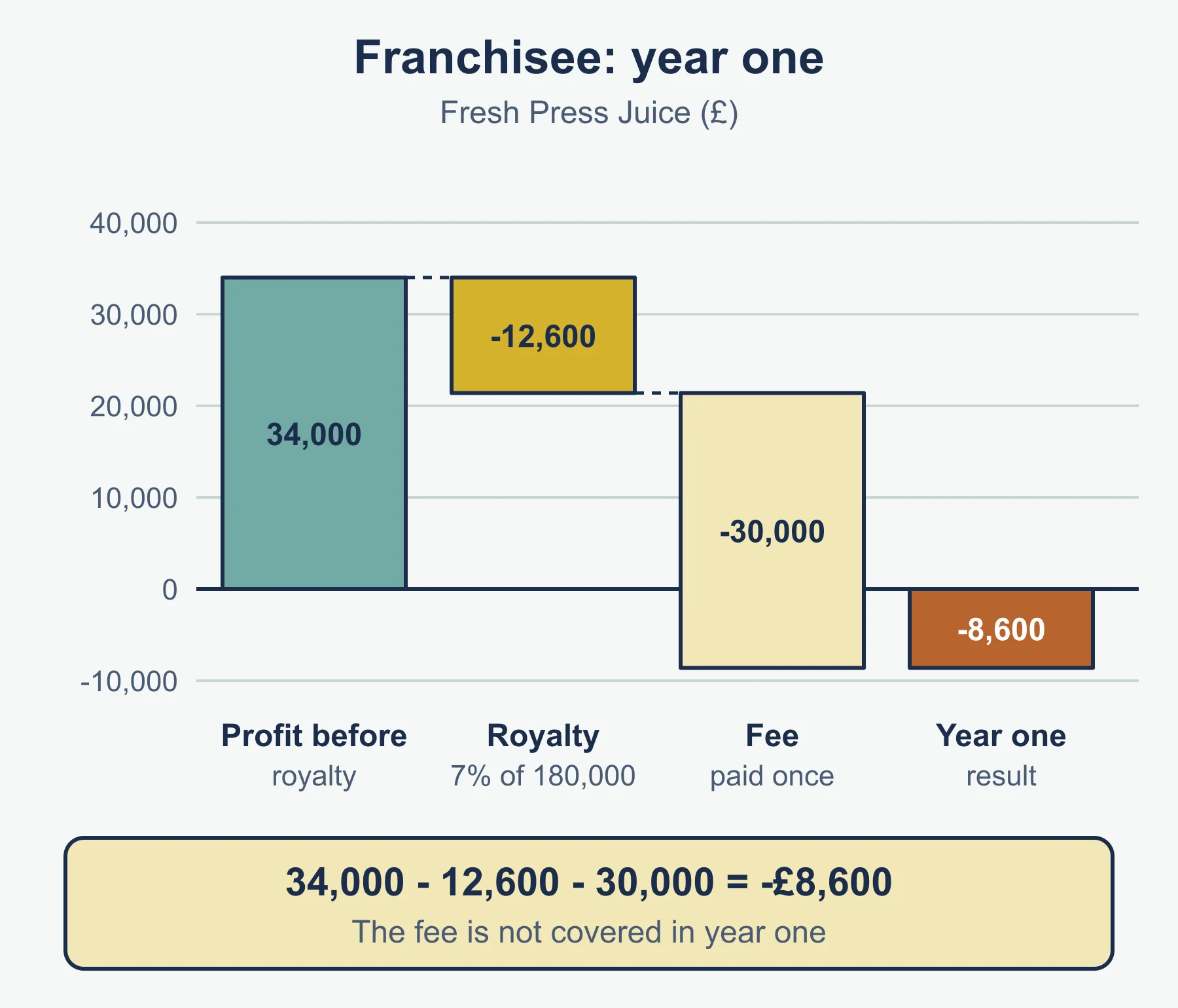
Nadia buys a Fresh Press Juice franchise. She pays an initial fee of £30,000 and a royalty of 7% of sales revenue. Her annual sales revenue is £180,000 and her profit before royalty is £34,000.
Royalty = 7% x 180,000 = £12,600. Profit after royalty = 34,000 - 12,600 = £21,400. In year one, after also paying the fee: 21,400 - 30,000 = -£8,600.
The first year does not cover the fee. Whether the franchise is a good idea depends on how long the agreement runs and whether the brand keeps trade up.
4. Proximity to market, labour, materials and competitors
Location means where the business operates. Each factor pulls in a different direction, and the best site is a trade-off.
- Proximity to market. Being near customers matters most where people walk in or where goods are costly or difficult to deliver. It can raise sales and cut distribution cost, but rent in busy places is higher.
- Proximity to labour. Being near enough people with the skills you need makes recruitment easier and may keep wages competitive. A shortage of skilled labour can push wages up.
- Proximity to materials. Heavy, bulky or perishable inputs cost more to carry and may spoil. Being close lowers transport cost and waste.
- Proximity to competitors. Being close can bring customers who are comparing choices, but it also means sharing them. Being far away can give a local monopoly but fewer passing customers.
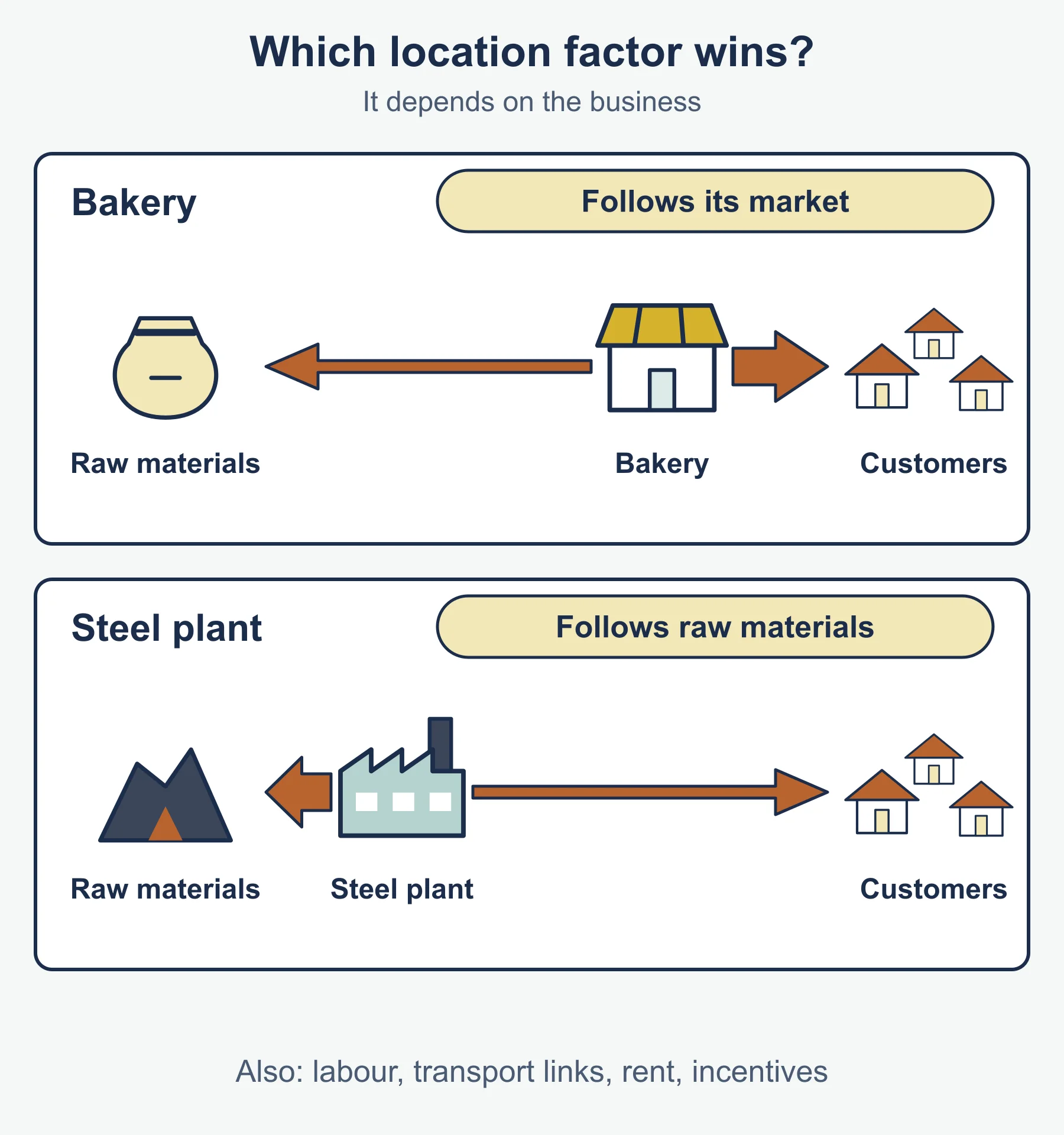
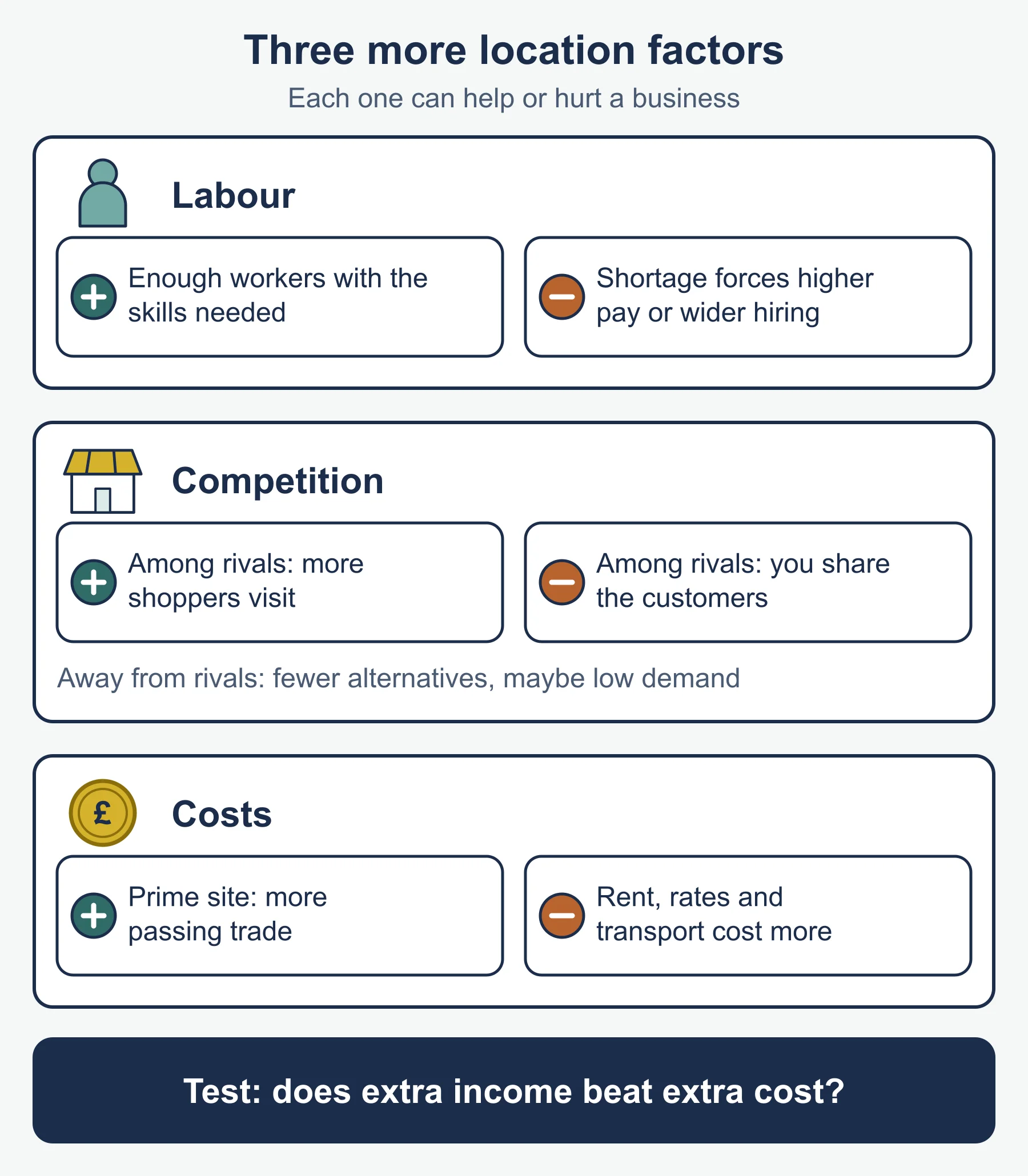
5. Nature of the business activity
The activity decides which factor dominates. A shop or hairdresser lives on footfall, so market comes first. A business that makes bulky goods from heavy materials leans toward the materials. A business that depends on a rare skill goes where the skilled labour is. A business that needs a lot of space may prefer cheaper land away from town centres. Always tie the factor to what the business actually does.
Worked example: Oakfield Loaves
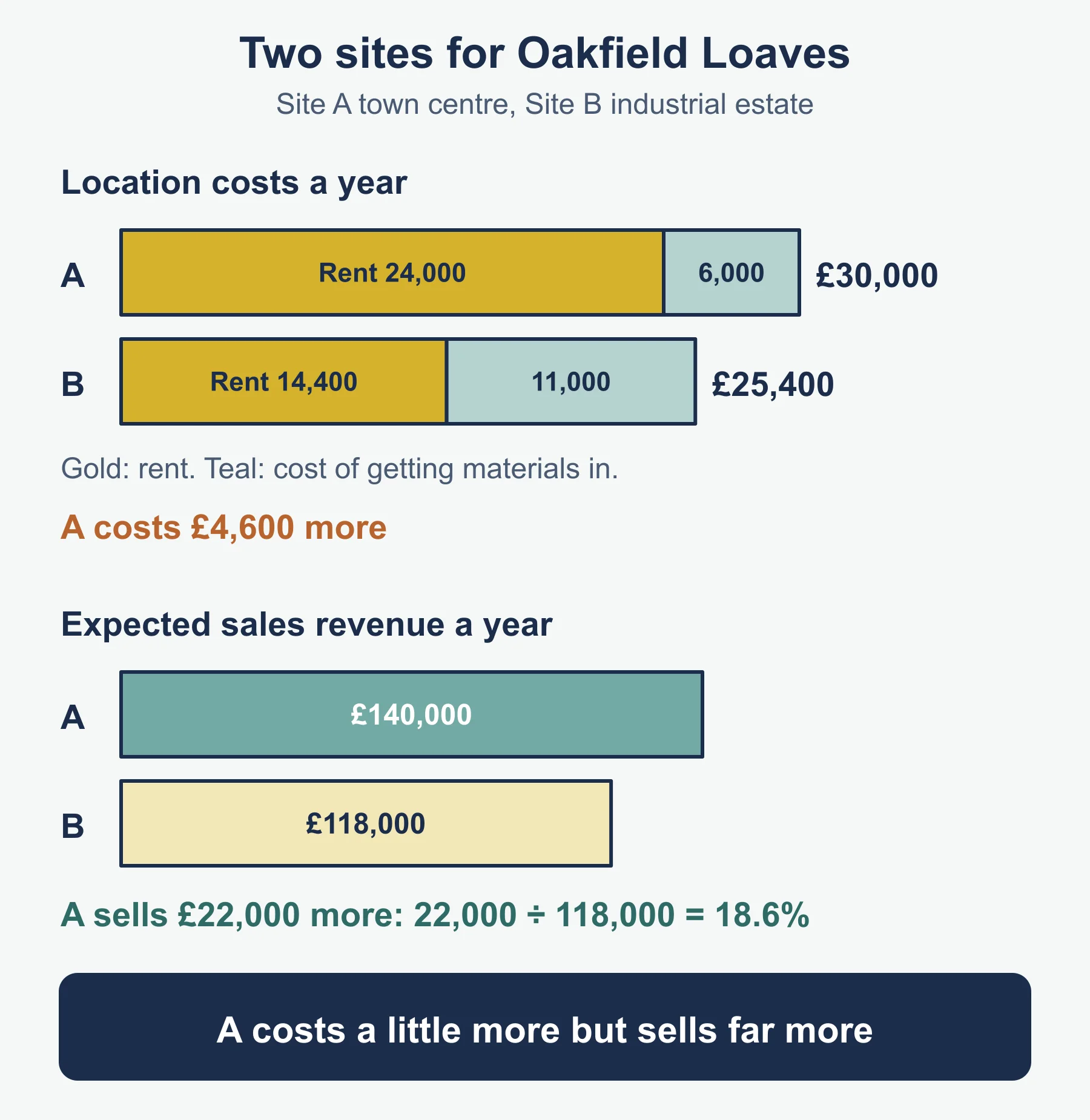
A bakery compares two sites for a year.
| Site A (town centre) | Site B (industrial estate) | |
|---|---|---|
| Rent | £24,000 | £14,400 |
| Cost of getting materials in | £6,000 | £11,000 |
| Expected sales revenue | £140,000 | £118,000 |
Site A location costs = 24,000 + 6,000 = £30,000. Site B = 14,400 + 11,000 = £25,400. Site A costs £4,600 more. Site A sales are 140,000 - 118,000 = £22,000 higher, which is 22,000 / 118,000 x 100 = 18.6% higher.
Site A costs a little more but brings far more sales revenue. A shop depending on walk-in trade would probably choose it, provided the sales forecast is reliable.
6. The internet and location
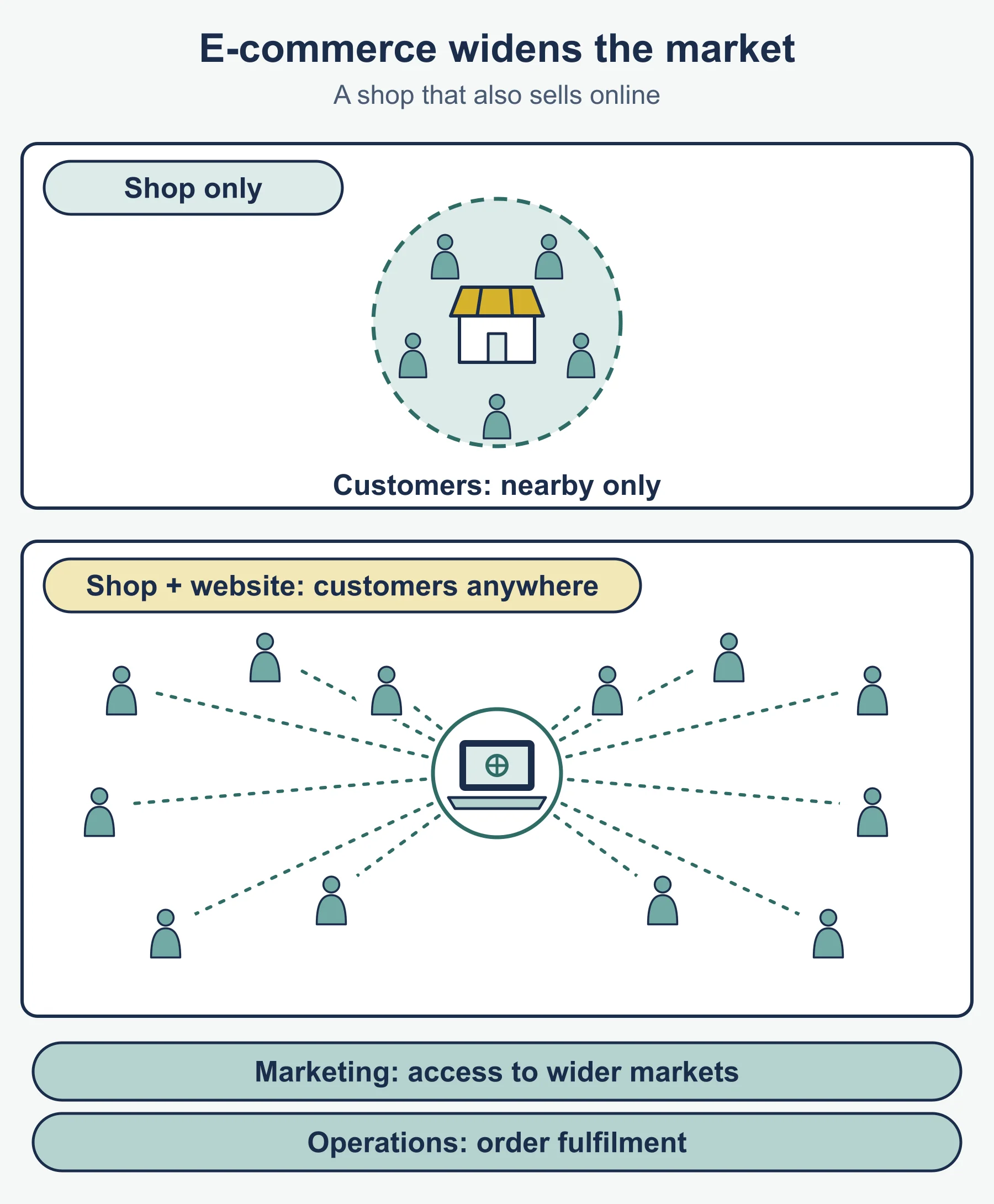
E-commerce means selling over the internet. It changes the location decision in several ways.
- A business can reach customers anywhere, so being near the market matters less for sales.
- It can choose cheaper premises, since customers do not visit. A warehouse in a low-rent area may be enough.
- Fixed premises still matter. Goods must be stored and sent, some customers want to see and try items, and services such as repairs or hairdressing cannot be delivered online.
- Many businesses combine both, using a website alongside a shop or a depot. Delivery costs and returns become new location factors.
Common errors
- Writing that limited liability means the business cannot lose money. It limits the owner’s loss, not the business’s.
- Saying that partners always have limited liability. Be exact: ordinary partners usually do not.
- Giving a franchise advantage without saying who gains. Name the franchisor or franchisee.
- Listing location factors without linking them to the business described.
- Claiming the internet removes the need for any premises.
Frequently asked questions
What is a sole trader? A sole trader is a business owned and run by one person, who keeps all the profit and makes decisions quickly. The owner has unlimited liability and a small pool of capital.
What is a private limited company? A private limited company is owned by shareholders and, as a general rule, its name ends in Ltd. Shareholders have limited liability, but there is more paperwork and, in general, its shares cannot be offered freely to the public.
How does the nature of the business affect its location? The activity decides which factor matters most. A shop or hairdresser depends on footfall, so being near the market comes first, while a business making bulky goods from heavy materials leans towards its materials.
How do partners share profit? Partners often agree in writing how to share profit, and a common method is in proportion to the capital each put in. Two partners investing £40,000 and £20,000 would share profit in the ratio 2 : 1.
Official syllabus
Pearson Edexcel Level 1/Level 2 GCSE (9-1) in Business (1BS0), Specification, Issue 2, July 2022, published by Pearson Education Limited. Theme 1: Investigating small business, Topic 1.4 Making the business effective, items 1.4.1 and 1.4.2.
Get free revision emails (optional)
Occasional emails with practice questions, worked explanations and links to free resources for the qualification and subjects you choose. No spam, and you can unsubscribe from any email. The free tools on this site never need an email.
Related resources
-
Practice questions
Edexcel GCSE Business: Limited liability and business location (1BS0) – Practice Questions
Original practice questions with worked answers on liability, business ownership, franchising and location for Edexcel GCSE Business.
Business · Pearson Edexcel · GCSE
Try questions -
Revision notes
Edexcel GCSE Business: Limited liability and business location (1BS0) – Revision Notes
Condensed revision notes on liability, sole traders, partnerships, private limited companies, franchises and location for Edexcel GCSE Business.
Business · Pearson Edexcel · GCSE
Revise topic -
Study guides
Edexcel GCSE Business: The marketing mix and the business plan (1BS0)
Study guide to the marketing mix and the business plan for Pearson Edexcel GCSE Business, Theme 1 topic 1.4, with worked forecast and cash-flow examples.
Business · Pearson Edexcel · GCSE
Read guide
Related articles
-
teaching
A Level tuition in Dubai: Cambridge or Pearson Edexcel International A Level?
Schools in Dubai and Abu Dhabi teach either Cambridge International AS & A Level or Pearson Edexcel International A Level. How the two are structured, why it matters for tuition, and how online classes from Lahore work.
9 October 2026
-
curriculum guides
Choosing subjects at IGCSE and A Level
How subject choices at 14 and 16 affect university options later, and how to keep pathways open without overloading a timetable.
28 July 2026
Studying this with a teacher
Working through Business GCSE?
This page is free and stays free. If you would rather be taught it, Marlbridge runs Business classes one-to-one and in small groups of up to 15, online in your own time zone. The first trial class is free. WhatsApp replies within an hour (8am–11pm Pakistan time, every day); email the same day.
Pearson Edexcel Business teachers at Marlbridge

