
Study Guides
Edexcel GCSE Business: The marketing mix and the business plan (1BS0)
Study guide to the marketing mix and the business plan for Pearson Edexcel GCSE Business, Theme 1 topic 1.4, with worked forecast and cash-flow examples.
- Subject
- Business
- Level
- GCSE
- Topic
- Making the business effective
- Author
- Marlbridge Academic Team
- Updated
- Reviewed by
- Asif Iqbal (what this means)
Aligned to Pearson Edexcel GCSE Business (1BS0), Issue 2, July 2022. Official specification .
Syllabus page (what it covers and how it is assessed): Pearson Edexcel GCSE Business.
Syllabus points this page covers
1BS0
- 1.4 Making the business effective (whole topic)
- 1.4.3 The marketing mix
- 1.4.4 Business plans
Found an error? Report a correction.
Want a teacher for this? Marlbridge teaches Business online. Request a free trial class.
This guide follows the Pearson Edexcel Level 1/Level 2 GCSE (9-1) in Business (1BS0) specification, Issue 2, July 2022. It covers Theme 1: Investigating small business, topic 1.4 Making the business effective, content items 1.4.3 The marketing mix and 1.4.4 Business plans. The specification has two written papers: Theme 1 Investigating small business (1BS0/01) and Theme 2 Building a business (1BS0/02). Each lasts 1 hour 45 minutes, carries 90 marks and is 50% of the qualification. Each has three sections (A 35 marks, B 30 marks, C 25 marks) of calculations, multiple-choice, short-answer and extended-writing questions, and Sections B and C use business contexts given in the paper. Calculators may be used, and formulae are listed in the specification (Appendix 3) but are not provided in the examinations.
Course links: the Edexcel GCSE Business hub, the printable checklist and the free diagnostics. Companion pages: the revision notes and the practice questions. Every business and figure below is invented. The descriptions of each marketing mix element and of the business plan sections are general explanations written for this guide, not wording from the specification, which lists the elements and sections as short bullet points.
What the specification asks for
| Item | What you need to learn | Where in this guide |
|---|---|---|
| 1.4.3 | What the marketing mix is and the importance of each element: price, product, promotion, place | Section 1 |
| 1.4.3 | How the elements work together: balancing the mix based on the competitive environment; the impact of changing consumer needs; the impact of technology (e-commerce, digital communication) | Section 2 |
| 1.4.4 | The role and importance of a business plan: identifying the business idea, aims and objectives, target market (market research), forecast revenue, cost and profit, cash-flow forecast, sources of finance, location and marketing mix | Section 3 |
| 1.4.4 | The purpose of planning business activity: minimising risk and obtaining finance | Section 4 |
The two items connect. The marketing mix is one section of a business plan, so a plan has to say what the business will sell, at what price, where and how it will tell customers. The briefest coverage below is the location line in 1.4.4, since location has its own item, 1.4.2.
1. What the marketing mix is (1.4.3)
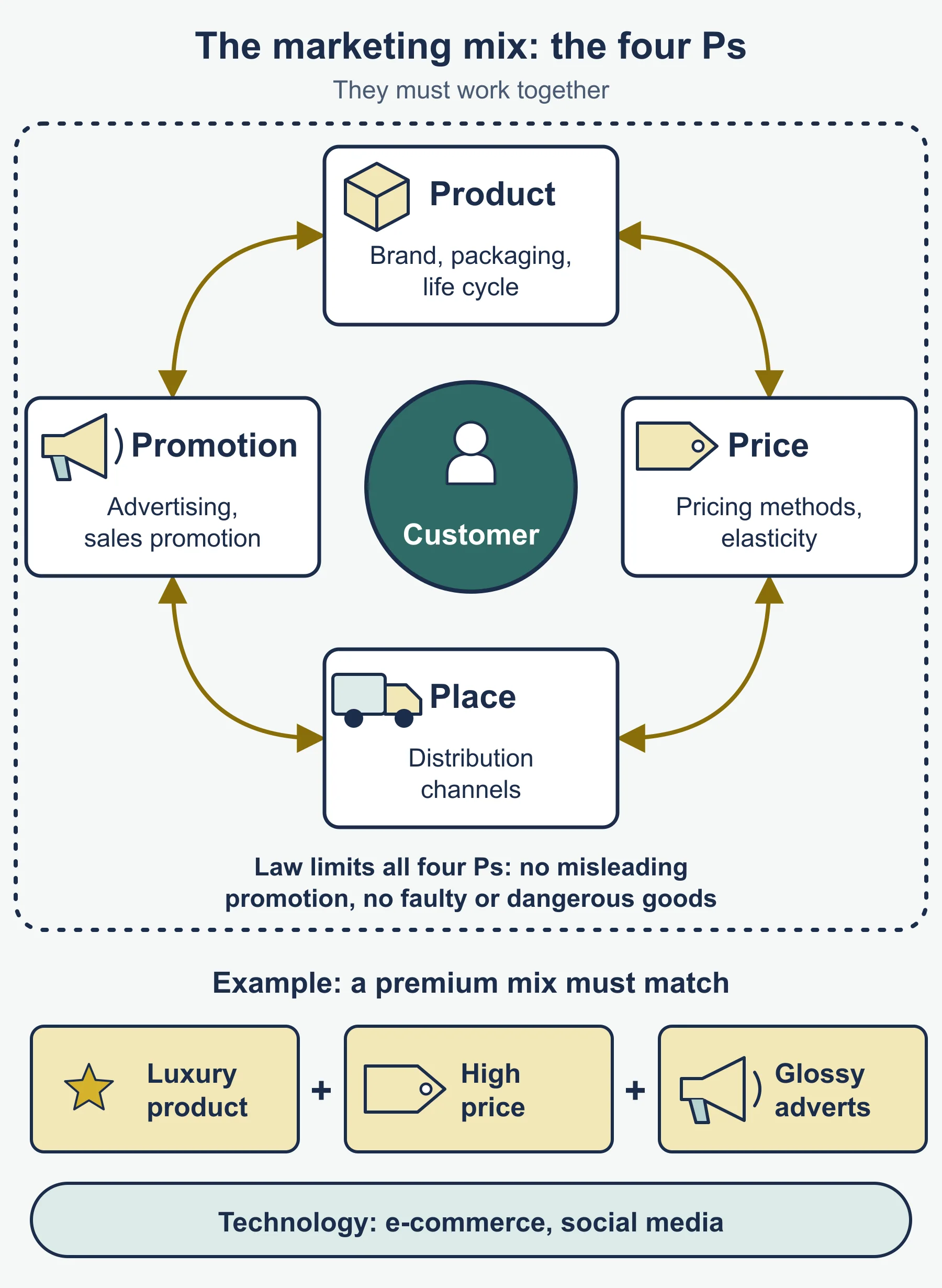
The marketing mix is the set of choices a business makes on four elements: price, product, promotion and place. A business controls all four, so together they decide whether a customer in the target market chooses it or a rival.
Product
The product is the good or service the business offers. It has to meet a need that the target market actually has, in a form customers find acceptable: the right features, quality, design and range. If the product is wrong, no amount of clever promotion will keep customers returning.
Price
Price is what the customer pays. It matters because it affects both demand and profit. It must be high enough to cover the cost of making or buying the product and leave a profit, and low enough that customers see value in it. Price also sends a message about quality, so a very low price can make a product look poor.
Promotion
Promotion is how the business informs and persuades customers. It makes people aware the product exists and gives them a reason to buy. A product nobody knows about cannot earn revenue. Promotion costs money, so a small business must judge which methods reach its target market at a cost it can afford.
Place
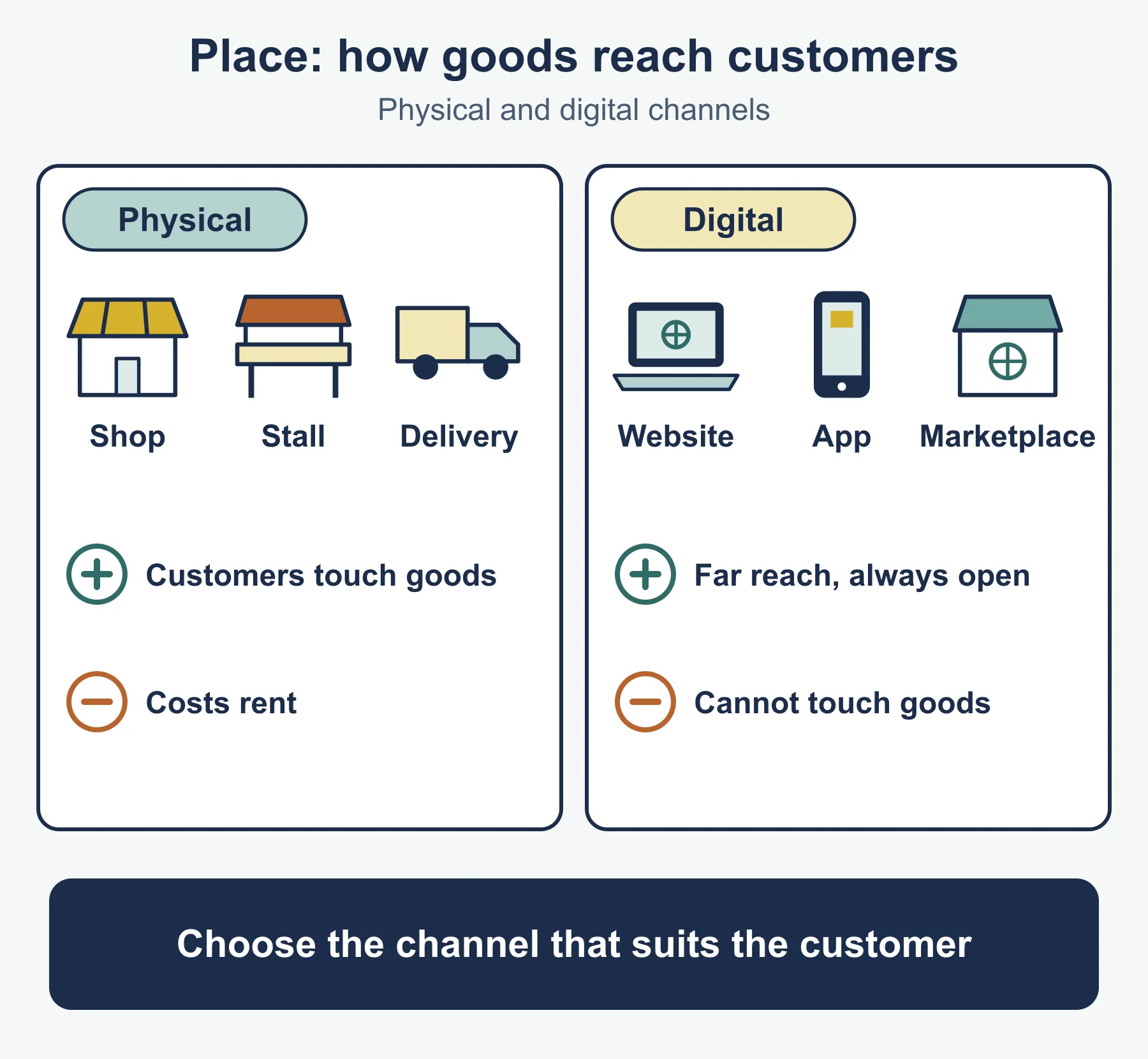
Place is how and where the product reaches the customer: a shop, a market stall, a website, delivery to the door, or a combination. It matters because customers must be able to obtain the product easily.
2. How the elements work together (1.4.3)
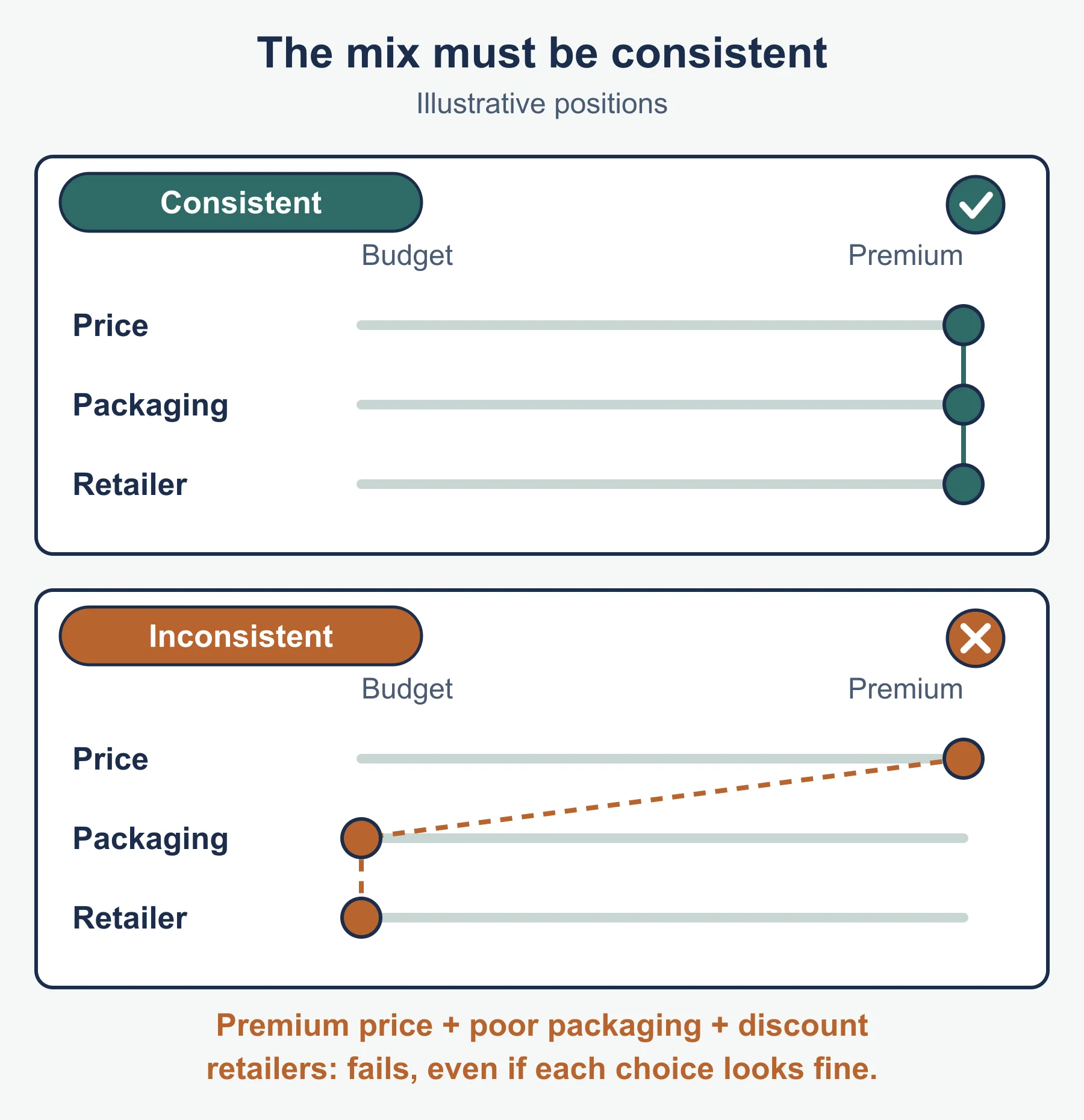
The four elements are not chosen separately. A change to one usually forces a change to another. A premium product needs a matching price, a place where premium buyers shop and promotion in the same style. Balancing the mix means making the four choices fit each other and the target market.
Balancing the mix for the competitive environment
The competitive environment means the rivals the business faces and what they offer. A business studies competitors before deciding how to position itself.
- Many close rivals selling similar products tend to push the business to watch price and to find something different in product or promotion.
- Few rivals give the business more freedom over price, but it still needs promotion to build awareness.
- A rival that cuts price or improves its product may force a response in the mix. The response need not match them: a business may keep its price and increase promotion that stresses quality.
Changing consumer needs
Consumer needs change as tastes, incomes, lifestyles and priorities change. The mix has to be reviewed for each element. If customers begin to want healthier or more sustainable choices, the product changes. If budgets tighten, price changes. If they want to buy at different times and places, place changes. If they spend time in different media, promotion changes.
The impact of technology
E-commerce means selling through a website or app. For place, it lets a small business reach customers beyond its local area without extra premises, though it must handle delivery and returns. For price, customers can compare prices quickly online, which puts pressure on the business to stay competitive. For product, a business can offer a wider range and sometimes customise items.
Digital communication means promoting through methods such as email, social media and a website. It can target particular groups at relatively low cost, and the business can see quickly how customers respond. The risks are that rivals use the same channels, and that poor online reviews spread quickly.
Worked example 1: balancing a mix
Wrenchwell Bike Repairs is a new business whose owner repairs bicycles at customers’ homes from a van. The only rival nearby is a shop with a waiting list of about a week. The target market is commuters who cannot visit shops during opening hours.
- Product: a repair service with a promise to fix common faults on the same visit.
- Place: the van travels to the customer, which a rival with fixed premises cannot match.
- Promotion: a simple website with a booking form, plus local social media posts.
- Price: £35 per repair. This is a convenience premium, justified by the same-visit fix and the saving of the customer’s time.
The four choices fit one another because the price is set at a level that suits a convenience service. Cutting the price below the shop’s would not suit a convenience service. The mix is balanced against the competitive environment: the rival is slow, so Wrenchwell competes on convenience, not on price alone.
3. The role of a business plan (1.4.4)
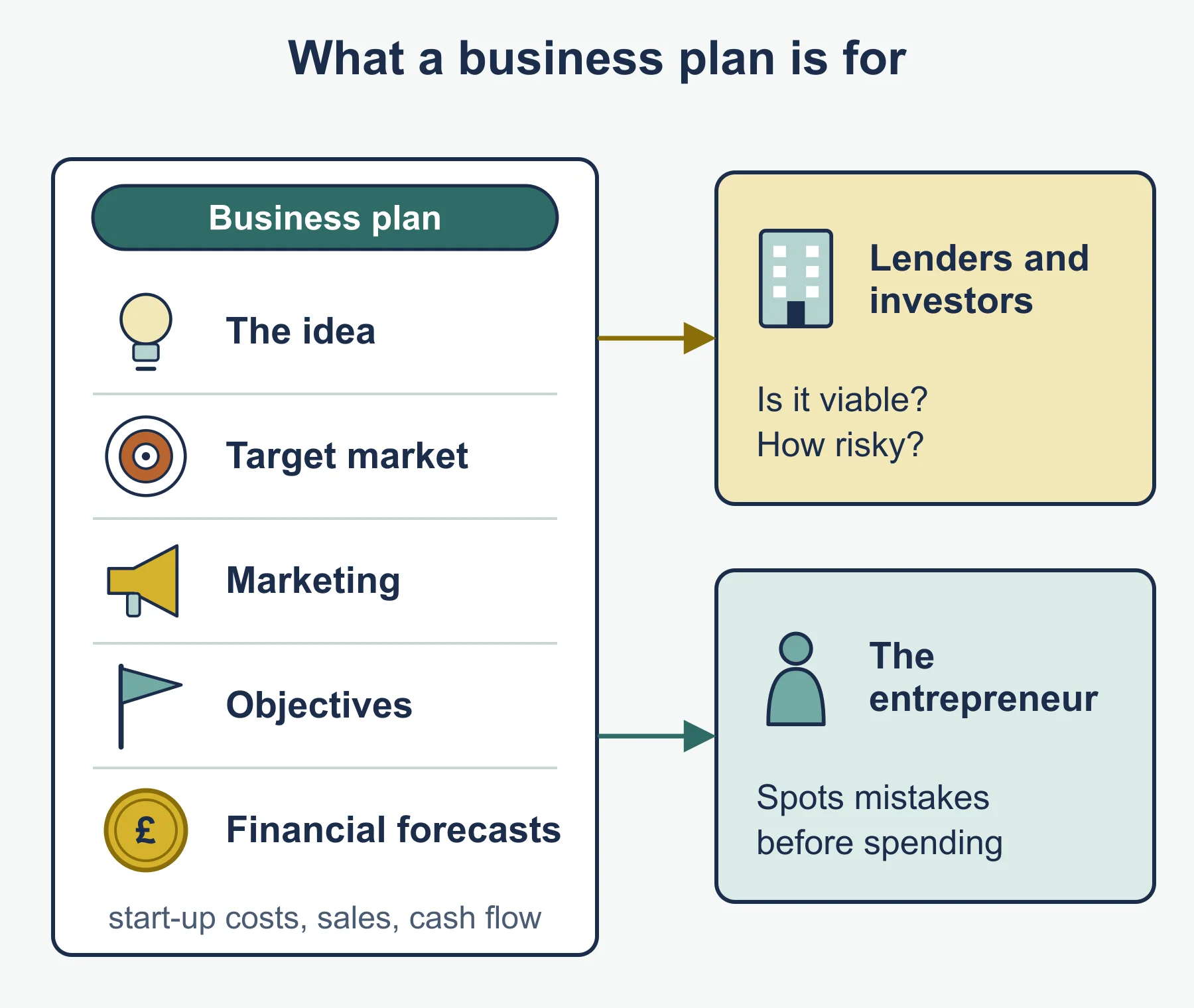
A business plan is a written document setting out what a business intends to do and how it will do it. The specification lists what it should identify.
- Business idea: what the business will sell and the customer need it meets.
- Business aims and objectives: what the owner wants to achieve, and the measurable targets set to get there.
- Target market (market research): who the customers are, and the evidence for it. Market research gathers information on customers and competitors, so the plan can show demand exists.
- Forecast revenue, cost and profit: estimates of sales, costs and the profit that results.
- Cash-flow forecast: a month-by-month estimate of cash coming in and going out.
- Sources of finance: where the money to start and run the business will come from.
- Location: where the business will operate, and why.
- Marketing mix: the product, price, promotion and place choices, together with the reasons for them.
Worked example 2: forecast revenue, cost and profit
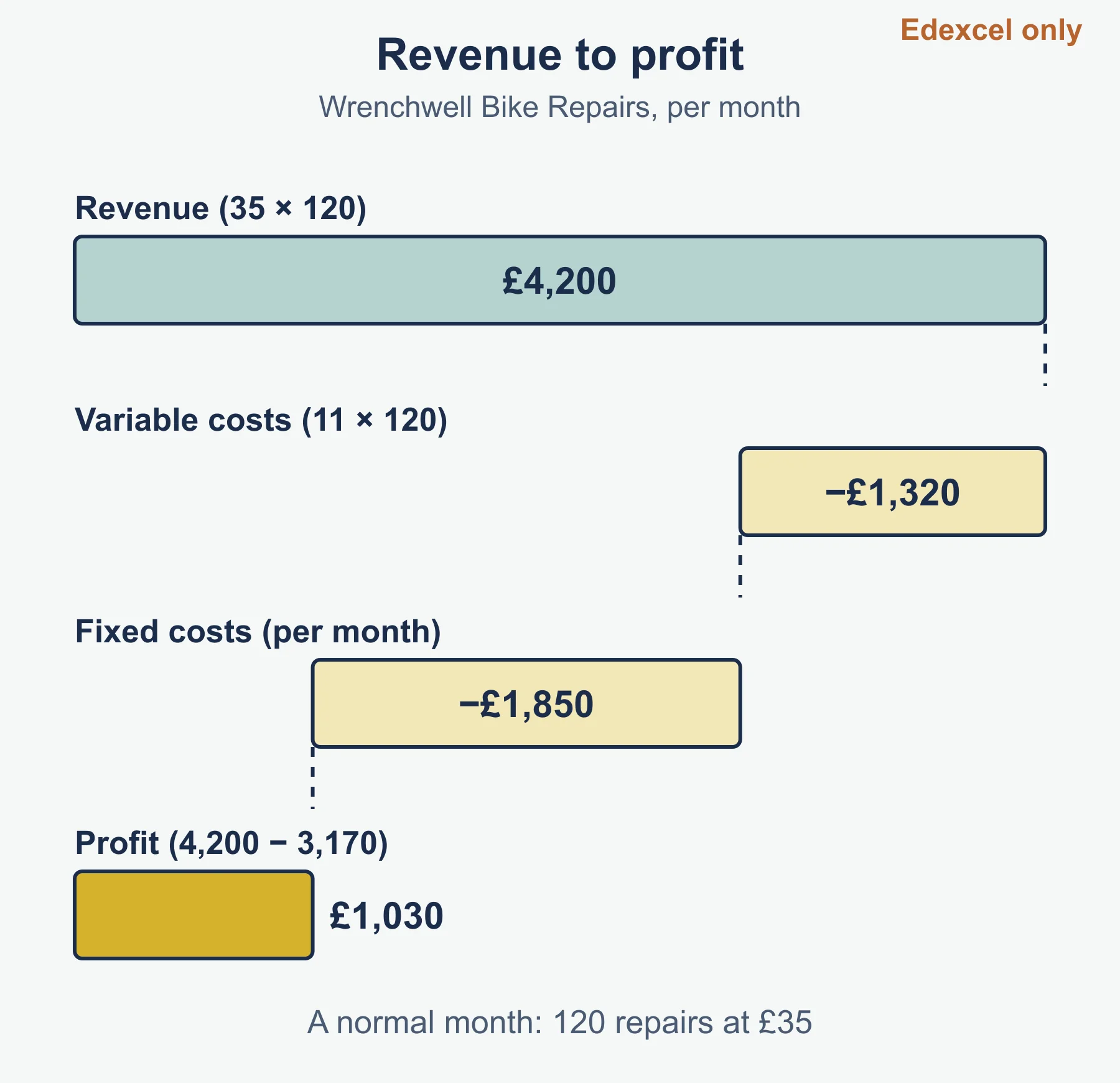
Wrenchwell expects to complete 120 repairs in a normal month at £35 each. The variable cost is £11 per repair, and fixed costs are £1,850 per month.
Using revenue = price × quantity and total cost = total fixed costs + total variable costs (both in Appendix 3), and profit = revenue − total cost (the standard form of the profit formula, not an Appendix 3 formula):
- Revenue: 35 × 120 = £4,200.
- Total variable costs: 11 × 120 = £1,320.
- Total cost: 1,850 + 1,320 = £3,170.
- Profit: 4,200 − 3,170 = £1,030 per month.
Worked example 3: a cash-flow forecast
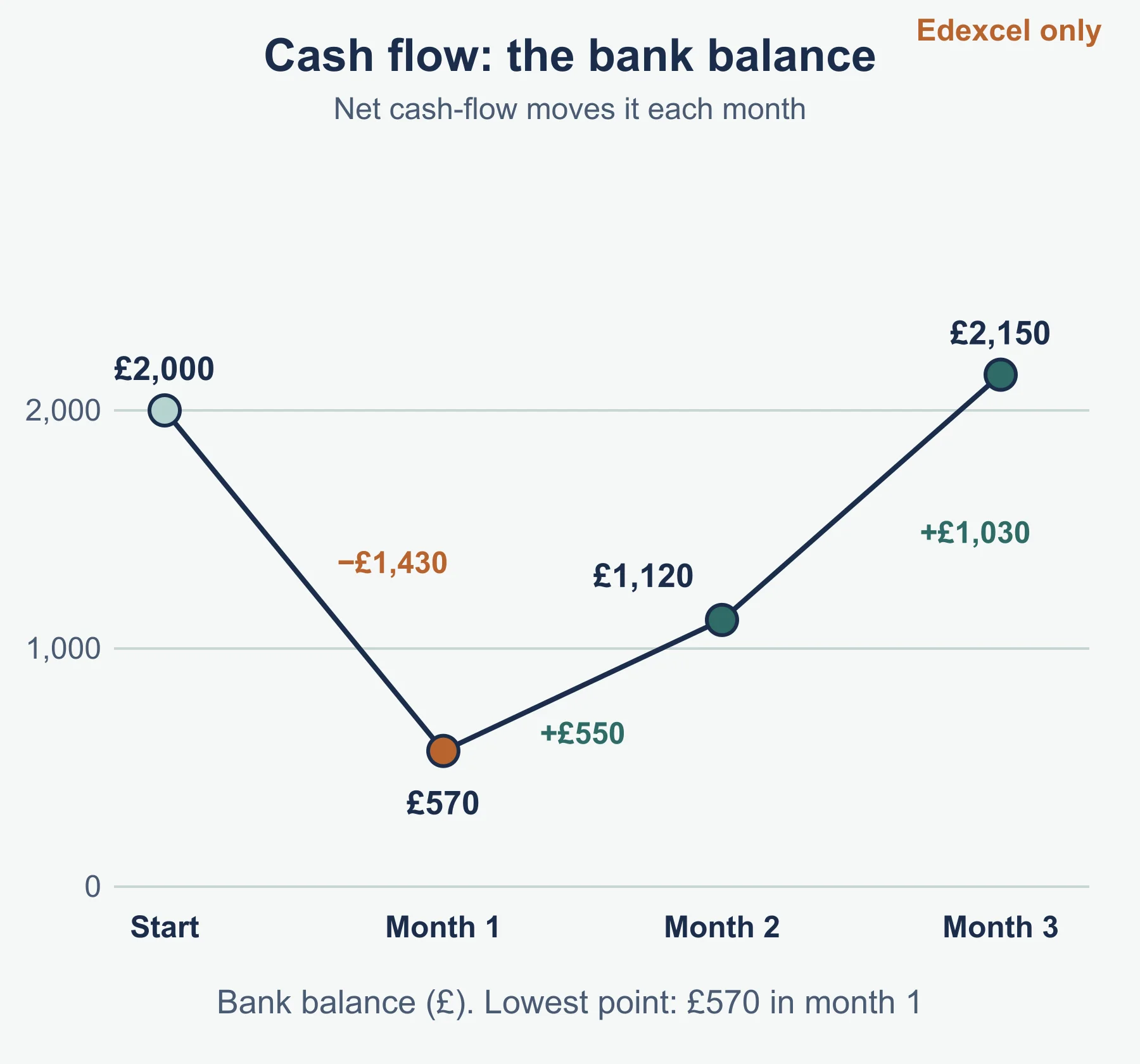
Cash flow is not the same as profit. The owner starts with £2,000 of savings in the bank. In month 1 she buys tools costing £1,500. She expects 80, 100 and 120 repairs in months 1 to 3. Using net cash-flow = cash inflows − cash outflows, and closing balance = opening balance + net cash-flow:
| Month 1 | Month 2 | Month 3 | |
|---|---|---|---|
| Opening balance (£) | 2,000 | 570 | 1,120 |
| Cash in: repairs (£) | 2,800 | 3,500 | 4,200 |
| Cash out: variable costs (£) | 880 | 1,100 | 1,320 |
| Cash out: fixed costs (£) | 1,850 | 1,850 | 1,850 |
| Cash out: tools (£) | 1,500 | 0 | 0 |
| Net cash-flow (£) | −1,430 | 550 | 1,030 |
| Closing balance (£) | 570 | 1,120 | 2,150 |
Each opening balance equals the previous closing balance. The business never runs out of cash, but the balance falls to £570 in month 1. A plan that shows this warns the owner that a smaller starting balance, or a weaker first month, could be a problem.
4. Why plan: minimising risk and obtaining finance (1.4.4)
Minimising risk
Starting a business is risky because the owner commits money before knowing how customers will respond. Planning cuts that risk in several ways.
- Writing down the idea forces the owner to test it against evidence from market research.
- Forecasts show whether the business could make a profit at the expected sales, and what happens if sales fall.
- A cash-flow forecast warns of months when cash could run out, so the owner can arrange extra finance before the shortage arrives.
- Looking at rivals and the mix shows weaknesses early, while they are cheap to fix.
A plan reduces risk but cannot remove it, because forecasts are estimates.
Obtaining finance
People who might lend or invest, such as a bank, want evidence that the owner has thought carefully and that the business can repay. A plan with market research, realistic forecasts and a clear cash-flow forecast gives them that evidence. It shows how much money is needed, what it will be spent on and how it will be repaid, so the owner is more likely to be able to obtain finance. A weak or missing plan makes a lender see the business as a bigger risk.
Worked example 4: using a plan to support a request
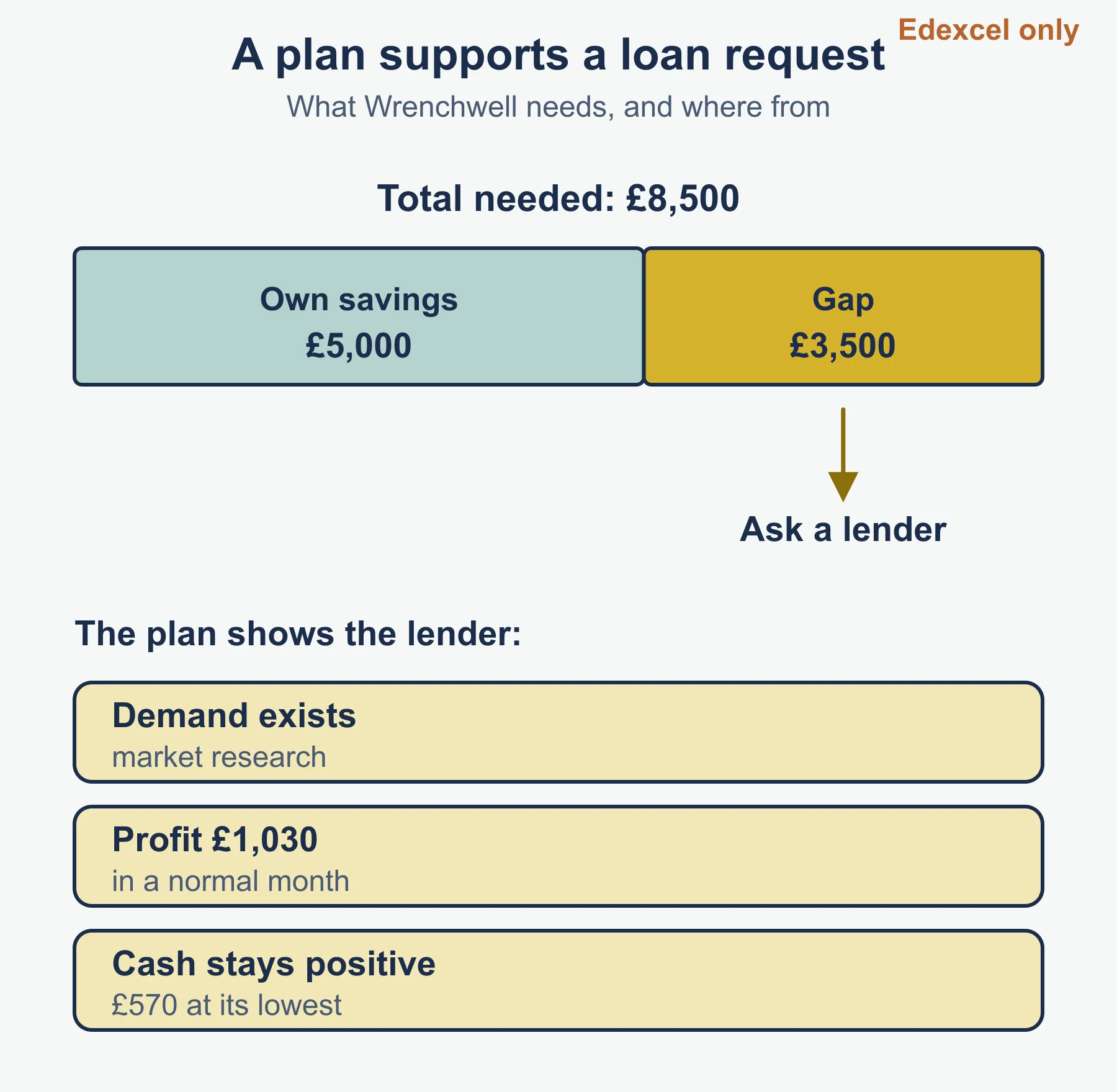
Suppose Wrenchwell’s owner needs £8,500 in total for the van deposit, tools and early running costs, and has £5,000 of her own savings. The gap is £3,500, which she may seek from a lender. The plan supports the request by showing demand, a profit of £1,030 in a normal month and a cash-flow forecast that stays positive. A cautious lender would still check that the first months are realistic.
Common errors
- Describing a marketing mix element without saying why it matters to this business.
- Treating the four elements as a list of unconnected facts, when the specification asks how they work together.
- Writing “technology helps” without saying which element it changes and how.
- Confusing profit with cash. A profitable month can still leave the bank balance lower, as in month 1 above.
- Saying a plan guarantees success. It reduces risk and helps with finance, but it cannot remove risk.
Next steps
Recap with the revision notes, then test yourself with the practice questions. Take the free diagnostics to see where to focus.
Frequently asked questions
How do the elements of the marketing mix work together? A change to one element usually forces a change to another. A premium product needs a matching price, a place where premium buyers shop and promotion in the same style.
How do changing consumer needs affect the marketing mix? As tastes, incomes and lifestyles change, each element has to be reviewed. If customers want healthier or more sustainable choices, the product changes; if budgets tighten, price may need attention.
How does e-commerce affect the marketing mix? For place, e-commerce lets a small business reach customers beyond its local area without extra premises, though it must handle delivery and returns. For price, customers can compare prices online easily.
How does a business plan help an owner get a loan? A plan with market research, realistic forecasts and a clear cash-flow forecast shows a bank that the owner has thought carefully and that the business can repay.
Official syllabus
Pearson Edexcel Level 1/Level 2 GCSE (9-1) in Business (1BS0), Specification, Issue 2, July 2022, published by Pearson Education Limited. Theme 1: Investigating small business, topic 1.4 Making the business effective, content items 1.4.3 The marketing mix and 1.4.4 Business plans.
Get free revision emails (optional)
Occasional emails with practice questions, worked explanations and links to free resources for the qualification and subjects you choose. No spam, and you can unsubscribe from any email. The free tools on this site never need an email.
Related resources
-
Practice questions
Edexcel GCSE Business: The marketing mix and the business plan (1BS0) – Practice Questions
Twelve original practice questions with worked answers on the marketing mix and business plans for Pearson Edexcel GCSE Business, Theme 1 topic 1.4.
Business · Pearson Edexcel · GCSE
Try questions -
Revision notes
Edexcel GCSE Business: The marketing mix and the business plan (1BS0) – Revision Notes
Condensed revision notes on the marketing mix and business plans for Pearson Edexcel GCSE Business Theme 1 topic 1.4, with formulae and a self-test.
Business · Pearson Edexcel · GCSE
Revise topic -
Study guides
Edexcel GCSE Business: Limited liability and business location (1BS0)
Study guide to limited and unlimited liability, sole traders, partnerships, private limited companies, franchising and location, for Edexcel GCSE Business.
Business · Pearson Edexcel · GCSE
Read guide
Related articles
-
teaching
A Level tuition in Dubai: Cambridge or Pearson Edexcel International A Level?
Schools in Dubai and Abu Dhabi teach either Cambridge International AS & A Level or Pearson Edexcel International A Level. How the two are structured, why it matters for tuition, and how online classes from Lahore work.
9 October 2026
-
curriculum guides
Choosing subjects at IGCSE and A Level
How subject choices at 14 and 16 affect university options later, and how to keep pathways open without overloading a timetable.
28 July 2026
Studying this with a teacher
Working through Business GCSE?
This page is free and stays free. If you would rather be taught it, Marlbridge runs Business classes one-to-one and in small groups of up to 15, online in your own time zone. The first trial class is free. WhatsApp replies within an hour (8am–11pm Pakistan time, every day); email the same day.
Pearson Edexcel Business teachers at Marlbridge

