
Revision Notes
Edexcel GCSE Business: Limited liability and business location (1BS0) – Revision Notes
Condensed revision notes on liability, sole traders, partnerships, private limited companies, franchises and location for Edexcel GCSE Business.
- Subject
- Business
- Level
- GCSE
- Topic
- Making the business effective
- Author
- Marlbridge Academic Team
- Updated
- Reviewed by
- Asif Iqbal (what this means)
Aligned to Pearson Edexcel GCSE Business (1BS0), Issue 2, July 2022. Official specification .
Syllabus page (what it covers and how it is assessed): Pearson Edexcel GCSE Business.
Syllabus points this page covers
1BS0
- 1.4 Making the business effective (whole topic)
- 1.4.1 Options for start-up and small businesses
- 1.4.2 Business location
Found an error? Report a correction.
Want a teacher for this? Marlbridge teaches Business online. Request a free trial class.
These notes condense Theme 1, Topic 1.4 items 1.4.1 and 1.4.2 of the Pearson Edexcel Level 1/Level 2 GCSE (9-1) in Business (1BS0) specification, Issue 2, July 2022. General points (partner liability, fee and royalty structure, share rules) are general knowledge, not specification text. For full explanations and worked examples, read the study guide. When you are ready to test yourself, use the practice questions, the Business hub, the printable checklist and the free diagnostics.
1.4.1 Liability: the core definitions
| Term | Meaning | Who it affects |
|---|---|---|
| Unlimited liability | The owner is personally responsible for every business debt | Sole traders, and (in general) partners in an ordinary partnership |
| Limited liability | The owner can lose only the amount invested in the business | Shareholders in a private limited company |
Implication in one line each:
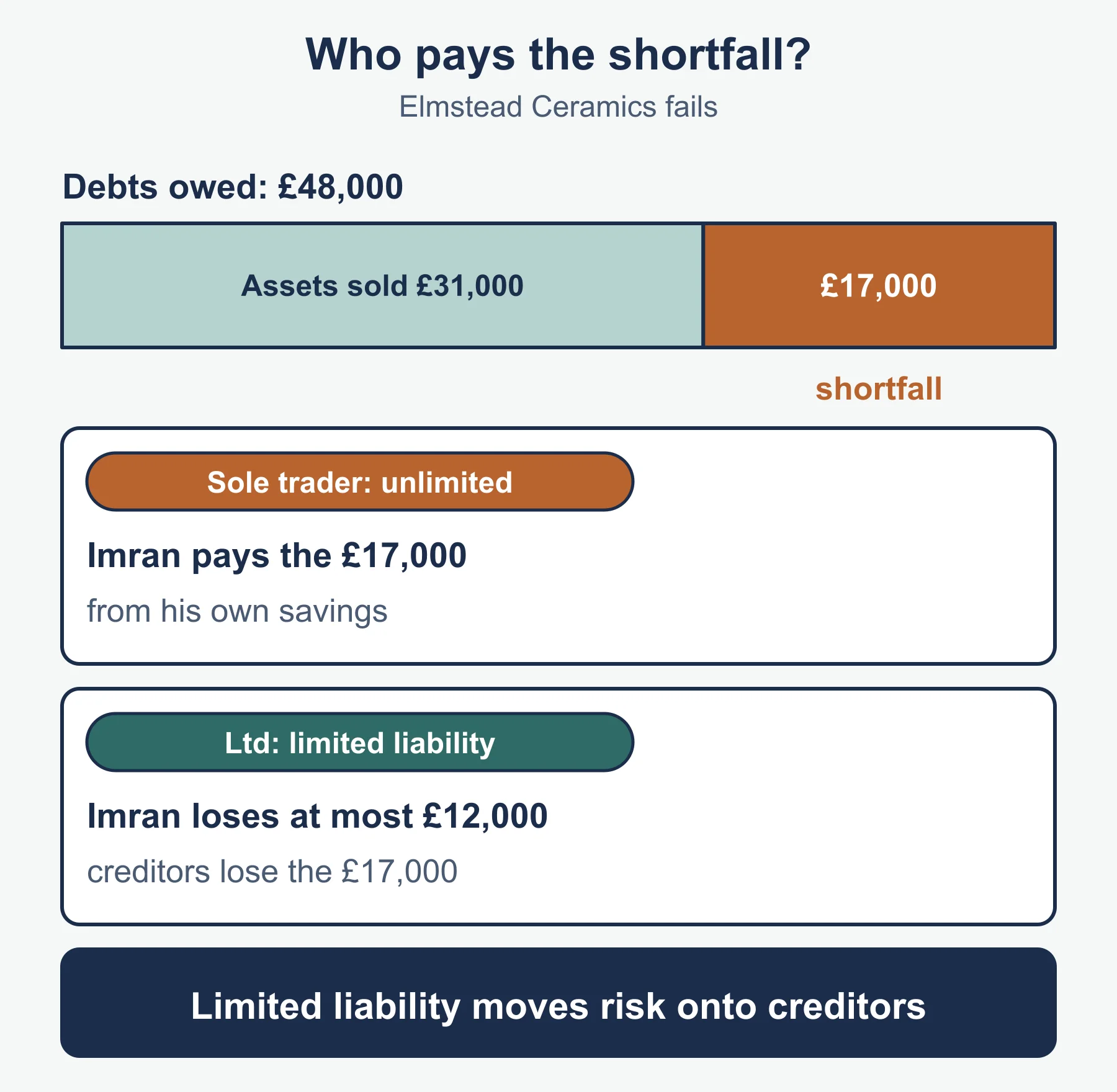
- Unlimited: personal savings and property can be used to settle debts, so failure can be a personal disaster.
- Limited: personal wealth is protected, so the owner can take bigger risks, but creditors carry the loss.
Method: a liability calculation
- Add up the total owed.
- Subtract what the business assets raise when sold.
- The result is the shortfall.
- Unlimited liability: the owner funds the shortfall. Limited liability: the owner’s loss stops at the sum invested.
Reminder: a business owes £27,500 and its assets raise £19,000. Shortfall = 27,500 - 19,000 = £8,500.
1.4.1 Ownership types at a glance
| Sole trader | Partnership | Private limited company | |
|---|---|---|---|
| Who owns it | One person | Two or more people | Shareholders |
| Liability | Unlimited | Unlimited in an ordinary partnership (general) | Limited |
| Main strengths | Full control, keeps all profit, easy start | Pooled money, skills and workload | Owner protection, can sell shares to raise funds, continues if an owner leaves |
| Main weaknesses | Personal risk, little capital, heavy workload | Disagreements, shared profit, personal risk | More rules and paperwork, shared control, shares generally not sold to the public |
| Typical fit | Hairdresser, tradesperson, market stall | Two dentists, a small design firm | A growing firm that wants outside investors |
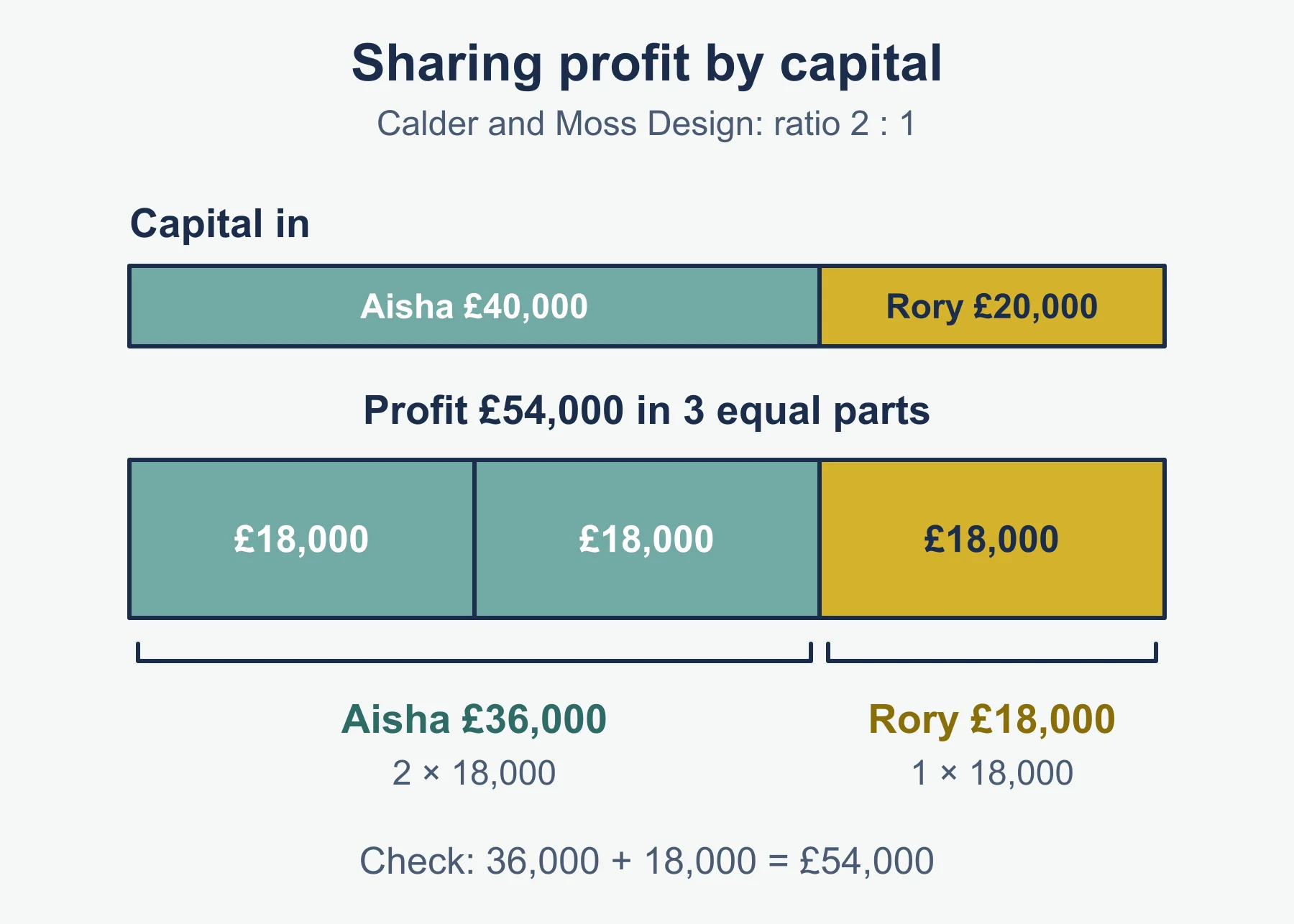
Profit sharing reminder: three partners agree to share equally and make £45,000. Each receives 45,000 / 3 = £15,000. If they share in the ratio of capital instead, add the parts first, then divide.
1.4.1 Franchising
| Role | Who | Receives | Pays or provides |
|---|---|---|---|
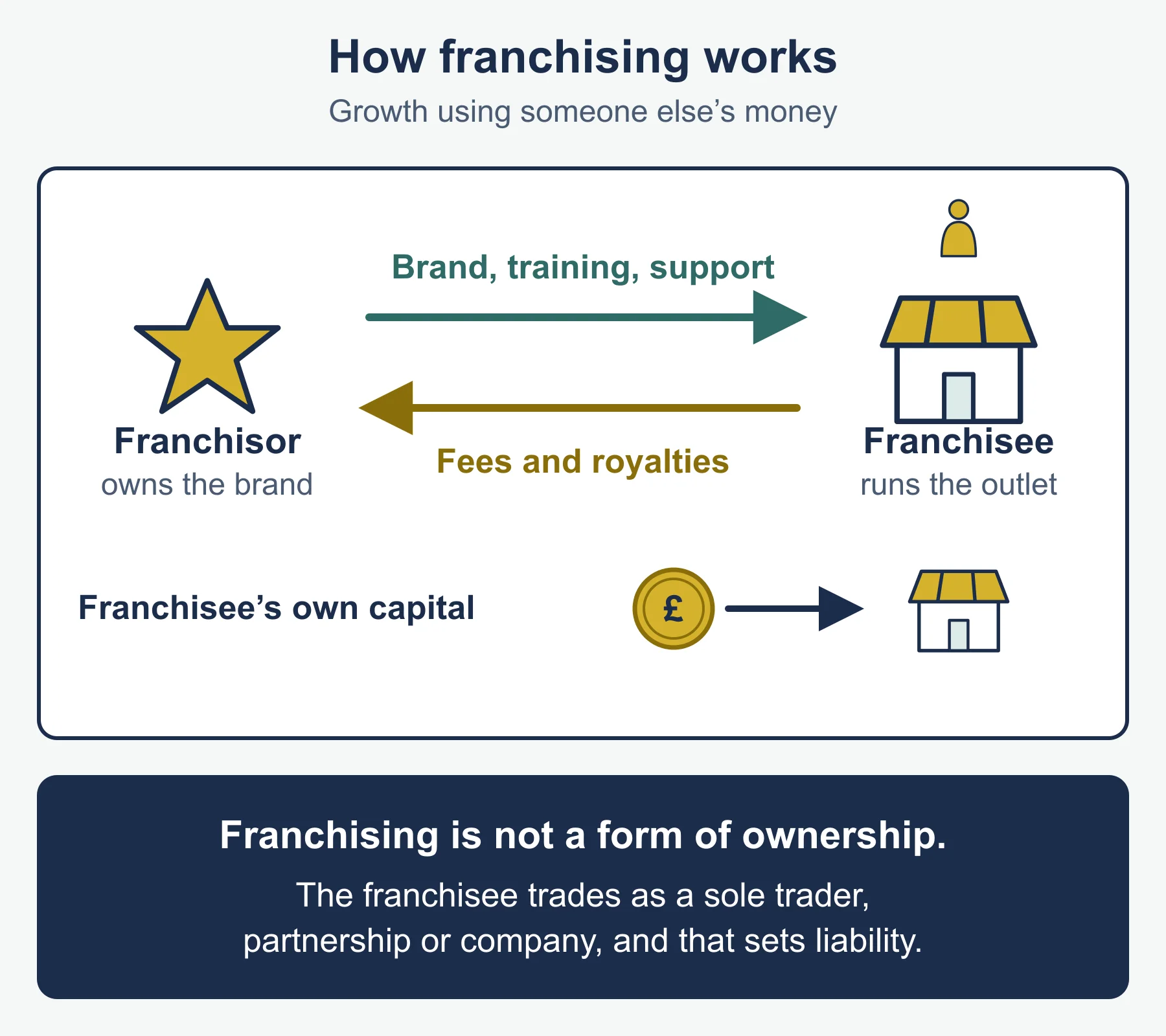
| Franchisor | Owner of the brand and business method | Usually an initial fee and a royalty | Brand, method, often training and support |
| Franchisee | Person who runs the outlet | The profit left after paying | Initial fee, royalty, running costs |
Advantages and disadvantages, sorted by who they affect:
- Franchisee gains: a recognised brand, a tested system, less risk, support.
- Franchisee loses: fees and royalties, little freedom over products and prices, shared reputation.
- Franchisor gains: faster growth using the franchisee’s money, a committed local manager, royalty income.
- Franchisor loses: some control over day-to-day quality, and part of the revenue.
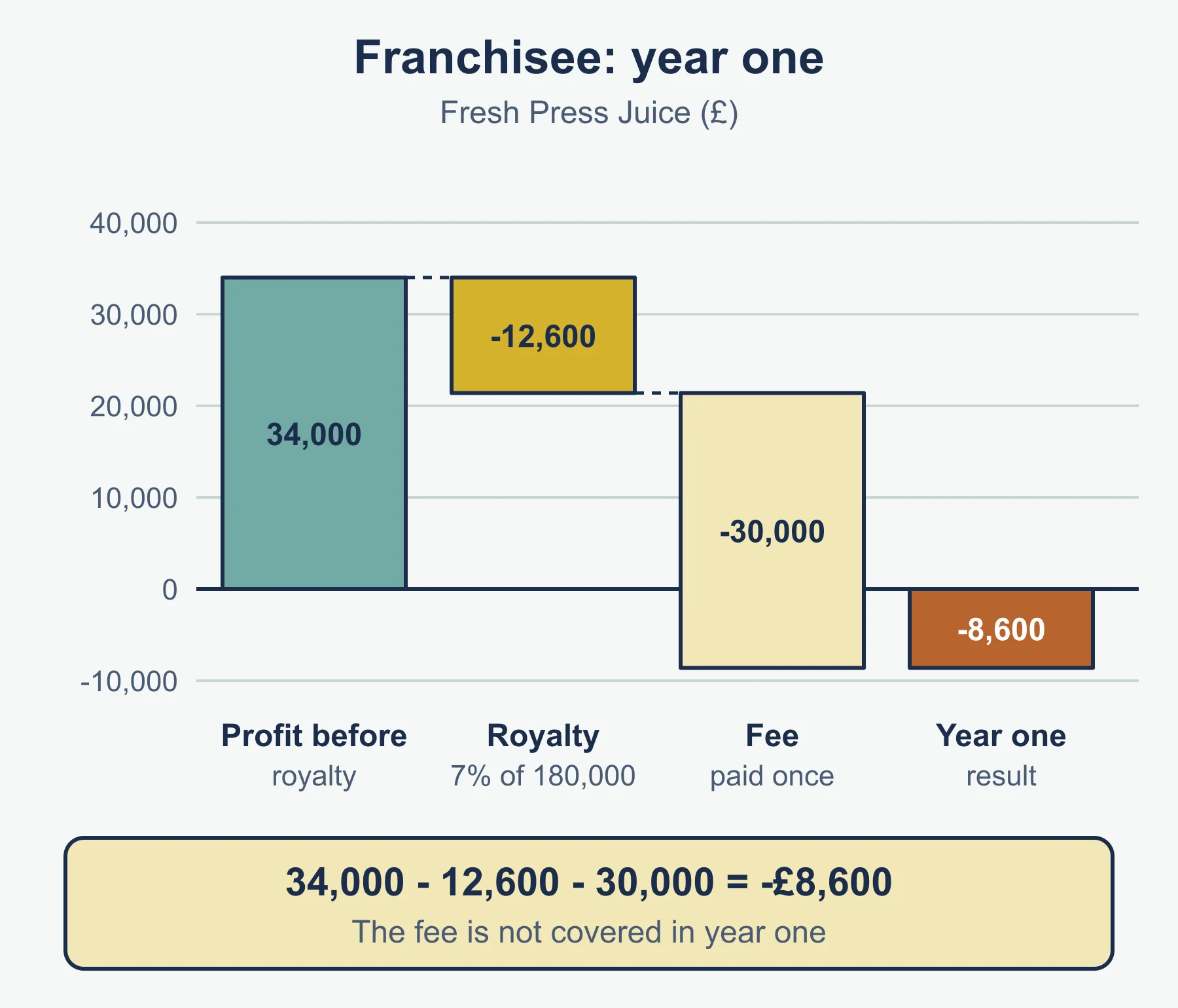
Reminder calculation: initial fee £15,000, royalty 4% of sales revenue of £225,000. Royalty = 0.04 x 225,000 = £9,000. First-year payments = 15,000 + 9,000 = £24,000.
1.4.2 Location factors
| Factor | Pulls the business toward | Gain | Risk |
|---|---|---|---|
| Market | Customers | More sales, lower delivery cost | High rent in popular places |
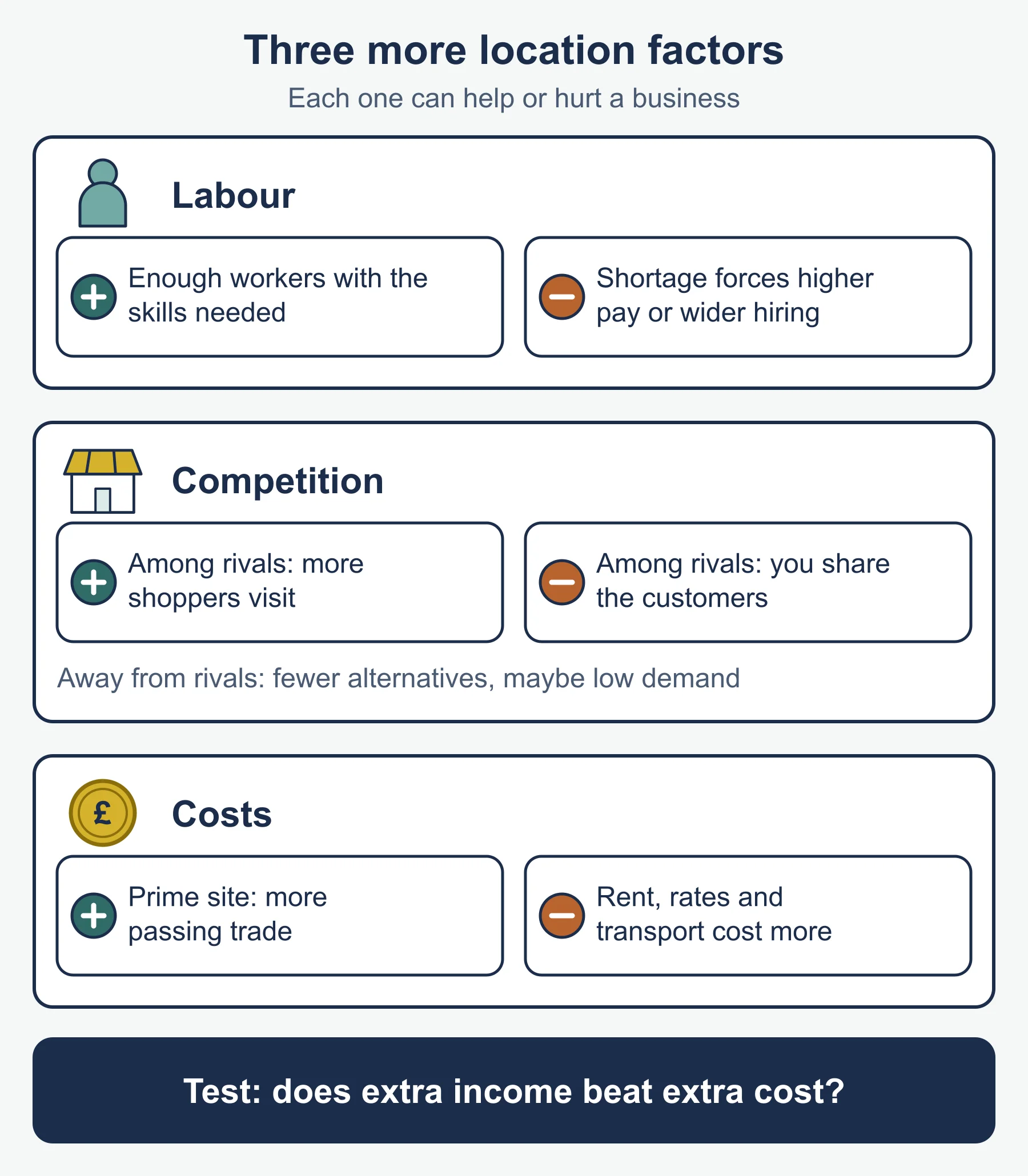
| Labour | Pools of the right workers | Easy recruitment, suitable skills | Competition for workers may raise wages |
| Materials | Suppliers and sources | Lower transport cost, less waste | Remote areas may lack customers |
| Competitors | Rivals, or away from them | Shared footfall, or a local monopoly | Shared customers, or low passing trade |
Nature of the business activity
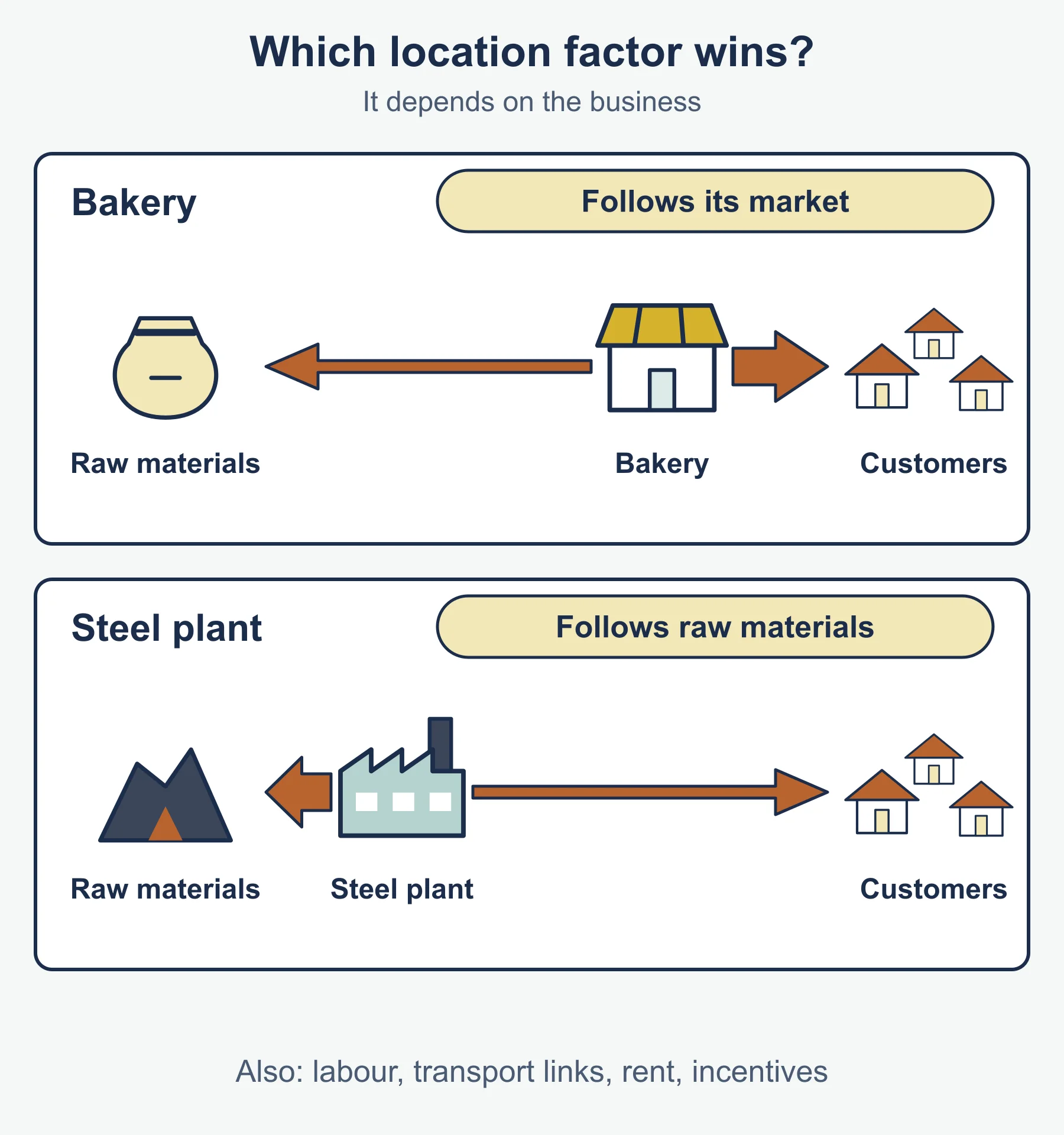
- Retail and personal services: market first, since trade depends on passing customers.
- Manufacturing with heavy or bulky inputs: materials, and often cheaper land.
- Skill-based work: labour.
- Perishable goods: speed to market or to the source.
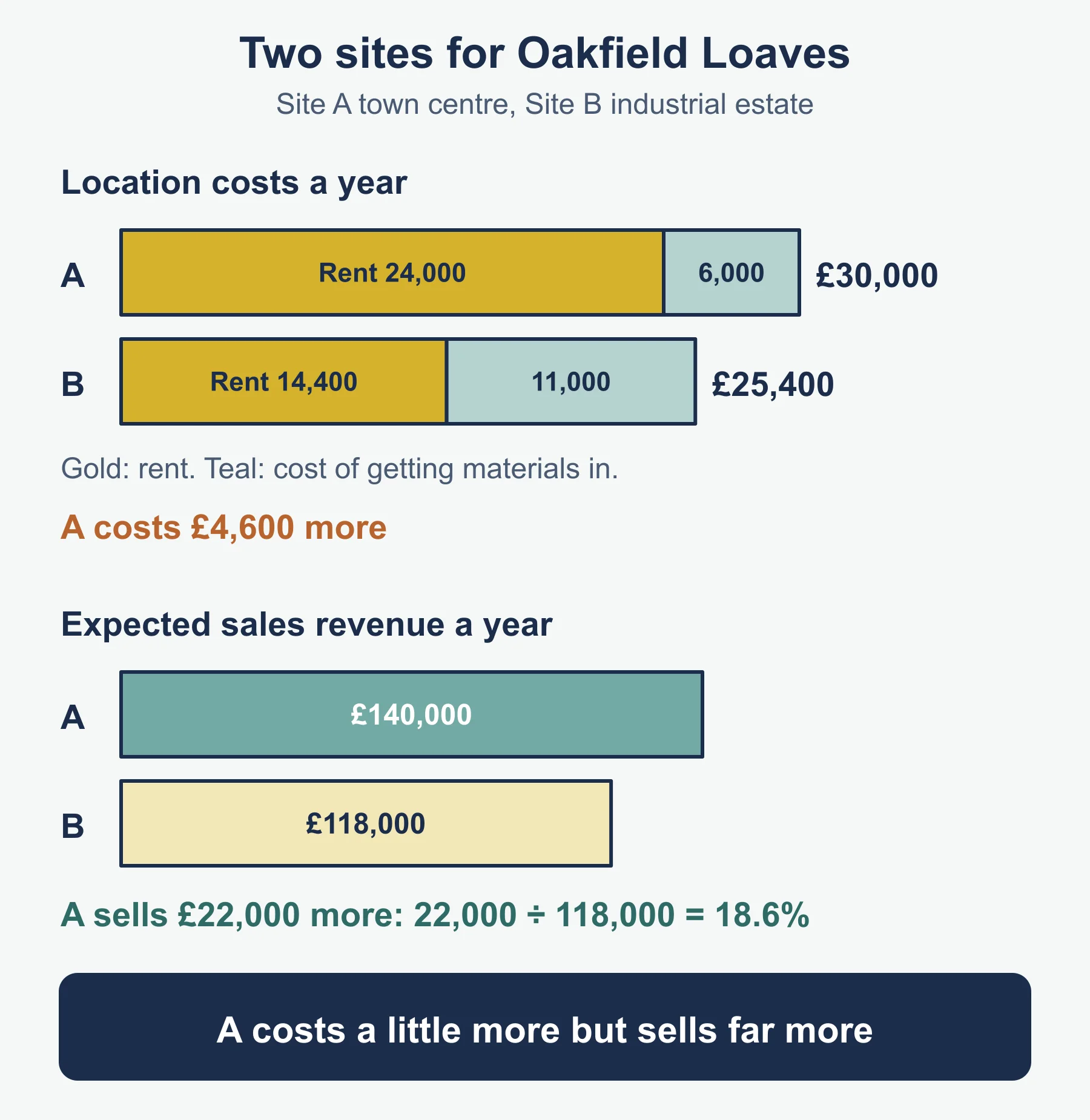
Method for a “which site?” question: pick the factor that matters most for this activity, use figures from the stem, compare costs and likely sales revenue, then reach a judgement.
Reminder calculation: a shop pays £9,000 rent on total costs of £60,000. Rent share = 9,000 / 60,000 x 100 = 15%. One site has expected sales of £82,000 and another £64,000. The first is (82,000 - 64,000) / 64,000 x 100 = 28.1% higher.
The internet and location
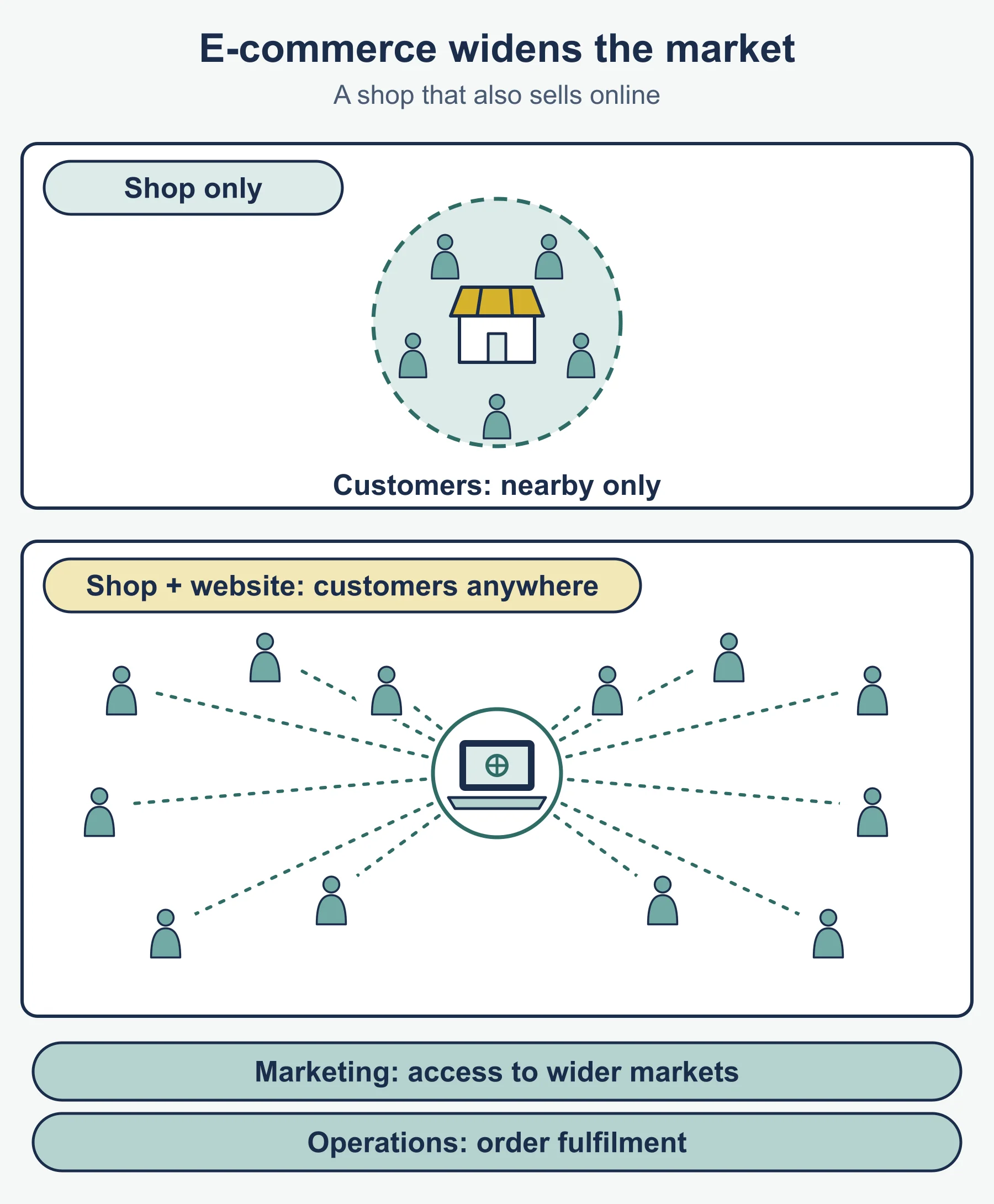
- E-commerce: customers can be anywhere, so market proximity matters less.
- Cheaper premises become possible because customers do not visit.
- Fixed premises still matter for storage, dispatch, trying goods and services delivered in person.
- Click-and-collect or delivery adds new costs to weigh.
- Many firms mix an online presence with a shop or depot.
Building a strong written answer
Use a short chain for any “explain” or “analyse” point: point, because, which leads to, so.
- Ownership example: “A sole trader has unlimited liability, because business debts become personal debts, which leads to the owner risking their home, so they may avoid borrowing to expand.”
- Franchise example: “A franchisee gets a known brand, because customers already trust the name, which leads to steadier sales in the first months, so the risk of early failure is lower.”
- Location example: “A restaurant near offices has a ready market, because workers eat out at lunchtime, which leads to higher sales revenue, so a higher rent may still be worth paying.”
For a recommendation question, pick the option the evidence supports, then say what would change your mind. For example, a partnership may look attractive because of pooled money, but if the partners disagree about direction, a private limited company with a clear shareholder agreement may suit better.
Quick decision prompts
Which ownership type fits?
- One person, low capital, wants full control: sole trader.
- Two or three people with complementary skills who trust each other: partnership.
- Plans to raise money from outsiders, or the owners want their personal wealth protected: private limited company.
- Wants a tested system and a brand but little experience: franchise.
Which location factor first?
- Customers must walk in: market.
- Highly skilled staff are scarce: labour.
- Inputs are heavy, bulky or perishable: materials.
- Customers compare several suppliers on one street: competitors may be a benefit.
Must-know distinctions
- Limited liability limits the owner’s loss. It does not stop the business losing money.
- Sole trader is one owner. Partnership is two or more. A private limited company is owned by shareholders.
- Franchisor sells the right. Franchisee buys it.
- “Explain” needs a point plus two expansions. “Analyse” needs the context applied.
- “Justify” ends with a recommendation of one of two options. “Evaluate” ends with a supported conclusion.
Quick self-test
- Define unlimited liability.
- A sole trader’s business owes £35,000 and its assets raise £22,500. How much must the owner fund personally?
- Give two types of business ownership for a start-up.
- Name one advantage of a partnership over a sole trader.
- Two partners put in £30,000 and £10,000 and share £28,000 profit in the ratio of capital. How much does each receive?
- State who pays the royalty in a franchise.
- A franchisee pays a 6% royalty on sales revenue of £150,000. Calculate the royalty.
- Give one disadvantage of franchising for the franchisee.
- Name the four proximity factors in the specification.
- Why might a fresh-fish processor locate near the coast?
- Give one reason an online-only seller might choose a low-rent unit.
- Explain why a hairdresser is unlikely to move to a fully online model.
Answers
- The owner is personally responsible for all the debts of the business.
- 35,000 - 22,500 = £12,500.
- Any two of sole trader, partnership, private limited company.
- More capital, a wider range of skills, or a shared workload.
- Ratio 3 : 1, four parts. One part = 28,000 / 4 = £7,000. First partner £21,000, second partner £7,000.
- The franchisee pays it to the franchisor.
- 0.06 x 150,000 = £9,000.
- Fees and royalties, less control over products or prices, or a reputation shared with other outlets.
- Market, labour, materials, competitors.
- Fish is perishable, so being close to the source cuts transport time and spoilage.
- Customers do not visit, so premises can be cheap and need only store and dispatch goods.
- The service is delivered in person, so customers must come to fixed premises.
Where marks are usually lost
- Writing “unlimited liability means unlimited debts”. The point is personal responsibility for the debts.
- Stating that a limited company cannot go out of business.
- Describing a partnership as limited liability without qualification.
- Giving advantages of franchising without saying whether they favour franchisor or franchisee.
- Listing the four location factors without applying one to the business in the question.
- Forgetting the one-off fee when working out the first-year cost of a franchise.
- Rounding percentages carelessly or leaving out units such as the pound sign.
- Ending an “evaluate” or “justify” answer with a summary of points and no decision.
- Saying the internet makes premises unnecessary.
Frequently asked questions
What is the difference between limited and unlimited liability? With unlimited liability, the owner is personally responsible for all the business’s debts, so creditors can claim personal wealth such as savings. With limited liability, the owner’s risk is limited to the money they put in.
Do partners have limited liability? In general, partners in an ordinary partnership have unlimited liability, like a sole trader. Describing every partner as having limited liability is a common error in Edexcel GCSE Business (1BS0) answers.
What are the advantages and disadvantages of a franchise for the franchisee? A franchisee gains a known brand, a proven business format and often training and support. In return it pays fees and royalties, has less freedom over products and prices, and can be harmed by the franchisor’s reputation.
Does the internet mean a business no longer needs premises? No. E-commerce lets a business reach customers anywhere and use cheaper premises, but goods still need storing and sending, some customers want to see items, and services such as hairdressing cannot be delivered online.
Official syllabus
Pearson Edexcel Level 1/Level 2 GCSE (9-1) in Business (1BS0), Specification, Issue 2, July 2022, published by Pearson Education Limited. Theme 1, Topic 1.4 Making the business effective, items 1.4.1 and 1.4.2.
Get free revision emails (optional)
Occasional emails with practice questions, worked explanations and links to free resources for the qualification and subjects you choose. No spam, and you can unsubscribe from any email. The free tools on this site never need an email.
Related resources
-
Study guides
Edexcel GCSE Business: The marketing mix and the business plan (1BS0)
Study guide to the marketing mix and the business plan for Pearson Edexcel GCSE Business, Theme 1 topic 1.4, with worked forecast and cash-flow examples.
Business · Pearson Edexcel · GCSE
Read guide -
Practice questions
Edexcel GCSE Business: The marketing mix and the business plan (1BS0) – Practice Questions
Twelve original practice questions with worked answers on the marketing mix and business plans for Pearson Edexcel GCSE Business, Theme 1 topic 1.4.
Business · Pearson Edexcel · GCSE
Try questions -
Revision notes
Edexcel GCSE Business: The marketing mix and the business plan (1BS0) – Revision Notes
Condensed revision notes on the marketing mix and business plans for Pearson Edexcel GCSE Business Theme 1 topic 1.4, with formulae and a self-test.
Business · Pearson Edexcel · GCSE
Revise topic
Related articles
-
teaching
A Level tuition in Dubai: Cambridge or Pearson Edexcel International A Level?
Schools in Dubai and Abu Dhabi teach either Cambridge International AS & A Level or Pearson Edexcel International A Level. How the two are structured, why it matters for tuition, and how online classes from Lahore work.
9 October 2026
-
curriculum guides
Choosing subjects at IGCSE and A Level
How subject choices at 14 and 16 affect university options later, and how to keep pathways open without overloading a timetable.
28 July 2026
Studying this with a teacher
Working through Business GCSE?
This page is free and stays free. If you would rather be taught it, Marlbridge runs Business classes one-to-one and in small groups of up to 15, online in your own time zone. The first trial class is free. WhatsApp replies within an hour (8am–11pm Pakistan time, every day); email the same day.
Pearson Edexcel Business teachers at Marlbridge

