
Revision Notes
Edexcel GCSE Business: The marketing mix and the business plan (1BS0) – Revision Notes
Condensed revision notes on the marketing mix and business plans for Pearson Edexcel GCSE Business Theme 1 topic 1.4, with formulae and a self-test.
- Subject
- Business
- Level
- GCSE
- Topic
- Making the business effective
- Author
- Marlbridge Academic Team
- Updated
- Reviewed by
- Asif Iqbal (what this means)
Aligned to Pearson Edexcel GCSE Business (1BS0), Issue 2, July 2022. Official specification .
Syllabus page (what it covers and how it is assessed): Pearson Edexcel GCSE Business.
Syllabus points this page covers
1BS0
- 1.4 Making the business effective (whole topic)
- 1.4.3 The marketing mix
- 1.4.4 Business plans
Found an error? Report a correction.
Want a teacher for this? Marlbridge teaches Business online. Request a free trial class.
These notes condense Pearson Edexcel Level 1/Level 2 GCSE (9-1) Business (1BS0), Issue 2, July 2022, Theme 1 topic 1.4 Making the business effective, content items 1.4.3 The marketing mix and 1.4.4 Business plans. For full explanations and worked examples, read the study guide. When you are ready to test yourself, use the practice questions.
Course links: the Edexcel GCSE Business hub, the printable checklist and the free diagnostics.
The specification sets two written papers, Theme 1 (1BS0/01) and Theme 2 (1BS0/02), each 1 hour 45 minutes, 90 marks and 50% of the qualification. Calculators may be used. Formulae are listed in the specification (Appendix 3) and are not provided in the examinations, so learn the ones below. The descriptions of the mix elements and plan sections in these notes are general explanations, not specification wording.
1. The marketing mix (1.4.3)
The marketing mix is the set of decisions a business makes about price, product, promotion and place.
| Element | What it is | Why it matters |
|---|---|---|
| Product | The good or service offered, including features, quality, design and range | Must meet a need of the target market, or customers will not buy |
| Price | What the customer pays | Affects demand and profit; must cover costs and look fair to the customer |
| Promotion | How the business informs and persuades customers | Customers cannot buy what they do not know about |
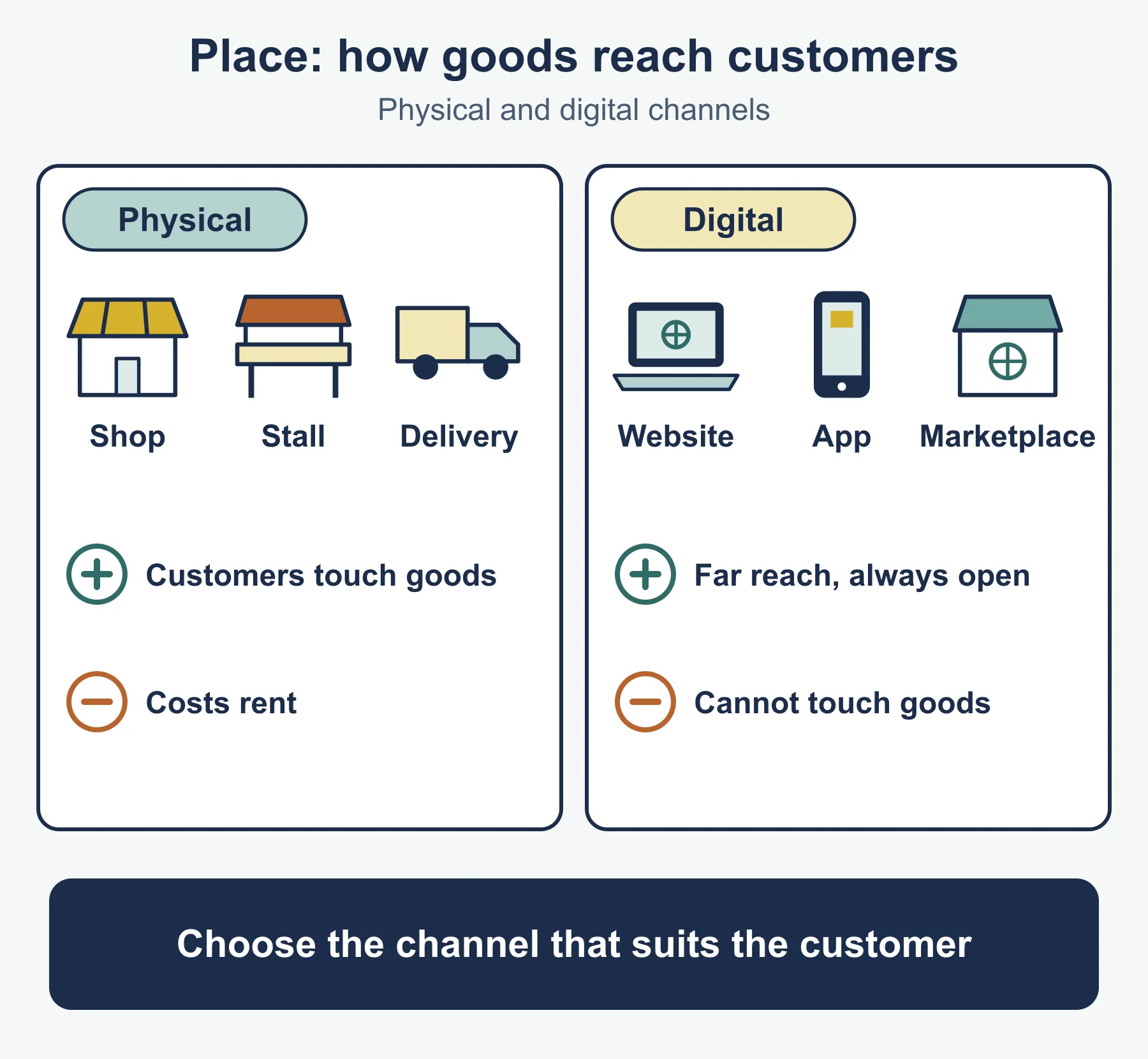
| Place | How and where the product reaches the customer | Customers must be able to get it easily |
Method in steps: answering “explain the importance of” an element
- Name the element and say what it means in this business.
- Link it to the customer: what would happen to buyers if it were wrong?
- Link it to the business: sales, revenue, profit or reputation.
- Where a context is given, use it.
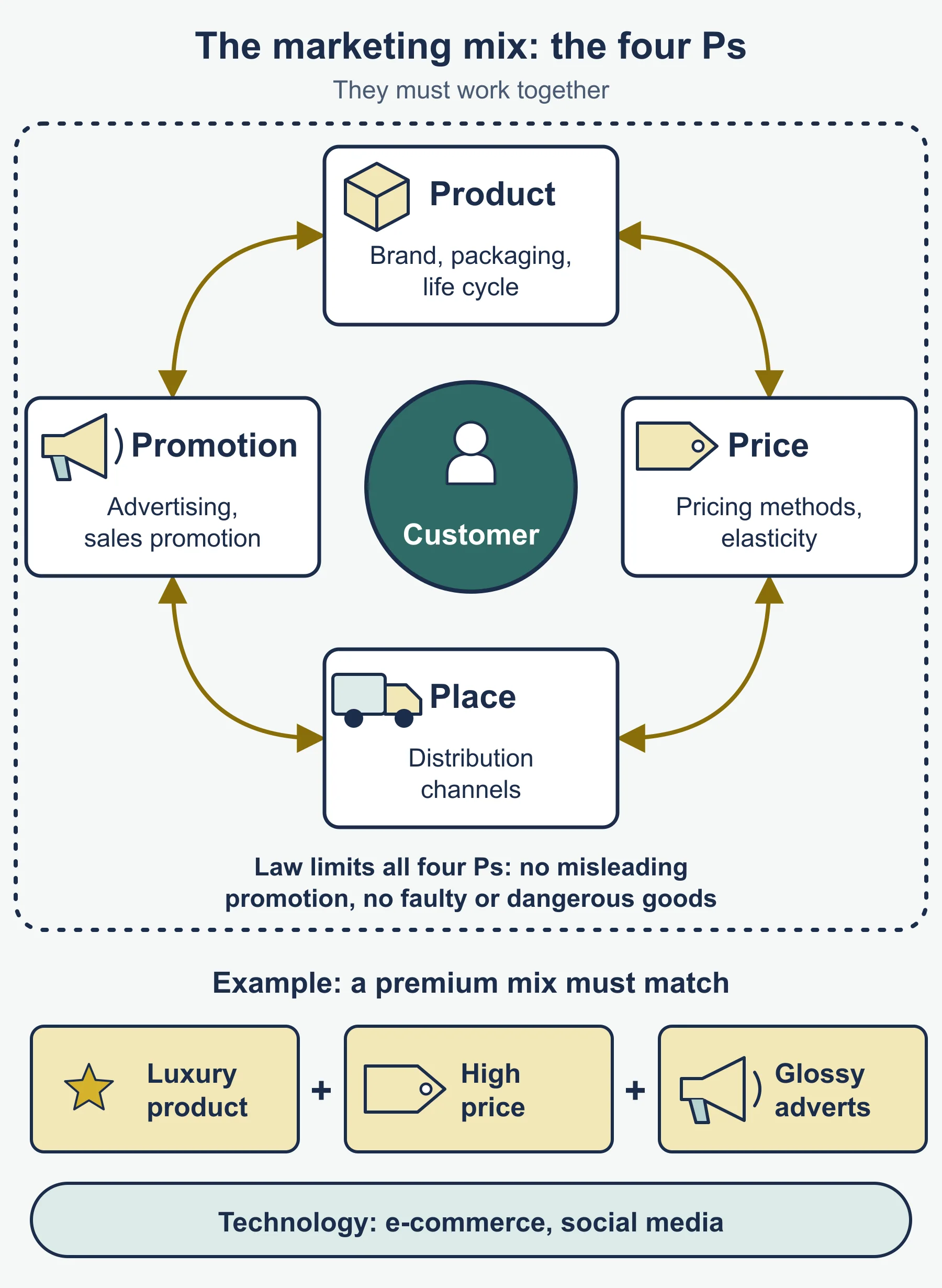
2. How the elements work together (1.4.3)
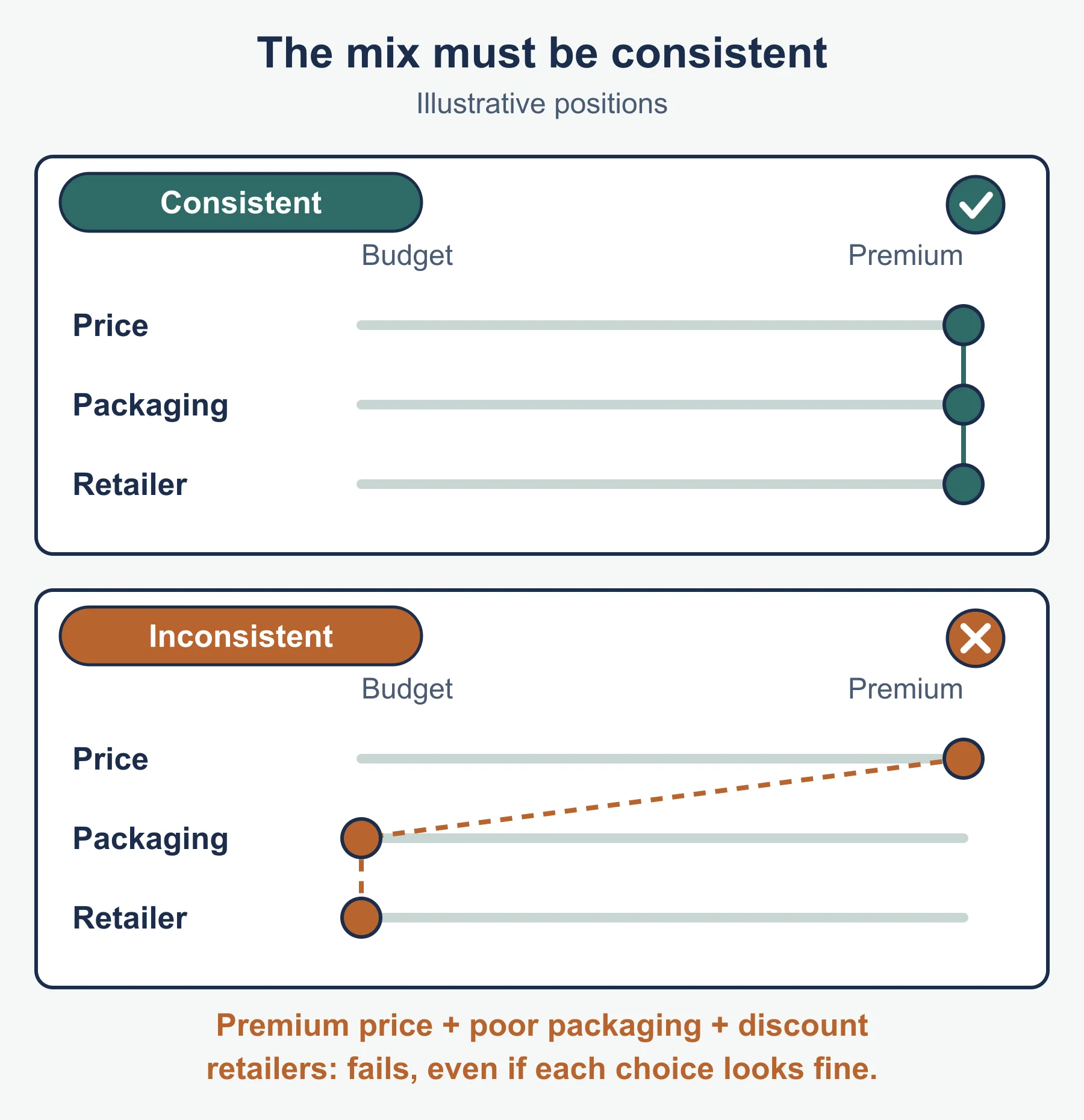
The four elements must fit each other and the target market. Changing one usually means reviewing the others.
| Factor | What changes | Typical effect on the mix |
|---|---|---|
| Competitive environment | Rivals, their prices, products and promotion | The business may adjust price, find a different product feature, or promote its strengths |
| Changing consumer needs | Tastes, incomes, lifestyles, priorities | Product, price, place and promotion may each need reviewing |
| E-commerce | Selling through a website or app | Wider reach for place; easy price comparison; wider product range |
| Digital communication | Email, social media, website | Targeted, quick and often low-cost promotion; reviews spread fast |
Pros and cons of technology in the mix
| Advantage | Disadvantage | |
|---|---|---|
| E-commerce | Reaches customers beyond the local area without extra premises | Delivery and returns to handle; customers can compare rivals easily |
| Digital communication | Can target groups and see responses quickly | Rivals use the same channels; poor reviews spread fast |
Must-know distinctions
- Balancing the mix means making the four choices consistent. It does not mean spending equally on each.
- Competitive environment is about rivals. Consumer needs is about customers. Technology is about how the business reaches and sells to them.
- E-commerce mainly changes place, but it also affects price (comparison) and product (range).
- Digital communication changes promotion first.
3. Business plans (1.4.4)
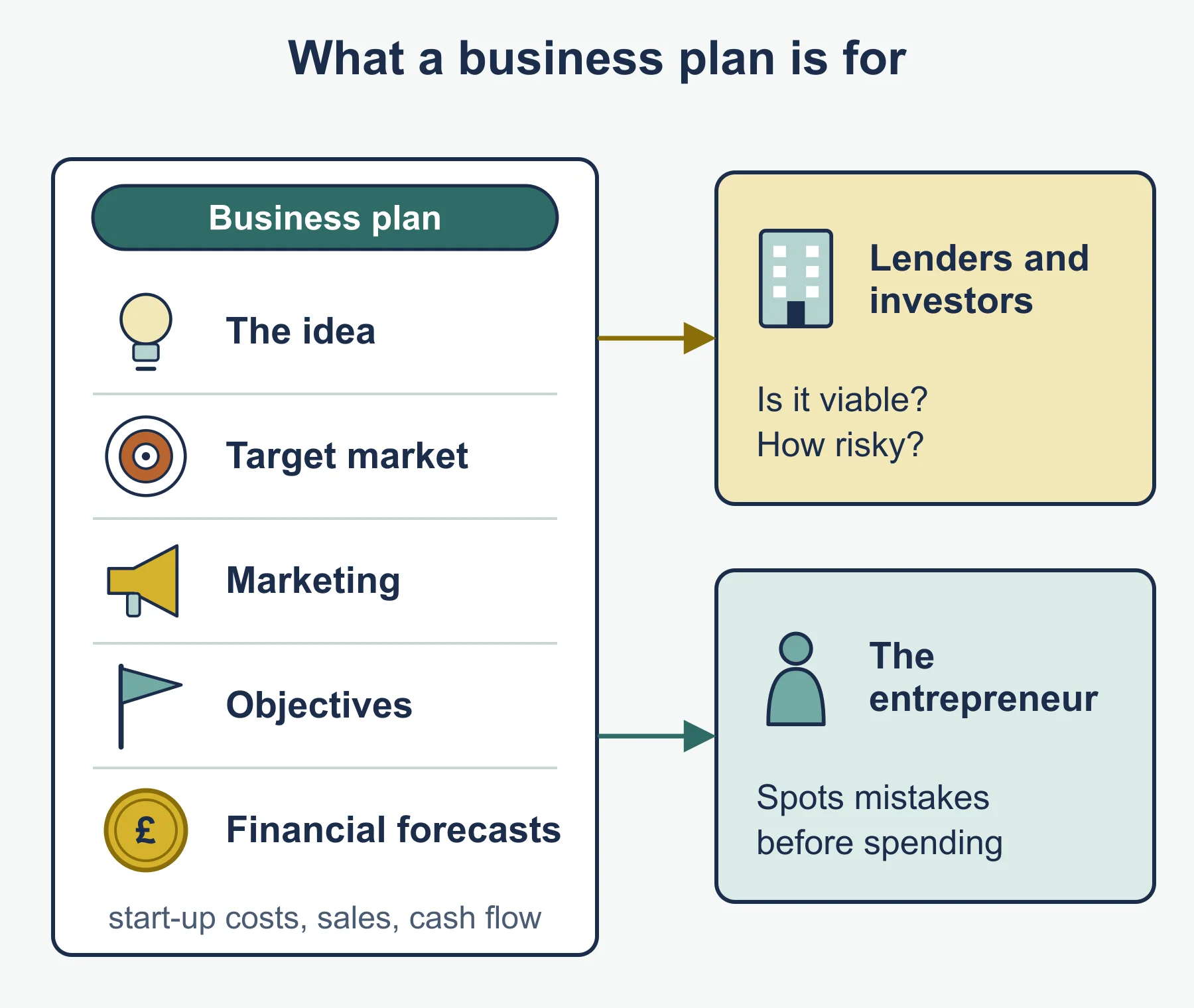
A business plan is a written document setting out what the business intends to do and how. The specification lists what it should identify.
| Section | What it contains |
|---|---|
| Business idea | What is sold and the need it meets |
| Aims and objectives | What the owner wants to achieve, and measurable targets |
| Target market (market research) | Who the customers are, with evidence from research |
| Forecast revenue, cost and profit | Estimated sales, costs and resulting profit |
| Cash-flow forecast | Estimated cash in and out, month by month |
| Sources of finance | Where start-up and running money comes from |
| Location | Where the business will operate, and why |
| Marketing mix | Product, price, promotion and place choices, with reasons |
Formulae to learn (Appendix 3)
| Measure | Formula |
|---|---|
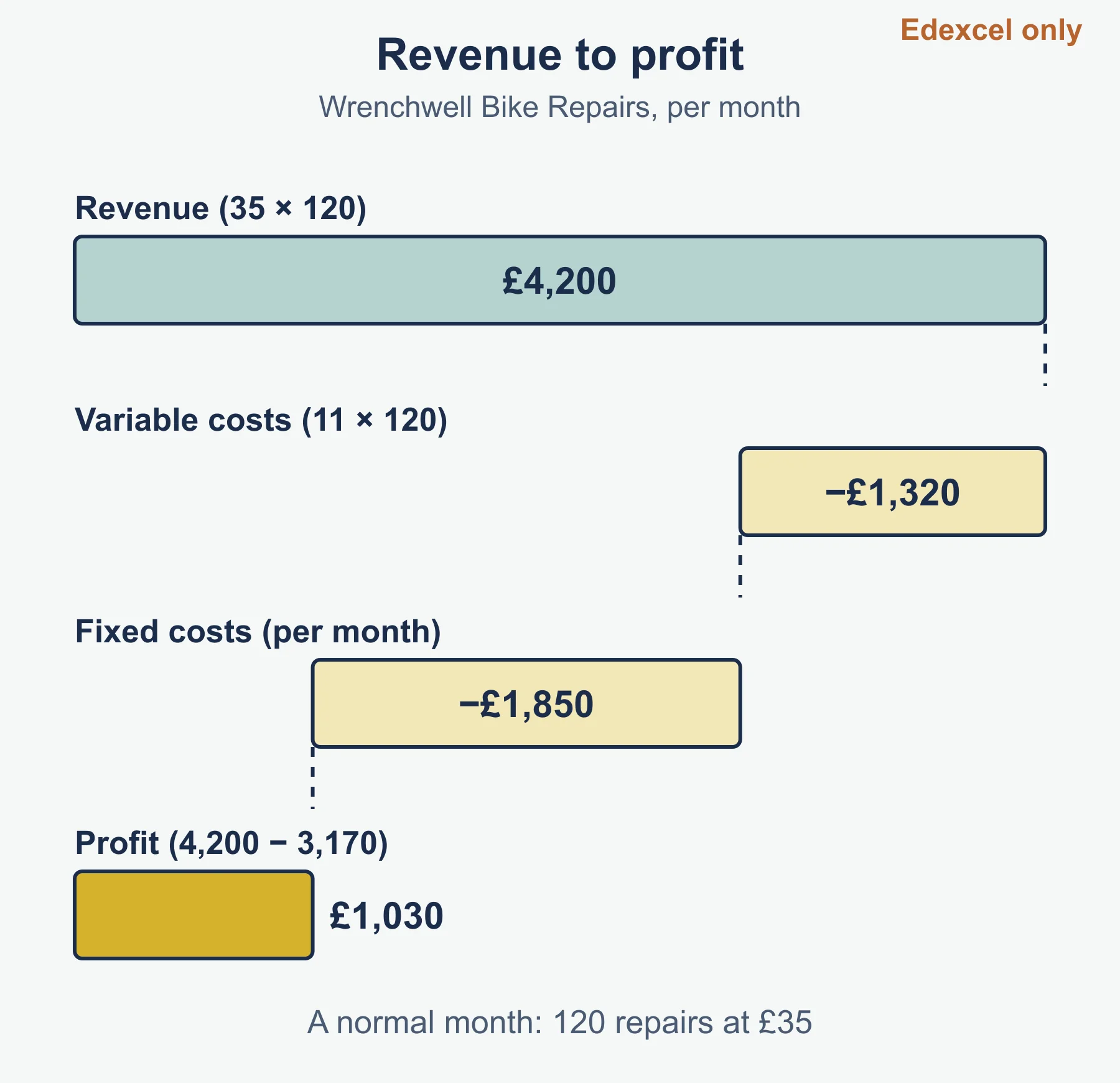
| Revenue | price × quantity |
| Total cost (TC) | total fixed costs (TFC) + total variable costs (TVC) |
| Profit | revenue − total cost (this is the standard form) |
| Net cash-flow | cash inflows − cash outflows in a given period |
| Opening balance | closing balance of the previous period |
| Closing balance | opening balance + net cash-flow |
Method in steps: completing a cash-flow forecast
- Write the opening balance for the first month.
- Add up all cash inflows for the month.
- Add up all cash outflows for the month.
- Net cash-flow = inflows − outflows. A negative number means more cash left than arrived.
- Closing balance = opening balance + net cash-flow.
- Copy the closing balance to become next month’s opening balance.
Small worked reminder
A business sells 400 units at £6.50. TFC is £900. Variable cost is £2.10 a unit.
- Revenue: 400 × 6.50 = £2,600.
- TVC: 400 × 2.10 = £840.
- TC: 900 + 840 = £1,740.
- Profit: 2,600 − 1,740 = £860.
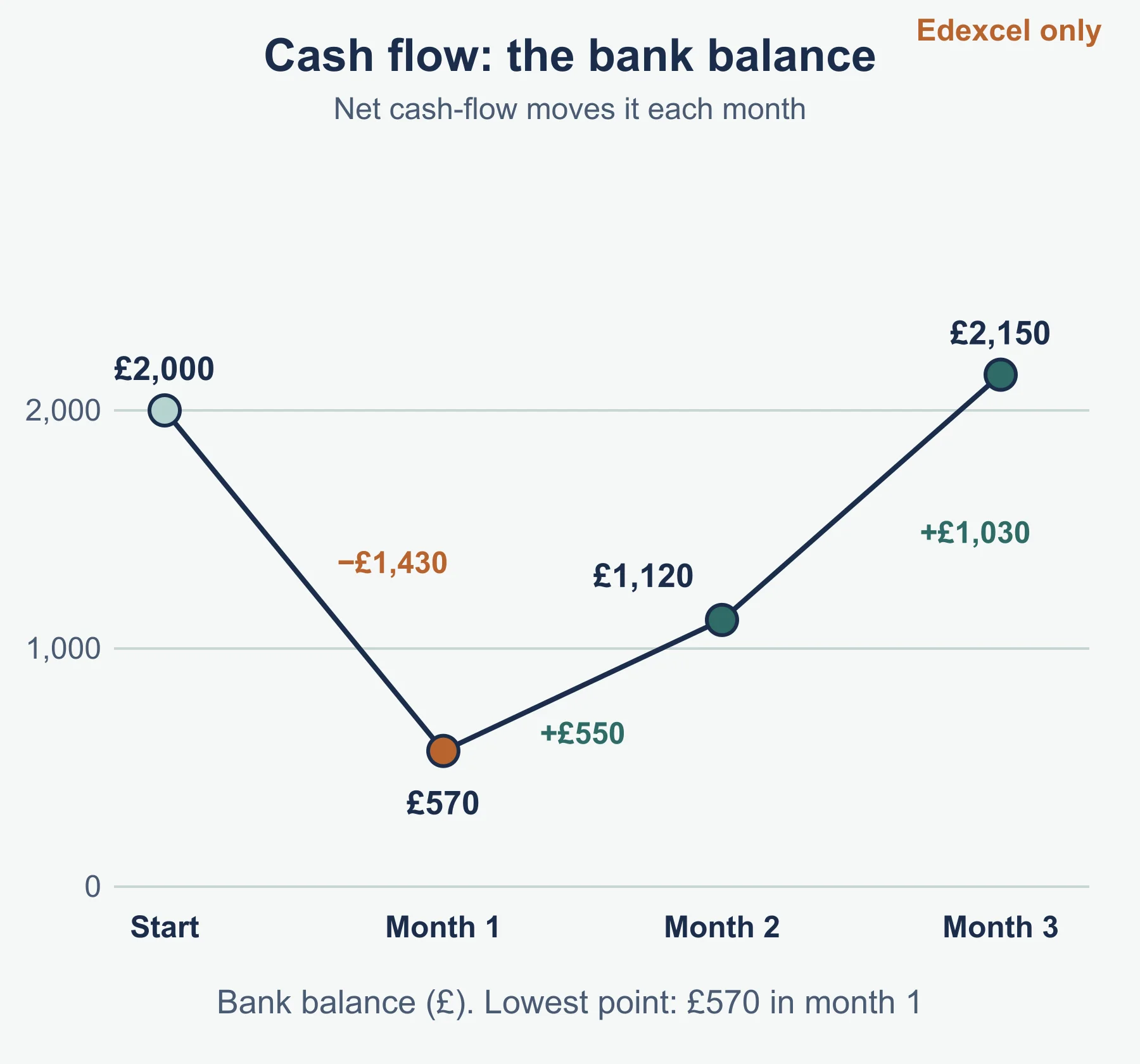
Small cash-flow reminder
A business opens month 1 with £1,200. Cash in is £3,900 and cash out is £4,350.
- Net cash-flow: 3,900 − 4,350 = −£450.
- Closing balance: 1,200 − 450 = £750, which is also the opening balance for month 2.
Using the context in a mix question
When a case study describes a business, pick out three things before writing: who the target market is, who the rivals are, and what has changed (customer needs, technology or competition). Then name the element, say what the business should do with it and give the reason it suits those customers. A recommendation with no reason tied to the stem gains little.
4. Purpose of planning (1.4.4)
| Purpose | How a plan helps |
|---|---|
| Minimising risk | Tests the idea against research; forecasts show whether profit is possible; the cash-flow forecast warns of shortages; weaknesses show up early |
| Obtaining finance | Gives lenders and investors evidence of research, realistic forecasts and a clear use of money; the business looks a lower risk |
A plan reduces risk. It does not remove it, because forecasts are estimates.
5. Must-know distinctions
- Profit is not cash. A business can be profitable yet short of cash in a month with a large one-off payment.
- Revenue is what comes in from sales. Profit is what remains after all costs.
- A forecast is an estimate of the future. It is not a record of what happened.
- Market research supports the target market section. The cash-flow forecast supports the finance section.
- “Importance” answers need a reason linked to the business, not a definition.
Quick self-test
- List the four elements of the marketing mix.
- A business prices a service at £8 and expects 650 customers. State the forecast revenue.
- Total fixed costs are £1,900 and variable cost is £3.20 per customer. Calculate total cost for the 650 customers in question 2.
- Calculate the forecast profit using your answers to questions 2 and 3.
- A business has an opening balance of £3,400 and a net cash-flow of −£1,150. Calculate the closing balance.
- Give two reasons a lender may want to see a business plan.
- State one way e-commerce can change the place element.
- Explain one way digital communication can help a small business promote its product.
- A rival opens next door and cuts its prices. Outline one way the business could respond using the marketing mix.
- Give two sections a business plan should identify, other than the marketing mix.
Answers
- Product, price, promotion, place.
- 8 × 650 = £5,200.
- TVC = 3.20 × 650 = £2,080. TC = 1,900 + 2,080 = £3,980.
- 5,200 − 3,980 = £1,220.
- 3,400 + (−1,150) = £2,250.
- For example: it shows evidence from market research that customers exist; it shows realistic forecasts and a cash-flow forecast, so repayment looks possible; it shows how the money will be spent.
- Customers can buy through a website or app, so the business reaches people beyond its local area without extra premises.
- For example: social media or email can target particular groups at low cost and show quickly how people respond, so a small business with a small budget can reach its target market.
- For example: keep prices but promote quality and service that the rival lacks, so the business competes on product and promotion instead of price alone.
- Any two from: business idea, aims and objectives, target market (market research), forecast revenue, cost and profit, cash-flow forecast, sources of finance, location.
Where marks are usually lost
- Defining an element of the mix when the question asks why it is important.
- Giving one-word points such as “cheap” or “online” with no development.
- Describing the mix elements separately when asked how they work together.
- Ignoring the context in a case study and giving a general answer.
- Mixing up profit and cash flow in a forecast question.
- Forgetting that the closing balance of one month is the opening balance of the next.
- Showing no working in a calculation, which leaves nothing to reward if the final figure is wrong.
- Saying a plan guarantees success or removes risk.
- Giving an evaluation with no conclusion that weighs the options and reaches a judgement.
Frequently asked questions
What are the four elements of the marketing mix? The marketing mix is made up of price, product, promotion and place. A business controls all four, and together they decide whether customers in the target market choose it.
What should a business plan include? The Edexcel GCSE Business (1BS0) specification lists the business idea, aims and objectives, target market (market research), forecast revenue, cost and profit, a cash-flow forecast, sources of finance, location and the marketing mix.
Why do businesses write a business plan? The specification gives two purposes: minimising risk and obtaining finance. Lenders and investors want evidence, such as market research and realistic forecasts, that the business can repay.
What is the difference between profit and cash in a business plan? Profit is revenue minus total cost, while cash flow tracks money actually coming in and going out. A profitable month can still leave the bank balance lower, for example when equipment is bought.
Official syllabus
Pearson Edexcel Level 1/Level 2 GCSE (9-1) in Business (1BS0), Specification, Issue 2, July 2022, published by Pearson Education Limited. Theme 1: Investigating small business, topic 1.4 Making the business effective, content items 1.4.3 The marketing mix and 1.4.4 Business plans.
Get free revision emails (optional)
Occasional emails with practice questions, worked explanations and links to free resources for the qualification and subjects you choose. No spam, and you can unsubscribe from any email. The free tools on this site never need an email.
Related resources
-
Study guides
Edexcel GCSE Business: Limited liability and business location (1BS0)
Study guide to limited and unlimited liability, sole traders, partnerships, private limited companies, franchising and location, for Edexcel GCSE Business.
Business · Pearson Edexcel · GCSE
Read guide -
Practice questions
Edexcel GCSE Business: Limited liability and business location (1BS0) – Practice Questions
Original practice questions with worked answers on liability, business ownership, franchising and location for Edexcel GCSE Business.
Business · Pearson Edexcel · GCSE
Try questions -
Revision notes
Edexcel GCSE Business: Limited liability and business location (1BS0) – Revision Notes
Condensed revision notes on liability, sole traders, partnerships, private limited companies, franchises and location for Edexcel GCSE Business.
Business · Pearson Edexcel · GCSE
Revise topic
Related articles
-
teaching
A Level tuition in Dubai: Cambridge or Pearson Edexcel International A Level?
Schools in Dubai and Abu Dhabi teach either Cambridge International AS & A Level or Pearson Edexcel International A Level. How the two are structured, why it matters for tuition, and how online classes from Lahore work.
9 October 2026
-
curriculum guides
Choosing subjects at IGCSE and A Level
How subject choices at 14 and 16 affect university options later, and how to keep pathways open without overloading a timetable.
28 July 2026
Studying this with a teacher
Working through Business GCSE?
This page is free and stays free. If you would rather be taught it, Marlbridge runs Business classes one-to-one and in small groups of up to 15, online in your own time zone. The first trial class is free. WhatsApp replies within an hour (8am–11pm Pakistan time, every day); email the same day.
Pearson Edexcel Business teachers at Marlbridge

