
Revision Notes
Edexcel GCSE Business: Business growth and changing aims (1BS0) – Revision Notes
Condensed revision notes on growth methods, plc, sources of finance and changing aims for Pearson Edexcel GCSE Business Theme 2, with a self-test.
- Subject
- Business
- Level
- GCSE
- Topic
- Growing the business
- Author
- Marlbridge Academic Team
- Updated
- Reviewed by
- Asif Iqbal (what this means)
Aligned to Pearson Edexcel GCSE Business (1BS0), Issue 2, July 2022. Official specification .
Syllabus page (what it covers and how it is assessed): Pearson Edexcel GCSE Business.
Syllabus points this page covers
1BS0
- 2.1 Growing the business (whole topic)
- 2.1.1 Business growth
- 2.1.2 Changes in business aims
Found an error? Report a correction.
Want a teacher for this? Marlbridge teaches Business online. Request a free trial class.
These notes condense Topic 2.1 Growing the business (items 2.1.1 and 2.1.2) of the Pearson Edexcel Level 1/Level 2 GCSE (9-1) in Business (1BS0) specification, Issue 2, July 2022. For full explanations and worked examples, read the study guide. Test yourself with the practice questions.
Course links: the Business hub, the printable checklist and the free diagnostics. The earlier page on limited liability and business location covers the other ownership types.
Key terms
| Term | Meaning |
|---|---|
| Internal (organic) growth | Growing using the business’s own resources, for example new products or new markets |
| External (inorganic) growth | Growing by merger or takeover |
| Innovation | Bringing in a new or improved product or way of working |
| Research and development (R&D) | Work to create or improve products before they are sold |
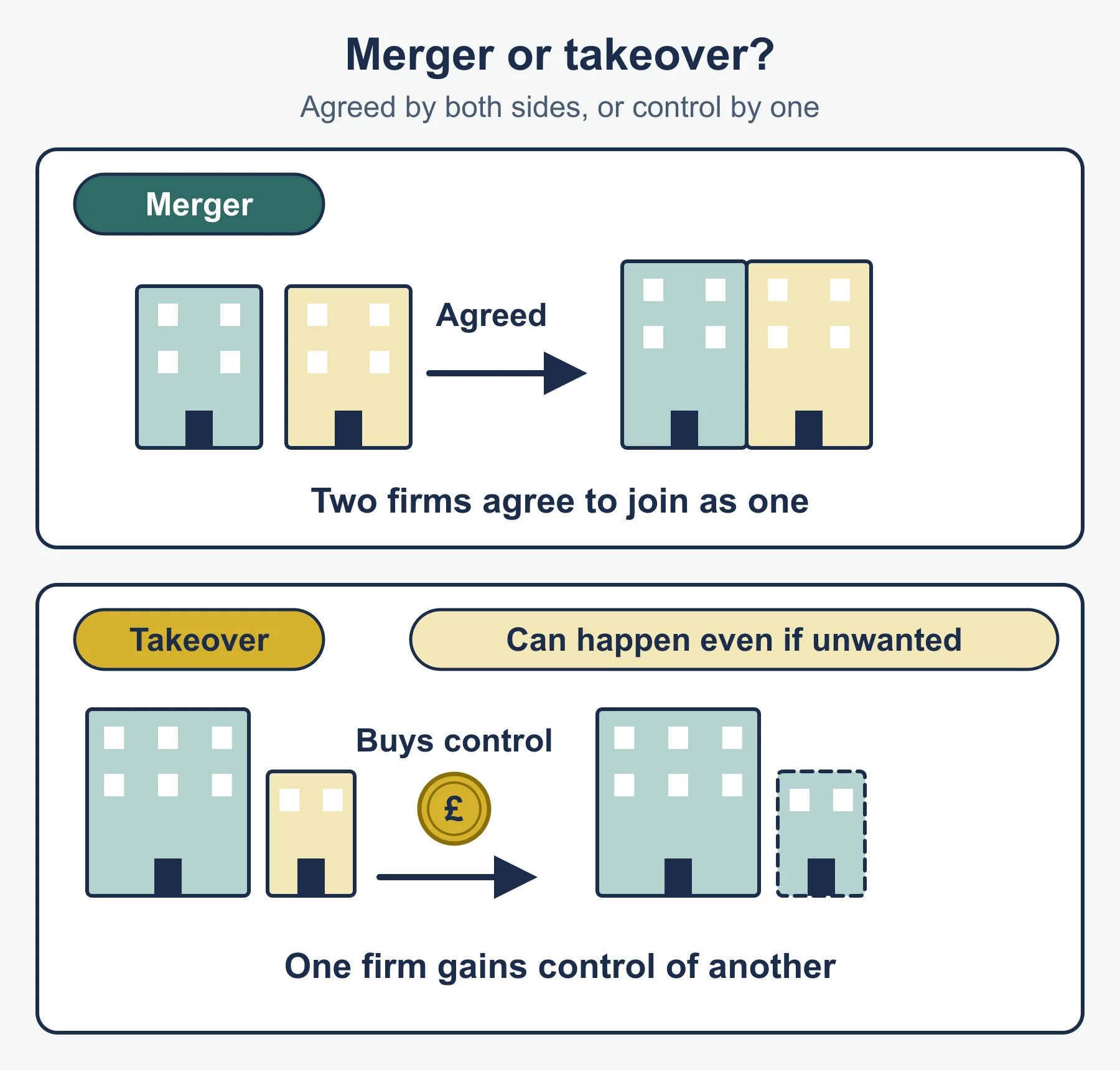
| Merger | Two businesses agree to combine into one (standard form of the definition) |
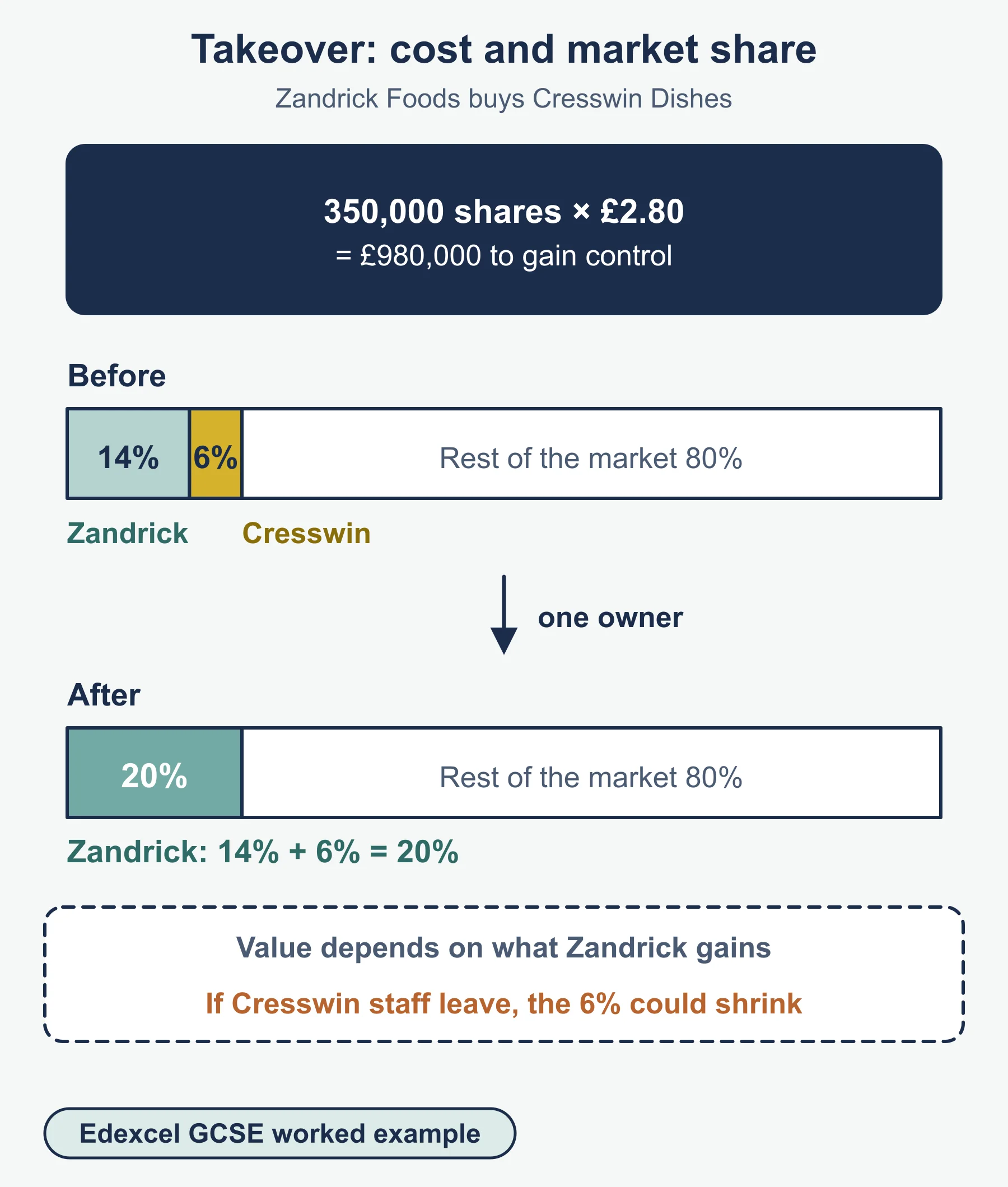
| Takeover | One business buys enough shares in another to control it (standard form) |
| Public limited company (plc) | A limited company whose shares can be offered to the public and traded on the stock market (general description) |
| Retained profit | Profit left in the business once tax is paid and dividends are deducted (standard form) |
| Loan capital | Money borrowed and repaid with interest |
| Share capital | Money raised by selling shares |
| Flotation | A company offering its shares to the public on the stock market |
| Aim and objective | An aim is the broad long-run purpose; an objective is a specific target set to reach it |
Growth methods at a glance
| Method | Type | Advantage | Drawback |
|---|---|---|---|
| New products (innovation, R&D) | Internal | Own design, keeps control | Costly, may fail |
| New markets: change the marketing mix | Internal | Reaches a new group using existing skills | Needs market knowledge |
| New markets: technology | Internal | Wider reach, no new site | Competition from many sellers online |
| New markets: expand overseas | Internal | Large customer base | Transport costs, unfamiliar tastes |
| Merger | External | Combined strengths, shared costs | Clashing cultures |
| Takeover | External | Immediate size and market share | High price, job losses, staff may leave |
Method boxes
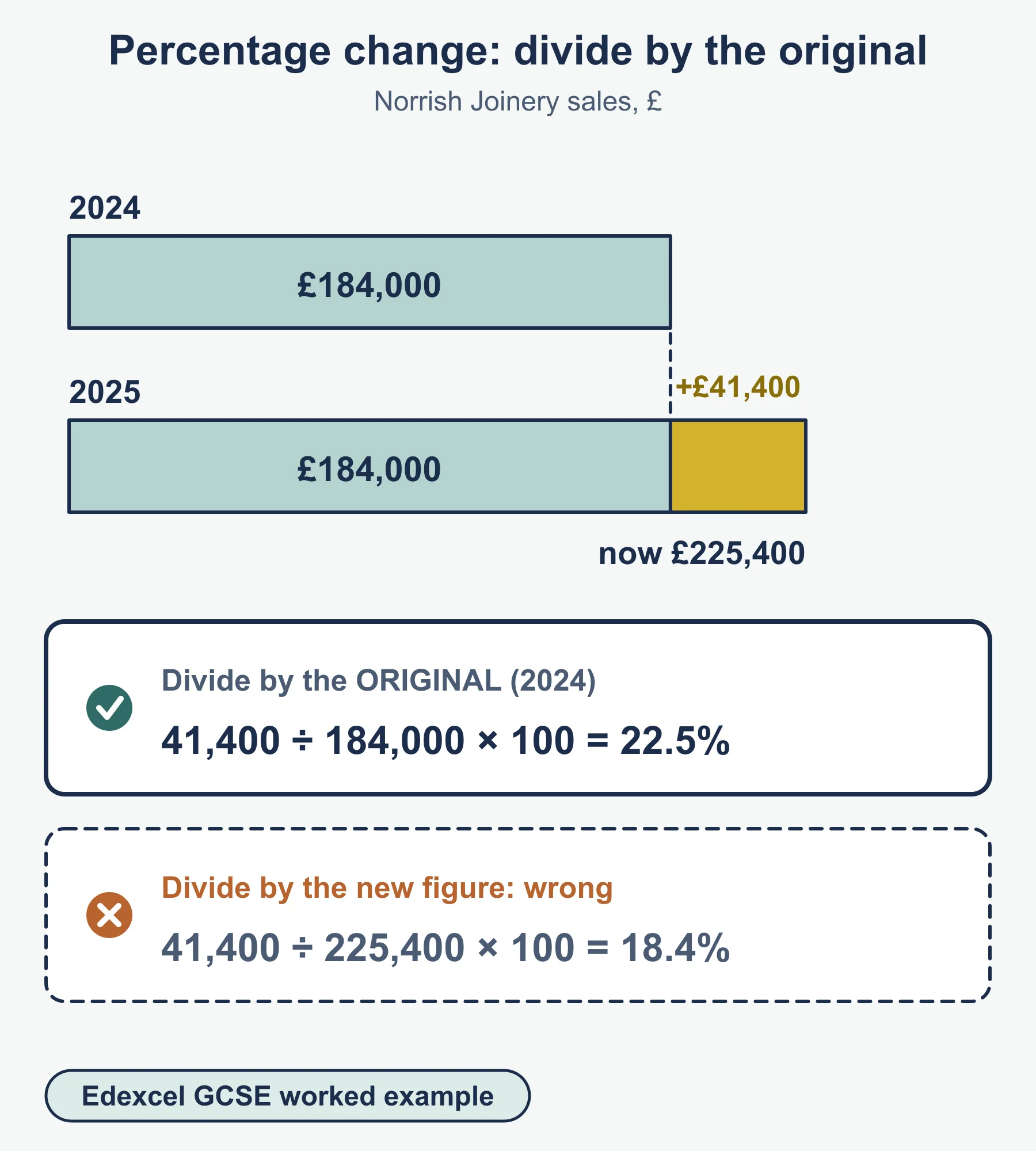
Percentage change.
- Find change = new - old.
- Use the OLD figure as the divisor.
- Multiply by 100 and state increase or decrease.
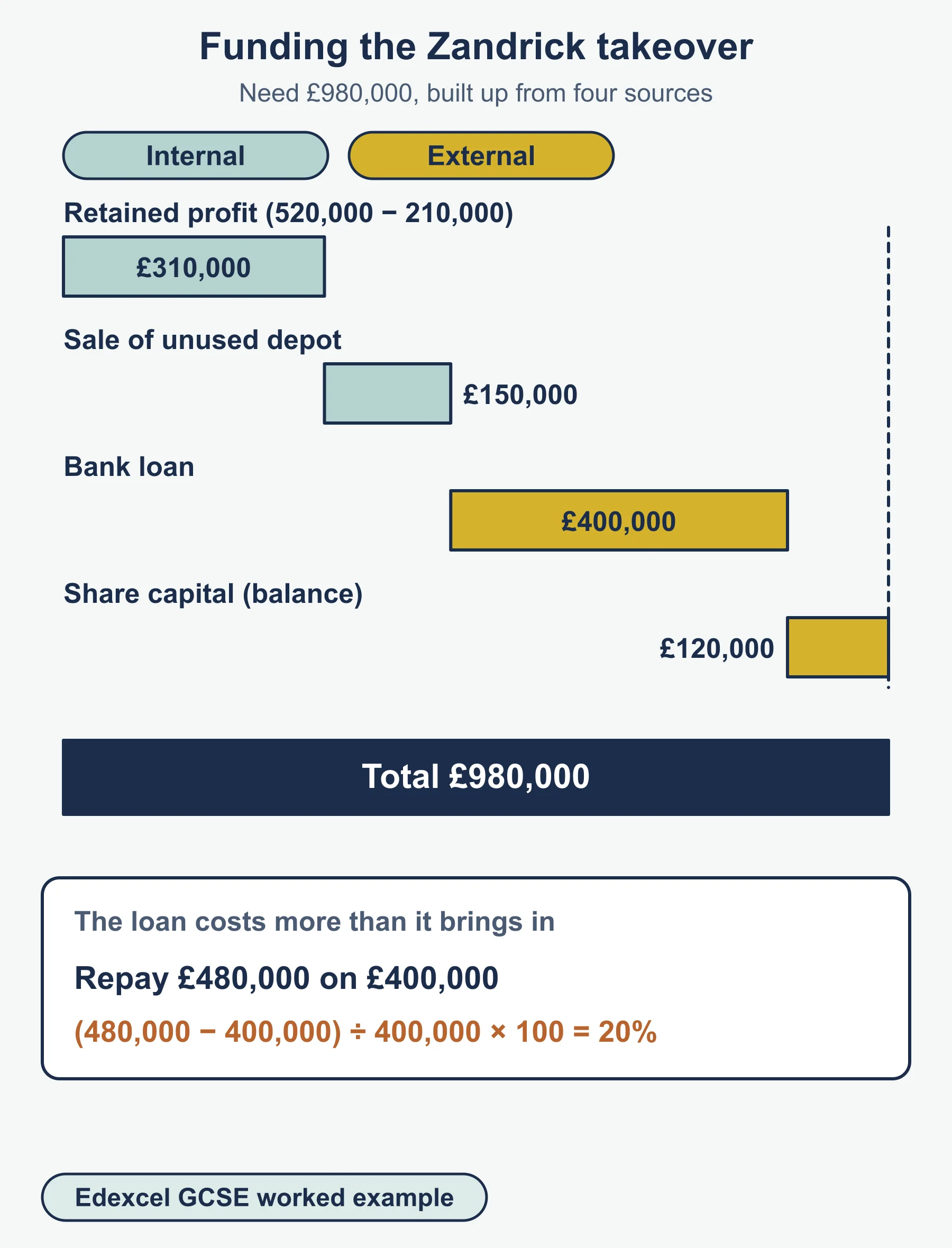
Interest on loans (Appendix 3). (total repayment - borrowed amount) / borrowed amount × 100.
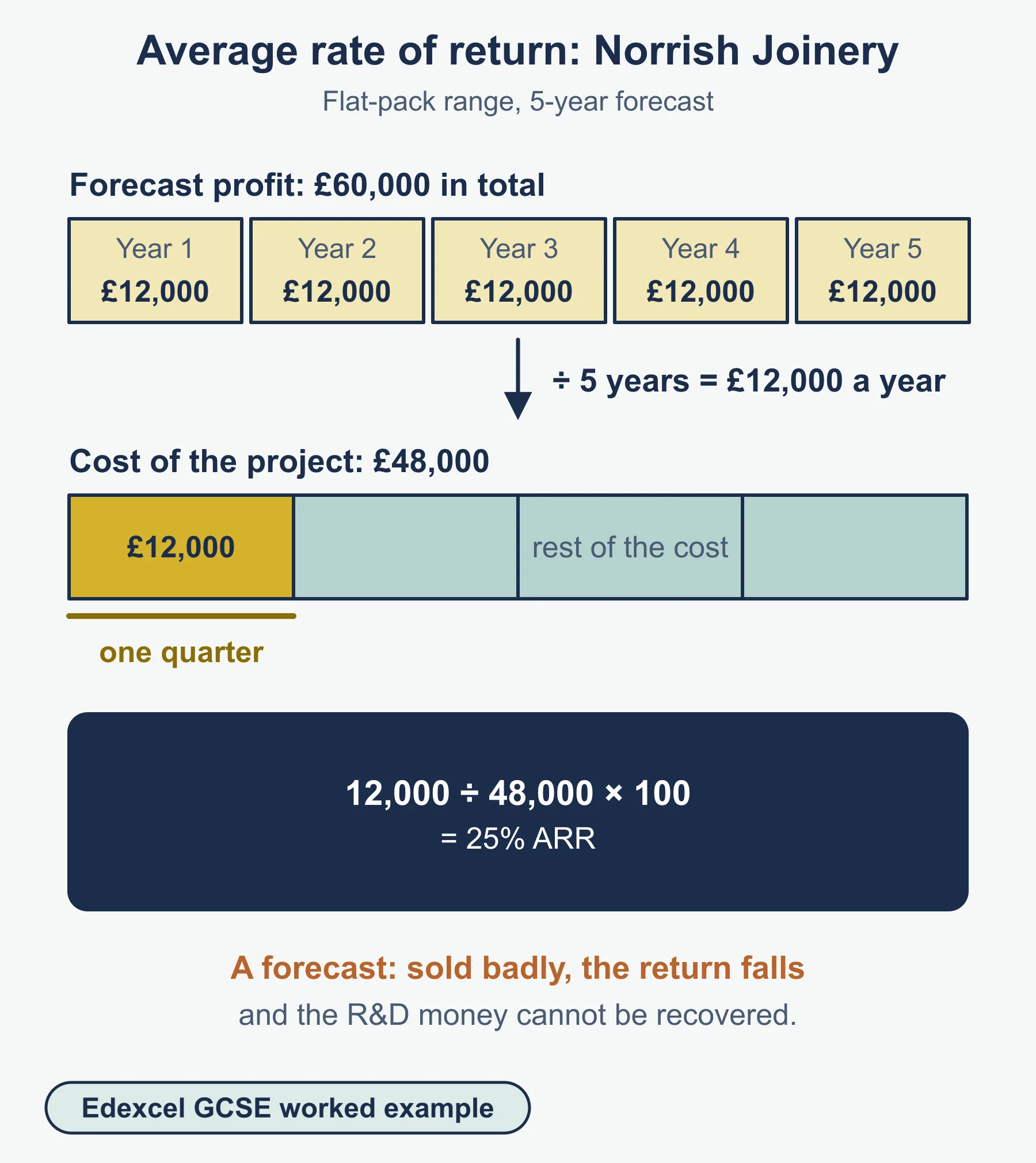
Average rate of return (Appendix 3). Average annual profit (total profit divided by years), over the cost of investment, times 100.
Net profit margin (Appendix 3). net profit / sales revenue × 100.
Answering “Analyse” or “Justify”.
- Make a point.
- Explain why it matters, using the numbers or facts in the case.
- Link back to the question. For “Justify” pick one option and say why the other is weaker.
Plc ownership
- Limited liability and the right to offer shares to the public.
- Raises large sums and can make a business better known.
- Many shareholders, so founders may lose control.
- Open to takeover because shares can be bought by anyone.
Sources of finance
| Source | Internal or external | Remember |
|---|---|---|
| Retained profit | Internal | Cheap but depends on past profit |
| Selling assets | Internal | Quick cash, lose the asset |
| Loan capital | External | Interest and repayments, lender takes no ownership |
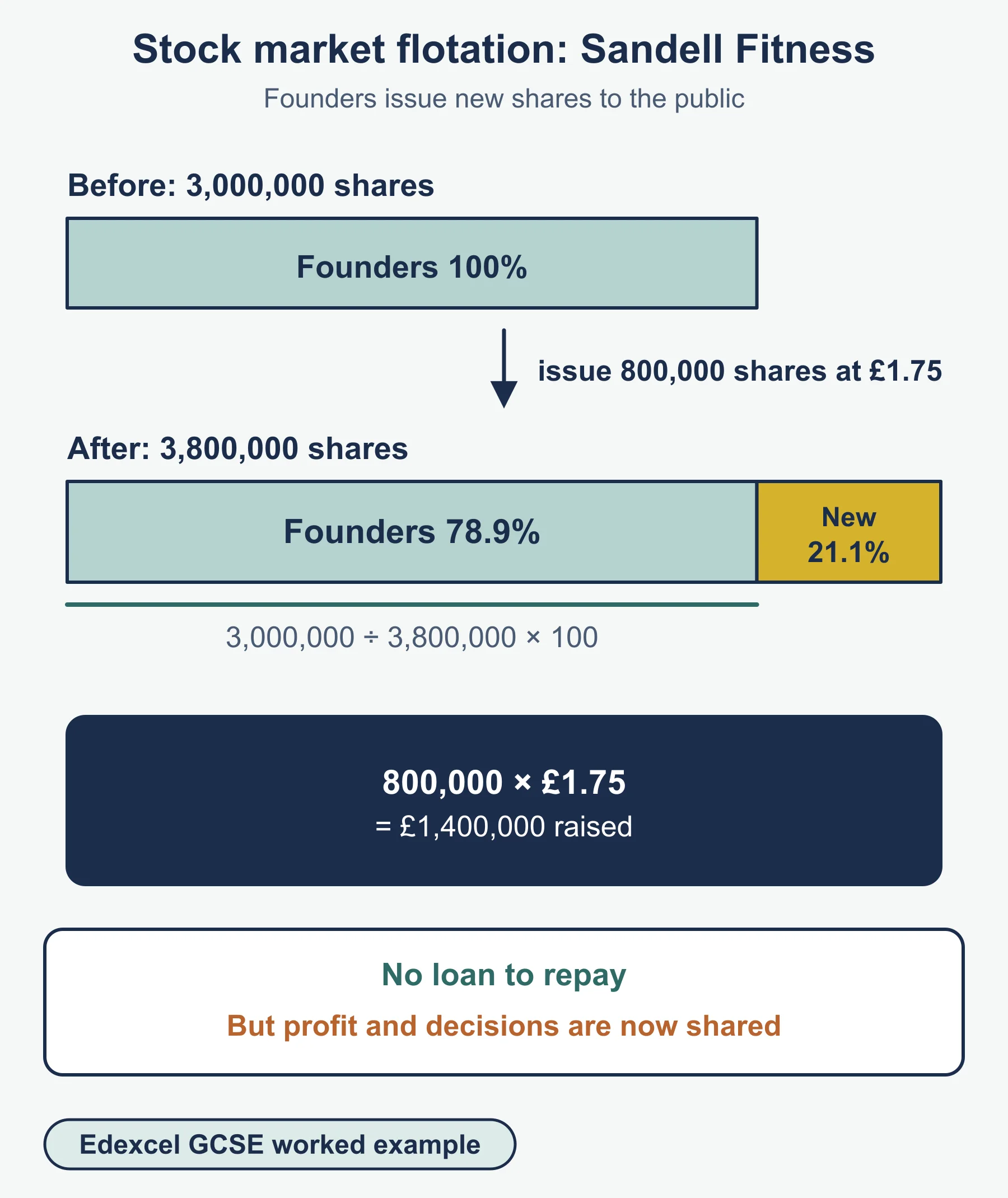
| Share capital | External | No repayment, but shares ownership |
| Stock market flotation | External (plc) | Large sums, loss of control, public attention |
Matching finance to the situation. A business with weak profit has little retained profit, so it may need a loan or shares. A business already heavily in debt may prefer shares. A short-term cash need might suit selling an unused asset.
Why aims change, and how
| Reason | Example |
|---|---|
| Market conditions | A new rival cuts prices, so a business drops its growth target |
| Technology | An online platform makes selling abroad possible |
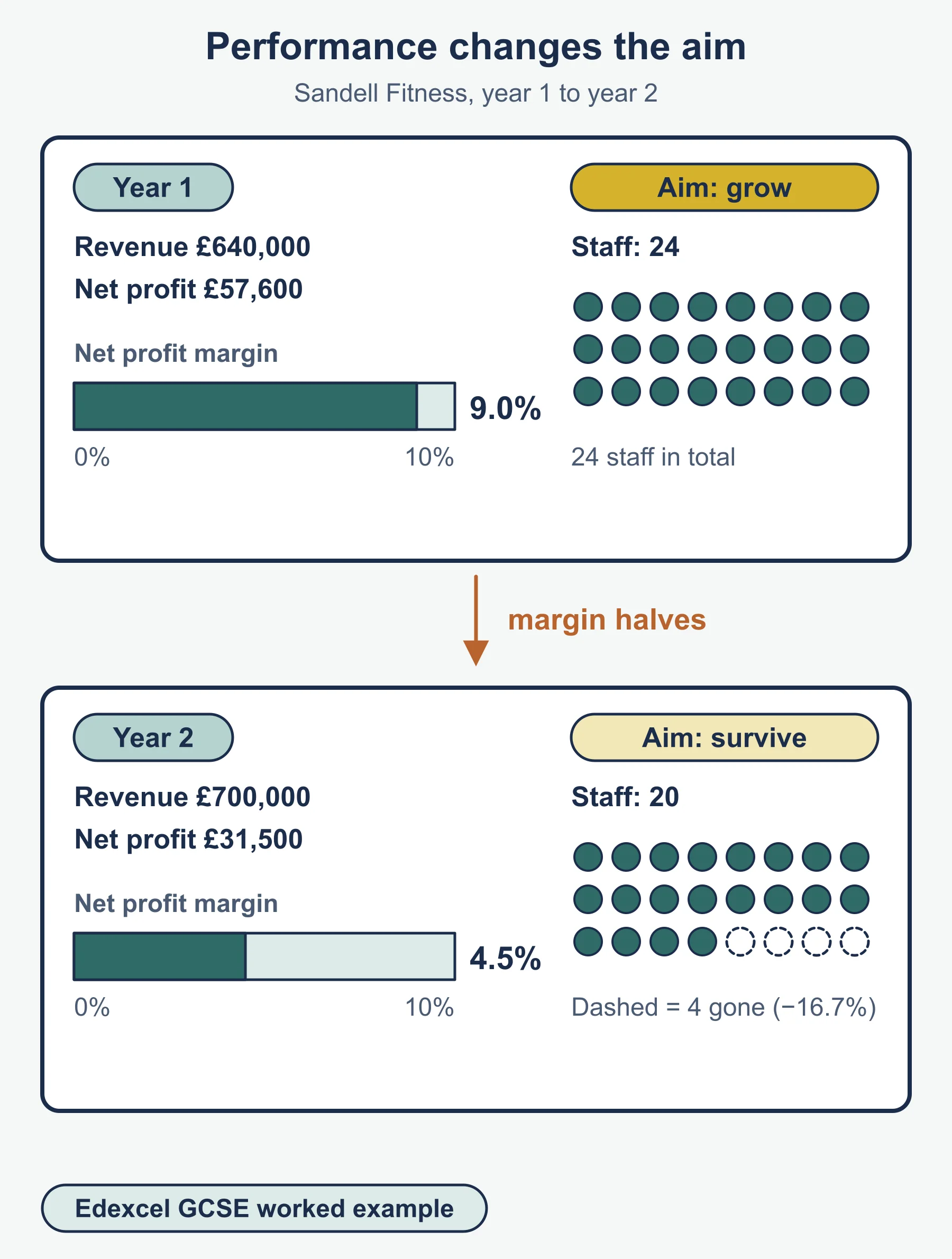
| Performance | Falling margin leads to a survival aim |
| Legislation | A new rule adds costs, so a product line is dropped |
| Internal reasons | A new owner wants a bigger business |
| How aims show up | Example |
|---|---|
| Survival or growth | A start-up targets survival; a strong firm targets growth |
| Entering or exiting markets | Opening in a new region, or closing a loss-making branch |
| Workforce | Hiring for expansion, or reducing staff to save cost |
| Product range | Adding lines for new customers, or dropping weak ones |
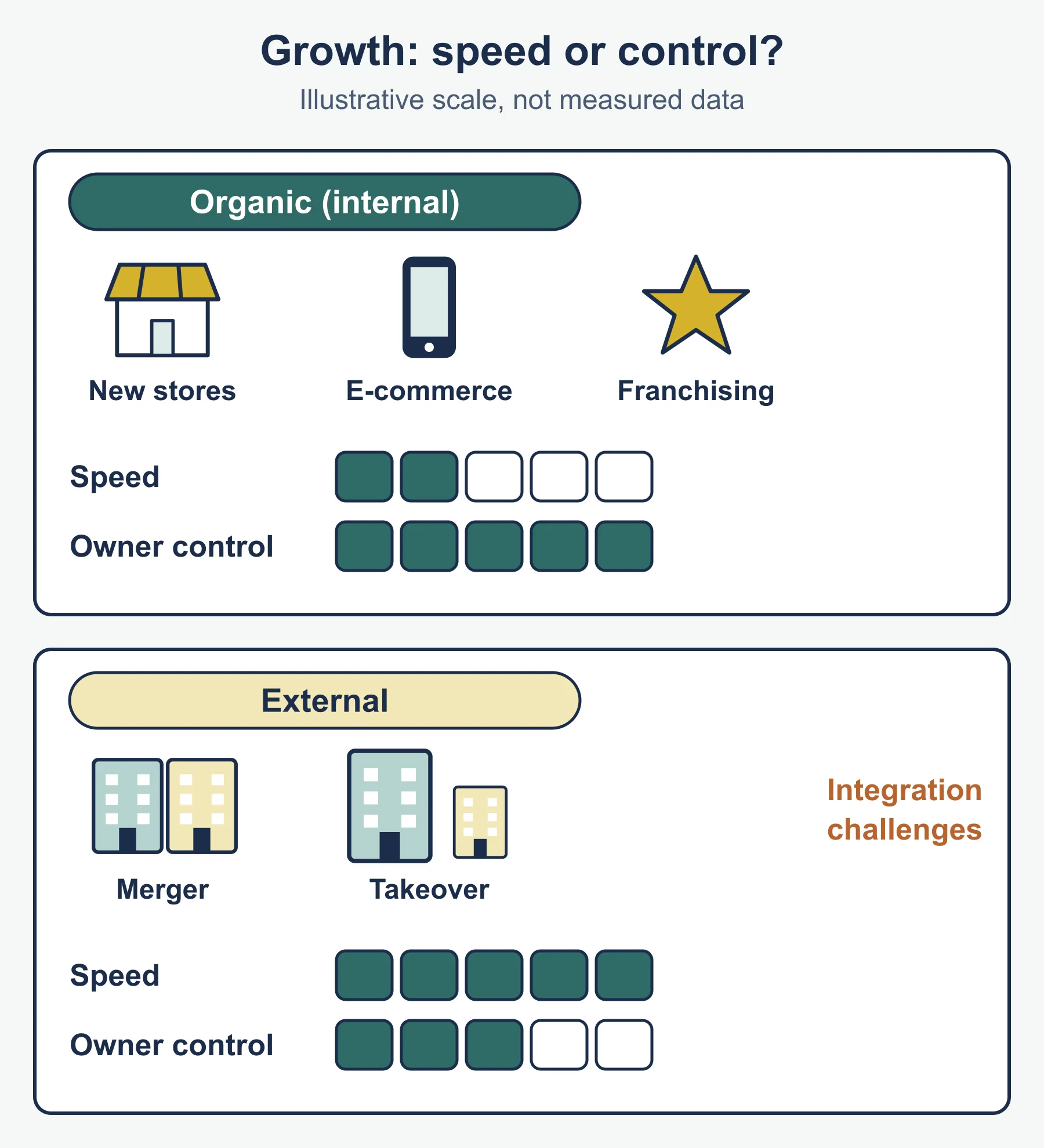
Must-know distinction. Organic growth keeps control and grows slowly. Inorganic growth is faster but costs more and brings integration problems.
Worked reminder: Teelan Tools
Teelan Tools makes garden tools. Its revenue rose from £45,000 to £58,500 after it started selling through its own website.
- Change = 58,500 - 45,000 = £13,500
- 13,500 / 45,000 × 100 = 30% growth. This is organic growth through new markets and technology.
Worked reminder: choosing finance
Rossiter Candles needs £60,000 for a new workshop. It has retained profit of £20,000 and plans to sell an old van for £4,000. It will borrow £30,000 and raise the rest from share capital.
- Internal finance = 20,000 + 4,000 = £24,000
- Loan = £30,000, so share capital = 60,000 - 24,000 - 30,000 = £6,000
The mix is a judgement. More loan capital means more interest and fixed repayments. More share capital means no repayment but the owners share control. Always link the choice to the business’s profit, existing debt and how quickly the cash is needed.
Command words for this topic
| Command word | What the specification says | Use it here to |
|---|---|---|
| Define | Define a term from the content | Give the meaning of merger, takeover, plc, flotation |
| State | A sentence at most, using the contextual information | Pick organic or external growth from a stem |
| Calculate | Use the data; workings should be given | Percentage change, interest, ARR |
| Explain | A fact with two expansion points, no context | Advantages of retained profit or share capital |
| Outline | Two linked points placed in context | A problem after a merger in a named business |
| Analyse | Extended, placed in the question’s context | Why a case business changed its aims |
| Justify | Recommend one of two options using the information | Organic growth versus takeover |
| Evaluate | A supported conclusion about a business situation | Survival versus growth aim |
Quick self-test
- Name the two types of external growth listed in the specification.
- Rossiter Candles raised sales from £52,000 to £65,000. Calculate the percentage increase.
- Rossiter borrows £20,000 and repays £22,400 in total. Calculate the interest as a percentage of the amount borrowed.
- A new machine costs £40,000 and is expected to give a total profit of £36,000 over 3 years. Calculate the average rate of return.
- A company makes £95,000 profit after tax and pays £35,000 in dividends. Calculate the retained profit.
- Give one internal and one external source of finance.
- A plc issues 50,000 shares at £4 each. How much does it raise?
- Two firms hold 9% and 11% of a market and merge. State the combined market share.
- A firm cuts staff from 40 to 34. Calculate the percentage reduction.
- State two reasons why a business might change its aims.
- Give one way in which a business might change its product range as its aims change.
- Give one reason a plc may be more at risk of takeover than a sole trader.
Answers
- Merger and takeover.
- (65,000 - 52,000) / 52,000 × 100 = 25%.
- (22,400 - 20,000) / 20,000 × 100 = 12%.
- Average annual profit = 36,000 / 3 = £12,000; 12,000 / 40,000 × 100 = 30%.
- 95,000 - 35,000 = £60,000.
- Internal: retained profit or selling assets. External: loan capital or share capital (flotation also counts for a plc).
- 50,000 × 4 = £200,000.
- 9% + 11% = 20%.
- (40 - 34) / 40 × 100 = 15%.
- Any two of: market conditions, technology, performance, legislation, internal reasons.
- Adding a new line to serve new customers, or dropping a weak, loss-making line to save cost.
- Its shares are traded openly, so another business can buy enough of them to gain control; a sole trader has no shares to buy.
Where marks are usually lost
- Calling any rise in sales “organic” without checking that it came from the business’s own resources.
- Using the new figure as the divisor in a percentage change.
- Forgetting the units or the percentage sign in a Calculate answer, or leaving out workings when the command word asks for them.
- Writing “a loan is cheap” with no link to the interest and the repayments in the case.
- Treating retained profit as spare cash rather than profit that may already be invested.
- Giving a general list of reasons for changed aims instead of picking the ones that fit the case.
- On Explain questions, giving one point without the two expansion points the command word asks for.
- On Justify questions, describing both options but never recommending one.
- Confusing merger (agreement) with takeover (buying control).
- Answering as if every business can float shares. Flotation is for public limited companies.
Frequently asked questions
What is the difference between organic and inorganic growth in GCSE Business? Organic (internal) growth uses the business’s own resources, such as new products or new markets, so the owners keep control but growth is slow. Inorganic (external) growth happens through a merger or takeover, which is faster but costs more and brings integration problems.
How do you calculate the average rate of return for Edexcel GCSE Business? Divide the total profit by the number of years to get the average annual profit, then divide that by the cost of the investment and multiply by 100. For example, £36,000 profit over 3 years on a £40,000 machine gives 12,000 / 40,000 × 100 = 30%.
Which sources of finance can a growing business use? Internal sources are retained profit and selling assets; external sources are loan capital, share capital and, for a public limited company, stock market flotation. The best choice depends on the business’s past profit, its existing debt and how quickly it needs the cash.
Can any business raise money through a stock market flotation? No. Flotation means offering shares to the public on the stock market, so it is only open to a public limited company (plc). In Edexcel GCSE Business (1BS0) answers, treating a sole trader or private company as able to float shares is a common error.
Official syllabus
Pearson Edexcel Level 1/Level 2 GCSE (9-1) in Business (1BS0), Specification, Issue 2, July 2022, published by Pearson Education Limited. Theme 2: Building a business, Topic 2.1 Growing the business, items 2.1.1 and 2.1.2.
Get free revision emails (optional)
Occasional emails with practice questions, worked explanations and links to free resources for the qualification and subjects you choose. No spam, and you can unsubscribe from any email. The free tools on this site never need an email.
Related resources
-
Study guides
Edexcel GCSE Business: Globalisation, ethics and the environment (1BS0)
Study guide to globalisation, ethical and environmental considerations and pressure groups for Pearson Edexcel GCSE Business, Theme 2 topic 2.1.
Business · Pearson Edexcel · GCSE
Read guide -
Practice questions
Edexcel GCSE Business: Globalisation, ethics and the environment (1BS0) – Practice Questions
Original practice questions with worked answers on imports, exports, tariffs, ethics, the environment and pressure groups for Edexcel GCSE Business.
Business · Pearson Edexcel · GCSE
Try questions -
Revision notes
Edexcel GCSE Business: Globalisation, ethics and the environment (1BS0) – Revision Notes
Condensed revision notes on globalisation, tariffs, trade blocs, ethics, the environment and pressure groups for Edexcel GCSE Business Theme 2, topic 2.1.
Business · Pearson Edexcel · GCSE
Revise topic
Related articles
-
teaching
A Level tuition in Dubai: Cambridge or Pearson Edexcel International A Level?
Schools in Dubai and Abu Dhabi teach either Cambridge International AS & A Level or Pearson Edexcel International A Level. How the two are structured, why it matters for tuition, and how online classes from Lahore work.
9 October 2026
-
curriculum guides
Choosing subjects at IGCSE and A Level
How subject choices at 14 and 16 affect university options later, and how to keep pathways open without overloading a timetable.
28 July 2026
Studying this with a teacher
Working through Business GCSE?
This page is free and stays free. If you would rather be taught it, Marlbridge runs Business classes one-to-one and in small groups of up to 15, online in your own time zone. The first trial class is free. WhatsApp replies within an hour (8am–11pm Pakistan time, every day); email the same day.
Pearson Edexcel Business teachers at Marlbridge

