
Study Guides
Edexcel GCSE Business: Enterprise and entrepreneurship (1BS0)
Study guide to why business ideas arise, risk and reward, adding value and the entrepreneur's role, for Edexcel GCSE Business Theme 1, Topic 1.1.
- Subject
- Business
- Level
- GCSE
- Topic
- Enterprise and entrepreneurship
- Author
- Marlbridge Academic Team
- Updated
- Reviewed by
- Asif Iqbal (what this means)
Aligned to Pearson Edexcel GCSE Business (1BS0), Issue 2, July 2022. Official specification .
Syllabus page (what it covers and how it is assessed): Pearson Edexcel GCSE Business.
Syllabus points this page covers
1BS0
- 1.1 Enterprise and entrepreneurship (whole topic)
- 1.1.1 The dynamic nature of business
- 1.1.2 Risk and reward
- 1.1.3 The role of business enterprise
Found an error? Report a correction.
Want a teacher for this? Marlbridge teaches Business online. Request a free trial class.
This guide follows the Pearson Edexcel Level 1/Level 2 GCSE (9-1) in Business (1BS0) specification, Issue 2, July 2022. It covers Theme 1, Topic 1.1 Enterprise and entrepreneurship, content items 1.1.1 (the dynamic nature of business), 1.1.2 (risk and reward) and 1.1.3 (the role of business enterprise). The specification lists formulae in Appendix 3 and says they are not provided in the examinations, so the revenue and profit sums below are worth learning.
Course links: the Business hub, the printable checklist and the free diagnostics. Companion pages: the revision notes and the practice questions.
What the specification asks for
| Item | You must be able to | Section |
|---|---|---|
| 1.1.1 | Explain why new ideas arise: changes in technology, changes in what consumers want, products and services becoming obsolete | 1 |
| 1.1.1 | Explain how ideas arise: original ideas, or adapting existing products, services or ideas | 2 |
| 1.1.2 | Explain the risks: business failure, financial loss, lack of security | 3 |
| 1.1.2 | Explain the rewards: business success, profit, independence | 3 |
| 1.1.3 | Explain the purpose of business activity: produce goods or services, meet customer needs | 4 |
| 1.1.3 | Explain how a business adds value: convenience, branding, quality, design, unique selling points | 4 |
| 1.1.3 | Explain the role of an entrepreneur: organises resources, makes business decisions, takes risks | 5 |
1. Why new business ideas come about
Business is dynamic. The world around a business keeps changing, and each change closes some opportunities and opens others. The specification gives three reasons.
Changes in technology. New equipment, software or networks make things possible that were not possible before, or make existing things cheaper. An entrepreneur who spots this can offer a better or cheaper product. For example, the spread of fast mobile data made it practical for a small firm to take orders through an app instead of by phone.
Changes in what consumers want. Tastes, incomes, habits and concerns shift. If more people want plant-based meals, less packaging or faster delivery, a gap appears. Whoever fills it first may win loyal customers.
Products and services becoming obsolete. A product is obsolete when it is out of date and few people still want it, usually because something better has replaced it. The old product’s sales fall, but the problem it solved remains. That leaves room for a replacement.
Worked example: all three reasons together
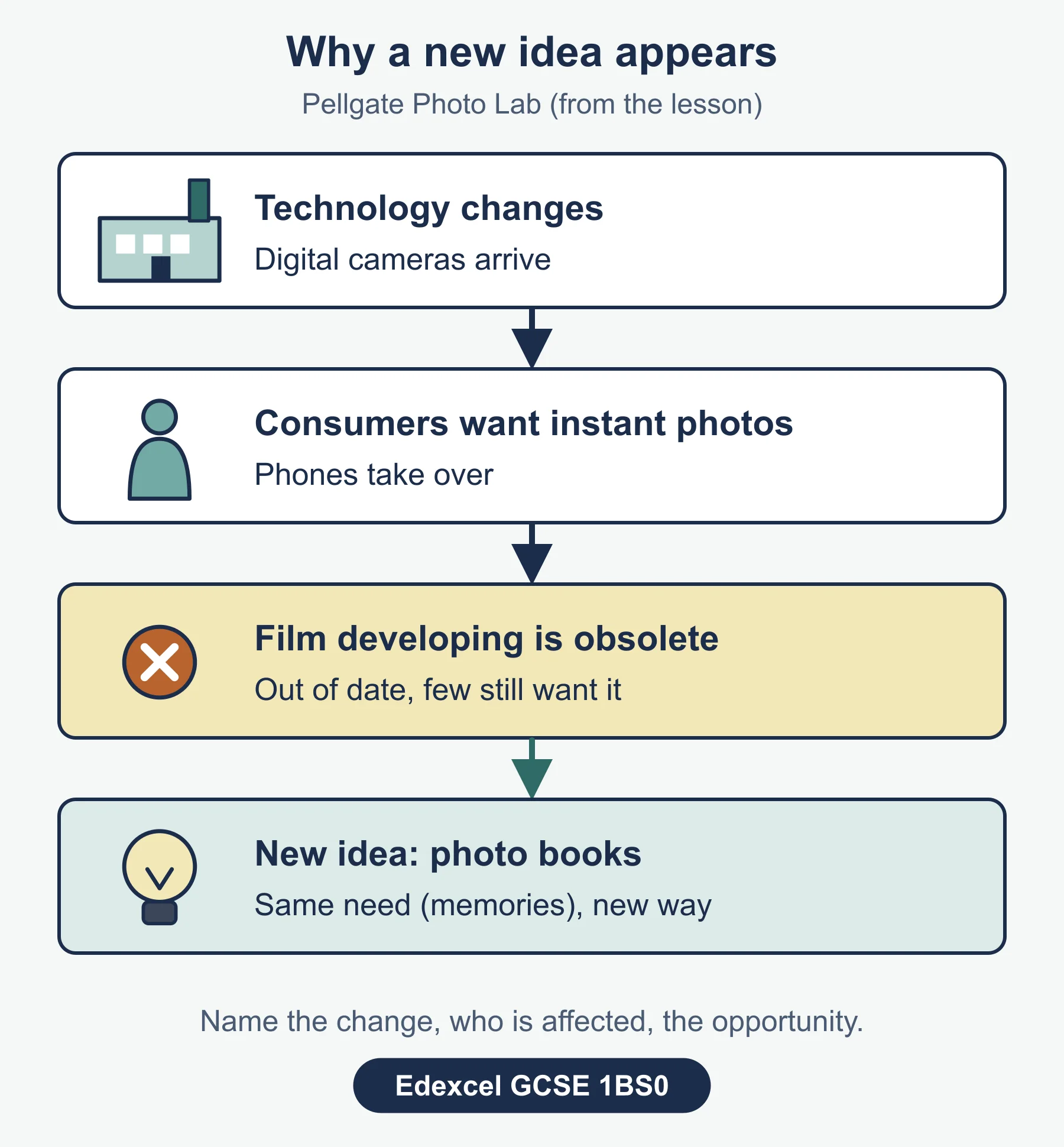
Pellgate Photo Lab developed holiday film. Digital cameras arrived (technology), then phones took over (consumers wanted instant photos), and film developing became obsolete. The owner could have closed. Instead she began printing photo books from customers’ phone images, serving the same need (keeping memories) in a way people now wanted.
Notice the pattern in a good answer: name the change, say who is affected, then say what opportunity follows.
2. How new business ideas come about
| Source | What it means | Strength | Weakness |
|---|---|---|---|
| Original idea | Something new, not offered before | No direct rivals; can charge for novelty | Demand untested; development can be costly |
| Adapting an existing idea | Changing a product, service or idea already on sale | Demand is proven; less to learn | Rivals already exist; easier to copy |
Adapting can mean changing the product, the way it is delivered, who it is aimed at, or the place it is sold. A bakery adding a gluten-free loaf has adapted. A van that brings a hairdresser to care-home residents has adapted a service by changing where it is delivered.
Most real ideas sit between the two. Exam answers should say which kind the business uses and why that suits it.
3. Risk and reward
Starting a business is a choice to accept uncertainty in return for the chance of gain.
| Risk | Meaning |
|---|---|
| Business failure | The business cannot cover its costs and closes |
| Financial loss | Costs exceed revenue, or money put in is lost |
| Lack of security | No guaranteed wage, holiday pay or job for the future |
| Reward | Meaning |
|---|---|
| Business success | The idea works, customers return, the business can grow |
| Profit | Revenue is greater than total costs |
| Independence | The owner decides what to do and when, and has no boss |
The standard forms used here are revenue = price × quantity (Appendix 3) and profit = revenue − total costs (the standard form; Appendix 3 lists total cost and net profit separately).
Worked example: the same idea, two outcomes
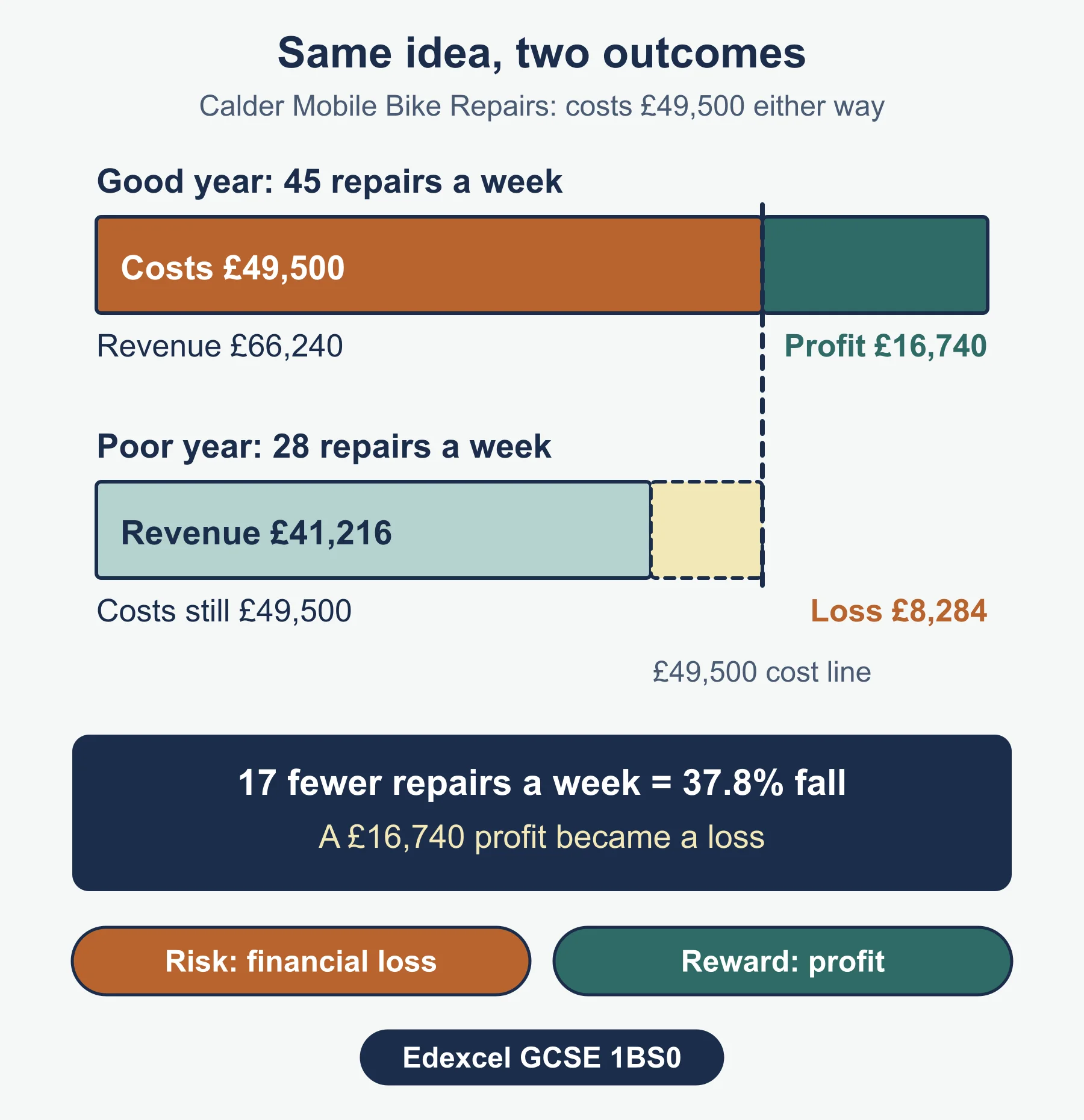
Calder Mobile Bike Repairs charges £32 a repair and works 46 weeks a year. Total costs are £49,500 a year, which includes the van, tools, parts and insurance. Assume costs stay the same either way.
Good year, 45 repairs a week:
- Revenue = 32 × 45 × 46 = £66,240
- Profit = 66,240 − 49,500 = £16,740
Poor year, 28 repairs a week:
- Revenue = 32 × 28 × 46 = £41,216
- Profit = 41,216 − 49,500 = −£8,284, a loss of £8,284
Repairs fell by 17 a week, which is 17 ÷ 45 × 100 = 37.8% (to 3 significant figures). That fall turned a £16,740 profit into a loss. The owner who carries this variation has no employer to absorb it, which is the lack of security. Cash lost in a bad year could also lead to failure if it continues.
The reward side is just as real. In the good year the owner keeps the profit and chose the working week. That is profit and independence together.
Risk and reward are linked: the bigger the possible reward, the greater the risk usually is. Risk is not a reason never to start, and reward is not guaranteed. A balanced answer shows both.
4. The role of business enterprise
The specification gives the purpose of business activity as three things: to produce goods or services, to meet customer needs, and to add value.
Produce goods or services. Goods are physical items such as bread or bicycles. Services are actions done for customers such as repairs or tuition. A business takes inputs and turns them into something customers will pay for.
Meet customer needs. A business only survives if it supplies what customers want. Its goods or services must solve a problem or satisfy a want.
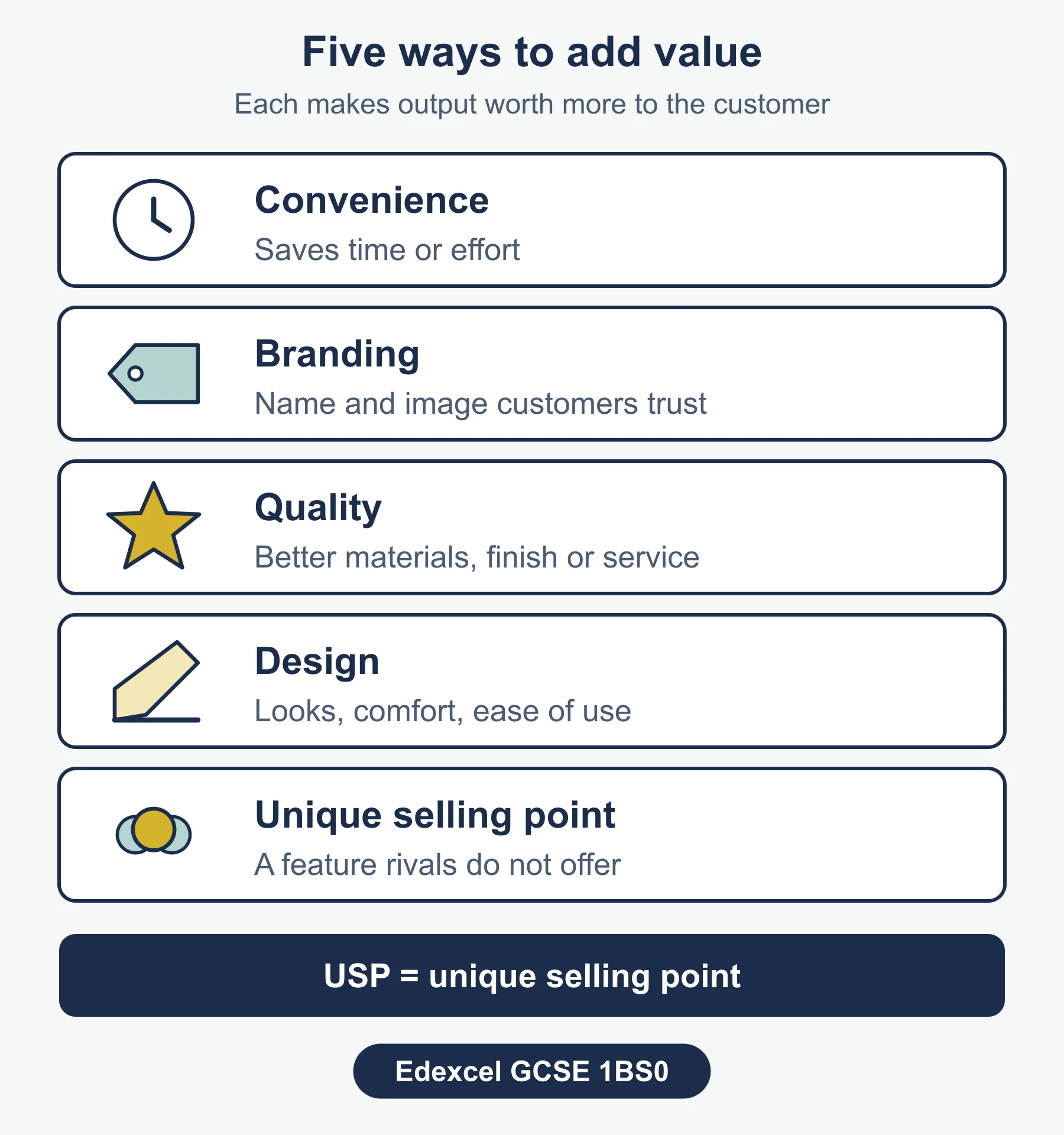
Add value. A business adds value when it makes its output worth more to the customer than the inputs it bought. The specification lists five ways.
| Way to add value | What it does | Example |
|---|---|---|
| Convenience | Saves time or effort | Delivery to the door; opening late |
| Branding | The name, logo and image by which customers know and trust a product | A bottle sold under a respected name costs more than an unbranded one |
| Quality | Better materials, finish or service | A handmade chair that lasts decades |
| Design | Appearance, comfort and ease of use | A cleverly shaped pan that stacks flat |
| Unique selling point (USP) | A feature rivals do not offer | The only cafe in town with a children’s play corner |
Worked example: adding value
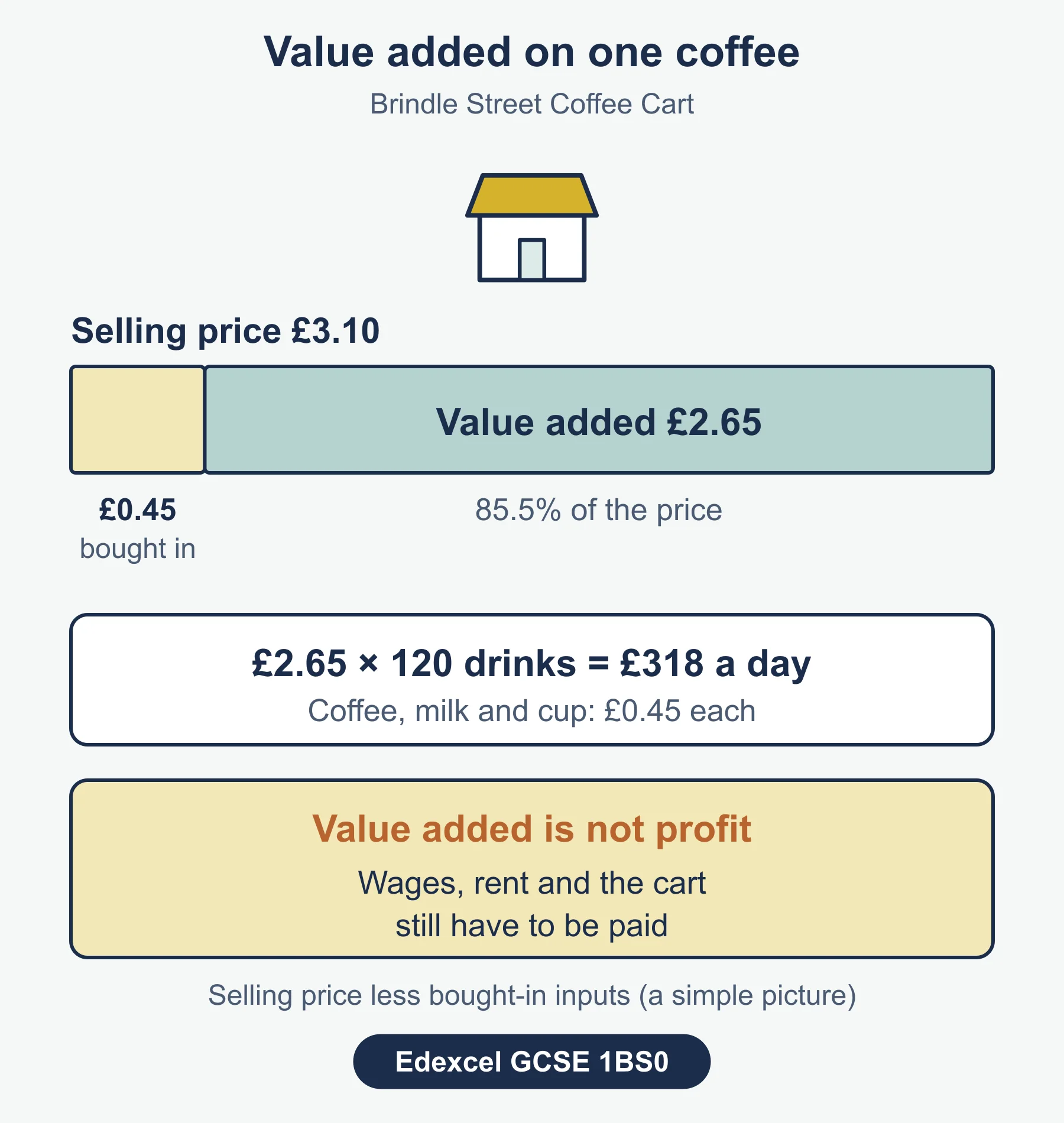
Brindle Street Coffee Cart buys £0.45 of coffee, milk and cup for each drink and sells it at £3.10.
- Difference = 3.10 − 0.45 = £2.65 per drink
- As a share of the price = 2.65 ÷ 3.10 × 100 = 85.5% (to 3 significant figures)
- At 120 drinks a day, that difference is 2.65 × 120 = £318 a day
The specification does not list a formula for value added. This is only a simple way to picture it: selling price less the cost of bought-in inputs. The £2.65 is not all profit, because wages, rent and the cart itself still have to be paid for. It is high because the cart is convenient (on the commuter route), the brand is trusted and the coffee is good quality.
5. The role of entrepreneurship
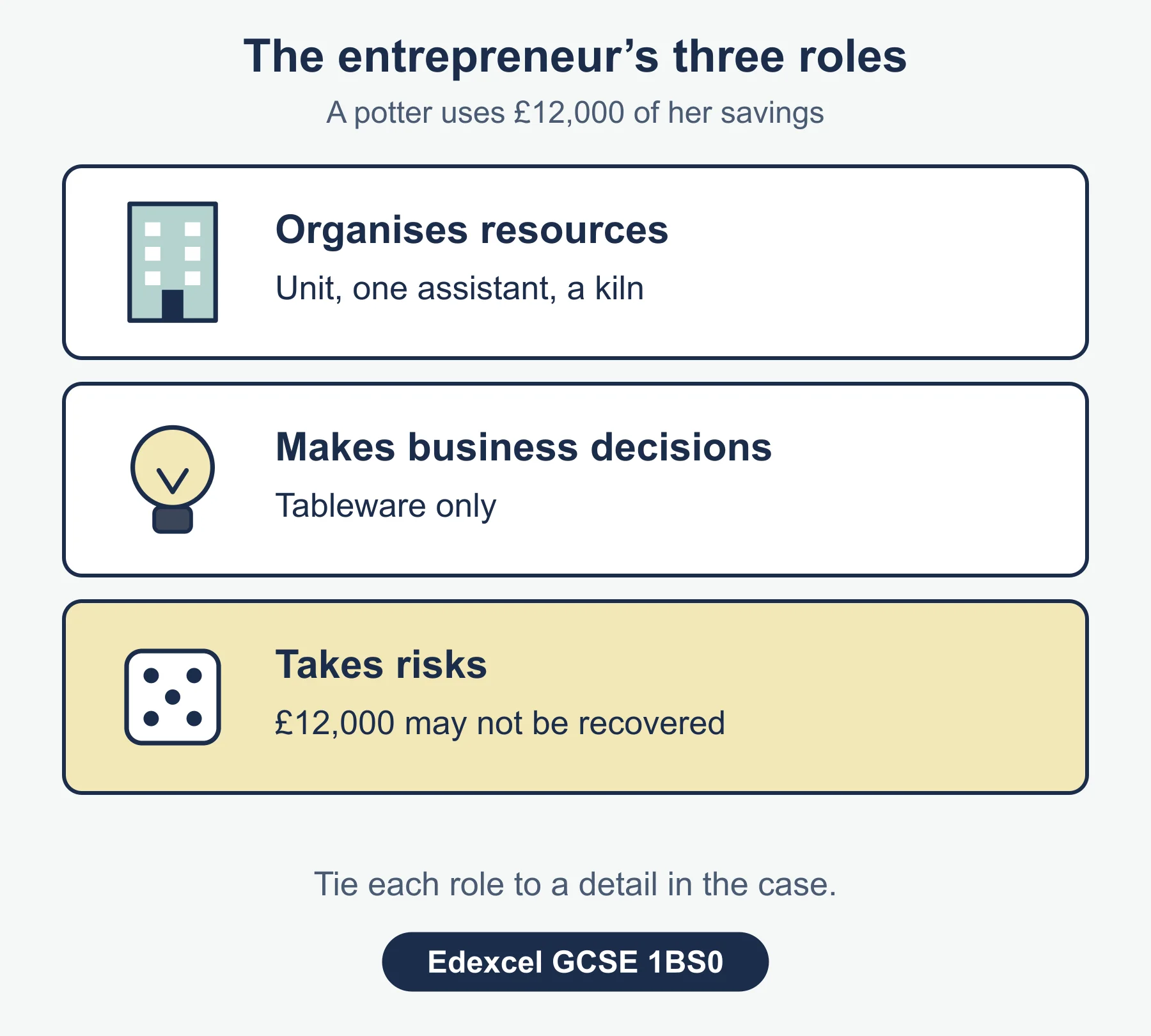
An entrepreneur is a person who sets up and runs a business, spotting an opportunity and acting on it. The specification gives three roles.
- Organises resources. Brings together land or premises, labour, equipment, materials and money so that the business can produce.
- Makes business decisions. Chooses what to sell, at what price, where, to whom and how much to spend.
- Takes risks. Puts in time and money without knowing whether customers will buy.
Worked example: spotting the roles
A woman rents a unit, hires one assistant, buys a pottery kiln and decides to make only tableware. She uses £12,000 of her savings.
- Organising resources: premises, labour and the kiln.
- Business decision: tableware only.
- Taking risks: the £12,000 may not be recovered if sales are weak.
For a context question, tie each role to a detail from the case. A bare list of the three roles earns little.
How the command words apply
Appendix 1 sets out what each command word asks for. For “explain”, it describes one fact developed with two further points, and says these questions have no context. “Analyse” is an extended answer placed in context by the question. “Justify” means using the information provided to back one of two options for the owner. “Evaluate” asks for a conclusion, backed by knowledge of the content, on the business situation. On a topic like this, an evaluation should weigh risk against reward, then decide.
Common errors
- Calling profit the only reward. Success and independence are also listed.
- Saying obsolete means “broken”. It means out of date and replaced.
- Treating value added as the same as profit.
- Listing the entrepreneur’s roles without applying them to the case.
- Giving only advantages of adapting an idea, or only of an original one.
Frequently asked questions
Why do new business ideas come about? The Edexcel GCSE Business (1BS0) specification gives three reasons: changes in technology, changes in what consumers want, and products and services becoming obsolete. Each change closes some opportunities and opens others.
What is the difference between an original idea and adapting an existing idea? An original idea is something not offered before, so it has no direct rivals but demand is untested. Adapting changes a product, service or idea already on sale, so demand is proven but rivals already exist and it is easier to copy.
What are the risks and rewards of starting a business? The risks in the specification are business failure, financial loss and lack of security. The rewards are business success, profit and independence.
What is a unique selling point? A unique selling point (USP) is a feature that rivals do not offer, such as the only café in town with a children’s play corner. It is one of the five ways a business can add value.
Official syllabus
Pearson Edexcel Level 1/Level 2 GCSE (9-1) in Business (1BS0), Specification, Issue 2, July 2022, published by Pearson Education Limited. Theme 1: Investigating small business, Topic 1.1 Enterprise and entrepreneurship, items 1.1.1 to 1.1.3.
Get free revision emails (optional)
Occasional emails with practice questions, worked explanations and links to free resources for the qualification and subjects you choose. No spam, and you can unsubscribe from any email. The free tools on this site never need an email.
Related resources
-
Practice questions
Edexcel GCSE Business: Enterprise and entrepreneurship (1BS0) – Practice Questions
Original practice questions with worked answers on business ideas, risk and reward, adding value and entrepreneurs for Edexcel GCSE Business Topic 1.1.
Business · Pearson Edexcel · GCSE
Try questions -
Revision notes
Edexcel GCSE Business: Enterprise and entrepreneurship (1BS0) – Revision Notes
Condensed revision notes with definitions, tables and a self-test on enterprise and entrepreneurship for Edexcel GCSE Business Theme 1, Topic 1.1.
Business · Pearson Edexcel · GCSE
Revise topic -
Study guides
Edexcel GCSE Business: Globalisation, ethics and the environment (1BS0)
Study guide to globalisation, ethical and environmental considerations and pressure groups for Pearson Edexcel GCSE Business, Theme 2 topic 2.1.
Business · Pearson Edexcel · GCSE
Read guide
Related articles
-
teaching
A Level tuition in Dubai: Cambridge or Pearson Edexcel International A Level?
Schools in Dubai and Abu Dhabi teach either Cambridge International AS & A Level or Pearson Edexcel International A Level. How the two are structured, why it matters for tuition, and how online classes from Lahore work.
9 October 2026
-
curriculum guides
Choosing subjects at IGCSE and A Level
How subject choices at 14 and 16 affect university options later, and how to keep pathways open without overloading a timetable.
28 July 2026
Studying this with a teacher
Working through Business GCSE?
This page is free and stays free. If you would rather be taught it, Marlbridge runs Business classes one-to-one and in small groups of up to 15, online in your own time zone. The first trial class is free. WhatsApp replies within an hour (8am–11pm Pakistan time, every day); email the same day.
Pearson Edexcel Business teachers at Marlbridge

