
Revision Notes
Edexcel GCSE Business: Legislation, the economy and external influences (1BS0) – Revision Notes
Condensed revision notes on legislation, the economic climate and responses to external change for Edexcel GCSE Business Theme 1, Topic 1.5.
- Subject
- Business
- Level
- GCSE
- Topic
- Understanding external influences on business
- Author
- Marlbridge Academic Team
- Updated
- Reviewed by
- Asif Iqbal (what this means)
Aligned to Pearson Edexcel GCSE Business (1BS0), Issue 2, July 2022. Official specification .
Syllabus page (what it covers and how it is assessed): Pearson Edexcel GCSE Business.
Syllabus points this page covers
1BS0
- 1.5 Understanding external influences on business (whole topic)
- 1.5.3 Legislation and business
- 1.5.4 The economy and business
- 1.5.5 External influences
Found an error? Report a correction.
Want a teacher for this? Marlbridge teaches Business online. Request a free trial class.
These notes condense Theme 1, Topic 1.5 items 1.5.3, 1.5.4 and 1.5.5 of the Pearson Edexcel Level 1/Level 2 GCSE (9-1) in Business (1BS0) specification, Issue 2, July 2022. For full explanations and worked examples, read the study guide. To test yourself, use the practice questions, the Business hub, the printable checklist and the free diagnostics.
1.5.3 Legislation: purpose and principles
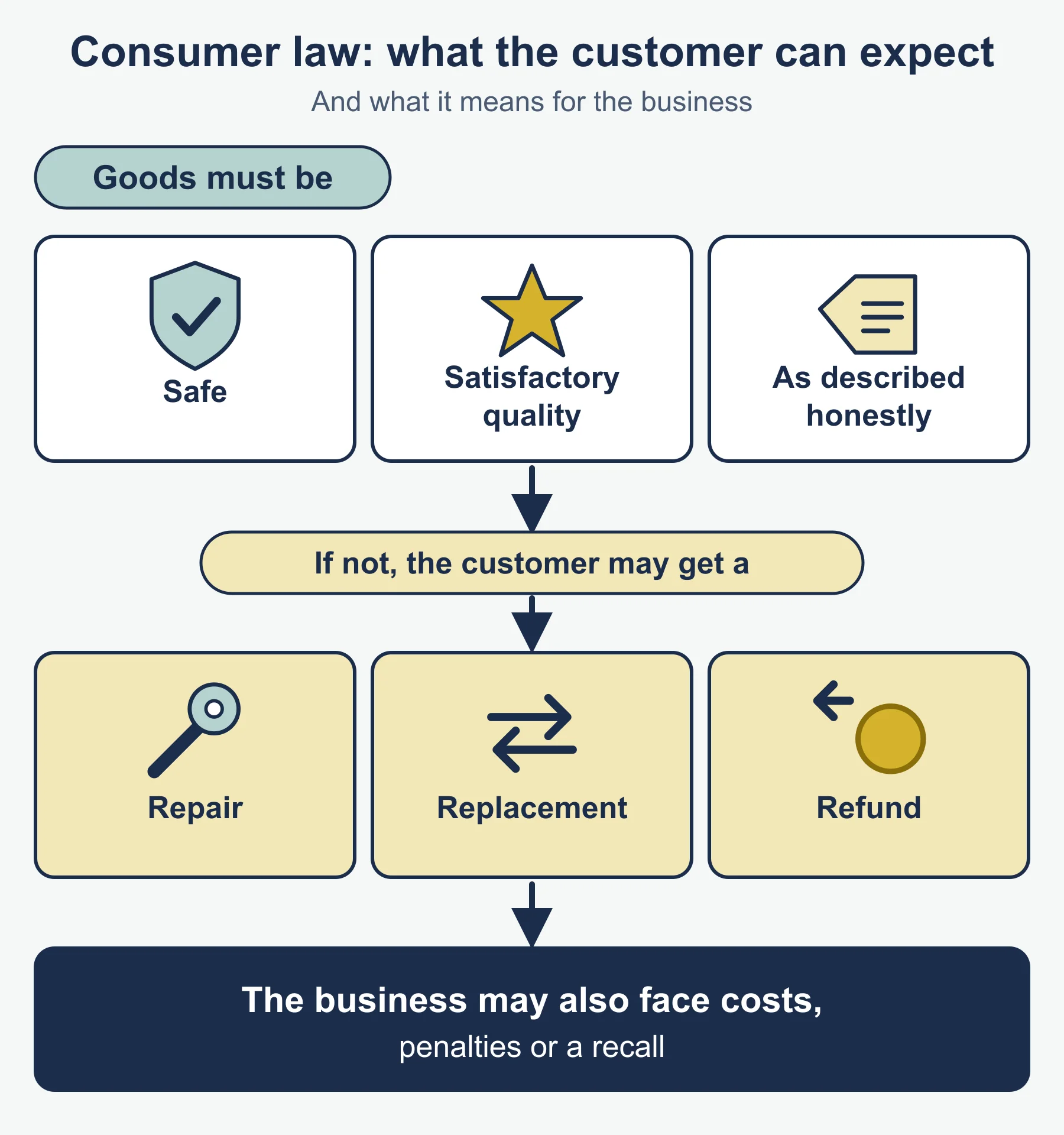
Legislation means laws made by government that businesses must follow. The specification names no particular Acts, so write about principles.
| Branch | Principles in the specification | In plain terms |
|---|---|---|
| Consumer law | Quality; consumer rights | Goods and services should be of reasonable standard; customers can seek a remedy if they are not |
| Employment law | Recruitment | Fair, honest selection of staff |
| Employment law | Pay | Workers paid correctly, on time and not below the legal minimum |
| Employment law | Discrimination | No unfair treatment because of a personal characteristic |
| Employment law | Health and safety | A safe workplace: risks assessed, equipment maintained, staff trained |
Why have it? To protect customers and workers, to make competition fairer, and to give everyone the same basic rules.
Impact on a business
| Meeting obligations | Not meeting obligations | |
|---|---|---|
| Cost | Training, equipment, checks, records, perhaps higher wages | Fines, compensation, closure or lost trading time, legal costs |
| Reputation | Trusted by customers and attractive to workers | Bad publicity, lost sales revenue |
| Staff | Safer, more settled team | Injuries, absence, resignations |
| Operations | Smoother, fewer disputes | Disruption, management time spent on investigations |
Key line: compliance costs money, but failing to comply can cost more and harm the brand.
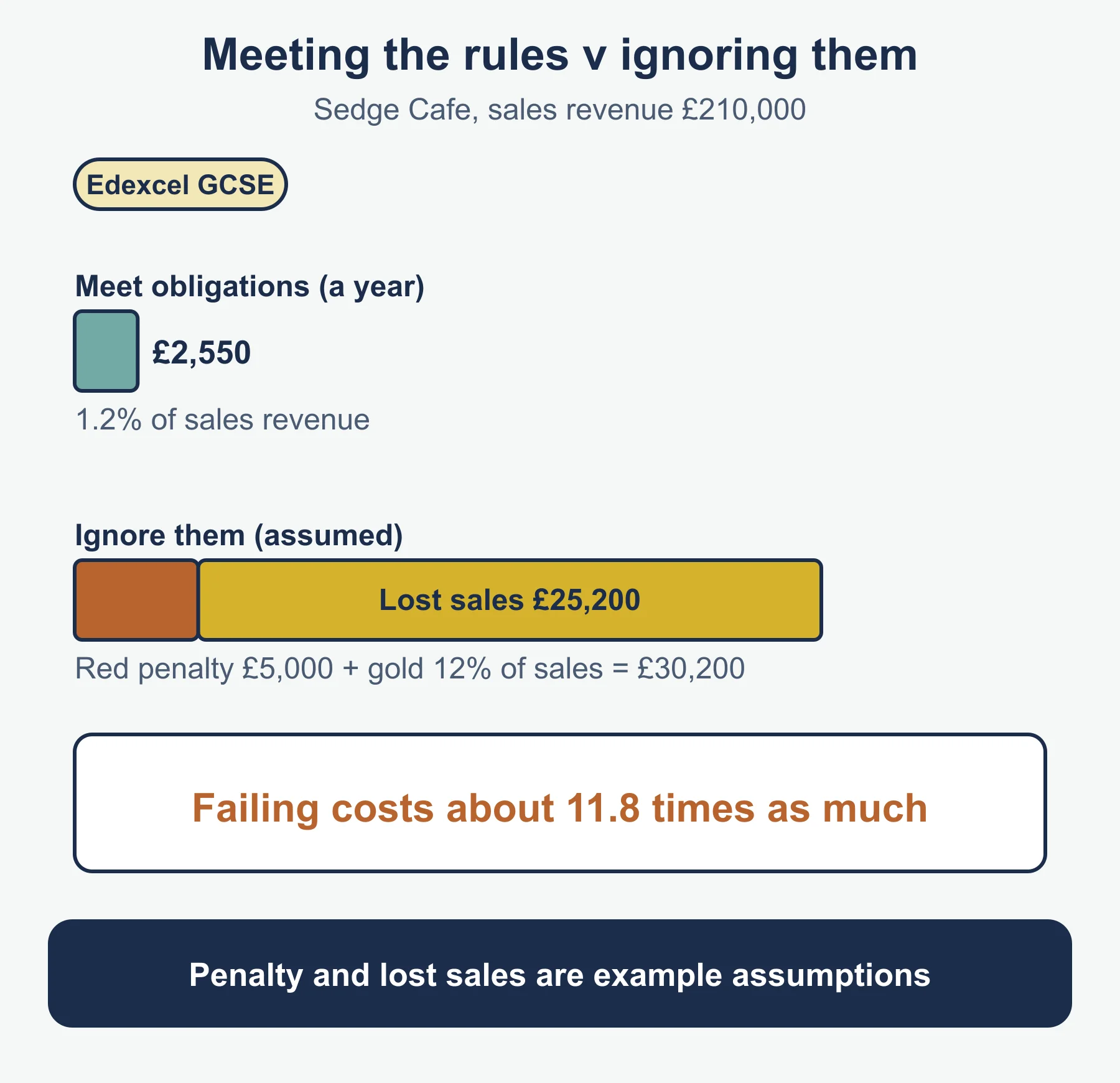
Reminder calculation
A business spends £3,200 a year on compliance. If it ignored the rules it would face a £7,500 penalty and lose 8% of £150,000 sales revenue. Lost sales revenue = 8% x 150,000 = £12,000. Total = 7,500 + 12,000 = £19,500. That is 19,500 - 3,200 = £16,300 more than complying costs.
1.5.4 The economic climate
| Influence | Direction of change | Likely effect on a business |
|---|---|---|
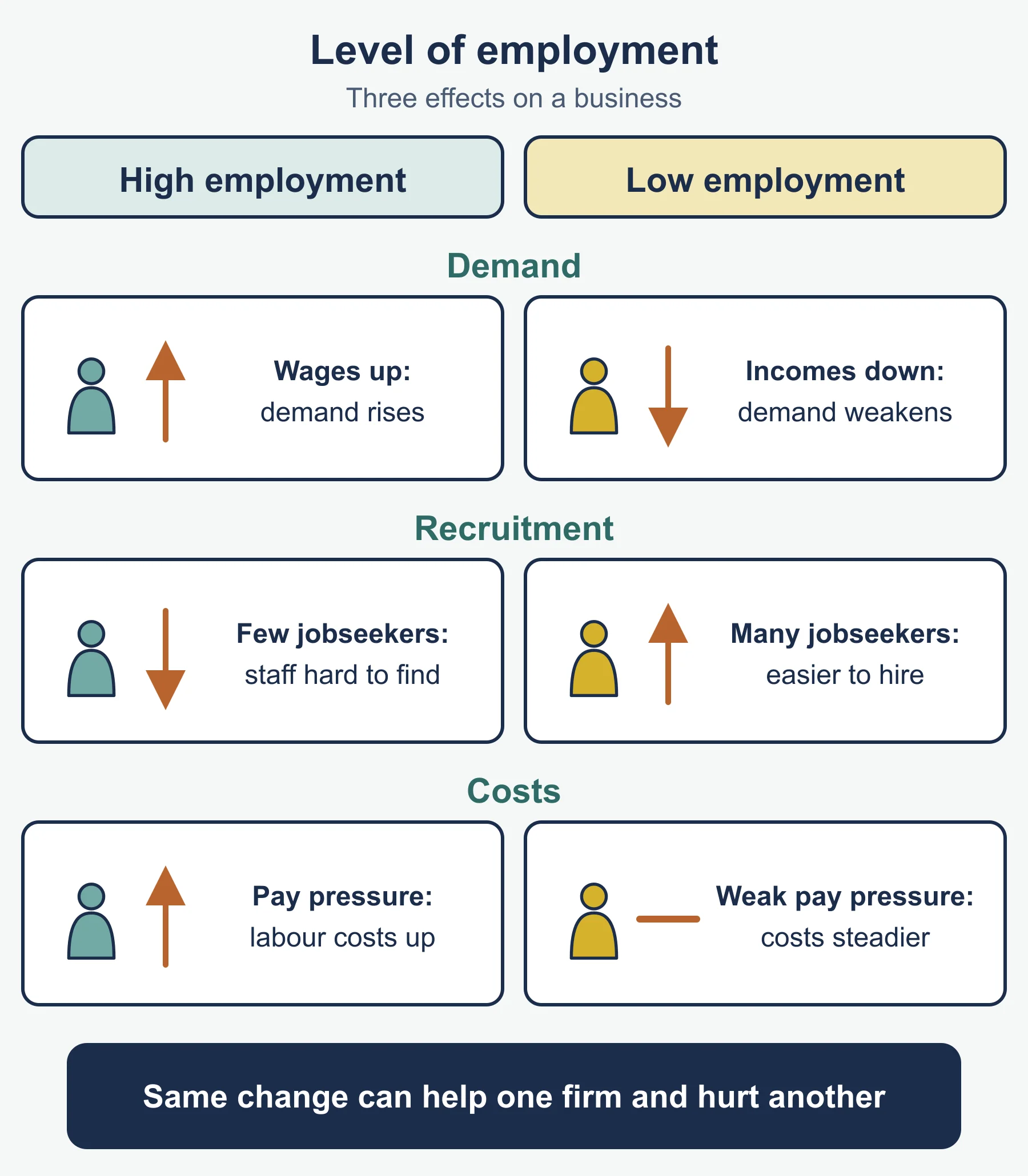
| Unemployment | Rises | Fewer customers with spending power, lower sales; easier to hire, less wage pressure |
| Unemployment | Falls | More spending; harder to recruit and wages may rise |
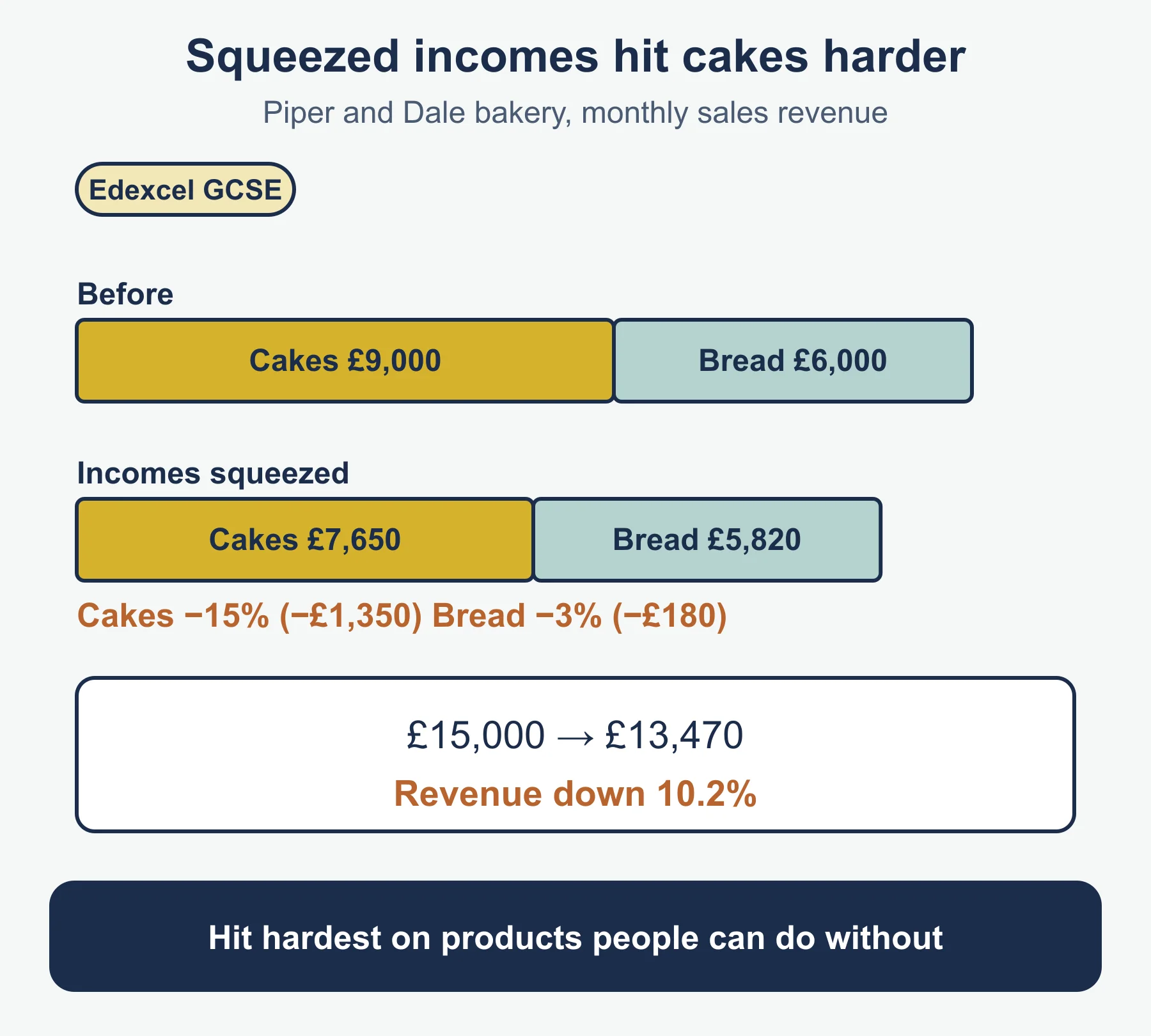
| Consumer income | Rises | More spending, especially on non-essential items |
| Consumer income | Falls | Spending falls; buyers choose cheaper alternatives |
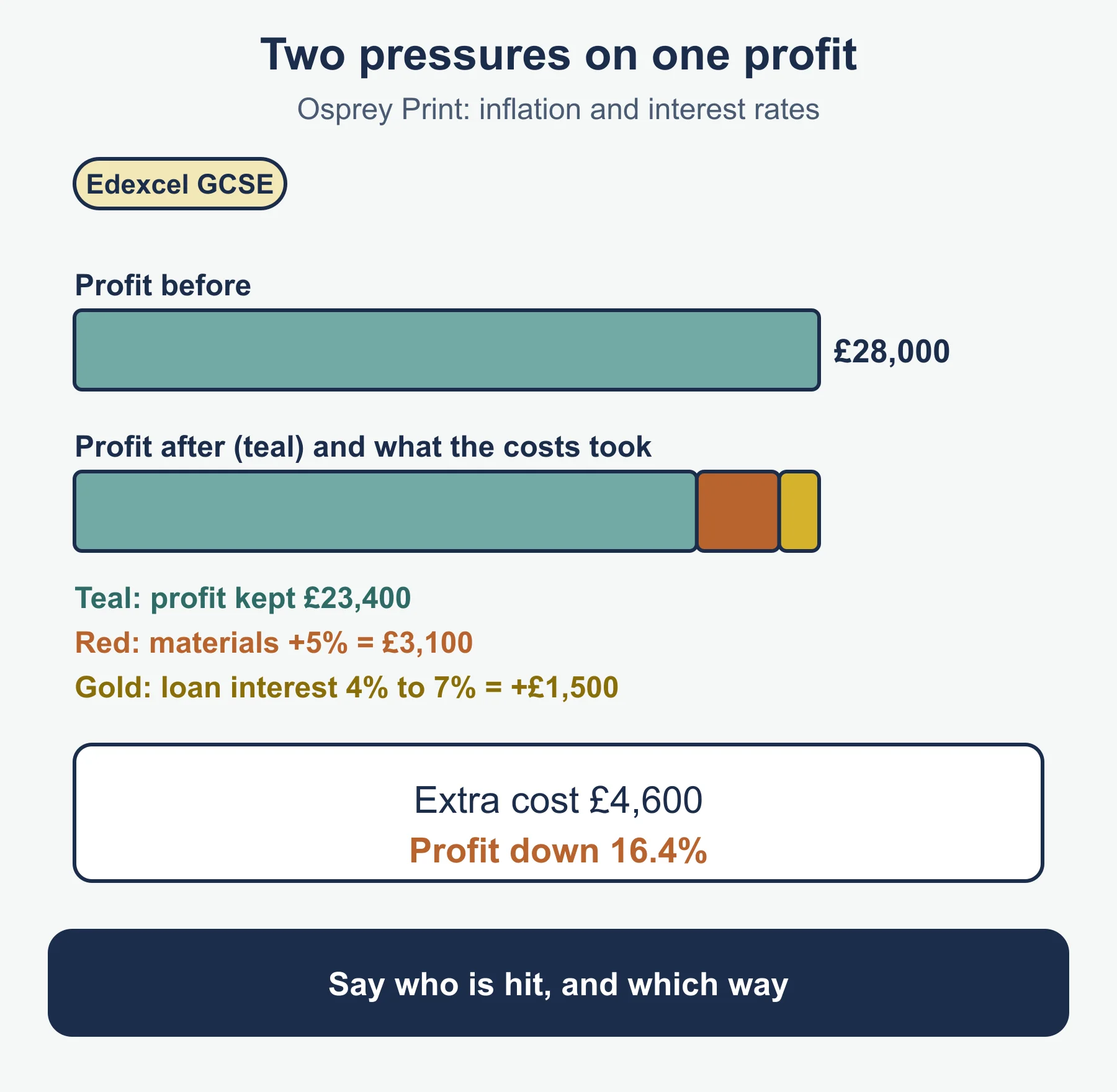
| Inflation | Rises | Costs rise; the business must absorb them or raise prices; customers can buy less |
| Interest rates | Rise | Borrowing and loan repayments cost more; spending and investment fall |
| Interest rates | Fall | Borrowing is cheaper; spending and investment may rise |
| Government taxation | Rises | Less profit kept (tax on profits) or less customer spending (tax on incomes or sales) |
| Government taxation | Falls | The reverse |
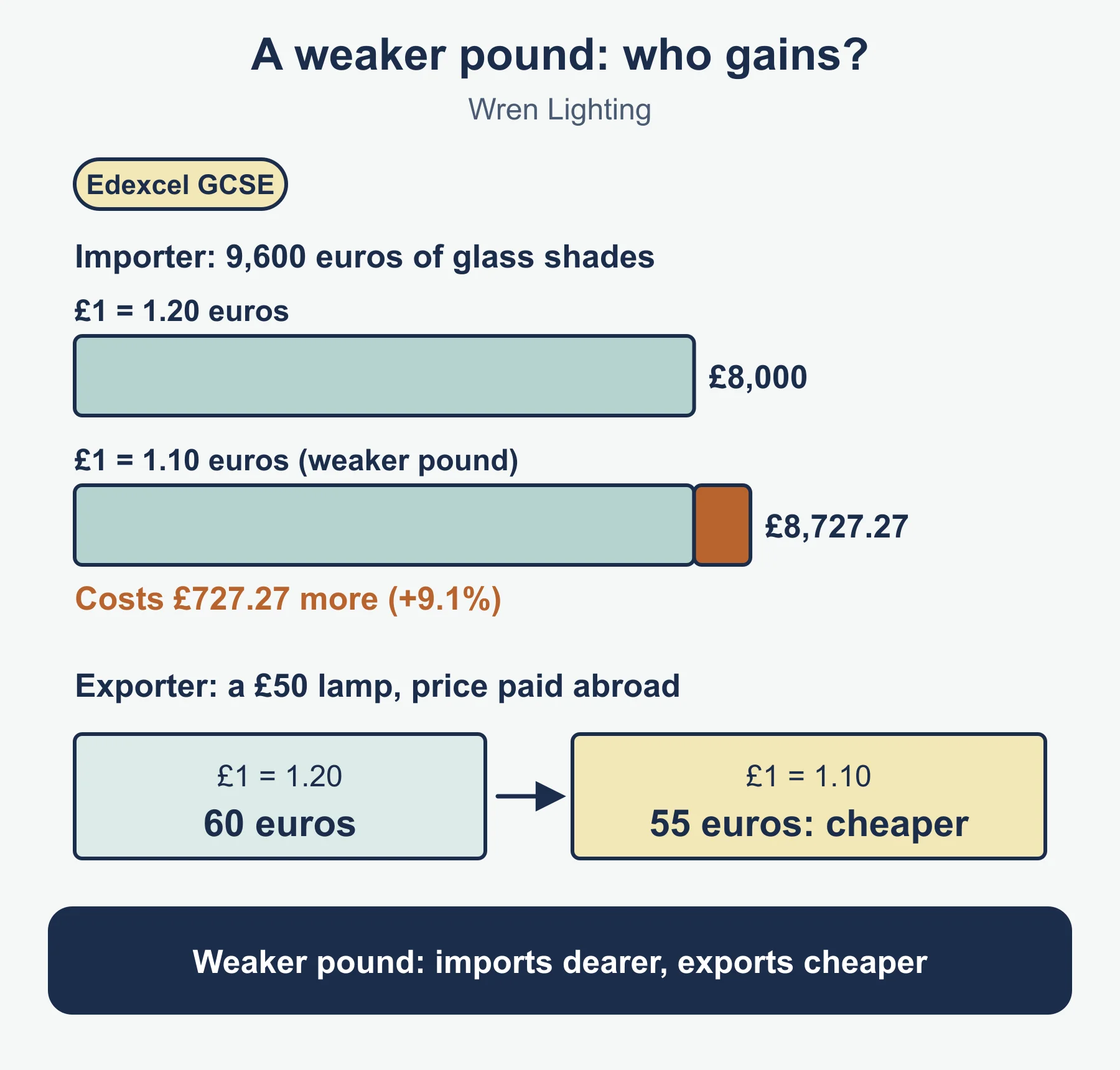
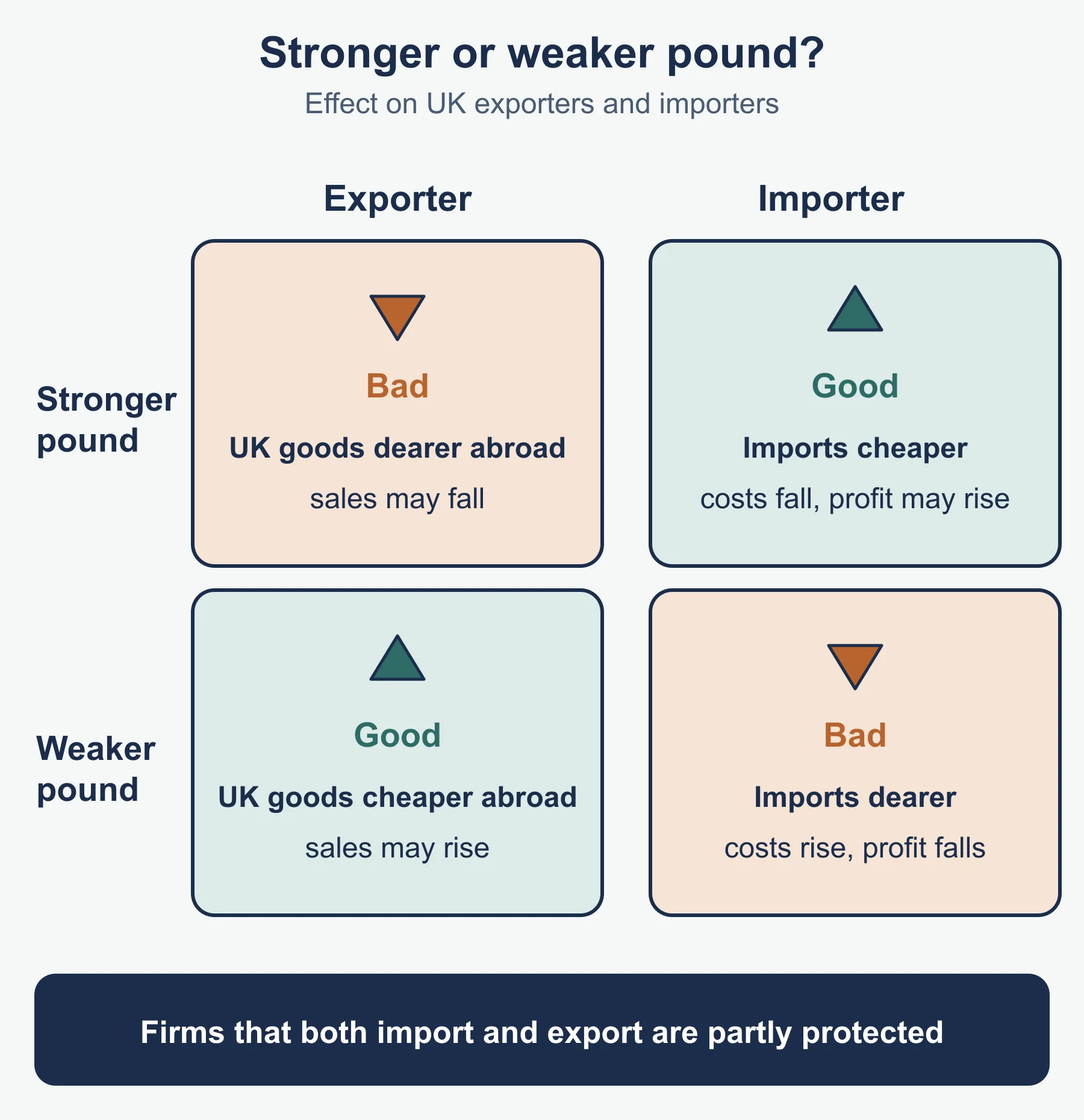
| Exchange rates | Pound strengthens | Imports cheaper, exports dearer abroad |
| Exchange rates | Pound weakens | Imports dearer, exports cheaper abroad |
Methods in steps
Percentage change (the standard form, not a formula given in the specification):
- Work out the change as the new figure less the starting figure.
- Divide that change by the starting figure.
- Multiply the result by 100.
Reminder: a cost moves from £80 to £84. Change = 4. 4 / 80 x 100 = 5%.
Inflation on a cost bill:
- Multiply the bill by the inflation rate.
- Add the result to the original bill.
Reminder: wages bill £90,000, up 3%. Rise = £2,700. New bill = £92,700.
Interest on a loan (annual): interest = loan x rate.
Reminder: £30,000 at 6% gives £1,800; at 4% gives £1,200. The 2-point rise costs £600 more a year.
Interest on a loan as a percentage (Appendix 3): (total repayment - borrowed amount) / borrowed amount x 100. Reminder: £30,000 borrowed, £33,600 repaid. Interest = 3,600 / 30,000 x 100 = 12%.
Exchange rates:
- Pounds to foreign currency: multiply by the rate.
- Foreign currency to pounds: divide by the rate.
Reminder: £1 = 1.30 euros. An invoice for 5,200 euros costs 5,200 / 1.30 = £4,000. If the rate becomes £1 = 1.25 euros, the same invoice costs 5,200 / 1.25 = £4,160, which is £160 more. An £80 product costs 80 x 1.30 = 104 euros before the change and 80 x 1.25 = 100 euros after.
Tax on income, as it affects customers: income £2,000 a month taxed at 20% leaves £1,600; at 25% it leaves £1,500. Customers have £100 less, a 6.25% fall in take-home pay, so they have less to spend.
1.5.5 External influences and responses
Why they matter: a business cannot control them, they can raise costs or lower demand, and businesses that respond sensibly stay competitive.
| Change | Possible responses |
|---|---|
| Technology | Invest in equipment or systems; sell online; use social media or digital communication; train staff; change how goods are made or delivered |
| Legislation | Train staff; change products, policies or contracts; budget for the cost; raise prices |
| Economic climate | Change prices; cut costs; widen or narrow the range; find new markets or suppliers; renegotiate or delay borrowing; keep cash reserves |
Method for a response question:
- Name the change and its direction.
- State the effect on this business (cost, revenue, demand).
- Suggest a response that fits.
- Weigh the cost and risk of that response.
- Reach a conclusion if the command word asks for one.
Must-know distinctions
- Meeting obligations has costs and benefits. Not meeting them has costs and almost no benefit beyond a short-term saving.
- Inflation is rising prices in general. Interest is the price of borrowing. Do not swap them.
- A stronger pound helps importers and hurts exporters. A weaker pound does the opposite.
- Consumer income is what customers have to spend. Unemployment is a separate influence that changes it.
- “Explain” is a statement with two expansion points, with no context. “Analyse” applies the same development to the business in the question.
- “Justify” means choosing between two options for the owner and backing the choice. “Evaluate” means reaching a conclusion about the whole situation, supported by what you know.
Quick self-test
- Define legislation.
- State the two principles of consumer law named in the specification.
- Give the four areas of employment law in the specification.
- A firm spends £4,500 a year on compliance. Sales revenue is £150,000. Calculate the cost as a percentage of sales revenue.
- Give one benefit of meeting legal obligations.
- Give one consequence of not meeting them.
- A loan of £60,000 has interest of 5%. Calculate the annual interest. The rate rises to 8%. By how much does the interest rise?
- Explain one effect of rising unemployment on a retailer.
- A raw material bill of £40,000 rises by 4% because of inflation. Calculate the new bill.
- £1 = 1.20 euros. A supplier invoices 6,000 euros. Calculate the cost in pounds. The pound falls to 1.00 euro. Calculate the new cost.
- Name one way a business could respond to a change in technology.
- Explain why a business might delay a loan-funded expansion when interest rates rise.
Answers
- Laws made by government that businesses must follow.
- Quality and consumer rights.
- Recruitment, pay, discrimination, health and safety.
- 4,500 / 150,000 x 100 = 3%.
- Any one: safer workplace, better reputation, easier recruitment, fewer disputes.
- Any one: fines, compensation, lost sales revenue, bad publicity, staff leaving.
- 5% x 60,000 = £3,000. At 8%: £4,800. Rise = £1,800.
- Fewer people have income to spend, so the retailer’s sales may fall. Higher unemployment may also give the retailer more applicants for vacancies.
- 4% x 40,000 = £1,600. New bill = £41,600.
- 6,000 / 1.20 = £5,000. At 1.00: 6,000 / 1.00 = £6,000. Rise = £1,000.
- Any one: sell online, buy new equipment, train staff, use social media.
- Repayments on the loan would cost more, so the expansion would be less profitable, and demand may weaken because customers also face higher borrowing costs.
Where marks are usually lost
- Naming a particular law from memory with the wrong details, when the question only needs the principle.
- Writing that legislation only costs a business money and never brings any benefit.
- Giving general statements such as “prices go up” without saying whose prices and what happens next.
- Confusing a stronger pound with a weaker pound.
- Using a stated percentage on the wrong base, for example applying inflation to total costs when the figure given is for materials only.
- Dropping the pound sign or the unit in a calculation answer.
- Listing several economic factors rather than developing one or two in the context of the business.
- Suggesting a response with no link to the change described.
- Ending an “evaluate” or “justify” answer without a decision.
- Treating an external influence as the owner’s fault or something the business controls.
Frequently asked questions
What are the four areas of employment law in Edexcel GCSE Business? The 1BS0 specification lists recruitment, pay, discrimination, and health and safety. Use the area names in your answer, then explain what the business must do.
How does a stronger pound affect a business? A stronger pound makes imports cheaper and exports dearer for overseas buyers. A weaker pound does the reverse, helping exporters but raising the cost of imported materials.
How do higher interest rates affect a small business? Loans and overdrafts cost more to repay, and customers may save more and spend less. A business might delay an expansion funded by borrowing.
Is legislation only a cost to a business? No. Complying costs money for training, checks and records, but meeting obligations brings a safer workplace, a better reputation, easier recruitment and fewer disputes, while not meeting them risks fines, compensation and lost sales.
Official syllabus
Pearson Edexcel Level 1/Level 2 GCSE (9-1) in Business (1BS0), Specification, Issue 2, July 2022, published by Pearson Education Limited. Theme 1: Investigating small business, Topic 1.5 Understanding external influences on business, items 1.5.3, 1.5.4 and 1.5.5.
Get free revision emails (optional)
Occasional emails with practice questions, worked explanations and links to free resources for the qualification and subjects you choose. No spam, and you can unsubscribe from any email. The free tools on this site never need an email.
Related resources
-
Study guides
Edexcel GCSE Business: Stakeholders and technology (1BS0)
Study guide to business stakeholders, conflicts between them, and technology's effect on sales, costs and the marketing mix, for Edexcel GCSE Business.
Business · Pearson Edexcel · GCSE
Read guide -
Practice questions
Edexcel GCSE Business: Stakeholders and technology (1BS0) – Practice Questions
Original practice questions with worked answers on stakeholders, conflicts and technology in business, for Edexcel GCSE Business Topic 1.5.
Business · Pearson Edexcel · GCSE
Try questions -
Revision notes
Edexcel GCSE Business: Stakeholders and technology (1BS0) – Revision Notes
Condensed revision notes on stakeholders, conflicts, and technology's effect on sales, costs and the marketing mix for Edexcel GCSE Business.
Business · Pearson Edexcel · GCSE
Revise topic
Related articles
-
teaching
A Level tuition in Dubai: Cambridge or Pearson Edexcel International A Level?
Schools in Dubai and Abu Dhabi teach either Cambridge International AS & A Level or Pearson Edexcel International A Level. How the two are structured, why it matters for tuition, and how online classes from Lahore work.
9 October 2026
-
curriculum guides
Choosing subjects at IGCSE and A Level
How subject choices at 14 and 16 affect university options later, and how to keep pathways open without overloading a timetable.
28 July 2026
Studying this with a teacher
Working through Business GCSE?
This page is free and stays free. If you would rather be taught it, Marlbridge runs Business classes one-to-one and in small groups of up to 15, online in your own time zone. The first trial class is free. WhatsApp replies within an hour (8am–11pm Pakistan time, every day); email the same day.
Pearson Edexcel Business teachers at Marlbridge

