
Study Guides
Edexcel GCSE Business: Legislation, the economy and external influences (1BS0)
Study guide to consumer and employment law, the economic climate and how businesses respond to external change, for Edexcel GCSE Business.
- Subject
- Business
- Level
- GCSE
- Topic
- Understanding external influences on business
- Author
- Marlbridge Academic Team
- Updated
- Reviewed by
- Asif Iqbal (what this means)
Aligned to Pearson Edexcel GCSE Business (1BS0), Issue 2, July 2022. Official specification .
Syllabus page (what it covers and how it is assessed): Pearson Edexcel GCSE Business.
Syllabus points this page covers
1BS0
- 1.5 Understanding external influences on business (whole topic)
- 1.5.3 Legislation and business
- 1.5.4 The economy and business
- 1.5.5 External influences
Found an error? Report a correction.
Want a teacher for this? Marlbridge teaches Business online. Request a free trial class.
This guide follows the Pearson Edexcel Level 1/Level 2 GCSE (9-1) in Business (1BS0) specification, Issue 2, July 2022. It covers Theme 1, Topic 1.5 Understanding external influences on business, content items 1.5.3 (legislation and business), 1.5.4 (the economy and business) and 1.5.5 (external influences). The specification lists formulae in Appendix 3 and says they are not provided in the examinations, so practise any calculation from memory.
Course links: the Business hub, the printable checklist and the free diagnostics. Companion pages: the revision notes and the practice questions.
All businesses, figures and rates below are invented for practice. The specification names no particular laws, so this guide describes legislation in general terms only.
What the specification asks for
| Item | You must be able to | Section |
|---|---|---|
| 1.5.3 | Explain the purpose of legislation: consumer law (quality and consumer rights) | 1 |
| 1.5.3 | Explain the purpose of employment law: recruitment, pay, discrimination, health and safety | 2 |
| 1.5.3 | Explain the impact of legislation on businesses: cost, and the consequences of meeting and not meeting obligations | 3 |
| 1.5.4 | Explain the impact of the economic climate: unemployment, consumer income, inflation, interest rates, government taxation, exchange rates | 4 |
| 1.5.5 | Explain why external influences matter, and the possible responses to changes in technology, legislation and the economic climate | 5 |
1. Consumer law (1.5.3)
Legislation means laws made by government that businesses must follow. Its purpose is to set rules that protect people and to make competition fairer. A business cannot choose whether to obey.
The specification names two principles of consumer law.
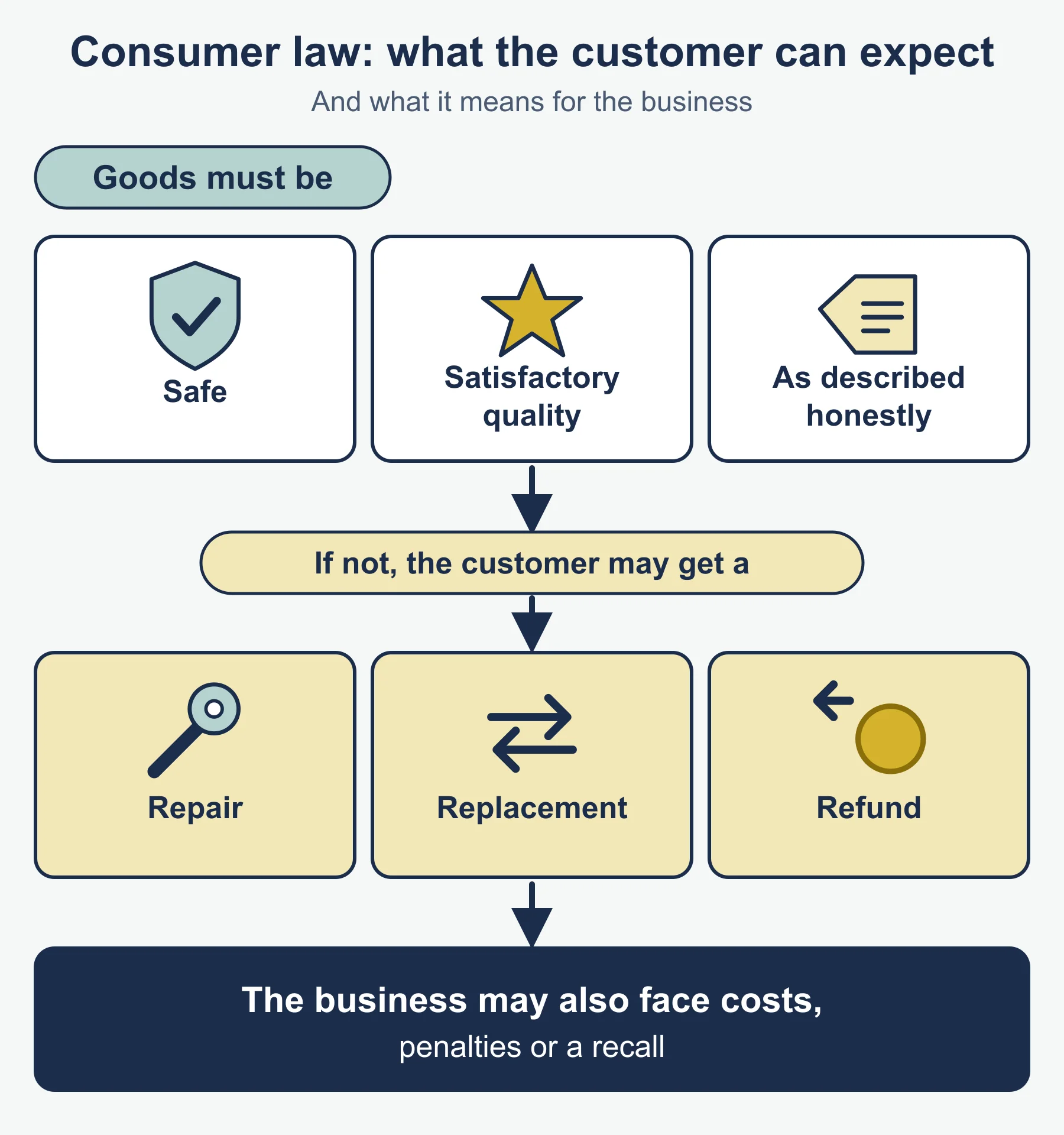
- Quality. Goods and services should be of a standard a customer can reasonably expect. A product should work, last a sensible time and match how it was described or advertised.
- Consumer rights. If a product or service falls short, the customer has rights to put things right. In general terms this means a remedy such as a repair, replacement or refund, and the right not to be misled by sellers.
Why does this matter to a business? It affects what it sells, how it describes the product, how it handles complaints and how much it budgets for returns. For the customer, it means trust: people buy more readily when they know they are protected.
Worked example: Larch Fell Outdoor
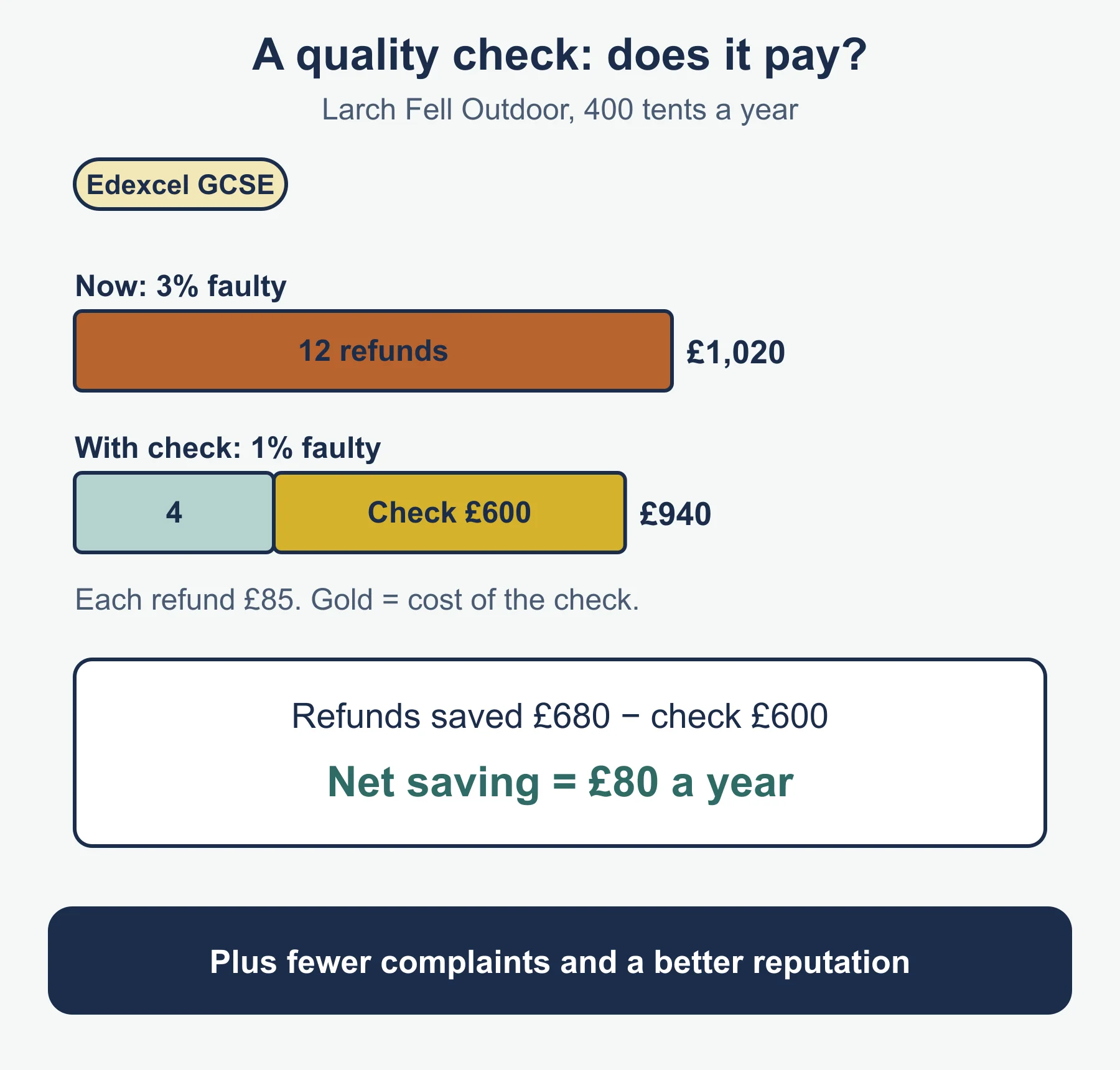
Larch Fell Outdoor sells 400 tents a year. At present 3% arrive faulty, and each fault is refunded at £85.
Faulty tents = 3% of 400 = 12. Refunds = 12 x 85 = £1,020.
An extra quality check costs £600 a year and cuts faults to 1%. Faulty tents = 4. Refunds = 4 x 85 = £340. Refunds saved = 1,020 - 340 = £680. Net saving = 680 - 600 = £80.
The money saving is small, but the check also protects the reputation of the brand and reduces complaints. Quality rules therefore push the business towards better inspection, and the benefit is more than the arithmetic shows.
2. Employment law (1.5.3)
Employment law protects people who work for a business. The specification lists four areas.
| Area | What the law is trying to achieve | What a business must do in practice |
|---|---|---|
| Recruitment | Fair selection of staff | Advertise honestly, judge applicants on ability to do the job, keep fair records |
| Pay | Workers receive a fair and legal wage | Pay at least the legal minimum for the worker’s situation, and pay accurately and on time |
| Discrimination | No unfair treatment because of a personal characteristic | Treat staff and applicants equally in hiring, promotion, pay and training |
| Health and safety | A safe place to work | Assess risks, maintain equipment, train staff, provide protective clothing where needed |
Notice the link between areas. A business that hires only people of one age group may break discrimination rules at the recruitment stage. A business that pays staff late breaks pay rules. Use the area names when you answer, then explain what the business has to do.
3. The impact of legislation on businesses (1.5.3)
The specification asks for two things: cost, and the consequences of meeting and not meeting obligations.
Cost
Complying costs money. Examples: training, equipment, safety checks, record keeping, extra staff time and sometimes higher wages. For a small business the burden is large compared with its revenue, because it has fewer units over which to spread the cost. Compliance costs can reduce profit or lead to higher prices.
Consequences of meeting obligations
- A safer workplace and fewer accidents, which cuts days lost.
- A good reputation with customers, staff and the public.
- Better recruitment and retention, because people prefer to work for fair employers.
- Fewer complaints, disputes and legal claims.
Consequences of not meeting obligations
- Fines, or orders to stop trading until problems are fixed.
- Compensation to staff or customers who are harmed.
- Damage to reputation, so sales revenue falls.
- Staff leave, and recruitment becomes harder.
- Management time wasted on investigations.
Worked example: Sedge Cafe
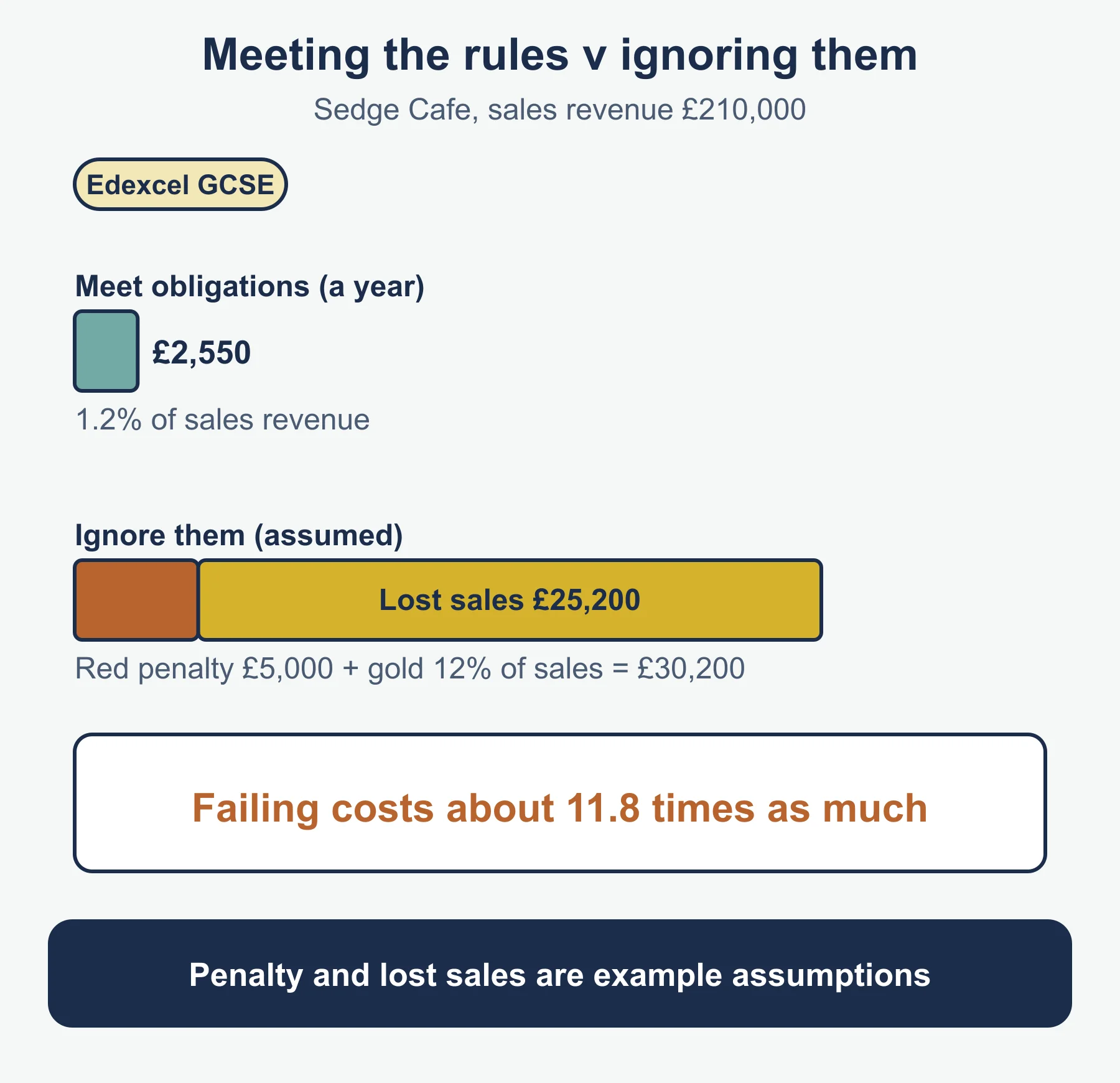
Sedge Cafe has 9 employees and sales revenue of £210,000. Each year it spends £1,150 on staff training, £800 on safety checks and £600 on record-keeping software.
Annual cost of meeting obligations = 1,150 + 800 + 600 = £2,550. As a percentage of sales revenue = 2,550 / 210,000 x 100 = 1.21%, so about 1.2%.
Suppose it ignored the rules, received a penalty of £5,000 and lost 12% of sales revenue after bad publicity. Lost sales revenue = 12% x 210,000 = £25,200. Total = 5,000 + 25,200 = £30,200, which is about 11.8 times the cost of complying.
The figures for a penalty and lost sales are assumptions made for the example. The point is the comparison: the cost of compliance is usually smaller than the possible cost of failure, and meeting obligations also brings benefits that do not show in the sums.
4. The economic climate (1.5.4)
The economic climate means the general condition of the economy in which a business operates. It is outside the business’s control. The specification lists six influences.
| Influence | What it means | Typical effect on a business |
|---|---|---|
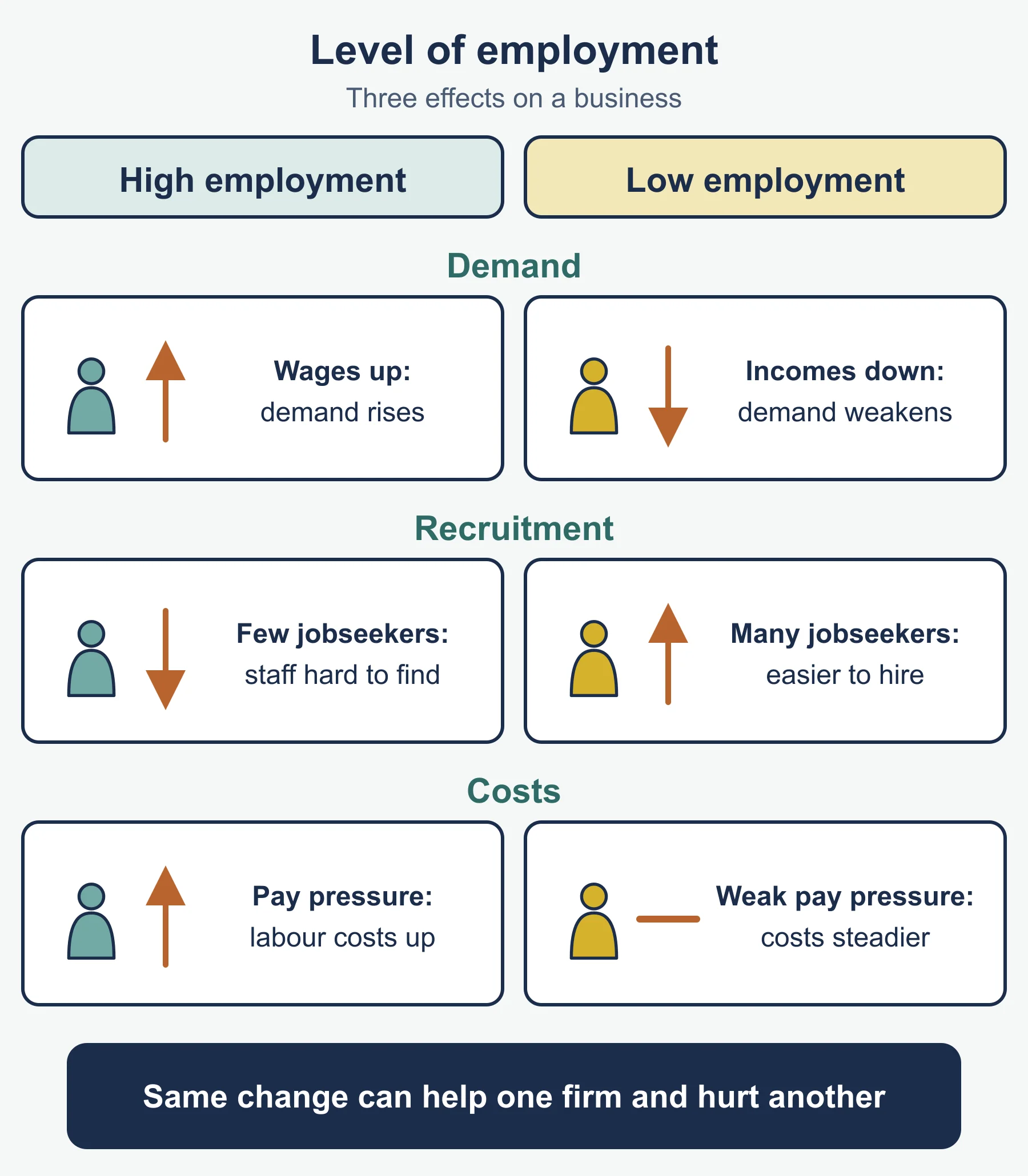
| Unemployment | The number of people without a job who want one | High: lower spending and falling sales, but an easier supply of workers and less pressure on wages. Low: harder to recruit, wages may rise |
| Consumer income | What households have to spend | Rises: more spending, especially on non-essentials. Falls: customers trade down or buy less |
| Inflation | A general rise in prices | Costs rise, so the business must absorb them or raise prices. Customers have less purchasing power |
| Interest rates | The cost of borrowing | Higher: loans and overdrafts cost more, saving looks attractive, spending falls. Lower: borrowing is cheaper and spending is encouraged |
| Government taxation | Taxes on profits, sales and incomes | Higher tax on profits reduces what is kept; higher tax on incomes reduces consumer spending |
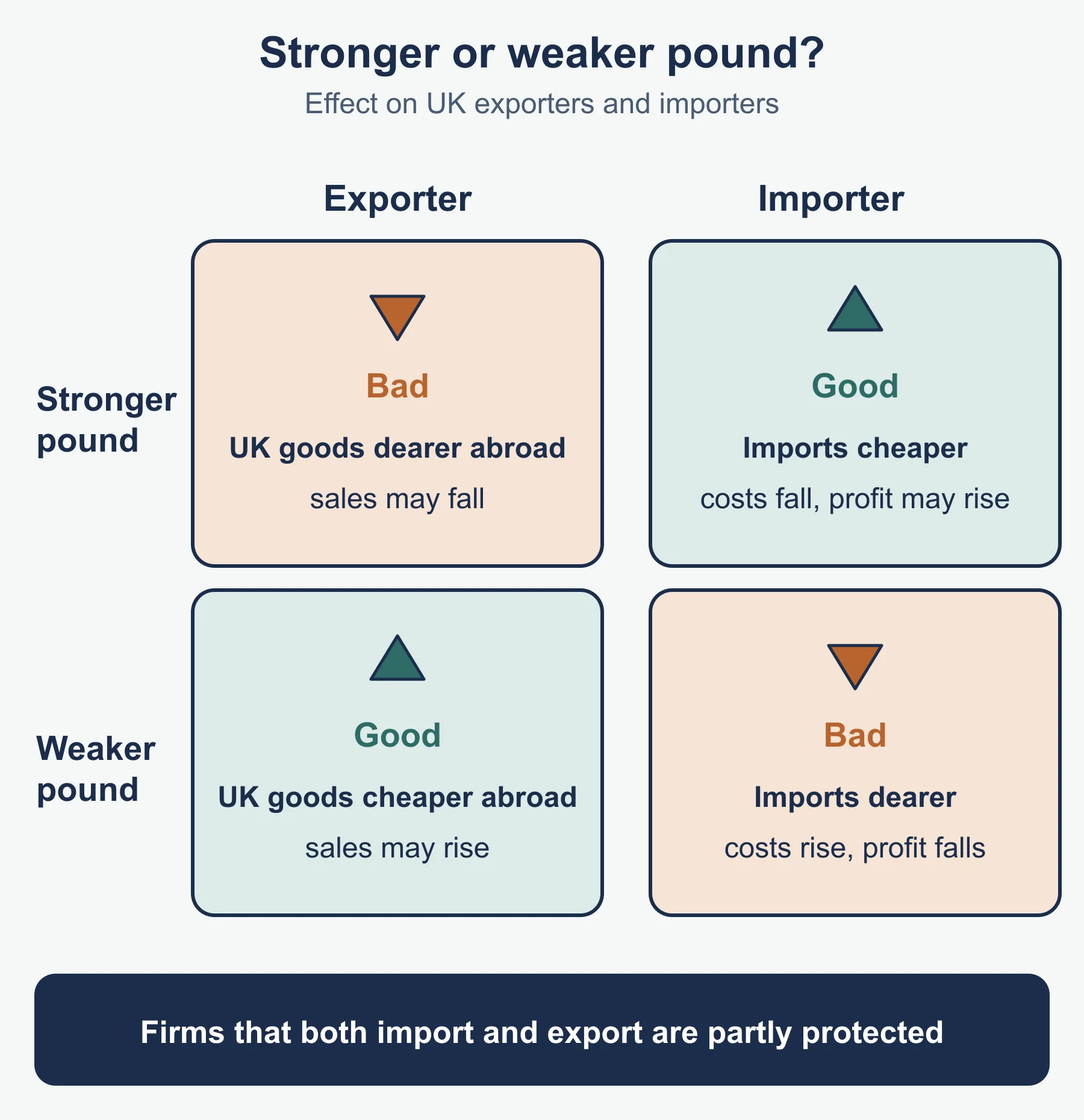
| Exchange rates | The price of one currency in another | A stronger pound makes imports cheaper and exports dearer; a weaker pound does the reverse |
Say who is affected. Write “a rise in interest rates increases the repayments of a business with a loan”, not “interest rates go up”.
Worked example: consumer income at Piper and Dale
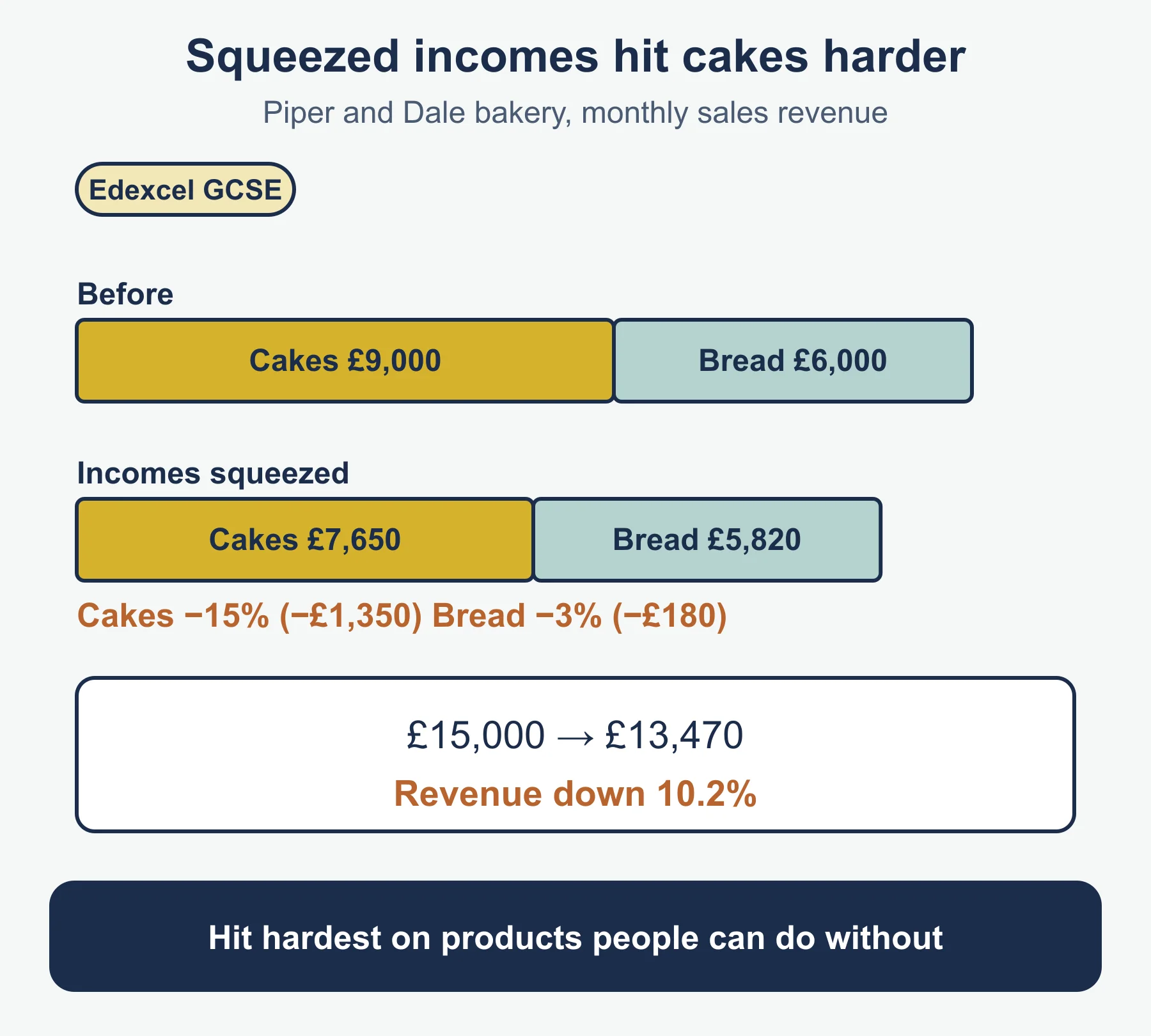
Piper and Dale is a bakery. Average monthly sales revenue is £9,000 from premium cakes and £6,000 from everyday bread. When household incomes are squeezed, premium cakes fall 15% and bread falls 3%.
Premium fall = 15% x 9,000 = £1,350. Bread fall = 3% x 6,000 = £180. Total fall = 1,350 + 180 = £1,530. New revenue = 15,000 - 1,530 = £13,470. Percentage fall = 1,530 / 15,000 x 100 = 10.2%.
The bakery is hit more on products people can easily do without. A good answer would link this to the type of product.
Worked example: inflation and interest at Osprey Print
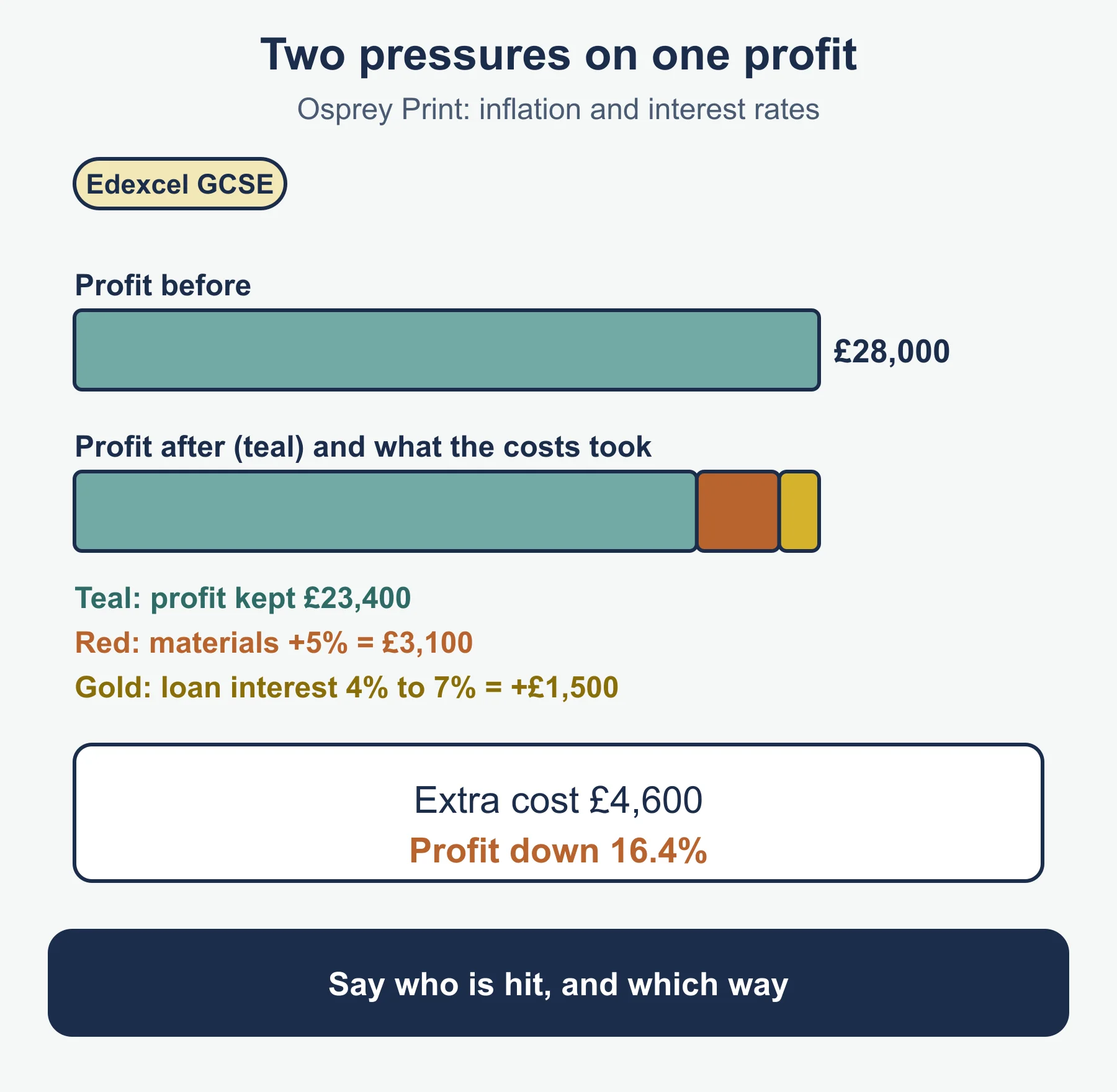
Osprey Print spends £62,000 a year on materials and has a £50,000 loan. Inflation of 5% raises material costs. The interest rate on the loan rises from 4% to 7%. Annual profit was £28,000.
Higher material cost = 5% x 62,000 = £3,100. Interest before = 4% x 50,000 = £2,000. Interest after = 7% x 50,000 = £3,500. Extra interest = £1,500. Total extra cost = 3,100 + 1,500 = £4,600. New profit = 28,000 - 4,600 = £23,400. Fall = 4,600 / 28,000 x 100 = 16.4%.
Worked example: exchange rates at Wren Lighting
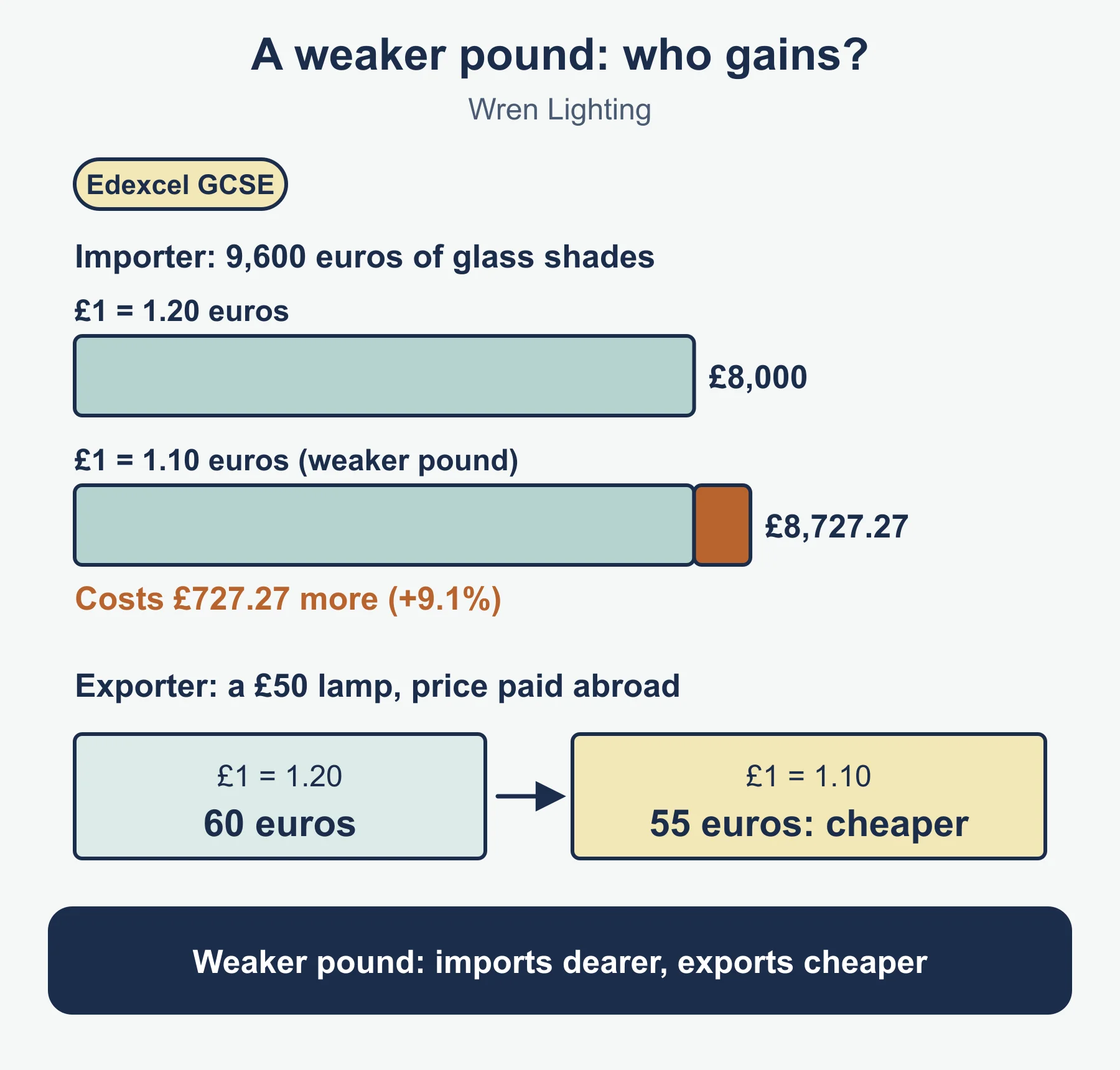
Wren Lighting buys glass shades from a supplier who invoices in euros: 9,600 euros. When £1 buys 1.20 euros, the cost is 9,600 / 1.20 = £8,000. When the pound weakens to £1 = 1.10 euros, the cost is 9,600 / 1.10 = £8,727.27, an extra £727.27, or 9.1% more.
An exporter sees the opposite side. A £50 lamp costs a buyer 60 euros at 1.20, but only 55 euros at 1.10, so a weaker pound makes the exporter’s goods cheaper abroad.
Taxation
Taxes affect businesses directly and indirectly. If a tax on profit rises from 20% to 25% and a business makes £40,000 profit before tax, the tax goes from £8,000 to £10,000 and profit kept falls from £32,000 to £30,000. Taxes on incomes or on spending reduce what customers can buy.
5. Responding to external influences (1.5.5)
Technology, legislation and the economic climate all change over time. A business that ignores them risks losing customers, breaking rules or running out of cash. A business that responds well can cut costs, win customers and avoid penalties. That is why they matter.
| Change | Possible responses |
|---|---|
| Technology | Invest in new systems or equipment, sell online, use social media and digital communication, retrain staff, change the way products are made or delivered |
| Legislation | Train staff, change products or procedures, update contracts and policies, budget for higher costs, adjust prices |
| Economic climate | Change prices, cut costs, vary the product range, seek new markets, renegotiate loans, build cash reserves, change how much is stocked |
Specific links help. Higher interest rates might lead a business to delay an expansion funded by a loan. Falling consumer income might lead it to add a lower-priced range. A weaker pound might lead it to look for suppliers inside the UK or to push exports.
Worked example: Halden Hardware
Halden Hardware sees more customers buying tools online. It considers a website costing £6,000. Expected extra online sales revenue is £18,000 a year with a gross profit margin of 35%.
Extra gross profit = 35% x 18,000 = £6,300 a year. That is £300 more than the cost of the website in the first year.
A reasoned response: the investment looks worthwhile if the sales forecast is realistic, but the business must also budget for delivery, returns and staff time. The forecast is an estimate and could be wrong.
Common errors
- Naming a law you are unsure about. Describe the principle instead.
- Saying legislation is only a cost. Meeting it also brings benefits.
- Giving an effect without a direction, such as “interest rates affect profit”. State up or down, and for whom.
- Mixing up a stronger and weaker pound.
- Listing economic factors without choosing the ones that matter most for the business in the question.
- Offering a response without saying why it suits the change.
Frequently asked questions
What is the purpose of consumer law? Consumer law sets rules on quality, so goods and services meet a standard customers can reasonably expect, and on consumer rights, so a customer can get a remedy such as a repair, replacement or refund when a product falls short.
What does the economic climate mean in GCSE Business? The economic climate is the general condition of the economy in which a business operates, and it is outside the business’s control. The Edexcel GCSE Business (1BS0) specification lists unemployment, consumer income, inflation, interest rates, government taxation and exchange rates.
How does inflation affect a business? Inflation is a general rise in prices, so a business’s costs rise and it must either absorb them or raise its prices. Customers also have less purchasing power.
How can a business respond to falling consumer incomes? It might add a lower-priced range, cut costs, change prices or seek new markets. Sales of non-essential products usually fall more than sales of essentials.
Official syllabus
Pearson Edexcel Level 1/Level 2 GCSE (9-1) in Business (1BS0), Specification, Issue 2, July 2022, published by Pearson Education Limited. Theme 1: Investigating small business, Topic 1.5 Understanding external influences on business, items 1.5.3, 1.5.4 and 1.5.5.
Get free revision emails (optional)
Occasional emails with practice questions, worked explanations and links to free resources for the qualification and subjects you choose. No spam, and you can unsubscribe from any email. The free tools on this site never need an email.
Related resources
-
Practice questions
Edexcel GCSE Business: Legislation, the economy and external influences (1BS0) – Practice Questions
Original practice questions with worked answers on legislation, the economic climate and business responses for Edexcel GCSE Business Theme 1.
Business · Pearson Edexcel · GCSE
Try questions -
Revision notes
Edexcel GCSE Business: Legislation, the economy and external influences (1BS0) – Revision Notes
Condensed revision notes on legislation, the economic climate and responses to external change for Edexcel GCSE Business Theme 1, Topic 1.5.
Business · Pearson Edexcel · GCSE
Revise topic -
Study guides
Edexcel GCSE Business: Stakeholders and technology (1BS0)
Study guide to business stakeholders, conflicts between them, and technology's effect on sales, costs and the marketing mix, for Edexcel GCSE Business.
Business · Pearson Edexcel · GCSE
Read guide
Related articles
-
teaching
A Level tuition in Dubai: Cambridge or Pearson Edexcel International A Level?
Schools in Dubai and Abu Dhabi teach either Cambridge International AS & A Level or Pearson Edexcel International A Level. How the two are structured, why it matters for tuition, and how online classes from Lahore work.
9 October 2026
-
curriculum guides
Choosing subjects at IGCSE and A Level
How subject choices at 14 and 16 affect university options later, and how to keep pathways open without overloading a timetable.
28 July 2026
Studying this with a teacher
Working through Business GCSE?
This page is free and stays free. If you would rather be taught it, Marlbridge runs Business classes one-to-one and in small groups of up to 15, online in your own time zone. The first trial class is free. WhatsApp replies within an hour (8am–11pm Pakistan time, every day); email the same day.
Pearson Edexcel Business teachers at Marlbridge

