
Study Guides
Edexcel GCSE Business: Stakeholders and technology (1BS0)
Study guide to business stakeholders, conflicts between them, and technology's effect on sales, costs and the marketing mix, for Edexcel GCSE Business.
- Subject
- Business
- Level
- GCSE
- Topic
- Understanding external influences on business
- Author
- Marlbridge Academic Team
- Updated
- Reviewed by
- Asif Iqbal (what this means)
Aligned to Pearson Edexcel GCSE Business (1BS0), Issue 2, July 2022. Official specification .
Syllabus page (what it covers and how it is assessed): Pearson Edexcel GCSE Business.
Syllabus points this page covers
1BS0
- 1.5 Understanding external influences on business (whole topic)
- 1.5.1 Business stakeholders
- 1.5.2 Technology and business
Found an error? Report a correction.
Want a teacher for this? Marlbridge teaches Business online. Request a free trial class.
This guide follows the Pearson Edexcel Level 1/Level 2 GCSE (9-1) in Business (1BS0) specification, Issue 2, July 2022. It covers Theme 1, Topic 1.5 Understanding external influences on business, content items 1.5.1 (business stakeholders) and 1.5.2 (technology and business). The specification says calculators may be used and that formulae, listed in its Appendix 3, are not provided in the examinations.
Course links: the Business hub, the printable checklist and the free diagnostics. Companion pages: the revision notes and the practice questions. For revenue, costs and profit see aims, objectives, revenue, costs and profit, and for the small-business setting see limited liability and business location.
What the specification asks for
| Item | You must be able to | Section |
|---|---|---|
| 1.5.1 | Say who business stakeholders are: shareholders (owners), employees, customers, managers, suppliers, local community, pressure groups, the government | 1 |
| 1.5.1 | Give the different objectives of these groups | 1 |
| 1.5.1 | Explain how stakeholders are affected by business activity | 2 |
| 1.5.1 | Explain how stakeholders impact business activity | 3 |
| 1.5.1 | Explain possible conflicts between stakeholder groups | 4 |
| 1.5.2 | Describe the types of technology used by business: e-commerce, social media, digital communication, payment systems | 5 |
| 1.5.2 | Explain how technology influences business activity in terms of sales, costs and the marketing mix | 6 |
All businesses and figures below are invented for practice.
1. Who the stakeholders are, and what they want
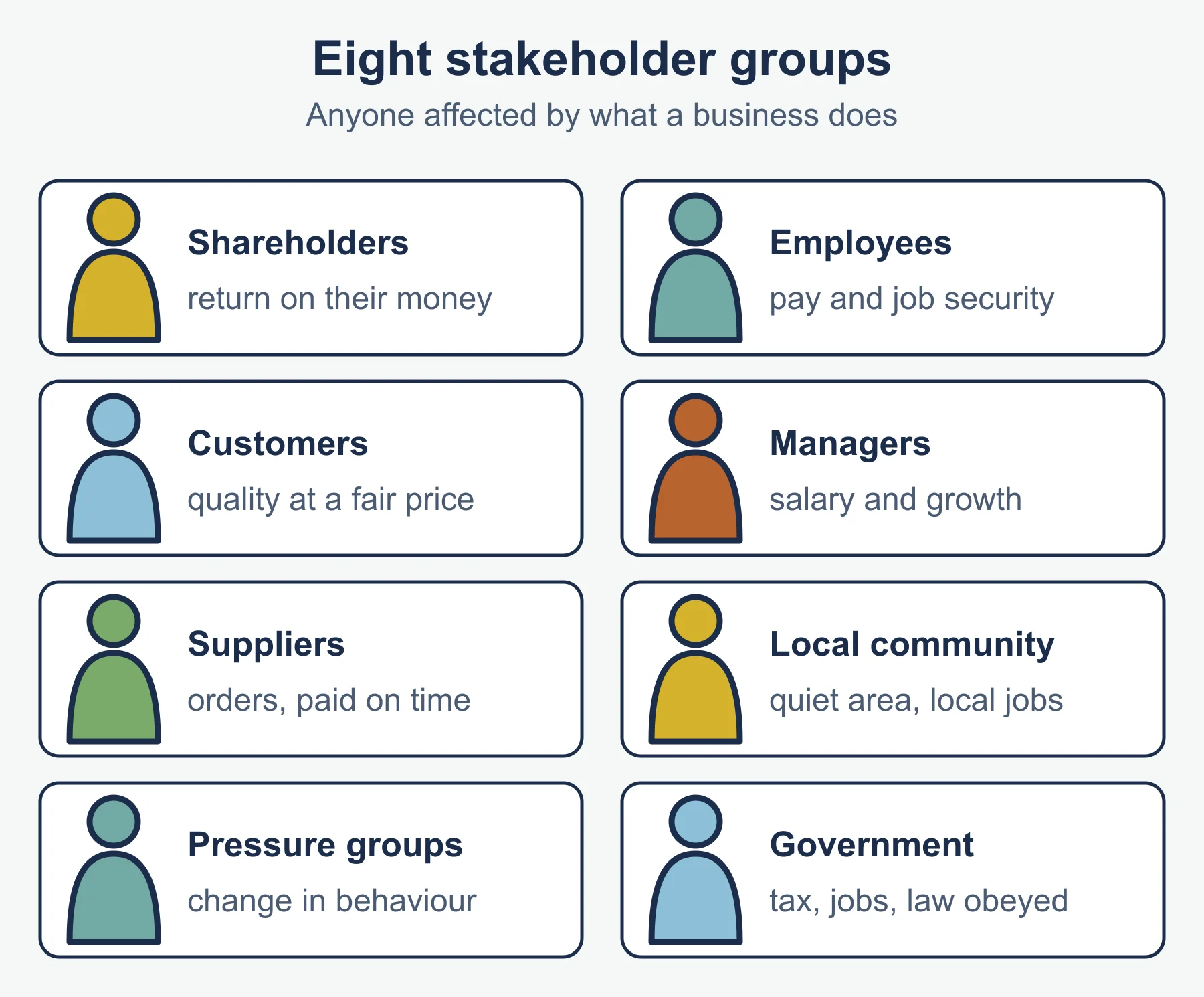
A stakeholder is anyone, or any group, affected by or concerned with a business’s actions. This is the standard meaning; the specification lists the groups rather than defining the word. The specification names eight groups and asks for their different objectives. It does not fix a list of objectives, so the ones below are typical examples.
| Stakeholder group | Typical objectives |
|---|---|
| Shareholders (owners) | A return on the money they put in, such as a share of profit; growth in the value of their shares; a business that survives |
| Employees | Fair pay, job security, safe and pleasant working conditions, training and chances of promotion |
| Customers | Good quality, fair prices, safe products, reliable service and a choice of goods |
| Managers | A good salary, perhaps bonuses, a secure post, a business that grows and decisions they are free to make |
| Suppliers | Regular orders, payment on time, a long-term relationship and fair prices for what they provide |
| Local community | Local jobs, little noise, traffic or pollution, and a business that supports local life |
| Pressure groups | A change in how a business behaves, such as better treatment of workers or less damage to the environment |
| The government | Tax revenue, jobs, businesses that obey the law and a healthy economy |
Describing a pressure group in this way is standard knowledge, not specification wording. Pressure groups are not owners, staff or customers. They choose a cause and try to influence the business, often by drawing public attention to it.
2. How stakeholders are affected by business activity
The specification asks you to explain how stakeholders are affected by what a business does. Link a decision to a group and say what changes for them.
- A business that takes on extra staff gives employees more work and income, and gives the government more income tax.
- A business that cuts its prices helps customers, but may squeeze the profit that shareholders hope to share.
- A factory that runs lorries through a village at night affects the local community through noise and traffic.
- A business that pays suppliers late hurts their cash flow.
- A business that closes a site ends jobs, which affects employees and, often, the area around it.
3. How stakeholders impact business activity
Stakeholders are not passive. They can change what a business does.
- Shareholders can press for higher profit or replace the managers.
- Employees who are well treated work harder and stay; poorly treated employees leave or take industrial action.
- Customers decide whether to buy. Poor reviews cut sales; loyal customers raise them.
- Managers make the day-to-day decisions that set the direction of the business.
- Suppliers can raise prices, change delivery times or stop supplying, which changes the business’s costs and output.
- The local community can object to plans or support the business with custom.
- Pressure groups can run campaigns that change how customers see a business.
- The government sets taxes and rules that the business must follow.
Worked example: a move to a larger unit
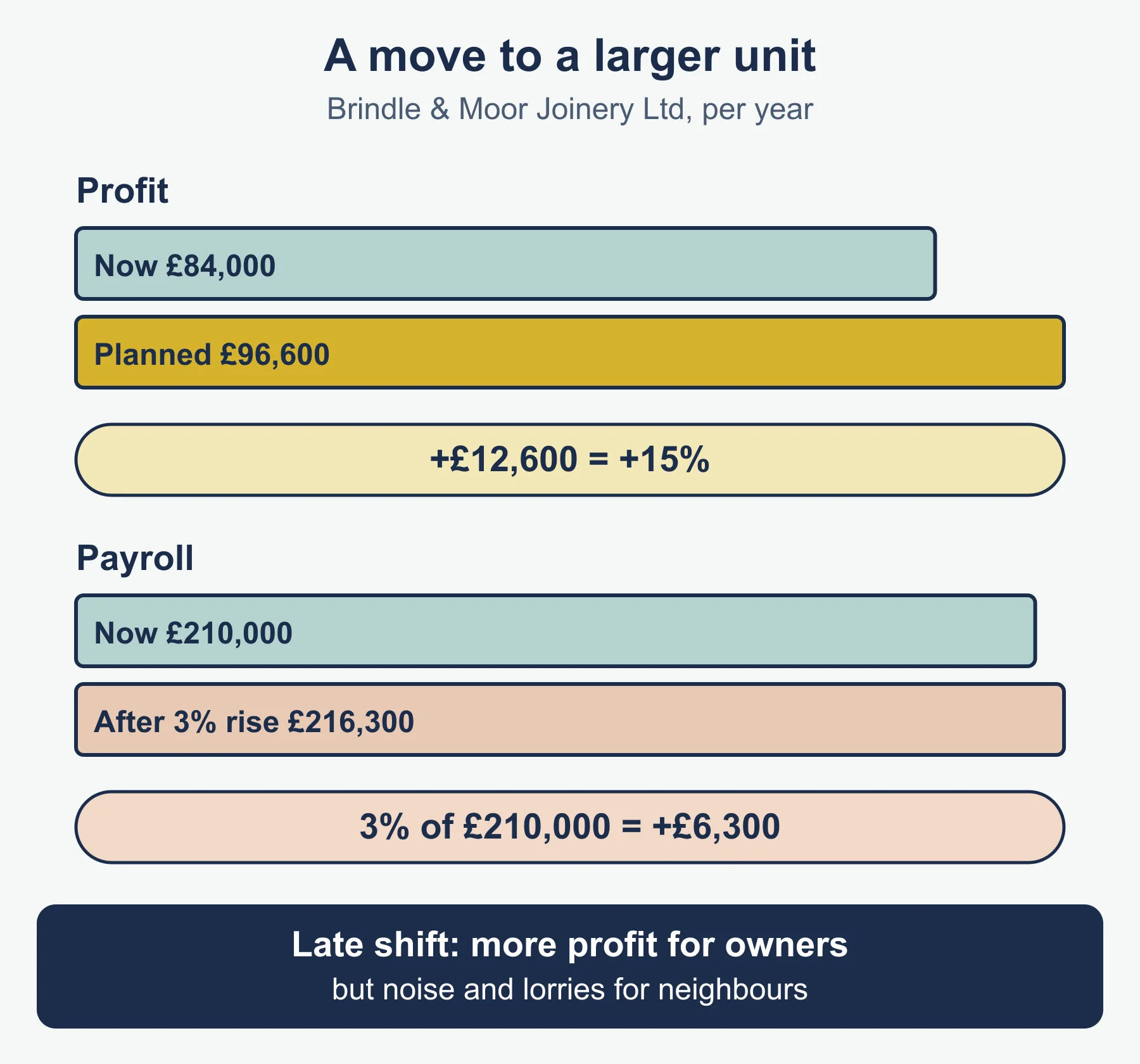
Brindle & Moor Joinery Ltd makes made-to-measure windows. It proposes to move to a bigger unit on the edge of a village and add a late shift. The owners expect annual profit to rise from £84,000 to £96,600. Payroll is £210,000 and a 3% rise is planned.
- Profit rises by £96,600 − £84,000 = £12,600. As a percentage: 12,600 ÷ 84,000 × 100 = 15%.
- The pay rise costs £210,000 × 0.03 = £6,300, so payroll becomes £216,300.
- Affected groups: shareholders (more profit), employees (more hours and pay but later shifts), the local community (noise and lorries), suppliers (larger orders) and the government (more tax).
- Impact on the business: residents might object, which could delay the move or add conditions, while a supplier that cannot meet the larger orders could limit output.
4. Possible conflicts between stakeholder groups
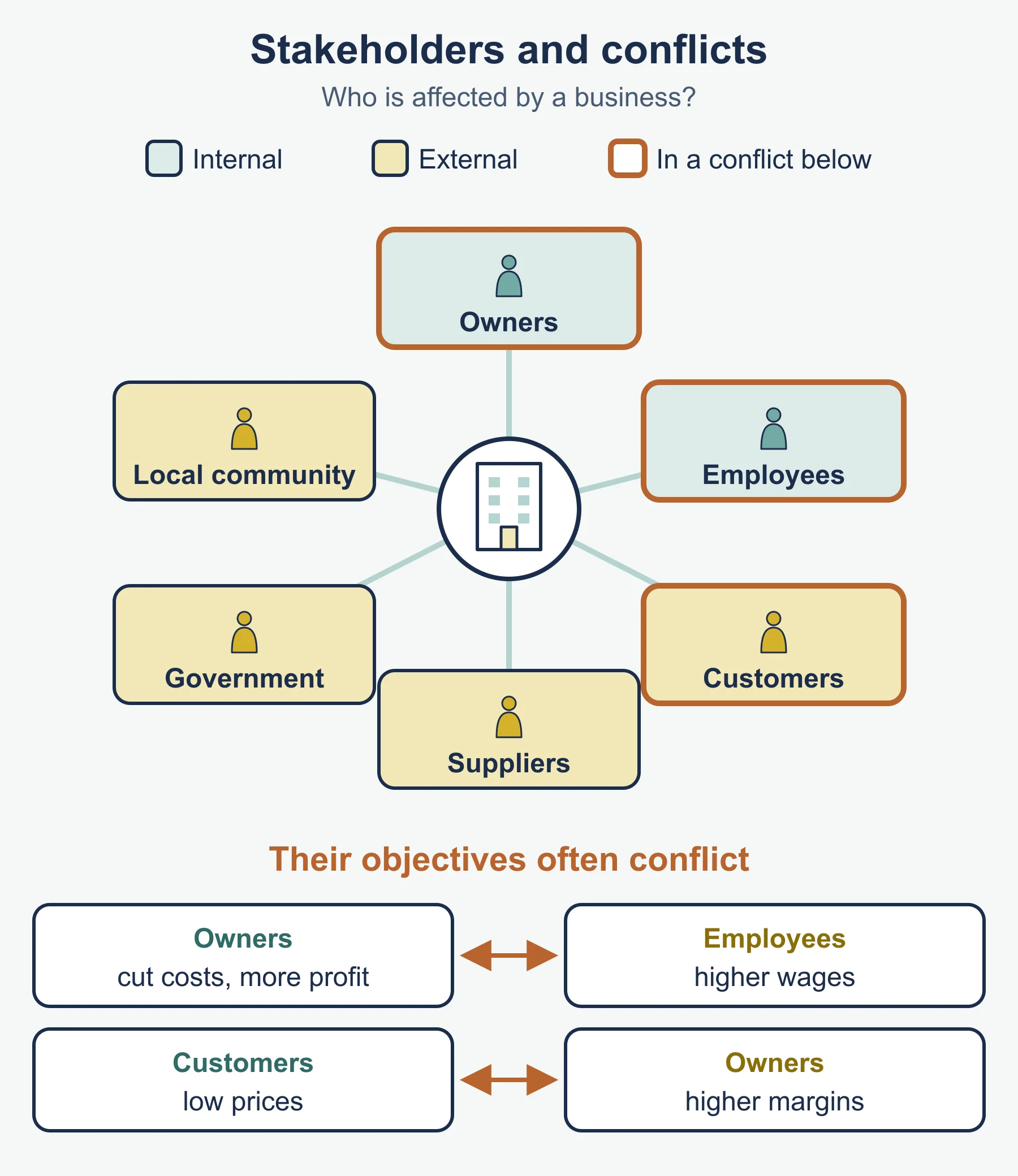
A conflict arises when the objectives of two groups cannot both be met in full. One group’s gain is often another’s loss.
| Conflict | Why it arises |
|---|---|
| Shareholders and employees | Higher wages reduce the profit available to share; cutting wages to lift profit upsets staff |
| Shareholders and customers | Lower prices or better quality cost money; higher prices raise profit but may lose customers |
| Managers and shareholders | Managers may want growth or high pay, while owners want profit returned to them |
| Local community and owners | The business wants to expand or extend its hours; residents want quiet |
| Pressure groups and managers | A campaign for greener methods may raise costs that the business would rather avoid |
| Suppliers and the business | The supplier wants a high price; the business wants low costs |
For Brindle & Moor, the late shift raises profit for shareholders but may anger neighbours. Good answers say how a business might settle a conflict, such as a trial period, noise limits or a staff bonus that is paid for out of the extra profit.
5. Types of technology used by business (1.5.2)
The specification names four types. The descriptions are standard knowledge, not specification wording.
- E-commerce. Trading goods or services online, through a business’s own website or a marketplace.
- Social media. Online platforms where a business posts content, talks with customers and can pay to advertise.
- Digital communication. Electronic ways of passing information inside the business and with others, such as email, video calls and messaging apps.
- Payment systems. Ways of taking or making payments electronically, such as card readers, contactless payments and online payments.
6. How technology influences business activity
The specification asks for the influence on three things: sales, costs and the marketing mix.
Sales
- E-commerce lets a small business reach customers far beyond its town and take orders outside opening hours.
- Social media can raise awareness and bring customers who would not otherwise have heard of the business.
- Easy payment can remove a reason to walk away, though a site that fails at the checkout loses sales.
Costs
- Digital communication can cut postage, travel and printing costs.
- E-commerce can reduce rent if a business needs a smaller shop, but adds website, delivery and packing costs.
- Payment systems often charge a fee on each sale or a monthly rental.
- Setting up and training staff to use new technology costs money in the short run.
The marketing mix
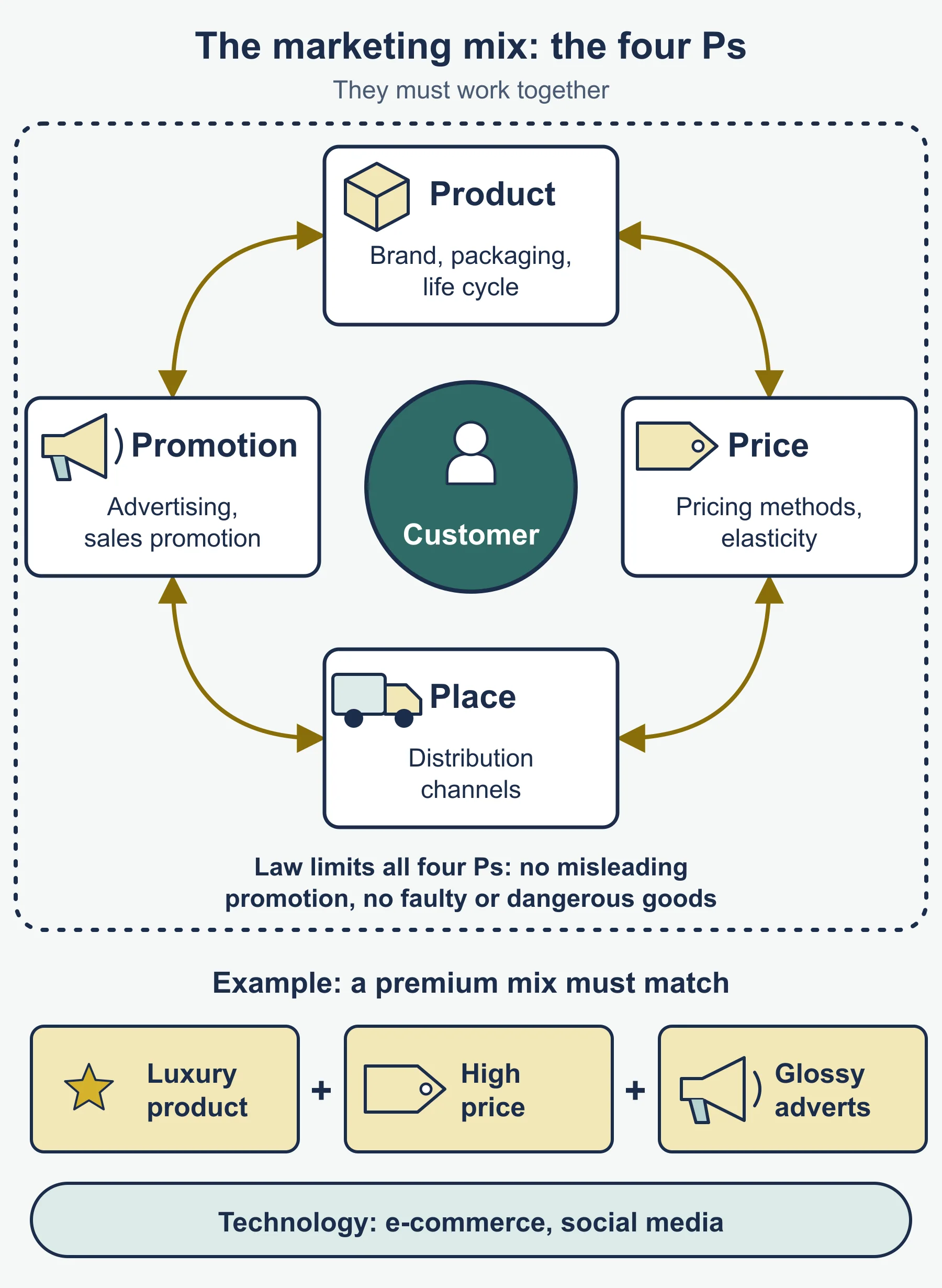
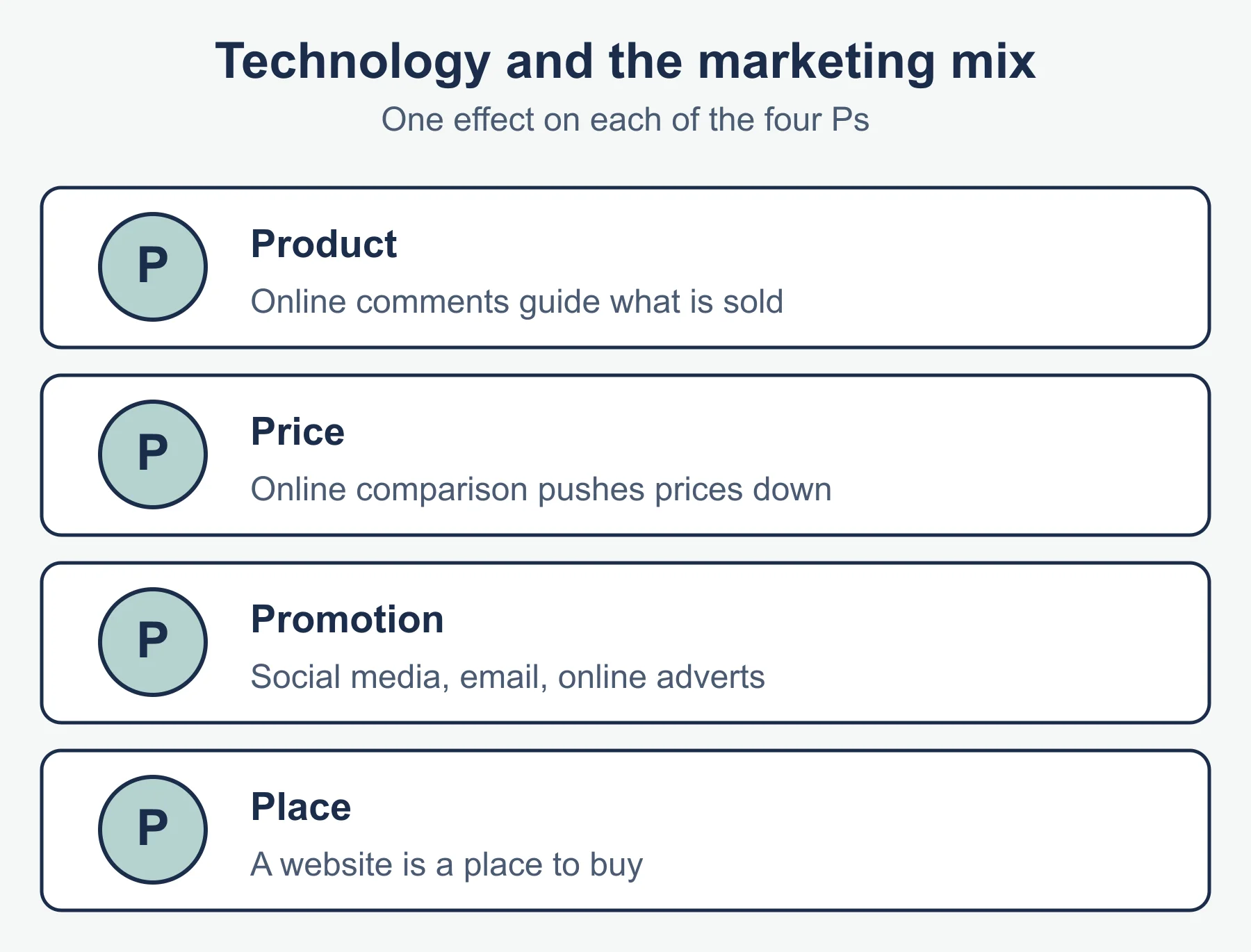
The marketing mix is product, price, promotion and place.
| Element | Technology’s influence |
|---|---|
| Product | Customer comments online help a business improve or change what it sells; some products can be delivered digitally |
| Price | Customers compare prices online, which pushes prices down; lower selling costs can allow lower prices |
| Promotion | Social media, email and online adverts can target groups cheaply |
| Place | E-commerce makes the website a place to buy, alongside or instead of a shop |
Worked example: opening an online store
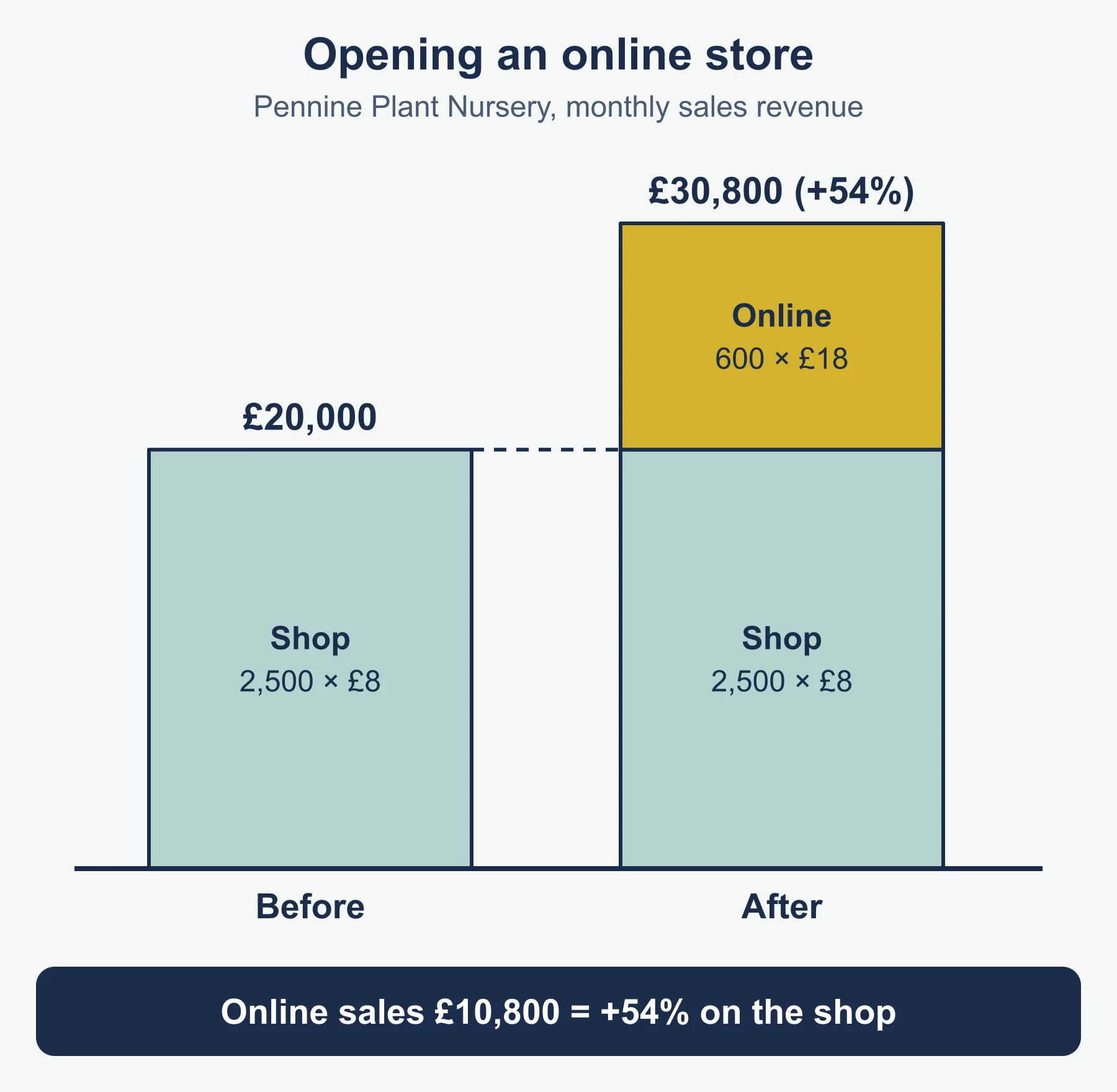
Pennine Plant Nursery sells 2,500 items a month in its shop at an average of £8. It opens an online store that takes 600 orders a month at an average of £18.
- Shop sales revenue = 2,500 × £8 = £20,000.
- Online sales revenue = 600 × £18 = £10,800. Total = £30,800.
- Sales revenue rises by 10,800 ÷ 20,000 × 100 = 54%.
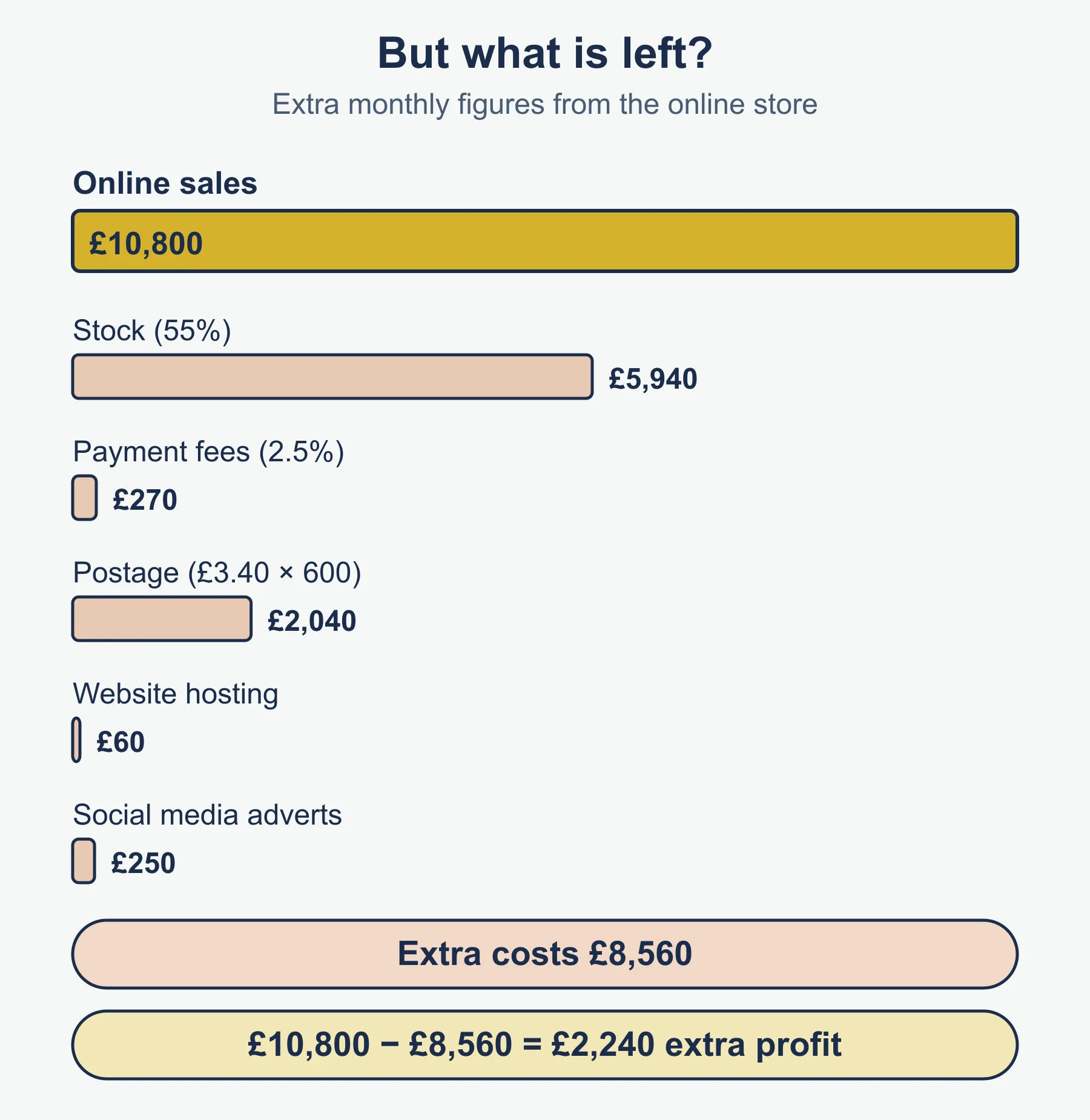
- Extra costs each month: stock at 55% of online sales = £5,940; payment fees at 2.5% = £270; postage at £3.40 an order = £2,040; website hosting £60; social media adverts £250. Total = £8,560.
- Extra profit = £10,800 − £8,560 = £2,240.
The result is positive but modest. The online store raises sales, while the added costs take most of the gain. A strong answer says so rather than praising technology without limit.
Common errors
- Listing stakeholder groups without saying what each wants.
- Writing that “everyone benefits” when the question asks about a conflict.
- Treating pressure groups as customers or owners.
- Saying technology “saves money” without naming the cost that falls, and ignoring the costs it adds.
- Describing a technology without linking it to sales, costs or a part of the marketing mix.
- Using general points that would fit any business instead of the one in the question.
Next steps
Boil the key points down with the revision notes, then test yourself with the practice questions. Return to the Business hub or tick off progress on the checklist. Find weak spots with the free diagnostics.
Frequently asked questions
Why do shareholders and employees sometimes conflict? Higher wages reduce the profit available to share among shareholders, while cutting wages to lift profit upsets staff. The objectives of the two groups cannot both be met in full.
How can stakeholders influence a business? Shareholders can press for higher profit, employees can leave or take industrial action, customers decide whether to buy, suppliers can change prices or delivery, the local community can object to plans and the government sets taxes and rules.
How does technology affect price in the marketing mix? Customers can compare prices online, which pushes prices down, while lower selling costs can allow a business to charge less. This is one of the ways the Edexcel GCSE Business (1BS0) specification expects you to link technology to the marketing mix.
Does technology always save a business money? No. Digital communication can cut postage and travel, but e-commerce adds website, delivery and packing costs, payment systems charge fees, and setting up and training costs money in the short run.
Official syllabus
Pearson Edexcel Level 1/Level 2 GCSE (9-1) in Business (1BS0), Specification, Issue 2, July 2022, published by Pearson Education Limited. Theme 1: Investigating small business, Topic 1.5 Understanding external influences on business, items 1.5.1 and 1.5.2.
Get free revision emails (optional)
Occasional emails with practice questions, worked explanations and links to free resources for the qualification and subjects you choose. No spam, and you can unsubscribe from any email. The free tools on this site never need an email.
Related resources
-
Practice questions
Edexcel GCSE Business: Stakeholders and technology (1BS0) – Practice Questions
Original practice questions with worked answers on stakeholders, conflicts and technology in business, for Edexcel GCSE Business Topic 1.5.
Business · Pearson Edexcel · GCSE
Try questions -
Revision notes
Edexcel GCSE Business: Stakeholders and technology (1BS0) – Revision Notes
Condensed revision notes on stakeholders, conflicts, and technology's effect on sales, costs and the marketing mix for Edexcel GCSE Business.
Business · Pearson Edexcel · GCSE
Revise topic -
Study guides
Edexcel GCSE Business: Legislation, the economy and external influences (1BS0)
Study guide to consumer and employment law, the economic climate and how businesses respond to external change, for Edexcel GCSE Business.
Business · Pearson Edexcel · GCSE
Read guide
Related articles
-
teaching
A Level tuition in Dubai: Cambridge or Pearson Edexcel International A Level?
Schools in Dubai and Abu Dhabi teach either Cambridge International AS & A Level or Pearson Edexcel International A Level. How the two are structured, why it matters for tuition, and how online classes from Lahore work.
9 October 2026
-
curriculum guides
Choosing subjects at IGCSE and A Level
How subject choices at 14 and 16 affect university options later, and how to keep pathways open without overloading a timetable.
28 July 2026
Studying this with a teacher
Working through Business GCSE?
This page is free and stays free. If you would rather be taught it, Marlbridge runs Business classes one-to-one and in small groups of up to 15, online in your own time zone. The first trial class is free. WhatsApp replies within an hour (8am–11pm Pakistan time, every day); email the same day.
Pearson Edexcel Business teachers at Marlbridge

