
Revision Notes
Edexcel GCSE Business: Organisational structures and job roles (1BS0) – Revision Notes
Condensed revision notes on structures, communication, ways of working, job roles and recruitment for Pearson Edexcel GCSE Business Theme 2.
- Subject
- Business
- Level
- GCSE
- Topic
- Making human resource decisions
- Author
- Marlbridge Academic Team
- Updated
- Reviewed by
- Asif Iqbal (what this means)
Aligned to Pearson Edexcel GCSE Business (1BS0), Issue 2, July 2022. Official specification .
Syllabus page (what it covers and how it is assessed): Pearson Edexcel GCSE Business.
Syllabus points this page covers
1BS0
- 2.5 Making human resource decisions (whole topic)
- 2.5.1 Organisational structures
- 2.5.2 Effective recruitment
Found an error? Report a correction.
Want a teacher for this? Marlbridge teaches Business online. Request a free trial class.
These notes condense Topic 2.5 Making human resource decisions, items 2.5.1 (Organisational structures) and 2.5.2 (Effective recruitment), from the Pearson Edexcel Level 1/Level 2 GCSE (9-1) in Business (1BS0) specification, Issue 2, July 2022. For full explanations and worked examples, read the study guide. Then try the practice questions.
Course links: the Business hub, the printable checklist and the free diagnostics. All businesses named are invented.
Key terms
| Term | Meaning in one line |
|---|---|
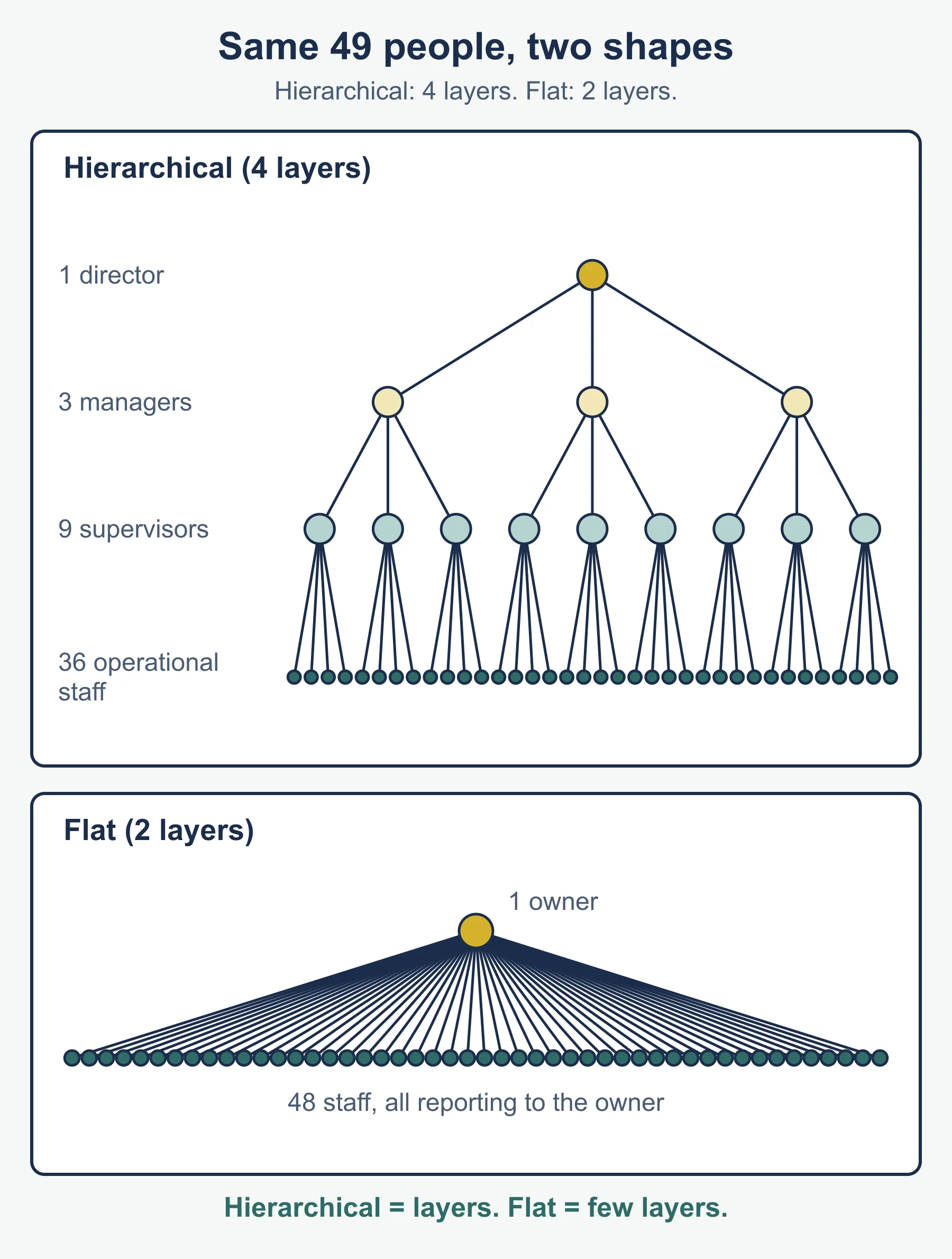
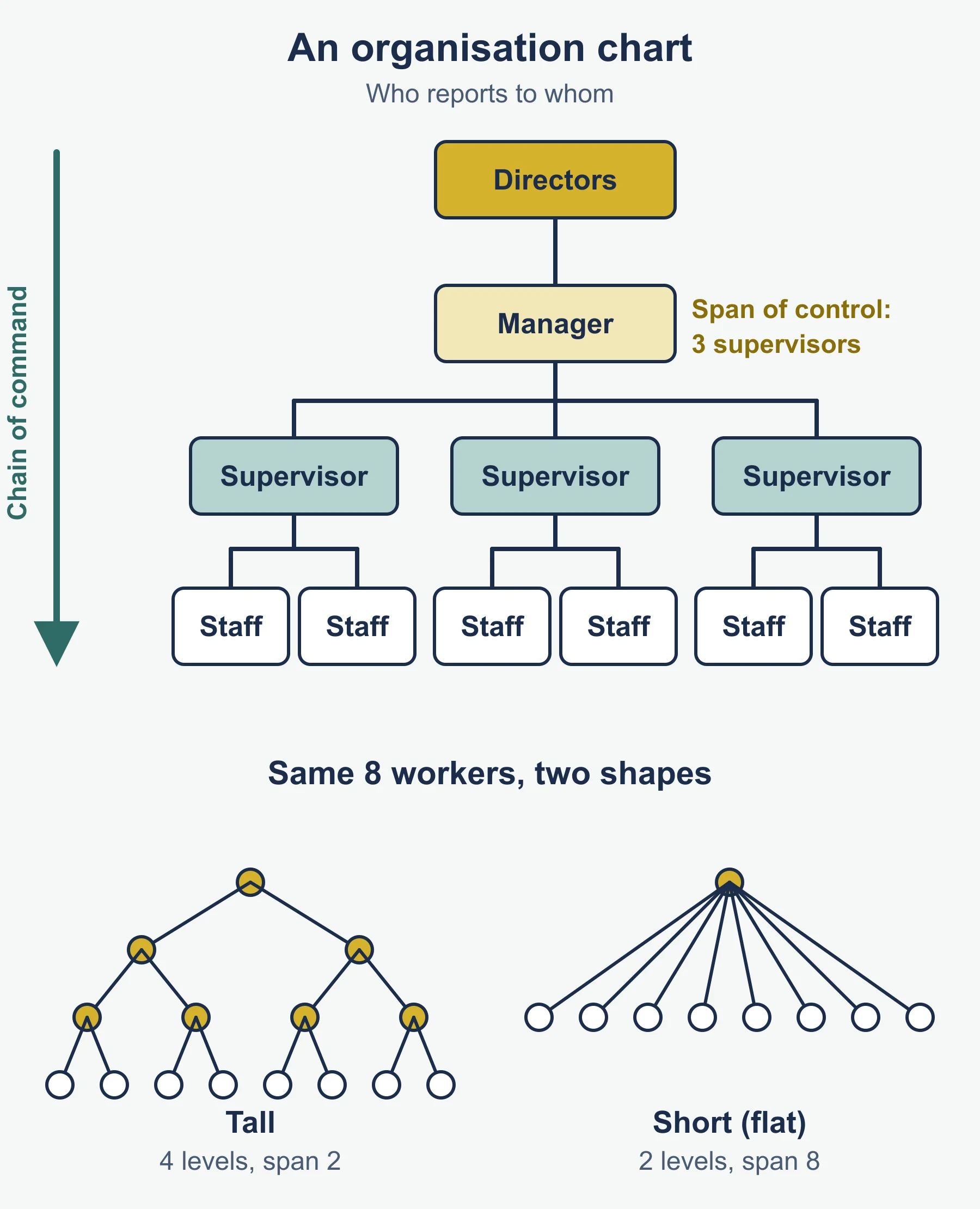
| Hierarchical structure | Many layers; small teams under each manager; messages pass through each layer |
| Flat structure | Few layers; larger teams; shorter route between staff and decision makers |
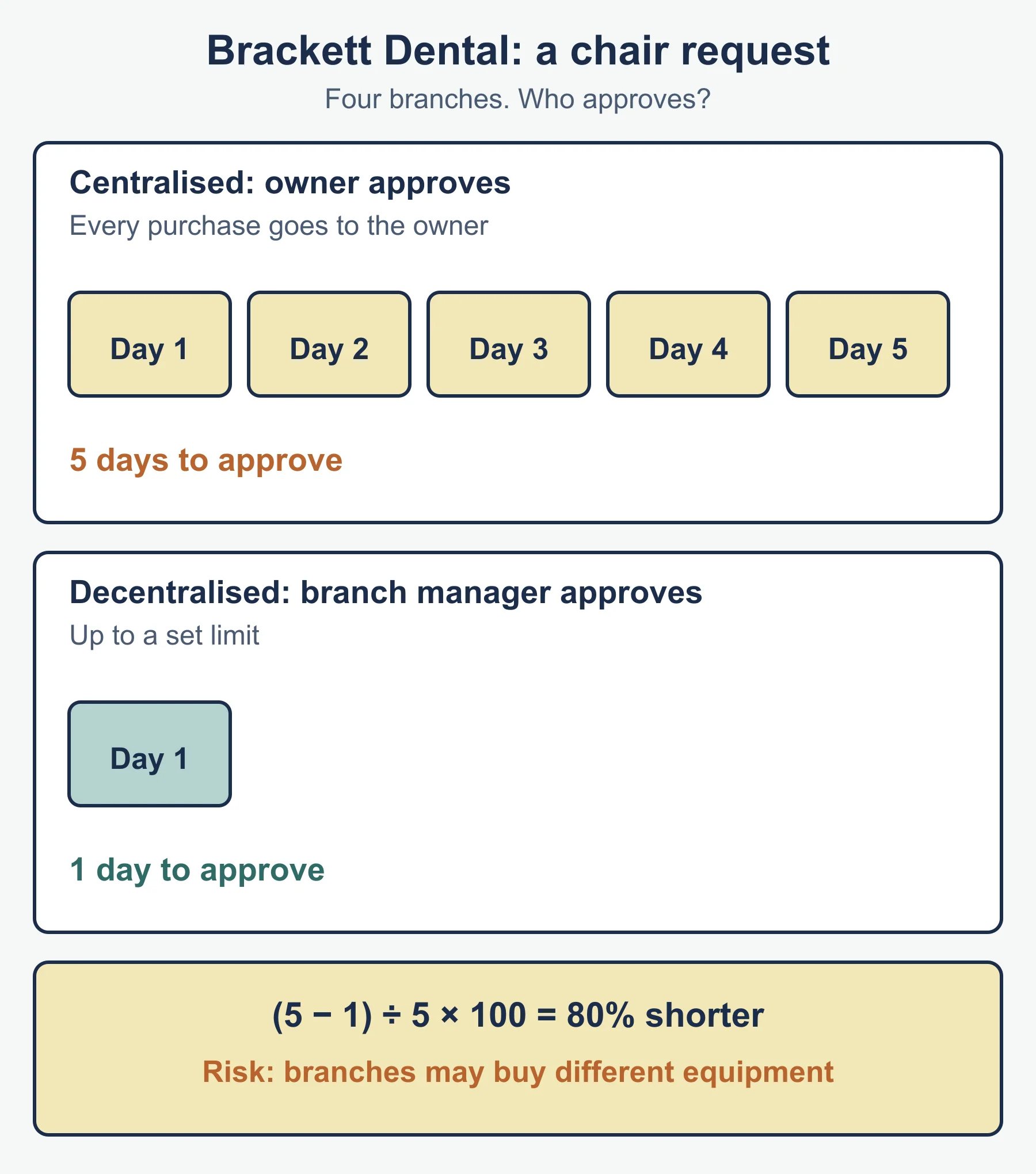
| Centralised | Important decisions made at the top (head office or owner) |
| Decentralised | Decisions passed down to branches, departments or teams |
| Effective communication | The right message reaches the right person at the right time and is understood |
| Barrier to communication | An obstacle that prevents a message arriving or being understood |
| Full-time | The standard full week of hours |
| Part-time | Fewer hours than a full week |
| Flexible hours | The worker has some choice over when the hours are worked |
| Permanent contract | No planned end date |
| Temporary contract | Fixed period or task |
| Freelance | Self-employed, paid for the job rather than as staff |
| Job description | Describes the job: title, duties, reporting line, place, hours |
| Person specification | Describes the person wanted: qualifications, skills, experience, qualities |
| Application form | Standard form designed by the business; same questions for all |
| CV | Written by the candidate; summarises education, experience and skills |
| Internal recruitment | Filling the post from current staff |
| External recruitment | Looking outside the business for candidates |
Structures at a glance
| Advantages | Disadvantages | Appropriate when | |
|---|---|---|---|
| Hierarchical | Clear authority; promotion steps; tight checking | Slow messages; more managers to pay | Large business; work needs checking |
| Flat | Quick messages; fewer managers; staff closer to decisions | Managers may be overloaded; few promotion steps | Small business; fast decisions matter |
| Centralised | Consistency; tight control | Slow response; local managers feel less trusted | Small business; mistakes costly; every branch must act alike |
| Decentralised | Quick local decisions; local knowledge; trusted managers | Inconsistency between branches; less control | Business has grown; locations differ; staff are skilled |
Must-know distinction: hierarchical or flat describes the number of layers. Centralised or decentralised describes where decisions are made. A small flat business is usually centralised, but the two ideas are separate.
Communication in steps
- State what is being passed on (instruction, news, request).
- Choose a method and person that suit the message.
- Check it was received and understood.
| Problem | Effect on efficiency | Effect on motivation |
|---|---|---|
| Insufficient communication | Mistakes, duplicated or missed tasks, mixed messages to customers | Staff feel ignored or unsure of their role |
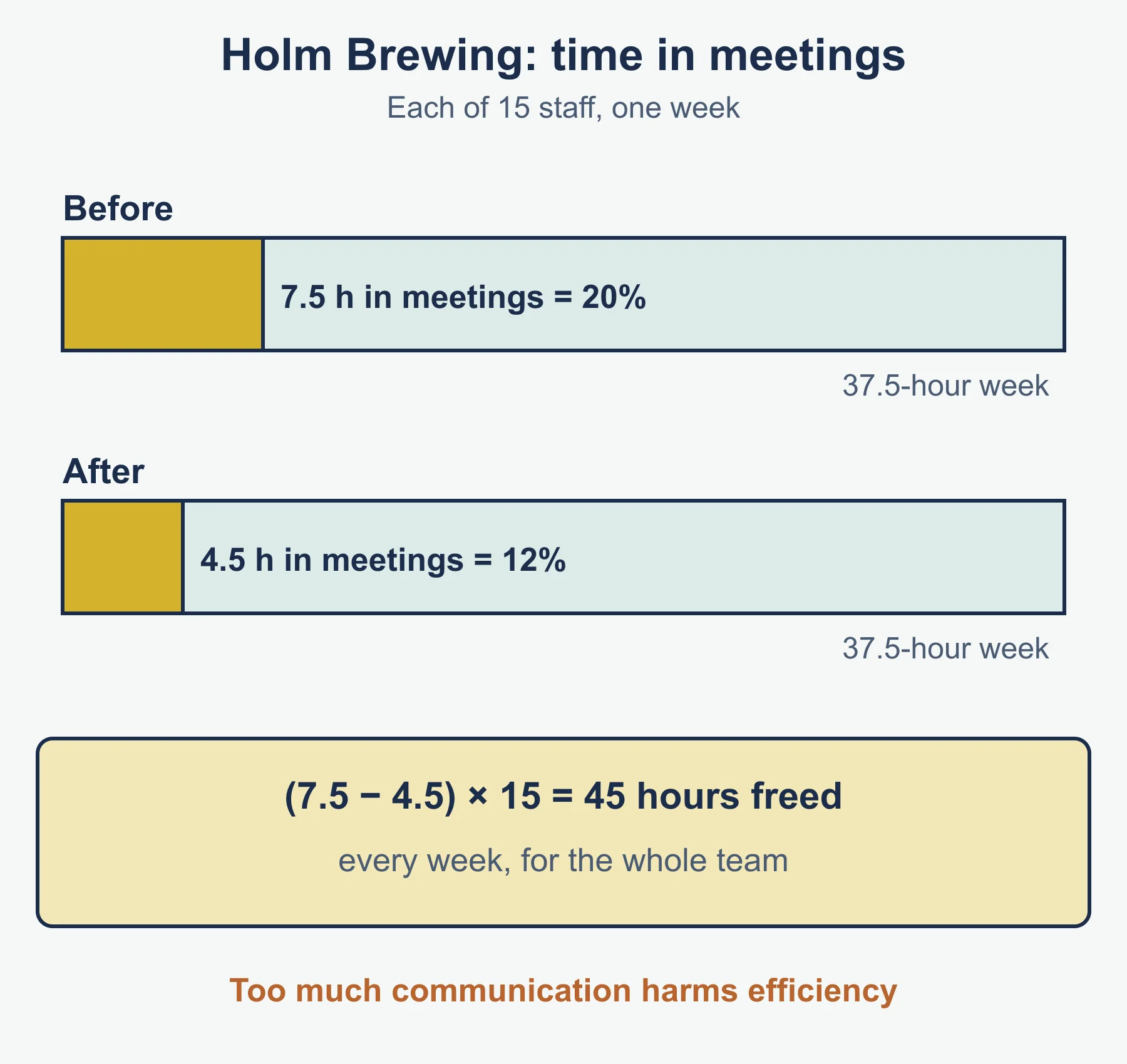
| Excessive communication | Time lost in meetings and messages; key messages missed | Staff feel their time is wasted |
Barriers to remember: unclear wording or jargon, wrong method for the message, language differences, faulty technology, too many layers, noise or distraction.
Ways of working
| Option | Advantage | Disadvantage |
|---|---|---|
| Full-time | Continuity; knows the business well | Higher total cost |
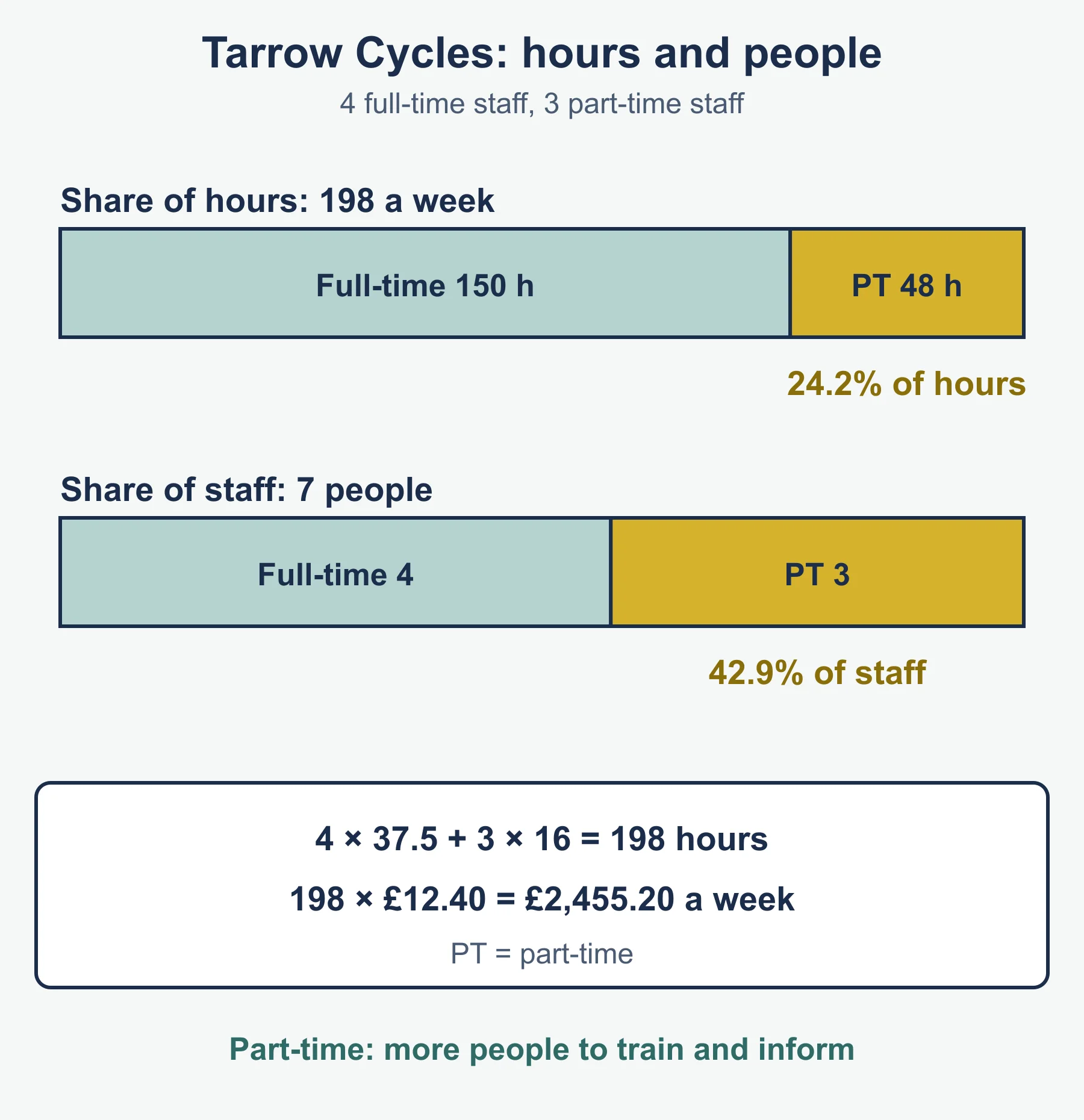
| Part-time | Matches staffing to busy times | More people to train and manage |
| Flexible hours | Helps work-life balance; supports motivation and retention | Cover and meetings harder to arrange |
| Permanent | Security; stable team | Pay continues if demand falls |
| Temporary | Flexible for short peaks or cover | May know less; less commitment |
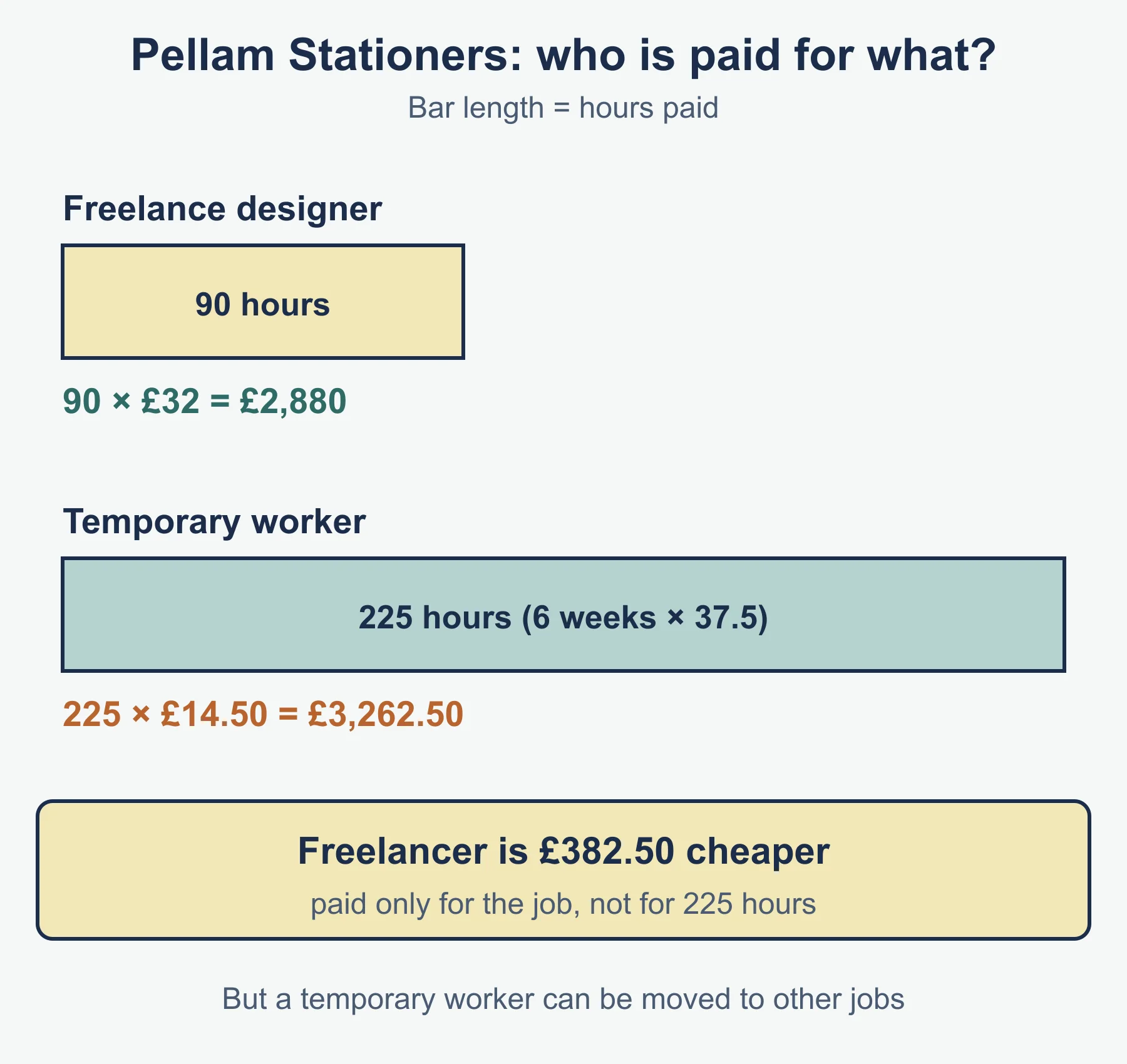
| Freelance | Specialist skills only when needed | High hourly rate; may be unavailable later |
Technology and ways of working:
- Efficiency: shared files, messaging and automated systems speed tasks up and cut errors. Costs: equipment, training, risk of system failure.
- Remote working: lower office costs, wider pool of recruits, less travel for staff. Costs: weaker team contact, harder supervision.
Job roles
| Group | One-line responsibility |
|---|---|
| Directors | Set direction and aims; make major decisions |
| Senior managers | Turn plans into department plans; manage managers |
| Supervisors/team leaders | Organise and check the daily work of a team |
| Operational staff | Do the main work of the business |
| Support staff | Provide services that help others do their jobs |
Recruitment in steps
- Decide what the post involves: write the job description.
- Decide who is needed: write the person specification.
- Choose internal or external recruitment to suit the need.
- Collect application forms or CVs.
- Compare each candidate against the person specification.
Internal or external:
| Internal | External | |
|---|---|---|
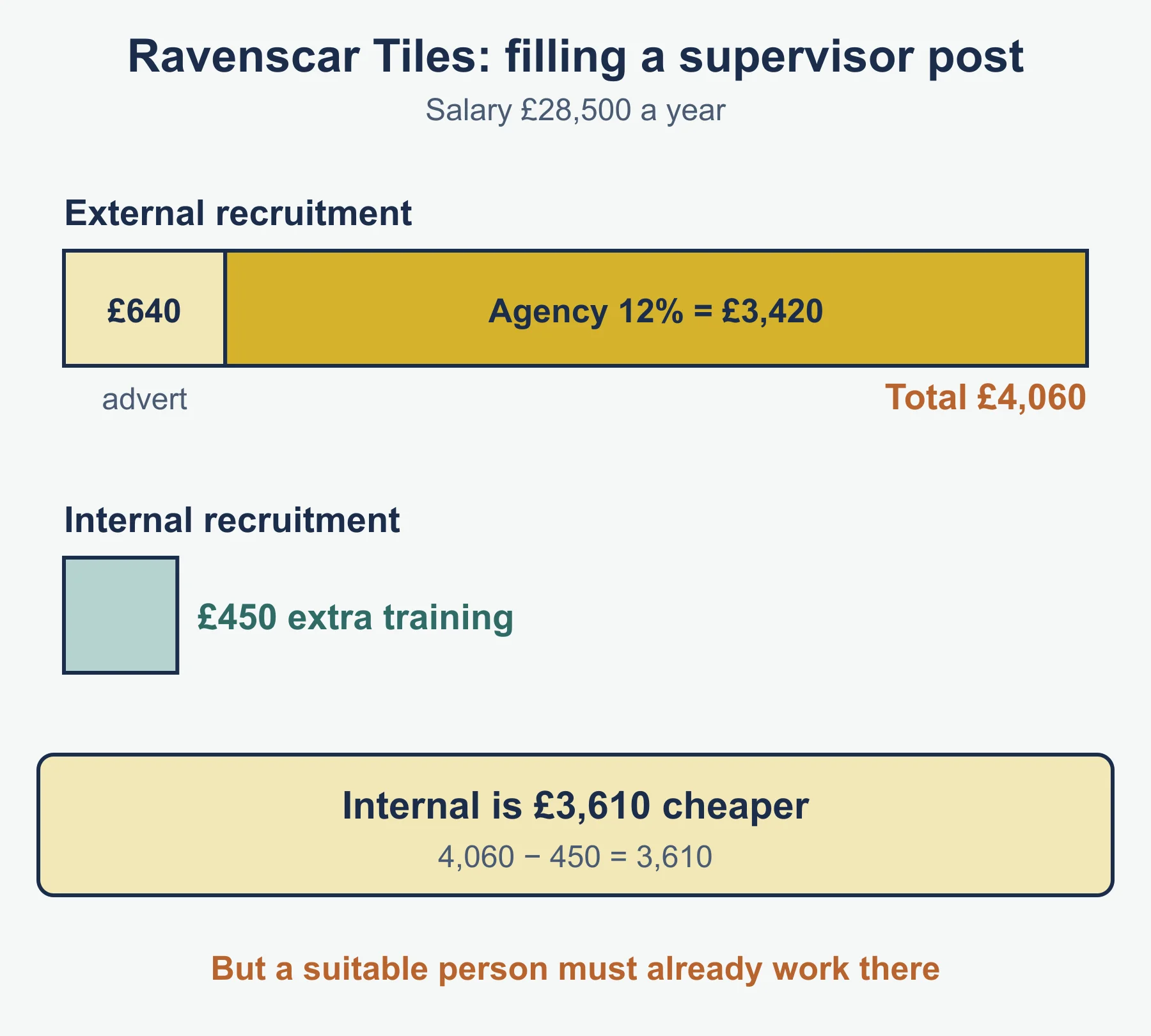
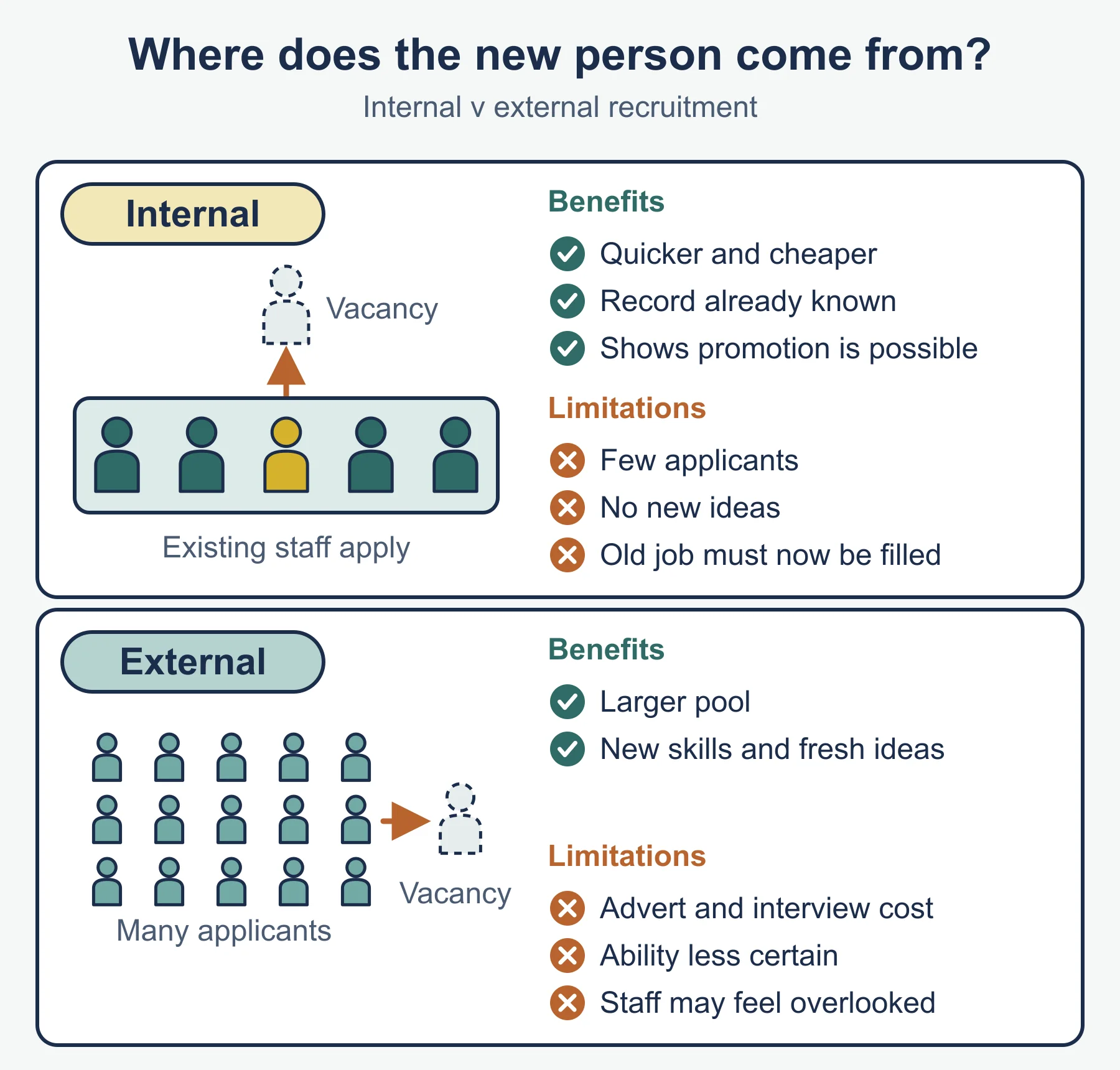
| Cost and speed | Cheaper and quicker | Dearer and slower |
| Skills | Known skills; no new ideas | Larger pool; new skills and ideas |
| Staff effect | Shows promotion is possible; leaves a gap elsewhere | May upset staff passed over; new person must learn the business |
Calculation reminders
The quantitative skills the specification lists include percentages, percentage changes and averages. Show your workings.
| Skill | Standard form | Example |
|---|---|---|
| Percentage change | (new - original) / original × 100 | Applications up from 40 to 52: 12 / 40 × 100 = 30% |
| Share of a total | part / total × 100 | 9 part-timers among 30 staff: 9 / 30 × 100 = 30% |
| Mean | total / number | Hours 40, 40, 24, 16, 20: 140 / 5 = 28 hours |
| Wage cost | hours × hourly rate | 22 hours × £11.80 = £259.60 |
The wage cost line is the standard form, not a formula the specification gives.
Building answers
Explain (statement plus two expansion points, no context). Example: “A flat structure speeds up communication. Messages pass through fewer layers, so staff get instructions sooner. This lets the business react quickly to a customer problem.”
Outline (two linked points, in context). Example for a cafe that hires a freelance baker: “The cafe pays only for the loaves it needs, so its costs do not rise in a quiet month. The hourly rate is high, so a busy month may cost more than a permanent employee.”
Analyse (extended, in context). Use a chain: point, evidence from the case, effect on the business, then a consequence for efficiency, motivation or cost.
Justify (recommend one of two options). Compare both using the numbers or facts given, then choose one and say why the other is weaker.
Evaluate (supported conclusion). Weigh both sides, then give a judgement and state the condition it rests on, for instance business size, staff skills or cost.
Applying the ideas to a case
When a case gives a business, ask four questions before writing.
- How big is it, and is it growing? Growth often pushes a business from centralised towards decentralised, and from flat towards more layers.
- How skilled and trusted are the staff? Skilled staff suit more freedom and flexible hours.
- Is demand steady or seasonal? Steady demand suits permanent contracts. Seasonal demand suits temporary or part-time staff.
- Does the post need new skills or existing knowledge? New skills suggest external recruitment. Existing knowledge suggests internal.
Link every answer to one of these facts. A general list of advantages gains less than a point tied to the case.
Quick self-test
- How does a hierarchical structure differ from a flat one?
- A shop’s owner takes every decision. Is it centralised or decentralised?
- Give one effect of insufficient communication on motivation.
- Name two barriers to effective communication.
- A manager cuts a decision from 5 days to 2 days. Calculate the percentage fall.
- Which contract is for a self-employed person paid for the job?
- Five staff work 40, 40, 24, 16 and 20 hours. Calculate the mean hours worked.
- Staff commute 36 minutes each way, 5 days a week. How many hours a week does remote working save?
- A freelancer is paid £25 an hour for 40 hours. Calculate the cost.
- Which document describes the qualities wanted in a candidate?
- Which job role group organises the daily work of a small team?
- An agency charges 10% of a £24,000 salary and the advert costs £350. Calculate the total external cost.
Answers
- Hierarchical has many layers and small teams. Flat has few layers and larger teams.
- Centralised.
- Staff feel ignored or unsure of their role, so motivation falls.
- Any two: unclear wording or jargon, wrong method, language differences, faulty technology, too many layers.
- (5 - 2) / 5 × 100 = 60% fall.
- Freelance.
- 140 / 5 = 28 hours.
- 5 × 2 × 36 = 360 minutes = 6 hours.
- 25 × 40 = £1,000.
- The person specification.
- Supervisors/team leaders.
- 0.10 × 24,000 = £2,400, plus £350 = £2,750.
Where marks are usually lost
- Writing “flat” for any small business instead of describing few layers.
- Mixing up centralised (decisions at the top) with hierarchical (many layers).
- Giving a general benefit of decentralisation with no link to the case.
- Treating communication as always good. Excessive communication also harms efficiency.
- Confusing freelance workers (self-employed) with temporary staff.
- Mixing up the job description and the person specification.
- Saying internal recruitment is best without noting it needs a suitable person already employed.
- Leaving out workings, units or the percentage sign in a Calculate answer.
- On Explain, giving one point with no expansion. On Evaluate, giving no supported conclusion.
Frequently asked questions
What is the difference between a hierarchical and a flat structure? A hierarchical structure has many layers, with each manager looking after a small number of people. A flat structure has few layers, with managers looking after larger teams and staff closer to the decision makers.
What is the difference between centralised and decentralised decision making? In a centralised structure, important decisions are made at the top, giving consistency and control. In a decentralised structure, decisions are passed down to managers and teams in each branch or region, which suits a larger business where local knowledge matters.
What is the difference between a freelance and a temporary worker? A temporary worker is employed for a fixed period or task, such as a seasonal rush. A freelance worker is self-employed and paid for the job, giving specialist skills only when needed.
What are the advantages of internal recruitment? Internal recruitment is cheap and quick, the person already knows the business, and it motivates others by showing promotion is possible. It brings no new ideas and leaves a gap elsewhere.
Official syllabus
Pearson Edexcel Level 1/Level 2 GCSE (9-1) in Business (1BS0), Specification, Issue 2, July 2022, published by Pearson Education Limited. Theme 2: Building a business, Topic 2.5 Making human resource decisions, items 2.5.1 and 2.5.2.
Get free revision emails (optional)
Occasional emails with practice questions, worked explanations and links to free resources for the qualification and subjects you choose. No spam, and you can unsubscribe from any email. The free tools on this site never need an email.
Related resources
-
Study guides
Edexcel GCSE Business: Training and motivation (1BS0)
Study guide to training, development and motivation methods for Edexcel GCSE Business Theme 2, Topic 2.5, items 2.5.3 and 2.5.4, with worked examples.
Business · Pearson Edexcel · GCSE
Read guide -
Practice questions
Edexcel GCSE Business: Training and motivation (1BS0) – Practice Questions
Original practice questions with worked answers on training, development and motivation for Edexcel GCSE Business Theme 2, items 2.5.3 and 2.5.4.
Business · Pearson Edexcel · GCSE
Try questions -
Revision notes
Edexcel GCSE Business: Training and motivation (1BS0) – Revision Notes
Condensed revision notes with tables, method steps and a self-test on training and motivation for Edexcel GCSE Business Theme 2, items 2.5.3 and 2.5.4.
Business · Pearson Edexcel · GCSE
Revise topic
Related articles
-
teaching
A Level tuition in Dubai: Cambridge or Pearson Edexcel International A Level?
Schools in Dubai and Abu Dhabi teach either Cambridge International AS & A Level or Pearson Edexcel International A Level. How the two are structured, why it matters for tuition, and how online classes from Lahore work.
9 October 2026
-
curriculum guides
Choosing subjects at IGCSE and A Level
How subject choices at 14 and 16 affect university options later, and how to keep pathways open without overloading a timetable.
28 July 2026
Studying this with a teacher
Working through Business GCSE?
This page is free and stays free. If you would rather be taught it, Marlbridge runs Business classes one-to-one and in small groups of up to 15, online in your own time zone. The first trial class is free. WhatsApp replies within an hour (8am–11pm Pakistan time, every day); email the same day.
Pearson Edexcel Business teachers at Marlbridge

