
Revision Notes
Edexcel GCSE Business: Training and motivation (1BS0) – Revision Notes
Condensed revision notes with tables, method steps and a self-test on training and motivation for Edexcel GCSE Business Theme 2, items 2.5.3 and 2.5.4.
- Subject
- Business
- Level
- GCSE
- Topic
- Making human resource decisions
- Author
- Marlbridge Academic Team
- Updated
- Reviewed by
- Asif Iqbal (what this means)
Aligned to Pearson Edexcel GCSE Business (1BS0), Issue 2, July 2022. Official specification .
Syllabus page (what it covers and how it is assessed): Pearson Edexcel GCSE Business.
Syllabus points this page covers
1BS0
- 2.5 Making human resource decisions (whole topic)
- 2.5.3 Effective training and development
- 2.5.4 Motivation
Found an error? Report a correction.
Want a teacher for this? Marlbridge teaches Business online. Request a free trial class.
These notes condense Theme 2, Topic 2.5 Making human resource decisions from the Pearson Edexcel Level 1/Level 2 GCSE (9-1) in Business (1BS0) specification, Issue 2, July 2022. They cover items 2.5.3 (Effective training and development) and 2.5.4 (Motivation). For full explanations and worked examples, read the study guide.
Course links: the Business hub, the printable checklist, the practice questions and the free diagnostics.
Key terms
| Term | Short definition |
|---|---|
| Training | Teaching an employee the skills needed to do a job well |
| Development | Preparing an employee for more responsibility over time (standard knowledge: the specification does not define it) |
| Formal training | Planned, structured, often away from the work area, may give a qualification |
| Informal training | Learning during normal work, such as shadowing or coaching |
| Self-learning | The employee takes charge of their own learning |
| Target | A goal to be reached by a set time; good targets are clear, measurable, achievable and dated (standard knowledge, SMART-style) |
| Performance review | A meeting to assess work against targets and agree next steps |
| Retention | Keeping employees rather than losing them |
| Motivation | The desire to work hard and do the job well |
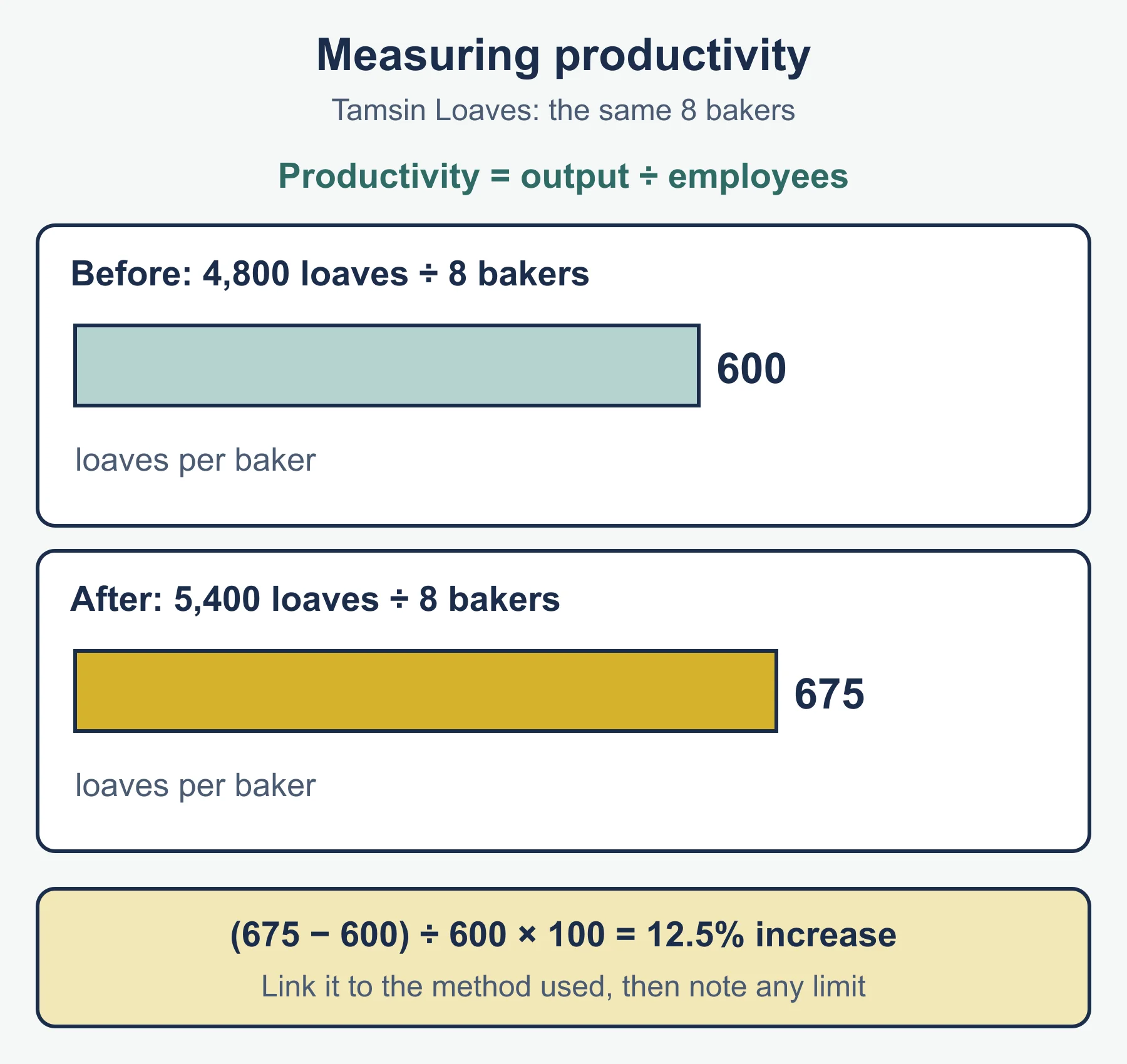
| Productivity | Output for a given input, usually per worker (standard knowledge, not given in the specification: output ÷ number of employees) |
| Remuneration | Payment for work: a wage (often hourly or weekly) or a salary (fixed annual amount); the wage and salary split is standard knowledge |
| Bonus | An extra payment for meeting a target or for good results |
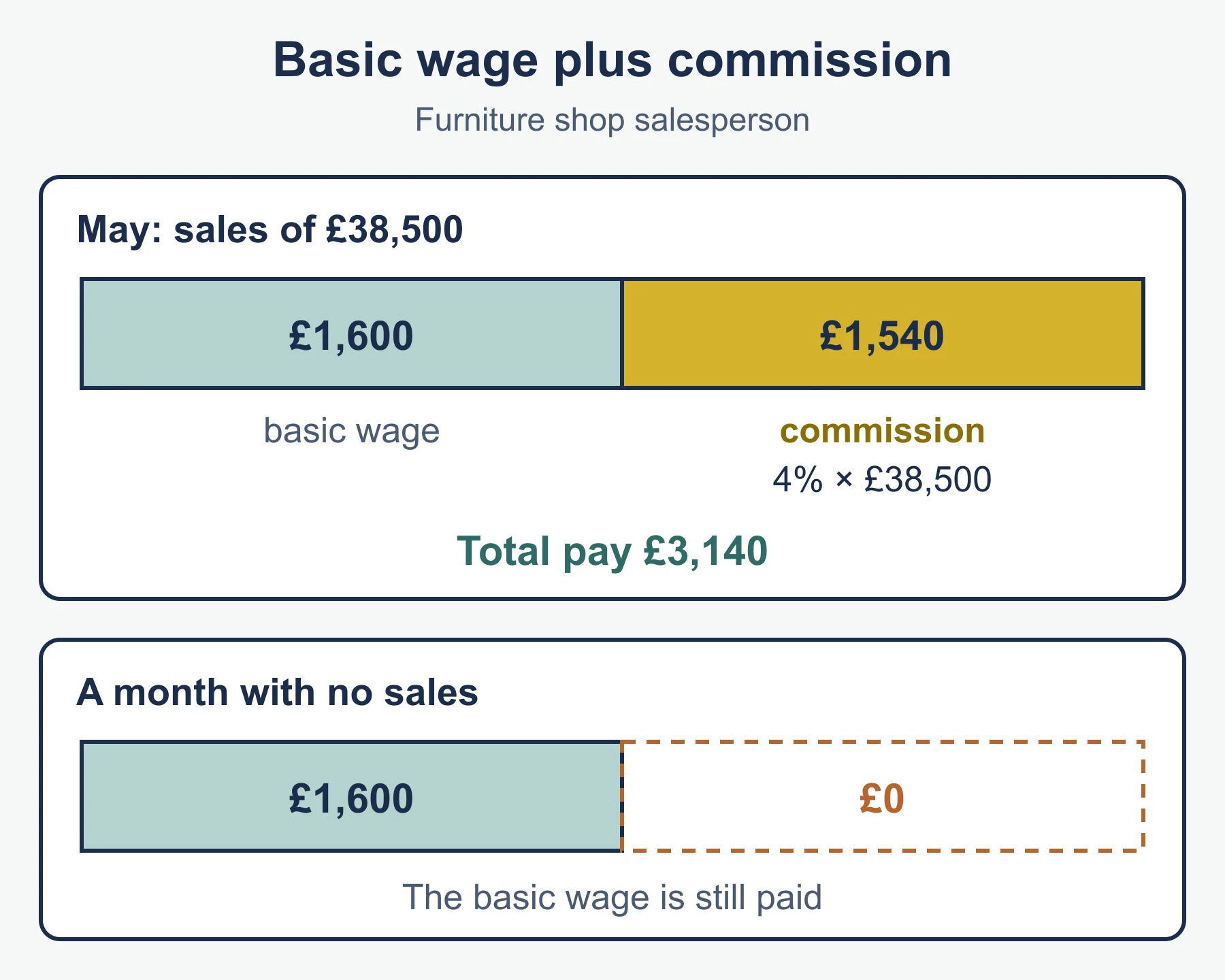
| Commission | Pay linked to sales made, usually a percentage of sales |
| Promotion | Moving to a higher post with more responsibility, usually with more pay |
| Fringe benefits | Extras given on top of pay |
| Job rotation | Moving between tasks or jobs at planned times |
| Job enrichment | Adding more challenging, responsible tasks to a job |
| Autonomy | Freedom to decide how to do the work |
2.5.3 Training and development
Ways to train and develop
| Way | Example | Plus | Minus |
|---|---|---|---|
| Formal training | Outside course, college day release | Consistent content; qualification | Cost; time away from work |
| Informal training | Shadowing, coaching at the workstation | Cheap; fits the real job | Depends on the teacher; slows the teacher |
| Self-learning | Online module, manual, practice | Own pace; low cost | Needs discipline; hard to check |
| Ongoing training for all employees | Regular updates for new and long-serving staff | Skills stay current | Repeated cost and time |
| Target setting | A stated output or quality goal with a deadline | Clear expectations | Unrealistic targets cause stress |
| Performance reviews | Yearly or half-yearly meeting with a manager | Feedback; finds training needs | Takes manager time |
Why train and develop
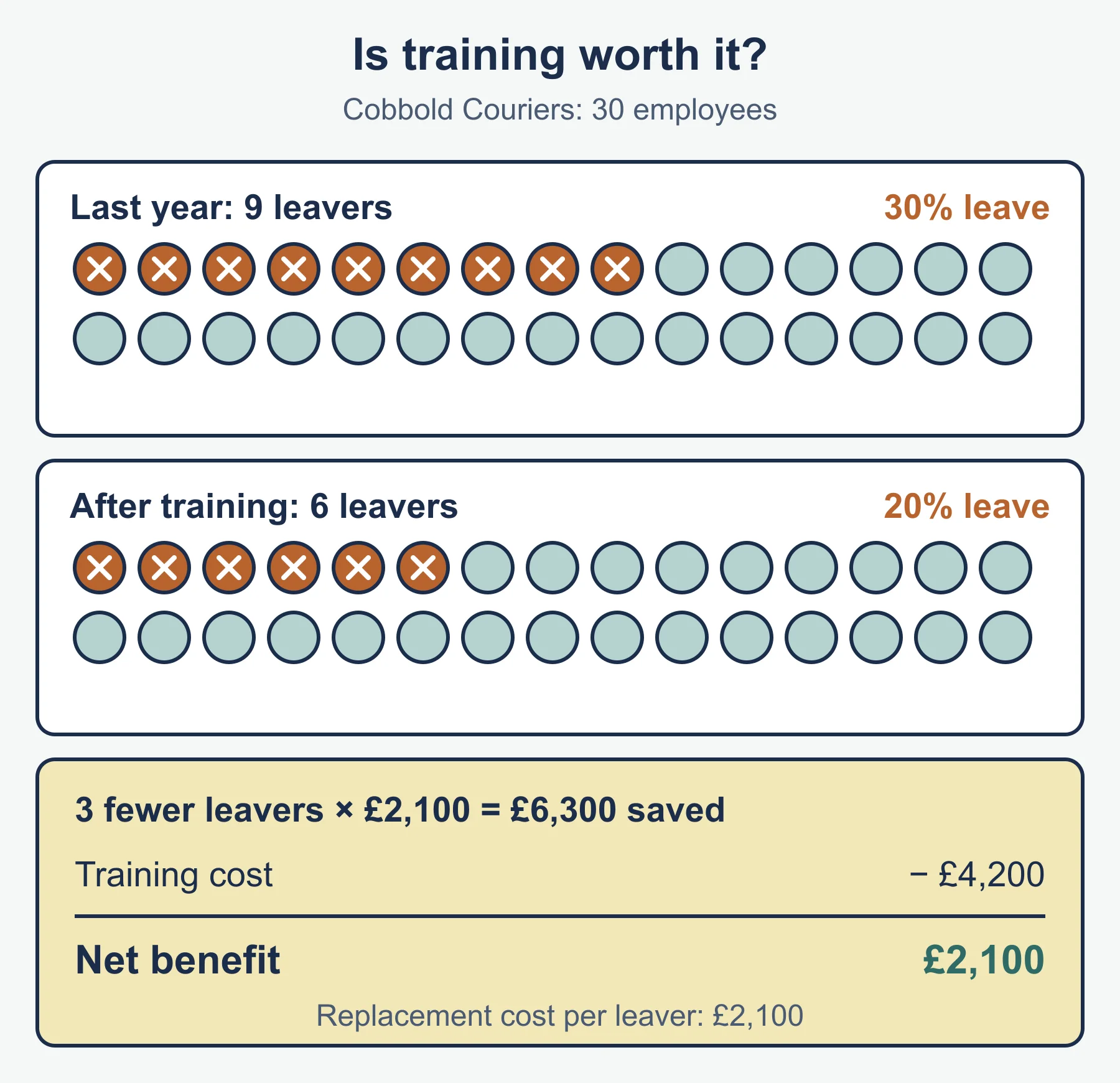
- Link: training can build confidence and satisfaction, which can raise motivation, which can improve retention.
- Retention saves recruitment costs: advertising, interviewing and lost output while a newcomer learns.
- Retraining for new technology: employees learn the new equipment or software so the investment is used well.
- Risk to weigh: a trained employee may leave for a rival.
Method in steps: recommending a training method
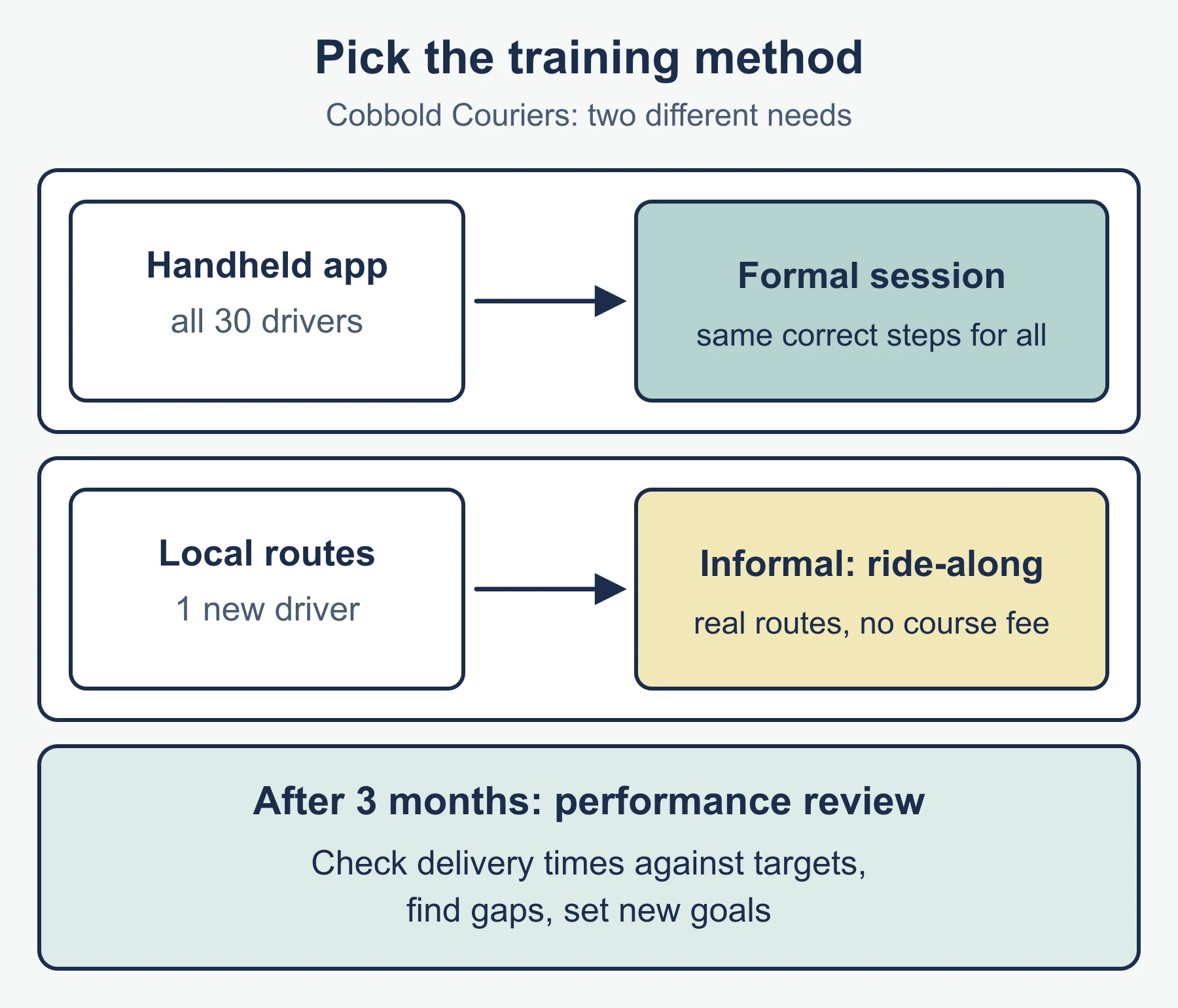
- Identify the need (new skill, new technology, weak performance, new starter).
- Match a method to it (for example, a supplier course for new software, shadowing for local knowledge).
- State the cost, including time away from work.
- Say how success will be checked (a target and a review).
- Reach a judgement and give a reason.
2.5.4 Motivation
Why it matters
| Reason | Think |
|---|---|
| Attracting employees | Better applicants; wider choice |
| Retaining employees | Fewer leavers; lower recruitment cost; experience kept |
| Productivity | More output per worker; fewer errors |
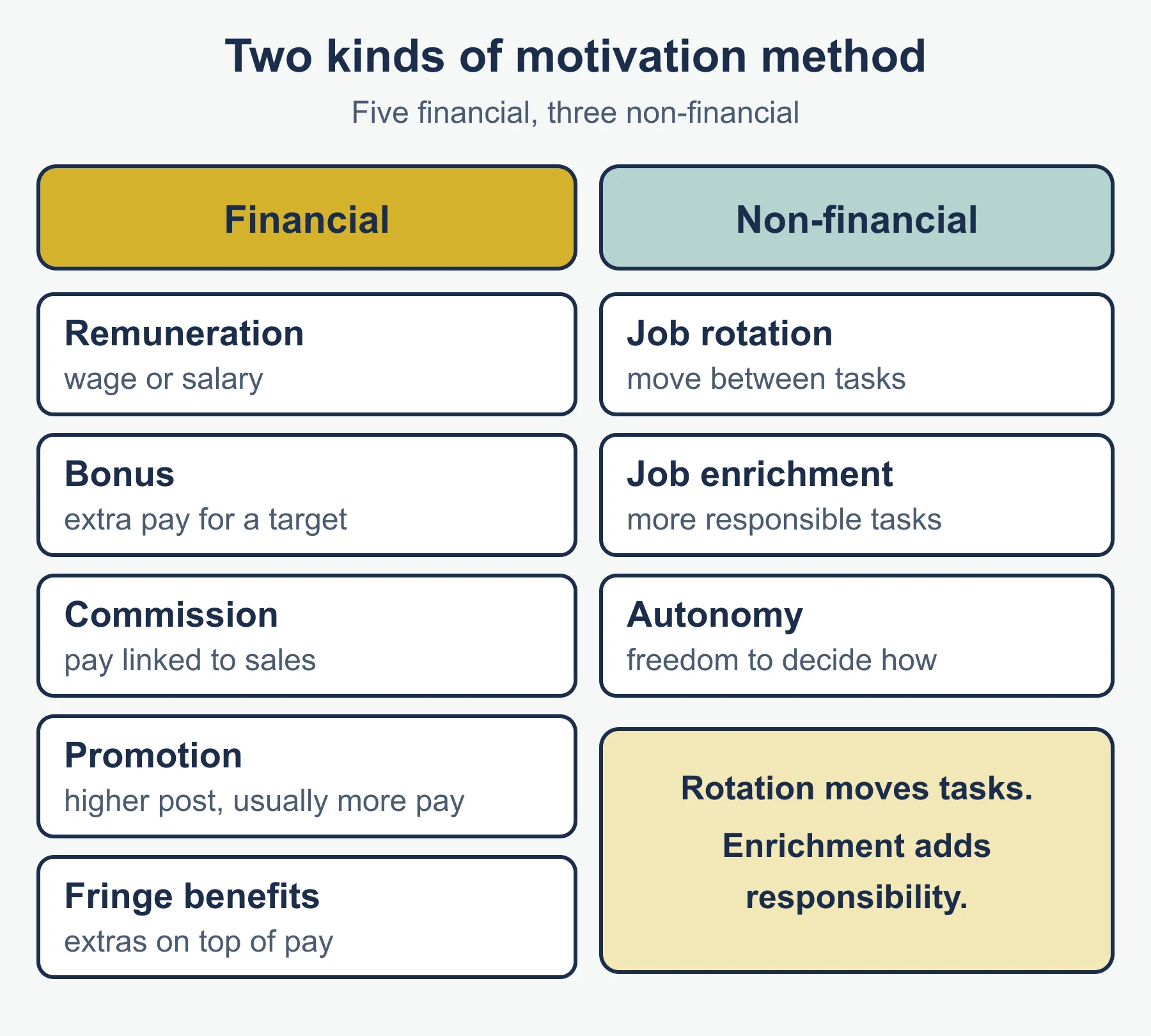
Financial methods
| Method | One-line point | Typical drawback |
|---|---|---|
| Remuneration | Wage or salary | Pay alone may not hold people |
| Bonus | Extra for target or results | Quality may suffer if only the target matters |
| Commission | Percentage of sales | Pay uncertain; pushy selling |
| Promotion | Higher post and usually more pay | Few posts; disappointment |
| Fringe benefits | Non-pay extras | Cost; valued differently |
Non-financial methods
| Method | One-line point | Typical drawback |
|---|---|---|
| Job rotation | Variety; wider skills; cover for absence | Extra training; slower at first |
| Job enrichment | More challenge and responsibility | May expect more pay; needs training |
| Autonomy | Trust and freedom to decide | Poor decisions; some want guidance |
Worked reminders
Commission. A sales assistant earns a basic £1,400 a month plus 5% commission. Sales are £24,000. Commission = 0.05 × 24,000 = £1,200. Total = £1,400 + £1,200 = £2,600.
Bonus. A workshop pays £2.50 for every unit above a target of 120 units. An employee makes 164. Extra units = 164 − 120 = 44. Bonus = 44 × 2.50 = £110.
Productivity. A workshop makes 3,150 items with 7 employees. Productivity = 3,150 ÷ 7 = 450 items per employee.
Percentage change. Leavers fall from 12 to 9. Change = (9 − 12) ÷ 12 × 100 = −25%, a fall of 25%. Divide by the starting figure.
Mean. Five employees had 2, 5, 3, 6 and 4 days of training. Mean = (2 + 5 + 3 + 6 + 4) ÷ 5 = 20 ÷ 5 = 4 days.
Applying it to a case
| If the case says… | Link to make |
|---|---|
| New software or machines are being introduced | Retraining so the investment is used well; fewer mistakes; less anxiety |
| Many staff are leaving | Retention: training, promotion prospects, pay, fringe benefits; recruitment costs avoided |
| Output per worker is low | Productivity: targets, bonus or commission, job enrichment, autonomy |
| Jobs are repetitive | Job rotation or job enrichment to reduce boredom |
| The business struggles to fill vacancies | Attracting employees: competitive remuneration, benefits, a reputation for training |
| The business has little spare cash | Low-cost methods: informal training, self-learning, autonomy |
Method in steps: an evaluation of a motivation method
- Name the method and say what it is.
- Explain how it affects attracting employees, retaining them or productivity.
- Give a cost or drawback, using figures from the case if there are any.
- Compare with an alternative.
- Decide, and give a reason that refers to the business.
Command words in this topic
| Command word | What the specification says it asks for |
|---|---|
| Define | Define a term from the specification content |
| Give | Recall an answer from the specification content |
| Calculate | Use mathematical skills on given data; workings should be given |
| Outline | Two linked points placed in context |
| Explain | A statement of fact with two expansion points; no context |
| Discuss | Extended answer, no context |
| Analyse | Extended answer placed in context |
| Justify | Use the information to recommend one of two options |
| Evaluate | Reach a supported conclusion about a business situation |
Must-know distinctions
- Training teaches skills for the present job. Development prepares for the future (standard knowledge).
- Formal training is planned and structured. Informal training happens during work.
- A bonus is linked to a target or results. Commission is linked to sales made.
- Remuneration is payment for work. Fringe benefits are extras beyond that pay.
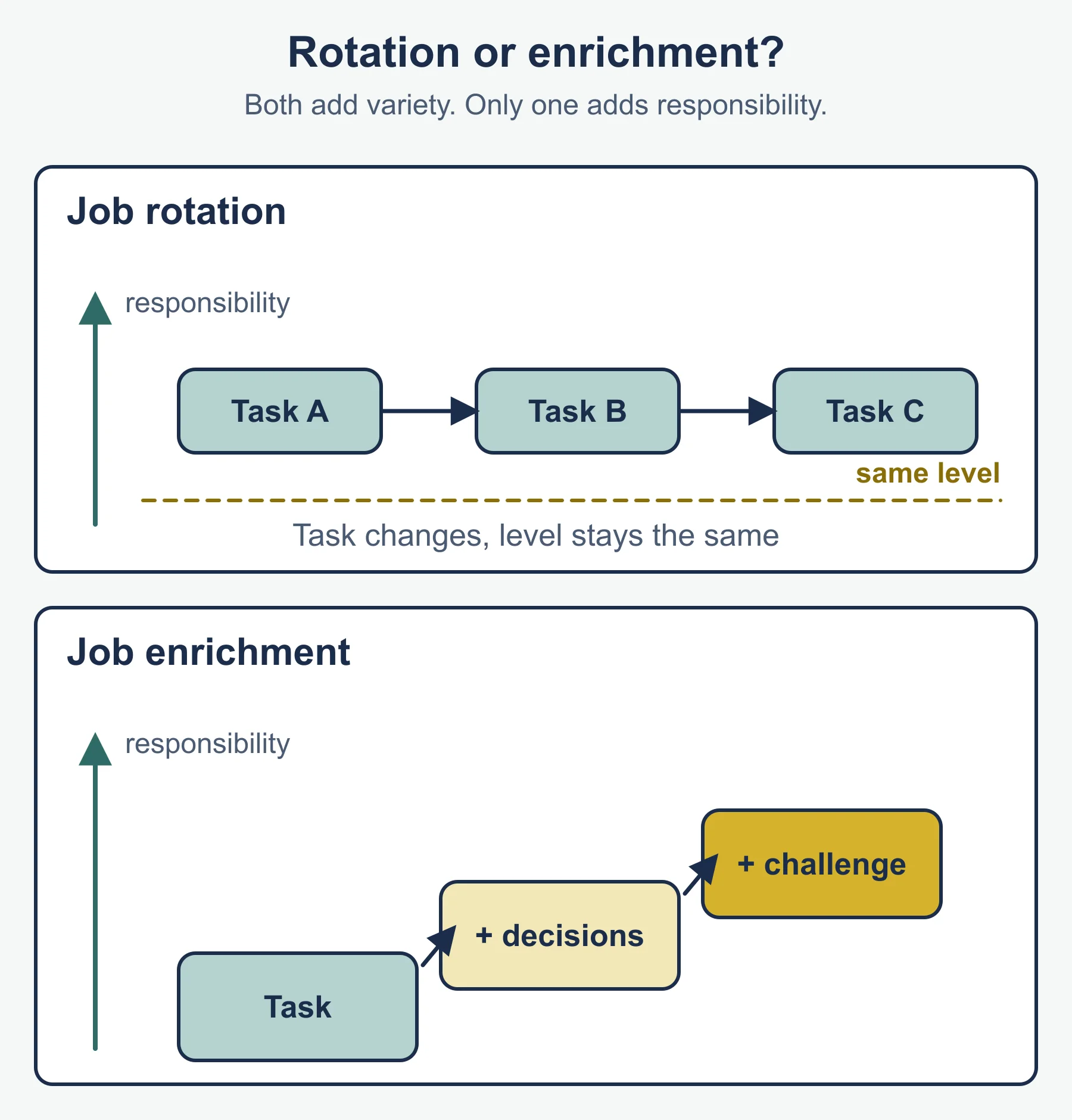
- Job rotation changes the task. Job enrichment makes the task more responsible.
- Autonomy is about deciding how to work. Job enrichment is about what the work contains.
- Motivation is the desire to work well. Productivity is the measured output.
- Retention keeps existing employees. Attracting brings in new ones.
Quick self-test
- Give one example of informal training.
- State what a performance review is.
- Explain one reason why a business might retrain staff when new technology arrives.
- A team leader earns £1,400 plus 5% commission on sales of £24,000. Calculate total pay.
- Seven employees make 3,150 items. Calculate productivity.
- Which is a financial method: job enrichment, autonomy or a bonus?
- Staff leavers fall from 12 to 9. Calculate the percentage change.
- Explain the difference between job rotation and job enrichment.
- Six employees each go on a £250 course. Calculate the total course fee.
- Of 24 employees, 18 had a review this year. Calculate the percentage reviewed.
- Give two ways in which motivation can help a business.
- Calculate the mean number of training days for 2, 5, 3, 6 and 4 days.
Answers
- Shadowing a colleague, or being coached at the workstation.
- A meeting where a manager and employee assess work against targets, give feedback and agree next steps.
- Employees may not know how to use the new equipment, so retraining lets them use it correctly. This means the investment is used well and employees feel less anxious about their jobs.
- £1,400 + (0.05 × 24,000) = £1,400 + £1,200 = £2,600.
- 3,150 ÷ 7 = 450 items per employee.
- A bonus.
- (9 − 12) ÷ 12 × 100 = −25%, a fall of 25%.
- Job rotation moves employees between tasks, giving variety. Job enrichment adds more challenging, responsible tasks to a job.
- 6 × £250 = £1,500.
- 18 ÷ 24 × 100 = 75%.
- Any two of: attracting employees, retaining employees, raising productivity.
- (2 + 5 + 3 + 6 + 4) ÷ 5 = 4 days.
Where marks are usually lost
- Naming a method with no explanation of how it motivates or trains.
- Mixing up a bonus and commission, or rotation and enrichment.
- Writing about motivation in general when the question names a business and its situation.
- Dividing a percentage change by the new figure instead of the original.
- Giving only the advantages of a method and no drawback.
- Forgetting the cost of training, including time away from work.
- Ending an “evaluate” or “justify” answer without a clear decision.
- Claiming that money is the only motivator.
Frequently asked questions
What is the difference between formal and informal training? Formal training is planned and structured, often away from the work area and sometimes leading to a qualification. Informal training happens during ordinary work, such as shadowing a colleague, and is cheap but depends on the person teaching.
What are the financial methods of motivation in Edexcel GCSE Business? The 1BS0 specification lists remuneration, bonus, commission, promotion and fringe benefits. Promotion usually brings higher pay, so it sits among the financial methods.
What is the difference between job rotation and job enrichment? Job rotation moves employees between different tasks at planned times to reduce boredom. Job enrichment redesigns a job to include more challenging, responsible tasks.
Why does motivation matter to a business? The specification gives three reasons: attracting employees, retaining employees and productivity. Motivated staff are less likely to leave, which cuts recruitment costs.
Official syllabus
Pearson Edexcel Level 1/Level 2 GCSE (9-1) in Business (1BS0), Specification, Issue 2, July 2022, published by Pearson Education Limited. Theme 2: Building a business, Topic 2.5 Making human resource decisions, items 2.5.3 and 2.5.4.
Get free revision emails (optional)
Occasional emails with practice questions, worked explanations and links to free resources for the qualification and subjects you choose. No spam, and you can unsubscribe from any email. The free tools on this site never need an email.
Related resources
-
Study guides
Edexcel GCSE Business: Organisational structures and job roles (1BS0)
Study guide to organisational structures, communication, ways of working, job roles and recruitment for Pearson Edexcel GCSE Business Theme 2.
Business · Pearson Edexcel · GCSE
Read guide -
Practice questions
Edexcel GCSE Business: Organisational structures and job roles (1BS0) – Practice Questions
Twelve original practice questions with worked answers on structures, communication, contracts, job roles and recruitment for Edexcel GCSE Business.
Business · Pearson Edexcel · GCSE
Try questions -
Revision notes
Edexcel GCSE Business: Organisational structures and job roles (1BS0) – Revision Notes
Condensed revision notes on structures, communication, ways of working, job roles and recruitment for Pearson Edexcel GCSE Business Theme 2.
Business · Pearson Edexcel · GCSE
Revise topic
Related articles
-
teaching
A Level tuition in Dubai: Cambridge or Pearson Edexcel International A Level?
Schools in Dubai and Abu Dhabi teach either Cambridge International AS & A Level or Pearson Edexcel International A Level. How the two are structured, why it matters for tuition, and how online classes from Lahore work.
9 October 2026
-
curriculum guides
Choosing subjects at IGCSE and A Level
How subject choices at 14 and 16 affect university options later, and how to keep pathways open without overloading a timetable.
28 July 2026
Studying this with a teacher
Working through Business GCSE?
This page is free and stays free. If you would rather be taught it, Marlbridge runs Business classes one-to-one and in small groups of up to 15, online in your own time zone. The first trial class is free. WhatsApp replies within an hour (8am–11pm Pakistan time, every day); email the same day.
Pearson Edexcel Business teachers at Marlbridge

