
Study Guides
Edexcel GCSE Business: Training and motivation (1BS0)
Study guide to training, development and motivation methods for Edexcel GCSE Business Theme 2, Topic 2.5, items 2.5.3 and 2.5.4, with worked examples.
- Subject
- Business
- Level
- GCSE
- Topic
- Making human resource decisions
- Author
- Marlbridge Academic Team
- Updated
- Reviewed by
- Asif Iqbal (what this means)
Aligned to Pearson Edexcel GCSE Business (1BS0), Issue 2, July 2022. Official specification .
Syllabus page (what it covers and how it is assessed): Pearson Edexcel GCSE Business.
Syllabus points this page covers
1BS0
- 2.5 Making human resource decisions (whole topic)
- 2.5.3 Effective training and development
- 2.5.4 Motivation
Found an error? Report a correction.
Want a teacher for this? Marlbridge teaches Business online. Request a free trial class.
This guide follows the Pearson Edexcel Level 1/Level 2 GCSE (9-1) in Business (1BS0) specification, Issue 2, July 2022. It covers Theme 2, Topic 2.5 Making human resource decisions, content items 2.5.3 (Effective training and development) and 2.5.4 (Motivation). The specification lists formulae in Appendix 3 and says they are not provided in the examinations. No formula there is specific to this topic, so where a calculation appears below (productivity, commission, percentages), the standard form is stated and labelled as such.
Course links: the Business hub, the printable checklist and the free diagnostics. Companion pages: the revision notes and the practice questions.
What the specification asks for
| Item | You must be able to | Section |
|---|---|---|
| 2.5.3 | Explain different ways of training and developing employees: formal and informal training, self-learning, ongoing training for all employees, target setting and performance reviews | 1 |
| 2.5.3 | Explain why businesses train and develop employees: the link between training, motivation and retention; retraining to use new technology | 2 |
| 2.5.4 | Explain the importance of motivation: attracting employees, retaining employees, productivity | 3 |
| 2.5.4 | Explain financial methods: remuneration, bonus, commission, promotion, fringe benefits | 4 |
| 2.5.4 | Explain non-financial methods: job rotation, job enrichment, autonomy | 5 |
1. How businesses train and develop employees
Training teaches an employee the skills needed to do a job well. Development is wider: it prepares a person to take on more responsibility over time. The two overlap. The specification names both words without defining them, so this distinction is standard knowledge rather than specification wording.
Formal training
Formal training is planned and structured. It often takes place away from the normal work area and may end with a certificate or qualification. Examples are a first-aid course run by an outside provider, a college day-release programme or a classroom session on health and safety.
- Strength: the content is consistent, and a recognised qualification can be shown to others.
- Weakness: courses cost money, and the employee is not producing while away.
Informal training
Informal training happens in the course of ordinary work. A new starter shadows an experienced colleague, a supervisor demonstrates a task, or a team member coaches another at their workstation.
- Strength: cheap, immediate and tailored to the job as it is really done.
- Weakness: quality depends on the person teaching, who may also pass on bad habits and has less time for their own work.
Self-learning
Self-learning means the employee takes charge of their own learning, for example by working through an online module, reading manuals or practising a new software tool in their own time. The business may provide the materials or allow time.
- Strength: low cost, and the employee learns at their own pace.
- Weakness: it needs self-discipline, and the business cannot easily check what has been learned.
Ongoing training for all employees
The specification lists ongoing training for all employees. This means training is not a one-off event for new starters. Every employee, whether newly appointed or long-serving, keeps updating skills through the year. Ongoing training helps a business keep up with changes in methods, products and rules.
Target setting and performance reviews
A target is a goal an employee is asked to reach by a set time, such as dealing with a stated number of orders a week. The specification does not say what makes a good target. As standard knowledge (a SMART-style description), good targets are clear, measurable, achievable and have a deadline. A performance review is a meeting, usually once or twice a year, where a manager and employee look at how well the employee has done against targets. The review gives feedback, praises success, identifies gaps in skills and agrees new targets. Gaps found at a review often lead directly to training, so the two methods work together.
- Strength: employees know what is expected, and training needs are found early.
- Weakness: unrealistic targets can cause stress, and reviews take managers’ time.
Worked example: choosing a method
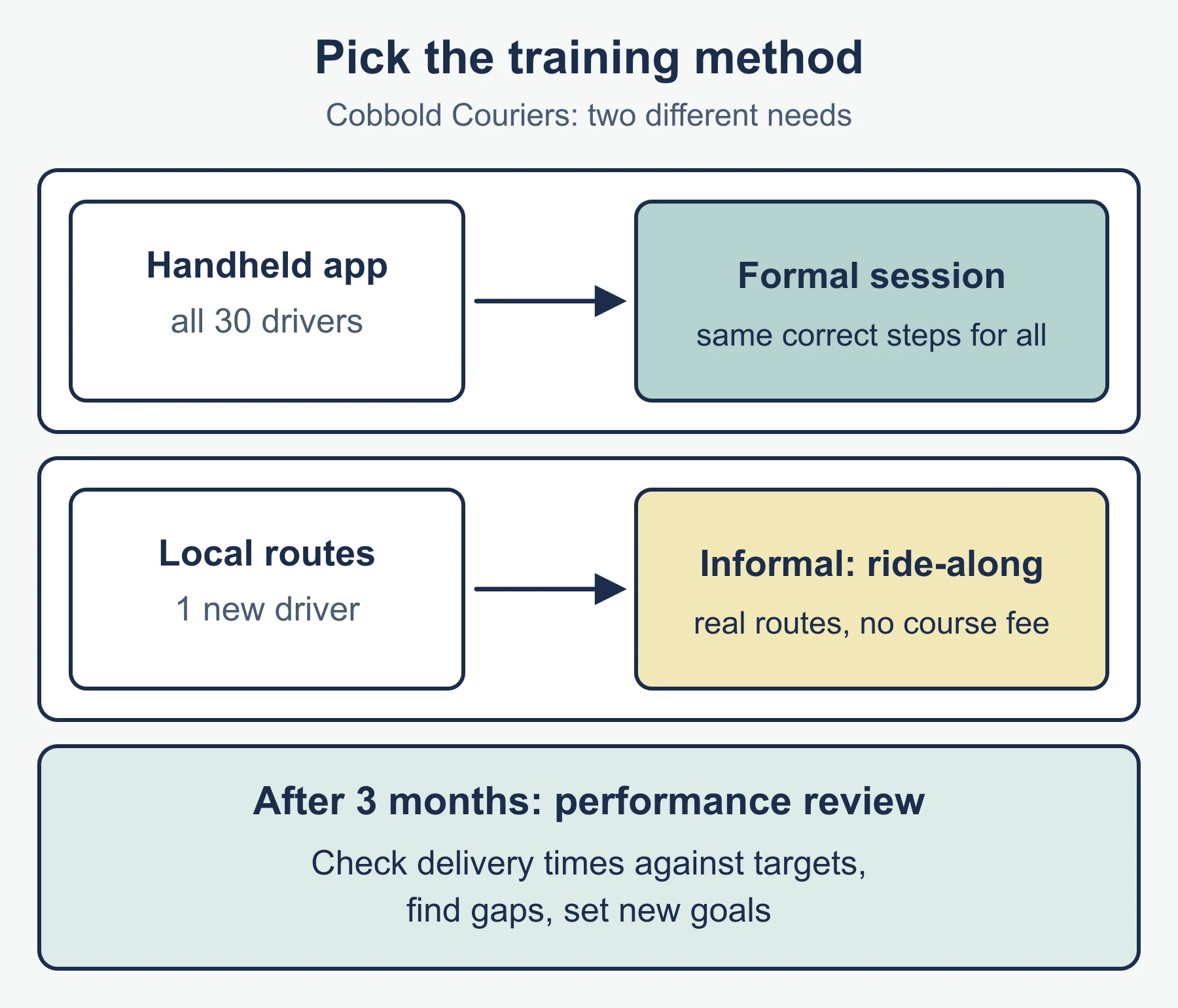
Cobbold Couriers has 30 staff. The owner wants all drivers to learn how to complete the new handheld delivery app, and wants a new driver to learn local routes.
- For the app, a short formal session with the supplier gives everyone the same, correct instructions.
- For local routes, informal training works well: the new driver rides along with an experienced colleague, learning real routes at no course fee.
- After three months, a performance review checks both skills against agreed targets, for example delivery times, and sets new goals.
2. Why businesses train and develop employees
The link between training, motivation and retention
Training can raise motivation. An employee who can do the job well feels more confident and gets more satisfaction from it. Being offered training also shows that the business values them and sees a future for them, which can encourage loyalty. Motivated employees are more likely to stay. Retention means keeping employees rather than losing them. Retention matters because replacing someone costs money (advertising, interviewing, lost output) and experience leaves too.
There is a risk to weigh. A trained employee may leave for a rival offering more pay, so training works best alongside other motivators.
Retraining to use new technology
Technology changes how jobs are done. When a business introduces new equipment or software, employees who were skilled in the old method may be unable to use the new one. Retraining teaches them the new method so that they can keep their jobs and the business gets the benefit of the investment. Without it, new machinery may be used badly or sit unused.
Worked example: is training worth it?
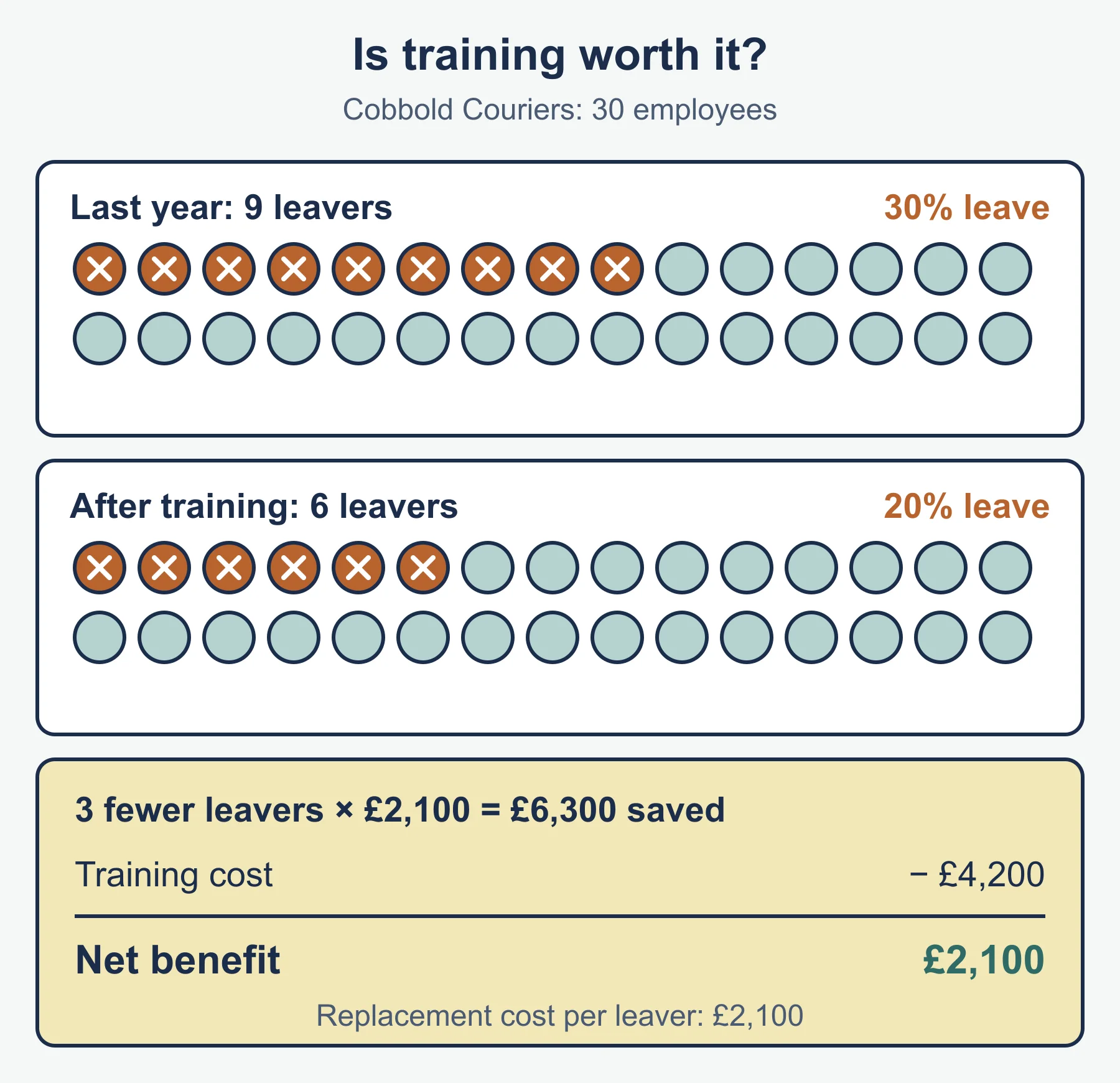
Cobbold Couriers had 9 of its 30 employees leave last year. Each replacement cost £2,100 in advertising, interviewing and lost output. The owner then spent £4,200 on a training programme. The next year, 6 employees left.
- Percentage leaving before: 9 ÷ 30 × 100 = 30%.
- Percentage leaving after: 6 ÷ 30 × 100 = 20%.
- Fewer leavers: 9 − 6 = 3, a fall of 3 ÷ 9 × 100 = 33.3% (to 1 decimal place).
- Replacement cost saved: 3 × £2,100 = £6,300.
- Net benefit: £6,300 − £4,200 = £2,100.
On these figures the programme paid for itself in one year. A careful answer adds that the owner cannot be sure the training caused all of the fall: pay changes or a quieter labour market could also have played a part.
3. Why motivation matters
Motivation is the desire to work hard and do the job well. The specification names three reasons it matters.
Attracting employees. A business that is known for fair pay, good benefits and interesting work receives more applications and can choose better candidates. This matters most when skilled labour is scarce.
Retaining employees. Motivated employees are less likely to look for another job. The business spends less on recruitment and keeps skills and customer knowledge.
Productivity. Productivity is how much output is produced for a given input, usually per worker or per hour. The specification gives no productivity formula, so this is standard knowledge, not specification wording: productivity = output ÷ number of employees. Motivated employees tend to concentrate better, waste less and work to a higher standard, so the same number of people produce more.
Worked example: measuring productivity
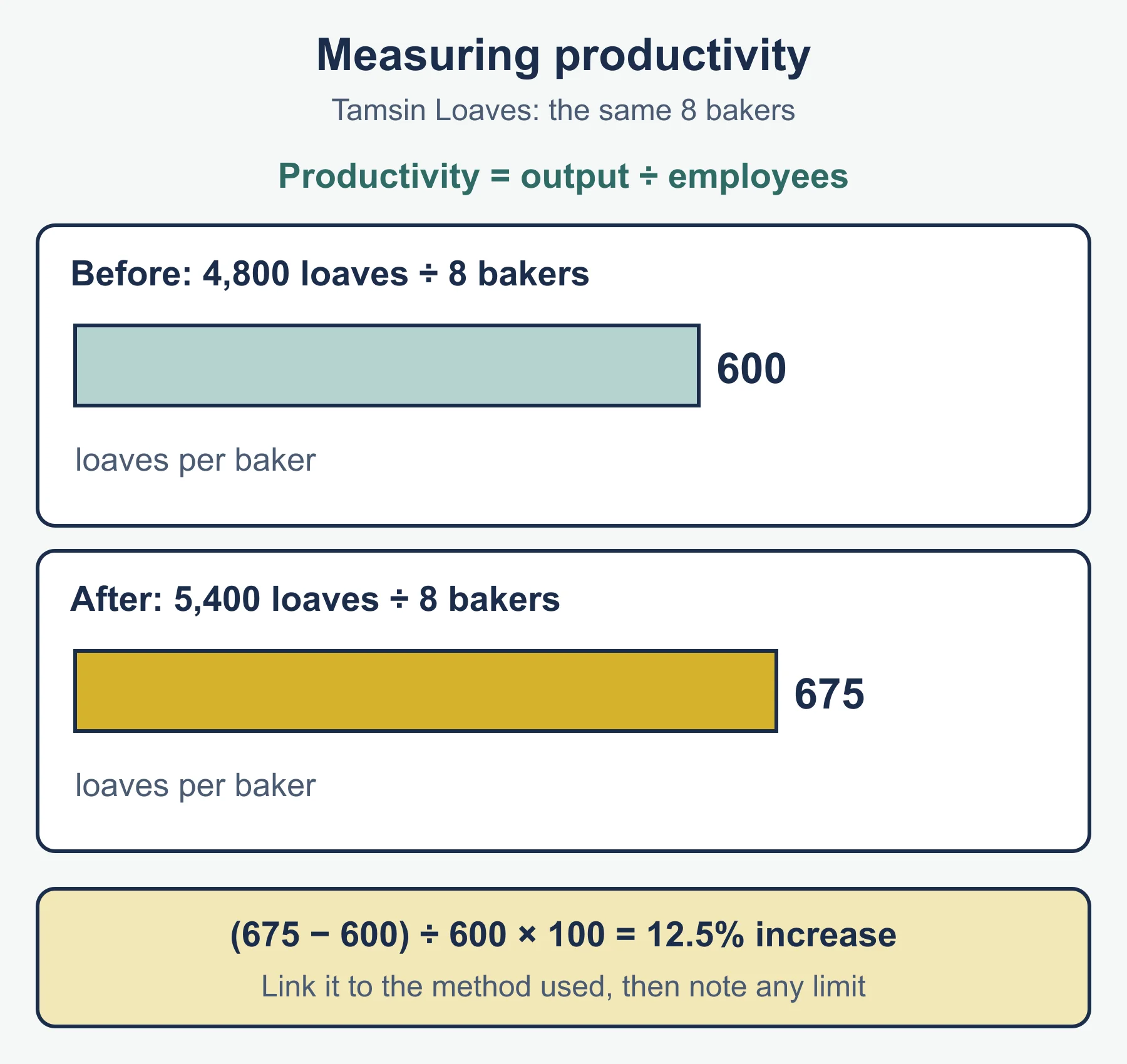
Tamsin Loaves employs 8 bakers who produced 4,800 loaves in a week. After the owner gave bakers more responsibility, the same 8 bakers produced 5,400 loaves.
- Before: 4,800 ÷ 8 = 600 loaves per baker.
- After: 5,400 ÷ 8 = 675 loaves per baker.
- Percentage change: (675 − 600) ÷ 600 × 100 = 12.5% increase.
The change is not proof that motivation caused it: demand may also have risen. In an analysis answer, link the figures to the method used, then note any limit.
4. Financial methods of motivation
| Method | What it is | Why it can motivate | Possible drawback |
|---|---|---|---|
| Remuneration | Payment for work, in the form of a wage (often paid by the hour or week) or a salary (a fixed annual amount, usually paid monthly). The wage and salary descriptions are standard knowledge; the specification lists only remuneration | Fair, competitive pay attracts and keeps employees | Costs rise; pay alone may not hold people who are bored |
| Bonus | An extra payment, often once a year, for meeting a target or when the business does well | Rewards effort and results | Employees may chase the target and neglect quality; it can cost a lot in a good year |
| Commission | Pay linked to sales made, usually a percentage of sales | The more sold, the more earned | Pay is uncertain; it may encourage pushy selling or neglect of other duties |
| Promotion | Moving to a higher position with more responsibility, usually with higher pay | Gives a goal and recognises success | Few posts; those not promoted may feel let down |
| Fringe benefits | Extras given on top of pay, such as staff discount, free meals, health cover or a company car | Add value without being pay; show care for employees | Cost to the business; benefits are valued differently by each person |
Worked example: commission
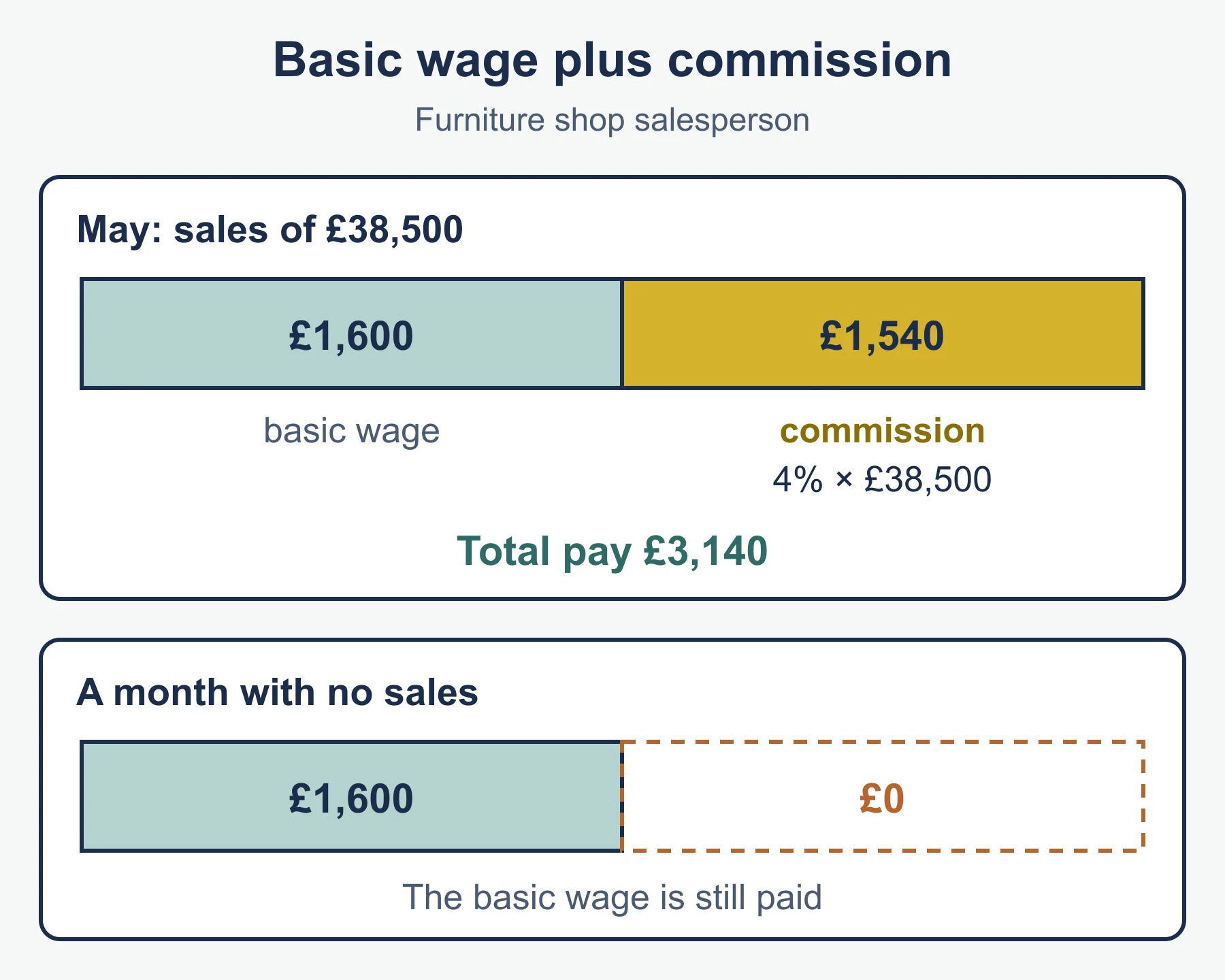
A salesperson at a furniture shop receives a basic wage of £1,600 per month plus commission of 4% of sales made. Sales in May were £38,500.
- Commission = 4% of £38,500 = 0.04 × 38,500 = £1,540.
- Total pay = £1,600 + £1,540 = £3,140.
If the person sold nothing, pay would still be the £1,600 basic. This is why many businesses combine a basic wage with commission rather than relying on commission alone.
5. Non-financial methods of motivation
These methods do not rely on extra money. They change the nature of the work.
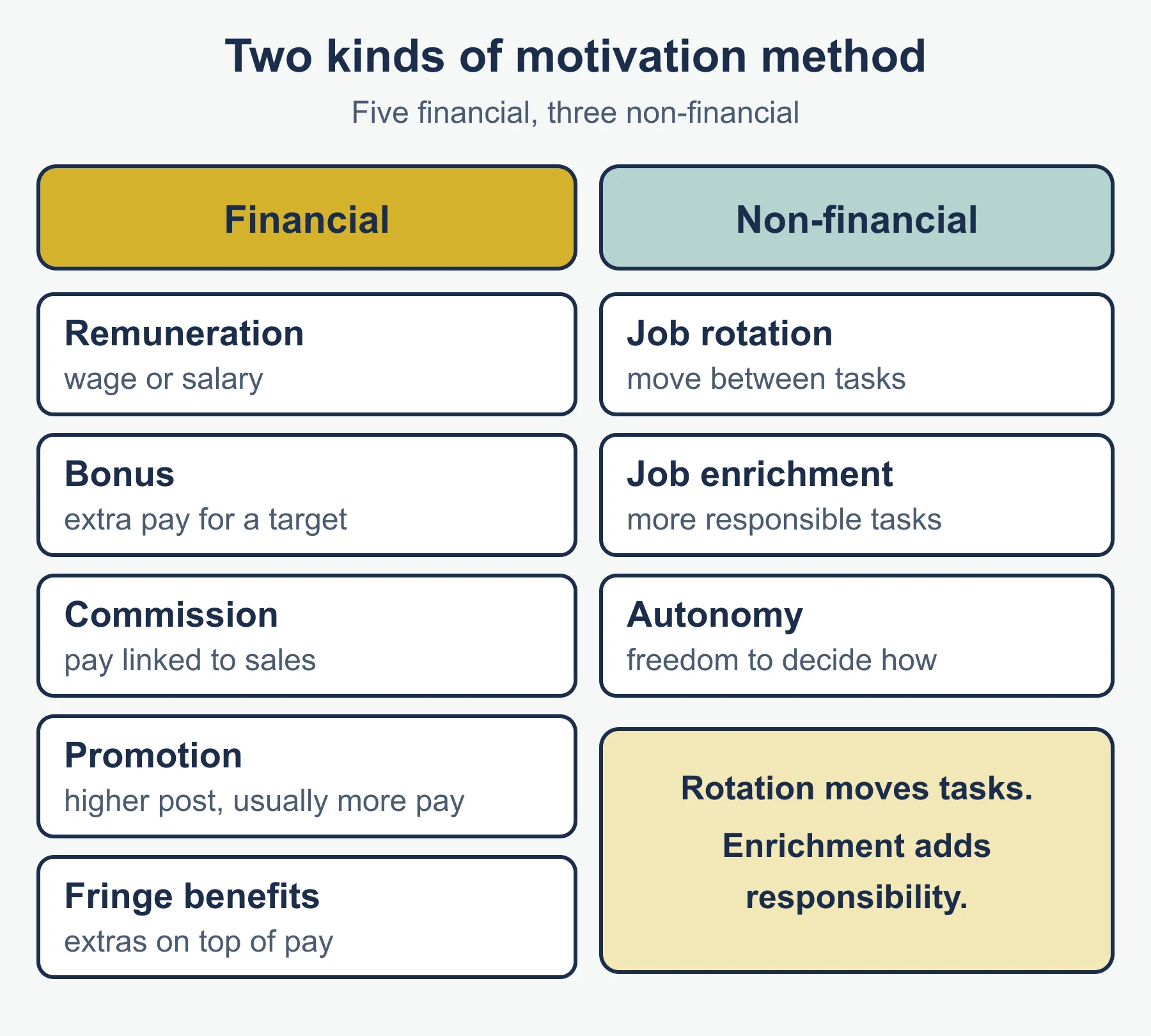
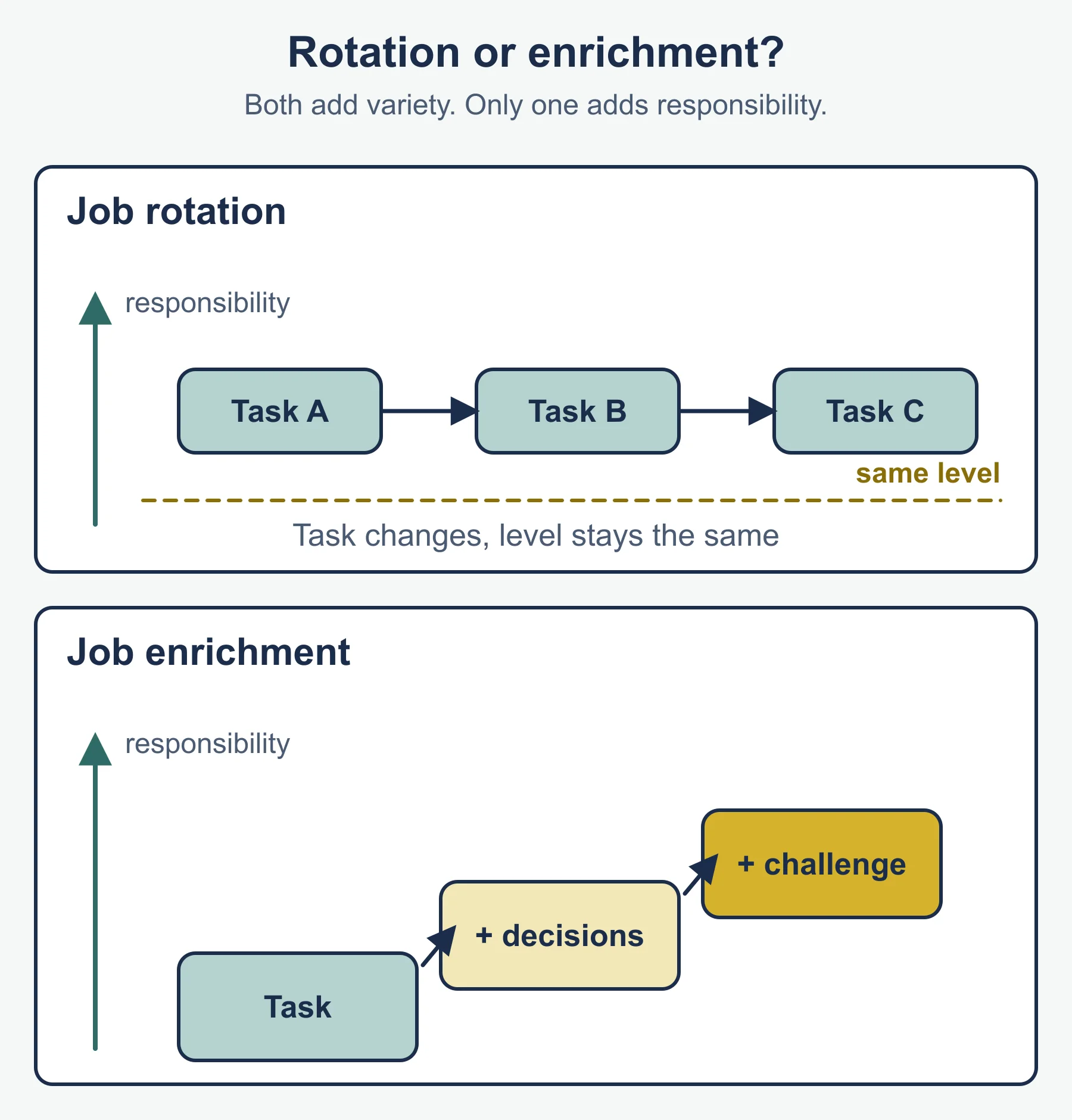
Job rotation. Employees move between different tasks or jobs at planned times. This reduces boredom, builds a wider range of skills and makes it easier to cover absences. The downside is that employees may need extra training and may be slower when learning a new task.
Job enrichment. The job is redesigned to include more challenging, responsible tasks, so the employee does more than repeat one small activity. A baker who only shapes dough might also be asked to plan the day’s batches. It can give a sense of achievement. It may need training and may mean a higher wage is expected.
Autonomy. Autonomy is the freedom to make decisions about how to do the work, with less supervision. People often feel trusted and responsible. The risk is that some employees make poor decisions or want more guidance than they are given.
Choosing between methods
A common exam task asks you to recommend a method for a business. Three questions help.
- What is the problem? A high number of leavers, low output and difficulty recruiting need different answers.
- What can the business afford? A bonus or pay rise adds to costs, while autonomy costs little.
- Who are the employees? A student on a temporary job may value flexible pay more than promotion prospects.
Financial and non-financial methods can work together.
How the command words apply
Appendix 1 sets out what each command word asks for. “Explain” asks for a statement of fact with two expansion points and no context. “Outline” asks for two linked points placed in the context given. “Analyse” is an extended answer placed in context by the question. “Justify” asks you to use the information provided to recommend one of two options. “Evaluate” asks for a supported conclusion about a business situation. For the last two, weigh both sides before you decide.
Common errors
- Writing “training” without saying which method, or what it achieves.
- Treating a bonus and commission as the same: a bonus is usually linked to a target or results, commission to sales made.
- Calling promotion a non-financial method only. It usually brings more pay and is listed among the financial methods.
- Confusing job rotation (moving between tasks) with job enrichment (adding more responsible tasks).
- Saying motivated employees “work harder” without linking to attracting, retaining or productivity.
- Concluding that one method is best for all businesses, without reference to the case.
Frequently asked questions
What is the difference between a bonus and commission? A bonus is an extra payment, often once a year, for meeting a target or when the business does well. Commission is pay linked to sales made, usually a percentage of sales.
What is autonomy as a motivation method? Autonomy is the freedom to make decisions about how to do the work, with less supervision. It costs little and staff often feel trusted, but some employees may make poor decisions or want more guidance.
How is training linked to staff retention? Training builds confidence and shows employees that the business values them, which can make them less likely to leave. A trained employee may still leave for a rival offering more pay, so training works best alongside other motivators.
Why do businesses retrain staff to use new technology? When new equipment or software is introduced, employees skilled in the old method may be unable to use the new one. Retraining teaches the new method so that the business benefits from the technology.
Official syllabus
Pearson Edexcel Level 1/Level 2 GCSE (9-1) in Business (1BS0), Specification, Issue 2, July 2022, published by Pearson Education Limited. Theme 2: Building a business, Topic 2.5 Making human resource decisions, items 2.5.3 and 2.5.4.
Get free revision emails (optional)
Occasional emails with practice questions, worked explanations and links to free resources for the qualification and subjects you choose. No spam, and you can unsubscribe from any email. The free tools on this site never need an email.
Related resources
-
Practice questions
Edexcel GCSE Business: Training and motivation (1BS0) – Practice Questions
Original practice questions with worked answers on training, development and motivation for Edexcel GCSE Business Theme 2, items 2.5.3 and 2.5.4.
Business · Pearson Edexcel · GCSE
Try questions -
Revision notes
Edexcel GCSE Business: Training and motivation (1BS0) – Revision Notes
Condensed revision notes with tables, method steps and a self-test on training and motivation for Edexcel GCSE Business Theme 2, items 2.5.3 and 2.5.4.
Business · Pearson Edexcel · GCSE
Revise topic -
Study guides
Edexcel GCSE Business: Organisational structures and job roles (1BS0)
Study guide to organisational structures, communication, ways of working, job roles and recruitment for Pearson Edexcel GCSE Business Theme 2.
Business · Pearson Edexcel · GCSE
Read guide
Related articles
-
teaching
A Level tuition in Dubai: Cambridge or Pearson Edexcel International A Level?
Schools in Dubai and Abu Dhabi teach either Cambridge International AS & A Level or Pearson Edexcel International A Level. How the two are structured, why it matters for tuition, and how online classes from Lahore work.
9 October 2026
-
curriculum guides
Choosing subjects at IGCSE and A Level
How subject choices at 14 and 16 affect university options later, and how to keep pathways open without overloading a timetable.
28 July 2026
Studying this with a teacher
Working through Business GCSE?
This page is free and stays free. If you would rather be taught it, Marlbridge runs Business classes one-to-one and in small groups of up to 15, online in your own time zone. The first trial class is free. WhatsApp replies within an hour (8am–11pm Pakistan time, every day); email the same day.
Pearson Edexcel Business teachers at Marlbridge

