
Study Guides
Edexcel International A Level Accounting: Role and purpose of accounting, and concepts and conventions (YAC11)
Study guide to Edexcel IAL Accounting 1.1.1-1.1.2 and 1.1.8-1.1.10: why accounting exists, who uses it, nine concepts and conventions, and IAS.
- Subject
- Accounting
- Level
- AS LEVEL
- Topic
- Principles of accounting and double entry bookkeeping
- Author
- Marlbridge Academic Team
- Updated
- Reviewed by
- Javaid Iqbal Sabri (what this means)
Aligned to Pearson Edexcel A Level Accounting (YAC11), 2015-onwards. Official specification .
Syllabus page (what it covers and how it is assessed): Pearson Edexcel A Level Accounting.
Syllabus points this page covers
YAC11 (AS Level)
- 1.1.1-1.1.2 Role and purpose of accounting
- 1.1.8-1.1.10 Accounting concepts and conventions
Found an error? Report a correction.
Need help with this topic? Request a free trial class for A Level Accounting (YAC11).
This guide teaches outcomes 1.1.1 to 1.1.2 (role and purpose of accounting) and 1.1.8 to 1.1.10 (accounting concepts and conventions) from the Pearson Edexcel International Advanced Subsidiary/Advanced Level in Accounting (XAC11/YAC11) specification, Issue 2, September 2018. This is Unit 1 (The Accounting System and Costing) content, so it is International AS material that also counts towards the full International A Level. All money amounts are in dollars.
Course hub: Edexcel A-Level Accounting. Printable checklist: YAC11 topic checklist. Companion pages: revision notes and practice questions. For the wider topic see the principles and double entry study guide, the principles revision notes and the principles practice set. To find your gaps first, try a free 10-minute diagnostic.
What this guide covers
| Outcome | You must be able to |
|---|---|
| 1.1.1 | Explain accounting as a need to record, analyse and communicate information to users |
| 1.1.2 | Explain accounting information as an aid to the management of a business |
| 1.1.8 | Apply going concern, prudence, accruals and consistency |
| 1.1.9 | Apply historic cost, materiality, money measurement, realisation and business entity |
| 1.1.10 | Explain the use of International Accounting Standards (IAS) |
Every concept below has a short test you can run on a scenario. Practise naming the concept, then saying what it does to profit or to the statement of financial position.
1.1.1 The role of accounting: record, analyse, communicate
A business cannot rely on memory. Accounting does three jobs in order.
- Record. Every transaction is captured in the books of account in money terms, so nothing is lost or forgotten.
- Analyse. The records are sorted, totalled and compared. A list of 600 sales invoices means little until it is summarised into revenue, cost of sales and gross profit, then turned into percentages.
- Communicate. The results are presented in a form the reader can use: financial statements, schedules and reports.
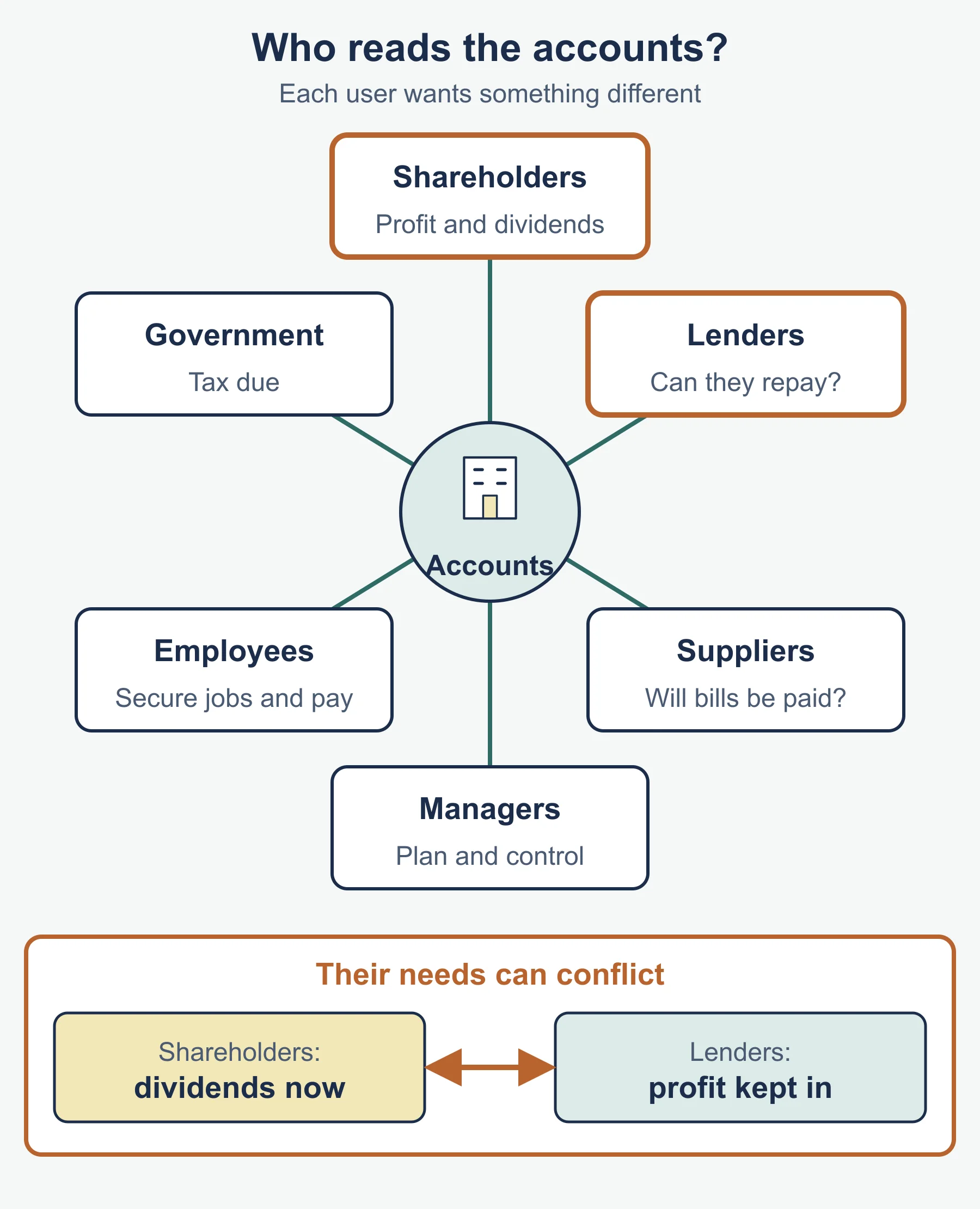
Who the users are. Users want different things from the same records.
| User | Typical question |
|---|---|
| Owner | Is the business profitable, and can I take drawings? |
| Managers | Which products earn most, and are costs under control? |
| Lender | Will the loan and interest be repaid? |
| Supplier | Will our invoices be paid on time? |
| Employees | Is the business secure enough to keep their jobs? |
| Tax authority | What profit is taxable? |
| Prospective investor | Is this a better use of my money than the alternatives? |
A rise in trade payables suits a manager who wants cheap credit, but worries a supplier waiting for payment.
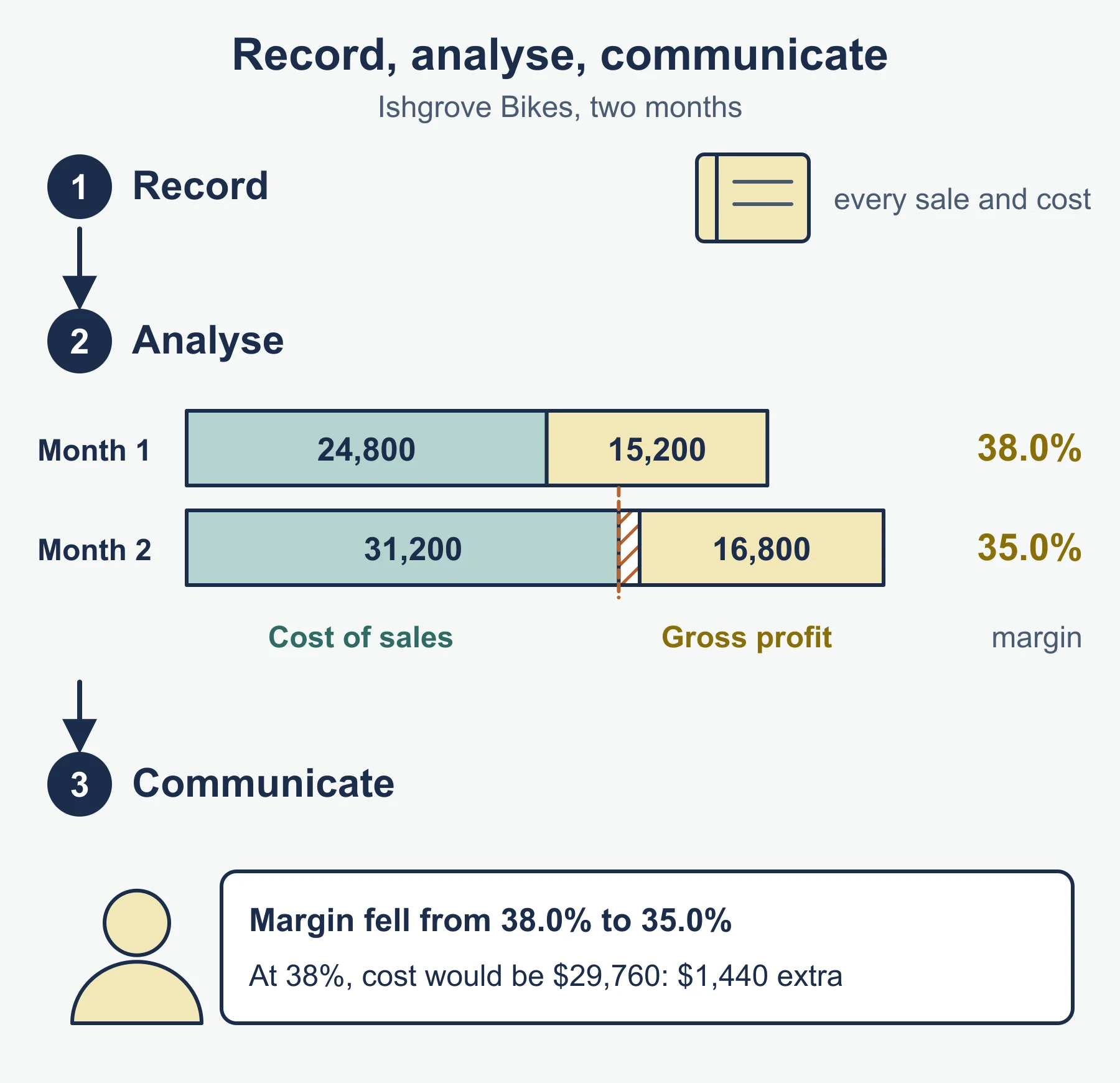
Worked example: record, analyse, communicate. Ishgrove Bikes sells repaired bicycles. For month 1 the books record revenue of 40,000 and cost of sales of 24,800. For month 2 they record 48,000 and 31,200.
| Month 1 | Month 2 | |
|---|---|---|
| Revenue | 40,000 | 48,000 |
| Cost of sales | 24,800 | 31,200 |
| Gross profit | 15,200 | 16,800 |
| Gross profit as a percentage of revenue | 38.0% | 35.0% |
Recording gave the raw figures, analysis produced gross profit and the percentage, and the table communicates them to the owner. Gross profit rose by 1,600 but the percentage fell by three points.
1.1.2 The purpose of accounting information: an aid to management
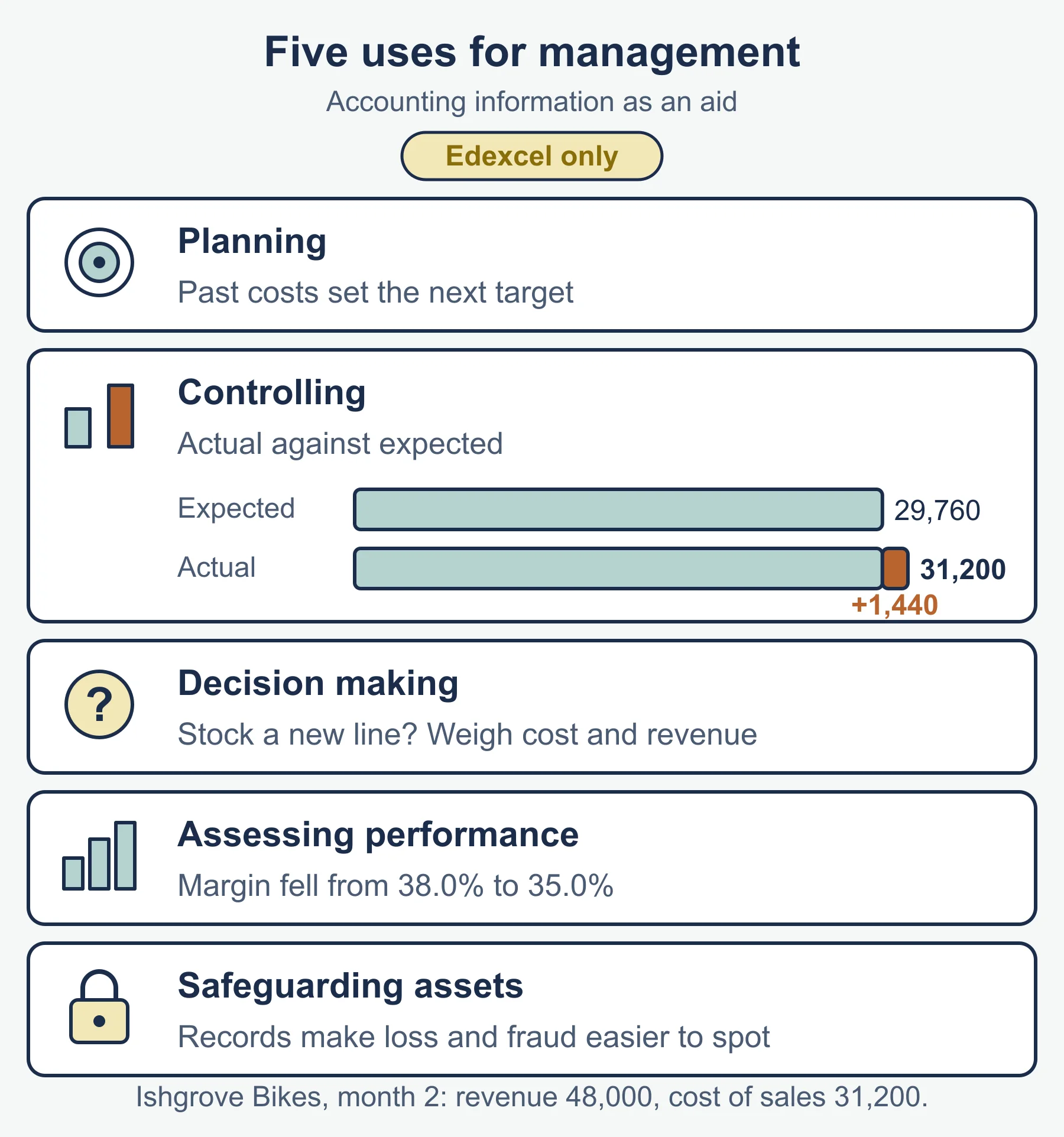
Managers use accounting information for five purposes. Tie each to a real figure.
- Planning. Past results and costs help set targets for the next period.
- Controlling. Actual results are compared with what was expected, so problems show early.
- Decision making. Choices such as whether to stock a new line rely on costs and likely revenue.
- Assessing performance. Profit, margins and returns show how well a product, a department or the whole business is doing.
- Safeguarding assets. Accurate records of inventory, receivables and cash make loss and fraud easier to spot.
Worked example: using the figures. At Ishgrove Bikes the fall from 38.0% to 35.0% needs explaining. Had month 2 kept the 38% margin, cost of sales would have been 48,000 x 0.62 = 29,760. Actual cost of sales was 31,200, so 1,440 more was spent on bikes and parts than the earlier margin predicts. The manager can now ask pointed questions: did parts prices rise, were discounts given, or was inventory wasted? Without the analysis the extra cost would sit unnoticed inside a rising revenue figure.
1.1.8 Going concern, prudence, accruals and consistency
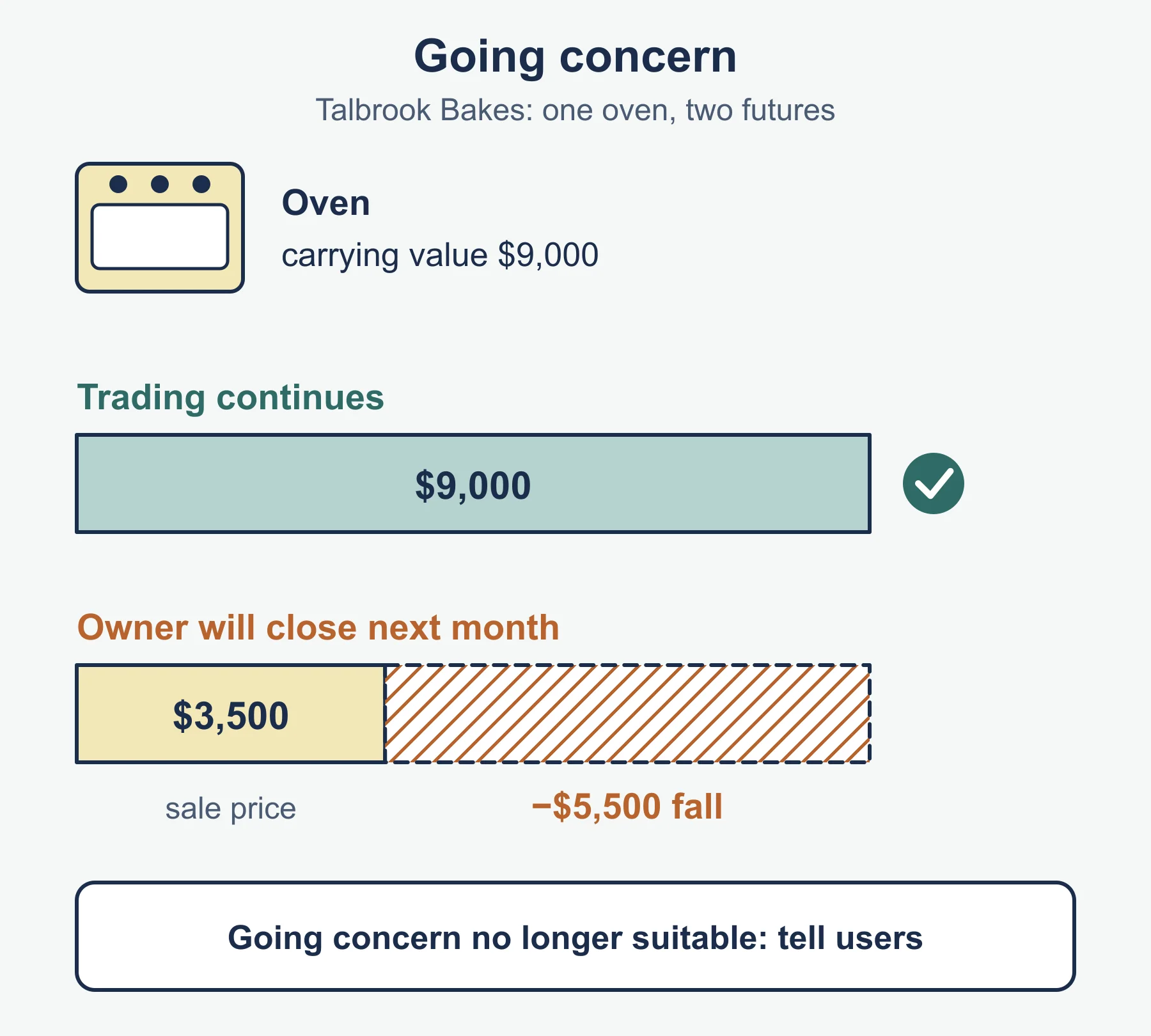
Going concern. Financial statements are prepared on the basis that the business will continue trading for the foreseeable future. Test: is there any plan or pressure to close? Because the business is expected to carry on, assets are kept at their carrying value and costs such as depreciation are spread over the asset’s life.
Worked example. Talbrook Bakes has an oven with a carrying value of 9,000. If trading continues, the oven stays in the statement of financial position at 9,000. If the owner has decided to close next month and the oven would sell for 3,500, a going concern basis is no longer suitable. The fall is 9,000 - 3,500 = 5,500, and users must be told.
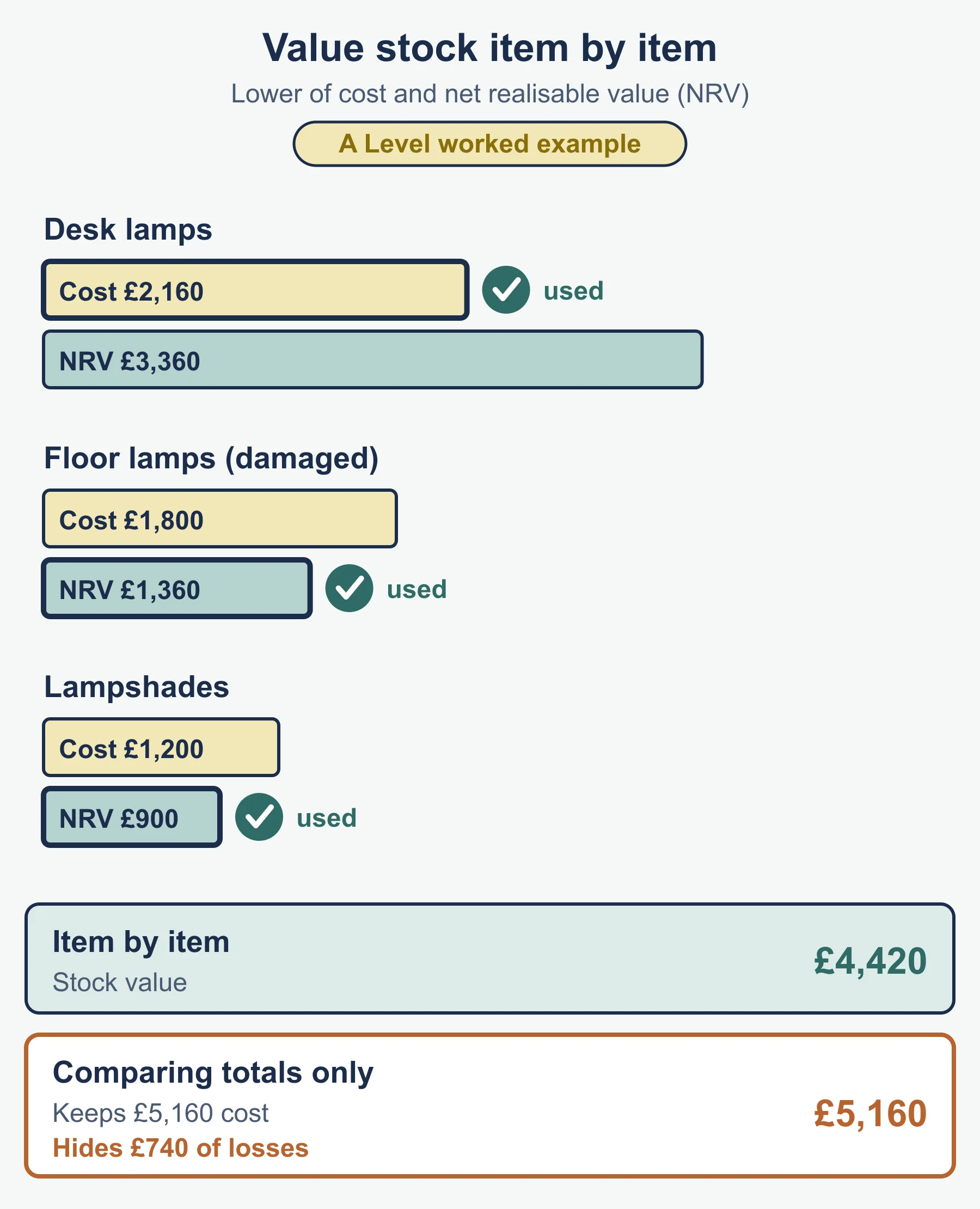
Prudence. Do not overstate assets or income, and do not understate liabilities or expenses. Where judgement is needed, choose the figure that gives the lower profit or lower asset value, but do not deliberately understate (that would be unfair to users in the other direction). Test: is there doubt over a gain or a loss? Include the likely loss now, wait for gains until they are certain.
Worked example. Orlow Games holds two inventory lines at the year end.
| Line | Units | Cost per unit | Selling price | Cost to sell | NRV per unit | Lower of cost and NRV | Value |
|---|---|---|---|---|---|---|---|
| Boxed games | 120 | 15 | 20 | 6 repackaging | 14 | 14 | 1,680 |
| Card games | 80 | 9 | 13 | 0 | 13 | 9 | 720 |
Net realisable value (NRV) is the selling price less costs of completing the sale. Boxed games at cost would be 1,800, so the prudent value is 120 lower. Card games stay at cost, because a gain on them is not recognised until they are sold. Total inventory is 2,400, against a total cost of 2,520, and profit for the year falls by 120.
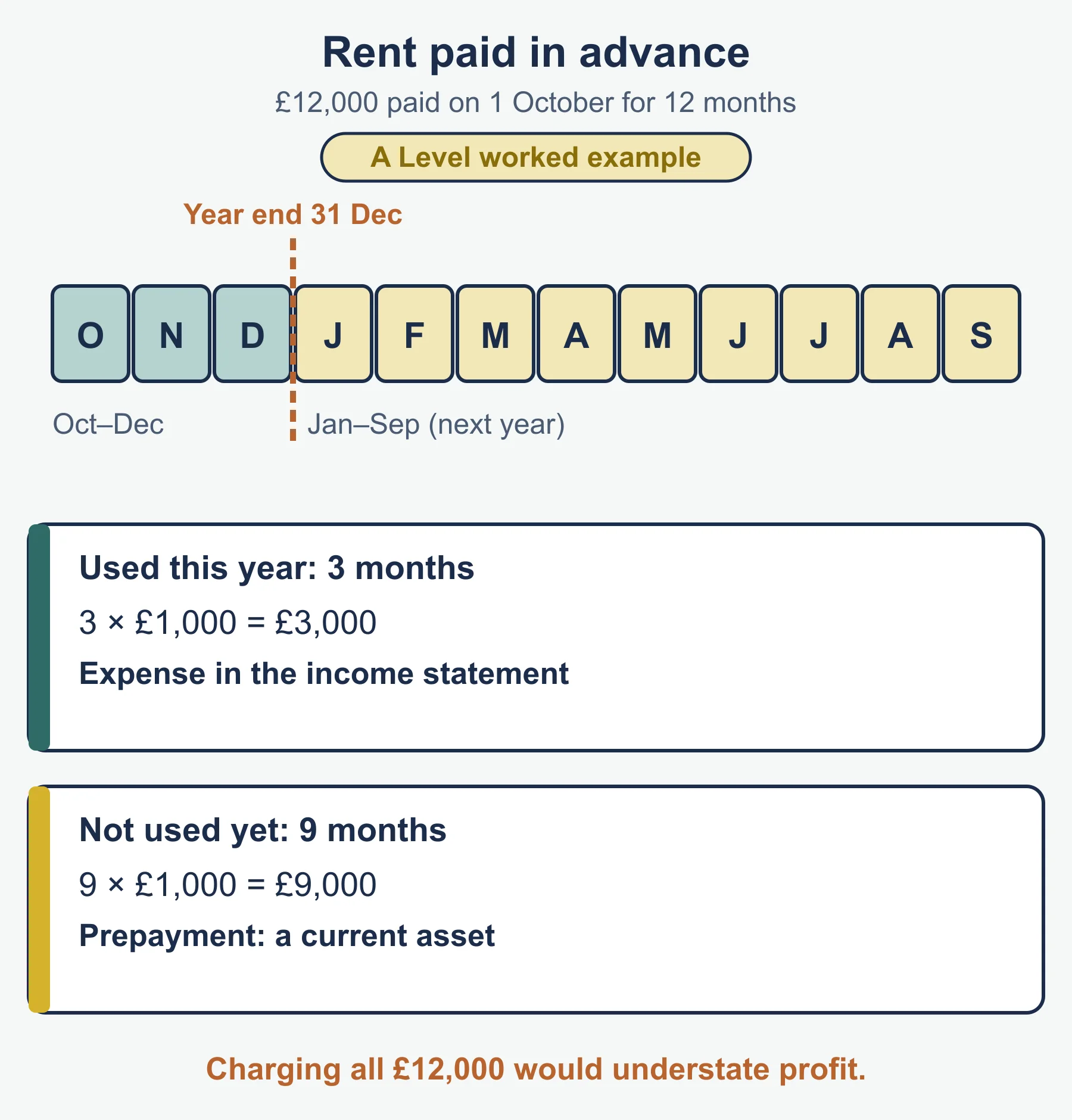
Accruals. Income and costs belong in the period that earns or uses them, whenever the cash happens to change hands. Test: does the cash payment fall in a different period from the benefit? Then adjust.
Worked example. On 1 November Talbrook Bakes pays 3,600 for twelve months of rent. The year ends on 31 December.
Monthly rent        3,600 / 12     = 300
Used by 31 Dec      2 months x 300 = 600   -> expense in this year
Not yet used        3,600 - 600    = 3,000 -> prepayment (other receivables)
A December electricity bill of 340 arrives in January. The electricity was used in December, so 340 is an expense of this year and an accrued expense (other payables) at the year end.
Consistency. Use the same accounting policies from period to period, so results can be compared. A change is allowed when there is good reason, but its effect must be disclosed.
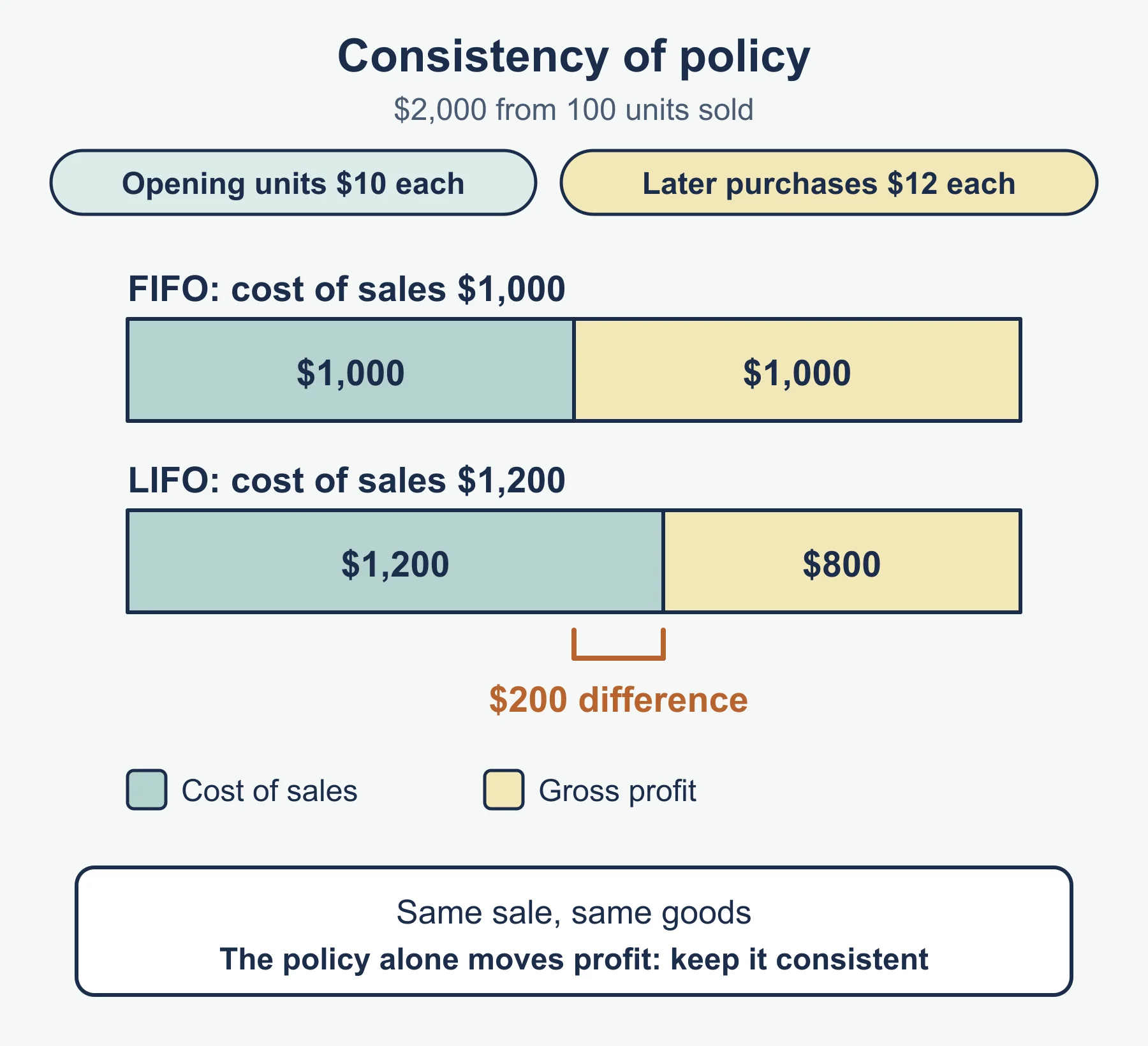
Worked example. A trader sells 100 units for 2,000. Opening units cost 10 each and later purchases cost 12 each. FIFO gives cost of sales 1,000 and gross profit 1,000. LIFO gives 1,200 and 800. The 200 difference comes from the policy alone, so the policy should not flip without reason.
1.1.9 Historic cost, materiality, money measurement, realisation, business entity
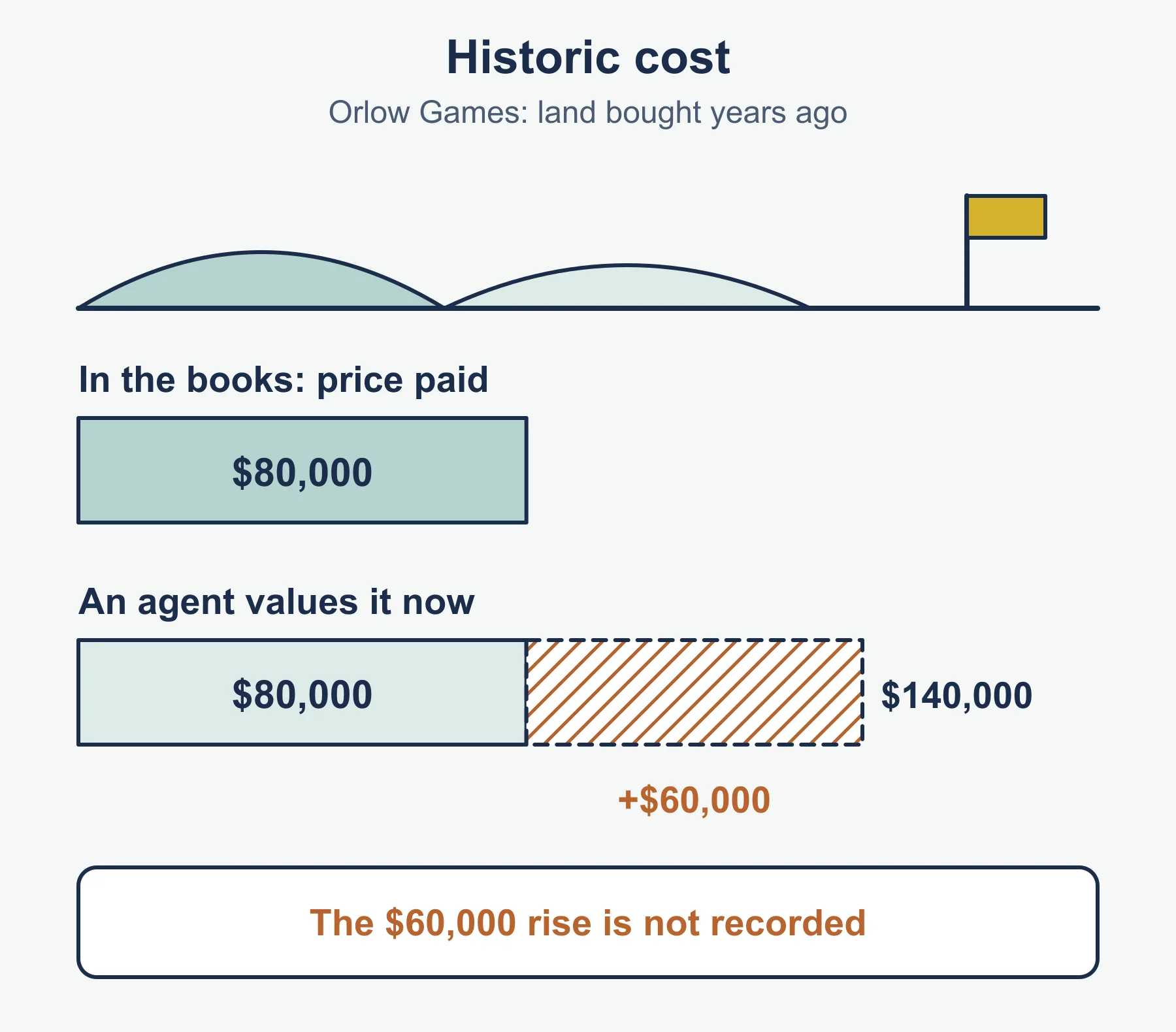
Historic cost. Assets are recorded at what was paid for them, not at current market value. This is objective and checkable from an invoice, but in a period of rising prices it can understate asset values.
Worked example. Orlow Games bought land for 80,000 years ago and an agent now values it at 140,000. Under historic cost the record shows 80,000, so the 60,000 rise does not appear. A user comparing this business with one that bought similar land last year should bear that in mind.
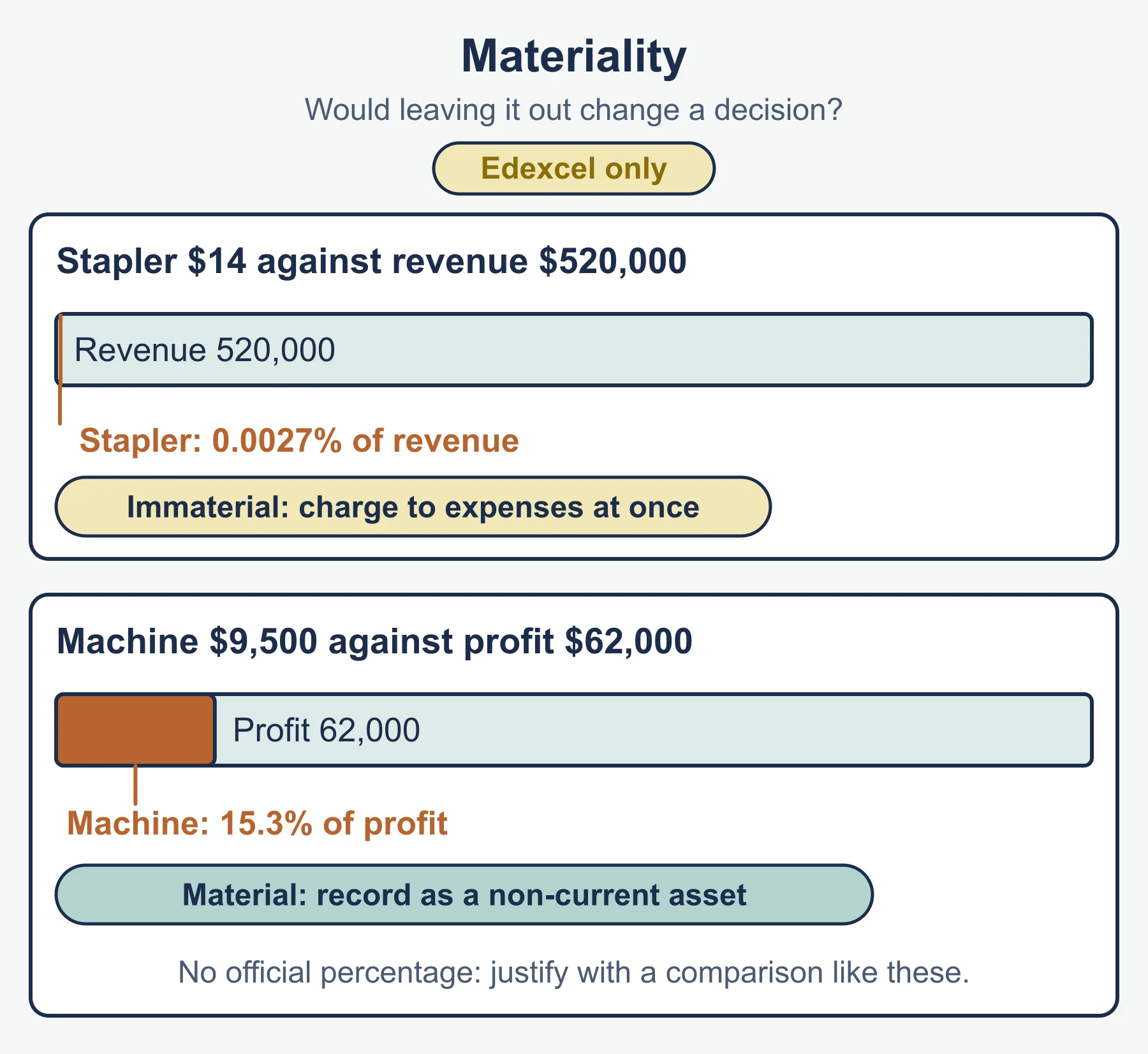
Materiality. A figure is material if a user might decide differently because it was left out or wrong. Small items can be treated in the simplest way.
Worked example. Ishgrove Bikes (revenue 520,000) buys a stapler for 14. The stapler lasts for years, but 14 is 0.0027% of revenue, so it is charged to expenses at once. A machine costing 9,500 against a profit for the year of 62,000 is 15.3% of profit, which is material and is recorded as a non-current asset. There is no single official percentage in this specification, so justify your judgement with a comparison like these.
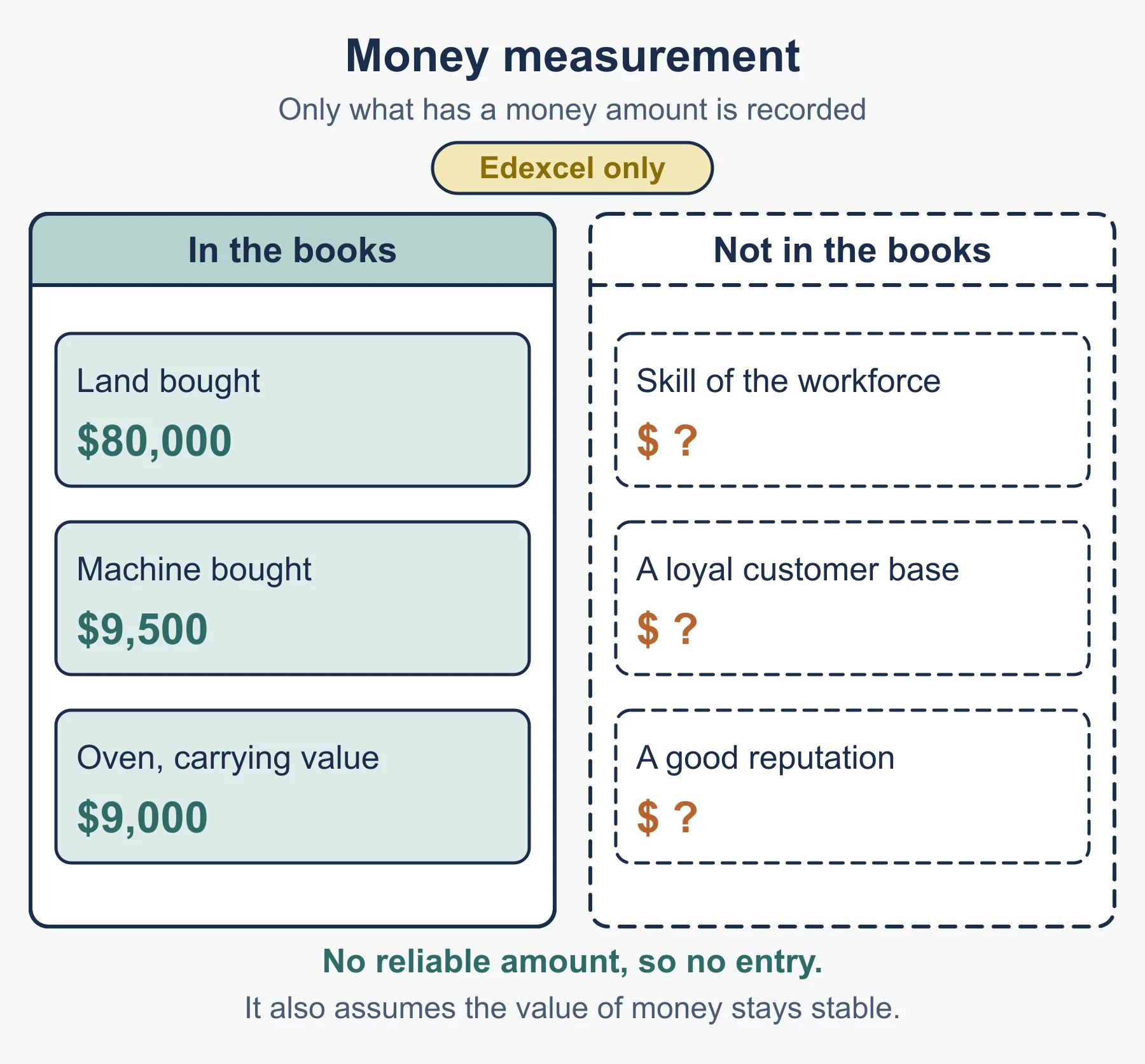
Money measurement. Only items that can be expressed in money are recorded. The skill of the workforce, a loyal customer base or a good reputation are not in the books because no reliable amount can be placed on them. Money measurement also assumes the value of money is stable, which limits comparisons over long periods.
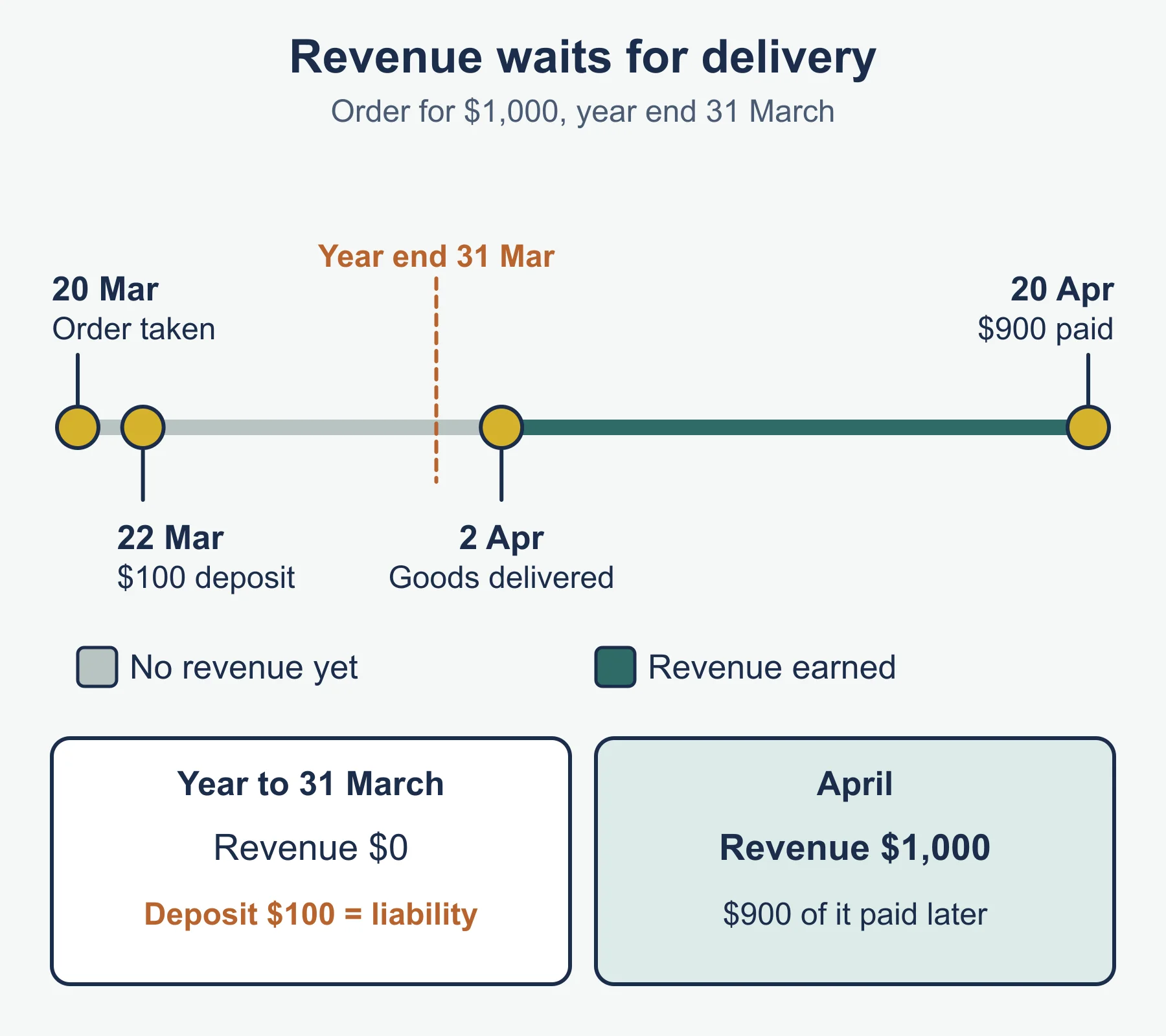
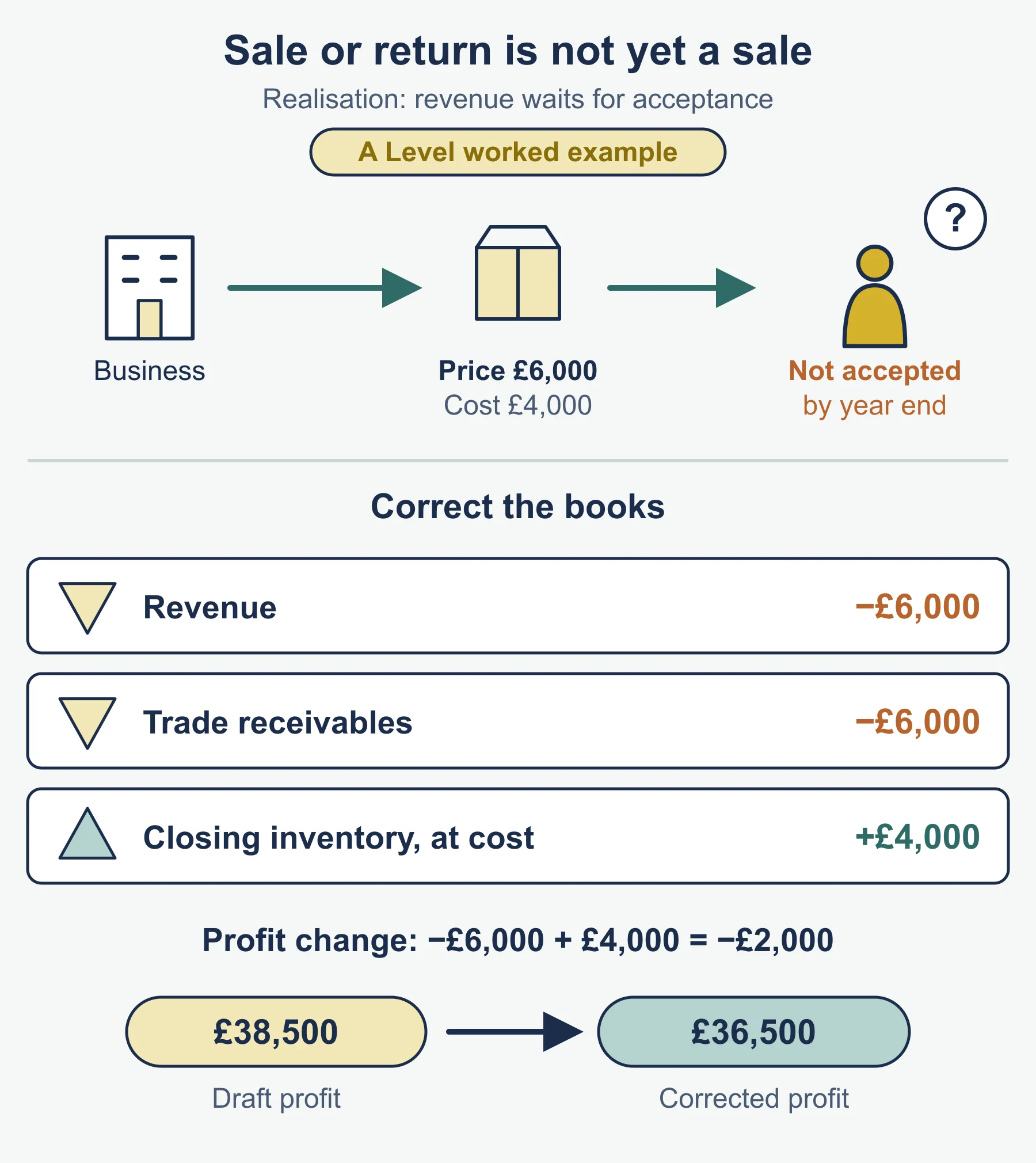
Realisation. Revenue is recognised when the goods or services are provided to the customer and the right to payment arises, not when the order is placed or cash is received.
Worked example. Orlow Games takes an order on 20 March for goods priced at 1,000 and receives a deposit of 100 on 22 March. The games are delivered on 2 April and the balance is paid on 20 April. With a year end of 31 March, no revenue is recognised in the year just ended. The 100 deposit is a liability (money held for goods not yet supplied). The 1,000 is revenue in April, even though 900 is received only on 20 April.
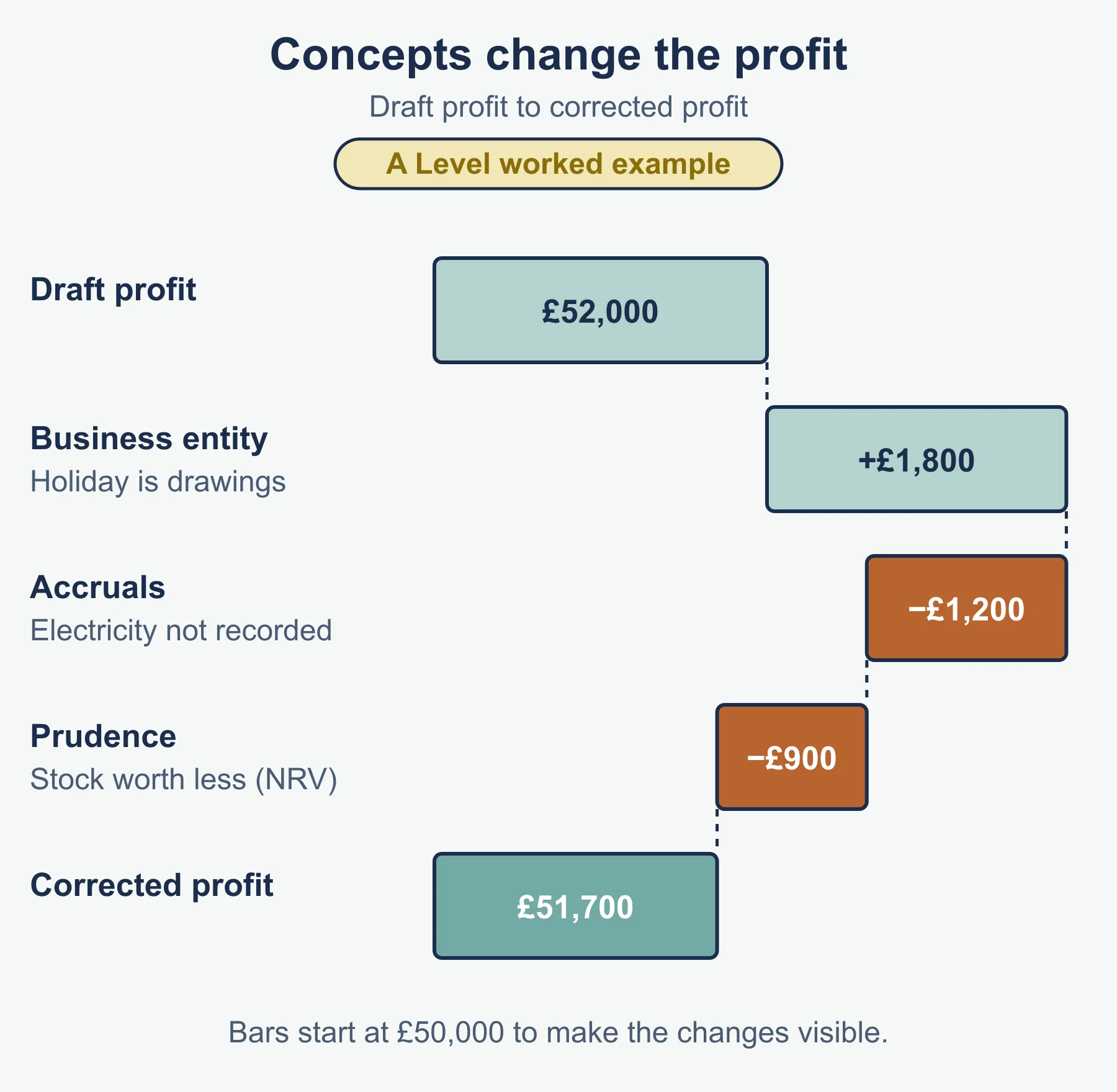
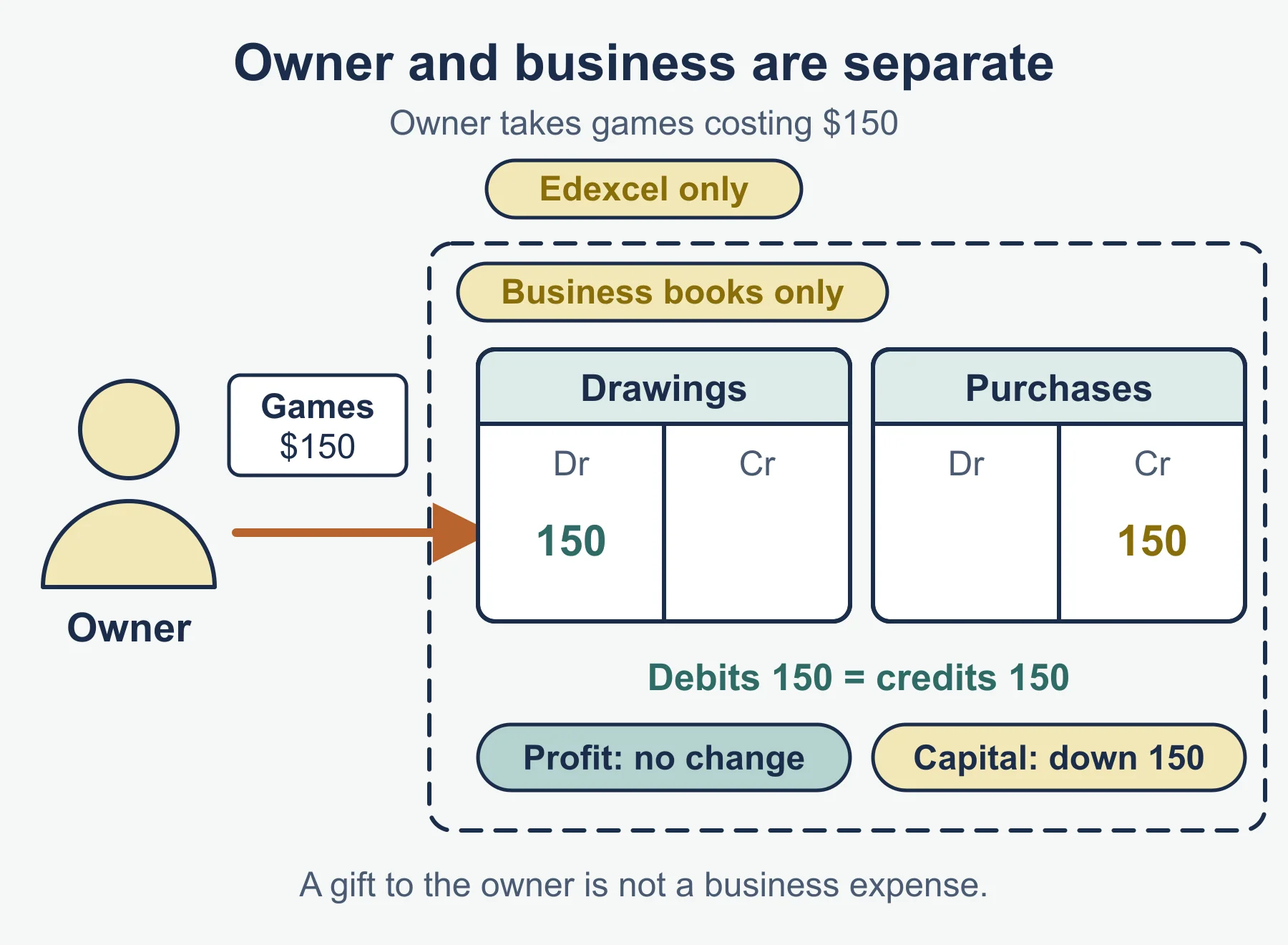
Business entity. The owner and the business count as two distinct parties, and the business books hold business dealings only. When the owner takes goods for personal use, it is not an expense of the business.
Worked example. The owner of Orlow Games takes games that cost 150 as a gift. Debit drawings 150, credit purchases 150. Profit is unaffected by the withdrawal, but capital falls by 150.
1.1.10 International Accounting Standards (IAS)
IAS are a set of agreed rules on how transactions are recognised, measured and presented. They were originally issued by the International Accounting Standards Committee, and the body that now sets standards, the IASB, adopted them. Using them gives businesses a shared approach.
- Comparability. Two businesses applying the same rules can be compared by an investor or lender, even across countries.
- Reliability and trust. Users can see that statements follow recognised rules, not just the preparer’s own choices.
- Less scope for manipulation. Fixed rules on matters such as inventory valuation limit the room for flattering the figures.
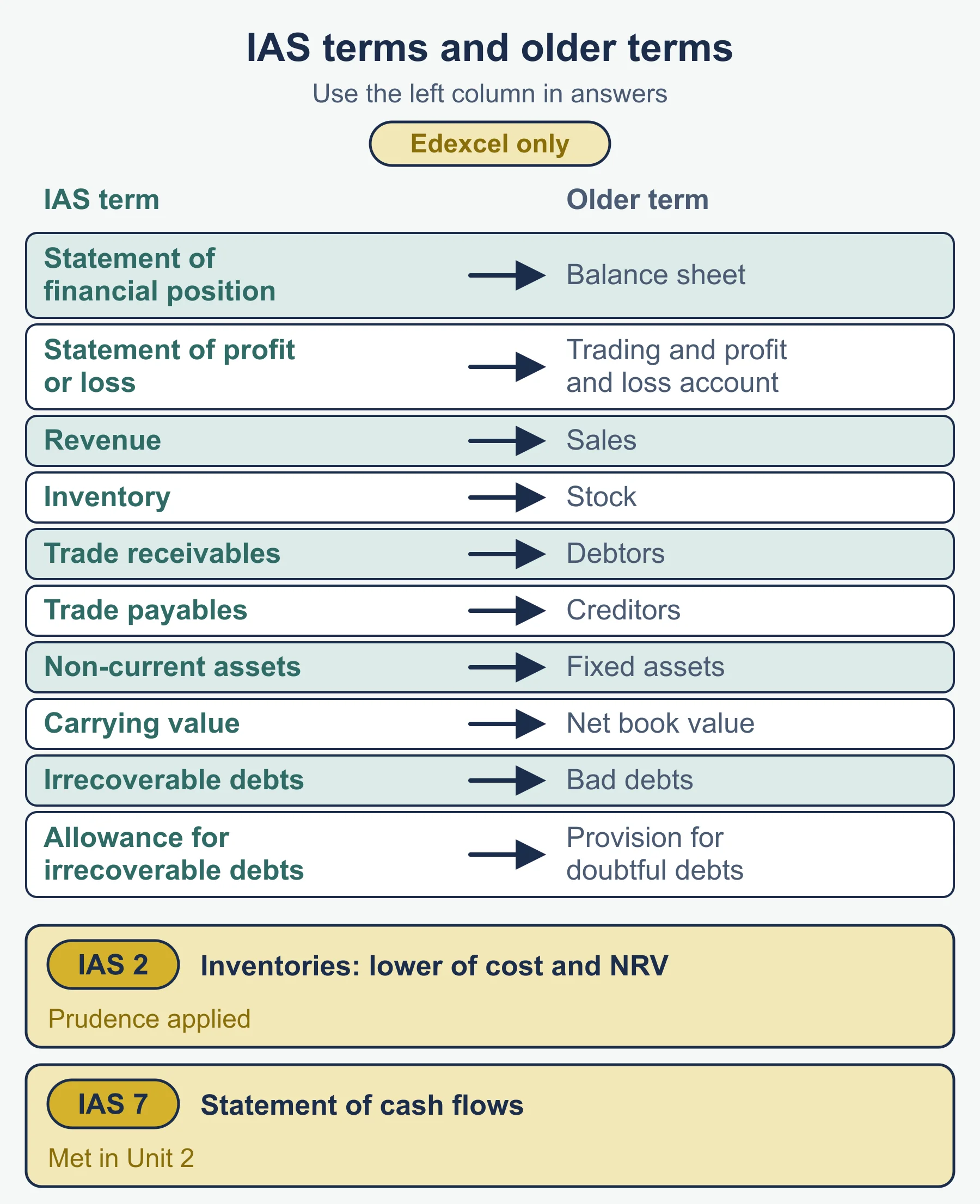
The specification states that “Examiners will use the IAS terms throughout Unit 1 and Unit 2”. Learn these pairs.
| IAS term | Older term |
|---|---|
| Statement of financial position | Balance sheet |
| Statement of profit or loss | Trading and profit and loss account |
| Revenue | Sales |
| Inventory | Stock |
| Trade receivables | Debtors |
| Trade payables | Creditors |
| Non-current assets | Fixed assets |
| Carrying value | Net book value |
| Irrecoverable debts | Bad debts |
| Allowance for irrecoverable debts | Provision for doubtful debts |
Two specific standards link directly to concepts here. IAS 2 deals with inventories and requires the lower of cost and net realisable value, which is prudence applied. IAS 7 deals with the statement of cash flows, which you meet in Unit 2.
Common errors
- Writing “accounting records transactions” and stopping. The role is record, analyse and communicate.
- Naming users without saying what each wants to know.
- Using prudence to justify deliberately low profit. It stops overstatement; it does not allow understatement.
- Confusing accruals with realisation. Accruals matches expenses to the period; realisation says when revenue is earned.
- Saying historic cost means current value minus depreciation. It means original price paid.
- Treating a deposit as revenue. Until goods are supplied, it is a liability.
- Using older terms such as stock or debtors.
Frequently asked questions
What is the role of accounting in Edexcel IAL Accounting? The role of accounting is to record, analyse and communicate financial information. Transactions are recorded in money terms, sorted and summarised, then presented as financial statements and reports that users can act on.
What is the difference between accruals and realisation? Accruals matches income and expenses to the period that earns or uses them, whenever cash changes hands. Realisation says when revenue is earned: when goods or services are provided and the right to payment arises, not when an order is placed or cash is received.
Does prudence mean understating profit? No. Prudence means not overstating assets or income and not understating liabilities or expenses; where judgement is needed, the lower figure is chosen. It does not allow profit to be deliberately understated.
What is historic cost in accounting? Historic cost means assets are recorded at the price originally paid, not at current market value. It is objective and checkable from an invoice, but in a period of rising prices it can understate asset values.
Why are International Accounting Standards used? IAS give businesses a shared set of rules on how transactions are recognised, measured and presented. This improves comparability between businesses, builds trust in the statements and limits the scope for manipulating the figures.
Official syllabus
Pearson Edexcel International Advanced Subsidiary/Advanced Level in Accounting (XAC11/YAC11) specification, Issue 2, September 2018, published by Pearson Education Limited.
Get free revision emails (optional)
Occasional emails with practice questions, worked explanations and links to free resources for the qualification and subjects you choose. No spam, and you can unsubscribe from any email. The free tools on this site never need an email.
Related resources
-
Practice questions
Edexcel International A Level Accounting: Role and purpose, concepts and conventions (YAC11) – Practice Questions
Original practice questions with worked answers on the role of accounting, accounting concepts and conventions and IAS for Edexcel IAL Accounting.
Accounting · Pearson Edexcel · AS Level
Try questions -
Revision notes
Edexcel International A Level Accounting: Role and purpose, concepts and conventions (YAC11) – Revision Notes
Condensed recall notes for Edexcel IAL Accounting 1.1.1-1.1.2 and 1.1.8-1.1.10: role of accounting, nine concepts, IAS terms and a self-test.
Accounting · Pearson Edexcel · AS Level
Revise topic -
Study guides
Edexcel International A Level Accounting: Principles and Double Entry Bookkeeping (YAC11)
Purpose of accounting, double entry, accounting concepts, capital versus revenue spending and depreciation: Topic 1 of Edexcel IAL Accounting (YAC11), Unit 1.
Accounting · Pearson Edexcel · AS Level
Read guide
Related articles
-
teaching
A Level tuition in Dubai: Cambridge or Pearson Edexcel International A Level?
Schools in Dubai and Abu Dhabi teach either Cambridge International AS & A Level or Pearson Edexcel International A Level. How the two are structured, why it matters for tuition, and how online classes from Lahore work.
9 October 2026
-
curriculum guides
Choosing subjects at IGCSE and A Level
How subject choices at 14 and 16 affect university options later, and how to keep pathways open without overloading a timetable.
28 July 2026
Studying this with a teacher
Working through Accounting AS LEVEL?
This page is free and stays free. If you would rather be taught it, Marlbridge runs Accounting classes one-to-one and in small groups of up to 15, online in your own time zone. The first trial class is free. WhatsApp replies within an hour (8am–11pm Pakistan time, every day); email the same day.
Pearson Edexcel Accounting teachers at Marlbridge

