
Study Guides
Edexcel International A Level Accounting: The trial balance and correction of errors (YAC11)
Study guide to the Edexcel IAL Accounting trial balance, its limits, error types, journals, suspense account, revised profit and control account fixes.
- Subject
- Accounting
- Level
- AS LEVEL
- Topic
- Control procedures
- Author
- Marlbridge Academic Team
- Updated
- Reviewed by
- Javaid Iqbal Sabri (what this means)
Aligned to Pearson Edexcel A Level Accounting (YAC11), 2015-onwards. Official specification .
Syllabus page (what it covers and how it is assessed): Pearson Edexcel A Level Accounting.
Syllabus points this page covers
YAC11 (AS Level)
- 1.2.1-1.2.2 Trial balance
- 1.2.5-1.2.9 Correction of errors
Found an error? Report a correction.
Need help with this topic? Request a free trial class for A Level Accounting (YAC11).
This guide teaches the trial balance and the correction of errors from Unit 1: The Accounting System and Costing in the Pearson Edexcel International Advanced Subsidiary/Advanced Level in Accounting (XAC11/YAC11) specification, Issue 2 (September 2018). It covers outcomes 1.2.1 and 1.2.2 (trial balance) and 1.2.5 to 1.2.9 (correction of errors), all International AS content. All amounts are in dollars.
Pair it with the revision notes and the practice questions. Building a control account from scratch (1.2.3 and 1.2.4) is in the control accounts guide; double entry is in topic 1.1. See also the Edexcel A-Level Accounting hub, the printable checklist and the free diagnostics.
What this topic covers
| Outcome | What you must be able to do |
|---|---|
| 1.2.1 | Prepare a trial balance from ledger balances |
| 1.2.2 | Explain the limitations of a trial balance |
| 1.2.5 | Identify errors that do and do not affect its balancing |
| 1.2.6 | Write journal entries to correct errors |
| 1.2.7 | Use a suspense account |
| 1.2.8 | Prepare a statement of revised profit |
| 1.2.9 | Correct errors in control accounts |
The specification does not name the error types. The names below (omission, commission and so on) are the usual ones, so describe the error in words as well.
1.2.1 Preparing a trial balance
A trial balance is a list of every ledger balance at one date, in a debit column and a credit column. Under double entry every transaction has an equal debit and credit, so the two totals should agree. Agreement is a check on arithmetic, not a proof of correctness.
Balance each account first: total both sides, put the difference on the smaller side as “balance carried down”, then show it on the opposite side as “balance brought down”. The side of the brought-down balance decides the column.
| Debit column | Credit column |
|---|---|
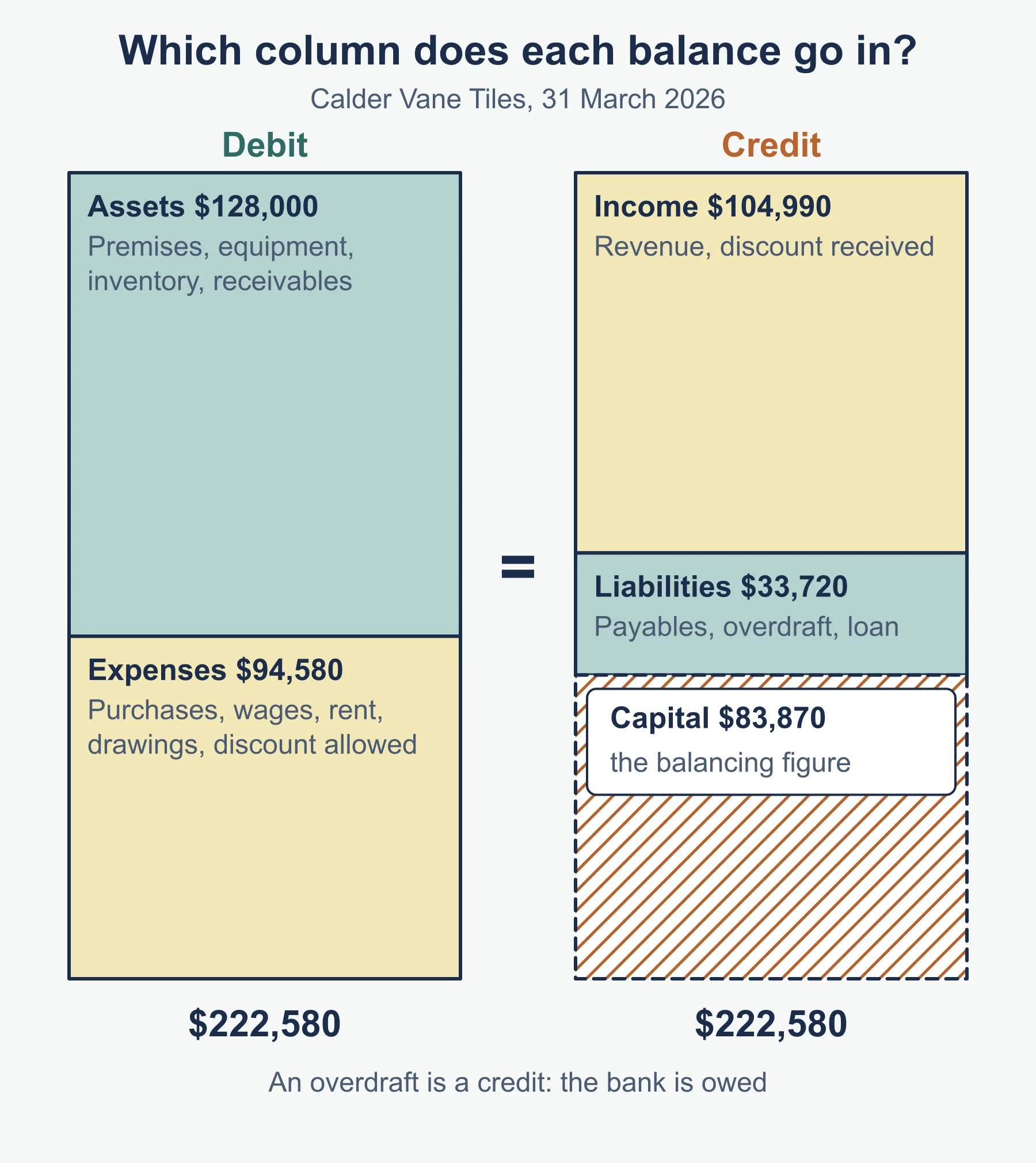
| Assets (non-current assets, inventory, trade receivables, a positive bank balance) | Liabilities (trade payables, loans, bank overdraft) |
| Expenses, purchases, drawings | Revenue and other income, capital |
| Discount allowed | Discount received |
Worked example. Calder Vane Tiles’ ledger balances at 31 March 2026. Capital is the balancing figure given to you.
| Account | Debit | Credit |
|---|---|---|
| Premises | 96,000 | |
| Equipment | 14,400 | |
| Inventory at 1 April 2025 | 7,850 | |
| Purchases | 58,200 | |
| Wages | 19,300 | |
| Rent and rates | 5,600 | |
| Trade receivables | 9,750 | |
| Drawings | 11,000 | |
| Discount allowed | 480 | |
| Revenue | 104,600 | |
| Trade payables | 6,420 | |
| Bank overdraft | 2,300 | |
| Bank loan | 25,000 | |
| Discount received | 390 | |
| Capital | 83,870 | |
| Totals | 222,580 | 222,580 |
The overdraft is a credit because the bank is owed money. Debits are 222,580 and credits before capital are 138,710, so capital is 83,870.
1.2.2 Limitations of a trial balance
An agreeing trial balance does not show that the books are right. It cannot reveal an error that puts equal amounts on both sides, nor errors that cancel each other. It also does not show profit or the financial position: you still need a statement of profit or loss and a statement of financial position.
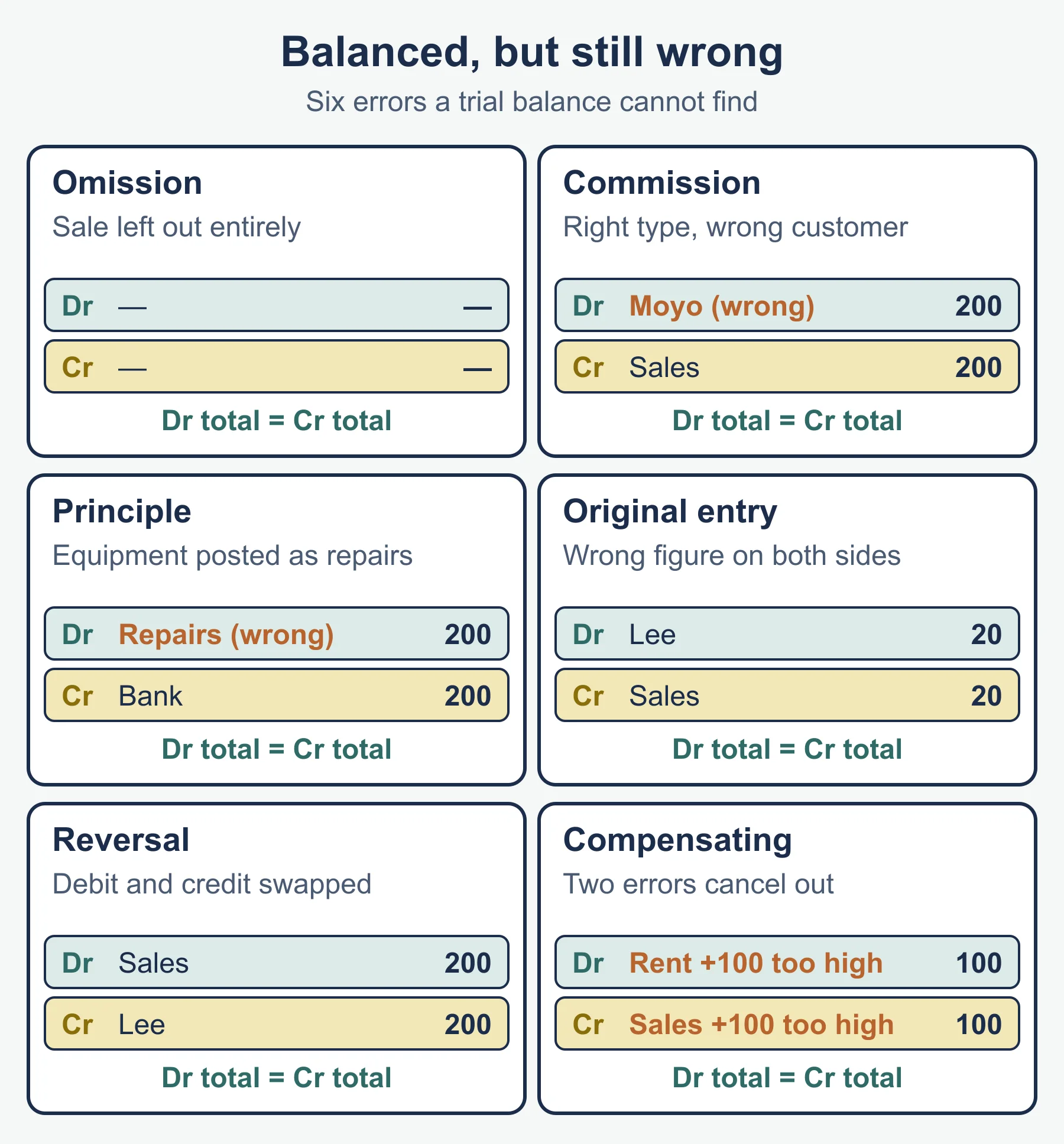
A compensating error is two or more errors that offset. Example: Weldon Hardware’s purchases account is under-added by 600 (debit too low) and its revenue account is under-added by 600 (credit too low). Both totals fall by 600, so the trial balance still agrees.
1.2.5 Errors that do and do not affect balancing
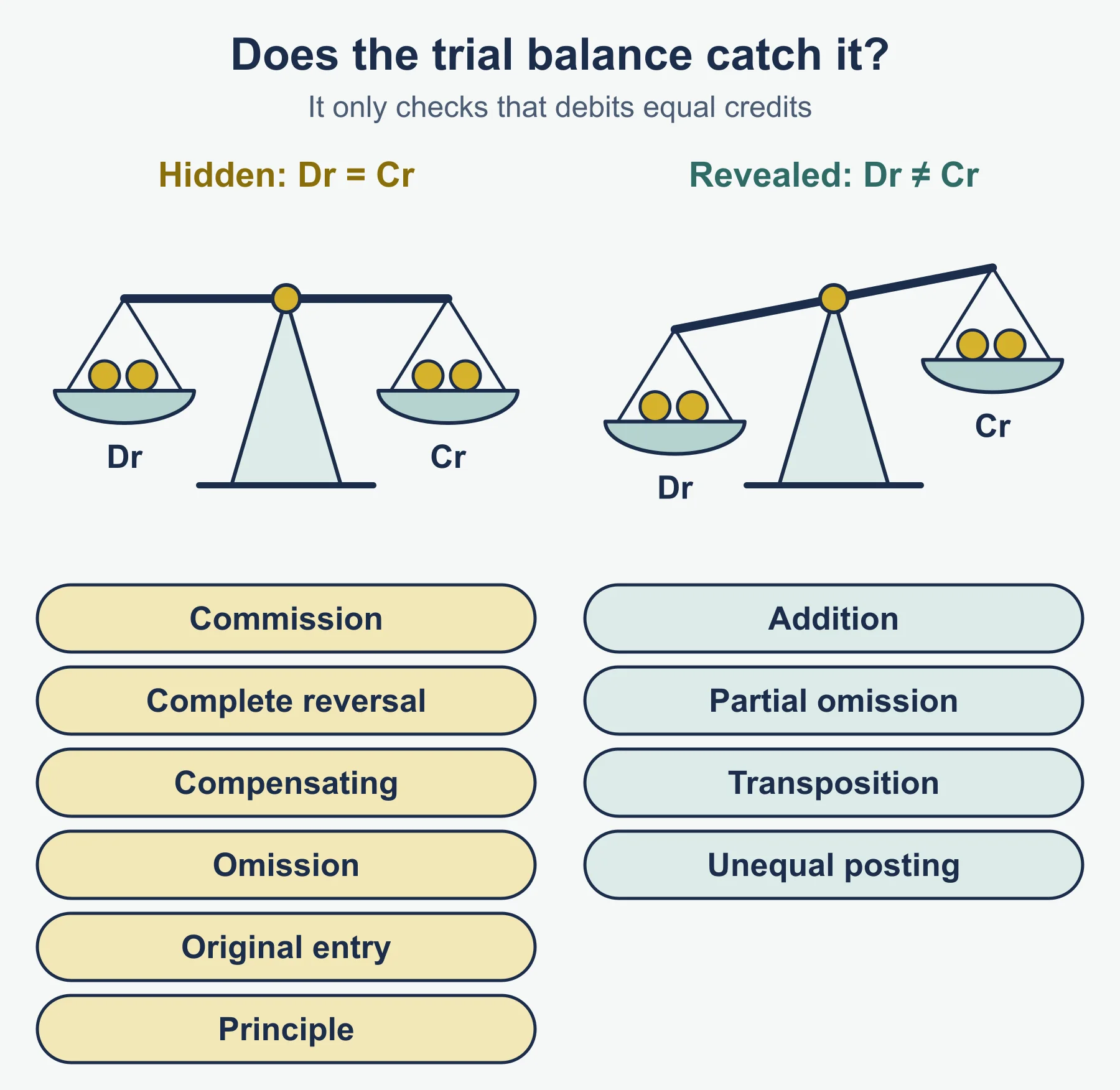
Errors that leave the trial balance agreeing (the debit and credit totals stay equal):
| Error | Weldon Hardware example |
|---|---|
| Omission | A credit sale of 2,400 to Hale Garage is never recorded |
| Commission | A payment of 760 to Dobbin Ltd is debited to the account of Dobbin Stores |
| Principle | The owner’s holiday of 1,500 is debited to travel expenses instead of drawings |
| Original entry | An invoice for 1,845 is recorded as 1,485 on both sides |
| Complete reversal | A cash receipt from Orwin of 2,000 is debited to Orwin and credited to bank |
| Compensating | Two equal and opposite errors, as above |
Errors that make it disagree:
| Error | Effect |
|---|---|
| One-sided entry (only the debit or only the credit posted) | Totals differ by that amount |
| Different amounts posted to each side (1,200 debit, 1,020 credit) | Difference 180 |
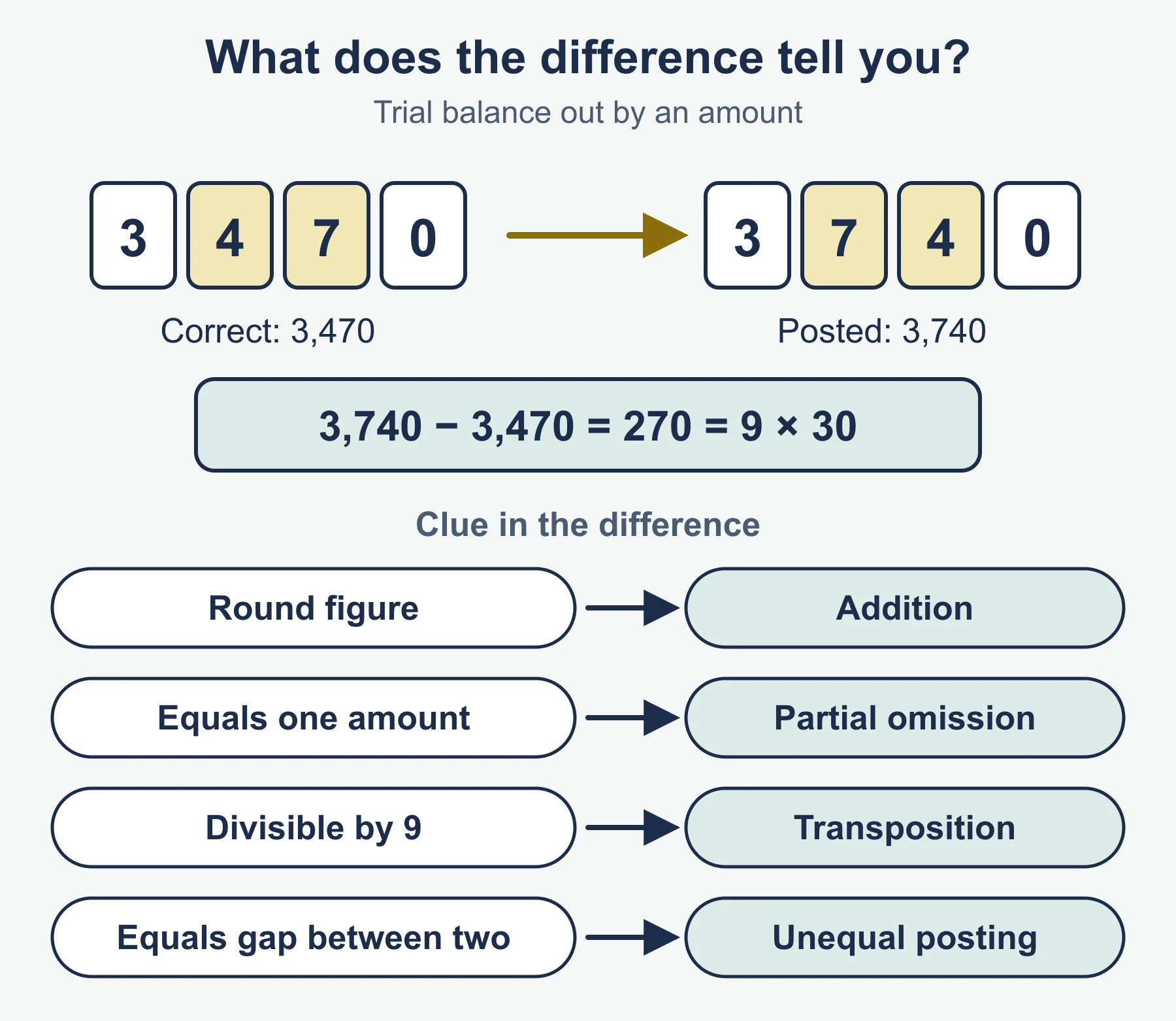
| Transposition on one side (4,350 posted as 4,530) | Difference 180, always divisible by 9 |
| Casting error (a column added up wrongly) | Totals differ by the addition error |
| Balance left out, or put in the wrong column | Totals differ by the balance, or twice it |
A difference divisible by 9 suggests a transposition, but it is only a clue. Other errors can also give such a difference.
Hunting a difference. Check the addition of the trial balance, then look for a posting equal to the difference, then for one equal to half of it (a balance on the wrong side), then test for division by 9, and finally check that every ledger balance was listed.
1.2.6 Journal entries to correct errors
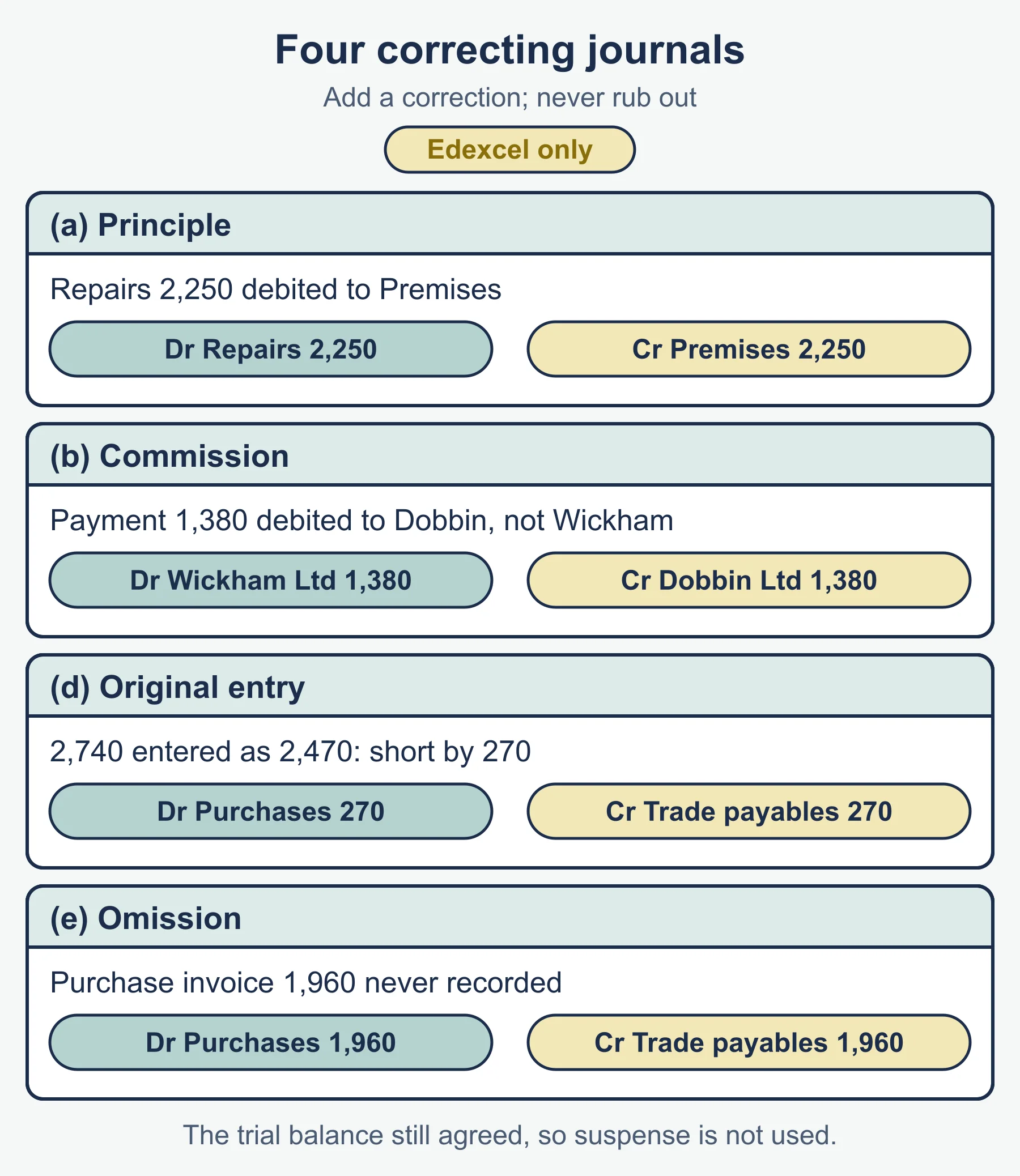
A correcting journal states the account debited, the account credited, the amount and a narrative. Work out what was posted, what should have been posted, and the difference. Never “rub out” the original: add a correction.
Weldon Hardware, five corrections:
(a) Principle. Repairs of 2,250 were debited to Premises.
    Dr Repairs                      2,250
        Cr Premises                         2,250

(b) Commission. Payment of 1,380 to Wickham Ltd was debited
    to Dobbin Ltd.
    Dr Wickham Ltd (trade payable)  1,380
        Cr Dobbin Ltd (trade payable)       1,380

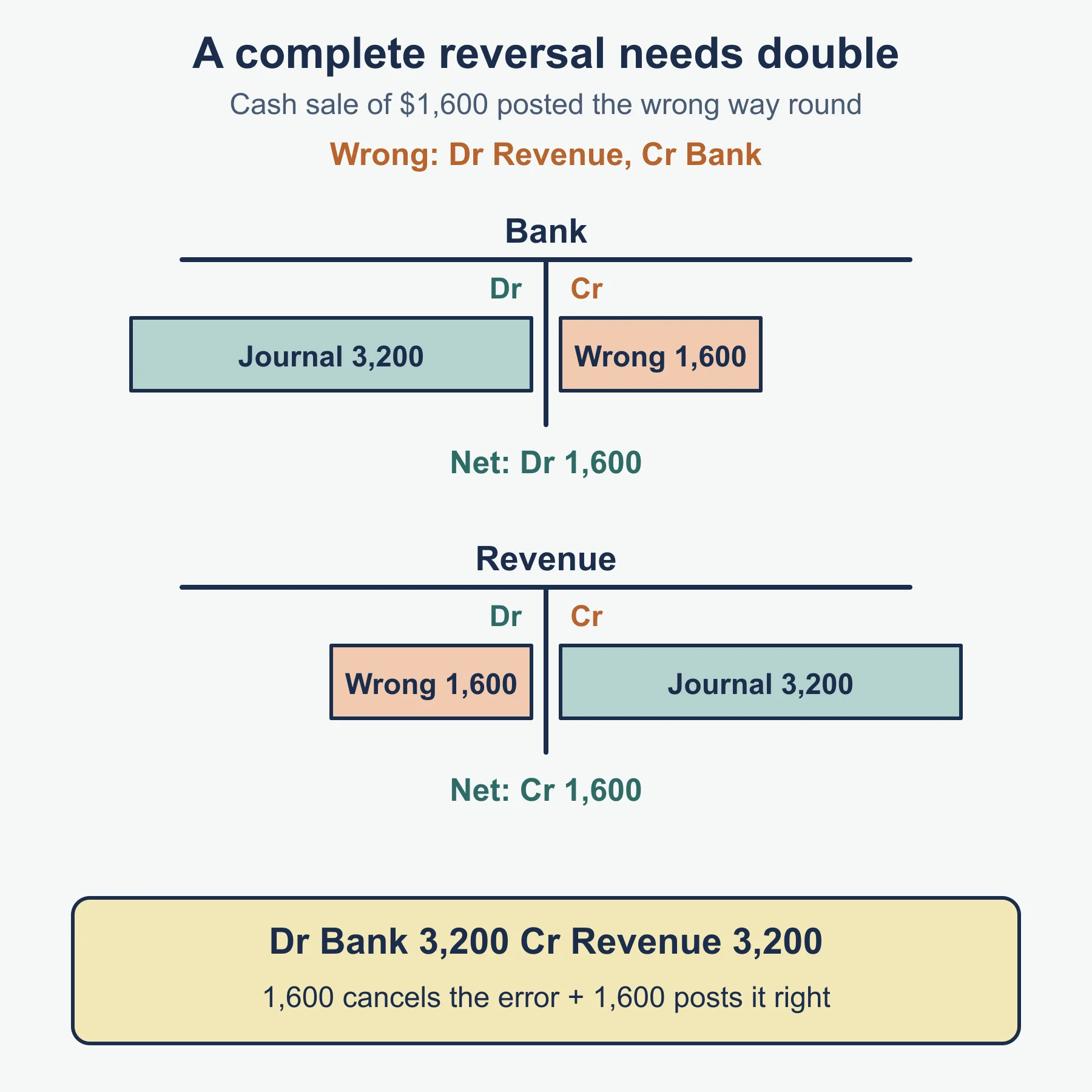
(c) Complete reversal. A cash sale of 1,600 was debited to
    Revenue and credited to Bank.
    Dr Bank                         3,200
        Cr Revenue                          3,200

(d) Original entry. An invoice for 2,740 was entered as 2,470
    on both sides.
    Dr Purchases                      270
        Cr Trade payables                     270

(e) Omission. A purchase invoice of 1,960 was never recorded.
    Dr Purchases                    1,960
        Cr Trade payables                   1,960
In (c) the amount is doubled: removing the wrong entry needs 1,600 and posting the right one needs another 1,600. A trial balance that disagrees is not corrected with a journal alone: it needs the suspense account.
1.2.7 The suspense account
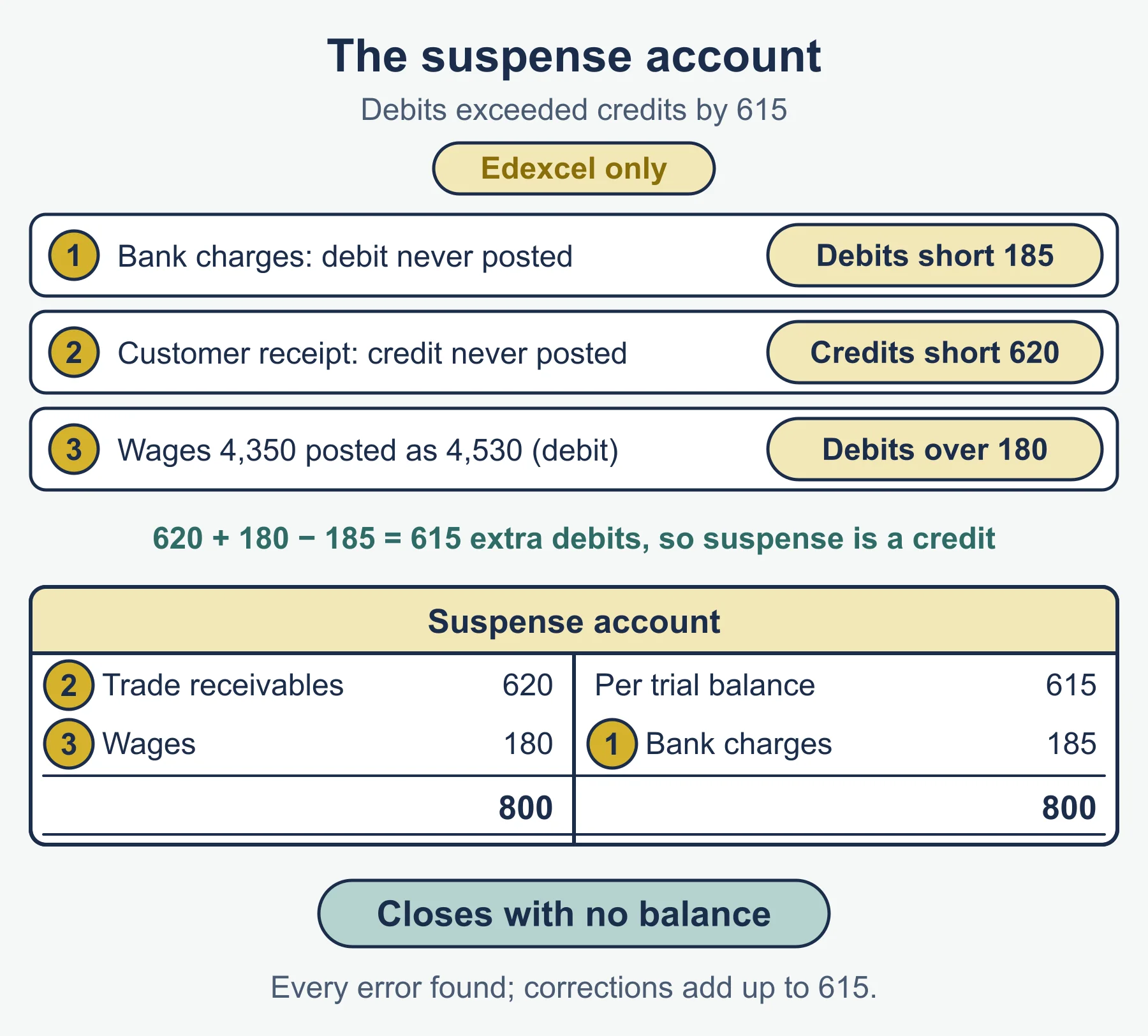
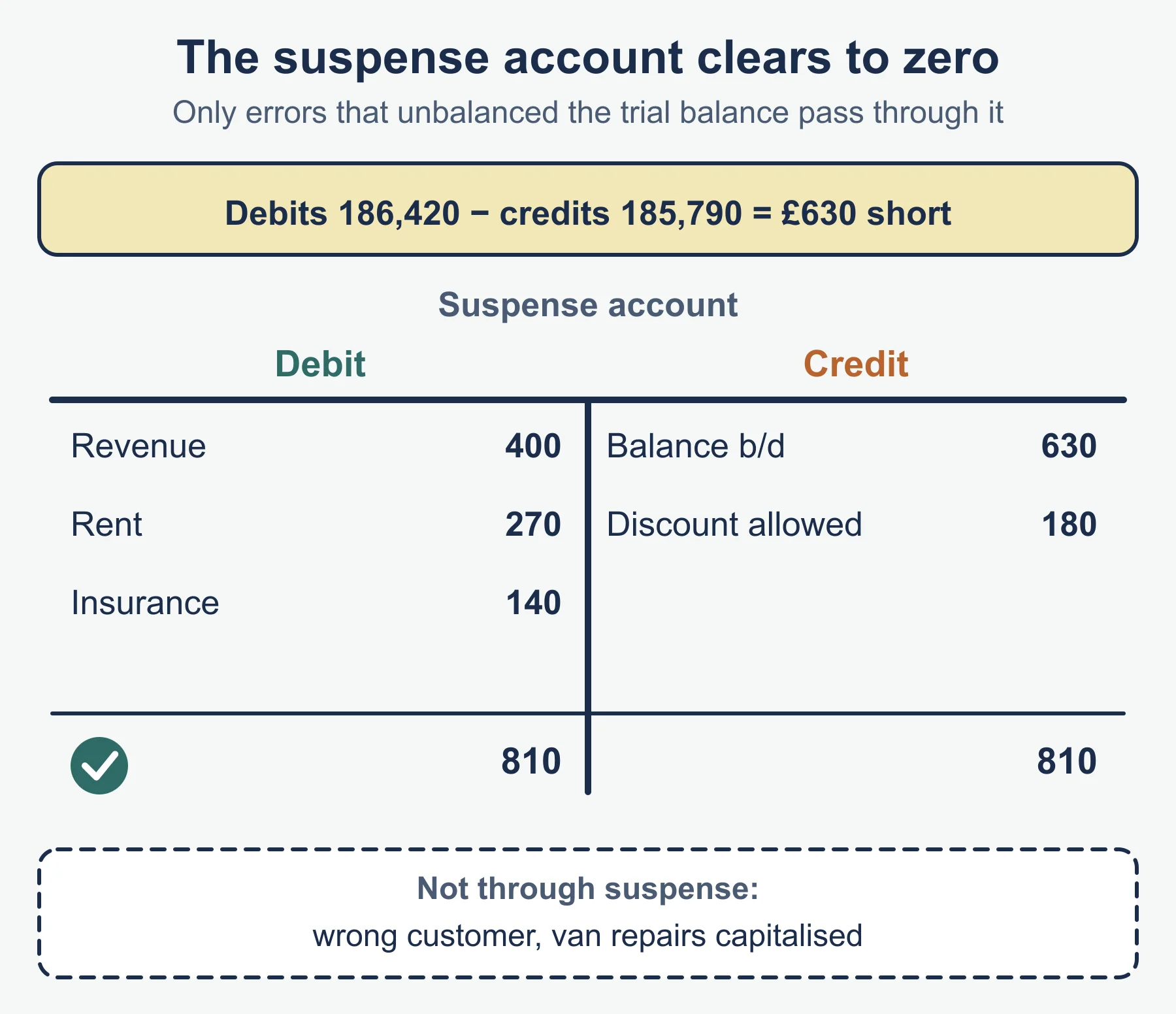
If the totals disagree and the error cannot be found in time, the difference is placed in a suspense account so the trial balance can be completed. It goes on the side that is short: debits exceed credits, so suspense is a credit balance; credits exceed debits, so suspense is a debit balance. When errors are found, each correction involves suspense on the side that clears it.
Weldon Hardware’s debits exceeded credits by 615. Three one-sided errors were later found:
- Bank charges of 185 were credited to bank, but the debit was never posted.
- A receipt of 620 from a customer was debited to bank, but never credited to the customer.
- Wages of 4,350 were credited to bank correctly but debited to wages as 4,530.
| Correcting entry | Dr | Cr |
|---|---|---|
| 1 | Bank charges 185 | Suspense 185 |
| 2 | Suspense 620 | Trade receivables 620 |
| 3 | Suspense 180 | Wages 180 |
| Suspense account | |||
|---|---|---|---|
| Trade receivables | 620 | Balance per trial balance | 615 |
| Wages | 180 | Bank charges | 185 |
| 800 | 800 |
The account closes with no balance, which confirms every error has been found and that the corrections add up to the original difference. Errors that leave the trial balance agreeing, such as (a) to (e) above, never involve suspense.
1.2.8 Statement of revised profit
Start with the profit already calculated and adjust for each correction that touches an expense or income account. Corrections that only move amounts between statement of financial position accounts, such as (b), change nothing.
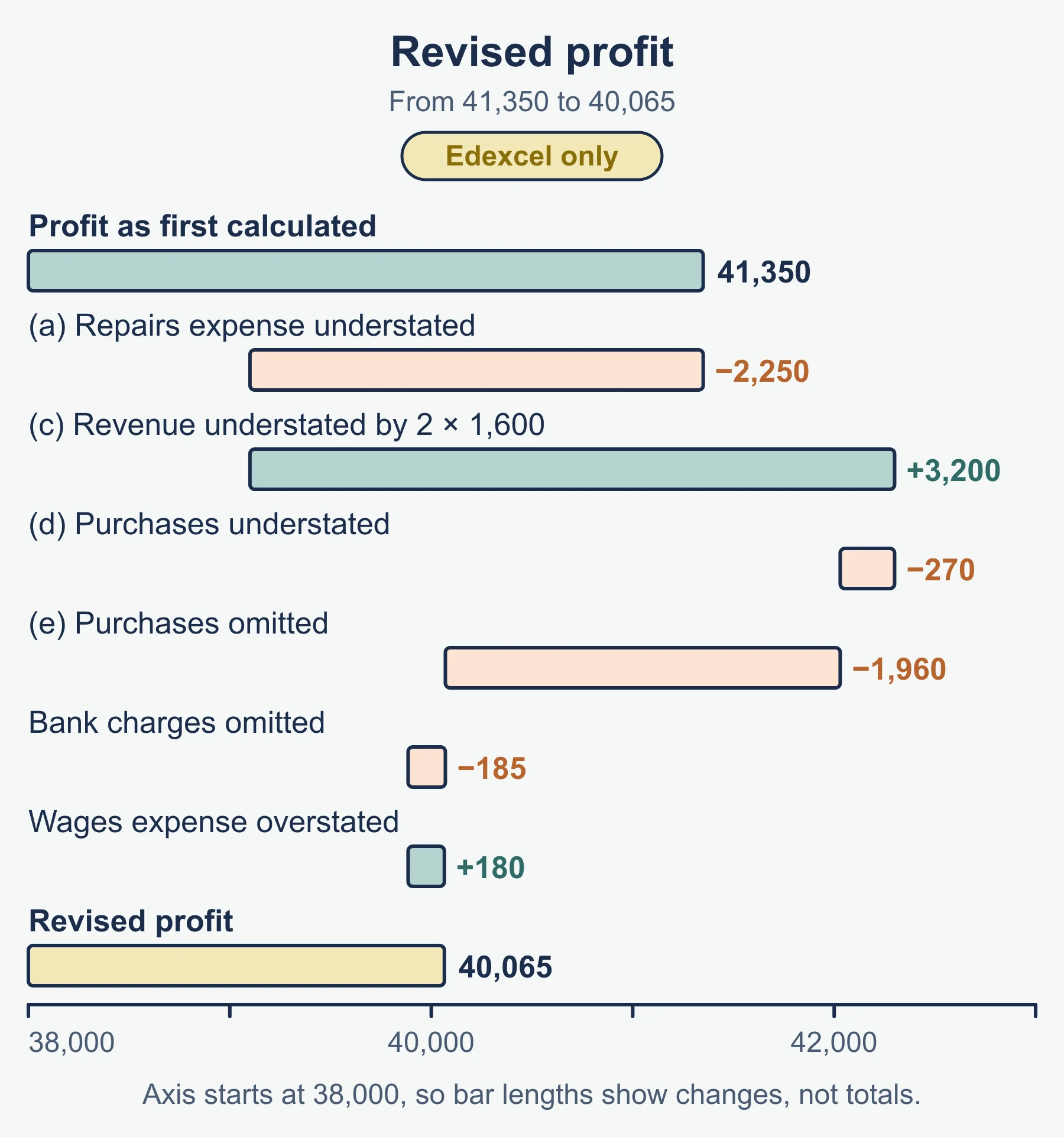
Weldon Hardware’s original profit for the year was 41,350. Using corrections (a) to (e) and the two suspense items:
| Item | Effect | Revised profit |
|---|---|---|
| Profit for the year as first calculated | 41,350 | |
| (a) Repairs expense understated | (2,250) | 39,100 |
| (c) Revenue understated by twice 1,600 | 3,200 | 42,300 |
| (d) Purchases understated | (270) | 42,030 |
| (e) Purchases omitted | (1,960) | 40,070 |
| Bank charges expense omitted | (185) | 39,885 |
| Wages expense overstated | 180 | 40,065 |
Revised profit for the year is 40,065. Rule: income understated or expense overstated raises profit; income overstated or expense understated lowers it. Gross profit also moves, by 3,200 − 270 − 1,960 = 970 for the revenue and purchases items, while the others affect operating expenses. Capitalising repairs in (a) may also have led to depreciation on them: adjust it only if the question gives a rate.
1.2.9 Correcting errors in control accounts
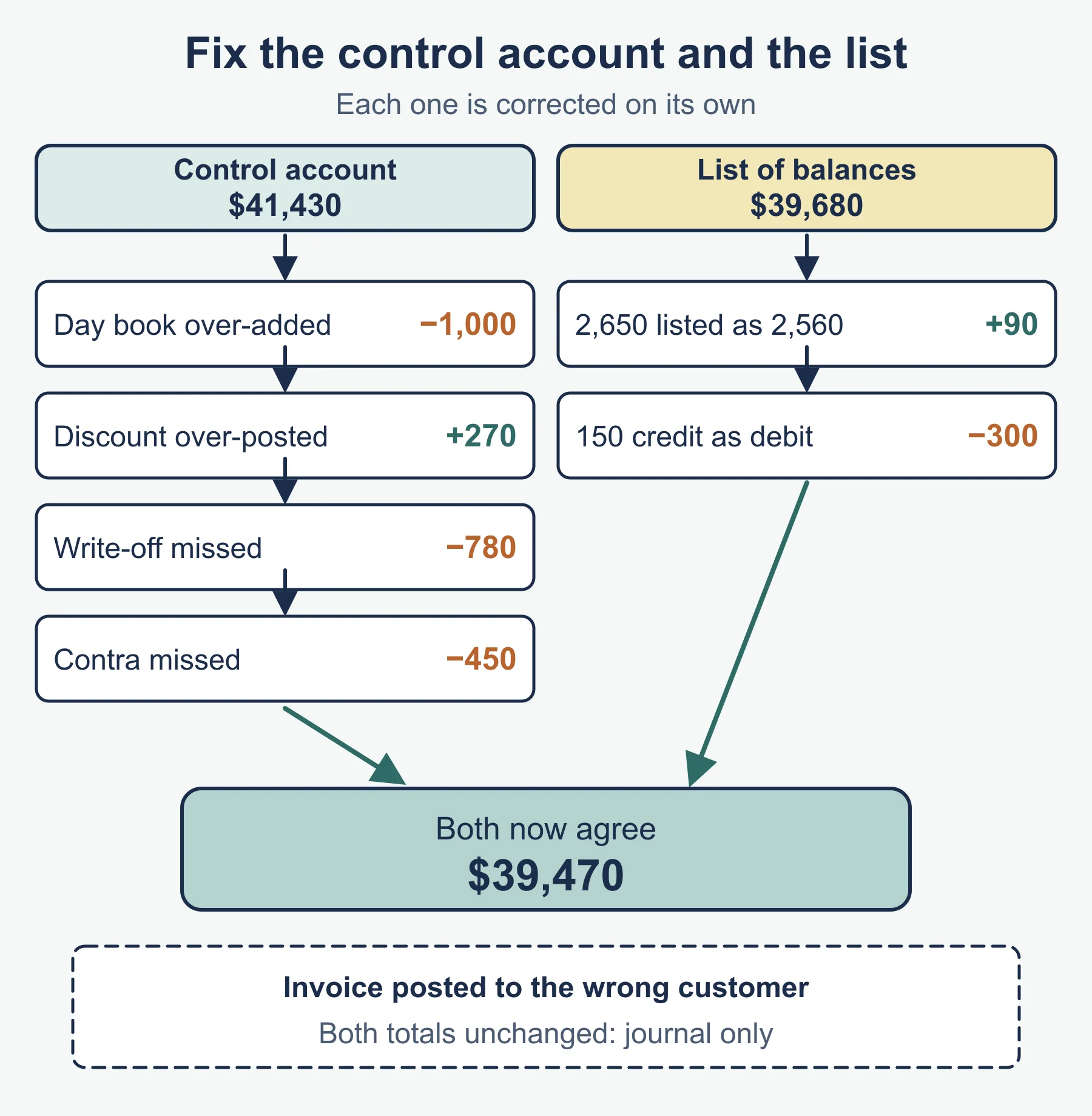
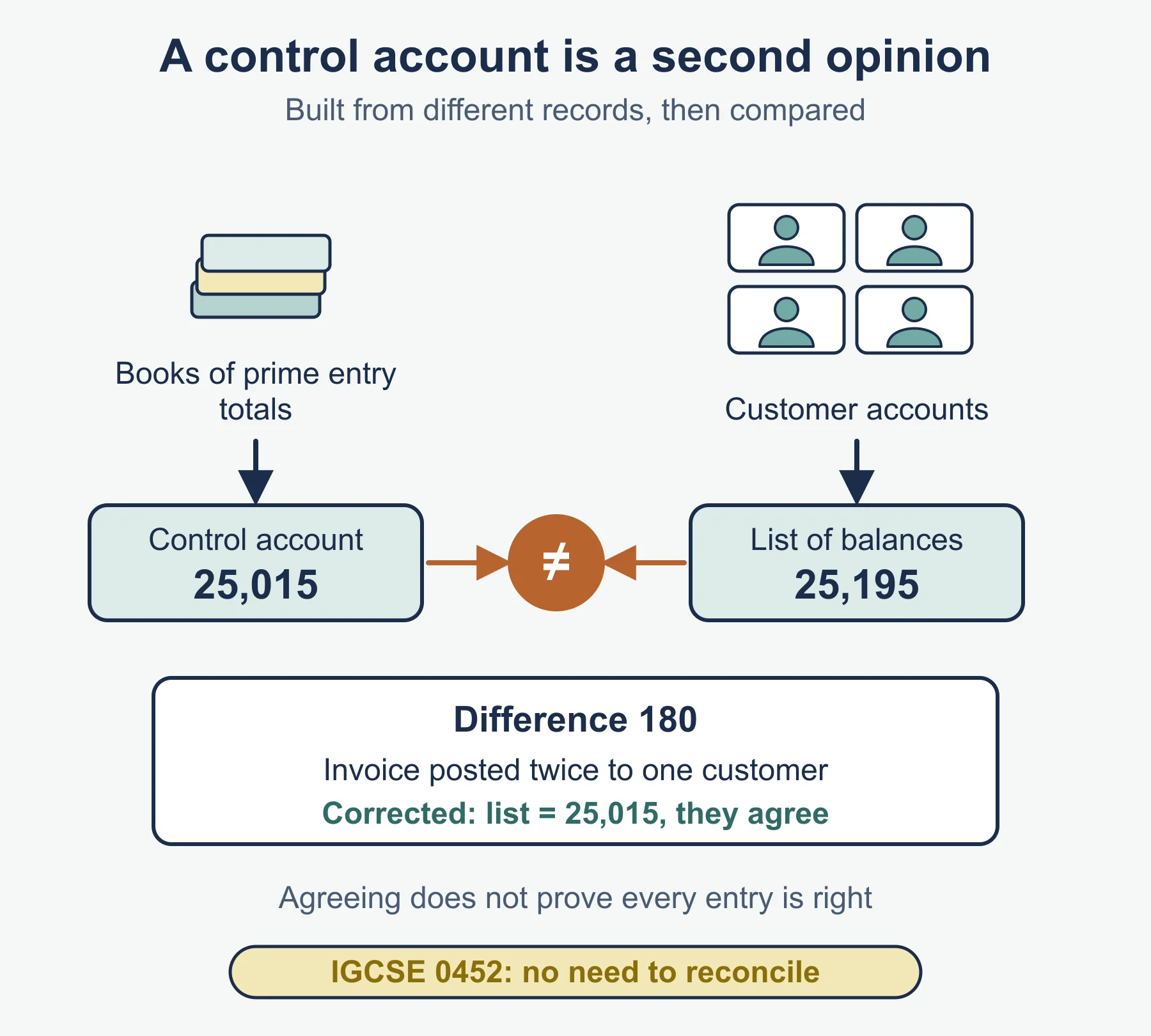
A control account and the list of individual balances can each be wrong, for different reasons, and each is corrected on its own. Thistledown Supplies’ trade receivables control account showed 41,430, but its list of customer balances totalled 39,680. The true balance is 39,470. The differences:
Errors in the control account (the list is not affected):
- The sales day book was over-added by 1,000.
- An irrecoverable debt of 780 was written off in the customer’s account but not in the control account.
- A contra entry of 450 with the trade payables ledger was made in the individual accounts only.
- Discount allowed of 1,250 was posted to the control account as 1,520.
| Trade receivables control account | |||
|---|---|---|---|
| Balance per books | 41,430 | Revenue (day book over-added) | 1,000 |
| Discount allowed (over-posted) | 270 | Irrecoverable debts | 780 |
| Trade payables (contra) | 450 | ||
| Balance carried down | 39,470 | ||
| 41,700 | 41,700 |
The same contra needs a debit in the trade payables control account.
Errors in the list (the control account is not affected):
| Total of list | 39,680 |
|---|---|
| Add balance of 2,650 listed as 2,560 | 90 |
| Deduct credit balance of 150 listed as a debit (twice 150) | (300) |
| Corrected total | 39,470 |
Now both agree. An invoice of 1,260 posted to the wrong customer changes neither total: it only needs a journal between the two customer accounts.
Common errors
- Putting suspense on the wrong side: it goes on the short side.
- Using suspense for errors that leave the trial balance agreeing.
- Journalising only the wrong amount for a complete reversal instead of double.
- Adjusting profit in the wrong direction.
- Treating an agreeing trial balance as proof the accounts are right.
- Correcting a control account for an error that only sits in the list.
Next, test yourself with the practice questions.
Frequently asked questions
What is a trial balance in Edexcel IAL Accounting? A trial balance is a list of every ledger balance at one date, in a debit column and a credit column. Under double entry the two totals should agree, but agreement is a check on arithmetic, not a proof that the books are correct.
What is a compensating error? A compensating error is two or more errors that offset each other, so the trial balance still agrees. For example, if purchases and revenue are both under-added by the same amount, both totals fall equally.
Which side of the trial balance does the suspense account go on? The suspense account goes on the side that is short. If debits exceed credits, suspense is a credit balance; if credits exceed debits, it is a debit balance, and it should close to nil once all the errors are corrected.
Why is a complete reversal of entries corrected with double the amount? A correcting journal for a complete reversal must first remove the wrong entry and then post the right one. Each step needs the original amount, so the correction is twice the amount of the transaction.
How do you work out a revised profit after correcting errors? Start with the profit already calculated and adjust for each correction that affects an income or expense account. Income understated or expenses overstated raises profit, income overstated or expenses understated lowers it, and corrections between statement of financial position accounts change nothing.
Official syllabus
Pearson Edexcel International Advanced Subsidiary/Advanced Level in Accounting (XAC11/YAC11) specification, Issue 2, September 2018, first teaching September 2015 (Pearson Education Limited). Unit 1, topic 1.2: outcomes 1.2.1, 1.2.2 and 1.2.5 to 1.2.9.
Get free revision emails (optional)
Occasional emails with practice questions, worked explanations and links to free resources for the qualification and subjects you choose. No spam, and you can unsubscribe from any email. The free tools on this site never need an email.
Related resources
-
Practice questions
Edexcel International A Level Accounting: The trial balance and correction of errors (YAC11) – Practice Questions
Original Edexcel IAL Accounting practice on the trial balance, error types, correcting journals, suspense accounts, revised profit and control accounts.
Accounting · Pearson Edexcel · AS Level
Try questions -
Revision notes
Edexcel International A Level Accounting: The trial balance and correction of errors (YAC11) – Revision Notes
Condensed Edexcel IAL Accounting revision notes on the trial balance, error types, correcting journals, suspense account and revised profit.
Accounting · Pearson Edexcel · AS Level
Revise topic -
Study guides
Edexcel International A Level Accounting: Control Accounts and Correction of Errors (YAC11)
Control accounts as a check on receivable and payable ledgers, plus error correction, journals and the suspense account, for Edexcel IAL Accounting (YAC11).
Accounting · Pearson Edexcel · AS Level
Read guide
Related articles
-
teaching
A Level tuition in Dubai: Cambridge or Pearson Edexcel International A Level?
Schools in Dubai and Abu Dhabi teach either Cambridge International AS & A Level or Pearson Edexcel International A Level. How the two are structured, why it matters for tuition, and how online classes from Lahore work.
9 October 2026
-
curriculum guides
Choosing subjects at IGCSE and A Level
How subject choices at 14 and 16 affect university options later, and how to keep pathways open without overloading a timetable.
28 July 2026
Studying this with a teacher
Working through Accounting AS LEVEL?
This page is free and stays free. If you would rather be taught it, Marlbridge runs Accounting classes one-to-one and in small groups of up to 15, online in your own time zone. The first trial class is free. WhatsApp replies within an hour (8am–11pm Pakistan time, every day); email the same day.
Pearson Edexcel Accounting teachers at Marlbridge

