
Revision Notes
Edexcel International A Level Business: Financial planning and Managing finance (YBS11) – Revision Notes
Condensed revision notes for Financial planning (2.3.2) and Managing finance (2.3.3) in Edexcel International A Level Business Unit 2, with a self-test.
- Subject
- Business
- Level
- AS LEVEL
- Topic
- Managing business activities
- Author
- Marlbridge Academic Team
- Updated
- Reviewed by
- Salman Ahmad (what this means)
Aligned to Pearson Edexcel A Level Business (YBS11), Issue 1, September 2017. Official specification .
Syllabus page (what it covers and how it is assessed): Pearson Edexcel A Level Business.
Syllabus points this page covers
YBS11 (AS Level)
- 2.3.2 Financial planning
- 2.3.3 Managing finance
Found an error? Report a correction.
Need help with this topic? Request a free trial class for A Level Business (YBS11).
Quick recall for sections 2.3.2 Financial planning and 2.3.3 Managing finance of Unit 2 in the Pearson Edexcel International Advanced Subsidiary/Advanced Level in Business specification (YBS11), Issue 1, September 2017. For full explanations start with the study guide, then test yourself with the practice questions. Wider Unit 2 pages: study guide, revision notes and practice. Hub: Edexcel A Level Business. Checklist: printable checklist. Find weak spots first with the free diagnostics.
The specification says the accounting ratios will not be supplied in the examination, so learn every formula below. All figures are in dollars and every business is invented.
Formulas to know by heart
| Measure | Formula |
|---|---|
| Sales revenue | selling price × sales volume |
| Total costs | fixed costs + total variable costs |
| Average cost | total costs ÷ output |
| Contribution per unit | selling price − variable cost per unit |
| Break-even output | total fixed costs ÷ contribution per unit |
| Margin of safety | actual output − break-even output |
| Net cash flow | inflows − outflows |
| Closing balance | opening balance + net cash flow |
| Variance | actual − budget |
| Gross profit | revenue − cost of sales |
| Operating profit | gross profit − other operating expenses |
| Profit for the year (net profit) | operating profit − interest |
| Gross profit margin | gross profit ÷ revenue × 100 |
| Operating profit margin | operating profit ÷ revenue × 100 |
| Profit for the year margin | profit for the year ÷ revenue × 100 |
| Current ratio | current assets ÷ current liabilities |
| Acid test ratio | (current assets − inventory) ÷ current liabilities |
| Working capital | current assets − current liabilities (standard form) |
The margin of safety as a percentage of actual output, and the working capital formula, are standard forms rather than formulas printed in the specification.
2.3.2 Financial planning
Sales, revenue and costs
- Fixed costs do not vary with output; variable costs do.
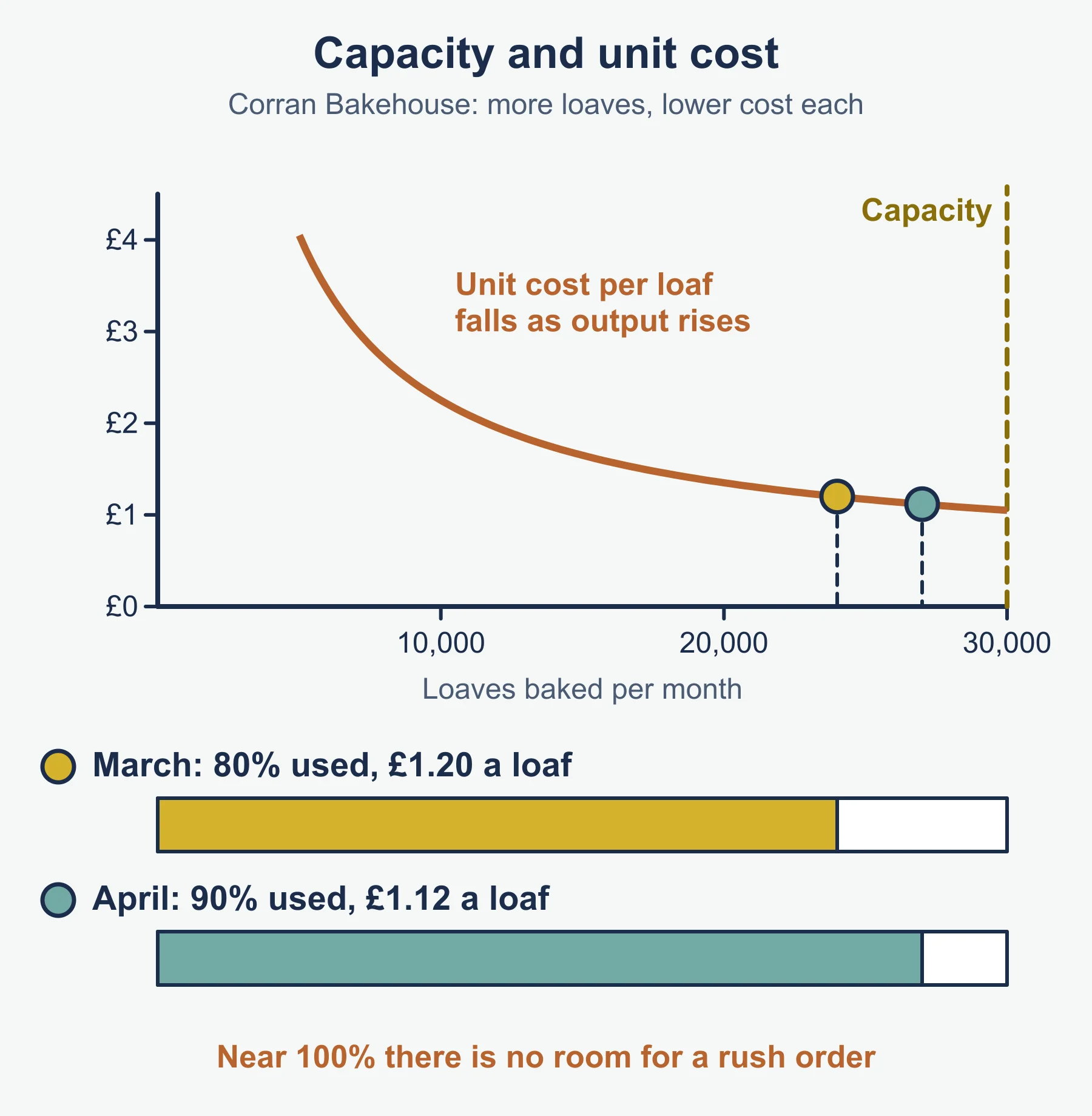
- Average cost falls as output rises while fixed costs are spread wider.
- Improving sales volume or revenue: promotion, product improvement, wider distribution, price change. A price change moves volume and revenue per unit in opposite directions.
Sales forecasting
| Point | Notes |
|---|---|
| Purpose | Base for budgets and cash-flow forecast; plans production, inventory and staffing; supports finance requests |
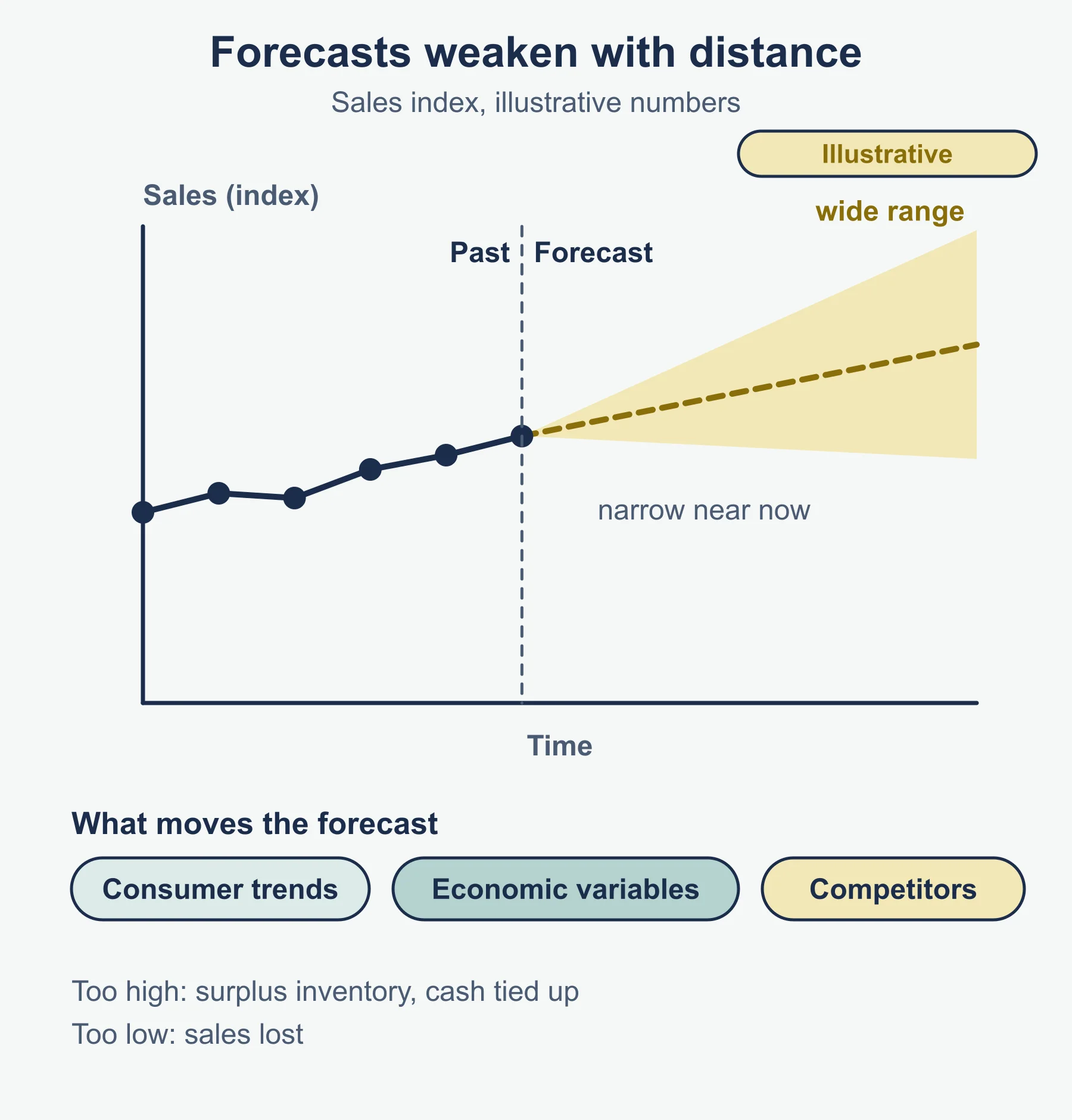
| Factors | Consumer trends; economic variables; actions of competitors |
| Difficulties | Uncertainty; no history for new products; fast-changing trends; competitor reactions; longer forecasts are weaker |
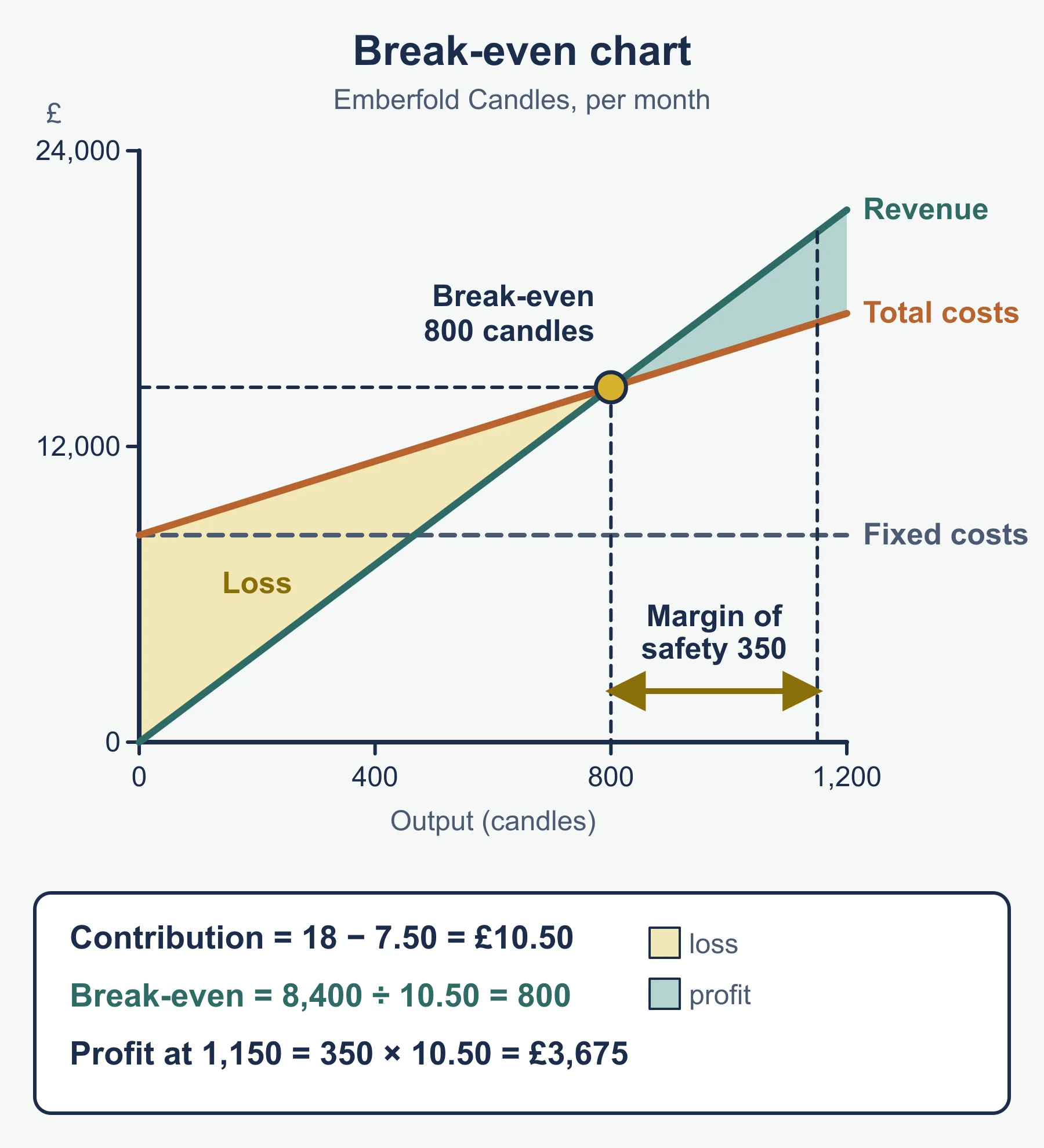
Break-even in steps
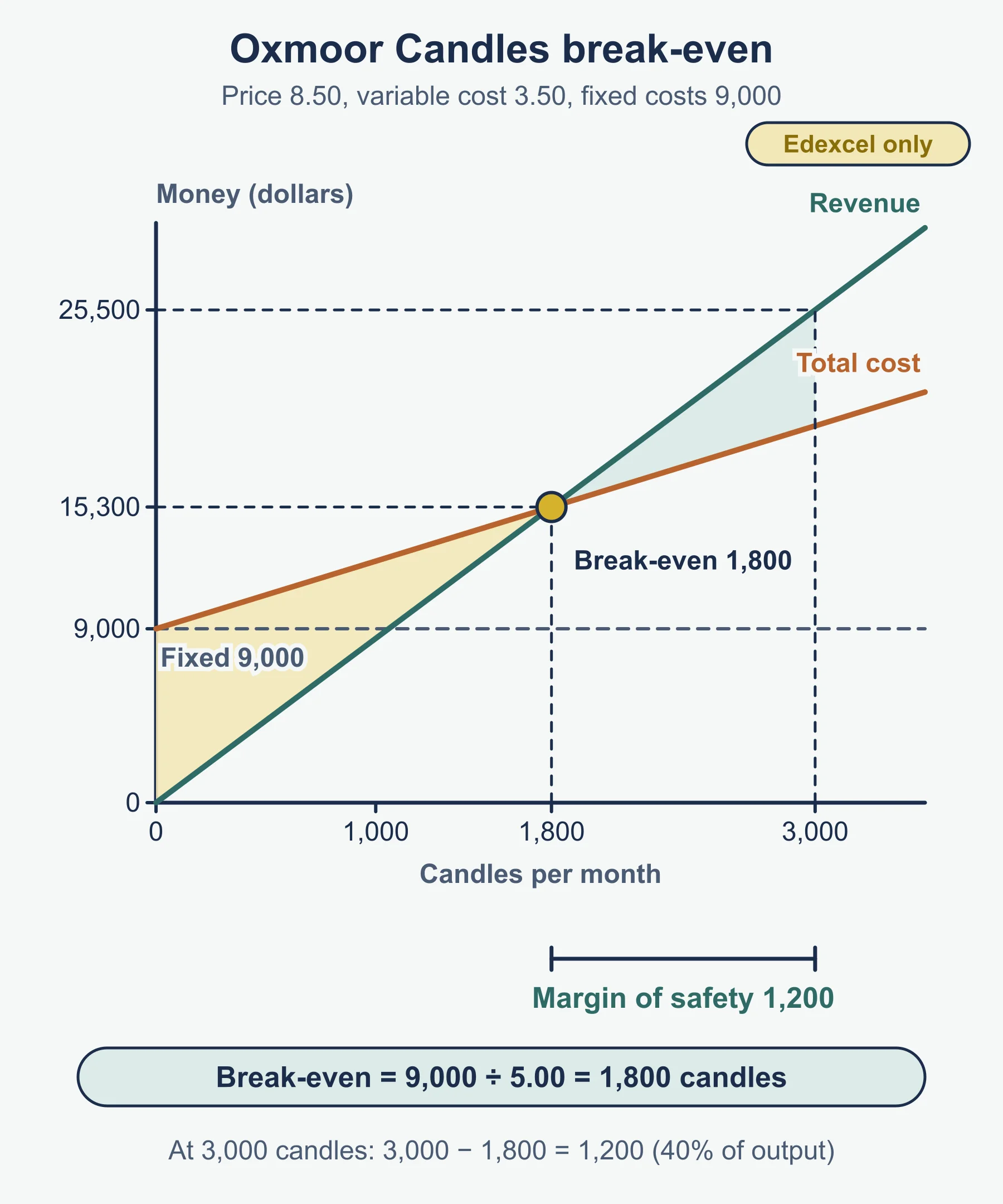
- Contribution per unit = price − variable cost per unit.
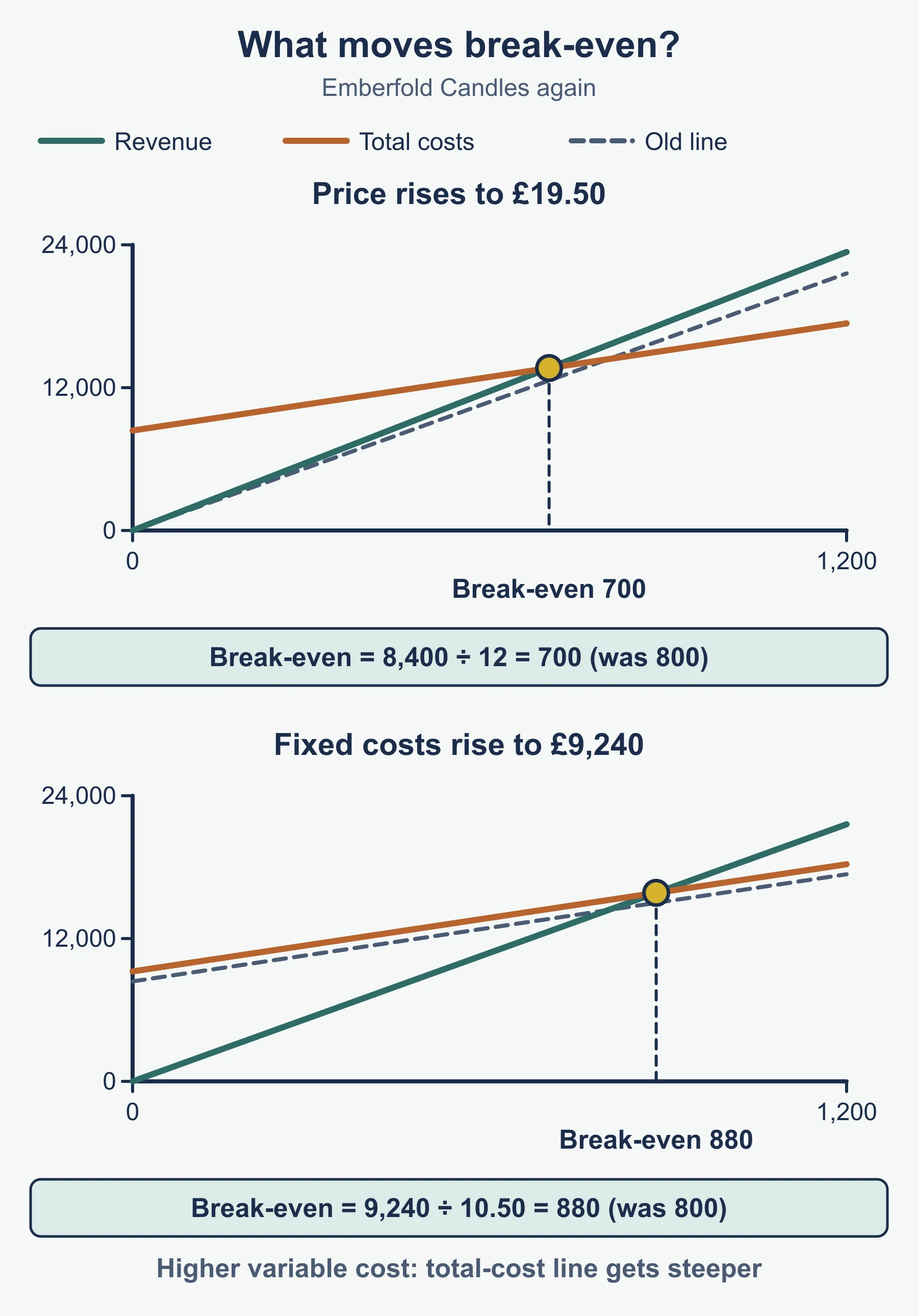
- Break-even output = fixed costs ÷ contribution.
- Margin of safety = actual output − break-even output.
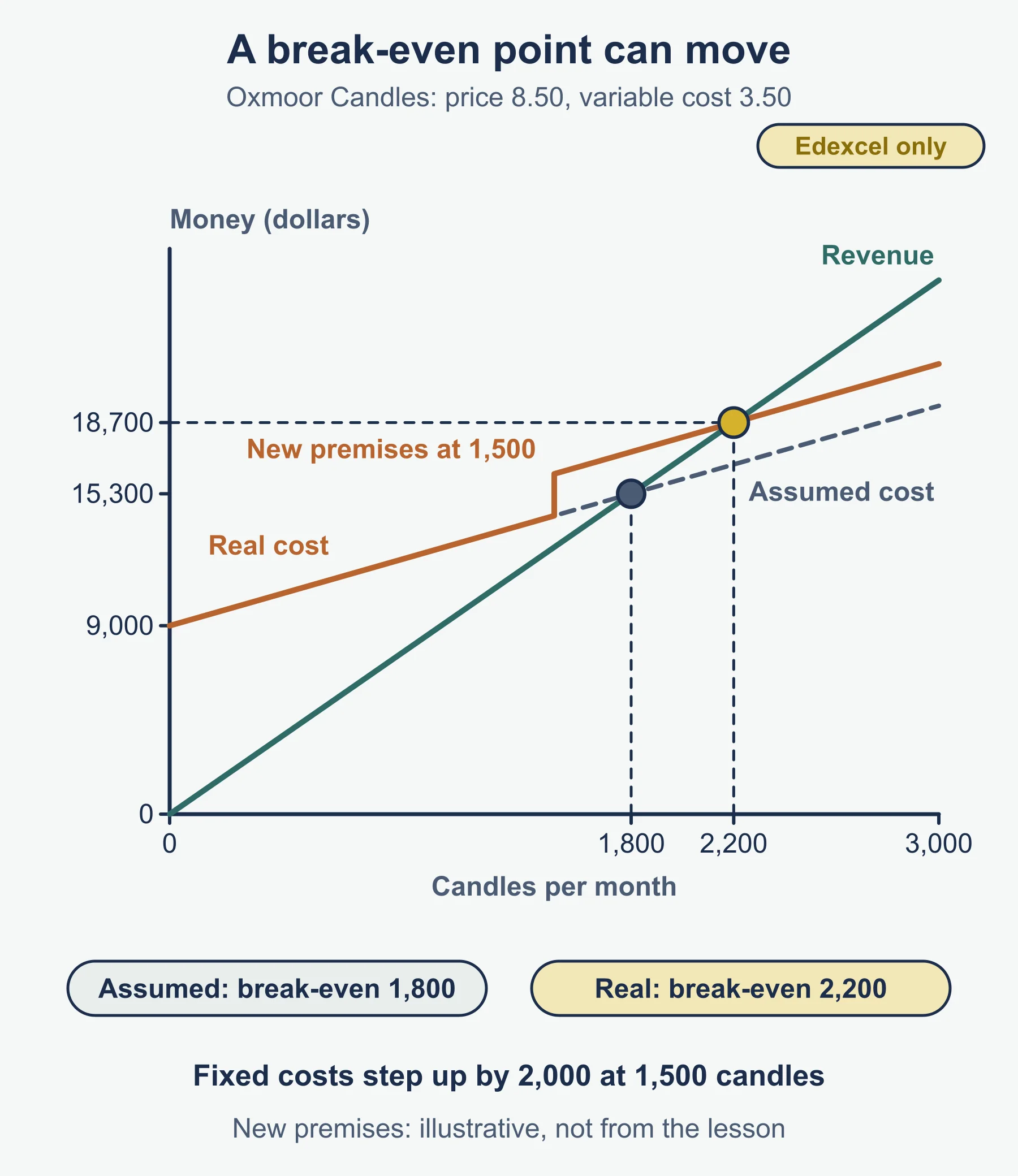
- Read the chart: revenue line crosses total cost line at break-even; the gap above is profit, below is loss.
Reminder, Alderney Frames: price 24, variable cost 15, fixed costs 18,000. Contribution 9; break-even 18,000 ÷ 9 = 2,000 frames. At 2,600 frames the margin of safety is 600 frames.
Limitations: assumes all output is sold; constant price and variable cost per unit; fixed costs stay fixed; best for one product; relies on forecasts; ignores cash timing and competitor reactions.
Cash-flow forecasts
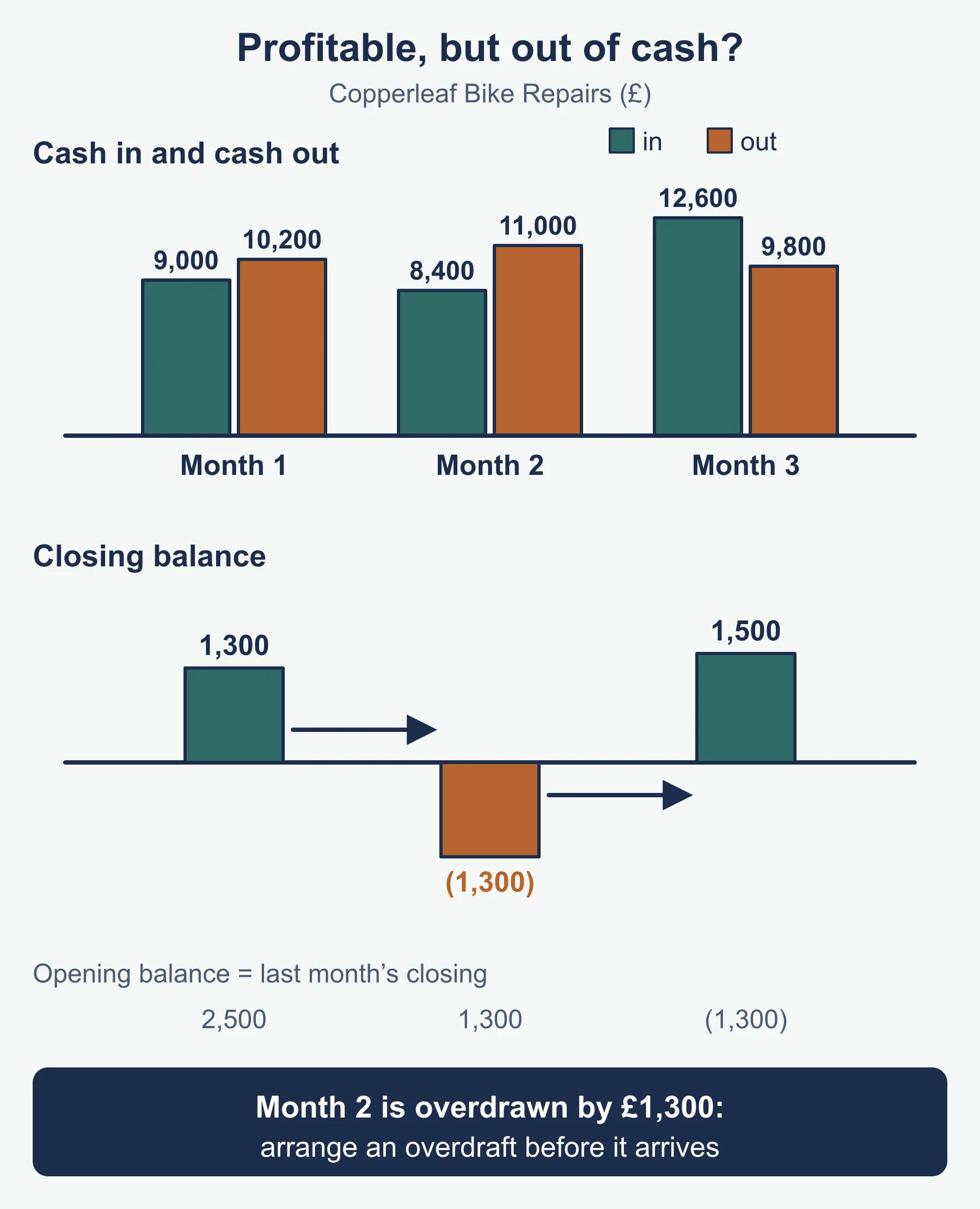
- Lay out opening balance, inflows, outflows, net flow and closing balance each month.
- Next month’s opening balance is this month’s closing balance.
- Uses: spot shortages early, support borrowing requests, time purchases.
- Limitations: forecast sales may be wrong; late payers and unplanned costs; needs regular updates; says nothing about profit.
Budgets
| Point | Notes |
|---|---|
| Purposes | Targets; control; allocate resources; coordinate; motivate; compare with actual |
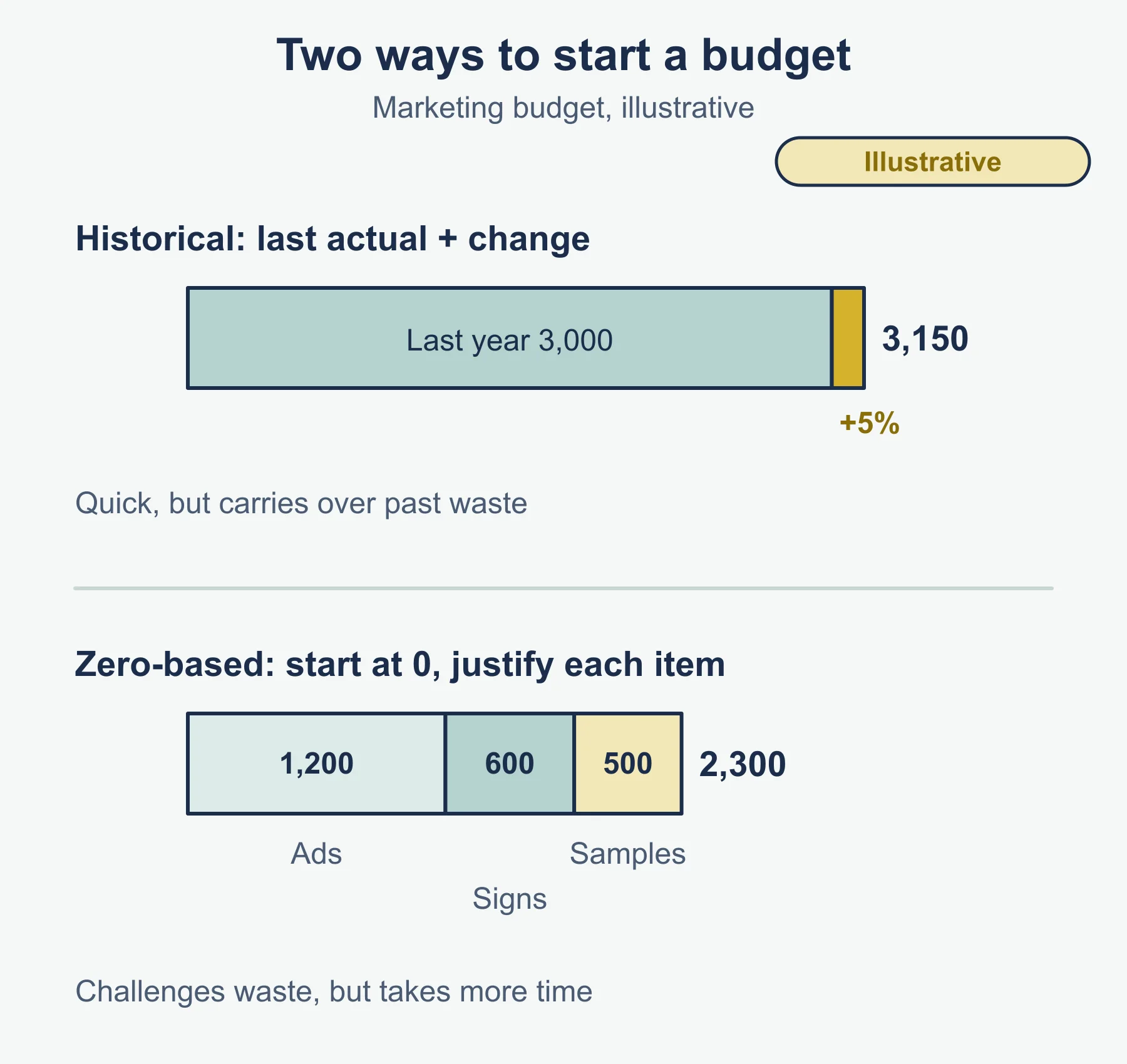
| Based on historical figures | Last period adjusted; quick; repeats old inefficiency |
| Zero based | Start at zero, justify every item; challenges waste; slower |
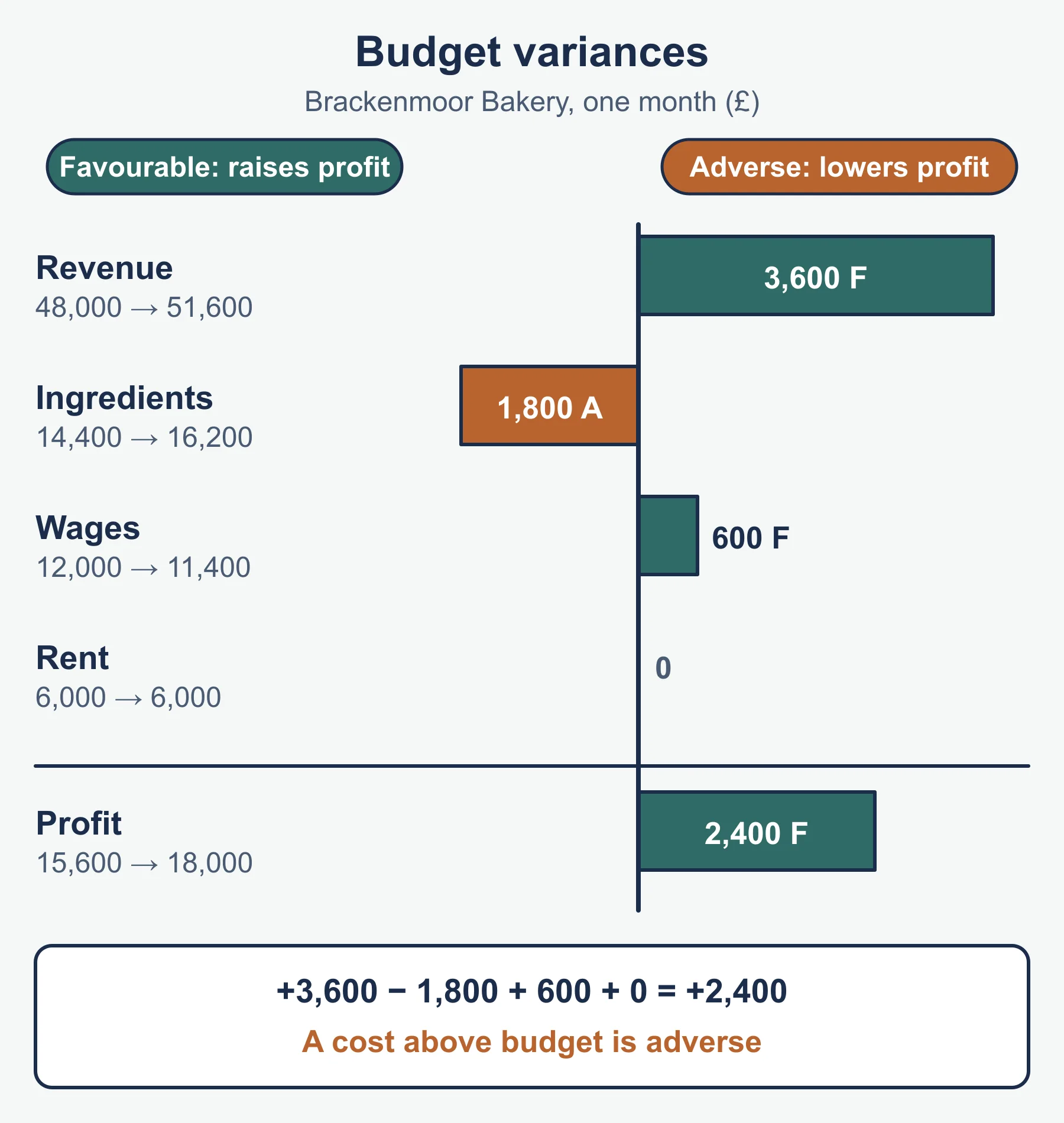
| Variance analysis | Actual − budget. Favourable raises profit; adverse lowers it |
| Difficulties | Forecast errors; time; padded bids; rigidity; demotivation |
For a cost, an actual above budget is adverse. For revenue, an actual above budget is favourable. Always write the label.
2.3.3 Managing finance
Profit and profitability
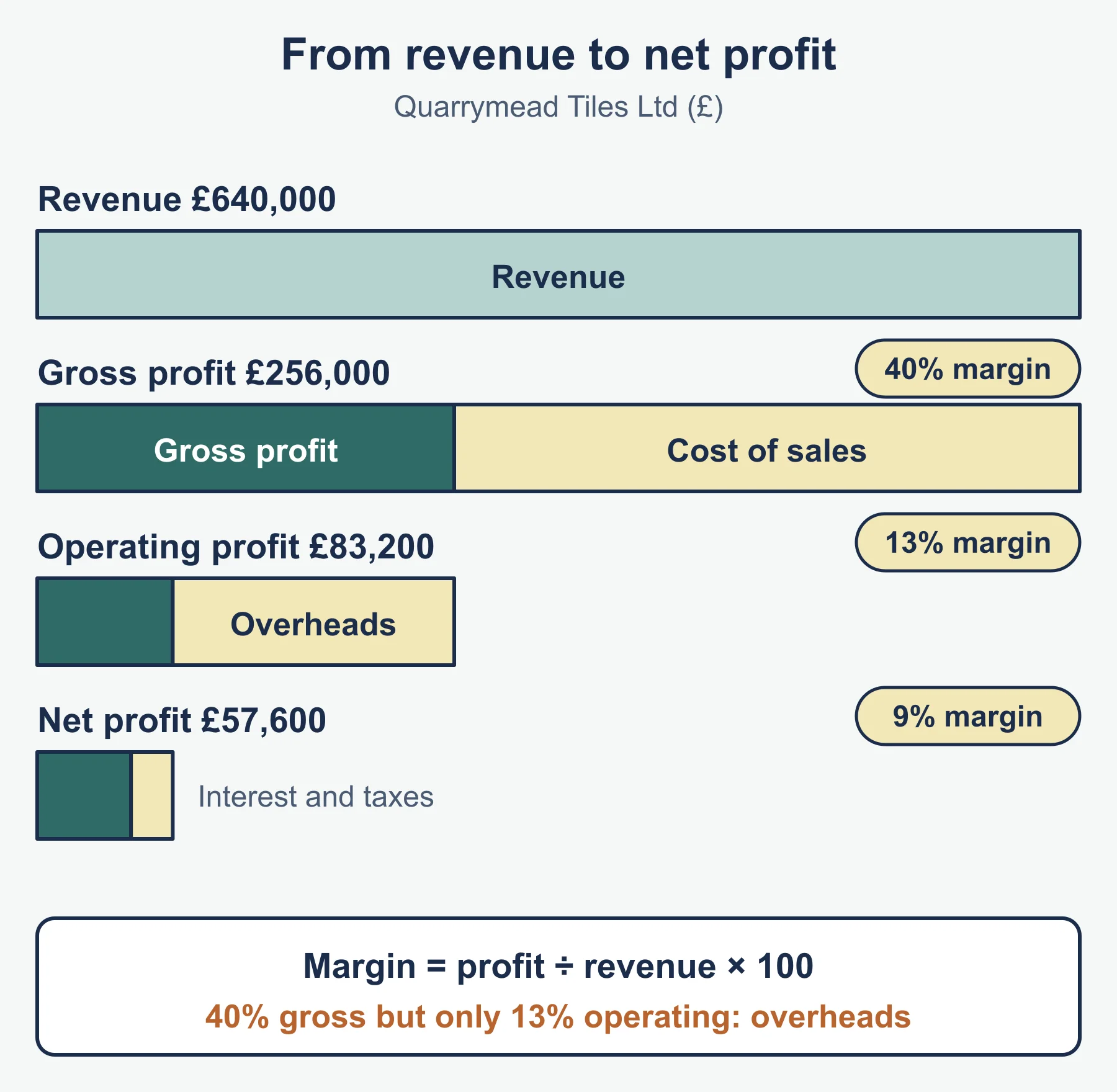
The statement of comprehensive income (profit and loss account) runs: revenue, minus cost of sales, gives gross profit; minus other operating expenses, gives operating profit; minus interest, gives profit for the year (net profit).
Reminder, Tansley Trims: revenue 210,000; cost of sales 126,000; other operating expenses 52,500; interest 4,200.
Gross profit     = 84,000   margin 40%
Operating profit = 31,500   margin 15%
Profit for the year = 27,300   margin 13%
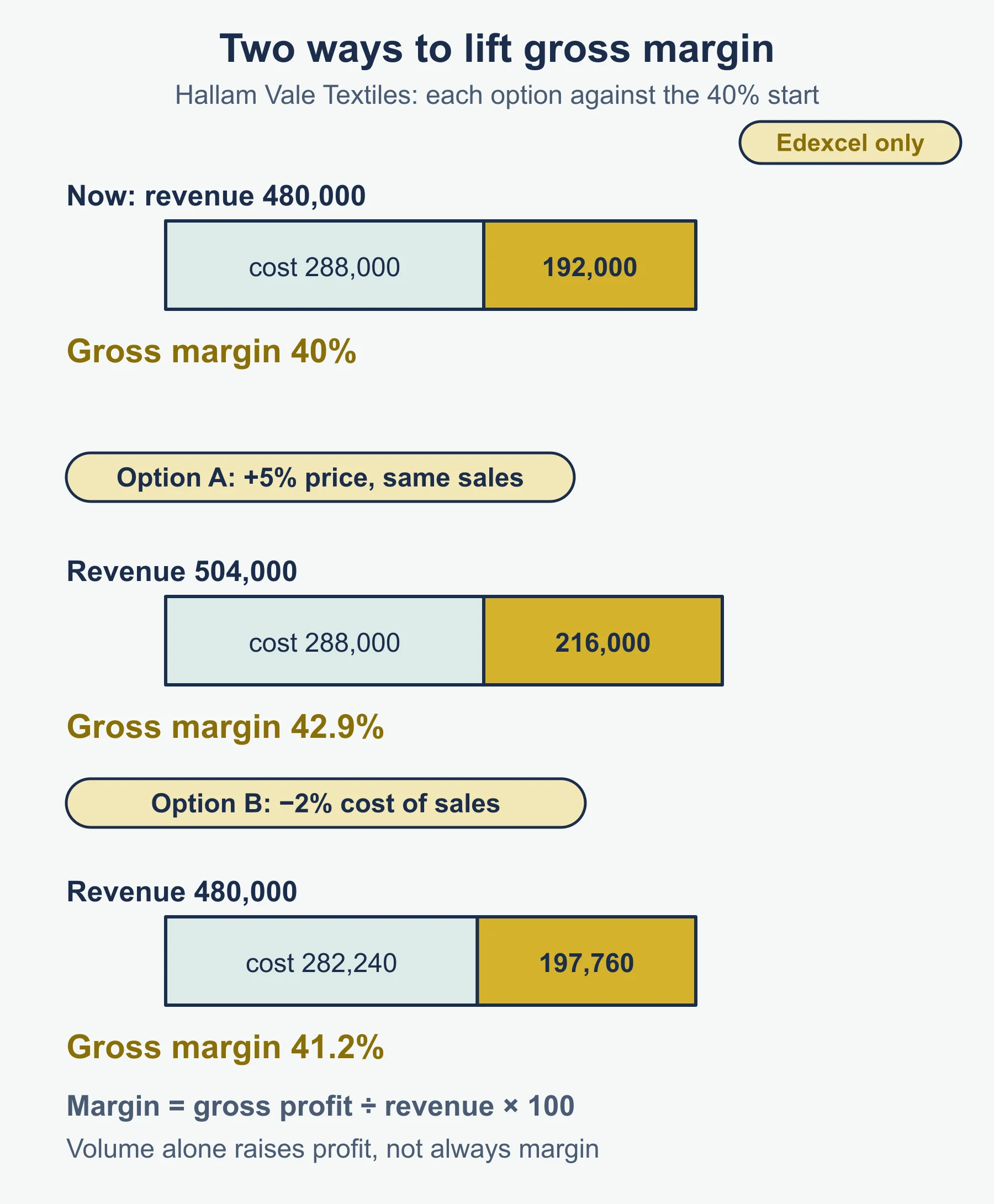
Ways to increase profit: raise revenue or cut costs. Ways to improve margins: raise prices; cut cost of sales through cheaper materials; cut other operating expenses; cut interest by repaying debt. More volume alone raises profit but not always margin.
Profit versus cash
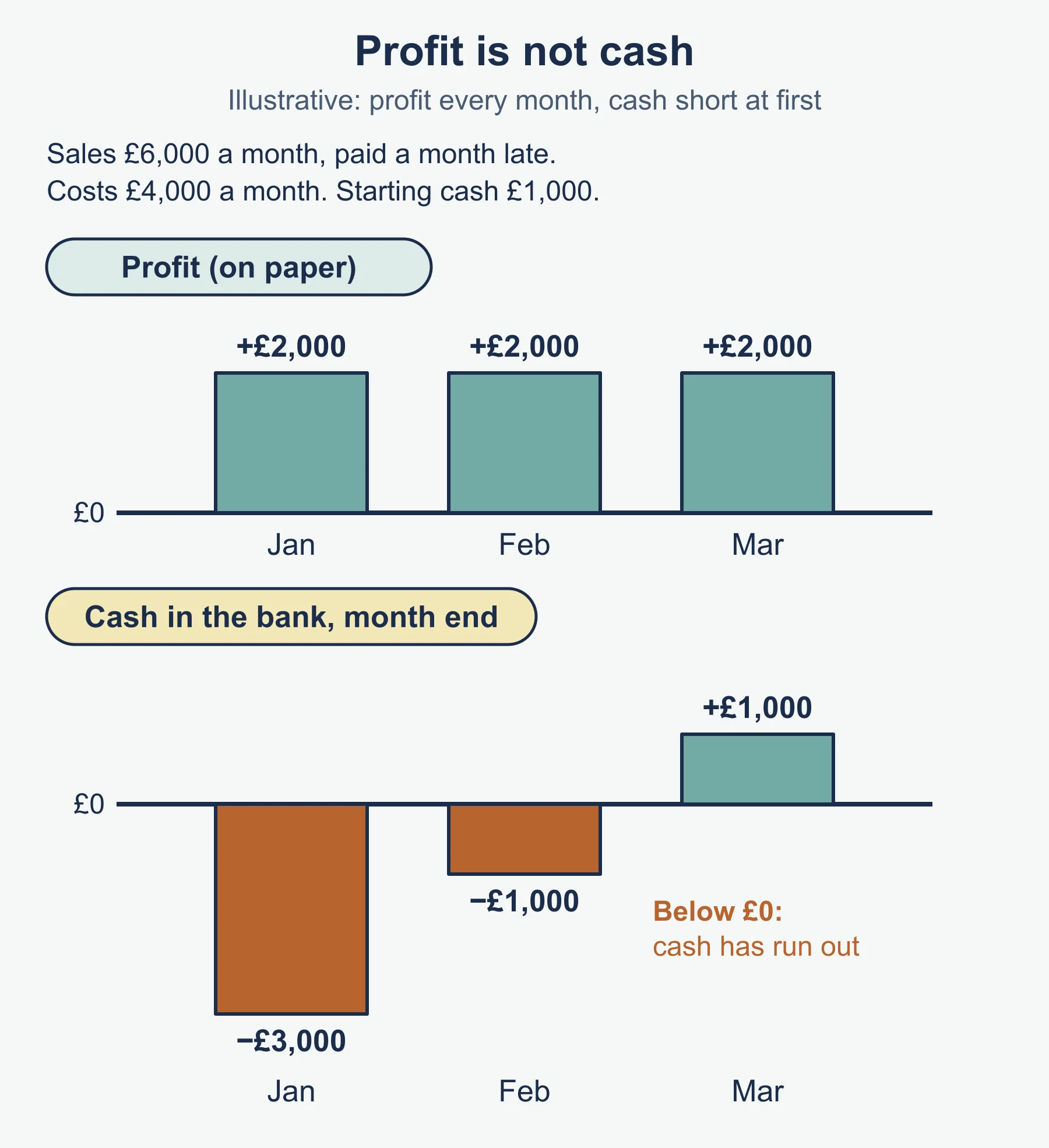
| Profit | Cash | |
|---|---|---|
| What it is | Revenue minus costs for a period | Money actually received and paid |
| Timing | When earned or incurred | When money moves |
| Credit sales | Counted at once | Arrive later |
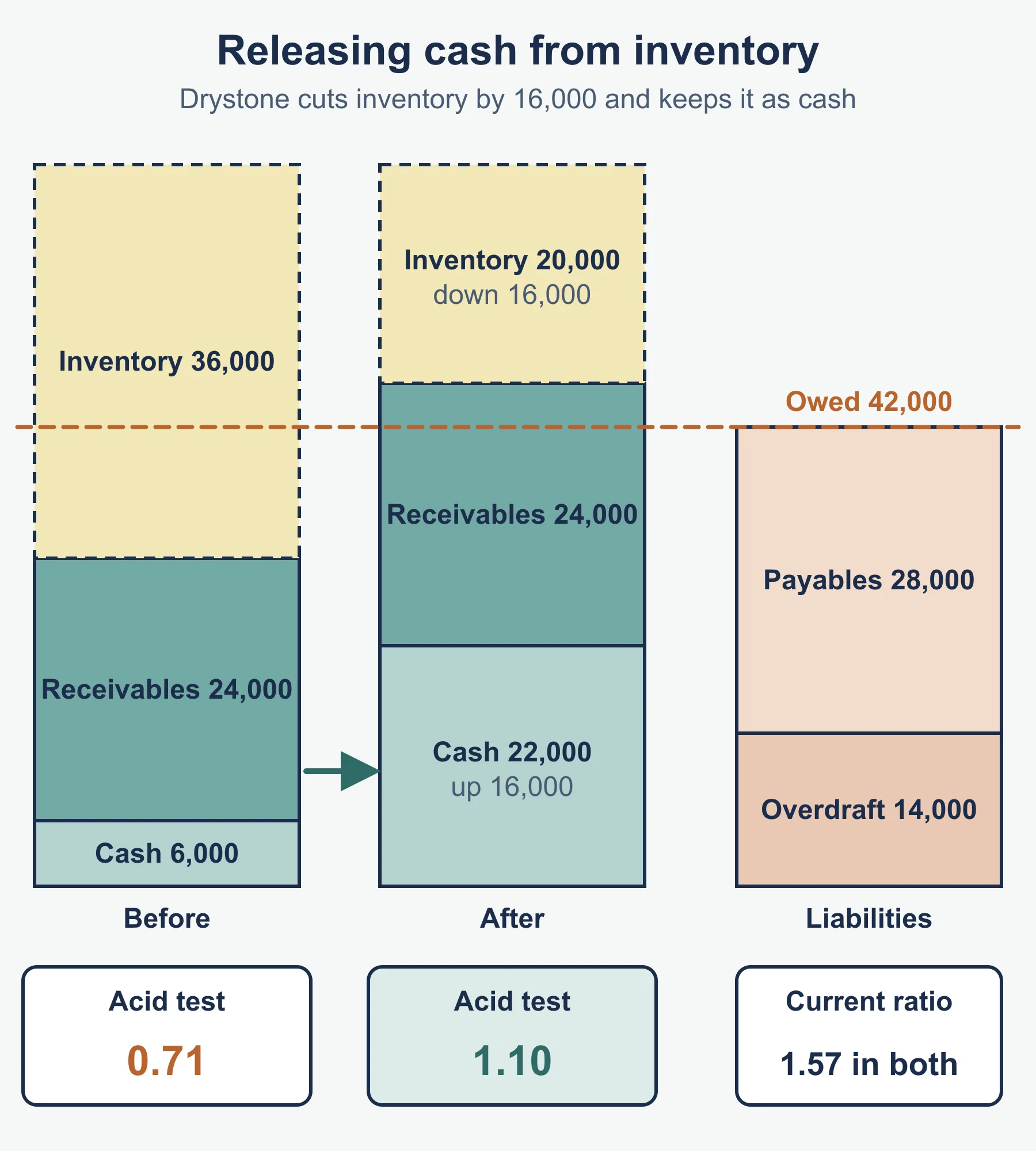
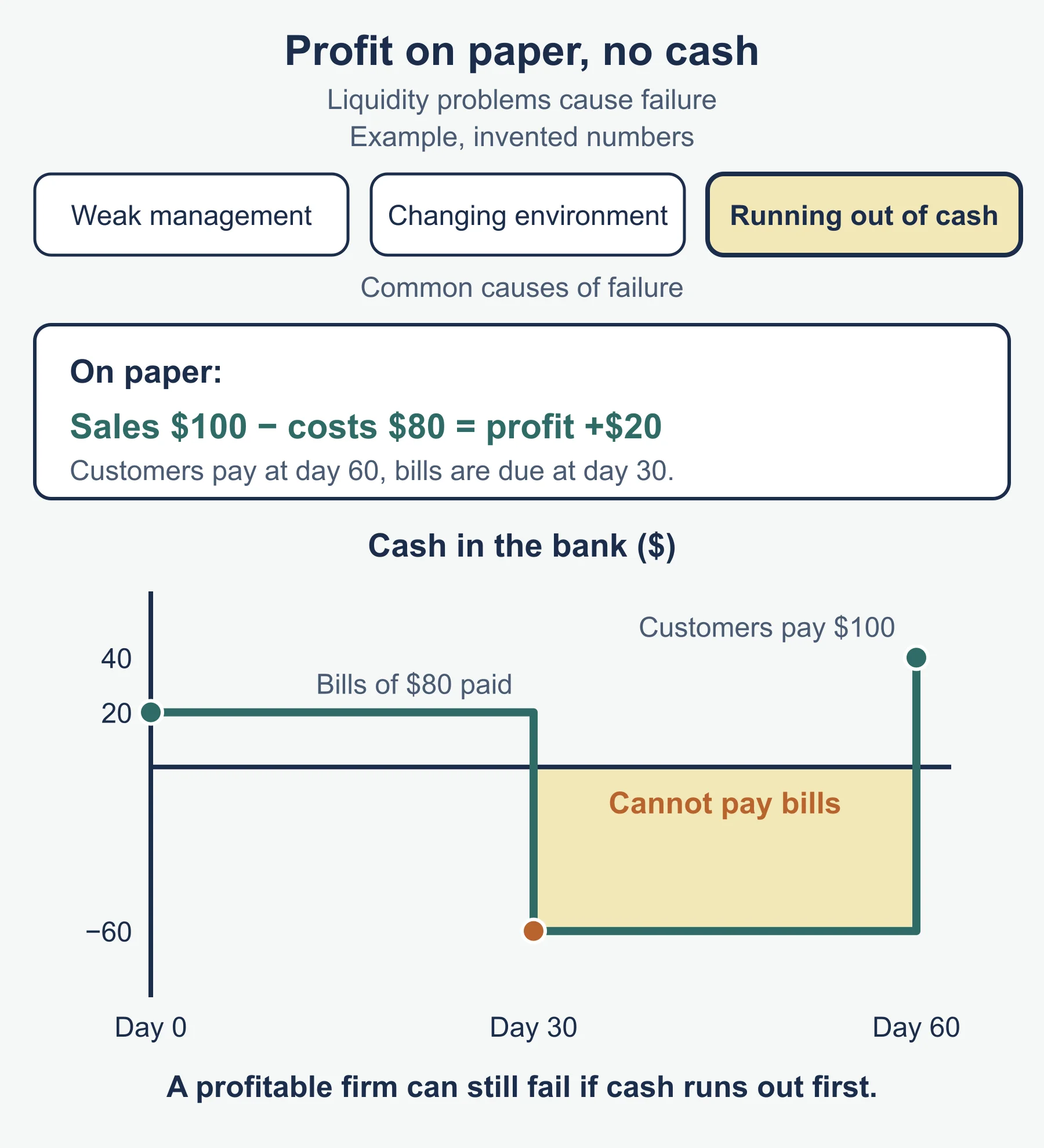
A profitable business can run out of cash, for example by paying suppliers quickly, offering long credit and building inventory.
Liquidity
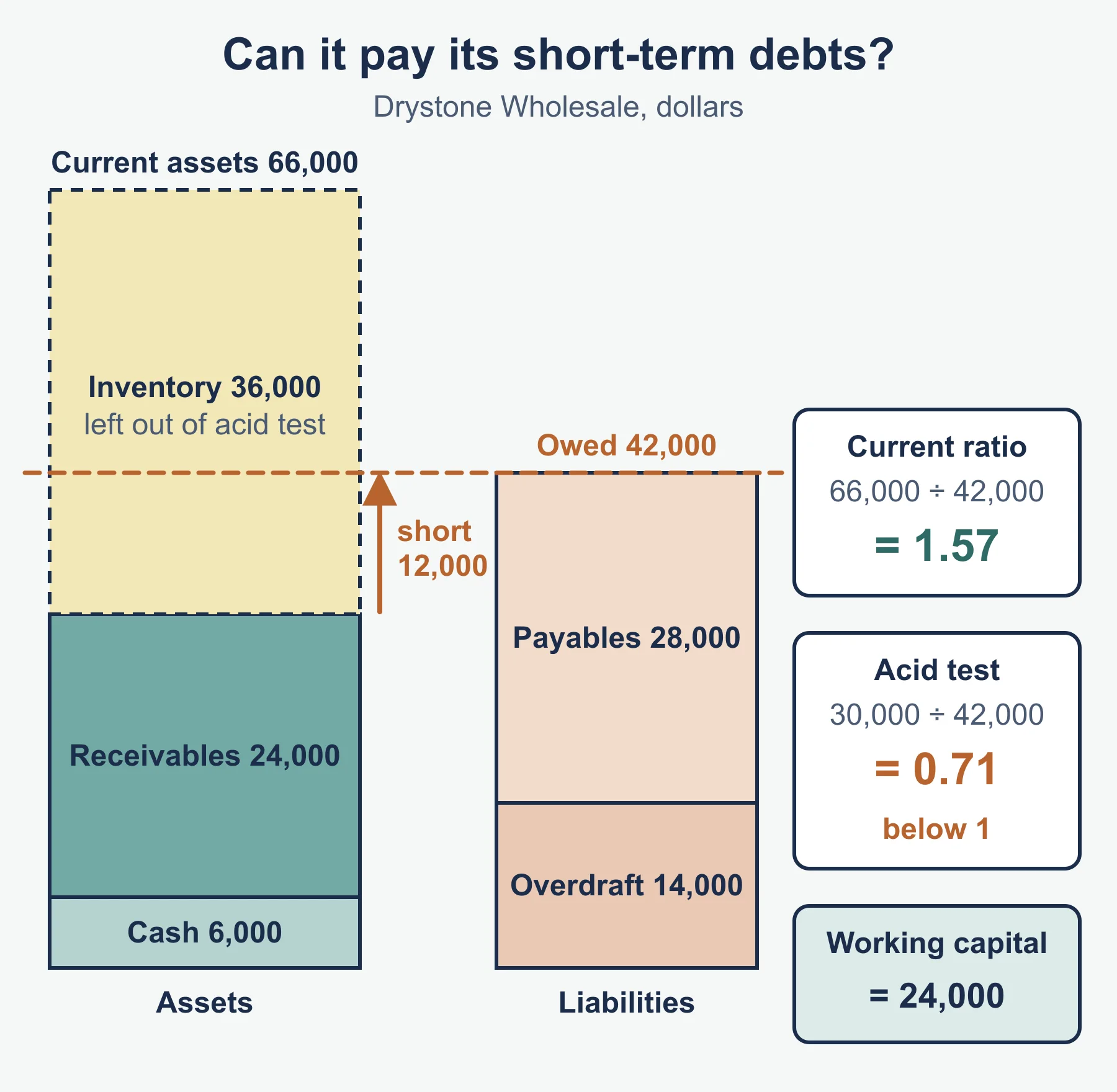
The statement of financial position (balance sheet) shows current assets (inventory, trade receivables, cash) and current liabilities (trade payables, overdraft).
Reminder, Mossdale Foods: current assets 50,000 including inventory 32,000; current liabilities 40,000.
Current ratio   = 50,000 / 40,000 = 1.25
Acid test ratio = 18,000 / 40,000 = 0.45
Mossdale looks acceptable on the current ratio but very weak on the acid test, because most current assets are inventory.
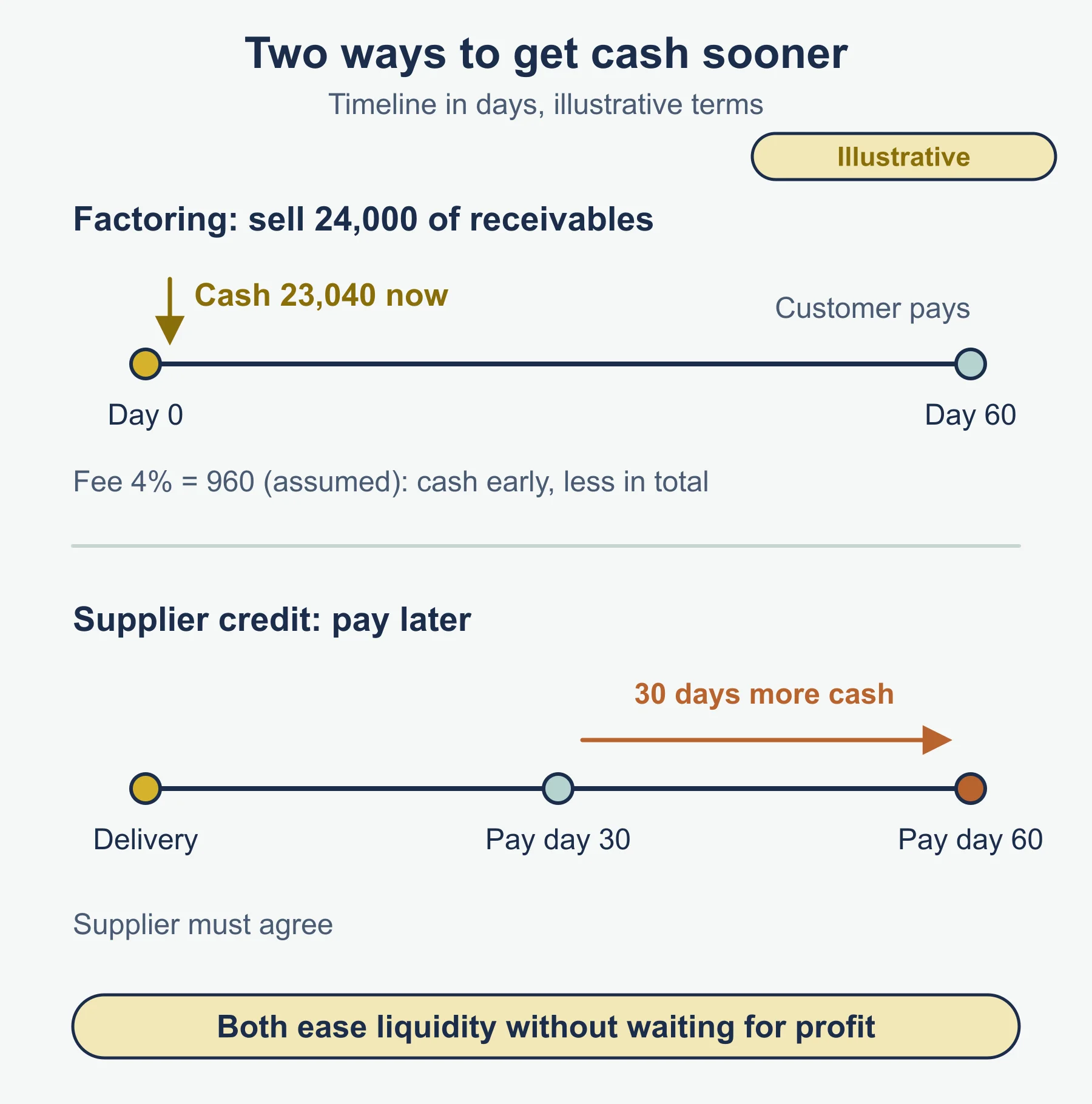
| Way to improve liquidity | How it helps | Drawback |
|---|---|---|
| Sell assets | Cash now | Loses use of the asset |
| Longer supplier credit terms | Cash leaves later | Suppliers may refuse or raise prices |
| Factoring | Cash for trade receivables now | Fee; customers may deal with the factor |
| Just in time inventory | Less cash tied up | Depends on reliable suppliers |
Working capital funds day-to-day running. The importance of cash: wages, suppliers and bills fall due on fixed dates, whatever the profit.
Business failure
| Internal | External |
|---|---|
| Poor management of cash flow | Market conditions |
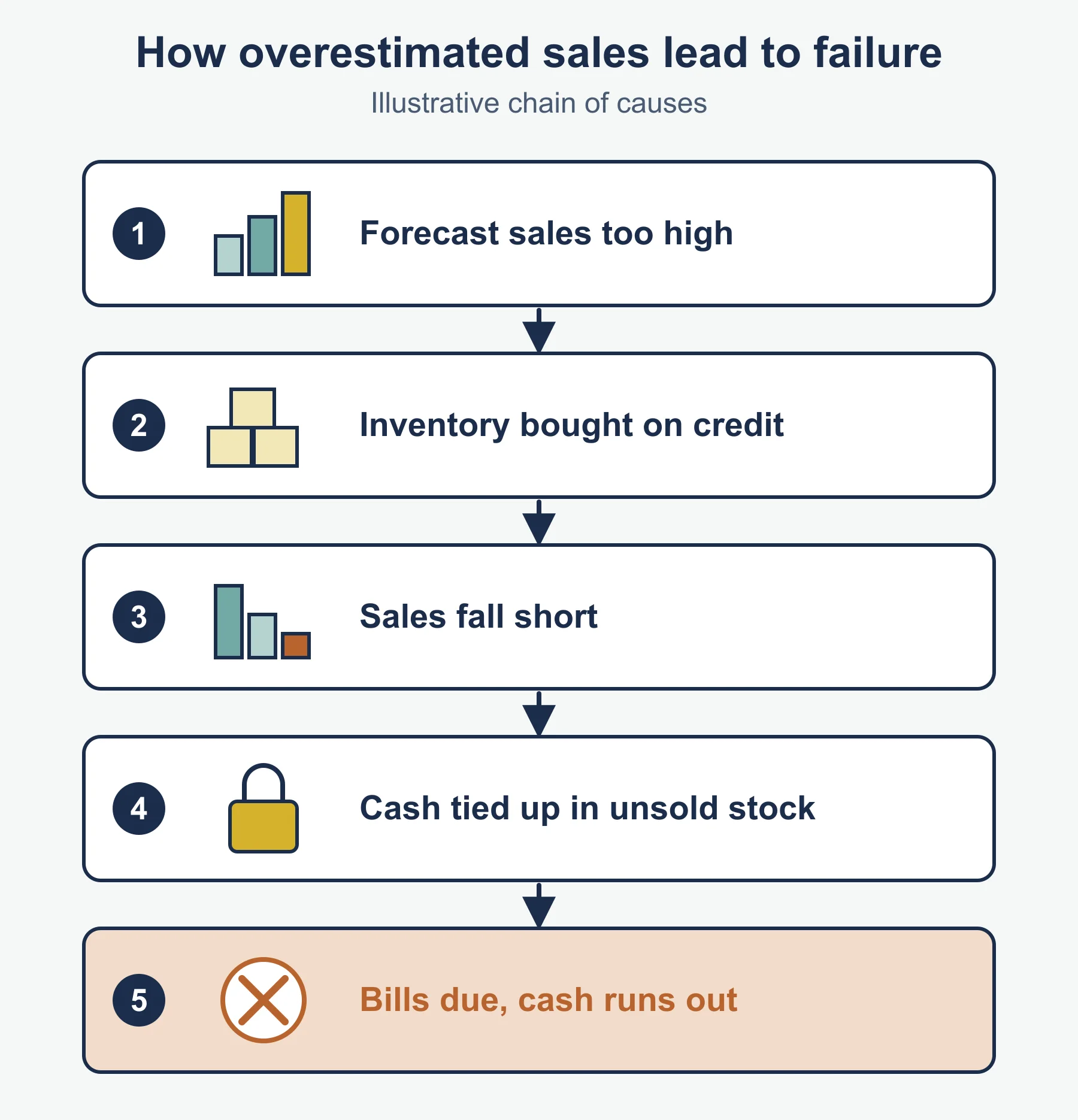
| Overestimation of sales | Competition |
| Overtrading (growth outpacing cash) | Economic conditions |
| Poor inventory control | Exchange rates |
| Poor marketing | Interest rates |
| Poor quality | Government regulations |
| Supplier problems | |
| Natural phenomena |
Internal causes are within management control; external causes are not, though a business can prepare for them.
Quick self-test
- Alderney Frames has fixed costs of 18,000 and contribution of 9 a frame. Find break-even output.
- Sales are 4,000 units and break-even is 3,000 units. State the margin of safety in units and as a percentage of actual output.
- Fixed costs 12,000; variable cost 4 a unit; output 1,500 units. Find average cost.
- Find sales revenue for 640 units sold at 27.50.
- A cost was budgeted at 22,000 and was 24,200. State the variance.
- Opening balance 1,200; inflows 9,000; outflows 10,100. Find the closing balance.
- Revenue 210,000; cost of sales 126,000; other operating expenses 52,500; interest 4,200. Find the operating profit margin.
- Current assets 50,000 (inventory 32,000); current liabilities 40,000. Find the acid test ratio.
- Current assets 55,000; current liabilities 38,000. Find working capital.
- Define overtrading.
- Name two external causes of business failure.
- State one difference between zero-based budgets and budgets based on historical figures.
Answers
- 18,000 ÷ 9 = 2,000 units.
- 4,000 − 3,000 = 1,000 units; 1,000 ÷ 4,000 × 100 = 25% (standard form).
- (12,000 + 4 × 1,500) ÷ 1,500 = 18,000 ÷ 1,500 = 12.00.
- 640 × 27.50 = 17,600.
- 24,200 − 22,000 = 2,200 adverse (10% over budget).
- 1,200 + 9,000 − 10,100 = 100.
- Gross profit 84,000; operating profit 31,500; 31,500 ÷ 210,000 × 100 = 15%.
- (50,000 − 32,000) ÷ 40,000 = 0.45.
- 55,000 − 38,000 = 17,000.
- Expanding output or sales faster than the business can fund the cash needed, so it runs short of cash.
- Any two of: market conditions, competition, economic conditions, exchange rates, interest rates, government regulations, supplier problems, natural phenomena.
- Zero-based budgets start from nothing and justify every item; historical budgets start from last period’s figures and adjust them.
Where marks are usually lost
- Dividing fixed costs by price instead of contribution.
- Quoting break-even in the wrong unit, or leaving out the unit.
- Carrying the wrong closing balance forward in a cash-flow forecast.
- Writing a variance with no favourable or adverse label.
- Leaving inventory in the acid test.
- Calling every fall in profit a cash problem.
- Giving causes of failure as a list without linking them to the case.
- Claiming factoring or selling assets is free of cost.
- Showing no working on a calculate question, since the command word asks for workings.
- Judging a ratio with no benchmark such as a past year or a rival.
Frequently asked questions
How do you calculate the margin of safety? Margin of safety is actual (or budgeted) output minus break-even output. It shows how far sales can fall before the business starts to make a loss.
What is the difference between the current ratio and the acid test ratio? The current ratio is current assets divided by current liabilities. The acid test ratio removes inventory from current assets first, so it shows whether short-term debts can be covered without selling stock.
What is the difference between historical and zero-based budgeting? A historical budget starts from last period’s actual figures, adjusted for expected changes, which is quick but carries over past inefficiency. A zero-based budget starts at zero, so every item of spending must be justified.
What is overtrading? Overtrading means expanding output faster than the cash available to fund it. It is one of the internal causes of business failure in the Edexcel IAL Business (YBS11) specification.
Official syllabus
Pearson Edexcel International Advanced Subsidiary/Advanced Level in Business specification (YBS11), Issue 1, September 2017, Unit 2, sections 2.3.2 and 2.3.3 and Appendices 8 and 9, published by Pearson Education Limited.
Get free revision emails (optional)
Occasional emails with practice questions, worked explanations and links to free resources for the qualification and subjects you choose. No spam, and you can unsubscribe from any email. The free tools on this site never need an email.
Related resources
-
Study guides
Edexcel International A Level Business: Planning a business and raising finance (YBS11)
Study guide to business plans, internal and external finance, forms of business and liability for Edexcel International A Level Business, section 2.3.1.
Business · Pearson Edexcel · AS Level
Read guide -
Practice questions
Edexcel International A Level Business: Planning a business and raising finance (YBS11) – Practice Questions
Twelve original questions with worked answers on business plans, finance, forms of business and liability for Edexcel International A Level Business.
Business · Pearson Edexcel · AS Level
Try questions -
Revision notes
Edexcel International A Level Business: Planning a business and raising finance (YBS11) – Revision Notes
Recall notes on business plans, finance sources and methods, forms of business and liability for Edexcel International A Level Business, section 2.3.1.
Business · Pearson Edexcel · AS Level
Revise topic
Related articles
-
teaching
A Level tuition in Dubai: Cambridge or Pearson Edexcel International A Level?
Schools in Dubai and Abu Dhabi teach either Cambridge International AS & A Level or Pearson Edexcel International A Level. How the two are structured, why it matters for tuition, and how online classes from Lahore work.
9 October 2026
-
curriculum guides
Choosing subjects at IGCSE and A Level
How subject choices at 14 and 16 affect university options later, and how to keep pathways open without overloading a timetable.
28 July 2026
Studying this with a teacher
Working through Business AS LEVEL?
This page is free and stays free. If you would rather be taught it, Marlbridge runs Business classes one-to-one and in small groups of up to 15, online in your own time zone. The first trial class is free. WhatsApp replies within an hour (8am–11pm Pakistan time, every day); email the same day.
Pearson Edexcel Business teachers at Marlbridge

