
Revision Notes
Edexcel International A Level Business: Global business (YBS11) – Revision Notes
Condensed revision notes for all of Unit 4 Global business in Edexcel International A Level Business (YBS11), with a quick self-test and answers.
- Subject
- Business
- Level
- A LEVEL
- Topic
- Global business
- Author
- Marlbridge Academic Team
- Updated
- Reviewed by
- Salman Ahmad (what this means)
Aligned to Pearson Edexcel A Level Business (YBS11), Issue 1, September 2017. Official specification .
Syllabus page (what it covers and how it is assessed): Pearson Edexcel A Level Business.
Syllabus points this page covers
YBS11 (A Level)
- 4 Global business (whole topic)
Found an error? Report a correction.
Need help with this topic? Request a free trial class for A Level Business (YBS11).
These notes condense Unit 4 Global business (sections 4.3.1 to 4.3.4) of the Pearson Edexcel International Advanced Subsidiary/Advanced Level in Business specification (YBS11), Issue 1, September 2017. For full explanations and worked examples, read the study guide. Test yourself with the practice questions. Course hub: Edexcel A Level Business. Checklist: printable checklist. Find weak spots with the free diagnostics.
4.3.1 Globalisation
| Point | Remember |
|---|---|
| Developed | High income per head, services-led, strong infrastructure |
| Developing | Low income per head, more agriculture, weaker infrastructure |
| Emerging | Fast growth, industrialising, opening to trade |
| GDP | Value of output in a period |
| GDP per capita | GDP ÷ population |
| HDI | Income plus health and education measures |
| Exports / imports | Sold abroad / bought from abroad |
| FDI | Investment in operations abroad |
| Specialisation | Concentrating on what is made efficiently, then trading |
Growth gives businesses trade opportunities and shifts employment patterns (farming, then manufacturing, then services). The specification names the growing economic power of Asia, Africa and other regions.
Causes of globalisation: trade liberalisation and the WTO; political change; transport and communication costs falling; MNCs; investment flows (FDI); migration; labour force growth; structural change. Then state the impact on businesses: larger markets, cheaper inputs, more competition, more risk.
Protectionism
| Tool | What it does | Effect |
|---|---|---|
| Tariff | Tax on imports | Raises import price; government gains revenue |
| Import quota | Limit on quantity | Restricts supply; raises price; no tax revenue |
| Legislation | Standards, rules | Can block foreign goods |
| Domestic subsidy | Payment to local firms | Lets local firms undercut imports |
Reasons: protect jobs, young industries and security; reduce a trade deficit. Impact on businesses: exporters face barriers and retaliation; importers pay more; protected firms can become complacent.
Trading blocs. EU and single market (free movement of goods, services, capital and people; common external barriers). ASEAN (South-East Asia). NAFTA (USA, Canada, Mexico). Impact: easier access and scale for members; barriers for outsiders, who may invest inside the bloc.
4.3.2 Global markets and business expansion
| Group | Items |
|---|---|
| Push | Saturated markets; competition |
| Pull | Increased sales and profitability; risk spreading; economies of scale |
| Cost | Off-shoring (own production abroad); outsourcing (another firm does it) |
| Life cycle | Extend the product life cycle in new countries |
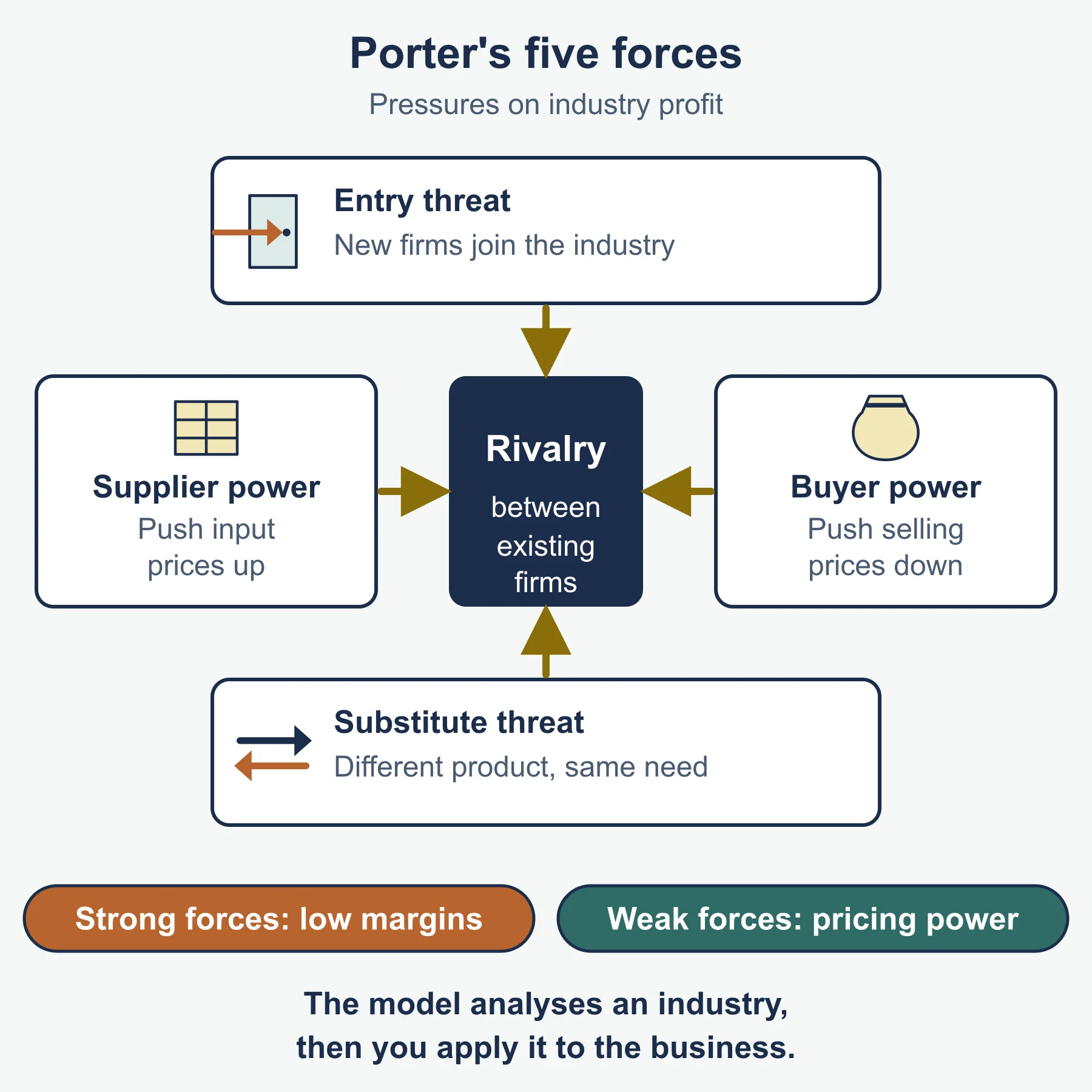
Market assessment checklist: disposable income (level and growth); ease of doing business; infrastructure; political stability; exchange rates; Porter’s five forces (new entrants, substitutes, buyer power, supplier power, rivalry).
Location checklist: production costs; labour skills and availability; infrastructure; trade bloc location; government incentives; ease of doing business; political stability; natural resources; likely return on investment.
Mergers, takeovers, joint ventures (reasons). Spread risk and gain scale; enter markets or blocs; acquire brands or patents; secure supplies; stay competitive; reduce competition; use local knowledge; meet legal requirements; reach supply chains and distribution; share costs and risks.
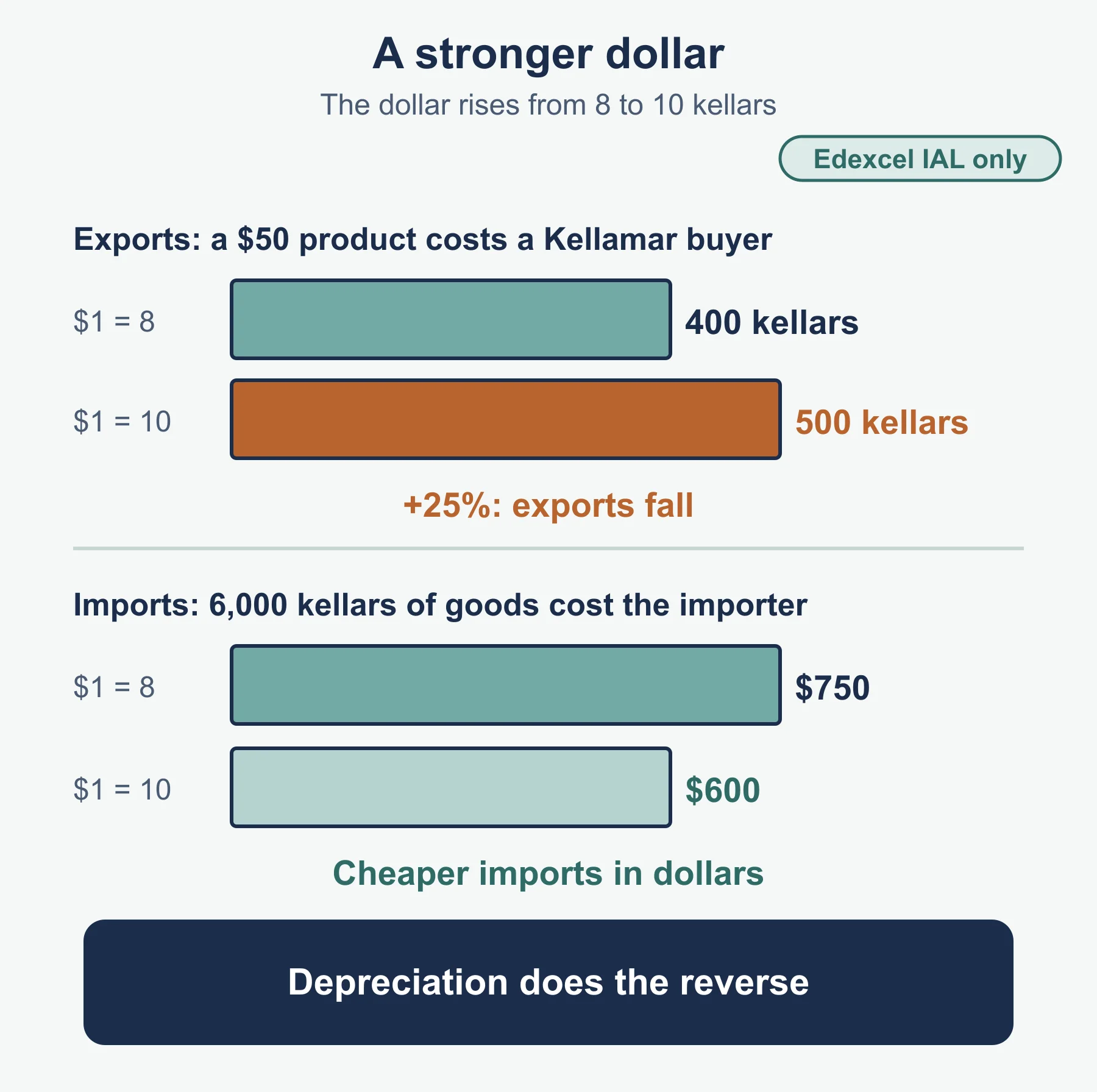
Uncertainty. Exchange rate appreciation makes exports dearer and imports cheaper; depreciation does the reverse. Skill shortages push up wages and weaken competitiveness.
Method: effect of an exchange rate change on a price
- Write the rate as foreign currency per home unit.
- Price in foreign currency = home price × rate.
- Compare old and new, then work out the percentage change.
- State who gains: exporters or importers.
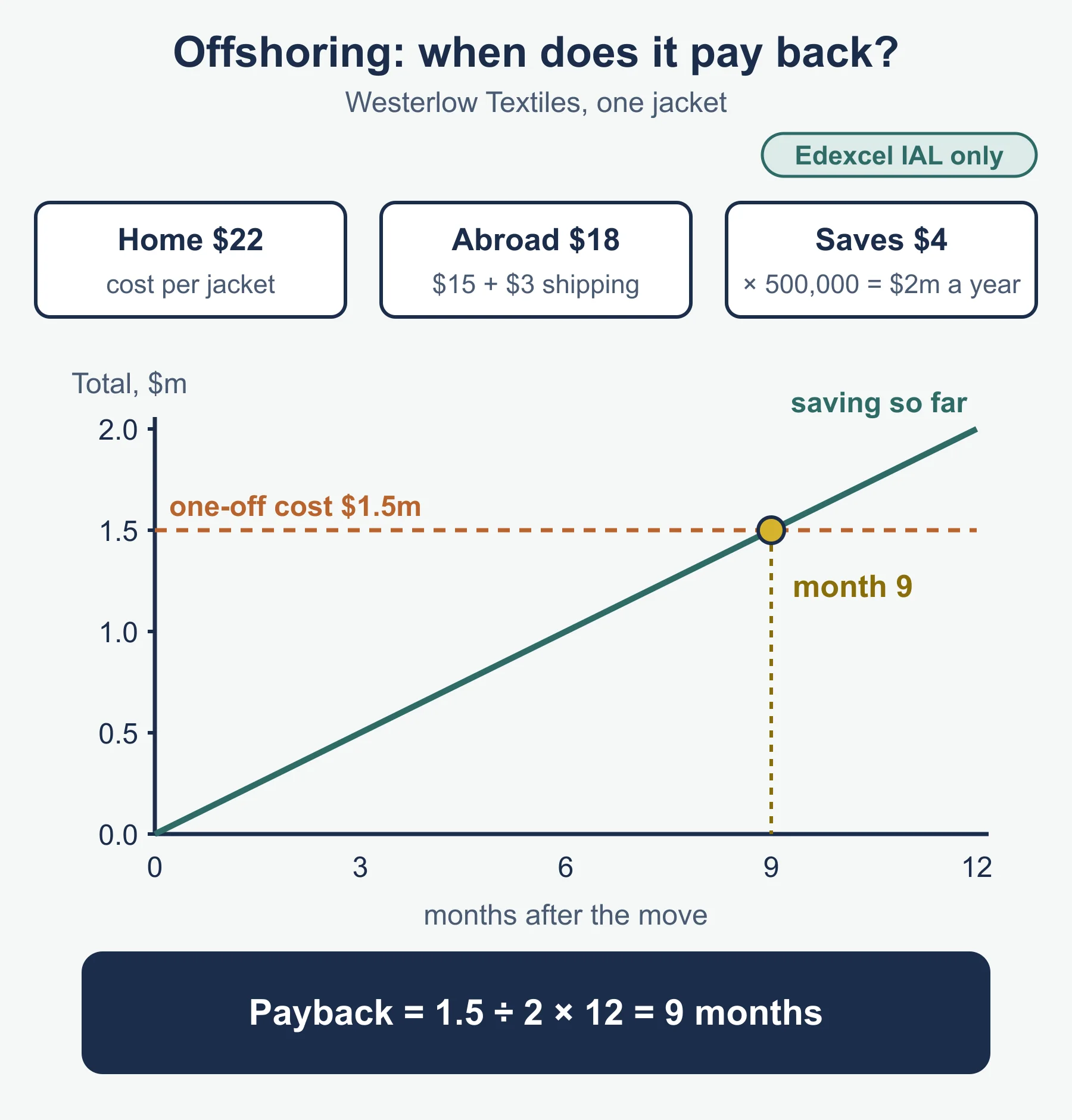
Method: payback (standard form). Payback = initial cost ÷ annual saving or net cash inflow. Return on investment (standard form) = annual profit ÷ investment × 100.
4.3.3 Global marketing
| Term | Meaning |
|---|---|
| Global marketing strategy | One approach across countries |
| Glocalisation | Global brand adapted to local tastes |
| Ethnocentric (domestic) | Home methods applied abroad |
| Geocentric (mixed) | Blend of standard and local |
| Polycentric (international) | Different approach in each country |
4Ps abroad: adapt the product (size, design, packaging), price (income, tariffs, exchange rates), promotion (language, media, values) and place (local distribution). Ansoff: penetration, product development, market development, diversification. Porter’s matrix: cost leadership, differentiation, focus.
Niche markets: groups with distinct interests and values. Features: specialised needs, loyalty, less competition. Adapt the 4Ps accordingly. Cultural and social factors: cultural differences, tastes, language and unintended meanings, inappropriate branding and promotion.
4.3.4 Global industries and companies
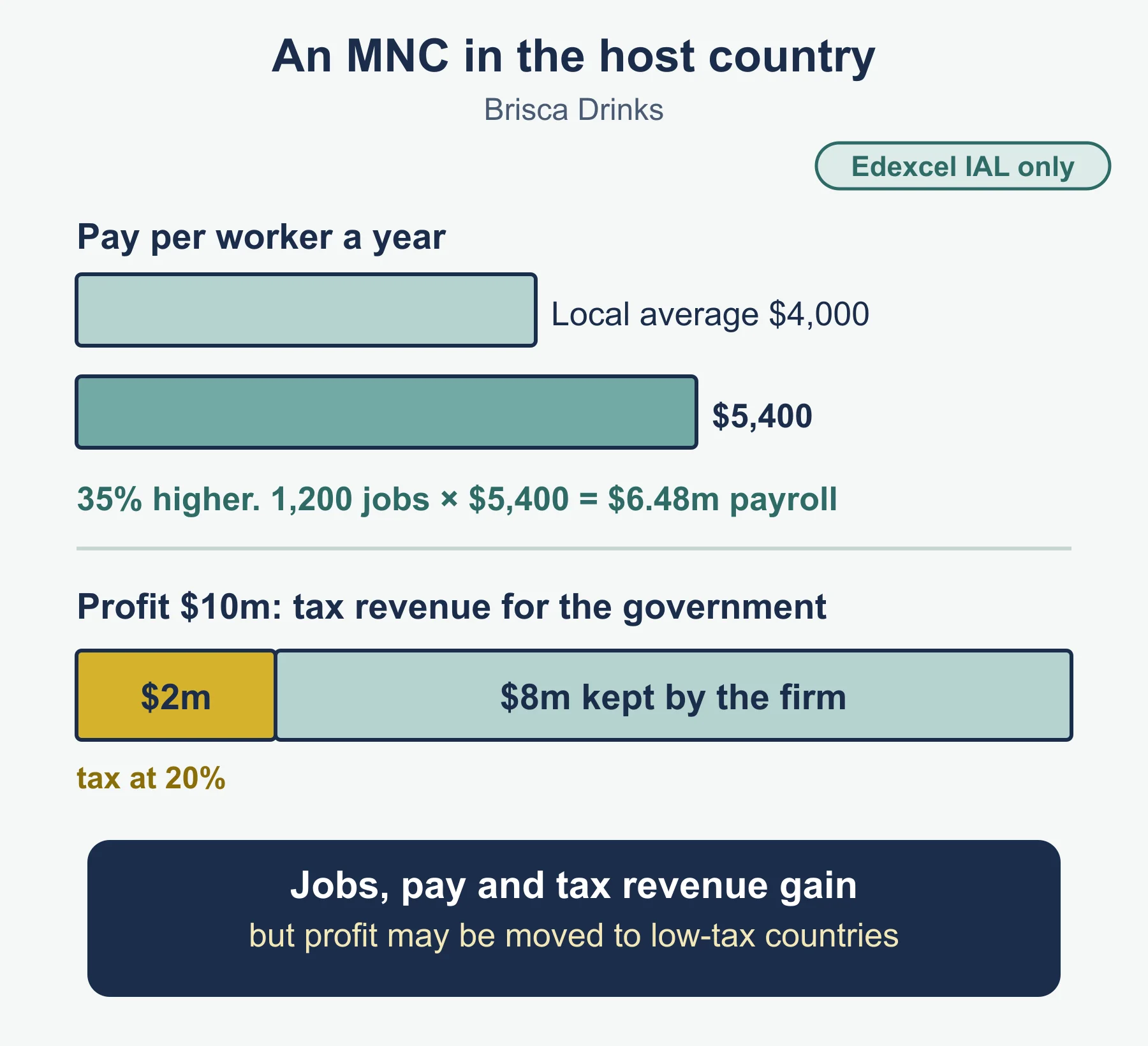
Local economy: jobs, wages, conditions; local businesses; community and environment. National economy: growth; FDI flows; balance of payments; technology and skills transfer; consumers; business culture; tax revenues.
Ethics: stakeholder conflicts; emissions, waste and sustainability; supply chains (pay, conditions, exploitation, child labour); marketing (misleading labels, inappropriate activities).
Controlling MNCs: their power; political influence; legal control; consumer pressure; pressure groups; social media; self-regulation.
Worked reminders
Exchange rate. Hadlow Bikes sells a bike for 300 dollars abroad. At 4 zelds per dollar the buyer pays 1,200 zelds. If the rate becomes 5, the buyer pays 1,500 zelds, up 25% (300 ÷ 1,200 = 25%). Expect fewer sales unless the brand is strong.
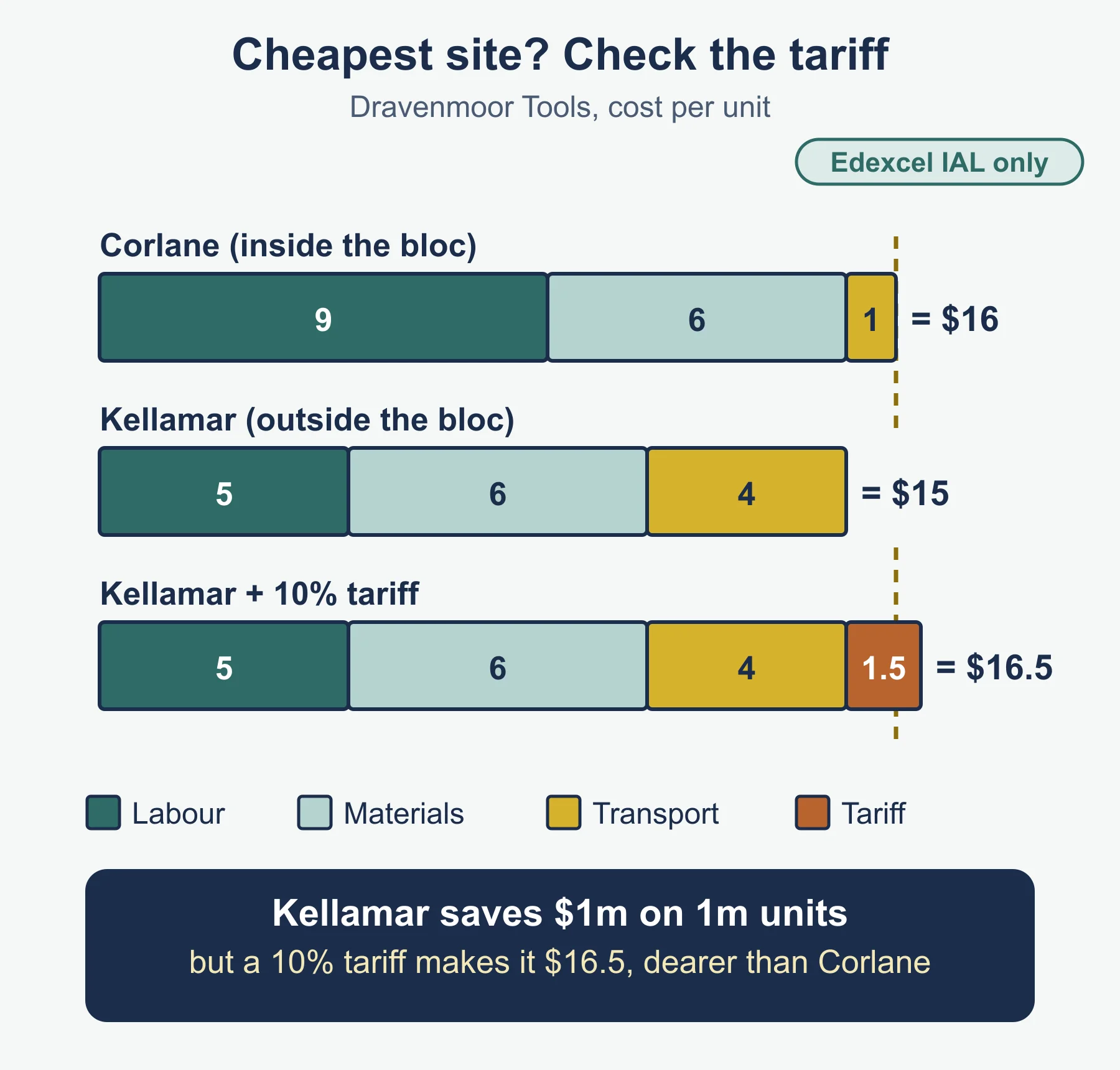
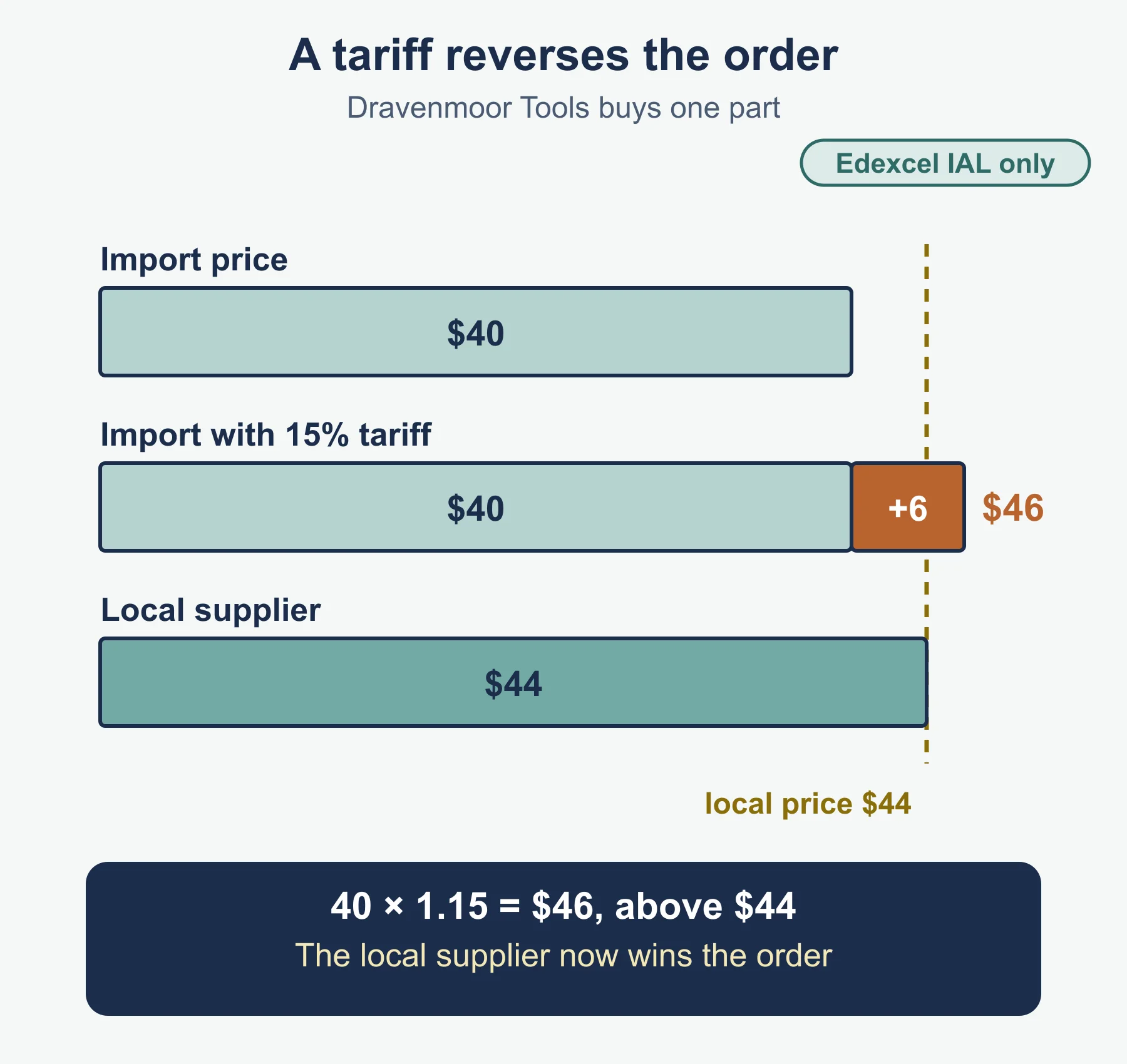
Tariff. An importer pays 250 for a part. A 20% tariff adds 50. If a local rival sells the same part at 280, the tariff has made the rival cheaper by 20.
Payback. A relocation costing 900,000 saves 450,000 a year, so payback is 2 years. State whether this is quick given the time the firm expects to stay in the market.
Joint venture. An 8m project shared 75:25 costs the partners 6m and 2m. The smaller partner gains access at lower risk but also less control.
Judgement prompts
Use these to turn a list into an assessment.
- Expansion abroad: compare the size of the market with the risk. A big market with unstable politics or volatile exchange rates may not justify entry.
- Off-shoring: cost savings against quality control, shipping time and reputation.
- Joint venture or takeover: local knowledge and shared risk against loss of control and clashes of culture.
- Standardise or adapt: a global brand saves cost, but adaptation avoids cultural mistakes.
- Protectionism: good for protected jobs in the short run, but higher prices for consumers and the risk of retaliation.
- MNC impact: jobs and tax revenue against pressure on local firms and the environment. Say which stakeholder you are judging.
- Controlling MNCs: the stronger the MNC, the more control depends on consumers, pressure groups and social media.
Linking the sections
The four sections are one story. Globalisation (4.3.1) creates the conditions; push and pull factors (4.3.2) explain why a firm goes abroad; the marketing choices (4.3.3) decide how it sells once there; and the MNC sections (4.3.4) ask what its size means for host countries and stakeholders. In an extended answer, show one link across sections, for example: falling transport costs (4.3.1) make off-shoring (4.3.2) cheaper, but supply chain ethics (4.3.4) may then damage the brand.
Use data from Units 1, 2 and 3 as well: break-even, cash flow, and the strategic tools such as Ansoff and Porter all return in global contexts.
Must-know distinctions
- Off-shoring moves your own production abroad; outsourcing hands the work to another firm.
- A tariff raises price and brings revenue; a quota limits quantity.
- Ethnocentric uses home methods; polycentric tailors to each country; geocentric blends.
- GDP measures output; HDI adds health and education.
Quick self-test
- A country has GDP of 45bn dollars and 9 million people. Find GDP per capita.
- GDP rises from 200bn to 210bn. Find the percentage growth.
- An imported good costs 250 and faces a 20% tariff. Find the new price.
- An importer paying in dollars buys goods priced at 120,000 zelds. The rate moves from 2.0 to 2.5 zelds per dollar. Find the dollar cost before and after, and the percentage change.
- A project costing 600,000 adds 90,000 profit a year. Find the return on investment.
- A 900,000 relocation saves 450,000 a year. Find the payback period.
- Name two push factors.
- Name two pull factors.
- A joint venture costs 8m and is shared 75:25. State each partner’s share.
- Name the term for a global brand adapted to local tastes.
- Give two ways of controlling an MNC.
- State one reason why a strong currency may hurt an exporter.
Answers
- 5,000 dollars.
- 5%.
- 250 × 1.2 = 300.
- 60,000 dollars before and 48,000 after, a 20% fall. The dollar has appreciated, so imports priced in zelds are cheaper for the importer.
- 15%.
- 2 years.
- Saturated home market; strong competition.
- Higher sales and profitability; risk spreading (or economies of scale).
- 6m and 2m.
- Glocalisation (global localisation).
- Any two: legal control, consumer pressure, pressure groups, social media, self-regulation.
- Foreign buyers pay more in their own currency, so demand may fall.
Where marks are usually lost
- Listing factors without linking them to the business in the data.
- Mixing up off-shoring and outsourcing.
- Treating a quota as a tax.
- Giving a correct number but not interpreting it (for example, a payback figure with no judgement).
- Forgetting that a weaker currency raises import costs.
- One-sided answers to discuss, assess or evaluate questions with no reasoned judgement.
- Describing MNC effects in general terms rather than for the stakeholder named.
- Forgetting to show workings on calculate questions.
Frequently asked questions
What is the difference between a tariff and an import quota? A tariff is a tax on imports, which raises their price. An import quota is a limit on the quantity imported, which raises prices by restricting supply, and the government earns no tax revenue from it.
What is the difference between off-shoring and outsourcing? Off-shoring means moving production abroad. Outsourcing means paying another firm to carry out the work. Both can make a business more cost competitive.
What are push and pull factors in global expansion? Push factors, such as saturated markets and competition, drive a firm out of its home market. Pull factors, such as increased sales and profitability, risk spreading and economies of scale, attract it abroad.
What is glocalisation? Global localisation, or glocalisation, keeps a global brand but adapts products and marketing to local tastes. It sits between a single global strategy and a separate approach for each country.
Official syllabus
Pearson Edexcel International Advanced Subsidiary/Advanced Level in Business, Specification, Issue 1, September 2017, Unit 4: Global business (first assessment June 2020).
Get free revision emails (optional)
Occasional emails with practice questions, worked explanations and links to free resources for the qualification and subjects you choose. No spam, and you can unsubscribe from any email. The free tools on this site never need an email.
Related resources
-
Study guides
Edexcel International A Level Business: Global business (YBS11)
Study guide to all of Unit 4 Global business in Edexcel International A Level Business (YBS11): globalisation, markets, marketing and MNCs.
Business · Pearson Edexcel · A Level
Read guide -
Practice questions
Edexcel International A Level Business: Global business (YBS11) – Practice Questions
Original practice questions with worked answers on Unit 4 Global business in Edexcel International A Level Business (YBS11).
Business · Pearson Edexcel · A Level
Try questions -
Study guides
Edexcel International A Level Business: Managing people and Entrepreneurs and leaders (YBS11)
Teaching guide to staffing, structure, motivation, leadership, entrepreneurs and objectives for Edexcel International A Level Business Unit 1.
Business · Pearson Edexcel · AS Level
Read guide
Related articles
-
teaching
A Level tuition in Dubai: Cambridge or Pearson Edexcel International A Level?
Schools in Dubai and Abu Dhabi teach either Cambridge International AS & A Level or Pearson Edexcel International A Level. How the two are structured, why it matters for tuition, and how online classes from Lahore work.
9 October 2026
-
curriculum guides
Choosing subjects at IGCSE and A Level
How subject choices at 14 and 16 affect university options later, and how to keep pathways open without overloading a timetable.
28 July 2026
Studying this with a teacher
Working through Business A LEVEL?
This page is free and stays free. If you would rather be taught it, Marlbridge runs Business classes one-to-one and in small groups of up to 15, online in your own time zone. The first trial class is free. WhatsApp replies within an hour (8am–11pm Pakistan time, every day); email the same day.
Pearson Edexcel Business teachers at Marlbridge

