
Study Guides
Edexcel International A Level Business: Managing people and Entrepreneurs and leaders (YBS11)
Teaching guide to staffing, structure, motivation, leadership, entrepreneurs and objectives for Edexcel International A Level Business Unit 1.
- Subject
- Business
- Level
- AS LEVEL
- Topic
- Marketing and people
- Author
- Marlbridge Academic Team
- Updated
- Reviewed by
- Salman Ahmad (what this means)
Aligned to Pearson Edexcel A Level Business (YBS11), Issue 1, September 2017. Official specification .
Syllabus page (what it covers and how it is assessed): Pearson Edexcel A Level Business.
Syllabus points this page covers
YBS11 (AS Level)
- 1.3.4 Managing people
- 1.3.5 Entrepreneurs and leaders
Found an error? Report a correction.
Need help with this topic? Request a free trial class for A Level Business (YBS11).
This guide is aligned to the Pearson Edexcel International Advanced Subsidiary/Advanced Level in Business specification (Issue 1, September 2017). It covers Unit 1, Marketing and people, sections 1.3.4 Managing people and 1.3.5 Entrepreneurs and leaders, for the International AS unit. The specification says calculators may be used on Unit 1.
Related pages: the topic overview, Marketing and people notes, Marketing and people practice, and for this scope the revision notes and practice questions. Also the course hub, the printable checklist and a free 10-minute diagnostic.
What the specification lists
| Section | Points you must be able to handle |
|---|---|
| 1.3.4 (1) Approaches to staffing | staff as an asset or a cost; flexible workforce; dismissal versus redundancy; individual approach and collective bargaining |
| 1.3.4 (2) Recruitment, selection and training | internal versus external recruitment; costs; induction, on-the-job, off-the-job |
| 1.3.4 (3) Organisational design | hierarchy, chain of command, span of control, centralised and decentralised; tall, flat, matrix; impact on efficiency and motivation |
| 1.3.4 (4) Motivation | why it matters; Taylor, Mayo, Maslow, Herzberg; five financial and eight non-financial methods |
| 1.3.4 (5) Leadership | management versus leadership; four styles; moving from entrepreneur to leader |
| 1.3.5 (1) Role of an entrepreneur | setting up; running and expanding; intrapreneurship; barriers; risk and uncertainty |
| 1.3.5 (2) Motives and characteristics | characteristics and skills; profit maximisation and satisficing; ethical stance, social entrepreneurship, independence, home working |
| 1.3.5 (3) Business objectives | survival; profit maximisation; sales maximisation, market share, cost efficiency, employee welfare, customer satisfaction, social objectives |
| 1.3.5 (4) Business choices | opportunity cost; trade-offs |
Approaches to staffing
Employees can be seen as an asset: skills that build competitive advantage, worth investing in. They can also be seen as a cost: an expense to hold down by trimming headcount and hours. Most firms mix the views.
A flexible workforce lets the business change labour input as demand changes. The specification names five forms.
- Multi-skilling: staff trained for several jobs, so cover is easy; training costs rise.
- Part-time and temporary staff: fewer hours or a fixed period. Good for peaks; less commitment.
- Zero-hour contracts: no guaranteed hours; staff are called in when needed. Low cost for the employer, but income insecurity for the employee.
- Flexible hours and home working: staff choose when or where they work. Aids retention, harder to supervise.
- Outsourcing: a task, such as payroll, bought from an outside firm. Gives expertise; control is weaker.
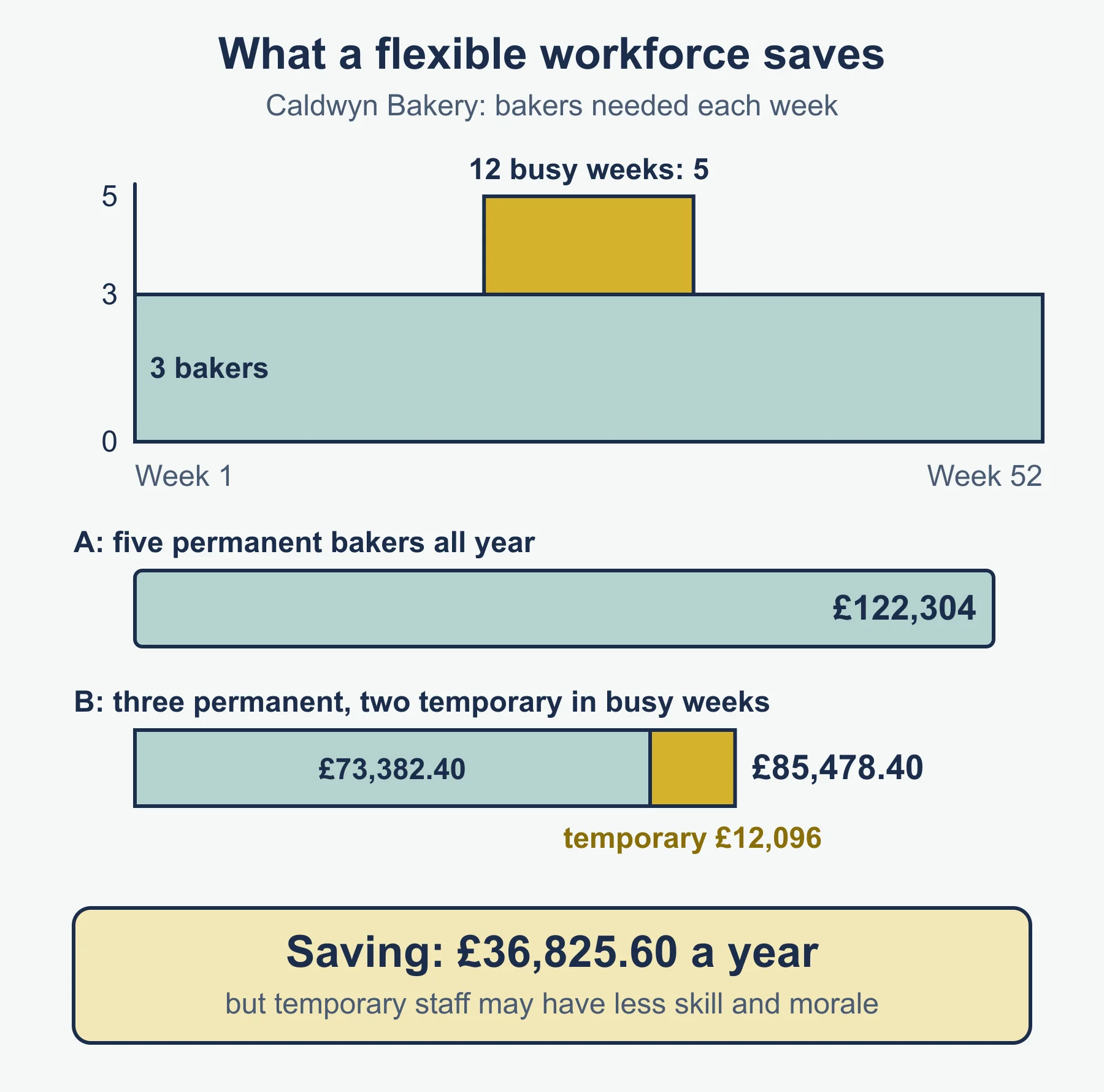
Worked example: the cost of flexibility. Caldwyn Bakery needs five bakers in 12 busy weeks and three in the other 40. A permanent baker is paid £11.20 an hour for 37.5 hours, plus 12% employer on-costs: £470.40 a week. A temporary baker costs 20% more through an agency (no on-costs): £504 a week.
- Option A, five permanent bakers all year: 5 × £470.40 × 52 = £122,304.
- Option B, three permanent and two temporary for the busy weeks: 3 × £470.40 × 52 = £73,382.40, plus 2 × £504 × 12 = £12,096. Total £85,478.40.
- Saving from flexibility: £36,825.60 a year.
The saving ignores the lower skill and morale of temporary staff, so say so in a judgement.
Dismissal and redundancy. Dismissal is the employer terminating a contract over the worker’s own conduct or performance, such as repeated misconduct or poor performance. Redundancy means the job no longer exists, for example after a plant closes, so the person is not at fault.
Employer/employee relationships. In an individual approach each employee agrees terms directly with the employer, which allows tailored deals and quick decisions. In collective bargaining representatives, often a trade union, negotiate pay and conditions for a whole group. The group has more power and the employer holds one set of talks, but disputes can disrupt production.
Recruitment, selection and training
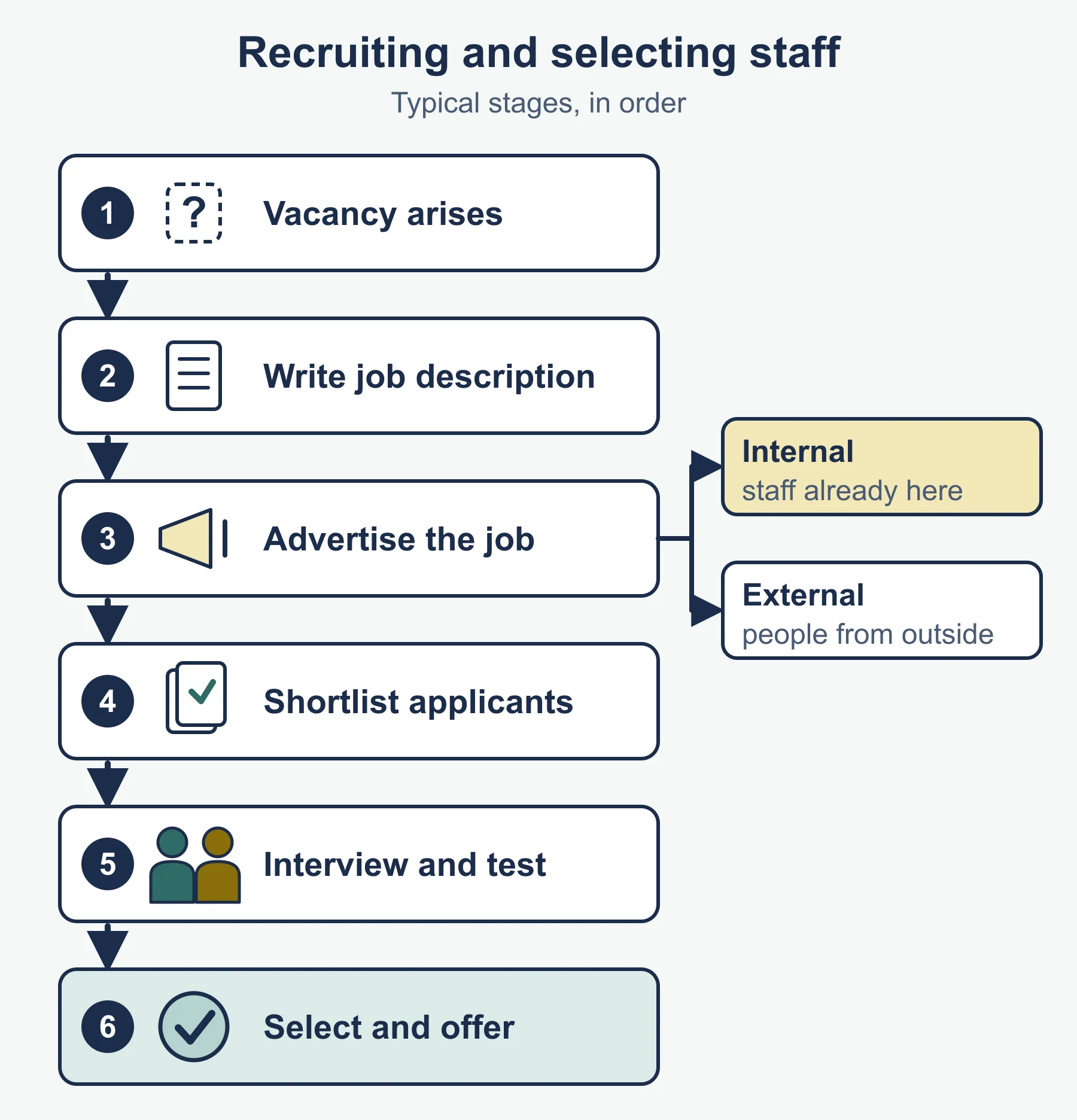
Recruitment attracts applicants; selection chooses between them using CVs, interviews and tests. Internal recruitment fills a post from existing staff: cheaper and quicker, but a narrow choice that leaves a gap elsewhere. External recruitment advertises outside: fresh ideas and a wider pool, but dearer, and the newcomer takes longer to settle.
Costs of recruitment, selection and training include advertising, agency fees, managers’ interview time, testing, induction, trainers’ pay and the output lost while someone learns.
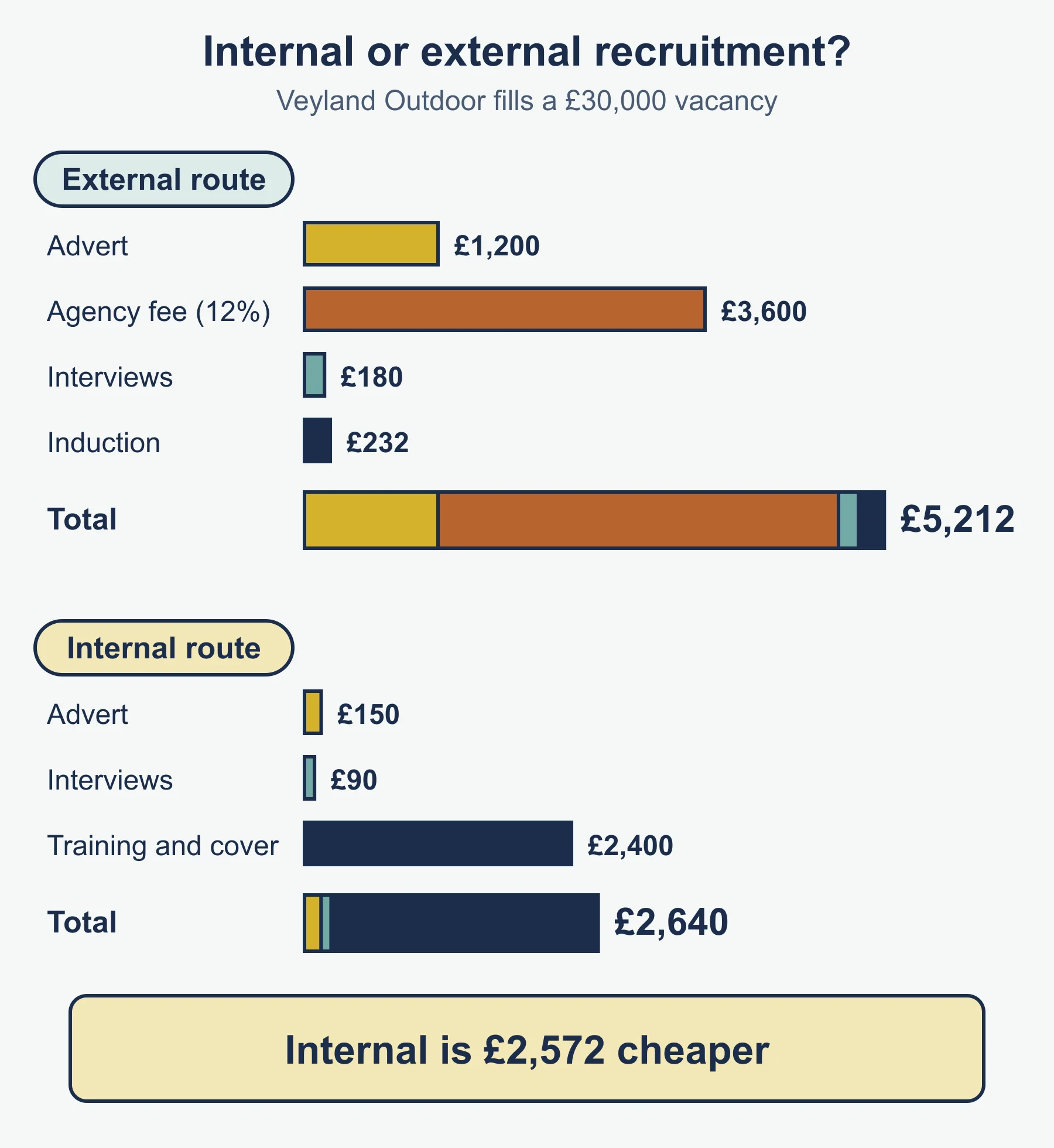
Worked example. Veyland Outdoor fills a £30,000 vacancy. The external route: advert £1,200; agency fee 12% of salary, £3,600; three managers interview for 2 hours each at £30 an hour, £180; two days’ induction for the newcomer (16 hours at £14.50), £232. Total: £5,212. The internal route: advert £150; the same three managers for 1 hour each, £90; £2,400 of training and cover for the promoted person’s old post. Total: £2,640. Internal is £2,572 cheaper.
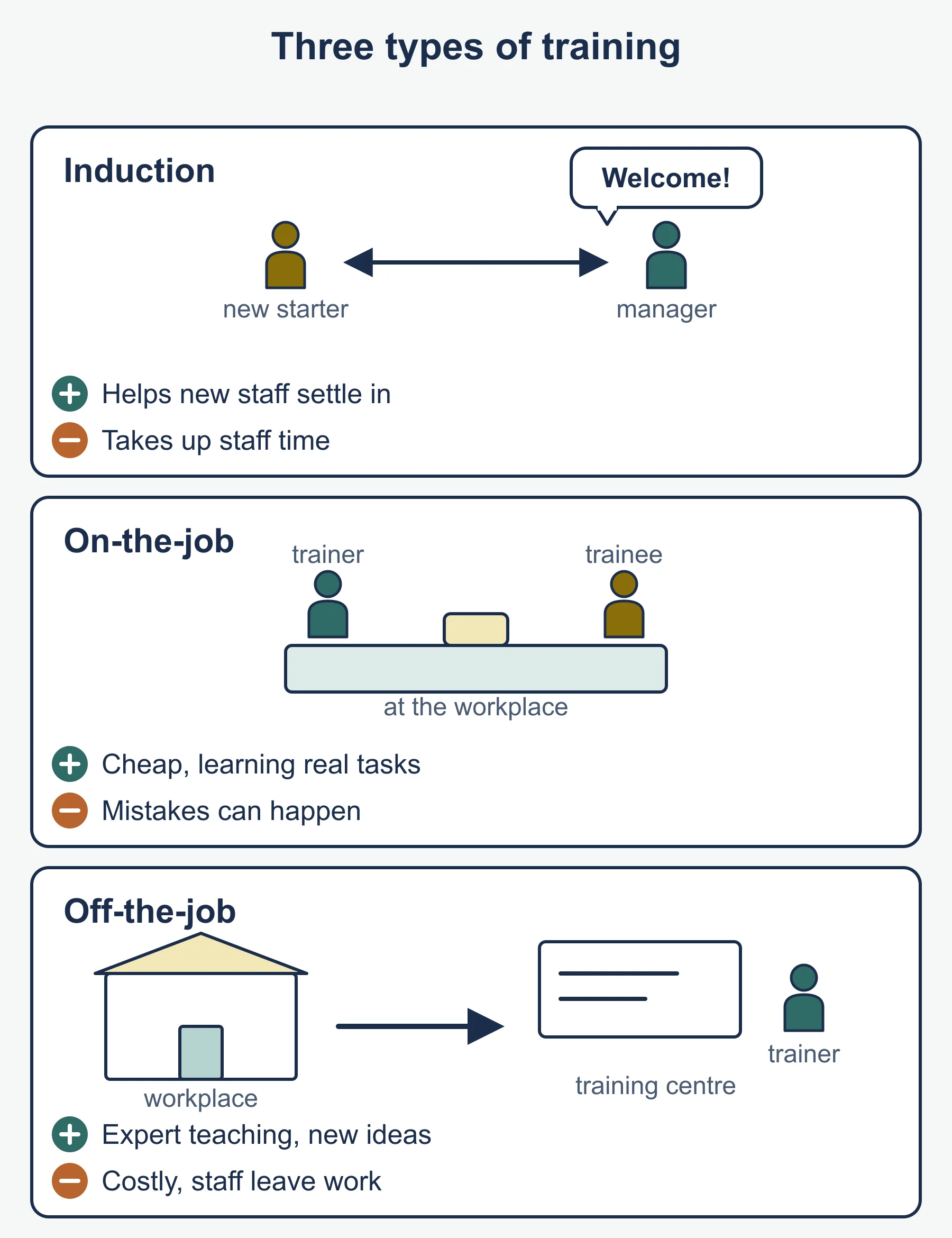
Types of training.
| Type | What it is | Strength | Weakness |
|---|---|---|---|
| Induction | Introduces a newcomer to the firm, rules and colleagues | Faster settling | Little skill gain |
| On-the-job | Learning by doing, beside an experienced colleague | Cheap, relevant | Passes on bad habits |
| Off-the-job | Away from work, such as a course | Expert input, qualifications | Costly; employee absent |
Organisational design
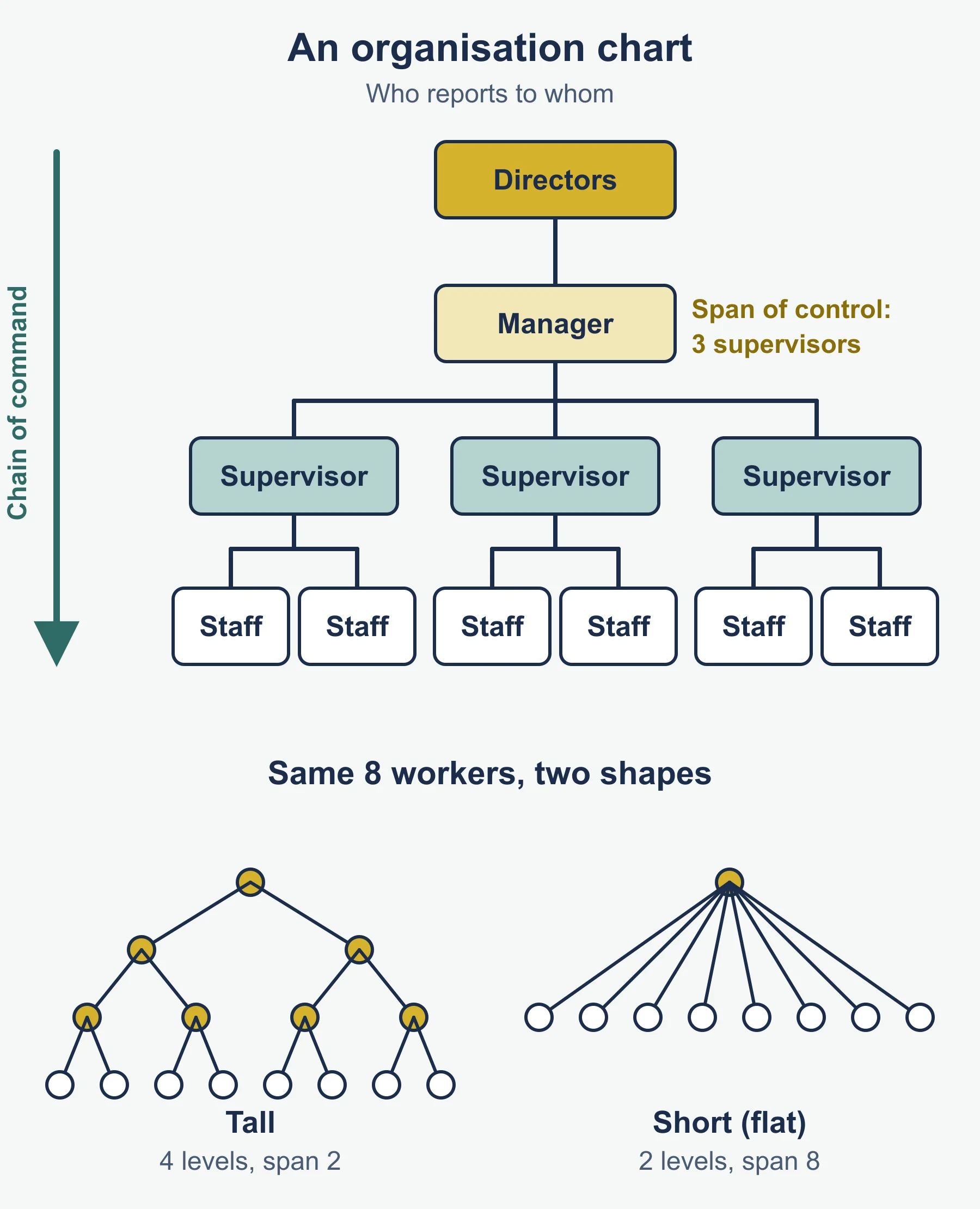
- Hierarchy: the levels of authority from top to bottom.
- Chain of command: the path along which instructions pass down and reports go up.
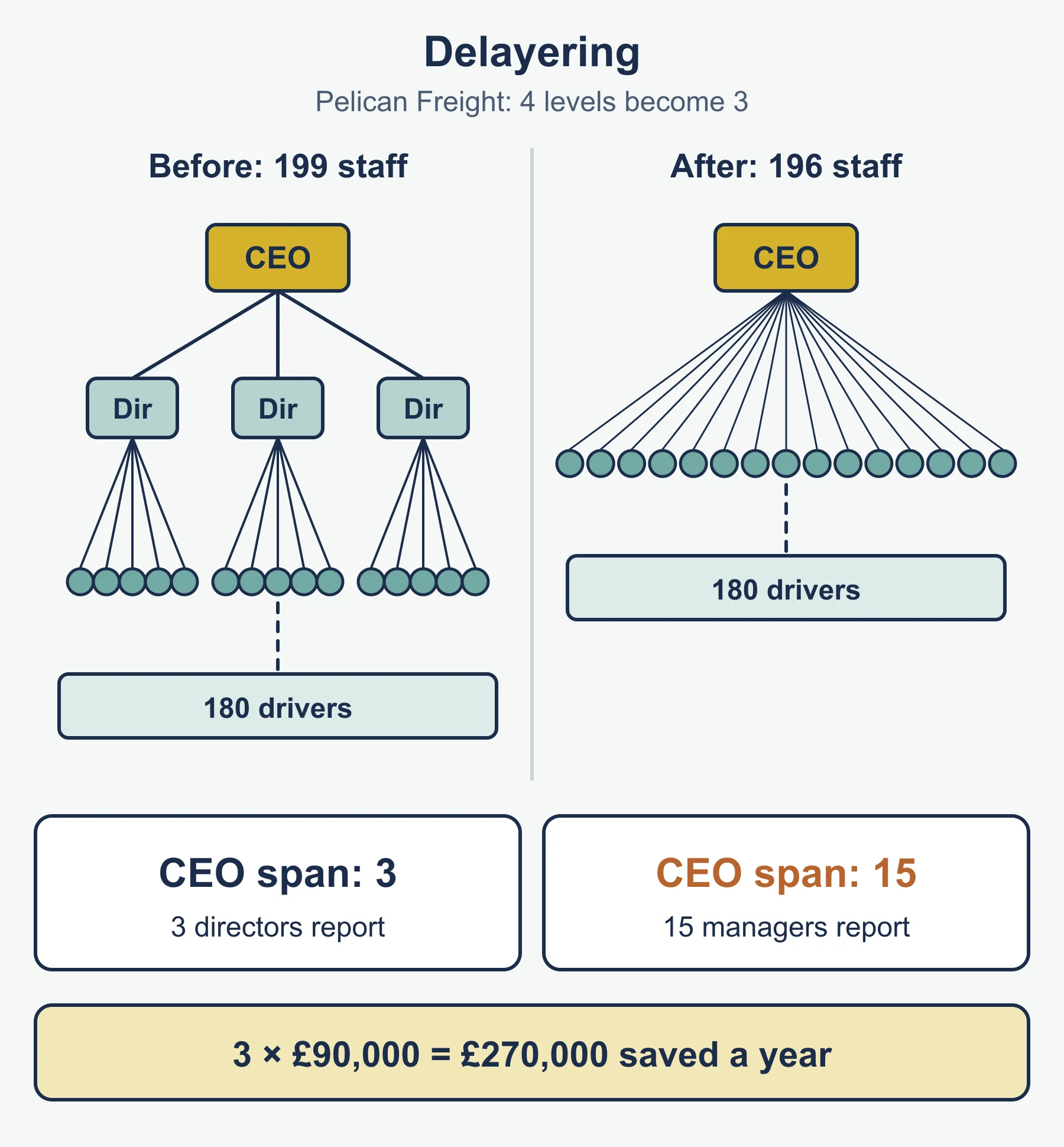
- Span of control: the number of people reporting directly to one manager.
- Centralised: key decisions are taken at the top, giving consistency but slower local response.
- Decentralised: decisions are pushed down, giving faster local response and more empowerment, but weaker central control.
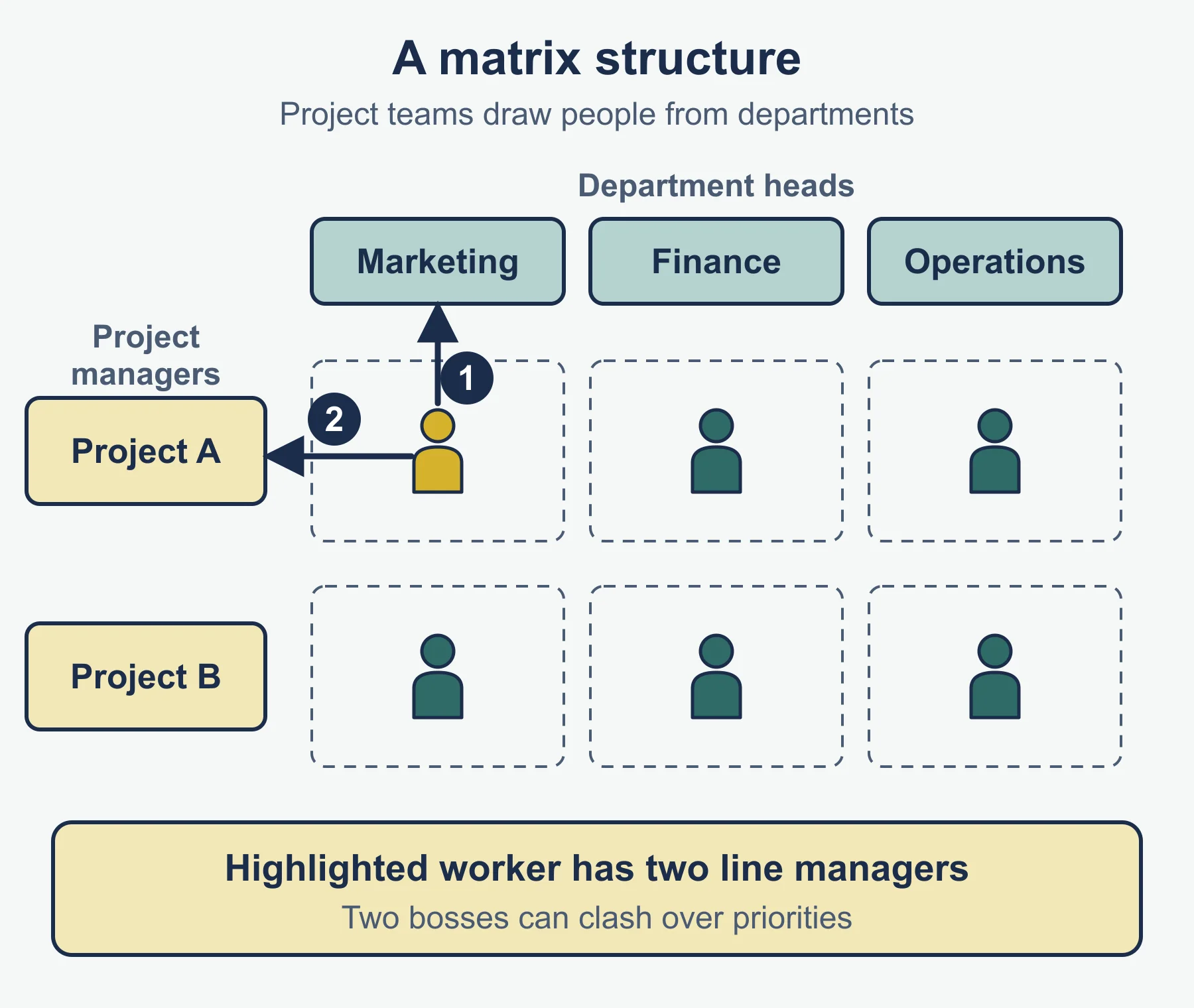
A tall structure has many levels and narrow spans. A flat structure has few levels and wide spans. A matrix structure sets up project teams that draw people from several departments, so each person has more than one line manager.
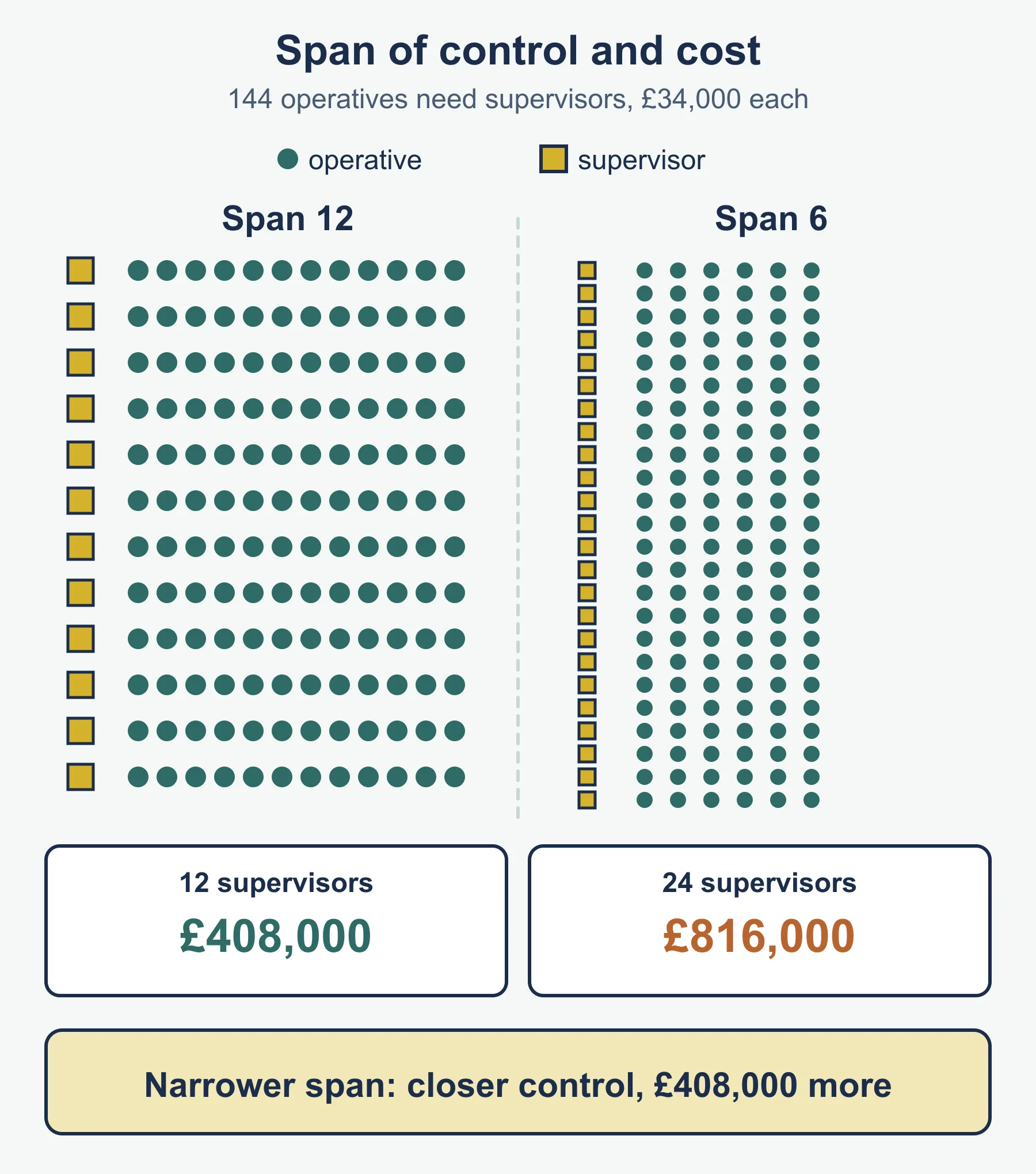
Worked example: span and cost. A plant has 144 operatives. With a span of 12 it needs 144 ÷ 12 = 12 supervisors; at £34,000 each that is £408,000. With a span of 6 it needs 24 supervisors, costing £816,000. Narrow spans give closer supervision but double the supervision bill: £408,000 more.
Impact on efficiency and motivation. Flatter structures cut management cost and speed communication, and wider spans push people to take responsibility, which can motivate; they can overload managers and remove promotion steps. Tall structures give career ladders and close control but are slow, costly and can feel restrictive. Matrix structures use skills across the business, but two bosses can clash over priorities.
Motivation in theory and practice
Why it matters. Motivated employees tend to work harder and stay longer, raising output and quality and cutting absence and recruitment cost. Methods cost money, so weigh benefit against cost.
The four theories.
| Theorist | Idea | What it suggests |
|---|---|---|
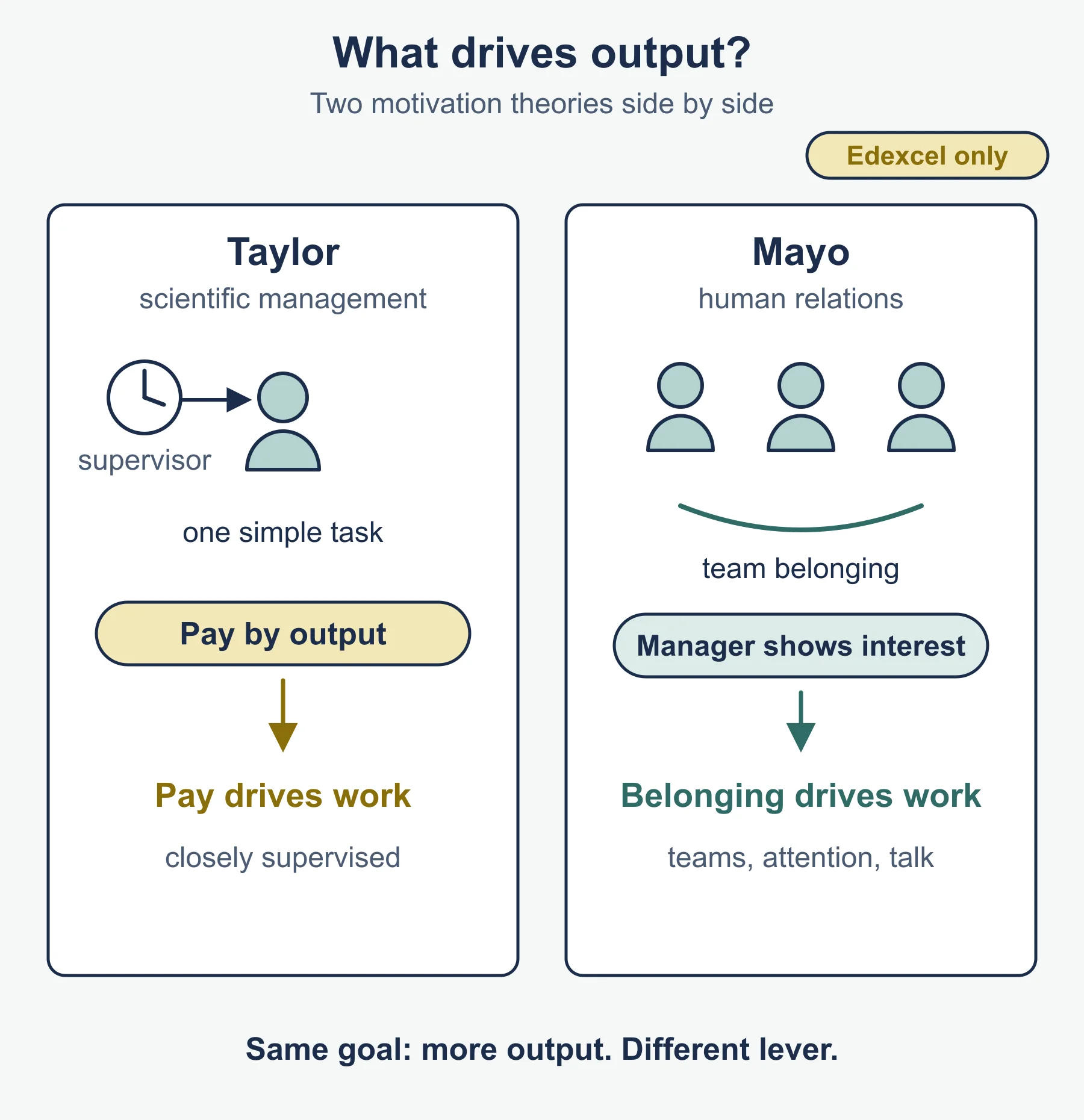
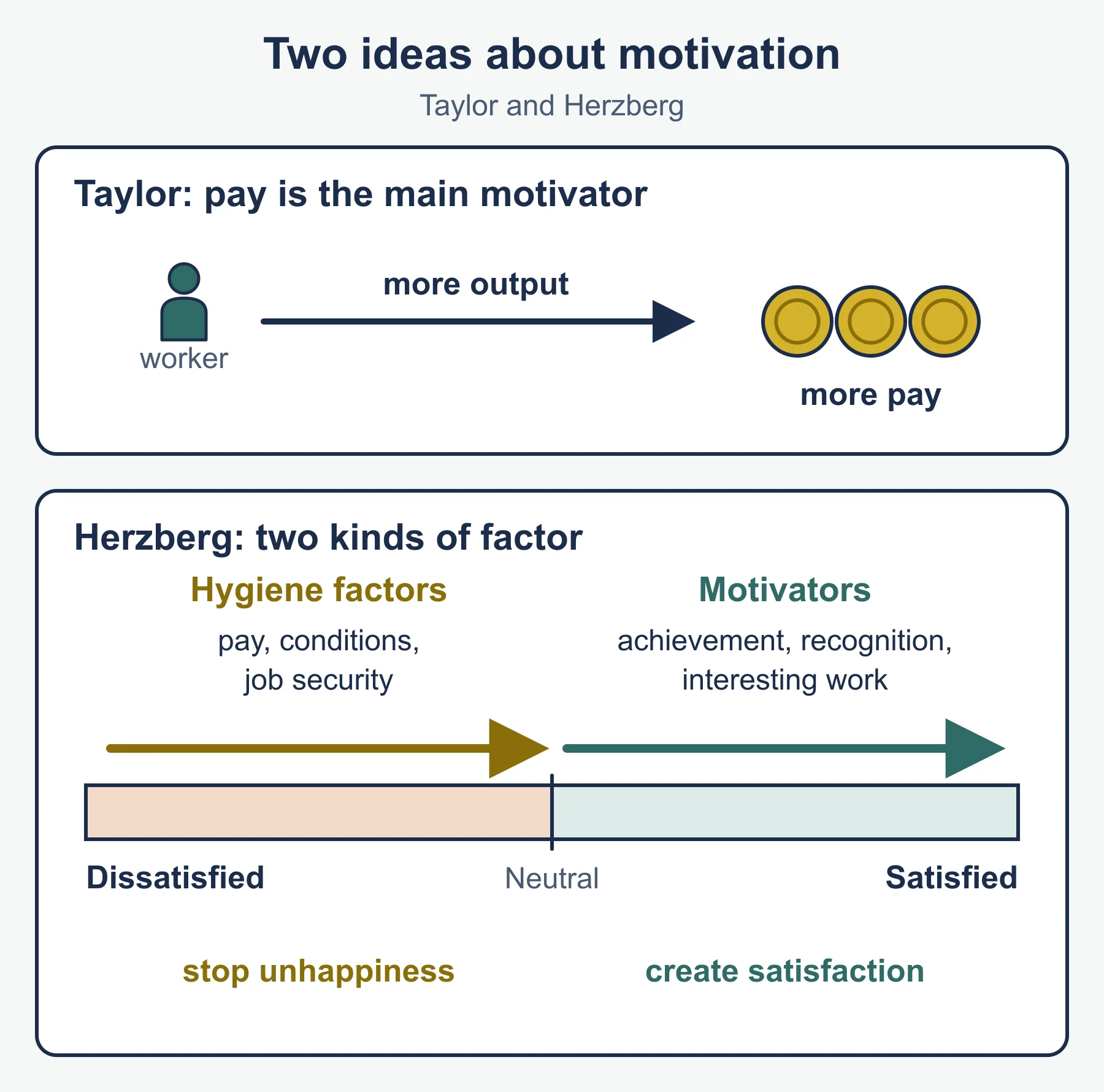
| Taylor (scientific management) | Work is broken into simple tasks, closely supervised and paid by output | Employees are mainly driven by pay |
| Mayo (human relations) | Belonging and attention affect output | Teams, interest from managers and communication |
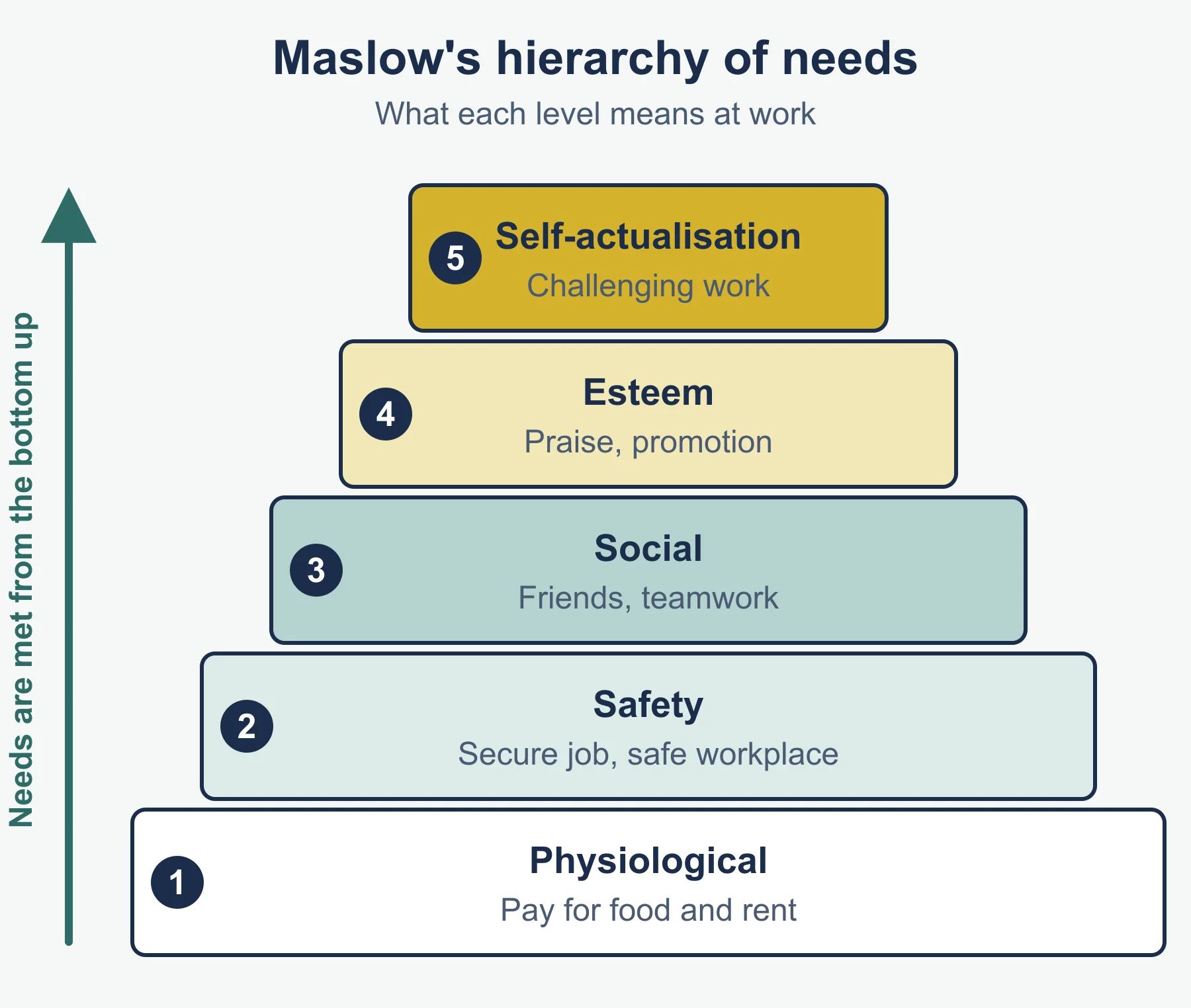
| Maslow (hierarchy of needs) | Needs run from physiological, through safety, social and esteem, to self-actualisation | Meet lower needs first, then offer higher ones |
| Herzberg (two-factor) | Hygiene factors prevent dissatisfaction; motivators create satisfaction | Fix pay and conditions, then add recognition and responsibility |
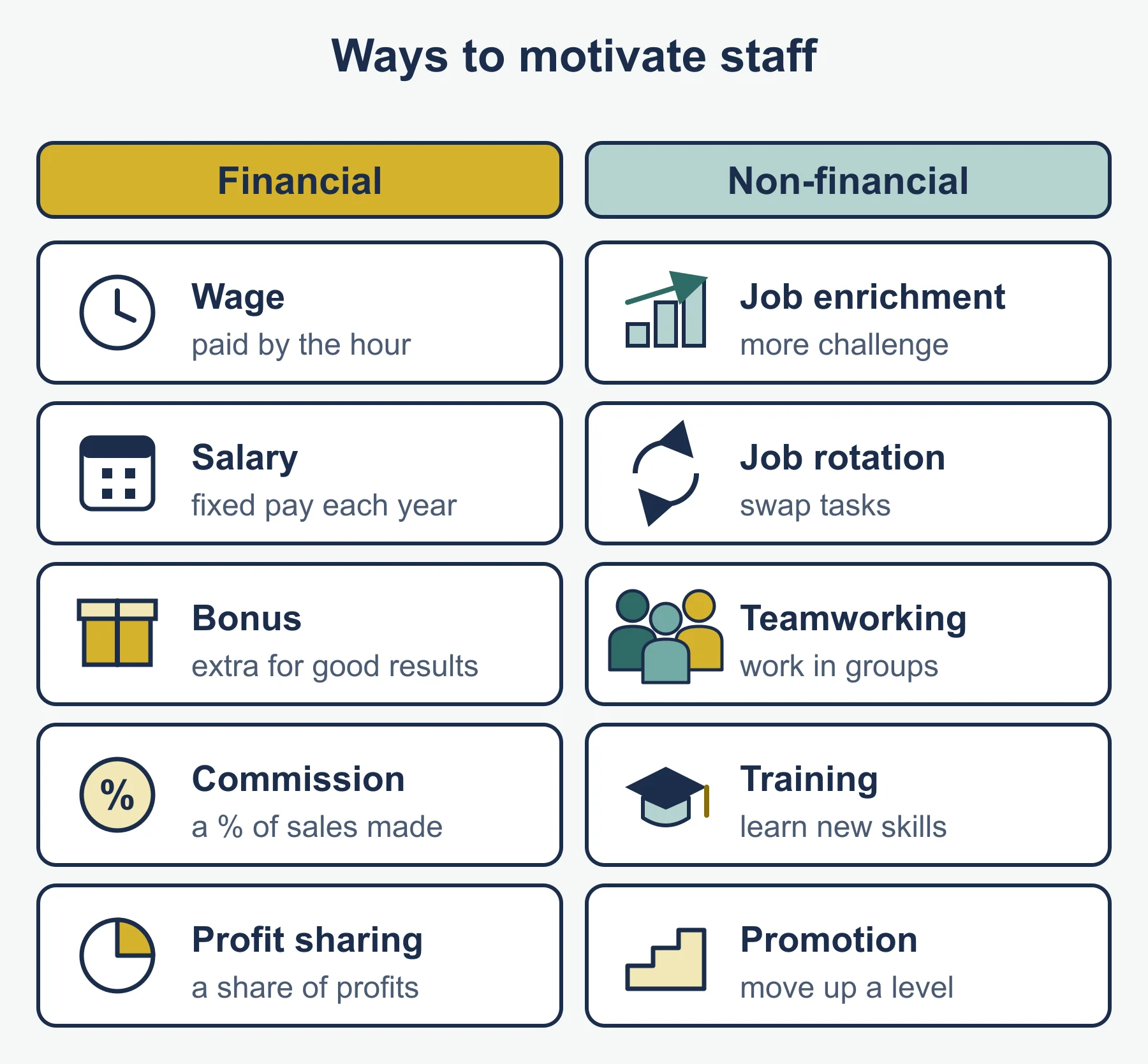
Financial methods.
- Piecework: pay per unit made; quality may fall.
- Commission: a percentage of sales; can push aggressive selling.
- Bonus: a one-off extra payment for meeting a target.
- Profit share: employees share company profit; builds loyalty but pay swings with profit.
- Performance-related pay: pay depends on assessed performance; measuring it can cause disputes.
Worked example. A Veyland salesperson earns a £18,000 base plus 4% commission on sales above £150,000. Sales of £310,000 give 4% × £160,000 = £6,400, so pay is £24,400. A 10% profit share on £420,000 profit divided equally among 35 employees pays each £1,200.
Non-financial methods.
- Delegation: passing authority for a task down the structure.
- Consultation: asking employees for views before deciding.
- Empowerment: giving employees the power to make decisions about their own work.
- Team working: staff share a goal.
- Flexible working: choice over hours or place.
- Job enrichment: more challenging and responsible tasks.
- Job rotation: moving between similar tasks to reduce boredom.
- Job enlargement: adding more tasks of a similar level.
Enrichment adds responsibility; enlargement and rotation add breadth. Herzberg would place enrichment closest to his motivators.
Leadership
Management and leadership. Managers plan, organise, coordinate and control resources to reach targets. Leaders set a direction and inspire commitment. One person often does both, but the skills differ.
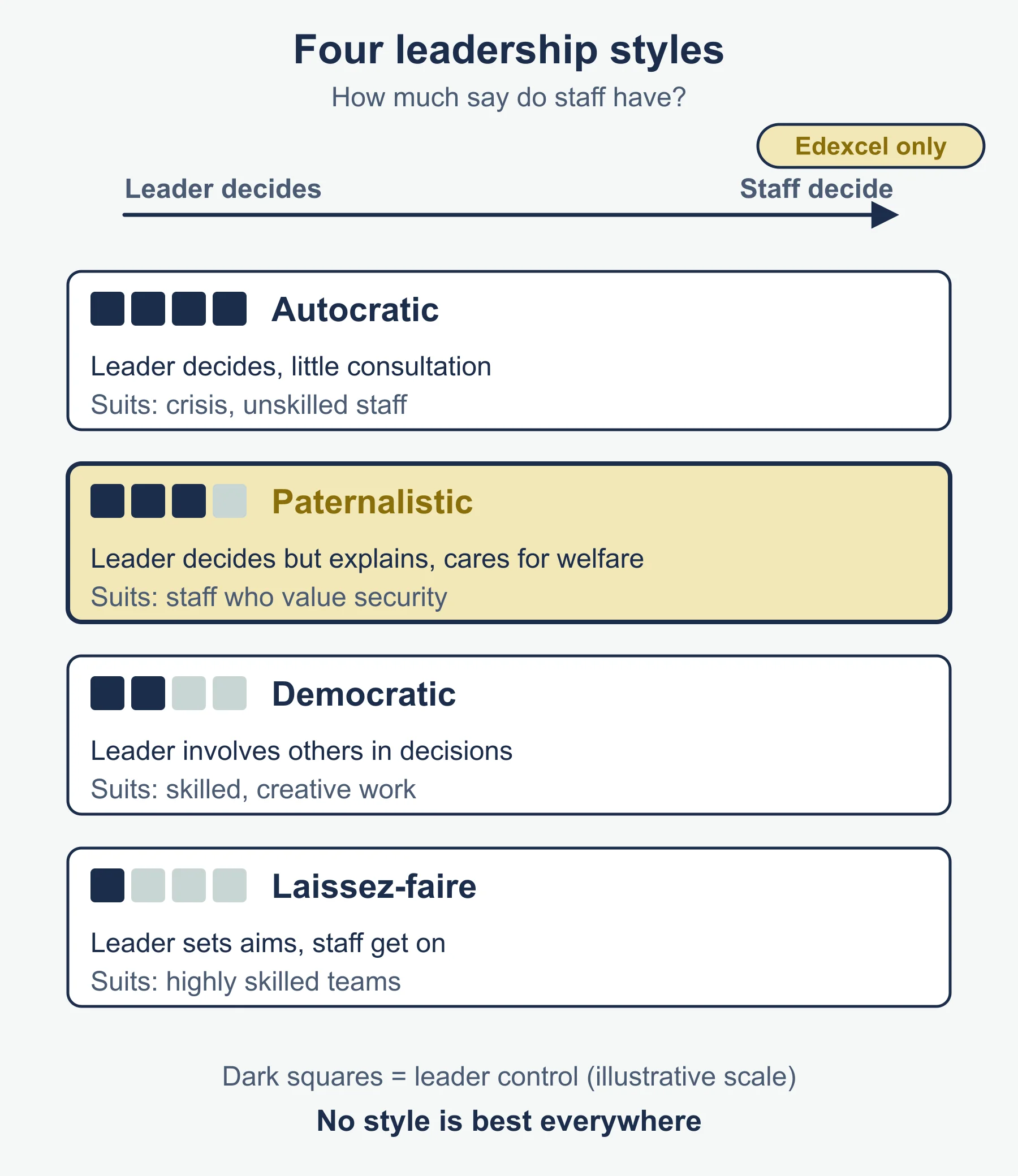
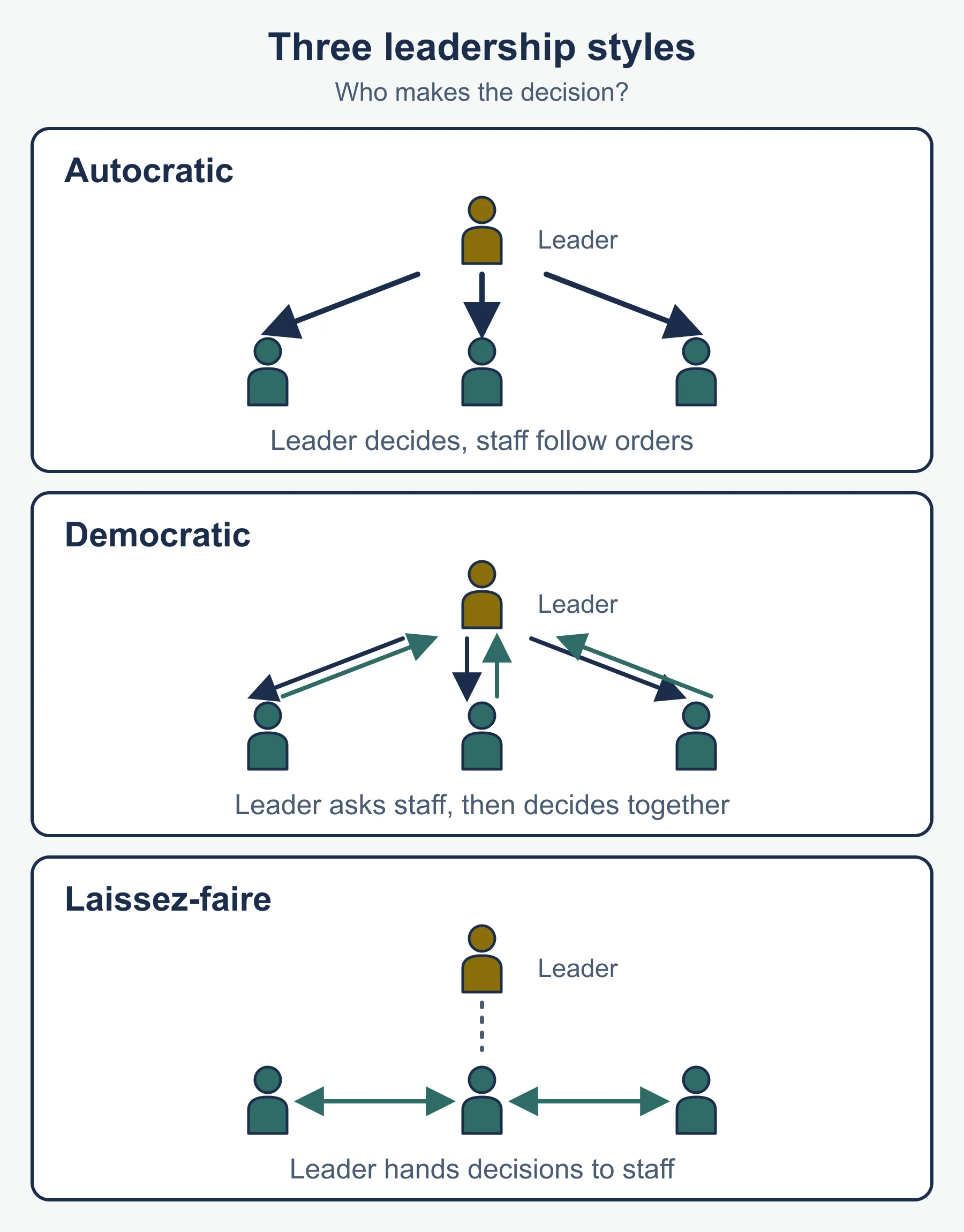
Styles.
| Style | Features | Likely suits |
|---|---|---|
| Autocratic | Leader decides, little consultation | Crisis, unskilled staff |
| Paternalistic | Leader decides but explains and cares about welfare | Staff who value security |
| Democratic | Leader involves others in decisions | Skilled staff, creative tasks |
| Laissez-faire | Leader sets broad aims, leaves staff to get on | Highly skilled teams |
No style is best everywhere; it depends on the task, people and time available.
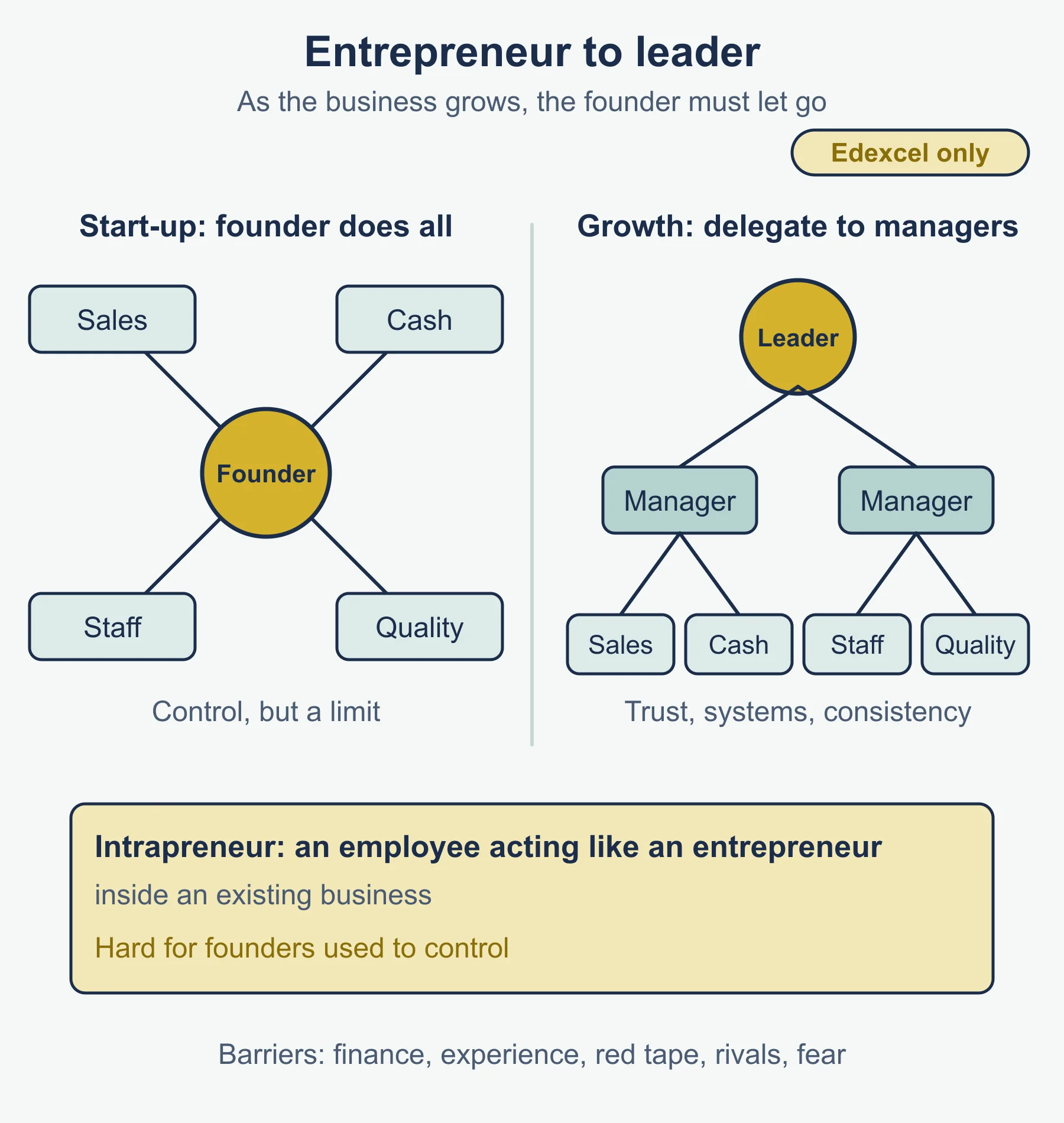
Moving from entrepreneur to leader. Founders often do everything themselves. As the business grows they must delegate, trust managers and build systems, which is hard for someone used to control or without management training. Staff may expect more consistency. A founder may need to hire managers or learn to let go.
Role of an entrepreneur
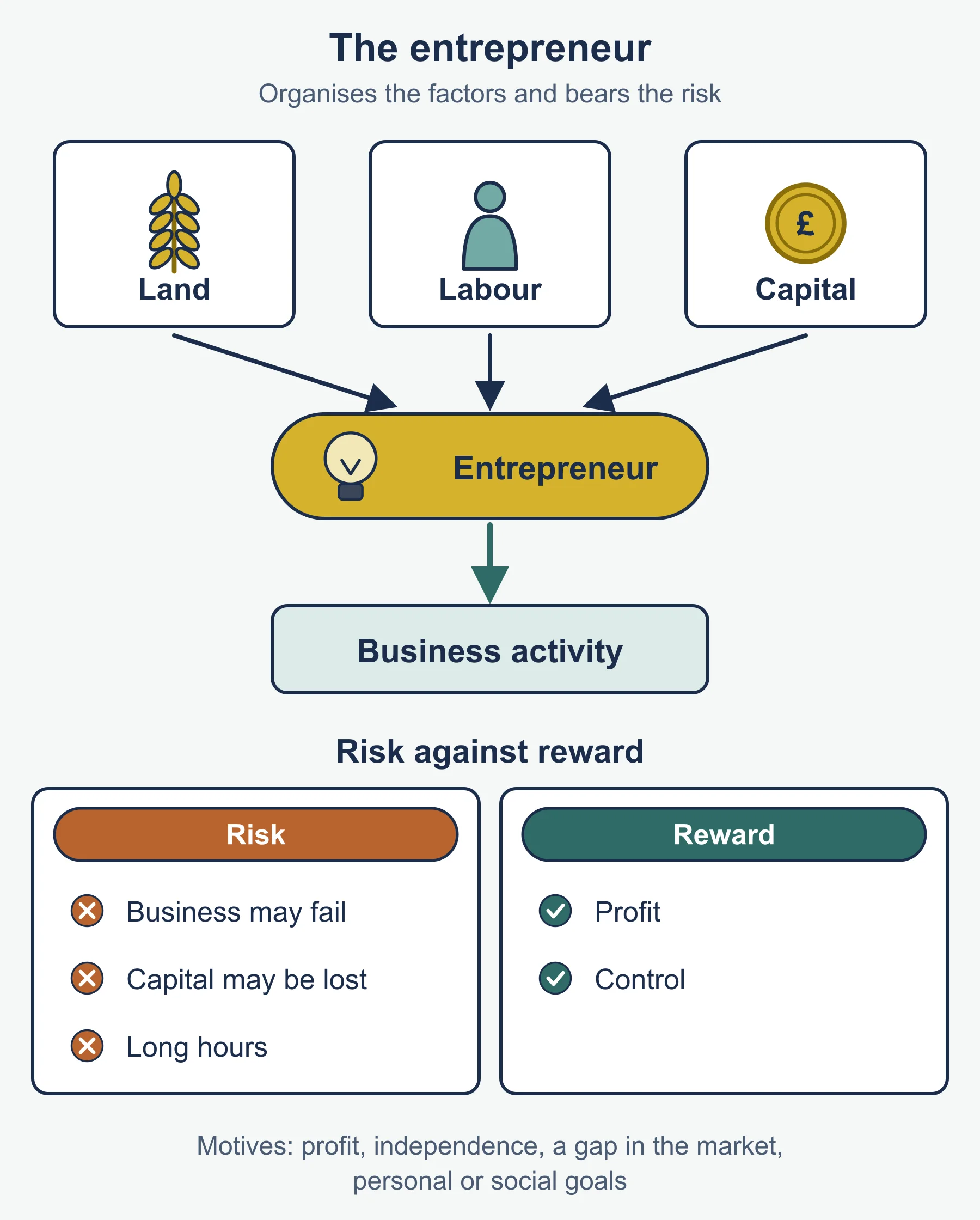
An entrepreneur takes the risk of organising resources to meet a need.
- Creating and setting up: spotting an opportunity, planning, raising finance, finding premises and customers.
- Running and expanding: managing cash, staff and quality, then growing through new products, markets or sites.
- Intrapreneurship: employees within an existing business act like entrepreneurs, developing new products or processes.
- Barriers: difficulty raising finance, lack of experience or contacts, regulation and red tape, strong competitors, and fear of failure.
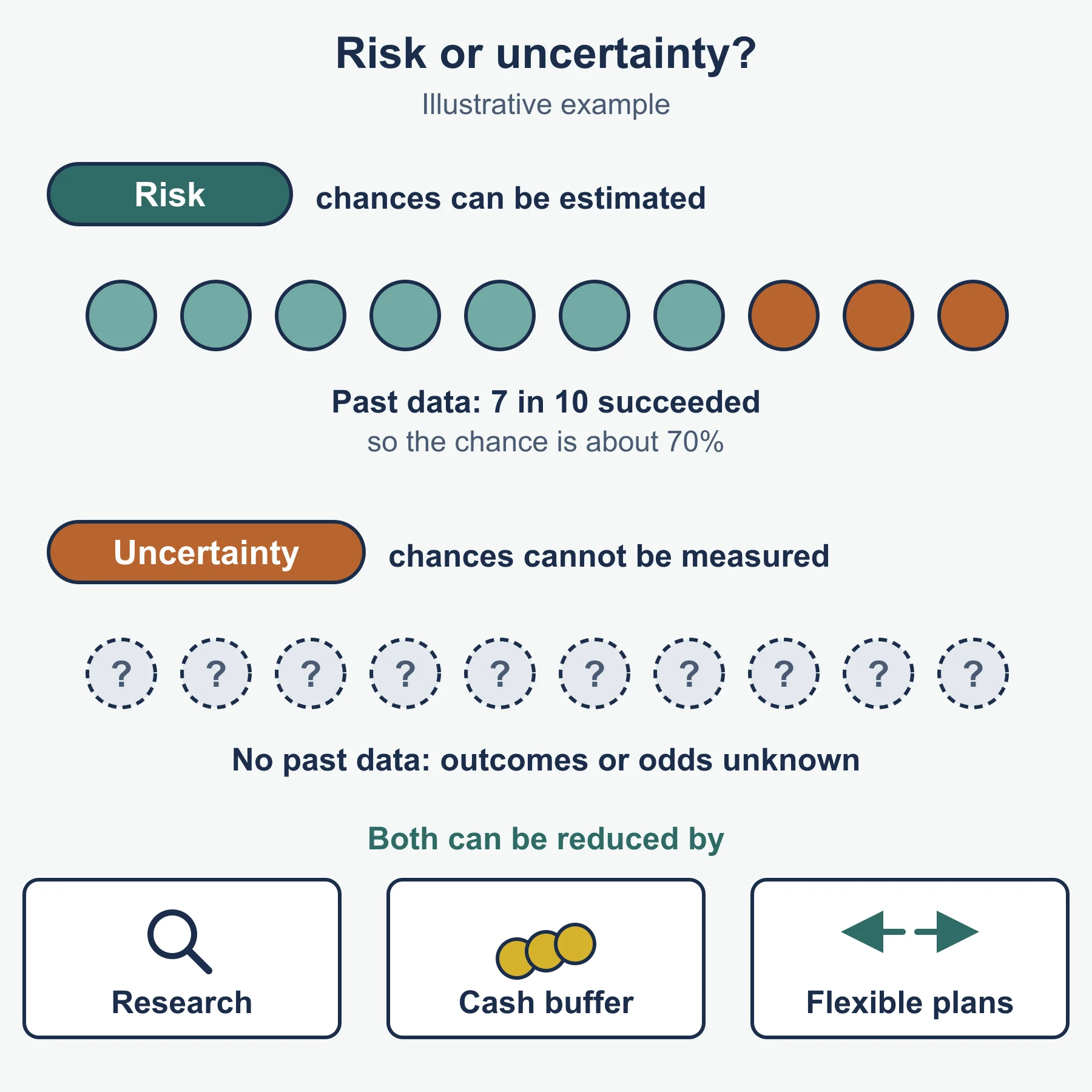
- Anticipating risk and uncertainty: risk can be estimated, because outcomes and probabilities are known or can be guessed from past data. Uncertainty cannot be measured because the outcomes or odds are unknown. Research, a cash buffer and flexible plans reduce both.
Entrepreneurial motives and characteristics
Characteristics and skills: willingness to take risks, creativity and innovation, determination, self-confidence, hard work, organisation and communication skills, and the ability to spot opportunities.
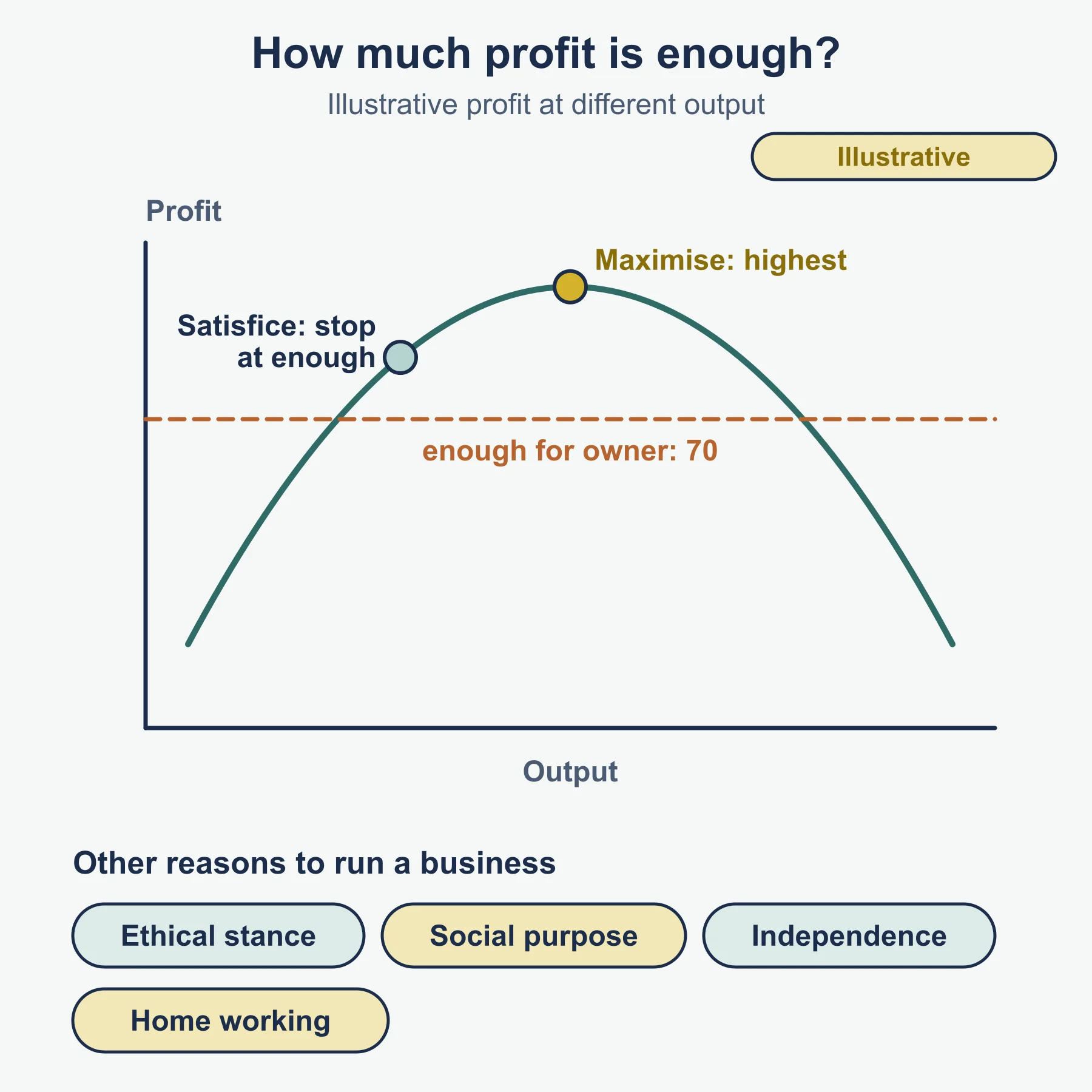
Financial motives. Profit maximisation aims for the highest possible profit. Profit satisficing aims for a satisfactory level that meets the owner’s needs without pursuing more.
Non-financial motives: an ethical stance (the owner wants to trade in line with their values), social entrepreneurship (the main purpose is to solve a social or environmental problem, with profit reinvested), independence (being one’s own boss) and home working (flexibility around family or health).
Business objectives
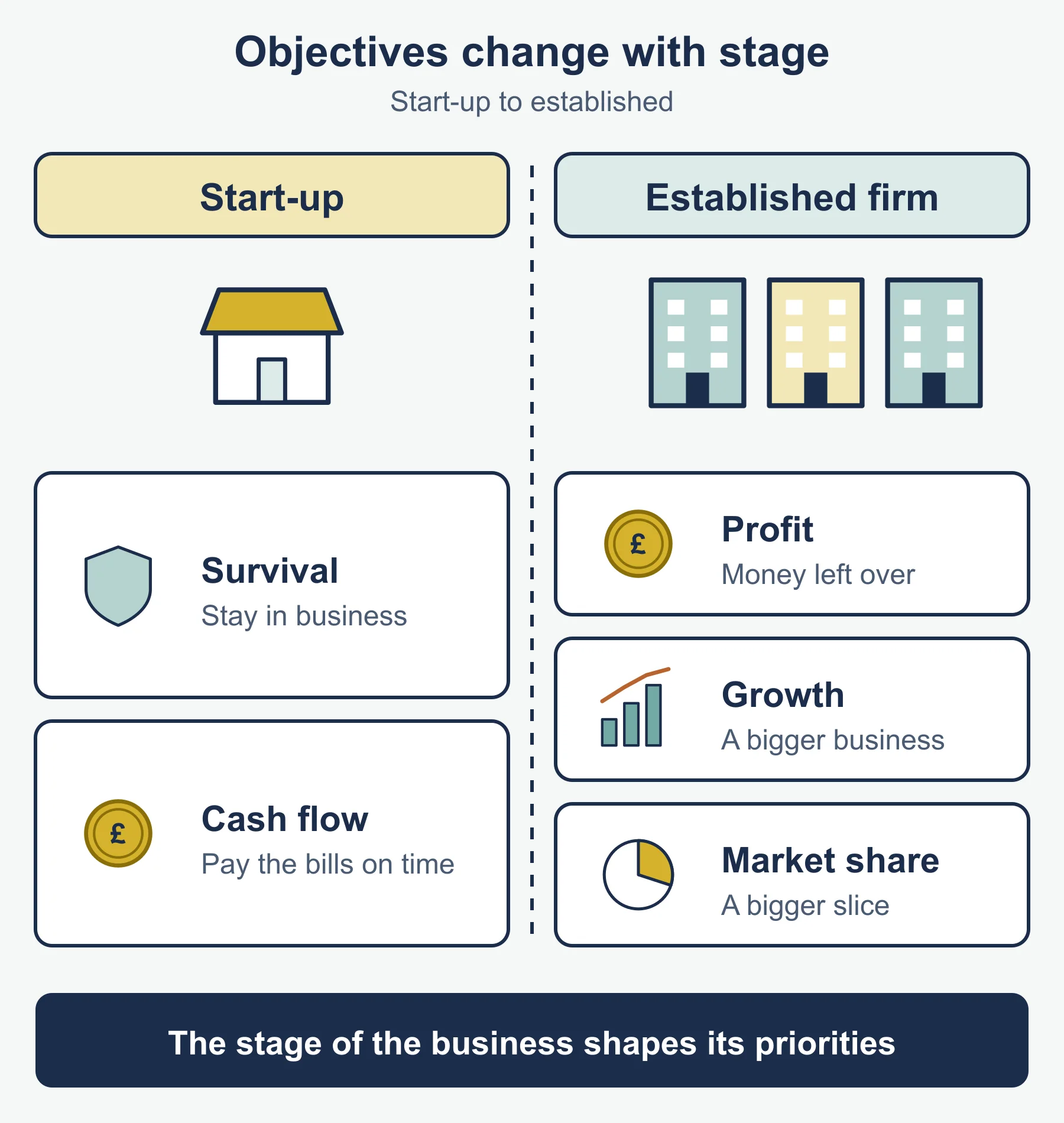
- Survival: the main aim for new or struggling firms; cash flow matters most.
- Profit maximisation: hard to achieve, as information is incomplete.
- Sales maximisation: highest sales, often via low prices that cut profit.
- Market share: the firm’s proportion of total market sales. For example, £3.6m of a £45m market is 8%.
- Cost efficiency: lower cost per unit at the same quality.
- Employee welfare: better pay, safety and conditions.
- Customer satisfaction: meeting or beating expectations.
- Social objectives: benefit to the community or environment.
Objectives change with the firm’s age, size, owners and market, and can conflict.
Business choices
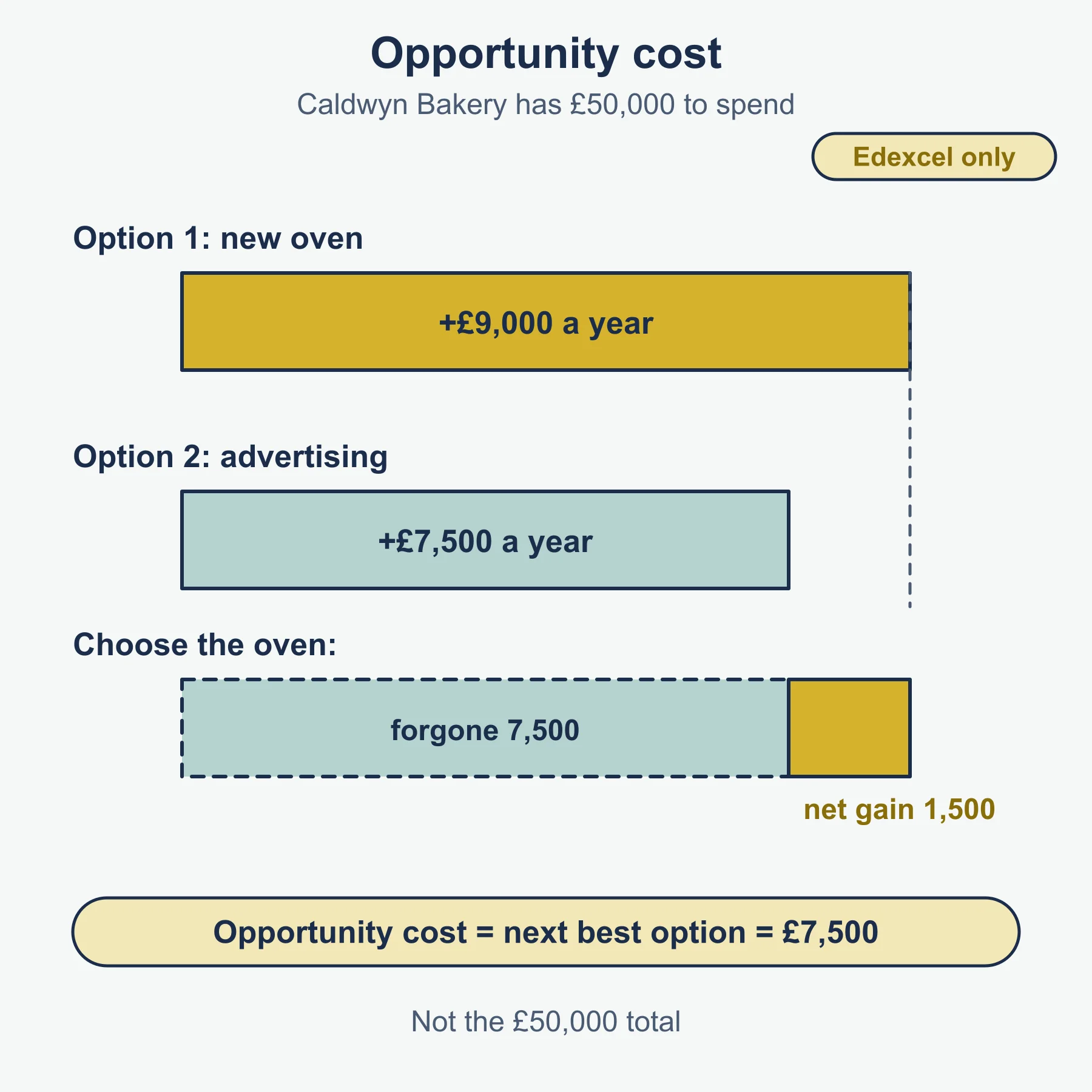
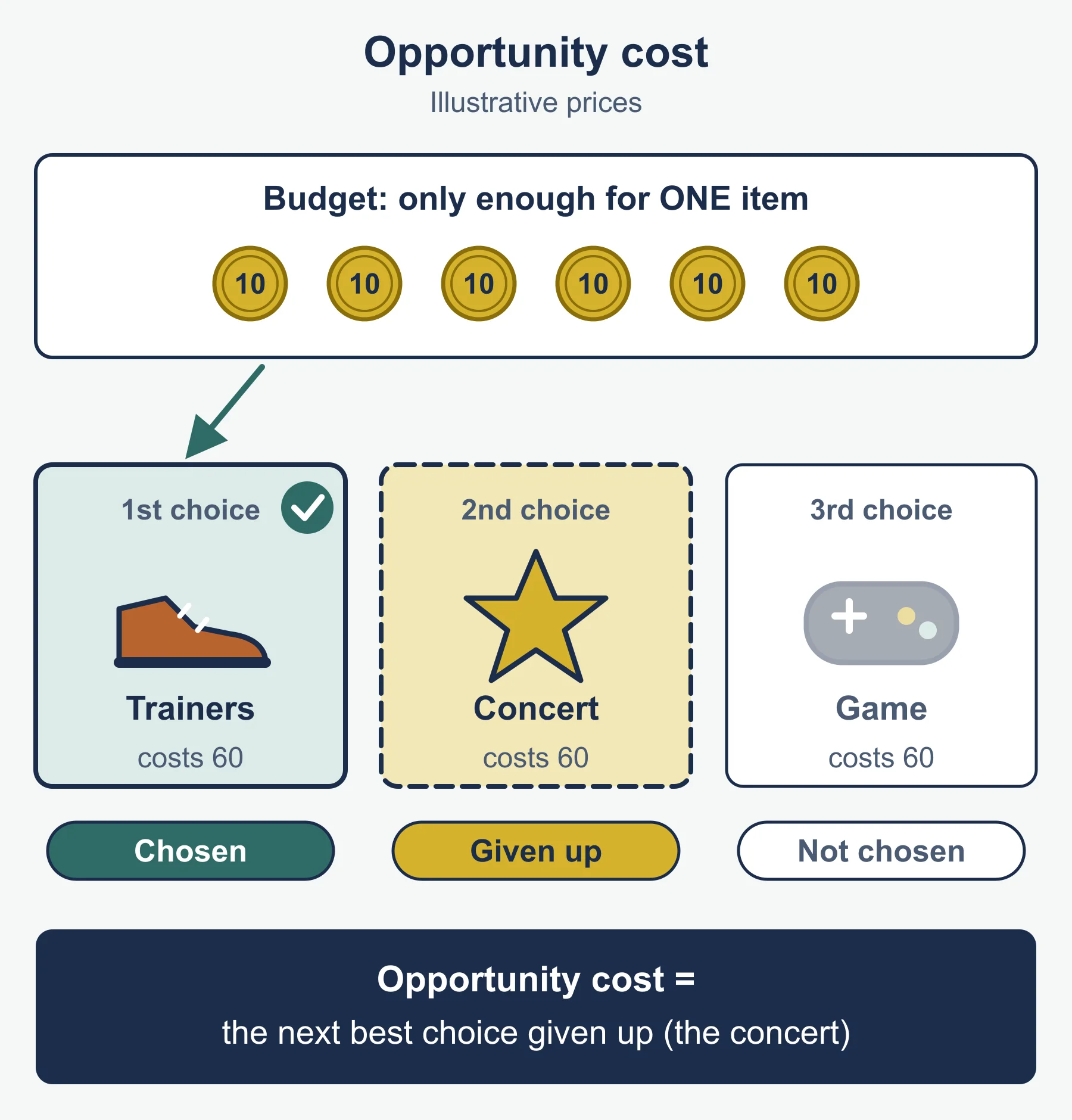
Opportunity cost is what is forgone by not taking the next best alternative. Caldwyn Bakery has £50,000. A new oven would add £9,000 a year of profit; advertising would add £7,500. Choosing the oven has an opportunity cost of £7,500 a year, so the net gain is £1,500 a year. A trade-off arises when gaining more of one aim means giving up some of another, such as higher quality against lower price, or growth against short-term profit.
Common errors
- Treating all pay as motivating, against Herzberg.
- Confusing span of control with chain of command.
- Treating risk and uncertainty as the same.
- Giving the total cost, not the next best option, as the opportunity cost.
- Concluding “it depends” without saying on what.
Frequently asked questions
What is a flexible workforce? A flexible workforce lets a business change its labour input as demand changes. The YBS11 specification names multi-skilling, part-time and temporary staff, zero-hour contracts, flexible hours and home working, and outsourcing.
What is the difference between a tall and a flat organisational structure? A tall structure has many levels and narrow spans of control. A flat structure has few levels and wide spans, which cuts management cost and speeds communication but can overload managers.
What is intrapreneurship? Intrapreneurship is when employees within an existing business act like entrepreneurs, developing new products or processes.
What is the difference between profit maximisation and profit satisficing? Profit maximisation aims for the highest possible profit. Profit satisficing aims for a satisfactory level of profit that meets the owner’s needs without pursuing more.
Official syllabus
Pearson Edexcel International Advanced Subsidiary/Advanced Level in Business, Specification, Issue 1, September 2017 (Pearson Education Limited); Unit 1: Marketing and people, sections 1.3.4 and 1.3.5, first assessment January 2019.
Get free revision emails (optional)
Occasional emails with practice questions, worked explanations and links to free resources for the qualification and subjects you choose. No spam, and you can unsubscribe from any email. The free tools on this site never need an email.
Related resources
-
Practice questions
Edexcel International A Level Business: Managing people and Entrepreneurs and leaders (YBS11) – Practice Questions
Ten original questions with worked answers on staffing, structure, motivation, leadership, entrepreneurs and objectives for Edexcel A Level Business.
Business · Pearson Edexcel · AS Level
Try questions -
Revision notes
Edexcel International A Level Business: Managing people and Entrepreneurs and leaders (YBS11) – Revision Notes
Condensed recall tables, quick calculations and a self-test for Edexcel International A Level Business Unit 1 people, leadership and entrepreneurs.
Business · Pearson Edexcel · AS Level
Revise topic -
Study guides
Edexcel International A Level Business: Marketing mix and strategy (YBS11)
A full study guide to marketing objectives, product, promotion, price and place for Pearson Edexcel International A Level Business, with worked examples.
Business · Pearson Edexcel · AS Level
Read guide
Related articles
-
teaching
A Level tuition in Dubai: Cambridge or Pearson Edexcel International A Level?
Schools in Dubai and Abu Dhabi teach either Cambridge International AS & A Level or Pearson Edexcel International A Level. How the two are structured, why it matters for tuition, and how online classes from Lahore work.
9 October 2026
-
curriculum guides
Choosing subjects at IGCSE and A Level
How subject choices at 14 and 16 affect university options later, and how to keep pathways open without overloading a timetable.
28 July 2026
Studying this with a teacher
Working through Business AS LEVEL?
This page is free and stays free. If you would rather be taught it, Marlbridge runs Business classes one-to-one and in small groups of up to 15, online in your own time zone. The first trial class is free. WhatsApp replies within an hour (8am–11pm Pakistan time, every day); email the same day.
Pearson Edexcel Business teachers at Marlbridge

