
Revision Notes
Edexcel International A Level Business: Managing people and Entrepreneurs and leaders (YBS11) – Revision Notes
Condensed recall tables, quick calculations and a self-test for Edexcel International A Level Business Unit 1 people, leadership and entrepreneurs.
- Subject
- Business
- Level
- AS LEVEL
- Topic
- Marketing and people
- Author
- Marlbridge Academic Team
- Updated
- Reviewed by
- Salman Ahmad (what this means)
Aligned to Pearson Edexcel A Level Business (YBS11), Issue 1, September 2017. Official specification .
Syllabus page (what it covers and how it is assessed): Pearson Edexcel A Level Business.
Syllabus points this page covers
YBS11 (AS Level)
- 1.3.4 Managing people
- 1.3.5 Entrepreneurs and leaders
Found an error? Report a correction.
Need help with this topic? Request a free trial class for A Level Business (YBS11).
These notes are for the final weeks of revision on sections 1.3.4 Managing people and 1.3.5 Entrepreneurs and leaders of Unit 1, Marketing and people, in the Pearson Edexcel International Advanced Subsidiary/Advanced Level in Business specification (Issue 1, September 2017). For full explanations, read the study guide. Then test yourself with the practice questions. Broader Unit 1 notes are in Marketing and people revision notes, and the topic overview and practice set cover the whole unit. See also the course hub, the printable checklist and the free 10-minute diagnostics.
1.3.4 Managing people
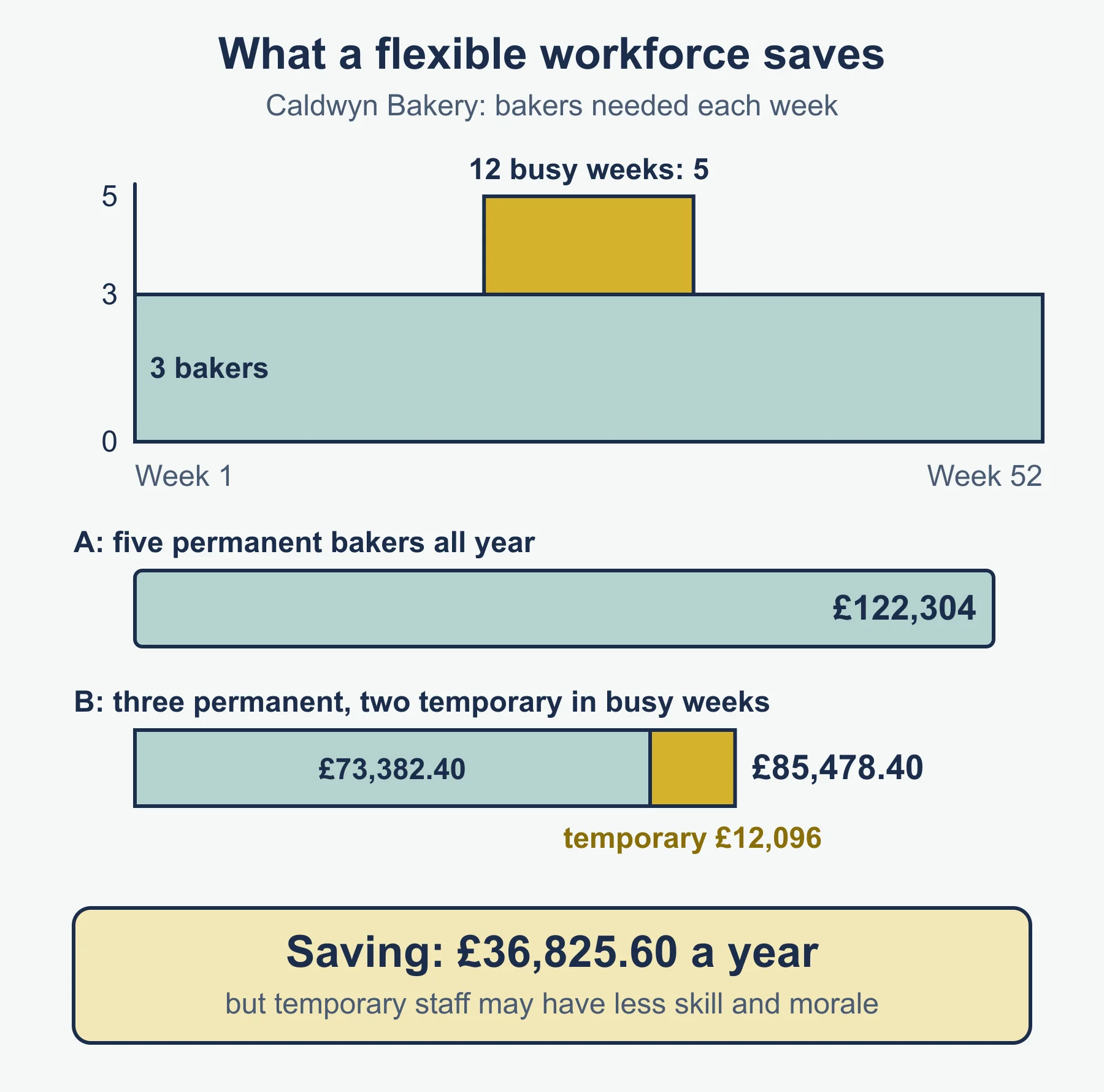
Approaches to staffing
| Term | Meaning | Watch for |
|---|---|---|
| Staff as an asset | People are a source of advantage worth investing in | Higher training and pay bills |
| Staff as a cost | People are an expense to minimise | Low morale, high turnover |
| Multi-skilling | Staff trained for several jobs | Training time |
| Part-time and temporary | Fewer hours or fixed period | Less commitment |
| Zero-hour contract | No guaranteed hours | Insecure income for staff |
| Flexible hours, home working | Choice over when or where | Harder to supervise |
| Outsourcing | An outside firm does the task | Less control |
| Dismissal | Contract ended for a reason about the employee | Fault-based |
| Redundancy | The job itself no longer exists | Not the worker’s fault |
| Individual approach | Terms agreed one to one | Slower across many staff |
| Collective bargaining | Union or group negotiates for many | Stronger employee voice |
Must-know distinction: dismissal concerns the individual worker; redundancy concerns the post.
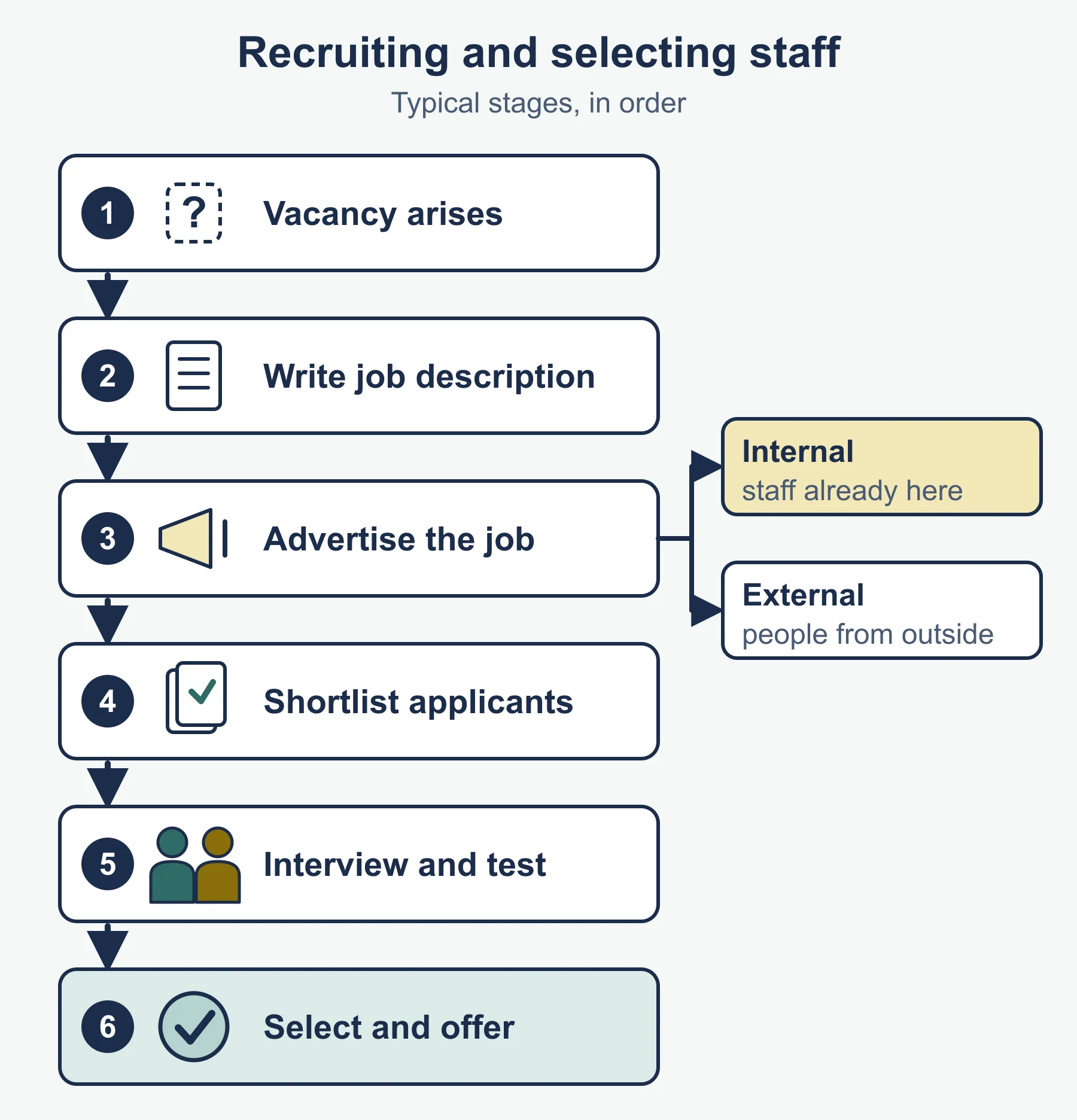
Recruitment, selection and training
- Recruitment attracts applicants; selection picks one.
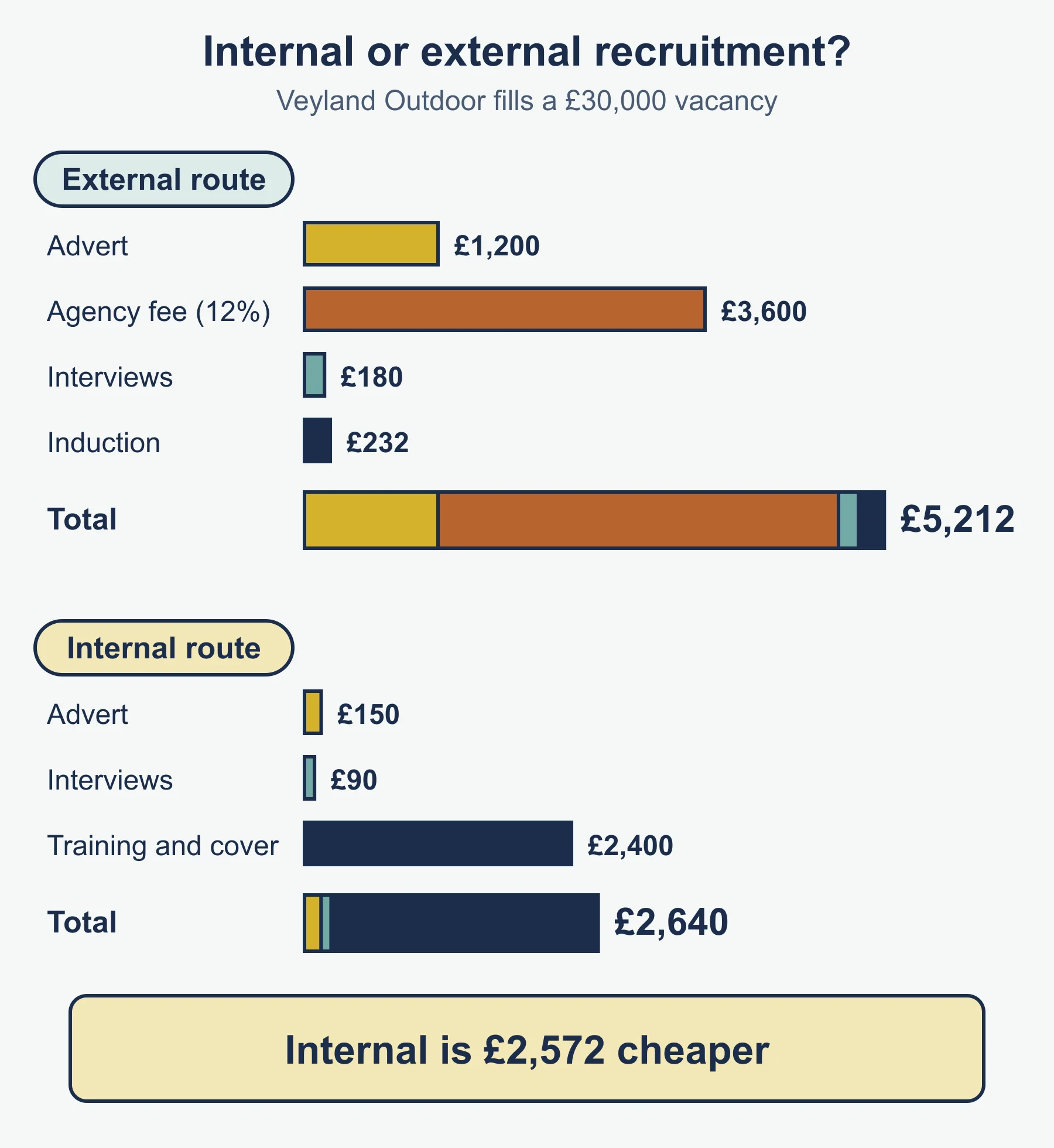
- Internal: cheaper, faster, known person, but narrow choice and a gap elsewhere.
- External: wider pool and new ideas, but dearer and slower to settle.
- Costs to list: advertising, agency fees, interview time, tests, induction, trainer time, lost output while learning.
- Worked reminder: advert £900, agency fee 10% of a £25,000 salary (£2,500) and two managers interviewing for 3 hours each at £25 an hour (£150) give a hiring cost of £3,550, before any induction or training.
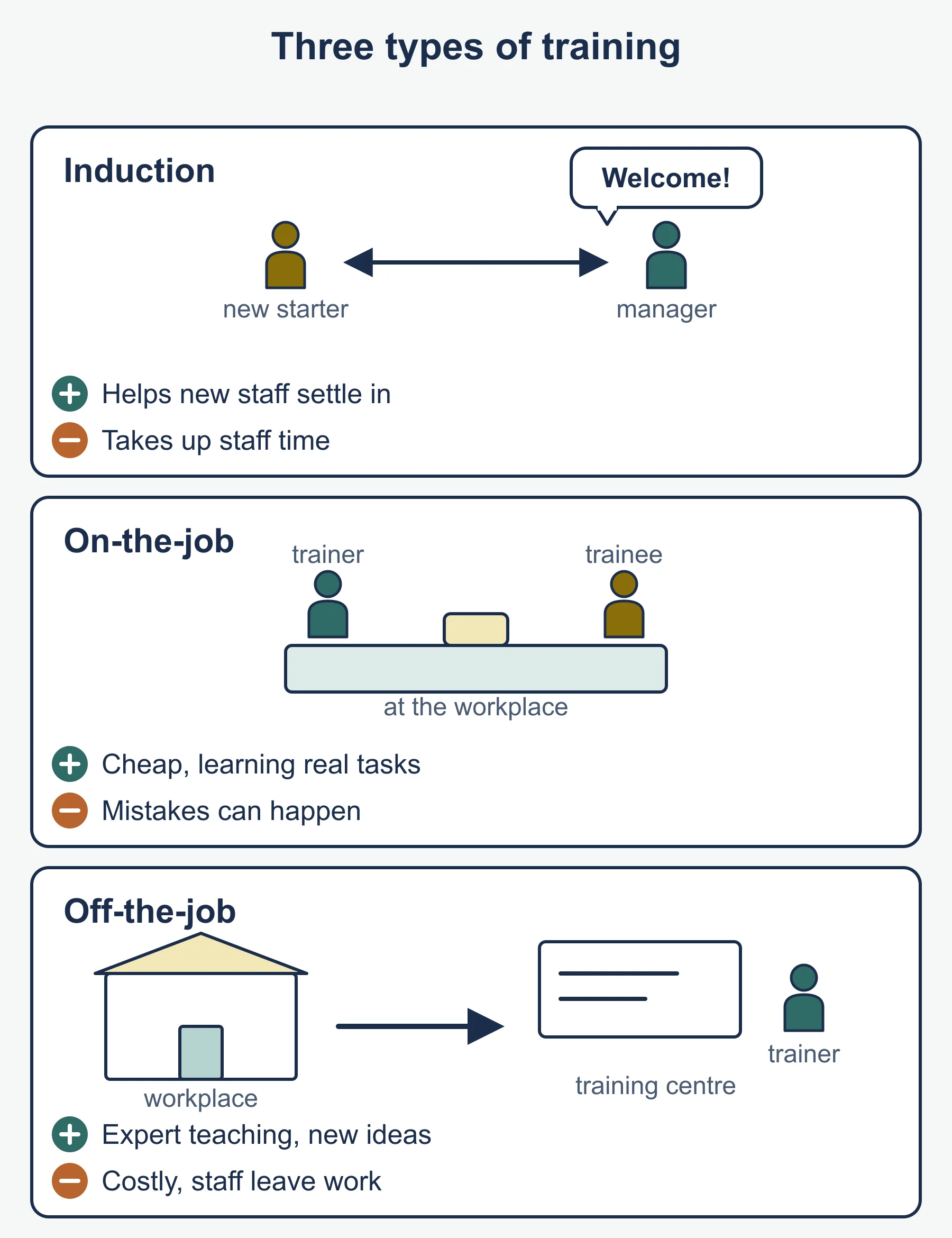
- Induction: introduction to the firm. On-the-job: learning at the workstation. Off-the-job: away from work, such as a course.
Organisational design
| Term | One-line definition |
|---|---|
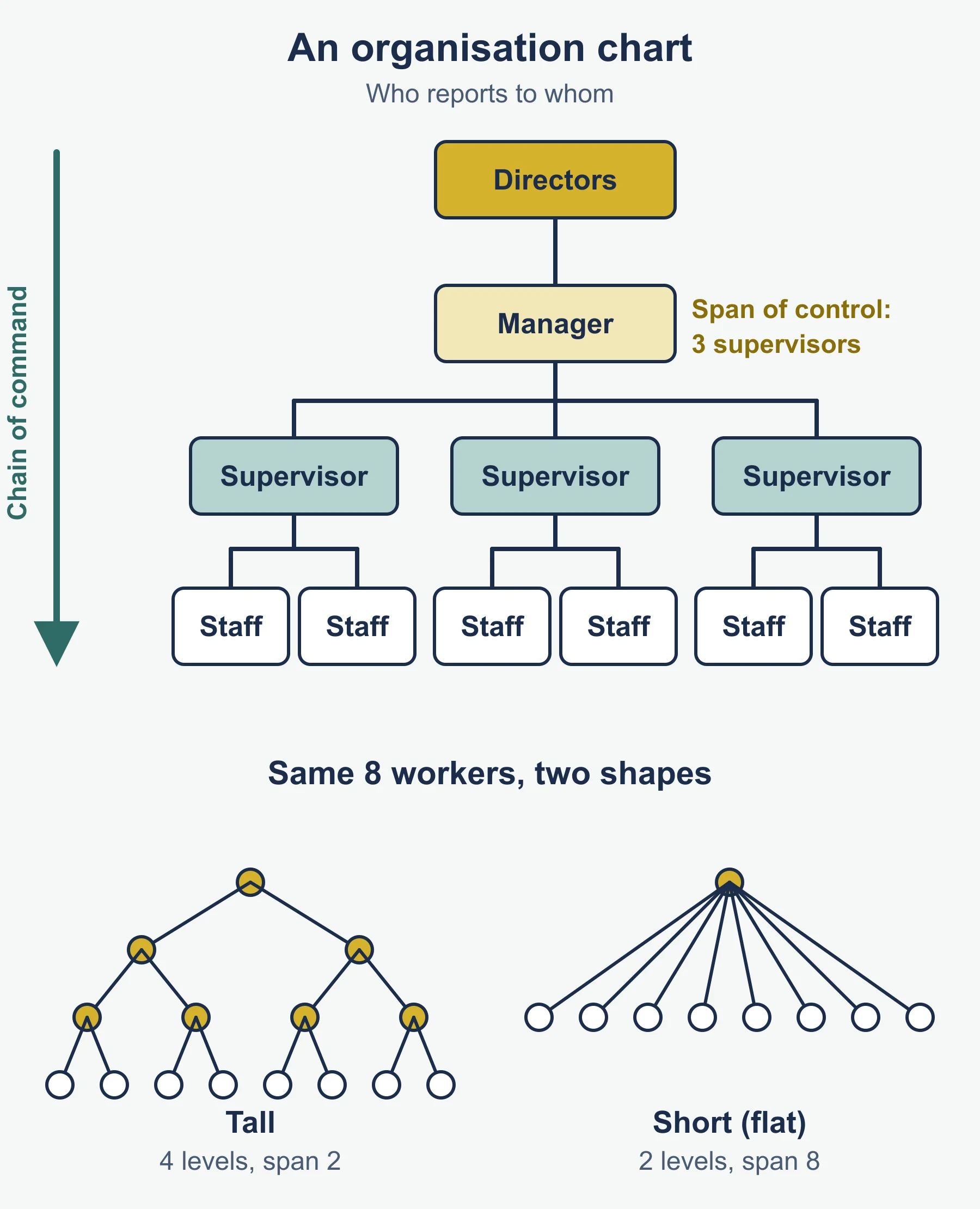
| Hierarchy | Levels of authority |
| Chain of command | Route for instructions down and reports up |
| Span of control | Number of people reporting to one manager |
| Centralised | Key decisions at the top |
| Decentralised | Decisions pushed down |
| Tall | Many levels, narrow spans |
| Flat | Few levels, wide spans |
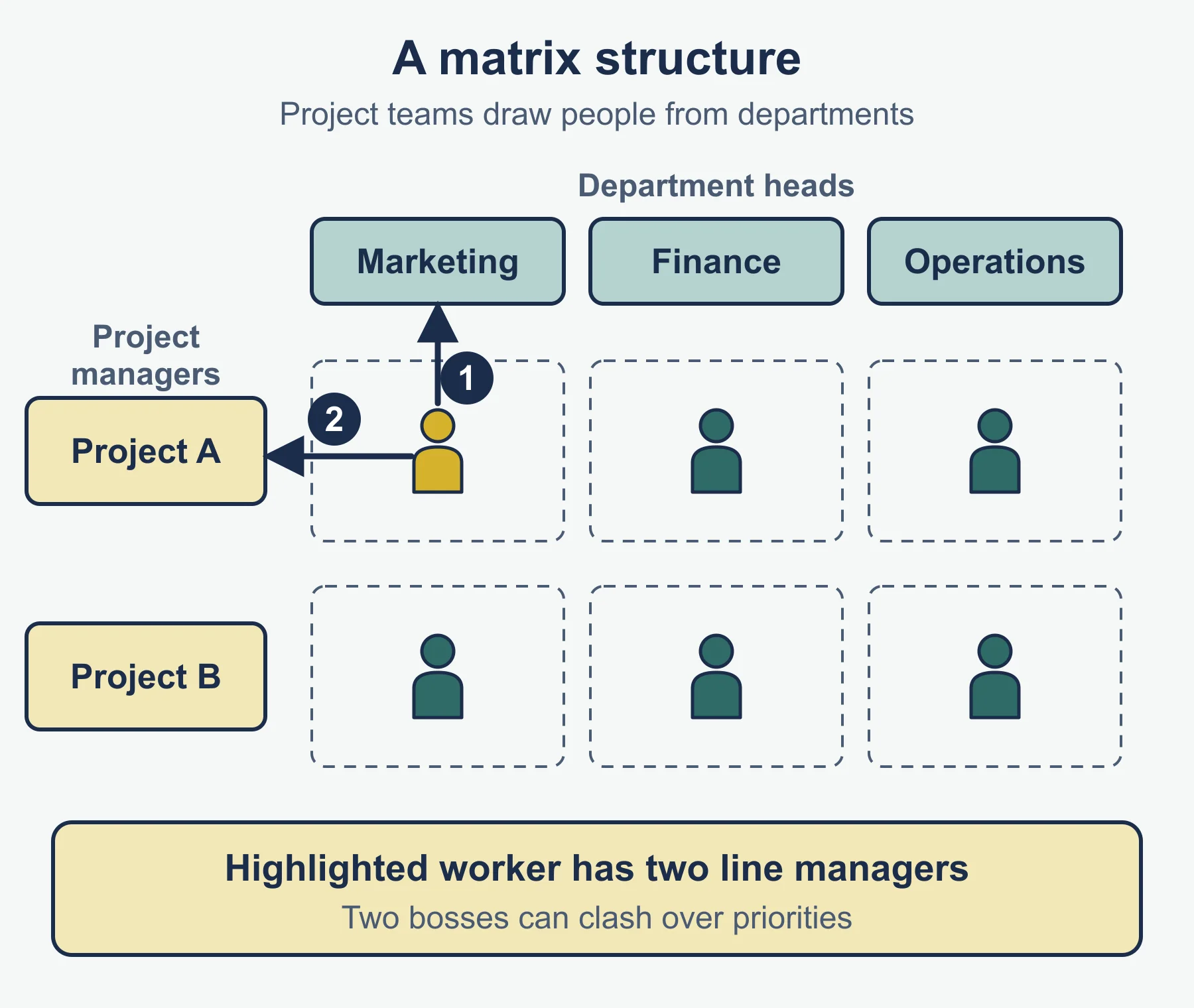
| Matrix | Project teams drawing people from several departments |
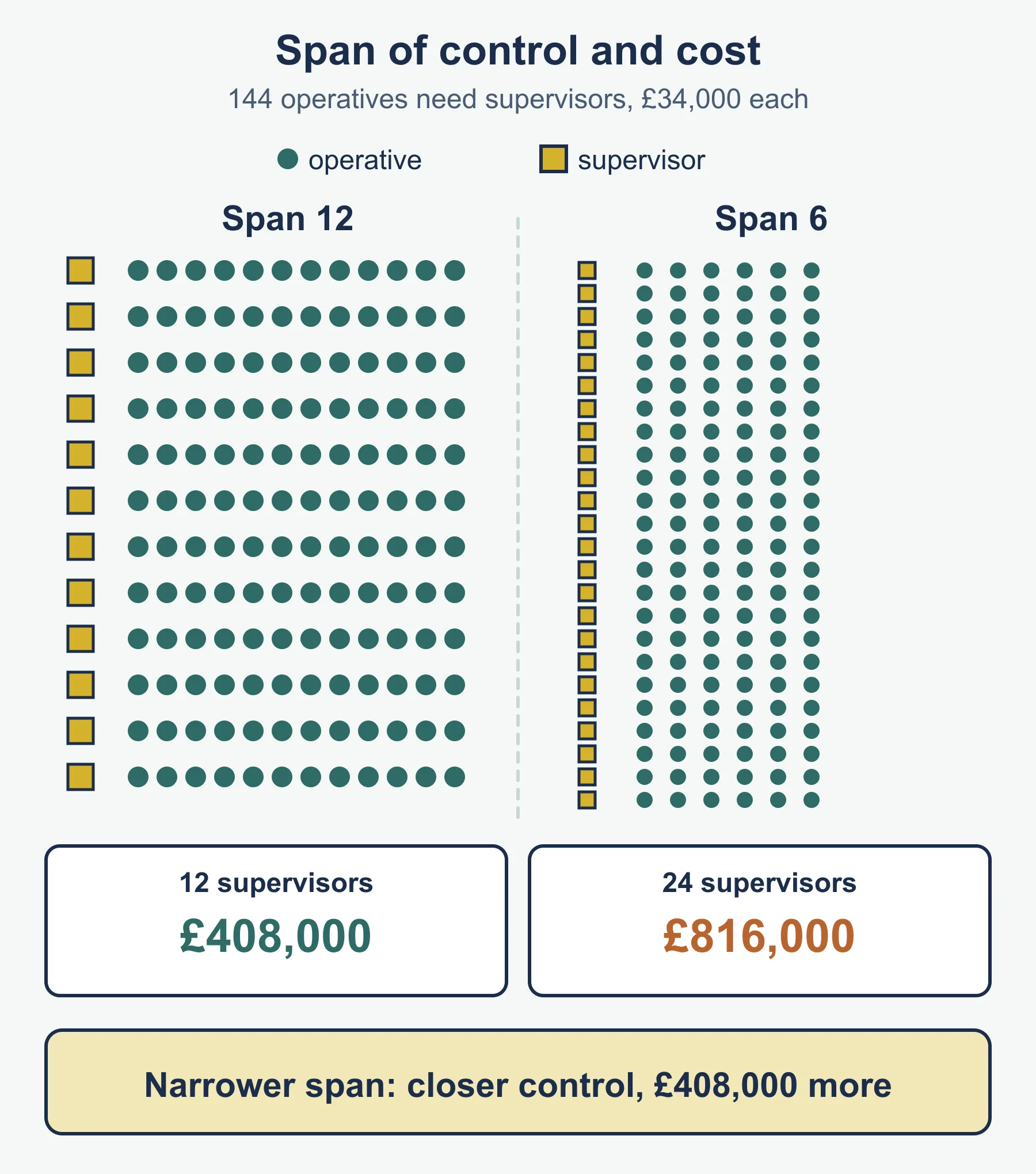
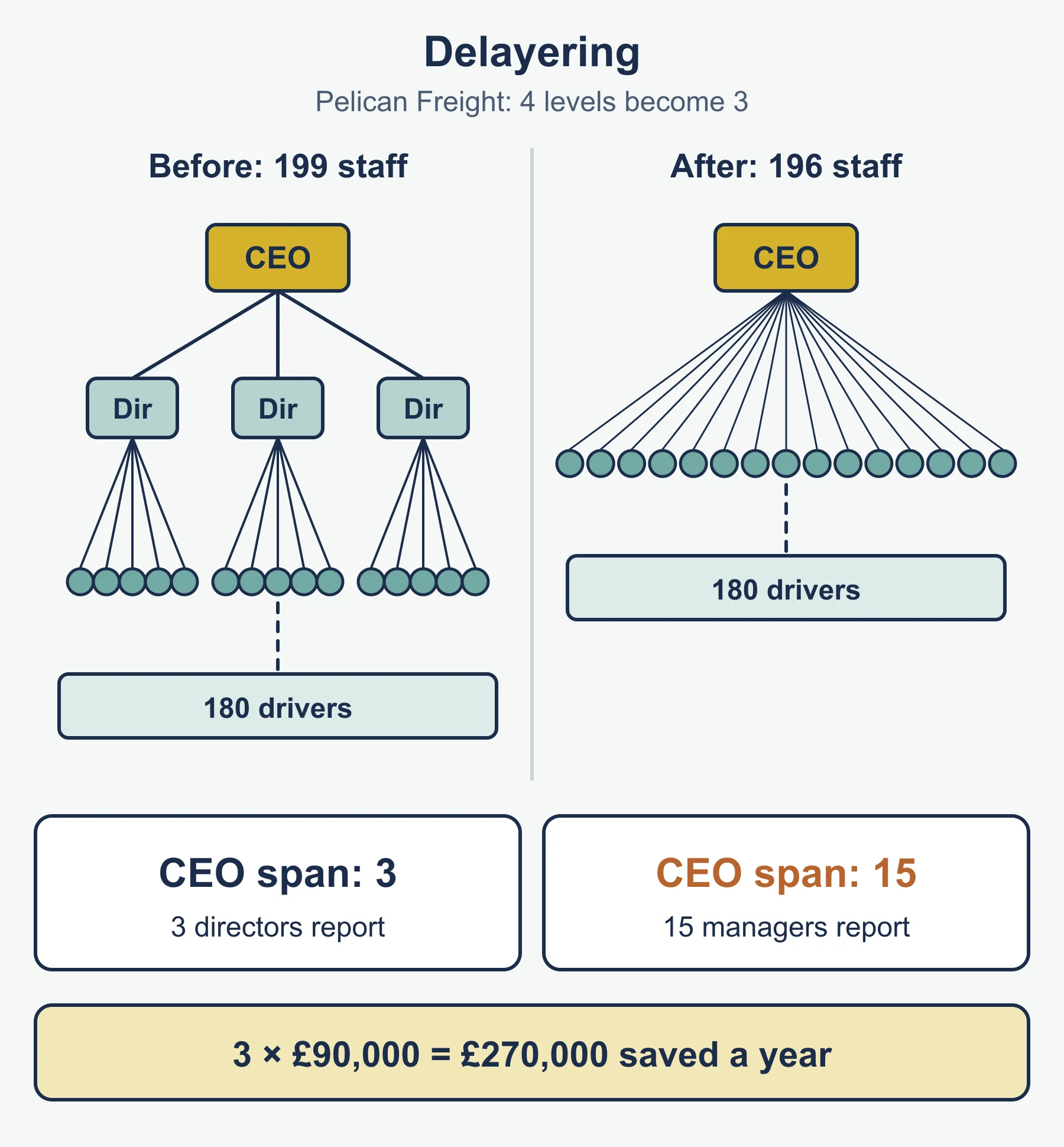
Quick calculation. Number of managers needed is staff divided by span. For 120 staff: span 8 gives 15 managers; span 15 gives 8. Wider span means fewer managers and lower cost, but each manager watches over more people.
Impact table.
| Structure | Efficiency | Motivation |
|---|---|---|
| Tall | Close control but slow, costly | Clear promotion steps; may feel restrictive |
| Flat | Quick, cheaper | More responsibility; fewer promotion steps, risk of overload |
| Matrix | Shares skills across projects | Variety; two bosses can conflict |
Motivation
Why it matters: better output and quality, lower absence and turnover, so lower recruitment cost.
| Theorist | Key idea | Practical use |
|---|---|---|
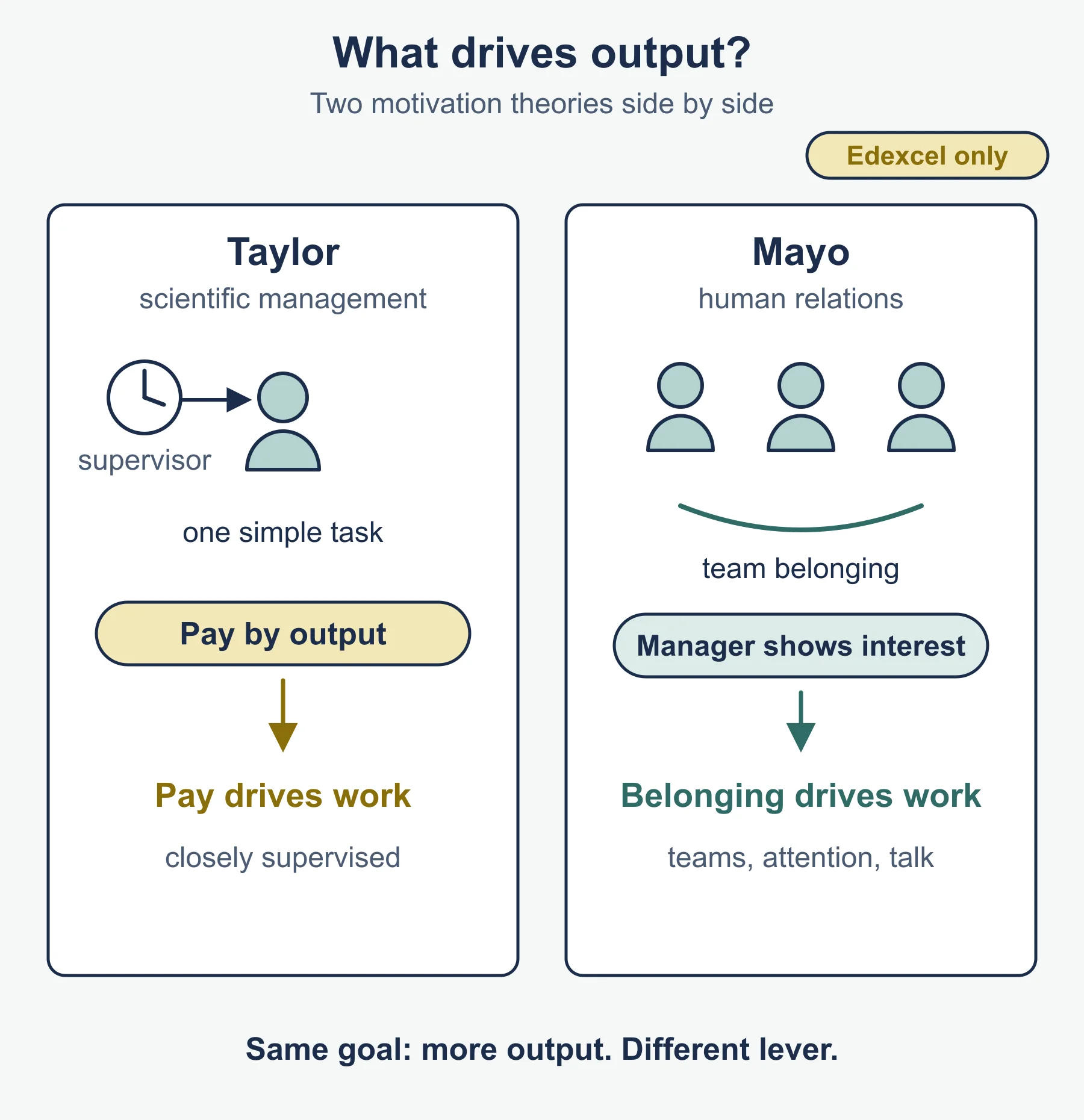
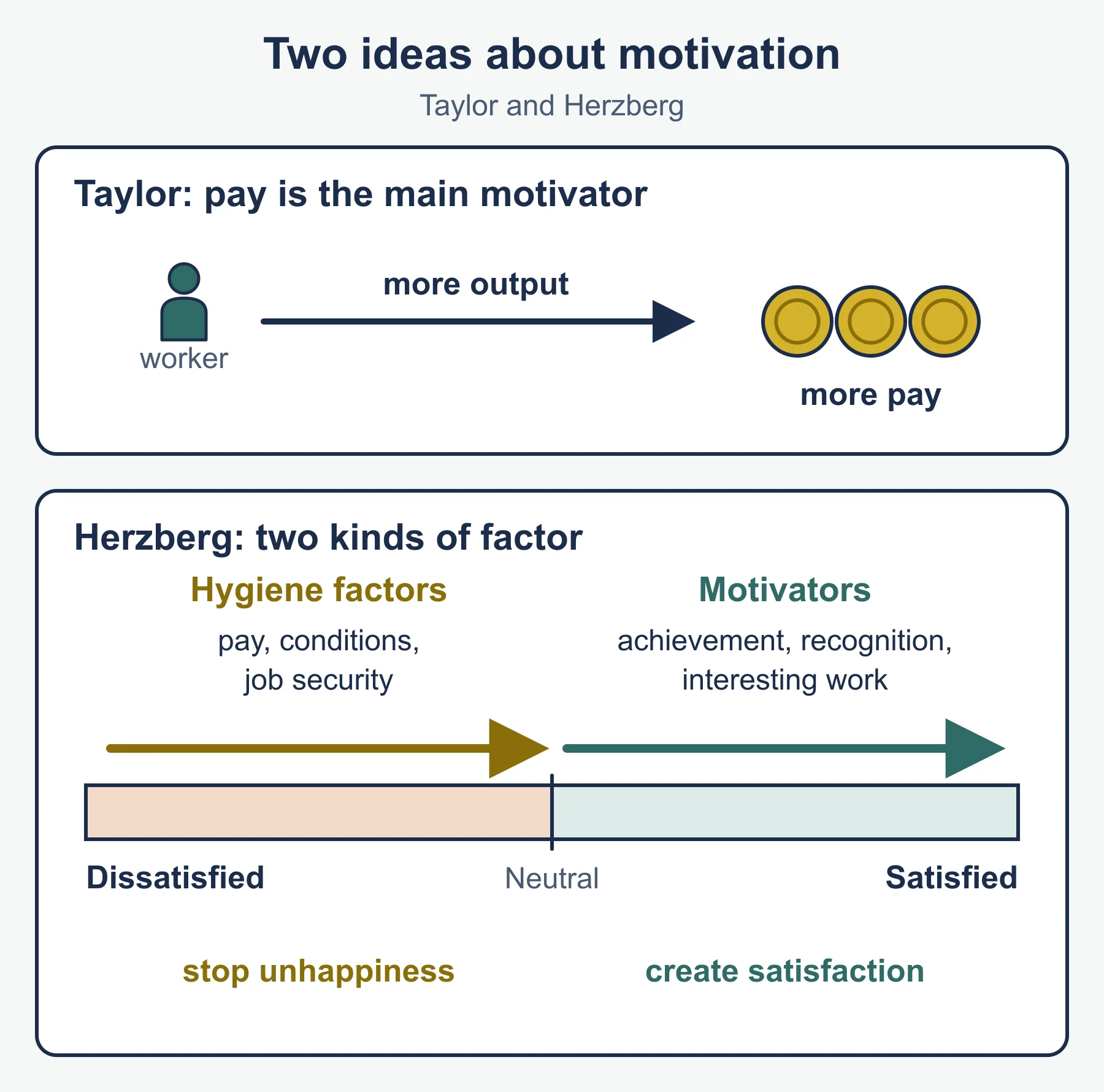
| Taylor | Simple tasks, close supervision, pay by output | Piecework |
| Mayo | Social needs, attention and teamwork | Team working, consultation |
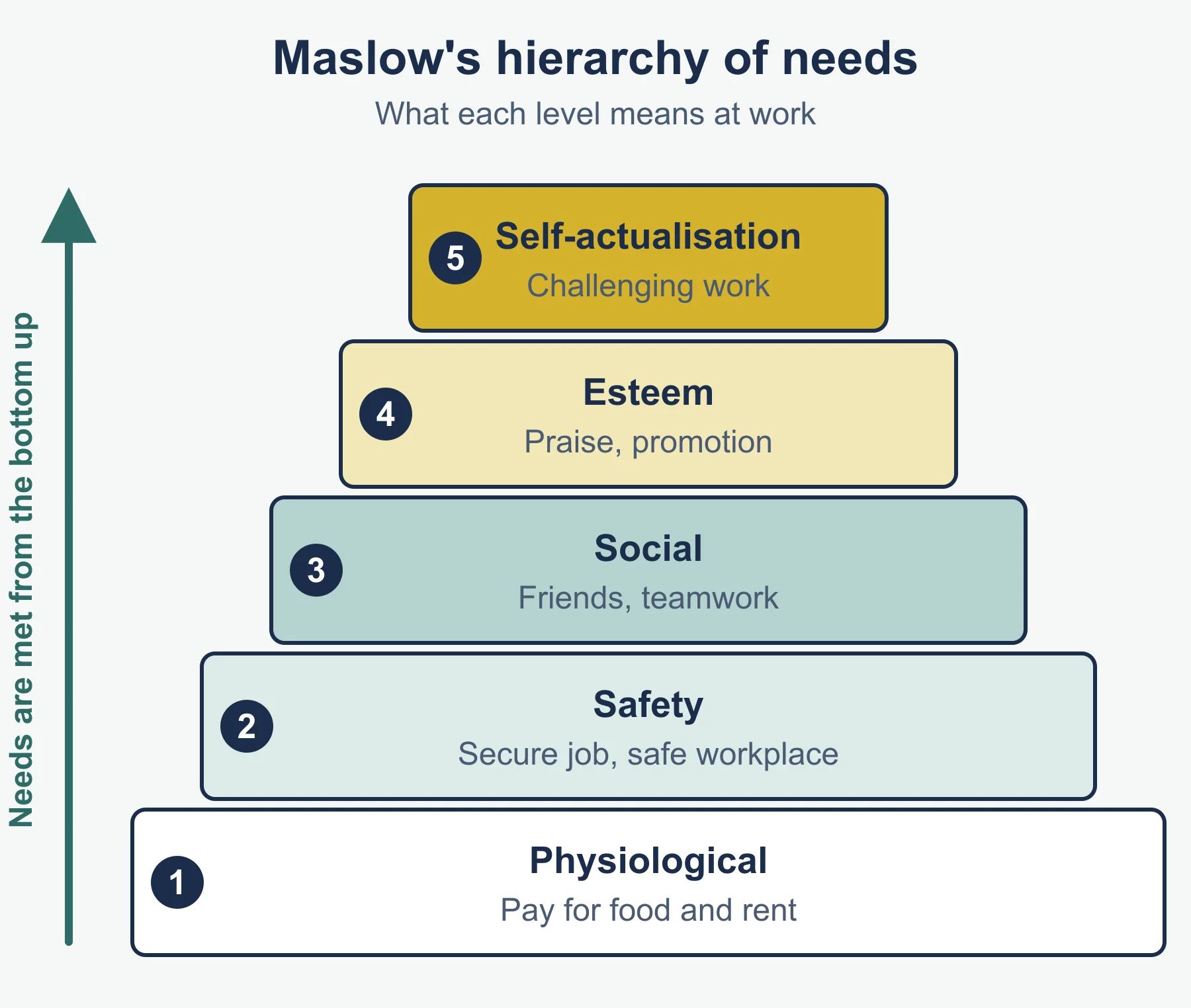
| Maslow | Hierarchy: physiological, safety, social, esteem, self-actualisation | Meet the lowest unmet need |
| Herzberg | Hygiene factors prevent dissatisfaction; motivators create satisfaction | Fix pay, then enrich the job |
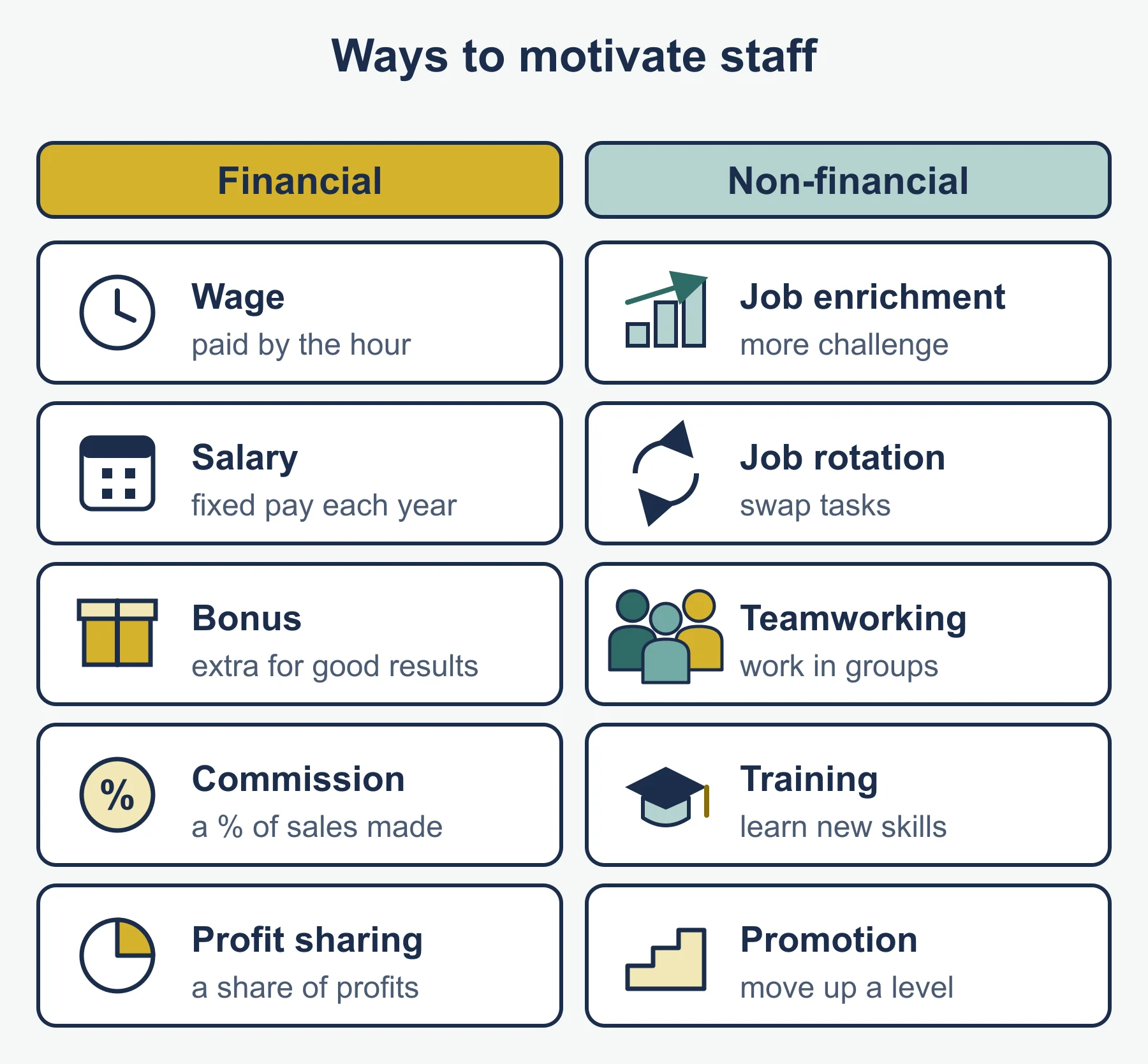
| Financial method | Idea |
|---|---|
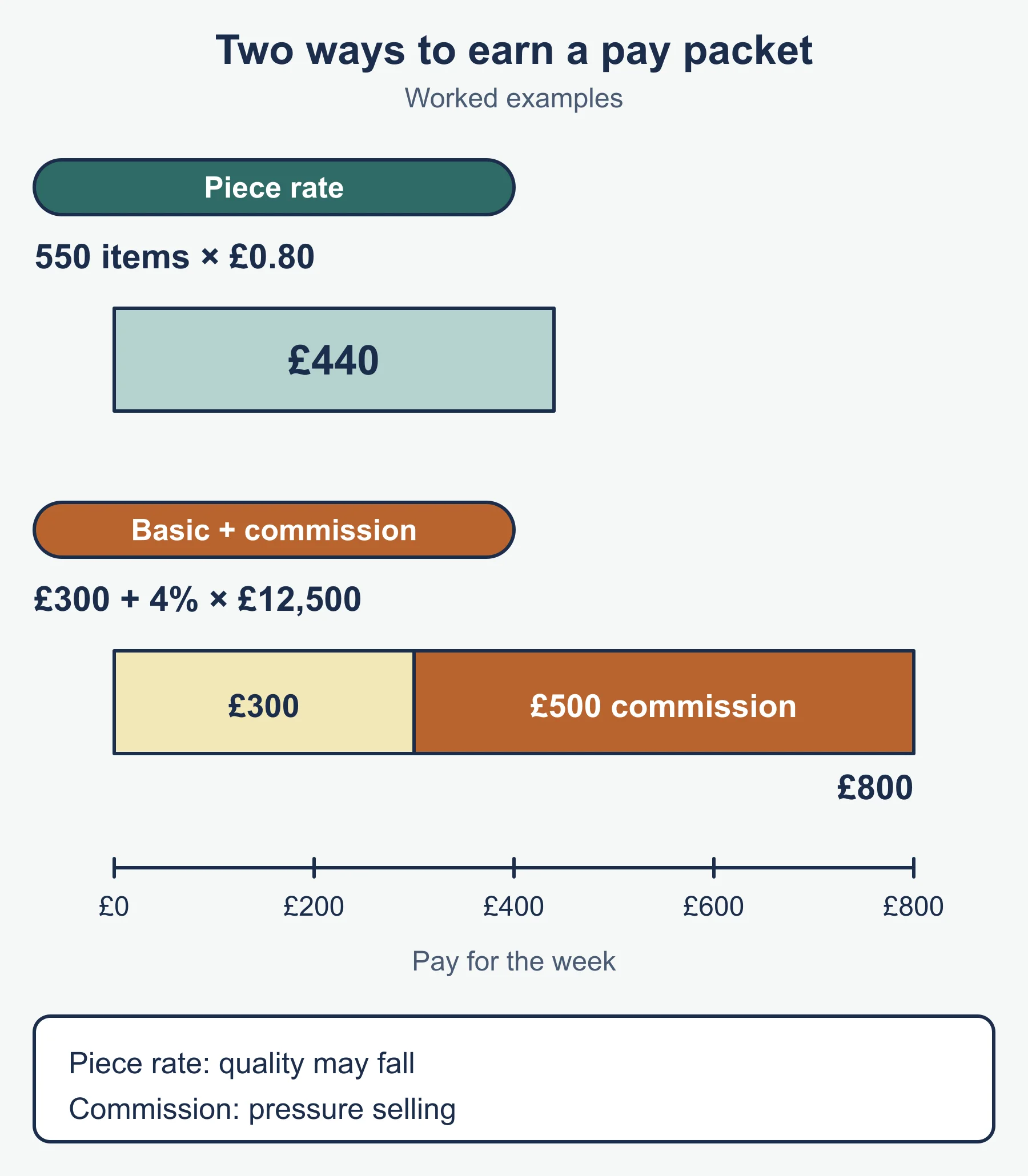
| Piecework | Paid per unit |
| Commission | Percentage of sales |
| Bonus | Extra for hitting a target |
| Profit share | Employees share profit |
| Performance-related pay | Pay linked to assessed performance |
| Non-financial method | Idea |
|---|---|
| Delegation | Authority passed down |
| Consultation | Ask before deciding |
| Empowerment | Staff decide about their own work |
| Team working | Shared goals |
| Flexible working | Choice of hours or place |
| Job enrichment | More responsibility and challenge |
| Job rotation | Switching between tasks |
| Job enlargement | More tasks at the same level |
Method in steps for a motivation question.
- Name the problem in the case (turnover, errors, absence).
- Pick a theory that explains it.
- Pick a method that fits that theory and the workforce.
- Say what it costs and how long it takes to work.
- Judge it against one alternative.
Quick calculations.
- Commission: 3% of £80,000 sales is £2,400.
- Piecework: 480 units at 75p is £360.
- Profit share: 5% of £260,000 is £13,000; shared among 26 staff, £500 each.
Leadership
- Management: plans, organises, coordinates and controls. Leadership: sets direction and inspires.
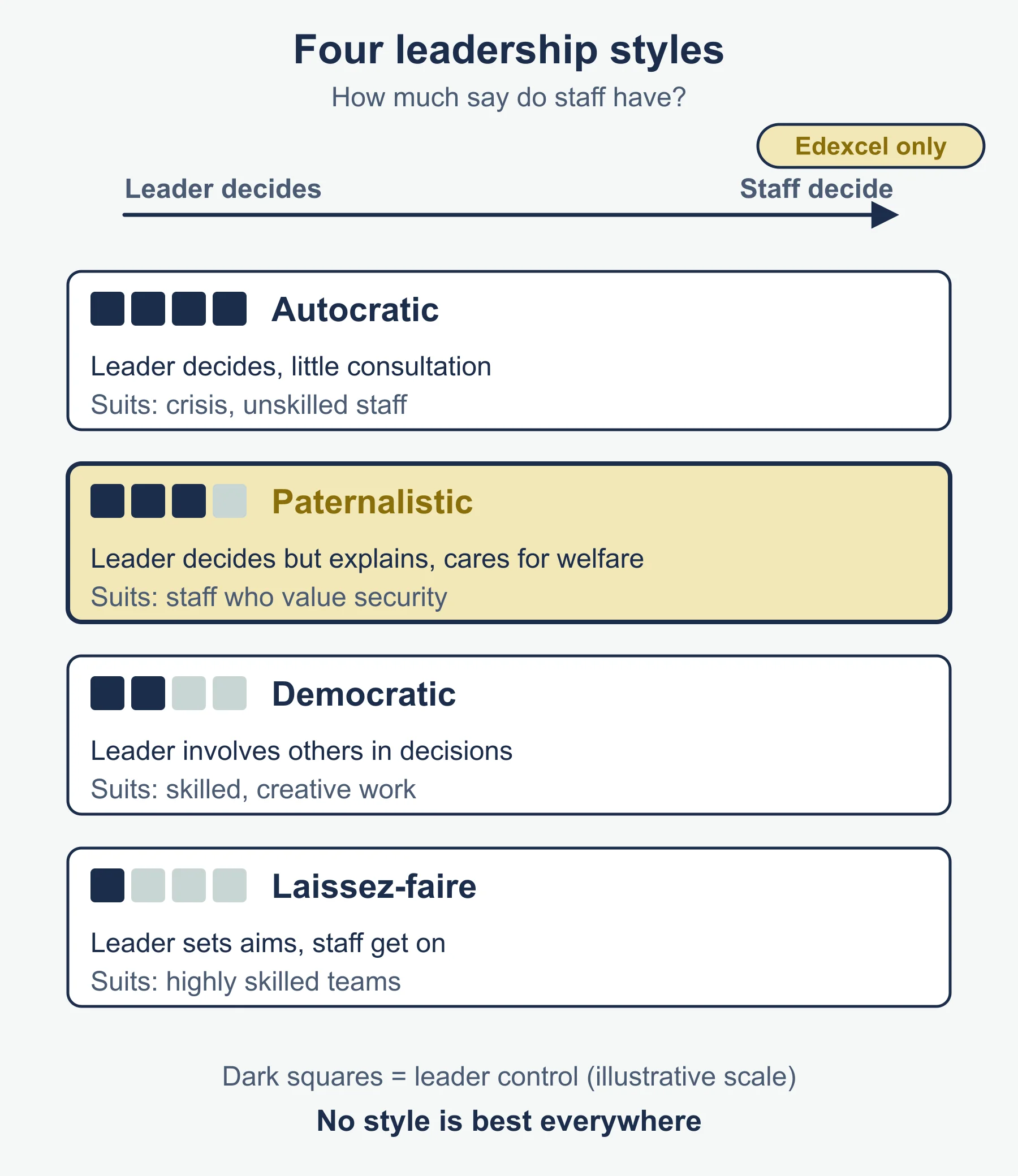
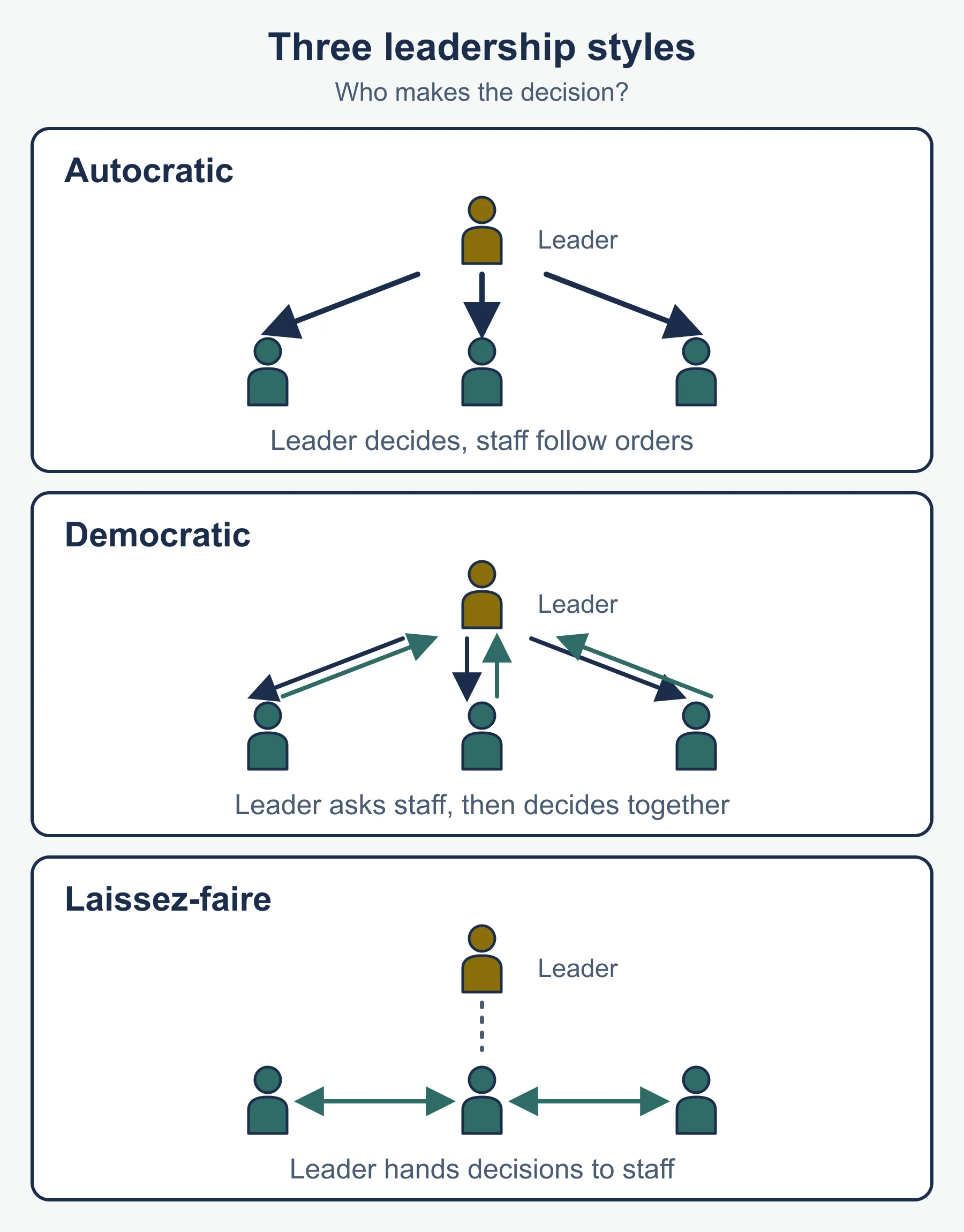
- Autocratic: leader decides alone. Paternalistic: leader decides but explains and cares. Democratic: involves staff. Laissez-faire: broad aims, staff decide how.
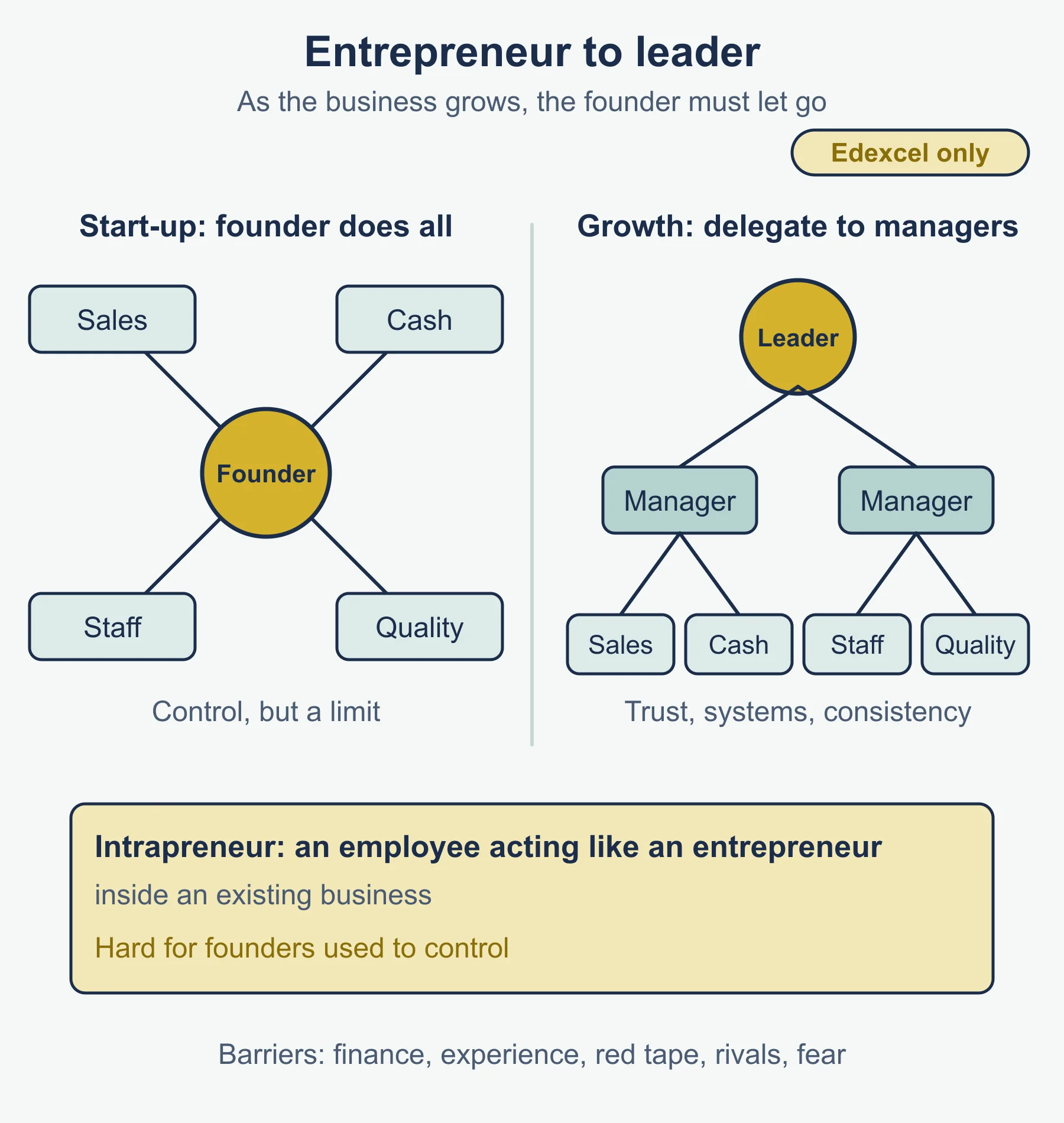
- Entrepreneur to leader: the founder must delegate, trust managers and put systems in place, which is hard for someone used to controlling everything.
1.3.5 Entrepreneurs and leaders
Role of an entrepreneur
| Role | Points |
|---|---|
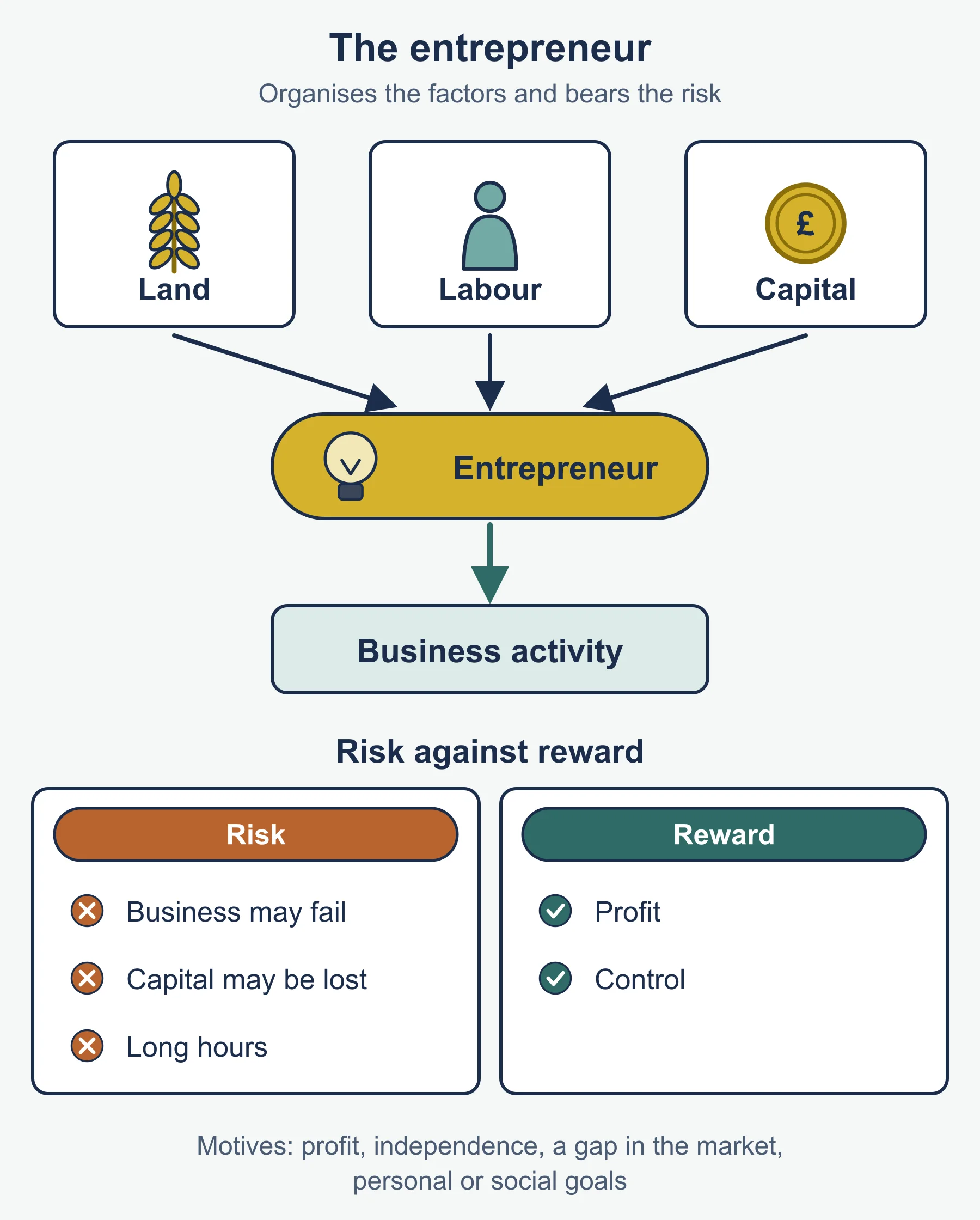
| Creating and setting up | Spot an opportunity, plan, raise finance |
| Running and expanding/developing | Manage cash and people, then grow |
| Intrapreneurship | Employees innovate inside an existing business |
| Barriers | Finance, experience, red tape, competition, fear of failure |
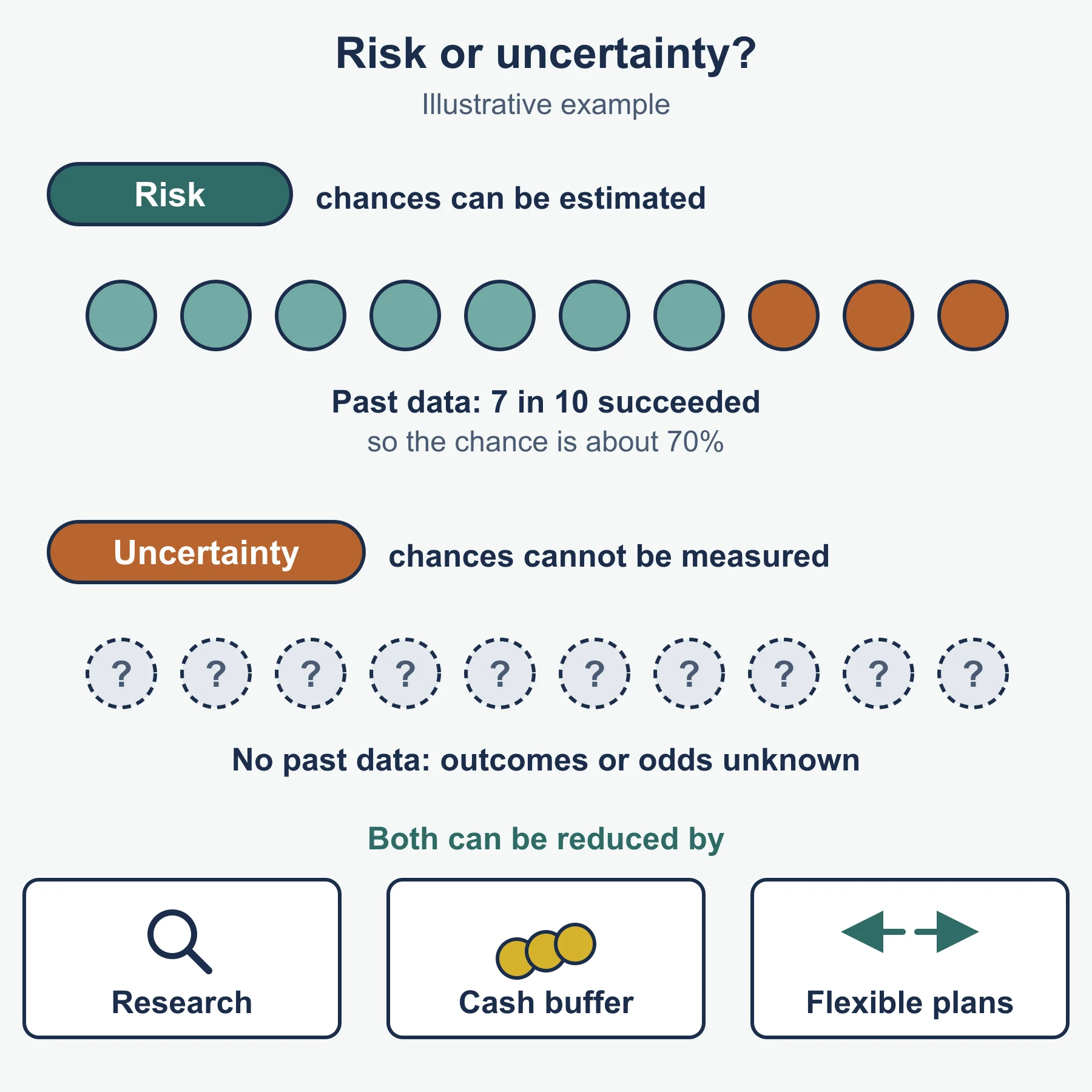
| Risk and uncertainty | Risk can be estimated; uncertainty cannot |
Motives and characteristics
- Characteristics and skills: risk-taking, creativity, determination, self-confidence, organisation, communication, opportunity spotting.
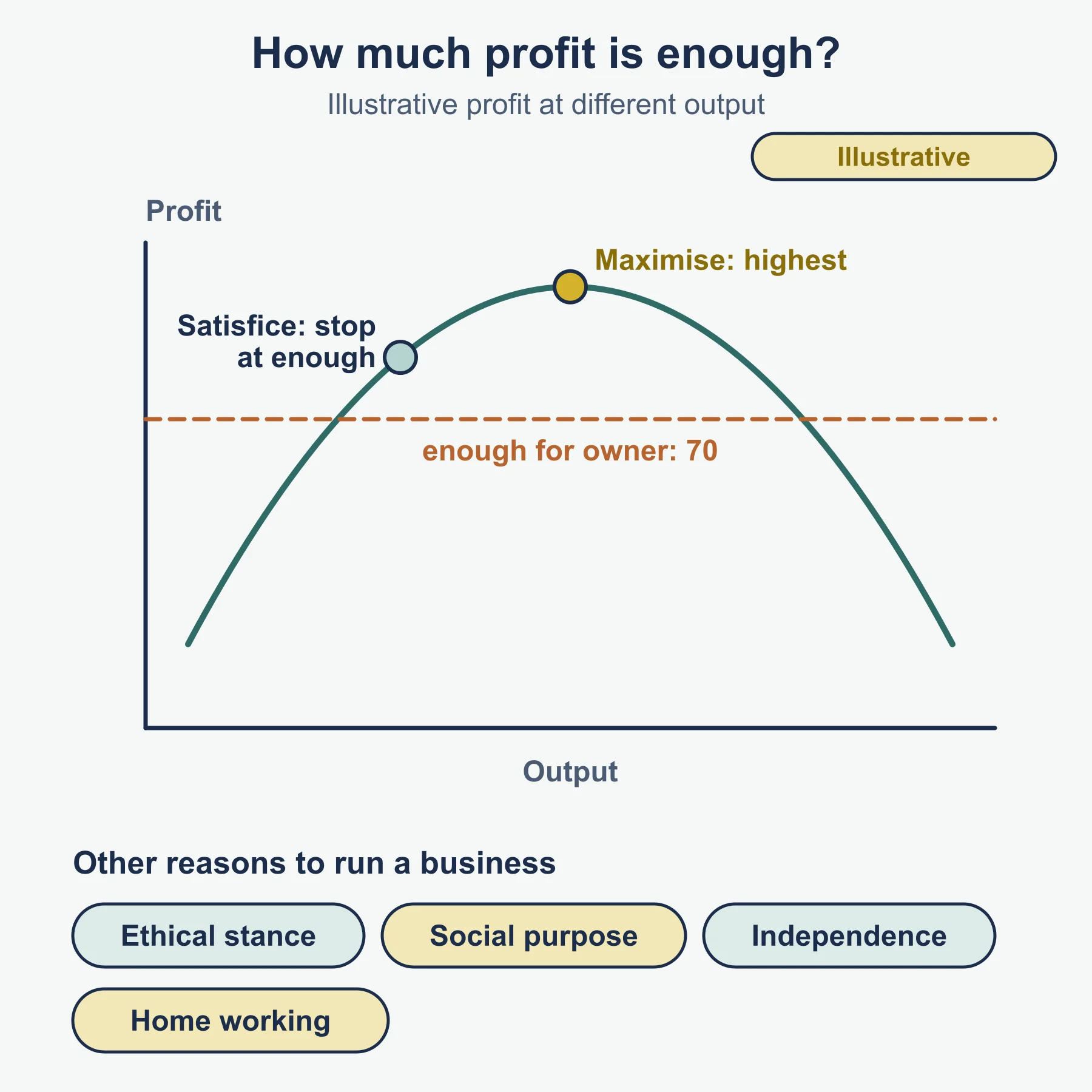
- Financial motives: profit maximisation (highest possible) and profit satisficing (enough to be content).
- Non-financial motives: ethical stance, social entrepreneurship, independence, home working.
Business objectives
| Objective | Short note |
|---|---|
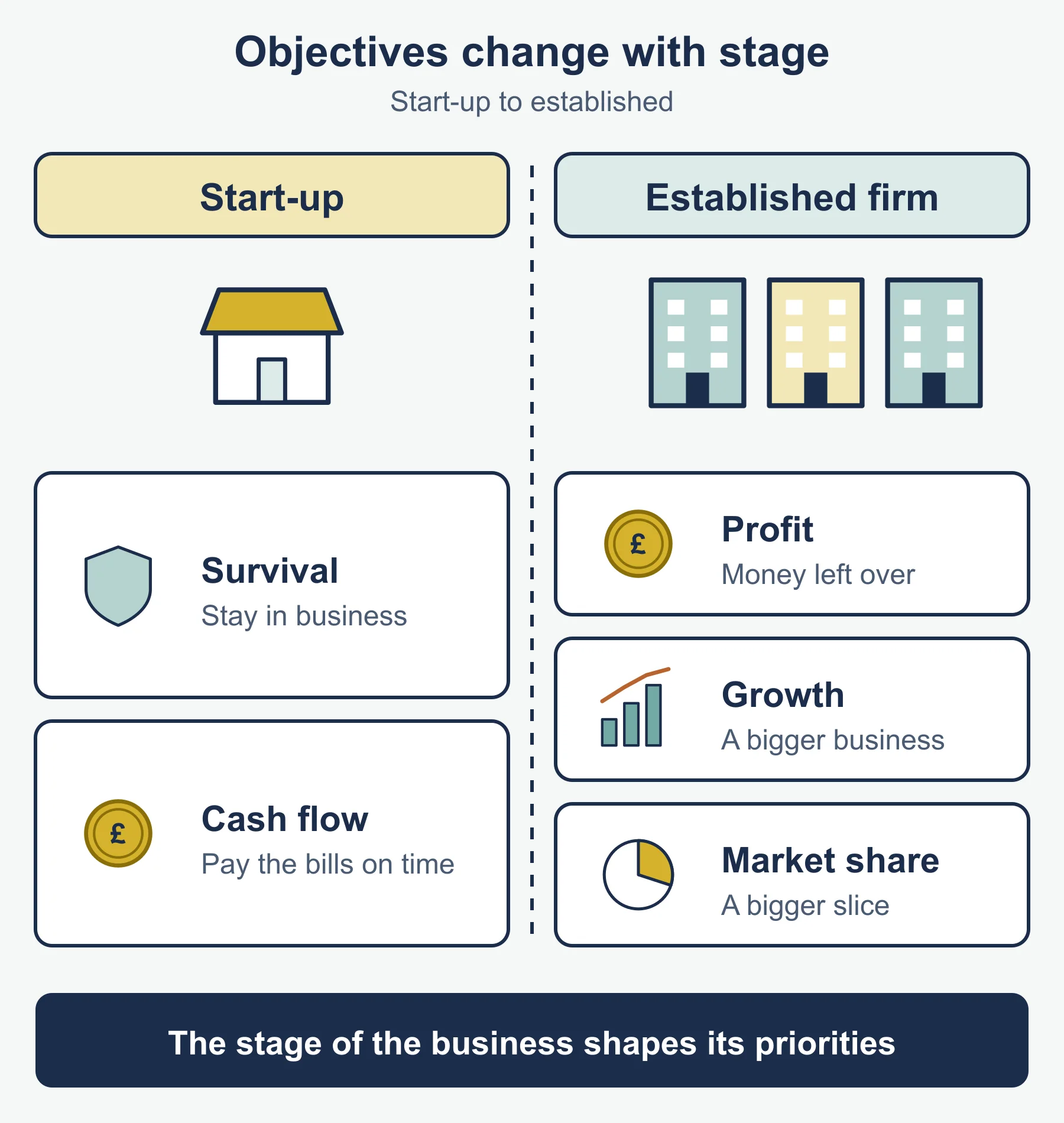
| Survival | New or struggling firms; cash flow |
| Profit maximisation | Highest profit; hard to know |
| Sales maximisation | Highest sales; margins may fall |
| Market share | Firm sales divided by market sales, times 100 |
| Cost efficiency | Lower unit cost |
| Employee welfare | Pay, safety, conditions |
| Customer satisfaction | Loyalty and repeat sales |
| Social objectives | Benefit to community or environment |
Quick calculation. Market share: £2.4m of a £30m market is 8%.
Business choices
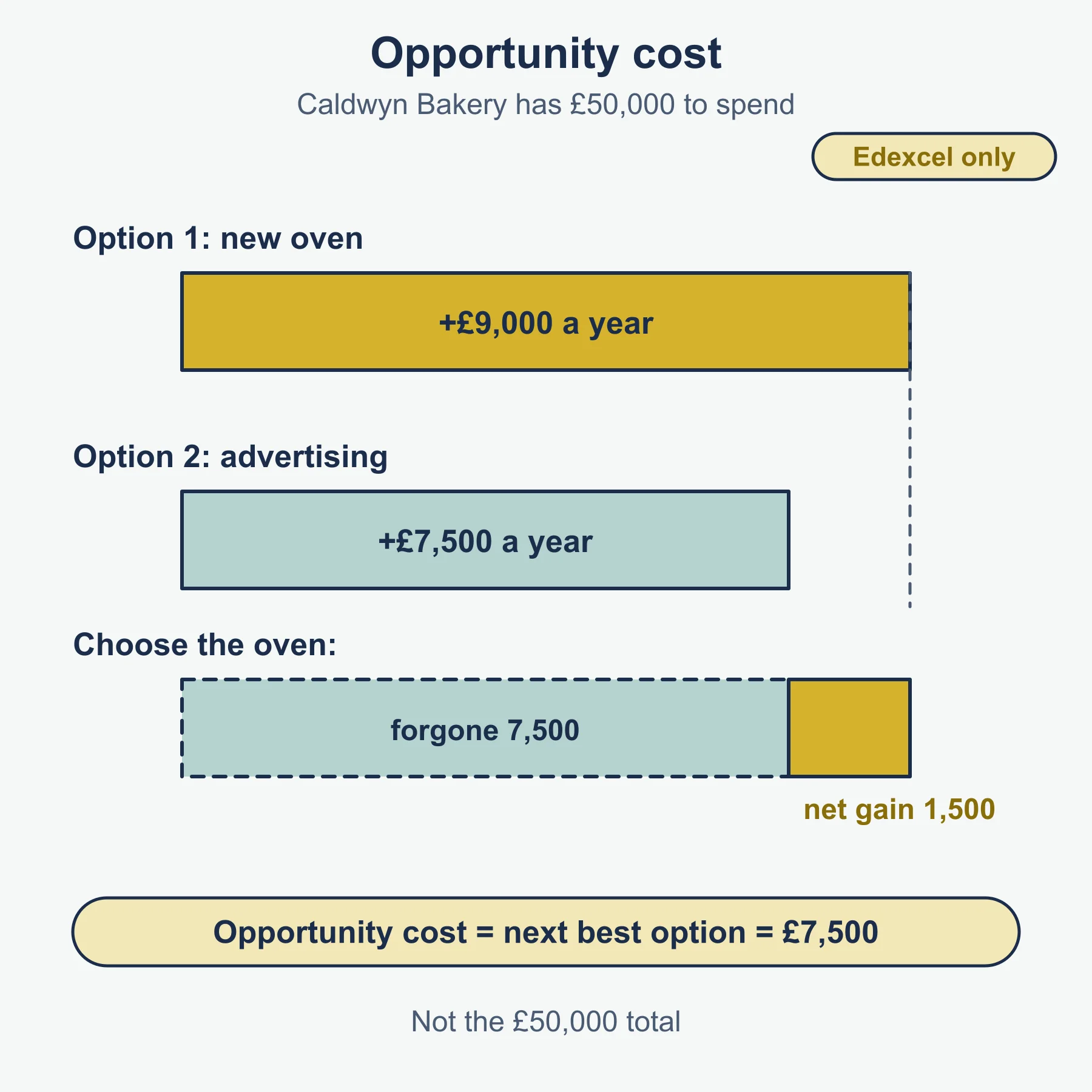
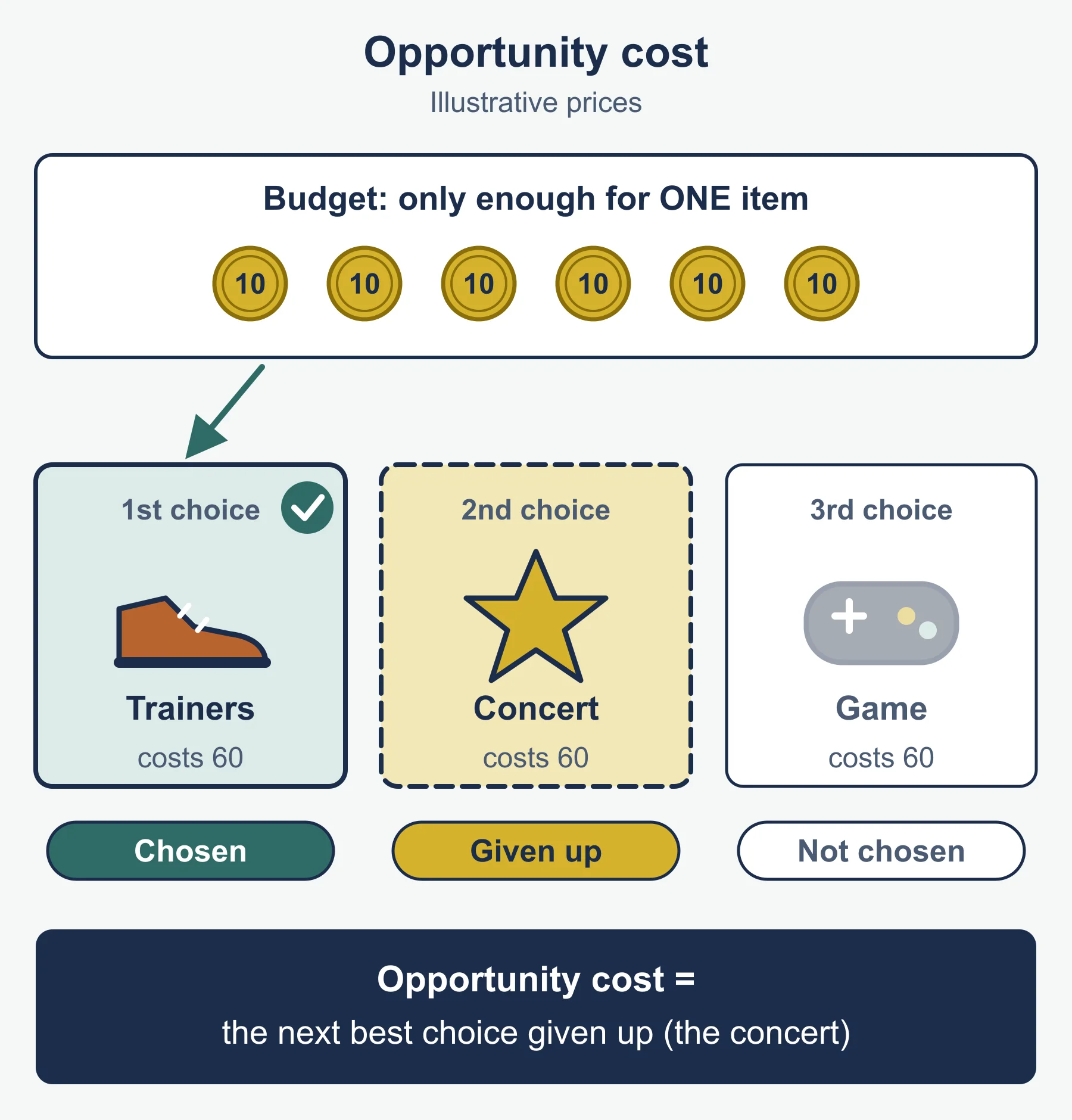
- Opportunity cost: the next best alternative given up. Two uses of £20,000 earn £3,000 and £2,600 a year. Choosing the first gives a net gain of £400 and an opportunity cost of £2,600.
- Trade-off: more of one aim means less of another, for example growth against short-term profit.
Method in steps for a judgement question
- State your answer in the first sentence.
- Give one developed reason for it, using case figures.
- Give one developed reason against it.
- Say which matters more for this business, and why.
- Name what the judgement depends on, such as firm size, staff skill, time frame or cash available.
Must-know distinctions
- Asset versus cost view of staff.
- Dismissal versus redundancy.
- Individual approach versus collective bargaining.
- Span of control versus chain of command.
- Job enrichment (depth) versus enlargement (breadth).
- Hygiene factors versus motivators.
- Risk versus uncertainty.
- Profit maximisation versus profit satisficing.
- Management versus leadership.
Quick self-test
- State two ways a business can create a flexible workforce.
- Define redundancy.
- A manager supervises 9 staff. Which term describes the 9?
- Give one benefit and one cost of internal recruitment.
- Which motivation theorist favoured pay by output?
- According to Herzberg, what do hygiene factors do?
- Name two financial methods of improving performance.
- What is the difference between job enrichment and job enlargement?
- Define profit satisficing.
- A firm chooses project A (net return £7,000) over project B (£5,500). What is the opportunity cost?
Answers
- Any two from multi-skilling, part-time and temporary staff, zero-hour contracts, flexible hours and home working, outsourcing.
- The job no longer exists, so the employee is let go through no fault of their own.
- Span of control.
- Benefit: cheaper or quicker, and the person knows the firm. Cost: the choice is narrow, and it leaves another vacancy.
- Taylor.
- They prevent dissatisfaction but do not by themselves motivate.
- Any two from piecework, commission, bonus, profit share, performance-related pay.
- Enrichment adds responsibility and challenge; enlargement adds more tasks at the same level.
- Aiming for a satisfactory profit rather than the highest possible.
- £5,500 a year, the value of the next best alternative.
Where marks are usually lost
- Defining a term but never applying it to the case.
- Calling redundancy dismissal, or the reverse.
- Saying a flat structure is always better, with no mention of managers’ workload.
- Writing that pay always motivates, and not using Herzberg.
- Leaving out the cost of a motivation method.
- Treating risk and uncertainty as one idea.
- Quoting a leadership style without saying why it suits the task or the people.
- Giving the whole cost, not the next best option, as an opportunity cost.
- Ending an evaluation with no judgement and no condition on which it depends.
Frequently asked questions
What are the four motivation theorists in Edexcel IAL Business Unit 1? The YBS11 specification names Taylor (scientific management), Mayo (human relations), Maslow (hierarchy of needs) and Herzberg (two-factor theory).
What is the difference between job enrichment and job enlargement? Job enrichment adds more challenging and responsible tasks, while job enlargement adds more tasks at a similar level. Job rotation moves staff between similar tasks to reduce boredom.
What are the four leadership styles? Autocratic leaders decide with little consultation, paternalistic leaders decide but explain and care about welfare, democratic leaders involve others in decisions, and laissez-faire leaders set broad aims and leave staff to get on.
What is the difference between risk and uncertainty for an entrepreneur? Risk can be estimated because outcomes and probabilities are known or can be guessed from past data. Uncertainty cannot be measured because the outcomes are unknown.
Official syllabus
Pearson Edexcel International Advanced Subsidiary/Advanced Level in Business, Specification, Issue 1, September 2017 (Pearson Education Limited); Unit 1: Marketing and people, sections 1.3.4 and 1.3.5.
Get free revision emails (optional)
Occasional emails with practice questions, worked explanations and links to free resources for the qualification and subjects you choose. No spam, and you can unsubscribe from any email. The free tools on this site never need an email.
Related resources
-
Study guides
Edexcel International A Level Business: Marketing mix and strategy (YBS11)
A full study guide to marketing objectives, product, promotion, price and place for Pearson Edexcel International A Level Business, with worked examples.
Business · Pearson Edexcel · AS Level
Read guide -
Practice questions
Edexcel International A Level Business: Marketing mix and strategy (YBS11) – Practice Questions
Original practice questions with worked answers on the Boston Matrix, pricing, branding and distribution for Edexcel International A Level Business.
Business · Pearson Edexcel · AS Level
Try questions -
Revision notes
Edexcel International A Level Business: Marketing mix and strategy (YBS11) – Revision Notes
Condensed recall notes, formulas and a self-test on objectives, the Boston Matrix, pricing and distribution for Edexcel International A Level Business.
Business · Pearson Edexcel · AS Level
Revise topic
Related articles
-
teaching
A Level tuition in Dubai: Cambridge or Pearson Edexcel International A Level?
Schools in Dubai and Abu Dhabi teach either Cambridge International AS & A Level or Pearson Edexcel International A Level. How the two are structured, why it matters for tuition, and how online classes from Lahore work.
9 October 2026
-
curriculum guides
Choosing subjects at IGCSE and A Level
How subject choices at 14 and 16 affect university options later, and how to keep pathways open without overloading a timetable.
28 July 2026
Studying this with a teacher
Working through Business AS LEVEL?
This page is free and stays free. If you would rather be taught it, Marlbridge runs Business classes one-to-one and in small groups of up to 15, online in your own time zone. The first trial class is free. WhatsApp replies within an hour (8am–11pm Pakistan time, every day); email the same day.
Pearson Edexcel Business teachers at Marlbridge

