
Study Guides
Edexcel International A Level Business: Global business (YBS11)
Study guide to all of Unit 4 Global business in Edexcel International A Level Business (YBS11): globalisation, markets, marketing and MNCs.
- Subject
- Business
- Level
- A LEVEL
- Topic
- Global business
- Author
- Marlbridge Academic Team
- Updated
- Reviewed by
- Salman Ahmad (what this means)
Aligned to Pearson Edexcel A Level Business (YBS11), Issue 1, September 2017. Official specification .
Syllabus page (what it covers and how it is assessed): Pearson Edexcel A Level Business.
Syllabus points this page covers
YBS11 (A Level)
- 4 Global business (whole topic)
Found an error? Report a correction.
Need help with this topic? Request a free trial class for A Level Business (YBS11).
This guide teaches the whole of Unit 4 Global business in the Pearson Edexcel International Advanced Subsidiary/Advanced Level in Business specification (YBS11), Issue 1, September 2017: sections 4.3.1 to 4.3.4. Unit 4 is a 2-hour paper marked out of 80, with short open-response and extended-writing questions. Questions may draw on Units 1, 2 and 3, and the specification says calculators may be used. The specification stresses that globalisation and global markets must be understood in relation to businesses. All countries, currencies and firms below are invented.
Use it with the revision notes and practice questions. Course hub: Edexcel A Level Business. Checklist: printable checklist. Check where you stand with the free diagnostics.
Map of the topic
| Section | Title | Main content |
|---|---|---|
| 4.3.1 | Globalisation | Economies, growth indicators, trade, causes, protectionism, trading blocs |
| 4.3.2 | Global markets and business expansion | Push and pull factors, assessing markets and locations, mergers, exchange rates |
| 4.3.3 | Global marketing | Strategy, glocalisation, approaches, 4Ps, niches, culture |
| 4.3.4 | Global industries and companies | Impact of MNCs, ethics, controlling MNCs |
4.3.1 Globalisation
Types of economy and growth
Developed economies have high income per head, large service sectors, strong infrastructure and mature markets. Developing economies have low income per head, more agriculture and weaker infrastructure. Emerging economies are growing fast, industrialising and opening to trade. The specification asks about the growing economic power of countries in Asia, Africa and elsewhere. Growth matters to businesses because it creates trade opportunities (new customers, new suppliers) and changes employment patterns, as work moves from farming to manufacturing and then services.
Two indicators are named. Gross domestic product (GDP) is the value of output produced in an economy in a period. GDP per capita is GDP divided by population. The human development index (HDI) combines income with measures of health and education, so it shows living standards that GDP alone misses.
Worked example. Kellamar’s GDP rises from 80bn to 84bn dollars and its population is 12 million. Growth = (84 − 80) ÷ 80 × 100 = 5%. GDP per capita = 84bn ÷ 12m = 7,000 dollars. A high figure for GDP per capita can hide inequality, so HDI is a useful second check.
International trade
Exports are goods and services sold abroad; imports are bought from abroad. Countries and businesses increasingly specialise: they concentrate on what they make efficiently and trade for the rest. Benefits are lower costs and larger scale. Risks are over-dependence on one product or one customer country and exposure to shocks abroad. Foreign direct investment (FDI) is a firm investing in operations abroad, such as building a factory or buying a foreign business. It links to growth by giving access to new markets, cheaper resources and scale.
Factors behind globalisation
Learn each as a cause, then link it to a business effect.
- Trade liberalisation: fewer trade barriers. The WTO (World Trade Organisation) promotes freer trade, runs negotiations and handles disputes.
- Political change: countries open their economies and join trade agreements.
- Cheaper transport and communication: firms can manage distant supply chains and sell online.
- Multinational corporations (MNCs): global firms with growing influence.
- Investment flows: more FDI.
- Migration: workers and consumers move within and between economies.
- Growth of the global labour force: more workers available, often at lower wages.
- Structural change: economies shift between primary, secondary and tertiary sectors.
The impact on businesses: bigger markets and cheaper inputs, but tougher competition, more complexity and exposure to exchange rates.
Protectionism
Protectionism means shielding domestic producers from foreign competition. Reasons include protecting jobs, infant industries and national security, and reducing a trade deficit.
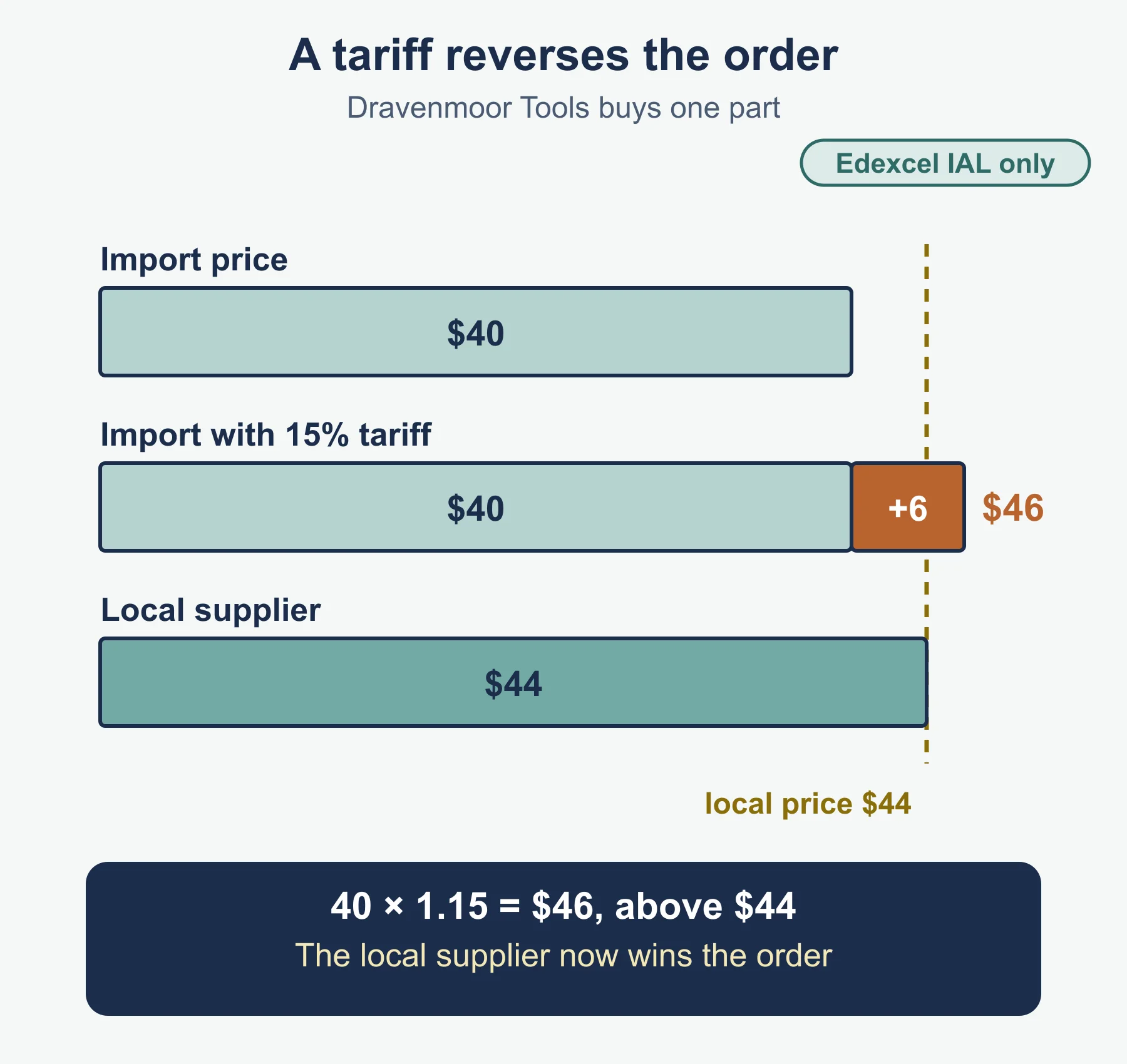
- Tariff: a tax on imports. Dravenmoor Tools imports a part priced at 40 dollars. A 15% tariff makes it 40 × 1.15 = 46. A local supplier at 44 now wins the order.
- Import quota: a limit on the quantity imported. It raises prices by restricting supply, and the government earns no tax revenue from it.
- Other barriers: government legislation (for example product standards) and domestic subsidies that let local firms charge less.
Impact on businesses: exporters meet barriers and may face retaliation; importers pay more; protected local firms gain, but may become inefficient.
Trading blocs
A trading bloc is a group of countries with reduced barriers between them. The specification names three. The EU and its single market allow free movement of goods, services, capital and people between members, with common external tariffs. ASEAN is the bloc of South-East Asian nations. NAFTA linked the USA, Canada and Mexico (it was later replaced by a successor agreement). Impact on businesses: easier access to bigger markets and more economies of scale, but members face competition, and outsiders face the common external barriers, which may push them to invest inside the bloc.
4.3.2 Global markets and business expansion
Conditions that prompt trade
- Push factors drive a firm out of its home market: saturated markets and competition.
- Pull factors attract it abroad: increased sales and profitability, risk spreading and economies of scale.
- Cost competitiveness can come from off-shoring (moving production abroad) or outsourcing (paying another firm to do it).
- Extending the product life cycle: a product in decline at home can be launched in a new country.
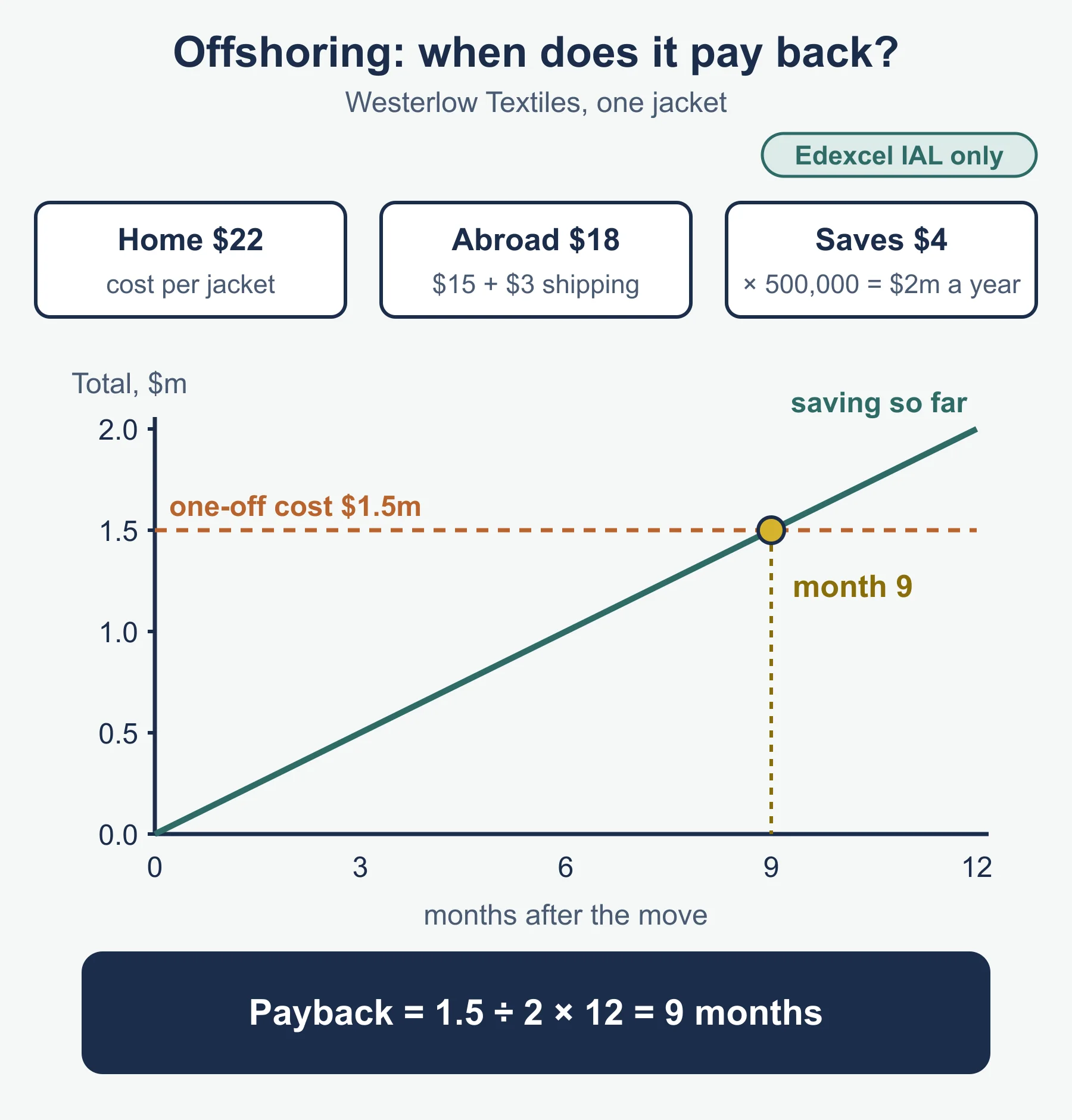
Worked example. Westerlow Textiles makes a jacket at 22 dollars at home. Abroad it costs 15 plus 3 for shipping, 18 in all. Saving per unit = 4. At 500,000 units this is 2m a year. Relocation costs 1.5m once. Payback = 1.5 ÷ 2 × 12 = 9 months. Non-financial factors (quality, reputation, supply risk) still need weighing.
Assessing a country as a market
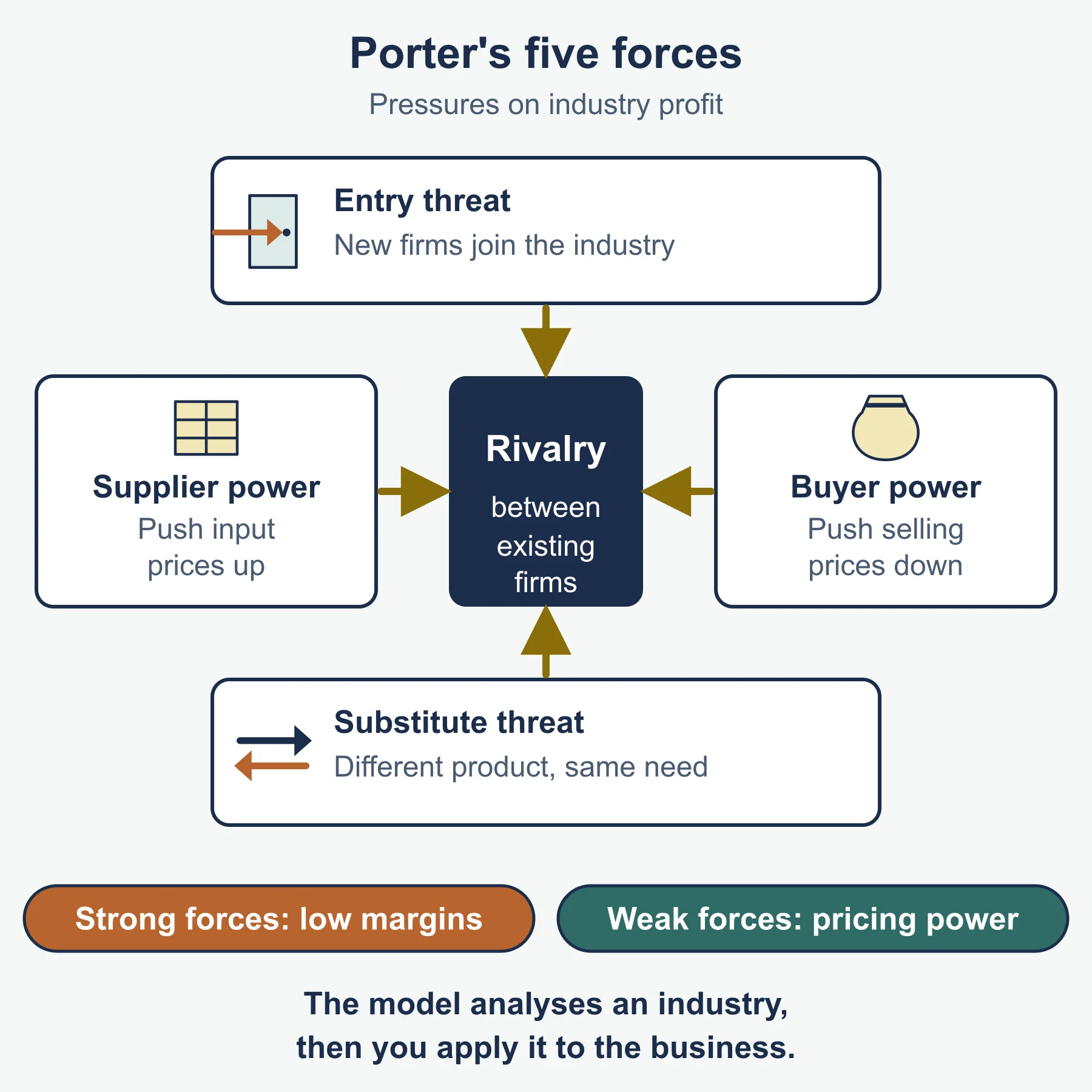
Factors: levels and growth of disposable income; ease of doing business; infrastructure; political stability; exchange rates. Apply Porter’s five forces to the market: the threat of new entrants, the threat of substitutes, the bargaining power of buyers, the bargaining power of suppliers and the rivalry among existing firms. High rivalry and strong buyers make a market less attractive.
Assessing a country as a production location
Factors: costs of production; skills and availability of labour; infrastructure; location in a trade bloc; government incentives; ease of doing business; political stability; natural resources; likely return on investment.
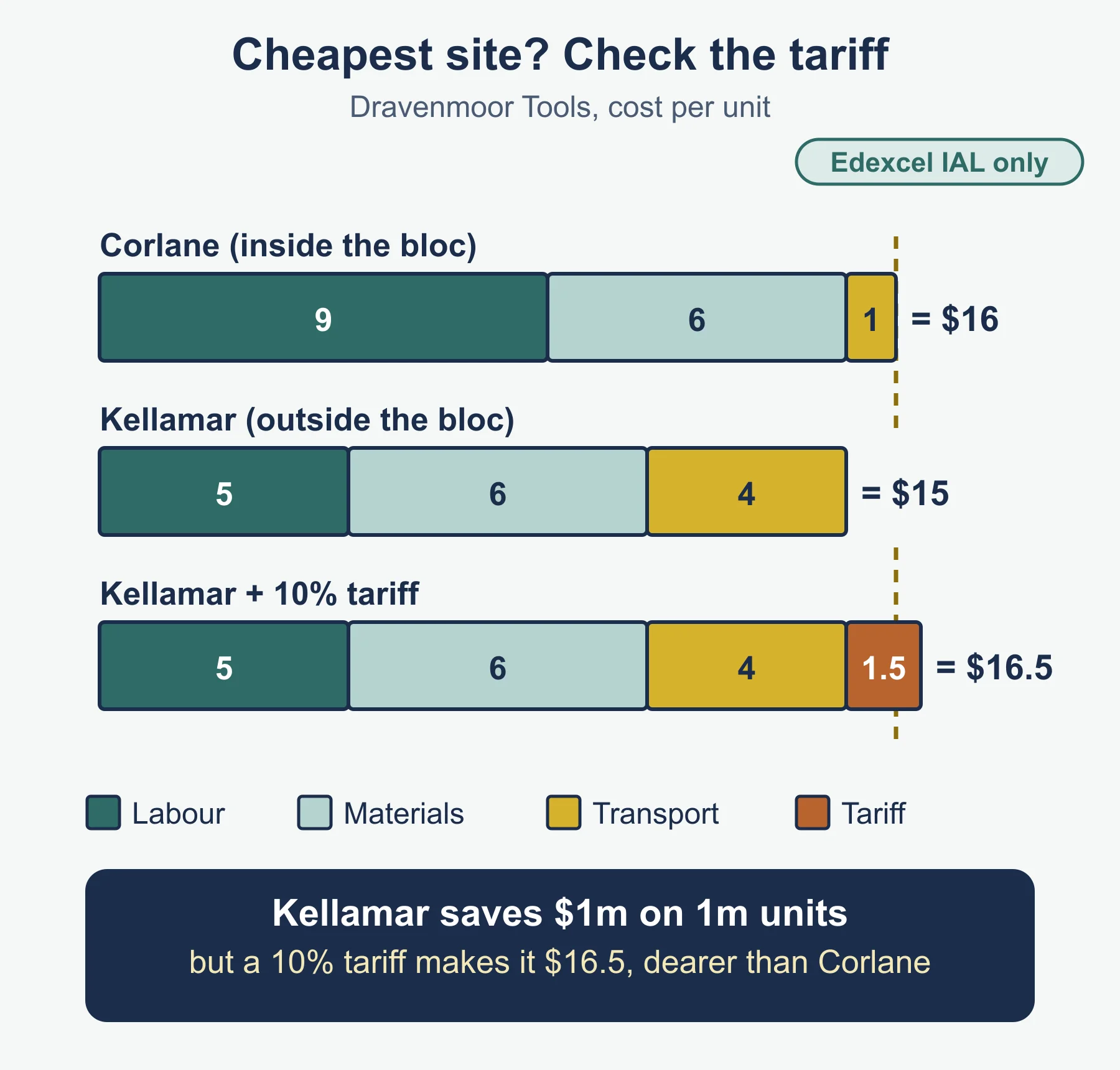
Worked example. Dravenmoor Tools compares sites for 1m units. Corlane: labour 9, materials 6, transport 1 = 16 per unit. Kellamar: labour 5, materials 6, transport 4 = 15. Kellamar saves 1m. But Kellamar is outside the bloc that Dravenmoor sells into, and a 10% tariff on 15 gives 16.5, which is dearer than Corlane. Return on investment (standard form: annual profit ÷ investment × 100): extra profit of 360,000 on 2.4m is 15%.
Global mergers, takeovers and joint ventures
Reasons: spreading risk and economies of scale; entering new markets or trade blocs; acquiring brand names or patents; securing resources or supplies; maintaining or increasing global competitiveness; reducing competition; using local knowledge; meeting a government or legal requirement; accessing supply chains and distribution networks; sharing costs and risks. If a 10m project is shared 60:40 in a joint venture, the partners carry 6m and 4m.
Uncertainty
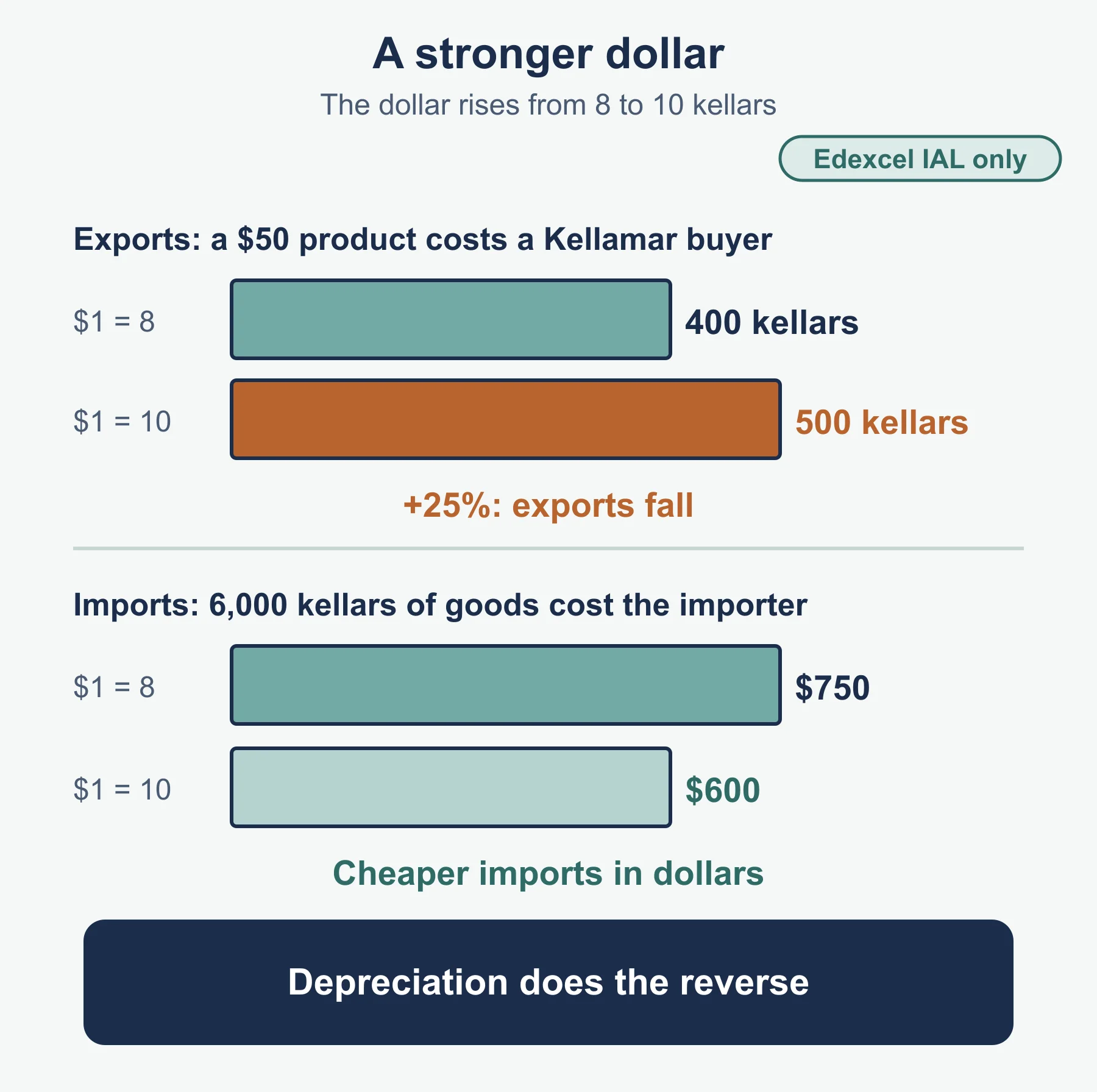
Exchange rates. If the dollar rises from 8 to 10 kellars, a 50 dollar product costs a Kellamar buyer 400 then 500 kellars, up 25%, so exports fall. Imports priced in kellars get cheaper in dollars: 6,000 kellars cost 750 dollars at 8 but 600 at 10. Depreciation does the reverse. Skill shortages raise wages, slow expansion and weaken international competitiveness.
4.3.3 Global marketing
Strategy and approaches
Global marketing strategy uses one approach across markets. Global localisation (glocalisation) keeps a global brand but adapts to local tastes. The three approaches are domestic/ethnocentric (home-market methods applied abroad), mixed/geocentric (a blend of global standardisation and local adaptation) and international/polycentric (a separate approach for each country).
Apply the 4Ps to global markets: product (design, size, packaging), price (income, tariffs, exchange rates), promotion (language and media) and place (local distribution). Use Ansoff’s matrix to judge growth: market penetration, product development, market development (the usual route abroad) and diversification (riskiest). Use Porter’s matrix (generic strategies: cost leadership, differentiation, focus) to decide how to compete.
Niche markets
Cultural diversity means groups differ in interests and values. A global niche is a small, specialised segment found in many countries, such as a sport or dietary group. Features: specific needs, loyal customers, less rivalry. Adapt the 4Ps: a specialised product, a premium price, targeted promotion (online, specialist media) and selective distribution.
Cultural and social factors
Consider cultural differences, tastes and preferences, language and unintended meanings (a name or slogan that translates badly), and inappropriate branding and promotion (colours, images or humour that offend). Research and local advice reduce these risks.
4.3.4 Global industries and companies
Impact of MNCs
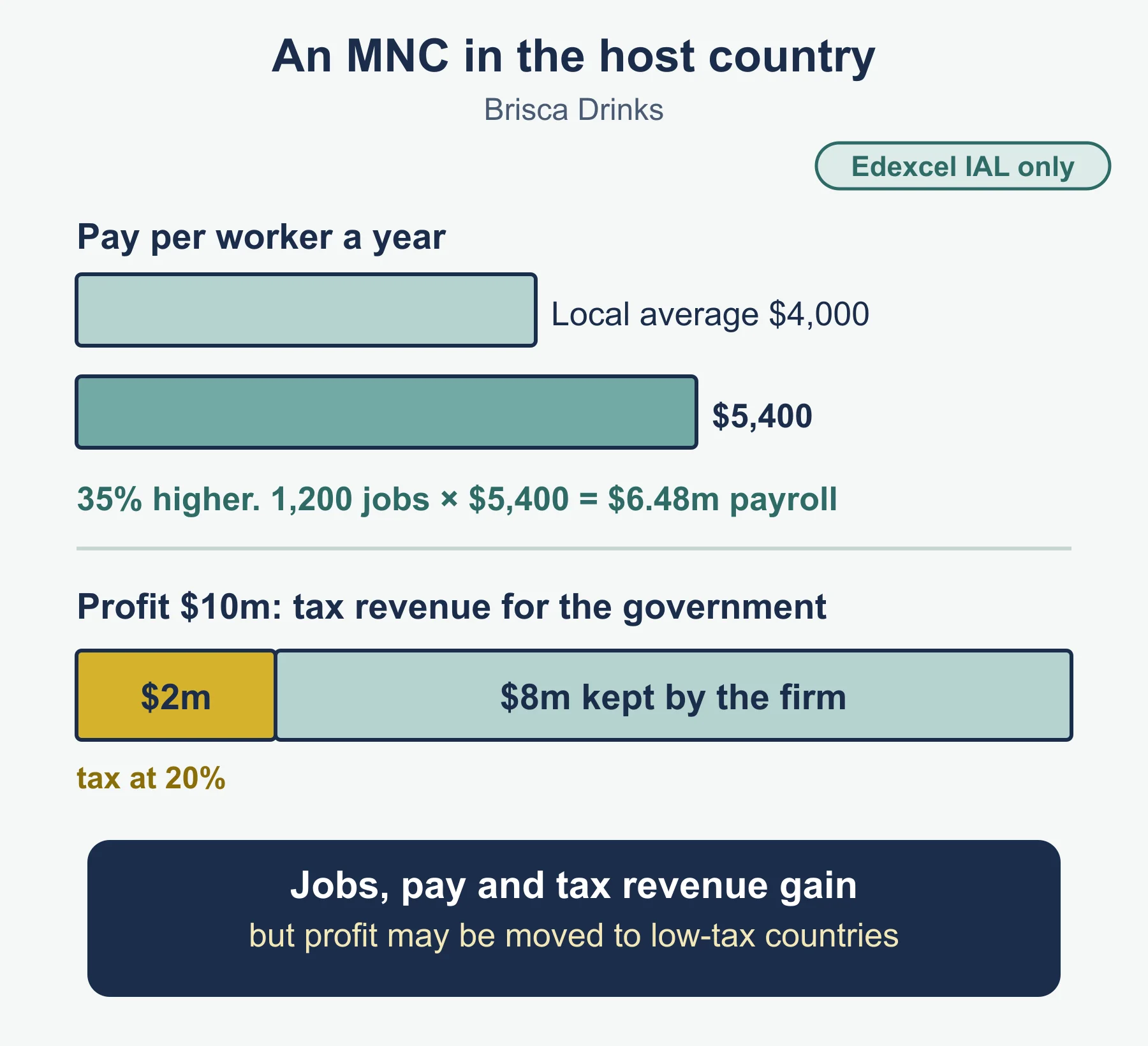
Local economy. Jobs and wages: Brisca Drinks employs 1,200 people at 5,400 a year against a local average of 4,000, which is 35% higher, and a payroll of 6.48m. Working conditions may be better or worse. Local businesses gain as suppliers but may lose to MNC competition. The community and environment can suffer through pollution and congestion.
National economy. Effects on economic growth, FDI flows, the balance of payments, technology and skills transfer, consumers (choice and price), business culture and tax revenues. If Brisca makes 10m profit taxed at 20%, tax revenue is 2m, though profit may be moved to low-tax countries.
International business ethics
Stakeholder conflicts arise, for example between shareholders wanting low costs and workers wanting higher pay. Consider: emissions, waste disposal and sustainability; supply chains, with pay, working conditions, exploitation and child labour; and marketing, with misleading product labelling and inappropriate marketing.
Controlling MNCs
Factors: the power of the MNC (it may threaten to leave), political influence, legal control, consumer pressure, pressure groups, social media and self-regulation. Legal control works best where governments are strong; self-regulation depends on the firm’s own commitment.
Case-study skills for this unit
The command words in the specification set the depth: define (2 marks), calculate (4), explain (4), analyse (6), discuss (8), assess (12 in Units 3 and 4) and evaluate (20). For analyse, build a chain: cause, effect on the business, consequence. For discuss, assess and evaluate, add the competing argument and reach a supported judgement that fits the firm in the data.
A useful pattern for global decisions: state the option, link it to the firm’s objective, give one benefit with numbers if possible, give one risk, then judge using the time scale, the size of the firm and the stability of the market. For example, off-shoring that pays back in 9 months looks strong, but if the firm’s brand depends on local craftsmanship, the judgement may change.
The quantitative skills for this unit are ratios, percentages and percentage changes, index numbers, profit and break-even, investment appraisal and interpreting numerical and written information together. In this topic that means growth rates, GDP per capita, tariff and exchange rate effects, payback and return on investment.
Common errors
- Defining GDP per capita without dividing by population.
- Treating a tariff and a quota as the same.
- Saying a weaker currency always helps: imported inputs cost more.
- Listing MNC effects without judging which stakeholder gains.
Frequently asked questions
What is GDP per capita? GDP per capita is gross domestic product divided by population. For example, GDP of 84bn dollars and a population of 12 million gives 7,000 dollars per person.
Which trading blocs are named in the Edexcel IAL Business specification? The YBS11 specification names the EU and its single market, ASEAN and NAFTA, which linked the USA, Canada and Mexico and was later replaced by a successor agreement.
What are the three approaches to global marketing? The domestic or ethnocentric approach applies home-market methods abroad, the mixed or geocentric approach blends global standardisation with local adaptation, and the international or polycentric approach uses a separate approach for each country.
How can multinational corporations be controlled? Factors include the power of the MNC, political influence, legal control, consumer pressure, pressure groups, social media and self-regulation. An MNC may threaten to leave a country, which limits how far governments can control it.
Official syllabus
Pearson Edexcel International Advanced Subsidiary/Advanced Level in Business, Specification, Issue 1, September 2017, Unit 4: Global business, sections 4.3.1 to 4.3.4 (first assessment June 2020).
Get free revision emails (optional)
Occasional emails with practice questions, worked explanations and links to free resources for the qualification and subjects you choose. No spam, and you can unsubscribe from any email. The free tools on this site never need an email.
Related resources
-
Practice questions
Edexcel International A Level Business: Global business (YBS11) – Practice Questions
Original practice questions with worked answers on Unit 4 Global business in Edexcel International A Level Business (YBS11).
Business · Pearson Edexcel · A Level
Try questions -
Revision notes
Edexcel International A Level Business: Global business (YBS11) – Revision Notes
Condensed revision notes for all of Unit 4 Global business in Edexcel International A Level Business (YBS11), with a quick self-test and answers.
Business · Pearson Edexcel · A Level
Revise topic -
Study guides
Edexcel International A Level Business: Managing people and Entrepreneurs and leaders (YBS11)
Teaching guide to staffing, structure, motivation, leadership, entrepreneurs and objectives for Edexcel International A Level Business Unit 1.
Business · Pearson Edexcel · AS Level
Read guide
Related articles
-
teaching
A Level tuition in Dubai: Cambridge or Pearson Edexcel International A Level?
Schools in Dubai and Abu Dhabi teach either Cambridge International AS & A Level or Pearson Edexcel International A Level. How the two are structured, why it matters for tuition, and how online classes from Lahore work.
9 October 2026
-
curriculum guides
Choosing subjects at IGCSE and A Level
How subject choices at 14 and 16 affect university options later, and how to keep pathways open without overloading a timetable.
28 July 2026
Studying this with a teacher
Working through Business A LEVEL?
This page is free and stays free. If you would rather be taught it, Marlbridge runs Business classes one-to-one and in small groups of up to 15, online in your own time zone. The first trial class is free. WhatsApp replies within an hour (8am–11pm Pakistan time, every day); email the same day.
Pearson Edexcel Business teachers at Marlbridge

