
Revision Notes
Edexcel IGCSE Accounting: Accounting ratios (4AC1) – Revision Notes
Condensed Edexcel IGCSE Accounting revision notes on the five ratios, profitability versus liquidity, interpretation phrases and a self-test.
- Subject
- Accounting
- Level
- IGCSE
- Topic
- The preparation of financial statements
- Author
- Marlbridge Academic Team
- Updated
- Reviewed by
- Javaid Iqbal Sabri (what this means)
Aligned to Pearson Edexcel IGCSE Accounting (4AC1), Issue 1, October 2016. Official specification .
Syllabus page (what it covers and how it is assessed): Pearson Edexcel IGCSE Accounting.
Syllabus points this page covers
4AC1
- 4 The preparation of financial statements (whole topic)
- 4.4 The calculation and interpretation of accounting ratios
Found an error? Report a correction.
Want a teacher for this? Marlbridge teaches Accounting online. Request a free trial class.
Quick recall for the Pearson Edexcel International GCSE in Accounting (4AC1) specification, Issue 1, October 2016, Topic 4, section 4.4 “The calculation and interpretation of accounting ratios”, points (a) to (c). Full explanations and a two-year worked example are in the study guide; questions to try are in the practice set. Course links: the 4AC1 Accounting hub, the printable checklist and the free diagnostics.
1. Profitability versus liquidity (4.4 a)
| Profitability | Liquidity | |
|---|---|---|
| Question it answers | Does the business earn a profit, and how much for its revenue or capital? | Can the business pay its short-term debts when they fall due? |
| Looks at | Income statement (and capital employed for ROCE) | Current assets and current liabilities |
| Ratios | Gross profit percentage; profit for the year as a percentage of revenue; ROCE | Current (working capital) ratio; liquid (acid test) ratio |
| Warning sign | Falling percentages | Ratios low or falling |
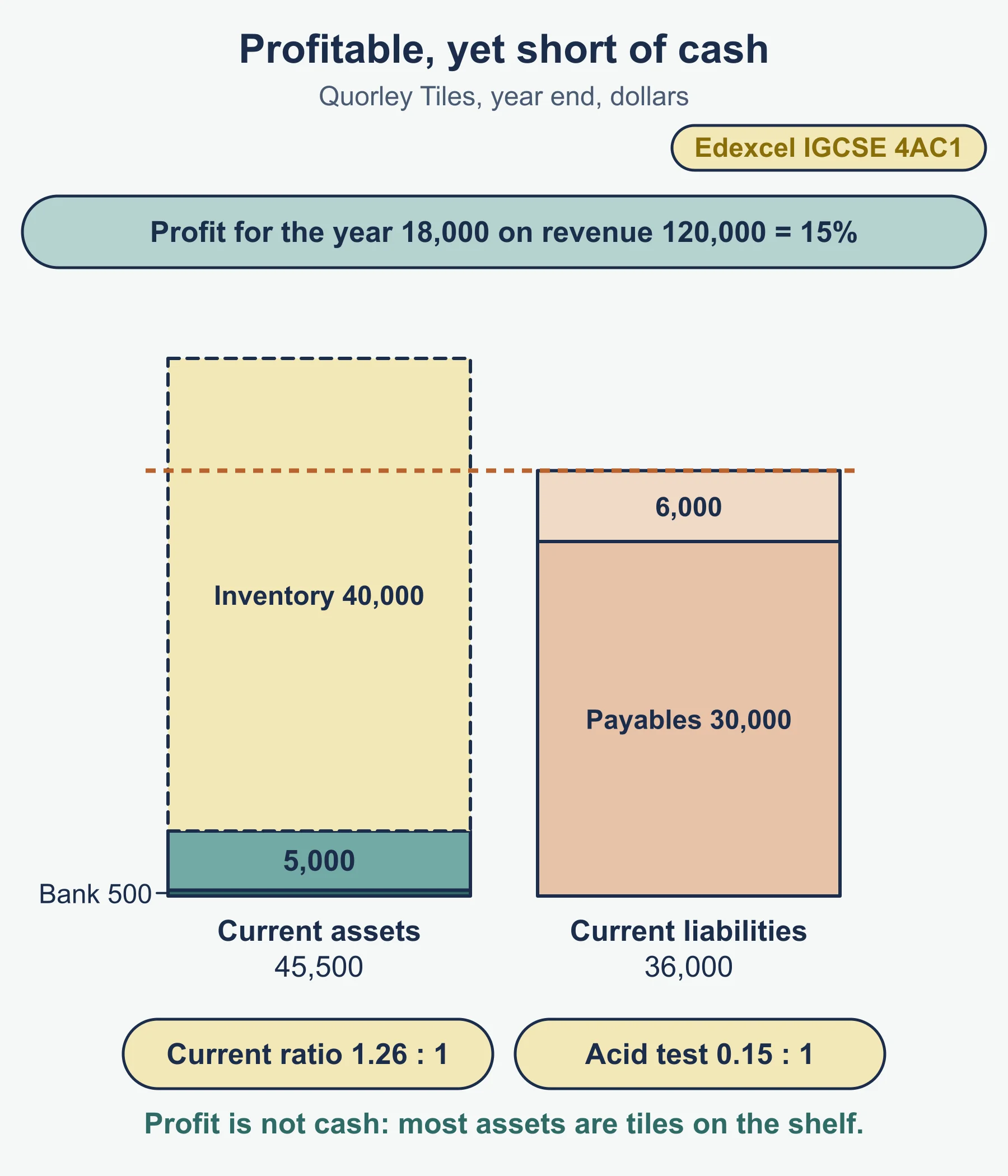
Key line: profit is not cash. A business can be profitable and short of cash, for example when profit is tied up in inventory or in amounts owed by customers.
2. The five formulas
| Ratio | Formula | Write as |
|---|---|---|
| Gross profit percentage | gross profit ÷ revenue × 100 | % |
| Profit for the year as a percentage of revenue | profit for the year ÷ revenue × 100 | % |
| Return on capital employed (ROCE) | profit for the year ÷ capital employed × 100 | % |
| Current (working capital) ratio | current assets : current liabilities | x : 1 |
| Liquid (acid test) ratio | (current assets − inventory) : current liabilities | x : 1 |
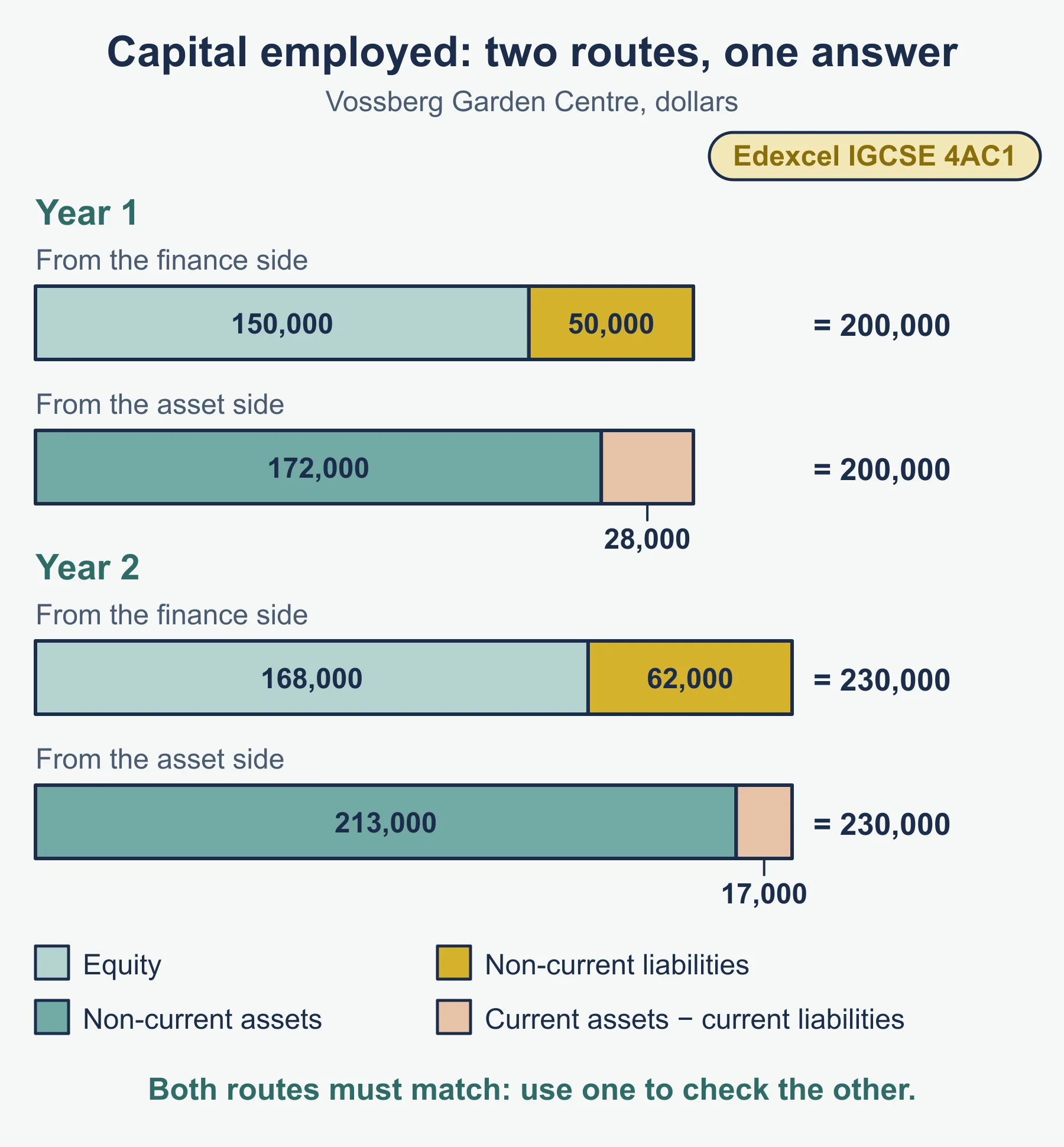
Capital employed, two routes that must agree:
- Equity + non-current liabilities.
- Non-current assets + current assets − current liabilities (non-current assets + working capital).
The specification gives no formula for capital employed, so write yours down. If a question defines it, use that definition.
3. Method in steps
- Write the formula.
- Pick the figures from the right statement: revenue, cost of sales, gross profit, expenses and profit for the year come from the income statement; current assets, current liabilities, equity and non-current liabilities come from the statement of financial position.
- Substitute, calculate and round (1 or 2 decimal places).
- Add the unit: % or x : 1.
- Interpret: what changed, why it may have happened, what follows.
4. Worked reminder: Palmerston Stationery
Revenue 82,000; cost of sales 57,400; other operating expenses 17,220. Equity 57,800; non-current liabilities 16,000. Inventory 9,000; trade receivables 3,900; bank 2,100; trade payables 7,000; other payables 1,000. All amounts in dollars.
| Step | Working | Answer |
|---|---|---|
| Gross profit | 82,000 − 57,400 | 24,600 |
| Gross profit percentage | 24,600 ÷ 82,000 × 100 | 30.0% |
| Profit for the year | 24,600 − 17,220 | 7,380 |
| Profit for the year as a percentage of revenue | 7,380 ÷ 82,000 × 100 | 9.0% |
| Capital employed | 57,800 + 16,000 | 73,800 |
| ROCE | 7,380 ÷ 73,800 × 100 | 10.0% |
| Current assets | 9,000 + 3,900 + 2,100 | 15,000 |
| Current liabilities | 7,000 + 1,000 | 8,000 |
| Current ratio | 15,000 ÷ 8,000 | 1.88 : 1 |
| Acid test | (15,000 − 9,000) ÷ 8,000 | 0.75 : 1 |
Reading: Palmerston Stationery retains 30 cents from every dollar of revenue as gross profit, and 9 cents once expenses are met. Its acid test is below 1 : 1, so quick assets do not fully cover current liabilities, and it relies on selling inventory to pay its bills.
5. Must-know distinctions
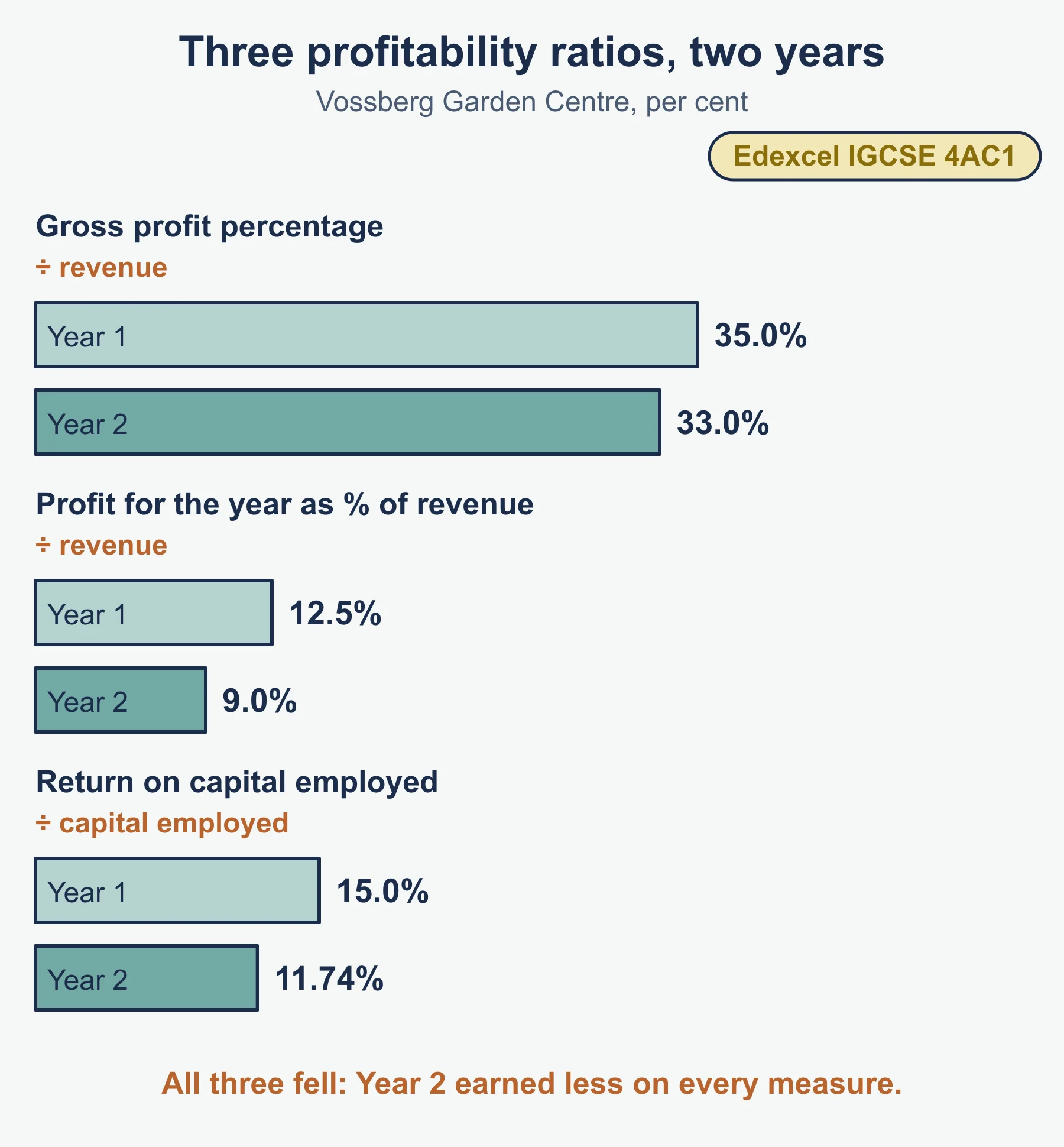
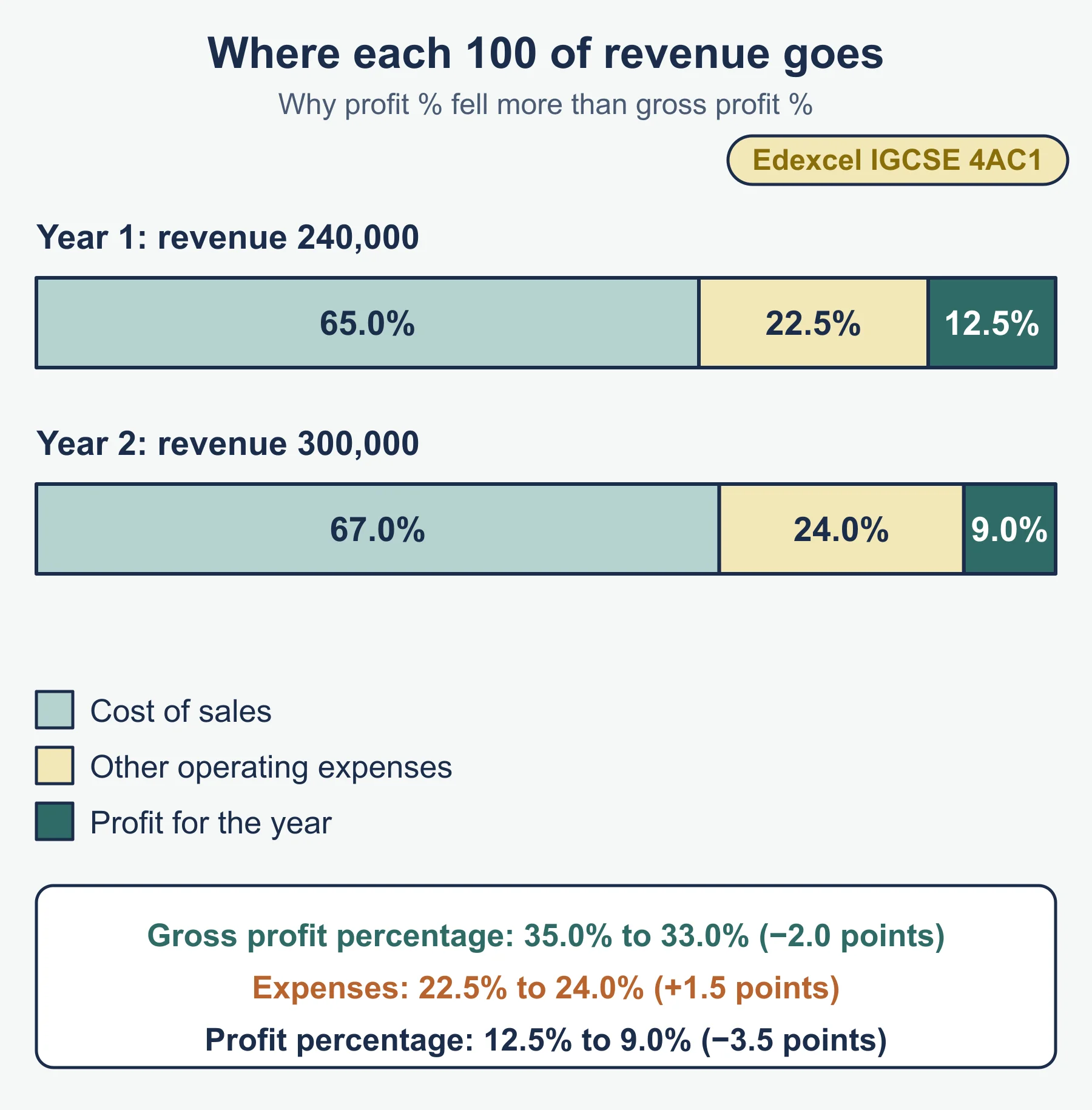
- Gross profit percentage versus profit for the year percentage. The first ignores expenses. A business can hold a steady gross profit percentage and still see the second fall if expenses rise.
- Profit percentage versus ROCE. One compares profit with revenue, the other with the money invested. A business can make a good percentage on each sale and still earn a poor return on capital if it has a lot of capital tied up.
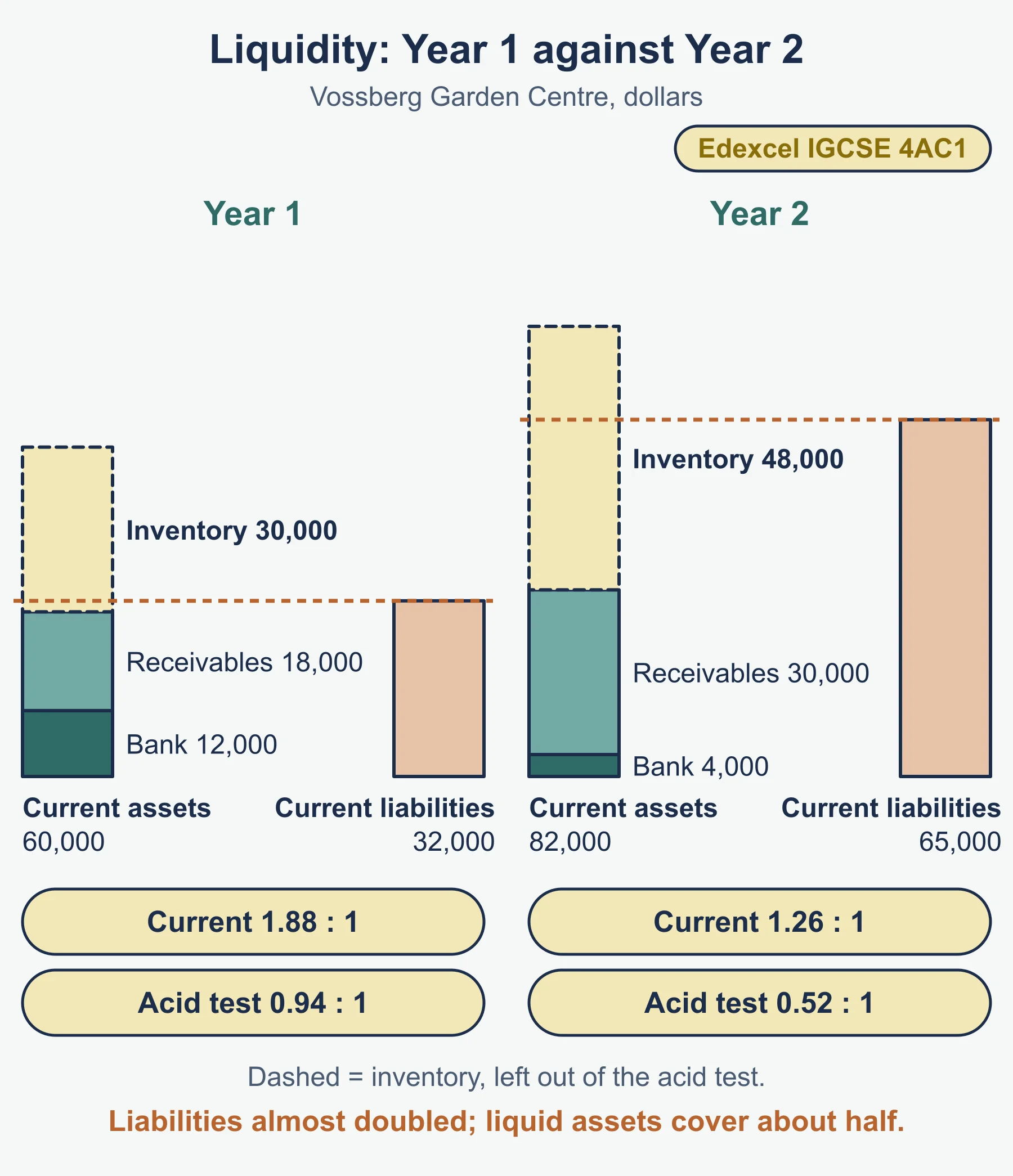
- Current ratio versus acid test. The acid test removes inventory. The two are very different when inventory is a large share of current assets.
- Percentage versus ratio. Profitability ratios are percentages. Liquidity ratios are written x : 1.
- Profit versus cash. A profit figure does not tell you what is in the bank.
6. Interpretation phrase bank
| If this moves | Possible reasons to consider |
|---|---|
| Gross profit percentage down | Lower selling prices or discounts; suppliers charging more; more goods lost or wasted; change in what is sold |
| Gross profit percentage up | Higher selling prices; cheaper supplies; a shift to higher-margin goods |
| Profit percentage down, gross profit percentage steady | Expenses rising faster than revenue |
| ROCE down | Profit down, capital employed up, or both |
| Current ratio or acid test down | More borrowing or trade payables; less cash; money tied up in inventory or in amounts owed by customers |
| Acid test well below current ratio | Much of the current assets is inventory |
Compare like with like: the same business in an earlier year, a target set by the owner, or a business of a similar type. A single year’s ratio on its own says little. Also remember that a ratio only points to a question; it does not prove the cause, so word reasons as possibilities (“this may be because”).
A full comment has three parts: the change (with figures), a reason that fits the information given, and the effect on the business or a suggested action.
7. Quick self-test
- A trader’s revenue is 64,000 and its cost of sales is 41,600. Calculate its gross profit percentage.
- Profit for the year is 7,200 on revenue of 72,000. Calculate the profit for the year as a percentage of revenue.
- Equity is 95,000 and non-current liabilities are 25,000. Profit for the year is 14,400. Calculate capital employed and ROCE.
- Current assets are 54,000, of which inventory is 21,000. Current liabilities are 30,000. Calculate the current ratio and the acid test.
- Non-current assets are 140,000, working capital is 22,000 and non-current liabilities are 30,000. Calculate capital employed and equity.
- Gross profit percentage rose from 30% to 34% but the profit for the year percentage fell from 8% to 6%. Give one possible explanation.
- Current assets are 30,000 and current liabilities are 20,000. The business pays 5,000 to a trade payable from the bank. Calculate the current ratio before and after.
- Explain why inventory is removed in the acid test.
- State which statement each of these comes from: revenue; non-current liabilities.
- True or false: a business with a high profit for the year must have good liquidity. Explain.
Answers
- Gross profit = 64,000 − 41,600 = 22,400. 22,400 ÷ 64,000 × 100 = 35%.
- 7,200 ÷ 72,000 × 100 = 10%.
- Capital employed = 95,000 + 25,000 = 120,000. ROCE = 14,400 ÷ 120,000 × 100 = 12%.
- Current ratio = 54,000 ÷ 30,000 = 1.8 : 1. Acid test = (54,000 − 21,000) ÷ 30,000 = 33,000 ÷ 30,000 = 1.1 : 1.
- Capital employed = 140,000 + 22,000 = 162,000. Equity = 162,000 − 30,000 = 132,000.
- Expenses grew faster than revenue (or the business paid more in expenses such as wages, rent or advertising), which cut profit even though the gross margin improved.
- Before: 30,000 ÷ 20,000 = 1.5 : 1. After: current assets 25,000 and current liabilities 15,000, so 25,000 ÷ 15,000 = 1.67 : 1.
- Inventory has to be sold, and the customers then have to pay, before it becomes cash; it may also be slow to sell. The acid test shows cover without relying on that.
- Revenue: the income statement. Non-current liabilities: the statement of financial position.
- False. Profit and cash are different. Profit may be tied up in inventory or in money owed by customers, or used to buy non-current assets or repay loans, leaving little cash to pay short-term debts.
8. Where marks are usually lost
- Using the wrong base: revenue for ROCE, or capital employed for a profit percentage.
- Using gross profit where profit for the year is needed, and the reverse.
- Not stating the capital employed formula and then using a figure the examiner cannot trace.
- Leaving inventory in the acid test, or taking out trade receivables as well.
- Giving liquidity ratios as percentages, or leaving out the x : 1 form.
- Leaving out the unit or sign on any answer.
- Describing the change without any figures from the question.
- Giving a reason that does not fit the data, such as blaming a rise in expenses when the question shows them falling.
- Treating high profit as proof of good liquidity.
Next steps
Work through the practice questions, re-read the study guide for anything shaky, and check the 4AC1 Accounting hub, the checklist and the free diagnostics.
Frequently asked questions
What is the formula for gross profit percentage? Gross profit percentage is gross profit divided by revenue, multiplied by 100. Show the formula, the working and the answer to 1 or 2 decimal places with the % sign.
Does a high profit mean a business has good liquidity? No. Profit is the difference between revenue and expenses, while liquidity depends on cash and assets that will soon become cash. A business can report a healthy profit and still be unable to pay a supplier on time.
What is a good current ratio for Edexcel IGCSE Accounting? Many textbooks quote about 2 : 1 for the current ratio and 1 : 1 for the acid test as a rule of thumb, but the 4AC1 specification sets no benchmark. Normal ratios differ between types of business, so compare with the previous year, a target or a similar business.
Why is profit for the year percentage lower than gross profit percentage? Profit for the year is gross profit minus other operating expenses, so it is a smaller share of revenue. If the profit percentage falls by more than the gross margin, expenses have grown faster than sales.
Official syllabus
Pearson Edexcel International GCSE in Accounting (4AC1), Specification, Issue 1, October 2016, published by Pearson Education Limited. Topic 4: The preparation of financial statements, section 4 “The calculation and interpretation of accounting ratios”, points (a) to (c).
Get free revision emails (optional)
Occasional emails with practice questions, worked explanations and links to free resources for the qualification and subjects you choose. No spam, and you can unsubscribe from any email. The free tools on this site never need an email.
Related resources
-
Study guides
Edexcel IGCSE Accounting: Financial statements of a manufacturer (4AC1)
Study guide to the manufacturing account for Edexcel International GCSE Accounting 4AC1: three inventories, prime cost, production cost, total cost.
Accounting · Pearson Edexcel · IGCSE
Read guide -
Practice questions
Edexcel IGCSE Accounting: Financial statements of a manufacturer (4AC1) – Practice Questions
Original 4AC1 practice questions on manufacturing accounts: inventories, prime cost, total cost and production cost, with worked answers.
Accounting · Pearson Edexcel · IGCSE
Try questions -
Revision notes
Edexcel IGCSE Accounting: Financial statements of a manufacturer (4AC1) – Revision Notes
Condensed 4AC1 revision notes on the manufacturing account: raw materials, work-in-progress, finished goods, prime cost, total cost, production cost.
Accounting · Pearson Edexcel · IGCSE
Revise topic
Related articles
-
teaching
A Level tuition in Dubai: Cambridge or Pearson Edexcel International A Level?
Schools in Dubai and Abu Dhabi teach either Cambridge International AS & A Level or Pearson Edexcel International A Level. How the two are structured, why it matters for tuition, and how online classes from Lahore work.
9 October 2026
-
curriculum guides
Choosing subjects at IGCSE and A Level
How subject choices at 14 and 16 affect university options later, and how to keep pathways open without overloading a timetable.
28 July 2026
Studying this with a teacher
Working through Accounting IGCSE?
This page is free and stays free. If you would rather be taught it, Marlbridge runs Accounting classes one-to-one and in small groups of up to 15, online in your own time zone. The first trial class is free. WhatsApp replies within an hour (8am–11pm Pakistan time, every day); email the same day.
Pearson Edexcel Accounting teachers at Marlbridge

