
Study Guides
Edexcel IGCSE Accounting: Financial statements of a manufacturer (4AC1)
Study guide to the manufacturing account for Edexcel International GCSE Accounting 4AC1: three inventories, prime cost, production cost, total cost.
- Subject
- Accounting
- Level
- IGCSE
- Topic
- The preparation of financial statements
- Author
- Marlbridge Academic Team
- Updated
- Reviewed by
- Javaid Iqbal Sabri (what this means)
Aligned to Pearson Edexcel IGCSE Accounting (4AC1), Issue 1, October 2016. Official specification .
Syllabus page (what it covers and how it is assessed): Pearson Edexcel IGCSE Accounting.
Syllabus points this page covers
4AC1
- 4 The preparation of financial statements (whole topic)
- 4.5 Financial statements of a manufacturer
Found an error? Report a correction.
Want a teacher for this? Marlbridge teaches Accounting online. Request a free trial class.
This guide covers Topic 4, section 4.5, Financial statements of a manufacturer, in the Pearson Edexcel International GCSE in Accounting (4AC1) specification, Issue 1, October 2016. Topic 4 sits in Paper 2, Financial Statements, which the specification describes as a one-hour 15-minute paper made up of two multi-part questions on financial statements. Paper 2 also builds on topics 1 to 3. The specification does not mark any part of 4.5 as limited to a tier or a sub-set of candidates, so all of it is open to you.
Links: Edexcel IGCSE Accounting hub, printable checklist, and the free 10-minute diagnostics to find weak spots first. After this guide, use the revision notes and the practice questions.
All amounts in this guide are in dollars. All businesses and figures are invented.
What the specification asks for
| Point | You must be able to | Where in this guide |
|---|---|---|
| 4.5 (a) | Understand the difference between the inventories of raw materials, work-in-progress and finished goods | Section 1 |
| 4.5 (b) | Prepare manufacturing accounts to show prime cost, production cost and total cost | Sections 2 to 5 |
The specification names the three figures but does not set out a layout or list the cost headings. The headings below are the standard ones. In an exam, follow the labels and order the question gives you.
1. Three kinds of inventory (4.5 a)
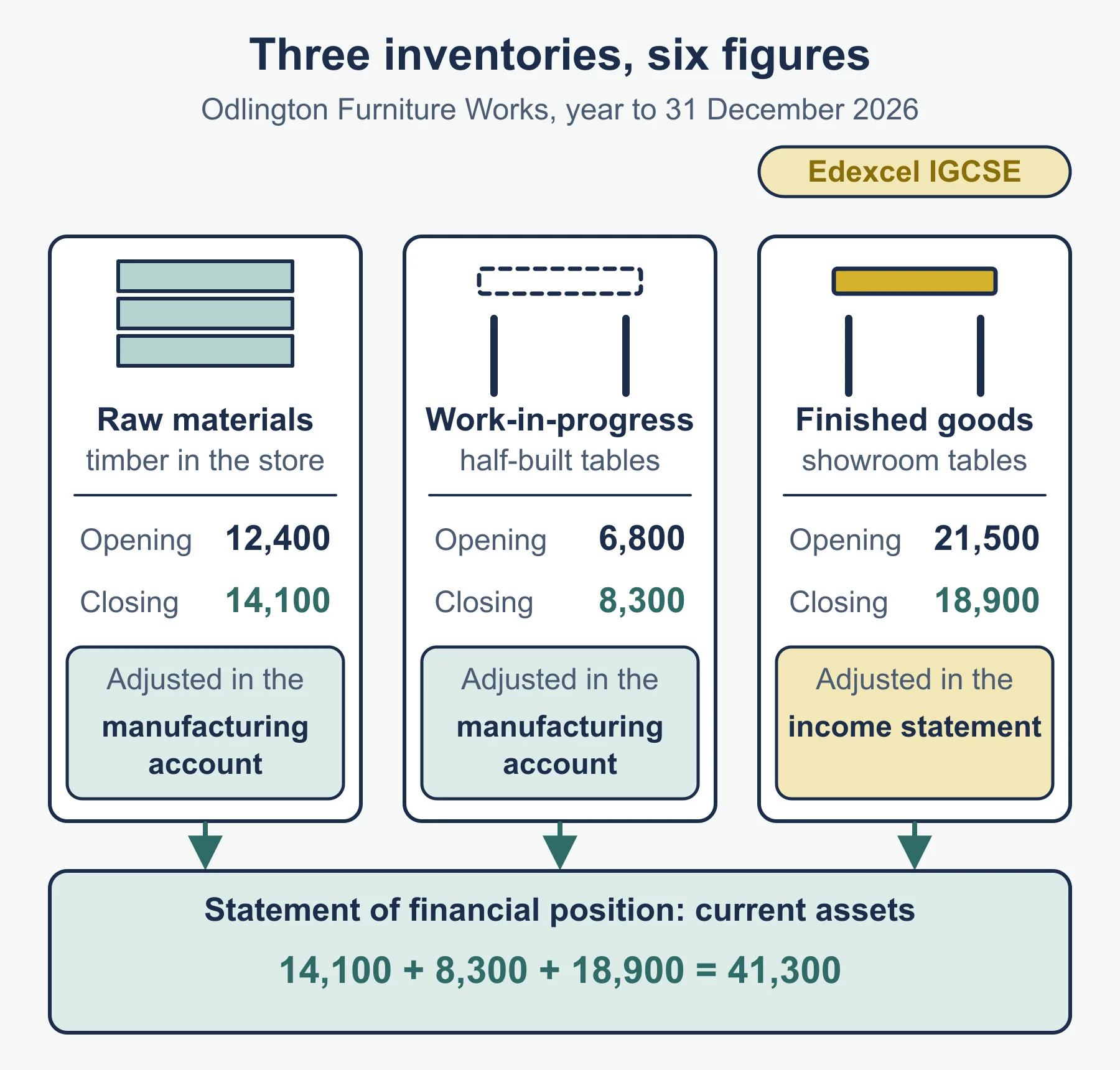
A trader buys goods and sells them as they are, so it holds one kind of inventory. A manufacturer buys materials and turns them into goods, so it holds three.
| Inventory | What it is | Example (a furniture maker) |
|---|---|---|
| Raw materials | Materials bought but not yet put into production | Planks of timber, screws, varnish in the store |
| Work-in-progress | Goods started but not finished at the year end | Half-built tables with no top fitted |
| Finished goods | Completed goods ready to sell | Finished tables in the showroom |
Work-in-progress is valued at the cost put in so far: the materials used, the wages of the workers who handled it and a share of factory overheads. A half-built table is therefore worth more than its timber alone.
Each inventory has an opening figure (the closing figure of the last year) and a closing figure (counted at the year end). That gives six inventory figures in all.
Where they go:
- Raw materials and work-in-progress are adjusted in the manufacturing account.
- Finished goods are adjusted in the income statement, in the place where a trader adjusts inventory.
- All three closing figures are current assets in the statement of financial position.
Quick check. A bakery factory has flour in the store, dough that has been mixed but not baked, and baked loaves in the despatch room. These are raw materials, work-in-progress and finished goods in that order.
2. Classifying the costs (4.5 b)
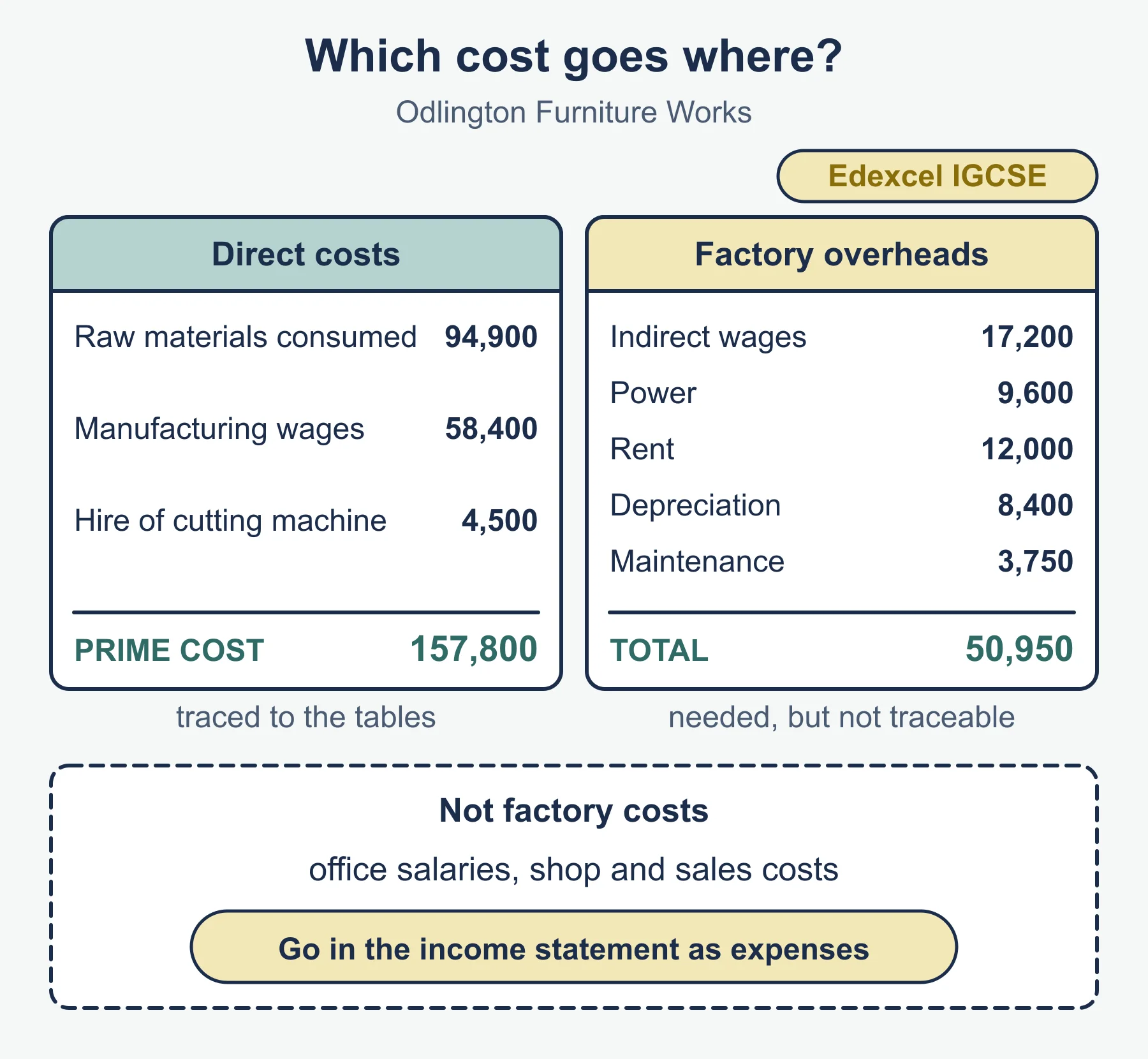
A manufacturing account collects the costs of making goods. Sort each cost into one of two groups.
Direct costs can be traced to the goods made. They make up prime cost:
- Direct materials, usually shown as raw materials consumed.
- Direct labour, meaning the wages of workers who make the goods (manufacturing wages).
- Direct expenses, such as the hire of a special machine for one order or a royalty paid per unit made.
Factory overheads (indirect costs) are needed to run the factory but cannot be traced to particular goods:
- Wages of supervisors, cleaners and maintenance staff.
- Factory rent and rates, heating, lighting and power.
- Factory insurance and repairs to factory machinery.
- Depreciation of factory machinery and buildings.
Costs of the office, the shop or the sales team are not factory overheads. They go in the income statement as expenses. Be ready for one cost to be split. If a question says a share of the rent relates to the factory, only that share goes in the manufacturing account and the rest goes in the income statement.
3. Raw materials consumed
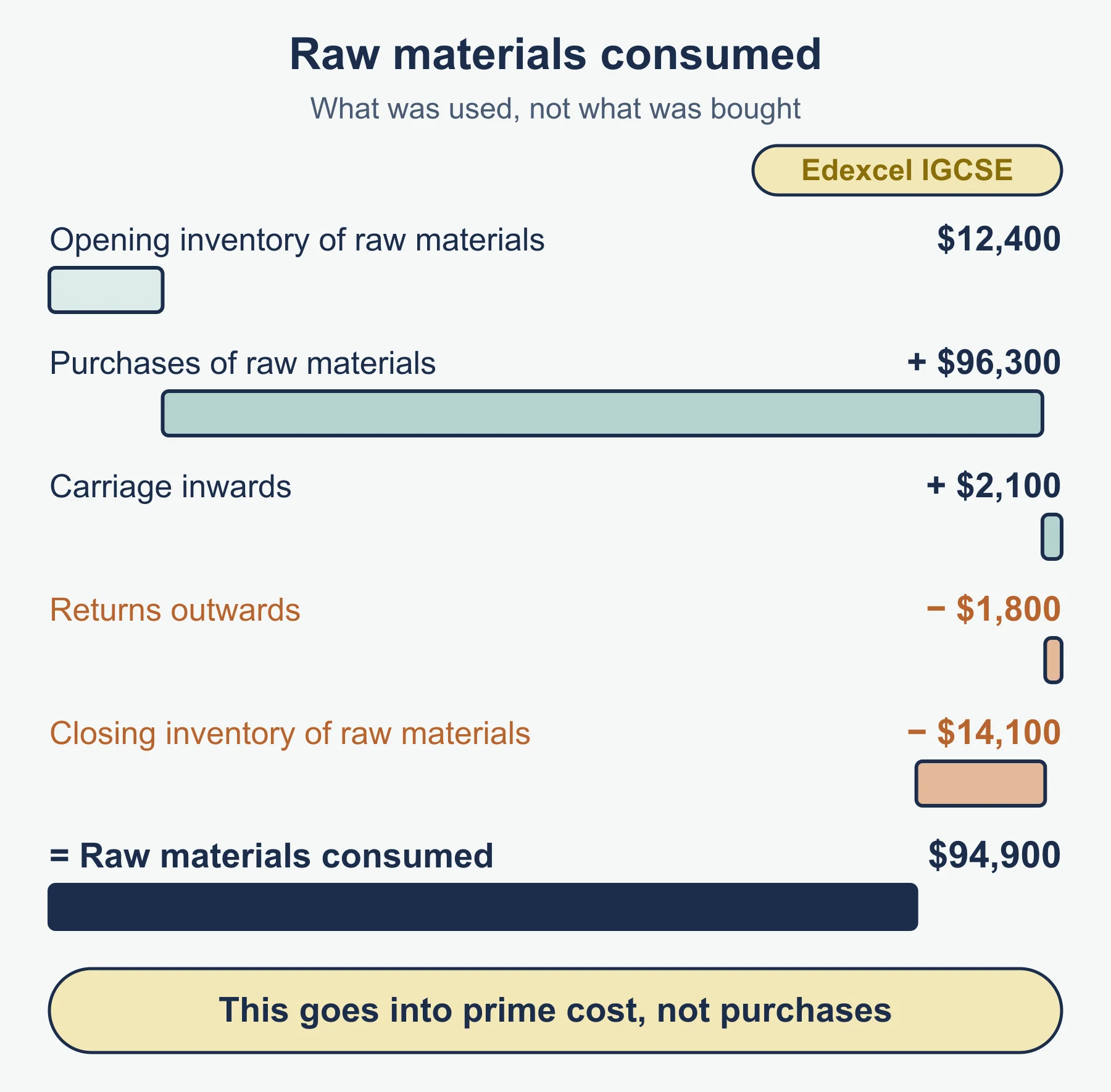
Raw materials consumed is what was used in production, not what was bought.
Opening inventory of raw materials
+ Purchases of raw materials
+ Carriage inwards
- Returns outwards
- Closing inventory of raw materials
= Raw materials consumed
Carriage inwards is the cost of delivery to the factory, so it adds to the cost of the materials. Carriage outwards is a cost of delivering to customers and does not belong here. Returns outwards are goods sent back to the supplier, so they reduce the cost.
4. The layout and the three figures
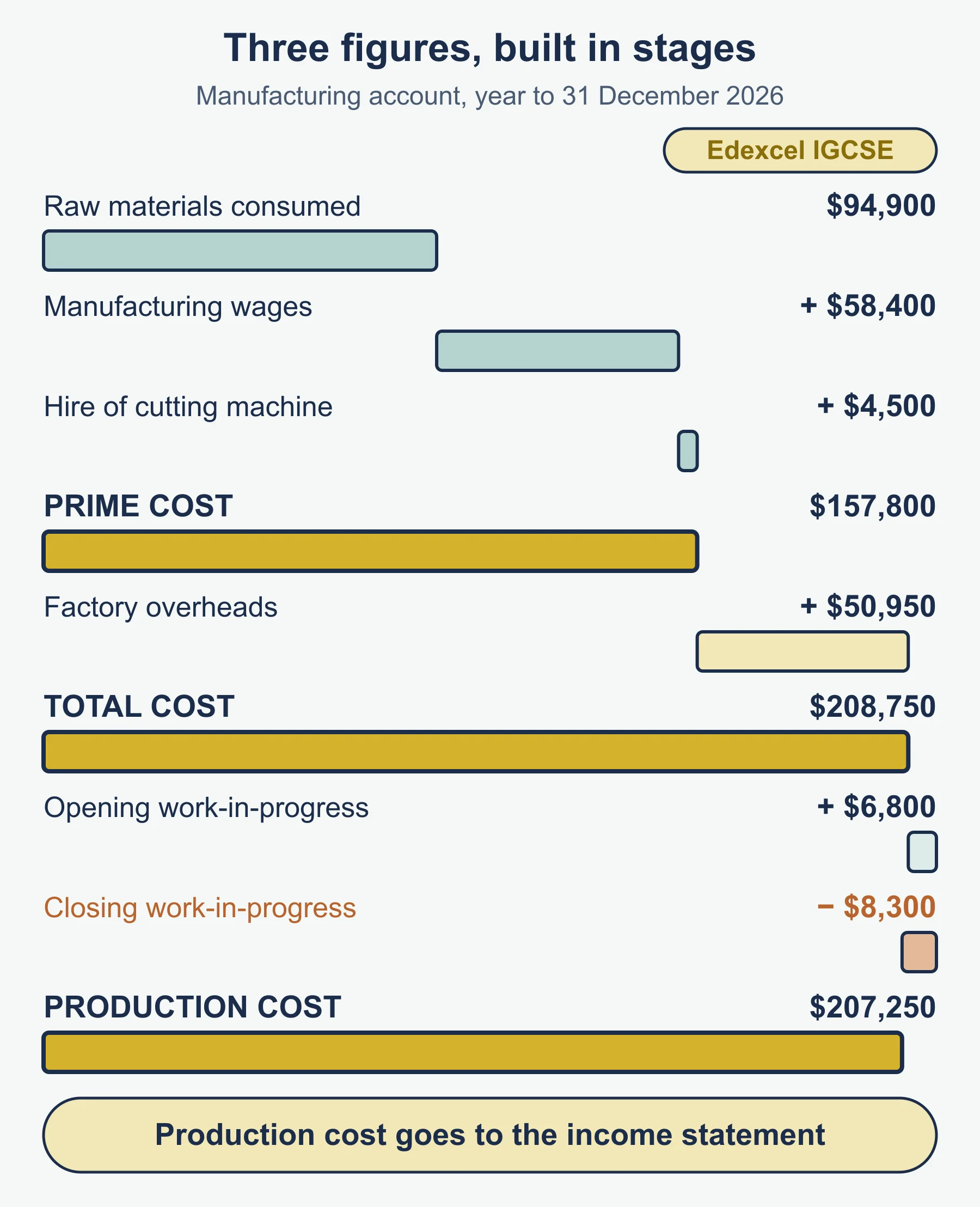
The manufacturing account is built up in stages. The three figures the specification names appear at the bottom of each stage.
Manufacturing account for the year ended 31 December

Opening inventory of raw materials
Add Purchases of raw materials
Add Carriage inwards
Less Returns outwards
Less Closing inventory of raw materials
Raw materials consumed
Direct (manufacturing) wages
Direct expenses
PRIME COST

Factory overheads (each listed)
Total factory overheads

TOTAL COST  (prime cost + factory overheads)

Add Opening work-in-progress
Less Closing work-in-progress

PRODUCTION COST  (transferred to the income statement)
In words:
- Prime cost = raw materials consumed + direct labour + direct expenses.
- Total cost = prime cost + factory overheads. This is the full cost of the work done in the year, before allowing for work-in-progress.
- Production cost = total cost + opening work-in-progress - closing work-in-progress. This is the cost of the goods completed in the year.
Why the work-in-progress adjustment? Opening work-in-progress was started last year, but finished this year, so its earlier costs now belong to this year’s output. Closing work-in-progress is not finished, so its costs belong to next year’s output. Opening is added and closing is deducted.
A word of caution on wording. Some books and papers use “total cost” or “factory cost” for slightly different totals. If a question prints its own layout, fill it in exactly as given. If it does not, use the layout above and label each total clearly.
5. Worked example: Odlington Furniture Works
Odlington Furniture Works makes wooden furniture. The figures below are for the year ended 31 December 2026.
| Item | Amount |
|---|---|
| Purchases of raw materials | 96,300 |
| Carriage inwards | 2,100 |
| Returns outwards (materials) | 1,800 |
| Manufacturing wages | 58,400 |
| Hire of special cutting machine | 4,500 |
| Indirect factory wages | 17,200 |
| Factory power | 9,600 |
| Factory rent | 12,000 |
| Depreciation of factory machinery | 8,400 |
| Factory maintenance | 3,750 |
| Revenue | 312,500 |
| Inventory | 1 January 2026 | 31 December 2026 |
|---|---|---|
| Raw materials | 12,400 | 14,100 |
| Work-in-progress | 6,800 | 8,300 |
| Finished goods | 21,500 | 18,900 |
Step 1: raw materials consumed. 12,400 + 96,300 + 2,100 - 1,800 - 14,100 = 94,900.
Step 2: prime cost. 94,900 + 58,400 + 4,500 = 157,800.
Step 3: factory overheads. 17,200 + 9,600 + 12,000 + 8,400 + 3,750 = 50,950.
Step 4: total cost. 157,800 + 50,950 = 208,750.
Step 5: production cost. 208,750 + 6,800 - 8,300 = 207,250.
Set out in full:
Odlington Furniture Works
Manufacturing account for the year ended 31 December 2026

Opening inventory of raw materials                 12,400
Add Purchases of raw materials         96,300
Add Carriage inwards                    2,100
Less Returns outwards                  (1,800)     96,600
                                                  109,000
Less Closing inventory of raw materials           (14,100)
Raw materials consumed                             94,900
Manufacturing wages                                58,400
Hire of special cutting machine                     4,500
PRIME COST                                        157,800
Factory overheads
  Indirect factory wages               17,200
  Factory power                         9,600
  Factory rent                         12,000
  Depreciation of factory machinery     8,400
  Factory maintenance                   3,750      50,950
TOTAL COST                                        208,750
Add Opening work-in-progress                        6,800
Less Closing work-in-progress                      (8,300)
PRODUCTION COST                                   207,250
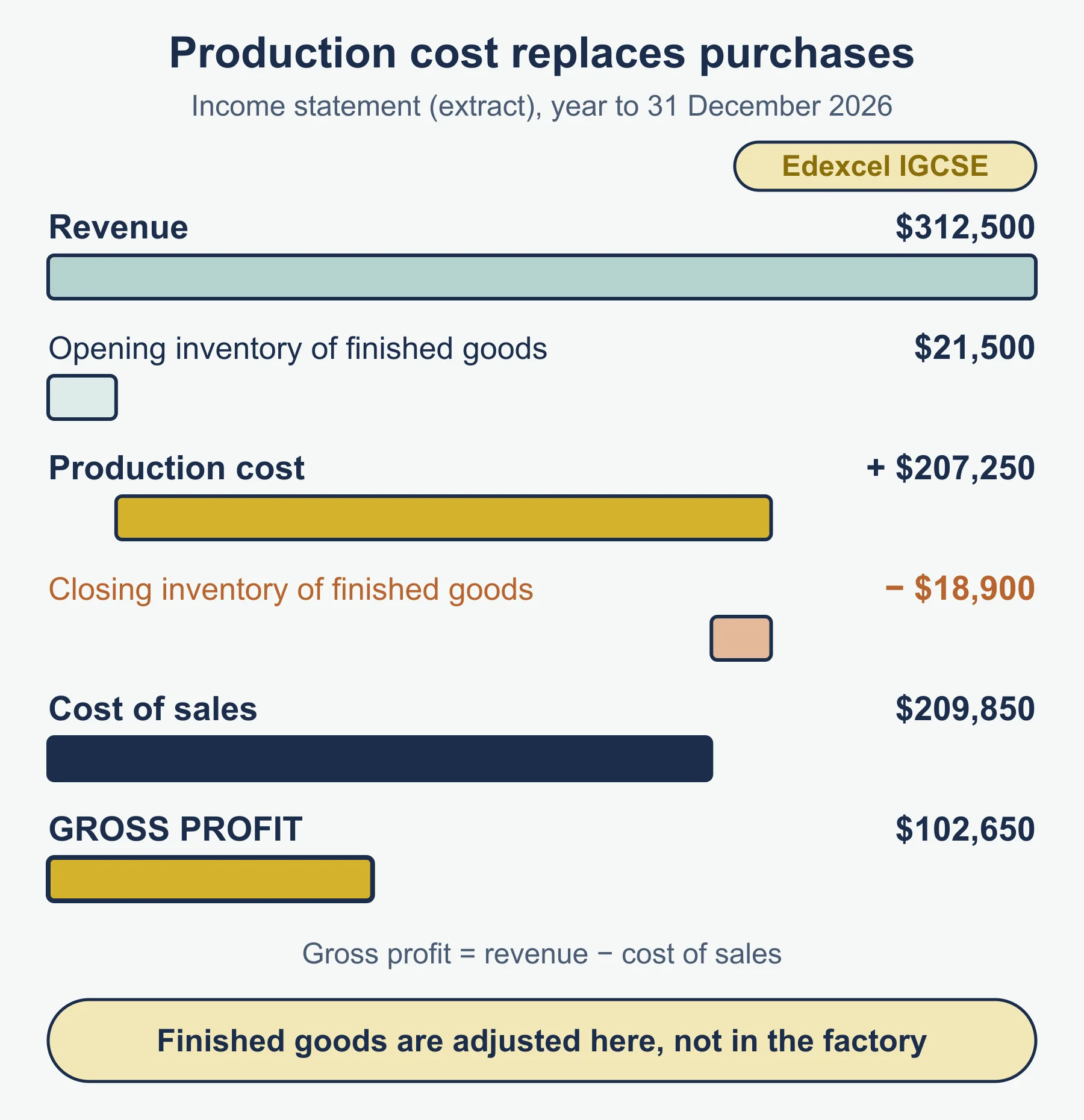
Step 6: the income statement. Production cost is carried to the income statement. It takes the place of purchases in a trader’s account, and finished goods are adjusted instead of ordinary inventory.
Income statement (extract) for the year ended 31 December 2026
Revenue                                           312,500
Opening inventory of finished goods    21,500
Add Production cost                   207,250
                                      228,750
Less Closing inventory of finished goods (18,900)
Cost of sales                                     209,850
GROSS PROFIT                                      102,650
Step 7: the statement of financial position. The current assets include inventories of 14,100 raw materials, 8,300 work-in-progress and 18,900 finished goods, together 41,300.
6. Worked example: apportioning and finding a missing figure
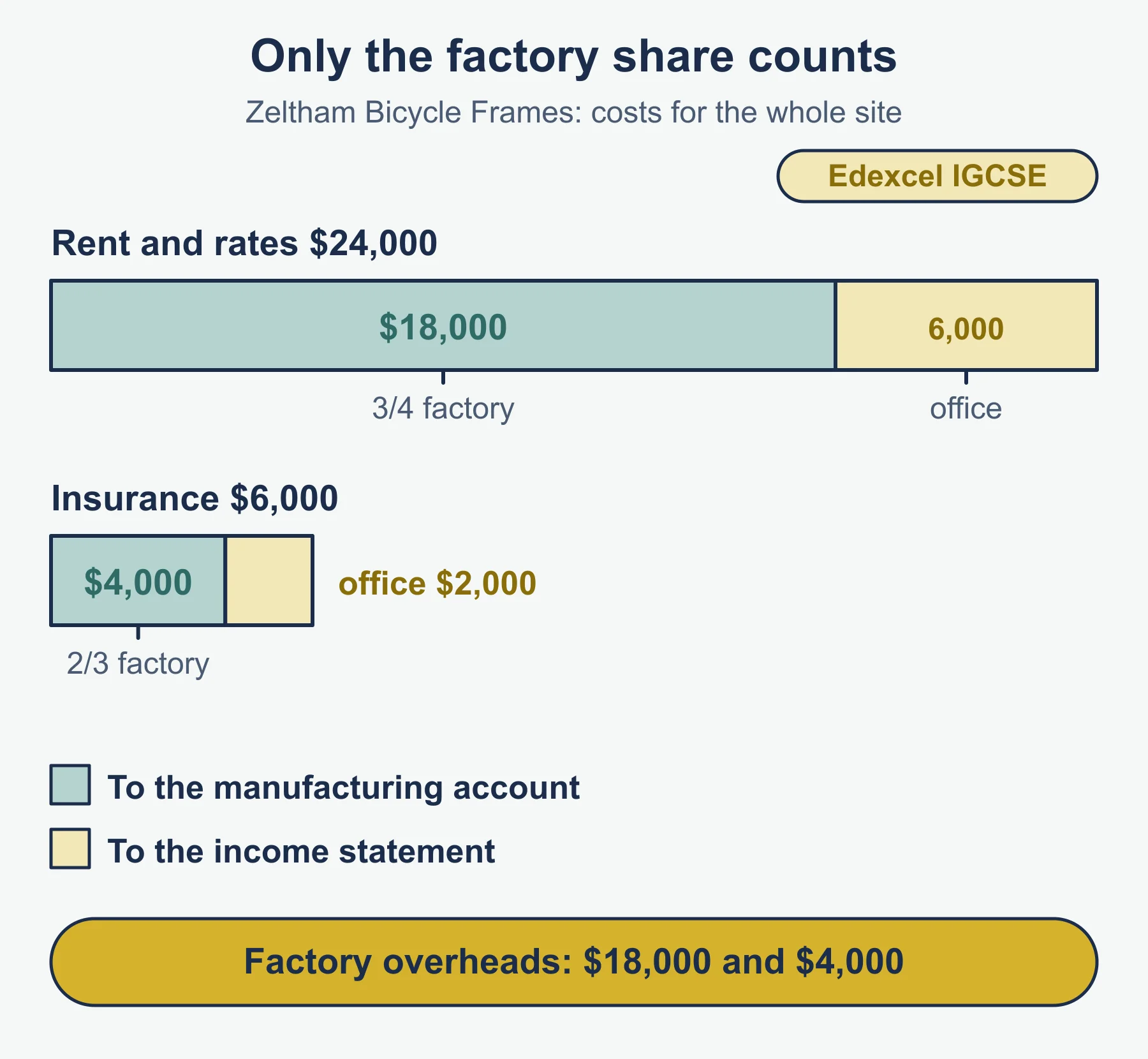
Zeltham Bicycle Frames pays rent and rates of 24,000 for the whole site and insurance of 6,000. Three-quarters of the rent and rates and two-thirds of the insurance relate to the factory.
- Factory share of rent and rates: 24,000 x 3/4 = 18,000. The office share, 6,000, goes in the income statement.
- Factory share of insurance: 6,000 x 2/3 = 4,000. The office share, 2,000, goes in the income statement.
Only 18,000 and 4,000 are factory overheads.
Now a missing figure. Zeltham has a prime cost of 84,000, factory overheads of 31,500, opening work-in-progress of 5,200 and a production cost of 118,300. Work back from the production cost.
- Total cost = 84,000 + 31,500 = 115,500.
- Production cost = total cost + opening work-in-progress - closing work-in-progress, so closing work-in-progress = 115,500 + 5,200 - 118,300 = 2,400.
Common errors
- Putting purchases, not raw materials consumed, into prime cost.
- Forgetting that closing raw materials is deducted inside the raw materials section, and closing work-in-progress is deducted in the work-in-progress adjustment. They are different inventories.
- Treating indirect factory wages as direct labour, or office salaries as factory overheads.
- Adding closing work-in-progress and deducting opening, which reverses the adjustment.
- Calling prime cost “total cost”. Factory overheads must be added before total cost exists.
- Carrying total cost, not production cost, to the income statement.
- Leaving out the finished goods adjustment, so cost of sales uses production cost only.
Next steps
Condense this with the revision notes, then work through the practice questions. The course hub, checklist and diagnostics show what to revise next.
Frequently asked questions
What are the three types of inventory a manufacturer holds? A manufacturer holds raw materials, work-in-progress and finished goods. Raw materials and work-in-progress are adjusted in the manufacturing account, finished goods in the income statement, and all three closing figures are current assets.
What is the difference between prime cost, total cost and production cost? Prime cost is raw materials consumed plus direct labour plus direct expenses. Total cost is prime cost plus factory overheads, and production cost is total cost plus opening work-in-progress minus closing work-in-progress.
What is the difference between direct costs and factory overheads? Direct costs, such as direct materials, the wages of workers who make the goods and royalties per unit, can be traced to the goods made. Factory overheads, such as supervisors’ wages, factory rent and depreciation of factory machinery, are needed to run the factory but cannot be traced to particular goods.
How do you calculate raw materials consumed? Raw materials consumed is opening inventory of raw materials plus purchases plus carriage inwards, less returns outwards, less closing inventory of raw materials. It measures what was used in production, not what was bought.
Where does production cost go after the manufacturing account? Production cost is carried to the income statement, where it takes the place of purchases in a trader’s account. Finished goods inventory is then adjusted to find cost of sales.
Official syllabus
Pearson Edexcel International GCSE in Accounting (4AC1) specification, Issue 1, October 2016, published by Pearson Education Limited – Topic 4: The preparation of financial statements, section 4.5 Financial statements of a manufacturer, points (a) and (b).
Get free revision emails (optional)
Occasional emails with practice questions, worked explanations and links to free resources for the qualification and subjects you choose. No spam, and you can unsubscribe from any email. The free tools on this site never need an email.
Related resources
-
Practice questions
Edexcel IGCSE Accounting: Financial statements of a manufacturer (4AC1) – Practice Questions
Original 4AC1 practice questions on manufacturing accounts: inventories, prime cost, total cost and production cost, with worked answers.
Accounting · Pearson Edexcel · IGCSE
Try questions -
Revision notes
Edexcel IGCSE Accounting: Financial statements of a manufacturer (4AC1) – Revision Notes
Condensed 4AC1 revision notes on the manufacturing account: raw materials, work-in-progress, finished goods, prime cost, total cost, production cost.
Accounting · Pearson Edexcel · IGCSE
Revise topic -
Study guides
Edexcel IGCSE Accounting: Financial statements of a partnership (4AC1)
Study guide to partnership accounts for Edexcel IGCSE Accounting 4AC1: Section 24, LLPs, appropriation and current accounts, with worked examples.
Accounting · Pearson Edexcel · IGCSE
Read guide
Related articles
-
teaching
A Level tuition in Dubai: Cambridge or Pearson Edexcel International A Level?
Schools in Dubai and Abu Dhabi teach either Cambridge International AS & A Level or Pearson Edexcel International A Level. How the two are structured, why it matters for tuition, and how online classes from Lahore work.
9 October 2026
-
curriculum guides
Choosing subjects at IGCSE and A Level
How subject choices at 14 and 16 affect university options later, and how to keep pathways open without overloading a timetable.
28 July 2026
Studying this with a teacher
Working through Accounting IGCSE?
This page is free and stays free. If you would rather be taught it, Marlbridge runs Accounting classes one-to-one and in small groups of up to 15, online in your own time zone. The first trial class is free. WhatsApp replies within an hour (8am–11pm Pakistan time, every day); email the same day.
Pearson Edexcel Accounting teachers at Marlbridge

