
Study Guides
Edexcel IGCSE Accounting: Financial statements of a partnership (4AC1)
Study guide to partnership accounts for Edexcel IGCSE Accounting 4AC1: Section 24, LLPs, appropriation and current accounts, with worked examples.
- Subject
- Accounting
- Level
- IGCSE
- Topic
- The preparation of financial statements
- Author
- Marlbridge Academic Team
- Updated
- Reviewed by
- Javaid Iqbal Sabri (what this means)
Aligned to Pearson Edexcel IGCSE Accounting (4AC1), Issue 1, October 2016. Official specification .
Syllabus page (what it covers and how it is assessed): Pearson Edexcel IGCSE Accounting.
Syllabus points this page covers
4AC1
- 4 The preparation of financial statements (whole topic)
- 4.2 Financial statements of a partnership
Found an error? Report a correction.
Want a teacher for this? Marlbridge teaches Accounting online. Request a free trial class.
This guide follows the Pearson Edexcel International GCSE in Accounting (4AC1) specification, Issue 1, October 2016. It covers Topic 4, section 2 (the financial statements of a partnership), content points a to g. Topic 4 is part of the content that Paper 2, Financial Statements, draws on. Amounts below are in dollars and every business and person is invented.
Course home: Edexcel IGCSE Accounting. Printable checklist. Find weak spots first with the free diagnostics. After this guide, use the revision notes and the practice questions.
What the specification asks for
| Point | You must be able to | Covered under |
|---|---|---|
| a | Understand the nature of a partnership and the reasons for forming one | The nature of a partnership |
| b | Understand the nature and structure of a limited liability partnership (LLP) | Limited liability partnerships |
| c | Apply Section 24 of the Partnership Act 1890 to salaries, division of profit or loss, interest on loans, capital and drawings | Section 24; Example 1 |
| d | Understand the nature and purpose of an appropriation account | The appropriation account |
| e | Prepare income statements and appropriation accounts | Example 2 |
| f | Prepare partners’ current accounts and capital accounts | Capital and current accounts; Example 2 |
| g | Prepare statements of financial position with partners’ capital balances and current account balances | Example 2 |
The nature of a partnership
A partnership is a business owned by two or more people who share its profit or loss. The partners usually write down how they will share it in a partnership agreement. Writing it down matters because it settles disputes before they start.
Reasons for forming a partnership rather than trading alone:
- More capital. Each partner pays in money, so the business can buy more non-current assets and inventories than one person could afford.
- Shared skills. One partner may be strong in selling and another in keeping records.
- Shared workload and risk. Someone can cover holidays and illness, and decisions can be discussed.
- Continuity. The business has more than one person who knows how it runs.
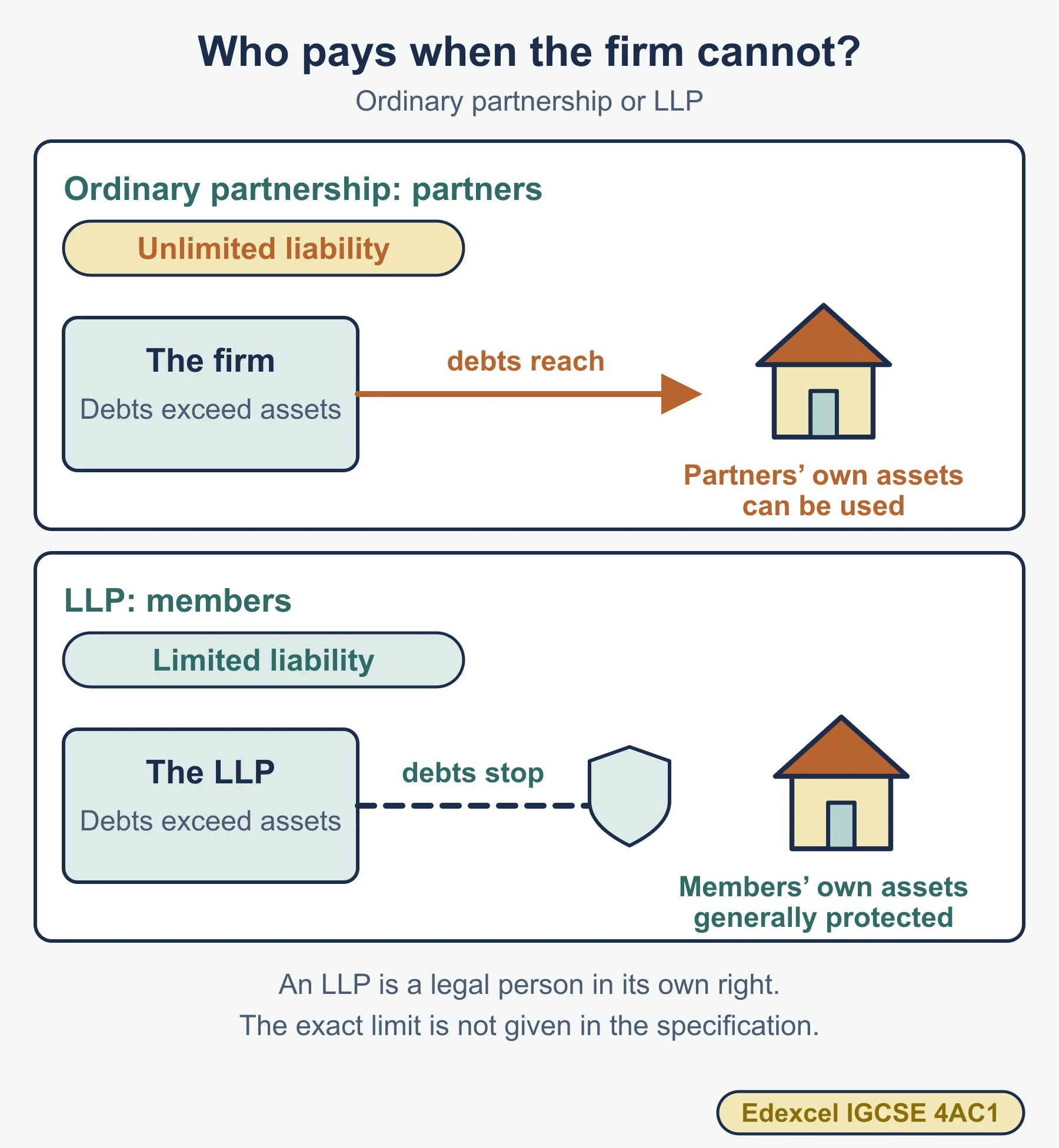
The drawbacks are the other side of the same coin. In an ordinary partnership the partners have unlimited liability, so their personal assets can be used to pay the firm’s debts. Partners can also disagree about money or about how hard each one works.
Limited liability partnerships
A limited liability partnership (LLP) is a business structure that is separate from the people who own it. The owners are called members. The key features are:
- the LLP is a legal person in its own right, so it can own assets and sign contracts in its own name;
- a member’s liability is limited, so their personal assets are generally protected in a way an ordinary partner’s are not (the specification does not list the exact limit);
- members agree how the profit is shared, in the same way partners do;
- the points above on legal personality and registration are general knowledge, not wording from the specification, which asks only for the nature and structure of an LLP. Check with your teacher how far your course goes into registration rules.
For an exam answer, the contrast is the one to remember: partners in an ordinary partnership have unlimited liability, whereas members of an LLP have limited liability.
Section 24 of the Partnership Act 1890
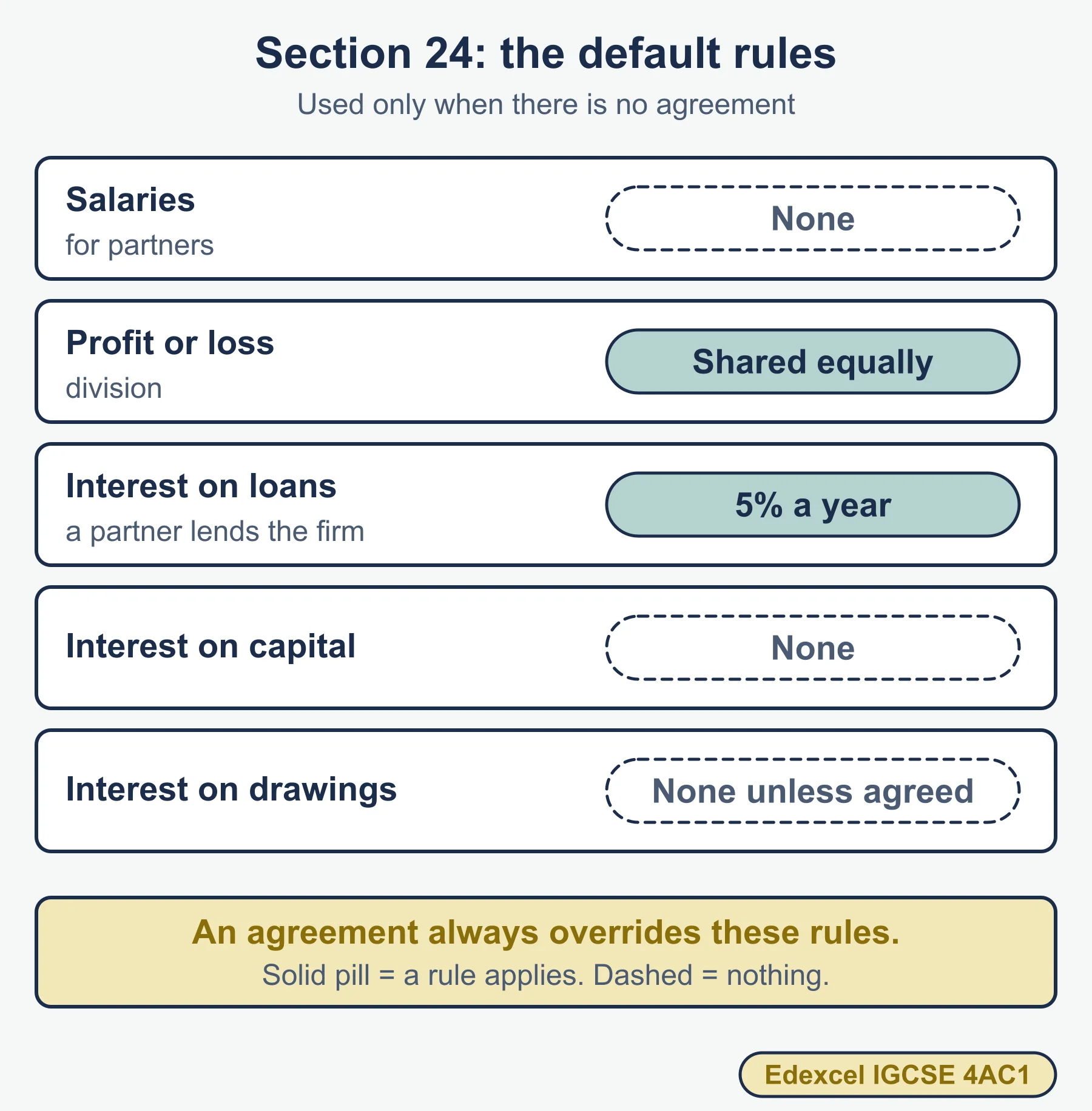
Section 24 sets rules that apply when the partners have no agreement, or where the agreement says nothing about a point. An agreement always overrides these defaults. The specification lists five areas. The rules in the table are given here as general knowledge of the Act and the usual textbook position, not as wording from the specification.
| Area | Section 24 rule if there is no agreement |
|---|---|
| Salaries | None. Partners are not paid a salary |
| Division of profit or loss | Shared equally, whatever each partner paid in or worked |
| Interest on loans | A partner who lends money to the firm beyond their agreed capital receives interest at 5% a year |
| Interest on capital | None |
| Interest on drawings | None charged unless the partners agree it (the Act itself makes no provision for it) |
Example 1: applying the defaults
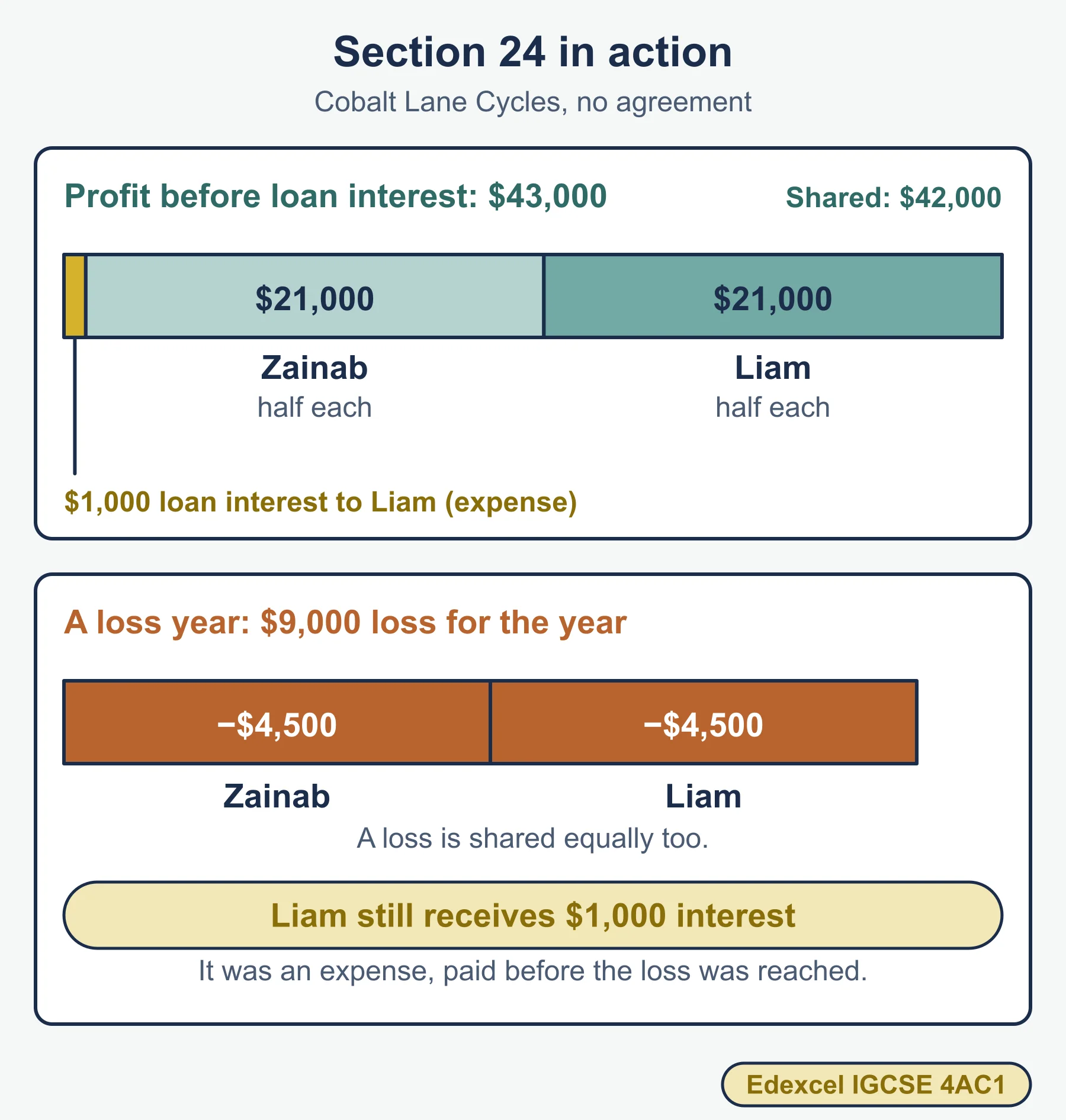
Zainab Okoro and Liam Brandt run Cobalt Lane Cycles with no written agreement. Liam lent the firm 20,000 for the whole year. The firm’s profit before loan interest was 43,000.
- Loan interest = 20,000 x 5% = 1,000. This is an expense of the firm, so it is deducted in the income statement.
- Profit for the year = 43,000 - 1,000 = 42,000.
- Shared equally: Zainab 21,000 and Liam 21,000.
Had the year ended with a loss for the year of 9,000, the same rule shares it equally: 4,500 each. Liam still receives his 1,000 interest, because it was paid as an expense before the loss was reached.
The appropriation account
An appropriation account shows how the profit for the year is shared among the partners. It is not part of the income statement. The income statement ends at profit for the year and the appropriation account starts from that figure. The nature of the account is that it appropriates, or allocates, profit to the partners once the business itself has finished measuring it.
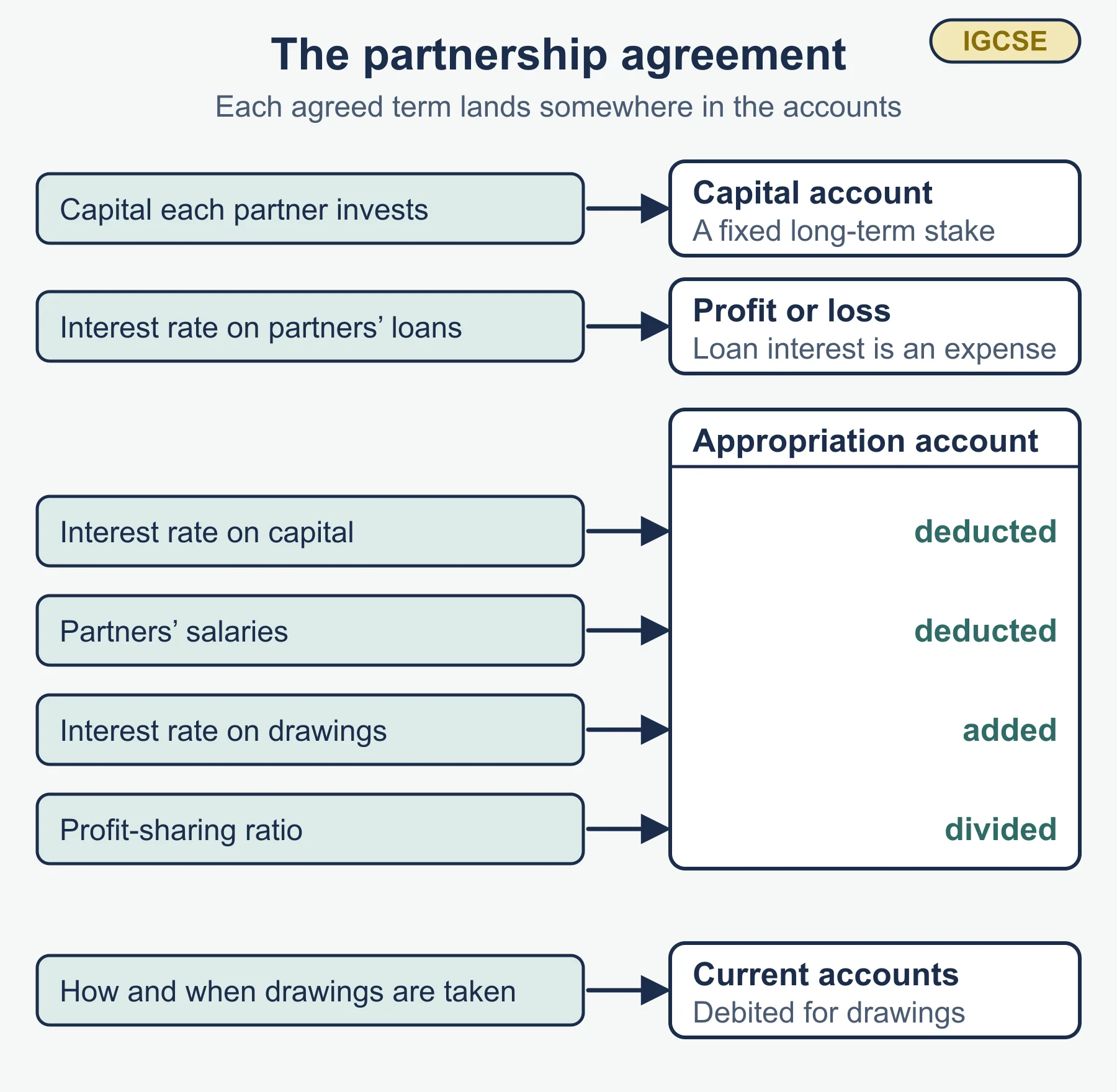
Typical contents, when the agreement provides for them:
| Item | Effect on the account |
|---|---|
| Interest on capital | Deducted, and credited to the partner’s current account |
| Partners’ salaries | Deducted, and credited to the partner’s current account |
| Interest on drawings | Added, because it is charged to the partner, so it increases the profit left to share |
| Residual profit (or loss) | Shared in the agreed profit-sharing ratio |
Two things do not appear here. Drawings are not appropriated, because they are the partner taking out money that has already been earned. Interest on a partner’s loan is not appropriated either. It is an expense above, in the income statement.
Capital and current accounts
Each partner has a capital account. Many firms keep it fixed, so it changes only when a partner pays in or takes out long-term capital. Each partner also has a current account, which collects the yearly movements:
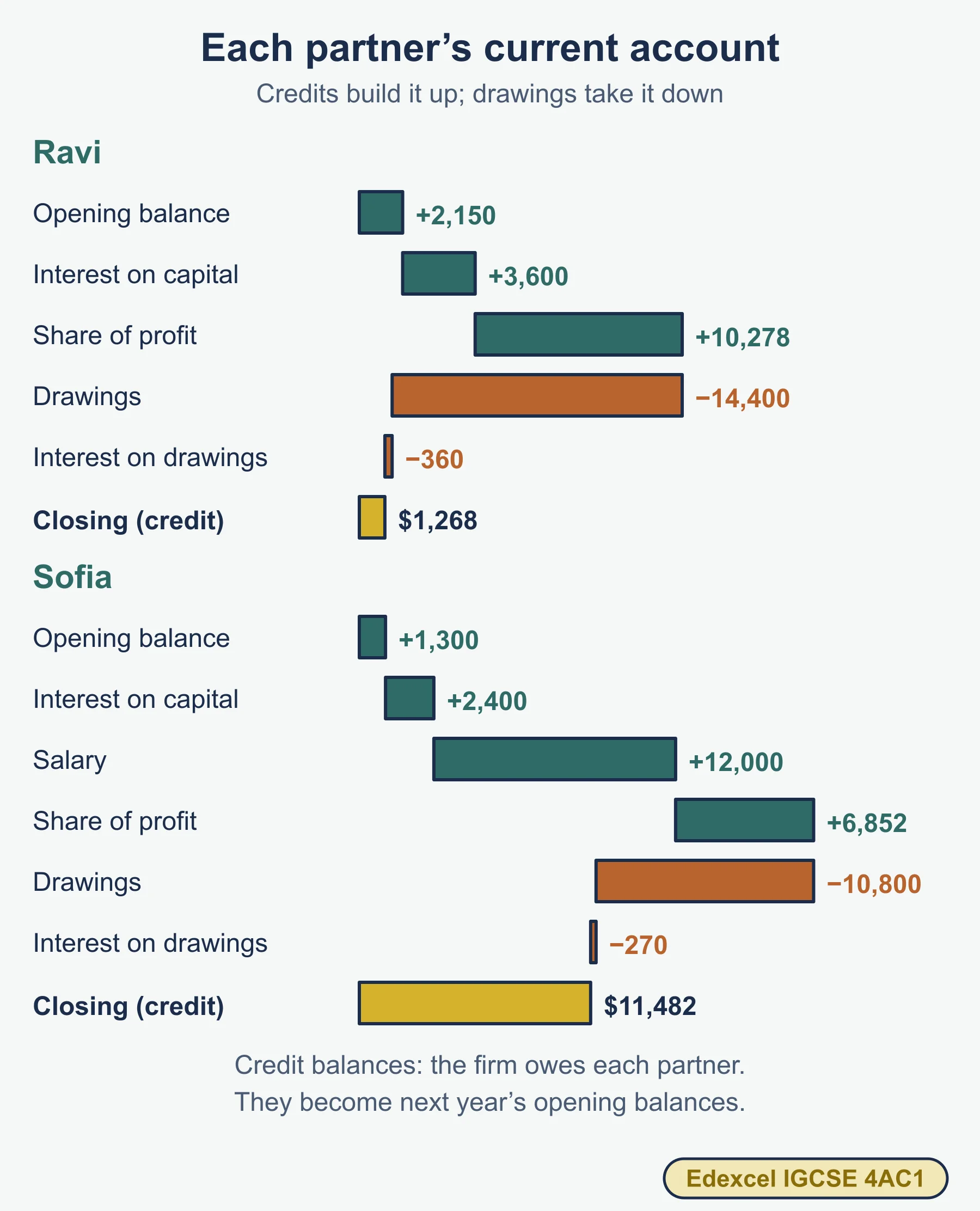
- Credits: interest on capital, salary, share of profit, and any opening credit balance.
- Debits: drawings, interest on drawings, share of any loss, and any opening debit balance.
A credit balance means the firm owes the partner. A debit balance means the partner has taken out more than has been credited to them. The statement of financial position shows both kinds of balance, as the example below shows.
Example 2: from income statement to statement of financial position
Ravi Menon and Sofia Marchetti trade as Lodestar Signs. The agreement says:
- interest on capital at 6% a year;
- Sofia receives a salary of 12,000;
- interest on drawings at 5%, with drawings taken evenly through the year (so interest runs for an average of six months);
- the residual profit is shared 3 : 2 between Ravi and Sofia.
Capital: Ravi 60,000, Sofia 40,000. Drawings: Ravi 14,400, Sofia 10,800. Opening current accounts: Ravi 2,150 credit, Sofia 1,300 credit. Sofia also lent the firm 16,000 at 5% for the whole year.
Income statement for the year
| Item | Amount |
|---|---|
| Revenue | 186,500 |
| Opening inventories | 14,200 |
| Purchases | 97,300 |
| Closing inventories | (16,800) |
| Cost of sales | (94,700) |
| Gross profit | 91,800 |
| Wages | 31,400 |
| Rent and rates | 9,600 |
| Heating | 3,100 |
| Insurance | 2,300 |
| Depreciation | 4,200 |
| Other operating expenses | 5,900 |
| Loan interest (16,000 x 5%) | 800 |
| Total expenses | (57,300) |
| Profit for the year | 34,500 |
Appropriation account
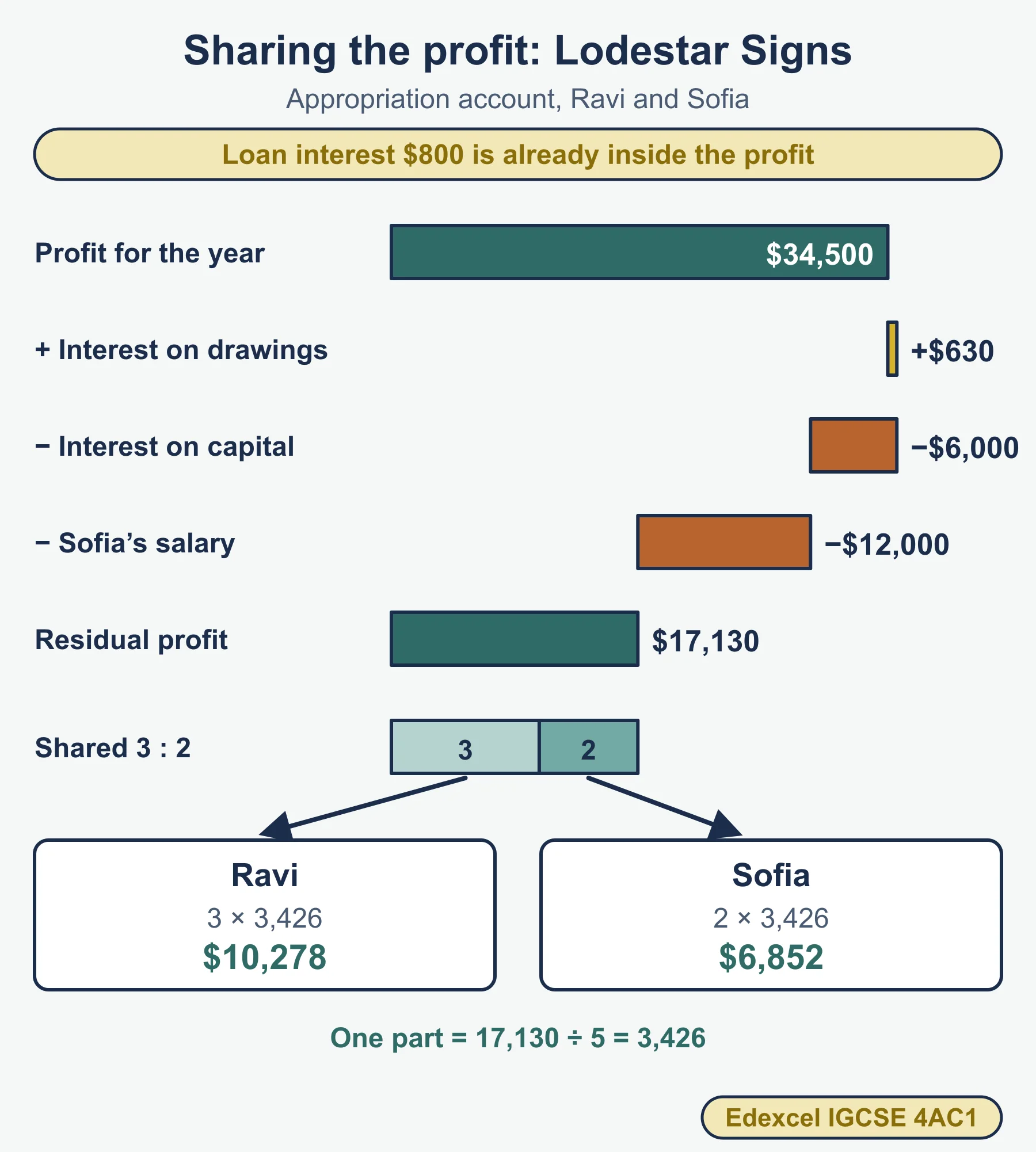
Interest on capital: Ravi 60,000 x 6% = 3,600 and Sofia 40,000 x 6% = 2,400. Interest on drawings: Ravi 14,400 x 5% x 6/12 = 360 and Sofia 10,800 x 5% x 6/12 = 270.
| Item | Ravi | Sofia | Total |
|---|---|---|---|
| Profit for the year | 34,500 | ||
| Add interest on drawings | 360 | 270 | 630 |
| 35,130 | |||
| Less interest on capital | 3,600 | 2,400 | (6,000) |
| Less salary | 12,000 | (12,000) | |
| Residual profit | 17,130 | ||
| Share 3 : 2 | 10,278 | 6,852 | 17,130 |
Residual profit is 17,130, and one part in the 3 : 2 ratio is 17,130 / 5 = 3,426.
Current accounts
| Details | Ravi | Sofia |
|---|---|---|
| Debit side | ||
| Drawings | 14,400 | 10,800 |
| Interest on drawings | 360 | 270 |
| Balance carried down | 1,268 | 11,482 |
| Total | 16,028 | 22,552 |
| Credit side | ||
| Opening balance | 2,150 | 1,300 |
| Interest on capital | 3,600 | 2,400 |
| Salary | 12,000 | |
| Share of residual profit | 10,278 | 6,852 |
| Total | 16,028 | 22,552 |
The balances carried down, 1,268 for Ravi and 11,482 for Sofia, are credit balances. They become the opening balances for next year. The capital accounts are unchanged at 60,000 and 40,000 because the partners paid in or took out no capital.
Statement of financial position (extract and totals)
| Item | Amount |
|---|---|
| Non-current assets (carrying value) | |
| Land and buildings | 70,000 |
| Equipment | 26,550 |
| 96,550 | |
| Current assets | |
| Inventories | 16,800 |
| Trade receivables | 19,700 |
| Other receivables | 900 |
| Bank | 7,250 |
| 44,650 | |
| Current liabilities | |
| Trade payables | (11,300) |
| Other payables | (1,150) |
| (12,450) | |
| Non-current liabilities | |
| Loan from Sofia Marchetti | (16,000) |
| Net assets | 112,750 |
| Equity | |
| Capital: Ravi Menon | 60,000 |
| Capital: Sofia Marchetti | 40,000 |
| Current account: Ravi Menon | 1,268 |
| Current account: Sofia Marchetti | 11,482 |
| Total equity | 112,750 |
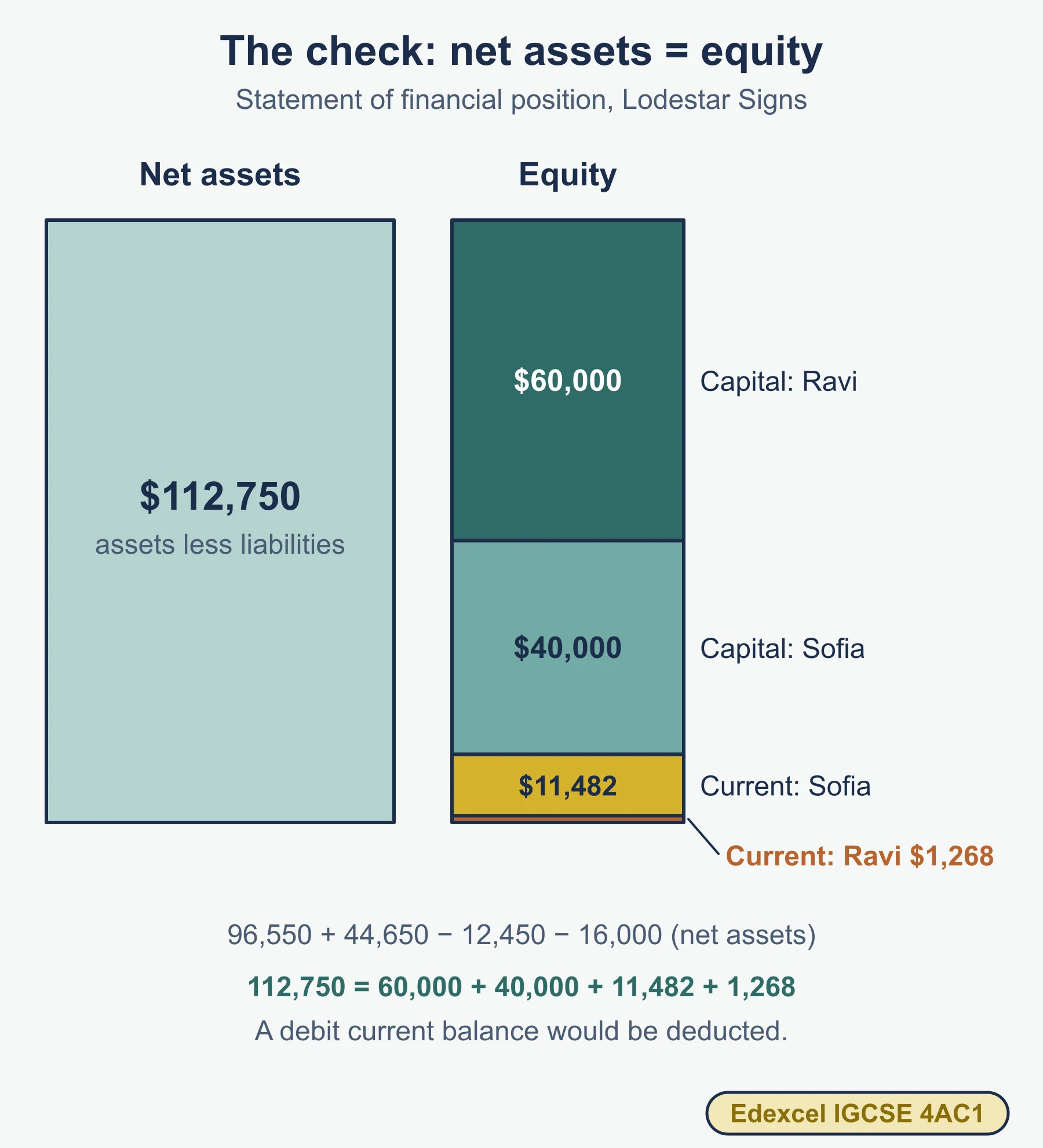
Net assets equal total equity, which is the check that the whole chain of workings is right. A partner’s debit current account balance would be deducted in the equity section, not added.
Common errors
- Putting loan interest in the appropriation account. It belongs in the income statement, above profit for the year.
- Deducting interest on drawings. It is charged to the partner, so it is added to the profit available to share.
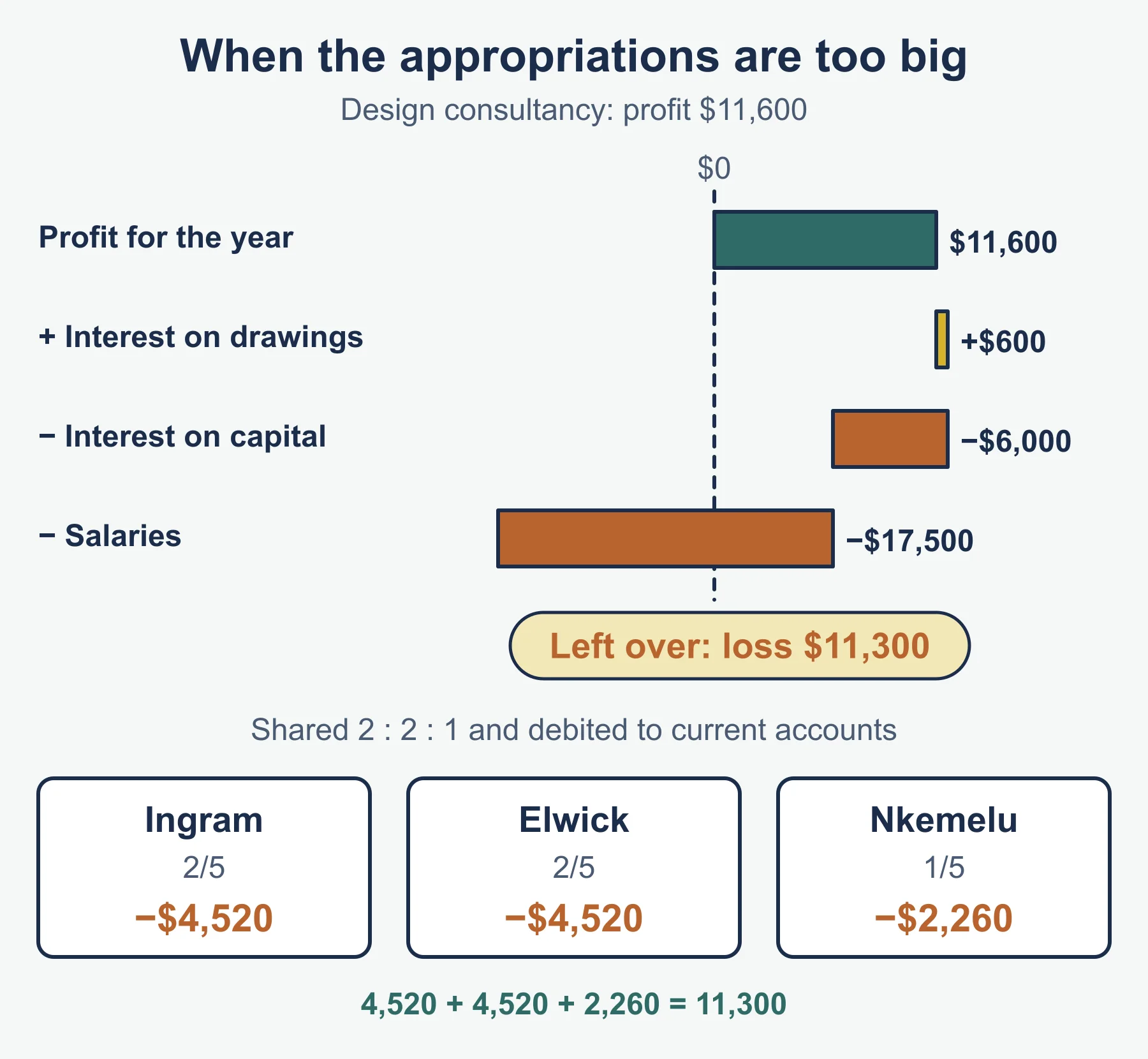
- Leaving out salary or interest on capital in a year of low profit. These are entitlements under the agreement, so a deficit after them is shared in the ratio.
- Using a profit-sharing ratio to share interest and salary. Those are fixed amounts for each partner. The ratio applies only to what is left.
- Entering drawings in the capital account of a firm that keeps fixed capitals.
- Treating the appropriation account as part of the income statement. The income statement stops at profit for the year.
- Applying the 5% loan rule when the agreement states a different rate. The agreement wins.
Frequently asked questions
What is the difference between an ordinary partnership and a limited liability partnership? Partners in an ordinary partnership have unlimited liability, so their personal assets can be used to pay the firm’s debts. Members of a limited liability partnership (LLP) have limited liability, and the LLP is a legal person separate from its owners.
What happens if partners have no partnership agreement? Section 24 of the Partnership Act 1890 sets default rules that apply where there is no agreement or the agreement is silent. For example, profits and losses are shared equally and a partner’s loan to the firm earns interest at 5% a year; an agreement always overrides these defaults.
Where does interest on a partner’s loan go? Interest on a partner’s loan is an expense of the firm, so it is deducted in the income statement before profit for the year. It does not appear in the appropriation account.
Why is interest on drawings added in the appropriation account? Interest on drawings is charged to the partner, so it increases the profit available to share. Deducting it instead of adding it is a common error in Edexcel IGCSE Accounting (4AC1) questions.
What is the difference between a partner’s capital account and current account? The capital account is often kept fixed and changes only when long-term capital is paid in or withdrawn. The current account collects the yearly movements: interest on capital, salary and share of profit are credited, while drawings, interest on drawings and any share of loss are debited.
Official syllabus
Pearson Edexcel International GCSE in Accounting (4AC1), Specification, Issue 1, October 2016, published by Pearson Education Limited. Topic 4: The preparation of financial statements, section 2 (Financial statements of a partnership), points a to g.
Get free revision emails (optional)
Occasional emails with practice questions, worked explanations and links to free resources for the qualification and subjects you choose. No spam, and you can unsubscribe from any email. The free tools on this site never need an email.
Related resources
-
Practice questions
Edexcel IGCSE Accounting: Financial statements of a partnership (4AC1) – Practice Questions
Eleven original partnership accounts questions for Edexcel IGCSE Accounting 4AC1, from Section 24 to full statements, with marked answers.
Accounting · Pearson Edexcel · IGCSE
Try questions -
Revision notes
Edexcel IGCSE Accounting: Financial statements of a partnership (4AC1) – Revision Notes
Condensed revision notes on partnership accounts for Edexcel IGCSE Accounting 4AC1: Section 24, appropriation, current accounts and a self-test.
Accounting · Pearson Edexcel · IGCSE
Revise topic -
Study guides
Edexcel IGCSE Accounting: Financial statements of a sole trader (4AC1)
Step-by-step guide to a sole trader's income statement and statement of financial position, with two worked examples, for Edexcel IGCSE Accounting.
Accounting · Pearson Edexcel · IGCSE
Read guide
Related articles
-
teaching
A Level tuition in Dubai: Cambridge or Pearson Edexcel International A Level?
Schools in Dubai and Abu Dhabi teach either Cambridge International AS & A Level or Pearson Edexcel International A Level. How the two are structured, why it matters for tuition, and how online classes from Lahore work.
9 October 2026
-
curriculum guides
Choosing subjects at IGCSE and A Level
How subject choices at 14 and 16 affect university options later, and how to keep pathways open without overloading a timetable.
28 July 2026
Studying this with a teacher
Working through Accounting IGCSE?
This page is free and stays free. If you would rather be taught it, Marlbridge runs Accounting classes one-to-one and in small groups of up to 15, online in your own time zone. The first trial class is free. WhatsApp replies within an hour (8am–11pm Pakistan time, every day); email the same day.
Pearson Edexcel Accounting teachers at Marlbridge

