
Revision Notes
Edexcel IGCSE Accounting: Financial statements of a sole trader (4AC1) – Revision Notes
Condensed notes on sole trader income statements and statements of financial position: layouts, classification tables, a worked reminder and a self-test.
- Subject
- Accounting
- Level
- IGCSE
- Topic
- The preparation of financial statements
- Author
- Marlbridge Academic Team
- Updated
- Reviewed by
- Javaid Iqbal Sabri (what this means)
Aligned to Pearson Edexcel IGCSE Accounting (4AC1), Issue 1, October 2016. Official specification .
Syllabus page (what it covers and how it is assessed): Pearson Edexcel IGCSE Accounting.
Syllabus points this page covers
4AC1
- 4 The preparation of financial statements (whole topic)
- 4.1 Financial statements of a sole trader
Found an error? Report a correction.
Want a teacher for this? Marlbridge teaches Accounting online. Request a free trial class.
These notes condense section 4.1, Financial statements of a sole trader, from Topic 4 of the Pearson Edexcel International GCSE in Accounting (4AC1) specification, Issue 1, October 2016. The two points are 4.1a (income statements showing gross profit and profit for the year) and 4.1b (statements of financial position showing assets, liabilities and equity). No tier labels are given. For full explanations and two complete worked examples, use the study guide.
Links: Edexcel IGCSE Accounting course hub, printable checklist, free diagnostics and the practice questions. All businesses and figures are invented and in dollars.
4.1a Income statement: layout to learn
Name of business
Income statement for the year ended (date)

Revenue
Less sales returns
Net revenue
Cost of sales:
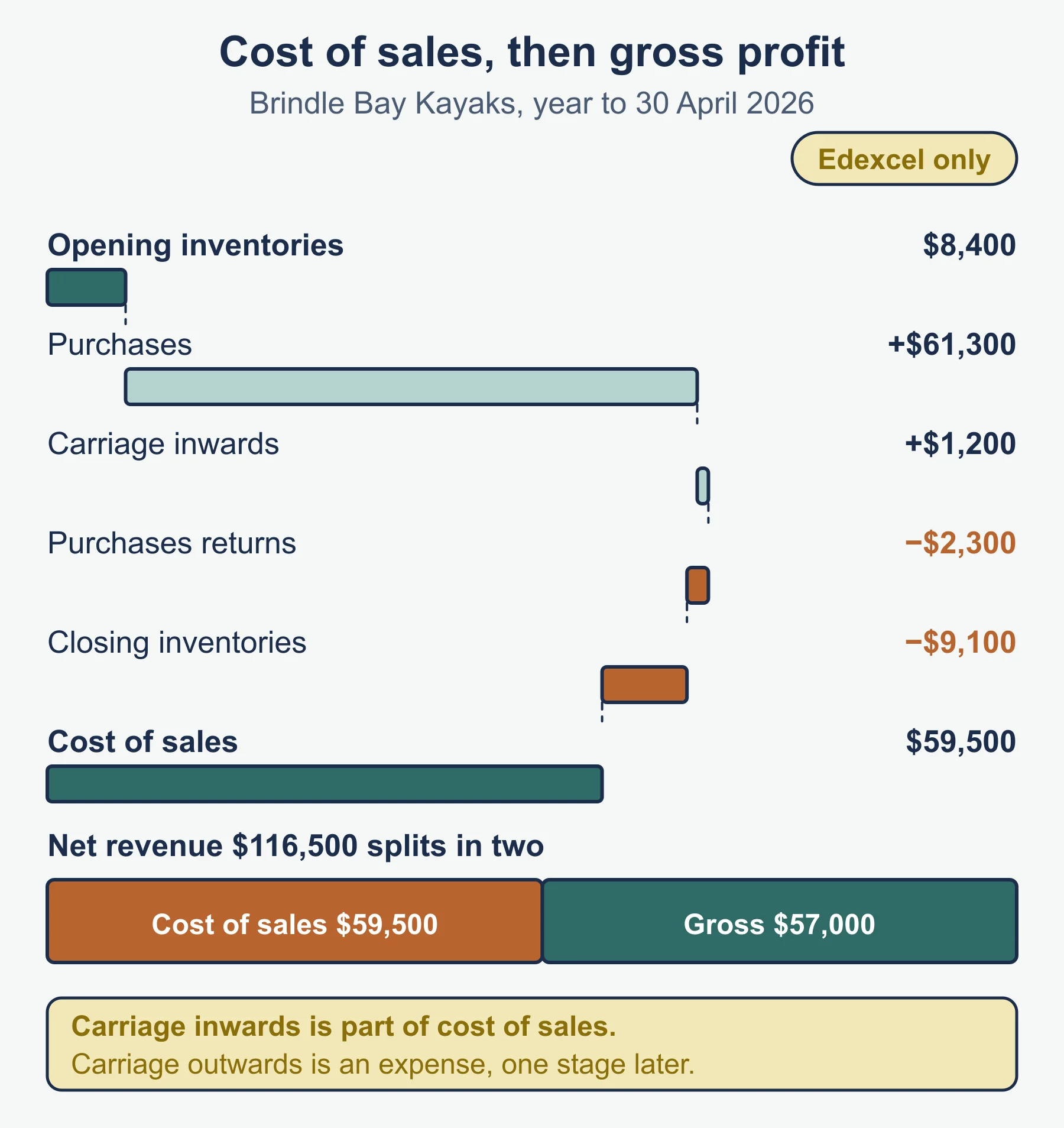
  Opening inventories
  Add purchases
  Add carriage inwards
  Less purchases returns
  Less closing inventories
Gross profit
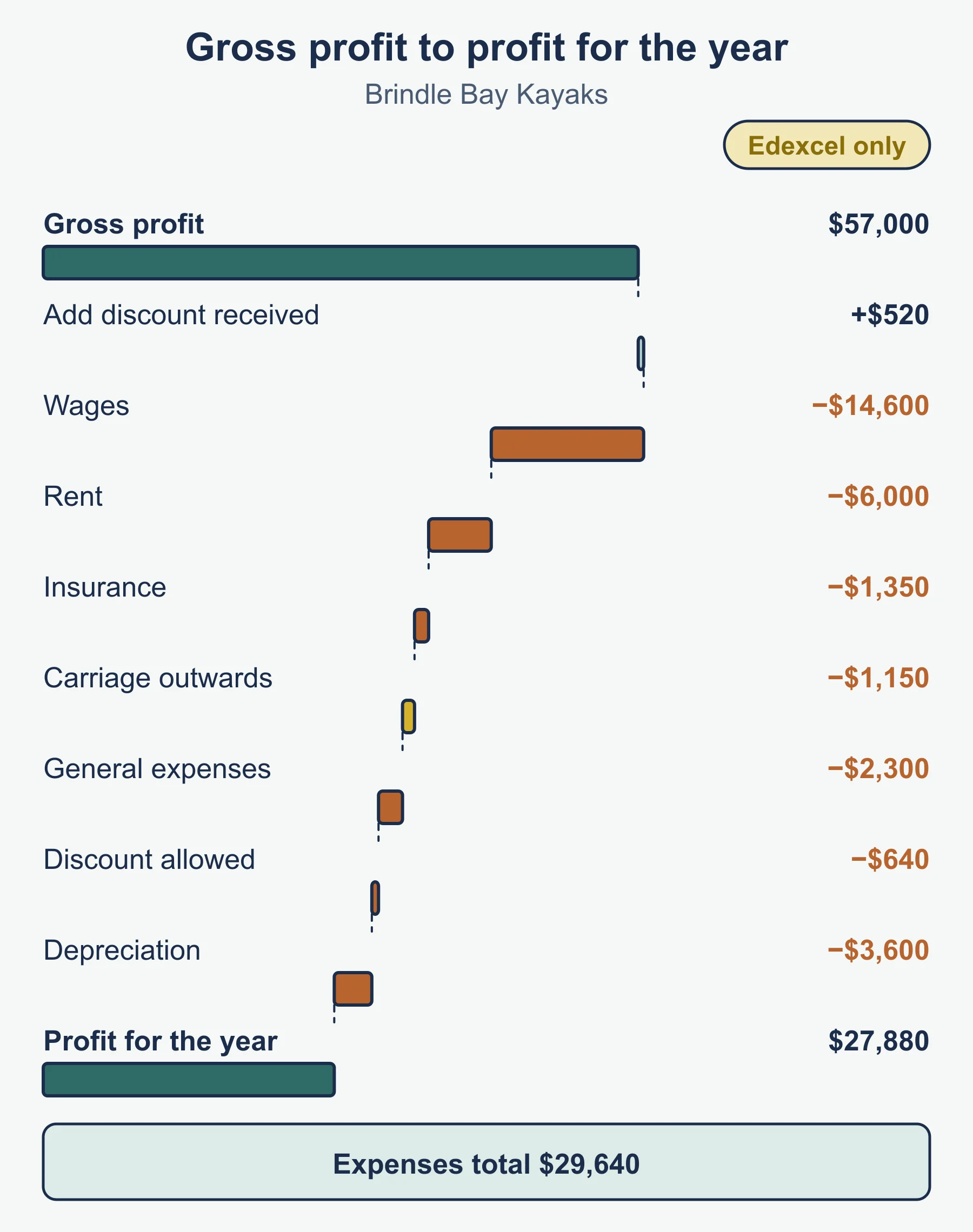
Add other income (for example discount received)
Less expenses (each listed)
Profit for the year  (or loss for the year)
Formulae
| Item | How to find it |
|---|---|
| Net revenue | Revenue - sales returns |
| Cost of sales | Opening inventories + purchases + carriage inwards - purchases returns - closing inventories |
| Gross profit | Net revenue - cost of sales |
| Profit for the year | Gross profit + other income - expenses |
Where each trial balance item goes
| Item | Placed in | Why |
|---|---|---|
| Sales | Top of income statement | Revenue |
| Sales returns | Deducted from revenue | Reduces net revenue |
| Purchases | Cost of sales | Goods bought for resale |
| Purchases returns | Deducted in cost of sales | Goods sent back |
| Carriage inwards | Cost of sales | Cost of getting goods to the business |
| Carriage outwards | Expenses | Cost of delivering to customers |
| Discount received | Added to gross profit | Other income |
| Discount allowed | Expenses | Cost of encouraging early payment |
| Wages, rent, insurance, general expenses | Expenses | Running costs |
| Depreciation charge for the year | Expenses | Using up of non-current assets |
| Loan interest | Expenses | Cost of borrowing |
| Drawings | Not in the income statement | Owner’s withdrawals reduce equity |
| Purchase of non-current assets | Not in the income statement | Capital expenditure |
4.1b Statement of financial position: layout to learn
Name of business
Statement of financial position at (date)

Non-current assets      Cost   Accumulated depreciation   Carrying amount
Current assets
  Inventories
  Trade receivables
  Other receivables
  Bank
  Cash
Current liabilities
  Trade payables
  Other payables
  Bank overdraft
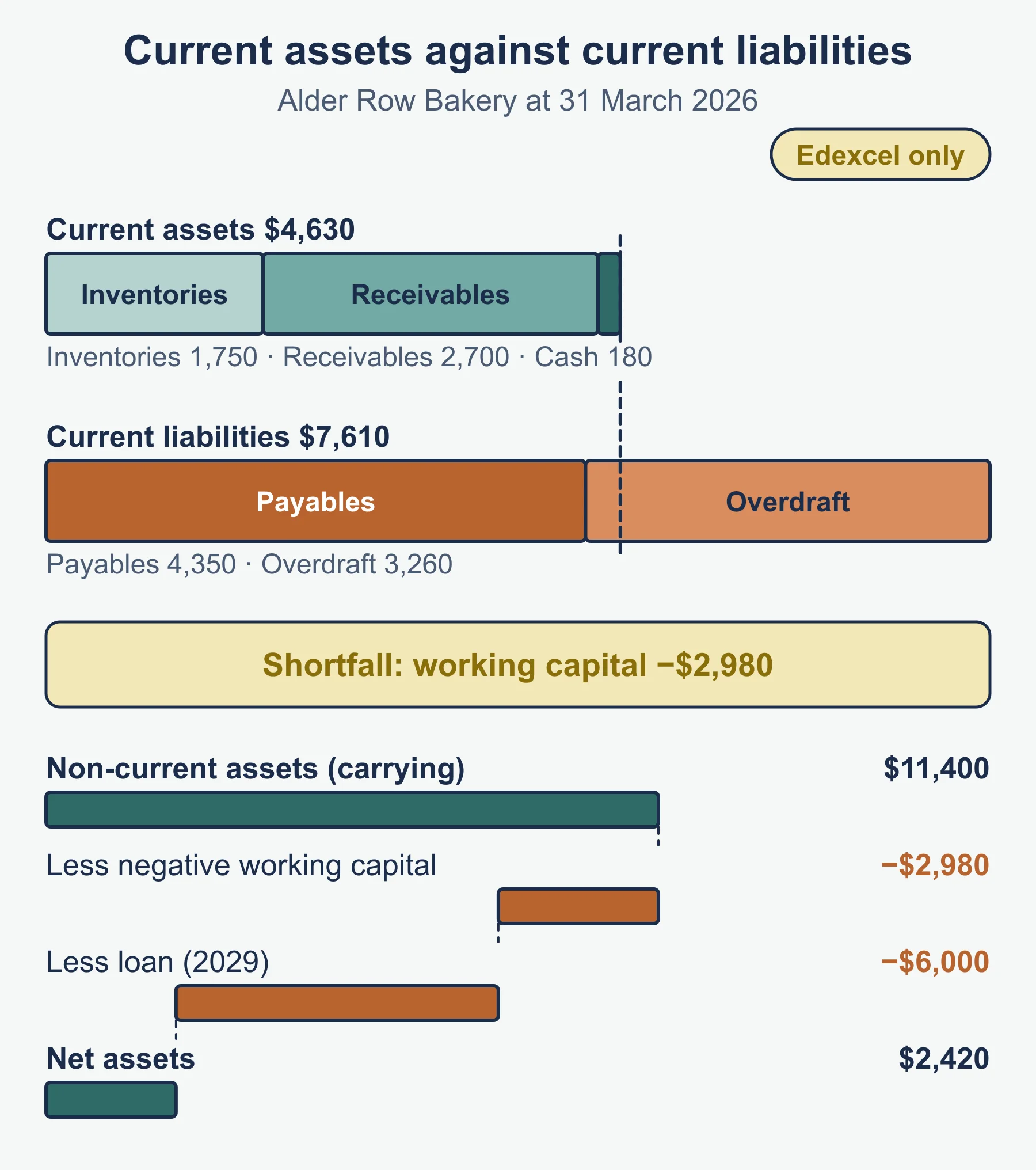
Working capital (current assets - current liabilities)
Non-current liabilities
  Loan
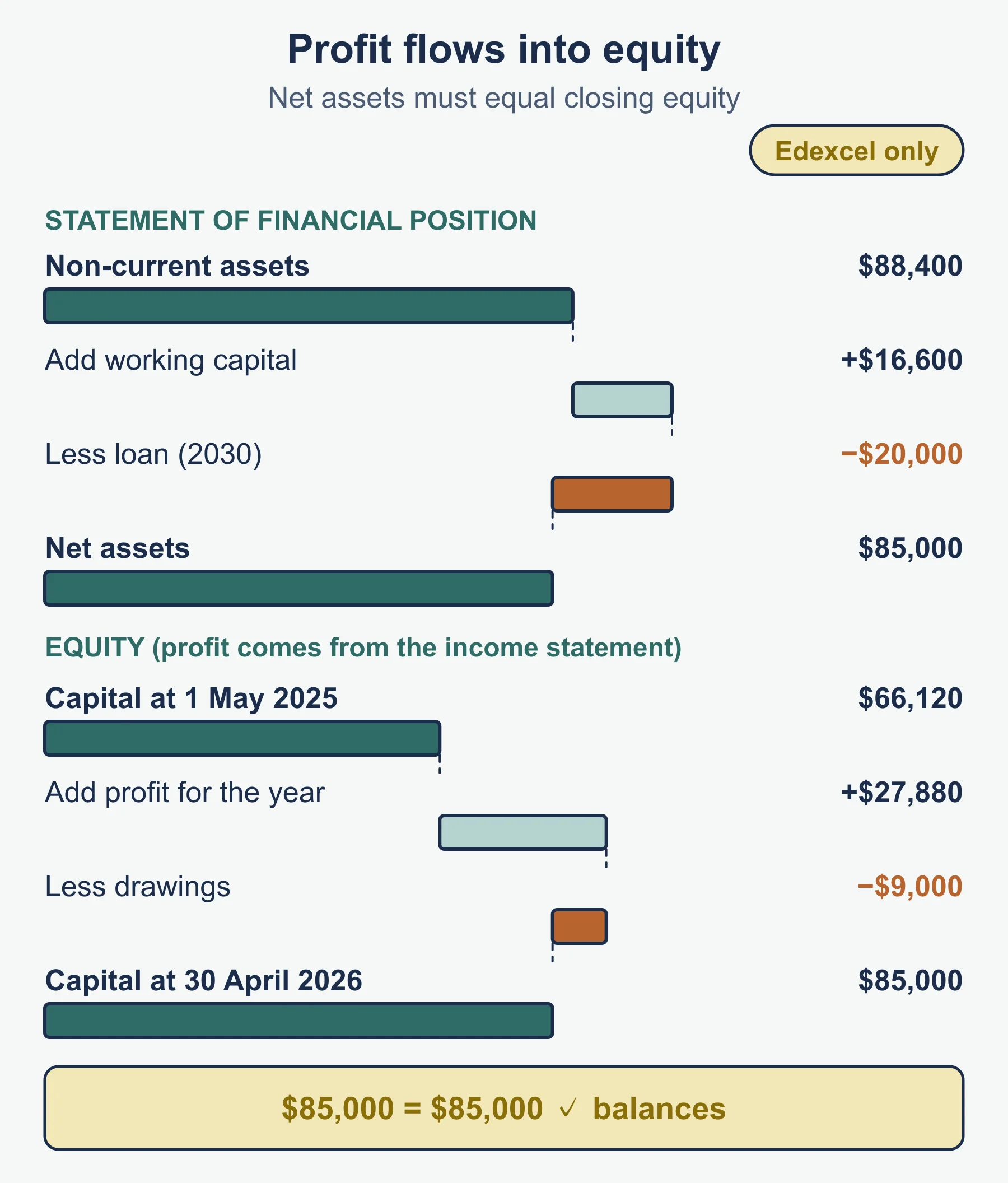
Net assets
Equity
  Capital at start
  Add profit (or less loss)
  Less drawings
  Capital at end
Definitions
| Term | Meaning |
|---|---|
| Asset | Something the business owns or is owed that will give future benefit |
| Liability | Something the business owes |
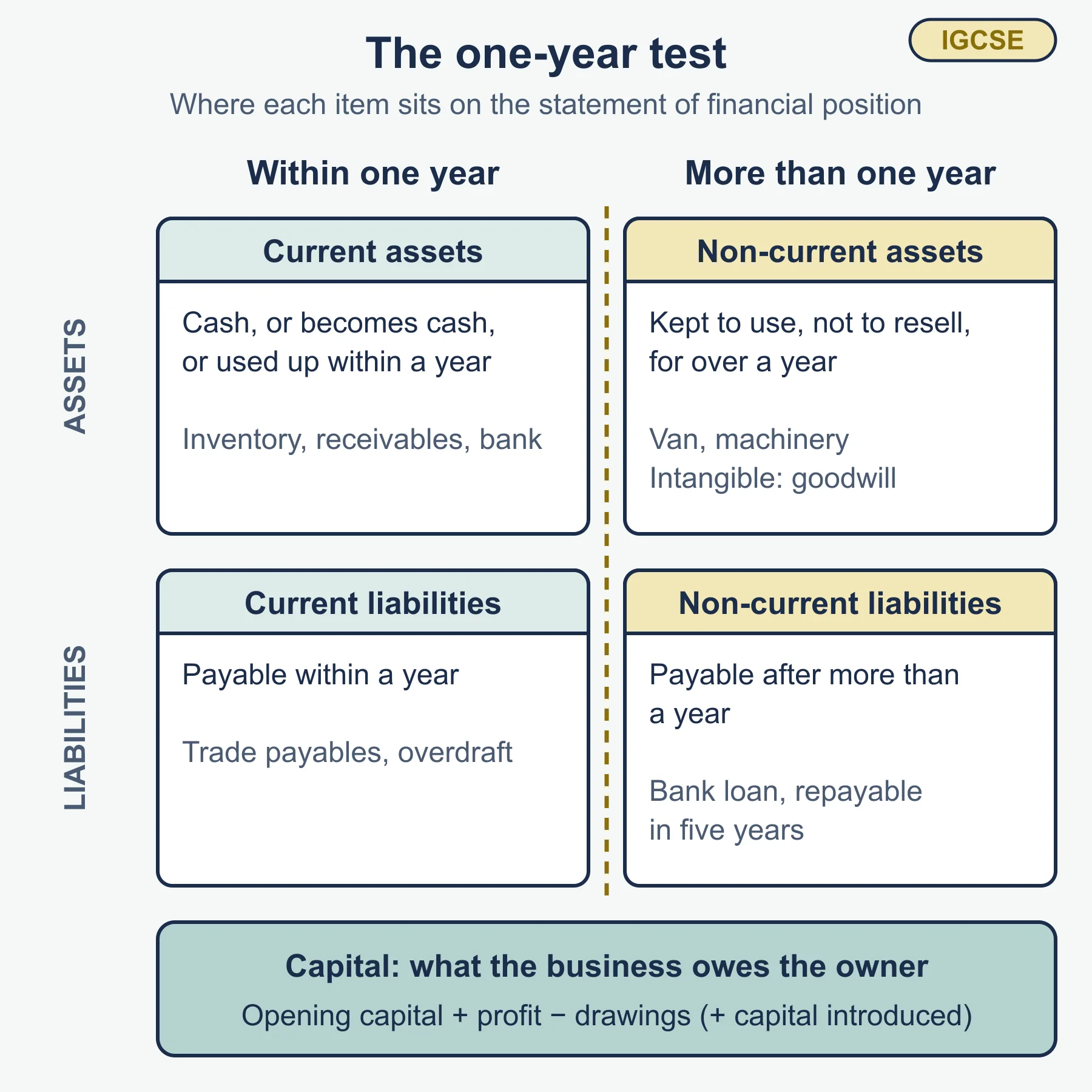
| Non-current asset | Kept for use over more than a year |
| Current asset | Expected to become cash within a year |
| Current liability | Due within a year |
| Non-current liability | Due after more than a year |
| Equity | Owner’s stake in the business: assets less liabilities |
| Carrying amount | Cost less accumulated depreciation |
| Working capital | Current assets less current liabilities |
| Net assets | Non-current assets + working capital - non-current liabilities |
Order of current assets
Inventories, trade receivables, other receivables, bank, cash. The idea is least liquid first, most liquid last.
Method in steps
- Read the heading: is the statement for a period or at a date?
- Underline closing inventories, depreciation charge and any other adjustments given in the question.
- Income statement: net revenue, cost of sales, gross profit.
- Add other income and list every expense. Total them. Profit or loss for the year.
- Statement of financial position: carrying amounts of non-current assets, then current assets and current liabilities, working capital, non-current liabilities, net assets.
- Equity: capital at start, plus profit (or minus loss), minus drawings.
- Check that net assets equal equity. If not, find the error before moving on.
Must-know distinctions
- Revenue versus profit. Revenue is the sales figure at the top. Profit for the year is what is left after cost of sales and all expenses.
- Gross profit versus profit for the year. Gross profit stops before running expenses. Profit for the year is after them.
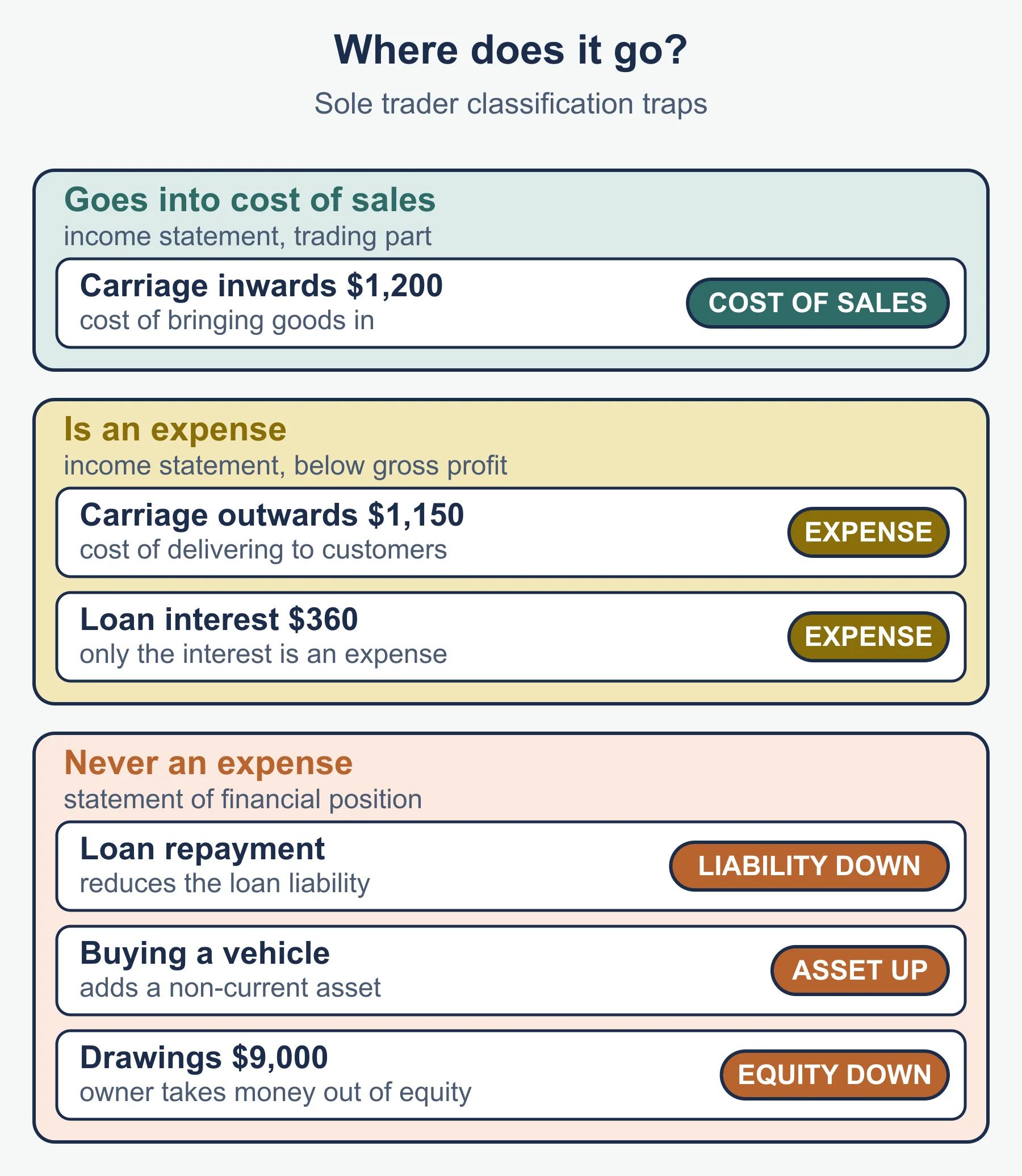
- Carriage inwards versus carriage outwards. Inwards is cost of sales; outwards is an expense.
- Drawings versus expenses. Drawings are the owner’s personal take; expenses are business costs.
- Capital versus equity. Capital is the owner’s investment at the start; equity at the end includes profit, loss and drawings.
- Current versus non-current. The dividing line is one year.
- Income statement versus statement of financial position. One is a period; the other is a moment.
Presentation checklist
- Headings: business name, name of statement and the date wording (“for the year ended” or “at”).
- Show every subtotal: net revenue, cost of sales, gross profit, total expenses, profit for the year.
- In the statement of financial position, show cost, accumulated depreciation and carrying amount in separate columns.
- Label the sections: non-current assets, current assets, current liabilities, non-current liabilities, equity.
- Put brackets round a negative figure such as a loss or negative working capital.
- Finish with the check: net assets equal closing capital.
Worked reminder
Rubina Chaudhry runs Tern Street Stationery. For the year ended 31 July 2026 her records show: sales 52,000; sales returns 1,200; opening inventories 3,000; purchases 31,000; carriage inwards 700; purchases returns 900; closing inventories 3,400; discount received 260. Expenses are wages 8,200, rent 3,600, insurance 640, carriage outwards 520, general expenses 1,340, depreciation 1,100 and discount allowed 180. Her capital at 1 August 2025 was 18,000 and her drawings were 8,500.
Net revenue      52,000 - 1,200 = 50,800
Cost of sales    3,000 + 31,000 + 700 - 900 - 3,400 = 30,400
Gross profit     50,800 - 30,400 = 20,400
Add discount received 260                = 20,660
Expenses         8,200 + 3,600 + 640 + 520 + 1,340 + 1,100 + 180 = 15,580
Profit for the year   20,660 - 15,580 = 5,080
Closing capital  18,000 + 5,080 - 8,500 = 14,580
The closing capital of 14,580 is the figure that the net assets in her statement of financial position must equal.
A loss, an overdraft and the accounting equation
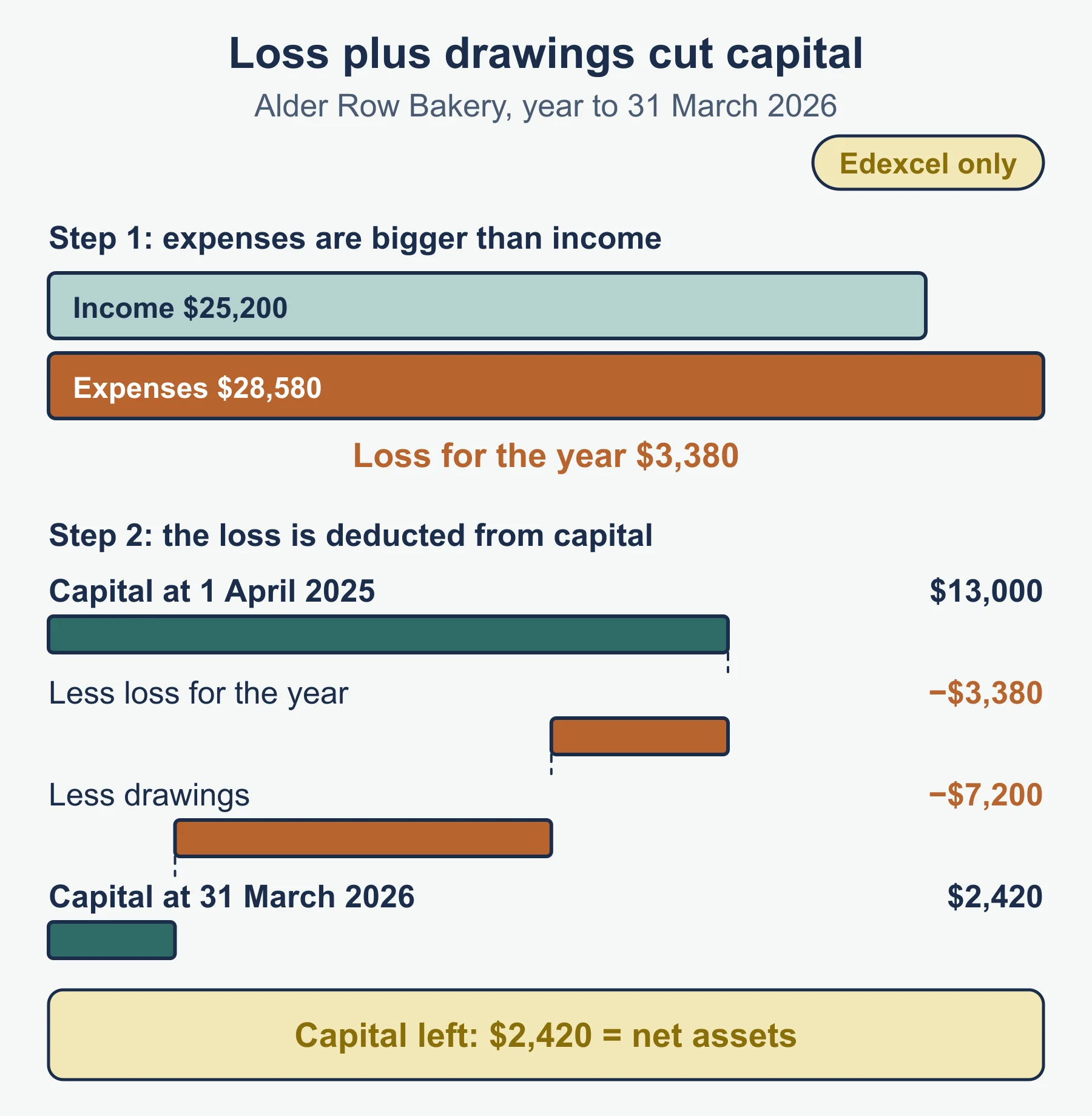
When expenses exceed gross profit plus other income, the result is a loss for the year and it is deducted from capital. A bank overdraft goes under current liabilities. If current liabilities exceed current assets, working capital is negative and is shown in brackets. The accounting equation is assets = liabilities + equity, or in the vertical layout, net assets = equity.
Quick self-test
- Opening inventories are 5,200, purchases 27,800 and closing inventories 4,900. Find cost of sales (no other items).
- Revenue is 41,500, sales returns 1,500 and cost of sales 28,100. Find gross profit.
- In which part of the income statement does carriage outwards go?
- Gross profit is 11,900, discount received 250 and expenses 8,430. Find profit for the year.
- Opening capital is 22,000, profit 3,720 and drawings 5,000. Find closing capital.
- State where drawings are shown.
- Equipment cost 12,000 and accumulated depreciation is 7,500. Find the carrying amount.
- Current assets are 9,300 and current liabilities 6,150. Find working capital.
- A loan repayable in five years is which type of liability?
- Total assets are 56,000 and total liabilities 21,800. Find equity.
- Is the purchase of a new delivery van an expense of the year? Give a reason.
- Which statement is prepared for a period of time?
Answers
- 5,200 + 27,800 - 4,900 = 28,100.
- 41,500 - 1,500 = 40,000 net revenue; 40,000 - 28,100 = 11,900.
- Expenses (after gross profit).
- 11,900 + 250 - 8,430 = 3,720.
- 22,000 + 3,720 - 5,000 = 20,720.
- In the equity section of the statement of financial position, deducted from capital plus profit. Not in the income statement.
- 12,000 - 7,500 = 4,500.
- 9,300 - 6,150 = 3,150.
- A non-current liability.
- 56,000 - 21,800 = 34,200.
- No. It is capital expenditure, so it is a non-current asset in the statement of financial position. Only its depreciation is an expense.
- The income statement.
Where marks are usually lost
- Using closing inventories at the start of cost of sales, or forgetting to deduct them.
- Leaving carriage inwards out of cost of sales, or putting it in expenses.
- Deducting drawings in the income statement.
- Adding a loss to capital instead of deducting it.
- Not showing accumulated depreciation, so the carrying amount is missing.
- Putting current assets in the wrong order or mixing current and non-current items.
- Forgetting the dates and the name of the business in the headings.
- Giving gross profit but not carrying on to profit for the year.
- Showing a bank overdraft as an asset.
- Not checking that net assets equal equity.
Frequently asked questions
What is working capital? Working capital is current assets less current liabilities. Adding it to non-current assets and deducting non-current liabilities gives net assets, which must equal equity.
How is a non-current asset shown in the statement of financial position? Show the asset at cost, less accumulated depreciation, to give the carrying amount. Accumulated depreciation includes previous years’ depreciation as well as this year’s charge.
What happens to equity when a sole trader makes a loss? A loss for the year is deducted from opening capital, along with drawings, so equity falls. Adding a loss to capital is a common error.
Why do closing inventories appear in both financial statements? Closing inventories are deducted in cost of sales in the income statement and listed as a current asset in the statement of financial position. They should not be used at the start of cost of sales, which begins with opening inventories.
Official syllabus
Pearson Edexcel International GCSE in Accounting (4AC1) specification, Issue 1, October 2016, published by Pearson Education Limited – Topic 4 The preparation of financial statements, section 4.1 Financial statements of a sole trader, points (a) and (b).
Get free revision emails (optional)
Occasional emails with practice questions, worked explanations and links to free resources for the qualification and subjects you choose. No spam, and you can unsubscribe from any email. The free tools on this site never need an email.
Related resources
-
Study guides
Edexcel IGCSE Accounting: Incomplete records (4AC1)
Study guide to incomplete records for Pearson Edexcel International GCSE Accounting 4AC1: profit from equity, control accounts and full statements.
Accounting · Pearson Edexcel · IGCSE
Read guide -
Practice questions
Edexcel IGCSE Accounting: Incomplete records (4AC1) – Practice Questions
Original practice questions with worked answers on incomplete records for Edexcel International GCSE Accounting 4AC1, section 4.3.
Accounting · Pearson Edexcel · IGCSE
Try questions -
Revision notes
Edexcel IGCSE Accounting: Incomplete records (4AC1) – Revision Notes
Condensed revision notes on incomplete records for Edexcel International GCSE Accounting 4AC1: formulas, methods, distinctions and a self-test.
Accounting · Pearson Edexcel · IGCSE
Revise topic
Related articles
-
teaching
A Level tuition in Dubai: Cambridge or Pearson Edexcel International A Level?
Schools in Dubai and Abu Dhabi teach either Cambridge International AS & A Level or Pearson Edexcel International A Level. How the two are structured, why it matters for tuition, and how online classes from Lahore work.
9 October 2026
-
curriculum guides
Choosing subjects at IGCSE and A Level
How subject choices at 14 and 16 affect university options later, and how to keep pathways open without overloading a timetable.
28 July 2026
Studying this with a teacher
Working through Accounting IGCSE?
This page is free and stays free. If you would rather be taught it, Marlbridge runs Accounting classes one-to-one and in small groups of up to 15, online in your own time zone. The first trial class is free. WhatsApp replies within an hour (8am–11pm Pakistan time, every day); email the same day.
Pearson Edexcel Accounting teachers at Marlbridge

