
Study Guides
Edexcel IGCSE Accounting: Financial statements of a sole trader (4AC1)
Step-by-step guide to a sole trader's income statement and statement of financial position, with two worked examples, for Edexcel IGCSE Accounting.
- Subject
- Accounting
- Level
- IGCSE
- Topic
- The preparation of financial statements
- Author
- Marlbridge Academic Team
- Updated
- Reviewed by
- Javaid Iqbal Sabri (what this means)
Aligned to Pearson Edexcel IGCSE Accounting (4AC1), Issue 1, October 2016. Official specification .
Syllabus page (what it covers and how it is assessed): Pearson Edexcel IGCSE Accounting.
Syllabus points this page covers
4AC1
- 4 The preparation of financial statements (whole topic)
- 4.1 Financial statements of a sole trader
Found an error? Report a correction.
Want a teacher for this? Marlbridge teaches Accounting online. Request a free trial class.
This guide covers section 4.1, Financial statements of a sole trader, from Topic 4 (The preparation of financial statements) in the Pearson Edexcel International GCSE in Accounting (4AC1) specification, Issue 1, October 2016. The specification lists no tier labels against these points. Topic 4 sits in Paper 2, Financial Statements, which also builds on the knowledge from topics 1 to 3, so you are expected to read a trial balance and know double entry before you start here.
Links: Edexcel IGCSE Accounting course hub, printable checklist and the free diagnostics. When you have worked through this guide, use the revision notes to memorise the layouts and the practice questions to test yourself.
All businesses and figures below are invented, and every amount is in dollars.
What the specification asks for
| Point | You must be able to | Where in this guide |
|---|---|---|
| 4.1a | Prepare income statements to show gross profit and profit for the year | Sections 1 to 3 |
| 4.1b | Prepare statements of financial position to show assets, liabilities and equity | Sections 4 to 6 |
Both statements come from the same trial balance, so the guide builds one set of statements in full (Worked example 1) and then a second set for a business that makes a loss (Worked example 2).
1. Two statements, two different questions
The income statement answers: how much profit did the business make in a period? It covers a stated period, for example “for the year ended 30 April 2026”. It collects revenue and expenses.
The statement of financial position answers: what does the business own and owe on one particular day? It is dated at a point, for example “at 30 April 2026”. It lists assets, liabilities and equity.
The link between them is the owner’s equity. Profit for the year from the income statement is added to equity in the statement of financial position, and the owner’s drawings are taken off. Each statement checks the other: if the statement of financial position does not balance, there is a mistake somewhere in your working.
2. Building the income statement
Work from the top down in two stages.
Stage 1: the trading part, ending in gross profit.
- Revenue is sales for the year. Deduct sales returns to get net revenue.
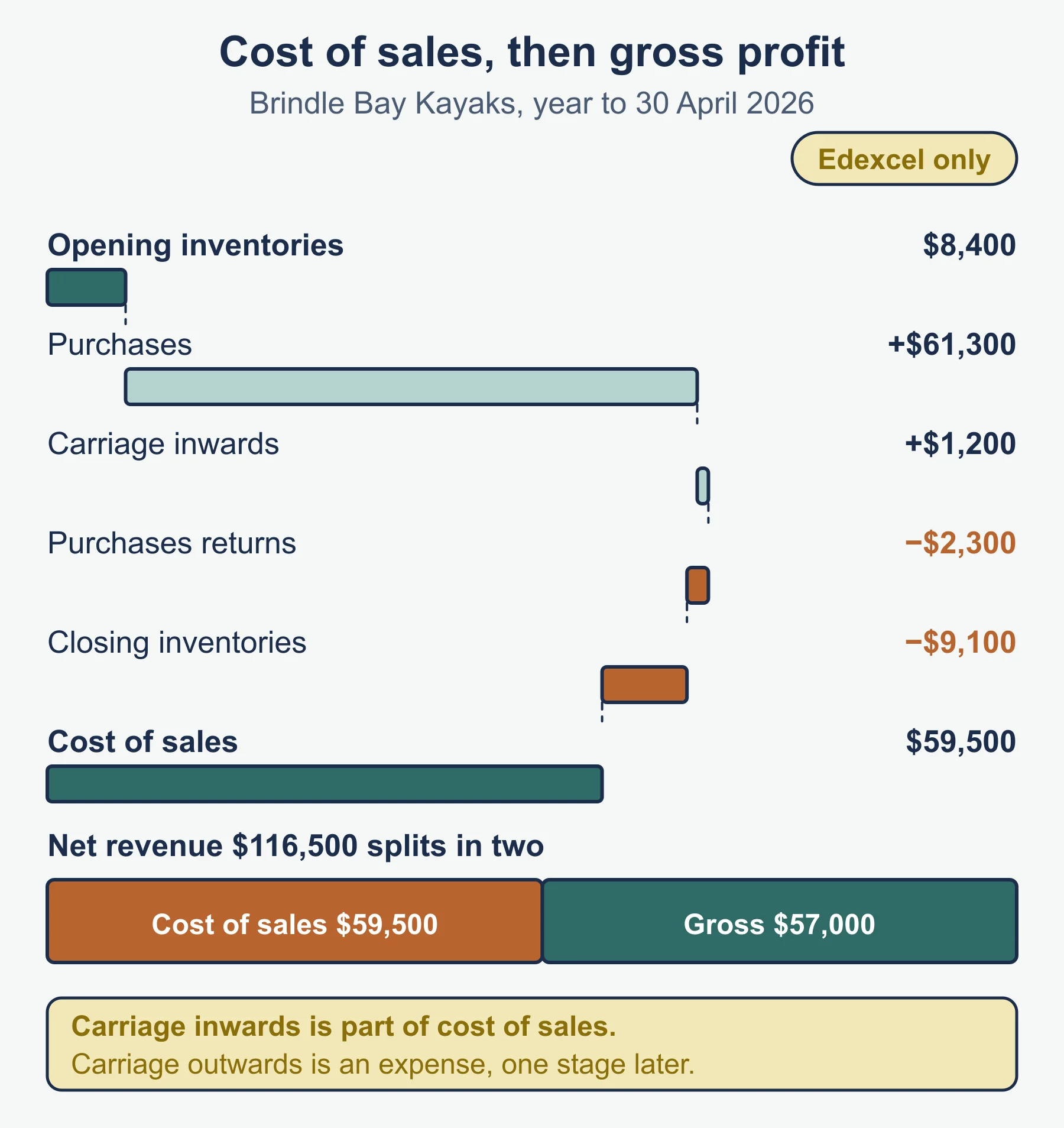
- Cost of sales is what the goods you sold cost you. Use opening inventories, add purchases and carriage inwards, deduct purchases returns, then deduct closing inventories.
- Gross profit is net revenue less cost of sales.
Cost of sales = opening inventories
              + purchases
              + carriage inwards
              - purchases returns
              - closing inventories
Gross profit  = net revenue - cost of sales
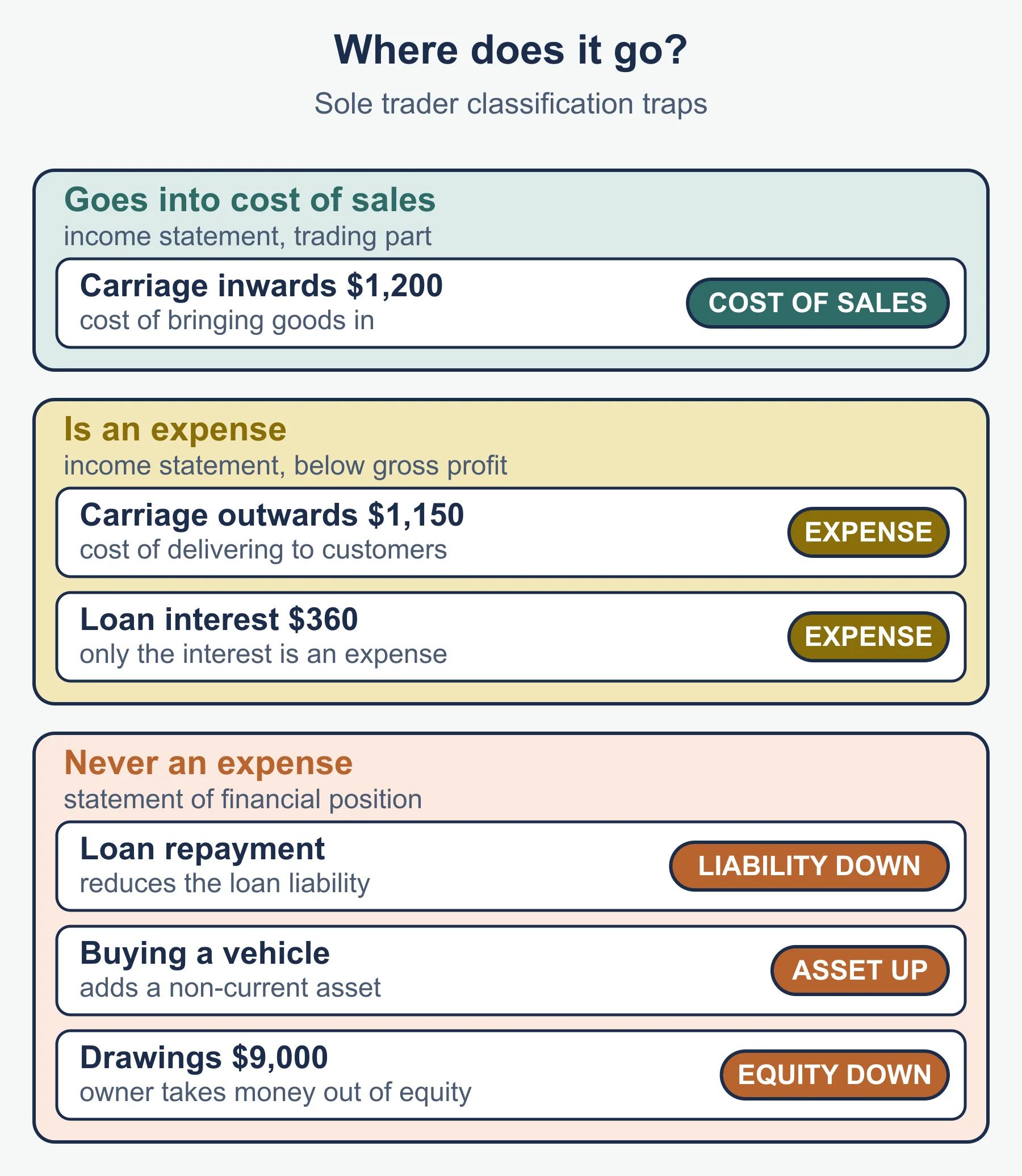
Carriage inwards is the cost of bringing goods to the business, so it is part of what the goods cost. Carriage outwards is the cost of delivering goods to customers, so it is an ordinary expense and belongs in stage 2.
Stage 2: from gross profit to profit for the year.
- Add any other income, such as discount received.
- Deduct every expense of running the business: wages, rent, insurance, carriage outwards, general expenses, discount allowed and the depreciation charge for the year.
- The result is profit for the year (or a loss if the expenses are larger).
Only revenue and expenses go in here. Buying a non-current asset is capital expenditure, so it goes into the statement of financial position, not the income statement. Drawings are not an expense either (see section 6).
3. Worked example 1: income statement
Daniyal Rauf runs Brindle Bay Kayaks. His trial balance at 30 April 2026 is below. The closing inventories were counted at 9,100. The depreciation charge for the year on equipment is 3,600; how that charge is calculated belongs to Topic 5, so here it is simply given.
| Account | Debit | Credit |
|---|---|---|
| Inventories at 1 May 2025 | 8,400 | |
| Purchases | 61,300 | |
| Sales | 118,400 | |
| Sales returns | 1,900 | |
| Purchases returns | 2,300 | |
| Carriage inwards | 1,200 | |
| Carriage outwards | 1,150 | |
| Wages | 14,600 | |
| Rent | 6,000 | |
| Insurance | 1,350 | |
| General expenses | 2,300 | |
| Discount allowed | 640 | |
| Discount received | 520 | |
| Premises at cost | 80,000 | |
| Equipment at cost | 18,000 | |
| Provision for depreciation of equipment | 6,000 | |
| Trade receivables | 7,250 | |
| Trade payables | 6,100 | |
| Bank | 5,900 | |
| Cash | 450 | |
| Loan (repayable in 2030) | 20,000 | |
| Drawings | 9,000 | |
| Capital at 1 May 2025 | 66,120 | |
| Totals | 219,440 | 219,440 |
Step 1: net revenue is 118,400 less 1,900 = 116,500.
Step 2: cost of sales is 8,400 + 61,300 + 1,200 = 70,900, less purchases returns 2,300 = 68,600, less closing inventories 9,100 = 59,500.
Step 3: gross profit is 116,500 less 59,500 = 57,000.
Step 4: add discount received 520 to get 57,520, then deduct expenses of 29,640 (wages 14,600, rent 6,000, insurance 1,350, carriage outwards 1,150, general expenses 2,300, discount allowed 640 and depreciation 3,600).
Brindle Bay Kayaks
Income statement for the year ended 30 April 2026

Revenue                                   118,400
Less sales returns                          1,900
Net revenue                               116,500
Cost of sales
  Opening inventories             8,400
  Purchases                      61,300
  Carriage inwards                1,200
                                 70,900
  Less purchases returns          2,300
                                 68,600
  Less closing inventories        9,100
                                             59,500
Gross profit                               57,000
Add discount received                          520
                                           57,520
Less expenses
  Wages                          14,600
  Rent                            6,000
  Insurance                       1,350
  Carriage outwards               1,150
  General expenses                2,300
  Discount allowed                  640
  Depreciation of equipment       3,600
                                             29,640
Profit for the year                         27,880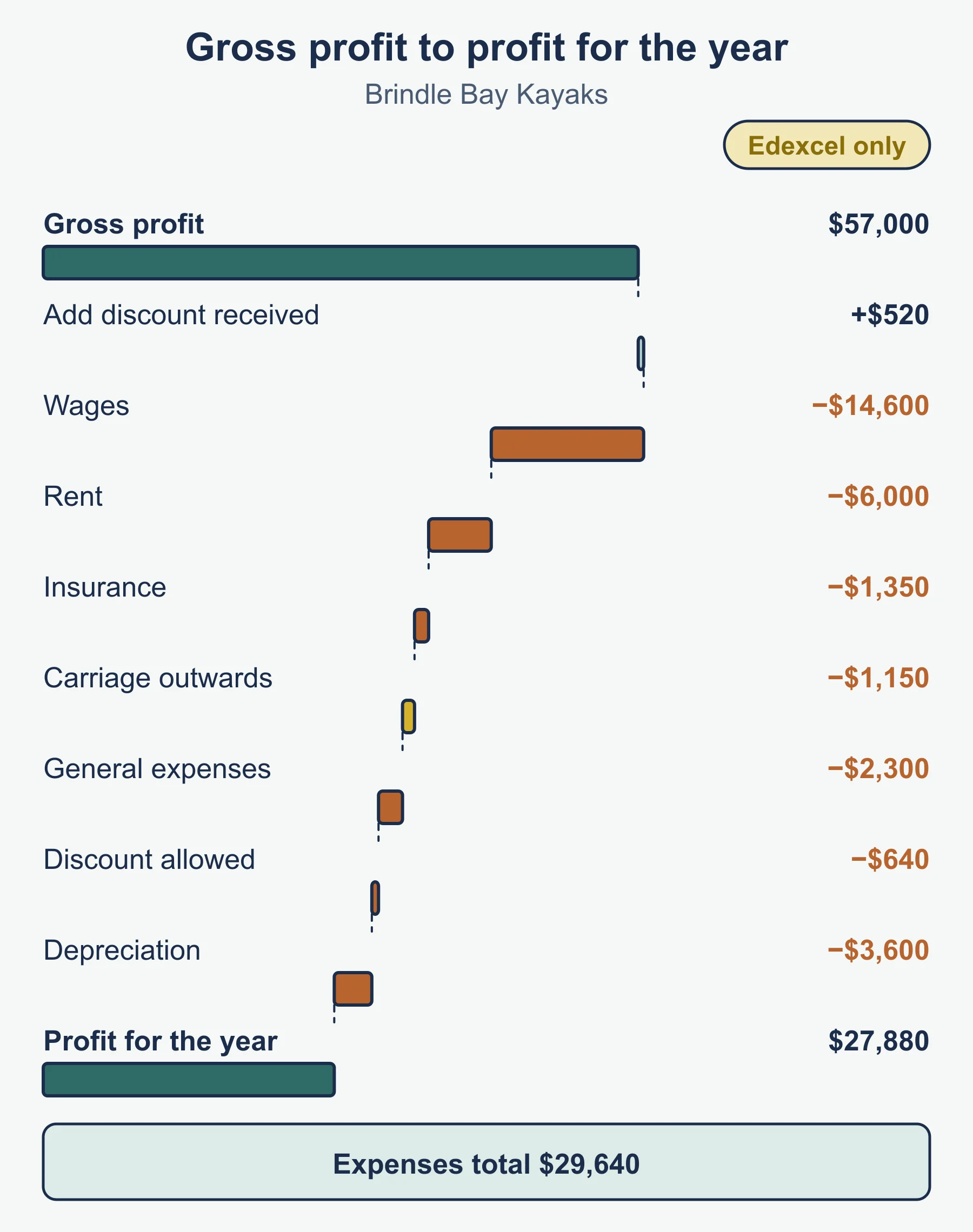
4. Building the statement of financial position
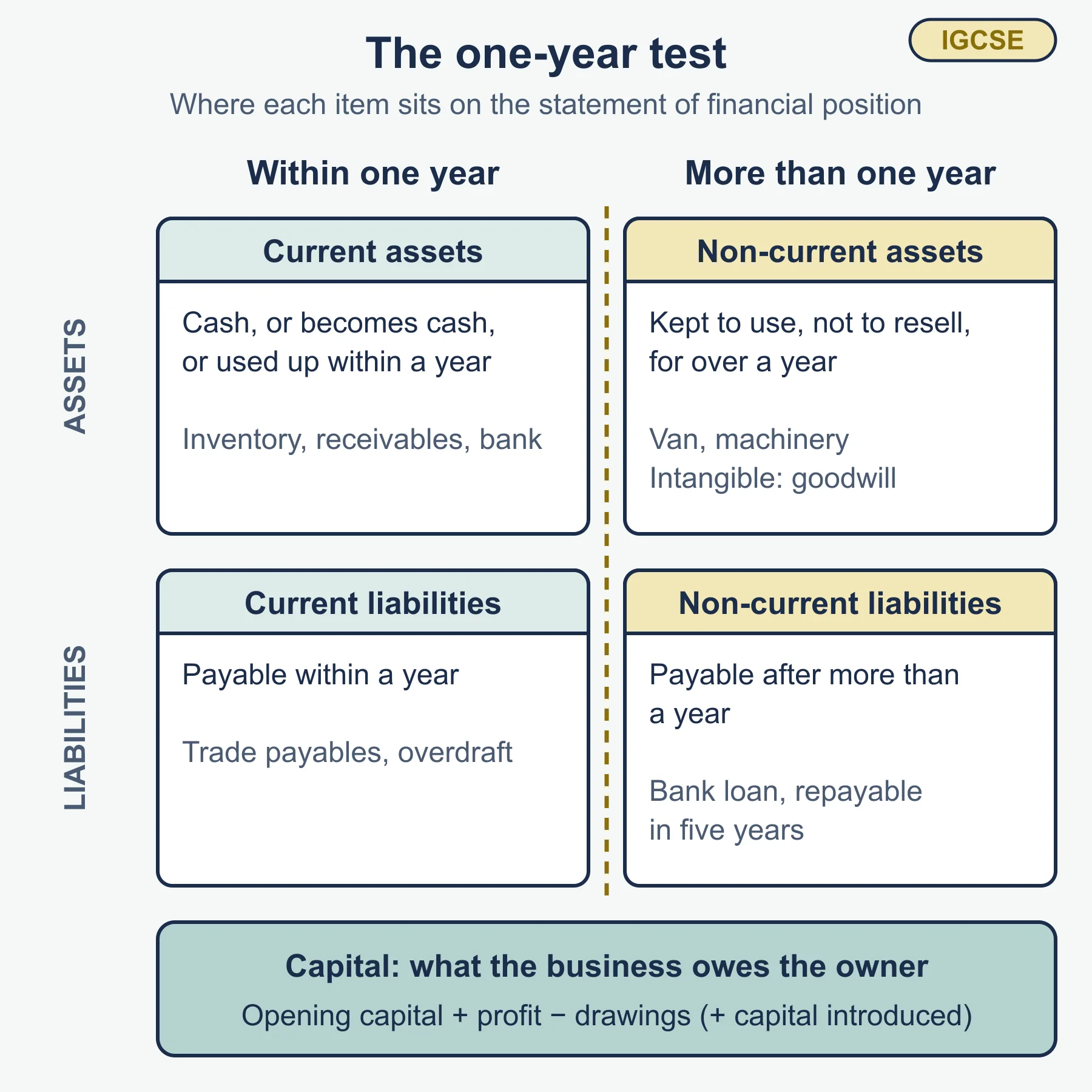
A vertical layout is used here. Assets and liabilities are grouped by how soon they turn into cash or fall due.
- Non-current assets are kept to use in the business for more than a year, such as premises and equipment. Show cost, less accumulated depreciation, to give the carrying amount.
- Current assets are expected to turn into cash within a year. List them from least to most liquid: inventories, trade receivables, other receivables, bank, cash.
- Current liabilities are due within a year: trade payables, other payables and any bank overdraft.
- Non-current liabilities are due after more than a year, such as a long-term loan.
- Equity is the owner’s stake: opening capital, plus profit for the year (or less a loss), less drawings.
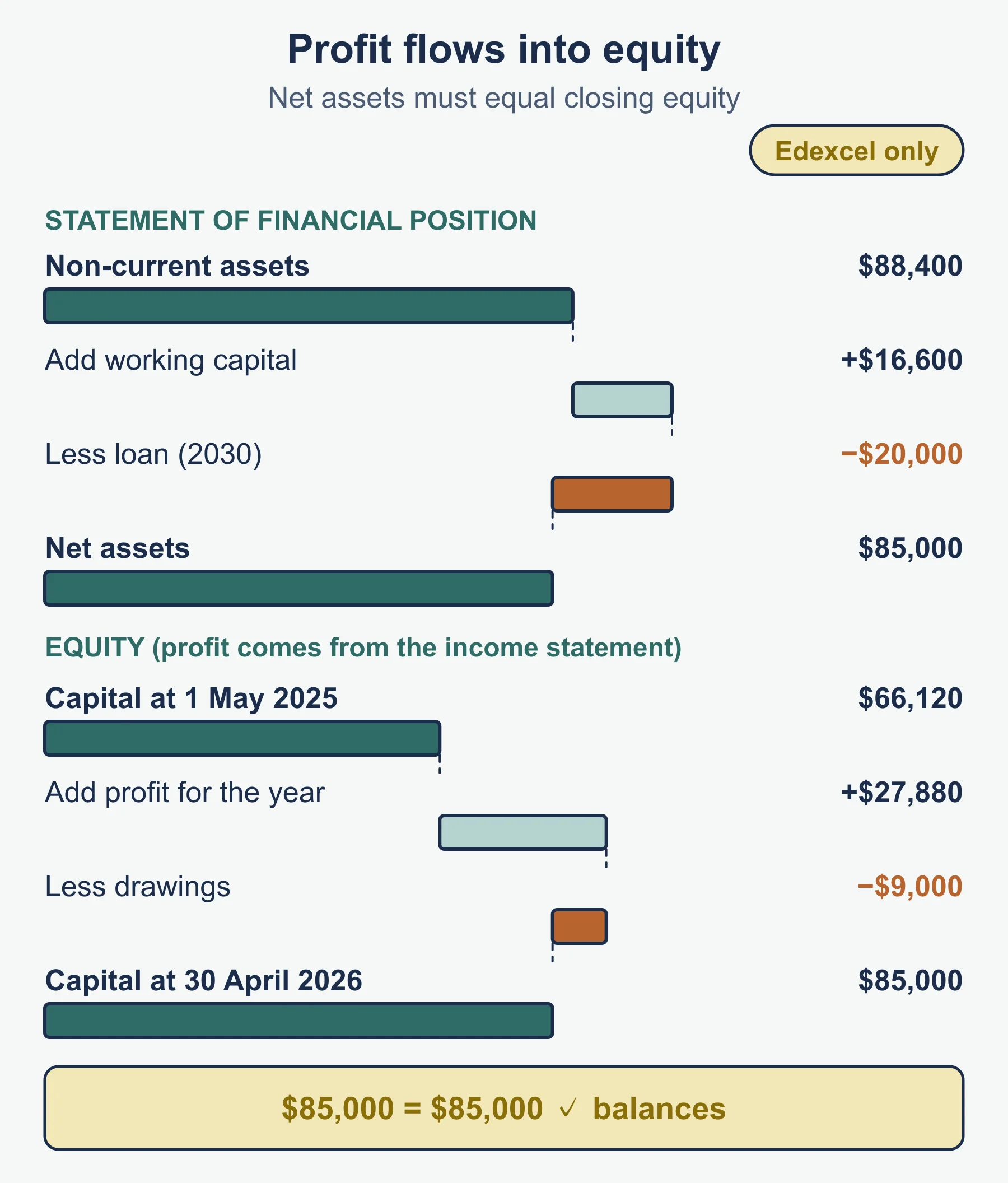
Current assets less current liabilities is working capital. Adding it to non-current assets and then deducting non-current liabilities gives net assets, which must equal equity.
5. Worked example 1: statement of financial position
Accumulated depreciation on the equipment is the opening provision 6,000 plus this year’s charge 3,600 = 9,600. The carrying amount is 18,000 less 9,600 = 8,400. Premises are not depreciated in this business.
Brindle Bay Kayaks
Statement of financial position at 30 April 2026

Non-current assets      Cost    Accum. dep.   Carrying amount
Premises              80,000                         80,000
Equipment             18,000         9,600            8,400
                      98,000         9,600           88,400

Current assets
Inventories                                   9,100
Trade receivables                             7,250
Bank                                          5,900
Cash                                            450
                                                       22,700
Current liabilities
Trade payables                                6,100
                                                        6,100
Working capital                                        16,600
                                                      105,000
Non-current liabilities
Loan (repayable in 2030)                               20,000
Net assets                                             85,000

Equity
Capital at 1 May 2025                                  66,120
Add profit for the year                                27,880
                                                       94,000
Less drawings                                           9,000
Capital at 30 April 2026                               85,000
The check works: net assets of 85,000 equal closing equity of 85,000. In the other direction, total assets (88,400 + 22,700 = 111,100) equal equity plus liabilities (85,000 + 20,000 + 6,100 = 111,100).
6. Classification traps
- Drawings are the owner taking money or goods for personal use. They are not a business expense, so they never appear in the income statement. They reduce equity.
- Closing inventories appear twice in your working but once on each statement: they are deducted in cost of sales and listed as a current asset.
- Loan repayments reduce the liability. Only the interest on the loan is an expense.
- Capital expenditure, such as buying a vehicle or the legal cost of buying premises, increases a non-current asset. It is not an expense of the year.
- A bank overdraft is a current liability, not a negative current asset, in this layout.
- Capital is the amount the owner has invested at the start. Equity at the end is capital plus profit less drawings.
7. Worked example 2: a business that makes a loss
Farah Lodhi runs Alder Row Bakery. For the year ended 31 March 2026 her records give:
- sales 64,800; sales returns 800
- inventories at 1 April 2025 2,100; closing inventories 1,750
- purchases 38,900; purchases returns 600; carriage inwards 450
- discount received 300
- expenses: wages 16,800, rent 4,800, electricity 1,950, repairs 640, loan interest 360, general expenses 1,230 and depreciation 2,800
- equipment at cost 24,000, with accumulated depreciation of 12,600 after this year’s charge
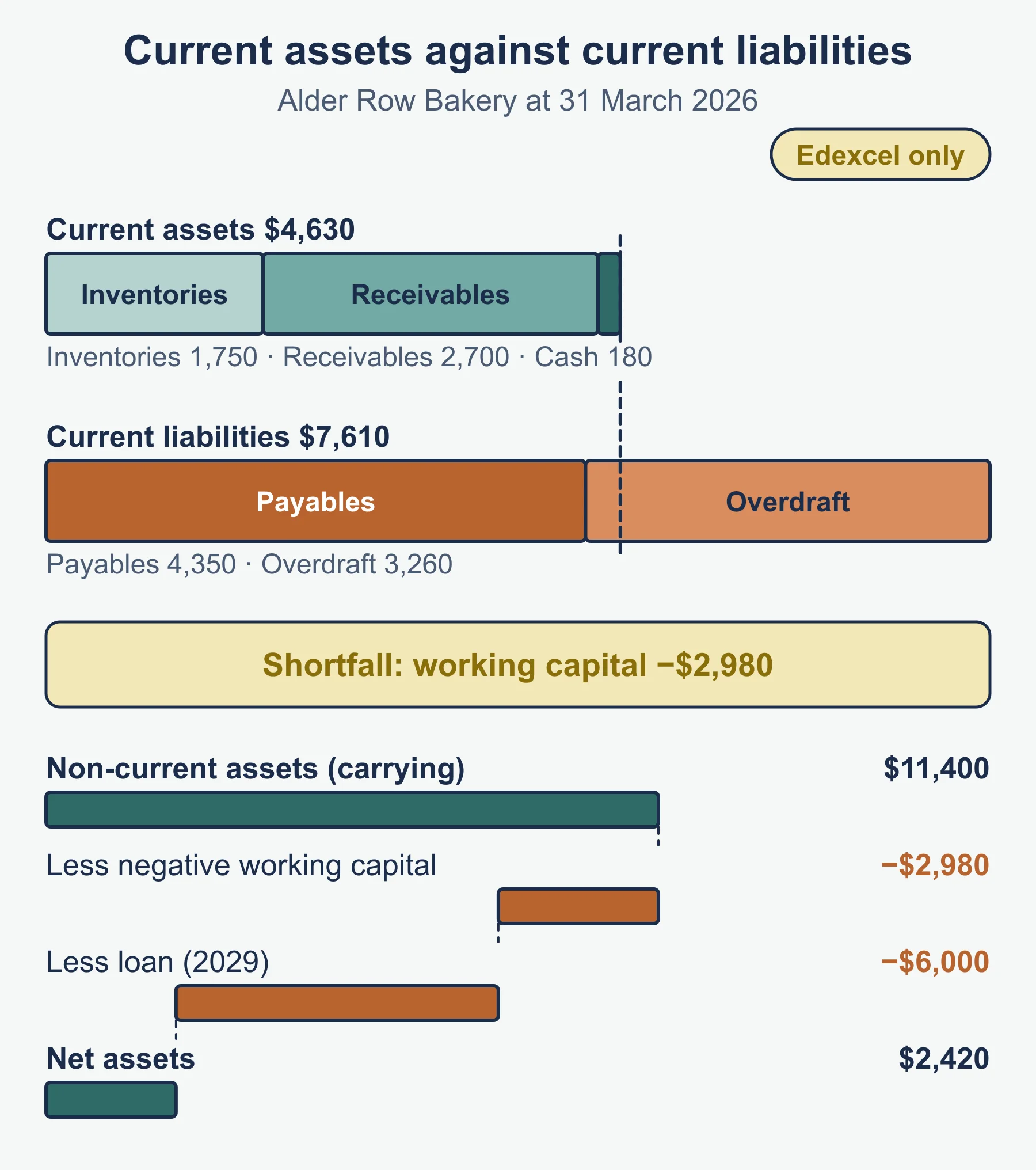
- trade receivables 2,700, cash 180, trade payables 4,350, bank overdraft 3,260, loan 6,000 (repayable in 2029)
- capital at 1 April 2025 13,000, drawings 7,200
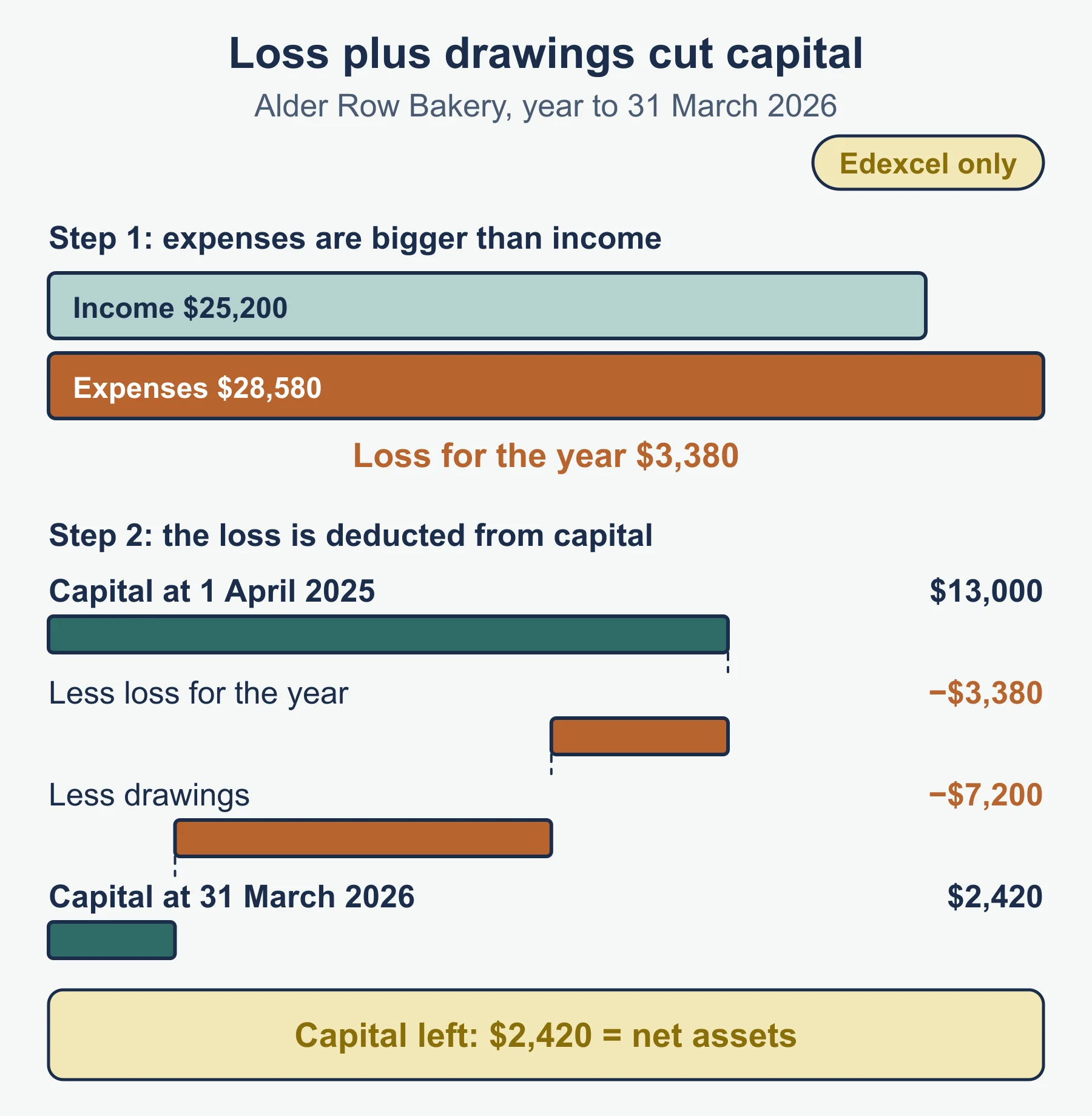
Cost of sales is 2,100 + 38,900 + 450 - 600 - 1,750 = 39,100. Net revenue is 64,000, so gross profit is 24,900. Adding discount received 300 gives 25,200. Expenses total 28,580 (16,800 + 4,800 + 1,950 + 640 + 360 + 1,230 + 2,800), so the result is a loss for the year of 3,380.
Alder Row Bakery
Statement of financial position at 31 March 2026

Non-current assets
Equipment at cost 24,000 less accumulated depreciation 12,600     11,400
Current assets
Inventories                                   1,750
Trade receivables                             2,700
Cash                                            180
                                                        4,630
Current liabilities
Trade payables                                4,350
Bank overdraft                                3,260
                                                        7,610
Working capital (negative)                             (2,980)
                                                        8,420
Non-current liabilities
Loan (repayable in 2029)                                6,000
Net assets                                              2,420

Equity
Capital at 1 April 2025                                13,000
Less loss for the year                                  3,380
                                                        9,620
Less drawings                                           7,200
Capital at 31 March 2026                                2,420
Notice what the statement shows. The loss and the drawings together cut equity from 13,000 to 2,420. Current liabilities are larger than current assets, which is why the working capital figure is negative.
Common errors
- Starting cost of sales with closing inventories instead of opening inventories.
- Putting carriage inwards among expenses, which understates gross profit.
- Treating a loss as a profit when adding to capital: a loss is deducted.
- Showing drawings in the income statement.
- Listing the cost of new equipment as an expense.
- Forgetting that carrying amount is cost less accumulated depreciation, not cost less this year’s charge only.
- Leaving out the date and period in the headings. “For the year ended” belongs on the income statement; “at” belongs on the statement of financial position.
Frequently asked questions
What is the difference between an income statement and a statement of financial position? The income statement shows the profit made over a stated period, such as “for the year ended”, by collecting revenue and expenses. The statement of financial position shows what the business owns and owes, and the owner’s equity, on one particular date.
How do you calculate cost of sales for a sole trader? Cost of sales is opening inventories plus purchases plus carriage inwards, less purchases returns, less closing inventories. Gross profit is then net revenue, which is sales less sales returns, minus cost of sales.
Is carriage inwards an expense? Carriage inwards is the cost of bringing goods to the business, so it is added to cost of sales. Carriage outwards, the cost of delivering goods to customers, is an ordinary expense below gross profit.
In what order are current assets listed in Edexcel IGCSE Accounting? Current assets are listed from least to most liquid: inventories, trade receivables, other receivables, bank and cash. A bank overdraft is a current liability, not a negative current asset.
How is a sole trader’s closing equity calculated? Closing equity is opening capital plus profit for the year, or less a loss, minus drawings. It must equal net assets in the statement of financial position.
Official syllabus
Pearson Edexcel International GCSE in Accounting (4AC1) specification, Issue 1, October 2016, published by Pearson Education Limited – Topic 4 The preparation of financial statements, section 4.1 Financial statements of a sole trader, points (a) and (b).
Get free revision emails (optional)
Occasional emails with practice questions, worked explanations and links to free resources for the qualification and subjects you choose. No spam, and you can unsubscribe from any email. The free tools on this site never need an email.
Related resources
-
Practice questions
Edexcel IGCSE Accounting: Financial statements of a sole trader (4AC1) – Practice Questions
Ten original questions with worked answers on preparing a sole trader's income statement and statement of financial position, for Edexcel IGCSE Accounting.
Accounting · Pearson Edexcel · IGCSE
Try questions -
Revision notes
Edexcel IGCSE Accounting: Financial statements of a sole trader (4AC1) – Revision Notes
Condensed notes on sole trader income statements and statements of financial position: layouts, classification tables, a worked reminder and a self-test.
Accounting · Pearson Edexcel · IGCSE
Revise topic -
Study guides
Edexcel IGCSE Accounting: Incomplete records (4AC1)
Study guide to incomplete records for Pearson Edexcel International GCSE Accounting 4AC1: profit from equity, control accounts and full statements.
Accounting · Pearson Edexcel · IGCSE
Read guide
Related articles
-
teaching
A Level tuition in Dubai: Cambridge or Pearson Edexcel International A Level?
Schools in Dubai and Abu Dhabi teach either Cambridge International AS & A Level or Pearson Edexcel International A Level. How the two are structured, why it matters for tuition, and how online classes from Lahore work.
9 October 2026
-
curriculum guides
Choosing subjects at IGCSE and A Level
How subject choices at 14 and 16 affect university options later, and how to keep pathways open without overloading a timetable.
28 July 2026
Studying this with a teacher
Working through Accounting IGCSE?
This page is free and stays free. If you would rather be taught it, Marlbridge runs Accounting classes one-to-one and in small groups of up to 15, online in your own time zone. The first trial class is free. WhatsApp replies within an hour (8am–11pm Pakistan time, every day); email the same day.
Pearson Edexcel Accounting teachers at Marlbridge

