
Study Guides
Edexcel IGCSE Accounting: Incomplete records (4AC1)
Study guide to incomplete records for Pearson Edexcel International GCSE Accounting 4AC1: profit from equity, control accounts and full statements.
- Subject
- Accounting
- Level
- IGCSE
- Topic
- The preparation of financial statements
- Author
- Marlbridge Academic Team
- Updated
- Reviewed by
- Javaid Iqbal Sabri (what this means)
Aligned to Pearson Edexcel IGCSE Accounting (4AC1), Issue 1, October 2016. Official specification .
Syllabus page (what it covers and how it is assessed): Pearson Edexcel IGCSE Accounting.
Syllabus points this page covers
4AC1
- 4 The preparation of financial statements (whole topic)
- 4.3 Incomplete records
Found an error? Report a correction.
Want a teacher for this? Marlbridge teaches Accounting online. Request a free trial class.
This guide teaches section 4.3 Incomplete records of the Pearson Edexcel International GCSE in Accounting (4AC1) specification, Issue 1, October 2016. It sits in Topic 4, The preparation of financial statements, which Paper 2 assesses (1 hour 15 minutes, 50 marks). The specification says Paper 2 also builds on topics 1-3, so expect to use your control account skills here. All amounts below are in dollars and every business is invented.
Course links: Edexcel IGCSE Accounting hub, the printable checklist and the free 10-minute diagnostics. Companion pages: the revision notes and the practice questions.
What 4.3 asks you to do
| Ref | You must be able to | Where in this guide |
|---|---|---|
| 4.3 a) | Calculate the profit for the year by comparing the open and closing equity figures | Part 1 |
| 4.3 b) | Calculate revenue and purchases using appropriate accounting techniques, to include control accounts | Part 2 |
| 4.3 c) | Prepare income statements and statements of financial position from incomplete records and information | Part 3 |
The briefest coverage here is the margin and mark-up technique in Part 2. The specification says only “appropriate accounting techniques”, so treat that technique as a supporting tool rather than a named requirement.
What “incomplete records” means
A small business may not keep a full double-entry system. It may have only bank statements, a till summary, a few invoices and a list of what it owns and owes. You cannot copy figures from a trial balance, so you rebuild the missing figures from whatever is available.
Two ideas drive everything:
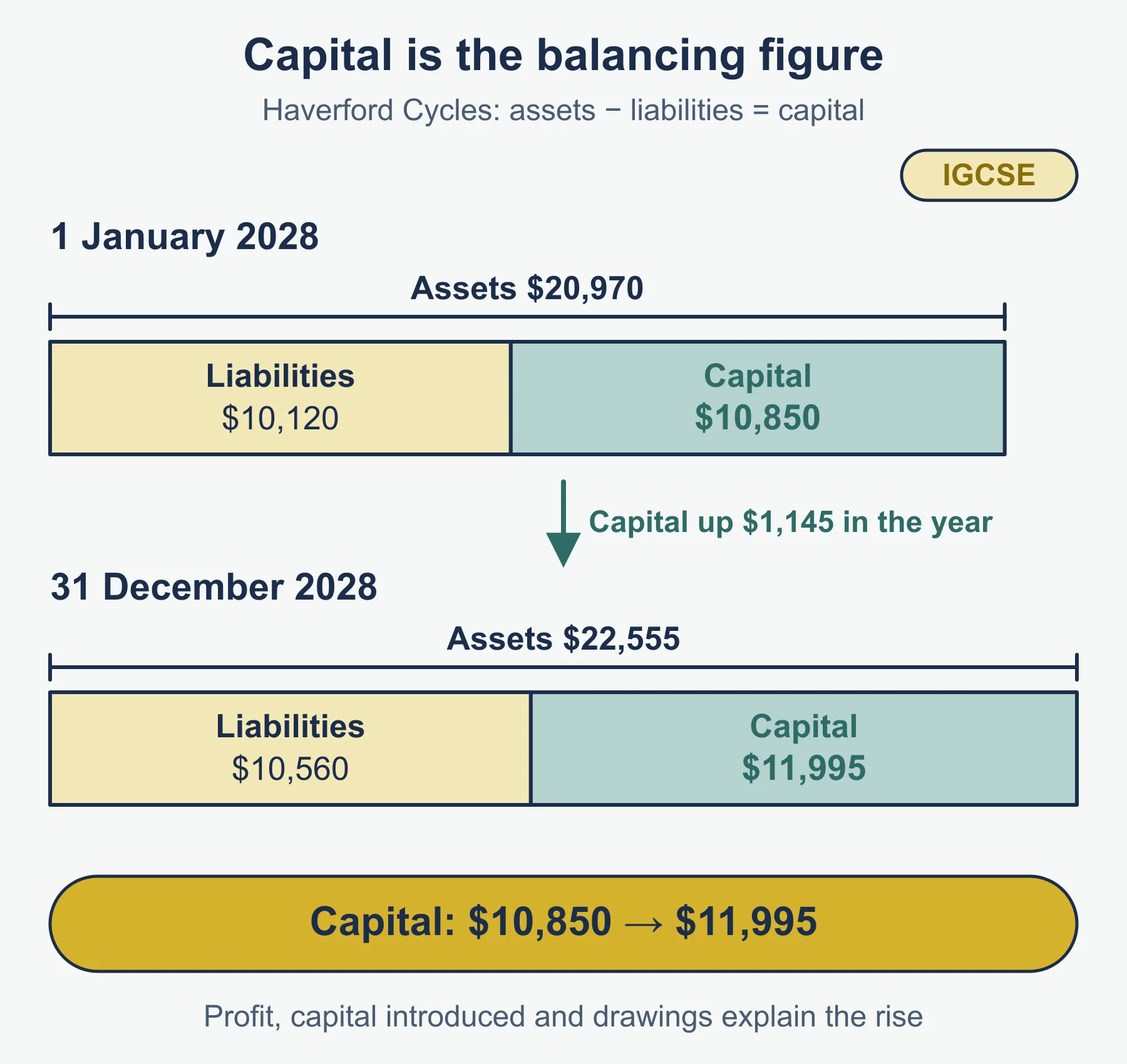
- The accounting equation: assets minus liabilities equals equity (capital).
- Control accounts and summaries show a missing figure as the balancing item.
Part 1: profit from opening and closing equity (4.3 a)
Equity is what the owner has invested plus profit kept in the business, less drawings. List assets and liabilities at two dates, work out the equity at each, and the change in equity is explained by only three things: profit, drawings and any new capital.
| Step | Working |
|---|---|
| 1 | Opening equity = opening assets minus opening liabilities |
| 2 | Closing equity = closing assets minus closing liabilities |
| 3 | Increase in equity = closing equity minus opening equity |
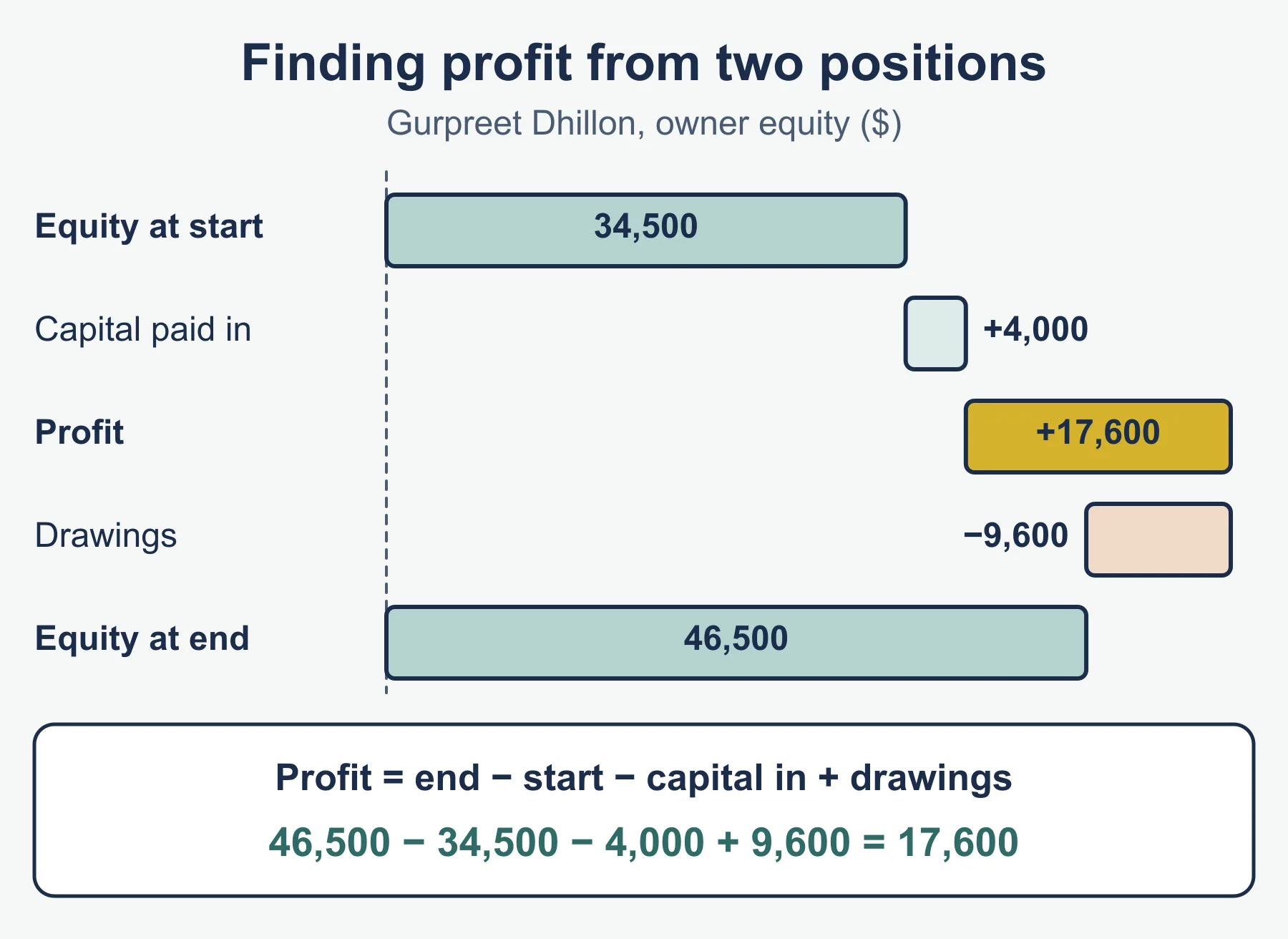
| 4 | Profit for the year = increase in equity + drawings - capital introduced |
Drawings reduced equity, so you add them back. Capital introduced raised equity without being profit, so you take it off. A negative answer is a loss.
Worked example 1: Rosewood Framing
Nasrin Dalgleish keeps no income statement. Her assets and liabilities are:
| 1 April 2025 | 31 March 2026 | |
|---|---|---|
| Equipment | 7,800 | 7,020 |
| Inventory | 2,640 | 3,190 |
| Trade receivables | 1,960 | 2,410 |
| Bank | 3,410 | 5,860 |
| Cash | 150 | 200 |
| Trade payables | 2,380 | 2,150 |
| Loan | 4,000 | 3,000 |
During the year she took drawings of 12,600 and paid 2,500 of her own money into the bank.
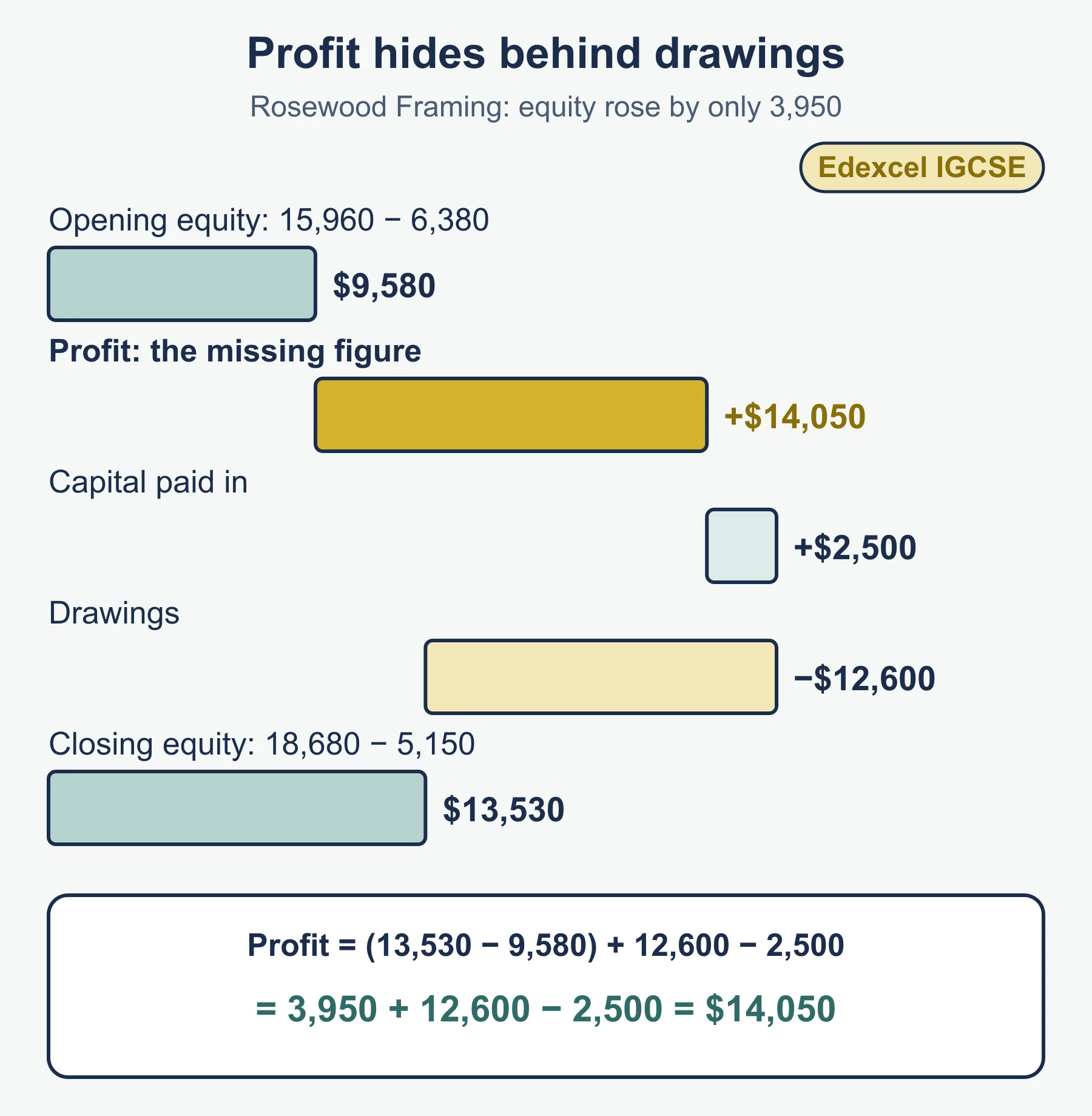
- Opening assets are 15,960 and liabilities 6,380, so opening equity is 9,580.
- Closing assets are 18,680 and liabilities 5,150, so closing equity is 13,530.
- Increase in equity is 13,530 - 9,580 = 3,950.
- Profit for the year = 3,950 + 12,600 - 2,500 = 14,050.
The method gives the profit for the year only. It does not show revenue, cost of sales or expenses, which is why Parts 2 and 3 exist.
Part 2: revenue and purchases (4.3 b)
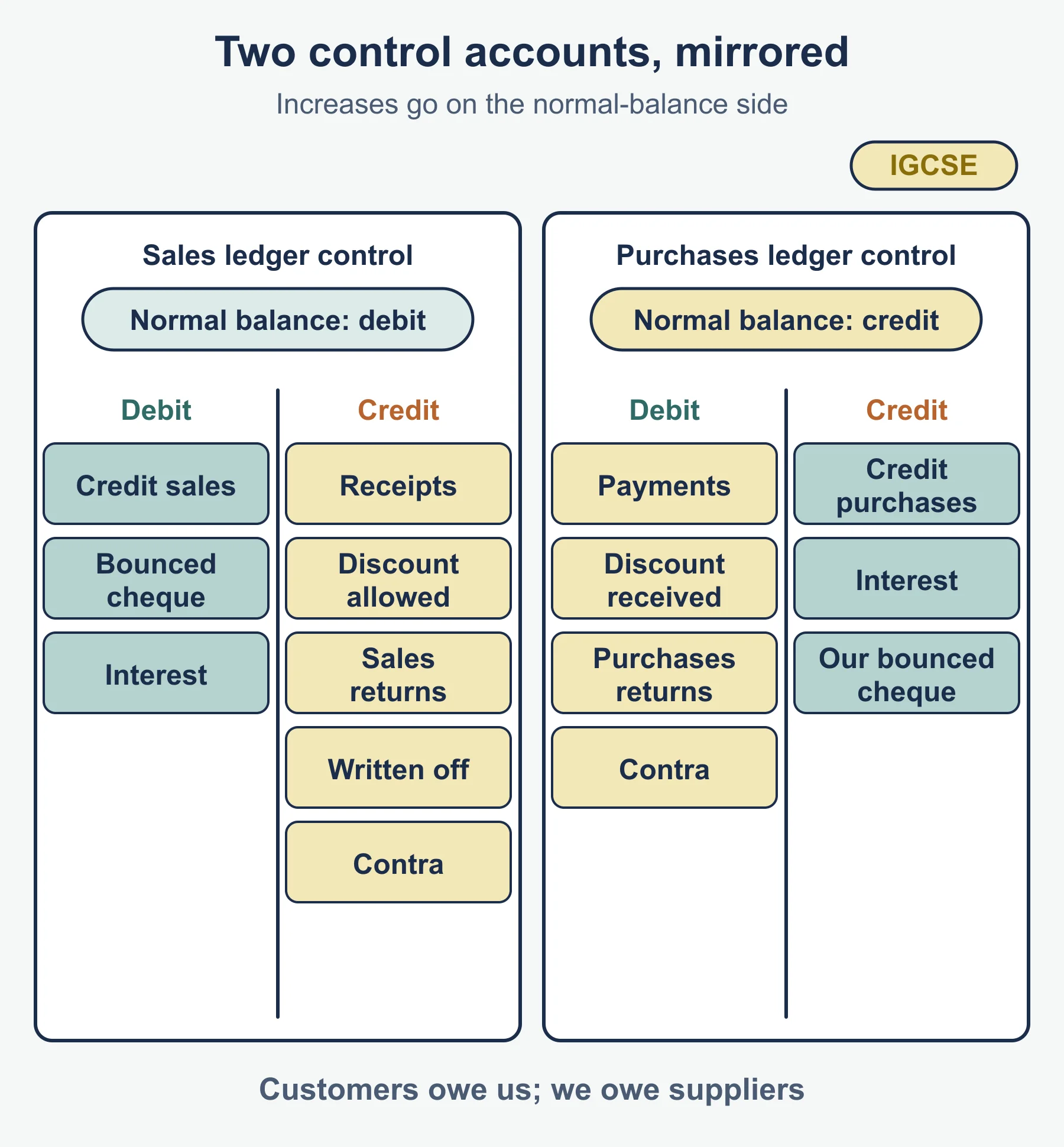
Control accounts as a source of credit sales
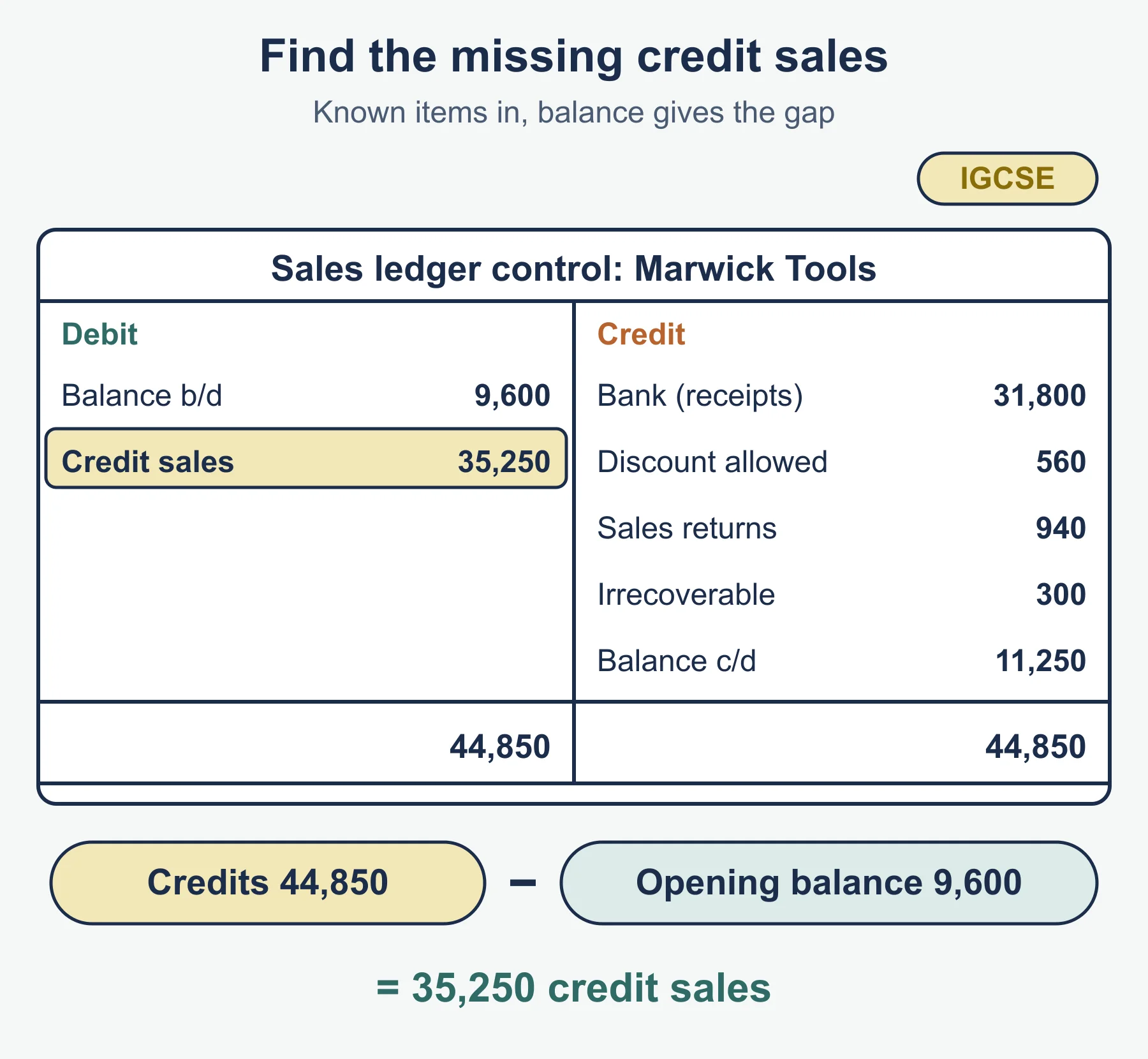
The trade receivables control account records everything that changes the total owed by customers. Credit sales are the figure you cannot see, so they balance the account.
Worked example 2: Prestwick Tools
Ambrose Cadogan has these figures for the year:
- Trade receivables: 6,420 at the start, 7,150 at the end.
- Cheques received from customers: 61,380.
- Discount allowed: 1,240. Irrecoverable debts written off: 530. Sales returns: 1,860.
Trade receivables control account
Balance b/d        6,420 | Bank                61,380
Credit sales      65,740 | Discount allowed     1,240
                         | Irrecoverable debts    530
                         | Sales returns        1,860
                         | Balance c/d          7,150
                  72,160 |                     72,160
Credit sales are the balancing figure, 65,740. Check it works: 7,150 + 61,380 + 1,240 + 530 + 1,860 - 6,420 = 65,740.
Cash sales from a till summary
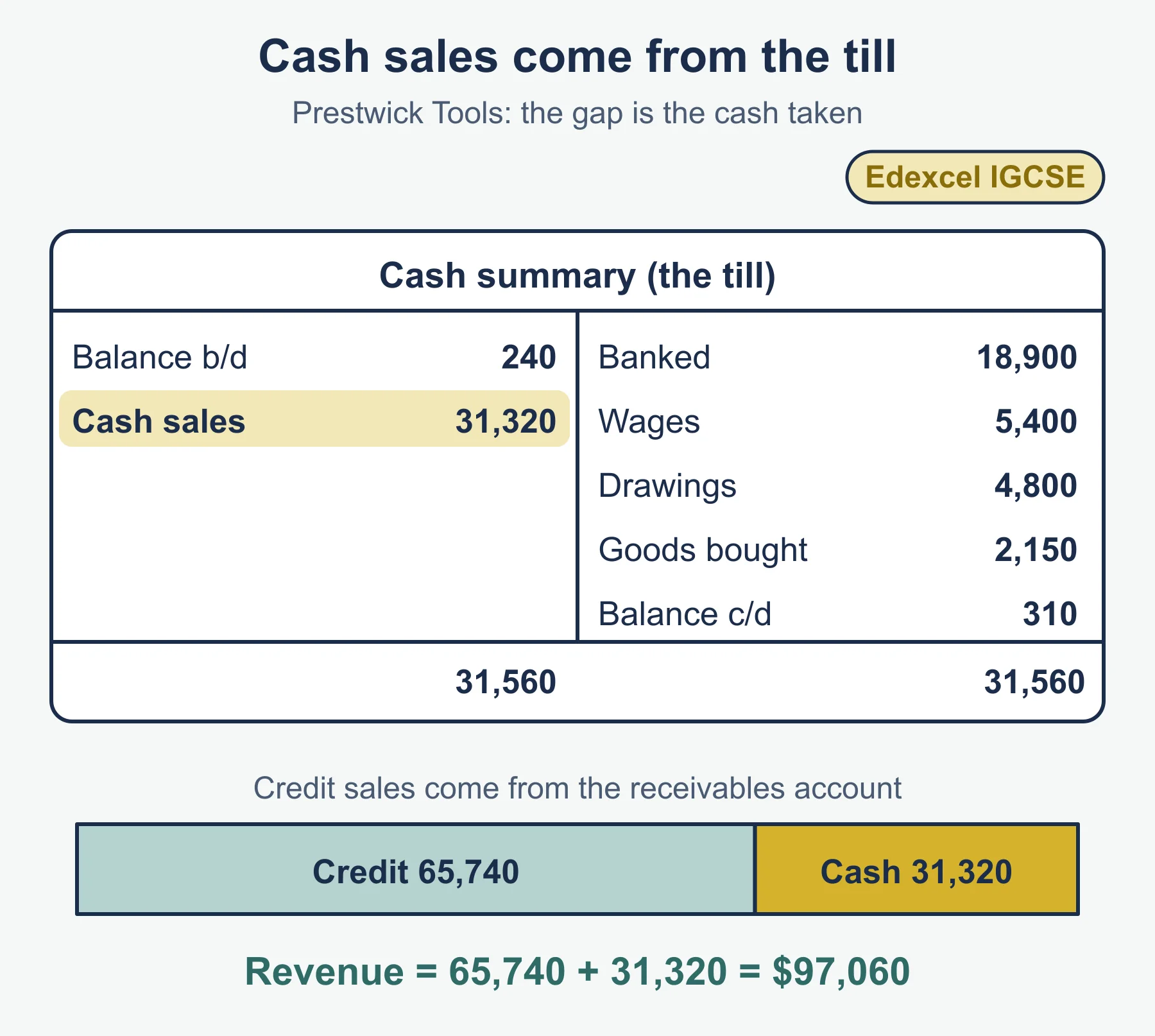
Cash sales come from a summary of cash takings. Everything that left the till, plus what is left, minus what was there at the start, equals the cash taken from customers.
Prestwick’s till held 240 at the start and 310 at the end. During the year 18,900 was banked, wages of 5,400 and drawings of 4,800 were paid from the till, and 2,150 of goods were bought for cash.
Cash sales = 18,900 + 5,400 + 4,800 + 2,150 + 310 - 240 = 31,320.
Revenue = credit sales + cash sales = 65,740 + 31,320 = 97,060.
Credit purchases from the trade payables control account
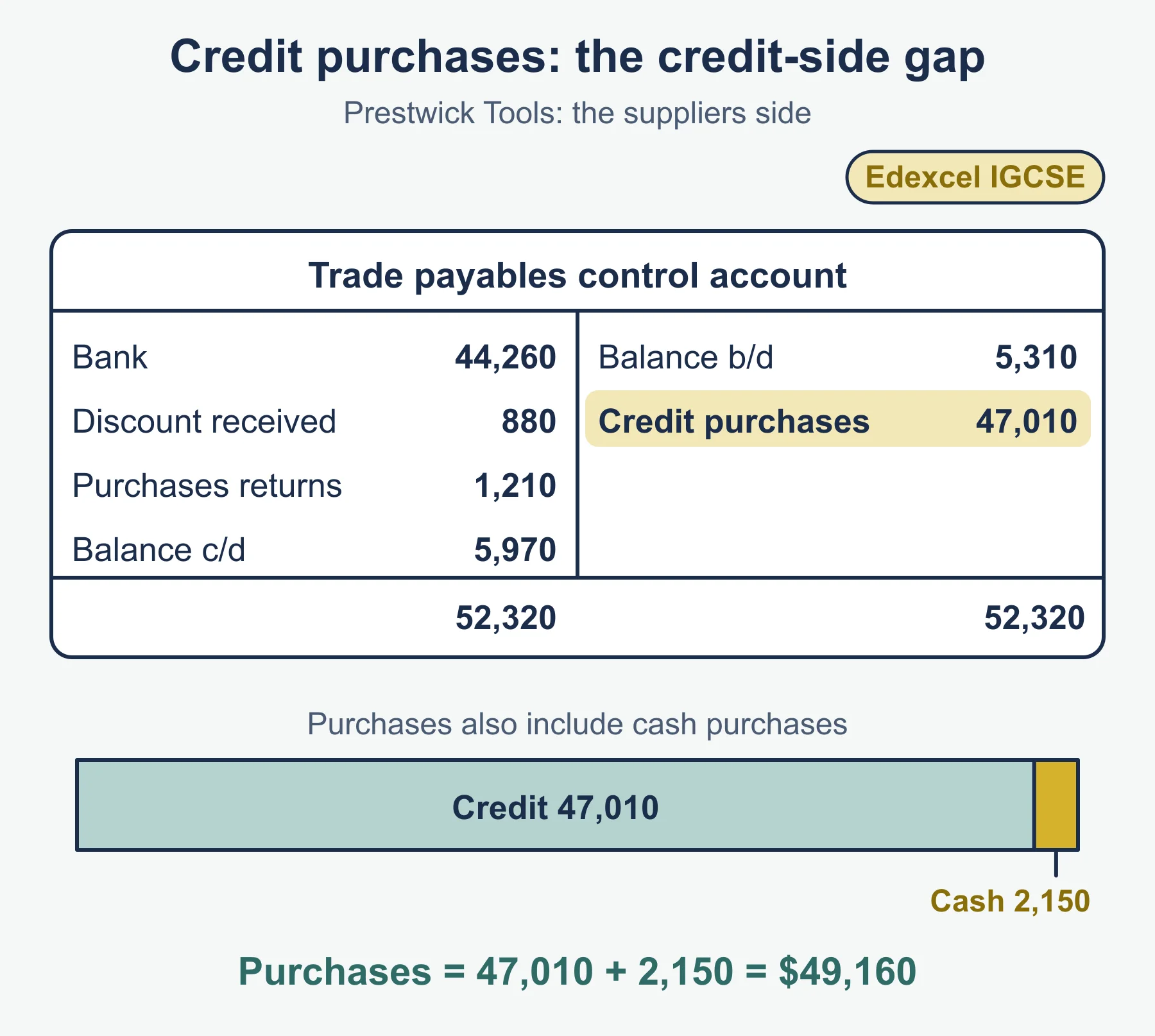
The same idea works on the supplier side, but the credit side holds the missing figure.
Prestwick’s trade payables were 5,310 at the start and 5,970 at the end. It paid suppliers 44,260, received discount of 880 and returned goods worth 1,210.
Trade payables control account
Bank                44,260 | Balance b/d        5,310
Discount received      880 | Credit purchases  47,010
Purchases returns    1,210 |
Balance c/d          5,970 |
                    52,320 |                   52,320
Purchases = credit purchases + cash purchases = 47,010 + 2,150 = 49,160.
With inventory of 8,300 at the start and 9,100 at the end, cost of sales = 8,300 + 49,160 - 9,100 = 48,360 and gross profit = 97,060 - 48,360 = 48,700.
Margin and mark-up as a check or a shortcut
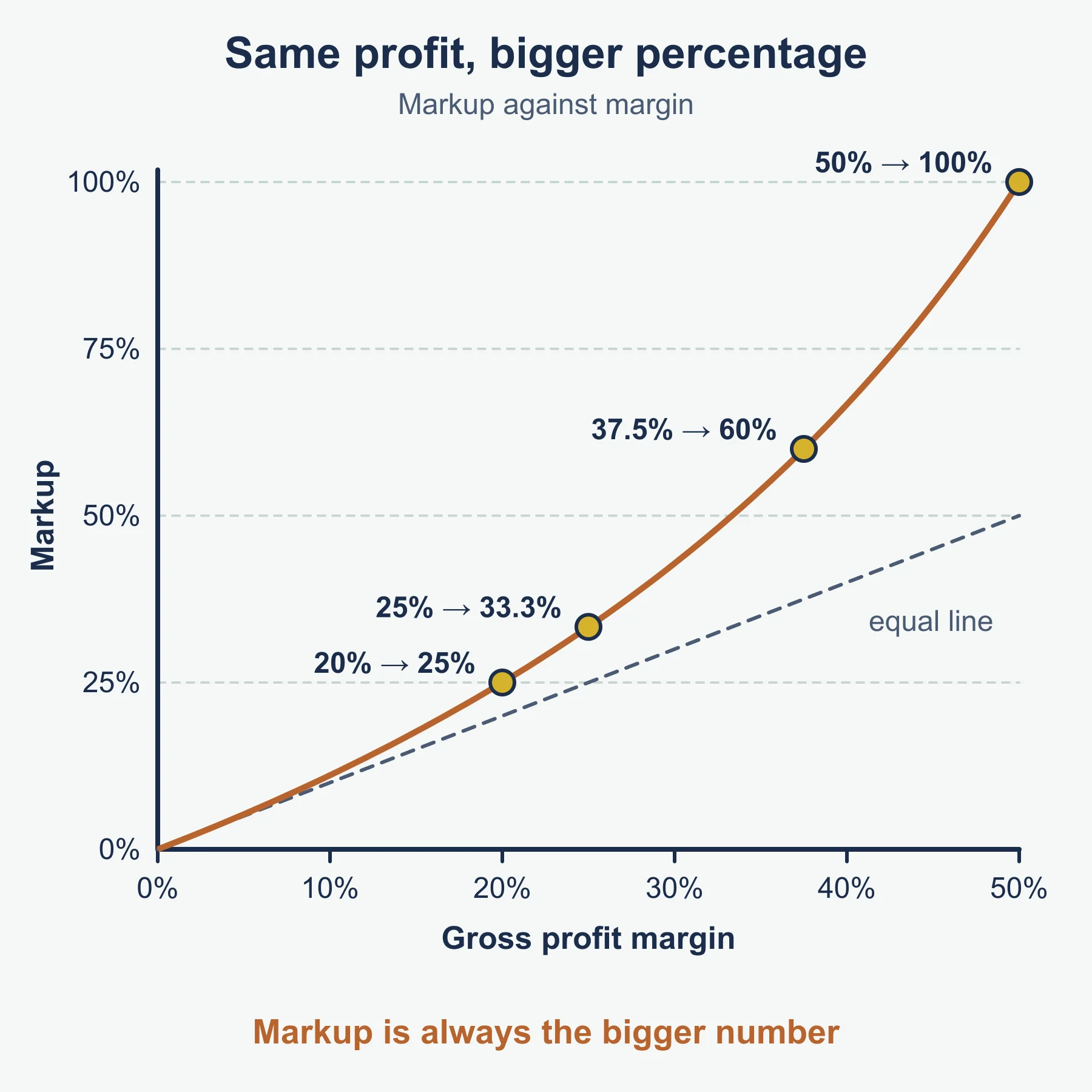
- Mark-up is gross profit as a percentage of cost of sales.
- Margin is gross profit as a percentage of revenue.
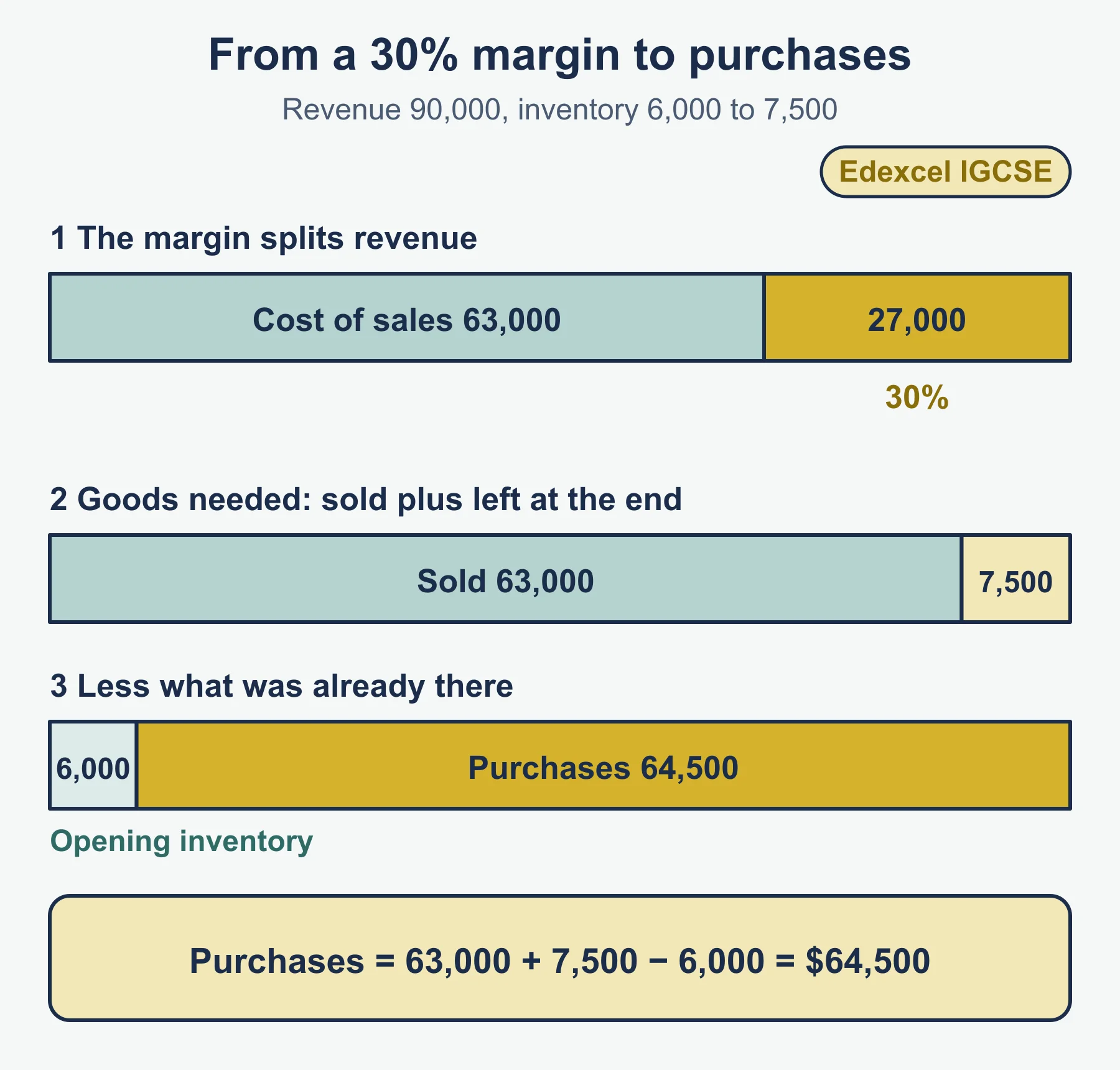
If cost of sales is 36,000 and mark-up is 25%, gross profit is 9,000 and revenue is 45,000, so the margin is 20%. If revenue is 90,000 with a 30% margin, gross profit is 27,000 and cost of sales is 63,000. With inventory of 6,000 at the start and 7,500 at the end, purchases = 63,000 + 7,500 - 6,000 = 64,500.
Goods taken by the owner
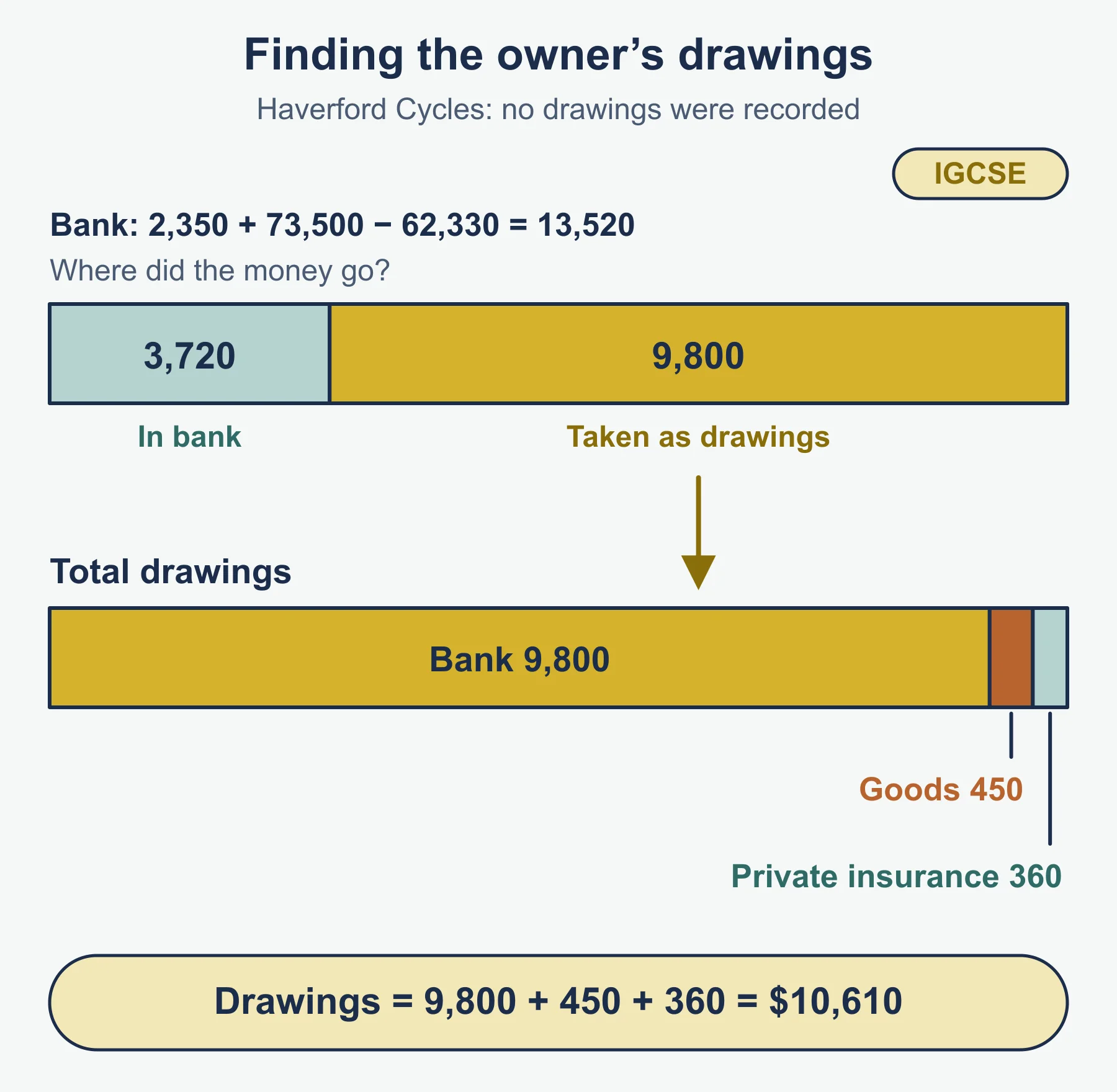
If the owner takes goods for personal use, reduce purchases by the cost of the goods and treat the same amount as drawings.
Part 3: income statement and statement of financial position (4.3 c)
Method, in order:
- Opening equity from the opening assets and liabilities.
- Credit sales, cash sales, credit purchases and cash purchases as in Part 2.
- Expenses from the bank summary, adjusted for amounts owing or paid in advance.
- Depreciation, irrecoverable debts and any provision for irrecoverable debts.
- Closing bank balance from the bank summary.
- Build both statements and check that closing equity equals net assets.
Worked example 3: Sandalwood Stationers
Calista Farquhar’s records for the year ended 30 June 2026:
- At 1 July 2025: shop fittings 9,600, inventory 6,800, trade receivables 3,900, bank 2,700, trade payables 3,100.
- Bank receipts: customers 52,400; cash sales banked 14,200.
- Bank payments: suppliers 40,300; rent 4,800; wages 6,900; electricity 1,150; drawings 9,600; new shop fittings 3,000.
- At 30 June 2026: inventory 7,300, trade receivables 4,700, trade payables 3,650.
- Irrecoverable debts of 300 were written off. Provision for irrecoverable debts is 5% of trade receivables.
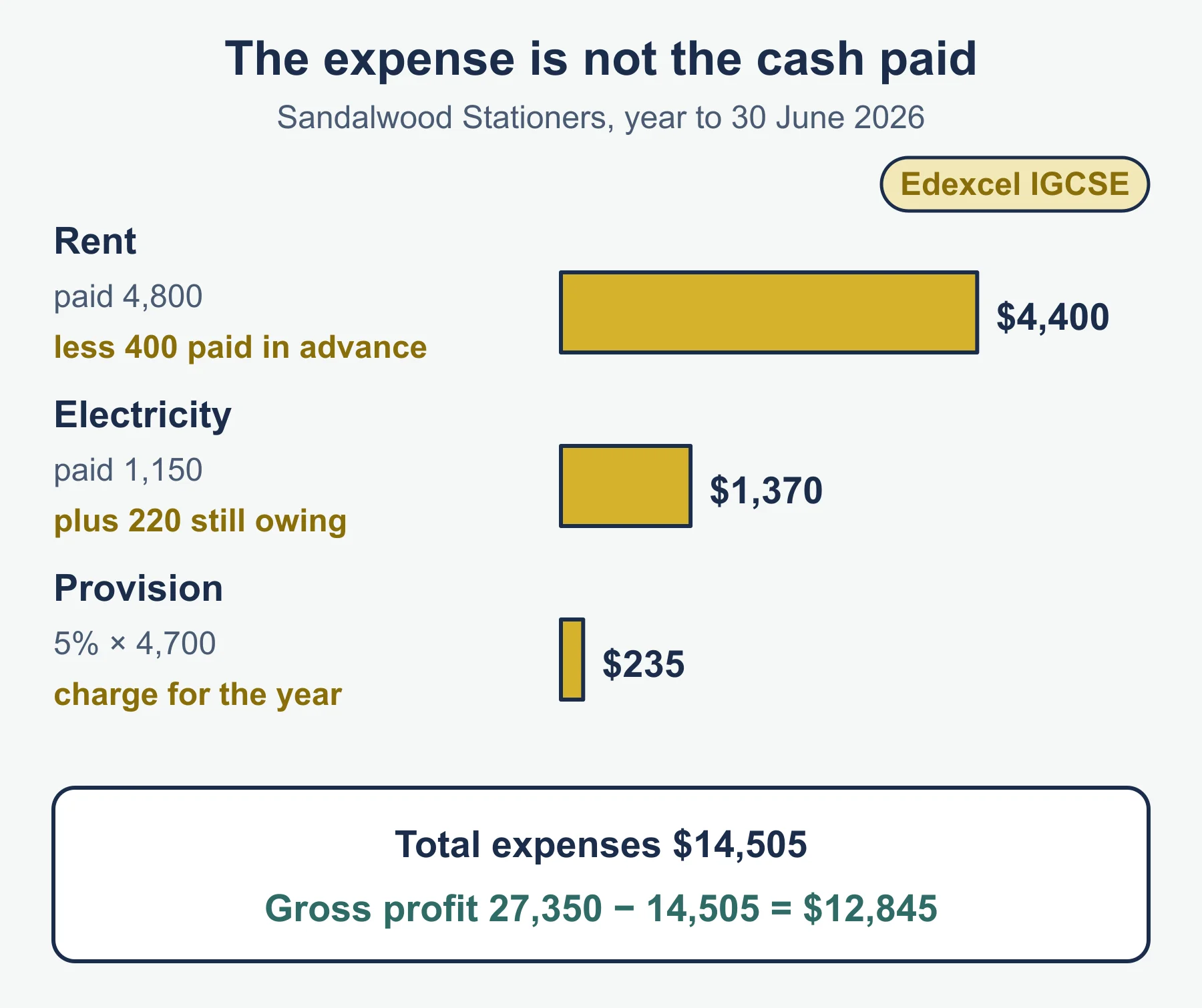
- Rent includes 400 paid in advance. Electricity of 220 is owing. Depreciation on shop fittings is 1,300.
Opening equity: 9,600 + 6,800 + 3,900 + 2,700 - 3,100 = 19,900. Credit sales: 4,700 + 52,400 + 300 - 3,900 = 53,500. Revenue: 53,500 + 14,200 = 67,700. Credit purchases: 3,650 + 40,300 - 3,100 = 40,850. Closing bank: 2,700 + 66,600 - 65,750 = 3,550.
Income statement for the year ended 30 June 2026
Revenue                                  67,700
Opening inventory            6,800
Purchases                   40,850
                            47,650
Closing inventory            7,300
Cost of sales                            40,350
Gross profit                             27,350
Rent                         4,400
Wages                        6,900
Electricity                  1,370
Depreciation                 1,300
Irrecoverable debts            300
Provision for irrec. debts     235
Total expenses                           14,505
Profit for the year                      12,845
Statement of financial position at 30 June 2026
Non-current assets: shop fittings 11,300
Inventory 7,300
Trade receivables (4,700 - 235) 4,465
Other receivables 400
Bank 3,550
15,715
Trade payables 3,650
Other payables 220
3,870
Net current assets 11,845
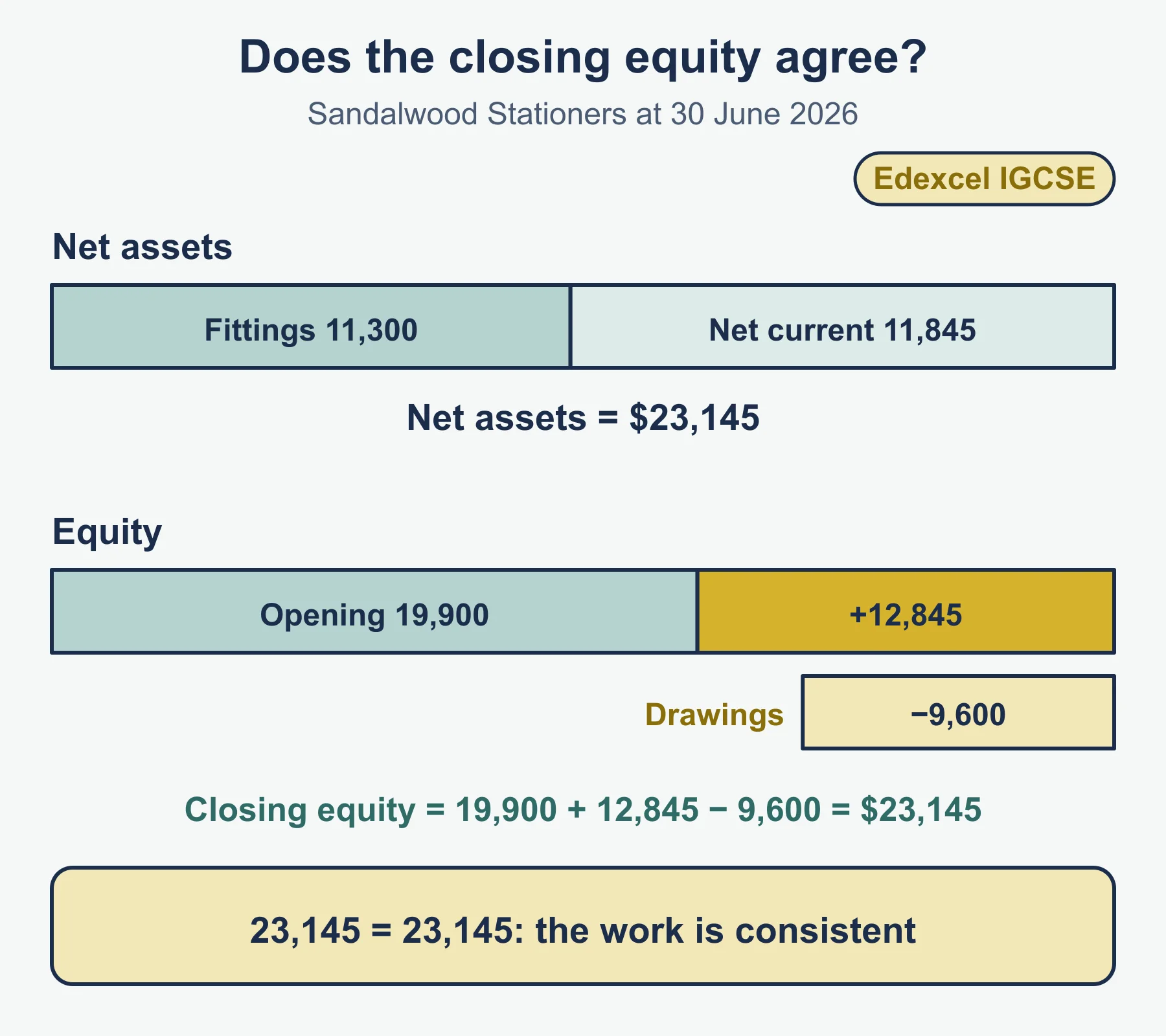
Net assets 23,145
Equity: opening 19,900 + profit 12,845 - drawings 9,600 23,145Closing equity equals net assets, so the work is internally consistent. If it does not agree, a figure is missing or wrong.
Common errors
- Adding capital introduced to profit instead of taking it off.
- Forgetting to add back drawings when starting from equity.
- Putting credit sales on the wrong side of the control account.
- Using only credit purchases as purchases and leaving out cash purchases.
- Calculating margin on cost or mark-up on revenue.
- Charging the cash paid for rent or electricity instead of the amount for the year.
Next steps
Condense this with the revision notes, then test yourself with the practice questions. Tick off what you can do on the checklist and try the diagnostics.
Frequently asked questions
What are incomplete records in Edexcel IGCSE Accounting? Incomplete records are kept by a business that does not use a full double-entry system, so it may have only bank statements, till summaries, some invoices and a list of assets and liabilities. Missing figures are rebuilt using the accounting equation and control accounts.
How do you calculate profit from opening and closing equity? Profit for the year equals the increase in equity, plus drawings, minus any capital introduced. A negative answer is a loss, and the method gives profit only, not revenue or expenses.
How do you find credit sales using a trade receivables control account? Credit sales are the balancing figure in the trade receivables control account. Put opening receivables and credit sales on the debit side, and receipts, discount allowed, irrecoverable debts, sales returns and closing receivables on the credit side.
What is the difference between margin and mark-up? Mark-up is gross profit as a percentage of cost of sales, while margin is gross profit as a percentage of revenue. For example, a 25% mark-up on a cost of sales of 36,000 gives gross profit of 9,000, revenue of 45,000 and a margin of 20%.
How are goods taken by the owner treated in incomplete records? Reduce purchases by the cost of the goods taken and treat the same amount as drawings. They are not a business expense.
Official syllabus
Pearson Edexcel International GCSE in Accounting (4AC1), Specification, Issue 1, October 2016, published by Pearson Education Limited. Topic 4: The preparation of financial statements, section 3 Incomplete records, points a) to c).
Get free revision emails (optional)
Occasional emails with practice questions, worked explanations and links to free resources for the qualification and subjects you choose. No spam, and you can unsubscribe from any email. The free tools on this site never need an email.
Related resources
-
Practice questions
Edexcel IGCSE Accounting: Incomplete records (4AC1) – Practice Questions
Original practice questions with worked answers on incomplete records for Edexcel International GCSE Accounting 4AC1, section 4.3.
Accounting · Pearson Edexcel · IGCSE
Try questions -
Revision notes
Edexcel IGCSE Accounting: Incomplete records (4AC1) – Revision Notes
Condensed revision notes on incomplete records for Edexcel International GCSE Accounting 4AC1: formulas, methods, distinctions and a self-test.
Accounting · Pearson Edexcel · IGCSE
Revise topic -
Study guides
Edexcel IGCSE Accounting: Accounting ratios (4AC1)
Study guide to profitability versus liquidity and the five Edexcel IGCSE Accounting ratios, with a two-year worked example and interpretation.
Accounting · Pearson Edexcel · IGCSE
Read guide
Related articles
-
teaching
A Level tuition in Dubai: Cambridge or Pearson Edexcel International A Level?
Schools in Dubai and Abu Dhabi teach either Cambridge International AS & A Level or Pearson Edexcel International A Level. How the two are structured, why it matters for tuition, and how online classes from Lahore work.
9 October 2026
-
curriculum guides
Choosing subjects at IGCSE and A Level
How subject choices at 14 and 16 affect university options later, and how to keep pathways open without overloading a timetable.
28 July 2026
Studying this with a teacher
Working through Accounting IGCSE?
This page is free and stays free. If you would rather be taught it, Marlbridge runs Accounting classes one-to-one and in small groups of up to 15, online in your own time zone. The first trial class is free. WhatsApp replies within an hour (8am–11pm Pakistan time, every day); email the same day.
Pearson Edexcel Accounting teachers at Marlbridge

