
Revision Notes
Edexcel IGCSE Accounting: Incomplete records (4AC1) – Revision Notes
Condensed revision notes on incomplete records for Edexcel International GCSE Accounting 4AC1: formulas, methods, distinctions and a self-test.
- Subject
- Accounting
- Level
- IGCSE
- Topic
- The preparation of financial statements
- Author
- Marlbridge Academic Team
- Updated
- Reviewed by
- Javaid Iqbal Sabri (what this means)
Aligned to Pearson Edexcel IGCSE Accounting (4AC1), Issue 1, October 2016. Official specification .
Syllabus page (what it covers and how it is assessed): Pearson Edexcel IGCSE Accounting.
Syllabus points this page covers
4AC1
- 4 The preparation of financial statements (whole topic)
- 4.3 Incomplete records
Found an error? Report a correction.
Want a teacher for this? Marlbridge teaches Accounting online. Request a free trial class.
These notes condense section 4.3 Incomplete records from Topic 4 of the Pearson Edexcel International GCSE in Accounting (4AC1) specification, Issue 1, October 2016. Topic 4 is assessed in Paper 2. For full explanations and longer worked examples, read the study guide, then test yourself with the practice questions. Course links: Edexcel IGCSE Accounting hub, the printable checklist and the free diagnostics. All amounts are in dollars.
Specification points
| Ref | Skill | Section below |
|---|---|---|
| 4.3 a) | Profit for the year from opening and closing equity | 1 |
| 4.3 b) | Revenue and purchases, including control accounts | 2 |
| 4.3 c) | Income statements and statements of financial position from incomplete information | 3 |
1. Profit from equity (4.3 a)
Key formulas:
| Item | Formula |
|---|---|
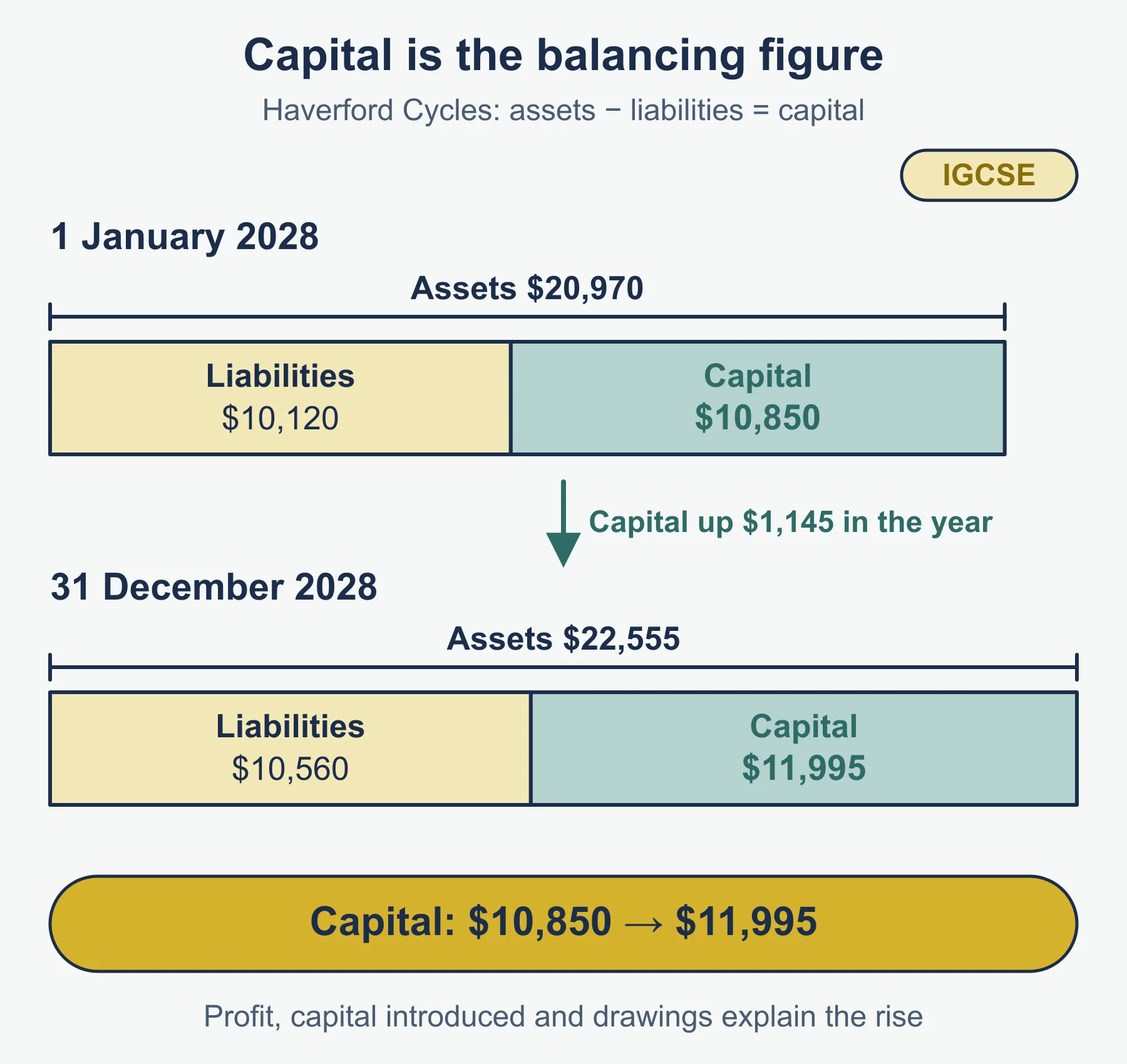
| Equity | Assets - liabilities |
| Change in equity | Closing equity - opening equity |
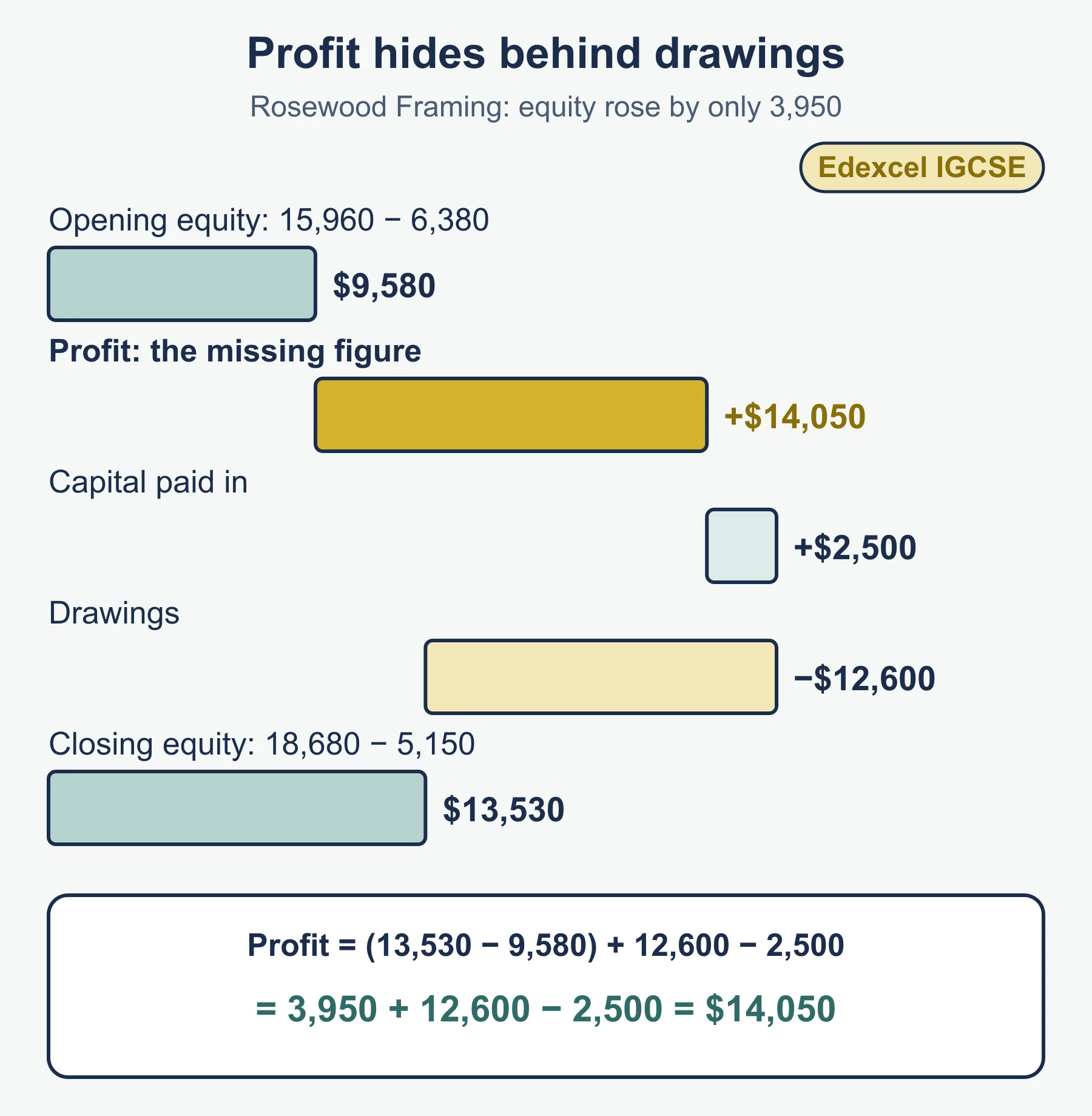
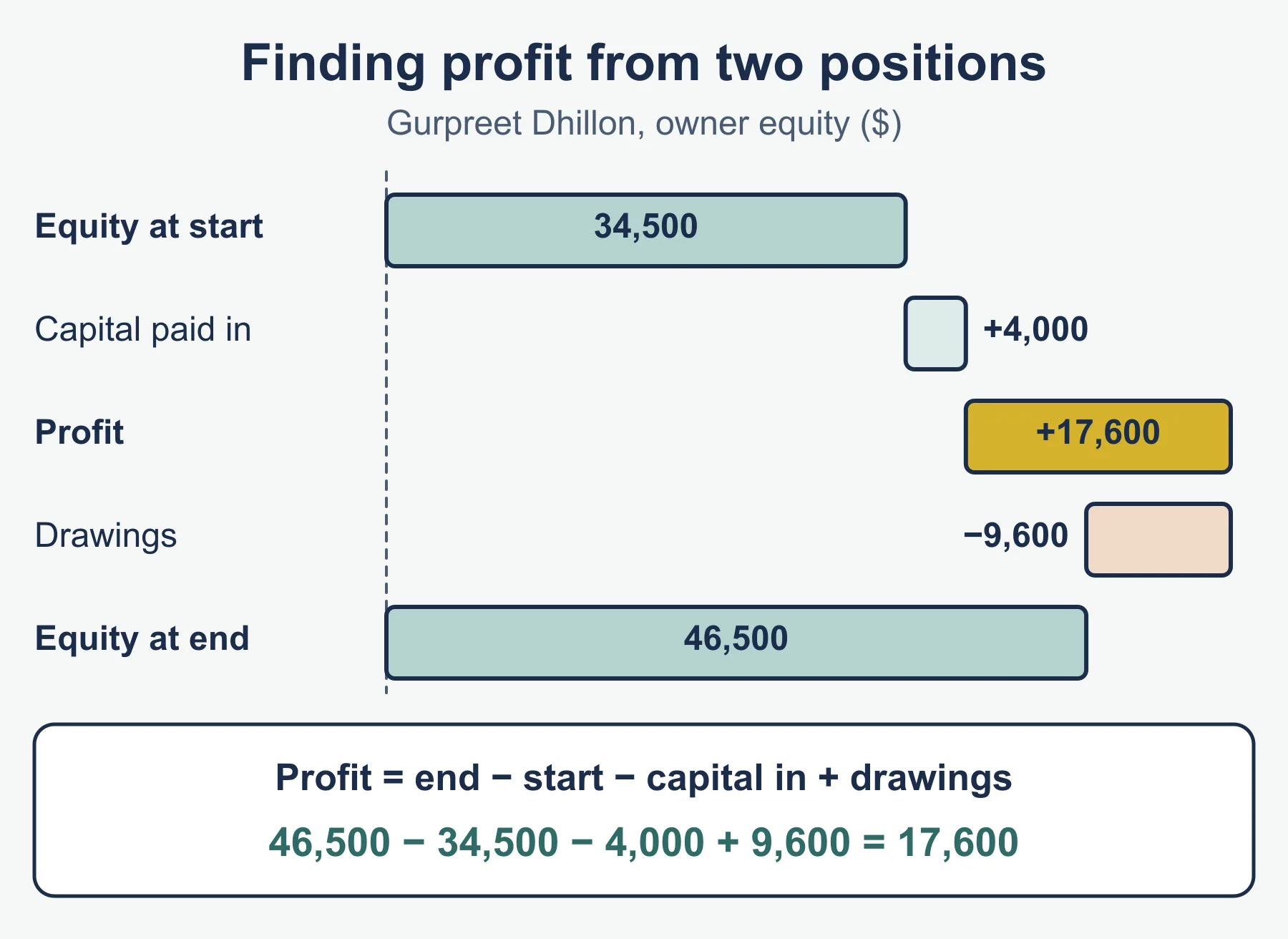
| Profit for the year | Change in equity + drawings - capital introduced |
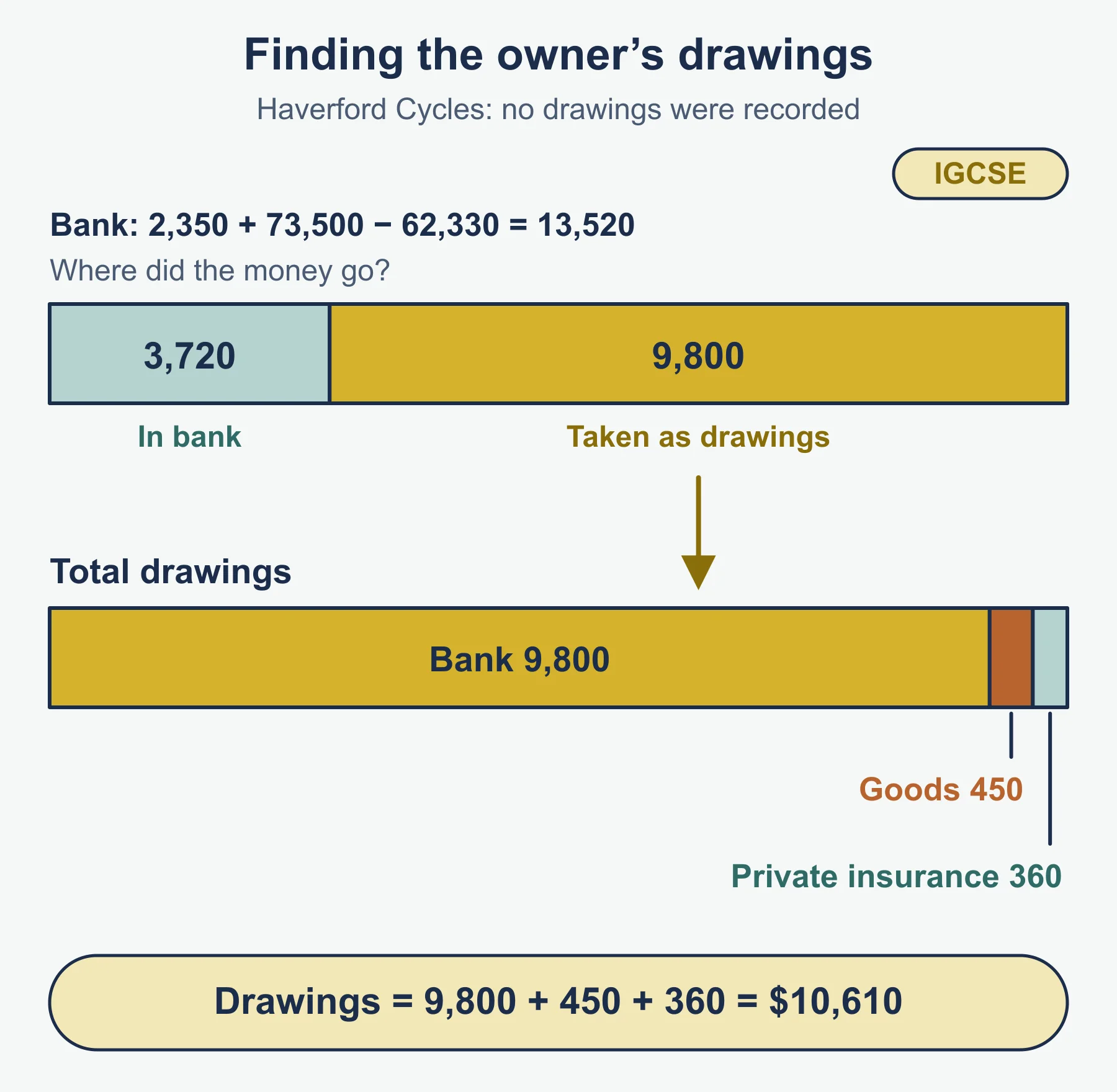
| Drawings (if profit known) | Opening equity + capital introduced + profit - closing equity |
Method:
- Add up the assets and the liabilities at each date.
- Find the equity at each date.
- Apply the profit formula and label a negative answer as a loss.
- Show each stage of the working, because the final figure depends on all of them.
Reminder: Jocelyn Isaacs runs Seabrook Candles. Opening equity is 21,400. Closing assets are 38,900 and closing liabilities 12,300, so closing equity is 26,600. Drawings were 10,200 and she added 4,000 of capital. Change in equity is 5,200, so profit for the year = 5,200 + 10,200 - 4,000 = 11,400.
2. Revenue and purchases (4.3 b)
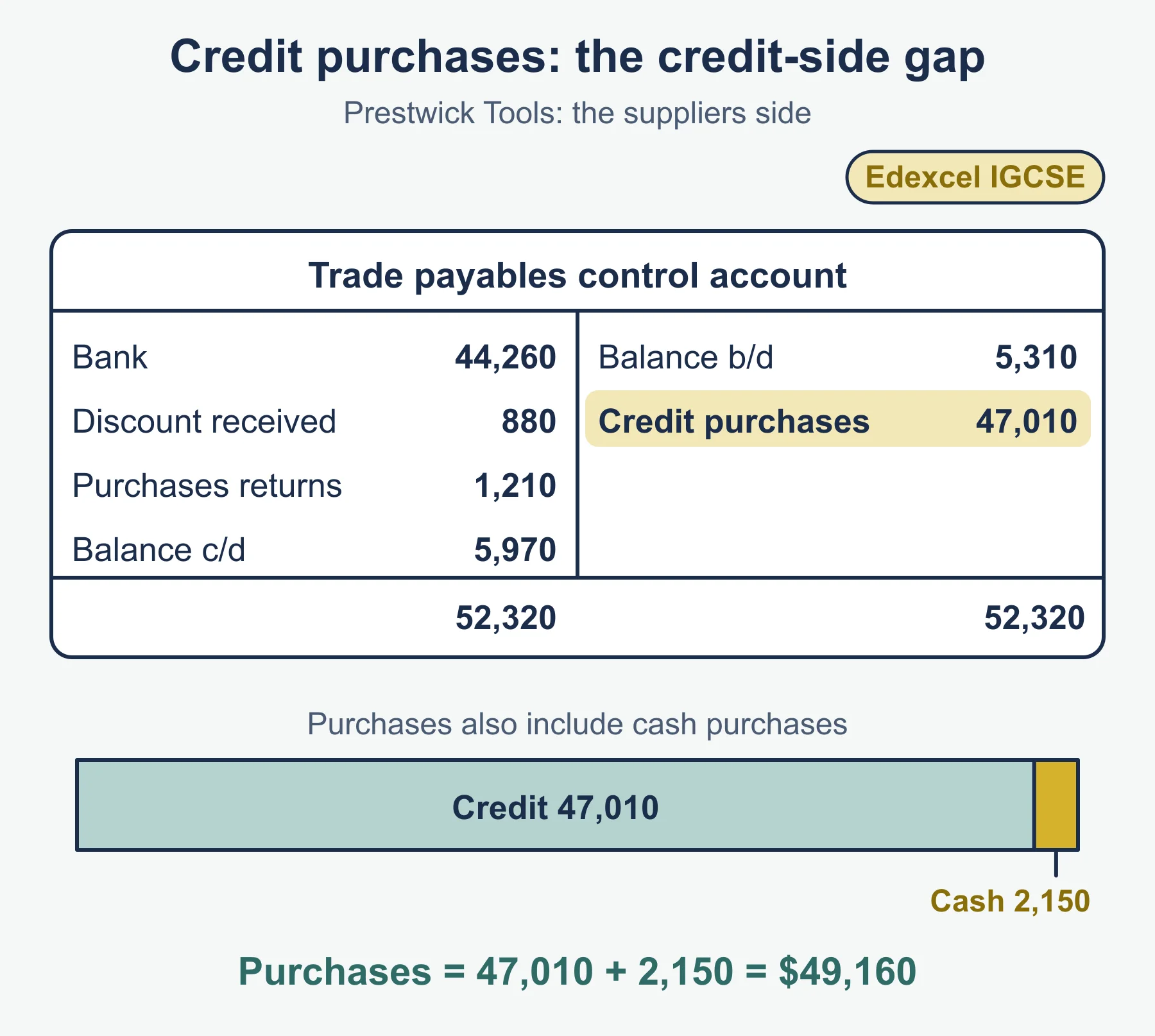
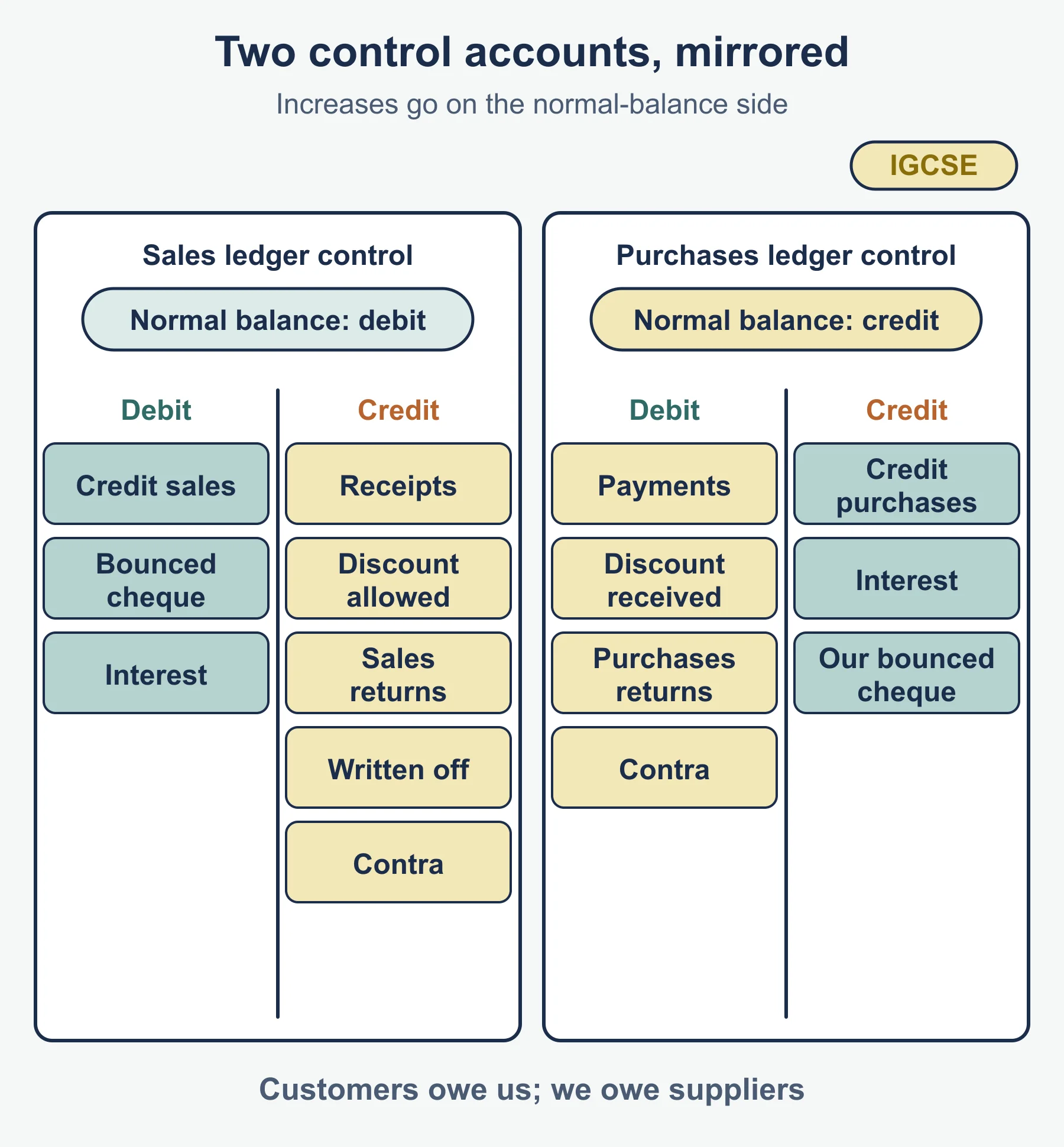
Control account rules
| Account | Opening balance | Missing figure | Other items |
|---|---|---|---|
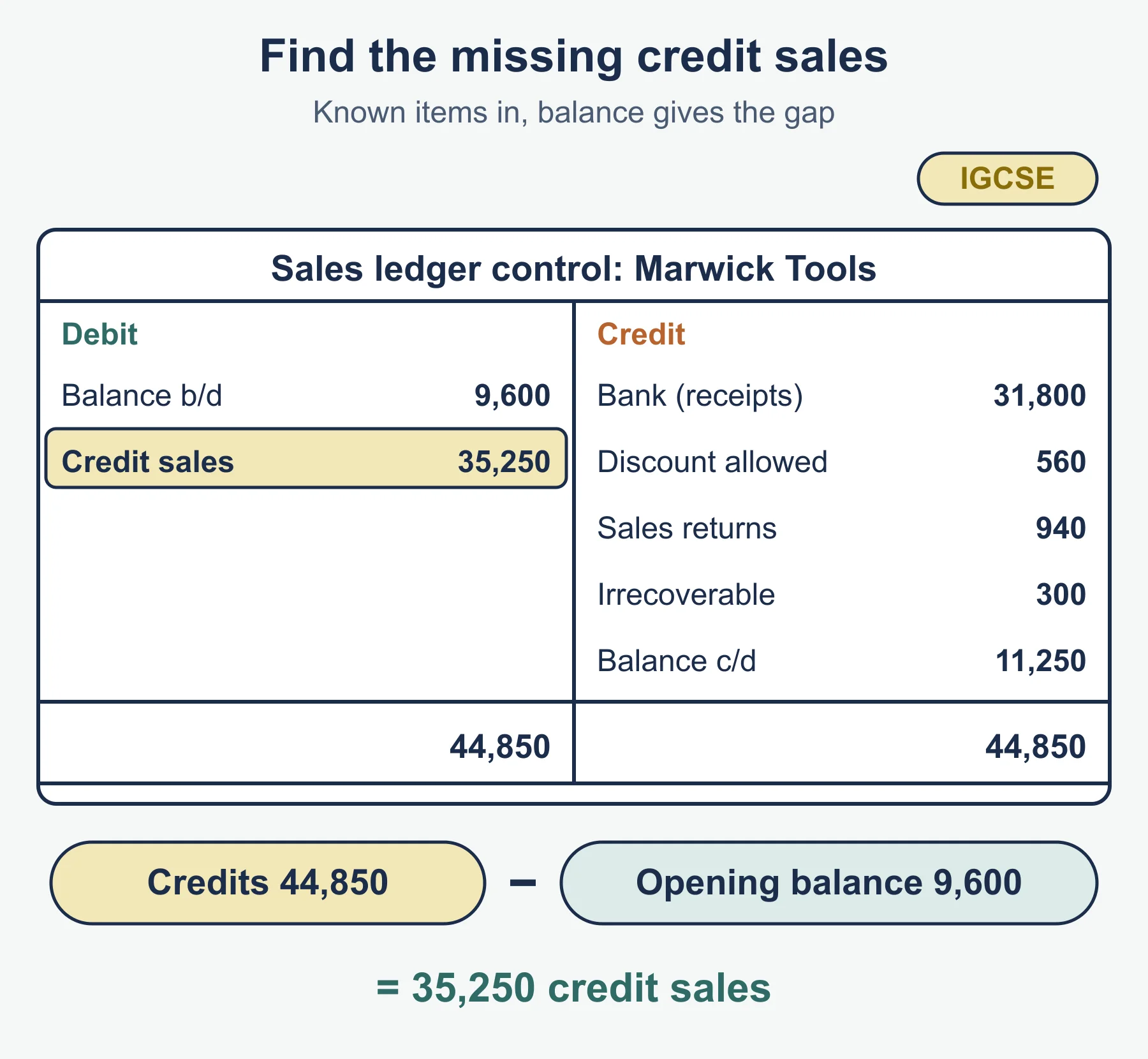
| Trade receivables control | Debit | Credit sales on the debit side | Receipts, discount allowed, irrecoverable debts, sales returns on the credit side |
| Trade payables control | Credit | Credit purchases on the credit side | Payments, discount received, purchases returns on the debit side |
Total each side, make the sides equal, and the unknown is the balancing figure.
Reminder: Zamora Tiles. Trade receivables were 9,800 at the start and 8,350 at the end. Customers paid 72,100, discount allowed was 900, irrecoverable debts were 640 and returns were 2,250.
Credit sales = 8,350 + 72,100 + 900 + 640 + 2,250 - 9,800 = 74,440. Both sides total 84,240.
Trade payables were 7,200 at the start and 6,480 at the end. Suppliers were paid 51,300, discount received was 650 and purchases returns were 1,400.
Credit purchases = 6,480 + 51,300 + 650 + 1,400 - 7,200 = 52,630. Both sides total 59,830.
Cash sales and other cash figures
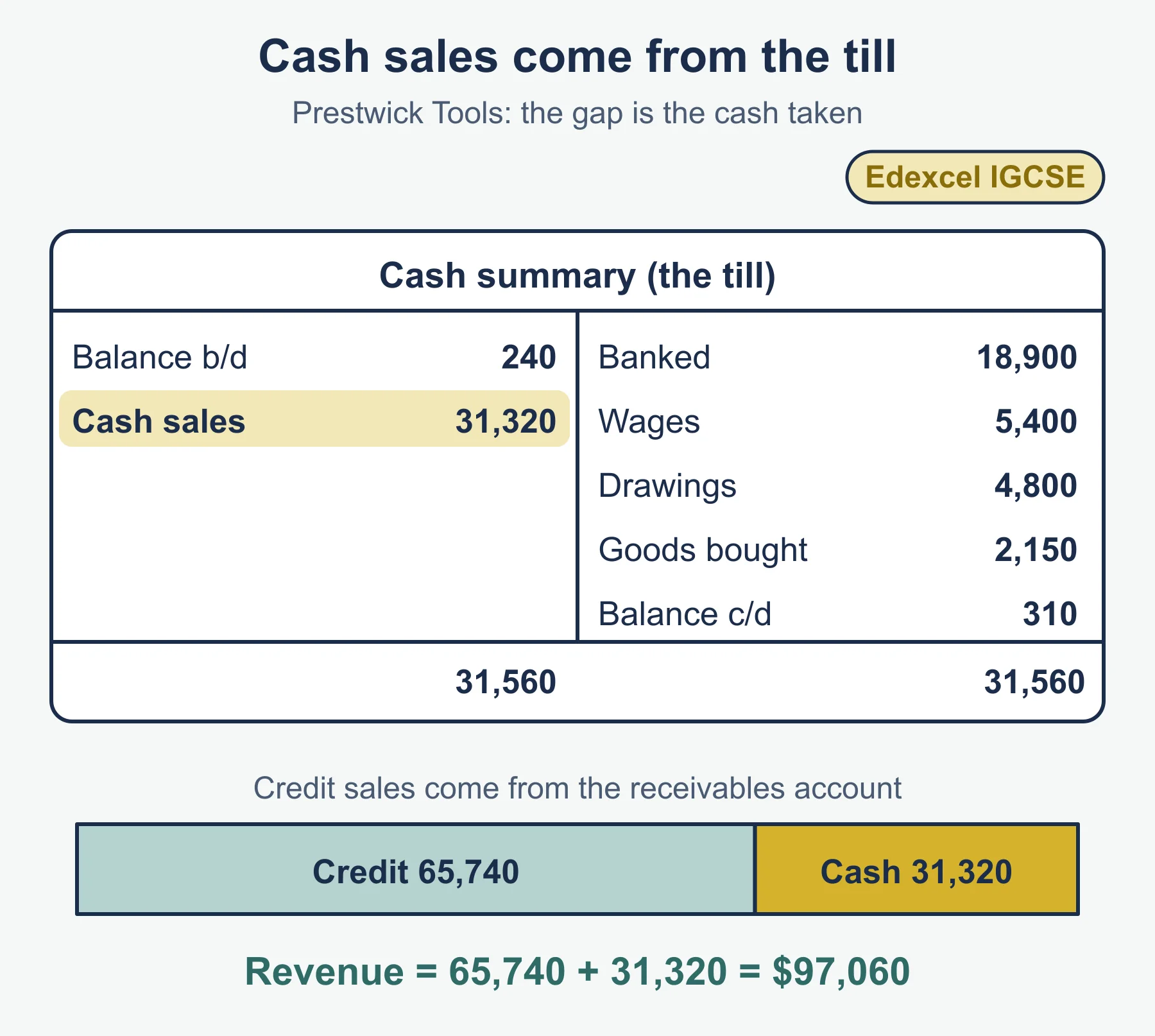
Use a summary of cash:
- Takings = cash banked + cash spent from the till + closing cash - opening cash.
- Revenue = credit sales + cash sales.
- Purchases = credit purchases + cash purchases.
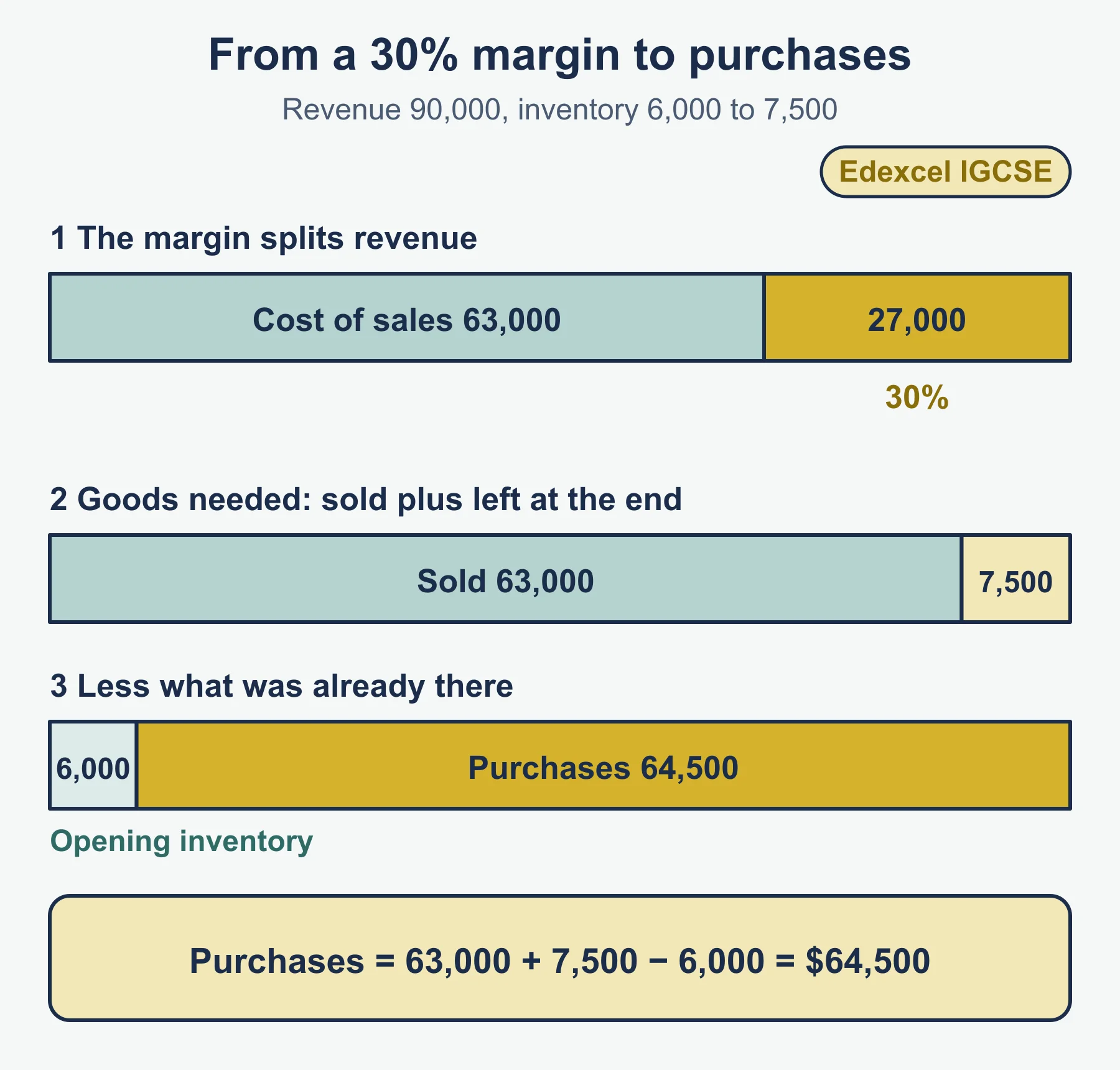
- Cost of sales = opening inventory + purchases - closing inventory.
Reminder: the Zamora till started the year with 100 and ended with 160. Banked 26,400 and paid expenses of 3,120. Takings = 26,400 + 3,120 + 160 - 100 = 29,580.
Mark-up and margin
| Measure | Based on | Formula |
|---|---|---|
| Mark-up | Cost of sales | Gross profit / cost of sales x 100 |
| Margin | Revenue | Gross profit / revenue x 100 |
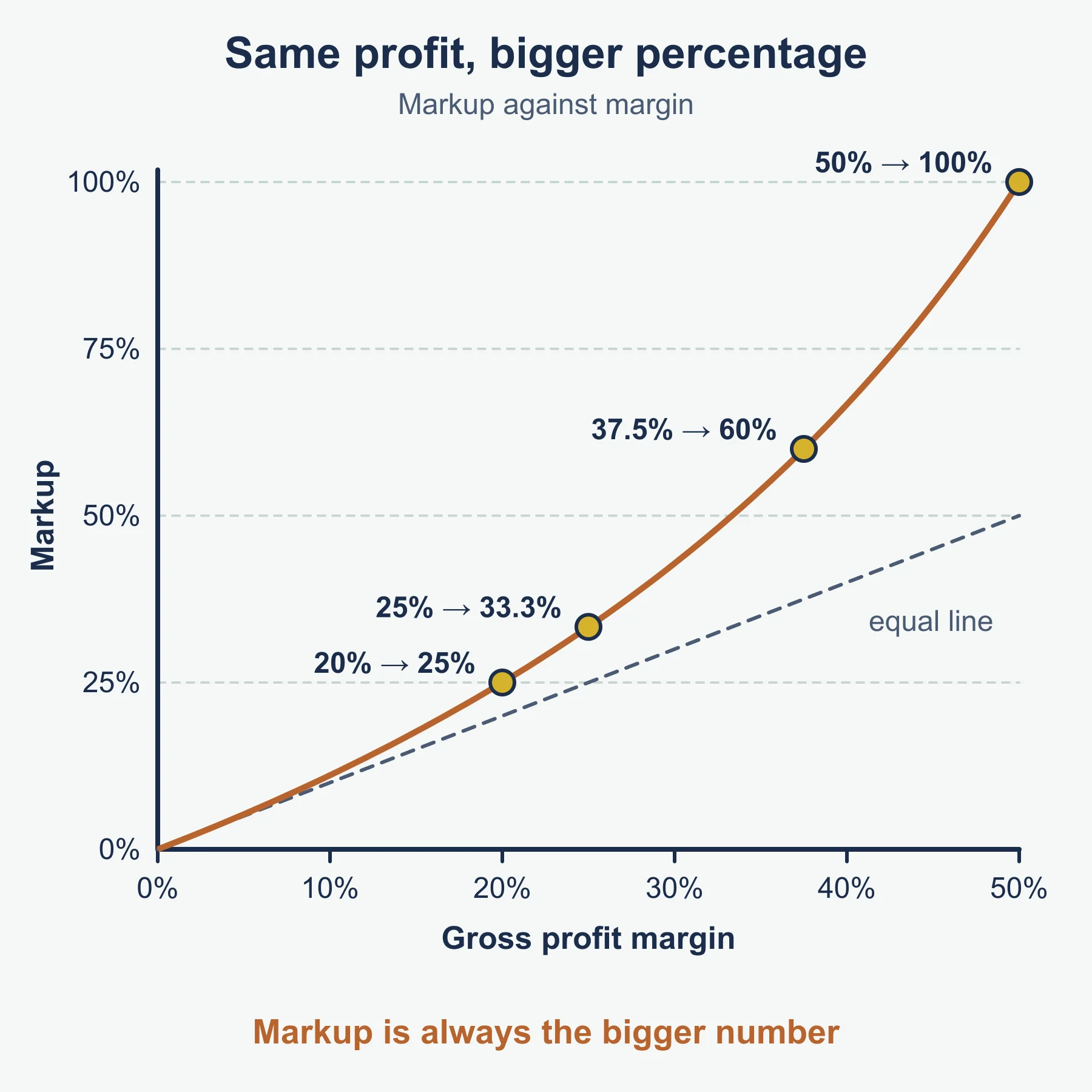
- A 40% mark-up on cost of sales of 18,000 gives gross profit 7,200 and revenue 25,200. The margin is 7,200 / 25,200 = 28.6%.
- A 60% mark-up equals a 37.5% margin, because 60 / 160 = 0.375.
- A 25% margin equals a 33.3% mark-up, because 25 / 75 = 0.333.
If the owner takes goods for private use, take the cost out of purchases and add it to drawings.
3. Statements from incomplete information (4.3 c)
Order of work:
- Opening equity.
- Revenue, purchases and cost of sales (section 2).
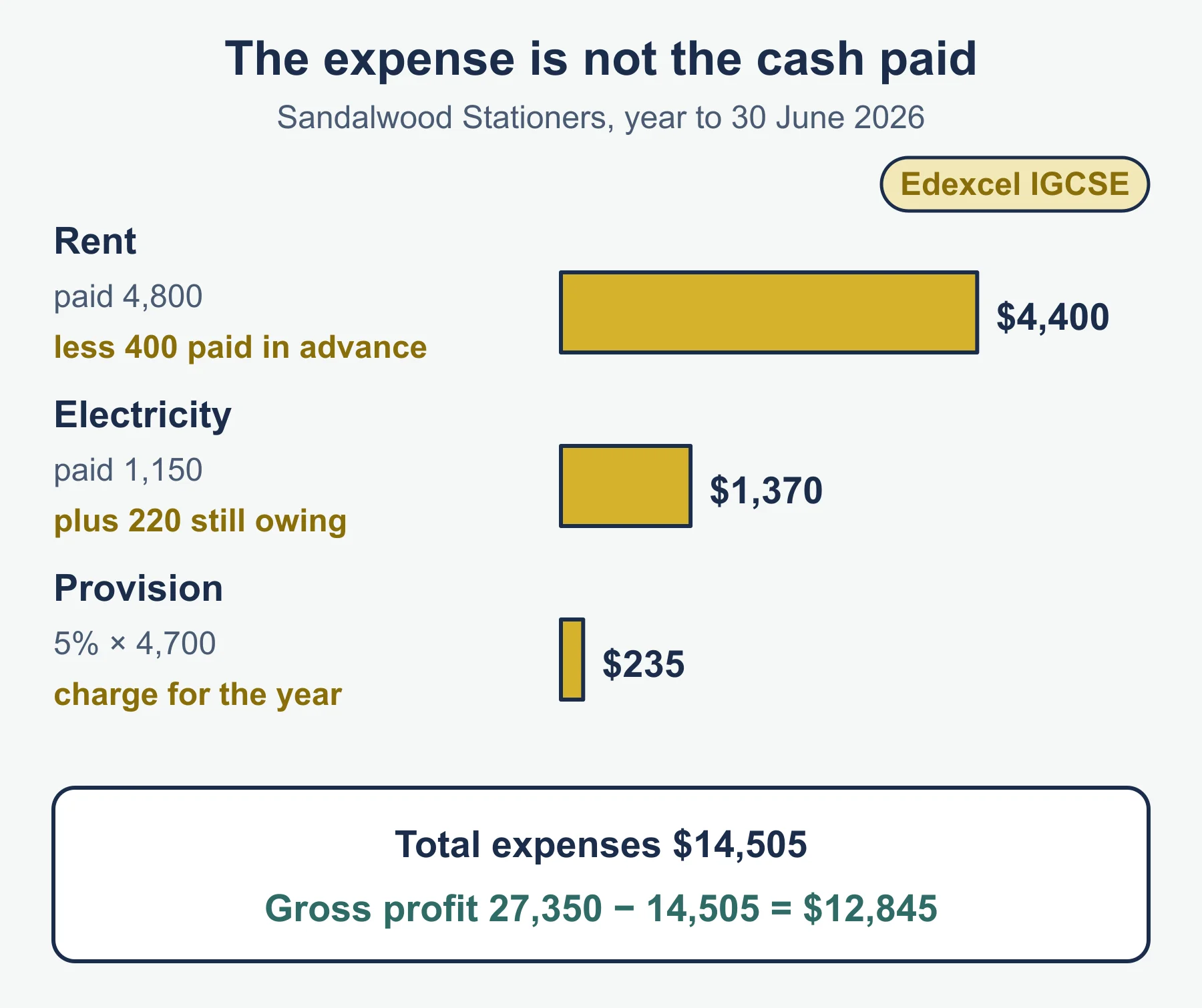
- Expenses from payments, then adjust for amounts owing and prepaid.
- Depreciation, irrecoverable debts, and the provision for irrecoverable debts.
- Closing bank balance.
- Both statements, then the check below.
Layout of the income statement:
| Line | Notes |
|---|---|
| Revenue | Credit sales plus cash sales |
| Cost of sales | Opening inventory + purchases - closing inventory |
| Gross profit | Revenue - cost of sales |
| Expenses | Adjusted for accruals and prepayments |
| Profit for the year | Gross profit - expenses |
Layout of the statement of financial position:
| Section | Items |
|---|---|
| Non-current assets | Carrying value after depreciation |
| Current assets | Inventory, trade receivables less provision, other receivables, bank and cash |
| Current liabilities | Trade payables, other payables, overdraft |
| Equity | Opening equity + profit for the year - drawings (+ capital introduced) |
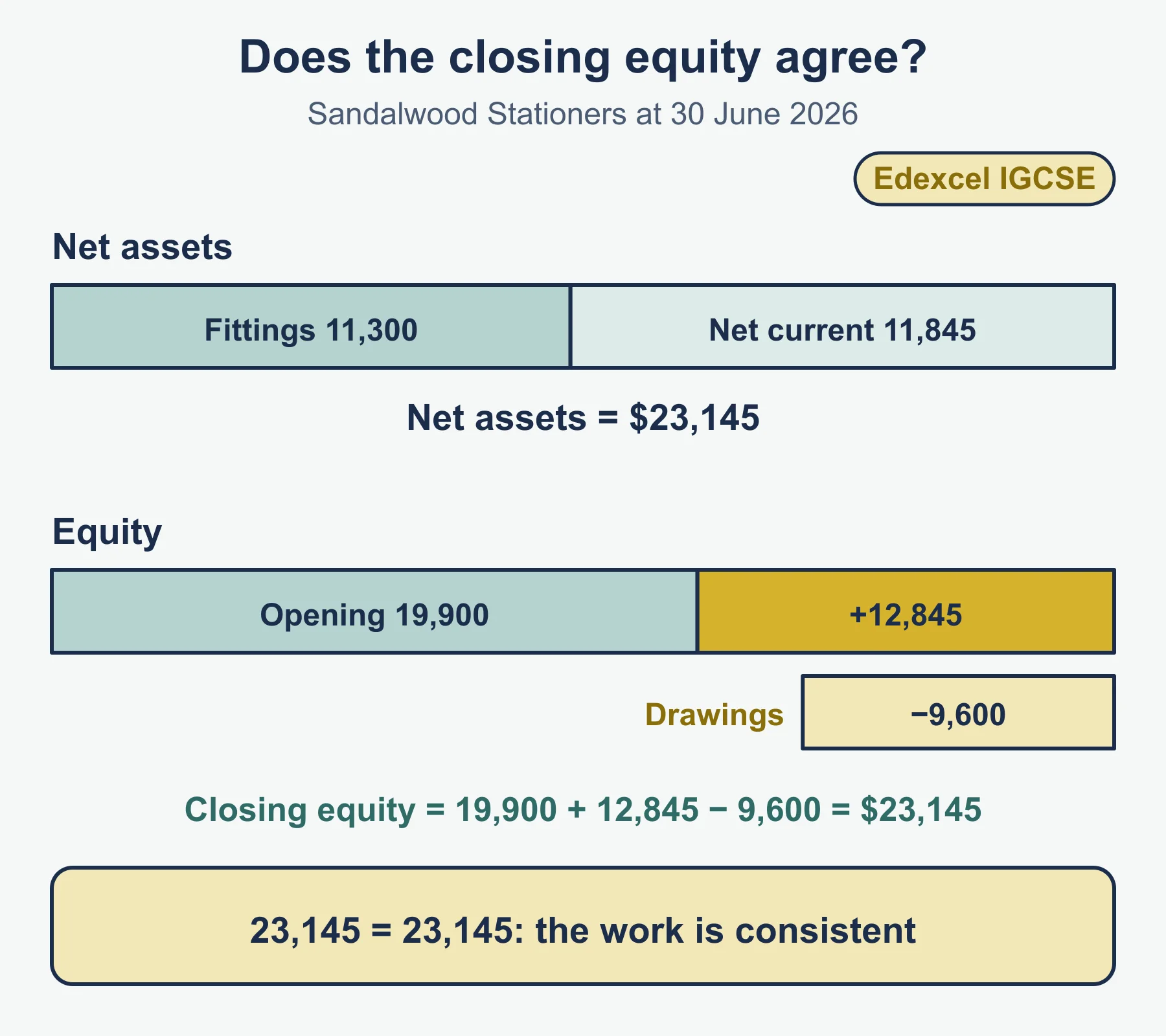
Check: equity must equal net assets. Equity comes from the capital route and net assets from the asset route, so agreement shows the working is consistent.
Reminder: finding drawings
If profit is known, rearrange the formula. Opening equity 20,000, capital introduced 3,000, profit 9,000 and closing equity 26,000 give drawings = 20,000 + 3,000 + 9,000 - 26,000 = 6,000.
Reminder: a whole set of figures
Quince Pottery, year to 31 March 2026. Start of year: equipment 5,000, inventory 3,000, trade receivables 1,500, bank 1,000, trade payables 1,200. Bank summary: customers paid 30,000, cash sales banked 8,000, suppliers paid 24,000, expenses 6,500, drawings 4,000. End of year: inventory 3,400, trade receivables 1,800, trade payables 1,500. Depreciation is 600.
| Step | Working | Result |
|---|---|---|
| Opening equity | 5,000 + 3,000 + 1,500 + 1,000 - 1,200 | 9,300 |
| Credit sales | 1,800 + 30,000 - 1,500 | 30,300 |
| Revenue | 30,300 + 8,000 | 38,300 |
| Credit purchases | 1,500 + 24,000 - 1,200 | 24,300 |
| Cost of sales | 3,000 + 24,300 - 3,400 | 23,900 |
| Gross profit | 38,300 - 23,900 | 14,400 |
| Expenses | 6,500 + 600 | 7,100 |
| Profit for the year | 14,400 - 7,100 | 7,300 |
| Closing bank | 1,000 + 38,000 - 34,500 | 4,500 |
| Net assets | 4,400 + 3,400 + 1,800 + 4,500 - 1,500 | 12,600 |
| Equity | 9,300 + 7,300 - 4,000 | 12,600 |
The last two lines agree, which is the check.
Which technique for which gap
| Missing figure | Tool |
|---|---|
| Profit, no income statement | Change in equity |
| Credit sales | Receivables control account |
| Credit purchases | Payables control account |
| Cash takings | Summary of cash |
| Revenue or purchases, with margin or mark-up known | Percentage on cost or revenue |
Must-know distinctions
- Profit versus cash: drawings and buying non-current assets use cash but are not expenses.
- Credit sales versus revenue: revenue includes cash sales too.
- Irrecoverable debt versus provision: the first is a specific debt written off, the second is an estimate of future losses.
- Mark-up versus margin: the first is on cost, the second on revenue.
- Other receivables are amounts paid in advance. Other payables are amounts owed for expenses.
Quick self-test
- A business has assets of 18,000 and liabilities of 6,500. Calculate its equity.
- Opening equity is 11,500, closing equity 15,200, drawings 7,000 and no capital was introduced. Calculate profit for the year.
- Opening equity 12,000, closing equity 9,800, drawings 3,500, capital introduced 1,000. Calculate the profit or loss.
- On which side of the trade receivables control account do credit sales appear?
- Receivables were 2,000 at the start and 2,600 at the end. Customers paid 18,500, with no other items. Calculate credit sales.
- Credit purchases were 24,000 and cash purchases 3,500. State total purchases.
- Cost of sales is 32,000 and the mark-up is 25%. Calculate revenue.
- Revenue is 80,000 and the margin is 35%. Calculate cost of sales.
- Rent paid was 3,600, including 300 paid in advance. Calculate the rent expense.
- The owner takes goods that cost 450 for personal use. State the effect on purchases and on drawings.
Answers
- 11,500.
- 15,200 - 11,500 + 7,000 = 10,700.
- 9,800 - 12,000 + 3,500 - 1,000 = 300 profit.
- The debit side.
- 2,600 + 18,500 - 2,000 = 19,100.
- 27,500.
- 32,000 x 1.25 = 40,000.
- 80,000 x 0.65 = 52,000.
- 3,600 - 300 = 3,300.
- Purchases fall by 450 and drawings rise by 450.
Where marks are usually lost
- Not adding back drawings, or subtracting capital introduced the wrong way round.
- Placing credit sales or credit purchases on the opposite side of the control account.
- Leaving cash sales or cash purchases out of totals.
- Mixing up margin and mark-up.
- Using cash paid for an expense without an accrual or prepayment adjustment.
- Forgetting the provision for irrecoverable debts when valuing trade receivables.
- Missing the labels, such as the date or the heading, on the statements.
- Skipping the equity versus net assets check.
- Treating drawings taken from the bank as an expense in the income statement.
- Showing a bare answer with no working, so a small slip cannot earn partial credit.
- Writing figures in the wrong place on the statement of financial position, for example putting the provision on the liabilities side.
Frequently asked questions
How do you calculate cash sales from a till summary? Cash sales equal everything that left the till (cash banked, wages, drawings and cash purchases paid from the till), plus the closing cash, minus the opening cash. Revenue is credit sales plus cash sales.
What is the accounting equation used in incomplete records? Assets minus liabilities equals equity (capital). Listing assets and liabilities at two dates gives the equity at each date, and the change is explained by profit, drawings and new capital.
Should the provision for irrecoverable debts be included when valuing trade receivables? Yes. Trade receivables in the statement of financial position are shown less the provision for irrecoverable debts, on the assets side. Forgetting the provision or putting it among liabilities loses marks.
Why should you show workings in an incomplete records answer? Incomplete records questions build each figure from several steps, so clear workings let a small slip still earn partial credit. A bare answer with no working cannot.
Official syllabus
Pearson Edexcel International GCSE in Accounting (4AC1), Specification, Issue 1, October 2016, published by Pearson Education Limited. Topic 4: The preparation of financial statements, section 3 Incomplete records, points a) to c).
Get free revision emails (optional)
Occasional emails with practice questions, worked explanations and links to free resources for the qualification and subjects you choose. No spam, and you can unsubscribe from any email. The free tools on this site never need an email.
Related resources
-
Study guides
Edexcel IGCSE Accounting: Accounting ratios (4AC1)
Study guide to profitability versus liquidity and the five Edexcel IGCSE Accounting ratios, with a two-year worked example and interpretation.
Accounting · Pearson Edexcel · IGCSE
Read guide -
Practice questions
Edexcel IGCSE Accounting: Accounting ratios (4AC1) – Practice Questions
Original practice questions with worked answers on profitability and liquidity ratios for Edexcel IGCSE Accounting (4AC1), Topic 4 section 4.4.
Accounting · Pearson Edexcel · IGCSE
Try questions -
Revision notes
Edexcel IGCSE Accounting: Accounting ratios (4AC1) – Revision Notes
Condensed Edexcel IGCSE Accounting revision notes on the five ratios, profitability versus liquidity, interpretation phrases and a self-test.
Accounting · Pearson Edexcel · IGCSE
Revise topic
Related articles
-
teaching
A Level tuition in Dubai: Cambridge or Pearson Edexcel International A Level?
Schools in Dubai and Abu Dhabi teach either Cambridge International AS & A Level or Pearson Edexcel International A Level. How the two are structured, why it matters for tuition, and how online classes from Lahore work.
9 October 2026
-
curriculum guides
Choosing subjects at IGCSE and A Level
How subject choices at 14 and 16 affect university options later, and how to keep pathways open without overloading a timetable.
28 July 2026
Studying this with a teacher
Working through Accounting IGCSE?
This page is free and stays free. If you would rather be taught it, Marlbridge runs Accounting classes one-to-one and in small groups of up to 15, online in your own time zone. The first trial class is free. WhatsApp replies within an hour (8am–11pm Pakistan time, every day); email the same day.
Pearson Edexcel Accounting teachers at Marlbridge

