
Study Guides
Edexcel IGCSE Accounting: Application of accounting concepts (4AC1)
Study guide to applying consistency, prudence, accruals, materiality, money measurement and business entity at the year end, for Edexcel IGCSE Accounting.
- Subject
- Accounting
- Level
- IGCSE
- Topic
- Accounting for end of period adjustments
- Author
- Marlbridge Academic Team
- Updated
- Reviewed by
- Javaid Iqbal Sabri (what this means)
Aligned to Pearson Edexcel IGCSE Accounting (4AC1), Issue 1, October 2016. Official specification .
Syllabus page (what it covers and how it is assessed): Pearson Edexcel IGCSE Accounting.
Syllabus points this page covers
4AC1
- 5 Accounting for end of period adjustments (whole topic)
- 5.1 Application of accounting concepts
Found an error? Report a correction.
Want a teacher for this? Marlbridge teaches Accounting online. Request a free trial class.
This guide covers section 5.1, Application of accounting concepts, in Topic 5 (Accounting for end of period adjustments) of the Pearson Edexcel International GCSE in Accounting (4AC1) specification, Issue 1, October 2016. The qualification is not tiered. The specification asks you to apply six concepts: consistency, prudence, accruals, materiality, money measurement and business entity. Paper 2 covers Topics 4 and 5 and also builds on what you learned in Topics 1 to 3, so these ideas can appear whenever you prepare or adjust financial statements. All money amounts on this page are in dollars, written without a currency sign.
Links: 4AC1 Accounting course hub, printable 4AC1 checklist, free 10-minute diagnostics. Next in this unit: the revision notes and the practice questions.
What this section asks you to do
| Specification point | What you need to be able to do |
|---|---|
| 5.1 (a) consistency | Use the same method year after year, and see what happens to profit if a method is changed |
| 5.1 (a) prudence | Avoid overstating profit or assets; recognise likely losses early |
| 5.1 (a) accruals | Match expenses and revenue to the period they belong to, not the period of payment |
| 5.1 (a) materiality | Decide whether an item is big enough to affect a user’s decisions |
| 5.1 (a) money measurement | Record only what can be given a money value, and see the limits of doing so |
| 5.1 (a) business entity | Keep the owner’s private affairs out of the business’s records |
The word in the specification is “apply”. Naming a concept is not enough. You pick the concept that fits a situation, say what the business should record, and show how profit or the statement of financial position changes. The same six concepts also appear in Topic 1, where you need to understand their significance. Here the focus is on the year-end adjustments.
Consistency
Consistency means that once a business chooses an accounting method, it keeps using it from one period to the next for items of the same kind. Methods that are open to choice include the method of depreciation and the way inventory is valued. A change is only sensible when there is a good reason, and it should be disclosed.
The point of the concept is comparability. If the method moves around, a rise or fall in profit may come from the method, not from trading.
Worked example: switching depreciation method
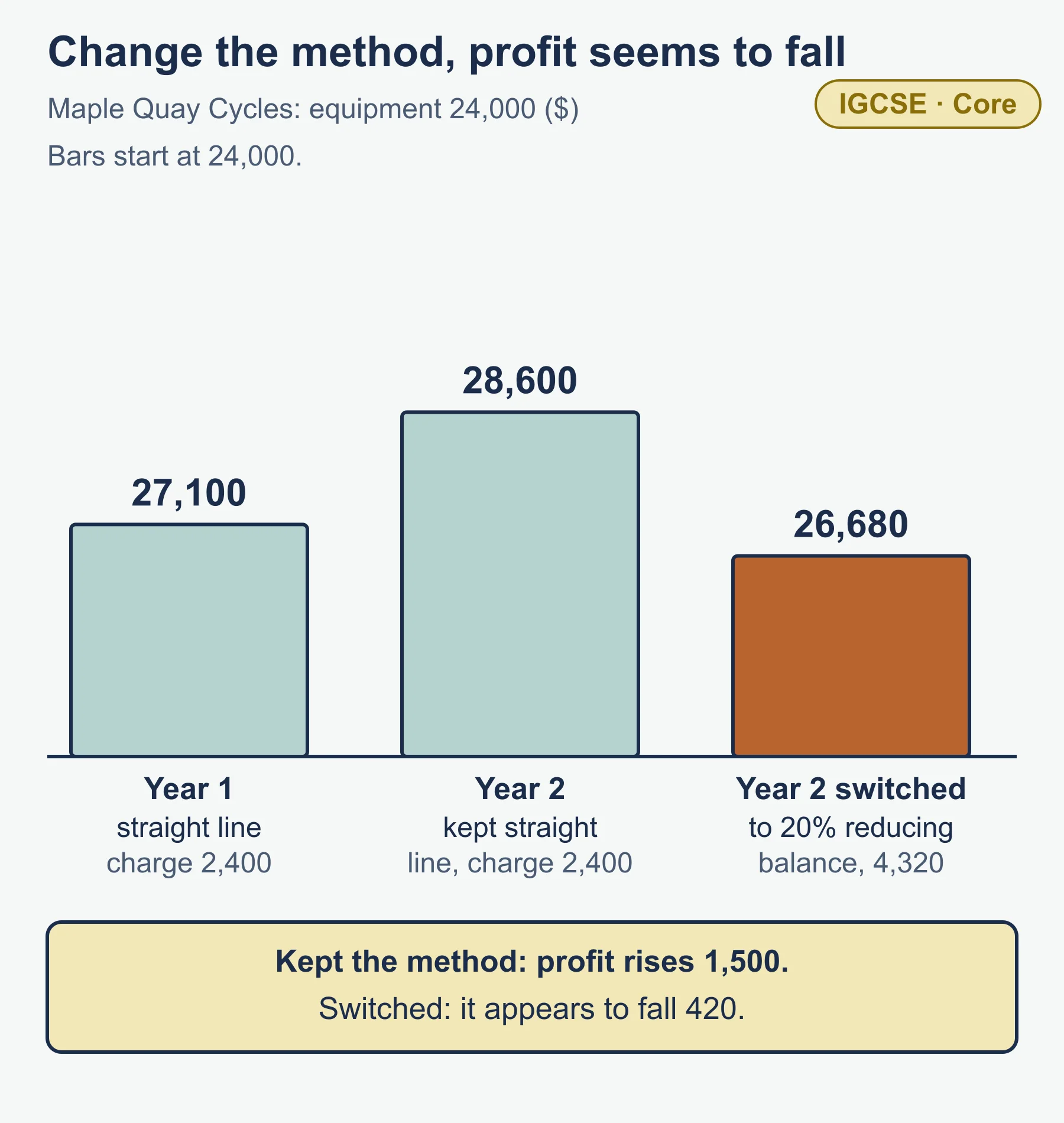
Maple Quay Cycles bought workshop equipment for 24,000 on 1 January of Year 1. It depreciates it by the straight line method over 10 years with no residual value, so the charge is 24,000 / 10 = 2,400 a year. Profit before depreciation was 29,500 in Year 1 and 31,000 in Year 2.
| Year 1 | Year 2 (kept straight line) | Year 2 (switched to 20% reducing balance) | |
|---|---|---|---|
| Profit before depreciation | 29,500 | 31,000 | 31,000 |
| Depreciation | 2,400 | 2,400 | 4,320 |
| Profit | 27,100 | 28,600 | 26,680 |
The Year 2 reducing balance charge is 20% of the carrying value of 24,000 − 2,400 = 21,600, which is 4,320. Trading improved by 1,500 before depreciation. With consistent treatment, profit rises by 1,500 from 27,100 to 28,600. After the switch, profit appears to fall by 420 to 26,680. A reader would draw the wrong conclusion, which is why a change of method needs a reason and a note.
Prudence
Prudence means you do not overstate profits or assets, and you do not understate losses or liabilities. If you are unsure, choose the figure that gives the lower profit or the lower asset value. It does not mean deliberately understating profit. Prudence is about caution, not pessimism.
Two year-end applications are:
- Inventory is shown at whichever is smaller, cost or net realisable value (the selling price less any costs needed to sell). A loss in value is recognised now; a gain is not recognised until a sale happens.
- Receivables that may not pay are covered by a provision for irrecoverable debts, so the statement of financial position does not show trade receivables above the sum the business expects to collect. The recording methods are in the section on irrecoverable debts.
Worked example: inventory and a provision
Dunmore Tiles counts three lines of inventory at the year end.
| Line | Cost | Net realisable value | Value used |
|---|---|---|---|
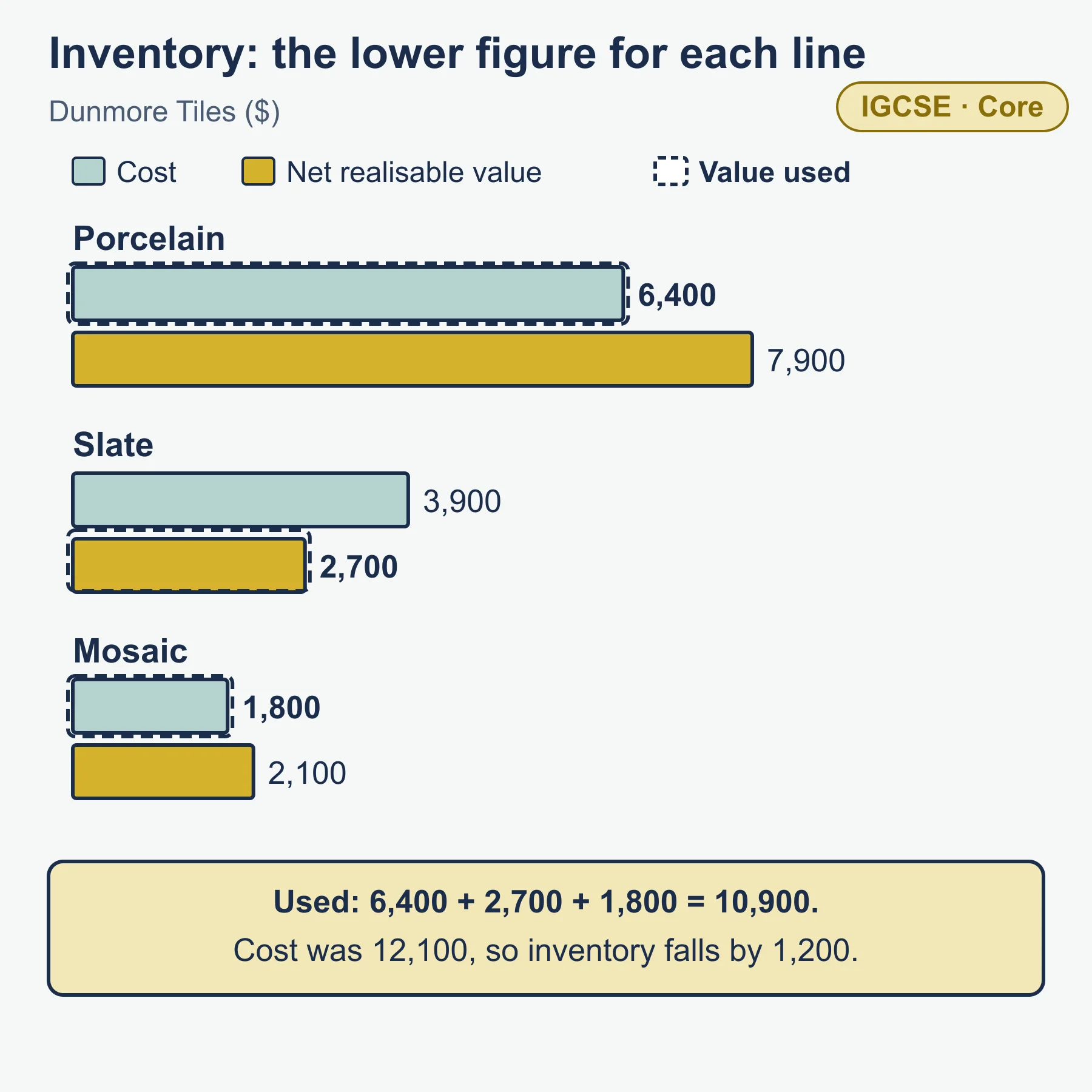
| Porcelain | 6,400 | 7,900 | 6,400 |
| Slate | 3,900 | 2,700 | 2,700 |
| Mosaic | 1,800 | 2,100 | 1,800 |
| Total | 12,100 | 10,900 |
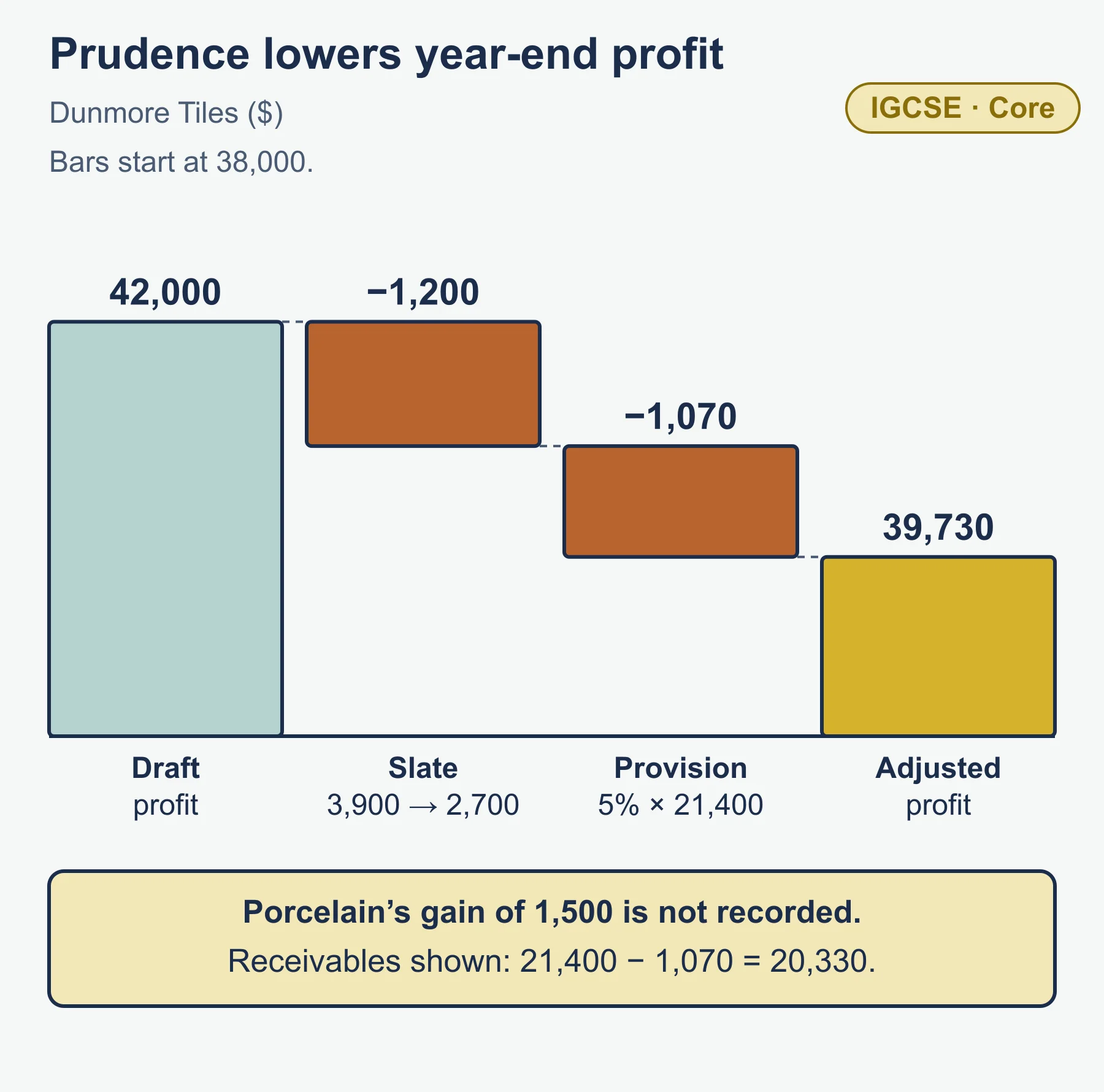
Valuing each line at the lower figure cuts closing inventory by 1,200 compared with cost. Profit falls by the same amount because cost of sales rises. The porcelain gain of 1,500 is not recorded.
Trade receivables are 21,400 after writing off a debt known to be bad. The business makes a first-time provision of 5%, which is 21,400 × 0.05 = 1,070. The statement of financial position shows 21,400 − 1,070 = 20,330.
Profit before these two adjustments was 42,000, so adjusted profit is 42,000 − 1,200 − 1,070 = 39,730.
Accruals
The accruals concept (also called matching) says revenue is recorded when it is earned and expenses when they are incurred, whatever the date of the cash movement. Each year’s statement of profit or loss should hold the expenses that helped to earn that year’s revenue.
In the specification’s terminology, an expense owed at the year end is an other payable, and an expense paid in advance is an other receivable.
Worked example: expenses and revenue at the year end
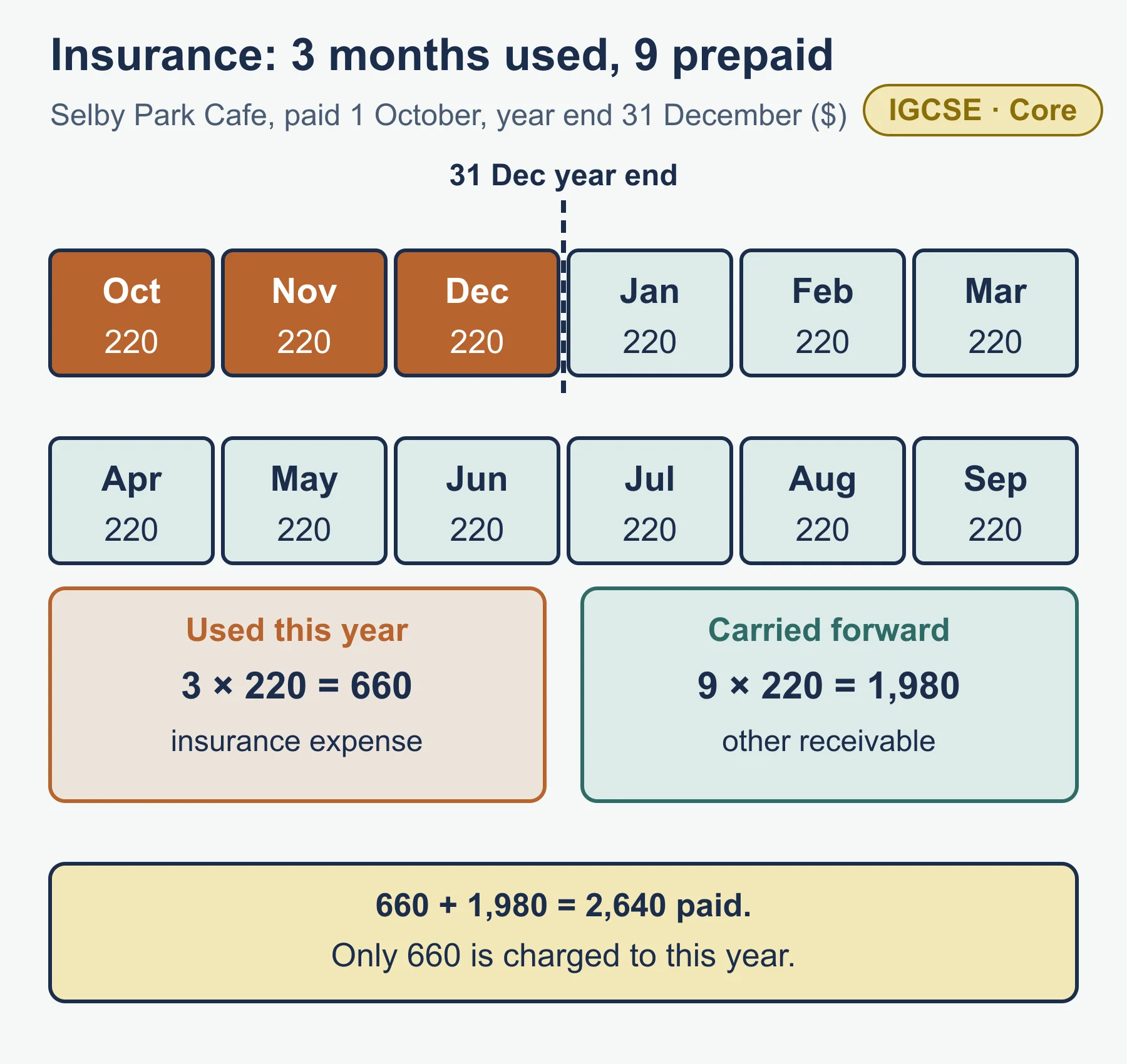
Selby Park Cafe has a year end of 31 December. Before adjustment its profit is 18,000. The following facts have not been dealt with.
| Item | Position | Adjustment to profit |
|---|---|---|
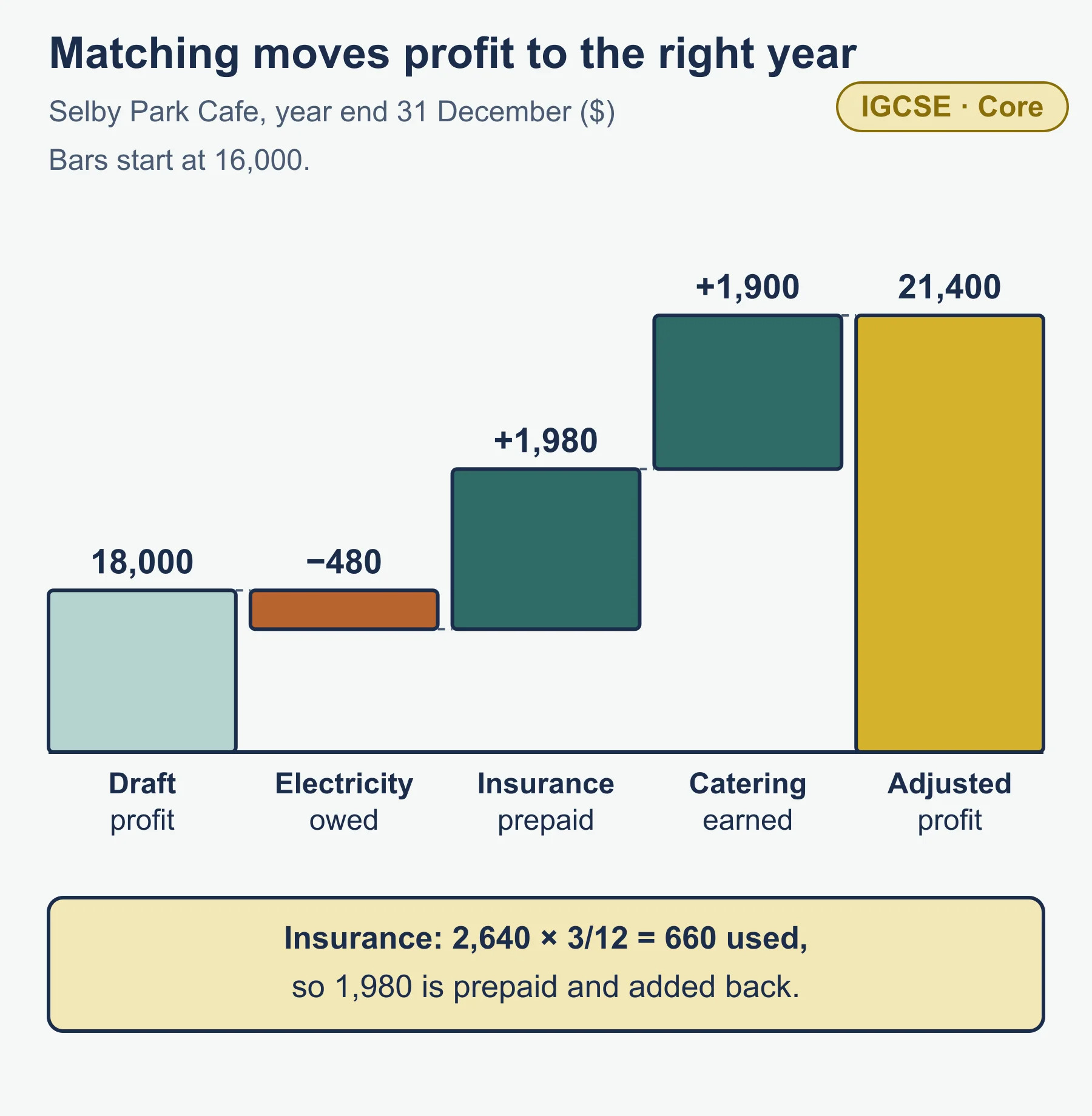
| Electricity | 3,150 was paid in the year; the December bill of 480 arrived in January | Expense becomes 3,630, other payable of 480 |
| Insurance | 2,640 was paid on 1 October for 12 months | 3 of 12 months used, so the expense is 660; other receivable of 1,980 |
| Catering | A 1,900 invoice for December catering was not recorded; the customer paid in January | Revenue of 1,900 belongs to this year |
Adjusted profit = 18,000 − 480 + 1,980 + 1,900 = 21,400. The first draft had charged the whole 2,640 of insurance, so 1,980 is added back.
Notice how accruals needs some arithmetic. Work out the share of the period used, then adjust.
Materiality
An item is material when omitting it, or getting it wrong, could alter a reader’s decisions about the business. Small items need not be treated with full accounting care. Materiality depends on the size of the business and the item, so it is a judgement, not a fixed number.
Typical applications are expensing low-cost items instead of recording them as non-current assets, and not correcting trivial differences.
Worked example: judging size
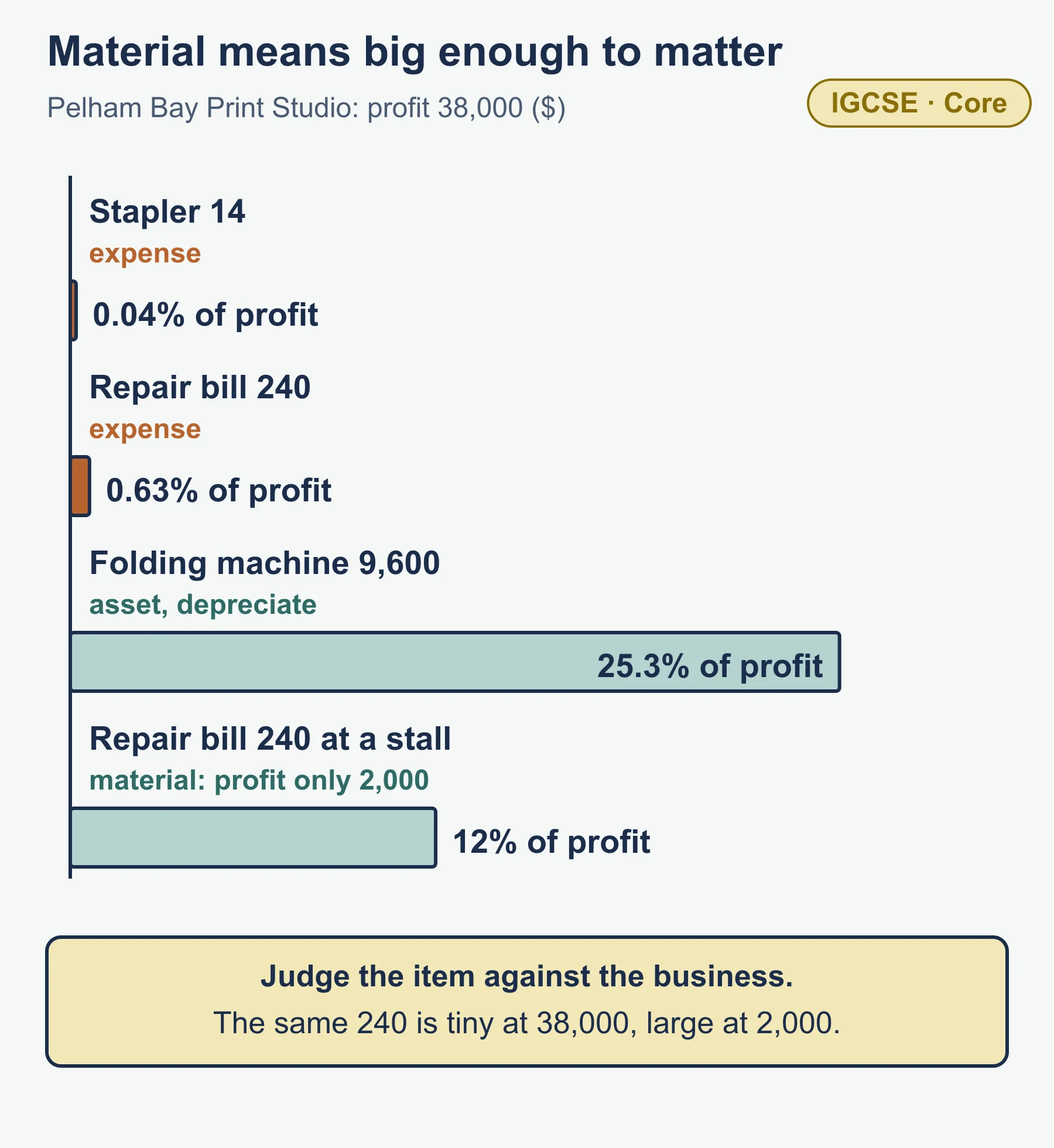
Pelham Bay Print Studio has revenue of 250,000 and profit of 38,000.
| Item | Amount | As % of profit | Treatment |
|---|---|---|---|
| Stapler | 14 | 0.04% | Expense; no asset record or depreciation |
| Repair bill | 240 | 0.63% | Expense (it is revenue expenditure anyway) |
| Folding machine | 9,600 | 25.3% | Material: record as a non-current asset and depreciate |
The same 240 might be material to a stall with profit of 2,000, because it would be 12% of profit. Say what the item is compared with. A policy of “expense anything under 500” is acceptable if it is applied consistently.
Money measurement
Money measurement means the books record only facts that can be stated in money. The advantage is that figures can be added together and compared. The limits are important and often asked about:
- Important things with no money figure are not recorded, such as the skill of the staff, a good reputation, or a loyal customer base.
- Items are usually recorded at the money amount paid, so a figure from several years ago sits beside recent ones even though the purchasing power of money has changed.
- Where a value cannot be fixed reliably, such as the outcome of a dispute, it is not entered as an exact amount.
Worked example: what appears
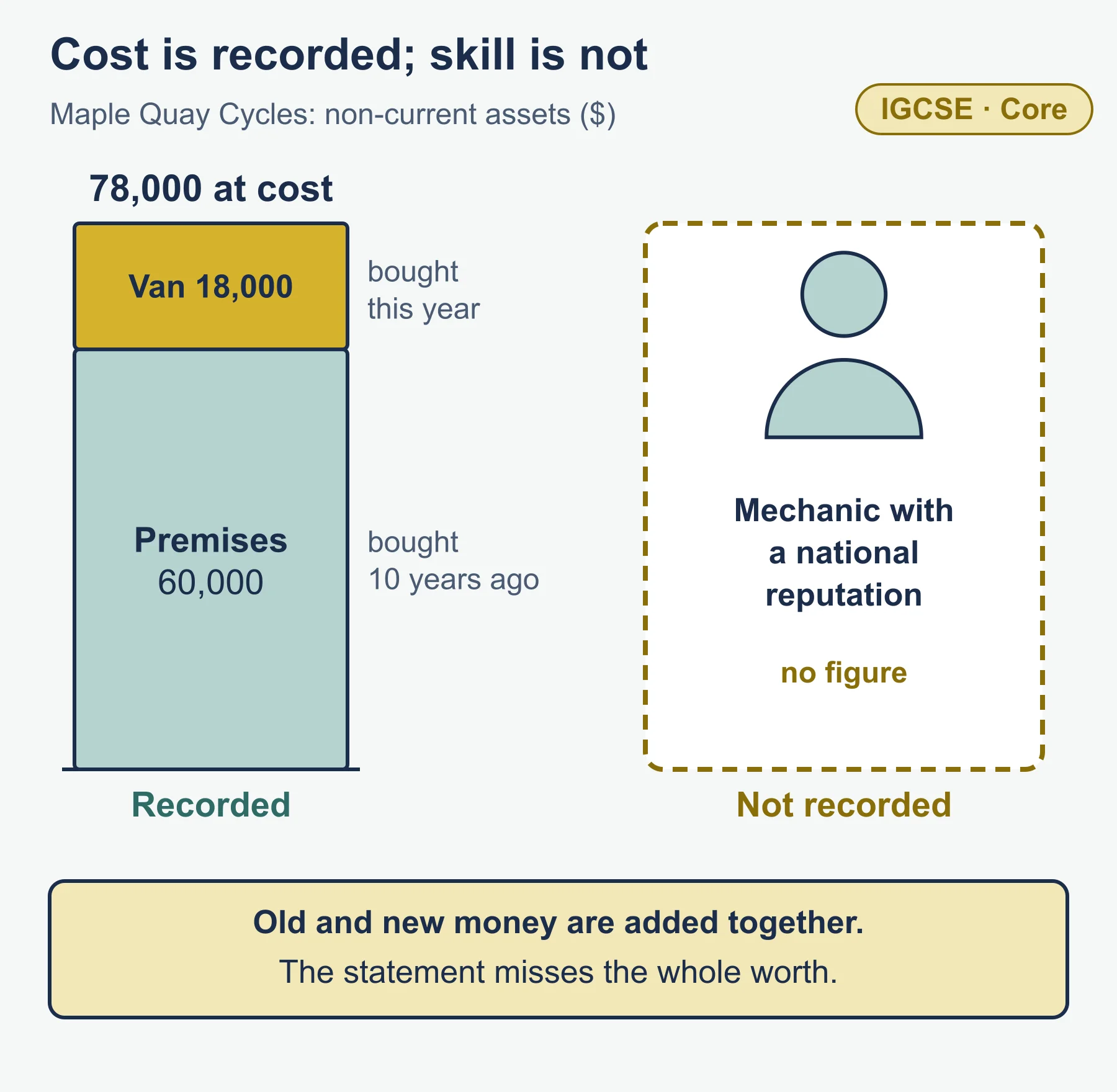
Maple Quay Cycles bought its shop premises ten years ago for 60,000 and a delivery van this year for 18,000. Both are shown at cost, giving 78,000 of non-current assets before depreciation, even though one figure is a decade old. The owner also employs a mechanic with a national reputation, but the statement of financial position carries no figure for that skill. The statement therefore does not show the whole worth of the business.
Business entity
The business is treated as a separate unit from its owner. Only business transactions go into the business’s books. When the owner takes money or goods for private use, or the business pays a private bill, the amount is drawings. It reduces the owner’s capital and is not an expense. Household assets and personal debts of the owner stay out of the statements.
Worked example: separating the owner
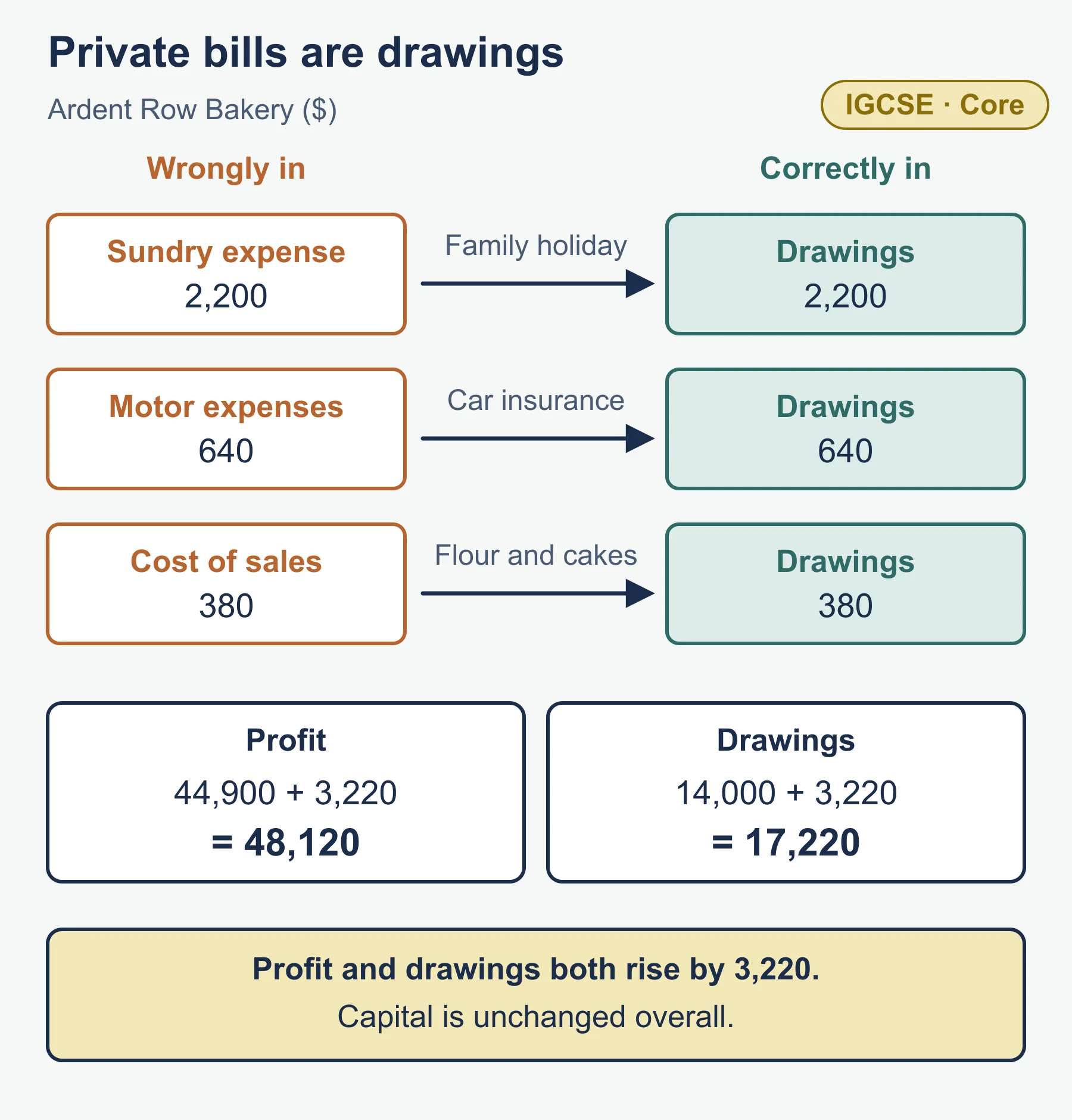
The draft profit of Ardent Row Bakery is 44,900. A review of the ledger shows three private items that were treated as business costs.
| Item | Recorded as | Correct treatment |
|---|---|---|
| Family holiday paid from the business bank | Sundry expense, 2,200 | Drawings |
| Owner’s car insurance | Motor expenses, 640 | Drawings |
| Flour and cakes taken home, at cost | Cost of sales, 380 | Drawings |
Private amounts total 2,200 + 640 + 380 = 3,220. Corrected profit = 44,900 + 3,220 = 48,120. Drawings were 14,000 in cash, so total drawings are 14,000 + 3,220 = 17,220. Profit and drawings both rise by 3,220, so the owner’s capital is unchanged overall, but expenses and drawings are now reported correctly.
Choosing the concept: a quick method
- Read the situation and ask what the problem is: method changed, doubt about value, wrong period, tiny amount, value that cannot be measured, or the owner’s private affairs.
- Name the matching concept: consistency, prudence, accruals, materiality, money measurement, business entity.
- State what the business should do.
- Say what changes in profit or in the statement of financial position, with figures if you have them.
Concepts sometimes pull in different directions. A provision follows prudence, but the expense belongs to the year of the sale, which is accruals. Name the concept the question is pointing at, and mention a second one only when it adds something.
Common errors
- Writing that prudence means “always choose the lowest profit”. It means avoid overstatement, with reasonable estimates.
- Treating an owner’s private bill as an expense. It is drawings.
- Explaining accruals as “recording when cash is paid”. It is the reverse.
- Claiming materiality has a fixed cut-off such as 5%. It depends on the item and the business.
- Saying money measurement means assets are valued at today’s prices. It means they are recorded in money terms, usually at cost.
- Showing the effect on profit with the wrong sign: an accrued expense lowers profit, a prepaid expense adds back.
Where to go next
Test yourself with the practice questions, then use the revision notes close to the exam. The course hub and diagnostics show what to cover next.
Frequently asked questions
Which accounting concepts must you apply in Edexcel IGCSE Accounting section 5.1? The 4AC1 specification asks you to apply six concepts at the year end: consistency, prudence, accruals, materiality, money measurement and business entity. Naming a concept is not enough; you must say what the business should record and how profit or the statement of financial position changes.
Does prudence mean always choosing the lowest profit? No. Prudence means not overstating profits or assets and not understating losses or liabilities, using reasonable estimates. It is about caution, not deliberately understating profit.
How is inventory valued under the prudence concept? Each line of inventory is shown at the lower of cost and net realisable value, which is the selling price less any costs needed to sell. A loss in value is recognised now, but a gain is not recognised until a sale happens.
Is there a fixed percentage for materiality? No. An item is material when omitting it or getting it wrong could alter a reader’s decisions, so it depends on the size of the item and the business. A policy such as expensing items under a set amount is acceptable if it is applied consistently.
What happens when an owner’s private bill is paid by the business? Under the business entity concept, the amount is drawings, not an expense. Correcting it raises profit and drawings by the same amount, so the owner’s capital is unchanged overall.
Official syllabus
Pearson Edexcel International GCSE in Accounting (4AC1) specification, Issue 1, October 2016, published by Pearson Education Limited – Topic 5 Accounting for end of period adjustments, section 5.1 Application of accounting concepts (consistency, prudence, accruals, materiality, money measurement, business entity).
Get free revision emails (optional)
Occasional emails with practice questions, worked explanations and links to free resources for the qualification and subjects you choose. No spam, and you can unsubscribe from any email. The free tools on this site never need an email.
Related resources
-
Practice questions
Edexcel IGCSE Accounting: Application of accounting concepts (4AC1) – Practice Questions
Eleven original Edexcel IGCSE Accounting questions on applying the six accounting concepts at the year end, with fully worked answers.
Accounting · Pearson Edexcel · IGCSE
Try questions -
Revision notes
Edexcel IGCSE Accounting: Application of accounting concepts (4AC1) – Revision Notes
Condensed Edexcel IGCSE Accounting revision notes on applying consistency, prudence, accruals, materiality, money measurement and business entity.
Accounting · Pearson Edexcel · IGCSE
Revise topic -
Study guides
Edexcel IGCSE Accounting: End-of-period adjustments (4AC1)
Study guide to Edexcel IGCSE Accounting 4AC1 end-of-period adjustments: depreciation, disposals, irrecoverable debts, provisions, accruals and prepayments.
Accounting · Pearson Edexcel · IGCSE
Read guide
Related articles
-
teaching
A Level tuition in Dubai: Cambridge or Pearson Edexcel International A Level?
Schools in Dubai and Abu Dhabi teach either Cambridge International AS & A Level or Pearson Edexcel International A Level. How the two are structured, why it matters for tuition, and how online classes from Lahore work.
9 October 2026
-
curriculum guides
Choosing subjects at IGCSE and A Level
How subject choices at 14 and 16 affect university options later, and how to keep pathways open without overloading a timetable.
28 July 2026
Studying this with a teacher
Working through Accounting IGCSE?
This page is free and stays free. If you would rather be taught it, Marlbridge runs Accounting classes one-to-one and in small groups of up to 15, online in your own time zone. The first trial class is free. WhatsApp replies within an hour (8am–11pm Pakistan time, every day); email the same day.
Pearson Edexcel Accounting teachers at Marlbridge

