
Study Guides
Edexcel IGCSE Accounting: End-of-period adjustments (4AC1)
Study guide to Edexcel IGCSE Accounting 4AC1 end-of-period adjustments: depreciation, disposals, irrecoverable debts, provisions, accruals and prepayments.
- Subject
- Accounting
- Level
- IGCSE
- Topic
- Accounting for end of period adjustments
- Author
- Marlbridge Academic Team
- Updated
- Reviewed by
- Javaid Iqbal Sabri (what this means)
Aligned to Pearson Edexcel IGCSE Accounting (4AC1), Issue 1, October 2016. Official specification .
Syllabus page (what it covers and how it is assessed): Pearson Edexcel IGCSE Accounting.
Syllabus points this page covers
4AC1
- 5 Accounting for end of period adjustments (whole topic)
- 5.2 Depreciation
- 5.3 Irrecoverable debts
- 5.4 Other receivables and other payables
Found an error? Report a correction.
Want a teacher for this? Marlbridge teaches Accounting online. Request a free trial class.
This guide is aligned to the Pearson Edexcel International GCSE in Accounting (4AC1) specification, Issue 1, October 2016. It covers Topic 5, sections 5.2 Depreciation, 5.3 Irrecoverable debts and 5.4 Other receivables and other payables. The specification marks no content in these sections as tier-specific. It says Paper 2, Financial Statements, draws on topics 4 and 5 and builds on topics 1 to 3, while Paper 1 draws only on topics 1 to 3. The same three areas also appear in Topic 2, so you can meet them in either paper.
Links: Edexcel IGCSE Accounting hub, printable checklist, free 10-minute diagnostics. Next: the revision notes and the practice questions.
All businesses and figures here are invented. Amounts are in dollars, written without a currency sign. “SPL” means the statement of profit or loss, which the specification’s glossary treats as the modern name for the trading and profit and loss account. “SFP” means the statement of financial position.
What the specification lists
| Section | You must be able to | Where in this guide |
|---|---|---|
| 5.2 a | Explain the causes of depreciation | Section 1 |
| 5.2 b | Distinguish straight line from reducing balance | Section 1 |
| 5.2 c | Calculate and record depreciation in the books | Section 2 |
| 5.2 d | Calculate and record profit or loss on disposal of non-current assets | Section 3 |
| 5.3 a, b | Explain why a provision is needed; distinguish an irrecoverable debt from a provision | Section 4 |
| 5.3 c | Calculate and record both | Section 5 |
| 5.4 a, b | Explain why these are accounted for; distinguish other receivables from other payables | Section 6 |
| 5.4 c | Calculate and record them | Section 7 |
1. Depreciation: causes and the two methods (5.2 a, b)
Non-current assets are bought to be used for several years. Depreciation spreads their cost over the years that benefit from them, so each year’s profit carries a fair share. Charging it involves no payment of cash, and no money is put aside to replace the asset.
Typical causes:
- Wear and tear. Use and age damage machinery and vehicles.
- Obsolescence. A better model on the market leaves the asset behind, although it still works.
- Passage of time. Some assets, such as a lease on premises, lose value simply because time runs out.
- Depletion. An asset such as a quarry is used up as it is extracted.
Two methods are named in the specification.
| Straight line | Reducing balance | |
|---|---|---|
| Charge each year | Same amount | Falls each year |
| Calculation | (cost - residual value) / useful life | Fixed percentage of the carrying value (net book value) at the start of the year |
| Suits | Assets that give equal benefit each year | Assets that lose most value early or need more repairs later |
| Residual value | Used in the formula | Not part of the percentage calculation |
Under straight line the carrying value falls by an equal step each year. Under reducing balance the percentage is applied to cost in year 1, then to cost less depreciation to date.
2. Calculating and recording depreciation (5.2 c)
Quillen Joinery has two non-current assets.
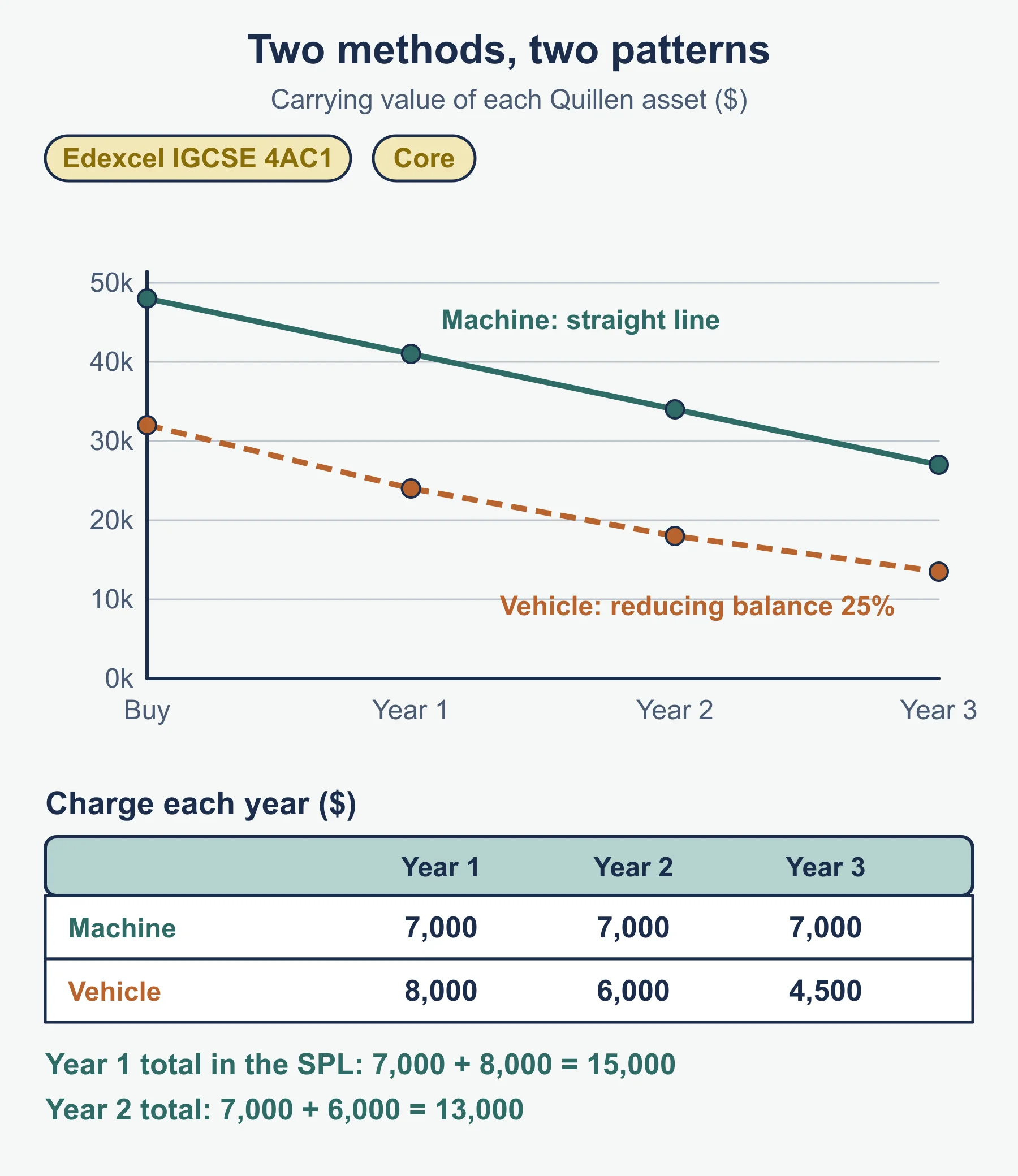
Machine, straight line. Cost 48,000, residual value 6,000, useful life 6 years.
Annual charge = (48,000 - 6,000) / 6 = 7,000. Carrying value is 41,000 after year 1 and 34,000 after year 2.
Vehicle, reducing balance at 25%. Cost 32,000.
| Year | Calculation | Charge | Accumulated depreciation | Carrying value |
|---|---|---|---|---|
| 1 | 25% of 32,000 | 8,000 | 8,000 | 24,000 |
| 2 | 25% of 24,000 | 6,000 | 14,000 | 18,000 |
| 3 | 25% of 18,000 | 4,500 | 18,500 | 13,500 |
Total depreciation in the SPL for year 1 is 7,000 + 8,000 = 15,000, and for year 2 it is 7,000 + 6,000 = 13,000.
The double entry each year is:
- Debit the depreciation expense account, credit the provision for depreciation account.
- At the year end, transfer the expense to the SPL.
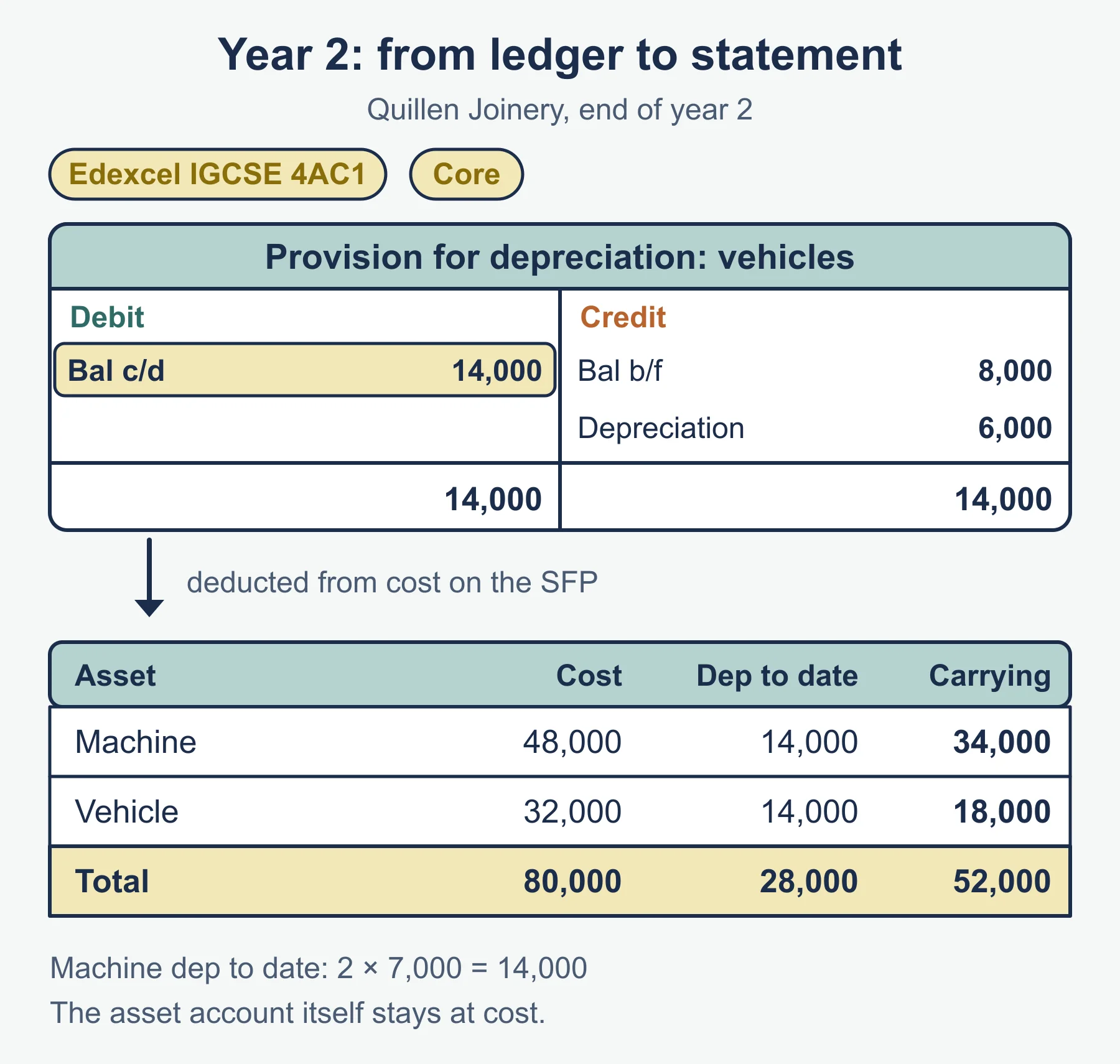
- The asset account stays at cost. The provision account (also called accumulated depreciation) builds up and is deducted from cost on the SFP.
Year 2 for the vehicle:
Provision for depreciation: vehicles
Bal c/d               14,000 | Bal b/f                8,000
                             | Depreciation           6,000
                      14,000 |                       14,000
Statement of financial position extract, end of year 2:
| Class of asset | Cost | Depreciation to date | Carrying value |
|---|---|---|---|
| Machine | 48,000 | 14,000 | 34,000 |
| Vehicle | 32,000 | 14,000 | 18,000 |
| Total | 80,000 | 28,000 | 52,000 |
The machine’s accumulated depreciation is 2 x 7,000 = 14,000. Both columns of figures must reconcile: 80,000 - 28,000 = 52,000.
3. Disposal of non-current assets (5.2 d)
On a sale, take the asset’s cost and its accumulated depreciation out of the ledgers, then set the sale proceeds against the carrying value.
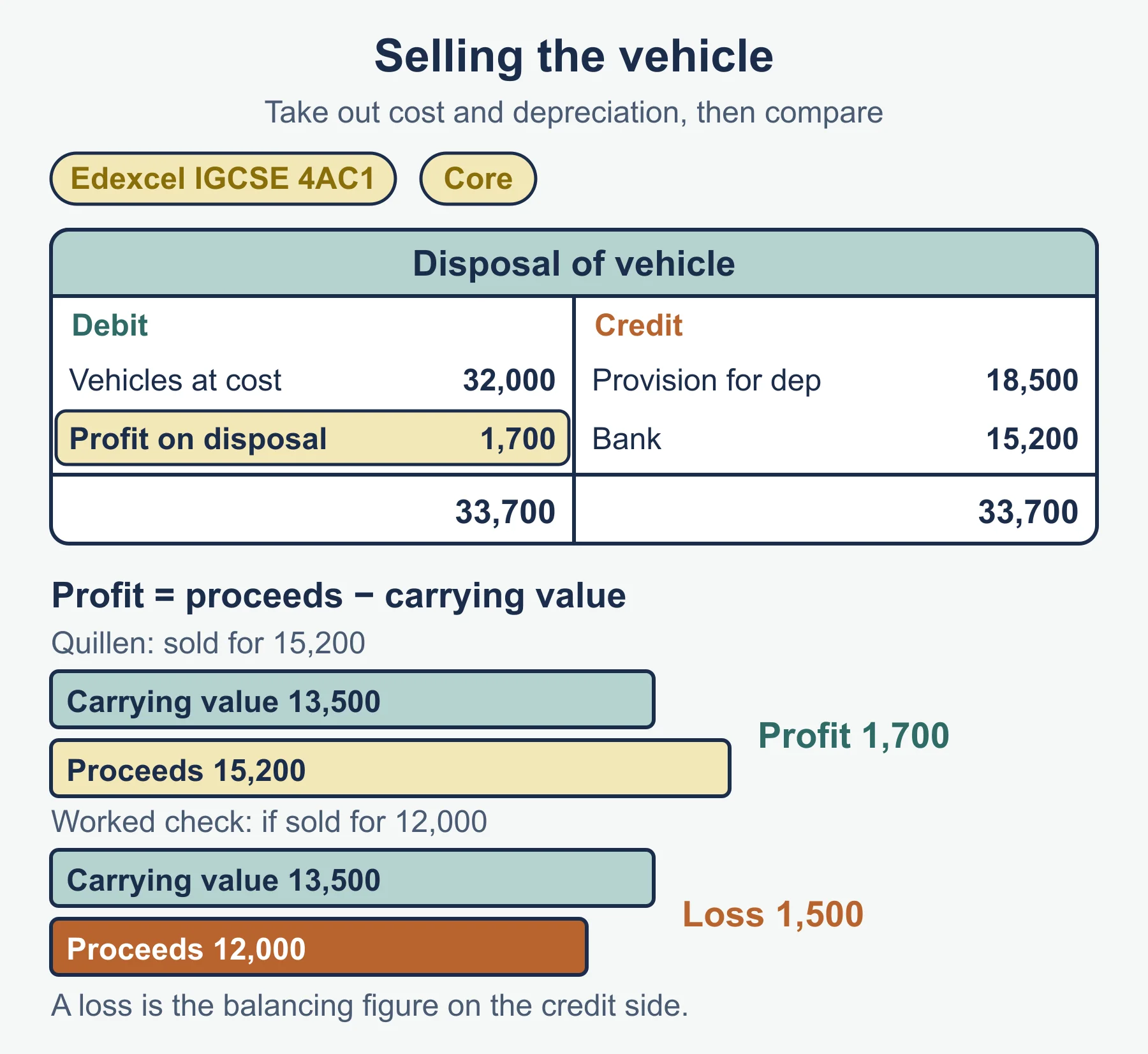
- Profit on disposal = proceeds - carrying value.
- Loss on disposal = carrying value - proceeds.
Quillen sells the vehicle at the end of year 3, after charging that year’s depreciation, for 15,200. Carrying value is 32,000 - 18,500 = 13,500, so the profit is 15,200 - 13,500 = 1,700.
Disposal of vehicle
Vehicles at cost      32,000 | Provision for dep     18,500
Profit on disposal     1,700 | Bank                  15,200
                      33,700 |                       33,700
The profit is the balancing figure. It is credited to the SPL as income. A loss is the balancing figure on the credit side and is an expense in the SPL. After the entries, the vehicle account and the vehicle’s provision account both show nil.
Worked check: if the proceeds had been 12,000 the debit side would hold cost 32,000 only, the credit side 18,500 + 12,000 = 30,500, and the balancing loss of 1,500 would appear on the credit side. That equals 13,500 - 12,000.
4. Irrecoverable debts and the provision: why and what (5.3 a, b)
Businesses sell on credit, so some trade receivables will never pay.
- An irrecoverable debt is a debt that has definitely gone bad, for example a customer who has been declared insolvent. The debt is written off: it leaves trade receivables and becomes an expense.
- A provision for irrecoverable debts is an amount set aside for debts that may go bad. No named customer is being written off. It is an estimate, usually a percentage of the trade receivables left after write-offs. The glossary’s modern term is “allowance for doubtful debt”.
Why a provision is needed:
- Prudence. Do not overstate assets or profit. Trade receivables are shown at the amount the business expects to collect.
- Accruals (matching). The sale was made this year, so the expected loss from it belongs in this year’s SPL, not in the year the customer finally fails to pay.
- Reliable figures. Owners, lenders and others use the SFP to judge liquidity.
| Irrecoverable debt | Provision | |
|---|---|---|
| Certainty | Known loss | Estimated future loss |
| Linked to | A named customer | The whole receivables total |
| Ledger effect | Credits the customer’s account | The customer’s account is untouched |
| Where it appears | Expense in the SPL | Change in provision is an expense or income in the SPL; the balance is deducted from trade receivables on the SFP |
5. Calculating and recording irrecoverable debts and the provision (5.3 c)
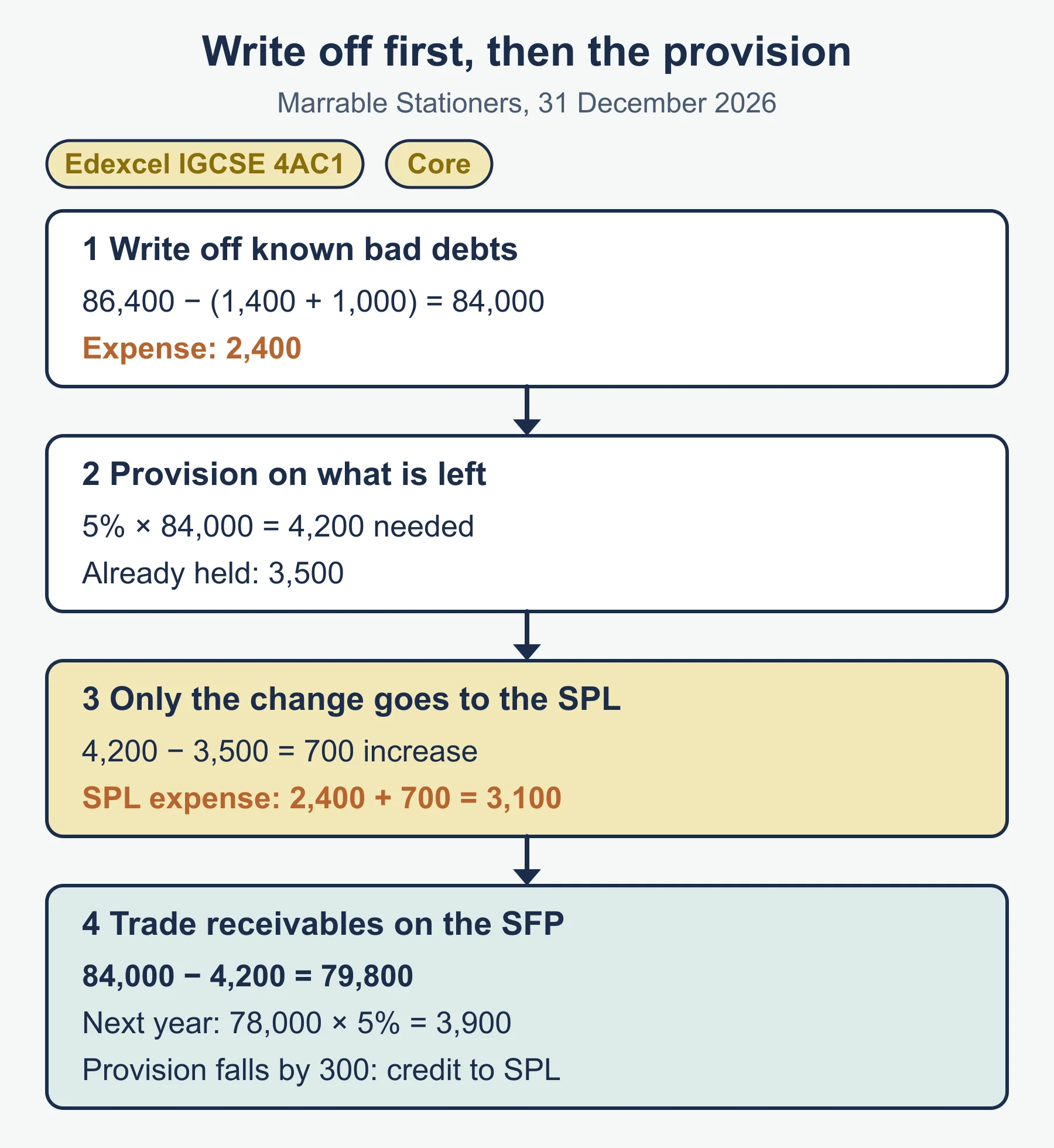
Marrable Stationers at 31 December 2026. Trade receivables before adjustment 86,400. Two debts are irrecoverable: K. Vance 1,400 and L. Dunley 1,000. The provision is 5% of the remaining receivables. The provision brought forward is 3,500.
- Write off: 1,400 + 1,000 = 2,400. Remaining receivables = 86,400 - 2,400 = 84,000.
- Provision needed = 5% x 84,000 = 4,200.
- Change in provision = 4,200 - 3,500 = 700 increase.
- SPL expense = 2,400 + 700 = 3,100.
Irrecoverable debts
K. Vance               1,400 | SPL                    2,400
L. Dunley              1,000 |
                       2,400 |                        2,400

Provision for irrecoverable debts
Bal c/d                4,200 | Bal b/f                3,500
                             | SPL (increase)           700
                       4,200 |                        4,200
The credit entries for K. Vance and L. Dunley are made in the trade receivables ledger, with the debits in the irrecoverable debts account.
SFP: trade receivables 84,000 less provision 4,200 = 79,800.
Next year, suppose receivables after write-offs are 78,000. Provision needed = 5% x 78,000 = 3,900. This is less than the 4,200 brought forward, so the provision is reduced by 300 and the 300 is credited to the SPL.
Provision for irrecoverable debts
SPL (decrease)           300 | Bal b/f                4,200
Bal c/d                3,900 |
                       4,200 |                        4,200
Only the change in the provision goes to the SPL, never the whole provision. The write-offs and the provision are separate steps, and the provision is worked out after the write-offs.
6. Other receivables and other payables: why and what (5.4 a, b)
Each period’s SPL has to carry the expenses and income earned or used in it, with or without a matching cash movement. That is the accruals concept.
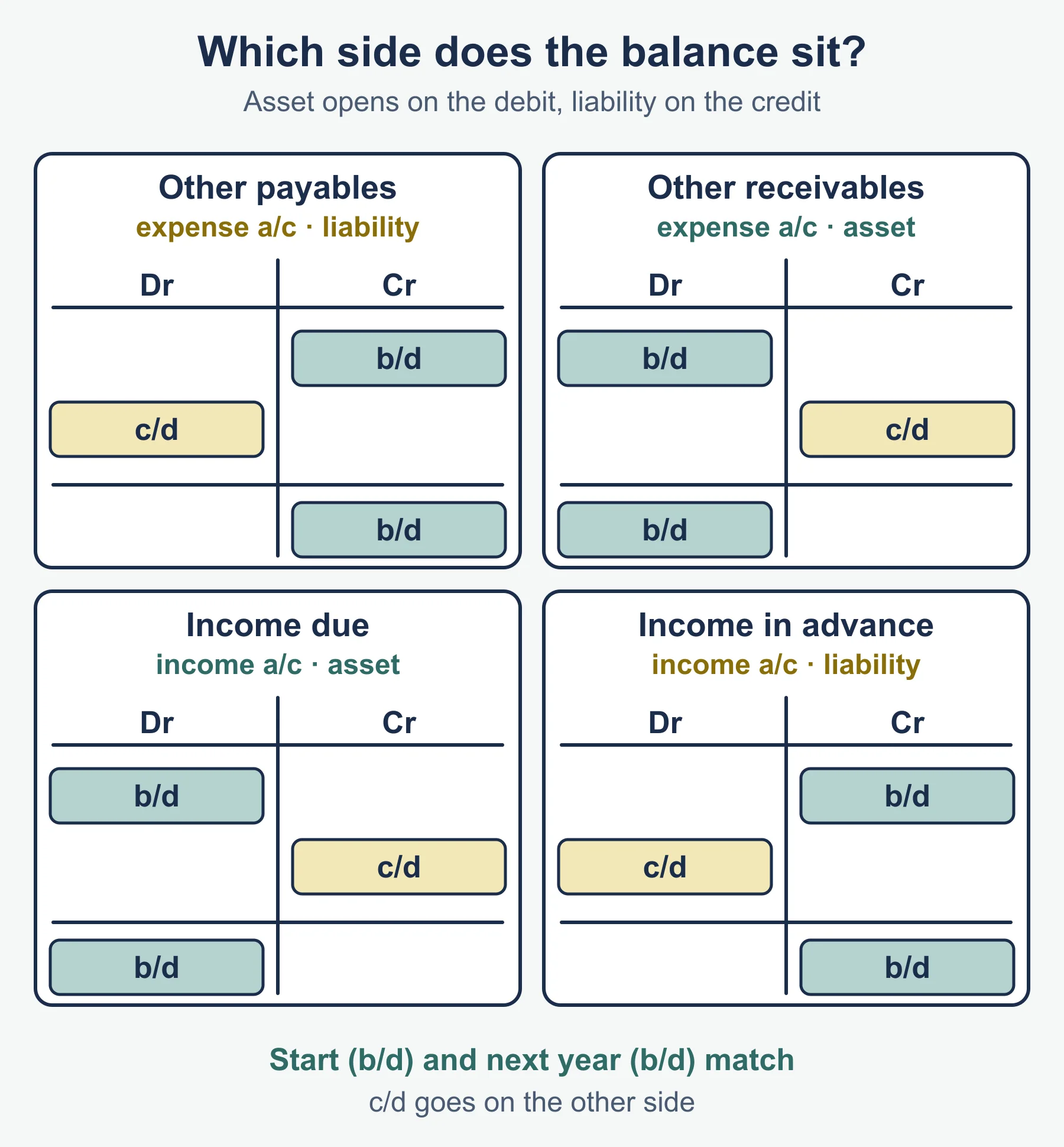
- Other payables (the glossary links them with accruals) are expenses that belong to this period but are unpaid at the year end. The business owes the money, so the amount is a current liability.
- Other receivables (linked with prepayments) are amounts paid this year for benefits of the next period, such as insurance paid in advance. The business is owed the benefit, so the amount is a current asset.
Neither is a trade receivable or trade payable, which arise from buying and selling goods on credit.
| Other payables | Other receivables | |
|---|---|---|
| Meaning | Expense owed at year end | Expense paid in advance |
| Effect on expense | Increases it | Decreases it |
| SFP | Current liabilities | Current assets |
| Next year | Opening balance reduces the expense | Opening balance adds to the expense |
Without these adjustments profit would be wrong and the SFP would miss a liability or an asset.
7. Calculating and recording other receivables and other payables (5.4 c)
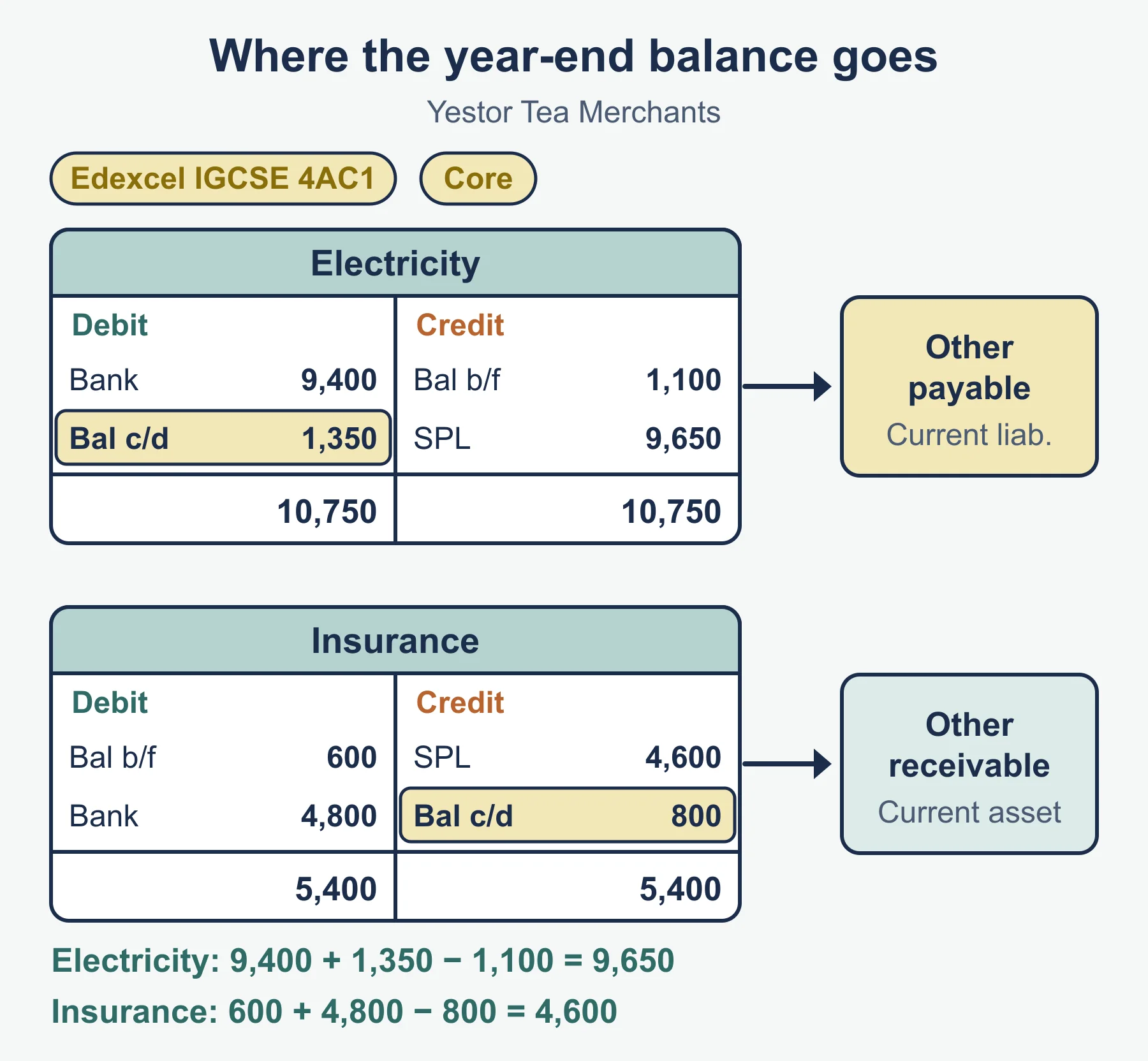
Yestor Tea Merchants. Electricity: opening accrual 1,100, bank payments 9,400, closing accrual 1,350.
Expense = 9,400 + 1,350 - 1,100 = 9,650.
Electricity
Bank                   9,400 | Bal b/f accrued        1,100
Bal c/d accrued        1,350 | SPL                    9,650
10,750 | 10,750Insurance: opening prepayment 600, bank payments 4,800, closing prepayment 800.
Expense = 600 + 4,800 - 800 = 4,600.
Insurance
Bal b/f prepaid          600 | SPL                    4,600
Bank                   4,800 | Bal c/d prepaid          800
                       5,400 |                        5,400
The balance carried down on the electricity account (1,350) goes to other payables under current liabilities. The balance carried down on insurance (800) goes to other receivables under current assets. Each balance is then brought down on the opposite side for the start of next year.
The same logic applies to income. If Yestor sub-lets a room and receives 3,000 of rent but is still owed 500 for the year, the SPL shows rent receivable of 3,500 and the 500 is an other receivable.
Common errors
- Applying reducing balance to cost every year instead of to the carrying value.
- Using the residual value in a reducing balance percentage calculation.
- Charging the whole provision for irrecoverable debts to the SPL, not the change.
- Calculating the provision before deducting the write-offs.
- Writing the disposal profit or loss on the wrong side, or forgetting to remove the accumulated depreciation.
- Adding an accrual to the expense twice, or subtracting a prepayment the wrong way round.
- Showing other receivables under current liabilities.
Frequently asked questions
What is the difference between an irrecoverable debt and a provision for irrecoverable debts? An irrecoverable debt has definitely gone bad, for example because the customer is insolvent, so it is written off as an expense. A provision for irrecoverable debts is an estimate of debts that may go bad, usually a percentage of the receivables left after write-offs; the Edexcel IGCSE glossary’s modern term is allowance for doubtful debt.
Why is a provision for irrecoverable debts needed? Prudence means trade receivables should be shown at the amount the business expects to collect, not overstated. The accruals concept also places the expected loss in the year the sale was made, rather than the year the customer fails to pay.
What are other payables and other receivables in Edexcel IGCSE Accounting? Other payables (accruals) are expenses that belong to the period but are unpaid at the year end, shown as a current liability. Other receivables (prepayments) are amounts paid this year for benefits of the next period, shown as a current asset.
How do you calculate an expense with an opening and closing accrual? The expense is the amount paid, plus the closing accrual, minus the opening accrual. With prepayments, add the opening prepayment and subtract the closing prepayment.
Is a profit on disposal of a non-current asset income or an expense? A profit on disposal, where the proceeds exceed the carrying value, is credited to the statement of profit or loss as income. A loss on disposal, where carrying value exceeds proceeds, is shown as an expense.
Official syllabus
Pearson Edexcel International GCSE in Accounting (4AC1) specification, Issue 1, October 2016, published by Pearson Education Limited: Topic 5, sections 5.2 Depreciation, 5.3 Irrecoverable debts and 5.4 Other receivables and other payables.
Get free revision emails (optional)
Occasional emails with practice questions, worked explanations and links to free resources for the qualification and subjects you choose. No spam, and you can unsubscribe from any email. The free tools on this site never need an email.
Related resources
-
Practice questions
Edexcel IGCSE Accounting: End-of-period adjustments (4AC1) – Practice Questions
Original Edexcel IGCSE Accounting 4AC1 practice questions on depreciation, disposals, irrecoverable debts, accruals and prepayments, with worked answers.
Accounting · Pearson Edexcel · IGCSE
Try questions -
Revision notes
Edexcel IGCSE Accounting: End-of-period adjustments (4AC1) – Revision Notes
Condensed Edexcel IGCSE Accounting 4AC1 notes on depreciation, disposals, irrecoverable debts, provisions, accruals and prepayments, with a self-test.
Accounting · Pearson Edexcel · IGCSE
Revise topic -
Study guides
Edexcel IGCSE Accounting: Application of accounting concepts (4AC1)
Study guide to applying consistency, prudence, accruals, materiality, money measurement and business entity at the year end, for Edexcel IGCSE Accounting.
Accounting · Pearson Edexcel · IGCSE
Read guide
Related articles
-
teaching
A Level tuition in Dubai: Cambridge or Pearson Edexcel International A Level?
Schools in Dubai and Abu Dhabi teach either Cambridge International AS & A Level or Pearson Edexcel International A Level. How the two are structured, why it matters for tuition, and how online classes from Lahore work.
9 October 2026
-
curriculum guides
Choosing subjects at IGCSE and A Level
How subject choices at 14 and 16 affect university options later, and how to keep pathways open without overloading a timetable.
28 July 2026
Studying this with a teacher
Working through Accounting IGCSE?
This page is free and stays free. If you would rather be taught it, Marlbridge runs Accounting classes one-to-one and in small groups of up to 15, online in your own time zone. The first trial class is free. WhatsApp replies within an hour (8am–11pm Pakistan time, every day); email the same day.
Pearson Edexcel Accounting teachers at Marlbridge

