
Revision Notes
Edexcel IGCSE Accounting: End-of-period adjustments (4AC1) – Revision Notes
Condensed Edexcel IGCSE Accounting 4AC1 notes on depreciation, disposals, irrecoverable debts, provisions, accruals and prepayments, with a self-test.
- Subject
- Accounting
- Level
- IGCSE
- Topic
- Accounting for end of period adjustments
- Author
- Marlbridge Academic Team
- Updated
- Reviewed by
- Javaid Iqbal Sabri (what this means)
Aligned to Pearson Edexcel IGCSE Accounting (4AC1), Issue 1, October 2016. Official specification .
Syllabus page (what it covers and how it is assessed): Pearson Edexcel IGCSE Accounting.
Syllabus points this page covers
4AC1
- 5 Accounting for end of period adjustments (whole topic)
- 5.2 Depreciation
- 5.3 Irrecoverable debts
- 5.4 Other receivables and other payables
Found an error? Report a correction.
Want a teacher for this? Marlbridge teaches Accounting online. Request a free trial class.
These notes condense Topic 5, sections 5.2 Depreciation, 5.3 Irrecoverable debts and 5.4 Other receivables and other payables, of the Pearson Edexcel International GCSE in Accounting (4AC1) specification, Issue 1, October 2016. The specification marks none of these points as tier-specific. For fuller explanations and ledgers, see the study guide.
Links: Edexcel IGCSE Accounting hub, printable checklist, free 10-minute diagnostics, practice questions.
Examples are invented. Amounts are in dollars, written without a currency sign. SPL means statement of profit or loss; SFP means statement of financial position.
The big picture
The specification says Paper 2, Financial Statements, draws on topics 4 and 5 and builds on topics 1 to 3. Paper 1 draws only on topics 1 to 3, where the same three areas appear again in Topic 2 (sections 5, 6 and 7). Learn the adjustments once, then practise showing them in a ledger and in the final statements.
| Adjustment | SPL effect | SFP effect |
|---|---|---|
| Depreciation | Expense | Deducted from cost of the non-current asset |
| Irrecoverable debt | Expense | Removed from trade receivables |
| Change in provision | Expense (increase) or income (decrease) | Provision deducted from trade receivables |
| Other payables (accrual) | Adds to expense | Current liability |
| Other receivables (prepayment) | Reduces expense | Current asset |
5.2 a, b Depreciation: causes and methods
Definition to learn: depreciation shares out an asset’s cost across the years in which the business uses it.
Causes (give a reason, not just a label):
- Wear and tear: physical use.
- Obsolescence: replaced by better technology.
- Passage of time: for example a lease running out.
- Depletion: natural resources used up.
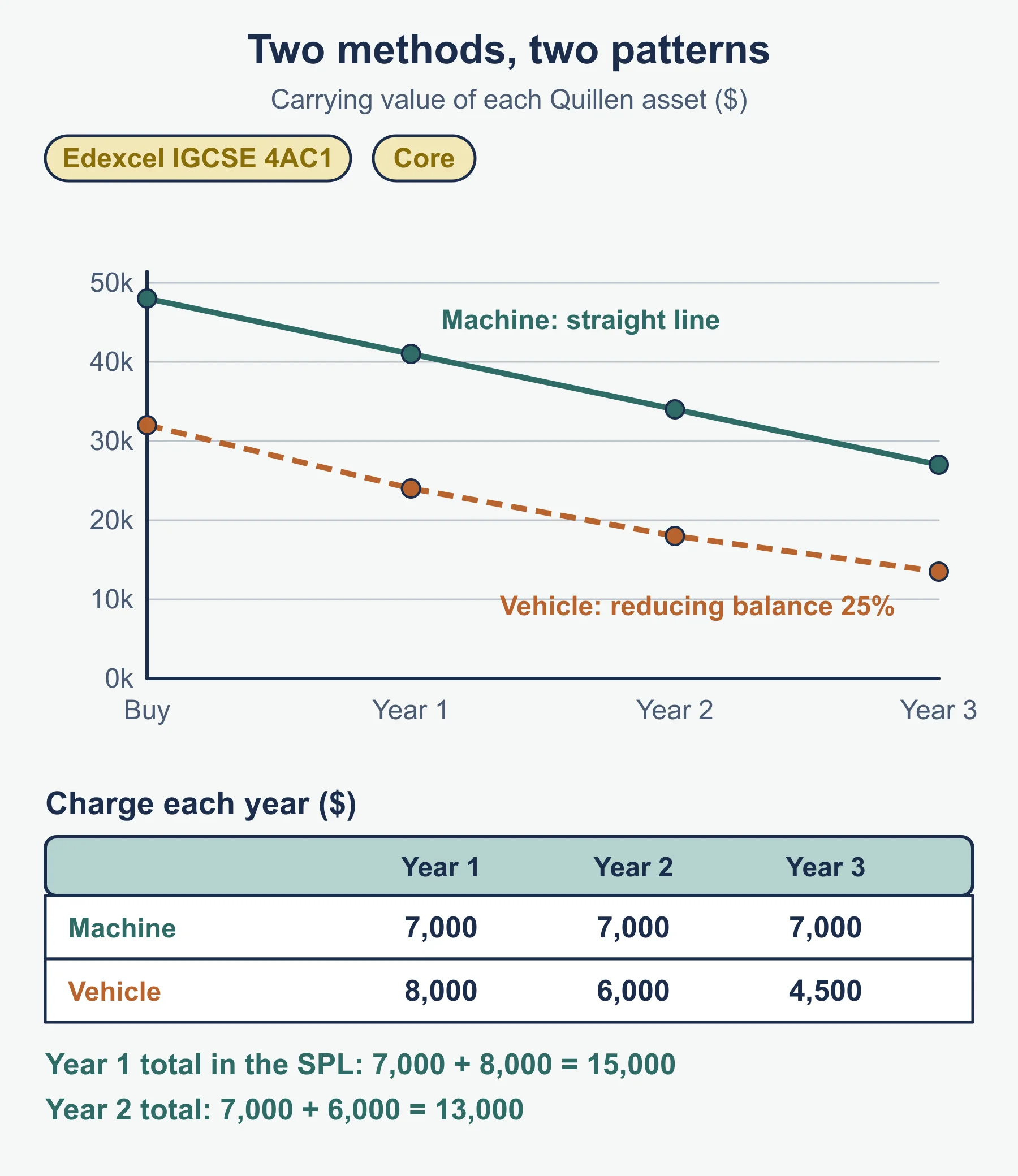
| Straight line | Reducing balance | |
|---|---|---|
| Formula | (cost - residual value) / useful life | Percentage x carrying value at start of year |
| Charge | Equal each year | Highest in year 1, then falls |
| Typical use | Even benefit each year | Benefit or value falls fastest early |
Must-know distinction: straight line uses residual value and life. Reducing balance uses a percentage and the carrying value (net book value) brought forward.
5.2 c Calculate and record
Talbury Pottery buys a kiln for 25,000. It uses reducing balance at 20%.
| Year | Charge | Accumulated | Carrying value |
|---|---|---|---|
| 1 | 5,000 | 5,000 | 20,000 |
| 2 | 4,000 | 9,000 | 16,000 |
| 3 | 3,200 | 12,200 | 12,800 |
For comparison, straight line with residual value 2,500 and a 5-year life would give (25,000 - 2,500) / 5 = 4,500 every year.
Method in steps:
- Work out the charge for the year.
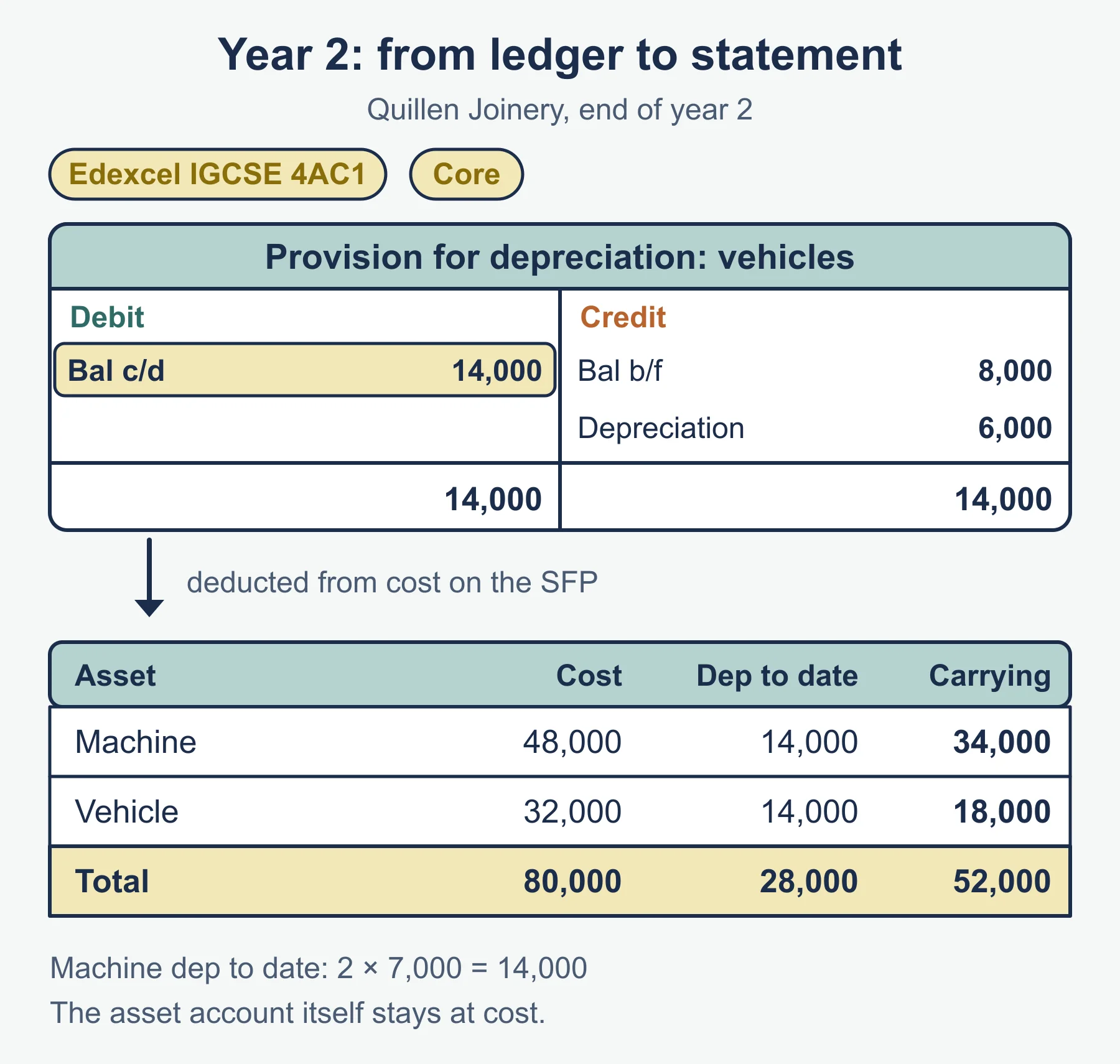
- Debit depreciation expense, credit provision for depreciation.
- Transfer the expense to the SPL.
- On the SFP, for each class of asset, list the cost, the depreciation to date and the carrying value.
The asset account stays at cost. Your teacher or textbook may call the provision account “accumulated depreciation”; the idea is the same.
5.2 d Disposal
Method in steps:
- Open a disposal account. Debit it with the asset at cost.
- Credit it with the accumulated depreciation up to the disposal date, and with the proceeds.
- The balancing figure is the profit (if debit side is the smaller side) or loss.
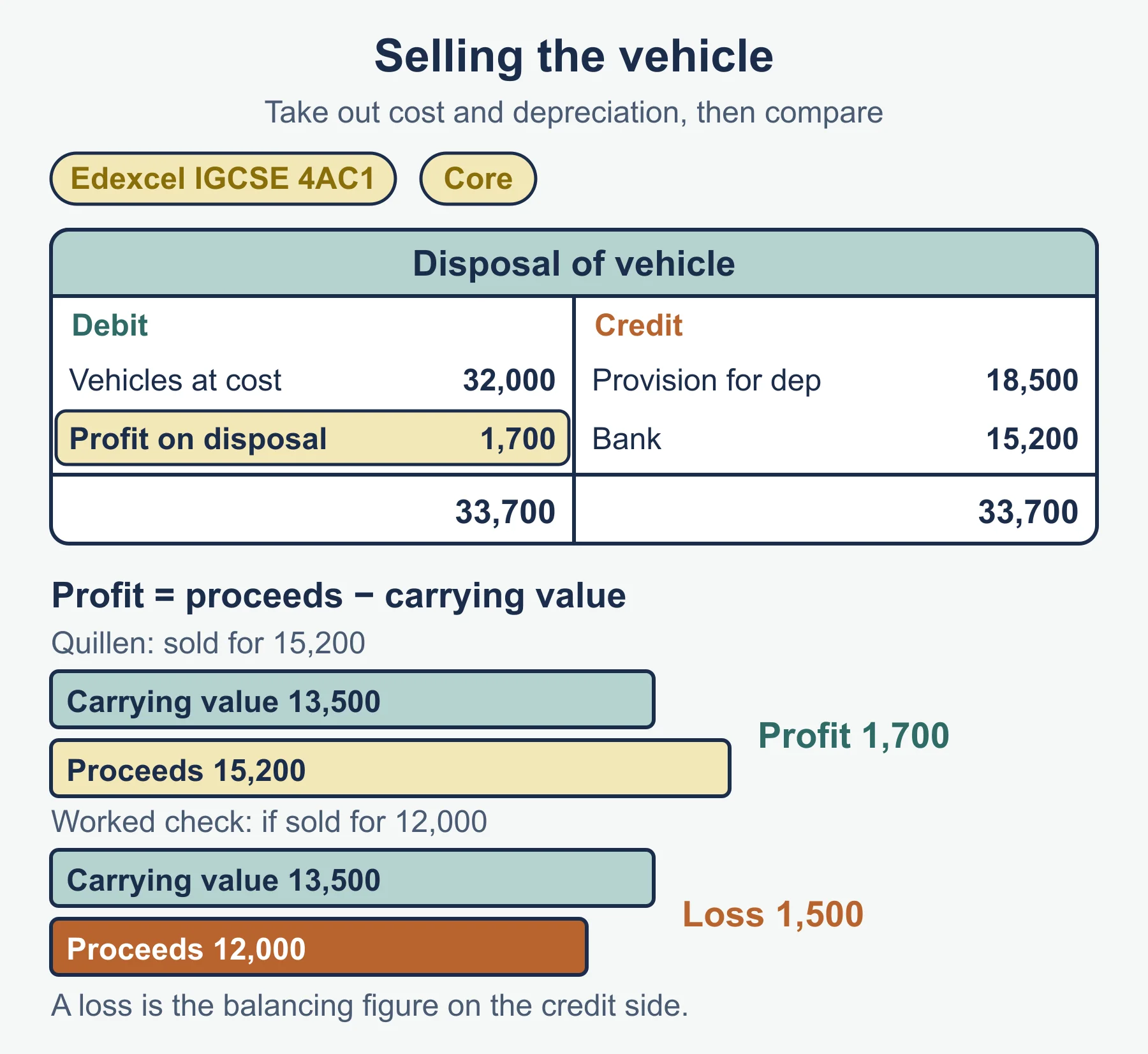
Short form: profit or loss = proceeds - carrying value.
Talbury sells the kiln at the end of year 3, after year 3 depreciation, for 12,000. Carrying value is 12,800, so the loss is 12,800 - 12,000 = 800.
Disposal of kiln
Kiln at cost          25,000 | Provision for dep     12,200
                             | Bank                  12,000
                             | Loss on disposal         800
                      25,000 |                       25,000
A profit goes to the credit side of the SPL as income. A loss goes to the debit side as an expense. Remember that the loss is not a cash payment. It is the difference between what the asset was valued at in the books and what it fetched.
5.3 a, b Irrecoverable debts and provision
| Irrecoverable debt | Provision for irrecoverable debts | |
|---|---|---|
| Meaning | Debt that will definitely not be paid | Estimate of debts that may not be paid |
| Customer’s account | Credited, so the balance is removed | Not touched |
| Calculated | Known amount | Percentage of receivables after write-offs |
| SPL | Whole amount is an expense | Only the change is an expense or income |
Why a provision is needed: prudence stops assets and profit being overstated, and accruals (matching) puts the likely loss in the year of the sale. Trade receivables on the SFP then show what the business expects to collect. The specification’s glossary gives “allowance for doubtful debt” as the modern term for a provision for doubtful debt.
5.3 c Calculate and record
Tressick Lamps at year end. Trade receivables before adjustment 40,000. One customer, owing 900, is irrecoverable. Provision is 3% of remaining receivables. Provision brought forward 1,500.
- Receivables after write-off = 40,000 - 900 = 39,100.
- Provision needed = 3% x 39,100 = 1,173.
- Change = 1,173 - 1,500 = 327 decrease.
- Net SPL charge = 900 - 327 = 573.
Provision for irrecoverable debts
SPL (decrease)           327 | Bal b/f                1,500
Bal c/d                1,173 |
                       1,500 |                        1,500
SFP: trade receivables 39,100 less provision 1,173 = 37,927.
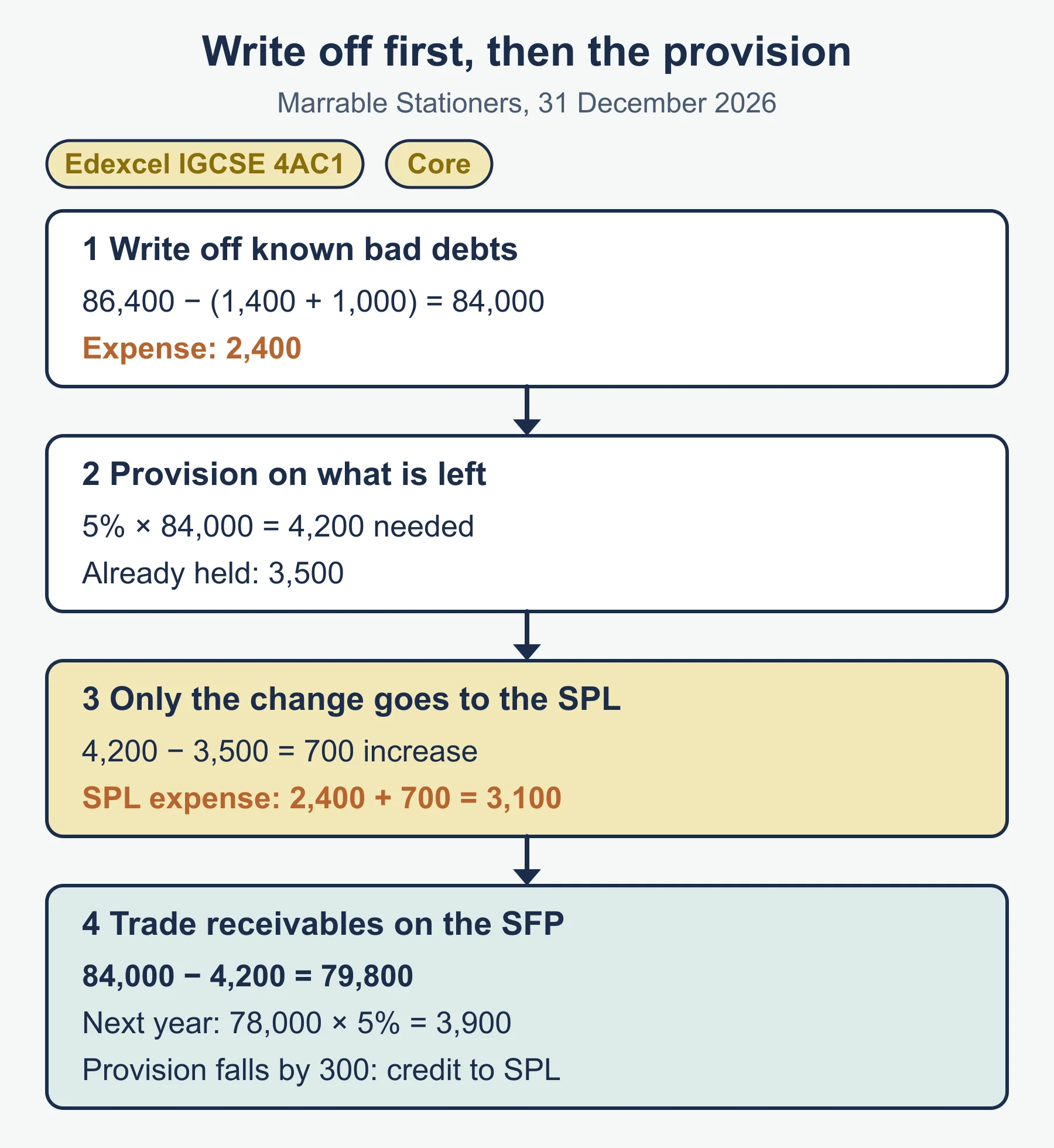
Order of work: write off first, then calculate the provision, then compare with the balance brought forward.
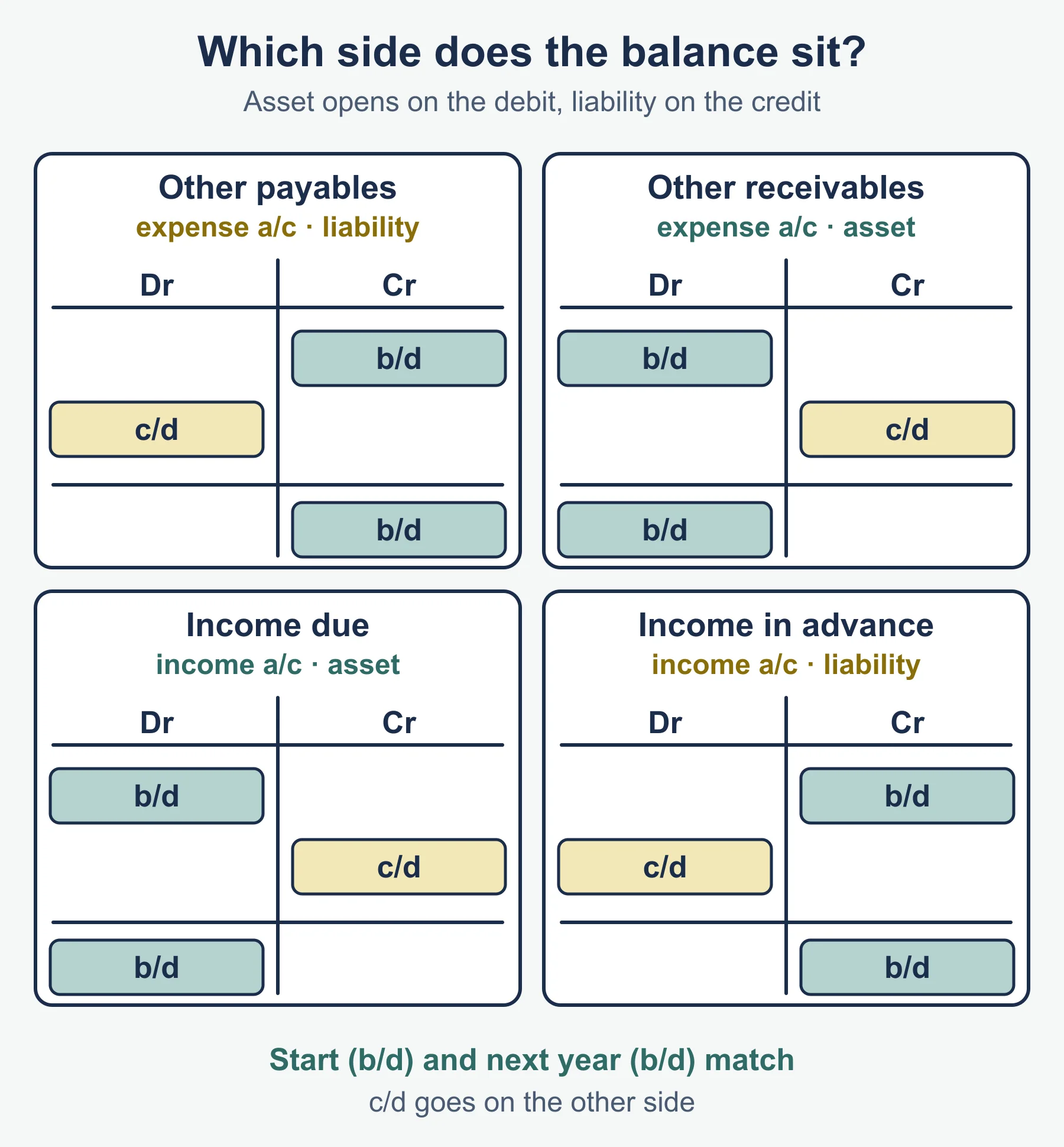
5.4 Other receivables and other payables
Why: the SPL must show the expenses and income of the period, not just the cash paid and received. The glossary pairs other payables with accruals and other receivables with prepayments.
Distinguish:
- Other payables: expense owed at the year end. Current liability.
- Other receivables: expense paid in advance. Current asset.
- Neither is a trade receivable or trade payable, which arise from credit sales and credit purchases of goods.
Formula for the expense:
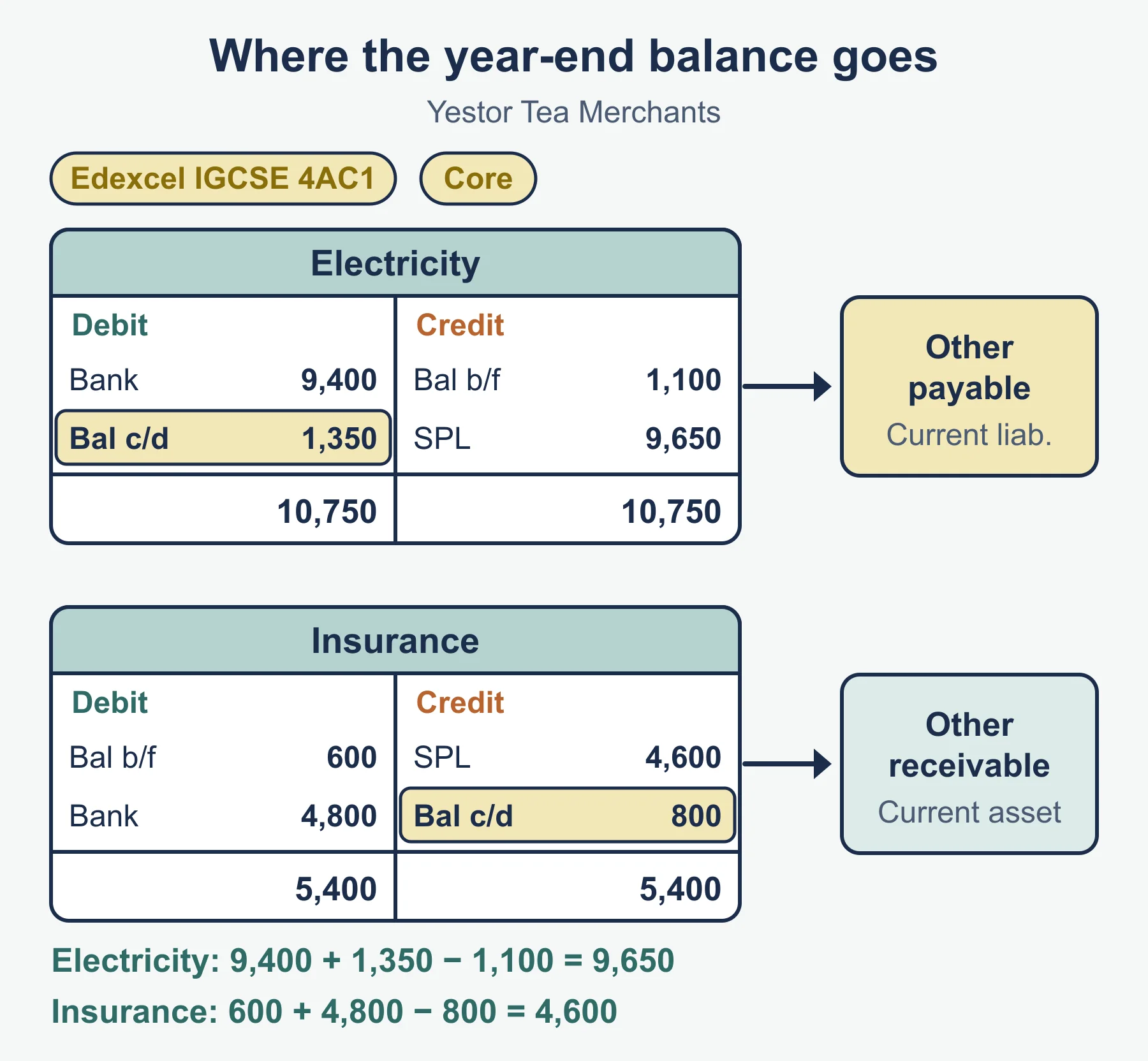
Expense = cash paid, plus closing accrual, less opening accrual. For prepayments, less closing prepayment and plus opening prepayment.
Dalgarno Cycles:
| Item | Opening | Paid | Closing | Expense |
|---|---|---|---|---|
| Rent | Prepaid 800 | 9,600 | Prepaid 1,000 | 800 + 9,600 - 1,000 = 9,400 |
| Wages | Accrued 500 | 20,400 | Accrued 700 | 20,400 + 700 - 500 = 20,600 |
| Heating | Accrued 400 | 3,000 | Accrued 250 | 3,000 - 400 + 250 = 2,850 |
SFP: other receivables 1,000 (current assets); other payables 700 + 250 = 950 (current liabilities).
Income works the same way. Rent receivable 6,000 received with 500 still owed gives income of 6,500 and an other receivable of 500.
Must-know distinctions
- Depreciation (a charge, no cash) versus disposal profit or loss (difference between proceeds and carrying value).
- Straight line versus reducing balance.
- Irrecoverable debt versus provision.
- Other payables versus other receivables.
- Opening balances (reverse last year’s entry) versus closing balances (this year’s adjustment).
Quick self-test
- Name two causes of depreciation.
- A machine costs 15,000, has residual value 1,500 and a 9-year life. Find the annual straight line charge.
- A lorry costing 20,000 loses 30% of its carrying value each year. Find the year 2 charge.
- Which ledger account holds accumulated depreciation?
- An asset with carrying value 9,400 is sold for 10,100. State the result.
- Receivables are 60,000, of which 2,000 is irrecoverable. A 5% provision is needed on the rest. Find the provision.
- The provision brought forward is 2,900 and 2,600 is needed. What is the SPL entry?
- Distinguish an irrecoverable debt from a provision in one sentence.
- Rent paid is 12,000, with 1,000 prepaid at the year end and no opening balances. Find the rent expense.
- Wages paid 8,500, opening accrual 400, closing accrual 650. Find the expense.
- On which section of the SFP does an accrual appear?
Answers
- Wear and tear; obsolescence (also passage of time or depletion).
- (15,000 - 1,500) / 9 = 1,500.
- Year 1 is 6,000, carrying value 14,000, so year 2 is 4,200.
- Provision for depreciation.
- Profit of 700.
- 5% x 58,000 = 2,900.
- Credit the SPL with 300 (decrease in provision).
- An irrecoverable debt is a known bad debt from a named customer; a provision is an estimate for debts that may go bad.
- 12,000 - 1,000 = 11,000.
- 8,500 + 650 - 400 = 8,750.
- Current liabilities, as other payables.
Where marks are usually lost
- Applying the reducing balance percentage to cost in every year.
- Putting the whole provision in the SPL instead of the change.
- Working out the provision before taking off the irrecoverable debts.
- Mixing up profit and loss on disposal, or leaving accumulated depreciation out of the disposal account.
- Placing a prepayment among liabilities, or an accrual among assets.
- Adding an opening balance instead of reversing it.
- Leaving out the unit or the label on a balance, such as “c/d” or “b/f”.
- Naming a cause of depreciation without tying it to the asset described.
Frequently asked questions
What is depletion as a cause of depreciation? Depletion applies to an asset that is used up as it is extracted, such as a quarry. Other causes of depreciation are wear and tear, obsolescence and the passage of time.
How is reducing balance depreciation calculated in the second year? The percentage is applied to cost in the first year, then to cost less depreciation to date in later years. Applying the percentage to cost every year is a common mistake.
What does SPL mean in Edexcel IGCSE Accounting? SPL stands for the statement of profit or loss, which the 4AC1 specification glossary treats as the modern name for the trading and profit and loss account. SFP stands for the statement of financial position.
Where does the provision for depreciation appear in the statement of financial position? The asset account stays at cost, and the provision for depreciation, also called accumulated depreciation, is deducted from cost to show carrying value. The yearly charge goes to the statement of profit or loss.
Official syllabus
Pearson Edexcel International GCSE in Accounting (4AC1) specification, Issue 1, October 2016, published by Pearson Education Limited: Topic 5, sections 5.2 Depreciation, 5.3 Irrecoverable debts and 5.4 Other receivables and other payables.
Get free revision emails (optional)
Occasional emails with practice questions, worked explanations and links to free resources for the qualification and subjects you choose. No spam, and you can unsubscribe from any email. The free tools on this site never need an email.
Related resources
-
Study guides
Edexcel IGCSE Accounting: Application of accounting concepts (4AC1)
Study guide to applying consistency, prudence, accruals, materiality, money measurement and business entity at the year end, for Edexcel IGCSE Accounting.
Accounting · Pearson Edexcel · IGCSE
Read guide -
Practice questions
Edexcel IGCSE Accounting: Application of accounting concepts (4AC1) – Practice Questions
Eleven original Edexcel IGCSE Accounting questions on applying the six accounting concepts at the year end, with fully worked answers.
Accounting · Pearson Edexcel · IGCSE
Try questions -
Revision notes
Edexcel IGCSE Accounting: Application of accounting concepts (4AC1) – Revision Notes
Condensed Edexcel IGCSE Accounting revision notes on applying consistency, prudence, accruals, materiality, money measurement and business entity.
Accounting · Pearson Edexcel · IGCSE
Revise topic
Related articles
-
teaching
A Level tuition in Dubai: Cambridge or Pearson Edexcel International A Level?
Schools in Dubai and Abu Dhabi teach either Cambridge International AS & A Level or Pearson Edexcel International A Level. How the two are structured, why it matters for tuition, and how online classes from Lahore work.
9 October 2026
-
curriculum guides
Choosing subjects at IGCSE and A Level
How subject choices at 14 and 16 affect university options later, and how to keep pathways open without overloading a timetable.
28 July 2026
Studying this with a teacher
Working through Accounting IGCSE?
This page is free and stays free. If you would rather be taught it, Marlbridge runs Accounting classes one-to-one and in small groups of up to 15, online in your own time zone. The first trial class is free. WhatsApp replies within an hour (8am–11pm Pakistan time, every day); email the same day.
Pearson Edexcel Accounting teachers at Marlbridge

